March for People Jobs and Services. March for Peace, Progress and Equality. March for a Better, Fairer Way.
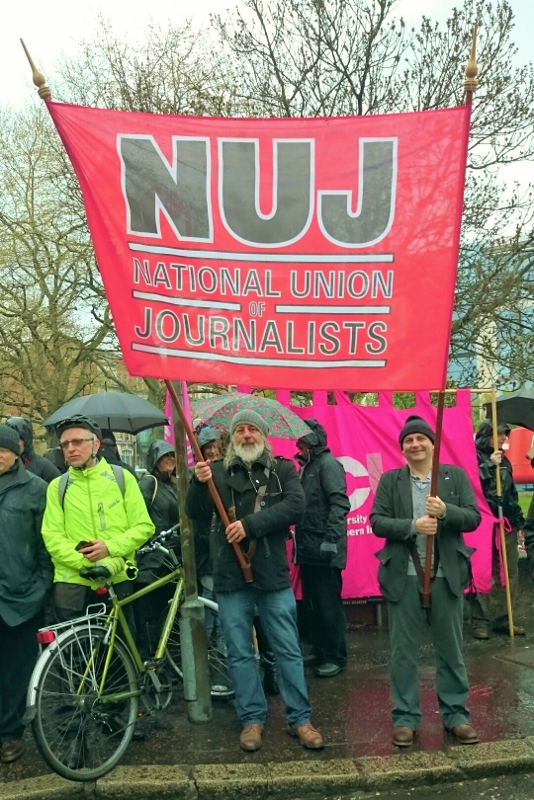
The Northern Ireland Committee of the Irish Congress of Trade Unions is pleased to announce the details of its annual May Parade. The annual parade to celebrate workers’ struggle around the world is being held today, Saturday May 2nd, departing at 12:00 noon from Art College Square in Donegall Street, parading around the centre of Belfast and returning to Donegall St.
Participants in the parade are being asked to assemble at 11:30am at Art College Square (UU Belfast), where the Belfast Lord Mayor Arder Carson will welcome guests and participants, followed by short speeches by trade union leaders, Mick Whelan (General Secretary ASLEF) and Larry Broderick (General Secretary, IBOA – the Finance Union).
The Parade will march off from Donegall St/Academy St at 12:00, passing Royal Avenue, Belfast City Hall and returning to Donegall Street via High St. The Belfast May Day parade is still the largest such workers’ event on the island of Ireland, regularly attracting 5-10,000 marchers from every trade union, as well as myriad campaigning and community organisations. It is uniquely multi-cultural, especially for Northern Ireland, although it always has a political message.
In L’Derry, the annual May Day parade will gather at 1pm in Guildhall Square. March off is at 1:20pm, and will be led by the Jay Dee Jazz Band, with some speeches at the end of the march, back at Guildhall Square.
This year’s message is resistance to the austerity programme of the outgoing Westminster government, and the detemination of the trade union movement to ensure that the failed experiment in heaping the cuts and the blame on working people and the most vulnerable will not be supported by any of the eighteen MPs to be elected next Thursday by the people of Northern Ireland.
For more details, download the full programme from the Congress website or pick up a copy of the leaflet from bars, cafes and trade union offices around the city. Copies of the brochure are also available from the ICTU office, Carlin House, 4-6 Donegall Street Place (Behind the John Hewitt Bar).
Villa Park then (1982) from the Holte End and now Photo: AVFC
Writing about Spaghetti Junction the other day, I mentioned Villa Park, the home of Aston Villa FC. I went there on a couple of occasions both to watch from the then terrace at the Holte End (see picture) and occasionally to report from the ground during my time in Birmingham with BBC Local Radio. So I am delighted to see that Patrick Comerford has written tonight about Aston Villa, and the club’s proud history. Like many Villa fans he remembers their great achievements in Europe in 1982 and is now looking forward to seeing the claret and blue in the FA Cup Final against Arsenal at Wembley on May 30th.
I know which team I want to win… but does David Cameron know? Patrick Comerford
Villa Park from Trinity Road Stand, showing (L-R) North Stand, Doug Ellis Stand and the Holte End (Photograph: Harry Vale/Wikipedia)
The Aston Villa website boasts a number of very public fans, including Prince William, Tom Hanks, Redd Pepper, Nigel Kennedy, Pauline McLynn (‘Mrs Doyle’ ofFather Ted), Oliver Phelps … and David Cameron. Well, Cameron claims he is a fan. But is he?
Early in the 2011-2012 season, he took his young son to watch Alex McLeish’s side as they faced QPR at Loftus Road. He once said: “The first game I ever went to was an Aston Villa game and so I am an Aston Villa fan.” It’s easy for him to have a proprietorial attitude towards Villa … after all, his uncle, Sir William Dugdale, who lived near Tamworth until he died late last year, chaired Villa from 1975 to 1982 and took the future Prime Minister to his first ever game as a 13-year-old.
But in a public blunder a few days, David Cameron gave a speech celebrating the diverse allegiances of British people in which he said: “Where you can support Man United, the Windies and Team GB all at the same time. Of course, I’d rather you supported West Ham .. eh, hem.” He later avoided questions from the media aiming to ascertain his level of support for Aston Villa, which he said he had supported since watching them beat Bayern Munich in the1982 European Cup Final when he was a child.
In an interview with theBirmingham Mail, he has since claimed his “profoundly embarrassing” West Ham gaffe was down to thinking about cricket. “I want to say how sorry I am,” Cameron said. “All I can explain is I went past the West Ham stadium the day before and I just said the word West Indies in my speech and I was making a point about the cricket Test and all the rest of it. I meant to say Aston Villa and I am profoundly embarrassed.”
Cricket? It is embarrassing. I never knew West Ham played cricket. I like cricket too. Indeed, as a Villa fan, I knew about Aston Villa’s cricket association since its early days. But does David Cameron?
Aston Villa Football Club was formed in March 1874, by four members of the cricket team at Villa Cross Wesleyan Chapel in Handsworth. From as early as 1867, the chapel was known as Aston Villa Wesleyan Chapel. The four founders were Jack Hughes, Frederick Matthews, Walter Price and William Scattergood. . Local lore says they met under a gas-light in Heathfield Road to set about forming a new club. As cricket players, they were looking for something to keep them occupied during the winter, and they chose football after witnessing an impromptu game on a meadow off Heathfield Road.The first match for the new side was against the local Aston Brook Saint Mary’s Rugby team on Wilson Road, Aston. As a condition of the match, the Villa side had to agree to play the first half under rugby rules and the second half under football rules. The game was a scoreless draw at half time but Jack Hughes scored a goal in the second half to ensure that Villa won their first ever game.Villa’s first official home was at Wellington Road in Perry Barr from 1876. The new club was soon playing soccer and won its first FA Cup in 1887, beating West Bromwich Albion 2-0 at the Oval. Aston Villa was one of the dozen teams that competed in the inaugural Football League in 1888. The first League game was on 8 September 1888, when Villa and Wolverhampton Wanderers drew 1–1.Aston Villa went on to become the most successful club in the Victorian period. In 1897, Villa moved to the current home ground, the Aston Lower Grounds. By 1900, the fans were calling Villa Park, and the ground was bought outright in 1911. By the end of Villa’s “Golden Age” and at the start of the World War I, the club had won the League Championship six times and the FA Cup five times. Aston Villa won its sixth FA Cup in 1920.
However, during the inter-war years Villa was on a slow decline that would led to relegation to Division II in 1936 for the first time. By 1957, Villa was a Cup-winning side once again with a seventh FA Cup win, defeating Manchester United’s “Busby Babes” 2–1 victory. I remember the 1971-1972 season, when I was spending a lot of time in Lichfield, and Aston Villa returned to Division II as champions with a record 70 points. I became a convinced Villa fan, and by 1975 the club was back into Division I. In the 1977-1978 season, Villa reached the quarter-final of the UEFA Cup, going out 4–3 on aggregate against Barcelona.
The club won the league in 1980-1981, and went on to an epoch-making 1-0 victory over Bayern Munich in the European Cup final in Rotterdam on 26 May 1982. Villa was relegated again in 1987, but was promoted the following year, rose to second place in the Football League in 1989, and was one of the founding members of the Premier League in 1992, when Villa finished runners-up to Manchester United in the inaugural season.
In 2000, Aston Villa reached the FA Cup Final for the first time since 1957, but lost 1–0 to Chelsea in the last game played at the old Wembley Stadium. Now, 15 years later, Villa is back in an FA Cup Final once again. An eighth cup win would be so sweet after a a season that was often dominated by regulation fears.
I pass by Villa Park many times a year, on my way to and from Lichfield on the train. The King Edward VII, a landmark pub popular with Aston Villa fans on matchdays, has stood proudly on the junction of Lichfield Road and Aston Hall Road since about 1900. However, local newspapers reported a few weeks ago that the pub is to be pulled down as part of a major industrial park development and a wider revamp of the junction with Aston Hall Road. According to the reports, the pub’s owner, Paul McMahon, plans to move his business to the nearby derelict Aston Tavern.
By accident, I have arranged already to be back in Lichfield on Cup Final Day. Once again, I shall find myself close to Villa Park. I must find a good place in Lichfield to watch the match. Any suggestions? After all, I know which team I am supporting … but does David Cameron?





 Michael Fisher's News