ICA MONAGHAN CELEBRATE 60 YEARS

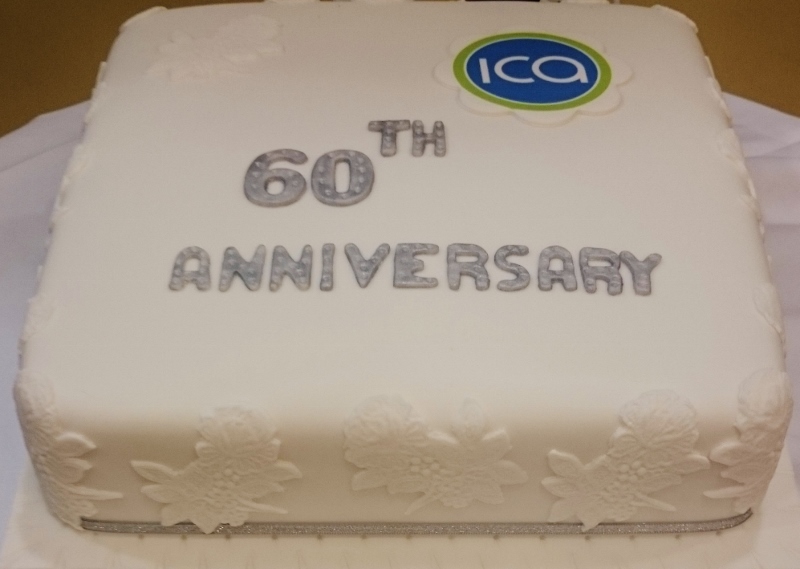
ICA Monaghan Federation 60th Anniversary Cake by Mary Reilly  Photo:  © Michael Fisher

ICA Monaghan Federation 60th Anniversary Cake by Mary Reilly Photo: © Michael Fisher

The Irish Countrywomen’s Association in County Monaghan is celebrating its diamond jubilee. The first guild was formed sixty years ago in Ballybay, as reported here last month. Representatives from eleven of the thirteen guilds in the county gathered for a celebration dinner at The Shirley Arms hotel in Carrickmacross on Friday evening.

The Shirley Arms Hotel, Carrickmacross Photo:  © Michael Fisher

The Shirley Arms Hotel, Carrickmacross Photo: © Michael Fisher

The guest of honour was the ICA National President Liz Wall. She presented long service certificates to members, some of whom had been in the Association for fifty or even sixty years. They included Mamo McDonald from the Clones guild, who was ICA National President from 1982-85.

ICA National President Liz Wall presents a certificate for 60 years' membership to one of her predecessors, Mamo McDonald from Clones guild Photo:  © Michael Fisher

ICA National President Liz Wall presents a certificate for 60 years’ membership to one of her predecessors, Mamo McDonald from Clones guild Photo: © Michael Fisher

The outgoing Monaghan Federation ICA President Patricia Cavanagh welcomed Liz Wall and was among the recipients of a certificate for her long service as a member of Ballinode guild, of which her sister Breege is also a long-standing member.

ICA National President Liz Wall presents Patricia Cavanagh with a silver oak leaf brooch to mark her three years as Monaghan Federation President  Photo:  © Michael Fisher

ICA National President Liz Wall presents Patricia Cavanagh with a silver oak leaf brooch to mark her three years as Monaghan Federation President Photo: © Michael Fisher

ICA Monaghan Federation Banner  Photo:  © Michael Fisher

ICA Monaghan Federation Banner Photo: © Michael Fisher

ICA guilds meet at least once a month from September to June with many guilds meeting on a more regular basis to  partake in activities such as arts, crafts, dancing, health and fitness regimes and social outings. In County Monaghan there are guilds in Aghabog, Ardaghey, Ballybay, Ballinode, Clones, Killany, Magheracloone, Rockcorry, Scotshouse, Smithboro, Threemilehouse, Tyholland and Mullyash. 

ICA Monaghan Federation 60th Anniversary Cake by Mary Reilly  Photo:  © Michael Fisher

ICA Monaghan Federation 60th Anniversary Cake by Mary Reilly Photo: © Michael Fisher

ICA guilds around the county are friends you may not yet have met who have already successfully walked a similar path and have much to offer in terms of support and friendship. ICA also needs people like you who can bring new talent, fresh ideas, and renewed energy to our organisation.  The ICA has arranged benefit partnerships with over 200 retail outlets, service providers, and facilities throughout Ireland with members enjoying discounts of up to 20% on their purchases.

Marion Duffy ICA Magheracloone Guild with her long service certificate 50 years  Photo:  © Michael Fisher

Marion Duffy ICA Magheracloone Guild with her long service certificate 50 years Photo: © Michael Fisher

The ICA encourages members to support and promote many charities. Last year Monaghan members were encouraged to participate in the Walk in our Shoes initiative in October by wearing funky, mismatched, or self decorated shoes to guild meetings, donating €2 to St Patricks Hospital Foundation in Dublin and also to mark World Mental Health Day on October 10th. Work on upgrading and repairing An Grianán, the adult education college in Termonfeckin featured in a recent television programme with Francis Brennan, is ongoing and fundraising continues in all Federations. The Monaghan Federation handed over a cheque on the night to Liz Wall for €2800 for An Grianán.

ICA Ballinode Guild members sample the birthday cake  Photo:  © Michael Fisher

ICA Ballinode Guild members sample the birthday cake Photo: © Michael Fisher

The ICA was founded in May 1910 by Anita Lett in Bree, County Wexford, Liz Wall’s native county. It was originally called the Society of the United Irishwomen (UI), whose aim was “to improve the standard of life in rural Ireland through education and co-operative effort”. In 1935, owing to political issues the then called UI changed its name to the Irish Countrywomen’s association (ICA). Around this time the ICA also let go of just improving rural lives and began focusing on all areas of Ireland. Contrary to popular belief the “country” within the ICA’s name stands for the country of Ireland as a whole, as opposed to “country” as in rural areas. The biggest ICA guild today is in an urban area, Blanchardstown in County Dublin.

ICA National President Liz Wall with her chain of office and silver oak leaf badge  Photo:  © Michael Fisher

ICA National President Liz Wall with her chain of office and silver oak leaf badge Photo: © Michael Fisher

Since its inception, the ICA has been heavily involved in campaigns designed to improve people’s lives. The ICA was the first organisation to provide access to adult education, well before the VEC. In its very early years, the then UI focused a project based on the health system in Ireland, due to the fact that women and girls were being sent to England to do basic nursing courses. The UI used what they called “Demonstration Cottages” where classes were held on health care, nutrition and hygiene. These classes also provided care to the sick. In 1954 An Grianán was gifted to the ICA. Since then this has been used as an adult education centre teaching an ever- changing wide range of courses. 
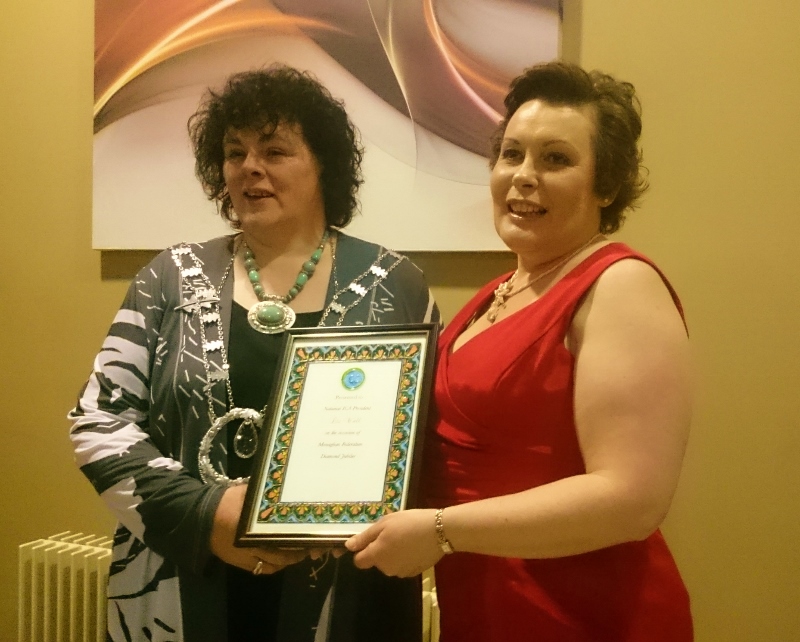
ICA Scotshouse guild member Lorna Soden presents ICAresident Liz Wall with a glazed glass framed certificate she made  Photo:  © Michael Fisher

ICA Scotshouse guild member Lorna Soden presents ICAresident Liz Wall with a glazed glass framed certificate she made Photo: © Michael Fisher

ICA Monaghan Federation Banner  Photo:  © Michael Fisher

ICA Monaghan Federation Banner Photo: © Michael Fisher

In the 1950s they campaigned for “better living”, which called for the access to electricity and safe clean water across Ireland. In the 1950s there was still limited access to electricity in some parts of Ireland. To rectify this, the ICA joined up with the ESB to help promote the use of electricity. To do this they made a model of a traditional farmhouse kitchen fitted with all the latest electrical appliances. This was then shown later that year at the ICAs spring show. In 1958 the kitchen model toured the country, now fitted with a dishwasher and microwave, showing people what was possible. In the 1960s some homes still did not have water within their homes and relied on an outdoor pump. To improve this, the ICA began the “turn on the tap” campaign which involved an exhibition and a conference aimed at educating people on how to take action on bringing water into their homes.

ICA Monaghan Federation 60th Anniversary Cake by Mary Reilly  Photo:  © Michael Fisher

ICA Monaghan Federation 60th Anniversary Cake by Mary Reilly Photo: © Michael Fisher

In recent years the ICA introduced a counselling service and helpline, offering confidential help and support to its members and their families. They have promoted easier access to breast and cervical cancer screening for all women. They opened “the Sanctuary” in An Grianán offering quiet getaways. They helped lobby to make Irish the 25th recognised language within the EU. They have also joined forces with other organisations aimed at improving lives such as SOS, See Change, COFACE with their most recent goal being to reduce the levels of depression within Ireland.

Patricia Cavanagh, outgoing ICA Monaghan Federation President Photo:  © Michael Fisher

Patricia Cavanagh, outgoing ICA Monaghan Federation President Photo: © Michael Fisher
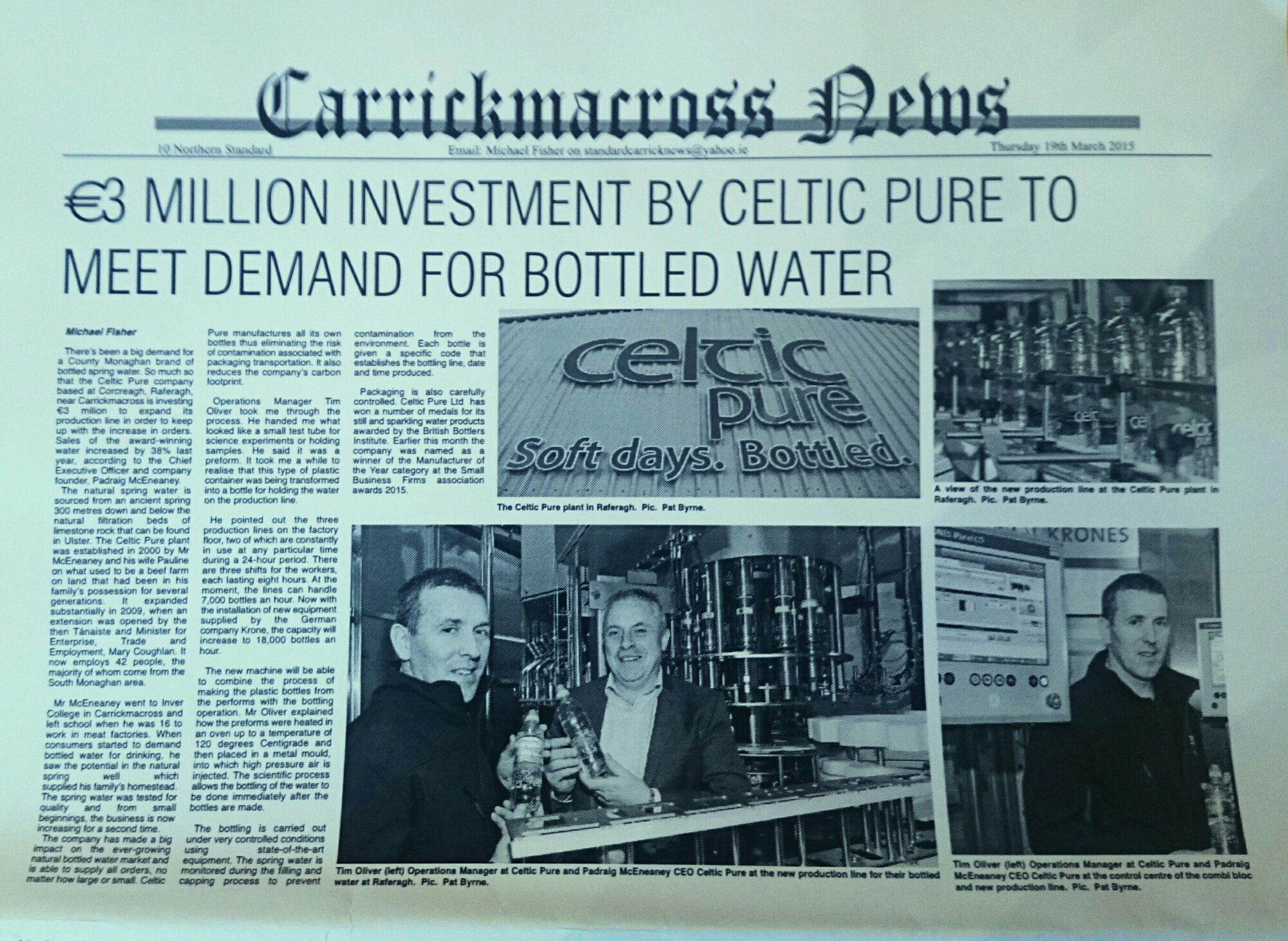
CELTIC PURE INVEST €3 MILLION

Celtic Pure Ltd plant at Corcreagh, Raferagh Photo: © Michael Fisher

Celtic Pure Ltd plant at Corcreagh, Raferagh Photo: © Michael Fisher

€3 MILLION INVESTMENT BY CELTIC PURE TO MEET DEMAND FOR BOTTLED WATER 

Michael Fisher 

There’s been a big demand for a County Monaghan brand of bottled spring water. So much so that the Celtic Pure company based at Corcreagh, Raferagh, near Carrickmacross is investing €3 milion to expand its production line in order to keep up with the increase in orders. Sales of the award-winning water increased by 38% last year, according to the Chief Executive Officer and company founder, Padraig McEneaney.

The natural spring water is sourced from an ancient spring 300 metres down and below the natural filtration beds of limestone rock that can be found in Ulster. The Celtic Pure plant was established in 2000 by Mr McEneaney and his wife Pauline on what used to be a beef farm on land that had been in his family’s possession for several generations. It expanded substantially in 2009, when an extension was opened by the then Tánaiste and Minister for Enterprise, Trade and Employment, Mary Coughlan. It now employs 42 people, the majority of whom come from the South Monaghan area.

Mr McEneaney went to Inver College in Carrickmacross and left school when he was 16 to work in meat factories. When consumers started to demand bottled water for drinking, he saw the potential in the natural spring well which supplied his family’s homestead. The spring water was tested for quality and from small beginnings, the business is now increasing for a second time.

The company has made a big impact on the ever-growing natural bottled water market and is able to supply all orders, no matter how large or small. Celtic Pure manufactures all its own bottles thus eliminating the risk of contamination associated with packaging transportation. It also reduces the company’s carbon footprint.

Operations Manager Tim Oliver took me through the process. He handed me what looked like a small test tube for science experiments or holding samples. He said it was a preform. It took me a while to realise that this type of plastic container was being transformed into a bottle for holding the water on the production line.

He pointed out the three production lines on the factory floor, two of which are constantly in use at any particular time during a 24-hour period. There are three shifts for the workers, each lasting eight hours. At the moment, the lines can handle 7,000 bottles an hour. Now with the installation of new equipment supplied by the German company Krone, the capacity will increase to 18,000 bottles an hour.

The new machine will be able to combine the process of making the plastic bottles from the performs with the bottling operation. Mr Oliver explained how the preHforms were heated in an oven up to a temperature of 120 degrees Centigrade and then placed in a metal mould, into which high pressure air is injected. The scientific process allows the bottling of the water to be done immediately after the bottles are made.

The bottling is carried out under very controlled conditions using state-of-the-art equipment. The spring water is monitored during the filling and capping process to prevent contamination from the environment. Each bottle is given a specific code that establishes the bottling line, date and time produced.

Packaging is also carefully controlled. Celtic Pure Ltd  has won a number of medals for its still and sparkling water products awarded by the British Bottlers Institute. Earlier this month the company was named as a winner of the Manufacturer of the Year category at the Small Business Firms association awards 2015.

image

CARRICK GAMING CLUB ON HOLD

Ground floor unit in Carrickmacross proposed for conversion into a private members gaming club Photo: © Michael Fisher
Ground floor unit in Carrickmacross proposed for conversion into a private members gaming club Photo: © Michael Fisher

APPLICATION FOR PRIVATE MEMBERS GAMING CLUB PUT ON HOLD

Michael Fisher

Planners in Monaghan County Council have put on hold an application to open a private members gaming club in a vacant commercial unit off the Main Street in Carrickmacross.

The planning application was received by Monaghan County Council on January 21st. It was submitted by a local architect on behalf of Carrick Gold Mine Ltd. It sought full planning permission for a change of use from an existing ground floor commercial unit to a private members gaming club with external signage, and including all other associated site works. The premises is situated beside the car park at the rear of Carrickmacross Shopping Centre at Drummond Etra, Main Street. At last month’s meeting of the Carrickmacross-Castleblayney Municipal District Council, the five members present had expressed their objections to the proposal.

Two people, a man and a woman with an address in Carrickmacross, are described as directors of the registered company that made the application. In a letter to the planners they said that the proposed use of the premises would be for a professionally managed Private Members Gaming Club. It would provide card games like Baccarat and other games like Texas Holdem etc “for groups of dedicated card players”. It would the Club’s intention to have weekly Poker tournaments, some of which would be for local sports teams and associations, according to the letter. The club’s facilities would be open to members only, who must be over eighteen.

A letter sent to the applicants by a planning officer last Friday requested additional information about a number of aspects. It asked them to indicate the proposed opening hours of the proposed gaming club and to submit proposals to demonstrate clearly that the premises can be operated in such a manner that a noise nuisance does not emanate from within the proposed private members gaming club or arise outside in the vicinity of the club. Carrick Gold Mine Ltd has also been asked to submit proposals for external lighting to each elevation of the development and the applicant shall submit revised details indicating a single sign to the front elevation. The applicant must also specify the materials to be used in the proposed sign, which shall not be internally illuminated. The applicants have a timeframe of six months to reply to the Council with the requested information.

THE NORTHERN STANDARD Thursday 19th March Carrickmacross News

ST PATRICK’S AT THE MAZE

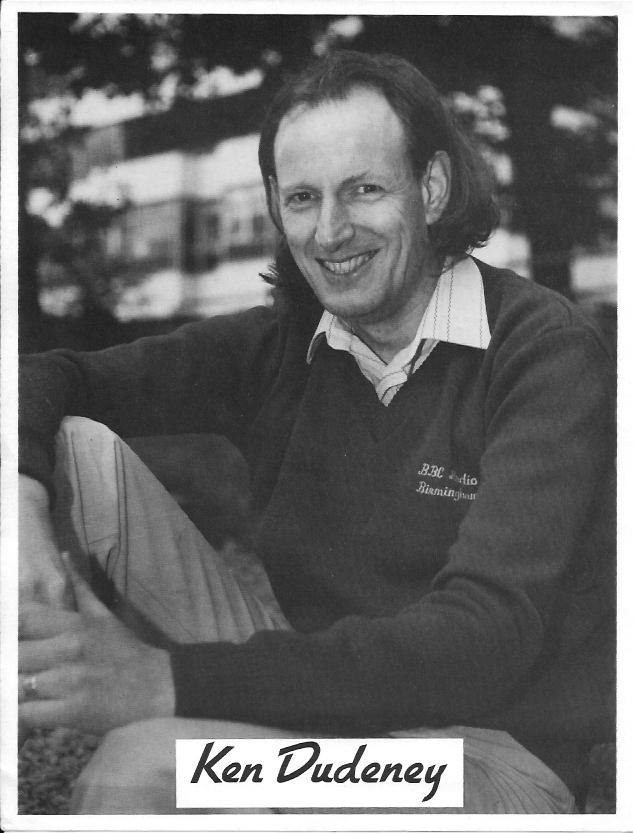
Returning from a brief visit to Birmingham yesterday on Saint Patrick’s Day, I flew into Belfast International Airport. I was at the funeral of a former colleague at BBC Radio Birmingham, now Radio WM, Ken Dudeney. I then remembered that 39 years ago in 1976 I had flown into Aldergrove airport as it was then known as a BBC Radio Birmingham reporter on a very different mission. I had been tasked to do a programme about a British Army regiment doing a tour of duty in the North, the Birmingham Gunners. Their correct title was 39 Medium Regiment Royal Artillery. They had been deployed there for four months on December 4th 1975 and served on that occasion until April 6th 1976. The BBC local radio station had been offered the opportunity by the British Army to meet and record interviews with some of the squaddies an their officers. During that tour of duty, H Battery was on duty securing the perimeter of the Maze prison near Lisburn. 132 Battery was on the border at Aughnacloy, manning the checkpoint on the main Dublin to Derry road. A third section 176 Battery covered Lurgan and Criagavon. Thus it was that on St Patrick’s Day in April 1976 I spent the night at the British Army base at HMP Maze. More of this story later.

KEN DUDENEY RIP

The funeral has taken place in Birmingham of my former BBC Radio Birmingham colleague Ken Dudeney who died in January.
image

image

Order of Service: Ken Dudeney RIP

Order of Service: Ken Dudeney RIP


My tribute to Country Ken was based on the song ‘Four Country Roads’, the last of them being the final journey at the end of Ken’s 70th year (he was 69). May he rest in peace. As it was Saint Patrick’s Day, I ended my tribute to Ken with the short prayer known as St Patrick’s Breastplate, which is sometimes sung or heard as a hymn:
Christ be with me,
Christ be beside me,
Christ be before me,
Christ be behind me,
Christ be at my right hand,
Christ be at my left hand,
Christ be with me everywhere I go,
Christ be my friend for ever and ever. Amen.

IRISH IN BIRMINGHAM

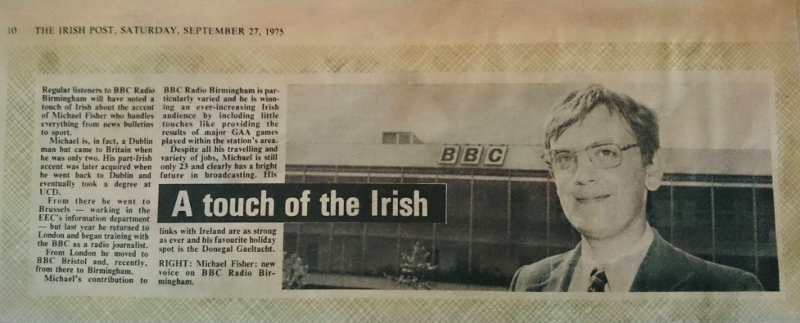
Greetings from Birmingham for Saint Patrick’s Day. A crowd of around 60,000 attended the parade in the city centre on Sunday. But how Irish is England’s second city now? The numbers seem to be lower than they were when I came here forty years ago in 1975 as a BBC journalist. This report is from the BBC Birmingham website.

The Irish Post: September 27th 1975 Words & Photo: Brendan Farrell

The Irish Post: September 27th 1975 Words & Photo: Brendan Farrell

Are the Irish Still Big in Birmingham? BBC News Birmingham & Black Country

They once made up 4% of Birmingham’s population and were its biggest minority group – but official figures say the number of Irish in the city has declined.

Yet 80,000 people are expected to attend the city’s annual St Patrick’s Day parade – believed to be the third biggest in the world after New York and Dublin – on Sunday. Are the Birmingham Irish really disappearing? Or has the definition simply changed?

The city’s Irish connection is plain to see; passengers arriving at Birmingham’s coach station are greeted by a sign reading “one hundred thousand welcomes” – a translation of the Gaelic greeting “cead mile failte”.

Its placement – in “Irish Quarter” Digbeth – is no accident.

The storied Dubliner pub – restored after it was gutted by a fire in 2006 – sits next door while Birmingham’s Irish Centre is a few hundred yards down the road.

‘No work here’

Regarded by some as a spiritual home of the Irish in Birmingham, Digbeth is also the terminus for the St Patrick’s Day parade.

But statistics say the number of Irish-born in the city has shrunk.

The 2001 census counted 22,828 Republic of Ireland-born and 6,086 Northern Irish Birmingham residents in 2001, whereas those numbers had dropped to 16,085 and 4,623 in 2011.

Two other cities in Britain noted for their Irish populations – Liverpool and Manchester – showed a more modest decrease in the same period, and, in fact, Merseyside’s ROI-born contingent fell by just three.

However, 50,900 Irish nationals emigrated from the Republic of Ireland in 2013, and a survey found almost 60% of respondents did so to find work.

The same report, from University College Cork, found New Zealand, Australia and Canada were drawing increasing numbers but the UK remained the most popular destination.

Paddy Foy, chairman of the Midlands Republic of Ireland Soccer Supporters Club, believes young Irish – many of them equipped with degrees – are heading for London instead of Birmingham.

He said the stereotype of the Irish “navvy” – manual workers employed in the construction industry – often no longer applies.

“When my mum and dad moved over in the 1950s the Irish did the jobs the English didn’t want to do,” he said.

“My dad helped to build [Birmingham landmarks] Spaghetti Junction and the Rotunda.

“Now the Irish are going to London to join big corporations because that’s where the jobs are seen to be.”

Maurice Long, of the Kerry Association, said Irish people were still coming to Birmingham to find work, but the flow was “slowing down”.

“The call to Birmingham is not like it used to be, work availability is not here, the cash is not here,” he said.

“A lot of people are choosing New Zealand and Australia – those places don’t seem so far any more.

“When I used to go home to Ireland the journey from New Street station took 23 hours.”

Mr Long, who emigrated to Birmingham 50 years ago, added young people who do look for work in the Midlands often stay for a short time.

“They’ve found Birmingham wasn’t as good as they thought and they’ve come from one recession into another,” he said.

‘Strong Irish culture’

But do the numbers tell the whole story? While the official statistics suggest just over 20,000 Irish-born in Birmingham, they don’t take children – or grandchildren – of immigrants into account.

Organisations such as the charity Irish in Birmingham have said counting second and third-generation descendants in the city’s Irish community would put the numbers closer to 100,000.

Anne Tighe, head of Birmingham’s St Patrick’s Day Parade board, said while the older generation may be fading, their offspring were keeping Birmingham’s Irish tradition alive. Born in the city to Irish parents herself, she said there was still evidence of a thriving community.

“I think it’s a very strong Irish culture in Birmingham,” she said.

“We have Gaelic football teams, a fantastic Irish dancing scene, there are places you can learn Irish instruments and there’s a great music scene for both traditional and more modern artists. There are still  a lot of Irish traditions and Irish family values, those are all very strong in the Irish community in Birmingham.”

Siobhan Mohan, editor of community newspaper The Harp, agreed Birmingham’s Irish-born population was ageing.

“The demographic seems to be changing, on the parade day you used to see lots of first-generation Irish in the crowd but the numbers seem to be dwindling these days,” she said.

Ms Tighe said she felt the St Patrick’s Day parade was a chance to not only celebrate Irishness, but the “unique” Irish culture in Birmingham.

“I think of myself as British but I regard my Irish roots as very strong and I’m also proud of being a Brummie,” she said.

“From my point of view organising the parade is important because I want Birmingham to be proud of and celebrate its history.

“A lot of other cities are much better at recognising that and I think we should be too.”sh traditions and Irish family values, those are all very strong in the Irish

A short history of the Irish in Birmingham

  • Many of the buildings which contributed to Birmingham’s expansion in the 1820s were worked on by Irish labourers
  • Journalist John Frederick Feeney arrived in 1835 and would go on to launch the Birmingham Daily Post. A charitable trust set up in his name to support arts projects still continues today
  • The 19th Century Irish community peaked at 11,322, accounting for 3.8% of the city’s population
  • Born in Belfast, Sir Charles Haughton Rafter became head of Birmingham’s police force in 1899, a post he held for 36 years
  • Anti-Irish sentiment in Birmingham rose after IRA bombs in the city killed 21 people in 1974. The Irish Centre was attacked
  • The St Patrick’s Day Parade – launched in the 1950s – was stopped after the bombings and did not make a comeback until 1996.

INNISKEEN PARADE

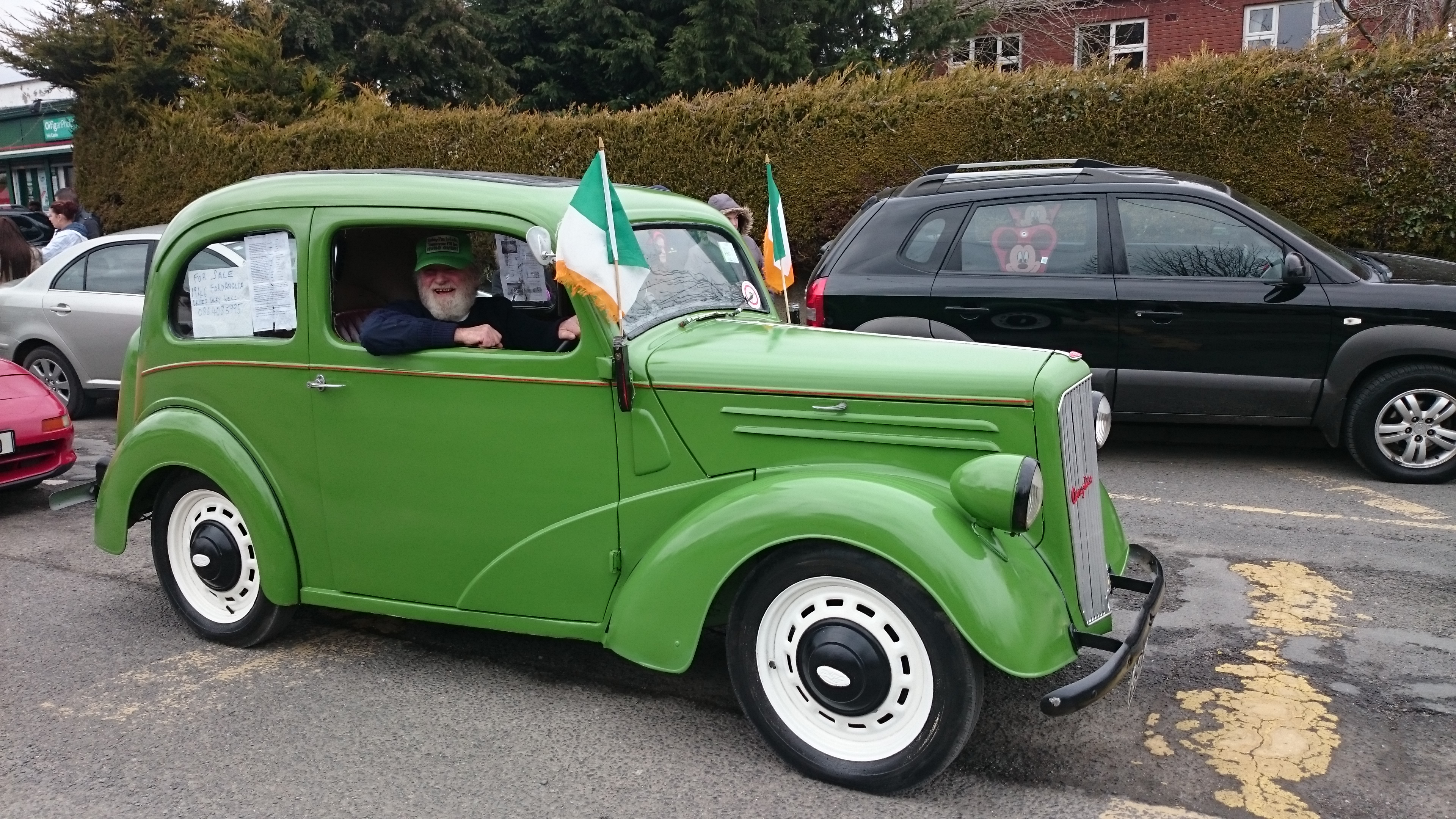
1946 Ford Anglia: part of the Vintage Display in the Inniskeen Parade Photo:  © Michael Fisher
1946 Ford Anglia: part of the Vintage Display in the Inniskeen Parade Photo: © Michael Fisher

The highlight of the St Patrick’s weekend celebrations in Inniskeen near Carrickmacross in County Monaghan was the annual parade this afternoon. Participants and floats gathered at the chapel and made their way into the village, passing the reviewing stand set up near the community centre.

Corduff Pipe Band at the Inniskeen St Patrick's Parade Photo:  © Michael Fisher
Corduff Pipe Band at the Inniskeen St Patrick’s Parade Photo: © Michael Fisher
All-Ireland pipe band champions Corduff Pipe Band were among three bands in the parade, along with Aughnamullen Pipe Band and the Stedfast Brass Band, which will be in Carrickmacross on Tuesday morning.

Plenty of vintage displays at Inniskeen St Patrick's Parade  Photo:  © Michael Fisher

Plenty of vintage displays at Inniskeen St Patrick’s Parade Photo: © Michael Fisher

The organising committee encouraged all small firms and businesses in the area to participate with a float depicting their crafty ideas and efforts (advertisements etc). There is a prize on the day for the best float.

Monaghan SF Cllr Noel Keelan flying the national flag on his vintage tractor in Inniskeen Photo:  © Michael Fisher

Monaghan SF Cllr Noel Keelan flying the national flag on his vintage tractor in Inniskeen Photo: © Michael Fisher
In conjunction with the weekend celebrations, the committee organised an art competition for the children of Blackstaff National School and Inniskeen National School with prizes for the best three entrants.  Any children who took part in the St Patrick’s parade were being encouraged to wear home-made or fancy dress costumes to illustrate the theme of leprechauns and fairies. There is a prize for the best costume.

Sean Conlan T.D. at the Inniskeen Parade Photo:  © Michael Fisher

Sean Conlan T.D. at the Inniskeen Parade Photo: © Michael Fisher
A Leprechauns Hunt was held on Sat 14th and there was an Art competition run through the local schools, St.Daigh’s National School and Scoil Cholmcille National School, Blackstaff, Inniskeen. In the Art Competition there were three categories – Jnr/Snr – 1st/2nd/3rd – 4th/5th/6th. There was a winner and runners up from each category. There were a great many entries for the Art competition, and Sarah Leddy (who herself, won the Overall Credit Union Art Competition) had a difficult task of choosing from all the entries. All winners from the Art competition, the Leprechaun hunt (Saturday) and winners of the fancy dress theme “Leprechauns and Faeries” who we hope will take part in the parade also will be announced on Sunday.

Slurry Spreader: part of Inniskeen's St Patrick's Parade Photo: © Michael Fisher

Slurry Spreader: part of Inniskeen’s St Patrick’s Parade Photo: © Michael Fisher

LÁ FHÉILE PÁDRAIG

HAPPY-~1Happy Ugadi Images on www.visiblecommunities.org

HAPPY-~1Happy Ugadi Images on http://www.visiblecommunities.org

Lá Fhéile Pádraig Sona dár gcairde agus teaghlach! Happy Saint Patrick’s Day to friends and family! I will be in Birmingham on the feastday, Tuesday, which has now become a national festival in Ireland. The parade in Birmingham takes place tomorrow, Sunday, having survived a funding crisis this year following council spending cuts. Meanwhile in County Monaghan and neighbouring areas, various towns and villages will be celebrating over the next few days. Here is a list of some of them:

BALLYBAY: The parade organised by the local Chamber of Commerce sets off from Gerry Traynor’s shop at 5pm. There will be live music and dancing from 3pm. A prize of €500 is offered for best float, with the runner-up receiving €300 and third place a prize of €200.

CARRICKMACROSS: Parade at 3pm. See my report last Sunday.

HAPPY-~1Happy Ugadi Images on www.visiblecommunities.org

HAPPY-~1Happy Ugadi Images on http://www.visiblecommunities.org

CLONES: A parade with a difference takes place in the town on Monday 16th March. Participants are being asked to come along at 6:30pm to Páirc Naomh Tiarnach with glow-sticks and lights, to light up the route. The parade will begin at 7:00pm along Church Hill and Fermanagh Street to The Diamond, where a fireworks display will be held at 8:30pm.

INNISKEEN: The celebrations in Patrick Kavanagh country will be tomorrow, Sunday 15th March. The parade in the village will be at 1:00pm. Today they were hunting leprechauns in the area!

MONAGHAN: The parade in the town will be the biggest in the county. The parade starts at 3:00pm and the route begins at the Lower Courthouse car park. It then goes along Broad Road, Park Street, Heaton’s Corner, left along North Road, Glaslough Street and then proceeds past the reviewing stand in The Diamond, continuing on to Dublin Street. British rally champion Daniel McKenna from County Monaghan is this year’s Grand Marshall. Participants have been asked to incorporate the theme ‘There’s no place like home’ into their parade contributions.
image

Following the parade the ‘Gig Rig’ will host peformances from several local acts from 4:00pm until 10:00pm.

HAPPY-~1Happy Ugadi Images on www.visiblecommunities.org

HAPPY-~1Happy Ugadi Images on http://www.visiblecommunities.org

NEWBLISS: The parade in the village is at 2:00pm tomorrow, Sunday 15th March, led by Daniel McKenna, the British rally champion, who comes from the area. There will also be a car boot sale on the day from 12:30pm.

ORAM: Near Castleblayney and home of country music legend Big Tom has built up a reputation for the smallest parade in Ireland. There will be live country and Irish music outside Rooney’s with Paddy King on the stand at 11:30am and the parade on Tuesday will start at 12:30pm from the Oram Centre. There will be a vintage display and a number of floats. Lady Mayor Margaret Ward will deliver a welcome address along with Big Tom McBride at 1:00pm. There will be jigs and reels from All-Ireland and world champion dancers from the Karen McMahon School. The celebrations will continue late into the evening.

COOTEHILL in County Cavan has a parade at 3pm. There are also annual parades in Kingscourt and Shercock.

DUNDALK and Ardee in County Louth will also be celebrating. Have a good day, wherever you are around the world! You are welcome to post greetings below in the comments section, especially if you have a Monaghan connection.

St Patrick's Day greeting card from USA Photo: www.smithtowntodaynews.com

St Patrick’s Day greeting card from USA Photo: http://www.smithtowntodaynews.com

COPING WITH DEMENTIA

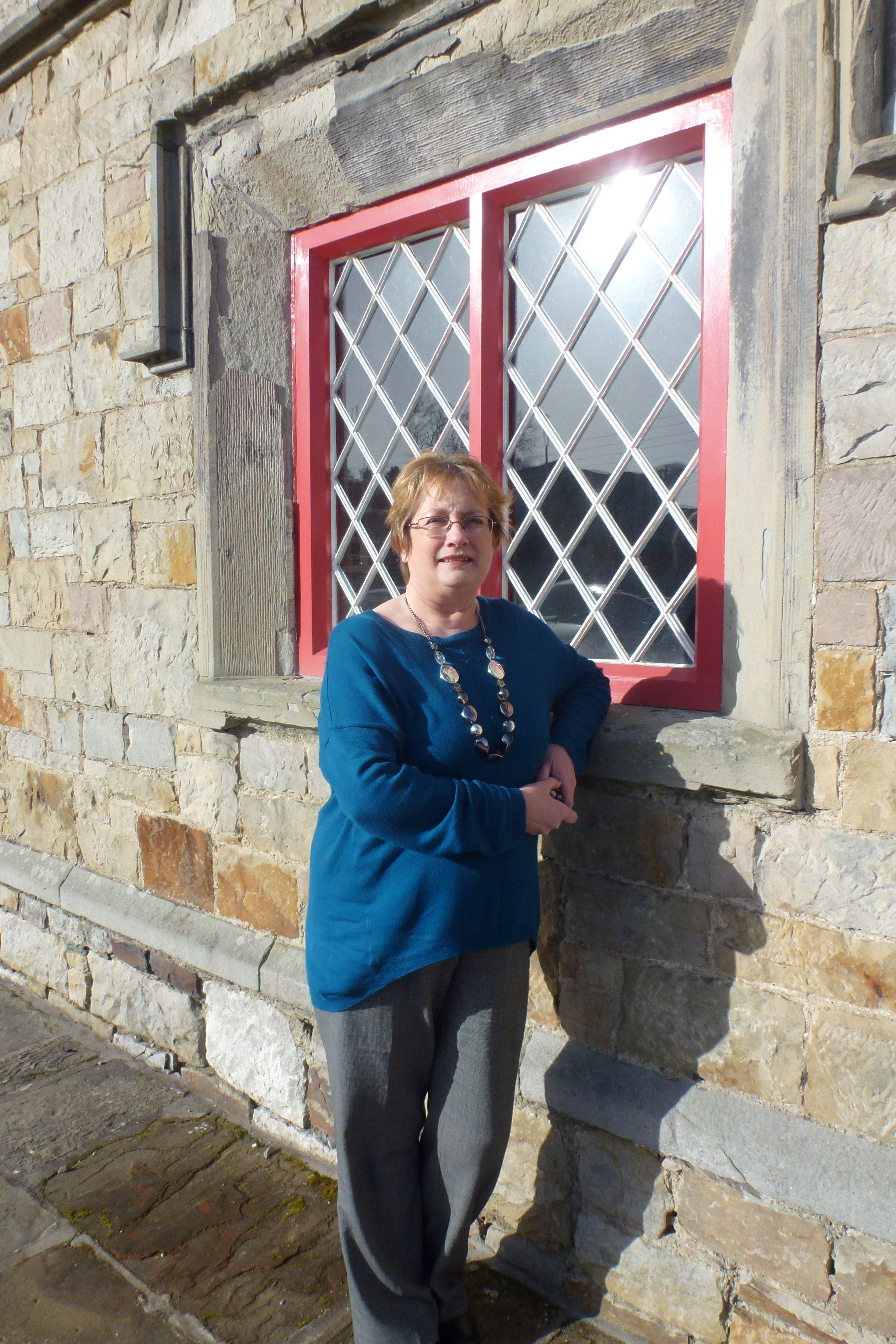
Maeve Montgomery, Dementia Adviser, Alzheimer Society, at Carrickmacross Wokhouse  Photo: © Michael Fisher

Maeve Montgomery, Dementia Adviser, Alzheimer Society, at Carrickmacross Workhouse Photo: © Michael Fisher

COPING WITH DEMENTIA: HOW THE MONAGHAN ADVISER CAN HELP Michael Fisher: Carrickmacross News Thursday 12th March 2015 The Northern Standard p.43

It can be very difficult to cope when a parent, brother, sister or other relative or maybe a friend develops dementia. Maeve Montgomery is there to help. There are 700 people with some form of memory loss in County Monaghan and 850 in neighbouring Cavan (2011 census figures). Maeve was appointed by the Alzheimer Society of Ireland last September to the post of dementia adviser, one of seven around the country. She will visit people in their homes to offer information and support when someone has been diagnosed with dementia. She can also give advice to anyone who calls to her office at the renovated Workhouse building in Carrickmacross.

The service, which is free and confidential, provides information tailored to individual needs, as well as emotional support. Maeve works with people of any age who have been diagnosed, or who are awaiting a diagnosis of dementia, as well as family members. As well as contacting her directly, people are sometimes referred to her by a health care professional such as a GP or public health nurse.

Maeve Montgomery, Dementia Adviser, Alzheimer Society, at Carrickmacross Wokhouse  Photo: © Michael Fisher

Maeve Montgomery, Dementia Adviser, Alzheimer Society, at Carrickmacross Workhouse Photo: © Michael Fisher

Speaking to the Northern Standard about her role, Maeve said it was important to reach people with dementia as early as possible. She feels there is a need for more back-up services, especially in rural areas like Monaghan. This will require more funding, which comes mainly from voluntary sources, as well as the HSE. She has high praise for the team of volunteers that raise funds locally, including an Alzheimer’s group in Carrickmacross chaired by Mae Murphy. They run a day care centre at Cloughvalley every Thursday.

Dementia and Alzheimer’s are used almost interchangeably by the lay person, possibly because Alzheimer’s is the most common form of dementia. There is also vascular dementia, arising from a stroke; Lewybody dementia (degeneration of brain tissue) and fronto-temporal dementia, affecting personality and behaviour.

Whilst they share similarities such as short-term memory loss, inability to carry out routine tasks, occasionally wandering, or repetition of questions, Maeve attempts to take every case on its own merits, as everyone is an individual. She hopes her service can help to give someone the best possible quality of life in the early stages of dementia. Her approach is to look at what people can do, rather than what they cannot do.

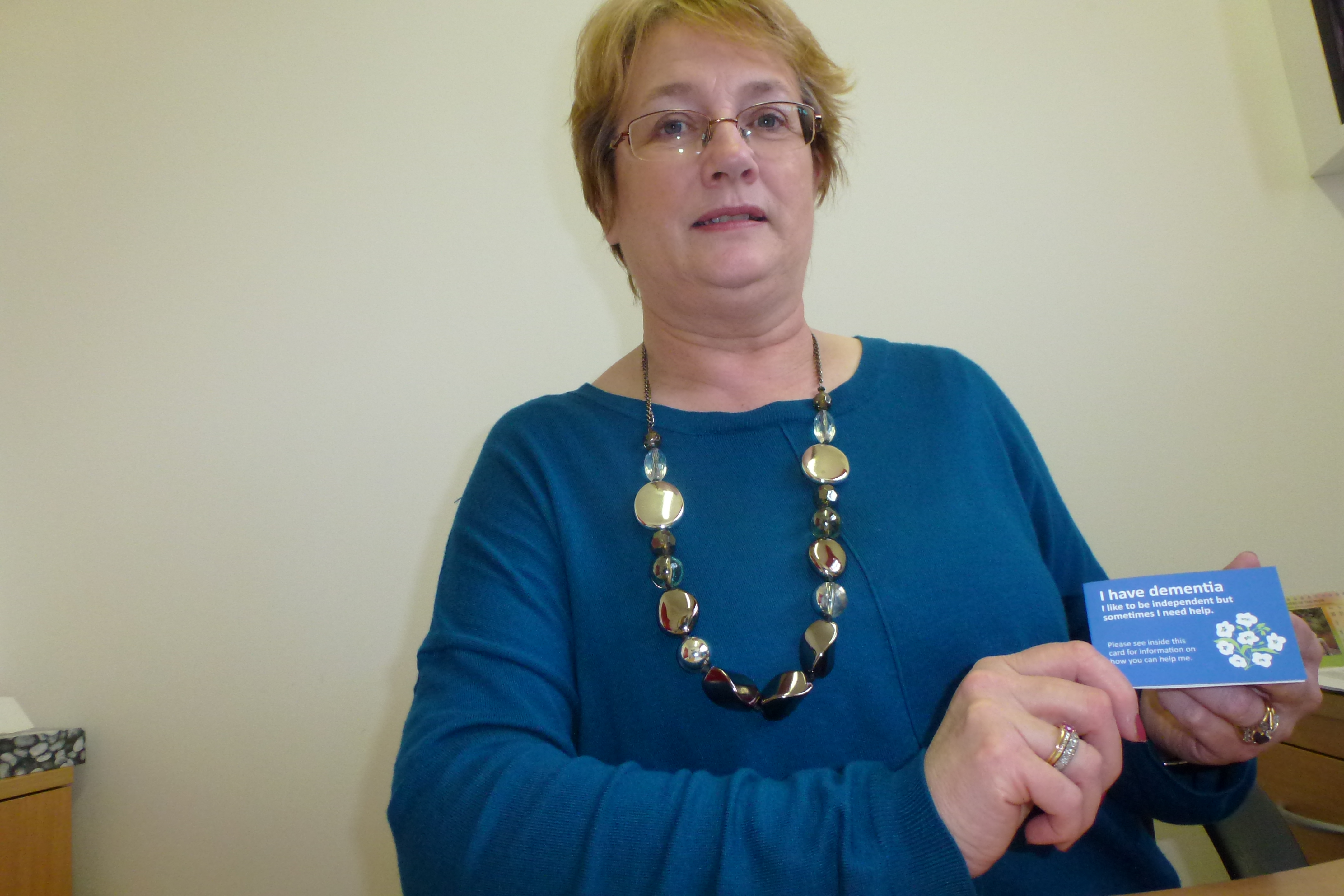
Dementia Card  Photo:  © Michael Fisher

Dementia Card Photo: © Michael Fisher

She can provide information about the condition and how to cope with the changes; how to live well on a day-to-day basis; how to plan for the future, including legal and financial matters; driving; services and supports available locally such as the Drumkill day centre at Threemilehouse; and how to get in touch with other people with dementia and their families.

Maeve said that where it is safe to do so, the emphasis should be on the affected person staying at home, if that is their choice, and enabling them to live independently and to live well, if the dementia is at an early stage. Smart technology can be used for devices that might help in a home, such as mats that detect movement or beams that set off alarms.

She says that grandchildren can play a useful role in helping a family member with dementia by asking them to reminisce about the way things were twenty or thirty years ago. Those long-term memories are often sharper whereas what happened yesterday can be a blur for someone with the condition. It can be a good idea to develop a life story, in which grandparents can get great joy from looking back at traditions associated with events such as Easter, Christmas or Halloween.

Maeve Montgomery, Alzheimer Society, with dementia card at Carrickmacross Wokhouse  Photo: © Michael Fisher

Maeve Montgomery, Alzheimer Society, with dementia card at Carrickmacross Workhouse Photo: © Michael Fisher

The Alzheimer Society estimate that 48,000 individuals in Ireland are living with dementia. For every person diagnosed they believe that, on average, three family members are directly affected. With an ageing population and no cure on the horizon, it’s only going to get worse. We are just not getting to them early enough,” Maeve says. “The hope is that we will get to people earlier. The sooner I can get to them the better for them, because there are very good services, but by the time they get into the services they’ve struggled maybe for years, with nobody. Maybe a person who has battled on with the knowledge that their memory is slipping, or that they are not able to carry out the same daily activities as effectively as they were; maybe their family have noticed it, which is quite common”.

Anyone concerned about their own memory loss, or that of a family member can contact Maeve, even before a diagnosis of dementia has been made. In practice however, most contact with Maeve is made post-diagnosis, often when the disease is at quite an advanced stage. This has been her experience in her previous role as ASI home care coordinator for County Louth, based in Dundalk.

“Quite often by the time someone was referred to me, they were on their knees. They had gone through quite a journey before they had got to us. If we’d only got to them a bit earlier maybe we could have made that journey a little bit easier”.

Of course a dreadful milestone in that journey is the diagnosis. “You walk out, and you are sitting in the car park, you’re reeling. It’s like getting the diagnosis of any serious condition, you are reeling. So anything that the specialist may have said to you might have come in one ear and out the other, because once you hear the word – do you go into a fog? Not everybody, but some people come out and they are so shocked that their worst fears have been realised. They maybe feeling quite bleak. They might be in a very deep dark hole as they sit there. They need someone to talk to at that point. So the idea of the adviser role is that we get in more quickly and we give them someone to support and talk to”.

Maeve Montgomery, Dementia Adviser, Alzheimer Society, at Carrickmacross Workhouse  Photo: © Michael Fisher

Maeve Montgomery, Dementia Adviser, Alzheimer Society, at Carrickmacross Workhouse Photo: © Michael Fisher

Maeve says the Association’s aim is to help people live well with dementia. In helping a loved one maximise their quality of life, communication is key. “Always, tell them what you are doing. It doesn’t matter what stage they are at, always explain what you are doing and then it might be easier, because you don’t know what someone can understand if they can’t express themselves, so always assume they can understand what you are saying.” She also encourages families to include the dementia sufferer in the lifeblood of the home, conversation.

“It would be very easy not to do that, because they are not actively contributing to the conversation. But if you turn to someone with dementia and include them, even by looking at them, your body language, all of that – they feel included and it makes them feel better.”

Regardless of their ability to speak, communication in at least some form is usually possible, as Maeve notes that merely 30% of communication is verbal. “The rest is gestures, eye contact, body language – all of that. People with dementia can lose words, they can lose speech, their ability to string sentences together, but they can still communicate and we have to adapt to learning how to read what they are saying,” she explains. Even if a person uses the wrong word for an item, as far as Maeve is concerned that should now be the new, accepted word for the item. However families can struggle with this notion. “You can understand that, there is an awful lot of emotion involved in the caring for someone. We are trying to say: ‘We’ll go with that’.” Going with that includes encouraging the person with dementia to continue to be active. As they lose the ability to carry out simple tasks, Maeve suggests that the carers focus on the tasks the person can still do, or attempt to do, rather than zero in on what they can’t.

Maeve Montgomery, Dementia Adviser, Alzheimer Society, at Carrickmacross Workhouse  Photo: © Michael Fisher

Maeve Montgomery, Dementia Adviser, Alzheimer Society, at Carrickmacross Workhouse Photo: © Michael Fisher

People with dementia can be prone to depression as they watch their abilities diminish over time. Thus it is all the more important to be supportive and accentuate the positive – even if they can no longer complete simple household tasks perfectly. “They might be able to complete it imperfectly, and that’s okay. And it’s okay if they lose interest because their attention span isn’t as good. So even if they can do it for a little while and then leave it, that’s okay too.” In other words: go with it.

Many people diagnosed with early-stage dementia start to cut themselves off from their communities because they are embarrassed about forgetting people’s names. Maeve says they advise people to maintain their social life and suggest ways around situations, such as by saying something like “my memory isn’t what it used to be. Please tell me your name.” It’s not such a big mistake to forget someone’s name.

Similarly, friends can stop calling to see someone who has been diagnosed with dementia. This can be very isolating for the person and their carer. It’s very important for friends and family members to continue to call to see someone with dementia, as it gives both the carer and the person a break in the day.

Sometimes, people perk up when someone calls to see them even if they don’t seem to recognise the visitor. People with dementia can have an emotional memory of someone and not be able to articulate this.

Sometimes, familiar people are mixed up so a daughter can be confused with a sister, or a son with a brother. This can seem very strange to the person visiting, but often the associations are pleasant, so their spirits are lifted by seeing the person.

People also sometimes think that people with dementia are automatically aggressive. This isn’t the case, but there is often a reason for the grumpiness. Sometimes, giving the person clues about why they aren’t comfortable can help. For example, ask if they would like to go somewhere quieter, or whether they have a pain or feel uncomfortable in the seat.

Listening carefully and being patient are the most important things to remember when spending time with someone with dementia. Caring for those with dementia can be very stressful, so having someone new come into the house can be a relief. However, it can also be annoying if someone says how well the person is, if the carer has been dealing with lots of difficult situations in the past few days. It’s very important to look after the carers of people with dementia. alzheimers-society-of-ireland

Maeve says she finds it very rewarding to visit people in their homes. Our mission in the Alzheimer Society of Ireland is to enable people with dementia to be as independent as possible for as long as they can. It’s impossible to put a timeframe on how long someone will remain well with dementia. There is a lot of love and kindness and gentleness involved in talking to people with dementia. When you reminisce with them, you are learning about social history and giving them so much pleasure at the same time. We also visit people with early-onset dementia. It can be difficult for families to accept a diagnosis of dementia for someone under 65.

The development of Alzheimer cafes gives people the opportunity to socialise with their loved ones in an environment where people understand their needs. More information about support services can be found at: www.alzheimer.ie and Maeve Montgomery can be contacted on (087) 7489258.

THE PHOTOGRAPHS

The three pictures that were used to illustrate this article (in the paper) were taken by Ardee-based photographer Ken Finegan, from a series entitled ‘Club Life’ . Taken in 2012, they depict club members of the Birches Alzheimers Day Care Centre in Dundalk. Some of the pictures have been presented to Dundalk Institute of Technology.

“Club Life” is a highly personal yet objective photographic study of Alzheimer’s disease and dementia. It questions, searches for knowledge, informs, is a possible insight not only of the person affected and the disease but an insight or understanding of oneself, one’s essence.

Ken explained, “The images reflect the difficulties individuals and others face during their day to day lives, like short term memory loss, confusion and frustration. But they also reflect the care and consideration of the person.”

‘Club Life’ refers to the people at The Birches and the life they lead, but also to our own lives. Ken says that in creating the images he sought to portray the sense of ‘personhood’ of those who attend the centre.

Ken is a professional photographer working in the North East of Ireland for over 28 years. He covers all areas of photography and has a Masters Degree in Fine Art (MFA) from the University of Ulster.

A DAY WITH HEATHER HUMPHREYS

Heather Humphreys TD at Blayney Blades celebration in Castleblayney  Photo: © Michael Fisher

Heather Humphreys TD at Blayney Blades celebration in Castleblayney Photo: © Michael Fisher

A BUSY SCHEDULE FOR HEATHER 

Michael Fisher

It’s a busy week for local Fine Gael T.D. and Minister for the Arts, Heritage and the Gaeltacht, Heather Humphreys. When this reporter met her in Castleblayney on Monday morning, she had been on the road since 8.30am, leaving her home in Aghabog to start work at her constituency office in Monaghan by 9am. Her first public engagement was at the Íontas Centre, where she was the guest speaker at an event organised by Blayney Blades to celebrate International Women’s Day. In her speech she mentioned how important an influence her mother Emily had been and how two of her secondary school teachers had encouraged her to enter politics. She stayed for two hours, networking with a large group of women and passing on the welcome news that funding a network of 17 women’s groups throughout the country had been secured. Instead of taking lunch at the Centre, the Minister stayed in Castleblayney to meet a constituent before returning to her office in Monaghan around 1:45pm. She just had time for a small snack from a nearby café before heading off to Beech Hill College in Monaghan, where a woodwork room had been refurbished and equipment upgraded with the aid of a grant. She took the opportunity to speak to the principal and teachers as well as some of the students. After an hour at the College she returned once again to the Mall Road office at 3:30pm to carry out constituency work for three hours. By 7pm she was back home, taking the opportunity to do some packing for an official trip she is making to England this week. She is flying to London on Wednesday night and will be the main guest at a number of functions over the St Patrick’s weekend. On Friday evening the Irish ambassador Dan Mulhall hosts a reception at the Irish embassy and there will be a formal dinner to attend on Saturday night. On Sunday the Minister will join fellow Monaghan native Barry McGuigan at the head of the St Patrick’s Day parade in the British capital.

Arts Minister Heather Humphreys TD at Magheracloone Fine Gael Branch AGM  Photo:  © Michael Fisher

Arts Minister Heather Humphreys TD at Magheracloone Fine Gael Branch AGM Photo: © Michael Fisher

The Minister’s third public engagement on Monday was at Magheracloone Community centre (near Carrickmacross), where she attended the AGM of the local Fine Gael branch. It was the first time in recent memory that a government Minister had been present. Over a welcome cup of tea at the end of the meeting, Heather Humphreys explained that the following day (Tuesday) her diary would be taken up with a Cabinet meeting in the afternoon and a meeting of the 1916 Commemoration committee (which is one of her responsibilities) that evening. Wednesday would see her answering questions in the Dáil.

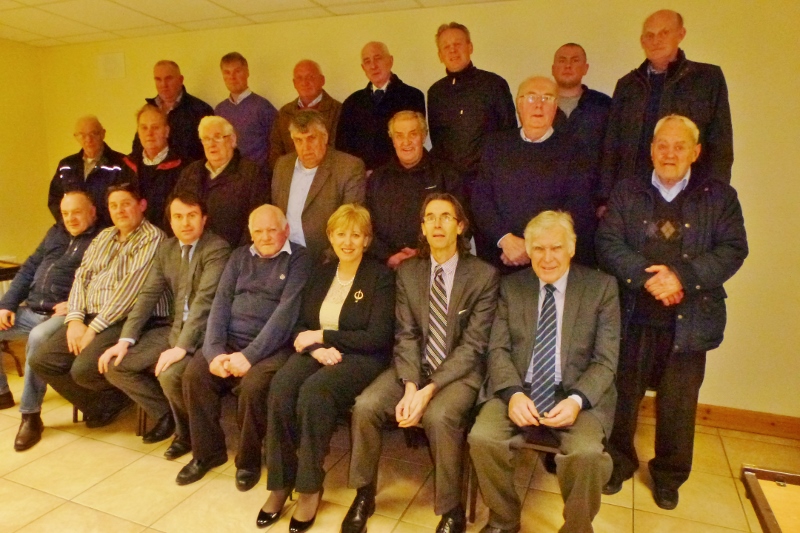
Arts Minister Heather Humphreys TD at Blayney Blades congratulates their Woman of the Year 2015 Sr Catherine Brennan  Photo: © Michael Fisher

Arts Minister Heather Humphreys TD at Blayney Blades congratulates their Woman of the Year 2015 Sr Catherine Brennan Photo: © Michael Fisher

So after putting in a fourteen hour shift on Monday, it was time (10:30pm) for the Minister to return home. She told me she normally tried to keep Sundays free as a family day, a time she could enjoy with her husband Eric and their two daughters. She certainly has a busy schedule.

*******************************************

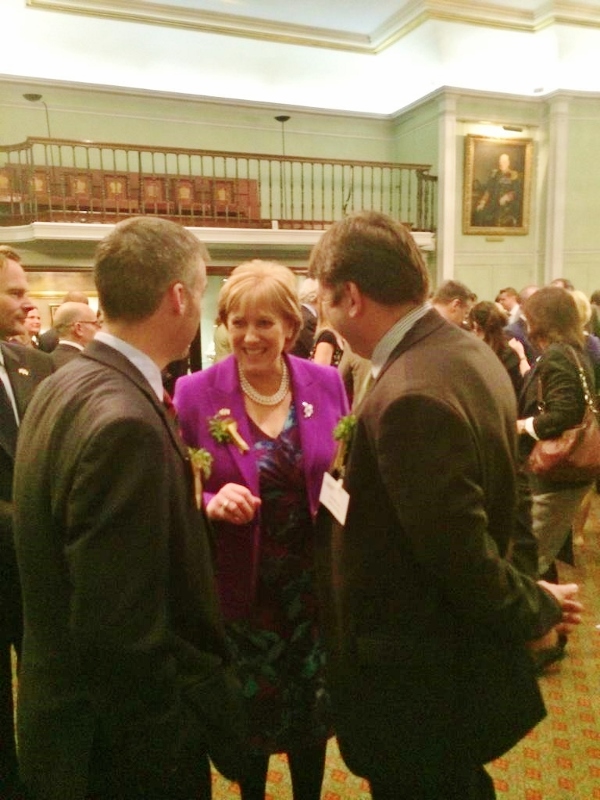
Tonight (Thursday) the Minister is in London, attending an Enterprise Ireland St Patrick’s Day reception at Trinity House (the body responsible for lighthouses). It is an opportunity to network with business people, many of them Irish, and to encourage investment in Ireland. This photo was posted on her twitter account @HHumphreysFG:

Arts Minister Heather Humphreys TD at Enterprise Ireland reception in London  Photo: @HHumphreysFG

Arts Minister Heather Humphreys TD at Enterprise Ireland reception in London Photo: @HHumphreysFG