Get me outta here!

Michael Fisher's News

© Michael Fisher MMXXII

Menu

Skip to content
  • Home
  • About

Author Archives

borderroamerhttps://fisherbelfast.wordpress.comThe Northern Standard, Monaghan. Reporter.
borderroamer's avatar

DESMOND FISHER (11)

16/01/2015 by borderroamer

image

My father Desmond Fisher edited the Catholic Herald in London’s Fleet Street in the mid-1960s at the time of Vatican II, which he reported on. I wrote the following obituary which is included in the latest edition of the new Catholic Herald magazine. My thanks to the current Editor Luke Coppen for suggesting a few changes at the start. I am glad to say that the rift between my father and the paper was put aside in recent times and that he was encouraged by Luke to contribute once again to this publication.

image

The Editor who brought Vatican II to Britain
It took half a century for a pope to address the need for reform of the Roman Curia. It was to have been tackled at the time of Vatican II, when many other changes were made in the Catholic Church. Days before my father Desmond Fisher died on December 30, I read him Pope Francis’s address to the Curia, outlining 15 ailments they suffered, including “spiritual Alzheimer’s”, which the Pontiff wanted to be cured. It was, my father said, the best news he had heard in 50 years. He was deeply involved with the progressive movement at Vatican II, where he made many friends, including Belgian Cardinal Leo Suenens and theologian Karl Rahner.

My father grew up in Ireland at a time when Catholic lay people were deferential to the clergy and especially the hierarchy. All that changed – or was supposed to – when Pope John XXIII summoned the Second Vatican Council to begin a reform of the Church. My father travelled to Rome before the opening and covered the later three sessions. He had been appointed editor of the Catholic Herald in 1962, in succession to Count Michael de la Bédoyère. Joining the Catholic Herald meant exchanging one Fleet Street office – that of the Irish Press, where he had been London editor since 1954 – for another.

In his first editorial he wrote that, as a lay-owned and independent paper, the Catholic Herald had “a freedom which is journalistically necessary if it is to carry out what it conceives to be its function and which relieves the hierarchy and the clergy generally of any responsibility for opinions expressed in these columns”. He built a team of new journalists around him, including John Horgan (later  Press Ombudsman in Ireland) and future Tablet editor John Wilkins. He has left behind a large archive of articles spanning 70 years. He considered that some of his best writing was published in the Catholic Herald and elsewhere in 1962-65.

“Early in the Council,” he recalled, “some 15 English-speaking journalists … organised an informal group, mainly for friendship but also to pool information and ideas… Our group frequently dined together, occasionally inviting bishops (among them Cardinal Suenens) … to join us to explain Council issues and interpret what was going on.” Cardinal Franz König of Vienna wrote to my father that he had learned “more of what is going on at the Council from your superb reports” than he heard “while on the spot”.

My father reckoned he was probably the first working journalist to be admitted to St Peter’s during a Council meeting, carrying a one-day pass for a Protestant observer and dressed in a dark grey suit, white shirt and black pullover. His good knowledge of Latin (from secondary school and his short time as an Augustinian novice) came in extremely useful on that occasion. He remembered two English bishops inviting him for a coffee in Rome. When Bishop Farren of Derry, his former headmaster at St Columb’s College, entered, he was invited to join them but refused, saying he would have nothing to do with him. My father noted that this animosity was shared by some of the English and Scottish bishops because of his reportage on the Council. Archbishop McQuaid of Dublin thought his articles were “very objectionable”.

Halfway during the fourth session, in 1965, my father was criticised by Cardinal Heenan because of a Catholic Herald  headline (not written by him): “Bishops clash at Council.” The cardinal claimed  the Catholic bishops did not “clash” since the Holy Spirit guided their deliberations. His Eminence was very annoyed and contacted the main owner of the paper, a conservative in his religious views. My father was recalled from Rome on the grounds that the bulk of the Council’s work had been done. It was, he said, one of the bitterest blows of his life and led to his resignation as editor “without regret” in May 1966.

Archbishop Hurley of Durban expressed “terrible dismay at the bitter news” of my father’s departure. “You did a wonderful job on the Catholic Herald,” he wrote, “and produced perhaps the best reporting of the Council that appeared in an English-language newspaper.” Trevor Beeson, a Canon of Westminster Abbey, wrote in his 1972 book An Eye for an Ear: “Almost certainly the most able journalist in the religious field in the past two decades, Fisher was deeply influenced by the spirit of Vatican II and, not surprisingly, this found expression in the pages of his paper. But Fisher was too far ahead of those holding the reins of power in English Catholicism. He urged reforms, which they were not ready to accept or implement.”

During a year as a freelance, one of my father’s tasks was to handle the copious media enquiries he received regarding Charles Davis. In December 1966 Fr Davis, then the best-known Catholic theologian in Britain, announced he was leaving the Church. Our phone at the house in Wimbledon, where he stayed for a short while, never stopped ringing for three days, with enquiries from local, national and international media.

It was then that my father wrote The Church in Transition, published in 1967 by Geoffrey Chapman, a friend and neighbour. When he wrote it, he predicted it would take 100 or 200 years to decide whether Vatican II was a failure. By 2010, his view was that the Church, at least in Europe, would not get anything like that length of time for reflection and it seemed more likely the future structure of Christianity would be determined in Africa or Latin America. He wrote that verdict three years before an Argentine Jesuit was elected to the See of St Peter.

In his final years, when his mobility was limited, a correspondence by email with Dom Mark Hederman, the Abbot of Glenstal, as well as renewed contact with Fr Enda McDonagh, a well-known liberal, and the inauguration of the new priests’ conference in Ireland gave my father some hope that the spirit of Vatican II had not died. His final project, at the age of 94, was to finish a book on the Stabat Mater, including his own translation of the original Latin poem. He was still working on it on his laptop when he became ill. The work is due to be published later this year.

Michael Fisher  

Share this:

  • Share on Facebook (Opens in new window) Facebook
  • Share on X (Opens in new window) X
Like Loading...
NEWS UNCATEGORISED Catholic HeraldCharles DavisChurch in TransitionDesmond Fisher Leave a comment

STATE OF THE IRISH CATHOLIC CHURCH

15/01/2015 by borderroamer
Desmond Fisher  Photo: © Margie Jones

Desmond Fisher Photo: © Margie Jones

Arthur Jones is a former Editor of the US publication, National Catholic Reporter. He has just published a history of the paper, marking its fiftieth anniversary. He worked for my late father Desmond Fisher in the Catholic Herald in London in the 1960s and they kept up a friendship since then. He wrote an obituary when my father died and his report was taken up by many other outlets including L’Osservatore Romano. In October 2011 Arthur and his wife Margie visited Ireland and he interviewed Des for an article in NCR about the state of the Irish Catholic Church.

Ireland’s struggle to become ‘a mature society’

Arthur Jones  |  Oct. 11, 2011

Boys work at the Artane Industrial School in Dublin, Ireland, in this undated photo contained in a report released in 2009 by the Commission to Inquire Into Child Abuse. The report stated that physical and sexual abuse occurred at the school, which was run by the Christian Brothers from 1870 to 1969. (CNS/Commission to Inquire Into Child Abuse)


DUBLIN, IRELAND — The Irish Free State was founded in 1922. Irish journalist Desmond Fisher was then 2 years old. Now 91, Fisher, grew up with the state. A former editor of the London Catholic Herald, Fisher covered the Second Vatican Council (1962-65), later joined Radió Telefís Éireann as deputy director of news and became head of current affairs.

To Fisher, “Irish culture has always had a large complement of religion in it. Traces of Druidism and nature worship are probably still there. St. Patrick contributed the solid core. The rest is a mishmash of superstition, pietism, a sugary sentimentalism, a streak of Puritanism, and a bleak authoritarianism borrowed from Victorian England.

“It was well into the 1960s when the changes, now accelerating rapidly, in Irish culture began to manifest themselves. This was the time that Irish bishops and the whole Catholic church needed to realize that religious practice needed to change to match the cultural changes. The mistake the Irish bishops made — and are still making — is to regard theology, like the basics of the faith itself — as uniform and immutable.”

Desmond Fisher           Photo:           © Margie Jones

Nothing reflects Fisher’s remark on “bleak authoritarianism borrowed from Victorian England” more than the horror story that is Ireland’s “institutional abuse” in the religious congregations-run industrial training schools and reformatories for boys, and institutions and laundries for women and girls.

The 2009-released Ryan Report by the Commission to Inquire Into Child Abuse is a five-volume catalog of page after page of gross and widespread “sexual abuse” of “poorly clothed, undernourished” boys who were subject to “brutal beatings and punishments” and “poor, inadequate, overcrowded living conditions, and were “emotionally deprived and psychologically” maltreated.

Ireland’s clerical sexual file begins with a suit against the Ferns diocese and the papal nuncio (he claimed diplomatic immunity) by Colm O’Gorman, sexually abused as an adolescent in the Ferns diocese in County Wexford. O’Gorman, later an Irish senator, now Amnesty International Ireland president, was awarded some $450,000 damages. He founded an abuse-victim advocacy group, One in Four, in England and Ireland, and his subsequent BBC documentary “Suing the Pope,” helped his campaign for a Ferns diocesan investigation. The report finally disclosed more than 100 allegations of abuse against 21 Ferns priests. His BBC documentary, “Sex Crimes and the Vatican,” aired in 2006.

“We in Ireland now are struggling with ways to have the kind of public conversation we needed to have at the time of the foundation of the state,” O’Gorman said. “If you look at some of the principles that underpinned the notion of what this republic might be, its first duty (incorporated into the 1937 Irish Constitution) is to safeguard its children. But can you have a common morality if that morality is dogmatically enforced, rather than considered and engaged with and developed? Without these steps we cannot have a mature society, and we don’t have one. Yet.”

After Ferns (2008), came reports on the Dublin archdiocese (2009), and the Cloyne diocese (2011) — the latter triggered Taoiseach Enda Kenny’s attack on the Vatican. The same litany of sexual abuse in Ireland is familiar to all countries dealing with it: denial and cover-up, and hovering over all, papal, Vatican and local hierarchical obfuscation or worse. Due next: a report on the Raphoe diocese in Donegal.

Next is the unresolved Magdalene laundries abuse. The account of decades-long institutional incarceration of women in these laundries sears the soul: Women slaved away, unpaid, bullied, often underfed, and basically unappreciated. This because they had children out of wedlock, or were prostitutes, or girl children considered “at risk” — their families couldn’t control them or didn’t want them — and first offenders were sent to laundries rather than reformatories. Many lived and died there in these institutions, unmourned, relatives never notified, buried in unmarked graves.

A subtext to the laundries’ shame is the suppression of women’s rights in Ireland. Contraceptive use was a criminal offense from 1935 until 1985. Women could not collect their own children’s state allowance until 1974, their husbands did; nor could women sit on juries until 1976. Divorce was constitutionally prohibited until 1995, five years after marital rape was criminalized. If women’s rights were delayed, adoptees’ rights were nonexistent. Adoption was secret; babies were secretly sent to the United States. Files remain closed.

In the past eight years, as the group Justice for Magdalenes stepped up its pressure on religious congregations and the Irish government for apologies and restitution for Magdalene victims, the organization has made adoptees’ rights a companion issue to laundries’ redress. Magdalene laundries exposés in books, television programs, newspaper investigations and Peter Mullan’s 2002 movie, “The Magdalene Sisters,” keep the topic before the public.

Finally, in 2009, a parliamentary all-party investigation into the Magdalene laundries was announced. Its report is pending. The Conference of Religious of Ireland, an association of 136 religious orders of men and women, this year stated on behalf of the four congregations who operated Magdalene laundries (Sisters of Our Lady of Charity, Religious Sisters of Charity, Sisters of Mercy and the Good Shepherd Sisters), “As the religious congregations, who, in good faith, took over and ran 10 Magdalene homes during part or most of that time, and as congregations still in relationship with many residents and former residents, we are willing to participate in any inquiry that will bring greater clarity, understanding, healing and justice in the interests of all the women involved.”

No governmental or congregational redress, compensation or apology has yet been made, said Justice for Magdalenes.

In a statement to NCR, Mercy Sr. Coirle McCarthy, her order’s congregational leader, said, “The sisters believe they have been misrepresented and demonized in recent years and portrayed in a way that seeks to undermine their voluntary service.”

To further the sisters’ earlier offer contribute to an independent fund for Magdalene survivors, the Mercy Sisters have requested a meeting with Education Minister Ruairi Quinn, she said. (Quinn’s office confirmed to NCR he would meet with them.) McCarthy said their 2009 offer includes (in approximate U.S. dollars) $27 million to an independent fund and properties valued at $15 million. Properties worth a further $110 million have been offered to the state, and $20 million in property offered to the voluntary sector.

“In the last 10 years alone,” she said, “the sisters have [also] donated cash and property in excess of $1.4 billion to ensure [their other] voluntary services continue for present and future generations.”

If, as Fisher said, the bishops continue to regard theology as “uniform and immutable,” what then? Mary Condren of the Dublin-based Institute for Feminism and Religion contends Ireland will retain “the same scapegoat theology that brought us 35 years of terror, clerical abuse and the Magdalene laundries.” Even worse, she said, such a theology “is likely to be reinvigorated with the forthcoming centenary celebrations of the Irish 1916 Easter Rising, at a time when what’s still needed is a theology of mercy, not sacrifice.”

What is also needed is latitude for theologians to deal with the issues of the time, whether in the church, in Ireland, or in the broader West with its rising evangelical fundamentalism and atheism. According to Dominican Sr. Margaret MacCurtain, for centuries it was the religious orders that provided the men and women “with the intellectual and spiritual energy” to meet society’s and the church’s contemporary major challenges.

The major losses in vocations to the religious orders, then, remain one problem, Rome’s penchant for silencing dialogue and debate, the other.


Share this:

  • Share on Facebook (Opens in new window) Facebook
  • Share on X (Opens in new window) X
Like Loading...
NEWS UNCATEGORISED Arthur JonesDesmond FisherNational Catholic Reporter Leave a comment

CARRICKMACROSS NEWS

14/01/2015 by borderroamer

P1180715 (800x141)My job for the next few months is to represent the Northern Standard as Carrickmacross correspondent in South Monaghan while the staff journalist is on maternity leave (congratulations Veronica on the new arrival!). I enclose the first two pages of Carrickmacross news from last Thursday’s edition (January 8th 2015). Pictures are by Pat Byrne. P1180705

P1180707 (602x800)

If you have a story from the area you can contact me at standardcarricknews@yahoo.ie or telephone (042) 9663890 on a Monday/Tuesday or contact the Monaghan office on a Wednesday (047) 82188.  P1180710 (777x800)

JB THE FUNDRAISER FROM KILLANNY

John Byrne, Killanny  Photo:  © Michael Fisher

John Byrne, Killanny Photo: © Michael Fisher

Around the parish of Killanny and further afield everyone knows him simply as ‘JB’. John Byrne from Lannatt is a former mechanic who used to repair and sell cars. Once it was easy work for him to lift an engine out of a car. But a heart attack thirteen years ago which he was lucky to survive meant he would have difficulty for a time lifting small objects such as a can of peas. He is now doing everything he can to ensure that potentially life-saving equipment is readily available at strategic points throughout the parish such as the parochial hall and a local restaurant.
Chatting to him at his house he told me how he had once been an active sportsman. He played football for Killanny GAA Club and also represented the county mainly at under-21 and minor level. He captained the Killanny side that won the double (championship and league) in 1979 earning them promotion from junior to intermediate and eventually senior level. He went on to become chairman and also manager of the club. But in February 2002 at a time when his work was becoming more and more pressurized he had a heart attack. He was taken to hospital in Dundalk and transferred to Dublin for treatment. Three months later he knew he was beginning to recover when he was able to walk from his house along the laneway that leads to the main road. But it would take nearly two years before he could resume work. His wife Noeleen and daughter Aoife (a keen footballer) were then able to help him in his next project. During his rehabilitation in Dundalk hospital JB noticed there was a need for equipment in a small gym that had been established there. So he helped to raise IR£4500 by asking a number of friends to do a bunjee jump at a parish sports day. Then in 2007 a stroll near the River Glyde inspired him to do a river walk, not alongside but in the water itself. Dressed as James Bond and wearing a dry suit over his tuxedo and bow tie, he managed to walk two miles in the river, ending up by killing off a crocodile-like figure that had been put in the water to introduce a bit of drama. His friends at the Riverbank pub provided sustenance after he successfully completed his task. The money raised was enough to provide six defribrillators which were installed at the GAA pitch and other public areas around the parish. They are kept inside specially marked boxes and cost around IR£3000 each. Now the emphasis is on training people in how to use them. JB’s target is to get two people in every household in Killanny  (population around 1200) trained in the use of these devices. The youngest person trained so far is 15 and the oldest 85. As the man himself put it: ‘the fun part was the fundraising, the work is only starting now’.

Share this:

  • Share on Facebook (Opens in new window) Facebook
  • Share on X (Opens in new window) X
Like Loading...
MONAGHAN NEWS UNCATEGORISED CarrickmacrossKillannyMichael FisherMonaghanNorthern Standard Leave a comment

DESMOND FISHER (10)

13/01/2015 by borderroamer

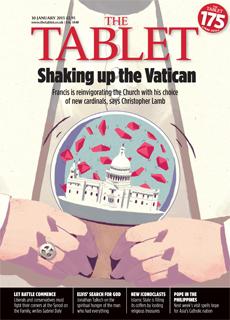
tablet30016_123747704330865_2770159_nJOHN WILKINS OBITUARY OF DESMOND FISHER JANUARY 10 2015

The former editor of The Tablet, John Wilkins, cut his teeth as a Catholic journalist with contributions to the Catholic Herald under Desmond Fisher, who has died in Dublin at the age of 94. Fisher was the Herald’s editor from 1962-1966, the years of the Second Vatican Council, in succession to the great Michael de la Bédoyère.

For Fisher the Council came as a liberation. He once sent Wilkins a postcard from Rome of St Peter’s with its famous dome. On the back he had written: “This is what needs the lid taken off it.” He could not have foreseen that Pope Francis would oblige.

He stood four square with the progressives, and he went at it full tilt. Another journalist indebted to Fisher is Senator John Horgan. Fisher gave him his first job. It was “fun” at the Herald, says Horgan. “Everyone did everything – writing leaders, articles, reports, taking photographs.”

Inevitably, however, the authorities took fright, and Fisher resigned. His reputation remained high, especially in the US, and from 1966 to 1974 he was a regular contributor to the Church Times. Back in Ireland, he filled senior posts with newspapers and with Ireland’s national broadcaster RTE.

Right up to a year or two ago he was still writing. His last work was an examination of the translations of the Stabat Mater, together with one of his own. In the hospice as he succumbed to cancer, ever the perfectionist, he was still putting the final touches to his text.

(John Wilkins is a former Editor of The Tablet)

tabletcover100115

Share this:

  • Share on Facebook (Opens in new window) Facebook
  • Share on X (Opens in new window) X
Like Loading...
NEWS UNCATEGORISED Catholic HeraldDesmond FisherJohn WilkinsThe Tablet 1 Comment

DESMOND FISHER (9)

12/01/2015 by borderroamer
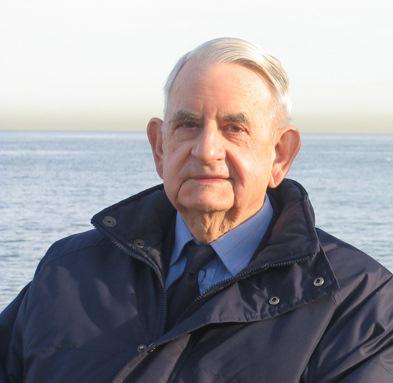
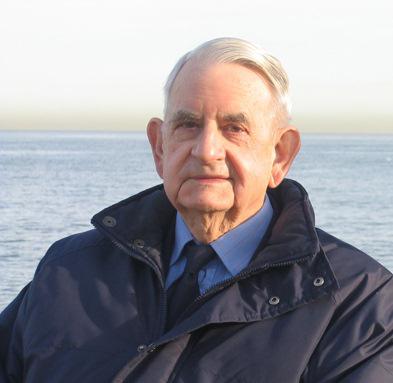
Desmond Fisher  Photo:  © Michael Fisher

Desmond Fisher Photo: © Michael Fisher

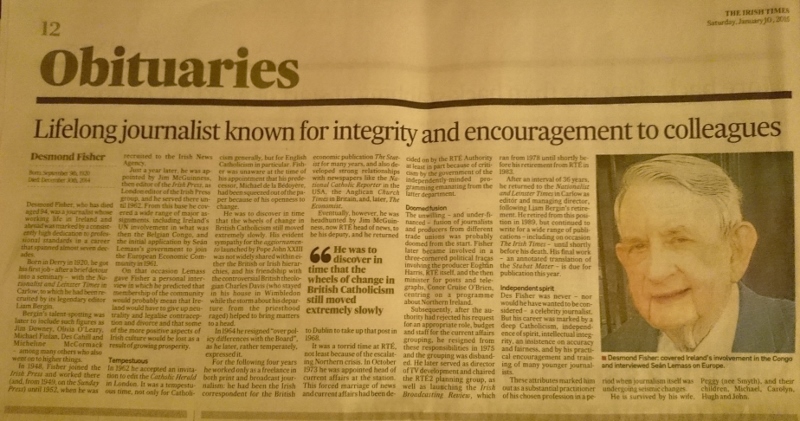
Irish Times Obituary Saturday 10th January 2015 p.12

Lifelong journalist known for integrity and encouragement to colleagues

Desmond Fisher  Born: September 9th 1920  Died: December 30th 2014

Desmond Fisher, who has died aged 94, was a journalist whose working life in Ireland and abroad was marked by a consistently high dedication to professional standards in a career that spanned almost seven decades.

Born in Derry in 1920, he got his first job — after a brief detour into a seminary — with the Nationalist and Leinster Times in Carlow, to which he had been recruited by its legendary editor Liam Begin.

Bergin’s talent-spotting was later to include such figures as Jim Downey, Olivia O’Leary, Michael Finlan, Des Cahill and Micheline McCormack — among many others who went on to higher things.

In 1948 Fisher joined the Irish Press and worked there (and, from 1949, on the Sunday Press) until 1952, when he was (also) recruited to the Irish News Agency.

Just a year later , he was appointed by Jim McGuinness, then editor of the Irish Press, as London editor of the Irish Press group, and he served there until 1962. From this base he covered a wide range of foreign assignments, including Ireland’s UN involvement in what was then the Belgian Congo, and the initial application by Seán Lemass’s government to join the European Economic Community in 1961.

On that occasion Lemass gave Fisher a personal interview in which he predicted that membership of the community would probably mean that Ireland would have to give up neutrality and legalise contraception and divorce and that some of the more positive aspects of Irish culture would be lost as a result of growing prosperity.

Tempestuous

In 1962 he accepted an invitation to edit the Catholic Herald in London. It was a tempestuous time, not only for Catholicism generally, but for English Catholicism in particular. Fisher was unaware at the time of his appointment that his predecessor, Michael de la Bédoyère, had been squeezed out of the paper because of his openness to change.

He was to discover in time that the wheels of change in British Catholicism still moved extremely slowly. His evident sympathy for the aggiornamento launched by Pope John XXIII was not widely shared within either the British or Irish hierarchies, and his friendship with the controversial British theologian Charles Davis (who stayed in his house in Wimbledon while the storm about his departure from the priesthood raged) helped to bring matters to a head.

In 1964 he resigned “over policy differences with the Board”, as he later, rather temperately, expressed it.

For the following four years he worked only as a freelance in both print and broadcast journalism: he had been the Irish correspondent for the British economic publication The Statist for many years, and also developed strong relationships with newspapers like the National Catholic Reporter in the USA, the Anglican Church Times in Britain, and later, The Economist.

Eventually, however, he was headhunted by Jim McGuinness, now RTÉ head of news, to be his deputy, and he returned to Dublin to take up that post in 1968.

“He was to discover in time that the wheels of change in British Catholicism still moved extremely slowly” 

It was a torrid time at RTÉ, not least because of the escalating Northern crisis. In October 1973 he was appointed head of current affairs at the station. This forced marriage of news and current affairs had been decided on by the RTÉ Authority at least in part because of criticism by the government of the independently-minded programming emanating from the latter department.

Doomed fusion

The unwilling — and under-financed fusion of journalists and producers from different trade unions was probably doomed from the start. Fisher later became involved in a three-cornered political fracas involving the producer Eoghan Harris, RTÉ itself, and the then minister for posts and telegraphs, Conor Cruise O’Brien, centring on a programme about Northern Ireland.

Subsequently, after the authority had rejected his request for an appropriate role, budget and staff for the current affairs grouping, he resigned from these responsibilities in 1975 and the grouping was disbanded. He later served as director of TV development and chaired the RTÉ2 planning group, as well as launching the Irish Broadcasting Review, which ran from 1978 until shortly before his retirement from RTÉ in 1983.

After an interval of 36 years, he returned to the Nationalist and Leinster Times in Carlow as editor and managing director, following Liam Bergin’s retirement. He retired from this position in 1989, but continued to write for a wide range of publications — including on occasion The Irish Times — until shortly before his death. His final work — an annotated translation of the Stabat Mater — is due for publication this year.  DSC_0941 (800x421)

Independent spirit

Des Fisher was never — nor would he have wanted to be considered — a celebrity journalist. But his career was marked by a deep Catholicism, independence of spirit, intellectual integrity, an insistence on accuracy and fairness, and by his practical encouragement and training of many younger journalists.

These attributes marked him out as a substantial practitioner of his chosen profession in a period when journalism itself was undergoing seismic changes.

He is survived by his wife, Peggy (nee Smyth), and their children, Michael, Carolyn, Hugh and John.


Share this:

  • Share on Facebook (Opens in new window) Facebook
  • Share on X (Opens in new window) X
Like Loading...
NEWS POLITICS UNCATEGORISED Catholic HeraldDesmond FisherIrish PressIrish TimesRTÉ Leave a comment

DESMOND FISHER (8)

11/01/2015 by borderroamer

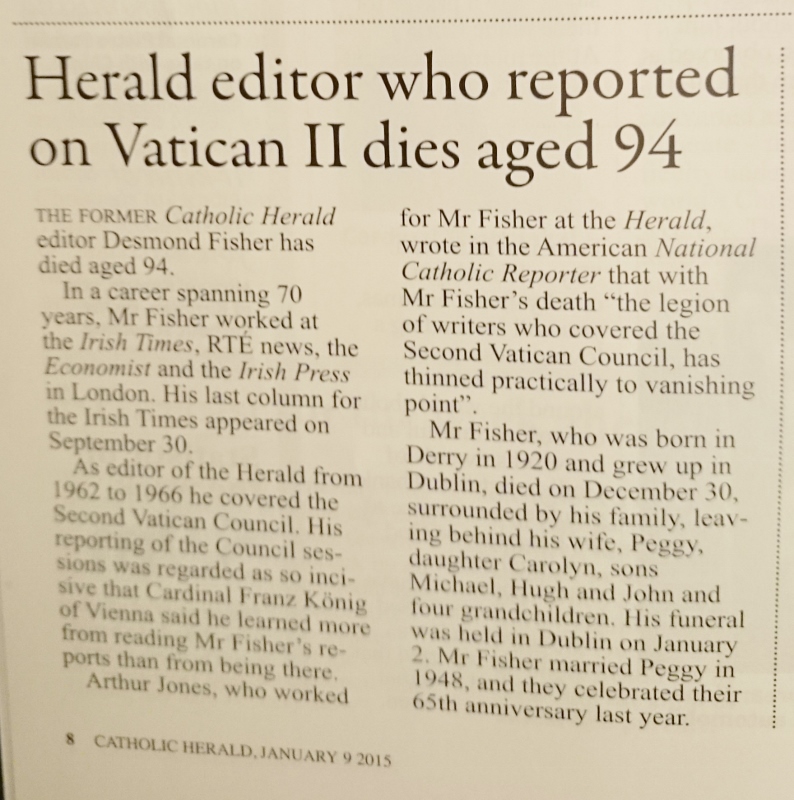
DSC_0907 (2) (612x800)CATHOLIC HERALD:  January 9 2015      Home News  p.8 Revered ex-Catholic Herald editor is mourned

Herald editor who reported on Vatican II dies aged 94

THE FORMER Catholic Herald editor Desmond Fisher has died aged 94.

In a career spanning 70 years, Mr Fisher worked at the Irish Times, RTÉ news, the Economist and the Irish Press in London. His last column for the Irish Times appeared on September 30.

As editor of the Herald from 1962 to 1966 he covered the Second Vatican Council. His reporting of the Council sessions was regarded as so incisive that Cardinal Franz König of Vienna said he learned more from reading Mr Fisher’s reports than from being there.

Arthur Jones, who worked for Mr Fisher at the Herald, wrote on the American National Catholic Reporter that with Mr Fisher’s death “the legion of writers who covered the Second Vatican Council has thinned practically to vanishing point”.

Mr Fisher, who was born in Derry in 1920 and grew up in Dublin, died on December 30, surrounded by his family, leaving behind his wife Peggy, daughter Carolyn, sons Michael, Hugh and John and four grandchildren. His funeral was held in Dublin on January 2. Mr Fisher married Peggy in 1948, and they celebrated their 65th anniversary last year. (2013)  DSC_0909 (2) (794x800)

Share this:

  • Share on Facebook (Opens in new window) Facebook
  • Share on X (Opens in new window) X
Like Loading...
NEWS UNCATEGORISED Arthur JonesCatholic HeraldDesmond FisherNational Catholic Reporter Leave a comment

DESMOND FISHER (7)

10/01/2015 by borderroamer

image

Lives Remembered: The Irish News Saturday 10th January
Desmond Fisher 1920-2014

My father was one of two Derrymen heading RTÉ News on the day of the banned Civil Rights march in the city on October 5 1968. The other was his former Irish Press boss Jim McGuinness, who had been instrumental in bringing him back to Dublin in 1967. That was eighteen months after my father’s resignation on a matter of principle as Editor of the Catholic Herald over his coverage of Vatican II. His articles from Rome, although acclaimed internationally, were regarded as too progressive by members of the English and Irish hierarchy, including Bishop Farren of Derry, his former headmaster at St Columb’s College.

Jim McGuinness, according to my father, “made the cogent argument that posterity would never forgive RTÉ if it failed to cover, as well as the BBC did, the historic developments in the North, which we claimed to be part of our own country”. Thus it was that news cameraman Gay O’Brien obtained remarkable footage of the Derry demonstration including protestors being hit with batons by the RUC.  The film was offered by RTÉ to other television stations via the Eurovision news exchange. Those scenes put the North’s problems on the international agenda.

In August 1969 my father was the senior RTÉ executive on duty when Taoiseach Jack Lynch arrived to address the nation, following the outbreak of serious rioting in Derry. He arranged for the annotated script to be typed out. For the record Mr Lynch said: “It is clear…that the Irish Government can no longer stand by and see innocent people injured and perhaps worse” (not using the word ‘idly’). Many years later my father recalled how Mr Lynch had privately asked him what he thought would happen if he ordered the (Irish) army to go into the North, as some had advised. Des told Lynch he thought the army would get some 20 miles across the border into Derry or Co. Down before suffering heavy casualties in a fight with the British. Mr Lynch told him he had come to the same conclusion.

My father’s parents lived in West End Park, Derry, and moved to Dublin with their three children when he was 11. He won an all-Ireland scholarship for Good Counsel College in New Ross. He took the education, but decided the Augustinian priesthood was “not for me”. He began and ended his active career with the Carlow Nationalist. His knowledge of Irish, Greek and Latin was exceptional. At 94, he had just completed a book, typed by himself, containing a new translation of the Stabat Mater.

DESMOND FISHER who died in Dublin on December 30 is survived by his wife Peggy and four children: Michael, Carolyn, Hugh and John.

Share this:

  • Share on Facebook (Opens in new window) Facebook
  • Share on X (Opens in new window) X
Like Loading...
NEWS POLITICS UNCATEGORISED Catholic HeraldDerryDesmond FisherIrish NewsIrish PressJack LynchLives RememberedRTÉ News Leave a comment

DESMOND FISHER (6)

09/01/2015 by borderroamer
Desmond Fisher  Photo:  © Michael Fisher

Desmond Fisher Photo: © Michael Fisher

Desmond Fisher 1920-2014

An appreciation (in The Irish Catholic)  ic-logo

Michael Fisher

It was, my father said, the best news he heard in 50 years. Days before his death, I read him Pope Francis’ address to the Curia, outlining 15 diseases they suffered. He had a progressive view of the Catholic Church, inspired by the time he reported from Rome on Vatican II, where he made many friends including Belgian Cardinal Leo Suenens and theologian Fr Karl Rahner.

The Vatican II version of the Church, he pointed out, is a “communion” of members sharing a common task, rather than a pyramid structure. As Editor of The Catholic Herald, his authoritative coverage of Pope John XXIII’s initiative for change was widely praised in the English-speaking Catholic world. However, it annoyed Archbishop John Charles McQuaid of Dublin who found his articles “very objectionable”.

The conservative English hierarchy, led by Cardinal John Heenan, complained to the newspaper’s directors, who recalled him to London. His archive notes describe this as one of the bitterest blows of his life. It was, he said, a consolation that history seemed to have supported his version of Vatican II rather than the Cardinal’s.

He resigned from the paper and freelanced for a year. One of his tasks was to handle the copious media enquiries he received regarding Charles Davis. In December 1966 Fr Davis, then the best-known Catholic theologian in Britain, announced he was leaving the Church.

My father was proud of his roots in Derry, where he was born in 1920. His parents (a mixed marriage) moved to Dublin and aged 11, he won an all-Ireland scholarship for secondary schooling at Good Counsel College in New Ross, run by the Augustinians. He took the education, but decided the priesthood was “not for me”.

Translation

His knowledge of Irish, Greek and Latin was exceptional, and at 94 he had just completed a book, typed by himself on his laptop, containing a new translation of the Stabat Mater. It is due to be published by Gracewing later this month. With a BA from UCD, his first job, at age 25, was assistant to the editor of The Nationalist and Leinster Times, Liam Bergin, who became a lifelong friend. In 2011 he stepped down as Vice-Chairman of the same paper.

My first memories of my father are from the time he was London Editor of the Irish Press in Fleet Street. He acted as the Group’s Diplomatic Correspondent, and in 1960 spent three months covering the UN when Frank Aiken chaired the General Assembly. The same year he reported from the Congo on Irish soldiers on UN duty being held prisoner in Jadotville.

Desmond Fisher returned to Ireland in 1967 as RTÉ’s Deputy Head of News, joining fellow Derryman Jim McGuinness.

He later became Head of Current Affairs in RTÉ and after a second resignation on a point of principle was appointed Director of Broadcasting Development. He became involved in the birth of Raidió na Gaeltachta and later RTÉ2.

On retirement from RTÉ in 1983 he returned to Carlow as Editor and Managing Editor of The Nationalist until 1989. He was author of The Church in Transition, a book on the Vatican Council, Broadcasting in Ireland, The Right to Communicate and several pamphlets.

Michael Fisher is a journalist.

Share this:

  • Share on Facebook (Opens in new window) Facebook
  • Share on X (Opens in new window) X
Like Loading...
NEWS UNCATEGORISED Archbishop McQuaidCatholic HeraldCharles DavisDerryDesmond FisherIrish CatholicIrish PressPope FrancisRTÉVatican II Leave a comment

DESMOND FISHER (5)

08/01/2015 by borderroamer
Desmond Fisher

Desmond Fisher

The Editor of The Irish Catholic Michael Kelly, who was in contact with my father in recent years, has written the following summary of his life. It was only since 2011 that my father started to read the paper when he became ‘reconciled’ with the parish of Mount Merrion and a new Parish Priest, thanks to a Eucharistic Minister who brought him a copy every week. Ironically, the paper used to be owned by the Catholic Herald group, with whom my father had parted company ‘without regret’ in May 1966, having had ‘policy differences’ with the Board of Directors relating to his progressive coverage of the Vatican Council.

ic-logo
Death of Vatican II and RTE journalist Desmond Fisher
Des Fisher’s ‘incisive’ work gave Irish Catholics an insight into the momentous event that was Vatican II, writes Michael Kelly

The death of journalist Desmond Fisher on December 30 at the age of 94 can truly be described as the end of an era. For decades, Mr Fisher was a prominent journalist who travelled extensively. He made a remarkable contribution to religious affairs, particularly during the Second Vatican Council (1962-65) where he reported from Rome for a time. In retirement, he was an occasional contributor to The Irish Catholic.

His reporting was acknowledged as incisive, with Vienna’s Cardinal Franz König reportedly saying that he learned “more of what is going on at the council from your superb reports” than he heard “while on the spot”.

Mr Fisher, as editor of The Catholic Herald, was in Rome in 1962 before the council opened. He also wrote for the Irish Press, giving Irish Catholics an insight into the momentous event that was Vatican II.

Article

According to Arthur Jones, who worked closely with Mr Fisher, when the latter resigned in 1966, an anonymous article in Herder Correspondence described the backdrop.

“Many bishops in England and Scotland, plus Dublin’s overbearing Archbishop John Charles McQuaid, had strongly opposed Fisher’s interpretation of council events – McQuaid called it ‘very objectionable.’

“When Fisher resigned, dozens of other bishop-attendees wrote to say quite the opposite,” according to Mr Jones.

He was born in Derry in 1920 and his first foray in to journalism was at the age of 25.

Mr Fisher and his wife, Margaret (Peggy), wed in 1948 and marked their 65th wedding anniversary in 2013. (66th in 2014)

For four years, Mr Fisher was with the Irish Press, and in 1954 became its London editor and daily columnist. He became the Press political correspondent and travelled widely in the early 1960s.

In 1962, he wrote in The Catholic Herald that a lay-owned and independent Catholic paper had “a freedom that is journalistically necessary if it is to carry out what it conceives to be its function and which relieves the hierarchy and the clergy generally of any responsibility for opinions expressed in its columns”.

It is a sentiment very close to the heart of The Irish Catholic.

He began working for RTÉ in 1967 and was, for 14 years, Ireland correspondent for The Economist.

Desmond Fisher died peacefully in Blackrock Hospice after a short illness. He is survived by his wife Peggy, daughter Carolyn, sons Michael, Hugh and John, daughters-in-law Evelyn, Ruth and Carmel, grandchildren Sarah, Clare, Sam and Lucy, sister Deirdre, sisters-in-law Nuala Fisher and Sr Nora Smyth, nephews, nieces and a wide circle of friends.

Anima eius et animae omnium fidelium defunctorum per Dei misericordiam requiescant in pace.

Share this:

  • Share on Facebook (Opens in new window) Facebook
  • Share on X (Opens in new window) X
Like Loading...
NEWS UNCATEGORISED Catholic HeraldDesmond FisherIrish CatholicMichael KellyVatican II Leave a comment

DESMOND FISHER (4)

07/01/2015 by borderroamer

My father Des Fisher was Editor of the Catholic Herald when Arthur Jones worked there. Their paths crossed again when Dad was guest Editor of the National Catholic Reporter in Kansas City MO in 1980. Arthur kept in touch over the years and recently sent my father a copy of his new book on the history of NCR, which he read with interest.

In September 2011 Arthur Jones visited Desmond Fisher in Dublin. He then travelled to Belfast to meet me and he gave an interview to the BBC Radio Ulster ‘Sunday Sequence’ programme presented by William Crawley. He wrote to me before departing from Baltimore, Maryland, on the trip:

ARTHUR JONES:

Liverpool-born journalist Arthur Jones entered Catholic journalism in America in 1962 on the Catholic Star Herald in New Jersey, before the 1962-65 Second Vatican Council began. The Ruskin College, Oxford-educated Jones was soon covering the “social gospel” issues: poverty, racism, traveling with the migrant farmworkers. At the highest levels he covered the first meetings between the US and Latin American hierarchies. In 1963 he used his British passport to report from Cuba on the suppression of the church under Castro. The following year he wrote the first extensive coverage of the Pius XII and the Jews drama. In 1965 he was on Fleet Street writing for the Catholic Herald where Irish journalist Desmond Fisher, later RTÉ Head of Current Affairs, was editor. Forty five years later, “we’re still fighting with one another, trying to outdo each other’s stories and jibes.” They lunched together in Dublin last Saturday (September 3rd **2011**): combined ages 166.

In 1975 he became editor of the independent National Catholic Reporter and expanded the newspaper’s range and investigative reporting in Central and Latin America, Rome and, most particularly, the United States. After serving also as the paper’s publisher and president of the company, in 1980 he stepped aside to return to reporting as editor-at-large, covering the globe, acting periodically as Washington correspondent, moving back to national and by the mid-1980s,  building the case regarding clerical sexual abuse.

in June 1985, seventeen years before the first secular U.S. national coverage, Jones broke wide open the American sexual abuse crisis in the National Catholic Reporter…Jones is the author of a dozen books, and has a separate career world as an economic and financial writer. He’s a former New York associate editor and European bureau chief of Forbes Magazine, a business magazine, a former FT correspondent, and, he says, “more besides.” He has worked for the National Catholic Reporter for 35 years, beginning as editor and after serving as editor-and-publisher, slowly worked his way down the ladder to become a reporter again.

Vatican II reporter Desmond Fisher dies at age 94

With the death on Dec. 30 of the noted Irish Catholic writer Desmond Fisher at age 94, the legion of writers who covered the Second Vatican Council (1962-65), has thinned practically to vanishing point.
Desmond Fisher  Photo: NCR/Pam Bauer

Desmond Fisher Photo: NCR/Pam Bauer

Fisher, as editor of The Catholic Herald on London’s Fleet Street, was in Rome in 1962 before the council opened to set up the Herald’s coverage. (His anecdote of Pope John XXIII from that time appeared in NCR’s 2012 Vatican II anniversary special. Fisher was also NCR guest editor for three weeks in 1980 and an occasional contributor.)

Fisher himself covered the 1963 and 1964 sessions of the council for the Herald and the Irish Press Group. Vienna’s Cardinal Franz König said in a note to Fisher that he learned “more of what is going on at the council from your superb reports” than he heard “while on the spot.”

In equal measure, Fisher’s council coverage offended some cardinals, not least Cardinal John Heenan of Westminster, England. The Catholic Herald’s owners — whether pressured by Heenan or not — recalled Fisher to London.

When Fisher resigned in 1966, an anonymous article in Herder Correspondence described the backdrop. Many bishops in England and Scotland, plus Dublin’s over-bearing Archbishop John McQuaid, had strongly opposed Fisher’s interpretation of council events — McQuaid called it “very objectionable.” When Fisher resigned, dozens of other bishop-attendees wrote to say quite the opposite.

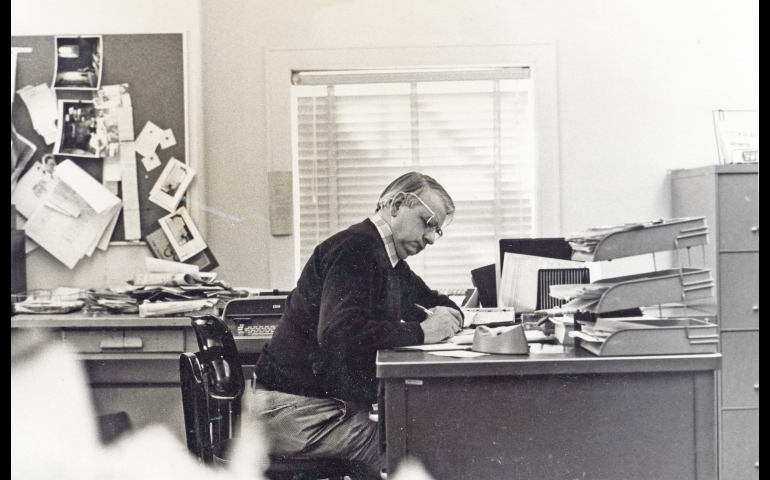
Desmond Fisher in NCR Newsroom 1980  Photo: NCR/Pam Bauer

Desmond Fisher in NCR Newsroom 1980 Photo: NCR/Pam Bauer

Fisher was born Derry, Ireland, on Sept. 9, 1920. Ireland was still a united land: This was prior to the “partition” that created Northern Ireland.

His father, who worked for a firm of wholesale wine and tea shippers — which explains in part Fisher’s own fondness for and knowledge of wine — moved to Dublin to establish an office there.

At age 11, Fisher won the all-Ireland scholarship that provided five years of secondary education at a school run by a religious order. He took the education, but not religious orders. His Irish, Greek and Latin were exceptional, and at 91 he completed a new translation of the Stabat Mater.

With a bachelor’s degree from University College Dublin, his first job, at age 25, was assistant to the editor of The Nationalist and Leinster Times. He became an experienced copy editor and reporter. His first editorial said, “True peace cannot be based on fear. For true peace transcends the bounds of policy and diplomacy. … It must be founded on freedom and justice, on the recognition that man is a spiritual being created for an eternal destiny and not a pawn in the game of power politics.”

Sixty-five years later, Fisher remarked, “It was a bit full-blown for an Irish provincial newspaper. But I would change very little. Pope John XXIII said much the same 18 months later in Pacem in Terris.”

Fisher and his wife, Margaret (Peggy), wed in 1948 and marked their 65th wedding anniversary in (September) 2013.

For four years, Fisher was with the Irish Press, and in 1952 became its London editor and daily columnist. He became the Press political correspondent and traveled widely overseas in the early 1960s. That began with a three-month United Nations Fellowship. He was present at the U.N. General Assembly during the famous scene when Nikita Khrushchev banged his shoe on the desk.

In 1962, in his first Catholic Herald editorial, he wrote that a lay-owned and independent Catholic paper had “a freedom that is journalistically necessary if it is to carry out what it conceives to be its function and which relieves the hierarchy and the clergy generally of any responsibility for opinions expressed in its columns.”

Recruited by RTÉ (Raidió Teilifís Éireann) as deputy head of news, by 1973 Fisher was head of current affairs. There, after several years of bureaucratic infighting over an unhonored agreement to make current affairs its own division, Fisher was promoted sideways to director of TV development.

For 14 years, he was also Ireland correspondent for The Economist. He left RTÉ on “early” retirement and returned to his origins, as editor and managing director of The Nationalist and Leinster Times, where his career had begun.

The Fishers lived in Dublin. Survivors include Peggy, four children and four grandchildren. Desmond Fisher had outlived practically all his journalistic contemporaries.

[Arthur Jones, NCR editor from 1975 to 1980, worked for Fisher at The Catholic Herald from 1964 to 1966.]

Share this:

  • Share on Facebook (Opens in new window) Facebook
  • Share on X (Opens in new window) X
Like Loading...
NEWS UNCATEGORISED Arthur JonesCatholic HeraldDesmond FisherIrish PressNational Catholic ReporterRTÉ NewsVatican II 1 Comment

Post navigation

← Older posts
Newer posts →

Recent Posts

  • DESMOND FISHER 1920-2014 30/12/2020
  • GAJ AWARDS 2020 24/12/2020
  • COVID-19 REPORTING AWARD 20/12/2020
  • HAPPY 100TH BIRTHDAY 31/03/2020
  • NUJ VOTING REMINDER 26/01/2020
  • WORLD PRESS FREEDOM 20/01/2020
  • REMINDER TO VOTE 18/01/2020
  • BOND, WE’VE BEEN EXPECTING YOU! 17/01/2020
  • NUJ MEMBERS IN IRELAND 09/01/2020
  • NUJ BLAST FROM THE PAST 08/01/2020

Archives

  • Dec 2020 (3)
  • Mar 2020 (1)
  • Jan 2020 (13)
  • Oct 2019 (10)
  • Sep 2019 (30)
  • Aug 2019 (31)
  • Jun 2019 (2)
  • May 2019 (1)
  • Sep 2018 (1)
  • Jul 2017 (1)
  • Dec 2016 (12)
  • Sep 2016 (2)
  • Aug 2016 (5)
  • Jul 2016 (5)
  • Jun 2016 (10)
  • May 2016 (15)
  • Apr 2016 (19)
  • Mar 2016 (14)
  • Jan 2016 (26)
  • Dec 2015 (2)
  • Aug 2015 (1)
  • Jul 2015 (30)
  • Jun 2015 (30)
  • May 2015 (32)
  • Apr 2015 (30)
  • Mar 2015 (31)
  • Feb 2015 (28)
  • Jan 2015 (31)
  • Dec 2014 (31)
  • Nov 2014 (14)
  • Mar 2014 (2)
  • Feb 2014 (2)
  • Jan 2014 (31)
  • Dec 2013 (19)
  • Nov 2013 (17)
  • Oct 2013 (29)
  • Sep 2013 (30)
  • Aug 2013 (31)
  • Jul 2013 (31)
  • Jun 2013 (30)
  • May 2013 (28)
  • Apr 2013 (32)
  • Mar 2013 (31)
  • Feb 2013 (28)
  • Jan 2013 (31)
  • Dec 2012 (3)
  • Oct 2012 (1)
  • Sep 2012 (1)
  • Aug 2012 (2)
  • Jul 2012 (3)
  • Jun 2012 (3)
  • May 2012 (3)
  • Apr 2012 (5)
  • Mar 2012 (1)
  • Jan 2012 (1)
  • Dec 2011 (1)
  • Nov 2011 (1)
  • Jun 2011 (1)
  • May 2011 (1)
  • Apr 2011 (2)
  • Dec 2010 (1)
  • Nov 2010 (3)
  • Oct 2010 (6)
  • Aug 2010 (1)
  • Jul 2010 (7)

Categories

Meta

  • Create account
  • Log in
  • Entries feed
  • Comments feed
  • WordPress.com

Enter your email address to follow this blog and receive notifications of new posts by email.

36th Ulster Division 2013 WPFG AFC Wimbledon An Bord Pleanála Ballinode Balmoral Show Barry McCall Battle of Somme BBC belfast Belfast Festival Belfast Lions Club Big Music Week Birmingham BOSE Bristol Carlow Carrickmacross Castleblayney Catholic Herald Clogher Clones CMAPC Defence Forces Derry Desmond Fisher Dublin EirGrid Emyvale Fine Gael GAA Geel Glaslough Heather Humphreys TD Iarnród Éireann Ice Hockey Ieper Inniskeen Irish Press Kingsmeadow London Meath Michael Fisher Monaghan Monaghan County Council NEC NEPPC Newbridge North/South Interconnector Northern Standard NUJ Odyssey Arena Patrick Comerford Pope Francis Poperinge Private Robert Hamilton PSNI Royal Irish Fusiliers RTÉ SDLP Shamrock Rovers Shared History Shared Future SIPTU St Macartan's Cathedral Tallaght Tydavnet Tyrone Ulster rugby Vatican II William Carleton William Carleton Society William Carleton summer school WW1 WWI WWII

Blog Stats

  • 243,590 hits
Blog at WordPress.com.
Michael Fisher's News
Blog at WordPress.com.
  • Subscribe Subscribed
    • Michael Fisher's News
    • Join 173 other subscribers.
    • Already have a WordPress.com account? Log in now.
    • Michael Fisher's News
    • Subscribe Subscribed
    • Sign up
    • Log in
    • Report this content
    • View site in Reader
    • Manage subscriptions
    • Collapse this bar
 

Loading Comments...
 

    %d