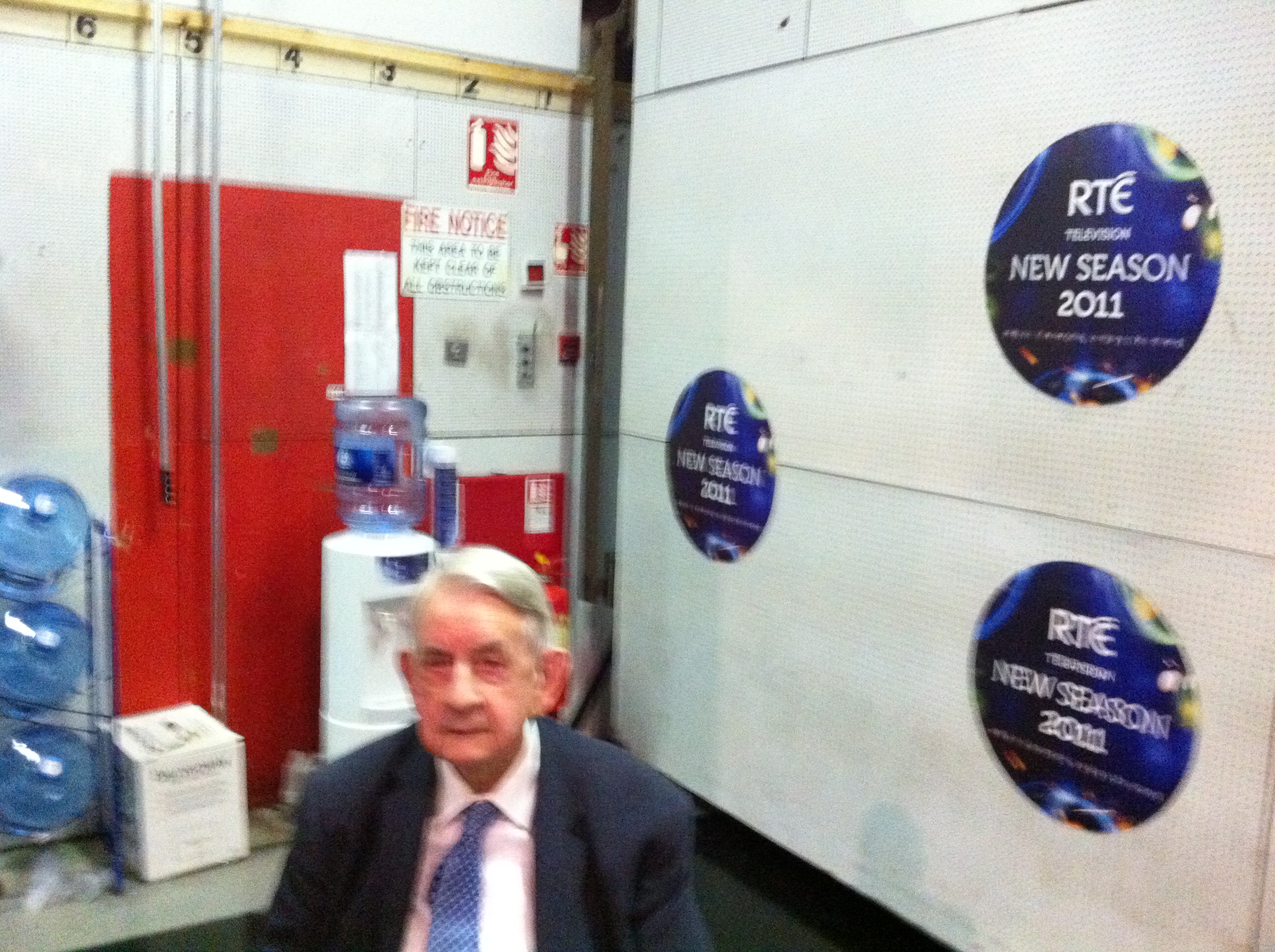
DESMOND FISHER (9)

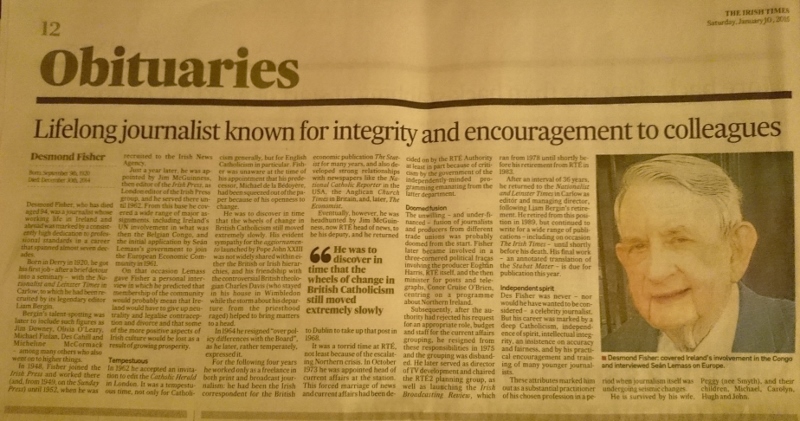
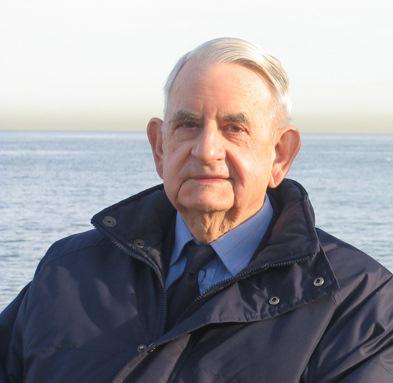
Desmond Fisher  Photo:  © Michael Fisher

Desmond Fisher Photo: © Michael Fisher

Irish Times Obituary Saturday 10th January 2015 p.12

Lifelong journalist known for integrity and encouragement to colleagues

Desmond Fisher  Born: September 9th 1920  Died: December 30th 2014

Desmond Fisher, who has died aged 94, was a journalist whose working life in Ireland and abroad was marked by a consistently high dedication to professional standards in a career that spanned almost seven decades.

Born in Derry in 1920, he got his first job — after a brief detour into a seminary — with the Nationalist and Leinster Times in Carlow, to which he had been recruited by its legendary editor Liam Begin.

Bergin’s talent-spotting was later to include such figures as Jim Downey, Olivia O’Leary, Michael Finlan, Des Cahill and Micheline McCormack — among many others who went on to higher things.

In 1948 Fisher joined the Irish Press and worked there (and, from 1949, on the Sunday Press) until 1952, when he was (also) recruited to the Irish News Agency.

Just a year later , he was appointed by Jim McGuinness, then editor of the Irish Press, as London editor of the Irish Press group, and he served there until 1962. From this base he covered a wide range of foreign assignments, including Ireland’s UN involvement in what was then the Belgian Congo, and the initial application by Seán Lemass’s government to join the European Economic Community in 1961.

On that occasion Lemass gave Fisher a personal interview in which he predicted that membership of the community would probably mean that Ireland would have to give up neutrality and legalise contraception and divorce and that some of the more positive aspects of Irish culture would be lost as a result of growing prosperity.

Tempestuous

In 1962 he accepted an invitation to edit the Catholic Herald in London. It was a tempestuous time, not only for Catholicism generally, but for English Catholicism in particular. Fisher was unaware at the time of his appointment that his predecessor, Michael de la Bédoyère, had been squeezed out of the paper because of his openness to change.

He was to discover in time that the wheels of change in British Catholicism still moved extremely slowly. His evident sympathy for the aggiornamento launched by Pope John XXIII was not widely shared within either the British or Irish hierarchies, and his friendship with the controversial British theologian Charles Davis (who stayed in his house in Wimbledon while the storm about his departure from the priesthood raged) helped to bring matters to a head.

In 1964 he resigned “over policy differences with the Board”, as he later, rather temperately, expressed it.

For the following four years he worked only as a freelance in both print and broadcast journalism: he had been the Irish correspondent for the British economic publication The Statist for many years, and also developed strong relationships with newspapers like the National Catholic Reporter in the USA, the Anglican Church Times in Britain, and later, The Economist.

Eventually, however, he was headhunted by Jim McGuinness, now RTÉ head of news, to be his deputy, and he returned to Dublin to take up that post in 1968.

“He was to discover in time that the wheels of change in British Catholicism still moved extremely slowly” 

It was a torrid time at RTÉ, not least because of the escalating Northern crisis. In October 1973 he was appointed head of current affairs at the station. This forced marriage of news and current affairs had been decided on by the RTÉ Authority at least in part because of criticism by the government of the independently-minded programming emanating from the latter department.

Doomed fusion

The unwilling — and under-financed fusion of journalists and producers from different trade unions was probably doomed from the start. Fisher later became involved in a three-cornered political fracas involving the producer Eoghan Harris, RTÉ itself, and the then minister for posts and telegraphs, Conor Cruise O’Brien, centring on a programme about Northern Ireland.

Subsequently, after the authority had rejected his request for an appropriate role, budget and staff for the current affairs grouping, he resigned from these responsibilities in 1975 and the grouping was disbanded. He later served as director of TV development and chaired the RTÉ2 planning group, as well as launching the Irish Broadcasting Review, which ran from 1978 until shortly before his retirement from RTÉ in 1983.

After an interval of 36 years, he returned to the Nationalist and Leinster Times in Carlow as editor and managing director, following Liam Bergin’s retirement. He retired from this position in 1989, but continued to write for a wide range of publications — including on occasion The Irish Times — until shortly before his death. His final work — an annotated translation of the Stabat Mater — is due for publication this year.  DSC_0941 (800x421)
Independent spirit

Des Fisher was never — nor would he have wanted to be considered — a celebrity journalist. But his career was marked by a deep Catholicism, independence of spirit, intellectual integrity, an insistence on accuracy and fairness, and by his practical encouragement and training of many younger journalists.

These attributes marked him out as a substantial practitioner of his chosen profession in a period when journalism itself was undergoing seismic changes.

He is survived by his wife, Peggy (nee Smyth), and their children, Michael, Carolyn, Hugh and John.
  

DESMOND FISHER (7)

image

Lives Remembered: The Irish News Saturday 10th January
Desmond Fisher 1920-2014

My father was one of two Derrymen heading RTÉ News on the day of the banned Civil Rights march in the city on October 5 1968. The other was his former Irish Press boss Jim McGuinness, who had been instrumental in bringing him back to Dublin in 1967. That was eighteen months after my father’s resignation on a matter of principle as Editor of the Catholic Herald over his coverage of Vatican II. His articles from Rome, although acclaimed internationally, were regarded as too progressive by members of the English and Irish hierarchy, including Bishop Farren of Derry, his former headmaster at St Columb’s College.

Jim McGuinness, according to my father, “made the cogent argument that posterity would never forgive RTÉ if it failed to cover, as well as the BBC did, the historic developments in the North, which we claimed to be part of our own country”. Thus it was that news cameraman Gay O’Brien obtained remarkable footage of the Derry demonstration including protestors being hit with batons by the RUC.  The film was offered by RTÉ to other television stations via the Eurovision news exchange. Those scenes put the North’s problems on the international agenda.

In August 1969 my father was the senior RTÉ executive on duty when Taoiseach Jack Lynch arrived to address the nation, following the outbreak of serious rioting in Derry. He arranged for the annotated script to be typed out. For the record Mr Lynch said: “It is clear…that the Irish Government can no longer stand by and see innocent people injured and perhaps worse” (not using the word ‘idly’). Many years later my father recalled how Mr Lynch had privately asked him what he thought would happen if he ordered the (Irish) army to go into the North, as some had advised. Des told Lynch he thought the army would get some 20 miles across the border into Derry or Co. Down before suffering heavy casualties in a fight with the British. Mr Lynch told him he had come to the same conclusion.

My father’s parents lived in West End Park, Derry, and moved to Dublin with their three children when he was 11. He won an all-Ireland scholarship for Good Counsel College in New Ross. He took the education, but decided the Augustinian priesthood was “not for me”. He began and ended his active career with the Carlow Nationalist. His knowledge of Irish, Greek and Latin was exceptional. At 94, he had just completed a book, typed by himself, containing a new translation of the Stabat Mater.

DESMOND FISHER who died in Dublin on December 30 is survived by his wife Peggy and four children: Michael, Carolyn, Hugh and John.

DESMOND FISHER (3)

Des Fisher interviewed by John Bowman Sept. 2011 Photo: RTÉ

Des Fisher interviewed by John Bowman Sept. 2011 Photo: RTÉ

Desmond Fisher was not just a noted Catholic religious commentator. He was also a senior RTÉ executive during an important time in Irish history that saw the outbreak of the troubles in 1969. He was a former Head of Current Affairs and Deputy Head of News at RTÉ and died last week, aged 94. In this article specially written for RTÉ News Online, RTÉ’s Religious and Social Affairs Correspondent Joe Little looks back at his career… 

Mr Fisher was one of the last surviving journalists to have reported from Rome on the Second Vatican Council which ended half a century ago.

His family had asked that his passing on 30 December last should not be made public until after his cremation which, in accordance with his wishes, took place after a private family Requiem Mass was celebrated last Friday, 2 January.

In a document released by his family, he described his experiences as a senior editorial manager at RTÉ in the early years of the Northern Troubles as the most stressful time in his working life.

Before coming to broadcasting, Des as he was widely known, had worked on the Nationalist and Leinster Times and with the Irish Press where he served as London Editor and Political Correspondent.

In 1962, as Pope John XXXIII was convening the Second Vatican Council, he took the helm at the Catholic Herald in London.

A graduate of UCD, he belonged to a post-revolutionary generation of thinkers hungry to learn about the wider world and particularly about stirrings of change in the universal Catholic Church which were stifled by the hierarchy here, thanks largely to the ultra-conservative Archbishop of Dublin, John Charles McQuaid, who was appointed in 1940 when Des Fisher was 20 years old.

“It was alienating modern men and women and losing many existing members…”

Writing for this website two years ago, he described Pope John’s motivation in calling the Vatican Council which was to bring the Church face-to-face with the modern world: “He had seen that the Roman Catholic Church was not fulfilling the task for which Christ established it.

“Instead of motivating more and more new members to follow Christ and come to love and worship God, it was alienating modern men and women and losing many existing members.”

He described how most of the 2,500 Council Fathers or church leaders who favoured change had to reckon with a highly regimented traditionalist minority: “They took their lead from the Roman Curia, which was against change from beginning to end of the Council and is still opposed to implementing the Council’s decisions.

Desmond Fisher photo for RTÉ News Online article taken on his laptop Oct. 2012

Desmond Fisher photo for RTÉ News Online article taken on his laptop Oct. 2012

Despite the obstacles the Council produced five major documents.

Taken together, they portray a new kind of Catholic Church very different from the 16th century Counter-Reformation version that still prevails.

The Vatican II Church abandons the existing portrayal of the Church as a pyramid with the Pope on top of descending tiers of cardinals, bishops and priests sitting on a bottom layer of lay Catholics whose only function, as a bishop told the Council, seems to be “to pray, to obey and to pay”.

The Vatican II version of the Church is a “communion” of members sharing a common task to convince all the people of the world that God loves them and that Christ is the example of how to love and serve him.

In this Church lay people are not the passive onlookers they are seen as now but the most active workers at the coalface.”

Mr Fisher’s reference to the Curia’s ongoing opposition to reform foreshadowed the yet-to-be-elected Pope Francis’ scathing attack last month on Vatican’s administrators for being infected with careerism, scheming, greed and “spiritual Alzheimer’s”.

Not surprisingly, the veteran journalist welcomed the Argentine Popes election in 2013.

Des Fisher interviewed by John Bowman about RTÉ Sep. 28 2011 Photo:  © Michael Fisher

Des Fisher interviewed by John Bowman about RTÉ Sep. 28 2011 Photo: © Michael Fisher

Extracts relating to RTÉ from Desmond Fisher’s own summary of his 70-year career in journalism have been released by his family.

They recall that one year after the Council ended, he left the Catholic Herald and freelanced to support his family in London.

But 18 months later, his former Irish Press colleague and fellow Derry man Jim McGuinness, Head of News at RTÉ, suggested he should apply for a job, about to be advertised, as his deputy.

After short attachments with the BBC and ITV in London in 1967 he came to Dublin in early 1968 to take up the job and to live full-time with his family which had moved to Dublin months earlier.

In October 1973, he was appointed Head of the Current Affairs Grouping, a new area in RTÉ responsible for all current affairs programmes on radio and television.

He wrote of this period: “What I do remember most about my time in RTÉ is that it was the most stressful time in my working life. My time there coincided with external pressure on RTÉ from a Government intent on denying publicity to the IRA and internal conflict between RTÉ producers and journalists working on current affairs programmes.”

“It was probably inevitable that a disaster would occur…”

Those twin pressures soon took their toll: “In the circumstances of the time, however, it was probably inevitable that a disaster would occur. The Current Affairs area is the most vulnerable in broadcasting, especially in a public service organisation with staff of divided political and trade union loyalties at a time when the country is in turmoil.

“On the night of October 17, 1974 while I was in Galway at the Annual Conference of the Labour Party, a seven Days programme on internment in the North was rushed on to the air…replacing the programme which I had cleared for transmission. It later transpired that the filmed programme included a sequence from a London agency, which had been brought in a short time before transmission, edited at the last moment and put out without my clearance.

“This led to a public attack on me on two successive evenings by the then minister in charge of RTÉ, Dr Conor Cruise O’Brien.

The inquiries that followed judged that I should have previewed the programme which, in my view, had been deliberately put out in my absence.

“I offered to resign if this would serve the institutional interests of RTÉ.

“This was refused but in April 1975 I told the then Director-General, Oliver Maloney, that the grouping would have either to be established as a full division with its own resources or closed down.

“He rejected the first alternative so I resigned and the Grouping was disbanded.

“Following my resignation, I was appointed Director of TV Development, a title later changed to Director of Broadcasting Development, a sideways move that really left it to me to determine what I would make of the job.”

He chaired the Planning Group for the station’s second television channel and continued to research and publish material for the public service broadcaster on a range of topics, including its relationship with government.

This was a particularly thorny subject given that in 1972, while he was Deputy Head of News, a Fianna Fáil government had fired the RTÉ Authority after the News Division broadcast a radio interview recorded with Seán Mac Stíofáin, then chief of staff of the Provisional IRA.

The then Taoiseach, Jack Lynch, justified the dismissal saying the Authority had  breached a government directive, given under Section 31 of the Broadcasting Act, ordering them “not to project people who put forward violent means for achieving their purpose”.

The Fine Gael-Labour administration, elected in 1973, had continued to implement the directive.

And this was the context in which Fianna Fáil’s new appointees to the RTÉ Authority and senior RTÉ management figures like Des Fisher, had to handle the seven days debacle in October 1974.

Des Fisher left the national broadcaster in 1983, less than two years before reaching the mandatory retirement age.

He became Editor and Managing Director of the Carlow Nationalist and Leinster Times.

In 2009, approaching the age of 80, he contributed to the RTÉ documentary “If Lynch Had Invaded” about his role with RTÉ in 1969 when the Taoiseach Jack Lynch made a dramatic television broadcast to outline the Government’s response to the security forces attacking nationalist communities in Derry.

In 1967, his book on the Second Vatican Council, “The Church in Transition” was published by (Geoffrey Chapman and) Fides.

He is survived by his wife Margaret (Peggy), daughter Carolyn, and sons Michael, John and Hugh, other close relatives and a wide circle of friends.

Extracts relating to RTÉ from Desmond Fisher’s own summary of his 70-year career in journalism are kindly reproduced courtesy of the Fisher family and are copyright  © 2015 

MIAMI SHOWBAND

Miami Showband  Photo: avaaz.org petition

Miami Showband Photo: avaaz.org petition

Please consider signing the petition at AVAAZ.org:

Why this is important

Dear Bob Geldof, Bono, Sinead O’Connor, Van Morrison and all our Heroic Musical Family,

In 2015 we will mark the 40th anniversary of The Miami Showband Massacre when, during a carefully planned attempt to frame the hugely popular young band as terrorists, three innocent Catholic and Protestant musicians were savagely murdered by British security forces in collusion with the Loyalist terror organisation, The UVF.

In the early hours of July 31st, 1975, while attempting to hide a bomb on the band’s minibus at a bogus security check, two terrorists blew themselves up when the device they were secretly planting exploded prematurely. To eliminate all witnesses, the rest of the gang then opened fire on the unsuspecting musicians, murdering three of them: Lead vocalist / keyboard player, Fran O’Toole, lead guitarist, Tony Geraghty and trumpeter, Brian McCoy, all died at the scene.

Two serving members and one former member of the British security forces’ C Company 11 UDR were subsequently convicted and received life sentences; all three were also members of the Loyalist Mid-Ulster unit of The UVF terror organisation. The leader of the gang, Robert “Robin” Jackson, a former member of The Ulster Defence Regiment, avoided arrest following a tip-off given to him by RUC Special Branch police officers and, despite clear evidence linking him to the killings, Jackson was never charged with the murders. A recent investigation into The Miami Showband Massacre by the British Historical Enquiries Team (HET) identified Robin Jackson as a Police Special Branch agent. He died of natural causes in 1998 aged 49. The British Army Officer, with the posh English accent, in overall charge at the murder scene, has never been positively identified.

Had this evil plan succeeded, every Irish person, especially Irish musicians, would subsequently have been viewed as potential terrorists and the British authorities given carte blanche, by an unsuspecting world, to deal with the Irish as they saw fit i.e. in much the same way as many innocent races are dealt with today by powerful nations and falsely demonised by their compliant media. Fortunately, the wicked plan failed because, although critically wounded, the band’s bass player and saxophone player survived their horrific injuries and lived to tell the truth.

Now, forty years on, with the courageous and unyielding support of “Justice For The Forgotten” and “The Pat Finucane Centre”, the surviving members of The Miami Showband Massacre, bass guitarist Stephen Travers and saxophonist, Des McAlea, are taking a civil action against The British Ministry of Defence (MOD) and The Chief Constable of The Police Service of Northern Ireland (PSNI) for direct involvement in the outrage. Thankfully, this action will not be fought with bricks, bottles or petrol bombs on the streets of Belfast or Derry! It will not be a riot or a running gun-battle! This time, nobody has to die! Unlike the ordered practice of British security forces in 1975, this will not be a secret, murderous campaign waged against the innocent; instead, it will be open and transparent. The impending battle between this modern-day David and Goliath will be fought in a peaceful and civilized manner through the law courts where the truth about British state-terrorism in Ireland will be laid bare for all the world to see.
Remarkably however, while the evidence against the British authorities is overwhelming, the Irish Government has yet to respond to a request for assistance with the considerable cost of taking legal action against its closest neighbour for deliberately attacking and brutally murdering its own citizens. To date, the Irish Government has yet to formally request full British Government cooperation with the legal representatives of The Miami Showband Massacre survivors. In truth, the shameful silence from both governments on one of the most notorious atrocities of “The Troubles” is deafening.
On hearing the story of The Miami Showband Massacre for the first time, in an address by Stephen Travers to an international Radicalisation-Awareness convention, the former Beirut hostage, Terry Waite, exclaimed “Good Lord, they (the British) certainly kept this one quiet”. But, it is no longer morally acceptable to “keep this one quiet”. The time is long overdue for all responsible commentators to speak out publicly against the murder of a Rock n Roll band. The honourable and decent British public have no idea that this outrage was carried out in their name but they must be told in order to prevent it happening again!
Today, the survivors of The Miami Showband Massacre call on every self-respecting musician in the world to stand shoulder-to-shoulder with them in their upcoming fight for justice against a regime that viewed innocent, Catholic and Protestant musicians as nothing more than lambs for the slaughter in pursuit of its own political and military objectives. We gratefully acknowledge the courageous support of our fellow Irish, British, European and American artists along with that of musicians, artists and writers from around the world and we now call on music celebrities that have the ear of world leaders to break their long and perplexing silence on this outrage and to use their powerful voices to demand justice for their slaughtered and permanently injured fellow musicians.
In another time and place…“Well tonight, thank God it’s them instead of you”.
Stephen Travers and John Desmond McAlea (Des Lee) The Miami Showband Massacre Survivors
Relevant Links
http://www.themiamishowband.com
http://www.regentstmedia.com/documentaries.html
http://www.terra-net.eu/files/publications/20131009124655Travers.pdf

Click to access 190_Stephen_Travers.pdf

Follow us on our new Twitter account @MiamiShowband


CLONTIBRET ‘INVASION’

ClontibretIt was hardly an ‘invasion’ in the true military sense. Nothing like the 200,00 Allied forces that invaded Iraq in 2003 or the German invasion of the Soviet Union in 1941 or of Poland in 1939. Yet Peter Robinson’s nocturnal excursion along with a group of 150 loyalists across the border into the quiet County Monaghan village of Clontibret on August 7 1986 was dubbed an ‘invasion’ by some sections of the media.

It was more like a sortie, a raid, an incursion or an infiltration. His intention was to show what he believed were the gaps in cross-border security, following the signing of the Anglo-Irish agreement in 1985. Yet it was the RUC who tipped off the Gardaí about his plans, according to Stormont papers recently released by the Public Record Office of Northern Ireland.

Historian Éamon Phoenix who has researched them says that a note from a Northern Ireland Office official from the Political Affairs Division to the British Ambassador to Dublin refers to about 150 loyalists, “some wearing paramilitary uniforms and carrying cudgels” entering Clontibret.

They daubed the slogan “Ulster is Awakening” on a Garda station and from what I myself remember of the day in question, on some walls including that of a Church of Ireland school. The crowd also injured two Gardaí.

The BBC reports that the note said: “The RUC’s action in tipping off the Gardai during the night of 6-7 August about the incursion by Peter Robinson and his loyalist thugs was also warmly appreciated in Dublin, according to Michael Lillis [of the Irish Department of Foreign Affairs].”

The NIO official who wrote the note told the ambassador: “We have done our little bit here by holding Irish hands in the [Anglo-Irish] Secretariat and feeding them with material for their hourly reports to their ministers during periods of particular tension.” The report notes that the crowd dispersed when gardai fired shots into the air.

“Robinson, who appears to have lingered behind deliberately, was arrested and held in custody for 32 hours (during which he refused all sustenance provided by the gardai, preferring the wholesome Ulster food brought to him by his wife) before being charged with four offences, including assaulting gardai and causing wilful damage.”

Although Mr Robinson was already in Ulster, this reference is to the breakfast brought to him by his wife Iris during his detention at Monaghan Garda station.

The official noted that Mr Robinson (who first appeared in court in Ballybay) was granted bail to appear in court in Dundalk on 14 August.

Other loyalist shows of strength planned to take place on the same night as Clontibret were limited by RUC activity to Swatragh in County Derry where a group of masked men, some carrying firearms, marched through the nationalist village, causing some damage to property. Both incidents were condemned by the British and Irish governments. For its part, the DUP hailed the operation “as a clear indication of the absence of cross-border security”.

A separate file reveals that Peter Robinson and his party leader, Ian Paisley, felt they “narrowly escaped with their lives” and made a formal protest to the British Foreign Office about inadequate protection, following a court appearance in Dundalk over the Clontibret incident.

Peter Robinson later took over from Ian Paisley as DUP leader and First Minister of Northern Ireland.

GOLLY! WATCH YOUR LANGUAGE

Black & White Minstrel Show Record Cover  Photo: 991.com

Black & White Minstrel Show Record Cover Photo: 991.com

My comments tonight are sparked by a Channel 4 television show: It was Alright in the 1970s. Episode two focused on old-fashioned Britishness on TV in the 70s. From blacking-up pre-watershed, through to rampant homophobia and xenophobia, it asked whether the 70s was the decade that taste forgot. Narrated by Matt Lucas, this two-part series included interviews with the people who appeared in the programmes, those who watched them and those who made them, and asked them ‘what were you thinking?’ at the time.

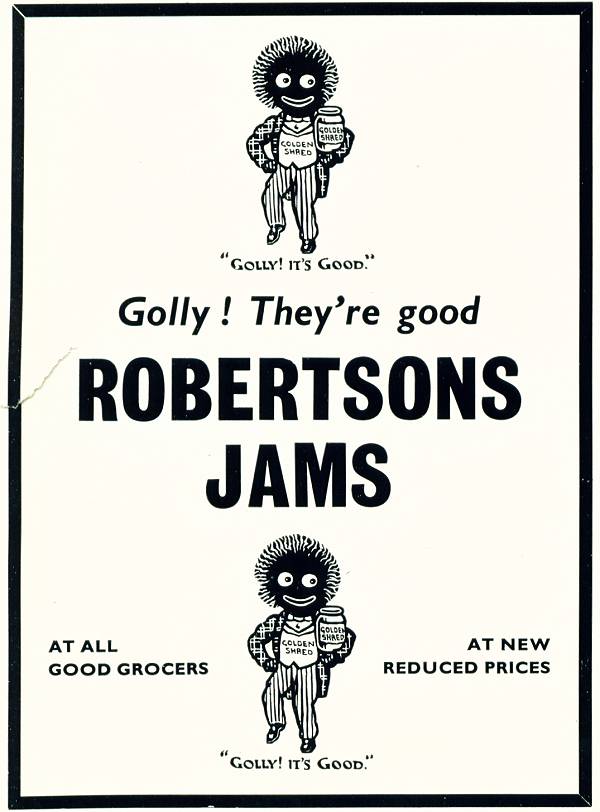
The programme included clips of shows I remember watching such as the ‘Black and White Minstrel Show’ and ‘The Goodies’. There were also bits of comedy from the series ‘Mind your Language’. One of the sequences included a flick through pages from a television guide (probably TV Times, as it included adverts). On one page there was an advert that said: ‘Golly it’s Good’.

Advert for Robertsons Jams 1959  Photo: historyworld.co.uk  Advert Museum

Advert for Robertsons Jams 1959 Photo: historyworld.co.uk Advert Museum

This included a picture of a golly (it is no longer politically correct to use the full version of the word). This was the marketing symbol for many years for Robertsons jams, made in Scotland. Jars of Golden Shred were a common sight on the breakfast table when I was growing up. But six years ago, after being part of British life since 1864, the jam was phased out. The golly character had become very much non-PC.

The black-faced minstrel doll with his natty red bow tie and trousers, flowing blue jacket and distinctive yellow waistcoat, danced his way across the label on pots for the best part of a century. Critics complained that the image was an offensive caricature of black people and was based on slave dolls.

In 1983 the Greater London Council stopped buying the firm’s jam and marmalade, saying Golly was racist. A year later, councillors in Islington, North London, banned a Golly-bearing road safety poster as ‘offensive’.

Roberstons Jam Lid Photo: ebay

Roberstons Jam Lid Photo: ebay

The Working Group Against Racism in Children’s Resources called it ‘undoubtedly an offensive caricature of black people; it embodies the mythical qualities such as the love of music and rhythm, superstition, large appetites, primitive simplicity and savagery’.

For years, Robertson’s defended Golly as a fictional nurseryland character, not a depiction of a black person. However, the character was axed from television adverts in 1988, and then disappeared from the labels printed in 2002. Premier Foods, who bought the brand from RHM in 2007 got rid of Robertson’s jam forever and promoted its other brand Hartley’s instead.

Golly! I had better watch my language in future in case of causing unintentional offence. However that did not seem to bother a 21st Century comedian on television last night. Des Bishop was very funny in parts but much of his sexually explicit language was in my view offensive.

Cartoon (origin unknown)

Cartoon (origin unknown)


ANN LOVETT

Grave of Ann Lovett in Granard  Photo: Wikimedia commons licence By Vankim (Own work) [CC BY-SA 3.0]

Grave of Ann Lovett in Granard Photo: Wikimedia commons licence by Vankim (Own work) [CC BY-SA 3.0]

It was, in the words of the Irish Examiner in January this year, one of the stories that changed Ireland. A 15 year-old schoolgirl Ann Lovett died after giving birth to a baby beside a grotto dedicated to Our Lady in the grounds of the Catholic church in Granard, in County Longford. Friends discovered her with her dead baby and she bled to death before an ambulance arrived to take her to hospital on January 31 1984.

I remember reporting from Granard on the day of her funeral, a time when the media were not welcome in this Midlands town. I got the cameraman to wait until after the funeral to get some pictures of the flowers covering her grave. No-one wanted to talk about the incident on the day but I did manage to get a radio news piece done from a public telephone box situated inside a local hotel. I tried to speak as softly as I could as I did not want those nearby to hear my report.

Although Ann’s death created huge public debate the only reference to her in the newly released National Archives documents is at the back of a file on the visit of US president Ronald Reagan to Ireland that year.

The Irish Times report from Fiona Gartland is as follows:

(The reference to Ann Lovett) “arises in letters from street poet Christopher Daybell to then Taoiseach Garret FitzGerald and Tánaiste Dick Spring about the death. Mr Daybell enclosed a letter to him from the Archdiocese of Armagh written in response to his correspondence, which is not on file. The letter from the Archdiocese, dated February 23rd, a984, said Mr Daybell did “a grave injustice to the people of Granard and particularly to the teachers” at Ms Lovett’s school.

“It is rather difficult to solve a problem that one does not know exists. Any priest could tell you of similar cases where children came to full-term without it being known to either their parents or their teachers.” It said “it was rather unfortunate” Ann did not “make it known even to her friends who might have been able to help her or did not seek medical assistance independently of her parents or teachers. Why she chose to keep her secret will never be known,” it added. “I think her sad death reflects more on her immaturity than on any lack of Christian charity amongst the family and people with whom she lived.”

The letter was signed by the diocesan secretary to the Catholic primate, cardinal Tomás Ó Fiaich, and noted the cardinal was absent. In Mr Daybell’s covering letter to Dr FitzGerald, dated March 3rd, he told the Taoiseach the girl’s death “coupled with” the letter from the archdiocese, had driven him “almost mad”.

“The letter goes beyond hypocrisy – that man in Armagh is incapable of feeling beyond the walls of his office and the great institution into which he has built his being,” he wrote. Referring to the description of Ms Lovett as immature, he wrote, “Why should she not have been so, at 15?” He also asked what assistance or intervention mechanism existed in Granard “apart from those elements which induce fear”. He included a poem he had written about the death.

In his letter of March 2nd to Mr Spring, he said it could emerge, “considering the hideous attitudes of men toward women in rural Ireland”, that Ms Lovett “was driven by forces other than those within herself”. “I await the result of the enquiry in a now cool anger, and hope that it will stiffen the resolve of your government on divorce and contraception,” the poet wrote.

Only one letter in response to Mr Daybell remains on the file. Dated March 8th, it is signed by the Taoiseach’s then private secretary George Shaw. It thanks him for his “further correspondence”, which he said would be brought to the Taoiseach’s attention. In a different typeface, someone printed ‘locate previous papers and put away'”. (end of article)

I could not find a copy of Mr Daybell’s poem. But I did find a very evocative work written in 1991 by another Dublin poet Paula Meehan and available on the web.

“The Statue of the Virgin at Granard”
By Paula Meehan

It can be bitter here at times like this,
November wind sweeping across the border.
Its seeds of ice would cut you to the quick.
The whole town tucked up safe and dreaming,
even wild things gone to earth, and I
stuck up here in this grotto, without as much as
star or planet to ease my vigil.

The howling won’t let up. Trees
cavort in agony as if they would be free
and take off – ghost voyagers
on the wind that carries intimations
of garrison towns, walled cities, ghetto lanes
where men hunt each other and invoke
the various names of God as blessing
on their death tactics, their night manoeuvres.
Closer to home the wind sails
over dying lakes. I hear fish drowning.
I taste the stagnant water mingled
with turf smoke from outlying farms.

They call me Mary – Blessed, Holy, Virgin.
They fit me to a myth of a man crucified:
the scourging and the falling, and the falling again,
the thorny crown, the hammer blow of iron
into wrist and ankle, the sacred bleeding heart.

They name me Mother of all this grief
Though mated to no mortal man.
They kneel before me and their prayers
fly up like sparks from a bonfire
that blaze a moment, then wink out.

It can be lovely here at times. Springtime,
early summer. Girls in Communion frocks
pale rivals to the riot in the hedgerows
of cow parsley and haw blossom, the perfume
from every rushy acre that’s left for hay
when the light swings longer with the sun’s push north.

Or the grace of a midsummer wedding
when the earth herself calls out for coupling
and I would break loose of my stony robes,
pure blue, pure white, as if they had robbed
a child’s sky for their colour. My being
cries out to be incarnate, incarnate,
maculate and tousled in a honeyed bed.

Even an autumn burial can work its own pageantry.
The hedges heavy with the burden of fruiting
crab, sloe, berry, hip; clouds scud east,
pear scented, windfalls secret in long
orchard grasses, and some old soul is lowered
to his kin. Death is just another harvest
scripted to the season’s play.

But on this All Soul’s Night there is
no respite from the keening of the wind.
I would not be amazed if every corpse came risen
From the graveyard to join in exaltation with the gale,
A cacophony of bone imploring sky for judgement
And release from being the conscience of the town.

On a night like this I remember the child
who came with fifteen summers to her name,
and she lay down alone at my feet
without midwife or doctor or friend to hold her hand
and she pushed her secret out into the night,
far from the town tucked up in little scandals,
bargains struck, words broken, prayers, promises,
and though she cried out to me in extremis
I did not move,
I didn’t lift a finger to help her,
I didn’t intercede with heaven,
nor whisper the charmed word in God’s ear.

On a night like this, I number the days to the solstice
and the turn back to the
light.

O sun,
center of our foolish dance,
burning heart of stone,
molten mother of us all,
hear me and have pity.

from http://www.politicalworld.org Poetry:- ‘The Invitation’ and others

Also Christopher Fox Graham website

http://foxthepoet.blogspot.ie/2008/10/statue-of-virgin-at-granard-by-paula.html

PRESIDENT HIGGINS’ CHRISTMAS MESSAGE

Uachtarán na hÉireann Michael D. Higgins has issued his Christmas and New Year message. He refers to the improving relations between Ireland and the UK, strengthened by his state visit to Britain earlier this year, the first such official engagement by an Irish President. He also thanks members of the emergency services, the Garda Síochána, and members of Óglaigh na hÉireann. some of whom are on overeas duty. His message which has been recorded for broadcasting is as follows:-

“Christmas is a season of joy and warmth. It is a special time of the year, when so many of us come together with family and friends in a spirit of sharing and celebration. It is an opportunity to revive hope and anticipation, which can encourage us, including those who may be feeling distressed or lonely, to look beyond the long dark nights, to the promise once again, of the dawning light of Spring.

The story of Bethlehem, of the homeless Joseph and Mary anticipating the birth of their child, is at the heart of this holiday and it invites us to reflect on how we relate to the stranger, the vulnerable in our midst. At Christmas we are reminded, not only of how a man and a woman had to leave their familiar surroundings and have their child in a strange place, of how they were joined by unknown shepherds and visitors from faraway lands, but most importantly, of the empowering ethic of hospitality.

I completed, last month, a three-week visit to Africa, where I witnessed first-hand the impressive solidarity of countries such as Ethiopia in responding to the predicament of so many men, women and children from neighbouring countries who were forced to leave behind their homes, communities and livelihoods to seek refuge in their neighbour’s territory. Such willingness to offer shelter to those fleeing persecution or hunger is an issue that should involve us all, and not just the countries first affected.

Christmas is a season of peace, a time to recall all that can be achieved through reflection, forgiveness and reconciliation. Earlier this year, I had the great honour of being Ireland’s first Head of State to pay a State Visit to our nearest neighbour in every sense, the United Kingdom. It was an immense privilege and pleasure to be thus able to manifest the friendship between our two peoples, who no longer “look at each other with doubtful eyes”, but, rather, with the trustful eyes of mutual respect and shared commitments.

As a New Year approaches, and we continue our lives together, may I offer our appreciation to all who make that possible. I know that a commitment to the service of our citizens is shared by all those with a public service mission. May I, on behalf of the Irish people, thank in particular those who are caring for our communities during the holiday season – including the staff in our hospitals and emergency services, An Garda Síochána, and members of our Defence Forces who are supporting peace abroad.

My wish is that 2015 will bring our people a bounty of opportunities for flourishing and renewal. May the caring spirit that infuses these precious few days spent in the company of those we love extend to all and well beyond the Christmas holiday, into the year ahead. Sabina and I wish each and every one of you a very happy Christmas and a peaceful and prosperous New Year.”

The English video of his address can be found here.

RTÉ LW252 RADIO REPRIEVE

LW252 mast Co. Meath Photo: Save RTE Longwave Radio

LW252 mast Co. Meath Photo: Save RTE Longwave Radio

Thank you RTÉ for putting a stay until 2017 on any closure of the LW252 transmitter for Radio 1. Following a campaign that included a petition, the national broadcaster has decided it will work in conjunction with the Department of Foreign Affairs and commission new research as well as consulting with Irish emigrants groups.

RTÉ Radio 1 LW will operate a full service in 2015, with reduced hours in 2016 before working towards a full shutdown in 2017. The service was due to end early next year after RTÉ postponed a decision to close the transmitter until 19th January 2015.

RTÉ had previously announced that it would be ceasing its Longwave 252 service from the Clarkstown longwave transmitter on 27 October and migrating its Radio One service to digital platforms.

RTÉ said that in slowing the pace of the longwave shutdown, it has considered contact from listeners and submissions from a range of groups, who highlighted that more time was needed to “understand and enable the migration to digital platforms for all listeners”.

Head of RTE Radio 1 Tom McGuire said: “We’ve listened particularly to the concerns raised by and on behalf of the elderly Irish in the UK.

“Cost-reduction remains a key priority for RTÉ and we remain convinced that, in the longer term, longwave has had its day. Nonetheless and despite the mid-term cost impact, RTÉ believes it is necessary to take a collaborative approach and slow this transition.”

The Department of Foreign Affairs and Trade said it is prepared to work with RTÉ to commission specific research to better understand the community in the UK who listen to the longwave service. The research will be conducted next year, will be funded by the department and will include perspectives from community groups representing the Irish elderly in the UK.

Chair of the Oireachtas Transport and Communications Committee John O’Mahoney TD said he was delighted at the decision of the RTÉ board to retain the service. Minister for Communications Alex White TD, a former RTÉ radio producer, has also welcomed the announcement.

He said: “I recently met representatives of the Irish community living in Britain, who stressed the value they place on RTÉ’s longwave service. I welcome the decision to extend the life of the service by two years, which will give the broadcaster space to engage with its listeners about other ways of accessing RTÉ radio in the UK.”

CASEMENT PARK

New Casement Park Aerial View  Photo: Casement Park Redevelopment Project

New Casement Park Aerial View Photo: Casement Park Redevelopment Project

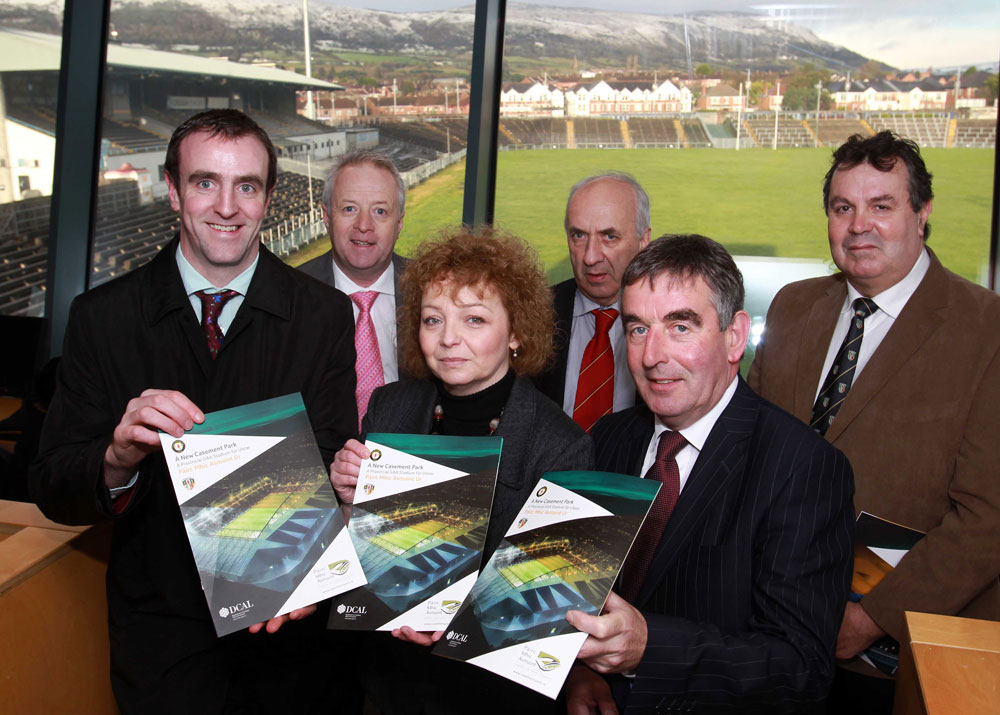
It was to be the GAA’s showcase in Ulster: a completely revamped £77m stadium at Casement Park in West Belfast that would seat 38,000 fans. It would take over from Páirc Naomh Tiarnach in the border town of Clones in County Monaghan as the venue for Ulster football finals. Now a judge at the High Court in Belfast has found that the planning application approved by the North’s Environment Minister Mark H. Durkan was “irretrievably flawed“.

The judicial review that lasted thirteen days heard that defects were also identified in the environmental survey, with no assessment of the impact on local residents of extra stadium facilities such as conference suites, bars, restaurants and car parking. A further hearing is expected later this week to decide the final outcome of the case.

Environment Minister Mark H.Durkan announces approval for project, December 2013  Photo: Casement Park Redevelopment Project

Environment Minister Mark H.Durkan announces approval for project, December 2013 Photo: Casement Park Redevelopment Project

The new stadium was set to be included in the list of GAA venues to be used as one of the Ireland’s bid for the 2023 Rugby World Cup. Hugo McNeill, the chairman of the bid, last month said that the Casement Park upgrade was “crucial” to the Northern Ireland component of its proposal.

Chairman of the Casement Park Project Board, Tom Daly, said they were “deeply disappointed” by the decision. “The proposed redevelopment of Casement Park would have provided the opportunity of a world class provincial stadium for the GAA and the broader community in the heart of Belfast. It would also have provided much needed economic and social benefits to west Belfast and beyond, including financial investment, new jobs, apprenticeships and community projects. Over the coming weeks we will reflect on this decision and consider what the next steps are for Casement Park”, he said.

The redevelopment of Casement Park is part of the Northern Ireland Executive’s policy to upgrade the three major sports grounds in Belfast – soccer’s Windsor Park, Ulster Rugby’s ground at Ravenhill and the GAA stadium at Casement. Three new stands have been constructed at Ravenhill. Work is ongoing on modernising Windsor Park, the home of Irish League club Linfield and the Northern Ireland international team.

I note that former Clones resident Darach MacDonald says he is not going to gloat about this outcome, which he has predicted several times to general disbelief. However, he thinks somebody needs to explain, and quickly, how a planning process described as ‘irretrievably flawed’ was presented to GAA fans and the general public as a fait accompli. From the outset, this was a politically tainted and contrived vanity project to siphon off public funds on a sectarian pretext for an inappropriate development in a place where it was not wanted, he said. 

Ulster Final Clones July 2013 Monaghan v Donegal  Photo:  © Michael Fisher

Ulster Final Clones July 2013 Monaghan v Donegal Photo: © Michael Fisher

Meanwhile, the existing venue for the Ulster Football Final, the provincial showpiece for the sport, has been relegated to a state of neglect pending redundancy (without floodlights or other investment since the early 1990s), disparaged and dismissed by those who pursued their ‘Field of Dreams’. As a life-long supporters of Gaelic games, Darach says he is “disgusted and impatient for answers”.