Northern Standard Thursday 21st May p.24
Michael Fisher
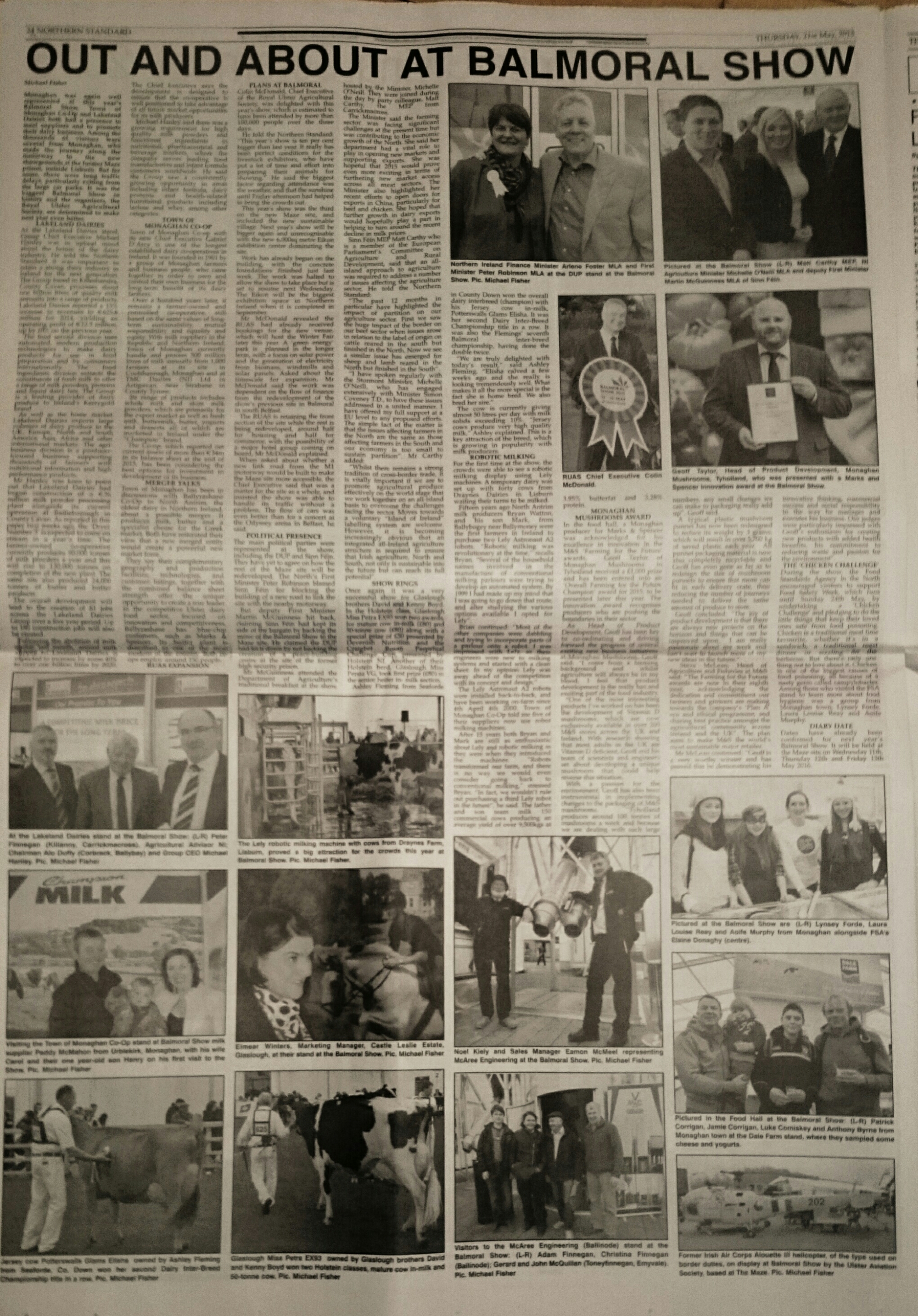
My coverage including pictures of the Balmoral Show 2015 at the Maze.

Northern Standard Thursday 21st May p.24
Michael Fisher
My coverage including pictures of the Balmoral Show 2015 at the Maze.

‘Stabat Mater, The Mystery Hymn,’ by Desmond Fisher, was launched in Donnybrook last week Photograph: Patrick Comerford, 2015
Patrick Comerford
Book launches are always a good opportunity to meet people with shared interests and stories.
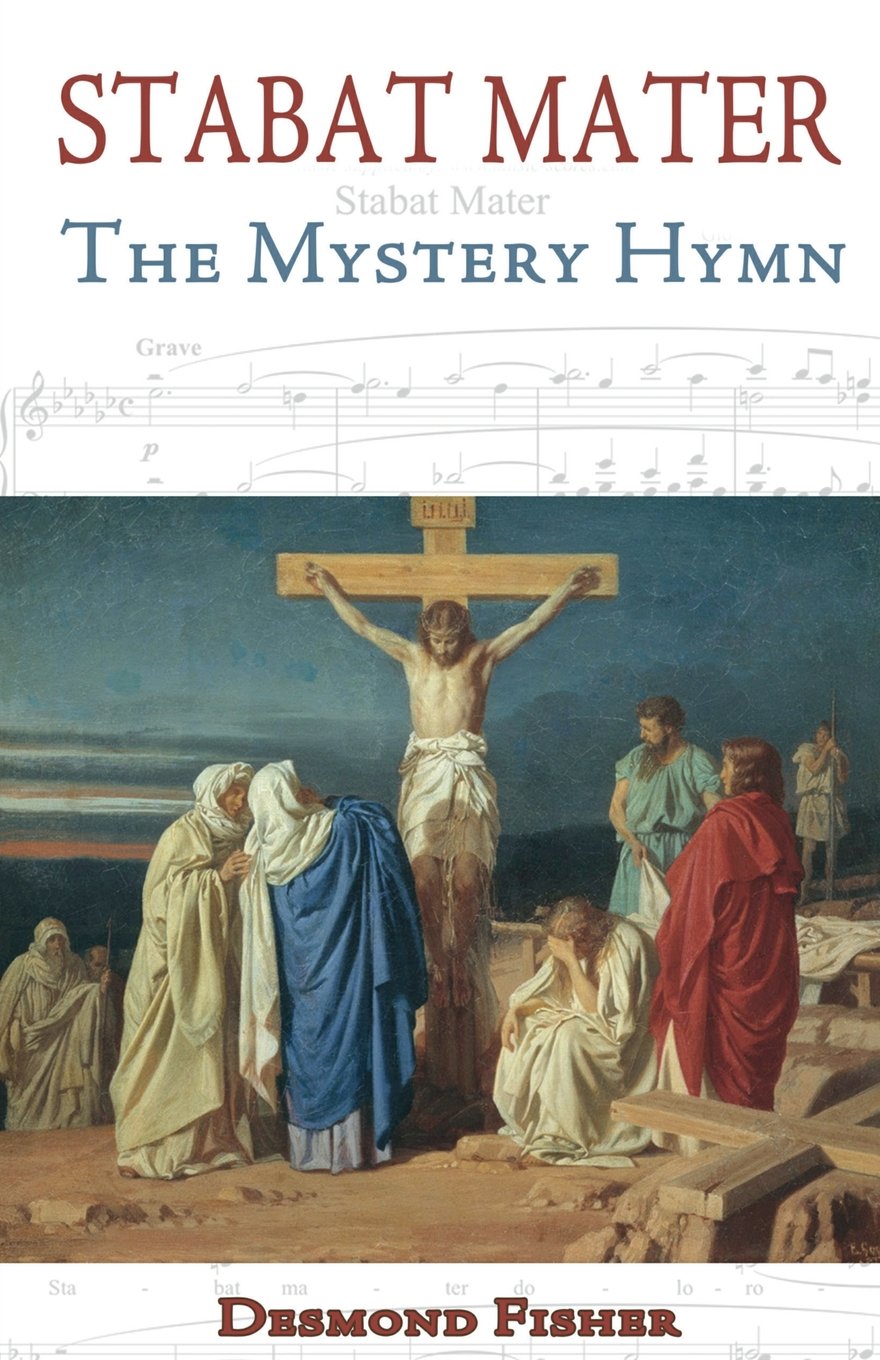
Last week, it was a pleasure to be invited by fellow blogger Michael Fisher to the launch in O’Connell’s in Donnybrook of a new book by his late father Desmond Fisher, Stabat Mater, The Mystery Hymn.
The book was launched by former Irish Times colleague and former Senator John Horgan, who is also a former Press Ombudsman. As a young reporter, John Horgan was given a job at the Catholic Herald in London by the editor, Desmond Fisher, who also worked for the Irish Press.
The attendance at the book launch included Wesley Boyd, who has reviewed the book in the ‘Irishman’s Diary’ in The Irish Times this morning [18 May 2015], and many former colleagues from, the world of journalism and broadcasting. But I was also there because of my theological and spiritual interests.
Stabat Mater is a much-loved Lenten hymn among English-speaking Roman Catholics, although it was once been banned by the Council of Trent and later by successive popes.
The title of this sorrowful hymn is an incipit of the first line, Stabat Mater Dolorosa (“The sorrowful mother stood”). The hymn meditates on the sorrows of the Virgin Mary as she stands at the foot of the Cross. It has been set to music by many composers, including Palestrina, Pergolesi, Alessandro Scarlatti and Domenico Scarlatti, Vivaldi, Haydn, Rossini, Dvořák, Karol Szymanowski, Poulenc and Arvo Pärt.
There are many variations in the translation from the original Latin. So, in this new book the late Desmond Fisher seeks to get back to the original meaning of the author who wroteStabat Mater 700 years ago. The hymn was well-known by the end of the 14th century. It was banned by the Council of Trent, but restored to the missal by Pope Benedict XIII in 1727, and was assigned by Pope Pius X in 1913 to the Feast of Our Lady of Sorrows (15 September).
But who was the author? At times, the hymn has been attributed to a variety of sources, including popes, three Saints and a member of the laity who was jailed and excommunicated.
In this book, Desmond Fisher identifies Jacopone da Todi (1230-1306) as the true author, and tells the story of his amazing life, from a dissolute to a disconsolate and desolate life. His privileged life came to end with the tragic death of his wife, and he eventually joined the Spirituali, an extreme, ascetic faction of Franciscans, before ending up in prison.
With a sympathetic and understanding approach, Desmond Fisher tells an amazing story of mediaeval extremism, but also provides a new translation of the poem, while adhering to the original metre and rhythm and re-presenting its emotions. He compares his own work with other well-known existing English versions – including those by the Irish poet Denis Florence McCarthy (1817-1882) and the English Anglican priest and hymn-writer Edward Caswall (1814-1878), who became a Roman Catholic – and tries to challenge long-accepted preconceptions.
This book was Desmond Fisher’s final achievement before he died on 30 December 2014 at the age of 94. In his final weeks, his manuscript was accepted by Gracewing.
As part of the pre-Reformation heritage of the undivided Church, it deserves to be better known among other traditions, including Anglicans. Even Archbishop Richard Chenevix Trench omitted it from his Sacred Latin Poetry in 1874 because of what he saw as its Mariolatry. Hopefully, Desmond Fisher’s new book will help to redress this.
Stabat Mater
Stabat mater dolorosa
juxta Crucem lacrimosa,
dum pendebat Filius.
Cuius animam gementem,
contristatam et dolentem
pertransivit gladius.
O quam tristis et afflicta
fuit illa benedicta,
mater Unigeniti!
Quae mœrebat et dolebat, pia Mater,
Quis est homo qui non fleret,
matrem Christi si videret
in tanto supplicio?
Quis non posset contristari
Christi Matrem contemplari
dolentem cum Filio?
Pro peccatis suæ gentis
vidit Iesum in tormentis,
et flagellis subditum.
Vidit suum dulcem Natum
moriendo desolatum,
dum emisit spiritum.
Eia, Mater, fons amoris
me sentire vim doloris
fac, ut tecum lugeam.
Fac, ut ardeat cor meum
in amando Christum Deum
ut sibi complaceam.
Sancta Mater, istud agas,
crucifixi fige plagas
cordi meo valide.
Tui Nati vulnerati,
tam dignati pro me pati,
pœnas mecum divide.
Fac me tecum pie flere,
crucifixo condolere,
donec ego vixero.
Juxta Crucem tecum stare,
et me tibi sociare
in planctu desidero.
Virgo virginum præclara,
mihi iam non sis amara,
fac me tecum plangere.
Fac, ut portem Christi mortem,
passionis fac consortem,
et plagas recolere.
Fac me plagis vulnerari,
fac me Cruce inebriari,
et cruore Filii.
Flammis ne urar succensus,
per te, Virgo, sim defensus
in die iudicii.
Christe, cum sit hinc exire,
da per Matrem me venire
ad palmam victoriæ.
Quando corpus morietur,
fac, ut animæ donetur
paradisi gloria. Amen.
● Desmond Fisher, Stabat Mater, The Mystery Hymn, Leominster: Gracewing, ISBN 978 085244 862 5, 176 pp, £9.99.
Stabat Mater: Gracewing Publications
Known locally as Crazy Jim, he had a habit of crawling on all fours, saddled and bridled like a donkey, around the main square of his native Todi, a hilltop town in Umbria. Yet he was one of the finest Italian poets of the Middle Ages and is considered to be the most likely author of the great Christian hymn, Stabat Mater Dolorosa. Other contenders for the authorship include at least three popes and three saints.
New light on the origin of the work is promised in a book by the distinguished Irish journalist, Desmond Fisher – finished just a few weeks before his death at the age of 95 in Dublin at the end of last year. Desmond, a Derry man, whose journalistic posts included editor of the Catholic Herald, London editor of the Irish Press and deputy head of news at RTÉ, spent the many years of his retirement researching the subject. His book, Stabat Mater, The Mystery Hymn, was published by Gracewing this month.
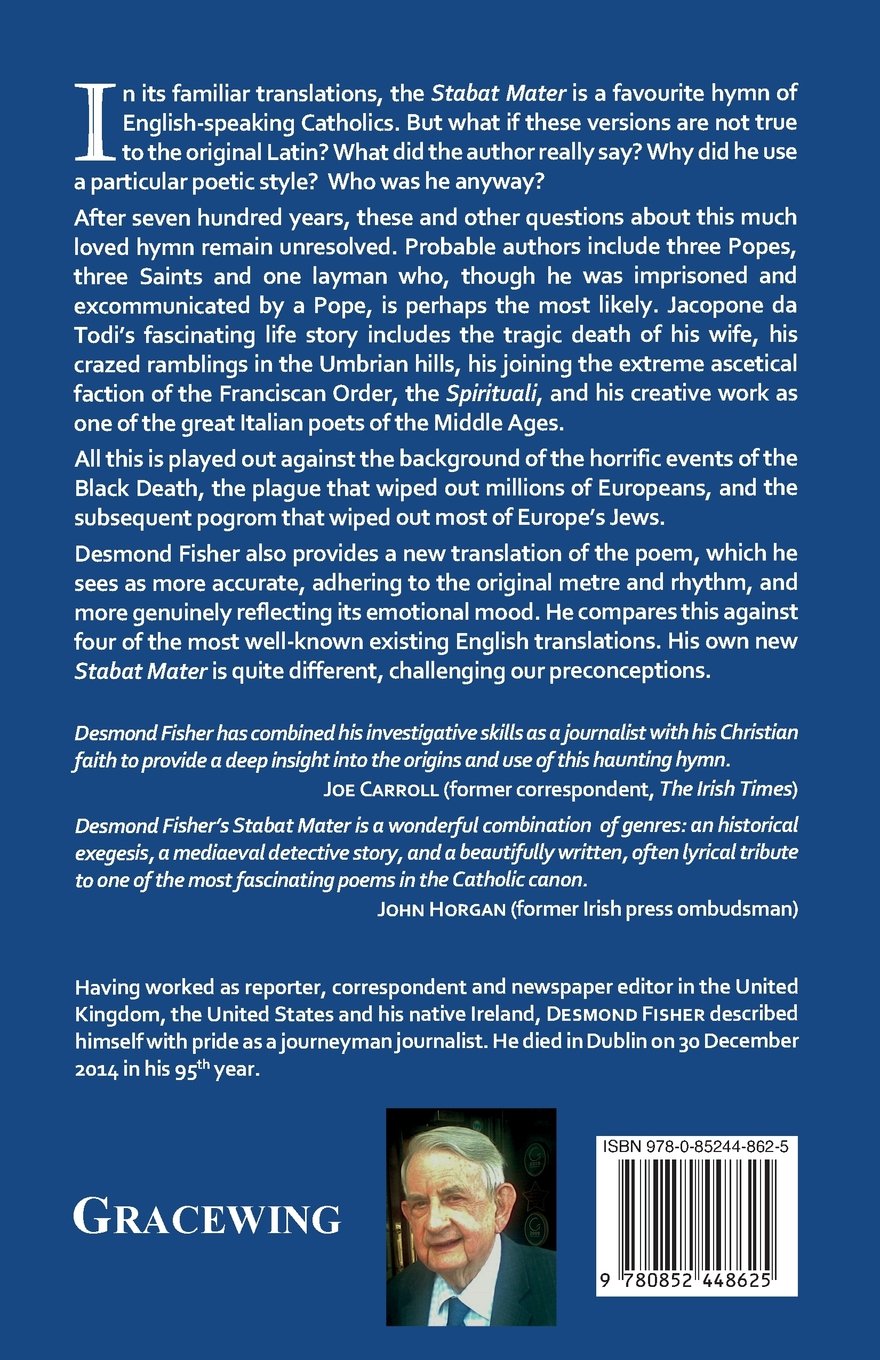
Stabat Mater Back Cover: with endorsements by John Horgan and Joe Carroll
There are many roads to be following when exploring this haunting hymn to the Virgin Mary. Over the centuries it has been set to music by various composers, including Pergolesi, Haydn, Dvorak, Rossini and Vivaldi. (There was a memorable performance of Pergolesi’s arrangement in the old slate quarry on Valentia Island in 2004, directed by the Cork artist Dorothy Cross, and performed by the Opera Theatre Company from Dublin.) It was banned by the Council of Trent in 1545 but restored to the canon nearly three centuries later by Pope Benedict XIII to mark the Feast of Our Lady of Sorrows on September 15th. But interesting as the history of the hymn itself is it is less fascinating than that of its putative author, Jacopone Benedetti, Crazy Jim himself.
He was born into an aristocratic family in Todi around 1230, a time of war, plague and turbulence. He was sent to Bologna to study law and returned to Todi to pursue his career as an advocate, some say unscrupulously. After years of dissolute philandering at the age of 37 he married Vanna, the daughter of a local count. He did little to moderate his way of life but Vanna remained faithful. Then tragedy struck. There was a feast day in Todi and the local gentry assembled on a raised platform to watch the parade. The platform collapsed and Vanna was crushed to death. Jacopone tried to revive his young wife and he discovered that under her fine robes she was wearing a shift of coarse, hairy cloth. Shocked by her death and stunned by the revelation that she had been secretly doing penance for his misdeeds, Jacopone changed his lifestyle.
He gave up his comfortable career as a lawyer and took to to the streets and roadways of Umbria as a mendicant wanderer dressed in shabby robes.
After a decade on the roads he became a lay brother in the Franciscan Order in his native town but continued in his eccentric behaviour.
Invited to a wedding in his brother’s house he turned up naked, tarred and feathered from head to toe. Jacopone had a poem for it: “A wise and courteous choice he’d make/Who’d be a fool for the dear Lord’s sake.”
Within the Franciscans there was a minority group who wished to follow a more austere and frugal way of life. They were dubbed the Spirituals and not unsurprisingly Jacopone, always attracted by extremes, joined their company. They petitioned the new pope, Celestine V, for permission to establish their own order.
Celestine favoured their cause but under the strain of having to deal with warring Christian states and church intrigues and scandals he resigned in 1294 after only five months in office. He was succeeded by Boniface VIII who promptly locked up Celestine and ordered the recalcitrant friars to return to the jurisdiction of their regular superiors. There was a history of enmity between Boniface and Jacopone, dating from the time when Boniface got a plum ecclesiastical job in Todi in 1260 from the bishop of the town who happened to be his uncle Peter.
The poet’s support for the Spirituals was condemned by Boniface and he imprisoned his old adversary. While in prison he wrote some of his greatest poems. In the jubilee year of 1300 Boniface sanctioned the release of many prisoners but left Jacopone in the dungeon. It was not until Boniface died three years later that he regained his liberty.
Jacopone was now over 70, broken in body and spirit. After more wanderings he found refuge in the Convent of the Poor Clares near his native Todi. There he died on Christmas Day 1306 as midnight Mass was being celebrated in the chapel. He is buried in the Franciscan church, Tempio San Fortunato, in Todi. The inscription on his tomb says “…. having gone mad with love of Christ, by a new artifice deceived the world and took Heaven by storm”.
There are many translations of Stabat Mater. The latest is by Desmond Fisher. I hope Crazy Jim likes it.
Glin Castle,the end of an era.
Blog by A Silver Voice from Ireland.

There is great sadness in West Limerick that Glin Castle is to be sold. Glin Castle is situated beside the lovely little town of Glin, overlooking the River Shannon. Glin has been the seat of the Fitzgerald family for over 700 years, and the village is proud of its association with the Knights of Glin down the centuries.The oldest part of the structure is a lower, two-storey “wing” of the castle, supposedly with interior turf walls. The more imposing section was built in 1780 and the castellations added in the 1820s.
In the summer of 2014 I was fortunate to visit the Castle, courtesy of West Limerick Resources and Limerick City of Culture 2014. What a wonderful experience to visit such an historic and beautiful place! Just months later the castle has been put up for sale and I am delighted to share some of my photos from that day.
The Building:
The rather unusual title ‘The Knight of Glin’ became extinct with the death of Desmond Fitzgerald,the 29th Knight of Glin in September 2011, as he did not have a male heir. His three daughters do not ‘count’ when it comes to the title! ‘Knight of Glin’ was an ancient Irish noble title,handed down by chieftains since the arrival of the family from Wales in the 12th Century. This title is not conferred by a monarch, but is rather a family tradition in the Fitzgerald family. The late lamented Desmond Fitzgerald was President of the Irish Georgian Society and a former curator of the Victoria and Albert Museum in London. He was an accomplished author the Irish representative of the renowned Christies Art Auction house in London. He was an avid collector of beautiful items some of which adorn the main reception rooms of this lovely house.
The Interior:
In the drawing-room table rests a copy of ‘The Knights of Glin, Seven Centuries of Change’ a collaborative series of essays by Irish Scholars, ably edited by my former colleague,Tom Donovan and published by Glin Historical Society.
 It is to be hoped that the new owners of Glin Castle will cherish the very special relationship with the locals in the village, a special relationship that has been nurtered and has endured for generations.

Colm Arbuckle Photo: BBC Radio Ulster
A new programme on BBC Radio Ulster at 2pm ‘Time of our Lives’ is presented by Colm Arbuckle and produced by Owen McFadden. Tune in to hear the over 60s reclaim the airwaves! My contribution can be heard halfway in, around 30:30 on playback. If you think my voice sounds strange, it seems to have been slowed down to suit the potential mature audience! I think when they were doing a digital cut, the speed was altered and not restored to ‘normal’ setting! I hope they will invite me back so you can hear what my voice really sounds like! Apologies if you thought something strange had happened in the years since I left RTÉ News…

WPFG Volunteer Michael Fisher with Kim Harper, Las Vegas Guns & Hoses at the Odyssey Arena July 2013 Picture: © Kelvin Boyes, Press Eye
IN RETIREMENT
Well, how are you? What’s the weather going to be like today? It’s a question I continue to get asked, nearly five years after my retirement. Or, more correctly, since I gave up a staff job as a television news reporter and took a voluntary retirement package.
So where, you might ask, does the weather come in? My job was always about news. Since 1984 here in Northern Ireland, that inevitably meant covering sometimes daily killings, and several major incidents. Before that two of my biggest stories were in County Kildare: a train crash and also the disappearance of the racehorse Shergar.
It’s true that my first story on my first day as an RTE News reporter in January 1979 was weather-related, when the temperature dropped to a record low of -18C. The story concerned the transport disruption caused by the snow and ice.
Back then it took me a while to work out why people from the farming community I was introduced to by my then fiancée would usually start a conversation by asking me about the weather. 35 years on and now in semi-retirement, that same question was posed to me as I looked out over the stony grey soil of Monaghan.
NOW I realise that the sunshine or rain enquiry was not because my interlocutor had heard or seen my reports on radio or on the box; it was because he or she thought the famous BBC weatherman Michael Fish had landed in their midst! So if that is my solitary claim to fame when I finally retire, I will be happy in the knowledge that I did have some impact as a television celebrity!
What also pleases me at this stage of my life is to know that manners and respect for older generations can still be found amongst 21st Century youth. When you reach your sixties, and become eligible for the brown travel card, you are glad of the courtesy shown when someone stands up on a bus or train to give you a seat. Or when a stranger unexpectedly offers to carry something for you. I’m already looking forward to the next stage: the blue pass, which entitles the holder to cross-border free travel, as well as within Northern Ireland.
Retirement has given me more opportunity to travel. Two years ago I persuaded my other half to go on a cruise departing conveniently from Belfast to Norway. We already knew a few of those on the trip. By the end of it we had made a number of new friends. Many couples on board were retired. Some, like us, were taking their first cruise. But the vast majority who came from different parts of Ireland had experienced cruises before and were enjoying a new stage of their lives.
If my plans work out, I will do some travelling while my health is reasonable. I do not need to look far for inspiration. My neighbour, who turned 70 recently, loves climbing mountains. He was in Australia before Christmas and travelled to Thailand in February. In October he will be heading to central Nepal and is currently raising funds for the area affected by the earthquake.
I have found that fundraising for charity has been a very productive way of spending some of my retirement. Today I will be helping out at a 10k run that will raise funds for the Special Olympics Ireland team. Previous volunteering shifts included the World Police and Fire Games, which led in turn to the Giro d’Italia cycle race.
All this unpaid voluntary work is my way of putting something back into the community and enjoying a role as an ambassador for Belfast and Northern Ireland. Next week you might come across me in Newcastle, helping to look after the many visitors to the Irish Open Golf. But if they ask me about the weather, I reckon I will just have to check my mobile phone.

Lely robotic milking machine at Balmoral Show Photo: © Michael Fisher
The robotic milking parlour by Lely was a big draw for the crowds this week at the Balmoral Show.

Judging in the cattle ring at Balmoral Show Photo: © Michael Fisher
Plenty of interest too in the judging of various categories including dairy cattle.
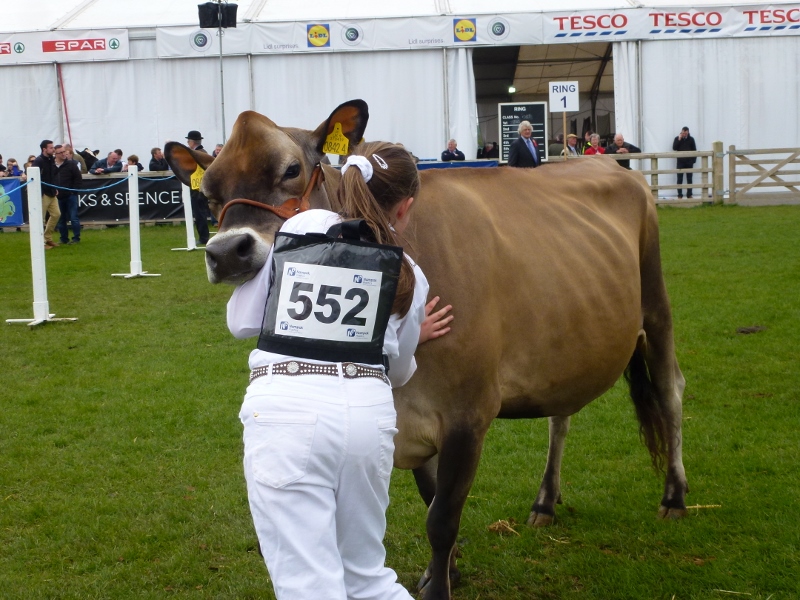
Judging in the cattle ring at Balmoral Show Photo: © Michael Fisher
Traffic problems did not seem to be as bad as two years ago but it still took half an hour to get out of the main car park yesterday afternoon (Friday).

Judging in the cattle ring at Balmoral Show Photo: © Michael Fisher

Judging in the cattle ring at Balmoral Show Photo: © Michael Fisher
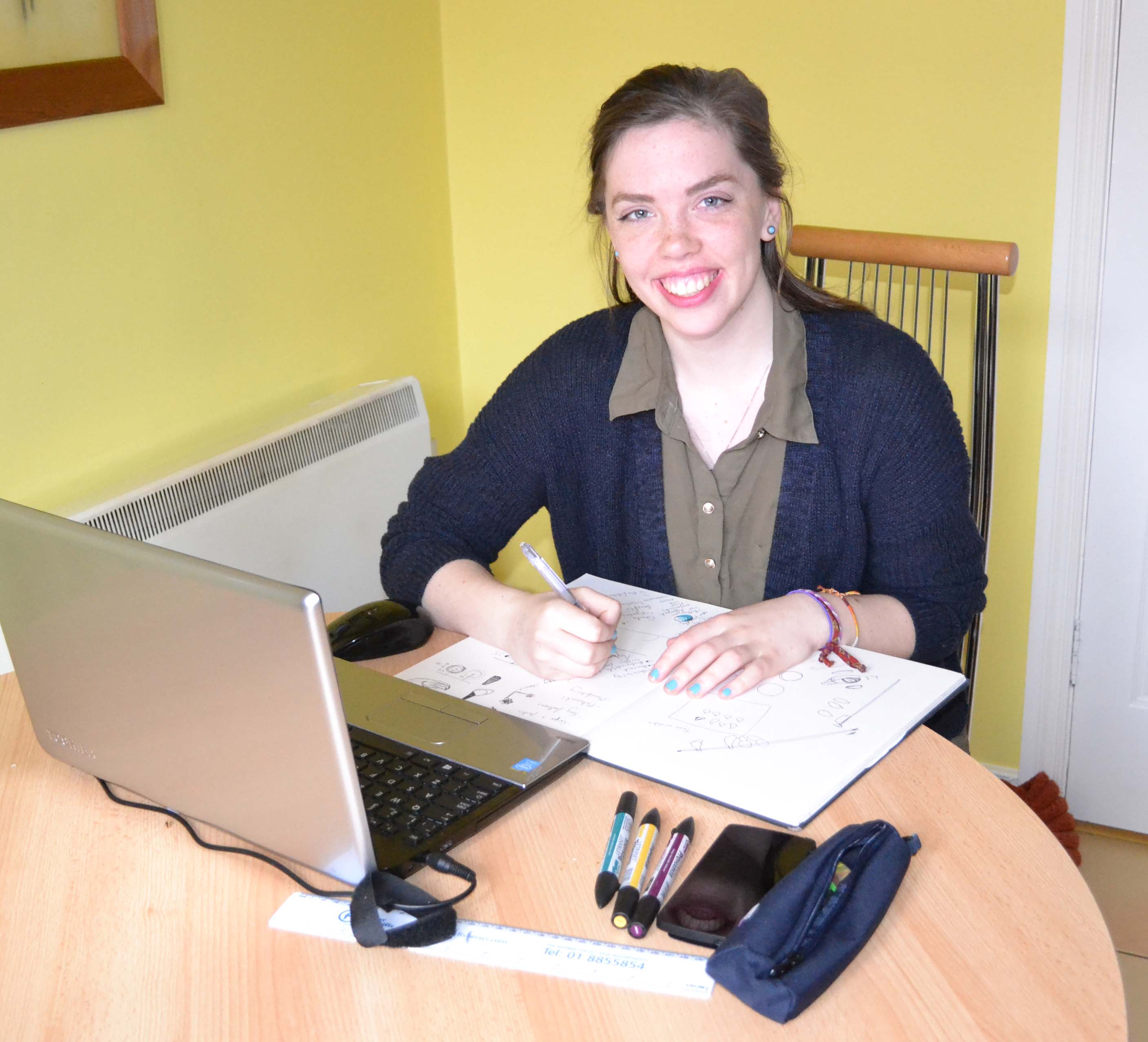
Róisín Keyes from Carrickmacross, a student at DIT
FORMER ST LOUIS PUPIL ACHIEVES NATIONAL SUCCESS
Michael Fisher Northern Standard Carrickmacross News Thursday 15th May
Róisín Keyes from Lisanisk in Carrickmacross is one of seven finalists from Ireland and Britain to reach the finals of a major competition to promote new inventions made with plastic and to find bright young designers of the future. Students were asked to identify a traditional metal product and replace it with the next generation of product using polymers. Róisín impressed the judges with her plastic extension keys for musical wind instruments, such as saxophones or concert flutes.
The competition is an annual award sponsored by multinational polymer company, Bayer MaterialScience, which has an office in Dublin. It aims to find the university student with the most creative new invention made with plastics. It is contested by students from universities throughout Ireland and Britain. Róisin was the only Irish student to get to the final out of 118 entrants.
She is a former pupil of St Louis Secondary School, Carrickmacross and is currently in the third year of a four-year B.Sc. course in Products Design at the Dublin Institute of Technology. The finalists go forward to judging by a panel of industry experts on Friday week, May 22nd at the British Plastics Federation in London. The winner will be announced on July 3rd, and will earn a placement with Bayer MaterialScience, in Leverkusen, Germany, one of the world’s largest producers of polymers and high-performance plastics.
In addition to a cash prize of £1,000 the winner will also have a work placement at PriestmanGoode, the leading global design and brand experience agency specialising in aviation, transport and product design.
All three top winners and four highly commended will receive cash prizes and either training courses or placements with other award sponsors: Innovate Product Design, a leading UK invention development company; PDD, London, worldwide provider of integrated design and innovation skills; G&A Moulding Technology, an independent company offering the injection moulding industry support, training and advisory services; Brightworks, an award-winning product design and development consultancy, and HellermannTyton,a global manufacturer and innovator of products for electrical and communication networks.
In addition, all finalists will be offered mentoring support with the goal of helping them take their design ideas closer to commercial realisation, and a year’s free membership of IOM3.
The prestigious Design Innovation in Plastics competition was established in 1985, during which it has provided opportunities for design students to make a name for themselves with products which have genuine use and potential commercial value. It promotes innovative design, raises awareness of high-tech plastics and enables universities to raise their profiles as institutes of excellence in this field. Róisín will have an anxious few weeks to wait to find out how she does in her presentation on May 22nd. We wish her every success.
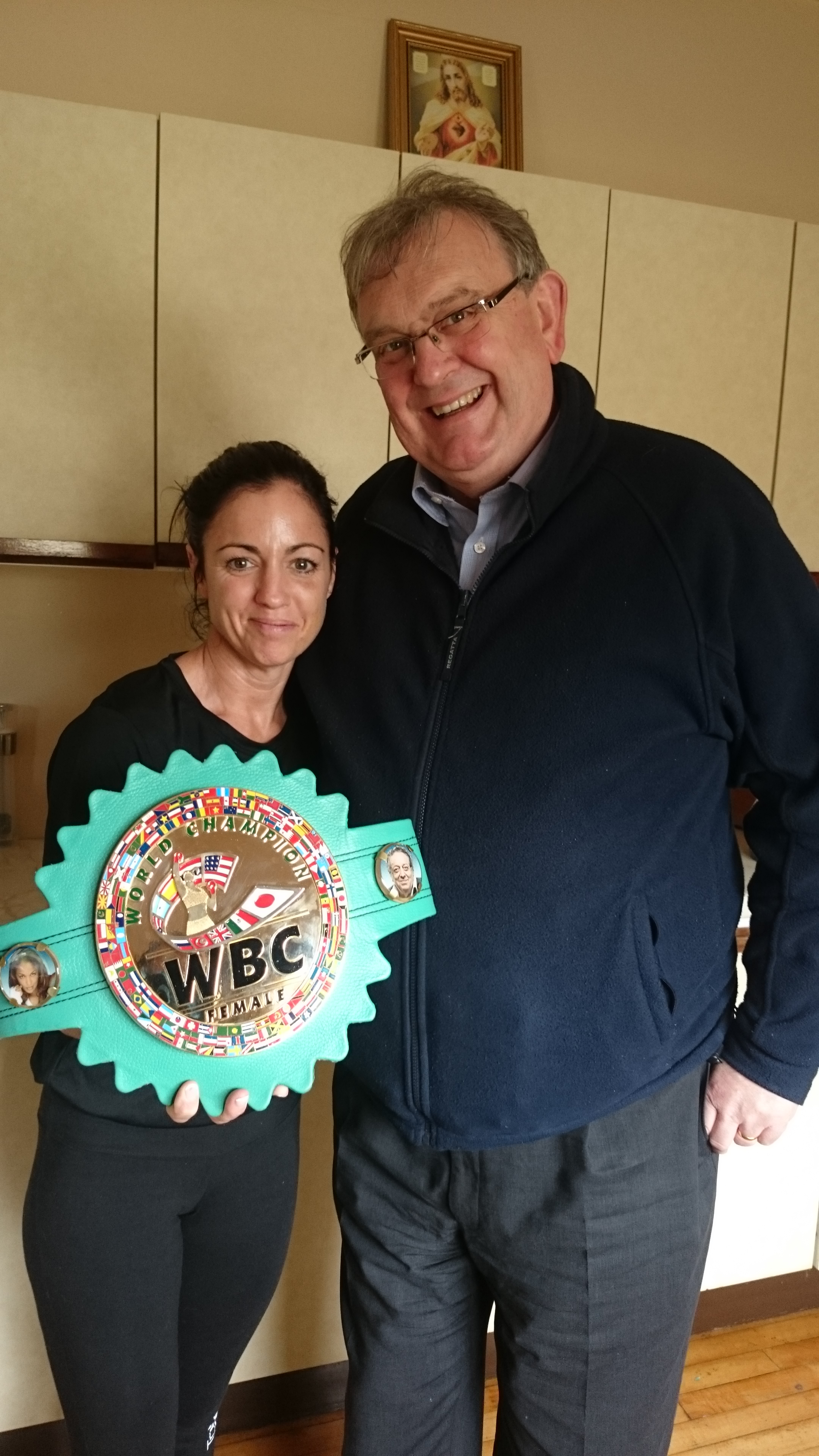
Michael Fisher interviewing Christina McMahon at her home in Carrickmacross Photo: Pat Byrne
CHAMPION CHRISTINA RELAXES AT HOME
Michael Fisher Northern Standard Thursday 14th May: with photos by Pat Byrne
“You are absolutely inspirational”, the Saturday Night Show host Brendan O’Connor told Christina McMahon from Carrickmacross as she finished her live interview on RTE1 in front of a studio audience at Donnybrook that included her coach and husband Frick and her parents. Christina is now resting after her tough ten rounds fight in Zambia to win the interim WBC bantamweight world title. The belt, the only one of its kind in Ireland at the moment, was with her as she explained to her interviewer how she had taken up boxing on a professional basis when she turned 35, having won a world title for kick-boxing. Now aged 40, she had been up against a much younger opponent in Lusaka, 22 year-old Catherine Phiri, who was strongly fancied to win by the home crowd.
Even before the fight, however, Christina and had come successfully through the psychological battle that saw the promoter favour Phiri and try to make things awkward for the Irish boxer. Christina spent an hour being interviewed on local radio and by the time she had finished, she had won the hearts and minds of many of the locals. It was yet another sign of her great determination. “I never gave up on my dream”, she told Brendan O’Connor and now, after a good rest, she will be prepared to go after the full title. The current WBC bantamweight title holder is Yazmin Rivas from Mexico, who won it last June.
Taking part in the RTE Saturday Night Show made her feel like a celebrity, she said. She had to get her hair done and also required special attention from make-up to ensure that the black eye she received in the fight did not show.
Now relaxing at home in Magheross, Christina says she does not need a national media focus after being under the radar for so long. She was delighted to receive a civic reception on her return to Carrickmacross last week. It was a lovely surprise, she told me. She also thanked the organisers, the Carrickmacross Festival Committee, for ensuring it went so smoothly. She expressed her thanks for the three gifts that were presented to her on the night.
Monaghan County Council. Cathaoirleach Padraig McNally gave Christina a gift of an Irish Crystal bowl. The Cathaoirleach of Carrickmacross-Castlebleyney Municipal District Cllr Jackie Crowe presented her with a framed gift of Carrickmacross lace. The Festival Committee presented the boxer with a clock to mark the occasion.
Christina is a former pupil at St Louis Secondary School, where a welcome home banner had been displayed. She studied sport and leisure management at Inchicore College of Further Education in Dublin. She told me she was delighted that after her victory, some of her former college friends were able to renew contact with her. She also received a message from a family for whom she used to babysit.
On Sunday evening a crowd gathered at the Shirley Arms Hotel to watch a replay of the fight and to celebrate with Christina and her husband. Hopefully there will be one more big celebration still to come in the next twelve months or so.
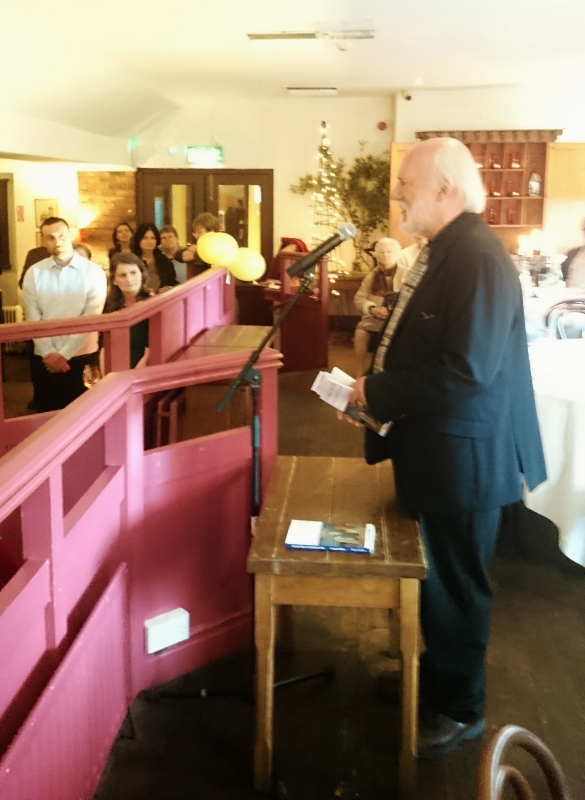
John Horgan speaking about Desmond Fisher Photo: © Michael Fisher
My late father’s book, Stabat Mater: The Mystery Hymn, was launched at a reception at O’Connell’s in Donnybrook, Dublin. The main speaker was the former Press Ombudsman, John Horgan. Some pictures from the launch are included here.
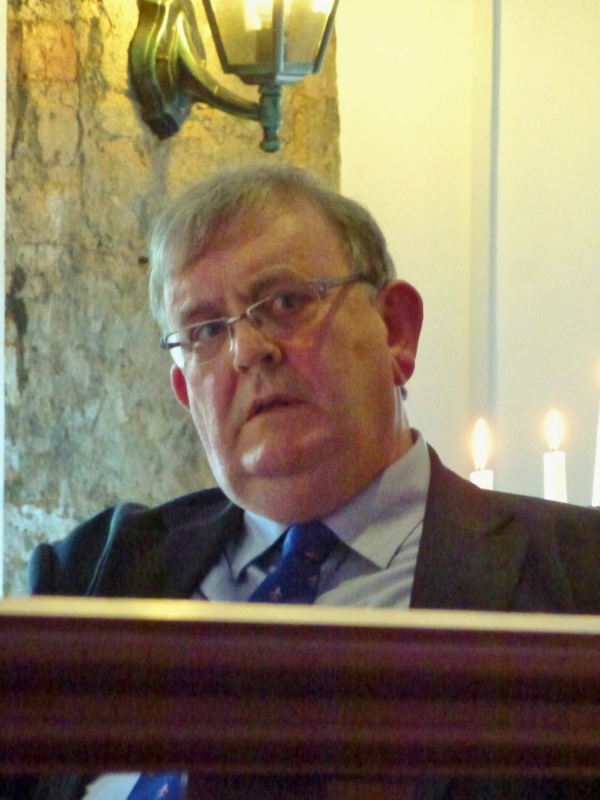
Michael Fisher listening to the speakers he introduced Photo: © Evelyn Fisher
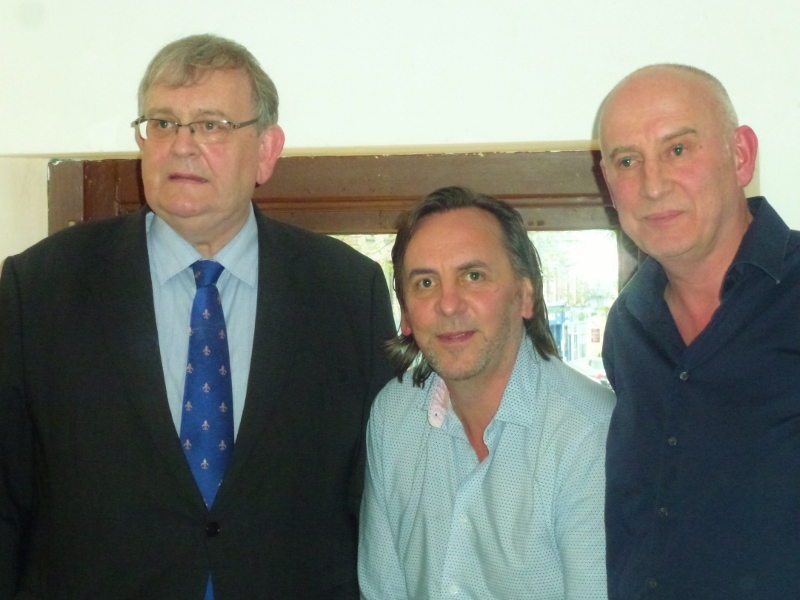
Michael, John and Hugh Fisher Photo: © Evelyn Fisher
Stabat Mater: Gracewing Publications
My father’s last achievement before he died at the end of last year, aged 94, was to finish a book about the medieval poem (hymn), Stabat Mater. It contained a new translation by him from the original Latin. He comes down in favour of Jacopone da Todi as being the author.
In his final weeks, the manuscript was accepted by a publisher in England, Gracewing. The first proofs were issued shortly after he was taken into hospital and he asked his family to take on the task of seeing that the relevant corrections were made and that the book was produced. Alas he did not live long enough to see it in print. However he was shown the book in draft form and I also provided him with laminated copies of the two pages containing his new translation of the poem (twenty stanzas).
Stabat Mater Back Cover: with endorsements by John Horgan and Joe Carroll
I reproduced this alongside the Latin original and I hope it gave him some satisfaction to see this part of his work in print while he was still alive and remained lucid. At his cremation service at Mount Jerome in Dublin, I read the translation as a prayer.

Book Reviews: Catholic Herald May 8th 2015 p.36
A brief review of the book has appeared in the latest edition of the new Catholic Herald magazine. In the section ‘Briefly noted…’, the reviewer says:
“Stabat Mater by Desmond Fisher (Gracewing, £9.99). This fascinating account of the origins and different translations of the well-loved Lenten hymn was written not long before the death of its author, a former Catholic Herald editor, who died soon after its completion last year, aged 94. The book seeks to discover the hymn’s likely author: Jacopone da Todi, who lived at the time of the Black Death. Fisher provides his own translation of the hymn alongside others, though the well-known translation by Edward Caswall is likely to remain the popular choice for its familiarity and mournful cadences”. 
This evening in Dublin we are launching the book. We are very pleased that John Horgan, the former Press Ombudsman. who as a young reporter was given a job by my father at the Catholic Herald in London, has agreed to be the main speaker. Copies of the book will be available at €10 and the proceeds on the night will be donated to the Irish Cancer Society in memory of my father.
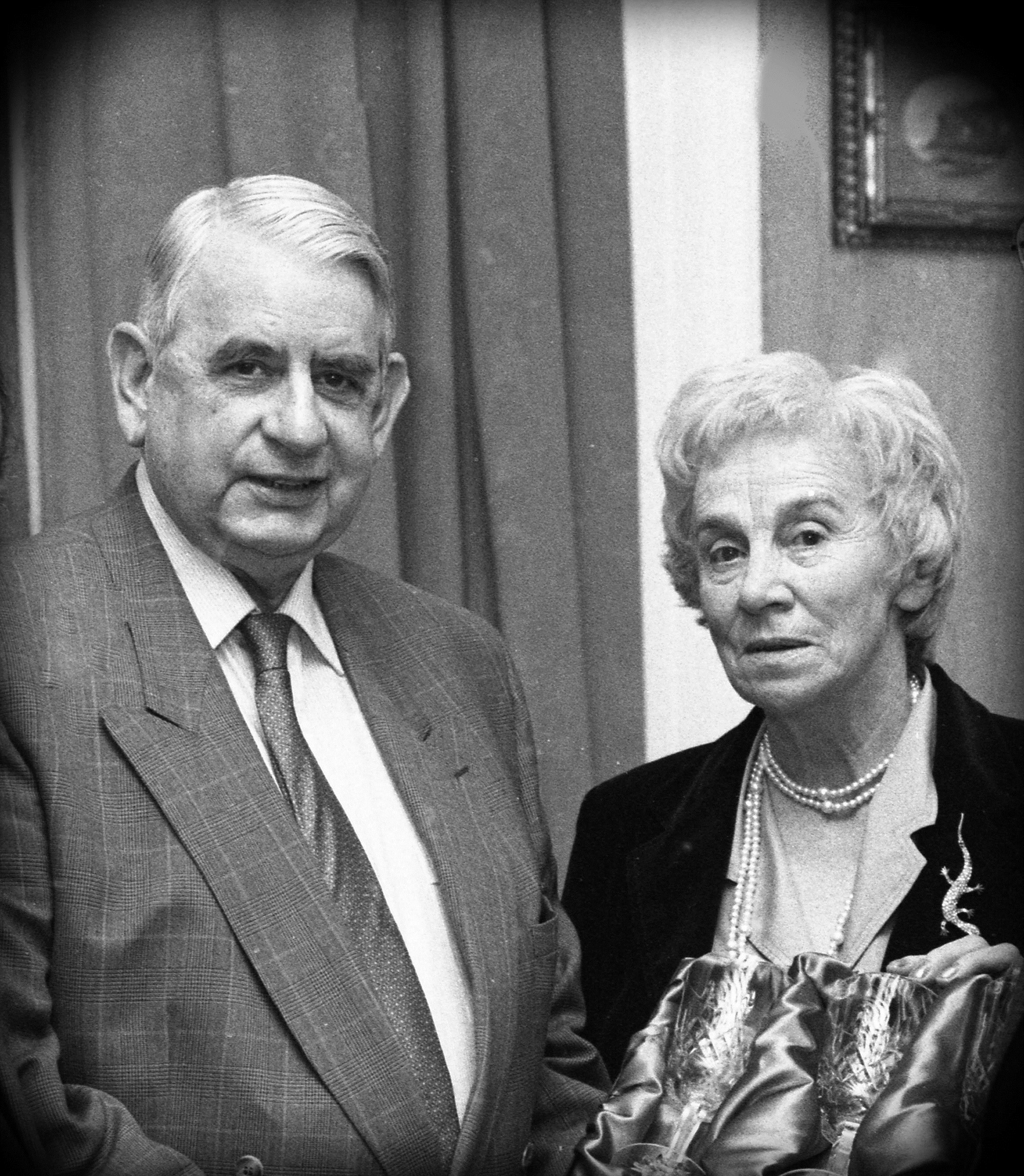
Desmond and Peggy Fisher on the occasion of my father’s retirement from the Carlow Nationalist Photo courtesy of Tom Geoghegan
If you would like an invitation to the event, please contact me. If you cannot attend and would like to purchase a copy, you can also contact me directly. If you live in Britain and wish to order a copy (£9.99) please do so using the Gracewing website or through Amazon or one of the online bookshops. It is also available worldwide using online orders.
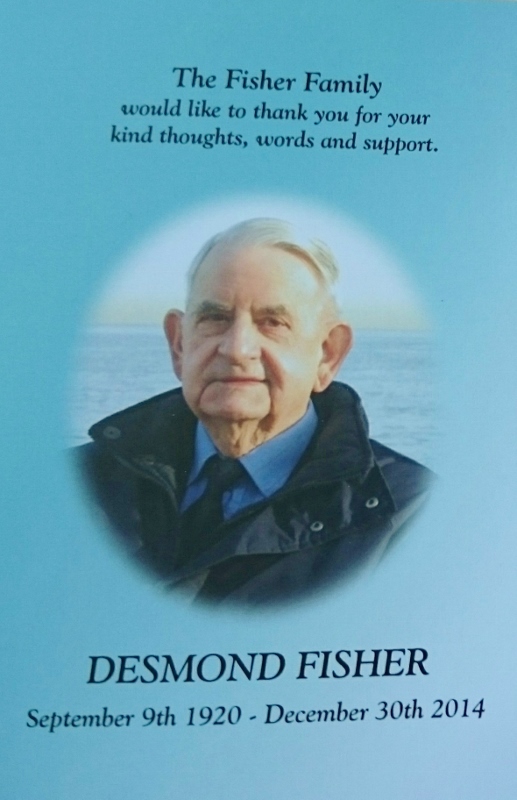
In Grateful Appreciation





 Michael Fisher's News