INTERCONNECTOR DAY21

This section was devoted to specific landowner and public issues from Co. Meath and around Kingscourt Co. Cavan

The hearing was told about specific landowner concerns in Co. Meath along the proposed line from Kilmainhamwood as far as Woodland, where it would enter the existing sub-station.

EirGrid was accused of spending its money on things like sponsorship of the Virginia pumpkin festival, the GAA (under 21 and Australian Rules), two local radio current affairs programmes and advertising in local media. A company spokesman said a key finding of a number of reviews of EirGrid’s operations and engagement with the wider community had shown the need for effective communication of the necessity for grid infrastructure to ensure a safe and sustainable electricity supply. As part of the company’s strategy to address this, it was placing an emphasis on improving how it communicated its role, including through advertising and sponsorship.

David Martin said “We welcome the strong engagement from landowners, public representatives and community members at the An Bord Pleanála oral hearing. The oral hearing provides an opportunity for all relevant information to be brought before An Bord Pleanála, and ensures that their concerns are addressed. We encourage all landowners and concerned residents to attend over coming weeks. If you would like more information on any aspect of the project, you can talk to our team on the ground, or drop in to our offices in Navan or Carrickmacross. Contact details for our Community Liaison Officer Gráinne Duffy and Agricultural Liaison Officer John Boylan are at www.eirgrid.com. Since submitting our planning application for the interconnector in June 2015, we have continued to engage with communities in Meath, Cavan and Monaghan.”

EirGrid said the consideration of alternatives to an overhead line, including underground cables (both cross-country and along public roads), had been outlined its planning application. This had relied on a suite of reports prepared by the government, third parties and EirGrid itself. One of these, prepared by PB Power, showed that an underground cable option is considerably more expensive, at €670 million more that overhead lines.

The government-appointed Independent Expert Commission found that an underground cable option would be €333million more expensive. The reason for the difference in these figures was that the PB Power report studied a cross-country option, while the IEC report considered a roadside route. The company said a further detailed study of roads in the project area had shown that the use of the M3 and local roads was simply not suitable for the interconnector project.

When considering alternatives for the project, cost was just one factor. Underground cables would also not be as reliable as overhead lines, causing greater complexity and greater risk. EirGrid said it also studied the use of disused railway lines and a subsea option for cables but they were not viable options for this project.


INTERCONNECTOR DAY20

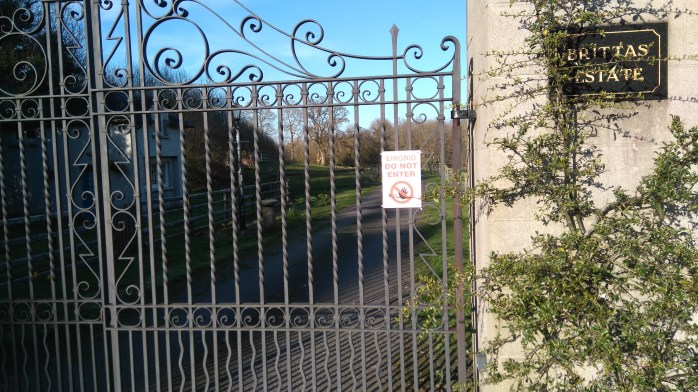
BRITTASGATE

Entrance Gates and Gate Lodge, Brittas Estate Co. Meath

This section was devoted to specific landowner and public issues from Co. Meath and around Kingscourt Co. Cavan

 On behalf of the Brittas estate near Nobber in Co. Meath, Michael O’Donnell BL said the proposed line, which would cross one of the main entrance roads to the historic house, close to an occupied gate lodge, amounted to sheer devastation. He referred to the inadequacy of the EirGrid documentation and said it was not acceptable under Irish planning law or EU rules. The company was treating the public with a level of contempt, he said.

Mr O’Donnell pointed out that Brittas was a protected structure equal to any other great Irish house such as Castletown, Carton or Russborough. Every structure in the demesne had the same status. It was the oldest unfortified and continuously occupied residence in the country dating back to the early 17th century. It was an extraordinarily important piece of landscape with its own eco system. It was about to be devastated by a 400kV line traversing it, going through a section of mature woodland that would have to be removed.


INTERCONNECTOR DAY19

DAY 19

EIRGRID’S RESPONSE

EirGrid lawyer Jarlath Fitzsimons SC said the photomontages were not a clever manipulation, nor were they dishonest. It was unhelpful and inaccurate suggest this. He said a full suite of tools had been used in making assessments and a number of significant impacts along the route had been clearly identified regarding specific residences.

Consultant landscape architect for EirGrid Jeorg Schulze gave an extensive reply to the concerns about photomontages raised by Fine Gael Cllr Sean Gilliland. He said they helped to give an assessment of the visual impact of the line on specific vistas identified in the county development plan. In response to several queries about why houses had not been shown in the photomontages, Mr Schulze said it was the landscape that was being assessed. He pointed out that the residential impact assessment for residences had covered 1070 houses within 500m either side of the proposed line in the Monaghan area. At no point had they tried to hide any impact there would be on residences.

He said the environmental impact statement stated the impact on individual houses and gave conclusions. They did not need photomontages from all locations to come to those conclusions. He himself had seen some of the areas from the public road and had walked along part of the Monaghan Way. Cllr Gilliland listened to the explanation and said EirGrid were being “economic with the truth” and he would leave it at that.

Monaghan County Council Cathaoirleach Cllr Noel Keelan, asked the presiding inspector what would be the response from An Bord Pleanála when a new government was formed and the new Dáil would have representatives from three main parties opposed to an overhead line, as had been made clear on Monday. He was informed that the Board would have to have regard to current government policy when it made its decision.

Fine Gael Cllr Aidan Campbell asked the inspectors what weight was placed by An Bord Pleanála on the county development plan, which had been worked on by all the councillors and the planning officers. The EirGrid response was not what they wanted because it contravened a number of things in the plan. So what was the point of having one, he asked. Presiding inspector Breda Gannon confirmed that the Board also had to have regard for county development plans (as well as government policy) in coming to their decisions.

This section dealt with concerned residents’ groups from Co. Meath

The inspectors heard submissions from eleven groups of residents who had come together to lodge joint submissions to An Bord Pleanála. The effect of the planned line on historic areas such as Teltown and Donaghpatrick was again made clear. Many had sent in objections when the previous application had made. By making one objection, it meant each group had to make only one payment of €50. The hearing was told that as almost 1000 submissions had been made to the Board, this would have brought in nearly €50,000 in revenue.

INTERCONNECTOR DAY18

DAY 18

This section was devoted to elected representatives from Monaghan, Cavan and Meath

Michael Fisher      The Northern Standard

Public representatives from the three main parties in Meath and Cavan/Monaghan were united in their opposition to EirGrid’s plan for a North/South electricity interconnector when stage two of a Bord Pleanála oral hearing into the planning application began on Monday. All pointed out that local communities and landowners were strongly against the overhead line. EirGrid again defended its decision not to put the cables underground on grounds of cost and security.

CAVAN/MONAGHAN TDs

CAOIMHGHÍN Ó CAOLÁIN T.D. party spokesperson on health and Cavan/Monaghan TD said there was very real anger and anguish in families and communities along the proposed route of the interconnector and further afield. He had experienced the vehement opposition to EirGrid’s plans at public meeting after public meeting. It knew no political or religious boundaries or borders. That vehement opposition equated with a mighty roar and one that must be heard, heeded and respected.

Like the overwhelming number of those directly affected by EirGrid’s plans, his party did not oppose the development of a North/South interconnector. What they opposed was the proposal to introduce this infrastructure by means of pylon supported overhead power lines. They supported the project proceeding by underground cabling, a technically feasible and very affordable method of delivering what they were told was a necessary power delivery link-up. Undergrounding was not only the most cost effective way to proceed, it was the only way to proceed. Holding to the overhead pylon approach meant facing continuing strong resistance, including protracted and costly court appearances and likely physical blockading and ever deepening entrenchment, with growing public disquiet and negativity towards EirGrid.

He said the company had shown scant regard for the wellbeing of the targeted and unwilling host families and communities in the affected area. Those who lived in close proximity to the proposed route had suffered grievously from stress and anxiety that had impacted on their physical health and mental wellbeing.

He claimed people were suffering from depression, sleep disorders, concentration difficulties, nervousness, loss of appetite and from fatigue. Men and women, fathers and mothers, had lost the yen for life, he said, and the interest in investing their energies and talents into developing and improving their holdings, their homes, their enterprise.

While they were told that overhead power lines were low-frequency, there was no disputing the fact that the electromagnetic fields they created caused a heating effect in matter within a given proximity and this was increased by the degree of energy in transit. He quoted from a World Health Organisation report (2004) on ‘Electromagnetic Hypersensitivity’ that said between 1% and 3% of the world’s population were affected by electromagnetic hypersensitivity syndrome. Mr Ó Caoláin claimed this meant, by extension, that between one and three in every 100 people across five counties from Meath to Tyrone who would be exposed to the overhead power line EMFs would, because of their natural make-up and disposition, develop one or any number of potential ill effects.

NIAMH SMYTH T.D. Fianna Fáil expressed her total objection to the proposed development in its current form and said it could not go ahead without public acceptance. Local people were distraught by this development on the grounds of health, devaluation of land, destruction of local heritage, flora and fauna along with many other reasons, she said.

She told the inquiry government policy had been to allow such development to take place in the west as an underground project. She urged An Bord Pleanála to use the same social conscience for the people of Cavan, Monaghan and Meath. She accepted the need for the North-South interconnector but vehemently disagreed with both the scale of the proposal and the choice of overhead transmission lines instead of underground cables. She said people’s concerns had not been adequately answered by EirGrid to give them peace of mind. Therefore this application did not have the basic principle in place of “public acceptance” and could not go ahead.

The reasons why local people were so distraught by this proposed development related to health, devaluation of land, and destruction of local heritage, flora and fauna
along with many other reasons. She referred to the beautiful and historical Lough-an-Leagh mountain, a major tourist attraction in East Cavan with nature walks such as Adrian’s Way and home of the sacred grounds of an ancient mass rock which attracted thousands of visitors every year. This was in very close proximity to Muff National School with 130 children. There was also the famous and oldest festival in the country, “The Fair of Muff”. The proposed line would run near these locations.

People in that area were very concerned that if the North/South interconnector was approved, it would soon be followed by a major substation near Kingscourt. EirGrid had conceded the interconnector could only be built if public acceptance existsed. Why then was undergrounding being dismissed as if the will of the people was irrelevant? Great play was being made by the company on the ‘urgency’ of this project and on the risks to consumers in the North if it did not go ahead. If it was genuinely so urgent, then surely undergrounding was the best way forward, even if ‘sub-optimal’?

In the North it had been decided for the same project to have two separate stages to the public hearing: firstly determine if the application was valid, then and only then engage the public in the oral hearing process. Why was this not considered in the Republic, to reduce the public’s potential waste of time and resources? Why has NEPPC to go to the courts basically to achieve the same parity of esteem automatically accorded to the people in Northern Ireland?

BRENDAN SMITH T.D. her Cavan/Monaghan constituency colleague claimed people in the North East were being treated as second class citizens compared to other parts of the country. He said the proposed monstrous pylons were not acceptable. Undergrounding was not estimated to be 1.5 times the cost of an overhead line and the EirGrid Chief Executive had said it was ‘technically feasible’.

EIRGRID RESPONSE ON UNDERGROUNDING

Following the submissions by public representatives EirGrid project manager Aidan Geoghegan again explained why the company had opted for the cross-country overhead route. He also denied that they had not consulted about an underground option. Mr Geoghegan also dismissed claims that the interconnector would bring no benefit to the three counties in the Republic that the proposed line would cross.

MONAGHAN COUNCILLORS

As well as the TDs, evidence was also given to the inspectors by a former Fine Gael TD Sean Conlan and by eleven of the eighteen Monaghan Councillors.

CLLR NOEL KEELAN, Cathaoirleach of Monaghan County Council, said he wanted to put on record the total opposition by the people of the county to the project in its current form. There was a sense of déjà vu: nothing had changed in the past six years since the previous application, he claimed. It was unacceptable that people in this area were being treated totally differently than elsewhere by EirGrid. He claimed the application showed a number of possible breaches of the county development plan 2013-19.

CLLR PAT TREANOR of Sinn Féin (Ballybay-Clones) said at each meeting between the Council and EirGrid representatives the members had sought further information on undergrounding of the cables to allow construction of the interconnector on that alternative basis. But none had been forthcoming. He said there was almost absolute unanimity on this issue, with an estimated 97% of landowners in Monaghan opposing the application but supporting undergrounding. The plan before the Board did not have public or community confidence or acceptance, he said.

Cllr Treanor said the appointment of liaison officers and EirGrid’s references to ‘community gain’ were seen overwhelmingly as an attempt to divide communities. The call for real and meaningful engagement, with a full consideration of all options, including undergrounding, had long been voiced by residents, landowners, campaign groups and public representatives. But he had no confidence that this had happened.

The County Monaghan Development Plan stated that undergrounding should be considered in the first instance. The Planning and Development (Strategic Infrastructure) Act 2006 (Section 36) required the applicant to submit information to allow An Bord Pleanála to decide on its jurisdiction over the project. But there had been so many amendments by EirGrid to the original application that in his view, An Bord did not have the proper information in order to make a decision. He urged the Board to reject the application. 

FIANNA FÁIL COUNCILLORS

CLLR SEAMUS COYLE introduced the Fianna Fáil representatives. He said the access routes EirGrid proposed to use for construction work were generally narrow country roads with no lay-bys for traffic to pass and their structural condition was already very poor. EirGrid had not carried out a detailed investigation about the road structures. They were proposing to use for access to pylon sites (in several cases) small private laneways that had been designed for a horse and cart.

The elected representatives in Monaghan strongly felt that the proposed overground option instead of undergrounding would provide long-term negative health, amenity and financial impacts for the residents and landowners in the affected areas. They felt the underground alternative had not been properly researched by EirGrid. In the case of the Grid Link and Grid West projects numerous alternative detailed options had been offered and the most advantageous solution accepted.

The potential for short-term cost saving gain had to be measured against the long-term overall implications for the most important factor: the residents of the area who would have to live their lives against the backdrop of unsightly intrusive pylons, a damaged roads infrastructure, potential pollution of ground waters, dramatically reduced land values and visual eyesores that would remain there for generations to come.

Cllr Coyle noted that this was a Project of Common Interest (PCI) as it was a transboundary application between two jurisdictions. In his party’s view, the quality of the applications should have been equal in detail. The major difference between the applications was that in the Northern Ireland application, access was given by landowners for Northern Ireland Electricity (NIE) to access their lands to carry out detailed surveys and assess the land terrain and access lanes, wildlife and hedgerows.

The absence of detailed measured and levelled surveys for each individual site was a source of concern. Access lane widths and road widths should be accurately measured to ensure that the proposed access by construction vehicles was possible, as well as determining if hedgerows needed to be removed to facilitate sight visibility splays. He said the proposal did not satisfactorily address the policies in the current Development Plan for County Monaghan that as councillors they had helped to prepare.

From an environmental viewpoint the protection of rivers and watercourses as well as the roads infrastructure was vital. The proposal did not in their opinion address these concerns to a satisfactory level, he said.

Protecting the landscapes and the tourism and amenity value of the county was another aspect that the elected representatives would fight hard to maintain. The EirGrid proposal did not provide enough information to ensure these core issues would be protected. The Fianna Fáil group strongly believed that the overground cable proposal selected by EirGrid was totally unsuitable for the project. They believed the provision of an underground cable network, clearly defined, offered the best way to achieve a sustainable and environmentally friendly solution. Facilitating the supply of power to another jurisdiction should not compromise the natural beauty of our countryside or result in long-term scarring of our landscape. Short-term gain would lead to long-term pain in this instance, he concluded.

CLLR PADRAIG MCNALLY said in more than thirty years as a councillor he had never before witnessed such a galvanisation against any project. There had been a lack of proper communication with the community by EirGrid, he said. They could not allow the company to come along and put a blot on the landscape in Monaghan among the hills, because the county was hoping to adopt a new strategy to attract tourism in the next few years.

Cllr McNally said EirGrid had lost a lot of credibility owing to the errors in the previous application. He referred to a planning application he had made to Monaghan county council, which he said operated strict criteria. One letter of the townland name in the address had been spelt incorrectly. He had been asked to withdraw it and re-apply because of that small mistake.

CLLR PJ O’HANLON queried why EirGrid had applied to open a temporary storage yard outside Carrickmacross for the sections of steel pylons and for soil removed from the various pylon sites beside one of the finest hotels in Ulster, where they were attending the oral hearing (a short distance from the Nuremore Hotel on a stretch of abandoned road beside the N2 Carrick bypass). That showed the amount of concern EirGrid had regarding tourism in the area, he claimed.

In the Corduff/Raferagh area the pylons would be placed close to one of the largest poultry producers in Ireland. Who was concerned about the effect on the chicken farmers? He claimed EirGrid was only thinking of its own balance sheet. All political parties were united against this application and it should be rejected, he said.

FINE GAEL COUNCILLORS

CLLR SEAN GILLILAND queried the photomontages that had been produced by EirGrid taken at various vantage points along the route. He showed the inspectors a series of photographs which he said gave more realistic views of the effects of individual pylons close to property and sited on top of drumlins. He claimed the line would be seen from a high point at Mullyash mountain even though it was 6km away.

He said EirGrid had gone to great length to persuade An Bord Pleanála that they had taken immense pains to minimalise the visual impact of the pylons on the environment. He said his photographs would show that (even at its least intrusive) a scar of 108 Pylons through the county of Monaghan would have a devastating impact on the visual environment, the people who lived there and their ability to promote the Farney county to potential tourists.

Cllr Gilliland pointed out that the shaping of the visual topography of County Monaghan was the legacy of the vast ice sheets during the last ice age and the deliberate human management over 5000 years of human settlement. EirGrid had described the landscape as ‘sparsely populated’, suggesting it was ‘uninhabited’. Nothing could be further from the truth, he said. County Monaghan was a patchwork of small residential farms adjacent to their land holdings. Families had inherited these small enterprises from their predecessors along with traditions and community bonds. The value of this inheritance and the value of the land and homes was inalienable. But if EirGrid got permission to overground the project then the farm and home would become worthless. Families would have nothing to hand onto the next generation; people would leave and then the land would become uninhabited.

The deliberate and careful management of the landscape had been ongoing for thousands of years; the issue at the heart of the matter was its protection. He would illustrate that the overgrounding of the North/South interconnector in no way protected the landscape; it defiled it.

EirGrid intended to place 65% of its 108 pylons on the top half or directly on top of hills and drumlins. This would have the effect of magnifying the visual impact of the pylon in the immediate environs. Many pylons would be towering over homes and in full view of scenic walks such as the Monaghan Way.

Cllr Gilliland observed that EirGrid had provided a series of photomontages to illustrate the visual impact. He claimed the company had been dishonest in the placement of many of the photos and it was his intention to provide additional photos so that presiding inspector could get a better understanding of the devastation the pylons would have on the environment. He suggested that the inspector should visit proposed sites herself as that was the only way to appreciate the damage that would be caused and what people were set to lose. (EirGrid responded later on the methodology used for the photomontages. The consultant involved said they had been out together in accordance with international guidelines).

CLLR CIARA MCPHILLIPS said EirGrid had not adequately responded to some of the issues raised by Monaghan County Council and the elected members. As the Board was aware, and as had been highlighted by other objectors, EirGrid had failed to identify a number of access points for tower construction. As even the most lay person applying for planning permission knew, and as common sense alone would dictate, an applicant must identify how the proposed development would be accessed.

A further point related to access to lands adjacent to the proposed access points. The applicant had, during the course of this hearing, provided details to affected landowners of the proposed location of access points. However, it was not clear whether the applicant had contacted the owners of adjoining land parcels. This was important and necessary in view of the County Monaghan Development Plan 2013-2019, which required at a very basic level and in line with national policy that sight splays or sight lines of up to 150m be available in some instances, varying on the seniority of the road upon which the access point protruded.

What was different in Monaghan though, was a requirement in the County Development Plan that there must be not only agreement with those landowners but also that permission to cut back trees, hedges and vegetation is registered as a burden on the adjoining landowner’s property. This clause was in place to ensure an ongoing and continuous ability to comply with a grant of planning permission.

Cllr McPhillips questioned if the applicant had identified the adjoining landowners? Had EirGrid contacted these landowners? Had the applicant consulted these landowners?

The company might argue that they intended to use, in at least some cases, existing access points. In that case, had they shown that the proposed development would not increase or intensify the use of the existing access point by more than 5%? Surely such a claim was utterly unfounded, particularly regarding construction phase?

The applicant stated that they might use flagmen during construction phase in order to allow for the safe movement of traffic to and from sites. Was that really a safe solution? Also, what would happen in 10-15 years’ time when the applicant wanted to access the site? Would they use flagmen then? Who would police this? A grant of planning permission should have the capability of being definitely complied with, without the need for ongoing policing, she added.

Sight lines and sight splays and the necessity in this county to register the right to cut back adjoining hedges on adjoining land folios was an onerous obligation on all applicants for planning permission within the county. In order to ensure road safety it remained an integral part of planning law within the area. All applicants must comply, even the applicant who might seek to rely on ESB wayleaves.

In relation to the potential for property devaluation, the applicant had stated that there was very little research in Ireland or Britain on the effect of overhead lines on adjacent property. The applicant sought to rely on research carried out in North America. She said comparing Irish farmland values to those in North America was an insufficient basis to make such a claim in circumstances where Irish agriculture was expected to meet European standards, and depended greatly on its reputation for overseas exports.

Pylon construction traffic would move from one land holding to another. This presents a risk of disease being spread, such as foot and mouth. What preventative measures would be in place? She said EirGrid seemed confused as to whether they would wash and disinfect lorries or not.

Cllr McPhillips then addressed a number of heritage issues. She expressed concern about the effect of the proposed line coming within 750m of St Patrick’s Church of Ireland church Ardragh and also near to Corvally Presbyterian church and former national school. She pointed out that the County Monaghan Development Plan resisted developments which “upset the setting” of heritage points. No specific mitigation measures were in place regarding St Patrick’s. Corvally Presbyterian Church and the former Corvally school were both included in the national inventory of architectural heritage, but neither appeared in Appendix 14.3, “Architectural Heritage”. The school was included in photomontage 30 and was in the vicinity of two towers. She wanted to know why these sites had been excluded.

Cllrs David Maxwell and Aidan Campbell also expressed their opposition to the overhead line.

INDEPENDENT COUNCILLORS

CLLR HUGH MCELVANEY said there was a clear need to put the cables underground. He posed a series of questions that he said must be answered by EirGrid. What benefit would the line be to County Monaghan? The answer was none, because there would be no substation built in the county or in close proximity that would be of benefit to the county.

Agriculture was the single biggest industry in the Republic. Monaghan farmers and landowners rightly claimed the project would devalue their land. They felt the plans to erect pylons would affect their livestock and turn their land into construction sites and had questioned the methods EirGrid would use for accessing their property.

Farmers he met told him the company had not gone out onto the ground and looked at the situation regarding access to their property for the construction work on the pylons. Was EirGrid aware this was contrary to the Monaghan County Council development plan 2013-19 and the sustainable development of the county? What had Eirgrid to say regarding farmers’ and landowners’ concerns regarding traffic on the local access roads needed for EirGrid construction work which would be totally unfit for purpose in areas such as Corduff and Raferagh?

Was it true that EirGrid representatives had not gone out onto the ground to inspect properties that would be affected, but had instead done an aerial survey? Why do the photomontages supplied by EirGrid not show the actual proximity of the pylons and their route to dwellings? Was it also true that EirGrid had not taken into account the implications for fauna and wildlife in the countryside as well as heritage spots such as ancient burial grounds?

The recent launch of new farming schemes showed certain requirements that were needed in order to be granted acceptance to the schemes. This meant land would be let go wild for gaming and wild bird cover. So if farmers on the grid were planning to let some of their crops go wild in order to meet these requirements, then the Department of Agriculture would find itself in contention with the Department for Energy, who are supporting the erection of pylons. It did not make sense when on the one hand the government was trying to help farmers, and this meant letting land go wild, and on the other hand, the same government was trying to let EirGrid go ahead.

Regarding the question of electricity supply: whose supply are we talking about here? EirGrid says there needs to be a 400kV line fit to carry 1500 megawatts of power, but the existing Louth to Tandragee interconnector can carry 1200MW and can be upgraded to carry 1500MW. Why can this not be done? Does this just not entail upgrading or using the existing system and pylon sites, a method which has already been conceded as an alternative in the south east of the country?

This line is being developed solely to supply electricity to Northern Ireland, plain and simple, and is not of strategic importance to the Republic of Ireland, he said.

Regarding the upgrading of our electricity supply, Why has EirGrid downsized the proposed Grid West project from Mayo to Roscommon and the proposed Grid Link Cork to Kildare project? Grid West was downgraded from a 400kV line to a 220kV line capable of carrying 500MW with an option that 30km of cabling capable of being undergrounded.

Regarding Grid Link which runs from Kildare to Cork the proposal is to now to underground a cable carrying 700MW.  So why can’t the proposed N/S interconnector be undergrounded?

Are our citizens and their families being asked to sanction an overhead line through their land and in sight of their homes (with possible health risks) so that the cost of electricity to Northern consumers is reduced?

SONI and EirGrid, the Transmission System Operators  (TSOs) for Northern Ireland and the Republic of Ireland respectively, publish an annual generation capacity statement which outlines the expected electricity demand and the level of generation capacity available over the next 10 years, together with an analysis of the adequacy of this generation to meet demand.

In the foreword to the most recent Generation Capacity Statement, published in January 2016, Mr Fintan Slye, the EirGrid CEO states , “ The medium term situation for security of supply in Northern Ireland has been alleviated by the recent signing of a contract which should provide sufficient generation capacity from 2016.” He does go on to say that the preferred solution is the installation of the North /South interconnector but this then begs the question as to the need for it at all as there is already an alternative supply contract now in place in Northern Ireland which could be enhanced in years to come.

Lots of questions arise out of this document not least of which is, are we, in this state, to subject our citizens, our tax and ratepayers, our farming community, and not least of all our children’s health to risk and ignore their concerns in order to bolster a failed electricity service in Northern Ireland?

Neither I nor any other right thinking EU citizen would oppose any such co-operation, including costs being borne equally between member states and indeed I will be the first to support this proposal if it was to be undergrounded but there are so many concerns regarding pylons and this planning process that neither I nor the electorate I represent can support the current proposal.

As you know the North-South interconnector project, announced in 2007, will stretch 140 km from Meath to Tyrone, with 40kms of that cutting through County Monaghan. This will entail the erection of hundreds of unsightly pylons through our county which is striving to attract tourism but worse still the proposal has raised major health concerns throughout our population. In particular, many people have expressed concerns about the effect on children’s health for those living along the route of the pylons.

A great deal of research has been carried out, with mixed results. However, the largest body of evidence relates to childhood leukaemia.. In 2005, the ‘Draper study’ was published in the British Medical Journal. This is the largest single study of childhood cancer and power lines. The authors reported an increased risk of leukaemia in children whose birth address fell within 600 metres of a high voltage overhead powerline. If there is any possibility of human health being affected, why then are Eirgrid insisting on putting huge pylons creating enormous EMF’s just 50 metres from some dwellings along the proposed route?  Indeed can Eirgrid explain why is it that those 50 metres is measured from the centre of the pylon and not as it should be measured from the actual cable nearest to the dwelling/building?

Locally the questions are : What benefit will this be to County Monaghan and the answer is none because there will be no substation built in the county or in close proximity to it which will be of benefit to the county. How do Eirgrid answer the charge that this project, despite 97% landowner opposition, is the only EirGrid project that remains unchanged since 2009 following its exclusion from the EirGrid national review? Why have there been no public or site notices about the proposed access routes for construction of the pylons?

Is it not true that report after report, including one published by the government appointed International expert commission have clearly proved that undergrounding of the power lines is both feasible and possible? Is it not also true that the Chief Executive of EirGrid told the Oireachtas Communications Committee that it is ‘technically feasible’ to put the lines underground?

I respectfully submit that all my questions must be answered to the satisfaction of, not only my electorate in County Monaghan, but to all concerned citizens of this state living along the proposed route of the interconnector. However it is my contention that the answer to all of them is clear….underground the cables!

CLLR PAUDGE CONNOLLY said archaeological sites such as the Black Pig’s Dyke were not being dealt with properly. The tombs and monuments along the route belonged to the people of Ireland, he said. There were also issues regarding wildlife such as otters and badgers.

CONLAN SAYS PYLONS WOULD LEAVE HUGE SCAR

The first person to address the inspectors on Monday was former Fine Gael TD Sean Conlan who lost his seat at the recent election and who acted as legal advisor to the Co. Monaghan anti-pylon committee. He said EirGrid’s refusal to include the underground option in the application was a grave error. There were concerns among property and land owners how the prices of their holdings would be affected by the proposed line. If it went ahead, farmers would not be able to farm the land for a period of up to three years. By planning a visually intrusive line with pylons situated on the top of drumlins leaving a huge scar on the landscape, the tourism potential of County Monaghan would be affected. It would be in EirGrid’s interests to withdraw the application now and to go back to the drawing board. EirGrid had put in nineteen new access routes after the event and this was a fundamental flaw in the application, which left the company’s action open to a legal review (a potential move which the NEPPC already has in train).

MEATH COUNCILLORS

CLLR DARREN O’ROURKE, leader of the Sinn Féin group on Meath County Council spoke about the serious and adverse visual impact the proposed 74 pylons and power line would have in scenic and historic areas such as Trim Castle, the Hill of Tara, Tailteann and Domhnagh Phádraig.

It would also affect the demesne landscapes of Ardbraccan, Brittas, Mountainstown, Gibstown, Teltown, Philpotstown, Rahood and Whitewood. He questioned whether the planning application was valid, and claimed the environmental impact statement was totally inadequate in terms of detailed information on flora and fauna, farming activities, soils and geology.

He said he found it incredible that Eirgrid announced, without any prior notice, 25 new access route changes to landowners’ properties. This included access entrances as far away as 135 metres from those submitted in the planning application. It also included now using private residence entrances as a means of access. Landowners had not been notified or consulted.

Cllr O’Rourke said the use of underground cable technology would solve all the issues created by the use of overhead lines and pylons. The cables can be placed alongside existing road infrastructure, without the need to pass through areas of historic importance such as Brittas or Teltown, and without the associated negative visual impact.

EirGrid has opted for what it sees as the easiest and most familiar technology of overhead transmission lines. It refuses to operate outside its comfort zone. The cost of this approach is for the County of Meath to bear the brunt of the negative impact of this technology, with zero benefit to its citizens.



INTERCONNECTOR LATEST

PLANNING INQUIRY ON EIRGRID NTERCONNECTOR TO HEAR VIEWS OF ELECTED REPRESENTATIVES

Michael Fisher

As the Bord Pleanála hearing into the proposed EirGrid North/South interconnector reaches the half way stage, public representatives will tomorrow (Monday) be asked to give their views on the development. A number of TDs from Meath and Monaghan along with local Councillors are expected to give evidence to the two inspectors in Carrickmacross. The oral hearing began on March 7th with an overview of the project and the views of the planners from the three counties involved. It’s expected to last a further five weeks, hearing mainly submissions from individual landowners.

EirGrid wants to erect a 400kV high voltage overhead line with 300 pylons extending from a substation at Woodland in Co. Meath near Dunshaughlin through part of Cavan and into Co. Monaghan, crossing the border near Clontibret. The Northern Ireland section of the line through Co. Armagh to Moy in Co. Tyrone is subject to a separate planning process. A preliminary public enquiry will be held in Armagh in June to assess the legality of the application by EirGrid subsidiary SONI.

The oral hearing got underway despite a legal move by anti-pylon campaigners to halt the proceedings. The presiding inspector said she was conducting an information gathering exercise and her report would be submitted at the end to the Planning Board for a decision.

In the third week of the hearing anti-pylon groups the NEPPC and Co. Monaghan Anti Pylon Committee withdrew from the proceedings, claiming they had become a farce. This was because EirGrid had added new information to the planning application submitted last June concerning 25 new or amended access routes out of a total of 584. These would be used by machinery carrying concrete and other material to the sites of the proposed pylons, mainly located in agricultural land. The hearing was told EirGrid had been granted access to only one quarter (25%) of the proposed sites in Meath, Cavan and Monaghan, owing to the strident opposition of local landowners.

Driving along some of the proposed route today the notices could still be found at various points such as Brittas, Donaghpatrick and Teltown in Meath (close to the historic Tailteann games site), as well as Shantonagh and Aughnamullen (Lough Egish) in Co. Monaghan, telling EirGrid staff or representatives to keep out of the fields. This meant the consultants for the semi-state company could not walk the ground and had to make use of other measures to draw up their reports on the proposed route, such as aerial photos, photomontages and views taken from the public road and ordnance survey maps, as well as Google earth material. There was some discussion about whether the photomontages taken at the Hill of Tara gave a true reflection of the impact of the line, which would be some 6km away from the historic site in the middle distance.

EirGrid told the hearing on day two that the temporary routes would not involve excavation or the laying of stones or wooden sleepers. Instead rubber mats or aluminium tracks would be laid on land required to gain access to 299 pylon sites.

Padraig O’Reilly of the North East Pylon Pressure Campaign said the hearing had developed into a charade second time round. A similar oral hearing on the interconnector six years ago ended when a discrepancy was shown in drawings including the height of the proposed towers in Co. Monaghan and EirGrid withdrew the application.

Meanwhile a legal action by the NEPPC, representing almost 200 landowners mainly in County Meath, went ahead at the High Court in Dublin. It is challenging the validity of the application. Mr Justice Humphreys is due to give a decision before May 12th on whether he will allow a judicial review.

Over 900 submissions comprising over 2000 people and some community groups were made to An Bord Pleanála. Most of them objected to the overhead power lines and pylons and called for them to be placed underground. The EirGrid project manager said last week the underground cable Direct Current (DC) option was the least preferred, primarily on the basis of cost effectiveness, its poor ability to facilitate future grid connections and because it would not be considered as complying with best international practice.

INTERCONNECTOR DAY17

This section was for other interest groups or individuals to make comments on the overall development

 Michael Fisher NORTHERN STANDARD 07/04/16

Panoramic View Lemgare Rocks.jpg

Panoramic view from Lemgare Rocks provided to oral hearing by James McNally

This panoramic view provided to the hearing by James McNally taken near his home close to Lemgare Rocks, Clontibret, shows the countryside over which EirGrid plans to erect pylons and an overhead 400kV power line running down to the valley and crossing the border into Co. Armagh. A separate application is being made by SONI for this section and is subject to the Northern Ireland planning appeal process. The proposed line also crosses over the border at one point between two pylons situated in Co. Monaghan; it then leads into Armagh in the Derrynoose area.

JAMES AND MARY MCNALLY

We will attempt to summarise the excessive number of discrepancies which we have identified and highlighted in the body of this oral submission, with regard to the shortcomings in the work carried out by Eirgrid in compiling this planning application. These include but are not limited to, the reluctance by the developer to ensure the “highest possible standards of transparency and public participation” in line with the principles of the Aarhus Convention, the inadequate consultation displayed by the complete failure of the developer to actively engage with people on the proposal, through the provision of an unrecognisable address on website for postal communication, the flawed route selection process by choosing the “crooked elbow route” through vulnerable elderly peoples’ property adding a further 3 kilometres to the route and 11 or 12 additional pylons, map location contour measurement discrepancies, disregard for health and safety regulation in the workplace and increased risk of electrocution for farmers and children, the trans-boundary “no mans’ land” dangers, the drastic negative impact on the main Tourist asset and local area of natural beauty, “The Monaghan Way Walk” ,the non-adherence to the landscape protection policies ( LPP’s 1-3) included in Monaghan County Development Plan 2013-2019 which protect the uniqueness of the landscape and its amenities, incorrect statement on the Monaghan Way Walk route passing between towers 109 and 110 when it is in fact it actually passes between towers 108 and 109 on a different more elevated roadway, statistically flawed, limited and inaccurate sampling techniques employed from a considerable distance off the alignment (binocular view) not on the land and hedgerows, skewed surveys at alignment road crossings where the representative sample area would be too small to draw any definitive conclusions from the bat survey, avoidance of compliance with National and EU Legislation and Habitats Directives in relation to protected species of bats, intentionally requesting advance approval from the board to be exempted from detailed surveys on protected species of bats and otters until overall planning approval has been granted, thereby, diluting established planning regulation and setting a new precedence for construction projects in future, the failure to consider the conservation interest of the Marsh Fritillary butterfly within the 10k colonising zone in Lemgare adjoining Drumgallon bog pNHA and the internationally recognised ASSI182 site in Drumcarn, the inadequacies of the Whooper swans survey in Tassan and the very limited consideration of other Fauna and Flora in the locality, the potential for destruction of a nationally recognised site for rare orchids on the “Tassan Grasslands” between Towers 117 – 118, the erroneous measurements on the distance of the proposed line from Tassan Lough pNHA, three separate inconsistent measurements varying from 250 metres to 310 metres, a variance of 60 metres all within the same EIS, the negative economic impact on Angling in the region, no consideration given to the serious and deadly risk for toxic lead, Zinc, or arsenic run off in to the ecologically sensitive Tassan Lough pNHA and potential poisonous pollution to the local water table as a result of disused mine shaft collapse underneath pylons 116 and 117, which could arise during the construction phase, the failure to investigate fully the ecologically sensitive areas of Annaglough and Lemgare with regards to mining and shaft collapse with the potential for shaft collapse and subsequent contamination of water sources in the area, the omission from the planning maps of a significant poultry building unit in Lisdrumgormly and the cultural venue “Kabin” in Tassan both of which have been in situ for a number of years would suggest that the developer was using outdated maps in the planning submission, major negative tourism impacts on the scenic perception from the National roadway N2, Tassan Lough pNHA Monaghan Way Walk, and Lemgare Rocks by the placing of a significant number of tall pylons up to 52 metres high on elevated ground midway up drumlins, with a web of powerlines crossing steep ridges, with cut back treelines and vegetation, the omission of known serious aviation risks for helicopters such as the Emergency Aeromedical Service, border security and ballooning, inappropriate requests for advance approval from the Board to allow the developer surreptitiously design a construction traffic management plan, the increased potential for damage to protected structures such as the perimeter of Latnakelly fort and other significant archaeological monuments in the area, the erection of powerlines across the local social centre and community area cultural venue at Murphy’s crossroads in Tassan known locally as the “Kabin”, the negative impacts on the floodplains and wetlands combined with the likelihood of drumlin shift or soil creep.

The foregoing are but a few of the shortcomings we have identified in this area for the planning application. It is therefore reasonable to conclude that the EIS and Eirgrid’s planning application for the proposed development is inadequate and incomplete.

I wish to acknowledge the hard work of our esteemed colleague, the late Councillor Owen Bannigan who recognised as far back as October 2007, the absolute and total futility of this project going over ground through the unique and beautiful Monaghan countryside. I am sure he is here with us in spirit as he relished nothing better than taking on giants and exposing the error of their ways, may he rest in peace.

The EIS and planning application does not in our view provide an impartial observer with concise, objective and sufficient, detailed evidence to justify the destruction of a beautiful unspoilt part of the Irish countryside when we know that the developer has alternative options such as the use of more modern HVDC (High Voltage Direct Current) technology which can be put underground along existing infrastructural road networks. The cumulative costs in terms of destruction of scenic drumlin landscape, negative visual impact from a visitor and tourist perspective, environmental and ecological destruction of protected species and habitats, the increased risk to health and safety and fatalities underneath the proposed line, the decimation of house and land values along the alignment are factors which substantially outweigh the likely benefits of the proposed overhead 400,000 volt powerline.

We would contest that the absence of detailed information particularly with regard to test holes and actual on the ground pylon site investigations render this planning application incomplete. The incompatible visual intrusion of industrial scale large steel pylons on a drumlin countryside would detract from the attractive rural character, appearance, amenity and setting of the landscape and would be contrary to the sustainable development of the area. The letter which was posted as part of our failed consultation, but which could not be delivered by An Post to the address as advertised on the Eirgrid website had the following commonly used legal phrase “Veritas nihil veretur nisi abscondi” in its final line, which when roughly translated means “Truth fears nothing but concealment”.

In conclusion, we are in favour of progress, but not to the detriment of our beautiful landscape, or our elderly neighbours who have worked hard all their lives to nurture this unique environment, our families health and welfare and our continued existence in this lovely neighbourhood which is our home. We would respectively request Bord Pleanála to reject this planning request.

MAGHERACLOONE FARMER CALLS FOR UNDERGROUNDING

THOMAS MC DERMOTT, a farmer from Drumbracken, Magheracloone, said if the development went ahead, it would represent a despicable blot on the landscape which his family had worked on for seven generations. He called for the power lines to be put underground. He told the inspectors he came to the hearing to support the objections expressed by his neighbours and friends, all of whom, he said, had the same fears and concerns regarding the proposed power line.

Mr McDermott said it was necessary when a project of this magnitude was planned to adopt a long-term view regarding the detrimental impact in relation to health, the economy of Co. Monaghan, the visual impact on the landscape of the county and the reduction in value of people’s property. All these aspects must represent a viable reason why the project in its present form should not get the go-ahead.

When the North/South Interconnector was first mooted undergrounding was dismissed out of hand by EirGrid as being excessively costly and all sorts of wild figures were bandied about in relation to these costs. Nine years later these potentially excessive costs for an underground route were no longer the case. Nobody was against progress. However, there was an alternative to the overgrounding of this project and that was to underground it. Although disruptive, it would not result in the same controversy, concerns and fears as an overhead line.

There were genuine health fears in relation to magnetic fields emulating from high voltage power lines. The utmost emphasis must be placed on our own health and that of future generations, he said. On both sides of the argument experts could be called on to make cases on both sides but surely the prudent view was to err on the side of caution.

Mr McDermott went on: “With regard to the future development of agriculture in this county I believe this planning application if granted will stifle that development and thereby affect not just the wider outlying rural community but the market towns of Co. Monaghan too.” He said this and the previous government’s policy on this infrastructure proposal was very short sighted. Future generations would not look kindly on those who could and should have taken the longer-term view.

He asked the inspector, as an independent overseer who would be making her report to the full Board, to support the longer-term view. “Please act in the interests of the current generation; act on behalf of my three month old grandson who will, I hope, pay many visits to his ancestral home in Magheracloone and please act for the generations to come.”

As they sat again in the Nuremore Hotel for the second time in six years, across the water in England the power grid companies were taking down overhead lines and undergrounding them. Common sense and economic sense had prevailed there and must prevail here (in Ireland).

Mr McDermott drew attention to a Sunday Business Post report that EirGrid’s senior executives had receieved bonuses of €19,000 each, junior executives a bonus of €10,000 each and other staff members bonuses of €2,000+ each. So between 2011 and 2015 bonuses of €6m to €7m had been paid out to these executives. It was money that could have been offset towards the undergrounding of this project. Such a ‘bonus culture’ created an air of arrogance, which he said had already manifested itself in relation to EirGrid’s treatment of those who had expressed genuine fears and concerns in relation to the project.

What the North East was looking for was parity of esteem before the planning process. Grid Link and Grid West had been mothballed. The people of County Monaghan deserved to be treated the same as the people of Counties Mayo, Roscommon, Kildare and Cork. He concluded: “Madam Inspector, should not any planning decision equate to equality before the law?”

REGIONAL GAME COUNCIL VIEW

DAN CURLEY Secretary of the Co. Monaghan Regional Game Council said nothing much had changed since the original planning application by EirGrid in 2010. In his view, the company had still not done a proper environmental impact statement. He described the latest effort as “a combination of waffle, generalisations and commenting on and using information EirGrid got from objectors’ submissions, and what was said at the previous oral hearing.”

He pointed out there was no baseline data of the environmental state of the proposed sites. With no starting point or a data log of the sites, the EIS could go nowhere. Talk of mitigation or alternative measures was totally irrelevant, because we do not know what we are trying to save or protect, he said.

EirGrid were not given an exemption from completing an environmental impact statement. So they must submit a proper EIS with the application. These statements were very important to ensure that EU law, the habitat and birds directives, and Irish law in this area were fully complied with. Mr Curley said bodies such as An Bord Pleanála had a huge responsibility to ensure all applicants submitted a proper EIS, as defined under Irish law (statutory instrument SI349/1989). He asked the presiding inspector to return the whole application to EirGrid and claimed they had not submitted a proper EIS as defined by law.

It was difficult to separate fact from fiction about the alternatives, as the debate had moved so much since the start. At the beginning, undergrouding of the cables was supposed to be eight times more expensive than overground. The latest figure he had heard mentioned was three times. EirGrid had spun so many stories it was difficult to know what was factual, he said.

In the latest EIS they said they needed the proposed 400kV and the existing Louth-Tandragee 275kV line so that they had a fallback should one fail. The company said the existing inerconnector was near overload, but they had not produced data or evidence that this current line was under pressure. To our knowledge there was never any outage North or South attributed to the shortcomings of this line, Mr Curley said. If all this went ahead, they would have 675kV capacity, whereas 275kV was doing the job at the minute. A 150% increase in capacity, which raised a question about just how necessary the project was.

Mr Curley asked whether EirGrid had considered connecting the two jurisdictions with a cable in the Irish Sea? It would seem sensible to connect Belfast or nearby with Drogheda, Dundalk or Dublin, bearing in mind that all the electricity usage was along the eastern coast, he said.

If EirGrid wanted to proceed with the proposed route, then it must be underground. Destroying this area of County Monaghan or any area visually and environmentally and making it a wasteland because of these pylons and lines must not be allowed to happen, because there were alternatives. Mr Curley called on Bord Pleanála to reject the application.

EIRGRID RESPONSE ON UNDERGROUNDING

AIDAN GEOGHEGAN, EirGrid Project Manager, explained that the existing electricity transmission system in Ireland, as in every other country in the world, was an HVAC (or Alternating Current) system. Any new transmission project that utilised HVAC would therefore be an extension of the existing technology.

High Voltage Direct Current wass an alternative method of transmitting electricity. He said HVDC technology was mostly used to transmit bulk power from one point to another over long distances where HVAC was not technically and/or environmentally acceptable (e.g. a high capacity submarine cable up to 50km long).

HVDC could also be the most effective option for very long transmission circuits. Analysis showed that HVDC underground and overhead options started at a cost disadvantage to any HVAC option owing to the relatively high cost of the converter stations required at the terminals. However as the circuit length increased, the difference in cost declined until eventually a breakeven point was reached and thereafter the HVDC option became the most effective.

The cost breakeven point for the HVDC underground option versus the (proposed) HVAC overhead line option occured when the circuit length was in the region of 600km-800km. In the case of the HVDC underground option the breakeven point with AC underground cabling was in the region of 80km-120 km. An HVDC UGC would never be more cost effective than a HVAC OHL option. A graph of the figures would suggest that the breakeven or crossover point between these two options would occur at some circuit length far in excess of 1000 km, a distance of no relevance for a country the size of Ireland. (These figures came from a Parsons Brinckerhoff Report (Electricity Transmission Costing Study, 2012).

HVDC is also used for linking independently operated HVAC systems (e.g. a link such as EirGrid‘s East-West interconnector) where it is impossible to link such systems using a standard HVAC circuit. Mr Geoghegan pointed out that inserting an HVDC circuit between any two points in an HVAC network would require the HVAC electricity to be converted into HVDC electricity at one end, transmitted through cable or overhead line to the other end, where it would be converted back from DC to AC, and then transmitted back into the HVAC network. This would be inefficient (unless the HVDC circuit was very long) and also costly (in terms of the requirement for converter stations) but it was ‘technically feasible’, he said.

The EirGrid Project Manager spoke about the two main HVDC convertor station technologies – Current Source Convertors (CSC) also known as Line Commutated Converters (LCC) and the emerging Voltage Source Converters (VSC). Both could be applied in combination with an overhead line or underground cable. VSC DC was considered a more flexible technology than LCC DC as it could be less difficult to integrate into an AC grid. This VSC DC technology continued to develop with converter stations becoming more efficient, reliable and compact; these advances were specifically referred to in the findings of the International Expert Commission report (2012).

Regarding development of the National Grid in England Mr Geoghegan told the hearing there were approximately 570km of existing high voltage overhead lines, supported on pylons, running through thirty national parks and designated Areas of Outstanding Natural Beauty in England and Wales. These lines had been built in the 1950s and 60s when less consideration was given to their visual impact than would now be the case.

A national consultation was carried out to determine the public’s willingness to pay for the undergrounding of these overhead lines. The outcome was that Ofgem, the energy regulator for England and Wales, authorised expenditure of £500 million for the undergrounding of the most visually intrusive sections.  National Grid the owner of the lines estimated that undergrounding a section of existing line would cost £20m-£22m per kilometre.

The £500 million budget was therefore sufficient to underground approximately 25km, or less than 4.5%, of the existing 570km of overhead lines. The National Grid had drawn up a shortlist of candidate sections for undergrounding, totalling 25km in length. These were located in the National Parks of Snowdonia, Peak District, New Forest and Brecon Beacons and in the Dorset, Tamar Valley, High Weald and North Wessex Downs AONBs. Mr Geoghegan explained that the 135km route of the proposed North/South interconnector had been chosen to avoid national parks and areas of outstanding natural beauty.


INTERCONNECTOR DAY16

This section dealt with material assets: general and traffic

Acting senior engineer with Monaghan County Council John McKernan said EirGrid’s response to submissions last year was too vague on a number of traffic issues. It did not provide any detail in relation to the transport of excess soil from the foundations of the proposed towers to the waste disposal sites. This was particularly in respect of egress from the access routes onto the public road, and the provision of visibility splays at the point of emergence onto the public road.

The response provided merely repeated what had been stated in the original application relating to the use of dumper trucks to deliver concrete to the foundations. He said the company’s response did not provide any detail regarding the off-loading of the concrete from the delivery truck at the public road, and the loading of the dumpers being used to deliver the concrete down the access lanes to the site of the towers.

Mr McKernan said no detail was given regarding the off-loading of the steel framework from the delivery truck at the public road and the loading of the vehicles being used to deliver the steel framework to the sites. EirGrid had still not addressed the key issues regarding the physical capacity of a number of the access routes to accommodate the traffic movements between the public road and the tower sites. He said no realistic measures had been provided to address the issues raised regarding any accommodation works and relating to the control of lands in order to carry out such works.

On the question of how much surplus soil and rock would be generated by excavation at the tower sites and taken away to a licensed waste management site, the ‘worst case scenario’ envisaged by EirGrid was said to be approximately 10,500 cubic metres. Mr McKernan said reasonable figures were required from the company in respect of waste soil generated at each tower location, in order to ascertain the volume of traffic movements generated on the affected public roads.

Regarding the frequency of construction traffic on narrow roads in Monaghan, Mr McKernan said concerns remained that a number of towers would be constructed at the same time in the same area, leading to a significant amount of traffic using the public road. He asked for specific details of the phasing of the construction work in order to allay the Council’s concerns.

Some of the haul routes were quite convoluted. No proposals had been put forward to prevent contractors using public roads that would provide more direct routes for access to towers. EirGrid had proposed to carry out a pre- and post-construction video survey of the road pavements and verges on the haul routes. But this was insufficient in his opinion and a full mechanical machine survey of the public roads involved should be made at least three months in advance of works commencing.

Finally, the use of flag men would not resolve difficulties regarding delivery trucks blocking the public road while parked for off-loading. Nor would it resolve conflicts between large delivery trucks meeting day-to-day traffic traversing the road.

Along with senior planner Toirleach Gourley Mr McKernan continued to interrogate EirGrid about when Monaghan County Council would be provided with specific foundation details for each of the 134 proposed towers in the county and part of Cavan near Kingscourt. EirGrid lawyer Jarlath Fitzsimons SC insisted the relevant information had already been provided in the application and response to submissions. Statements that there was inadequate or no information were without substance, he said. He told the presiding inspector it was not a function of Monaghan County Council to reject the information.

We are looking at new and significant information, Mr Gourley stated. It differed from what had been published in the environmental impact statement. He said he had identified gaps in the EirGrid information. As a result the Council could not examine the impact of construction vehicle movements such as concrete lorries on local roads. The latest information they received conflicted with the information presented on behalf of EirGrid yesterday.

Asked by the inspector about information on traffic movements and towers, consultant engineer Tom Cannon said there had been a robust traffic assessment and the figures provided were an over-estimation of what would be required. He said there would be excavated material during the construction of the proposed development, specifically in relation to the tower foundations. Typically 34 m3 of excess soil would be excavated at each intermediate tower location with approximately 230 m3 of excess soil excavated from angle towers. In the case of three angle 90 degree angle towers the excavations would be deeper, requiring more concrete to be laid and more soil to be removed. It was stated that 96 of the 104 intermediate towers would not require piling. A worst case scenario would be that all excavated material amounting to 10,500m3 for all the towers in Monaghan would be sent off-site to a licenced waste recovery facility. He indicated that there were a number of potential storage sites in Monaghan, including the proposed temporary yard outside Carrickmacross.

But senior planner Toirleach Gourley pointed out that because the licence was coming to an end at one site and another two had been filled with soil from the new factory development on the Monaghan by-pass, the possibilities for disposal were restricted. His estimate was that there was approximately 17,000 m3 of soil to be disposed off as there was an extra 7000 cubic metres intended for the storage yard over and above what was in the environmental assessment.

Jarlath Fitzsimons SC said EirGrid had used information that was publicly available at the time of the planning application in June last year. It was not possible to use a crystal ball to predict the possible landfill sites when the line came to be constructed. Mr Cannon, he said, had indicated some of the sites that might be available. There was a wide sweep of potential disposal areas provided. Different areas would be required at different times. Mr Gourley, he said, seemed to be arguing for perfection in the environmental impact statement.

Robert Arthur of ESB International repeated the various stages of construction that would be required for the towers and gave details of the timescale involved. John McKernan asked for details of concrete lorries that would be off-loading material on public roads to dumper trucks that would bring the concrete up to the site towers. Some of the roads were very narrow and one proposed point for off-loading was at a crossroads and another at a T-junction. He was informed there were three angle towers where extra deliveries of concrete would be required for the deeper foundation.

In response to further questioning, the EirGrid consultant Tom Cannon advised that where the same access route was being used for two or more towers, the pylons would be constructed one at a time in order to reduce the level of traffic on the public road. He outlined other mitigation measure that would be taken including the use of flagmen at a small number of locations to ensure that traffic was not blocked. He also said there would be one proposed road closure during construction of two towers in the Monaghan area.

Mr McKernan asked EirGrid to put in place a mechanical survey of the state of the local roads that would be used three months before the development started. Mr Cannon advised him that the company intended to do a video of the routes involved both before and after construction, but Mr McKernan said this would not be a suitable way of collecting and assessing the relevant information.

BALLOON FLIGHTS

Malcolm White of Irish Balloon Flights said his company had been providing passenger flights from its base in Co. Meath for sixteen years. He told the hearing about how their business could be affected if the proposed high voltage power line was permitted. Their main concern was for the safety of passengers and crew.

A consultant for EirGrid Damien Grehan said ballooning was taking place in a landscape that included numerous overhead cables including a 400kV line. Aeronautical engineer Rodney Fewings said the ultimate responsibility for flight regulation rested with the Irish Aviation Authority and pilots were allowed to fly over power lines.

The presiding inspector asked Mr Fewings about the potential of the overhead lines to impact on the Medevac helicopter operations in Ireland, as this had been raised in a number of submissions in response to the planning application. He said he saw no reason why it should be a problem because of the modern navigation equipment on board new helicopters.

This section dealt with the transboundary and cumulative impact

As members of the County Monaghan Anti Pylon Committee and NEPPC had decided a fortnight ago they would withdraw from the proceedings over EirGrid’s conduct at the hearing, it was left to the presiding inspector to ask EirGrid any relevant questions in this section. EirGrid said a comprehensive evaluation of the potential effects on County Armagh at the point where the proposed line crossed the border at Lemgare in County Monaghan had been set out in the environmental impact statement. These ranged from none to moderate.

EirGrid subsidiary SONI had produced its own impact assessment for the effects in the Republic of the development in Northern Ireland as the line extends to Turleenan near Moy in Co. Tyrone. Both companies together had produced a separate consolidated environmental statement on the entirety of the project.

BIRD STUDIES

EirGrid consultant ecolgist Daireann McDonnell who had presented details of the most recent wintering bird surveys for 2014/15 to the inquiry two days previously in response to a request from the National Parks and Wildlife Service then read a statement into the record. He confirmed that the studies along the proposed line had not identified any new sensitive locations or mitigation requirements for whooper swans. Mr McDonnell recommended that additional flight diverters should be installed on a section of the lines between thirteen towers near the River Blackwater in County Meath.

EIRGRID CLARIFICATION ON LANDS ACCESSED

The hearing was told EirGrid and its consultants had been able to gain access to only 25% of the land along the route required for the towers, because they did not have permission from every landowner. At the conclusion of the module EirGrid lawyer Jarlath Fitzsimons SC outlined the reasons why the company had decided not to use its statutory powers to gain access in order to carry out environmental appraisals.

He said EirGrid respected the rights of each landowner in relation to their own lands, and always sought to achieve access through liaison with landowners and local communities to the greatest extent possible. EirGrid and its team had conducted site appraisals at a sizeable number of locations which, given the high degree of uniformity of land type and land use in both study areas, assisted in the confirmation of the conclusions of the baseline environmental appraisals conducted without the benefit of site surveys, in many instances.

There was no necessity for EirGrid to exercise statutory powers inherited from the ESB in relation to conducting surveys of lands for the proposed interconnector because they were able to use a suite of alternative assessment methods. The senior counsel told the inspectors that EirGrid and its consultants were confident the appraisal methodologies employed where physical access to sites was not granted had not had a material impact on the quantity or quality or adequacy of the information included in both the Environmental Impact Statement and Natura Impact Statement submitted to the Planning Board as part of the application.

EirGrid remained of the view that the exercise of its statutory powers to gain access to lands compulsorily would have not resulted in additional information being garnered which would have altered the environmental appraisal in any material way, he concluded.

STAGE TWO NEXT WEEK

There is a chance today (Thursday) for interested groups or individuals to comment on part one of the proceedings, which began five weeks ago. On Monday the hearing moves into part two, when elected representatives, concerned residents groups from Co. Meath and then individual landowners will make oral submissions on specific issues. Dates for the hearing have been set until mid-May.

HIGH COURT CASE

At the High Court in Dublin last week Mr Justice Humphreys reserved a decision on a legal case by the North East Pylon Pressure Campaign. They are seeking permission for a judicial review of the validity of the planning application by EirGrid. The judge sad he hoped to give a decision before May 12th.


INTERCONNECTOR DAY15

This section dealt with geology, hydrogeology, soils and water

CRITICISM OF GEOLOGY REPORT

Colin Andrew, an experienced geologist from Ardbraccan Co. Meath who is also landowner along the proposed route for the power lines and a supporter of the North East Pylon Pressure Campaign made a scathing critique of the environmental impact assessment submitted by EirGrid during an hour-long submission. He concluded that because the EirGrid planning application failed to address and include various important details it was in his professional opinion fatally flawed and inadequate. It was materially deficient, wrong, and thus incomplete and clearly unfit for purpose.

He claimed the geology report showed a poor standard of reporting with confused and inaccurate use of geological terminologies. There was a total absence of site investigation studies to appropriate standards, with no evidence of sites inspected and a failure to conduct hydrological flood risk assessments.

Dr Andrew claimed there was a failure by EirGrid to assess the potential for contaminated ground and unstable or reactive bedrock issues. He told the presiding inspector there was a lack of knowledge of the depth to bedrock and of the materials below the surface they proposed to excavate. The assessment in his view showed a lack of knowledge of the depths of excavations that would be acceptable for load-bearing and thus a lack of knowledge of the quantities of material to be transported from or to sites, with the attendant impact on the numbers of HGV movements.

There was, he said, a failure to address issues associated with mining operations such as blast vibration. Another failure was to assess the impact of overhead power lines on geophysical mineral exploration methods, along with an absence of any geological or hydrological assessment of access tracks.

Although these failings had been identified for EirGrid during their previous application six years ago, Dr Andrew said the company had failed to correct the gross inadequacies of the impact assessment.

He claimed the suitability of individual leg block foundations for the proposed 299 pylons (each pylon has four) had not been assessed in terms of the individual sites along the line. Instead, EirGrid had operated a “one design fits all” policy.

MONAGHAN CO. COUNCIL VIEW

Monaghan County Council senior planner Toirleach Gourley also called on Eirgrid to provide a site specific plan for each of the proposed towers, rather than outlining general measures. His colleague consultative chemist John Paul McEntee said under the EU water framework directive a site specific plan was required showing the location of all drainage outfall and the location of any temporary waste water treatment facilities.

Mr Gourley continued to press EirGrid on its plans for the removal of waste material from individual tower sites and queried details shown in a table included with a diagram of the amount of concrete to be used for the construction of the various types of tower foundations.

Robert Arthur of ESB International explained that the construction of the base of each pylon with four legs and the latticed steel tower was ‘a relatively modest development’. He said the company did not do site specific designs but had forty years of experience in designing such infrastructure throughout Ireland.

EirGrid admitted that during the preparation of the Environmental Impact Statement there were a number of constraints in terms of getting access to sites. Only 25% of the pylon sites had been surveyed. Notwithstanding the constraints, a robust evaluation of the likely significant effects of all aspects of the proposed development, both in respect of the line and the towers, had been undertaken for the purpose of preparing the environmental impact statement.

The working area for construction of a 400 kV tower would extend to 30 x 30m all around the footprint of the base of the tower, with the exception of Towers 166 and 168 close to Lough Morne, which had larger working areas proposed to account for additional excavations required to stabilise ground adjacent to the foundation locations. The minimum width of these working areas is proposed to be 41m at Tower 168 and 34m at Tower 166.

Each of the four corners of the lower part of the tower legs would be separately anchored below ground in a block of concrete. Approximately 10,500m3 of material would be excavated as part of the proposed development in the Monaghan/Cavan area, a figure that was subsequently challenged by the planner from Monaghan County Council.

EirGrid set out how impacts on the existing ground conditions would be restricted to the tower locations, temporary access routes, guarding locations and stringing locations. The magnitude of the impacts at the tower locations was considered to be low. Temporary access tracks consisting of aluminium road panels or rubber matting would be required at approximately nineteen tower locations. It was not proposed to use stone roads or timber sleepers as part of the proposed development.

A report by consultant hydrogeologist John Dillon acknowledged that the construction phase of the proposed development would impact on geological conditions through the use of the temporary access routes and excavations required for the tower bases. The company’s environmental statement said during construction the potential impacts to the underlying soil and geology from the proposed works could derive from accidental spillages of fuels, which could impact the soil, bedrock and groundwater quality, if allowed to infiltrate to ground.

EirGrid said the tower locations had been selected to avoid known areas of lacustrine deposits, intact peat and cutover peat where possible. Intact peat was not identified at any tower location along the line route including Cashel Bog. The predicted impact on the soils and geology was considered to be long term and negligible, according to the company. Mr Dillon said there would be monitoring of sites after the pylons had been constructed.

Figures produced by EirGrid continued to be queried by Toirleach Gourley of Monaghan County Council. When he suggested that the amount of soil to be removed from sites could be as high as 35,000 m3 based on his calculations, he was informed by Robert Arthur of ESB International that was absolutely not the case and such an amount was “totally out of the realms of possibility.”


INTERCONNECTOR DAY14

This section dealt with flora and fauna

Two experts from the Department of Arts, Heritage and the Gaeltacht were present at the hearing. Dr David Tierney a wildlife ranger with the National Parks and Wildlife Service talked about the impact of the development on bird migration patters, particularly whooper swans. The swans tended to be found on wetland in parts of Co. Meath and some of their flight lines would go close to the proposed power lines.

Dr Tierney noted that in EirGrid’s respsonse to submissions, “grey coloured flight diverters are proposed as they will minimise potential additional visual impact impacts whilst increasing the visibility of the earth wire to flighting birds”. He said it seemed the choice of using grey diverters over yellow might have been made on aesthetic grounds, potentially compromising their efficacy in reducing bird deaths. It was difficult to understand that grey line markers offered more contrast than yellow ones especially in an Irish context of relatively mild wet winters.

He noted that along with bird distribution and flight activity surveys EirGrid proposed to undertake surveys of wintering waterbirds sites in the area along the route of the line. It would be useful if such data was regularly submitted to the Irish Wetland Bird Survey office, he said.

Apart from starting to acquire a standardised evidence base to quantify bird fatalities as a result of collision events with electric utility facilities across Ireland, which would inform the assessment of future developments, Dr Tierney said data collected from the proposed monitoring programme would need to be able to feedback into adapting, refining and increasing where necessary the suite mitigation measures aimed at minimising bird collision rates if this development was permitted.

Cliona O’Brien head of ecological assessment at the NPWS commented on an issue raised with EirGrid about what would happen if a badger sett was discovered at any of the tower construction sites. The hearing was informed that the company would then apply to the Department under the Wildlife Act for the necessary licence for any works during the construction period.

She also raised the subject of a previous ecological incident involving the construction of a 110kV electricity line by the ESB over bogland in County Donegal.

EirGrid’s response was that the line in question was constructed in quite challenging terrain consisting of deep peat that was completely different to that of the proposed North South interconnector. On the Donegal project an incident occurred during the lifting of bog mats which resulted in the top layer of soil being removed.

The company said it was now standard practice for an ecologist to oversee work on large transmission projects to ensure the construction and monitoring protocol was followed. In the case of the interconnector, EirGrid said the environmental officer would monitor construction to minimise impacts to bats, otters, kingfishers, badgers, whooper swans and other birds.