Get me outta here!

Michael Fisher's News

© Michael Fisher MMXXII

Menu

Skip to content
  • Home
  • About

Author Archives

borderroamerhttps://fisherbelfast.wordpress.comThe Northern Standard, Monaghan. Reporter.
borderroamer's avatar

BREXIT REFERENDUM

23/06/2016 by borderroamer
DSC_0152

Former NI customs post at Inishammon on Fermanagh/Monaghan border near Roslea.  Pic: Michael Fisher

CRUCIAL VOTE TO DECIDE FUTURE OF UNITED KINGDOM IN EUROPEAN UNION

Michael Fisher   Northern Standard  Thursday June 23rd  p.14

HEATHER HUMPHREYS TD

As voters go to the polls today in the six counties of Northern Ireland and Britain to decide on the future of the United Kingdom in the European Union, politicians from various parties in Monaghan and other border areas of the Republic have been urging a “Remain” vote. Minister for Regional Development Heather Humphreys spoke to farmers in Co. Down on Monday evening at an event in Castlewellan organised by SDLP MP Margaret Ritchie.

Minister Humphreys said facts have been drowned out by rhetoric during the referendum campaign. Unfounded allegations had been given the same status as evidence-based research. This had left many people feeling confused and unsure what to do.

As someone who lived on a farm just a couple of miles over the border, this was an issue that was very much close to her heart. Being part of the EU had brought many benefits to Northern Ireland. Britain and Ireland’s membership of the EU had been an important part of building better relationships and in underpinning the right of people in the North to be British, or Irish, or both. There had been hundreds of millions of pounds of PEACE funding. Access to the single market helped to create jobs.

The Minister said she believed, as did her government colleagues in Dublin, that the best interests of this island, north and south, were best served by having the United Kingdom at the heart of Europe – leading, not leaving. She did not underestimate the challenges a ‘leave’ vote could create. This was especially true from a trade perspective, especially for the Irish agri-food sector.

She was very conscious that along the border there had been a very complex set of relationships along the agri-food value chain. Much of the milk produced in the North was processed in the South. Cattle wee fattened in different farms on either side of the border before being slaughtered on one side or the other.

The Ulster Farmers Union had said that no compelling argument had been made that Northern Ireland agriculture would be better off outside the EU. Why risk changing a formula which, whilst imperfect, was delivering for farmers today? Rural communities were the lifeblood of Ulster and had been supported by the EU. Projects like the Rural Community Network or the ARC project in Fermanagh had helped to keep rural communities alive. They helped us take advantage of the stability and certainty which the Good Friday Agreement gave Northern Ireland.

The Minister continued: “Leaving the EU would leave Northern Ireland open to many risks. The Open University economist Leslie Budd concluded that leaving the EU could cost the Northern Ireland economy almost £1bn a year. He said that transaction costs for cross border trade could rise significantly and act as a disincentive to economic co-operation.

The reality would be that, under certain exit conditions, the UK would have the freedom to move away from EU policy. Given the degree of interconnectivity between agriculture and agri-business North and South, any differences would add to the cost and complexity of farming.

Under most scenarios, a British exit from the EU would see the return of some sort of border controls, customs or administrative procedures that would replace the current free movement of goods. One would have to anticipate a higher level of administrative controls than currently exists, with possibly a “hard” border and/or a Border Inspection Post. This was stated by Prime Minister David Cameron last week.

“Inevitably any restoration of the border, even a customs border, would add to farmers’ administrative costs. We all remember the old border in Newry. The queues of trucks. Who wants to go back to that?”, she said. “It is in your interest that the UK, and in particular Northern Ireland, remains in the EU”, she told the farmers.

DSC_0144.JPG

Monaghan/Fermanagh border outside Roslea. Pic: Michael Fisher

NIAMH SMYTH TD

Fianna Fáil TD for Cavan-Monaghan Niamh Smyth said voters in the North and across the UK had the chance to further relations North and South of the border if they voted to remain in the European Union.  The Brexit referendum was one of the most historic votes on this island as a vote to leave could have major economic, political and cultural consequences for the whole of Ireland.

Deputy Smyth commented, “The latest opinion polls show the Leave and Remain sides with very little between them.  While Fianna Fáil understands and respects the fact that this is a decision for Britain alone to decide, we cannot ignore the impact of a possible Brexit on Ireland.”

“A recent Standard and Poors report into Brexit stated that there would be “significant reverberations to the Irish economy should the UK leave the EU”.  Not only would a British exit from the EU have direct negative consequences for Ireland in the trade, travel, tourism, agri-food and energy sectors, there are also ramifications politically and culturally.”

“The political relationships North and South of the border, and between the British and Irish Governments, have been simplified by the fact that both are EU members, and this has allowed us to forge common bonds at EU level and to foster good working relationships.  A British exit from the EU would be an immense blow to our capacity to work together to secure lasting peace and stability in Northern Ireland.  The prospect of border controls cannot be ruled out and will most likely depend on the relationship that Britain establishes with the EU in the event of a Brexit.  This would deal a major blow to border counties like Cavan and Monaghan in terms of students and workers who can currently travel freely North and South.”

“Today marks a defining moment in Britain’s relationship with the EU, and it is imperative that those who are registered to vote do so.  Fianna Fáil believes a Brexit is not in the best interests of the island of Ireland and we would encourage people to vote to Remain in the EU”. Deputy Smyth said.
Fermanagh.jpg

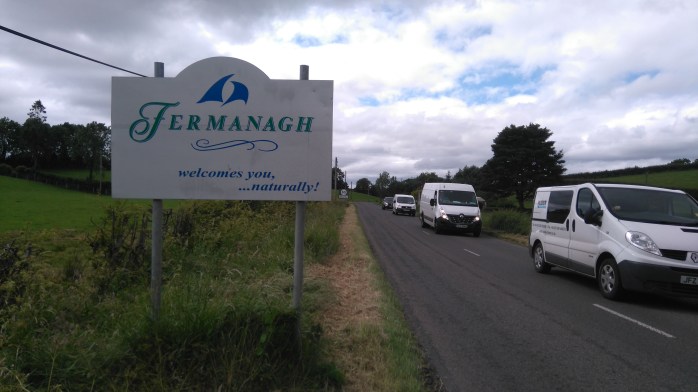
Traffic crossing the Monaghan/Fermanagh border outside Roslea.  Pic: Michael Fisher

DECLAN KEARNEY MLA

Sinn Féin MLA and National Chairperson Declan Kearney also urged people to vote Remain in the EU referendum. Mr Kearney said: “It is very clear that a Brexit will be bad for the economy on the island, bad for farmers, bad for the environment, bad for workers and communities, bad for young people, and bad for Irish unity.”

“Our people in the North of Ireland should not allow the most reactionary elements of the British Tory party to set our political agenda or Ireland’s economic future and to drag us out of Europe. Brexit has the potential to entrench partition. We are committed to ending partition and don’t want to see the return of border checkpoints between north and south.”

“We have been very critical of the democratic deficit at the heart of the EU but the only way to change that is from within. We want to change the EU and build a progressive, prosperous and social Europe, which respects sovereignty. Sinn Féin is calling on everyone to Put Ireland First and vote Remain in the referendum”, Mr Kearney concluded.

THERESA MAY MP

Meanwhile the British Home Secretary Theresa May has warned of border controls in the event of a Brexit. She was speaking during a visit to Northern Ireland to campaign for a remain vote in the referendum.

Theresa May said it was “inconceivable” that there would not be changes to current arrangements between the North and the Republic if the UK voted to leave the EU. Ms May said that, while the Common Travel Area between the two countries existed prior to the EU, if there was a Brexit some form of control would be inevitable.

“It is inconceivable that a vote for Brexit would not have a negative impact on the North/South Border, bringing cost and disruption to trade and to people’s lives,” she said. “Put simply, Northern Ireland outside the EU could not prevent free movement and continue with an open North/South Border.”

Ms May also claimed the economic argument for Northern Ireland to vote remain was compelling. TOM KELLY, the Stronger In chairman in the North, said the Remain campaign was concentrating on getting people out to vote today. “I am very confident that we will win the argument,” he said.

ARLENE FOSTER MLA

However the Northern Ireland First Minister and DUP leader Arlene Foster is urging a ‘leave’ vote. She said she had listened to the arguments on all sides of the debate and after full and careful consideration had reached the conclusion that the right answer was to vote to leave the EU and to take back control of the UK’s future.

“Firstly there is the matter of the democratic principle. I am a devolutionist and believe decisions should be as close to the people as possible.  The European Union is pulling power and decision-making further away.  A return of powers would not simply flow to London but to Belfast too.”

“I believe in accountability. The decision-makers should have to answer to their voters.  The unelected European Commission plays the central and decisive role in EU policy and law making. European Court rulings can have far reaching consequences for us. The process of getting agreement between 28 countries and the use of qualified majority voting has given us a cumbersome process, where our interests can be and often are harmed.”

She continued: “Those who want to push towards a new superstate have already produced their plans and want to create more common institutions like an EU Army.  The golden opportunity to change was refused in the recent renegotiation. Secondly, we have the matter of costs and benefits. The UK as a whole has been a net contributor. The difference between what we pay in and get back has quadrupled in the last four years.”

“The UK has a huge trade deficit with the EU. Globally, the EU is falling behind.  The only continent with worse growth than continental Europe is Antartica.  The EU is not just holding us back but many other countries through its waste, bureaucracy and the straitjacket of the single currency.”

“Thirdly, I see the opportunities.  Many commentators have asked how as a former economy minister do I support a Vote Leave?  It was because of my experiences that I believe it is the right choice.  I have been across the world and I have seen the opportunities that are out there for the taking. I have seen Northern Ireland businesses take them up.  This fills me with confidence and the will to go after them.  I have also seen how power flowing down works best”, she said.

“This is why I am convinced that taking control of our future is the way forward for Northern Ireland and the United Kingdom. I must admit my resolve in this has grown and grown as the EU referendum campaign has developed.”

“Our constitutional future will be decided only by the ballot box. With devolution, people in Northern Ireland have more power over their elected representatives than ever before and we now have both a government and an opposition. This referendum holds true to that principle.”

“Finally, there is one threat to our peace process and one threat alone. Those paramilitary organisations who remain intent on killing are the threat to our peace. A threat the security forces deserve our praise and support for combating every day.

It is deeply offensive to present the people of Northern Ireland as ready to return to violence in the blink of an eye, especially over a democratic vote.  I know, I trust and I wholeheartedly believe we are better than that and those who have made such claims should know better as well.”

“I believe in the people of Northern Ireland. I believe in the businesses of Northern Ireland. I believe in what can they can achieve.  This is why I reject the absurd predictions and exaggerated threats. This is why I look to the future and the opportunities after the 23rd June. This is why I am asking you to Vote Leave.”

Polling stations in the North will remain open until 10pm this evening and it will be Friday when the outcome of the referendum is known.
Share this:

  • Share on Facebook (Opens in new window) Facebook
  • Share on X (Opens in new window) X
Like Loading...
AGRICULTURE MONAGHAN NEWS POLITICS UNCATEGORISED Arlene Foster MLABrexitDeclan Kearney MLAHeather Humphreys TDNiamh Smyth TDReferendumTheresa May MPTom Kelly Leave a comment

MAINTAINING QUALITY BEEF

18/06/2016 by borderroamer

ABP CLONES: A VITAL PART OF BEEF INDUSTRY

Northern Standard reporter Michael Fisher was among a group from the Guild of Agricultural Journalists invited to tour the ABP meat plant at Clones last Thursday. The company organised a visit to a local beef farmer near Carrickmacross and sponsored a barbeque and dinner. The event was organised three months ago. NORTHERN STANDARD Thursday 16th June 2016 p.14

IMG_1224.JPG

ABP Clones General Manager George Mullan with a group from the Guild of Agricultural Journalists. Photo courtesy of ABP.

QUALITY IRISH BEEF

Irish beef has begun to re-establish its first class reputation on the menus of leading restaurants and the shelves of supermarkets in Britain and Europe. The Bord Bia Origin Green scheme of which the ABP Group is a founder member emphasises sustainability and the reduction of environmental impact. So any development in the agri-sector that could affect the reputation of quality beef is potentially worrying.

The ABP Group owned by businessman Larry Goodman is the largest beef processor in Ireland and the UK. It is proud of its record in producing quality Irish beef mainly for export to the United Kingdom and Europe. Various measures are taken at processing plants such as Clones to ensure that high standards are maintained at all times.

Visits to the ABP factory in Clones are strictly regulated. Human hygiene is crucial, as in any meat or food plant. On entry to the plant, visitors must wear protective clothing and hairnets, as well as removing jewellery. Footwear must be replaced by wellington boots, which are scrubbed meticulously in a special walk-through unit before entry is permitted to the boning and other sections. Hands must be washed and disinfectant gels applied.

The boning plant has different sections and each part of the animal carcass is used up along the line, starting with the hide. By-products are sent to some of the company’s other units.

The top class steak cuts were skillfully removed and later packaged, labelled with ABP’s own brand. In the packing hall differently coloured boxes indicated the various countries the meat was destined for, such as the Netherlands, Germany and Italy.

TRACEABILITY

Veterinary inspectors from the Department of Agriculture check the carcasses and stamp them before they are processed. Each carcass is given a tag with details of the farm it came from and where it was slaughtered. Photographs are taken of each individual carcass as it passes along the production line. New tags with barcodes are attached and after chilling they are sent to the boning hall. This is to ensure traceability of the meat to help reassure customers at the end of the food chain and to ensure quality can be maintained.

The tour of the plant then moves outside to the lairage facility where cattle arrive to be processed. The ABP Food Group say animal welfare is a cornerstone of their business, so they have invested heavily in ensuring that customers can be 100% secure in the integrity of their processes.

The company source farm-assured cattle from throughout Ireland (including Co. Monaghan) and the UK. Although the fields of Co. Fermanagh are just a stone’s throw away, the company processes only cattle from the Republic, within a 50 mile distance of the plant. This is because there are special regulations for processing cattle from the North and they could not be handled at the same time as animals from the Republic.

ABP worked closely with the bestselling author and world-renowned livestock-expert Dr Temple Grandin to design and plan their facilities and procedures. She approved every aspect of the holding pens (lairage), assisting the company’s goal to ensure cattle are relaxed and stress-free prior to slaughter. There is a special slat rubber system for the cattle to walk on. Not only does this give livestock the respect and integrity they deserve, but the lower pre-mortem glycogen levels and PH balance of stress-free animals make for a higher quality and tenderness of carcass, according to ABP.

Dr Grandin campaigned to reduce the prodding of cattle with electric goads by showing a humane approach makes much better quality meat. She designed the lairage with curved solid walls, baffled gate latches to cut down noise, and uniform colour and lighting to reduce stress on the cattle. The curved walls ensure each animal is prevented from seeing what lies ahead and just concentrates on the hind quarters of the animal in front of it.

IMG_1220.JPG

ABP Clones General Manager George Mullan (right) explaining the various stages of processing at the meat plant to Michael Fisher. Photo courtesy of ABP.

George Mullan, general manager of ABP Clones, who showed the visiting group around the plant, said since the lairage was opened three years ago he had noticed a huge difference in the behaviour of cattle at the plant. They’re happier animals and calmer at all times, he said. “Animal welfare is a very major concern of the consumer in this present day”, he added.

Mr Mullan explained how following slaughter the patented hanging process increased the natural breakdown of muscle fibres in each carcass while it hung and matured prior to de-boning. ABP Food Group has also created a method of sympathetically chilling the carcass to prevent cold shortening and guarantee absolute tenderness in the beef.

The Managing Director of ABP Beef (Ireland) Finbarr McDonnell outlined the group’s four divisions. ABP Food Group Ireland is Europe’s leading beef exporter, specialising in beef processing, de-boning and retail packing. It has a long tradition of working with farmers and customers, operating highly efficient factories supplying quality beef to European and worldwide retail markets.

The UK branch of ABP is a leading supplier of fresh and frozen meat and meat-free products. It continues to drive innovation in every aspect of business, including collaborative partnerships with customers, to industry leading practices in processing and product development. The ABP Ellesmere development near Liverpool is an example of embedding sustainability at the heart of the company’s operations. Over £20million has been invested to make this plant a carbon neutral operation.

ABP Pet Foods is one of Europe’s leading manufacturers of private label pet food, producing 570,000 tonnes every year from seven facilities. C&D Foods with headquarters in Mullingar is headed by Philip Reynolds, whose father set up the original company. Philip sold a majority interest in the business to ABP in 2011.

The fourth arm of the group is Olleco, the largest collector of used cooking oil in these islands, employing 550 people. It helps many of the biggest restaurants and catering groups to maximise the environmentally sustainable treatment of waste food and oil products.

More than 30 years ago used cooking oil was collected and used in animal feed. When this was banned owing to tighter regulations, a huge amount of used cooking oil ended up in landfill or was illegally poured into drains. Olleco looked at other ways to recover the value from this resource. The company started to collect both used cooking oil and food waste and convert them into renewable energy instead of throwing it away.

With fourteen depots across the UK the company is one of the UK’s largest distributors of cooking oils to the catering trade. In 2013 a specialist biodiesel plant was constructed in Liverpool. Capable of producing 16 million litres of biodiesel it is the UK’s largest purpose built plant dedicated to producing biodiesel from used cooking oil. Two years later Olleco opened the first anaerobic digestion plant, providing the heat and power to operate the biodiesel plant. Tallow is collected at the Clones plant and is sent to England for processing.

Finbarr McDonnell joined ABP in 1973 and held a variety of positions with the company including Group Production Manager and Factory Manager at the Cahir plant. He was appointed Chief Executive of ABP Beef (Ireland) in January 2008. He predicted that with a market turning its back on Friesian types and a re-nationalisation of the French market, cattle prices could be hit in the latter half of 2016.

“It is unfortunate that sterling is where it is and unfortunate that live exports are dead in the water,” he told the Guild of Agricultural Journalists. He urged the country’s expanding dairy sector to prioritise cross-breeding with the traditional Irish Hereford and Angus breeds for which ABP were pushing an open door on export markets. He said the company was ‘concerned’ about how the Brexit referendum next Thursday might turn out.

Mr McDonnell said the market was now ten times more in favour of Hereford and Angus than Friesian beef, adding that he was “very worried” about the consequences for the progeny of dairy farms unless they adapted to breeding more for market requirements. ABP currently handled over a fifth of national output, equivalent to 125,000t per year. It planned to expand further on its 41 sites within the EU employing up to 9000 people. The company was optimistic of a successful outcome to its bid to buy 50pc of Slaney Foods within the coming weeks. The move would result in ABP controlling 28% of the national beef kill.

A year ago ABP Food Group completed a €50 million redevelopment of its facilities in Cahir, Co. Tipperary. It included an extension and upgrade of food processing facilities as well as the introduction of a new state-of-the-art gel bone production plant at its neighbouring by-products site. A report by Oxford Economics and KPMG found that the upgraded facilities employing over 600 people are expected to be worth over €200 million a year to the local economy in Tipperary and surrounding counties.

The plant in Clones employs around 300, with 60% of the staff coming from abroad, including Lithuania and Poland. Based on the Cahir study, this would indicate that the Teehill factory brings in a benefit of around €100 million a year to Co. Monaghan and the surrounding area. This is taking into account employment created by the factory in subsidiary areas like haulage and canteen supplies. ABP is one of the largest employers in the county. It also contributes to the local community through charitable activities such as sport.

THE SUPPLIERS

Freddie and Caroline Merrin farm land at Ballyloughan, Lough Fea, outside Carrickmacross. The Merrins operate a weanling to beef system and have received Bord Bia awards for their product. They are members of the 150-strong Monaghan Quality Cattle Producer Group that supplies cattle to ABP in Clones. Freddie is originally from Killanny and Caroline comes from Kells, Co. Meath.

The farm is 170 acres and there is a similar acreage on a long-term lease from the adjoining Lough Fea estate. The Merrins are helped by their three children, Emma, George, and Linda, a Leaving Certificate student at St Louis secondary school, Carrickmacross. Emma and George are both attend UCD, studying history and science respectively.

Weanlings are grazed and finished out of the shed as either bulls or steers the following winter. The sheds are multi-functional and there is a huge emphasis on grass utilisation. At the moment there are around 700 cattle on the farm. Freddie bought in 350 calves over a five-week period starting in mid-February. He would usually go to the mart in Bandon to buy them.

After a spell in the sheds the calves are out out to grass between mid-May and mid-June. Bull calves would usually be brought to be killed before 24 months and heifer calves before 20 months. When it came to sending them to the factory there could be no room for sentimentality, Freddie said.

ABP Group Livestock Manager Paul Mathews said the company was investing in genetics and had its own herd for research. He said they needed to build up a strong database about breeds and they were working alongside the Irish Aberdeen Angus Association. The Merrins enterprise was one of the best examples of a family farm amongst their suppliers, according to the company.


Share this:

  • Share on Facebook (Opens in new window) Facebook
  • Share on X (Opens in new window) X
Like Loading...
AGRICULTURE MONAGHAN NEWS UNCATEGORISED ABPBeefCarrickmacrossClonesFreddie MerrinGeorge MullanMeat plantTemple Grandin Leave a comment

BISHOP NOEL TREANOR

17/06/2016 by borderroamer
thumb_Treanorcopy_1024

Bishop Noel Treanor following the Mass at St Brigid’s Belfast Pic: Michael Fisher

BISHOP NOEL TREANOR CELEBRATES FORTY YEARS IN PRIESTHOOD

Michael Fisher  Northern Standard  Thursday 16th June 2016 p.14

On the occasion of his fortieth anniversary as a priest, Monaghan native Bishop Noel Treanor of Down and Connor has urged Catholics to continue to foster ways and means of promoting the human dignity of every person and to find new ways of doing so, like in the European Union. It was a new way, never a perfect one, pooling sovereignty and promoting the common good. We have a massive task to promote the social and ethical, he said.

DSC_4562.JPG

Canon Brian McCluskey with Bishop Noel Treanor & Fr Eddie O’Donnell PP St Brigid’s   Pic: Michael Fisher

Bishop Treanor is from Tyholland. The inspiration for the celebration in Belfast on Monday evening came from fellow Monaghan man Canon Brian McCluskey from Inniskeen, a retired priest of Clogher diocese and an assistant at St Brigid’s parish in south Belfast. He realised that the Bishop’s ruby anniversary coincided with that of the parish priest of St Brigid’s Fr Eddie O’Donnell and organised a joint celebration. Two other priests who concelebrated Mass were Fr Sean Emerson PP Antrim and Fr Patrick Winkle CC from Youghal in Co. Cork.

Bishop Treanor thanked Canon McCluskey for his friendship over the years. He said there was clear evidence in the parish of the difference everyone could make together in the community, in the diocese and in the world. It was great to see in St Brigid’s parish and in many others that people were joining them from different countries such as Brazil, the Congo, the Philippines and of course from Monaghan! This was most important at a time (in Europe) when there was a danger of rising nationalism. “We have to open our doors and find new ways of living, working and managing society”, Dr Treanor said, “in order to promote and foster the dignity of every person”.

Fr Eddie O’Donnell thanked Bishop Treanor for sharing the ruby anniversary celebration. He paid tribute to Canon McCluskey, who he met for the first time six years ago when he came to the parish. Brian was now a good friend and he couldn’t do without him in the parish, he said.

At the start of the Mass Bishop Treanor said he was privileged to share forty years of priestly service with Fr Eddie. He recalled that the day of his ordination (13th June 1976) was a very warm day in Monaghan during a beautiful and glorious summer.

DSC_4579.JPG

The ordination by Bishop Patrick Mulligan (centre) of Fr Noel Treanor (left) with Fr Duffy and Fr Daly at St Macartan’s Cathedral Monaghan June 13th 1976. From the files of The Northern Standard June 18th 1976.


The Northern Standard recorded the occasion at St Macartan’s Cathedral when the Bishop of Clogher, the late Dr Patrick Mulligan, ordained Fr Noel along with Reverend Laurence Duffy, Magheracloone (now Parish Priest in Carrickmacross) and Reverend Michael Daly, Killanny (PP Donaghmoyne).

Bishop Mulligan said in his homily forty years ago: “This is a day of rejoicing and gladness for the diocese to see the Church in Clogher renewing itself in the ordination of these young men to be priests…The Church lives and grows through its priests— preaching, offering Mass, taking the place of Christ among God’s people. Without priests the Church dies, the work of the redemption does not bear fruit. Thank God we have had enough priests in every generation to maintain the life of the Church…May Our Lord give these young men and all priests the rewards he has promised to those who leave all things to follow Him both in this life and in the life to come”.

Bishop Treanor said along with Fr Eddie he wished to thank his family, relatives and the local communities who had nourished and supported them in their vocation. He also thanked the parishioners of St Brigid’s for the support they had shown to Fr Eddie since his appointment as Parish Priest.

He reflected on how they were both children of the 1950s and 60s. They grew up in the era of The Beatles and in Monaghan, country and western music with stars such as Big Tom. They had been ordained with many others in 1976, a time of great hope and aspiration. They had moved through times of great change and scandals, even in the church. They had seen the arrival of different forms of fundamentalism and the rise of nationalism, which were recipes for war. But they still stood as a Christian community proud to serve the living word of God for our times and faith.

Looking back over forty years they were thankful. There had been much water under the bridge and now they must look to the future as people of hope. There was now a good balance between laymen and women and ordained priests working together to make parishes a welcoming place and centres of faith that were also part of a diocesan and a world church.

DSC_4571.JPG

Following the ordination of Fr Treanor a reception was held in Tyholland parish at Leitrim old school where he had been a pupil. From the files of The Northern Standard June 18th 1976.

Bishop Treanor spoke of the need to find new ways of catechising for young people. He hoped there would still be Catholic schools in fifty years’ time. But if that was not guaranteed then the church might have to provide Sunday school education for faith.

He referred to the vibrancy of the Catholic church in places like Brazil, India, Korea, China and Myanmar and hoped that people from these countries would bring a freshness of experience to the church locally. They gave thanks to their forebears for the gift of faith and prayed they might hand it on to the next generation.

At the end of the Mass Fr O’Donnell told the congregation he had wanted a quiet anniversary, but Canon McCluskey had plotted with the parishioners to hold a double celebration. He described Canon Brian as a special friend, who he could not do without “in spite of his hang-ups with Monaghan GAA and the poetry of Patrick Kavanagh!” Reflecting on the shortage of new vocations, Fr Eddie said there was a great psychological difference in asking “do you need priests?” and “do you want priests?” If you said “want” then you were more likely to do something about it and gain the courage to ask a son or relative to consider seriously Christ’s call.

Canon McCluskey spoke afterwards during a meal organised at the parish hall. When he first met Fr Eddie six years ago, he had resided in the parish for a number of years (since his retirement from the diocese of Clogher). When he got into conversation with him, one of the first things he told him was that Monaghan had a (GAA) football team, something Fr Eddie didn’t know!

They were gifted that a Monaghan man had been sent to lead this diocese. He himself had been the precursor, the John the Baptist figure preparing the way for Bishop Noel to come to Down and Connor. Canon McCluskey said this would be a night to remember, the night of the great feast, just as people in the past had recalled the night of the great wind.

DSC_4564.JPG

St Brigid’s parishioner John Mooney whose family came from Annyalla, Co. Monaghan with Bishop Noel Treanor and Canon Brian McCluskey at the 40th anniversary celebration. Pic: Michael Fisher

Bishop Treanor was born on Christmas Day 1950 at Silverstream, Co. Monaghan, in the parish of Tyholland. He attended St Brigid’s National School, Leitrim, and completed his early education at St Mary’s CBS, Monaghan. In 1968 he began his study of Arts and Philosophy at St Patrick’s College, Maynooth, and in 1971, commenced the study of Theology, achieving his Licence in Sacred Theology with special commendation in 1977.

Following his ordination he was sent by the late Bishop Mulligan to the Irish College in Rome to pursue his studies of theology at the Pontifical Gregorian University. Recalled in 1980 by the then new Bishop of Clogher, Most Revd Joseph Duffy, he was appointed assistant in the Cathedral parish, in charge of the local Catholic Marriage Advisory Council.

From 1981 to 1985 he again pursued the study of theology in Rome, while at the same time serving as Prefect of Studies at the Irish College. Having returned to his Diocese in 1985, he was appointed Director of Adult Education. He organised a diocesan assembly of clergy held in 1986 to promote pastoral renewal within the diocese. His next appointment was as a curate in Enniskillen, where he also provided service at the general hospital and was active at Lough Derg pilgrimage centre.

In 1989 he was sent to Brussels to work with the Commission of the Bishops’ Conferences of the European Community, COMECE. While deeply involved in the expanding endeavour of this Church body to project Christian values into the European process, he continued to engage in pastoral work through contact with the English-speaking community in the city. He also published and lectured widely on European construction issues, the Church and Europe, and Church-State matters.

On March 31st 1993 he was unanimously appointed Secretary General of COMECE for a three-year term and was reappointed for several successive terms since then. In May 1994 he was nominated Chaplain to His Holiness. His appointment as a Bishop was announced by Pope Benedict XVI in February 2008 and he was installed at St Peter’s Cathedral in June that year on the feastday of St Peter and Paul.

Fr O’Donnell was ordained for the Down and Connor diocese at St Patrick’s church Donegall Street in Belfast. He is a native of Magherafelt in County Derry and celebrated his first Mass there. His brother, sister and cousins attended the anniversary Mass. Fr Eddie as he is known went on to serve as a hospital chaplain before being appointed diocesan Secretary in 1982-1991 during the stewardship of Bishop Cahal Daly. He served in Antrim, Newtownards and was parish priest of St Anne’s Derriaghy before being appointed by Bishop Treanor to St Brigid’s in 2010.

Ad multos annos.


Share this:

  • Share on Facebook (Opens in new window) Facebook
  • Share on X (Opens in new window) X
Like Loading...
MONAGHAN NEWS UNCATEGORISED Bishop MulliganBishop Noel TreanorClogher dioceseDown & ConnorFr Eddie O'Donnell PPMonaghanSt Brigid's BelfastTyholland Leave a comment

CASEMENT PARK

10/06/2016 by borderroamer
DSC_4403.JPG

A derelict Casement Park with the old stand that is due to be demolished Pic: Michael Fisher

WILL A NEW CASEMENT PARK HOST ULSTER FINAL IN 2020?

Ulster GAA re-launch plans for new all-seater Belfast stadium

Michael Fisher  NORTHERN STANDARD  Thursday 9th June 2016 p.14

As Monaghan took the first step in Clones on Sunday towards retaining the Ulster football championship, the GAA in Ulster is proceeding with plans to start re-building Casement Park stadium next year. The first matches at the new £77 million ground could be played in 2019 and Casement could be ready to host its first Ulster senior football final in July 2020.

President of the Ulster Council Michael Hasson, an Antrim man, has welcomed the progress made on re-launching the plan. He said since opening in 1953 Casement Park had played a significant role in the development, promotion and profile of Gaelic Games in Belfast, Antrim and across Ulster. The GAA as a proud community organisation embedded in communities and open to everyone thrived on community spirit. The Casement Park project, he said, represented an opportunity to invest in a community that the Association was proud to be a part of.

Mr Hasson told the Northern Standard he hoped the new Casement Park would be able to host the Ulster final. But he stressed that this did not mean the end of Clones as a major venue. On the contrary, the GAA was keen to develop Clones to be on a par with the new Kingspan Breffni Park and with the re-developed stadium in Belfast, the biggest urban centre in Ulster. He himself was a member of the committee planning the redevelopment of Clones.

Last year on two separate occasions the GAA President Aogán Ó Fearghail stated that the GAA would never abandon Clones as a venue for major games. He told members of Monaghan County Council that Clones had nothing to fear from a major redevelopment at Casement Park. But he stopped short of guaranteeing that St Tiernach’s Park would remain as the exclusive home of the Ulster football final. He said Clones was the same as Breffni and there would always be a significant need for it.

DSC_4405.JPG

Hoarding around the perimeter of Casement Park, Andersonstown Pic: Michael Fisher

The original plans for the new stadium on the Andersonstown Road in West Belfast to host up 38,000 people were drawn up in 2012 and lodged with the planning service in July 2012. But they ran into difficulty soon afterwards and a legal action was taken by a group of local residents opposed to the project because of its size. A civil servant also raised concerns about crowd safety issues.

In the meantime Ulster Rugby’s Ravenhill ground and soccer’s Windsor Park have both had millions of pounds pumped into their redevelopment by the Stormont Executive. When the plans for Casement were first published it was envisaged that the stadium would open by 2016 but so far no work has taken place and the main gates remain locked.

Former Department of Culture Arts and Leisure Minister Carál Ní Chuilín stated that money for the Casement Park redevelopment had been “ring-fenced” by the Executive. But there are fears that with a new team at Stormont and a DUP Minister, the development process could drag on, leaving the GAA in Ulster without a new state-of-the-art stadium while soccer and rugby will benefit from the latest facilities.

Casement Project Manager Stephen McGeehan said the GAA was now willing to consider a capacity below 38,000, the number of seats in the original redesign plan. As the Association launched a fresh round of community consultation about the proposal, he said the GAA had no intention, and never had, of knocking people’s houses down, or of purchasing or demolishing anyone’s homes to make room for the stadium.

Since 2014 when planning permission for the redevelopment was overturned the GAA has been working on a new planning application. The GAA said it wanted to hear feedback from people in west Belfast and further afield about the proposed stadium design. It organised a number of consultation initiatives.

The Northern Standard was shown the details at one of three public events held in west Belfast last month. The GAA intends to submit a planning application before the end of this year. Under the new timetable, work would start on the new stadium by the end of next year and the ground would be completed by the end of 2019. The hope would be to play the first Ulster provincial final at the new Casement Park in summer 2020.

The GAA said the redesigned stadium would take into account the fears over the emergency exiting arrangements in the original design. But they have not yet put a figure on the proposed capacity. Local residents had wanted a maximum of 25,000 spectators. Stage 2 of the consultation will take place in late Summer/Autumn when detailed plans will be available for review along with the findings of the Environmental Impact Assessment.

Chairman of the Casement Park Project Board Tom Daly commented: “We are looking forward to hearing the views of anyone with an interest in the project. This will be a facility everyone in west Belfast, County Antrim, Ulster and throughout Ireland will be immensely proud of and a stadium that the next generation of young people can aspire to play in. The start of the community consultation is an important step as we look forward to a new and modern stadium at Casement Park.”

The consultation will go above and beyond the twelve weeks process required, extending over a twenty-week period. The GAA said they would welcome views about all elements of the new provincial stadium from the local community, interest groups, the wider GAA and other relevant groups across business, arts, social and sports.

Project Director Rory Miskelly said: “Casement Park promises to be another landmark facility in the heart of Belfast and one which we are all looking forward to. The project remains a Programme for Government commitment and a key part of the Regional stadium programme. There is a clear roadmap for the project in place and the consultation forms a key part of this.”

At this stage the proposed development comprises the demolition and subsequent redevelopment of Casement Park to create a new provincial GAA stadium. It is anticipated that proposals will include:

  • Demolition of all existing structures and their re-use on site where appropriate;
  • Construction of a new all-seater stadium with capacity to accommodate Ulster GAA finals and semi-finals, All Ireland Qualifiers, Antrim County GAA (football and hurling) fixtures and other sporting events. The pitch will be constructed and laid out to established GAA standards;
  • Stands on all sides accommodating spectator seating in a range of categories (general admission, premium, corporate, VIP, ambulant disabled and disabled – designed to the highest standards of inclusive design including space for families to sit with wheelchair users); associated player, media, conferencing, bar and banqueting facilities, offices (Event Management Suite), medical and safety facilities, handball courts, community space, education and heritage centre, social club, kitchens and circulation space;
  • The provision of floodlighting and stadium lighting to facilitate high-definition media;
  • On-site car, coach parking and provision of a space for outside broadcast units;
  • Vehicular access to the site from Andersonstown Road; with emergency access arrangements towards Kennedy Way and Stockman’s Lane and pedestrian routes to Owenvarragh Park, Mooreland Drive and Andersonstown Road;
  • The stadium will be designed and constructed to a standard that will enable the hosting of a small number of special events including music concerts, subject to appropriate licensing and availability with regard to the primary use of the stadium for GAA fixtures and other sporting events;
  • The use of the Stadium for large scale (18,000 attendance) music events will be restricted by the seasonal nature of both the sporting calendar and the weather conditions which in effect will limit this use to not more than five days a year.

An Environmental Impact Assessment (EIA) will be prepared to address all environmental issues and submitted as part of the planning application. A number of preliminary/baseline environmental surveys are ongoing; these include but are not limited to:

  • Flora surveys
  • Mammal Surveys
  • Noise surveys
  • Ground Investigation surveys
  • Traffic surveys
  • Landscape & Visual surveys
  • Japanese Knotweed surveys and plan

The final design of the stadium will be subject to a detailed EIA that will address all necessary issues including:

  • Ecology
  • Air Quality & Climate
  • Noise & Vibration
  • Landscape & Visual
  • Water & Drainage
  • Cultural Heritage & Archaeology
  • Contaminated Land & Japanese Knotweed
  • Socio-economic
  • Overshadowing and Sunlight / Daylight effects
  • Lighting
  • Soils & Geology
  • Telecommunications
  • Highways & Transportation

Support for the project has come from a number of local GAA clubs. Michael Davitt’s GAA Club on the Falls Road in West Belfast said it was vital everyone showed support for the Casement Project. Hopefully, we will all be able to demonstrate a favourable impression and show there is a really strong support within Antrim County for the new Casement Park stadium.,‘Let’s build Casement!’ was their message to supporters.

Because of the closure of Casement, some important Antrim games are now being played at Corrigan Park in west Belfast, home of St John’s GAC. The All-Ireland Football qualifier round 1B game between Antrim and Limerick will be held there on Saturday 25th June. Time to be confirmed.


Share this:

  • Share on Facebook (Opens in new window) Facebook
  • Share on X (Opens in new window) X
Like Loading...
UNCATEGORISED Leave a comment

BRITISH DAIRY GOLD CUP

09/06/2016 by borderroamer

TYRONE FARMERS IN FINAL FOR BRITISH DAIRY GOLD CUP

 Michael Fisher  Northern Standard Thursday 9th June 2016 p.9

Two Tyrone farmers will be in contention for the prestigious Gold Cup at this year’s British Dairy Farmers Livestock Event in Birmingham. It’s the premier UK national dairy herds competition, recognising efficiency in commercial milk production. Entry to the event on July 6th and 7th at the National Exhibition Centre outside Birmingham is free for all visitors.

David Irwin and his father Alan run a herd of 170 redhouse Holsteins at their farm near Benburb. The farm is located near the River Blackwater in the townland of Derrycreevy. The other family members involved in the enterprise are William Irwin, Ida, Sylvia, and Jayne.

Their land comprises approximately 240 acres of grassland and cereals. A lot of it is too steep or too wet for cutting silage or growing cereals. Most of the land is heavy soil over red clay.

Approximately 120 acres of silage is made in each of three cuts to supply the stock with forage all year round. Fifty acres of spring barley is grown each year to supply whole grain cereals and straw for feeding to stock.

The farm was initially a mixed dairy, beef and arable farm. The cows were lost to brucellosis in 1974. The present herd started in 1979 with bought in heifer calves in 1977. No stock has been purchased since 1979. The dairy herd was increased and beef gradually phased out, until the present day herd of cows and replacements.

The cows are milked three times a day and the milk is sold to Fane Valley Co-op. All the work is carried out on the farm by the Irwin family and two full-time employees. The work undertaken includes all silage making, slurry spreading and cereal making.

The second Tyrone farmer to compete in the Gold Cup final is Adrian McFarland from Omagh. The two Northern Ireland entrants will be up against two competitors from Scotland, one from Wales and one from England.

The annual event is organised by the Royal Association of British Dairy Farmers and attracts more than 400 exhibitors covering thirteen unique product zones. Exhibitors are on hand during the two-day event to demonstrate all-new equipment, products and services to over 17,000 UK and International livestock farmers.

The Gold Cup is the top award in British dairy farming and is open to all dairy herds with official milk records and meeting the criteria of at least 100 cows in the herd,  an annual average cell count of 200,000/ml or less and a £PLI value which is breed specific. Entrants complete a detailed questionnaire giving herd performance data, including production, feed, health and fertility information.

Finalists are selected and visited by the team of judges, and each finalist is judged on factors such as physical and management performance, environmental schemes and their future plans for the dairy business. The winner will be announced and presented with the Gold Cup at the Livestock Event.

The main focus of the event is to share information, ideas and practical advice to help farm businesses survive the next eighteen months. The RABDF Chief Executive Nick Everington told journalists in Belfast: “Times are tough. We are conscious that falling incomes in the livestock sector are continuing to have a severe impact, particularly in dairying. Consequently as a charity representing farmers, the Royal Association of British Dairy Farmers is attempting to support the future of farming businesses, where it can.”

“That’s why we have organised this year’s focus at the Livestock Event to be all about helping farmers drive resilience into their businesses. What’s more we have agreed to offer free entry to all visitors; they will have an opportunity to think outside the box and collect a day’s worth of ideas, information and advice to take home from under one roof, and all without charge.”

“Whilst the event has attracted over 350 trade stands, including some companies from Ireland, we are also proud to launch several new technical features, demonstrations and presentations and to have redeveloped new ones. Visitors will be able to find out about relevant products and concepts that will save money and keep on track, and investigate the latest new products and innovation – future investment, staying ahead of the game. We’re expecting over 100 new products to be available, including more than thirty to be launched at the event.”

British Agriculture Minister George Eustice MP will officially open the event on the first day, and will be responding to visitors’ queries on the outcome of the Brexit referendum and its implications for the industry’s future. The Association itself has adopted a neutral stand on the issue.

Mr Everington adds: “We are looking forward to welcoming farmers, stockmen, students, vets, consultants and suppliers, arriving with an open mind and being prepared to embrace change. The future is in their hands.” To pre-register for a free ticket see www.livestockevent.co.uk.

Flights from Belfast and Dublin to Birmingham arrive at the international airport, which is within walking distance of the National Exhibition Centre. TravelSolutions of Belfast (tel. 048-90455030) can provide a booking service for individuals or groups.

Among the key features of this year’s event are:

Forage Field: designed to help all livestock farmers learn more about how to exploit the massive potential of home grown forage, in particular grass, the most cost efficient feed. Forage Field is a hands on practical area that will be split in to two; making more from grass and forage options, and saving silage costs by reducing dry matter losses and improving clamp consolidation.

Calf rearing demonstrations: showcasing a variety of feeding and housing systems including live calves in igloos, conventional and specialist buildings, all of which are designed to improve rearing efficiency of both dairy and beef calves. The feature will be complemented by a series of knowledge sharing seminars delivered by leading youngstock specialists discussing the latest in nutrition and management.

Machinery Demonstration Arena: a new working demonstration featuring mixer wagons, loaders, bedders and straw choppers – essential kit for most intensive dairy and beef farms. Visitors will be able to observe and compare models and weigh up the cost saving opportunities as they are put through their paces.

Foot trimming / Healthy Feet: return of one of the most popular demonstrations. Foot trimming will feature the Dutch Five Step method using both a knife and grinder repeated four times each day, and supported with independent commentary and additional information on locomotion. Healthy Feet is a practical workshop, supported by AHDB, designed to help farmers understand more clearly what causes lameness, its impact and how to reduce incidences. Each session will focus on how to recognise lameness in the early stages, followed by prompt and effective treatment.

Livestock Learning: a new conference theatre designed to offer all dairy, beef and sheep farmers practical advice delivered by specialists and covering a comprehensive range of topics from health to grassland livestock systems. There will also be an opportunity to ‘ask the farmer’, with some of the UK’s award winning farmers taking to the platform.

RABDF Presentations Forum: an opportunity for livestock farmers to glean useful information on a wide range of subjects affecting their businesses including; Decisions4Dairy, tools for survival, how to sell milk at £2 per litre (a niche market for unpasteurised milk), controlling Johne’s and dealing with farm safety issues. It’s estimated that 60% of British dairy farmers do not know the rolling costs of their milk production.

 Beef Arena: another new feature focused on measuring and monitoring to help all rearers and finishers improve their management systems. The arena will feature live EID demonstrations of leading equipment; livestock specialist Miriam Parker will talk through handling systems whilst the central area will be dedicated to weigh crates, cells and accompanying software.

Livestock showing: dairy, beef and sheep will all feature in the show ring: six different breeds within the National Dairy Show including Ayrshire, Brown Swiss and British Friesian cattle societies each staging their national shows, along with British Charolais Cattle Society, the South Devon Herd Book Society will be holdings its second performance championship. The Lleyn Sheep Society will be highlighting what this commercial sheep breed has to offer. 

Share this:

  • Share on Facebook (Opens in new window) Facebook
  • Share on X (Opens in new window) X
Like Loading...
AGRICULTURE MONAGHAN NEWS UNCATEGORISED BenburbBirminghamDairy FarmingGold CupLivestock EventNECOmaghRABDFRedhouse HolsteinTyrone Leave a comment

EIRGRID AGM

03/06/2016 by borderroamer

EIRGRID DEFENDS OVERHEAD INTERCONNECTOR IN ANNUAL REPORT

Michael Fisher  NORTHERN STANDARD Thursday 2nd June 2016 p.14

The EirGrid Chief Executive Fintan Slye has said the proposed North/South electricity interconnector will secure energy supply across the island of Ireland. His comments are included in the company’s recently published annual report 2015 ‘Connecting Jobs and Prosperity’.

Mr Slye attended the oral hearing in Carrickmacross twice in the closing stages in May to observe the proceedings and to talk to the company’s representatives. But he made no comment on the hearing itself.

Chairman John O’Connor presented the EirGrid annual report to the Minister for Communications, Energy and Natural Resources Alex White, following the company’s annual general meeting. Mr O’Connor said: “delivering the right electricity grid and operating it securely and efficiently for the entire island of Ireland, north and south, is what guides us in EirGrid Group.

Last year continued a trend of strong financial performance. Group revenue was €706.2m, making it €37.9m (5.7%) higher than 2014. Profit before tax was €40.7 million, with underlying profits at €16.9 million. Based on this strong performance, we are able to deliver a proposed dividend of €3.5 million to our shareholder (the exchequer).”

Mr O’Connor continued: “in the previous annual report 2014, I said that the EirGrid group of companies were on a constant mission to improve how we do things and that this requires us to embrace change. A year on, I can truthfully say that this commitment can be seen across all aspects of our business.”

“It is evident in the way we are planning for the future needs of the electricity transmission grid. It is evident in the way we are reaching out to and consulting with communities and individuals who are affected by, or have an interest in, our projects. It is evident in the way we are breaking new ground in accommodating an ever higher share of renewable generation on the grid. It is evident in the large investment in new wholesale electricity market systems to ensure we have the most competitive prices possible,” he added.

EirGrid Chief Executive Fintan Slye commented: “throughout 2015 we have worked closely with some of the biggest companies in the world to foster jobs and prosperity in communities across the island. Much of this work has focused on the development of data centres, for example, Apple in Athenry, Co. Galway, Facebook in Clonee, Co. Meath and Microsoft in Grangecastle, Co. Dublin. Large data centres are high energy users, so they will often connect directly to the electricity grid. Developments such as these bring construction jobs, long-term employment and increased rates to fund local council facilities.”

“Though electricity is just one element of the critical infrastructure that underpins these investments, we work hard to ensure that power quality, energy prices and security of supply bring such customers to the table. I would like to thank Minister for Communications, Energy and Natural Resources, Alex White, and the Minister for Enterprise, Trade and Investment in Northern Ireland, Jonathan Bell, for their positive engagement throughout the year”, the CEO added.

In the annual report Mr Slye said 2015 was a milestone year for the North/South Interconnector project, as the company submitted a planning application to An Bord Pleanála in June. In the same month they also submitted the necessary paperwork to the Department of Environment in Belfast, thus completing the information required for recommencement of the public inquiry into the project in Northern Ireland. The North/South Interconnector will secure energy supply across the island of Ireland, Mr Slye said.

EirGrid Chair John O’Connor said the North/South interconnector was the single most important and most urgent infrastructure project on the island of Ireland. Designated a ‘Project of Common Interest’ by the European Commission, the interconnector was urgently needed to secure adequate electricity supply in Northern Ireland. It would facilitate the optimal operation of the all-island electricity market, for the benefit of people and businesses everywhere.

According to Mr O’Connor the interconnector also provides a local benefit to the people in the North East, by increasing the capacity of the electricity network in the region. In turn, this would help to attract inward investment and jobs. Subject to the planning process now underway, EirGrid were committed to delivering this project as soon as possible for the benefit of electricity consumers in both jurisdictions.

Rosemary Steen, EirGrid’s executive director of external affairs, said the launch of their draft grid development strategy, “Your Grid, Your Views, Your Tomorrow”, in March 2015 was another significant step forward for the group. This draft strategy was a response to feedback received from the public during consultations on major grid development projects. It also represented a key part of their efforts to encourage greater participation in the decision-making process.

Your Grid, Your Views, Your Tomorrow reflected an updated view of the economic context for developing the grid. The strategy further incorporated EirGrid’s growing experience of promising new transmission technologies. It included a new Regional Option for the Grid Link project and a hybrid option for the Grid West project. It also concluded that overhead lines were the best solution for the North/South interconnector.

Ms Steen said: “we continue to engage with local communities on this key project and have recently initiated a wide-ranging outreach and information campaign. This has resulted in meetings and dialogue with many community members on issues including undergrounding, environmental interests and health concerns. We are staffing community offices, holding regional discussion forums and are communicating more widely to better explain our plans. A key initiative has been the appointment of Agriculture and Community Liaison Officers across the island, as well as a public affairs lead in Northern Ireland. The development of a consultation handbook and toolkit, plus the adoption of “plain English” in our publications, further reflects our commitment to meaningful and accessible engagement.”

She added: “we seek to engage early with public representatives in Stormont and the Oireachtas, and across local government. This provides government feedback while also acting as an avenue to engage with local communities. Our Chief Executive appeared twice during the year (2015) at the Oireachtas Joint Committee on Transport and Communications. This was accompanied by outreach and walk-in sessions with Senators and TDs, which provided some valuable feedback. We also worked within the framework of the government’s new Regional Action Plan for Jobs. We were delighted when the North South Interconnector was identified as a key enabler of jobs and development through this forum.”

“In Northern Ireland, we carried out a significant body of political engagement, which included briefings with all tiers of elected representatives across each political party; from Councillors to MEPs. We were honoured when Minister Jonathan Bell opened our new SONI offices in June. We also briefed several of the new local government districts or ‘super-councils’, a programme which will continue throughout 2016.”

“As we look forward, engagement, consultation and outreach will continue to form a key part of our grid development strategy. While further consultation is not required as part of the planning process for the North/South interconnector, we are committed to continue informing and engaging with local communities.”

John Fitzgerald, executive director grid development and interconnection, explained how the company had been delivering the grid to meet future needs. In co-operation with NIE and ESB, they identified and submitted an application for planning approval for the North/South 400 kV interconnection development. The interconnector, he said, would increase the security and reliability of electricity supply to households and businesses throughout the island of Ireland. It would support growth and boost existing industry in the North East region and ensure a continuing reliability of electricity supply. It would enable the all-island wholesale electricity market to work efficiently, allowing for increased competition in electricity supply, thereby offering consumers choice and competitive prices.

SALARIES

The annual report also gives some details regarding remuneration. The Chairperson’s fees were equivalent to €21,600 per annum during the year (2014: €21,600). Directors’ fees were equivalent to €12,600 each per annum during the year (2014: €12,600). The only executive Board Member during the year was the Chief Executive, Fintan Slye.

The Chief Executive’s remuneration is set by the Department of Public Expenditure and Reform and the Department of Communications, Energy and Natural Resources. The remuneration of the Chief Executive consists of basic salary, taxable benefits and certain retirement benefits. The retirement benefits of the Chief Executive are calculated on basic pay only and aim to provide in retirement a pension of one-eightieth and a gratuity of three-eightieths of salary for each year of service as Chief Executive.

The increases in accrued pension and accrued gratuity excluding inflation during the year to 30th September 2015 were €2,125 (2014: €2,125) and €6,375 (2014: €6,375) respectively. The total accrued pension at the end of the year was €16,170 (2014: €14,045) and the total accrued gratuity was €53,660 (2014: €47,285). The transfer value of the relevant increase was €28,541 (2014: €27,141).

The Chief Executive’s remuneration:

Basic salary €170,000 30/09/15 (€170k 2014)

Annual Bonus – –

Taxable benefits €18,000 (€18k 2014)

Pension contributions paid €29,000 (€26k 2014)

Director’s fees – –

TOTAL: €217,000  2015   (€214,000  2014)

Share this:

  • Share on Facebook (Opens in new window) Facebook
  • Share on X (Opens in new window) X
Like Loading...
MONAGHAN NEWS POLITICS UNCATEGORISED AGMAn Bord PleanálaCarrickmacrossEirGridFintan SlyeJohn O'ConnorNorth/South Interconnector Leave a comment

EIRGRID AT ORAL HEARING

02/06/2016 by borderroamer

EIRGRID’S TEAM WAS WELL PREPARED FOR ORAL HEARING

 Michael Fisher  Northern Standard Thursday 2nd June p.14

Throughout the oral hearing in Carrickmacross into the proposed North/South electricity interconnector, EirGrid had a team of up to forty people lined up to address the inspectors. Each was not present every day for the thirty-five days of the proceedings and some were relied on more heavily than others to make the case for the 400kV overhead line and 300 pylons stretching from Meath to Tyrone, through Cavan and Monaghan. They included staff members and consultants and their contributions were led by a legal team.

EIRGRID TEAM:

 THE LAWYERS

JARLATH FITZSIMONS SC is a well-known barrister practising in the area of planning and environmental law. He is a former lecturer in Law at Trinity College, Dublin.

BRIAN MURRAY SC has been a Senior Counsel since 2002 and has a particular expertise in the area of constitutional law and company law. He has been involved in many high profile cases and has appeared in inspection, restriction and disqualification cases on behalf of the Director of Corporate Enforcement. Educated at Trinity College Dublin and Cambridge University, he previously lectured in company law at Trinity College Dublin.

STEPHEN DODD, Junior Counsel is a practising barrister. He has written widely on commercial, planning and other areas of law. He is the author of the Consolidated and Annotated Planning and Development Regulations 2001/2005 (Round Hall, 2005) and the Consolidated and Annotated Planning and Development Acts 2000/2007 (Round Hall, 2008).

DEIRDRE NAGLE, Senior Solicitor, EirGrid

A highly dedicated senior planning and environmental lawyer, with extensive experience in advising on legal matters within the energy industry. A member of the GC Powerlist: Ireland for 2015. As Senior Solicitor, she has ensured the provision of a legal services across the EirGrid Group, while managing a significant case load.

EIRGRID STAFF

DES COX, Senior Planning Consultant EirGrid. He was educated at Trinity College Dublin BA Mod geography and sociology and at UCD where he obtained a Master’s degree in regional and urban planning (MRUP). He worked for three years as a senior inspector with An Bord Pleanála and was Operational Director for RPS Planning Dublin before joining EirGrid in 2010 as Senior Co-Ordinator Public Planning and Consents.

SHANE BRENNAN, Project Engineer, EirGrid/SONI. A native of Co. Monaghan, he represented the company at the information office in Carrickmacross and has been involved with the Northern Ireland end of the project.

AIDAN GEOGHEGAN, Project Manager. He played a key role in explaining why the company had chosen an overhead line and had ruled out undergrounding.

WILLIAM MONGEY, Senior Engineer, Grid Development. Responsible for the co-ordination of wayleaves.

DR MAEVE FLYNN, Senior Ecologist. Lead Ecologist in the department of Grid Development and Interconnection at EirGrid. Her role is to provide ecological expertise and support to project teams within Grid Development and to promote best practice in ecological impact assessment for projects.

FERGAL McPARLAND, Senior Programme Manager, Transmission Asset Management. An experienced senior projects manager, principal engineer and team leader with a successful track record delivering national renewable and extra high voltage transmission infrastructure projects. Senior Project Manager for delivery of Transmission System Operator (TSO) commerical offers associated with Gate 3, the group renewable processing scheme for over 3000 MW of renewable generation established by the Commission for Energy Regulation. He was educated at UCD (MBA) and the University of Bath (MSc in electrical engineering).

DAVID MARTIN, Senior Communications Specialist. An expert in public relations, he is the senior lead communications specialist at EirGrid. Over the past five years, his role has involved the management of political and stakeholder relations, strategic corporate communications and corporate social responsibility initiatives.

MARK NORTON, Manager Transmission Network Planning.

PHILIP O’DONNELL, Manager Energy System Analysis.

CONSULTANTS

ESB INTERNATIONAL

ROBERT ARTHUR, Senior Consultant, Construction. He made a significant contribution to the EirGrid case, explaining the company’s expertise over more than thirty years of erecting pylons and overhead lines. He was asked to explain details of the proposed method of construction for the pylons. He outlined how they could be built in different terrain, including bogland and on sloping ground. Started his career in 2000 working in EMC testing & EMF Human Health surveys with Compliance Engineering Ireland Limited. Joined ESB International in 2004, dealing with HV Transmission Line Conflicts. Maintained specialist work in EMF field when taking up EMF Specialist role in 2006 within ESBI. Currently High Voltage Transmission Lines & Cables Maintenance Manager within ESBI’s Asset Management Services group. Responsible for a team of 22 staff dealing with overhead transmission line and HV cable maintenance. Educated at DIT and University of Bath (MSc electrical power systems).

JARLATH DOYLE, Senior Consultant, Construction. Project Director 400kV projects. Specialises in design and construction of transmission lines; project management; tower foundation design; material testing and specification; preparation of environmental impact statements. Educated at NUI Galway (BE) and University of Limerick (MBA).

KEVIN COFFEY, Line Routing Specialist.

BRENDAN ALLEN, Senior Planning Consultant.

DR PADDY KAVANAGH, Environmental Director.

EXPONENT:

DR BILL BAILEY, Principal Scientist.

DR GABOR MEZEI, Medical Doctor & Senior Managing Scientist.

RPS:

NEASA KANE-FINE, Senior Communications Specialist.

LEAH KENNY, Operations Director & Director of Planning.

TOBIN:

DAMIEN GREHAN, Director of Energy & Environment.

JOHN DILLON, Senior Environmental Engineer.

DAIREANN McDONNELL, Senior Ecologist.

TOM CANNON, Senior Traffic Engineer.

According to Tobin Consulting Engineers, there is no doubt about the significant benefits that the North/South 400kV interconnection development will bring to the people of Ireland, north and south. It will link the power distribution network in both parts of the island of Ireland, and it will improve competition by reducing the constraints that are restricting the efficient performance of the all-island Single Electricity Market. It will improve security of supply by providing a reliable high capacity link between the two parts of the all-island transmission system; it will support the development of renewable power generation by enhancing the flexible exchange of power flows over a large area of the island and it will specifically reinforce the security of the electricity supply in the North East.

TOBIN is a key member of the consultancy team on this nationally important strategic project. The company brought their GIS capability to route selection along the approximately 60km southern section of the proposed development, screening the entire study area under all constraints such as designated conservation areas, dwellings, surface water features, cultural heritage features, geology and landscape designations. This work enabled the identification of the route corridor options that minimised environmental impact as it ensured the avoidance of the most significant constraints. The Environmental Impact Statement for the Meath section of the indicative route was linked and coordinated with that for the Cavan-Monaghan section prepared by other colleagues. Planning for this development fell under the Strategic Infrastructure Act.

TOBIN’s ornithological team undertook detailed ornithological surveys focusing on the Whooper Swan, over a number of years within Counties Meath, Cavan, Monaghan and Armagh for this project to determine the location of both feeding and roosting sites as well as regularly used flight lines between sites. As part of this study, they completed both field surveys and aerial surveys. TOBIN is the only consultancy to have such expertise within Ireland, possessing the most significant and up-to-date body of national research for this specific species.

The project has drawn its share of controversy, but the TOBIN approach, of presenting the fundamental facts, in a focussed, patient and calm manner, concentrating on the fundamental matters of concern, has been respectful and productive, according to the company. Their consultations have been, in many instances, one-to-one briefings.

AECOM:

AECOM is a large international company providing a blend of global reach, local knowledge, innovation and technical excellence in delivering solutions that create, enhance and sustain the world’s built, natural and social environments.

JOERG SCHULZE, Senior Landscape Architect. He played an important role during the hearing introducing photomontages of critical points along the interconnector route and commenting on the likely effects on the landscape, including sensitive area such as the Hill of Tara. He has over twelve years’ experience as a landscape architect. He has a comprehensive track record in managing the preparation of landscape and visual impact assessments for road schemes, transmission lines (overground and underground), wind farms, substations, quarries, light industrial developments, wave energy units and domestic housing developments throughout the island of Ireland as part of the EIA process. He is also involved on a broad range of projects including master planning and detail design of commercial, residential, tourism and civic developments throughout Ireland. He also manages the production of GIS mapping, photomontages and preparation of ZTV mapping. He has been an expert witness at oral hearings and public inquiries. He is experienced in working closely with other disciplines, stakeholder engagement, community consultations and has organised and participated in public workshops for a number of projects.

BARRY SHERIDAN, Acoustic Consultant. Environmental Engineering Project Manager with fifteen years’ experience in Noise and Vibration Specialism and Environmental Health and Safety.

KEN GLASS, Principal, Community, Tourism & Leisure, Environment & Planning, Ireland & Scotland.

ALISTAIR HENDERSON, Digital Visualiser.

INDIVIDUAL CONSULTANTS

DECLAN MOORE, Principal Archaeologist, Moore Group. He studied Archaeology and English at University College Galway, graduating in 1991. He obtained a certificate in Management Studies in 1994 and became a licence eligible archaeologist in 1999.  Since graduating he has gained over twenty years’ experience as a field archaeologist, site supervisor and consultant. He is a member of the Institute of Archaeologists of Ireland and the European Association of Archaeologists. He founded Moore Group in 2001. His professional experience stems from a comprehensive knowledge of Irish field archaeology, historical research and Irish archaeological legislation. During the hearing he was asked to comment on several sensitive areas for the proposed interconnector such as Teltown and Brittas in Co. Meath and Lemgare and Lough Egish in Co. Monaghan.

CON CURTIN, Agricultural Consultant with almost thirty years’ experience. He has assessed the agronomy impacts on several major infrastructural projects.

TOM CORR, Chartered Valuation Surveyor & Agronomist. A native of Co.Monaghan he has over thirty years’ experience in the areas of property and agriculture and possesses a strong technical knowledge across both areas. He has a major focus on providing creative solutions and ideas to client issues and projects.

PROFESSOR CATHAL WALSH, Chair of Statistics, University of Limerick & member of Insight Statistical Solutions. His research interests include Bayesian modelling, evidence synthesis, disease and epidemic models, and biomedical statistics. He has published over 100 journal publications in these areas. Professor Walsh is also a HRB Research Leader in Health Decision Science. Specific areas in which he has used his expertise are in the modelling of heterogeneity using latent variable models and in combining evidence from multiple sources. He has held visiting appointments in Bayesian groups in Brisbane and in Boston. He contributes to the statistical societies in the UK and Ireland and is currently a member of the Council and theme Director for the Royal Statistical Society. He is an advisor to the National Centre for Pharmacoeconomics on statistical methodology for Health Technology Assessment and on the Scientific Advisory group for HTA for the Health Information and Quality Authority.

MICHAEL SADLIER, Veterinary Surgeon specializing in Equine Management. He gave evidence about horses in the vicinity of power lines and drew up a report for EirGrid on equine psychology and behavior. The substantial body of research on both livestock and other animals did not indicate any adverse effects from transmission lines. There was therefore no scientific basis in the research literature to conclude that the presence of EMF from transmission lines would create conditions that would impair the health of horses or would precipitate abnormal behaviour.

DR PATRICK CRUSHELL, Director & Senior Environmental Consultant, Wetland Surveys Ireland. He gave evidence about the movements of whooper swans and other birds and wildlife. Dr Crushell established Wetland Surveys Ireland in 2007. He received an honours degree in Applied Ecology from UCC, a Masters degree in Environmental Resource Management from UCD and studied for a PhD (Environmental Sciences) at Wageningen University, the Netherlands. The focus of his PhD research was on soak systems of Clara bog, Co. Offaly. His research also took him to the Netherlands, Estonia, Latvia and Argentina. The multidisciplinary approach to his research has given him a broad range of expertise including restoration ecology, eco-hydrology, hydrochemistry, vegetation science and aquatic macro-fauna ecology. He is a Full Member of the Chartered Institute of Ecology and Environmental Management (CIEEM), adhering to their code of professional conduct. He has been working in the area of nature conservation and ecological assessment for the past 15 years. He has worked as a consultant ecologist in the preparation of Ecological Impact Assessments on over 300 different projects for a range of organisations including government agencies, engineering firms, local environmental groups and NGOs and has appeared as an expert witness on numerous occasions. Dr Crushell’s roles include project management, site surveying, GIS data management and mapping, report compilation and editing, hydrochemistry co-ordinator and data analysis.

DR MARTIN HOGAN, Medical Doctor & Occupational & Environmental Health Specialist. He was called to comment on the effects of power lines on children with autism. Dr Hogan graduated in 1987 at UCC and trained as a specialist in Occupational Health at the University of Manchester. He is the current national specialty Director in Occupational Medicine responsible for training specialist in Occupational Medicine.
Dr Hogan lectures in Occupational Medicine and is a specialist trainer and examiner for the Faculty of Occupational Medicine of the Royal College of Physicians of Ireland. He sits on a number of expert committees in the pharmaceutical industry. He is also a consultant occupational health advisor to the Health and Safety Authority in Ireland.

RODNEY FEWINGS, Aviation consultant. Former senior research fellow at Cranfield University, England.

DR NORMAN MacLEOD, Technical Director HVDC, PB Power

THE OBSERVERS

Apart from specified bodies such as Monaghan and Meath and Cavan County Councils, and the public representatives, the main observers were represented by two voluntary groups.

NORTH EAST PYLON PRESSURE CAMPAIGN

DR PADRAIG O’REILLY

AIMEE TREACEY, Chair

DR COLIN ANDREW

Co. MONAGHAN ANTI-PYLON COMMITTEE

NIGEL HILLIS

MARY MARRON

MARGARET MARRON

ALLEN MCADAM

The Bord Pleanála Inspectors who will now report back to the Board after the eleven weeks hearing that began in March were:

BREDA GANNON

DEIRDRE MCGOWAN.


Share this:

  • Share on Facebook (Opens in new window) Facebook
  • Share on X (Opens in new window) X
Like Loading...
MONAGHAN NEWS POLITICS UNCATEGORISED AECOMAn Bord PleanálaCarrickmacrossCMAPCEirGridESB InternationalExponentMonaghanNEPPCNorth/South InterconnectorRPSTOBIN Leave a comment

WE’RE GOING UP!

31/05/2016 by borderroamer

Fourteen years ago the mandarins of the Football Association took away our football club Wimbledon FC. They said it was not in the wider interest of football to remain in London. Well fast forward to 2016 and a crowd of nearly 60,000 at Wembley, over one-third of them supporting AFC WIMBLEDON. A 2-0 win against Plymouth Argyle has ensured that the real Dons will be in League One next season. Among their opponents will be Franchise FC from Milton Keynes who were allowed to take our club away and set it up 60 miles away from SW19. Now you have the answer. Come on you Dons (Scotland excepted)! Here is a great flavour of the occasion from BBC Radio London: AFC WIMBLEDON

51.556021 -0.279519

Share this:

  • Share on Facebook (Opens in new window) Facebook
  • Share on X (Opens in new window) X
Like Loading...
NEWS SPORT UNCATEGORISED AFC WimbledonDonsLeague OneWembley Leave a comment

INTERCONNECTOR DAY35 MONAGHAN

26/05/2016 by borderroamer

EIRGRID ACCUSED OF BULLYING LOCAL PEOPLE AS INTERCONNECTOR ORAL HEARING ENDS

DAY THIRTY-FIVE

Closing submissions were made as the oral hearing entered its eleventh week

Michael Fisher  NORTHERN STANDARD  Thursday 26th May p.14

JAMES MCNALLY, Latnakelly, Anyalla, made his submission on Day 34. He said it would be an absolute travesty for the Board to approve such a poorly prepared planning application. His submission dealt with a section of the proposed route from where it would cross the border at Lemgare, near Clontibret, to Cornamucklagh. He said he had identified a number of discrepancies within the Environmental Impact Statement, but had received no credible answers.

He claimed the route selection process was flawed, by EirGrid choosing the “crooked elbow route”, through vulnerable elderly peoples’ property, adding a further 3km to the route and at least 11 or 12 additional pylons for which no rational or verifiable explanation had been provided. There would be a drastic negative impact over a considerable distance on the main tourist asset and local area of natural beauty, “The Monaghan Way” walk, he said.

Mr McNally claimed there had been avoidance of compliance with national and EU Legislation and habitats directives in relation to protected species such as the marsh fritillary butterfly and their habitat, bats, and badgers on the site of one of pylons. He claimed there was potential for the destruction of a nationally recognised site for rare orchids on the “Tassan grasslands”. He said there were three separate erroneous measurements on the distance of the proposed line from Tassan Lough national heritage area.

Regarding the presence of old mine shafts, Mr McNally claimed EirGrid had given no consideration to the risk for toxic lead, zinc, or arsenic run-off, into the ecologically sensitive Tassan Lough area and the potential for poisonous pollution to the local water table as a result of disused mine shaft collapse underneath two of the proposed pylons and other unidentified mine shafts in Lemgare and Annaglough. There was also the omission from the planning maps of a significant poultry unit in Lisdrumgormly. (EirGrid has already given its response on the mines issue, published last week).

EirGrid could not, and would not be allowed to force or coerce the people of Monaghan to accept an overhead powerline, he said. That was a fact that had been well established and emphasised by the numerous oral submissions at the hearing. No amount of posturing, or belittling, of the public submissions, would diminish the landowners’ resolve to have this powerline undergrounded. The community without access to experts, had spoken with one voice. He said it was now up to the inspectors to reflect that voice to the Board for its deliberations, however unpalatable it might seem to EirGrid.

CMAPC SUBMISSIONS

MARGARET MARRON of the County Monaghan Anti-Pylon Committee said for the last nine years since the project was first announced, the process pursued by EirGrid had been very stressful, annoying, frustrating and contrary to what would be expected of a publicly funded organisation. An organisation which she said had used taxpayers’ money arbitrarily to focus exclusively on their own narrow-minded objective, namely to build this powerline overground on pylons, with absolutely no regard for what the affected communities or their political representatives thought.

From the outset, the observers and public concerned, including the landowners, did not sense that procedural justice was high on the list in the oral hearing. Time limits were imposed on public participation and there were constant reminders that the process being conducted was “a fact-finding mission”, not an oral hearing on the application in front of the Board. The landowners were totally dismayed at the inaction of the inspectors in dealing with the “errata” identified in the EIS and the proposed modifications to route access points, the developer being allowed continually to improvise and amend the planning application throughout the hearing process.

CMAPC in association with NEPPC felt there was no alternative but to withdraw from a process which, in the eyes of the landowners, was flawed and biased in favour of the developer. We witnessed the developer being permitted, without hindrance or comment by the presiding Inspectors, to use the “fact finding mission” and information gleaned from the public submissions to address the deficiencies in the EIS and planning application, she said. The public therefore had a right to ask: where was the right to “access to justice in environmental matters” as stipulated in Article 1 of the Aarhus Convention?

Ms Marron continued: “Public hearings should not facilitate a “single-sided” approach while the opposition is absent, or where the public is unaware of the matters being proposed by the developer for acceptance by the Board. The only conclusion which the public can justifiably arrive at is that natural justice is being denied, and the whole planning process is therefore undermined. It could be easily construed that this whole planning process was just another ‘let some steam off’ or ‘tick the boxes’ exercise, designed to placate the public, while meeting the ever changing and seemingly flexible criteria of planning legislation to the advantage of the developer.”

She said it was incredible for the Board to allow a developer and its richly rewarded advisors blatantly to deny in public that there would be any health or life-changing impacts on vulnerable elderly people and mothers with autistic family members. She felt it was heart rending and shocking to watch private people who felt forced to outline their own personal family circumstances in a public arena. No attempt had been made to hold any of the public hearing “in camera” or in private, which was normal practice to accommodate people when issues of a sensitive nature were being considered.

She pointed out that throughout the oral hearing the developer had been seen to request the Board to ignore the established planning standards, regulations and laws, which had been strictly adhered to and implemented by planning authorities both at local and national level, and to allow the developer to carry out pre-construction verification surveys as a solution to their failure to carry out onsite surveys. This was not a solution which could be applied in drumlin topography and it had the added danger of setting a new precedent i.e. that established planning regulations could be totally ignored in future major development proposals.

The failings of desktop studies, aerial photography and LiDAR orthophotography were emphasised throughout the oral hearing process and were shown to be totally ineffective in identifying features on the ground. Some of the proposals provided by the developer to gain access over hedgerows and drains were farcical, totally inappropriate and bordering on the ridiculous.

The suggestions for transport of vast volumes of concrete and washing down of dumpers were equally absurd. The use of mini-diggers to gain access underneath enclosed hedgerows and rock surrounded entrances was impractical, yet the authenticity of such proposals was not questioned by the inspectors in most instances. Were members of the public present at the hearing expected to believe that what was being proposed by the developer was actually feasible, she asked.

In the opinion of the CMAPC, the EIS and planning application did not provide a neutral observer with objective, concise, and adequate detailed evidence to justify the destruction of a scenic unspoilt part of the Monaghan landscape. The developer had other options such as the use of more modern HVDC (High Voltage Direct Current) technology which could be put underground along existing infrastructural road networks which are owned by the state. The cumulative costs in terms of destruction of the unique drumlin landscape, the environmental and ecological destruction of protected species and habitats, the negative visual impact from a visitor and tourist perspective, the obtrusive overshadowing of national heritage assets, the increased risk to health and safety and possible fatalities underneath the proposed line, the decimation of house and land values along the alignment were some of the factors which in their view substantially outweighed the likely benefits of the proposed overhead 400kV power line.

The incompatible visual intrusion of industrial scale large steel pylon structures up to 52 metres high with the drumlin countryside would detract from the attractive rural character, appearance, amenity and setting of the landscape. It would be contrary to the proper planning and sustainable development of County Monaghan.

CMAPC were requesting the Board to consider the recovery of costs incurred by the public in this second planning application process and asking for a mechanism to be drawn up by the Board whereby the public and their advisors were reimbursed the fees incurred in participating in the “fact finding process” which had lasted over a number of weeks and months. People had endured considerable stress and emotional torment over an extended period during this entire planning process and were entitled at least to reimbursement of the direct costs associated with the hearing.

In conclusion Ms Marron said the anti-pylon committee had absolutely no doubt about the importance of Co. Monaghan to its residents and the devastating impact EirGrid’s proposal would have on their little bit of heaven. “We believe we do not inherit the Earth from our ancestors, we merely borrow it from our children and we want to ensure that future generations can inherit and enjoy the unique, unspoiled drumlin landscape, flora and fauna that we are fortunate enough to enjoy. We attended this hearing in good faith; we hope justice will prevail in the end and the Board will reject this planning application”, she said.

NIGEL HILLIS of the CMAPC referred to the government white paper on ‘Ireland’s Transition to a Low Carbon Energy Future 2015 – 2030’ launched in December 2015, which mentioned the need for the interconnector no less than six times. In para. 241 it stated: “The proposed North-South transmission line, which is currently in the planning process, will improve security of supply and reduce electricity transmission costs across the island”. Mr Hillis said it was implicit therein that the line would get planning permission. In his opinion this statement was tantamount to political interference and an attempt to finesse the planning process. It should be seen in that light by you and the Board, he told the presiding inspector.

The developer had stated over and over again that this project was needed for the economic development of the island of Ireland. As we have seen, it is of far greater economic importance to Northern Ireland than to us as they will supposedly run out of power in a few years’ time. So in the sense of economic development it was very much the case of the tail wagging the dog, he said.

Sustainable development in latter years had been very much driven by and embraced by climate change, he said. There had to be a compelling argument that undergrounding the project, which EirGrid’s CEO Fintan Slye had admitted was not only possible, but was also acceptable, was even more worthy of the title sustainable. It integrated and satisfied the three pillars of sustainable development: economic development, social equity and environmental protection. Undergrounding was in fact the most sustainable solution as it totally satisfied this triple bottom line of sustainability.

EirGrid had argued it would cost more to deliver the project underground and he accepted that the ‘nuts and bolts’ capital expenditure would be greater. But Mr Hillis said the affordability of undergrounding had never been examined because a full cost-benefit analysis had never been carried out.

Regarding access to lands along the route, it had been revealed that only 25% had been accessed and they did not even know where or what they are. There was no breakdown as to how much of the land accessed actually would have pylons, how much would have only the wires crossing and how much would be within 50 metres of the line, having neither pylons nor wires. Mr Hillis said in his view this was not proper planning. Indeed the withholding of such details was the antithesis of proper planning because properly informed comment could not be made by the public in the absence of this vital information.

This was now a project of common interest and the very highest standards must apply in both jurisdictions. If NIE or SONI walked into the Northern Ireland planning authorities with their application and said: we have only had access to 25% of the land for environmental surveys, I have no doubt they would be told to take the application away with them and shown the door, said Mr Hillis. In fact a “Consolidated Environmental Statement Addendum” was published in June 2015, the purpose of which was to provide the planning authorities with additional environmental information based on full access to 97% of the land in Armagh and Tyrone.

Mr Hillis noted that An Bord Pleanála had specifically requested that the NI planning documents and in particular the consolidated ES would be appended to EirGrid’s planning application. He requested that the inspectors and the Board took careful note of the huge difference in the quality of the environmental information, due mainly to the fact that 97% of land was accessed not once, but twice, in the N. Ireland section.

He then turned to his own area of expertise, namely construction, and a section in the Environmental Impact Statement regarding the requirement for temporary access tracks. It stated: “for the purposes of this appraisal, all temporary access routes have been assessed based on very wet weather conditions, expansive construction techniques with heavy machinery or equipment”.

Mr Hillis pointed out that only nineteen access points in Monaghan and Cavan and six in Meath were deemed to require temporary access tracks. This was totally ludicrous and nonsensical and was complete and utter guesswork and not evidence based on actual walk-over surveys in very wet weather, he said. He wondered what other areas of the EIS were totally deficient owing to the lack of proper on-site surveys at appropriate times of the year.

With regard to the so called mapping anomalies and incorrect capturing of roadside entrances, Mr Hillis claimed these were semantics in order to cover the fact that the roads had not been not driven on. He claimed the assessment was all done from out-of-date blurry large scale aerial maps on a computer, sitting in an office.

Again as more and more anomalies were brought to light by the landowners the machinery got smaller and smaller: mini diggers and mini piling rigs and concrete unloaded into dumpers ranging from 6 tonnes right down to 3.5 tonnes, the removal and double handling of spoil from sites, but yet the logistics for these operations had not been properly appraised at all. Mr Hillis said during the course of the hearing he had asked for a method statement to be prepared in order to understand better exactly what was entailed in this ever-changing construction methodology. But EirGrid’s barrister had immediately jumped to say that this would be going into excessive and inappropriate detail.

Mr Hillis continued: the Bob the Builder approach constantly taken by the developer (Can we fix it? Yes, we can) had no place at an oral hearing, in particular when the developer was a semi-state body which should have its planning application developed to the highest standards in all respects. The construction methodology had been totally revised in the course of the oral hearing and that section of the EIS was now, in his opinion, totally deficient and not fit for purpose.

He pointed out to the inspectors that in March 2016 an independent review group had published its organisational review of An Bord Pleanála. The review group was chaired by Gregory Jones QC who wrote in his foreword: “Planning is all about shaping the places in which we live. Planning decisions are not always easy. They involve judgements based upon balancing competing interests upon which people may have strongly held and divergent views. The issues are often complex and controversial.”

“The way in which planning decisions are taken also involves striking a balance between many factors. Some of these factors pull in different directions. We want planning decisions to be taken by people of integrity. We want decisions-takers to have fully considered the evidence and for their decisions to be soundly and carefully reasoned. We want everyone to have had a fair say.”

“Many challenges, such as, providing sufficient housing, securing sustainable economic growth, environment protection and addressing climate change, are shared by us all. In meeting these challenges countries can learn from one another. On the other hand, successful planning systems must also be fine-tuned to reflect the culture and values of the country and people they serve. One size does not fit all.”

The foreword by Mr Jones ends: “An Bord Pleanála enjoys a well-deserved high reputation for its integrity and professionalism. It is an internationally unique body playing a vital role in the planning system of Ireland. I consider it an honour and great responsibility to have been appointed to chair this Review.”

Mr Hillis addressed his closing remarks to the presiding inspector: “I don’t know, Madam Inspector, if you consider it an honour or not to have been appointed to this case or indeed if you simply just picked the short straw. But you do have a great responsibility, which cannot be abdicated, and I would ask you to dwell on those words of Gregory Jones QC. In particular, has everyone had a fair say at every stage of the process and does this application reflect the culture and values of the people that EirGrid are mandated to serve?”

“I ask you to give very careful and serious consideration if this strategic infrastructure application is indeed in accordance with proper planning and sustainable development in the linear area through which it is proposed to be sited. Whether that be the royal county of Meath, the intangible cultural areas of Loughanleagh and Muff in Cavan or the unique drumlins and scenic small lakes of Monaghan and indeed on the land of each and every landowner (big and small) on which it is proposed to be sited. I would respectfully submit to you that on the basis of the information gathered at this oral hearing it very definitely is not in accordance with proper planning and sustainable development.”

COLETTE MCELROY, Ballintra, again expressed concern about the proposed construction 475m from her house of a pylon with 400kV wires. She repeated her worries about the noise that would emanate from the lines, especially in wet weather and the impact the development would have on health.

EIRGRID have previously responded that during standard conditions there would be no significant noise emission from the overhead lines, but during wet conditions, corona noise might occur. The company said (using international standard methodologies) this noise was not predicted to cause significant impact at sensitive receptors. But for people with noise sensitivity, there was a need to consider this on a case-by-case basis.

MONAGHAN POLITICIANS

CAOIMGHÍN Ó CAOLÁIN TD, Sinn Féin deputy for Cavan-Monaghan, said the lives, hopes, plans and ambitions of people had been suspended in midair for the past nine years as a result of the application. If EirGrid thought the repeated statements that had been made favouring an underground route were a bluff, then let them call their bluff and they would see how strong the support was for undergrounding the interconnector.

He said the health risks from the proposed interconnector were real, as were the fears of local people. Over the past nine years the plans had caused stress on individuals, families and communities. He again raised concerns about the impact on the environment, on agriculture, on property and land valuation, as well as the effects it would have on tourism in the five coubnties affected.

He said his party was just one of the many political voices that had unanimously opposed the overhead lines. The EirGrid plan was also collectively challenged by the three County Councils in Monaghan, Cavan and Meath. An Bord must take note of their written and oral presentations on the project, he said. In 31 years as an elected representative he had rarely seen such a crass example of corporate bullying than had been demonstrated by EirGrid.

CLLR SEAN GILLILAND said the EirGrid application was “upside down” and it was the local community who had turned it upside down by showing its flaws especially regarding access routes and plans to build pylons on ground that EirGrid had not been able to access. He asked the inspectors and Bord Pleanála to let the people of Monaghan Cavan and Meath back to their normal lifestyle by rejecting the plan. The nature of the application was an insult to the people, to the inspectors and to the Board, he said.

Cllr Gilliland again claimed that photomontages produced by EirGrid at a number of locations were selective, using narow angle lenses so that in some cases the proposed pylons were hidden behind hedgerows, gateposts or road signs. On other occasions a wide angle lens had been used when it suited.

JOERG SCHULZE, the lanscape architect consultant for EirGrid previously pointed out in response to Cllr Gilliland and others that the photomontages had been taken at designated viewpoints on the public road. All had been produced in accordance with the relevant Landscape Institute guidelines for landscape and visual impact assessment.

NEPPC SUBMISSIONS

PADRAIG O’REILLY of the North East Pylon Pressure Campaign told the inspectors the EirGrid planning application remained invalid and should be rejected. Dr O’Reilly said multiple changes to the application that had been made during the eleven weeks oral hearing were an unacceptable waste of public monies. He said An Bord Pleanála had a duty not only to reject the application outright, but to direct that an appropriate alternative be considered for the future.

Dr O’Reilly said the application had been in the public domain for almost a year since it was submitted to An Bord Pleanála last June. In the past ten weeks the plan had been laid bare at the hearing. NEPPC which represented around 200 landowners mainly in Meath said its position in June 2015 was that this was an application so inadequate and deficient in so many aspects that it should never have been accepted as a valid application by the competent authority of An Bord Pleanála.

Now that the hearing was ending, the group’s position was that the application was even more inadequate, deficient and by default invalid than had originally been realised. The significant changes, errata, omissions and admissions made during the oral hearing were a testament to this invalidity and to the fatally flawed contents of the application. The legitimacy of the application and indeed of the applicant was therefore tarnished beyond redemption.

Dr O’Reilly said EirGrid to this day had refused to carry out the relevant analysis and costing of a site-specific underground high voltage DC cable solution along public roads. It followed from this fact that the planning application had failed to include an objective consideration of alternatives, and this fact alone should render the entire application invalid.

EirGrid was unaware of the latest publication from the European underground cable manufacturers representative body – Europacable – highlighting and proving their argument that an appropriate HVDC cable could easily be accommodated along the roads of the North-East. This publication had to be handed to EirGrid by the NEPPC.

According to the NEPPC, EirGrid’s blatant disregard for the whole process of consultation was on display at the hearing for the last ten weeks. Over fifty access route changes onto farmers’ lands were made during the hearing. No landowner notification, let alone consultation, occurred prior to any of these announcements. In fact the landowners affected by the first five announcements on Day One were never even informed until three weeks later.

There was a refusal by the company to make any attempt, such as public notices or other forms of media, to inform affected landowners promptly. There was also a refusal to put any of these changes on its website, until reluctantly consenting to do so at the very end of the hearing.

Significant changes had been made to the planning application during the course of the hearing. The Board had refused to clarify if these proposed changes were being accepted. This raised critical questions such as: why are significant changes to the planning application being entertained at this late stage? And why was there a refusal to date to clarify if the changes would be accepted?

NEPPC claimed EirGrid had taken an ‘a la carte’ approach to the planning application. For example there were now a series of options regarding access routes, guarding construction methods, concrete delivery methods, off-loading concrete, traffic movements and traffic management options, and a choice of forestry clearfelling, namely manual versus mechanical. This approach accoding to the group was contrary to all normal planning guidelines and instructions for the rest of the country.

The oral hearing process shone the spotlight on the glaring deficiencies in the Environmental Impact Statement (EIS). The only rational conclusion that could be drawn was that the EIS was so deficient as to render it impossible to arrive at an adequate Environmental Impact Assessment (EIA).

The NEPPC pointed out that EirGrid was unable to access at least 75% of the lands for which it intends to construct over 300 massive pylons. The Environmenal Impact Statement was thus 75% deficient in detailed site-specific information on such critical aspects as flora and fauna and soil geology. Finally, EirGrid had interviewed only 5% of the landowners on whose lands it required access and co-operation. For these reasons, Dr O’Reilly said, the Board had a duty not only to reject the application outright, but to direct that an appropriate alternative be considered for the future.

AIMÉE TREACY, Chairperson of the NEPPC, spoke on behalf of concerned residents groups in Co. Meath. She said EirGrid had given no prior notice nor had they been in consultation with landowners before they made more than fifty changes to the original planning application, most of them alternative access routes for construction. She described the application as deeply flawed and claimed it was invalid. It would never be accepted by the public, she said. Her contribution was applauded by the large crowd of observers.

Dr COLIN ANDREW of the NEPPC said the EirGrid application had been catastrophically flawed from the outset. EirGrid representatives had prevaricated and filibustered and refused to give straight ‘Yes’ or ‘No’ answers to questions raised by observers. He said the application had not shown that there would be any benefit to the electricity consumer by building the interconnector.

MEATH POLITICIANS

PEADAR TÓIBÍN TD Sinn Féin deputy for Meath West said the Board now had an opportunity to put the rights of citizens and of the community at the centre of the planning process. He claimed EirGrid were stealing equity away from families by attempting to put pylons on their property.

REGINA DOHERTY TD, government Chief Whip and Fine Gael deputy for Meath East called on An Bord Pleanála when making their decision to take into account the impact the plan would have on real lives, which she said could not be underestimated. She said that EirGrid had behaved with what could only be described as arrogance, and with very little respect for the public, the affected communities and landowners.

She told the inspectors it was almost exactly ten years since she first attended a public meeting in Trim, organised by the NEPPC, for the initial proposal for the North-South interconnector. “I find it incredibly difficult to fathom, exactly how EirGrid, ten years later, have made so many last minute, but substantial, changes to their planning application, despite having had six years since their initial application to An Bord Pleanála”, she said.

Ms Doherty continued: “For the second time, we have seen a planning application from EirGrid which is inherently flawed, in the form of what one can only assume to be carefully choreographed changes to fifty access routes, which have left both members of the public, and affected landowners, completely in the dark. As a result, we have been left unable to engage with these changes. I am reliably informed that some affected landowners have not even been notified by EirGrid as to these changes, despite EirGrid stating otherwise.”

“EirGrid, has essentially robbed Meath landowners and communities from being able to partake in what should have been a thoroughly democratic and transparent public consultation. I also share the confusion which was voiced in the room as to whether the Board will be adjudicating upon this planning application either with, or without, the extensive amendments to access routes presented by EirGrid.”

Ms Doherty said in conclusion: “I again echoed the striking absence of a fully costed alternative undergrounding, or partial undergrounding, of the interconnector, which, in and of itself, most are in agreement is a much needed upgrade to our critical national infrastructure. We cannot, and will not, take EirGrid on its word, that undergrounding is not feasible for long-term viability and sustainability reasons.”

 GOVERNMENT WHITE PAPER

KEVIN BRADY, Principal Officer in charge of Strategic Energy Policy at the former Department of Communications, Energy and Natural Resources, said a white paper on energy (Ireland’s Transition to a Low carbon Energy Future) was published in December last year, setting out a vision and framework for energy policy from 2015-2030. He said Ireland valued its relationship with Northern Ireland including energy matters and they were part of an all-island electricity market. Mr Brady said the need for an appropriate energy infrastructure including interconnectors underpinned all energy policy. But the government was not seeking to determine specific details of the interconnector scheme or to direct EirGrid about particular sites, routes or technology.

A second interconnector would fulfil the three core energy policy requirements of competitiveness, security of supply and sustainability. The proposal had been designated as an EU project of common interest. They needed to ensure there was access to wider markets and both Ireland and Northern Ireland would benefit from security of supply by having a single system across the island, Mr Brady said.

EIRGRID CLOSING SUBMISSION

BRIAN MURRAY SC for EirGrid set out the reasons why a second North-South overhead interconnector was required. It was necessary to overcome the risk of system separation and to increase transfer capacity between the two electricity transmission systems on the island. It would help achieve the objectives of improving market competition in the context of the Single Electricity Market, to support the development of renewable power generation and to improve security of supply. “These are absolutely critical objectives”, he said.

Mr Murray re-stated the support for the proposal which had been voiced by government in its white paper on energy and other key stakeholders who had made presentations at the hearing. “Garrett Blayney of the Commission for Energy Regulation said that there was a ‘clear and pressing need for the construction of the interconnector as quickly as possible and in a cost efficient manner’. Mr Owen Wilson of the Electricity Supply Association said that ‘failure or delayed delivery of the North- South Interconnector risks significant damage to Ireland’s national interest’.”

“Mr Neil Walker of IBEC gave evidence that IBEC wished to see the interconnector proceed as proposed, as it will be of real benefit for all electricity users and the wider economy. Mr Iain Hoy of the Northern Ireland CBI said that successful construction was ‘vital to protect security of existing supply, facilitate competition of SEM and reduce costs’. Similar evidence was given by Mark O’Mahoney of Chambers Ireland.”

EirGrid’s closing statement outlined the requirement for an overhead, 400 kV Alternating Current (AC) interconnector. Mr Murray said the use of Direct Current (DC) as opposed to AC current had been considered. A DC option would not provide the same level of reliability and security of supply as an AC solution. A DC solution would be suboptimal. The complexity of the system required to accommodate a DC link introduced a big risk that things could go wrong, as Project Manager Aidan Geoghegan had explained. There was no example of a comparable HVDC scheme embedded in an AC system.”

EirGrid’s view was that the proposed 1500MW capacity was required in order to provide adequate contingency in the event of a failure of the existing interconnector. It was also necessary to provide sufficient additional capacity to allow the longer term sustainable development of the network as demand for electricity grew both in the region and on the island of Ireland.

Mr Murray continued: “Cost is certainly a relevant and important consideration. EirGrid is mandated by statute to develop the national grid in a manner that is safe, secure and cost effective. A DC underground cable would cost €670m more than the proposed AC overhead line”. However, contrary to what had been said repeatedly at the hearing, cost was not the only consideration.

“It is not technically feasible to underground the entire interconnector using AC cable. This is because the distance is simply too great for an AC underground cable of the size and power carrying capacity required for this project to operate safely”, the lawyer for EirGrid explained.

Mr Murray also spoke of the environmental considerations in the proposal. “The potential for impacts on designated European sites (River Boyne and River Blackwater) have been comprehensively assessed in the Natura Impact Statement. It has been clearly established that no structures or works will be located within these or any designated European sites. Mitigation by avoidance at the design stage, in addition to effective and proven robust mitigation measures, must lead to the conclusion that there will be no impacts on the integrity of any designated Natura 2000 site.”

Regarding the level of public consultation carried out as part of the project, Mr Murray said “this project has been the subject of exhaustive consultation. It is not and never was a ‘box ticking’ exercise. It is something viewed by EirGrid as central to the future of the project.”

Mr Murray addressed the issue of temporary access routes, which had been raised on several occasions during the hearing. “The access routes do not form part of the development. Therefore, no part of the development has changed in any way in the course of the hearing. The access routes are included as part of the Environmental Impact Statement (EIS). For that reason, EirGrid has quite properly taken account of information gathered in the course of that process.”

“It is in this context that EirGrid brought a number of access routes to the attention of the attendees at the hearing in order to enable the Board to assess the modifications proposed to those access routes. These have been advised to affected landowners.”

EirGrid said it had considered all potential deviations or mapping discrepancies, whether those issues arose from the EIS access route mapping or the larger-scale landowner mapping. The review process had revisited aerial imagery, landowner access mapping and EIS figures with follow-up vantage surveys, as necessary, according to Mr Murray.

He concluded: “EirGrid submits that the second North-South interconnector is a project which is critically necessary. It is a project which we believe can only be sustainably developed in the manner proposed, and it is a project which minimises adverse impacts to the greatest extent possible.”

Referring to the court case brought by the NEPPC seeking to halt the oral hearing, Brian Murray SC said the inspectors would recall that on the eve of the hearing, some observers sought to halt it, and repeated that application before the hearing. Thus on Thursday May 12th, just as the submissions were concluding, the High Court delivered its judgement on the application for leave to seek judicial review.

The High Court determined, effectively, that the various grounds which had been raised before it were (save for PCI) in the first instance matters properly for An Bord Pleanála to determine rather than for the High Court. Mr Murray said that did not preclude a judicial review on those grounds following a decision of the Board if the application was granted. But it did mean that it was the Board which must decide those issues first, on the basis of the facts and evidence it has before it.

The application to build a 400kV overhead line with almost 300 pylons stretching 135km from Meath to Tyrone was made to the Board in June last year. It has been examined in detail at the oral hearing that began in March and lasted 35 days. It was one of the biggest ever such enquiries into what is said to be the largest single infrastructure development in the state in recent years. The inspectors will now prepare a report for the Board, which is expected to announce its decision towards the end of this year.

A preliminary hearing under the auspices of the Planning Appeals Commission in Northern Ireland will take place in Armagh next month. This first stage will discuss legal and procedural issues surrounding the SONI application for the 34km section of the interconnector with 102 pylons from Crossreagh, Co. Armagh (near Clontibret) to Turleenan near the Moy in Co. Tyrone, where a substation is due to be built.

Share this:

  • Share on Facebook (Opens in new window) Facebook
  • Share on X (Opens in new window) X
Like Loading...
MONAGHAN NEWS POLITICS UNCATEGORISED An Bord PleanálaCaoimhghin Ó Caolain T.D.CarrickmacrossCMAPCEirGridMargaret MarronMonaghanNEPPCNigel HillisNorth/South Interconnector Leave a comment

INTERCONNECTOR DAY35 MEATH

25/05/2016 by borderroamer

EIRGRID ACCUSED OF BULLYING LOCAL PEOPLE AS ORAL HEARING ENDS

ANTI PYLON GROUP SAYS APPLICATION MUST BE REJECTED

 Michael Fisher    MEATH CHRONICLE  Saturday 28th May

EirGrid has been accused of bullying and of showing disregard and disrespect for landowners, famers and residents in Meath, Cavan and Monaghan affected by the company’s plan to build a second North/South electricity interconnector. Government Chief Whip Regina Doherty TD (Meath East) along with two Sinn Féin TDs were among a dozen people (including EirGrid) who made closing submissions this week to the two inspectors at an oral hearing in Carrickmacross.

The application to build a 400kV overhead line with almost 300 pylons stretching 135km from Meath to Tyrone was made to the Board in June last year. It has been examined in detail at the oral hearing that began in March and lasted 35 days. It was one of the biggest ever such enquiries into what is said to be the largest single infrastructure development in the state in recent years.

Sinn Féin Meath West TD Peadar Tóibín said the Board now had an opportunity to put the rights of citizens and of the community at the centre of the planning process. He claimed EirGrid were stealing equity away from families by attempting to put pylons on their property.

The anti-pylon group North East Pylon Pressure Campaign told the inspectors the EirGrid planning application remained invalid and should be rejected. Dr Padraig O’Reilly said multiple changes to the application that had been made during the eleven weeks oral hearing were an unacceptable waste of public monies. He said An Bord Pleanála had a duty not only to reject the application outright, but to direct that an appropriate alternative be considered for the future. The significant changes, errata, omissions and admissions made during the oral hearing were a testament to the invalidity and the fatally flawed contents of the application.

NEPPC claimed EirGrid had taken an ‘à la carte’ approach to the planning application. For example there were now a series of options regarding access routes, guarding construction methods, concrete delivery methods, off-loading concrete, traffic movements and traffic management options. This approach according to the group was contrary to all normal planning guidelines and instructions for the rest of the country.

Dr Colin Andrew of the NEPPC said the EirGrid application had been catastrophically flawed from the outset. EirGrid representatives had prevaricated and filibustered and refused to give straight ‘Yes’ or ‘No’ answers to questions raised by observers. He said the application had not shown that there would be any benefit to the electricity consumer by building the interconnector.

REGINA DOHERTY TD at a previous sitting called the hearing “an absolute disgrace”. She told presiding inspector Breda Gannon there was a technical, financial and information deficit in the details provided to the Board. She requested that EirGrid should be asked to address and fix the deficit and then come back and have another debate about the plan.

Ms Doherty said the first public consultation regarding the original proposal was in 2007 and EirGrid had had several years to prepare a new application (submitted in June 2015). It was an inadequate application for the people of Meath, Cavan and Monaghan to defend and oppose the case. Although she acknowledged the need for security of electricity supply, the overhead lines and pylons proposed were not the appropriate technology.

Ms Doherty said the company had to show why other than overhead options were technically inferior and take into account the effects on land valuation and the impact on flora and fauna. The only thing they heard from EirGrid was that “we know best; the people know nothing”. There had never been a fully costed underground route either acknowledged or entertained. This was a huge flaw. EirGrid’s unwillingness on this was a disservice and an injustice to the people who would be affected. The financial and emotional costs had not been weighed up.

The Meath East TD said she was pleading with the inspectors to get an explanation why. We are arguing in the dark, she said, about the technical and financial perspective. She was asking EirGrid to go back to the drawing board and come back with what they should have done in the first place. EirGrid should put the options forward and allow a reasonable and informed debate and they should listen to the very real concerns raised by people at the hearing.

AIDAN GEOGHEGAN, EirGrid Project Manager, explained the company’s approach to the application. He said a high voltage DC underground option had greater complexity and brought greater risks. It would not do the job as well as an overhead route and was not in line with best international practice. He put the extra cost involved at €670 million.

Dr GEORGE EOGHAN from Nobber, Co. Meath, an internationally acclaimed archaeologist who excavated the passage tomb at Knowth said it would be horrifying to put a series of pylons and power lines near the historic Bronze Age site at Teltown (Tealtainn), a key cultural area. The former UCD Professor said he could not undertstand the proposal as he thought the Irish people had a greater respect for our national monuments. What was proposed amounted to a criminal action, he claimed.

He said Teltown should be left in its rural setting and kept as it is. The unspoilt rural landscape must be preserved for present and future generations. Dr Eoghan called for the EirGrid application to be rejected.

DECLAN MOORE, consultant archaeologist for EirGrid, said earlier in the hearing in the Teltown area, no known archaeological monuments would be directly, physically impacted upon by the proposed development. Because of its high archaeological potential and as previously unrecorded archaeological remains could be found during the construction of the towers, mitigation measures were recommended.

The magnitude of the impact of the proposed development on the setting of Rath Dhu, the fort thought to be the centre for the ancient Teltown funeral games, was considered to be minor with the overall significance of the impact on the setting of the monument deemed to be slight.

Although the proposed power lines were almost 700m from Teltown church, a number of the towers associated with the development would be visible as it passed to the east. The magnitude of the impact of the proposed development was found to be substantial. The overall significance of the impact on the setting of Teltown church was found to be moderate negative.

KEVIN BRADY, Principal Officer in charge of Strategic Energy Policy at the former Department of Communications, Energy and Natural Resources, said a white paper on energy (Ireland’s Transition to a Low carbon Energy Future) was published in December last year, setting out a vision and framework for energy policy from 2015-2030. He said Ireland valued its relationship with Northern Ireland including energy matters and they were part of an all-island electricity market. Mr Brady said the need for an appropriate energy infrastructure including interconnectors underpinned all energy policy. But the government was not seeking to determine specific details of the interconnector scheme or to direct EirGrid about particular sites, routes or technology.

A second interconnector would fulfill the three core energy policy requirements of competitiveness, security of supply and sustainability. The proposal had been designated as an EU project of common interest. They needed to ensure there was access to wider markets and both Ireland and Northern Ireland would benefit from security of supply by having a single system across the island, Mr Brady said.

 EIRGRID CLOSING SUBMISSION

EirGrid as the applicant was given the last word to explain why a 400kV alternating current (AC) overhead interconnector was a key part of Ireland’s energy future. A lawyer for the company Brian Murray SC said the proposed infrastructure was necessary to overcome the risk of system separation and to increase transfer capacity between the two electricity transmission systems on the island. It was required to achieve the absolutely critical objectives of improving market competition in the context of the Single Electricity Market, to support the development of renewable power generation and to improve the security of supply.

Mr Murray said the use of Direct Current (DC) as opposed to AC current was considered. A DC option would be suboptimal as it would not provide the same level of reliability and security of supply as an AC solution. He said there was no example of a comparable HVDC scheme embedded in an AC system. Mr Murray also spoke of the environmental considerations in the proposal.

On public consultation carried out as part of the project, Mr Murray said “this project has been the subject of exhaustive consultation. It is not and never was a ‘box ticking’ exercise”.

Mr. Murray addressed the issue of temporary access routes, which was raised on several occasions during the hearing.

He said the access routes did not form part of the development. Therefore, no part of the development had changed in any way in the course of the hearing. The access routes had been included as part of the Environmental Impact Statement (EIS). For that reason, EirGrid had quite properly taken account of information gathered in the course of that process.

It was in this context, he said, that EirGrid brought a number of access routes to the attention of the attendees at the hearing in order to enable the Board to assess the modifications proposed to those access routes. These had been advised to the affected landowners.

Mr Murray concluded “EirGrid submits that the second North-South Interconnector is a project which is critically necessary. It is a project which we believe can only be sustainably developed in the manner proposed, and it is a project which minimises adverse impacts to the greatest extent possible.”

The inspectors will now prepare a report for the Board, which is expected to announce its decision later this year.

Share this:

  • Share on Facebook (Opens in new window) Facebook
  • Share on X (Opens in new window) X
Like Loading...
MONAGHAN NEWS POLITICS UNCATEGORISED An Bord PleanálaEirGridMeathMonaghanNorth/South InterconnectorPeadar Tóibín TDRegina Doherty TD Leave a comment

Post navigation

← Older posts
Newer posts →

Recent Posts

  • DESMOND FISHER 1920-2014 30/12/2020
  • GAJ AWARDS 2020 24/12/2020
  • COVID-19 REPORTING AWARD 20/12/2020
  • HAPPY 100TH BIRTHDAY 31/03/2020
  • NUJ VOTING REMINDER 26/01/2020
  • WORLD PRESS FREEDOM 20/01/2020
  • REMINDER TO VOTE 18/01/2020
  • BOND, WE’VE BEEN EXPECTING YOU! 17/01/2020
  • NUJ MEMBERS IN IRELAND 09/01/2020
  • NUJ BLAST FROM THE PAST 08/01/2020

Archives

  • Dec 2020 (3)
  • Mar 2020 (1)
  • Jan 2020 (13)
  • Oct 2019 (10)
  • Sep 2019 (30)
  • Aug 2019 (31)
  • Jun 2019 (2)
  • May 2019 (1)
  • Sep 2018 (1)
  • Jul 2017 (1)
  • Dec 2016 (12)
  • Sep 2016 (2)
  • Aug 2016 (5)
  • Jul 2016 (5)
  • Jun 2016 (10)
  • May 2016 (15)
  • Apr 2016 (19)
  • Mar 2016 (14)
  • Jan 2016 (26)
  • Dec 2015 (2)
  • Aug 2015 (1)
  • Jul 2015 (30)
  • Jun 2015 (30)
  • May 2015 (32)
  • Apr 2015 (30)
  • Mar 2015 (31)
  • Feb 2015 (28)
  • Jan 2015 (31)
  • Dec 2014 (31)
  • Nov 2014 (14)
  • Mar 2014 (2)
  • Feb 2014 (2)
  • Jan 2014 (31)
  • Dec 2013 (19)
  • Nov 2013 (17)
  • Oct 2013 (29)
  • Sep 2013 (30)
  • Aug 2013 (31)
  • Jul 2013 (31)
  • Jun 2013 (30)
  • May 2013 (28)
  • Apr 2013 (32)
  • Mar 2013 (31)
  • Feb 2013 (28)
  • Jan 2013 (31)
  • Dec 2012 (3)
  • Oct 2012 (1)
  • Sep 2012 (1)
  • Aug 2012 (2)
  • Jul 2012 (3)
  • Jun 2012 (3)
  • May 2012 (3)
  • Apr 2012 (5)
  • Mar 2012 (1)
  • Jan 2012 (1)
  • Dec 2011 (1)
  • Nov 2011 (1)
  • Jun 2011 (1)
  • May 2011 (1)
  • Apr 2011 (2)
  • Dec 2010 (1)
  • Nov 2010 (3)
  • Oct 2010 (6)
  • Aug 2010 (1)
  • Jul 2010 (7)

Categories

Meta

  • Create account
  • Log in
  • Entries feed
  • Comments feed
  • WordPress.com

Enter your email address to follow this blog and receive notifications of new posts by email.

36th Ulster Division 2013 WPFG AFC Wimbledon An Bord Pleanála Ballinode Balmoral Show Barry McCall Battle of Somme BBC belfast Belfast Festival Belfast Lions Club Big Music Week Birmingham BOSE Bristol Carlow Carrickmacross Castleblayney Catholic Herald Clogher Clones CMAPC Defence Forces Derry Desmond Fisher Dublin EirGrid Emyvale Fine Gael GAA Geel Glaslough Heather Humphreys TD Iarnród Éireann Ice Hockey Ieper Inniskeen Irish Press Kingsmeadow London Meath Michael Fisher Monaghan Monaghan County Council NEC NEPPC Newbridge North/South Interconnector Northern Standard NUJ Odyssey Arena Patrick Comerford Pope Francis Poperinge Private Robert Hamilton PSNI Royal Irish Fusiliers RTÉ SDLP Shamrock Rovers Shared History Shared Future SIPTU St Macartan's Cathedral Tallaght Tydavnet Tyrone Ulster rugby Vatican II William Carleton William Carleton Society William Carleton summer school WW1 WWI WWII

Blog Stats

  • 242,410 hits
Blog at WordPress.com.
Michael Fisher's News
Blog at WordPress.com.
  • Subscribe Subscribed
    • Michael Fisher's News
    • Join 173 other subscribers.
    • Already have a WordPress.com account? Log in now.
    • Michael Fisher's News
    • Subscribe Subscribed
    • Sign up
    • Log in
    • Report this content
    • View site in Reader
    • Manage subscriptions
    • Collapse this bar
 

Loading Comments...
 

    %d