INNISKEEN ROAD: JULY EVENING

ALL PHOTOGRAPHS ARE COPYRIGHT MICHAEL FISHER © MMXIII AND MUST NOT BE REPRODUCED IN ANY WAY WITHOUT PERMISSION

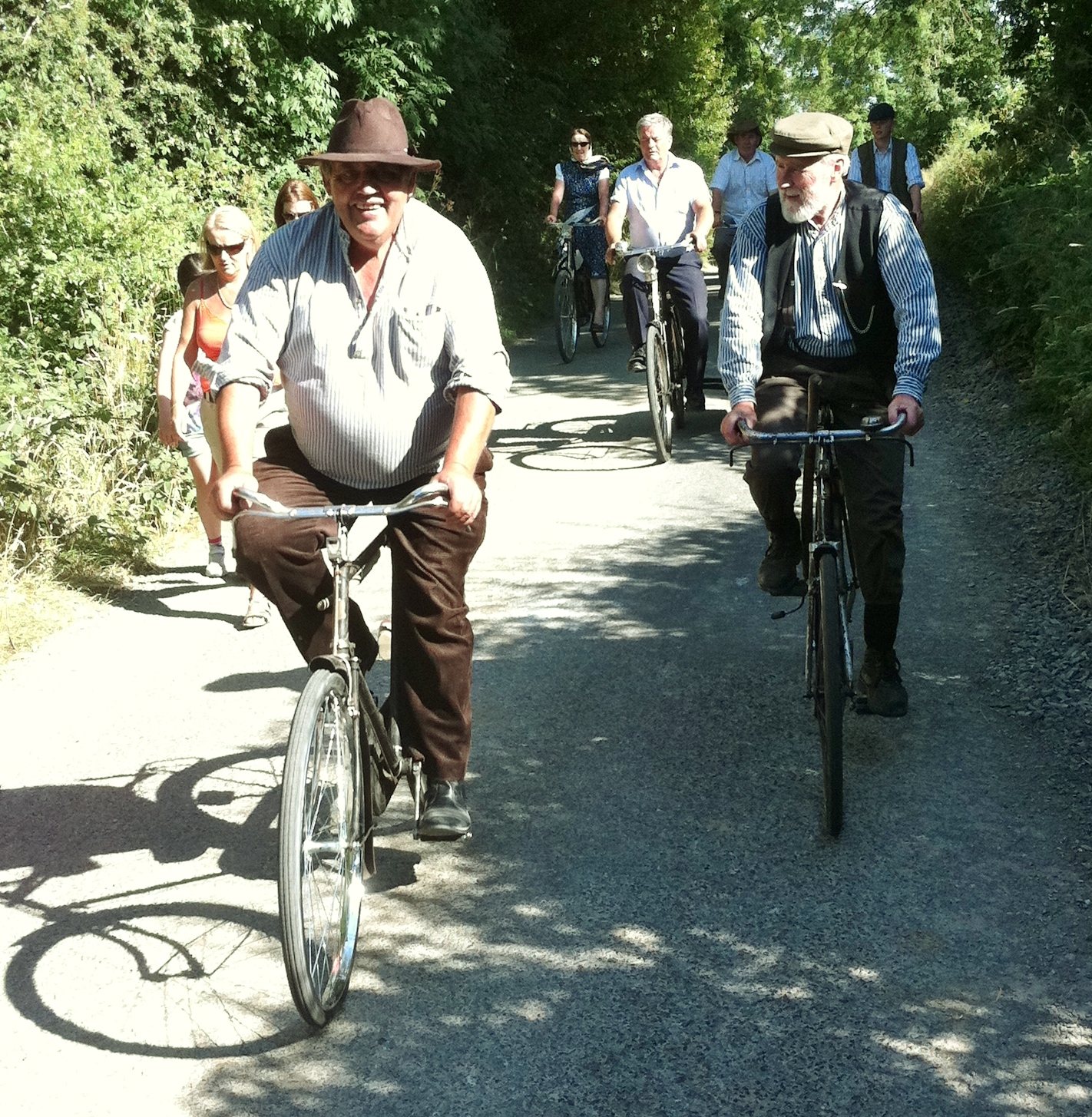
Bikes on the road to Billy Brennan's Barn, Inniskeen

Bikes on the road to Billy Brennan’s Barn, Inniskeen Photo: © Michael Fisher

The bicycles go by in twos and threes –
There’s a dance in Billy Brennan’s barn to-night,
And there’s the half-talk code of mysteries
And the wink-and-elbow language of delight.
Half-past eight and there is not a spot
Upon a mile of road, no shadow thrown
That might turn out a man or woman, not
A footfall tapping secrecies of stone.
I have what every poet hates in spite
Of all the solemn talk of contemplation.
Oh, Alexander Selkirk knew the plight
Of being king and government and nation.
A road, a mile of kingdom, I am king
Of banks and stones and every blooming thing.
Patrick Kavanagh Inniskeen Road: July Evening 

Bikes on the road to Billy Brennan's Barn, Inniskeen

Bikes on the road to Billy Brennan’s Barn, Inniskeen Photo: © Michael Fisher

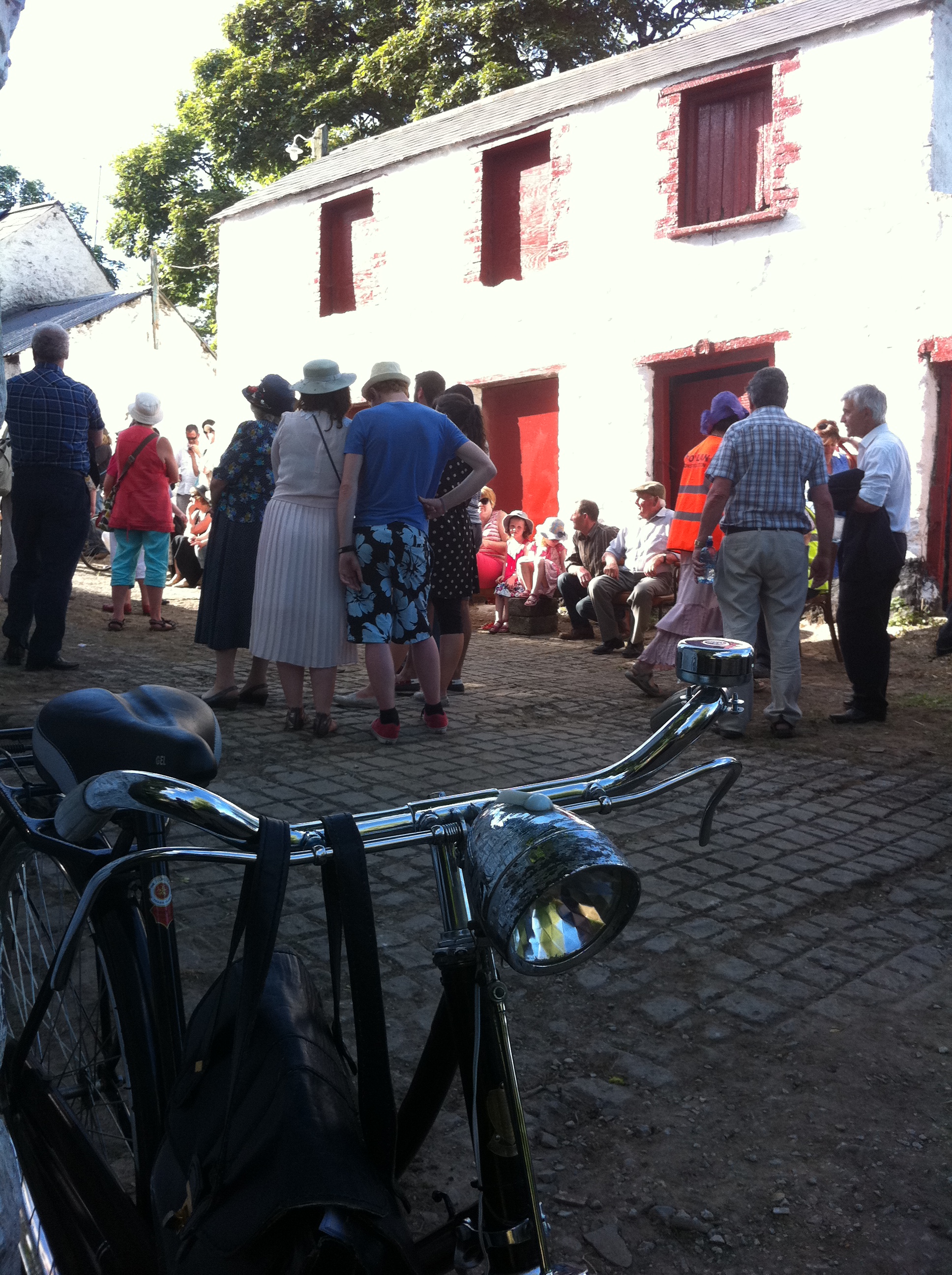
This was an enjoyable visit to Patrick Kavanagh country in Inniskeen, South Monaghan. The Patrick Kavanagh Centre organised a Gathering event based on Kavanagh’s poem quoted above, Inniskeen Road: July Evening. So it was a chance to get the High Nellies back into action over a 7.5km route through and around the village. I joined the walkers. The weather was really hot, so plenty of liquid was required en route to prevent dehydration, including a welcome cup of tea at Billy Brennan’s Barn. A great idea for a festival.

Tea and a hooley at Billy Brennan's Barn, Inniskeen

Tea and a hooley at Billy Brennan’s Barn, Inniskeen Photo: © Michael Fisher

VIRGINIA, Co. CAVAN

Taylo(u)r Coat of Arms (Marquis of Headfort)

With Cavan beating Fermanagh in the All-Ireland Championship qualifier and with the Virginia Show fast approaching in little over a month’s time, I found a suitable contribution today from blogger ‘Lord Belmont’ on the history of landowners the Marquesses of Headfort. It was originally published in July 2011 and is one of a series of such interesting articles on his website relating the story of the Big Houses of Ulster….
Virginia Park
THE MARQUESSES OF HEADFORT WERE MAJOR LANDOWNERS IN COUNTY CAVAN, WITH 14,220 ACRES

The first of this family who went over to Ireland was:

THOMAS TAYLOUR, who being a close friend of the celebrated Sir William Petty, accompanied him thither, in 1653.

This Thomas was the son of John Taylour, of Battle, in Sussex, and grandson of Thomas Taylour, of Ringmere, in that parish, who died at Stoneham, in that county, in 1629, aged 70.

Thomas, the grandson, jointly undertook, and perfected, the Down Survey, although the maps were published in the name of Sir William Petty only.

In 1660, he sold his lands in England, and purchased others in County Meath; and, after the Restoration, was appointed a sub-commissioner of the court of Claims, 1664-66.

After some intermediate employments, he officiated as vice-treasurer at war, during the suspension of the Lord Ranelagh, in 1681, in which office he died of dropsy and jaundice in 1682, aged 51.

His only surviving son, THOMAS TAYLOUR was created a baronet in 1704 and appointed a member of the Privy Council in 1726.

His grandson, THOMAS, 3rd Baronet, born in 1724, was raised to the peerage as Baron Headfort, in 1760; and advanced to a viscountcy, as Viscount Headfort, in 1762. Lord Headfort was further advanced, in 1766, to the dignity of an earldom, as Earl of Bective, in 1766. His eldest son, THOMAS, 2nd Earl, KP, was created MARQUESS OF HEADFORT in return for his support in passing the Act of Union, in 1800.

His seat, Headfort House, in County Meath, was the only Adam house in Ireland. In 1901 the 4th Marquess, an eminent horticulturist, caused a sensation when he converted to Rome to marry a showgirl called Rosie Boote. A figure of great dignity, she remained the dominant personality in the family during young Michael’s youth and early adult life. Virginia, in the county of Cavan, was named after ELIZABETH I, “the Virgin Queen”. It owes its origin to the plantation of Ulster in 1609. The lands eventually passed into the possession of Lucas Plunkett, Earl of Bective, a Roman Catholic, who was later created Earl of Fingall.

It can also be said that Lucas Plunkett, along with his son Christopher, frustrated the plans of the Government to proceed with the development of the town and its incorporation during his tenure. He was sympathetic to the rebel Irish and sided with them against the planters during the 1641 Rebellion and the Williamite Wars of 1688-91, earning him the label of ‘traitor’.

Consequently it fell to Thomas, 1st Marquess of Headfort, and his successors, to fulfil the patent in relation to the development of the town in the second half of the 18th century and 19th century – the patent which was originally granted to Captain Ridgeway in 1612. Lord Headfort maintained a beautiful park beside Ramor Lough, where he had a hunting lodge (above) in plain, rambling, Picturesque cottage style; a two-storey house with a three-bay centre and single-storey, three-bay wings. The family often stayed here during the summer or autumn months, between 1750 and 1939.

The former hunting lodge is now a hotel, located on the shores of Lough Ramor. The Headforts also owned 12,851 acres in Westmorland and 7,544 acres in County Meath. (Blog: Lord Belmont)

Tom Doorley pointed out on twitter @tomdoorley that the current (7th) Marquis of Headfort, Thomas Michael Ronald Christopher (Taylour), Earl of Bective, born in 1959, is an estate agent in West London. Thanks also to Tom, there’s a bit of family history in an obituary in the Daily Telegraph for the 6th Marquis, who died in December 2005, aged 73. Tom also recommends a book by Lingard Goulding on The Story of Headfort School.

In a further development it was drawn to my attention by @ThisIsCavan that the Anglo-Celt newspaper in Cavan reports that the Park Hotel, recently on the market for €900,000 with its 28 bedrooms and nine-hole golf course in a 93 acre parkland setting beside Lough Ramor, had now been purchased by a leading London restaurateur in Mayfair, Richard Corrigan.

AMALFI

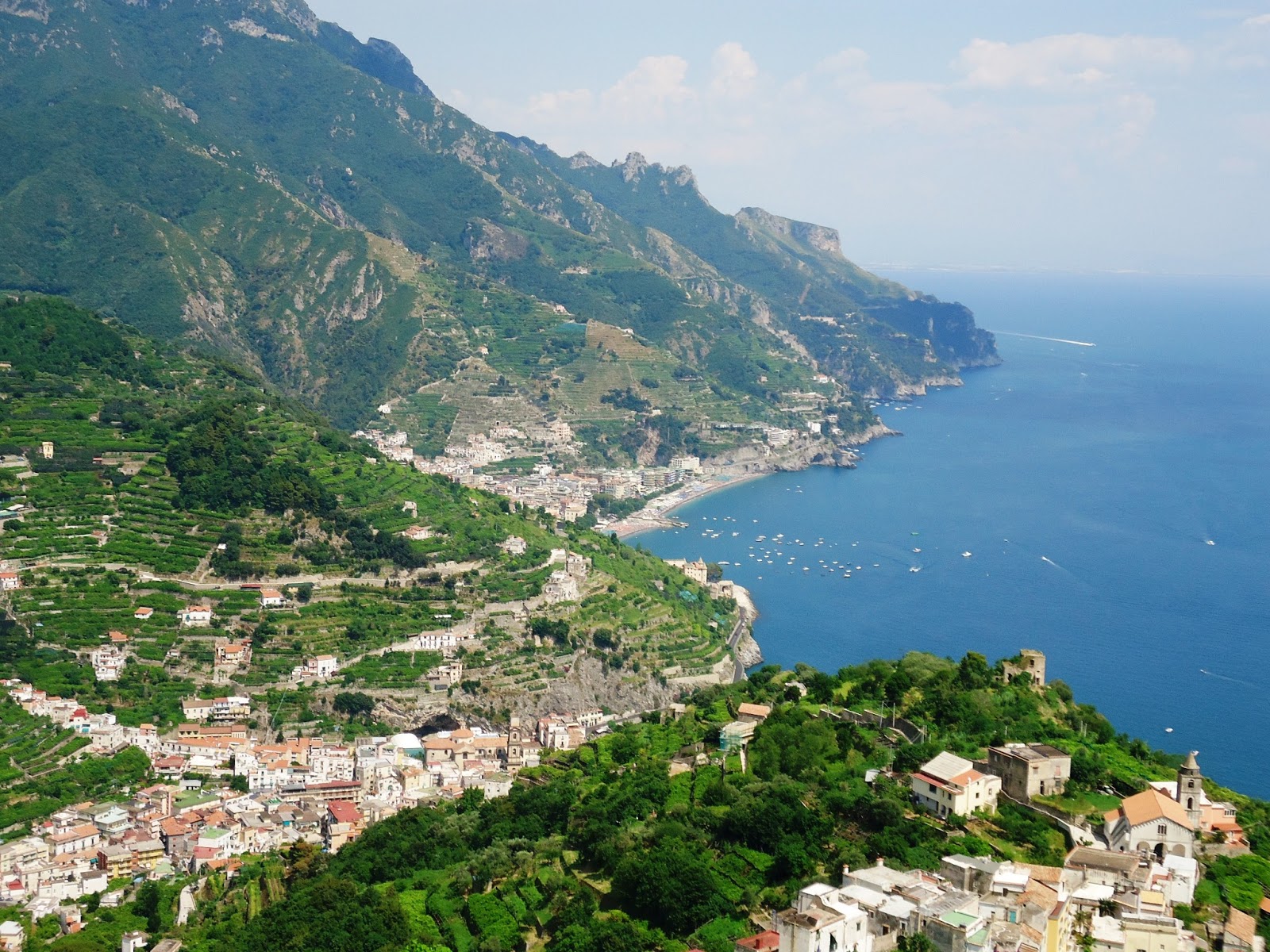
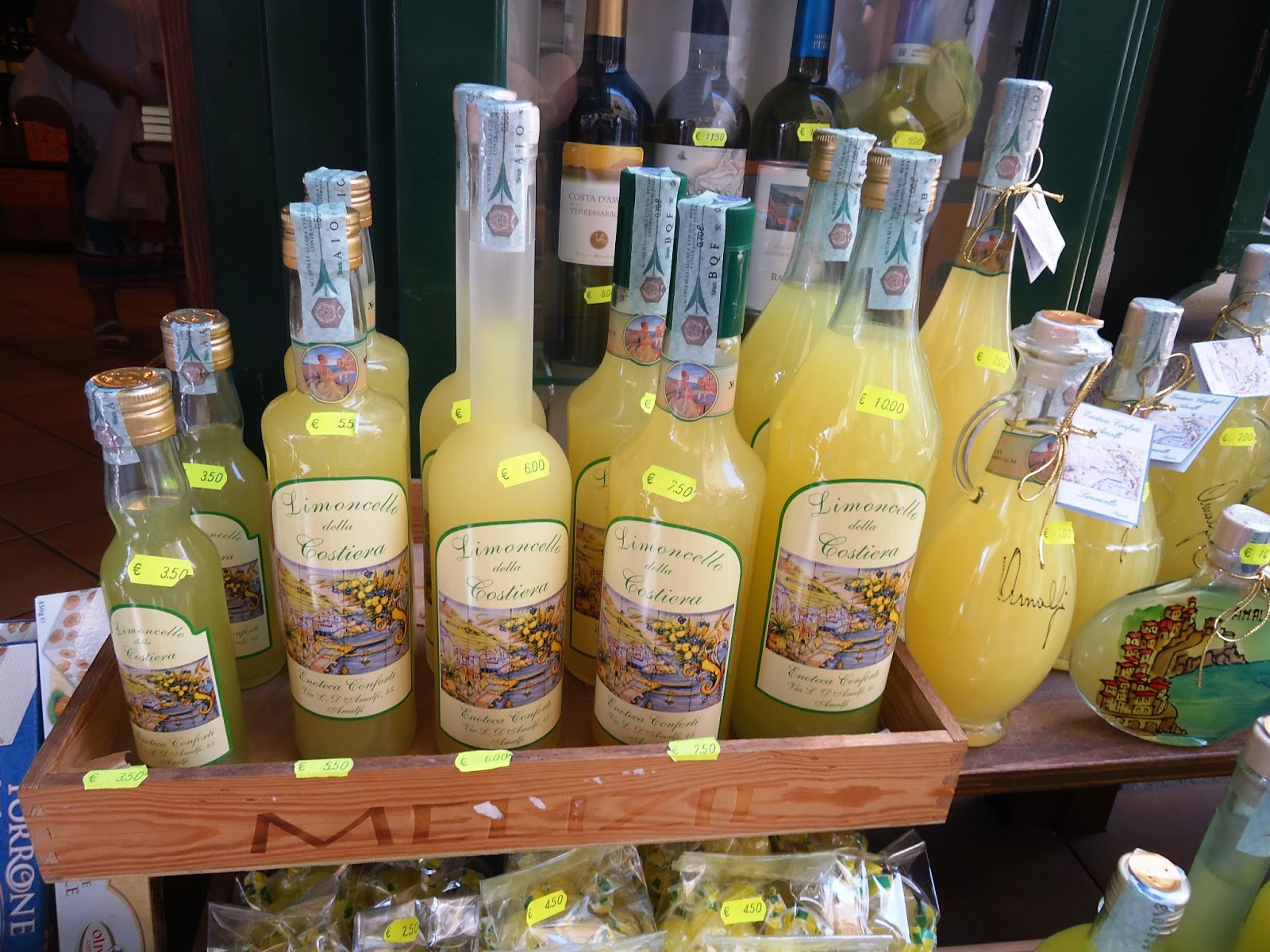
I have enjoyed reading about Patrick Comerford’s  travels in Italy, particularly his blog on “Three weddings and some cathedrals on the Amalfi coast”. I visited many of the same places last year including the Duomo at Amalfi itself. He also made the journey up the mountain to Ravello, where there are some lovely villas and where you get a great view across towards Sorrento and looking down on Maiori (where we stayed) and the Bay of Salerno. He has some nice photographs as well, including the local liqueur, limoncello:

Looking down on the Amalfi coast from Ravello (Photograph: Patrick Comerford (2013)

Patrick Comerford

I spent Saturday [6 July 2013] along the Amalfi Coast, which stretches along the southern coast of the peninsula east of Sorrento. With its steep shoreline, towering cliffs, rocky outcrops, hairpin bends, with the shimmering blue sea below and one pretty coastal town or pastel-coloured village after another, the Amalfi Coast is a popular location for motor advertising shots and the weekend traffic also showed how this a popular destination for both Italians and the thousands of tourists staying in the Naples and Sorrento area. I had no mid-life-crisis, open-topped red sports car for today’s journey. Instead, I travelled by coach with the four dozen or so people in our group along the only land route on the Amalfi Coast – the 40 km stretch along the Strada Statale 163, running along the coastline from Positano in the west to Vietri sul Mare in the east.

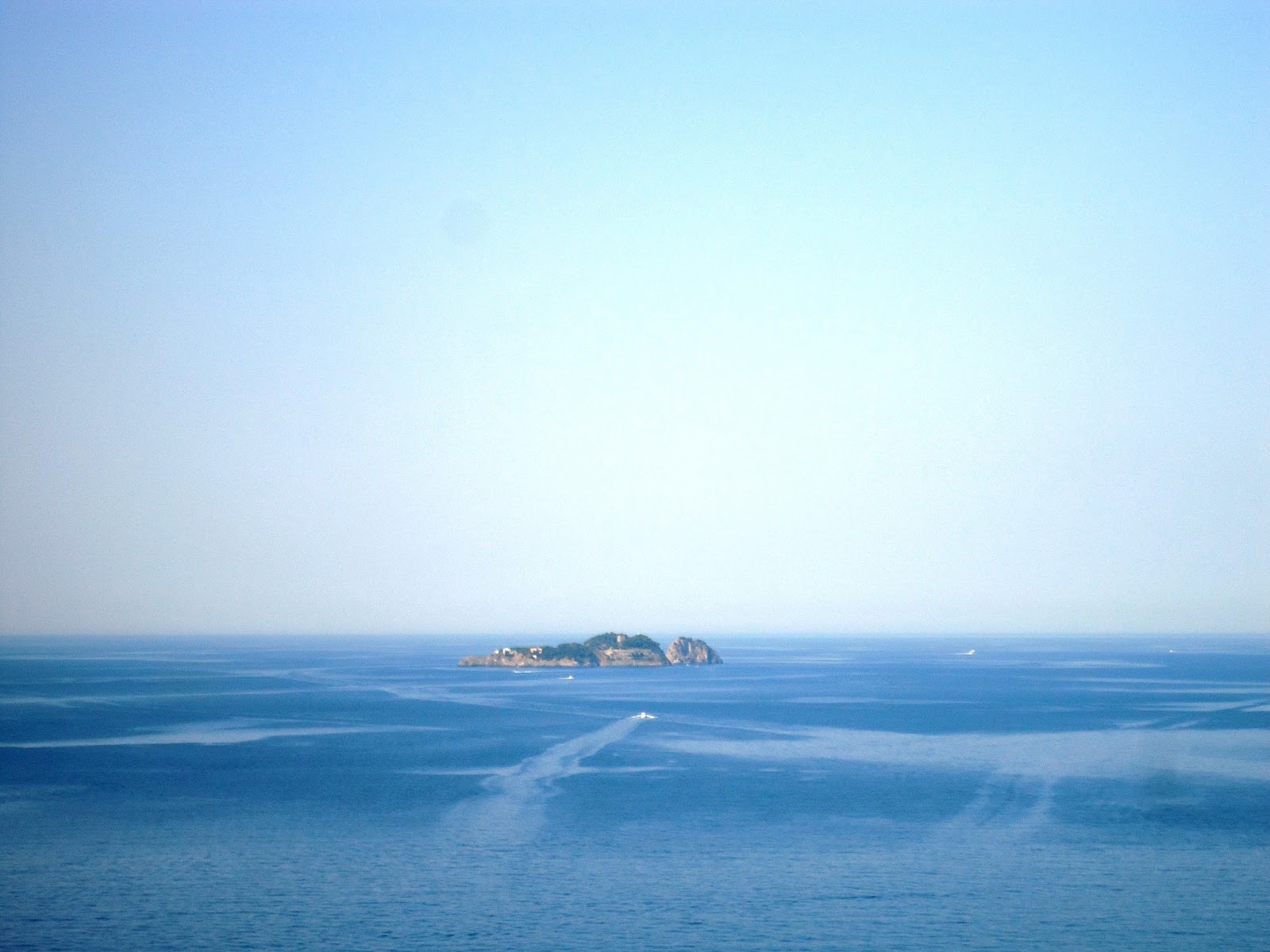
The rocks of Sirenuse … home to the Sirens who may have given their name to Sorrento (Photograph: Patrick Comerford, 2013)

Below us in the blue sea for the most part of the journey we could see the tiny islands that form Li Galli Archipelago. United the 19th century there were known as Sirenuse and the said to be the home of the mythical Sirens who lured sailors unto the rocks and who may have given their name to Surrentum or Sorrento. In the 10th and 11th centuries, the Duchy of Amalfi was an independent statelet based on the town of Amalfi. This coastline was part of the Principality of Salerno, until Amalfi was sacked by the Republic of Pisa in 1137.

The Amalfi Coast is known for limoncello, a liqueur produced from locally-grown lemons (Photograph: Patrick Comerford, 2013)

In 1997, the Amalfi Coast was listed as a Unesco World Heritage Site and as a cultural landscape. This area is also known for limoncello, a liqueur produced from lemons grown between February and October in the terraced gardens along the coast. After the unification of Italy, the Amalfi coast has enjoyed a huge economic revival, boosted in the late 20th century by international tourism. Our first stop was in Positano, a village and commune , mainly in an enclave in the hills leading down to the coast. It was a port in the mediaeval Amalfi Republic. The church of Santa Maria Assunta has a dome made of majolica tiles and a 13th century Byzantine icon of a black Madonna. According to local legend, the icon was stolen in Byzantium and was being shipped across the Mediterranean by pirates when a terrible storm blew up in the sea near Positano. The frightened sailors heard a voice on board saying: “Posa, posa!” (“Put down! Put down!”) The sacred icon was taken off the boat and carried to the fishing village, and only then the storm abated. Positano prospered in the 16th and 17th centuries. However, by the mid-19th century, the town had fallen on hard times, and more than half the population emigrated, mostly to Australia. By the first half of the 20th century, Positano was a relatively poor fishing village. It began to attract large numbers of tourists in the 1950s, especially after John Steinbeck published his short story ‘Positano’ in Harper’s Bazaar in May, 1953. “Positano bites deep,” he wrote. “It is a dream place that isn’t quite real when you are there and becomes beckoningly real after you have gone.” After we gone through Positano and stopped briefly on the eastern edge of the town for the panoramic view and freshly squeezed orange juice and once again at a ceramic shop at Grotta dello Smeraldo before continuing on to the harbour town of Amalfi. I had an internal debate between boats and architecture: would I go on a boat trip with the others out into the Bay of Salerno? Or would I visit the Duomo in Amalfi on my own?

The portico of the Duomo di Sant’Andrea looks down onto the Piazza Duomo below (Photograph: Patrick Comerford, 2013)

I plan to visit Capri on Monday, so architecture won the day today, and I climbed the broad steep steps to the Duomo di Sant’ndrea. And I was just in time too, for a wedding was about to begin, and by the time the boat-trippers returned the bride had arrived and the cathedral was closed to visitors.

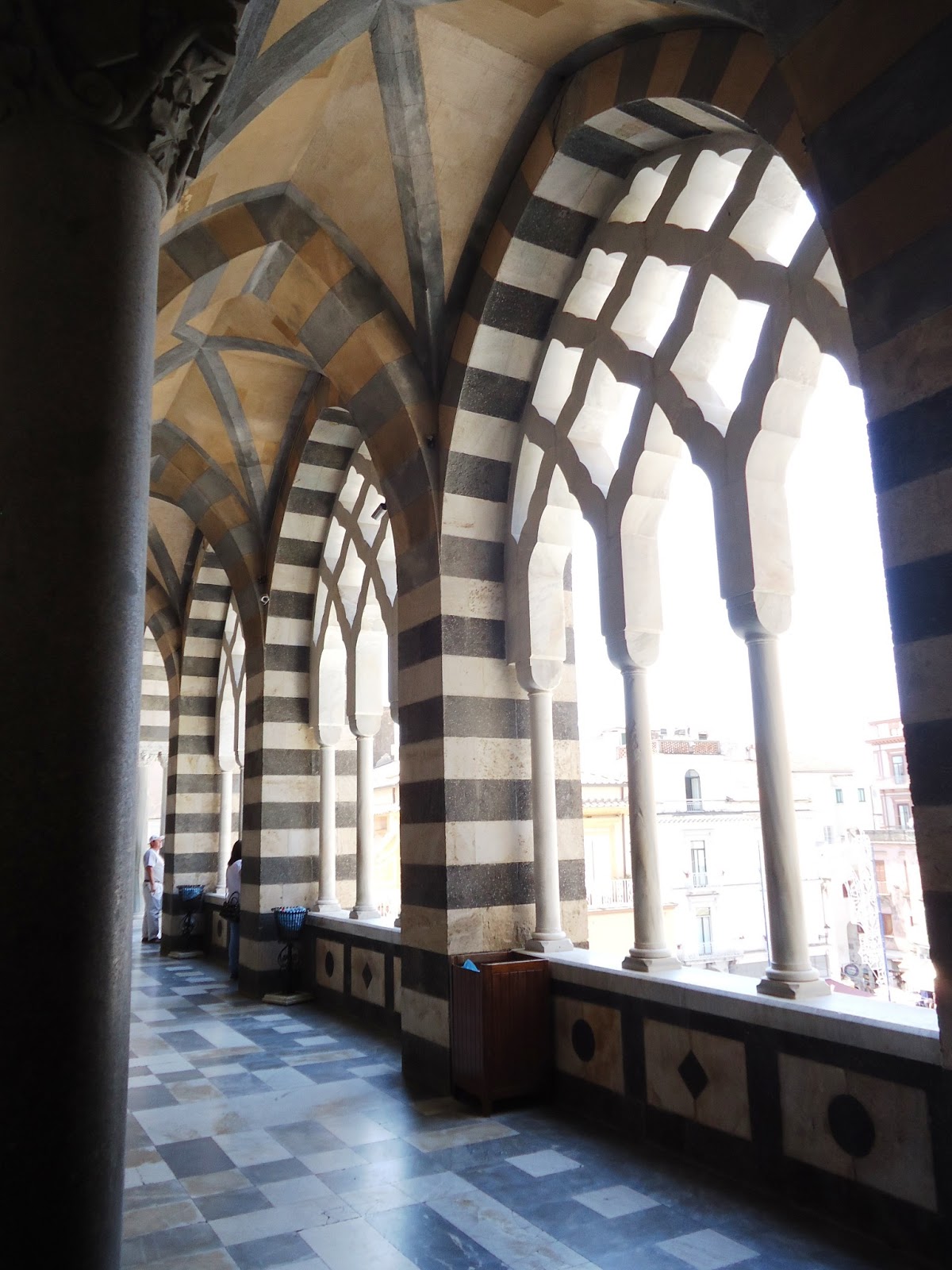
The Cloisters of Paradise with their ornate Moorish-style colonnades (Photograph: Patrick Comerford, 2013)

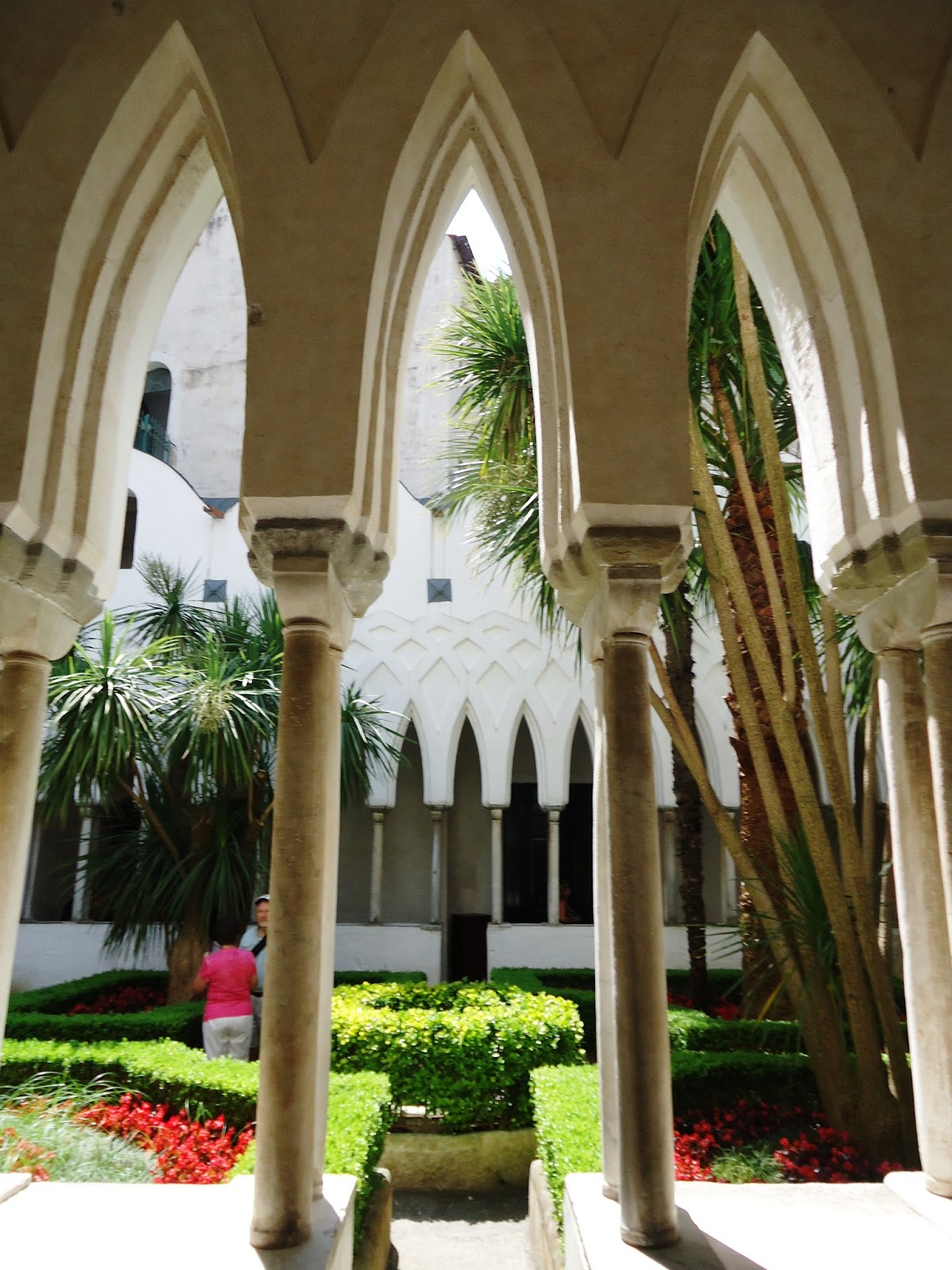
The cathedral doors were cast in bronze in Constantinople in the 11th century. But the entrance to the cathedral is through the beautifully named Chiostro del Paradiso or Cloisters of Paradise, with its ornate Moorish-style colonnades of white-washed, interlaced arches, palm trees, and inner garden. The cloisters lead into the museum in the former Basilica di Crocifissio, with bare walls and an eclectic collection of ecclesiastical artefacts, including a bishop’s sedan chair made in Macao in the 18th century, along with paintings, mitres and vestments.

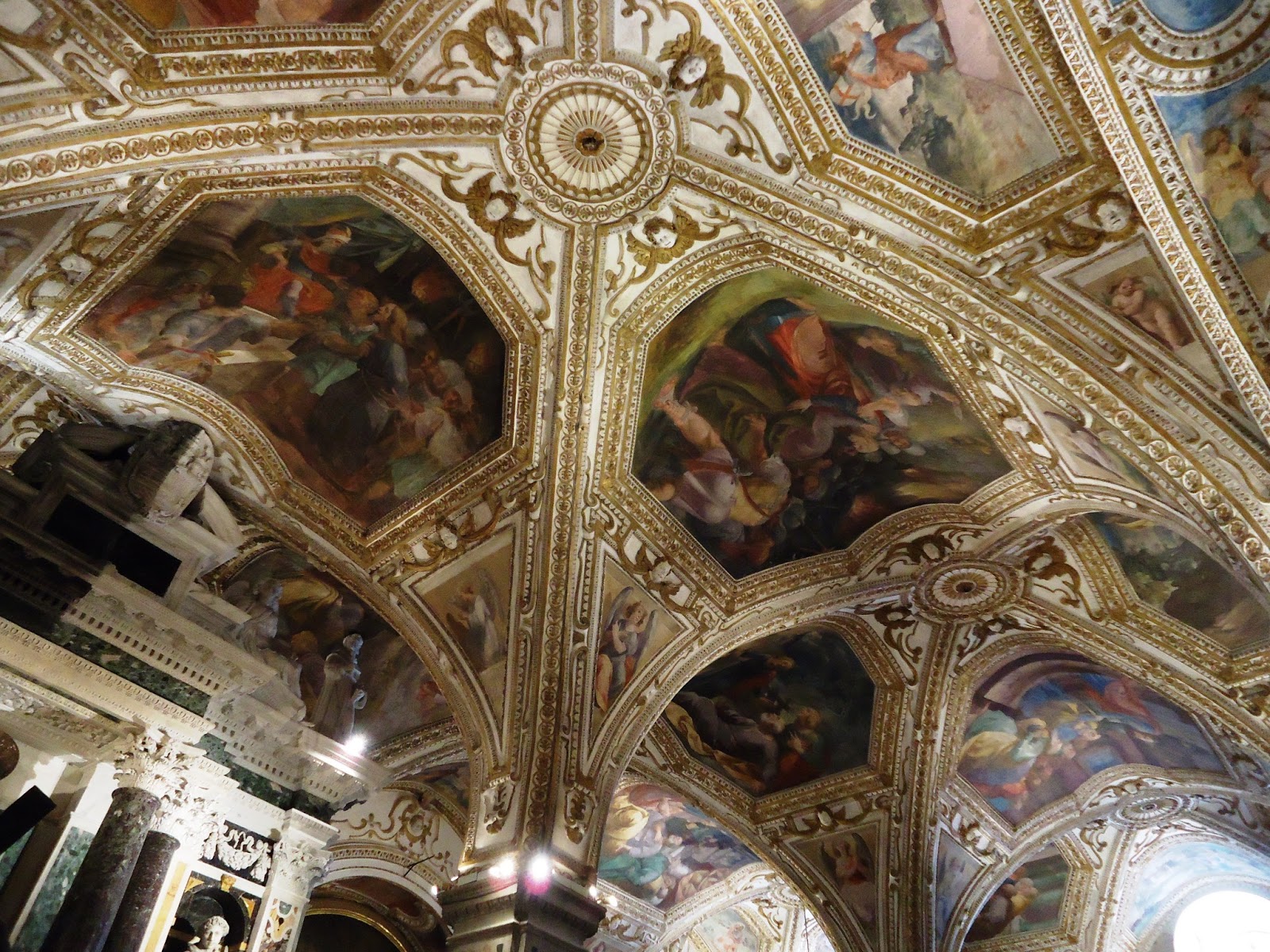
The richly decorated ceiling of the crypt below the Duomo in Amalfi (Photograph: Patrick Comerford, 2013)

Steps lead down to the crypt, with its richly decorated baroque ceiling and a shrine containing the body of Saint Andrew, who gives his name to the cathedral above. The apostle’s body was brought to Amalfi by the Knights of Saint John of Jerusalem, who brought it here in 1204, having plundered it in Constantinople which contains. The body is buried deep beneath the shrine – although the saint’s head is in Patras in Greece – but the shrine includes a small vessel placed above the coffin to catch a miraculous fluid that is said to flow from the saint’s body ever since the 14th century. Away from the bustle of the square in the front of the cathedral and back from the busy beach and harbour, the back streets and the stepped side streets were quiet and cool in the mid-day sun. From Amalfi, we climbed up through the cultivated terraced mountainside and the hairpin bends to Scala, where we had lunch in the Margheritta Hotel, in a balcony looking down on the road we had had climbed in our two small buses.

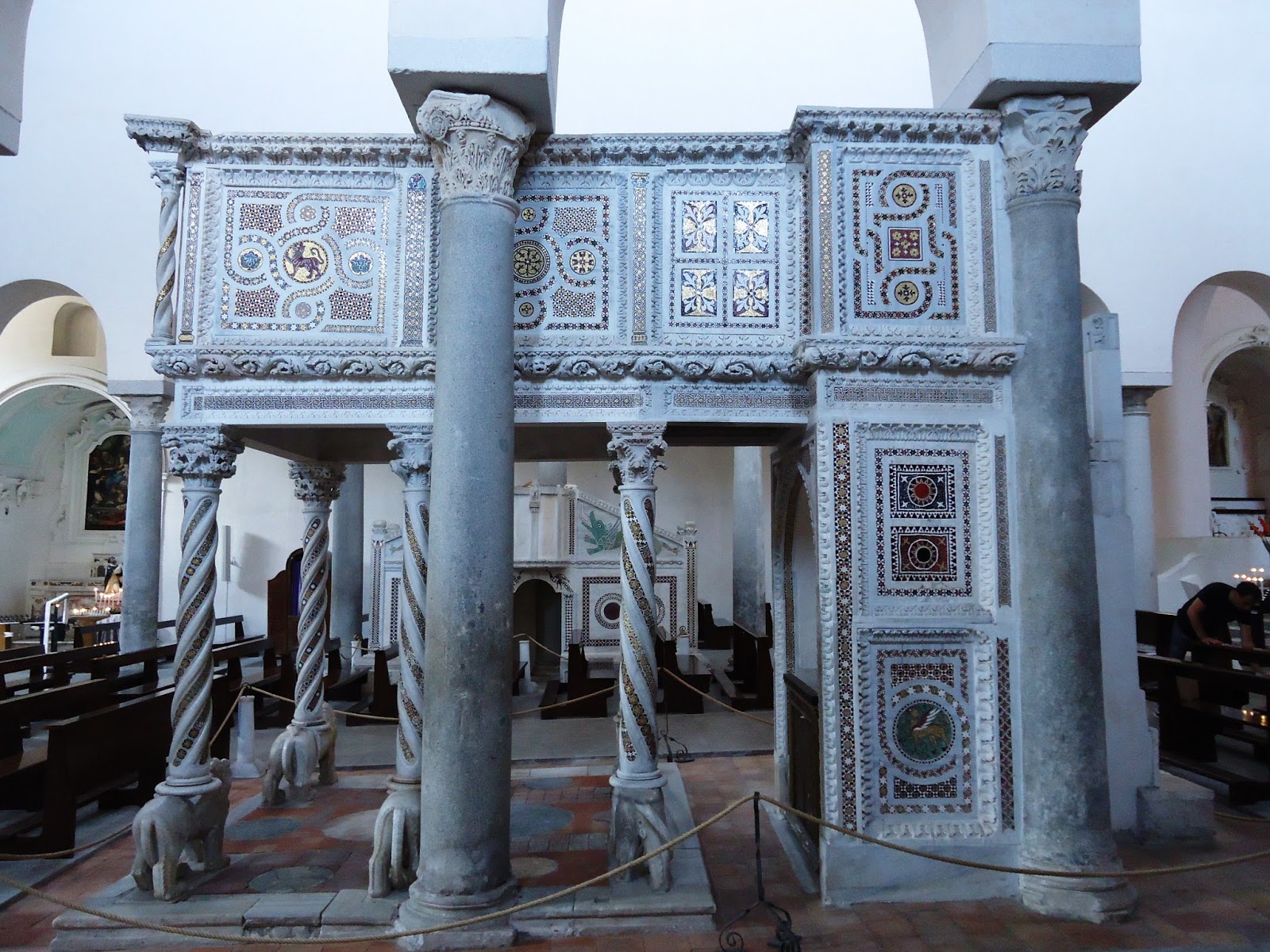
The ornate Gospel pulpit in the Duomo in Ravello (Photograph: Patrick Comerford, 2013)

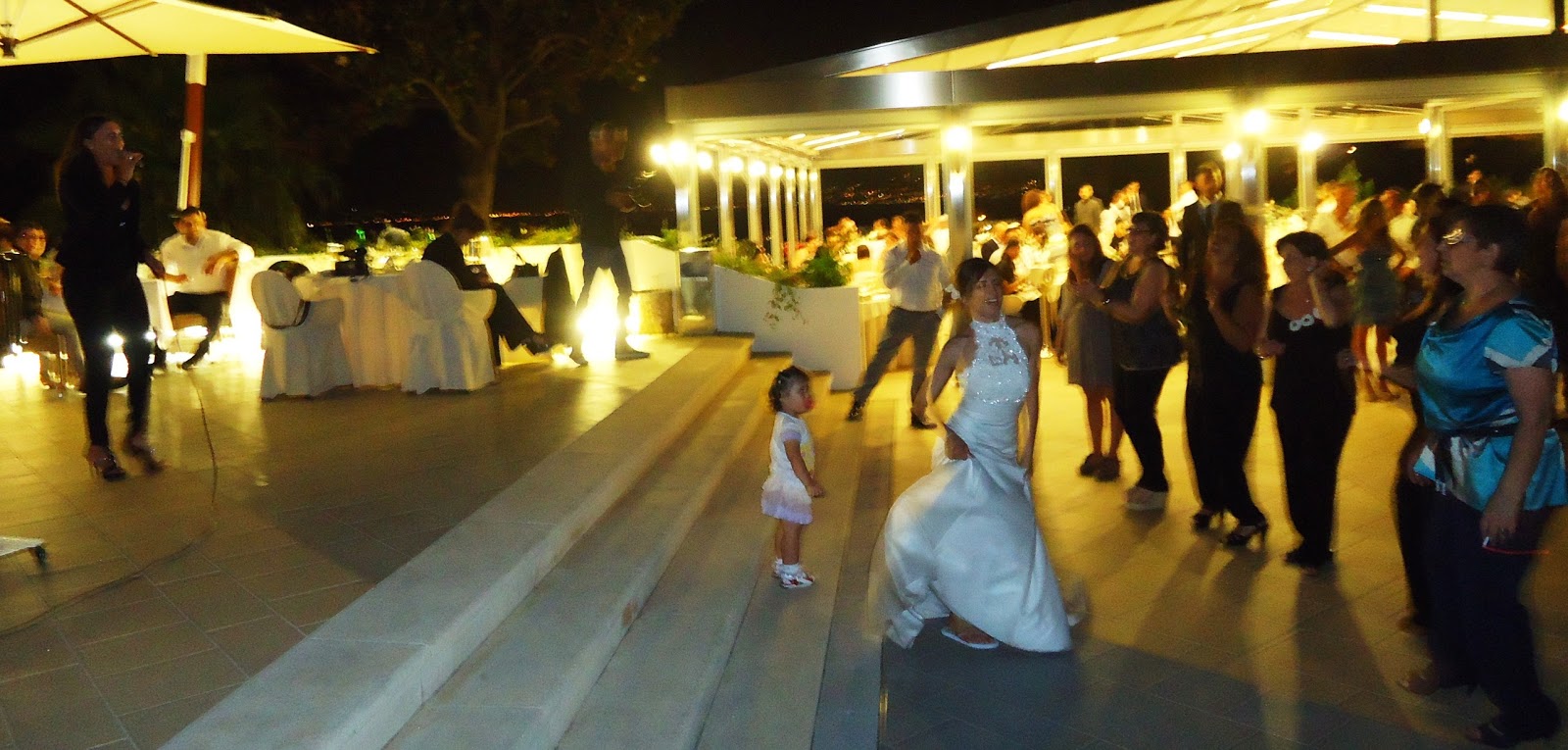
From Scala, we travelled back down to Ravello, once an independent city state. This was also the setting for part of Richard Wagner’s Parsifal, and here DH Lawrence wrote part of Lady Chatterley’s Lover. The Duomo, dedicated to Saint Pantaleone, was being prepared for a wedding, but once again I had arrived in time to see the inside of the cathedral and its museum. The duomo has two ornately decorated pulpits – an Epistle pulpit and a Gospel pulpit. The Gospel pulpit has twisted columns patterned with mosaics resting on six carved lions. There was time to look inside the tropical gardens of the Villa Rufolo, which inspired Klingsor’s magic garden and the stage design of Wagner’s Parsifal. Although we could see it from the balconies of Ravello, we never got as far as Salerno. As we sat to dinner back in the Grand Hotel Moon Valley, a wedding was taking place by the pool, and some of us joined the happy families until late in the evening.

The bride dances at the third wedding in a day (Photograph: Patrick Comerford, 2013)

VESUVIUS

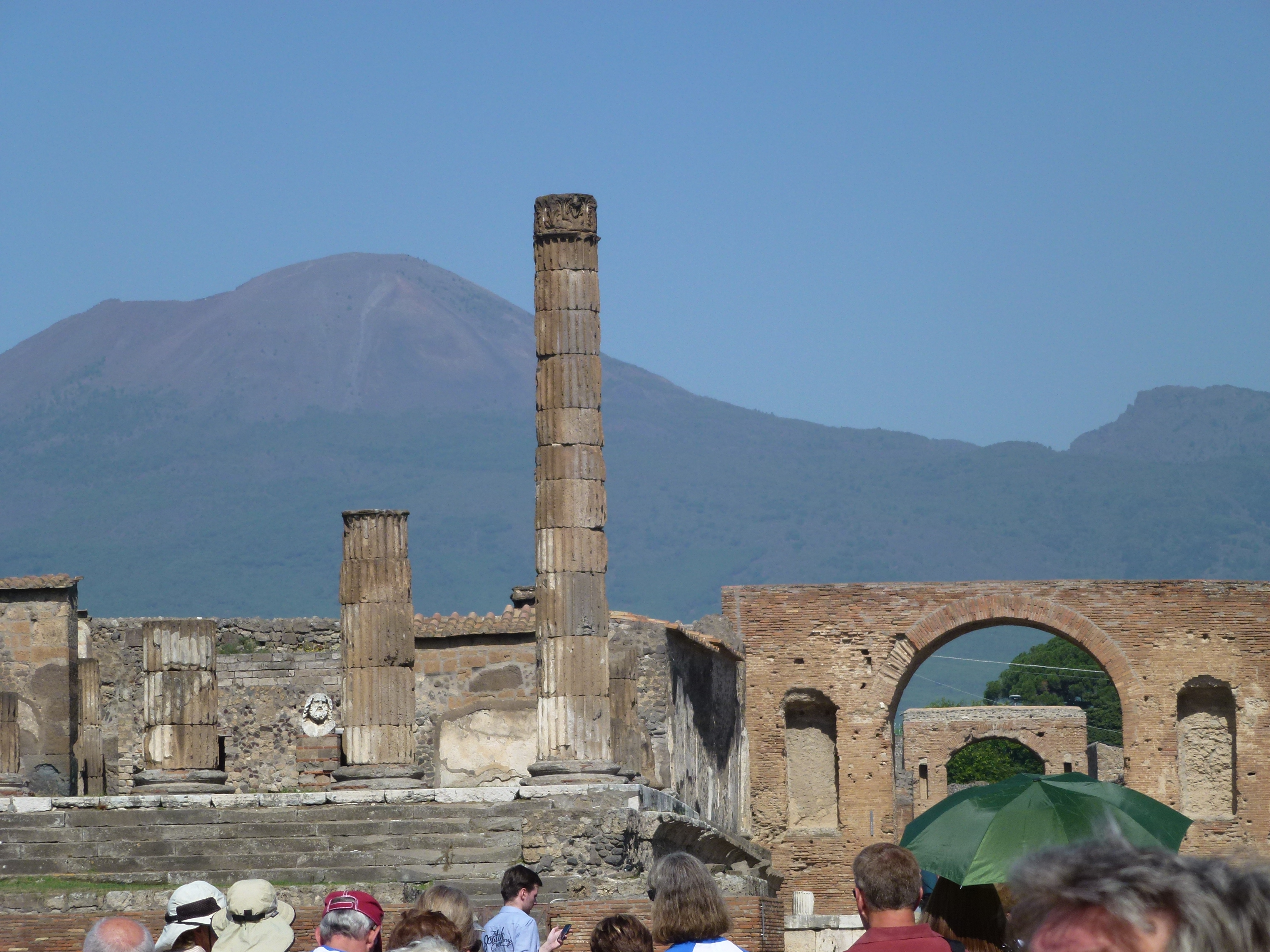
Pompeii and Mount Vesuvius

Pompeii and Mount Vesuvius: Photo © Michael Fisher 2012

Patrick Comerford’s blog today from Vesuvius and Pompeii reminded me of my visit there last August. I wrote about it in April, mentioning the exhibition that is running in the British Museum on “Life and Death: Pompeii and Herculaneum”

Patrick Comerford: Walking beneath the clouds of Mount Vesuvius:

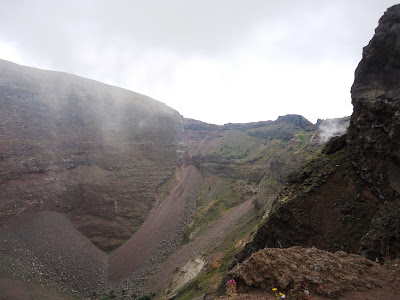
Looking into the crater on the top of Mount Vesuvius (Photograph: Patrick Comerford, 2013)

For most of Thursday [4 July] Mount Vesuvius was wrapped in rain clouds, pouring rain down intermittently on Pompeii below. The clouds spread out over the Bay of Naples, and this afternoon blocked the view across the bay as we climbed Mount Vesuvius.

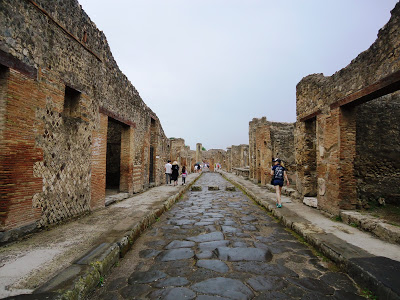
But we began the day with a morning walking through the streets, houses, theatres, temples, baths, the forum, the markets and the open areas of Pompeii, the city destroyed – and preserved – by the eruption of Mount Vesuvius on the afternoon 24 August 79 AD.

Walking through the paved streets of Pompeii (Photograph: Patrick Comerford, 2013)
Pompeii attracts about 5,000 visitors a day, or about 2.5 million visitors each year. There almost 50 people on this tour group, and for some it was an interesting reminder that Pompeii too was a holiday or weekend destination for many wealthy Romans almost 2,000 years ago until the city was buried under 4 to 6 metres of ash and pumice that fatal day.

Time has stood still in Pompeii ever since. It was good to be reminded too that apart from some modern inventions such as the internal combustion engine, the railway, electricity and the internet, many of the 20,000 residents of Pompeii lived very much like us, with two-storey houses, a clean water system – and a problem with producing too much domestic waste.

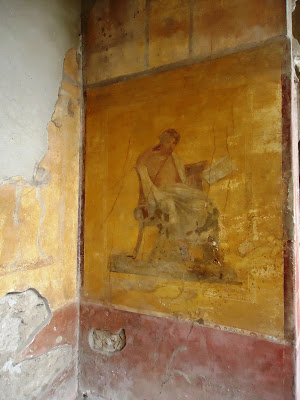
The walls of a house in Pompeii Pompeii (Photograph: Patrick Comerford, 2013)
The mosaics, frescoes, gardens, rooms and domestic shrines could only begin to tease our imaginations about life in Pompeii. Everyone says a morning there does not do it justice.

Throughout the morning, as we walked through the town, Vesuvius, wrapped in clouds, loomed above us in the distant background.

After lunch below the town in Lucullus, we continued on to the slopes of Mount Vesuvius. From the car park it was a 20-minute climb to the rim of the crater at the top, and most of us managed the steep ascent in about 20 or 30 minutes, but the clouds still blocked a complete view of the Bay of Naples and the islands.

It was quicker coming back down the mountain path. There were no burns or injured limbs.

Back at the Grand Hotel Moon Valley, the pool also has a perfect view of Mount Vesuvius, the only active volcano in Europe. They say Vesuvius should erupt every 30 years – but it has not done so since 1944.  PATRICK COMERFORD

MALLARD RECORD

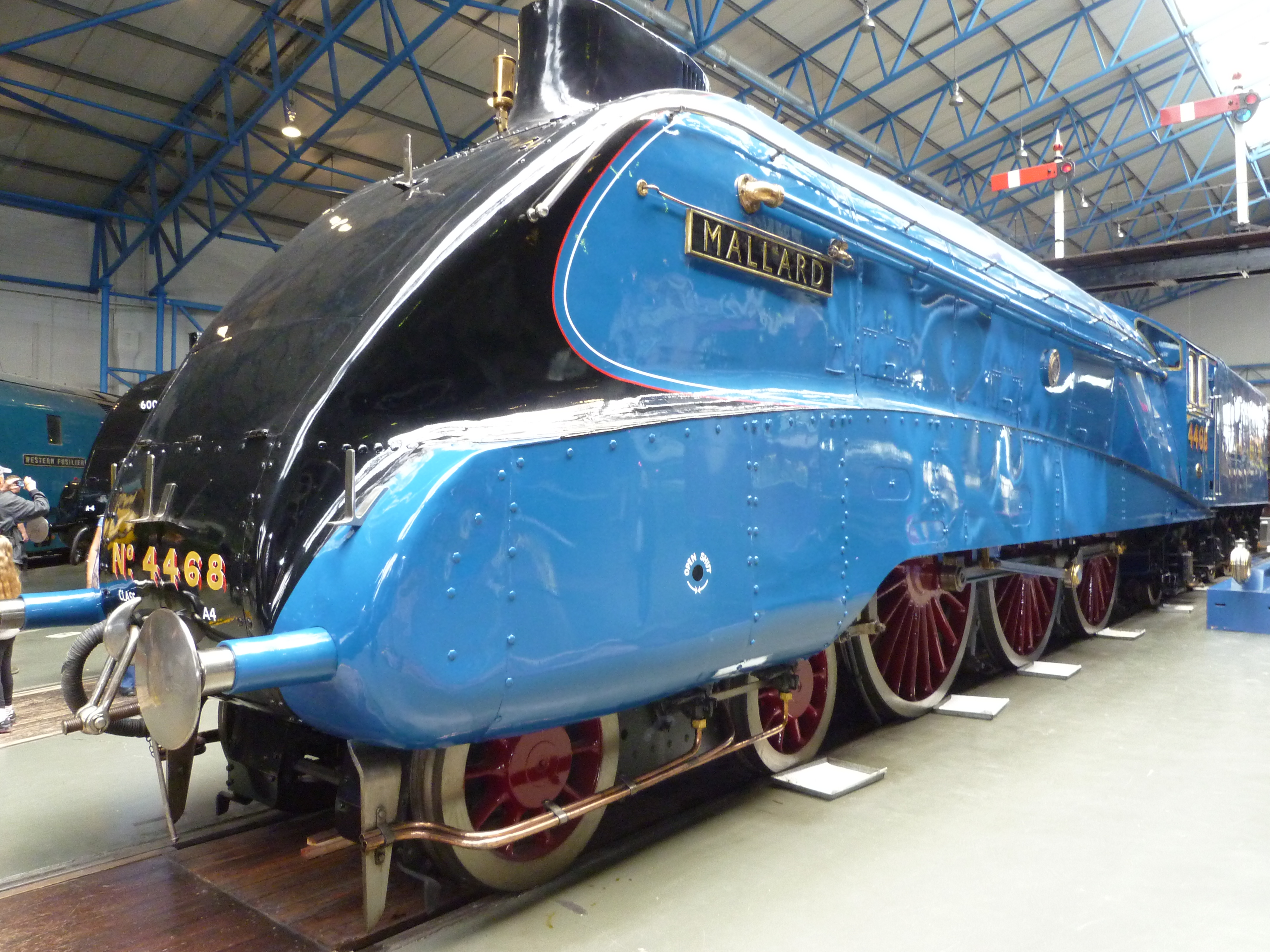
Mallard at National Railway Museum York

Mallard at National Railway Museum York

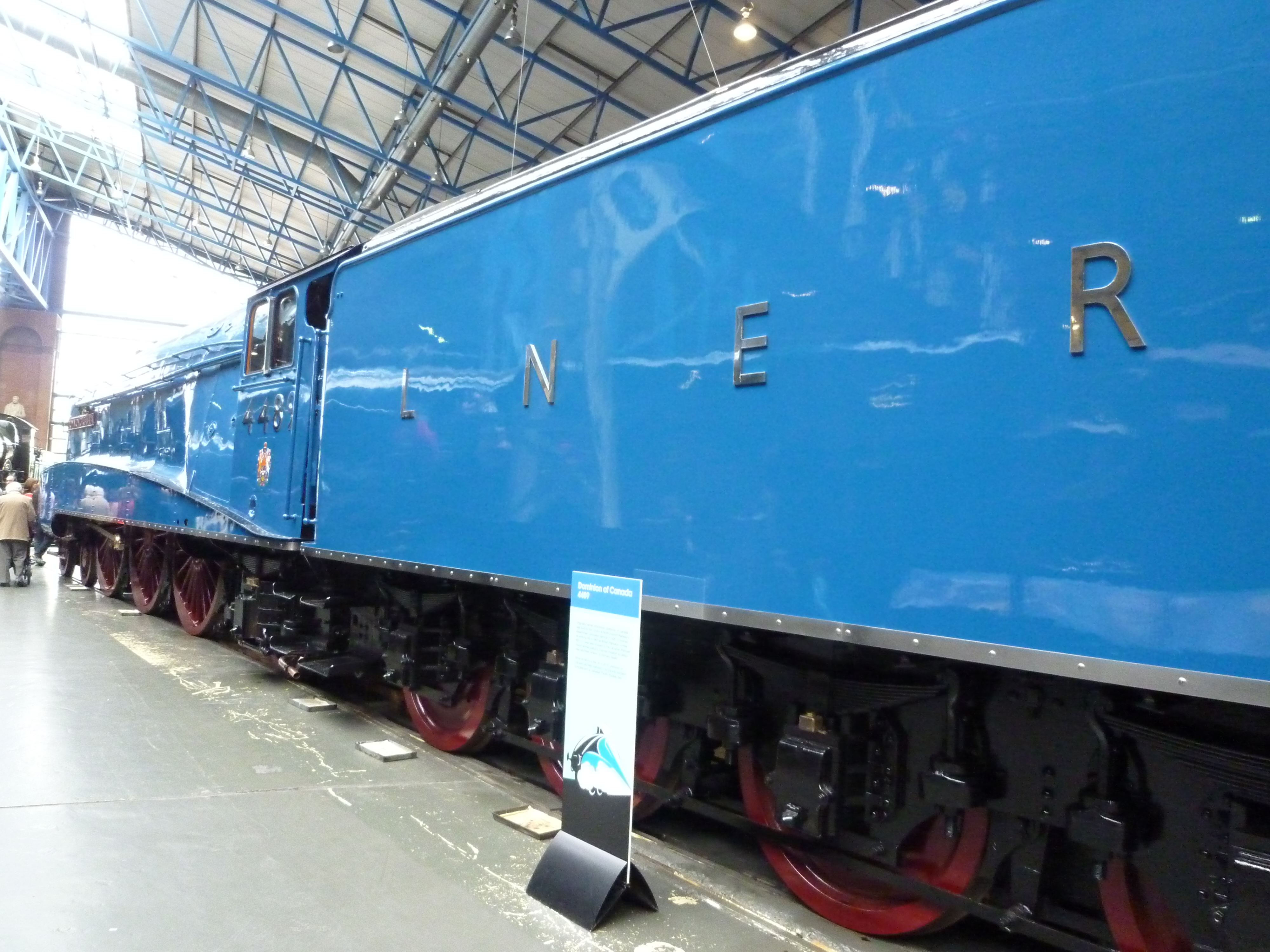
75 years ago today, Mallard set a new record. The A4 Class steam locomotives broke the world speed record for steam on July 3rd 1938 by travelling at 126mph (203km/h) at Stoke Bank near Grantham in Lincolnshire. To mark the occasion a special “Gathering” of the six surviving engines in the class has been organised by the National Railway Museum in York which I visited last month. It’s the first time the six surviving engines, Dwight D Eisenhower, Mallard, Bittern, Union of South Africa, Dominion of Canada and Sir Nigel Gresley  have been seen together.

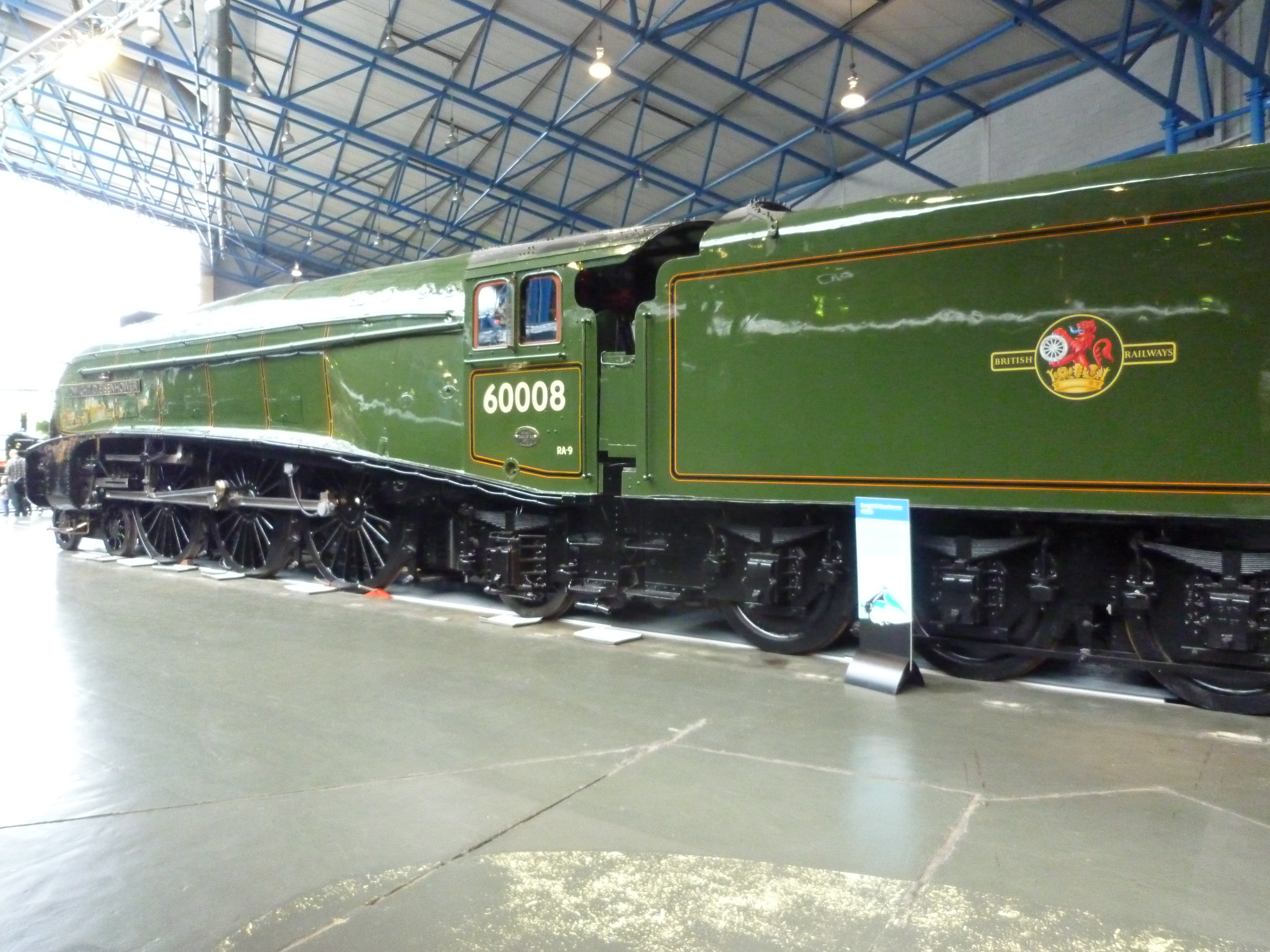
Dwight D Eisenhower at York in traditional BR green livery

Dwight D Eisenhower at York in traditional BR green livery

It was a huge undertaking for the organisers. with Dwight D Eisenhower and Dominion of Canada having to be shipped from North America for the event. Bittern travelled from London King’s Cross under its own steam on Saturday in a 90mph (145km/h) run up the East Coast Mainline to York. Mallard ran on the East Coast Mainline from the 1930s to the 1960s and on the historic day in 1938 was driven by the late Joe Duddington from Doncaster.

Mallard

Mallard

The A4 Class was designed by Sir Nigel Gresley, who also created the Flying Scotsman. Mallard was thought to have been chosen for the record-breaking run because it was one of the newest locomotives and Sir Nigel wanted to test its new performance exhaust. The locomotive broke down soon after it reached the top speed and was brought back to the workshop to have a bearing replaced.

Mallard

Mallard

A golden plaque on the side of Mallard reads: “On July 3rd 1938 this locomotive attained a world speed record for steam traction of 126 miles per hour.”

British Rail’s modernisation plan began sweeping steam away in 1955 and Mallard was withdrawn from service in 1963. The engine was restored by the National Railway Museum in the mid-1980s.

Visiting Mallard at NRM York

Visiting Mallard at NRM York

FROM SHIPLEY TO SALTAIRE

West Mill, Saltaire

West Mill, Saltaire

I was disappointed when I arrived in Shipley by way of Ilkley Moor. I thought the centre of this industrial Yorkshire town had been altered unsympathetically by 1960s redevelopment. Few of the Victorian buildings remain. The slums were replaced with low-rise modern retail outlets. A central square serves as an outdoor market and an underground indoor market is situated beneath a tall,  market hall tower which is a landmark for many miles around. I thought it was a block of flats when I noticed it.  A second phase of clearance in 1966 saw the construction of an Asda supermarket (now the main building in the town centre), a library which had a small section on local history, a swimming pool and a health centre. By 1970 2,900 slum houses had been demolished.

Railway Line beside West Mill, Saltaire

Railway Line beside West Mill, Saltaire

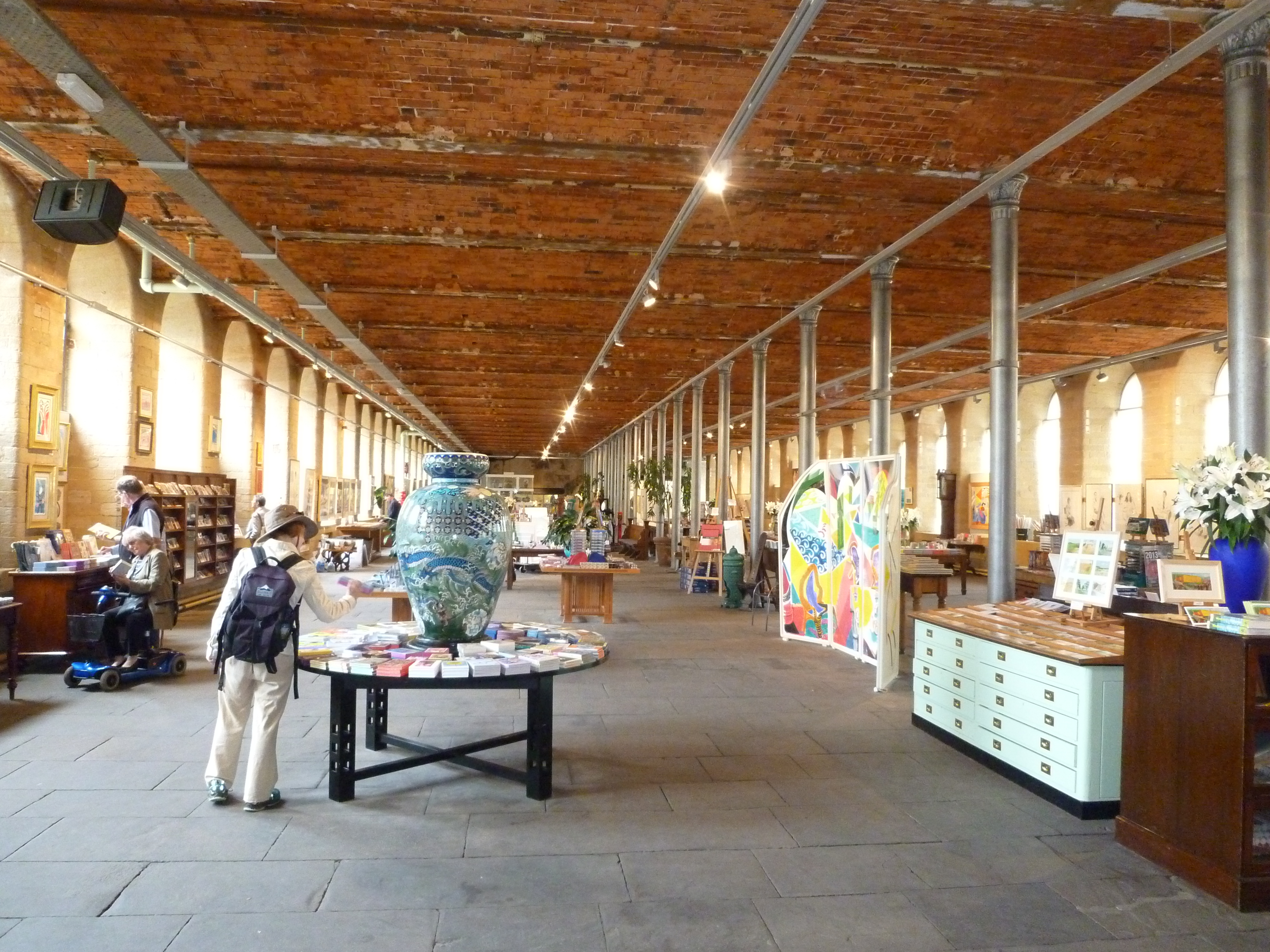
I saw from the map that Saltaire was nearby and when I got my bearings I soon saw the large former mill buildings not too far distant, on the other side of a railway line. This was a gem in industrial architecture. The township built by Sir Titus Salt alongside the River Aire is now a UNESCO world heritage site. Part of the Salt’s Mill complex contains retail outlets and another section of it is devoted to commercial use. There are some nice restaurants inside. I thought Belfast’s old mills were big but Salt’s building has a frontage that is 545 ft long, with six storeys rising 72 ft. At one stage in the 1800s some 4000 people worked here. The weaving shed of the mill housed 1200 looms, producing 30,000 yards of alpaca and other cloths daily.

Shop in former Salt's Mill

Shop in former Salt’s Mill


GEEL GROUP DEPARTS

Geel group ready for departure from Tydavnet

Geel group ready for departure from Tydavnet

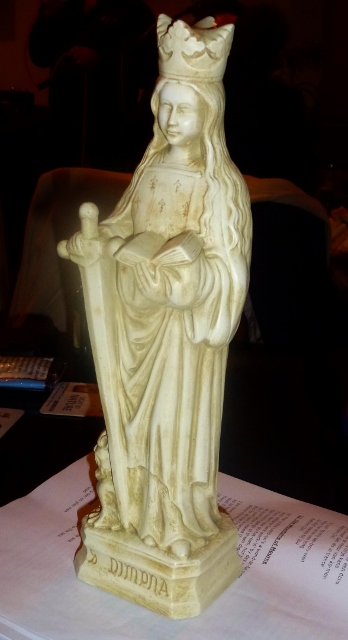
Gift from Geel to Tydavnet: statue of St Dympna

Gift from Geel to Tydavnet: statue of St Dympna

 They came here as part of The Gathering. A group of fourteen visitors from Geel led by Mayor Vera Celis has returned to Belgium following a five day stay in Tydavnet, County Monaghan, with which the town in Flanders is twinned. The common connection is St Dympna, whose story is reflected in both areas.

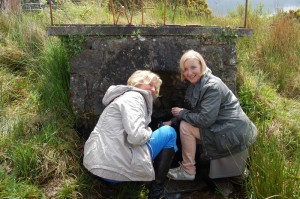
Geel Mayor Vera Celis & Cllr Nadine Laeremans collect water from St Dympna's Well, Tydavnet Photo: © Patricia Cavanagh

Geel Mayor Vera Celis & Cllr Nadine Laeremans collect water from St Dympna’s Well, Tydavnet Photo: © Patricia Cavanagh

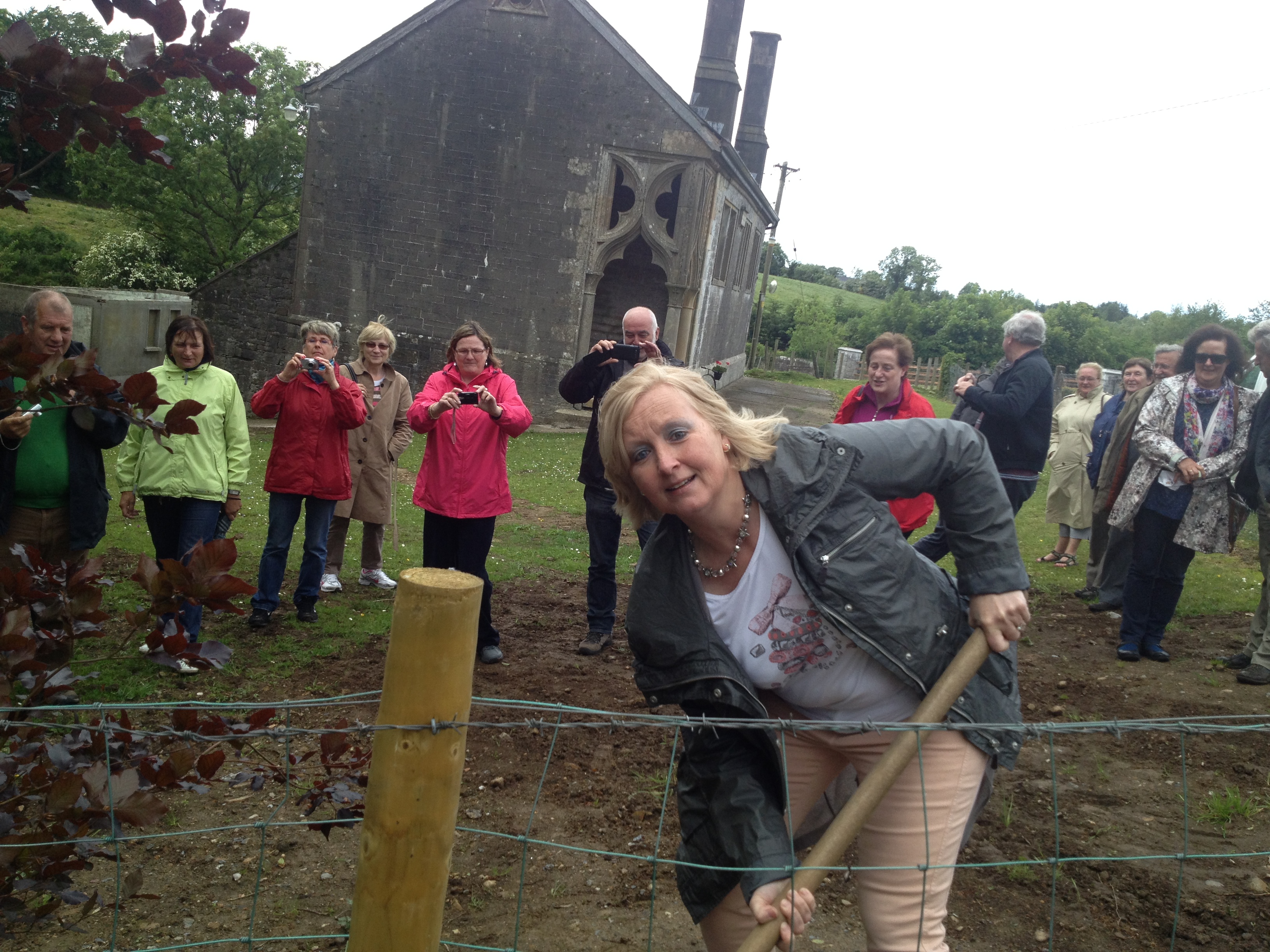
The well of St Dympna at Culdavnet has had access restored and the visitors went there to collect some of the water. The Mayor of Geel Vera Celis also planted a tree at the former national school at Cornagilta, which the local community hopes to open as a heritage centre.

The group also visited the mens’ shed project in Monaghan town and were given a tour of the new educational complex on the site of the former military barracks, as well as a tour of the new Garage Theatre. It was an interesting programme put together by the hard-working local committee of volunteers in Tydavnet, with the support of Monaghan County Council. On Sunday morning the visitors attended the 10am Mass at St Dympna’s church in Tydavnet and they were brought afterwards to the community centre for refreshments.

Geel Mayor Vera Celis planting tree at Cornagilta school Photo: © Paudge Connolly

Geel Mayor Vera Celis planting tree at Cornagilta school Photo: © Paudge Connolly

The visitors stayed with local families and in return, visitors from Tydavnet are hosted by local people when they travel to Geel. An invitation was made by Vera Celis and Councillor Nadine Laeremans for the Tydavnet group to travel to Geel in May 2015 when the next St Dympna pageant (“Omegang”) will take place, a celebration held every five years.

Before they departed, Mayor Vera Celis presented Marie McAree representing the Tydavnet group with a gift: a statue of St Dympna from Geel. A suitable place must now be found to display it, perhaps in the chapel.

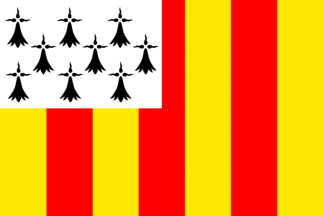
Flag of Geel

Flag of Geel

RACING AT YORK

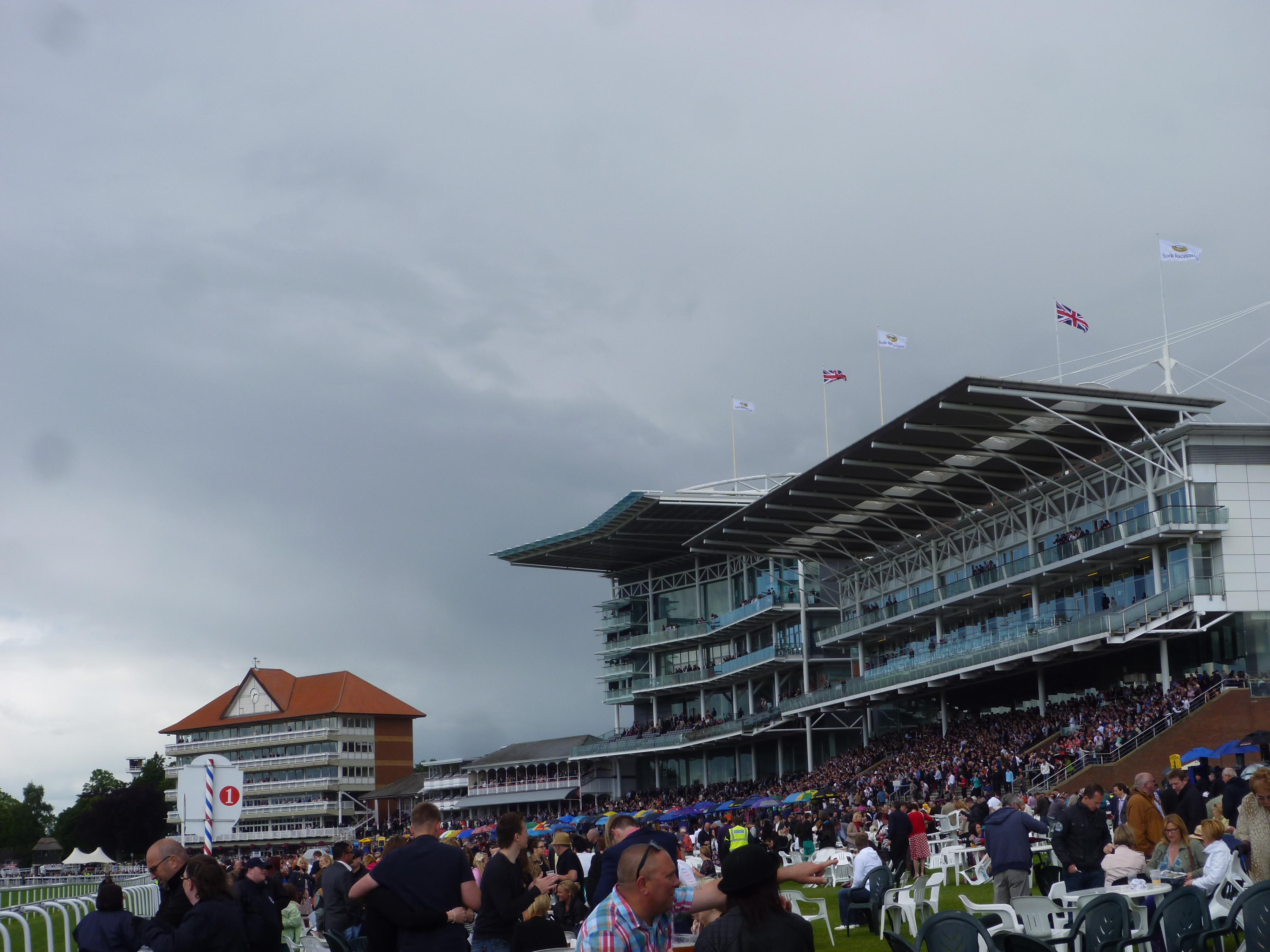
York Racecourse

York Racecourse

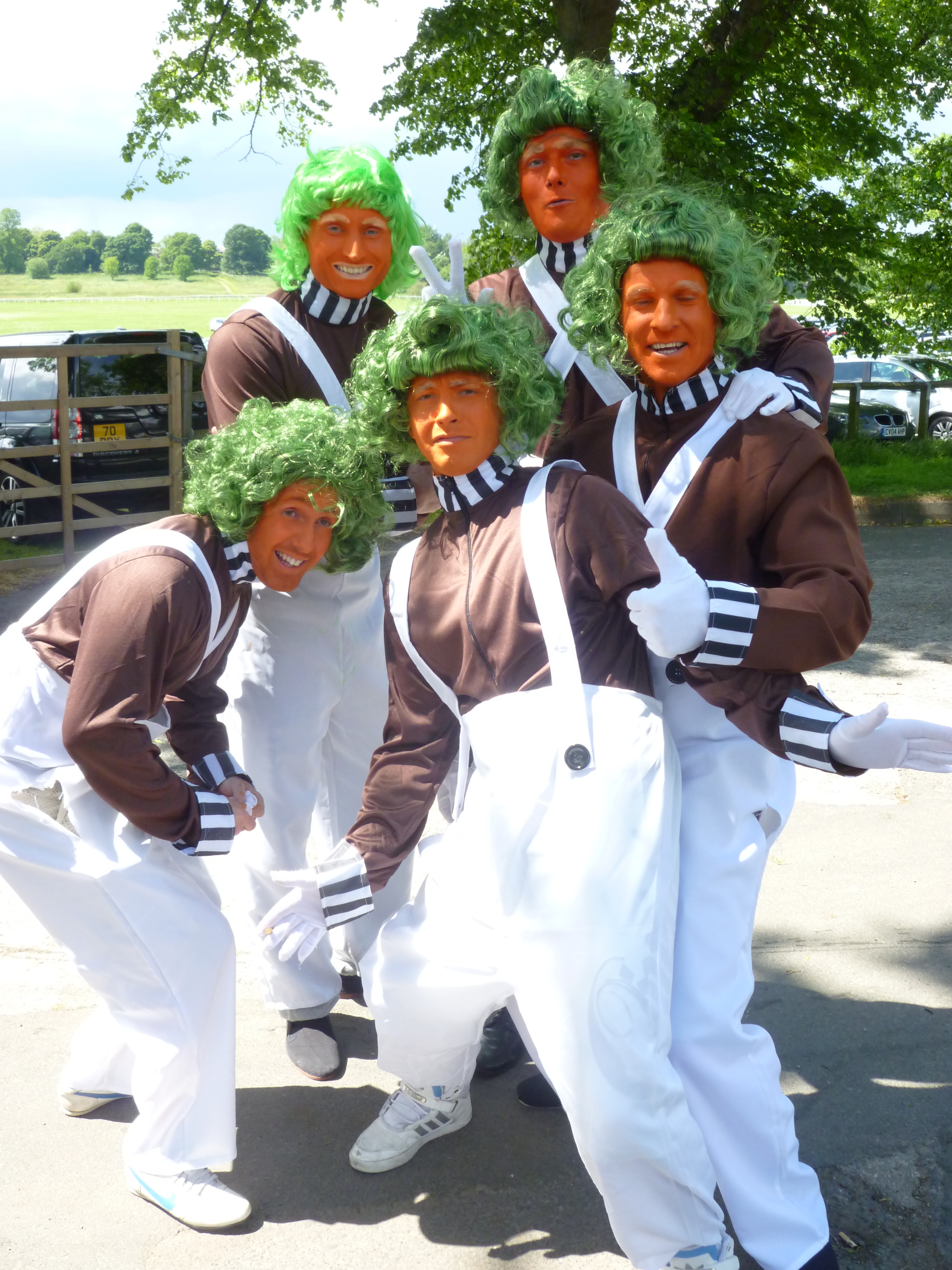
I thought that when it came to partying, especially on a sporting occasion, that nothing could beat Dublin. I have seen them celebrating in Newcastle in the North East of England at weekends and felt they also knew how to enjoy themselves. But their near neighbours in Yorkshire must come top of the list, especially when there is racing on at York. This has been a thoroughly enjoyable day out. I saw three races and got as good a view of them as any of the punters in the large county stand did, from the rails just beyond the one furlong marker. This evening the centre of the historic city turned into one big fashion show. One tip for the ladies: high heels and cobbled stones do not mix, as some of them discovered!   

Happy Punters at York

Happy Punters at York

MONAGHAN IN LOURDES

Fr Jerry Caroll, Carrickmacross, Air Corps chaplain in Baldonnel

Fr Jerry Caroll, Carrickmacross, Air Corps chaplain in Baldonnel

NORTHERN STANDARD Thursday 6th June 2013

With around 30,000 pilgrims in Lourdes last weekend most of them attending the 55th annual international military pilgrimage, Michael Fisher managed to find several Monaghan connections among the Defence Forces contingent that travelled from Dublin……
Among the six chaplains with the 300-strong party was Fr Jerry Carroll from Carrickmacross. He is chaplain to the Air Corps at Baldonnel in Co. Dublin.

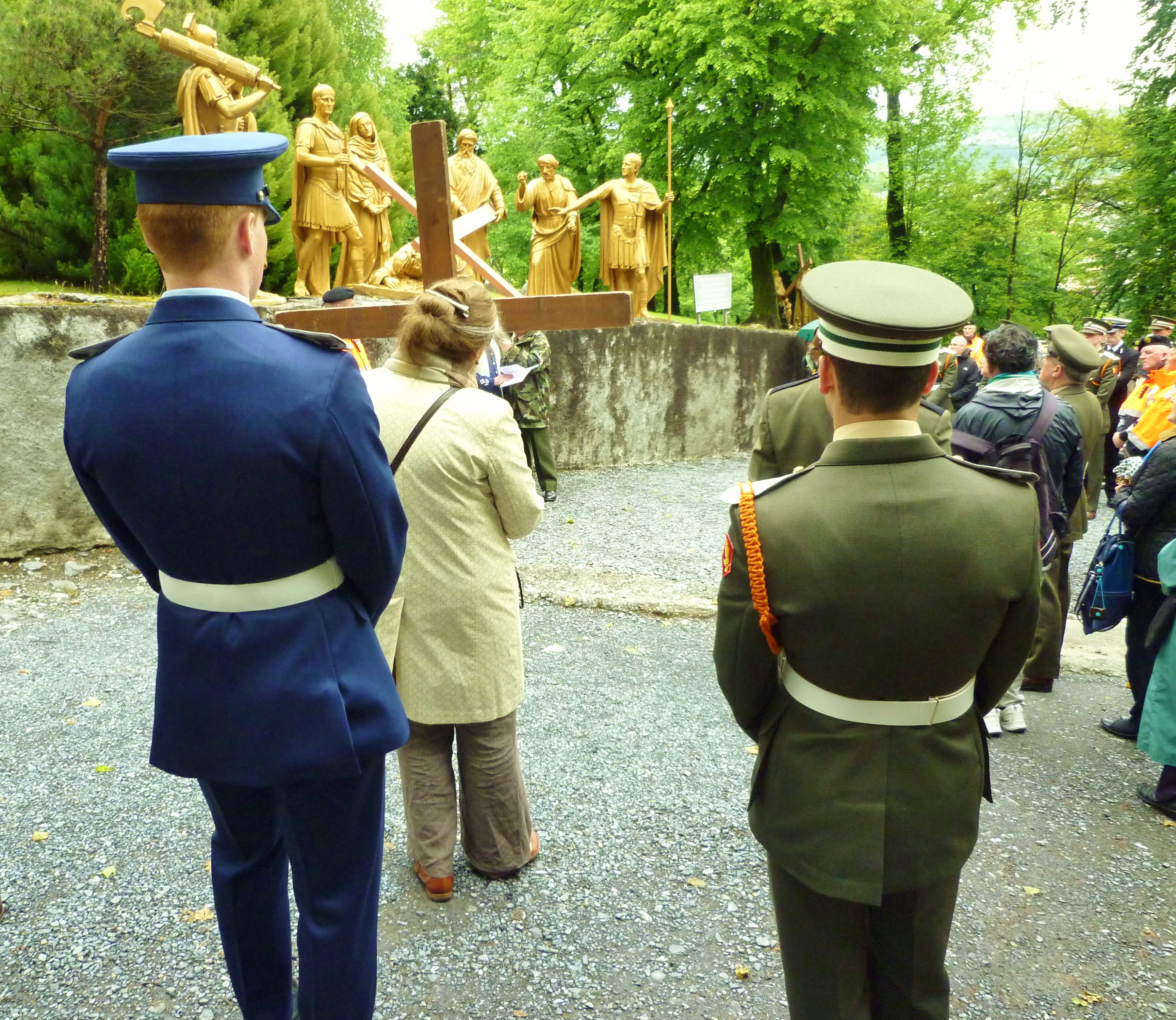
Stations of the Cross at Lourdes

Stations of the Cross at Lourdes

He led the group in making the Stations of the Cross. During the procession Evelyn Fisher from Drumcoo Woods, Tydavnet, was asked to carry the cross at the eighth station (Jesus meets the women of Jerusalem) to the next one (Jesus falls the third time).

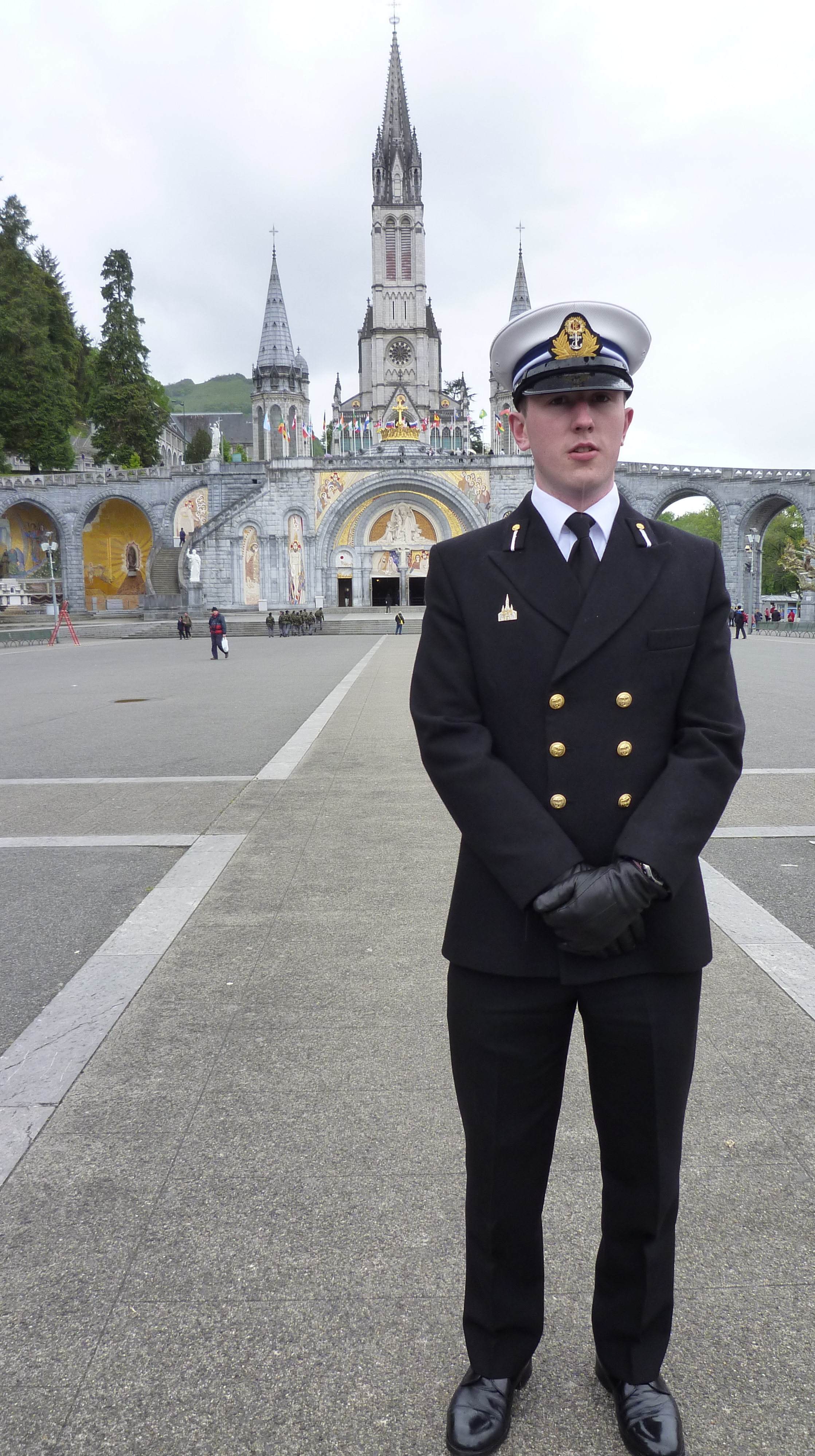
Naval Cadet and former member of the Reserve Defence Force in Monaghan, Aron Nutley, was among the 51st cadet class who travelled overland from Haulbowline in Cork with their chaplain Fr Des Campion to take part in the visit to the shrine of Our Lady and to the Grotto.

Naval Cadet Aron Nutley, Monaghan

Naval Cadet Aron Nutley, Monaghan

Mass for English-speaking countries including Ireland, the UK, USA and Norway was concelebrated by Bishop Richard Moth, Chaplain to the British forces along with the Defence Forces Head Chaplain Monsignor Eoin Thynne and a number of other priests. Aron from Coolshannagh is a former pupil of Beech Hill College in Monaghan. Accompanying the party from the 89th Army Cadet Class at the Curragh, the Air Corps and Navy cadets was a group of nineteen from the Civil Defence drawn from eight counties.

They included a number from Westmeath, based in Mullingar. One of them was Siobhan Courtney from Clones, a former pupil at Largy College. The Civil Defence have been accompanying the military on the pilgrimage since 1994 and for three of them, this was their 20th trip.

Siobhan Courtney & Civil Defence group from Co.Westmeath

Siobhan Courtney & Civil Defence group from Co.Westmeath

Paddy Reilly, Monaghan

Paddy Reilly, Monaghan

A number of former soldiers took part in the pilgrimage, including Paddy Reilly from Glenview Drive in Monaghan. He is a UN Veteran who served in Monaghan town and for a number of years was in charge of the local FCÁ unit (now the Reserve Defence Force). He was also active with the Civil Defence. The final Monaghan connection was through one of the Joe Walsh Tours guides, Carmel Power (McGinty). She lives in Skerries, Co. Dublin and is a former pupil of Clochar Lughaidh Muineachain, where she was a boarder for a number of years.

Former St Louis Monaghan pupil Carmel Power (McGinty), JWT travel rep in Lourdes

Former St Louis Monaghan pupil Carmel Power (McGinty), JWT travel rep in Lourdes

Groups from the Dioceses of Raphoe (Donegal) and Ossory (Kilkenny) were in Lourdes at the same time as the military pilgrimage. The Minister of State for Defence Paul Kehoe TD joined the group and read one of the lessons at the International Mass on Sunday in the underground basilica of St Pius X. He also laid a wreath at the Irish memorial at the town cemetery in Lourdes which commemorates all those Irish pilgrims who died there, including Monsignor James Horan from Knock and Cardinal O Fiaich.

Minister of State Paul Kehoe TD lays wreath at Irish memorial in Lourdes

Minister of State Paul Kehoe TD lays wreath at Irish memorial in Lourdes

ENTERPRISE TRAIN FIRE

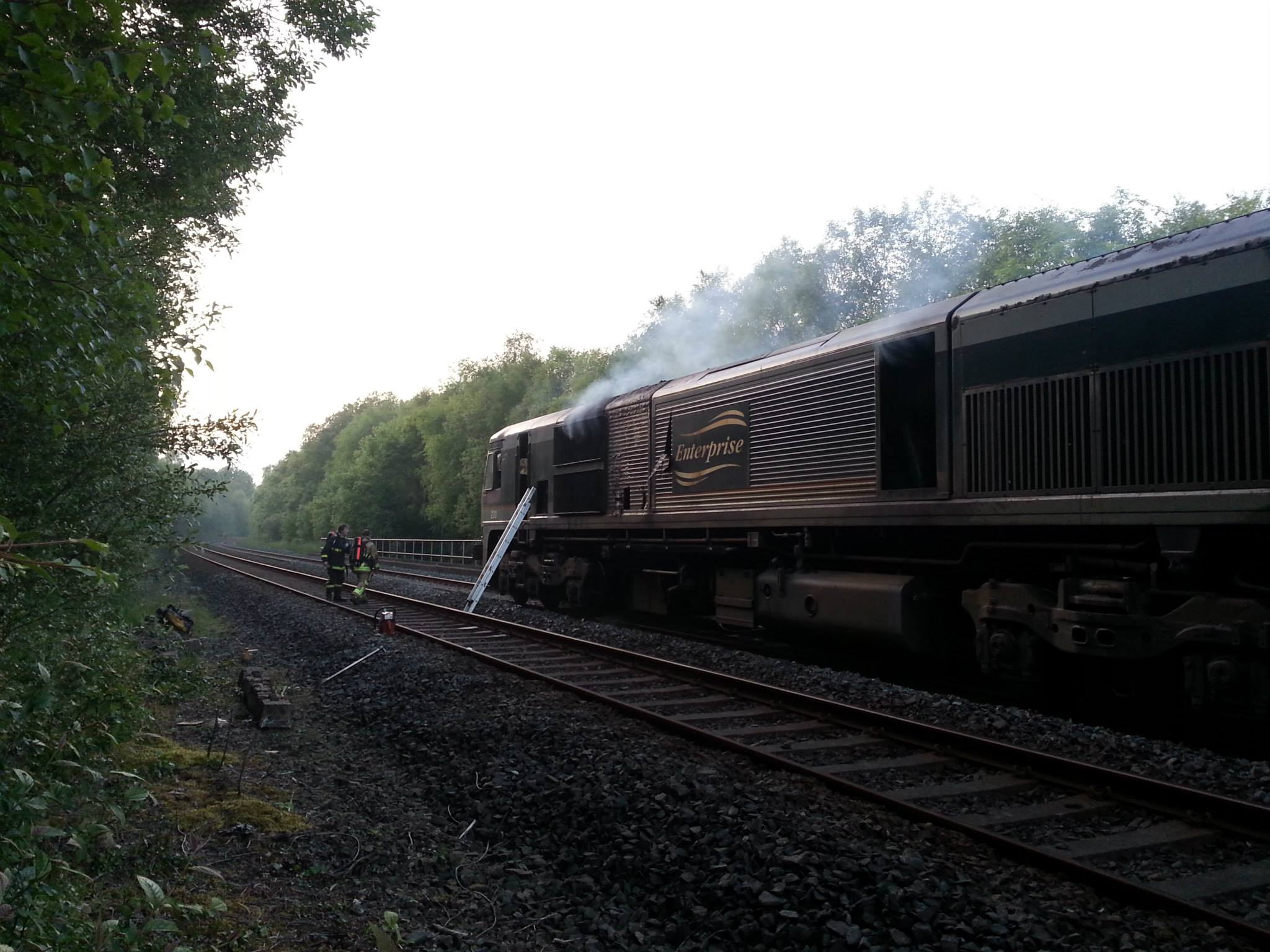
Train loco on fire: Photo PSNI Newry & Mourne via facebook

Train loco on fire: Photo PSNI Newry & Mourne via facebook

I have a lot of sympathy for the train passengers whose journey from Belfast to Dublin last night was disrupted by a fire on board a locomotive at the tail end (from what I see in the picture) of the 18:05 Enterprise service from Central station to Connolly. Reports of the incident carried by BBC News and other outlets say there were 114 passengers on board the train when the driver (presumably at the other end) realised there was a problem in the engine compartment. He was forced to bring the train to a halt at the former Goraghwood station in County Armagh, a few miles from Newry.

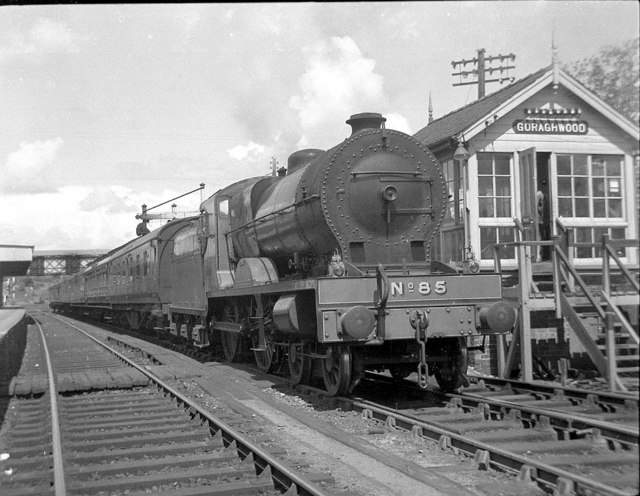
Goraghwood Station on the GNR Enterprise service: Photo Wilson Adams: Creative Commons Attribution-Share Alike 2.0 Generic license

Goraghwood Station GNR Enterprise service: Photo Wilson Adams: Creative Commons Attribution-Share Alike 2.0 Generic license

Goraghwood station was closed in 1965. It used to be the stop for the customs check by HM Customs & Excise, although the process was speeded up for train passengers from 1947 when customs checks were added at Great Victoria Street station in Belfast and Amiens Street station in Dublin. A General Order issued by Customs in London in 1923 following partition and the creation of a land boundary noted as follows:-

*Note. ____  There are three Customs Stations on the G.N.R. Main Line in Northern Ireland, viz.: Goraghwood, Portadown and Belfast. Trucks from the Free State for Railway Stations short of Portadown will be cleared at Goraghwood; all others for any stations short of Belfast, at Portadown; and trucks for Belfast, at Belfast. Passengers will be dealt with at Goraghwood or at Portadown, according to which is the first scheduled stop at each train.

A former customs man, Ronald, remembers his time on duty there:-

“The main railway line between Belfast and Dublin passed through the Border Railway Station at Goraghwood in Newry.  The Daily Express Trains, ‘The Enterprise’ stopped at Goraghwood for Customs Clearance, a staff of LPM’s  boarding the trains and obtaining declarations from the passengers, any Revenue payments being called for by the Preventive Officer in attendance. Bars on board the Dublin/Belfast services were sealed after declaration by the Catering Staff. Secondly, the Guinness Supply Train en route from Dublin to Belfast, stopped at Goraghwood every night with its load, which was examined, samples being taken by the Officer i/c for submission to the Government Chemist“. HM-Customs-Waterguard-L Archives 19 NOV 2007 

I wonder did they ever get a chance to sample any of it themselves!

However it was not a customs check that stopped the main rail service between the two cities last night but rather the problem of an engine fire. A few observations about the incident. I have not used the Enterprise service in recent times, preferring instead to go by car on the new motorway. A journey from South Belfast to South Dublin can now be done in under two hours. The train runs eight times daily (Monday to Saturday) with a reduced service on Sundays between the cities but often with stops, which means the journey from city centre to city centre usually takes two hours and ten minutes. The Aircoach service goes from Great Victoria Street (Glengall Street) to O’Connell Street in Dublin in the same time and is generally cheaper, as is the frequent Translink/Bus Éireann express service. So the cost and the road have played a major part in the reduction of passenger numbers on the Enterprise, which were also reduced at the time the viaduct at the Malahide estuary partially collapsed in August 2009 and was closed for three months for repairs.

P1120123

Enterprise Train at Lisburn: Photo © Michael Fisher

My recent contact with the Enterprise has been sightings of one of the trains in various locations. I noticed it going through Adelaide station in Belfast, with black smoke coming from the exhaust and I thought it was not very environmentally friendly. I saw it in Lisburn station heading for Belfast at the time I was going to the Balmoral Show last month and I got a picture of it. A few days ago as I headed on the A1 to Dublin outside Newry, I noticed the Belfast-bound train going across the Craigmore viaduct near the station at Bessbrook. The first thing that came to mind was how dirty the front engine looked and that it was a poor advertisement for what is supposed to be a “flagship service”, according to Translink.

I am not certain how many train units are currently in service. But according to the records, there are nine 201-Class locomotives built by General Motors (1994-5) in use for the Enterprise. Two of them (8208 River Lagan and 8209 River Foyle) are owned by Translink, the other seven belong to Iarnród Éireann (Irish Rail). The Wikipedia entry records that the locos have had a chequered service history and that “the authors of Jane’s Train Recognition Guide noted that IÉ had had problems with engine fires and bogie cracks” (Harper Collins, London 2005). Last night’s was not the first such incident.

Translink advised on twitter that there was already a problem with the 16:50 Dublin to Belfast service: “1650 Dublin – Belfast is now 35 minutes late – Will be formed of 4 coaches. 1st class not available & catering is reduced.” When the problem on the 18:05 service to Dublin arose, the company initially advised that “Replacement road transport will be provided between Newry and Dublin Connolly.” But after ensuring that the passengers were led to safety in the opposite end of the train, they were kept waiting until an Iarnród Éireann train arrived on the other track and the passengers were led across a ramp from one train to the other, assisted by the Northern Ireland Transport Minister and local MLA Danny Kennedy and Translink staff. The passengers arrived in Dublin after 1am, nearly five hours late.

Fire on board Enterprise locomotive: Photo: PSNI Newry & Mourne via Facebook

Fire on board Enterprise locomotive: Photo PSNI Newry & Mourne via facebook

At the end of the day, no-one was injured. Mr Kennedy said there would be a full investigation. The loco involved was number 230, River Bandon, and is part of the Iarnród Éireann stock. They are model type JT42HCW, fitted with an EMD 12-710G3B engine of 3200 hp, weigh 112 tonnes and have a maximum speed of 164 km/h (102 mph). The Enterprise locos all operate on a push-pull basis.