I was at the Christmas Eve Mass at Saint Macartan’s Cathedral in Monaghan where the chief celebrant was Bishop MacDaid. Standing room only when I arrived. Here is the joint Christmas Message from the Bishops of Clogher Dr Liam MacDaid and Right Reverend John McDowell.
Vatican Radio reports on the meeting Pope Francis had in the Vatican yesterday with the heads and other senior officials of the departments of the Roman Curia, in their traditional exchange of Christmas greetings. But there was something very non-traditional about the Pope’s remarks. He listed fifteen ailments of the administration that he wanted to be cured. The Holy Father focused on the need for those who serve in the Curia – especially those in positions of power and authority – to remember and cultivate an attitude and a spirit of service.
“Sometimes,” said Pope Francis, “[officials of the Curia] feel themselves ‘lords of the manor’ [It. padroni] – superior to everyone and everything,” forgetting that the spirit, which should animate them in their lives of service to the universal Church, is one of humility and generosity, especially in view of the fact that none of us will live forever on this earth…The Curia is always required to better itself and to grow in communion, sanctity and wisdom to fully accomplish its mission. However, like any body, it is exposed to sickness, malfunction and infirmity… I would like to mention some of these illnesses that we encounter most frequently in our life in the Curia. They are illnesses and temptations that weaken our service to the Lord”, continued the Pontiff, who after inviting all those present to an examination of conscience to prepare themselves for Christmas, listed the most common Curial ailments:
The first is “the sickness of considering oneself ‘immortal’, ‘immune’ or ‘indispensable’, neglecting the necessary and habitual controls. A Curia that is not self-critical, that does not stay up-to-date, that does not seek to better itself, is an ailing body. … It is the sickness of the rich fool who thinks he will live for all eternity, and of those who transform themselves into masters and believe themselves superior to others, rather than at their service”.
The second is “’Martha-ism’, or excessive industriousness; the sickness of those who immerse themselves in work, inevitably neglecting ‘the better part’ of sitting at Jesus’ feet. Therefore, Jesus required his disciples to rest a little, as neglecting the necessary rest leads to stress and agitation. Rest, once one who has brought his or her mission to a close, is a necessary duty and must be taken seriously: in spending a little time with relatives and respecting the holidays as a time for spiritual and physical replenishment, it is necessary to learn the teaching of Ecclesiastes, that ‘there is a time for everything’”.
Then there is “the sickness of mental and spiritual hardening: that of those who, along the way, lose their inner serenity, vivacity and boldness and conceal themselves behind paper, becoming working machines rather than men of God. … It is dangerous to lose the human sensibility necessary to be able to weep with those who weep and to rejoice with those who rejoice! It is the sickness of those who lose those sentiments that were present in Jesus Christ”.
“The ailment of excessive planning and functionalism: this is when the apostle plans everything in detail and believes that, by perfect planning things effectively progress, thus becoming a sort of accountant. … One falls prey to this sickness because it is easier and more convenient to settle into static and unchanging positions. Indeed, the Church shows herself to be faithful to the Holy Spirit to the extent that she does not seek to regulate or domesticate it. The Spirit is freshness, imagination and innovation”.
The “sickness of poor coordination develops when the communion between members is lost, and the body loses its harmonious functionality and its temperance, becoming an orchestra of cacophony because the members do not collaborate and do not work with a spirit of communion or as a team”.
“Spiritual Alzheimer’s disease, or rather forgetfulness of the history of Salvation, of the personal history with the Lord, of the ‘first love’: this is a progressive decline of spiritual faculties, that over a period of time causes serious handicaps, making one incapable of carrying out certain activities autonomously, living in a state of absolute dependence on one’s own often imaginary views. We see this is those who have lost their recollection of their encounter with the Lord … in those who build walls around themselves and who increasingly transform into slaves to the idols they have sculpted with their own hands”.
“The ailment of rivalry and vainglory: when appearances, the colour of one’s robes, insignia and honours become the most important aim in life. … It is the disorder that leads us to become false men and women, living a false ‘mysticism’ and a false ‘quietism’”.
Then there is “existential schizophrenia: the sickness of those who live a double life, fruit of the hypocrisy typical of the mediocre and the progressive spiritual emptiness that cannot be filled by degrees or academic honours. This ailment particularly afflicts those who, abandoning pastoral service, limit themselves to bureaucratic matters, thus losing contact with reality and with real people. They create a parallel world of their own, where they set aside everything they teach with severity to others and live a hidden, often dissolute life”.
The sickness of “chatter, grumbling and gossip: this is a serious illness that begins simply, often just in the form of having a chat, and takes people over, turning them into sowers of discord, like Satan, and in many cases cold-blooded murderers of the reputations of their colleagues and brethren. It is the sickness of the cowardly who, not having the courage to speak directly to the people involved, instead speak behind their backs”.
“The sickness of deifying leaders is typical of those who court their superiors, with the hope of receiving their benevolence. They are victims of careerism and opportunism, honouring people rather than God. They are people who experience service thinking only of what they might obtain and not of what they should give. They are mean, unhappy and inspired only by their fatal selfishness”.
“The disease of indifference towards others arises when each person thinks only of himself, and loses the sincerity and warmth of personal relationships. When the most expert does not put his knowledge to the service of less expert colleagues; when out of jealousy … one experiences joy in seeing another person instead of lifting him up or encouraging him”.
“The illness of the funereal face: or rather, that of the gruff and the grim, those who believe that in order to be serious it is necessary to paint their faces with melancholy and severity, and to treat others – especially those they consider inferior – with rigidity, hardness and arrogance. In reality, theatrical severity and sterile pessimism are often symptoms of fear and insecurity”.
“The disease of accumulation: when the apostle seeks to fill an existential emptiness of the heart by accumulating material goods, not out of necessity but simply to feel secure. … Accumulation only burdens and inexorably slows down our progress”.
“The ailment of closed circles: when belonging to a group becomes stronger than belonging to the Body and, in some situations, to Christ Himself. This sickness too may start from good intentions but, as time passes, enslaves members and becomes a ‘cancer’ that threatens the harmony of the Body and causes a great deal of harm – scandals – especially to our littlest brothers”.
Then, there is the “disease of worldly profit and exhibitionism: when the apostle transforms his service into power, and his power into goods to obtain worldly profits or more power. This is the disease of those who seek insatiably to multiply their power and are therefore capable of slandering, defaming and discrediting others, even in newspapers and magazines, naturally in order to brag and to show they are more capable than others”.
Pope Francis Photo: news.va
Pope Francis continued: “We are therefore required, at this Christmas time and in all the time of our service and our existence – to live ‘speaking the truth in love, we are to grow up in every way into him who is the head, into Christ, from whom the whole body, joined and held together by every joint with which it is equipped, when each part is working properly, makes the body grow so that it builds itself up in love’”.
“I once read that priests are like aeroplanes: they only make the news when they crash, but there are many that fly. Many criticise them and few pray for them”, he concluded. “It is a very nice phrase, but also very true, as it expresses the importance and the delicacy of our priestly service, and how much harm just one priest who falls may cause to the whole body of the Church”.
This is surely one of the most important addresses by any Pope in the past fifty years or so, since Vatican II. The video of his address in Italian can be watched here.
Uachtarán na hÉireann Michael D. Higgins has issued his Christmas and New Year message. He refers to the improving relations between Ireland and the UK, strengthened by his state visit to Britain earlier this year, the first such official engagement by an Irish President. He also thanks members of the emergency services, the Garda Síochána, and members of Óglaigh na hÉireann. some of whom are on overeas duty. His message which has been recorded for broadcasting is as follows:-
“Christmas is a season of joy and warmth. It is a special time of the year, when so many of us come together with family and friends in a spirit of sharing and celebration. It is an opportunity to revive hope and anticipation, which can encourage us, including those who may be feeling distressed or lonely, to look beyond the long dark nights, to the promise once again, of the dawning light of Spring.
The story of Bethlehem, of the homeless Joseph and Mary anticipating the birth of their child, is at the heart of this holiday and it invites us to reflect on how we relate to the stranger, the vulnerable in our midst. At Christmas we are reminded, not only of how a man and a woman had to leave their familiar surroundings and have their child in a strange place, of how they were joined by unknown shepherds and visitors from faraway lands, but most importantly, of the empowering ethic of hospitality.
I completed, last month, a three-week visit to Africa, where I witnessed first-hand the impressive solidarity of countries such as Ethiopia in responding to the predicament of so many men, women and children from neighbouring countries who were forced to leave behind their homes, communities and livelihoods to seek refuge in their neighbour’s territory. Such willingness to offer shelter to those fleeing persecution or hunger is an issue that should involve us all, and not just the countries first affected.
Christmas is a season of peace, a time to recall all that can be achieved through reflection, forgiveness and reconciliation. Earlier this year, I had the great honour of being Ireland’s first Head of State to pay a State Visit to our nearest neighbour in every sense, the United Kingdom. It was an immense privilege and pleasure to be thus able to manifest the friendship between our two peoples, who no longer “look at each other with doubtful eyes”, but, rather, with the trustful eyes of mutual respect and shared commitments.
As a New Year approaches, and we continue our lives together, may I offer our appreciation to all who make that possible. I know that a commitment to the service of our citizens is shared by all those with a public service mission. May I, on behalf of the Irish people, thank in particular those who are caring for our communities during the holiday season – including the staff in our hospitals and emergency services, An Garda Síochána, and members of our Defence Forces who are supporting peace abroad.
My wish is that 2015 will bring our people a bounty of opportunities for flourishing and renewal. May the caring spirit that infuses these precious few days spent in the company of those we love extend to all and well beyond the Christmas holiday, into the year ahead. Sabina and I wish each and every one of you a very happy Christmas and a peaceful and prosperous New Year.”
The English video of his address can be found here.
LW252 mast Co. Meath Photo: Save RTE Longwave Radio
Thank you RTÉ for putting a stay until 2017 on any closure of the LW252 transmitter for Radio 1. Following a campaign that included a petition, the national broadcaster has decided it will work in conjunction with the Department of Foreign Affairs and commission new research as well as consulting with Irish emigrants groups.
RTÉ Radio 1 LW will operate a full service in 2015, with reduced hours in 2016 before working towards a full shutdown in 2017. The service was due to end early next year after RTÉ postponed a decision to close the transmitter until 19th January 2015.
RTÉ had previously announced that it would be ceasing its Longwave 252 service from the Clarkstown longwave transmitter on 27 October and migrating its Radio One service to digital platforms.
RTÉ said that in slowing the pace of the longwave shutdown, it has considered contact from listeners and submissions from a range of groups, who highlighted that more time was needed to “understand and enable the migration to digital platforms for all listeners”.
Head of RTE Radio 1 Tom McGuire said: “We’ve listened particularly to the concerns raised by and on behalf of the elderly Irish in the UK.
“Cost-reduction remains a key priority for RTÉ and we remain convinced that, in the longer term, longwave has had its day. Nonetheless and despite the mid-term cost impact, RTÉ believes it is necessary to take a collaborative approach and slow this transition.”
The Department of Foreign Affairs and Trade said it is prepared to work with RTÉ to commission specific research to better understand the community in the UK who listen to the longwave service. The research will be conducted next year, will be funded by the department and will include perspectives from community groups representing the Irish elderly in the UK.
Chair of the Oireachtas Transport and Communications Committee John O’Mahoney TD said he was delighted at the decision of the RTÉ board to retain the service. Minister for Communications Alex White TD, a former RTÉ radio producer, has also welcomed the announcement.
He said: “I recently met representatives of the Irish community living in Britain, who stressed the value they place on RTÉ’s longwave service. I welcome the decision to extend the life of the service by two years, which will give the broadcaster space to engage with its listeners about other ways of accessing RTÉ radio in the UK.”
The Church of Ireland church of Saint Brigid in Stillorgan, once a village on the outskirts of Dublin, is where Sir William Orpen (see yesterday) was baptised. His father Arthur Herbert Orpen was honorary secretary to the select Vestry for fifty years. Neither is buried there but on a visit there yesterday I did get a chance to look at the adjoining cemetery.
Dominic Lee, photographer, of Priory Studios, Stillorgan, has begun a fundraising campaign for a sculpture of the well-known artist, Sir William Orpen. Orpen was baptised at St Brigid’s Church of Ireland church in Stillorgan. Earlier this year Dominic came to nearby Mount Merrion parish to talk about the project and to display copies of some of his paintings from World War I.
Dominic says there is a beautiful spread in the 2015 Obelisk journal about his fundraising project for a sculpture of Sir William Orpen for Stillorgan Village. Cover painting – The Hill, Stillorgan by Olivia Hayes.
Published by Kilmacud Stillorgan Local History Society – Copies available from stillorganlocalhistory@gmail.com for €6. Talks take place at 8pm on the 2nd Thursday of every month in Glenalbyn Sports Club.
New Casement Park Aerial View Photo: Casement Park Redevelopment Project
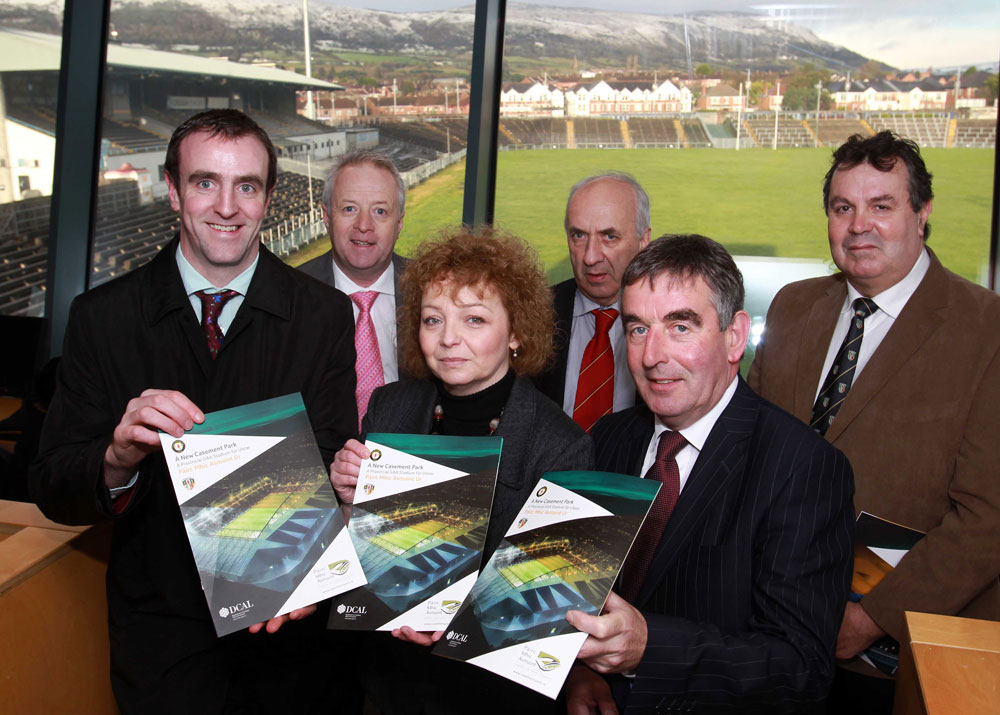
It was to be the GAA’s showcase in Ulster: a completely revamped £77m stadium at Casement Park in West Belfast that would seat 38,000 fans. It would take over from Páirc Naomh Tiarnach in the border town of Clones in County Monaghan as the venue for Ulster football finals. Now a judge at the High Court in Belfast has found that the planning application approved by the North’s Environment Minister Mark H. Durkan was “irretrievably flawed“.
The judicial review that lasted thirteen days heard that defects were also identified in the environmental survey, with no assessment of the impact on local residents of extra stadium facilities such as conference suites, bars, restaurants and car parking. A further hearing is expected later this week to decide the final outcome of the case.
Environment Minister Mark H.Durkan announces approval for project, December 2013 Photo: Casement Park Redevelopment Project
The new stadium was set to be included in the list of GAA venues to be used as one of the Ireland’s bid for the 2023 Rugby World Cup. Hugo McNeill, the chairman of the bid, last month said that the Casement Park upgrade was “crucial” to the Northern Ireland component of its proposal.
Chairman of the Casement Park Project Board, Tom Daly, said they were “deeply disappointed” by the decision. “The proposed redevelopment of Casement Park would have provided the opportunity of a world class provincial stadium for the GAA and the broader community in the heart of Belfast. It would also have provided much needed economic and social benefits to west Belfast and beyond, including financial investment, new jobs, apprenticeships and community projects. Over the coming weeks we will reflect on this decision and consider what the next steps are for Casement Park”, he said.
The redevelopment of Casement Park is part of the Northern Ireland Executive’s policy to upgrade the three major sports grounds in Belfast – soccer’s Windsor Park, Ulster Rugby’s ground at Ravenhill and the GAA stadium at Casement. Three new stands have been constructed at Ravenhill. Work is ongoing on modernising Windsor Park, the home of Irish League club Linfield and the Northern Ireland international team.
I note that former Clones resident Darach MacDonald says he is not going to gloat about this outcome, which he has predicted several times to general disbelief. However, he thinks somebody needs to explain, and quickly, how a planning process described as ‘irretrievably flawed’ was presented to GAA fans and the general public as a fait accompli. From the outset, this was a politically tainted and contrived vanity project to siphon off public funds on a sectarian pretext for an inappropriate development in a place where it was not wanted, he said.
Meanwhile, the existing venue for the Ulster Football Final, the provincial showpiece for the sport, has been relegated to a state of neglect pending redundancy (without floodlights or other investment since the early 1990s), disparaged and dismissed by those who pursued their ‘Field of Dreams’. As a life-long supporters of Gaelic games, Darach says he is “disgusted and impatient for answers”.
LW252 mast Co. Meath Photo: Save RTE Longwave Radio
When I tune into RTÉ Radio 1 in Belfast I usually have my radio on 252 Long Wave, This is because the signal quality seems to be more stable than FM. Even with the swap of FM frequencies between Radio 1 and Lyric FM, I find the Long Wave service much more convenient. It was always very useful to have LW252 as an option when travelling by car in Britain. When it comes to summer sports such as GAA finals, the LW service remains a very important link for the Irish diaspora in Britain and beyond.
In the Irish Times, Patsy McGarry has an interesting article about the benefits of LW252. RTÉ’s planned closure of its long-wave radio service on January 19th has been described as a “crying shame” by a leading Irish child sex abuse campaigner in Britain. Mick Waters founded the Survivors of Child Abuse Soca (UK) group, precursor to Soca (Ireland). It grew out of the Artane Old Boys organisation he set up in the English midlands in 1965. Speaking to The Irish Times from Coventry, Mr Waters said many of the people he had dealt with down the decades “love that [RTÉ long-wave] connection. It’s very important to them.”
Tony Corcoran was driving in Southport, Lancashire, listening to RTÉ radio when he spoke to The Irish Times on the issue. “It’s as clear as any local station,” he said. If the long-wave service was to go, neither he nor anyone else in the UK would be able to listen to RTÉ in a car, he said. He said that during the football championship, people sat in cars across the UK with RTÉ on and windows open so others could hear commentary.
RTÉ originally intended to close down the transmitter at Clarkstown in County Meath on October 27th 2014 but it has postponed the move until January 19th 2015 following calls by emigrants’ groups and others in Britain. The Catholic bishops of Ireland also criticised the decision. If you want to know more about the campaign to save LW252, a page with a petition can be found here.
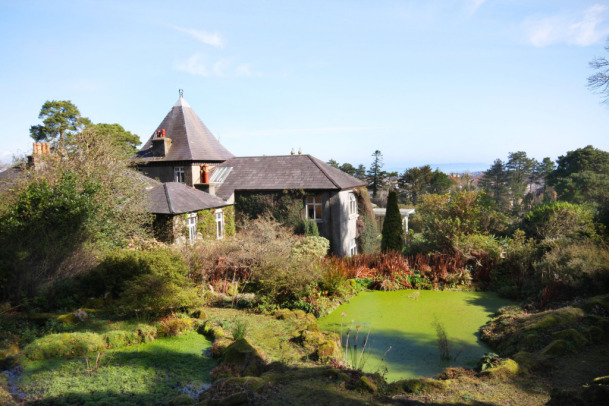
Fernhill House and Gardens Photo: Colliers/daft.ie
Fernhill House and estate has been sold. But it’s not the one in the Glencairn area of West Belfast that used to house a Peoples Museum with loyalist memorabilia. The one I am referring to is in South County Dublin, between Sandyford and Stepaside. I have passed it on a number of occasions in the past two months, but I never realised what was behind the long stone wall along the Enniskerry Road, opposite Belarmine.
The Irish Times reports that the house and gardens have been sold for €4.25m to Dún Laoghaire Rathdown Council. A council spokesman said it was planned to redevelop the 84-acres site as a regional public park in the coming years. The property was bought by developer David Arnold for around €45 million in 2008 and later taken over by the assets management agency NAMA. It went on the market in April through Colliers at a guide price of €5 million.
Fernhill Gardens site Photo: Colliers/daft.ie
Council chairwoman Marie Baker said the acquisition was one of the last opportunities for the council to buy a “sizeable parcel of land” to be used for recreational purposes. Fernhill gardens were started in the early 19th century and have rare collections of plants, trees and shrubs. About 45 acres of the land is wooded. The property was owned by the Walker family from 1934 onwards. The house was initially built in 1723.
Fernhill House and Gardens Photo: Colliers/daft.ie
According to estate agents Colliers International, the Darley Family, are credited with most of the changes that the house has been through. The original section of the house is the single storey section to the front which now contains the principle reception rooms. The structure to the rear is believed to have been a range of outbuildings which were converted and extended to living accommodation, probably by Edmond or Justice William Darley.
At a meeting organised by the Belfast and District Branch of the National Union of Journalists a number of reporters and a photographer were awarded life membership of the union, having belonged to the NUJ for over forty years. I was presented with my certificate by the Irish Secretary Seamus Dooley and somehow I managed to receive two of them! Seamus pointed out that my father Des is also a long-time NUJ member (he helped to start the Irish South Eastern Branch when he started work in Carlow) as is my sister Carolyn who also worked in RTÉ.
The Cathaoirleach of the Irish Executive Council Gerry Curran presented me with a limited edition coin, issued last year to mark the centenary of the 1913 lockout in Dublin, which I was very proud to receive in recognition of my contribution to the NUJ in Ireland and Britain. I joined the union in July 1974, becoming a member of the London Radio Branch when I worked in the BBC Radio Newsroom at Broadcasting House as a News Trainee. I later joined the Birmingham Branch when I moved to the West Midlands in 1975. I then joined Dublin Broadcasting Branch on taking up a position with RTÉ News in Dublin in January 1979. I transferred to Belfast in August 1984, becoming a member of Northern Ireland Broadcasting Branch, subsequently amalgamated with Belfast and District.
I remember the Broadcasting Branch Treasurer at the time was Austin Hunter of BBC Northern Ireland. He has also been awarded life membership (44 years a member), along with two of his former BBC colleagues, David Lynas and Noel McCartney. Noel who received his certificate two years ago and had served on the union’s National Executive Council, was congratulated on the achievement by Gerry Curran.
A fifth life membership goes to photographer Alan Lewis, a familiar figure in Belfast media circles. He joined the NUJ 42 years ago. He received his certificate from the President of the International Federation of Journalists, Jim Boumelha, another NUJ stalwart.








 Michael Fisher's News