AN LONDUBH: THE BLACKBIRD

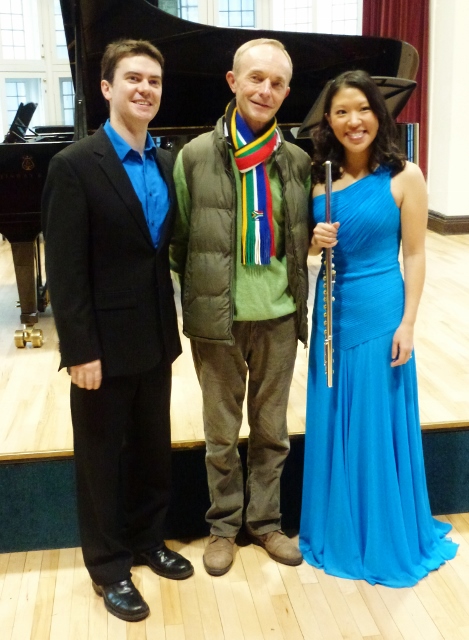
Cathal Breslin, Philip Hammond and Sabrina Hu Photo: © Michael Fisher

Cathal Breslin, Philip Hammond and Sabrina Hu Photo: © Michael Fisher

The imaginary musical trill of the blackbird filled the Harty Room on Sunday. Not the bird itself but rather the beautiful sound of the flute played so well by Sabrina Hu, accompanied by her husband Cathal Breslin on piano. They were performing a new work by Belfast composer Philip Hammond, entitled ‘An Londubh’, the Irish word for blackbird. It was part of the 51st Ulster Bank Belfast Festival at Queen’s and was staged by the Belfast Music Society as part of their Northern Lights Mini-Fest.

Cathal Breslin, Professor of Piano, University of Memphis  Photo: © Michael Fisher

Cathal Breslin, Professor of Piano, University of Memphis Photo: © Michael Fisher

Cathal had the score stored on his iPad and using it with wifi technology was able to flick effortlessly from one page to the next. There was an interesting contrast with a similarly named piece (‘Le Merle Noir’ by Messiaen) which Cathal and Sabrina played first. Philip Hammond explained that his composition was intended as a companion piece for the 20thC Frenchman’s work. But his starting point was very different.
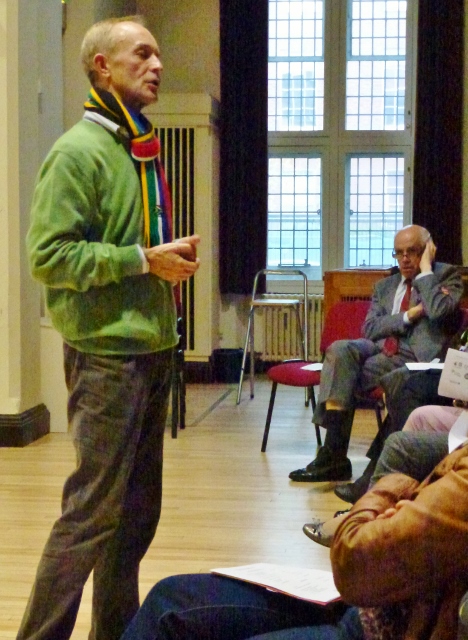
Philip Hammond explains his new work: An Londubh  Photo: © Michael Fisher

Philip Hammond explains his new work: An Londubh Photo: © Michael Fisher

Hammond explained to the audience that rather than the real birdsong, he created a fanciful play between flute and piano , with what he thought a blackbird might sing, if it was so inclined. The main origin of the piece is an ancient Irish air, arranged by Edward Bunting. It was published in the third volume of such arrangements in 1840. He has included it note for note at the end of the work, a fusion that works well. By coincidence I am watching an interview on BBC1 Northern Ireland in which the composer and cellist Neil Martin (who wrote music for Carlo Gébler’s Belfast by Moonlight) explained to Marie Louise Muir how he also had been influenced by Bunting.

The other influencing factor for Hammond comes in the shape of a poem, written by Dr William Drennan, the United Irishman and friend of Bunting. Drennan wrote it in the grounds of Cabin Hill, near Stormont, when his sister lived there. There is a spot in the grounds called the Drennan stone where he is believed to have rested to seek inspiration.  Hammond is also a former music teacher at Cabin Hill, when the house was the preparatory department for Campbell College.

Sabrina Hu  Photo: © Michael Fisher
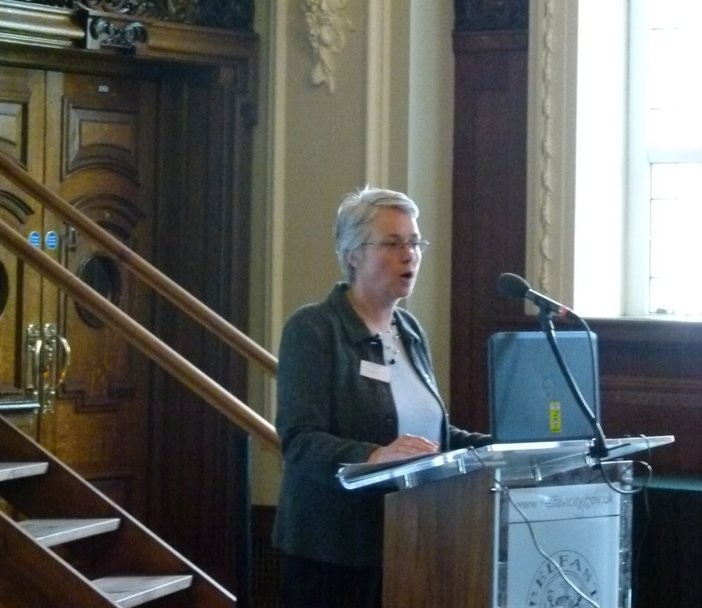
Sabrina Hu Photo: © Michael Fisher

BFQ: BELFAST BY MOONLIGHT

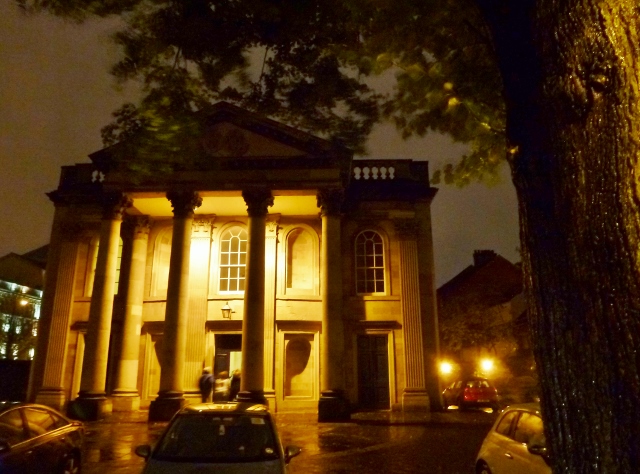
St George's Church Belfast Photo: © Michael Fisher

St George’s Church Belfast Photo: © Michael Fisher

Carlo Gébler Photo: © Michael Fisher

Carlo Gébler Photo: © Michael Fisher

No sign of the moon but plenty of atmosphere provided mainly by candlelight as Carlo Gébler’s new play Belfast by Moonlight was given its world premiere at St George’s by the locally based Kabosh theatre company. It’s the oldest Anglican church in the city in use and will soon celebrate its bicentenary, so it proved to be a very appropriate setting for a drama based around 400 years of Belfast since the granting of a Royal Charter in 1613.

In a recent interview with CultureNorthernIreland for What’s On, Gébler explained how the work evolved. He said artistic director Paula McFetridge briefed him not to write a dramatized history but to produce something personal, possibly involving music, that would work in St George’s Church, a play that would be true to that space. He has certainly fulfilled his brief admirably.

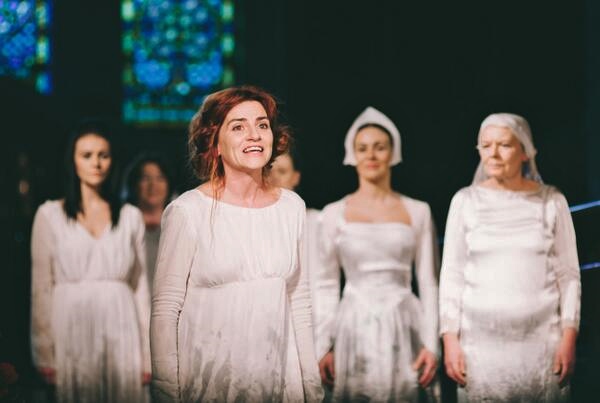
Belfast by Moonlight: Photo: Kabosh theatre company

Belfast by Moonlight: Photo: Kabosh

Attending a rehearsal of another piece that Kabosh had also commissioned, Gébler came up with the idea that the cast would all be female and would play the role of ghosts or spirits from the past. Each of the six was to have a significant event in their lives that had occurred in or around the Church. It was a concept that worked well.

The six 'spirits' from Kabosh (in middle) are applauded along with the Choir Photo: © Michael Fisher

The six ‘spirits’ from Kabosh (in middle) are applauded along with the Choir Photo: © Michael Fisher

Gébler says this is not a realistic play. But when the action reached the 20th Century period up to today, I found there were elements of social commentary that had also featured in Crimea Square, the community-led drama I had seen the previous night on the Shankill Road. That play had scenes including the glue sniffers and young people growing up in the era of rock n’ roll. Géblers ghostly spirits materialised at the start, resurrected from the grave to tell their stories in the chancel area of the church. They included a woman who had given up her two year-old son for adoption in the 1960’s and a young woman who was a drug addict.

The play certainly had an impact on the young drama students in the audience: fifteen from Banbridge Academy and another group from various schools in Gébler’s base in Enniskillen. One was particularly moved by the story of one of the spirits from the time of the Great Famine around 1845: Joanna I think she was named. The spirit represented a cottier from County Monaghan where she had lived in a mud cabin. Her husband had died from fever and she came to Belfast with her two young children looking for support but her story too ended in tragedy.

Choir: Belfast by Moonlight Photo: © Michael Fisher

Choir: Belfast by Moonlight Photo: © Michael Fisher

Around 40% of the play is sung by the main actors and the eight-strong female choir, with original music composed by cellist Neil Martin. The choir come from areas as far apart as Dungannon and Donegal. They were conducted by Nigel McClintock, Director of Music at St Peter’s Cathedral in Belfast and have been rehearsing under Emma Gibbins, Director of Music at St George’s.

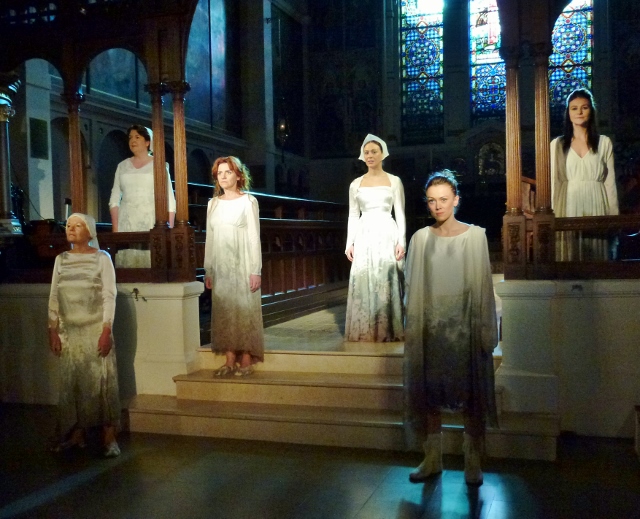
Kabosh: Belfast by Moonlight at St George's Church Photo: © Michael Fisher

Kabosh: Belfast by Moonlight at St George’s Church Photo: © Michael Fisher

The actors are Bernadette Brown, Maria Connolly, Roisin Gallagher, Laura Hughes, Carol Moore and Kerri Quinn.  As the full moon rises, the six spirits they portray congregate to offer a haunting lament for Béal Feirste and to explore the rich past of the city..

St George’s is on High Street, where the River Farset used to flow. In the play, the rivers of Belfast are a recurring theme presented in song by the choir and the actors. The small rivers flow into the big rivers and the big rivers flow into the sea. Gébler has produced a chorus from their names: “the River Knock, the Connswater, the Purdysburn, the Ligoniel, Derriaghy, Colin, Blackstaff, Forth, Milewater, Cregagh, Farset, Lagan Navigation, the Ravernet”. For vimeo footage by NvTv of the Kabosh production in rehearsal, see here.

There is a stained glass window behind the main altar of the church with the Bible verses “O Death Where is Thy Sting/O Grave Where is Thy Victory”. Very appropriate for the six spirits performing in the Belfast moonlight.

The six 'spirits' from Kabosh come to the end of their story by moonlight Photo: © Michael Fisher

The six ‘spirits’ from Kabosh come to the end of their story by moonlight Photo: © Michael Fisher

Festival Guest Blogger  Michael Fisher

@fishbelfast

GÉBLER’S BELFAST BY MOONLIGHT

St George's Church Belfast Photo: © Michael Fisher

St George’s Church Belfast Photo: © Michael Fisher

St George’s Parish Church in Belfast is the oldest Anglican church in the city in use and was a very appropriate setting for Carlo Gébler’s new play, looking back over 400 years of the city.

Carlo Gébler Photo: © Michael Fisher

Carlo Gébler Photo: © Michael Fisher

It’s called Belfast by Moonlight but tonight unfortunately there was no sign of the moon. However the lighting effects (including candles) inside the church provided a suitable atmosphere for the dialogue and the accompanying music, provided by an eight-strong female choir who come from areas as far apart as Dungannon and Donegal. They were conducted by Nigel McClintock, Director of Music at St Peter’s Cathedral in Belfast and have been rehearsing under Emma Gibbins, Director of Music at St George’s.

Kabosh: Belfast by Moonlight at St George's Church Photo: © Michael Fisher

Kabosh: Belfast by Moonlight at St George’s Church Photo: © Michael Fisher

The play began with six spirits (all female) appearing out of the darkness, as if resurrected from the tomb. Each was from a different period, starting from 1613 when Belfast received its Royal Charter from King James I granting it the right to form a Corporation and extending up to the present day. The six are Bernadette Brown, Maria Connolly, Roisin Gallagher, Laura Hughes, Carol Moore and Kerri Quinn, all members of the Kabosh theatre company under the artistic direction of Paula McFetridge. Each spirit is connected in some way to St George’s: one got married there; the spirit from the 1960s has a two year-old son who was given away for adoption at an office said to be in the church.

Around 40% of the play is sung by the main actors and the choir, with original music composed by cellist Neil Martin. Where the River Farset joins the mouth of the Lagan rests the chapel of the sandy ford; an inhospitable place for a city. As the full moon rises, the six spirits congregate to offer a haunting lament for Béal Feirste and explore the rich past of the city.

The six 'spirits' from Kabosh (in middle) are applauded along with the Choir Photo: © Michael Fisher

The six ‘spirits’ from Kabosh (in middle) are applauded along with the Choir Photo: © Michael Fisher

St George’s is on High Street, where the River Farset used to flow. In the play, the rivers of Belfast are a recurring theme presented in song by the choir and the actors. The small rivers flow into the big rivers and the big rivers flow into the sea. Gébler has produced a chorus from their names: “the River Knock, the Connswater, the Purdysburn, the Ligoniel, Derriaghy, Colin, Blackstaff, Forth, Milewater, Cregagh, Farset, Lagan Navigation, the Ravernet”. For vimeo footage by NvTv of the Kabosh production at the rehearsal stage, see here. There is a great picture of the stained glass window behind the main altar of the church, which contains the Bible verses from 1Corinthians 15:55-56 : “O Death Where is Thy Sting/O Grave Where is Thy Victory”. Again, very appropriate when the six spirits are gathered at the altar steps.

There will be post-show talks on 23rd and 26th October with matinee performances on Saturday 26th and Wednesday 30th October at 3pm. There are no Sunday performances. This event runs after the Festival until All Hallows’ Eve on Thursday 31st October (Halloween). Tickets are £14 (concession £10) and can be booked hereBelfastFestival_2012Logo-thumb-540x560-98241

BELFAST BY MOONLIGHT

Belfast by Moonlight

Belfast by Moonlight

Belfast by Moonlight is a new play by Carlo Gébler with original music composed by cellist Neil Martin. Where the River Farset joins the mouth of the Lagan rests the chapel of the sandy ford; an inhospitable place for a city. Yet in 1613 a town charter is granted. 400 years on as the full moon rises, six spirits congregate to offer a haunting lament for Béal Feirste.

Carlo Gébler Photo: © Michael Fisher

Carlo Gébler Photo: © Michael Fisher

Cast: Bernadette Brown, Maria Connolly, Roisin Gallagher, Laura Hughes, Carol Moore and Kerri Quinn. There will be post-show talks on 23rd and 26th October with matinee performances on Saturday 26th and Wednesday 30th October at 3pm. There are no performances on a Sunday as the venue is St George’s Anglican church in High Street.

This event runs after the Festival until All Hallows’ Eve on Thursday 31st October (Halloween). Tickets are £14 (concession £10) and can be booked here.

CRIMEA SQUARE: BELFAST FESTIVAL

Applause for Cast of Crimea Square Photo: © Michael Fisher

Applause for Cast of Crimea Square Photo: © Michael Fisher

The Shankill is the people: that’s according to well-known community worker Jackie Redpath, Chief Executive of the Greater Shankill Partnership regeneration agency. His interview on video is among several shown as part of the play.

Crimea Square: Photo © Michael Fisher

Crimea Square: Photo © Michael Fisher

Crimea Square is the story of the Shankill over 100 years, from the signing of the Ulster Covenant up to the present day. It includes the IRA bomb at Frizzell’s fish shop on October 23rd 1993. The 20th anniversary will be next week so memories are still fresh and it was a good idea to portray this event using only audio clips from eye witnesses and in almost darkness. When the dialogue stopped, there was a pause for almost one minute during which there was complete silence.

On Wednesday 23rd the community will come together to commemorate the nine people who lost their lives in the blast. An IRA member was also killed when the device exploded prematurely.

BELFAST FESTIVAL: CRIMEA SQUARE

Crimea Square Photo: Belfast Festival

Crimea Square Photo: Belfast Festival

It’s festival time again in Belfast as the long-established Ulster Bank Belfast Festival at Queen’s gets underway. The large public art project WISH has been officially unveiled by the artist Jorge Rodríguez–Gerada at the 11 acre site beside the Titanic Centre. The new face for Belfast on the old face of the city can be viewed from the centre (viewing opportunities now closed) or from W5 at specific times during the festival and to book a free ticket, register here (W5).

Wish by Jorge Rodríguez–Gerada Photo: Belfast Festival

Wish by Jorge Rodríguez–Gerada Photo: Belfast Festival

This evening, the opening concert takes place at the Waterfront Hall with the internationally acclaimed tenor José Carreras and Irish soprano Celine Byrne from County Kildare. As a volunteer with the festival, I will be attending the preview night of Crimea Square, which presents the story of the Shankill Road from 1912 until the present day, using film, performance and sound.

Populated by some of the Shankill’s greatest characters, this production covers major events from the signing of the Ulster Covenant up to and beyond the Shankill Road bombing in October 1993.

Using a unique combination of especially commissioned sound scape and film, the era of the cinema will be brought back to the Spectrum Centre (old Stadium Cinema) through the use of large screens recalling the Shankill of old, using a mix of professional and community actors.

Previews on Thurs 17 and Fri 18 October. Shows: 19, 20, 24, 25, 26, 27 October. There will be a talk after the show on Thursday 24 October. Tickets are £10 (concession £8) and can be booked hereBelfastFestival_2012Logo-thumb-540x560-98241

This event continues after the Festival on the following dates: 31st October, 1st November and 2nd November.  There will be a post show talk on 31st October. If you would like to book tickets for one of these performances after the Festival, please contact the Spectrum Centre on 028 9050 4555.

THIRD AGE CONFERENCE

Four Seasons Hotel Monaghan Photo: © Michael Fisher

Four Seasons Hotel Monaghan Photo: © Michael Fisher

A major conference takes place in Monaghan tomorrow. In support of the objectives of Monaghan Age-Friendly Alliance, the local branch of the University of the Third Age U3A is hosting an event at the Four Seasons Hotel. The theme is “Positive Living in the Third Age – Enhancing the Golden Years”. This conference is one of the events in the Monaghan Gathering 2013 calendar

The conference will address the challenges, opportunities and policies to be pursued both within Ireland and the European Union to promote a rewarding and life enhancing older age for citizens. With people living longer and healthier lives this presents a major challenge for all policy makers. The conference will open at 11am with a civic reception given by the Monaghan County Mayor Councillor Sean Conlon.

Claire Keatinge Commissioner for Older People NI

Claire Keatinge Commissioner for Older People NI

The speakers include Claire Keatinge, Commissioner for Older People for Northern Ireland, who will speak on “Self-help, volunteering and employment of the 50+ generation”; Marian Harkin, Member of the European Parliament will address “Active Ageing – An Age Friendly EU”. It is also hoped that Kathleen Lynch, Minister of State for Health with Responsibility for Older People will deal with national strategy for an ageing population in the Republic.

Other particpants are Stuart Pollard, Northern Ireland Regional Trustee for the Third Age Trust and Margaret Fitzpatrick, Education Officer with Age Action Ireland, both of whom will address issues to do with the U3A movement on both sides of the border. Those attending will also hear about the most up to date research on home safety for older adults from Lisa Jennings, PhD candidate at Queen’s University, Belfast. Monaghan members will give an outline of the development of the U3A movement in Monaghan and the contacts made with fellow U3A groups in Northern Ireland.

The sessions will be chaired by two eminent professionals from the field of research into ageing matters. Professor Thomas Scharf, Director of the Irish Centre for Social Gerontology at NUI Galway. At NUIG Professor Scharf is leading a major programme of work addressing issues relating to ageing in rural communities. Dr. Roger O’Sullivan, Director of the Centre for Ageing Research and Development in Ireland (CARDI). Dr O’Sullivan has undertaken a wide range of research on issues relating to older people including research for the Office of the First Minister and deputy First Minister of the Northern Ireland Assembly.

The conference will conclude with a humorous drama presentation by the newly formed Market House Players from Monaghan town as well as the first public performance by the newly formed U3A choir – with some help from the accomplished Oriel Singers.

Monaghan U3A has been in existence for four years and has nearly 150 members. The U3A is a worldwide movement of older people where members share their skills and life experiences – learners teach and teachers learn.

The Monaghan group participates in a variety of learning and social activities which include – a walking group; bowling shared with Knockatallon Bowling Club; social card playing; weekly computer workshops for beginners; gardening classes each autumn and spring; flower arranging; digital photography; spoken French and Irish. In addition the U3A host a very successful monthly talk and lunch at the YWCA premises and of course some very interesting day trips for members.

The conference fee is €20 or £18, which includes lunch and refreshments.

CELINE BYRNE

Celine Byrne at the Defence Forces Benefit Concert in Dublin Photo: © Michael Fisher

Celine Byrne at the Defence Forces Benefit Concert in Dublin Photo: © Michael Fisher

Soprano Celine Byrne from Co. Kildare will be singing with tenor José Carreras at the Waterfront Hall in Belfast on Thursday 17th October. The concert marks the start of the Belfast Festival at Queens, which runs until Sunday October 27th. The full programme can be accessed here. I will be blogging on some of the events as a volunteer with the festival. I have already previewed the preparation for the major public art display beside the Titanic Centre, Wish, by Jorge Rodríguez–Gerada.

Celine was the guest artist at the Defence Forces benefit concert in Dublin last Sunday. She will be back in the capital at the weekend to accompany José Carreras again at the Bord Gáis Energy theatre on Sunday. Details can be found here.

IRISH ARMY BANDS HISTORY

Defence Forces Concert Photo: © Michael Fisher

Defence Forces Concert Photo: © Michael Fisher

The Defence Forces annual benefit concert at the National Concert Hall in Dublin with members of the combined army bands marked the 90th anniversary of the Army School of Music. The programme contained some fascinating articles and photos about the history of music in the Irish army, including the appointment in March 1923 of two senior German army officers who were musicians to lead the new school once the Irish Free State was established.

Pipes & Drums at the Concert Photo: © Michael Fisher

Pipes & Drums at the Concert Photo: © Michael Fisher

The Director of the DF School of Music Lt Col Mark Armstrong writes about his predecessor, the first director, Colonel Fritz Brase, who had been a very highly regarded German bandmaster. He led the school until his death in 1940. Brase brought with him another talented musician, Captain Friedrich Christian Sauerzweig. The first public performance by the new army band was on October 14th 1923, exactly ninety years ago, at the Theatre Royal in Dublin.

Celine Byrne and Lt Col Mark Armstrong are applauded  Photo: © Michael Fisher

Celine Byrne and Lt Col Mark Armstrong are applauded Photo: © Michael Fisher

In 1922 when the state was founded General Risteard Mulcahy was the first Minister for Defence. To advise on the formation of an Irish military music school, he appointed Dr John F.Larchet, who was then Professor of Music at University College Dublin.

Therein lies another connection with the past. The National Concert Hall in Earlsfort Terrace was for many years the main building for UCD. Indeed I remember doing first year Arts exams in the Aula Maxima, which has now been transformed into an international concert hall and provided the splendid setting for Saturday night’s concert.

DINING AT DEANES

First Stop: Deane & Decano Photo: © Michael Fisher

First Stop: Deane & Decano Photo: © Michael Fisher

It was a hop-on hop-off bus tour with one major difference: this was a dining experience centred on Michael Deane’s four restaurants in Belfast.

Prosecco  Photo: © Michael Fisher

Prosecco Photo: © Michael Fisher

It started off at 5pm on Friday evening (11th October) at Deane and Decano, conveniently located at the bottom of my road on the Lisburn Road. A glass or two of prosecco greeted us on arrival and some tasty arancini nibbles along with garlic bread and olive oil. After an hour the diners were then invited to board the bus, taking us along the Lisburn Road via Windsor Park to the Malone Road. Éamonn Ó Catháin provided some music along the way courtesy of his iPad. Coming past a block of modern apartments where once there was a UDR base, it occurred to me that this particular journey would not have been possible twenty years ago.

My only complaint at this stage was that the bus was not the traditional Routemaster red bus shown on the Deane’s publicity material or even one of the new Boris buses built by Wrights. It was one of the buses that usually serves the Belfast City Tours.

Deanes at Queens

Deanes at Queens Photo: © Michael Fisher

Deane’s at Queen’s was the second stop where we were given a master class on how to mix cocktails and given an opportunity to try two types, including a Mojito.

The Dine Around Deanes experience costs £50 and will be repeated on Saturday October 19th and Friday November 8th. More details and booking arrangements here.