BACK IN BRISTOL

Many years ago in 1975 I worked in Bristol for a few months on an attachment with the BBC regional newsroom. I haven’t been back to the city until today, and will spend a weekend there with friends. So I expect to notice some changes, in particular the area around the former docks.

Bristol was once an important centre in the slave trade, a past it probably wants to forget. Anti-slavery campaigners, inspired by non-conformist preachers such as John Wesley, started some of the earliest campaigns for abolition of the trade. The campaign itself proved to be the beginning of movements for reform and women’s emancipation.

John Wesley

John Wesley

Wesley founded the very first Methodist Chapel, The New Room in Broadmead in 1739, which is still in use in the 21st century. Wesley had come to Bristol at the invitation of George Whitfield. He preached in the open air to miners and brickworkers at Kingswood and Hanham, on the eastern outskirts of the city (Wikipedia). Bristol has an importance second only to London in the history of Methodism.

Bristol is also known as an important centre for the aircraft and aerospace industry. When I arrived here at St Augustine’s Reach, I was reminded that this was also a major city for shipbuilding. The area around the old harbour has been developed with bars and restaurants and is now a very lively place, compared to what it was like over 35 years ago!

St Augustine's Reach

St Augustine’s Reach

EASTENDERS

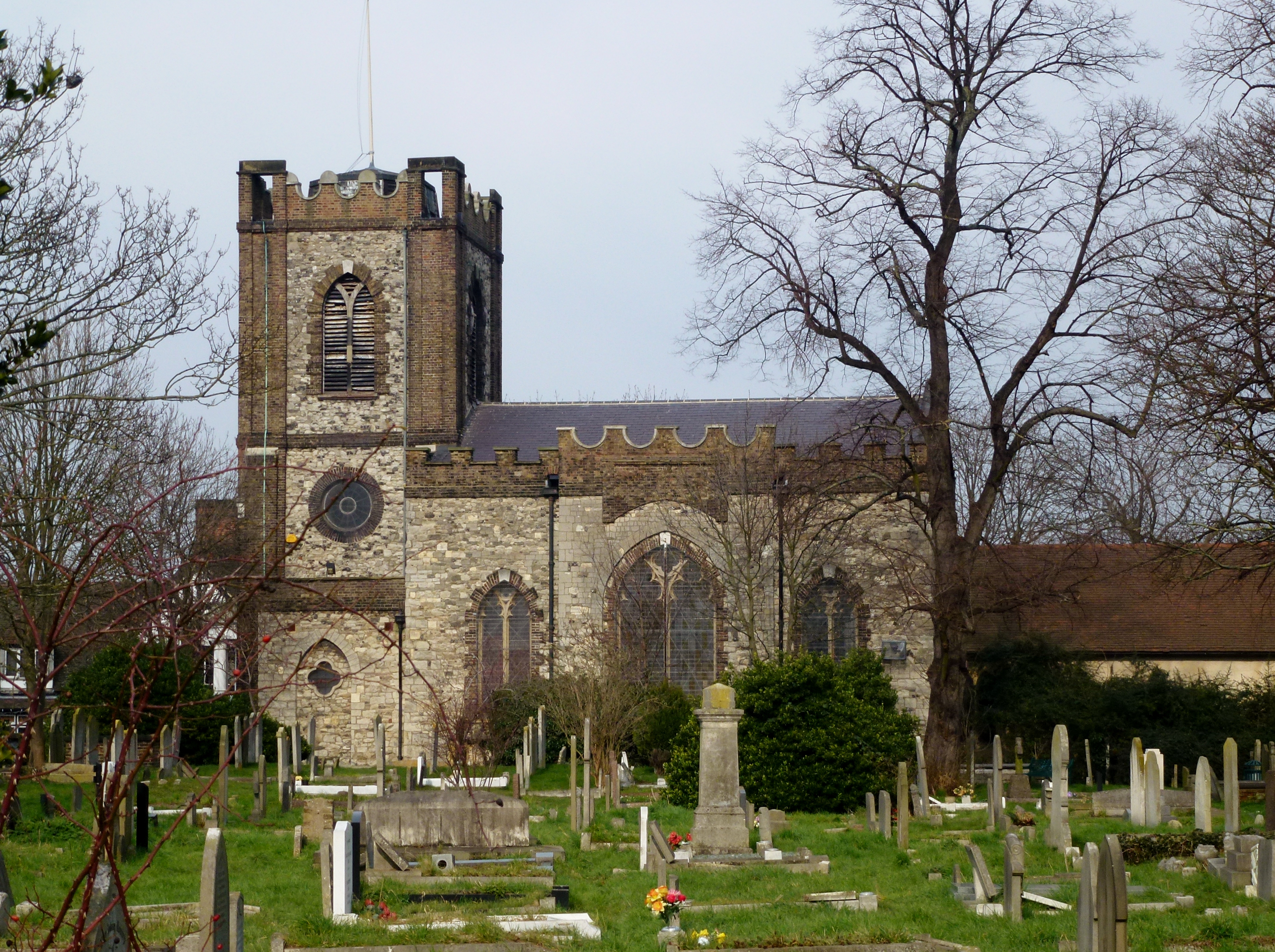
St Peter's & St Paul's Church, Dagenham

St Peter’s & St Paul’s Church, Dagenham

At the heart of any English village you will usually find the Anglican parish church. When I visited Dagenham at the weekend, I did not expect to find much evidence of the past. Yet there is evidence of history around, if you know where to find it. Growing up in Wimbledon, this part of London was a place I only knew as the other end of the District Line close to Upminster. Having set off from Dagenham East underground station I consulted a map and discovered that nestled among the busy main roads, there is a green area marked Dagenham Village, dominated by St Peter and St Paul’s Church.

The parish church is of medieval origins, first mentioned in 1205 and rebuilt in 1800. The building and surrounding churchyard has associations with local families and various famous people. Another building preserved is the former Vicarage, dating from the 17th Century and remodelled in the 19th Century. Close by is the Cross Keys Inn public house, a 15th Century timber-framed hall house which was once a tannery. A former bank and an old national school are among the other buildings which survived redevelopment.

Cross Keys Inn and War Memorial

Cross Keys Inn and War Memorial

The area was once largely rural, a village in Essex first mentioned in a charter of 687. But in 1919 London County Council started planning an expansion of housing and in the next 19 years over 25,000 houses were provided for working class families on the Becontree estate.

In 1972 there was a large-scale demolition of properties in the village as part of a comprehensive redevelopment plan. This led to the development of the Ibscott Close housing estate, bordering the heart of the old village. The development included the creation of a more open space aspect to the church, two new shopping parades, three car parking areas, and new housing. This effectively destroyed the historic integrity and structure of the village, reducing it to a few key components. Dagenham Village Conservation Area Appraisal, September 2009, London Borough of Barking & Dagenham.

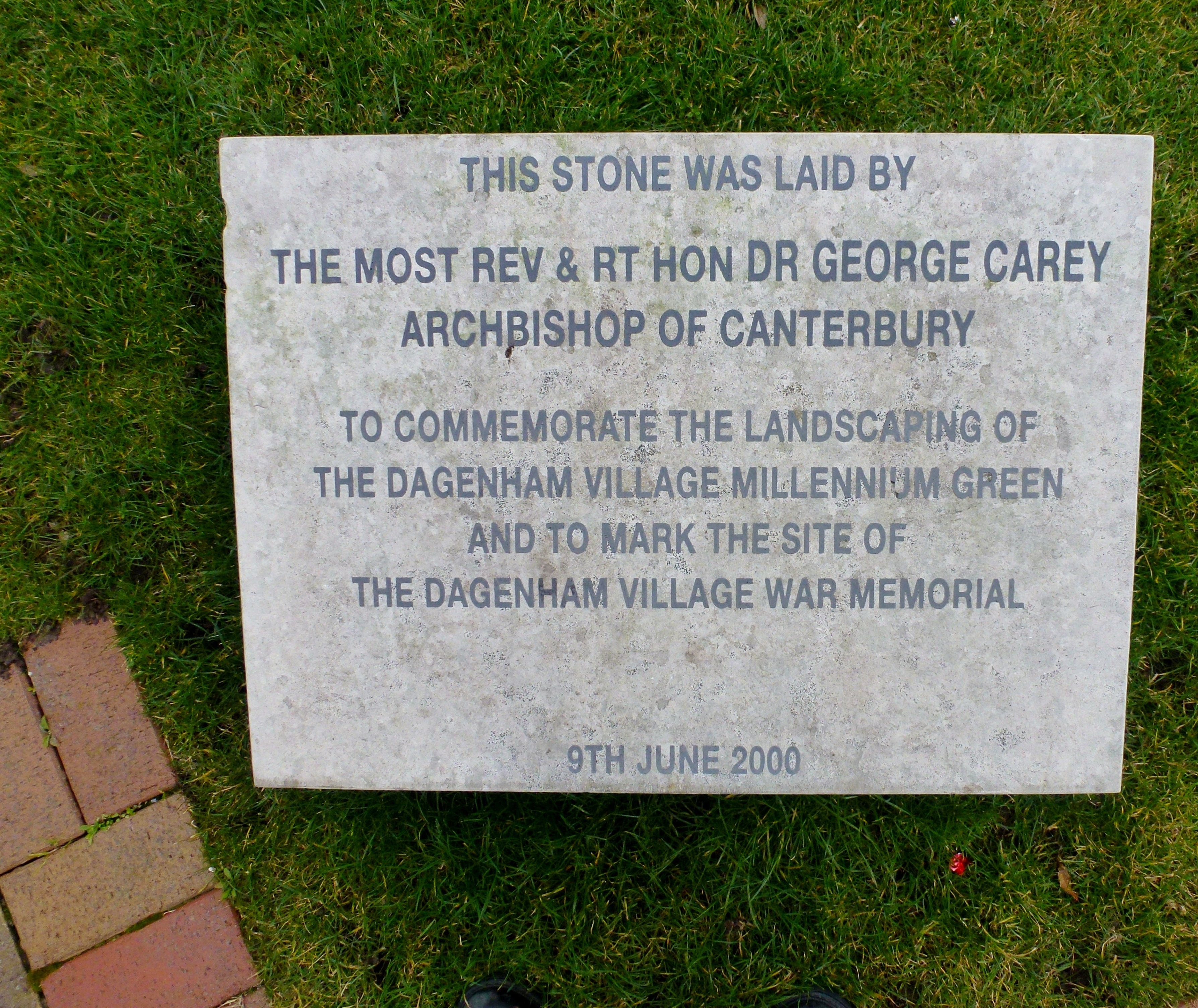
Millennium Green Plaque

Millennium Green Plaque

Walking through the graveyard you will find the last resting places of some interesting people, inclding the parents of the former Archbishop of Canterbury, Dr George Carey, who opened the redesigned green around the second world war memorial to mark the millenium in 2000. As part of the lottery-funded scheme, a flagpole was erected and the union flag is flown. I also spotted the grave of a World War 1 serviceman and also one of a local man who died in an accident as he crossed the newly-opened London to Southend railway line.

When Dagenham expanded, it was also necessary to create employment for the workers. The first big factory was opened by the Ford Motor Company in 1931 when an AA light truck rolled off the assembly line. It produced nearly 11 million cars until vehicle production ceased in 2002. At one stage 40,000 people worked there but now the total is one-tenth of that figure and the plant specialises in making diesel engines. It was announced last year that 1,000 jobs were to go at the stamping plant in Dagenham, according to the GMB union.

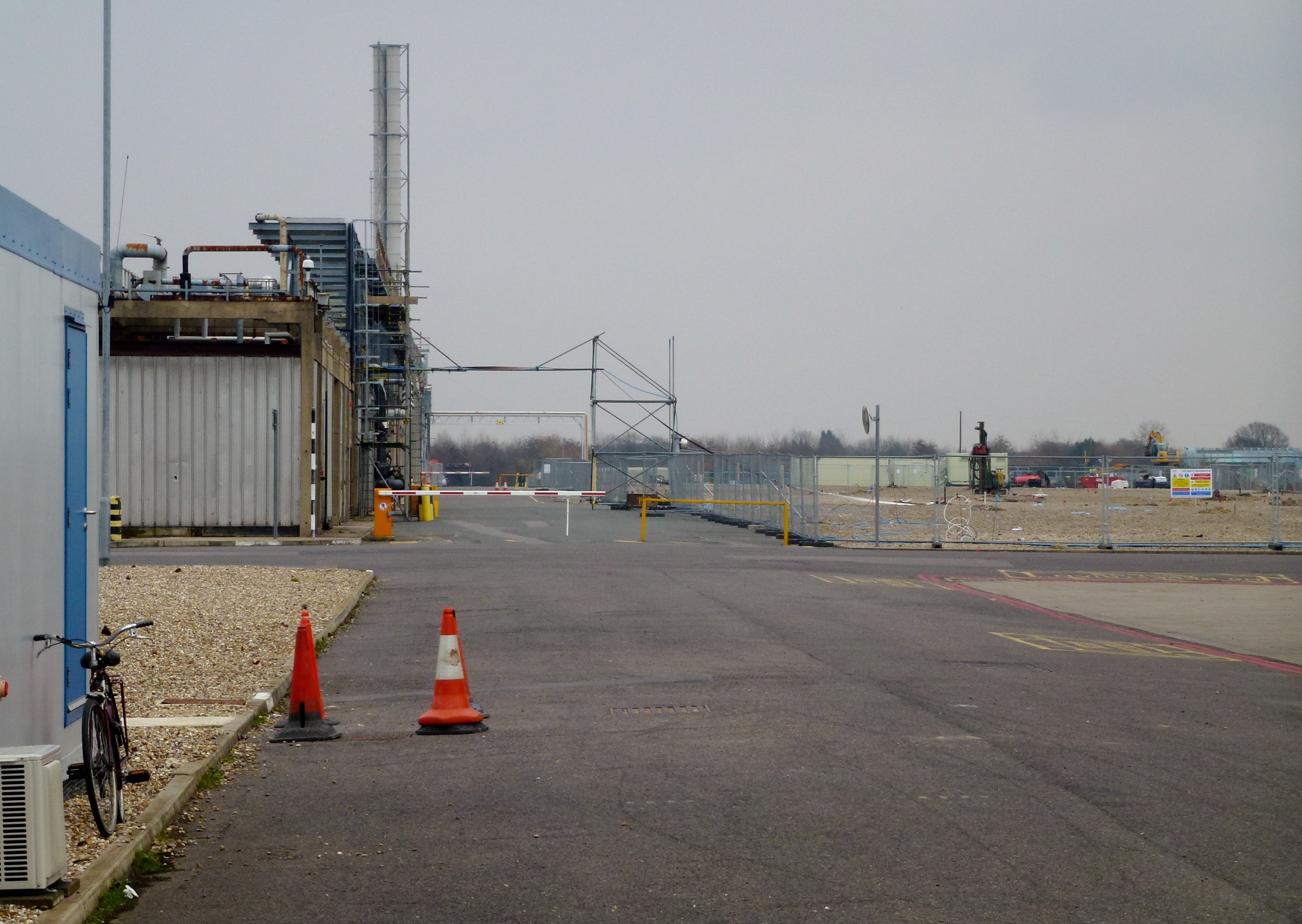
Sanofi Plant, Dagenham

Sanofi Plant, Dagenham

There was further evidence of changing times when I passed the entrance to the huge Sanofi plant close to Dagenham & Redbridge FC. It was announced in November 2009 that the facility would close some time this year with the loss of 450 jobs because  a continued strong decline in demand for its drugs was making the site “economically unsustainable”. Sanofi is one of the world’s largest pharmaceutical companies. It hopes to invest in a major regeneration project, with the potential of creating 2500 jobs. Planning permission for the overhaul of the site includes building a new supermarket, hotel and manufacturing operations while using existing buildings for a health and dental care centre and retaining existing laboratories and scientific manufacturing facilities, with the intention of attracting other technology companies to take them over (The Manufacturer).

An interesting sidebar: The film “Made in Dagenham” which deals with the Ford motor company female sewing machinists’ strike in 1968 over equal pay is being shown on BBC2 on Saturday 9th March at 9:00pm. For the first time for a BBC film, there will be a live tweet-a-long commentary from director Nigel Cole and composer David Arnold, who will give audiences a unique insight into the production process. If you wish to join the conversation on the night, follow the hashtag #bbc2mid.

BAFTA GAMES AWARDS

BAFTA Game Awards 2013

BAFTA Games Awards

You might think that BAFTAs were just for films. But that’s not the case. The British Academy also has its own “Oscars” for video games. So congratulations go to County Monaghan man Terry Cavanagh on his latest success (with potentially more to come!).

Terry Cavanagh

Terry Cavanagh

His parents from Tydavnet who are over in Cambridge at the moment tell us he is in the running for a BAFTA award for his Super Hexagon game. It’s one of six nominations in the “British game” category, which has been added for the first time this year.

Dara O Briain

Dara O Briain

The host for the gala evening at the London Hilton hotel on Tuesday 5th March is another Irishman, Dara O Briain. It will be shown on the UK’s Challenge television channel (Sky 125, Freeview 46, Virgin 139).  Another of Terry’s game creations, VVVVV, won an award for being the most fun and compelling game at the Indiecade showcase for games developers in Los Angeles in October 2010. So let’s wait and see if he gets another “Oscar” under his belt!   gamegames-awards-logo-2926

BRITISH GAME:

1. Dear Esther

Daniel Pinchbeck, Robert Briscoe, Jessica Curry

Thechineseroom/thechineseroom

2. Forza Horizon

Development Team

Playground Games/Turn 10 Studios/Microsoft Studios

3. LEGO: The Lord of the Rings

Development Team

TT Games/Warner Brothers Interactive Entertainment

4. Need for Speed Most Wanted

Development Team

Criterion Games/EA

5. The Room

Mark Hamilton, Rob Dodd, Barry Meade

Fireproof Games/Fireproof Games

6. SUPER HEXAGON

Terry Cavanagh, Niamh Houston, Jenn Frank

Terry Cavanagh/Terry Cavanagh

CARLETON AND IRISH

William Carleton

William Carleton

The historian John Paul McCarthy immediately caught my attention in his column in the Sunday Independent p.16 10/02/13 with his mention of William Carleton in the sub-heading. He is writing about the poet Liam O Muirthile from Cork. Under the heading “Language of love and friendship”, he says that Liam’s latest collection of peoms is in the humane Carleton tradition. He goes on to make a very interesting comparison of the works of both men.  I am therefore publishing his comments here because of my interest in Carleton.

It is good to see the work of Liam O Muirthile getting recognition. I worked with him in the RTÉ newsroom in Dublin, where he was part of the Nuacht team. After he left RTÉ, he devoted his time to literature and he used to have a regular column in The Irish Times.

Liam O Muirthile, file (poet)

Liam O Muirthile, file (poet)

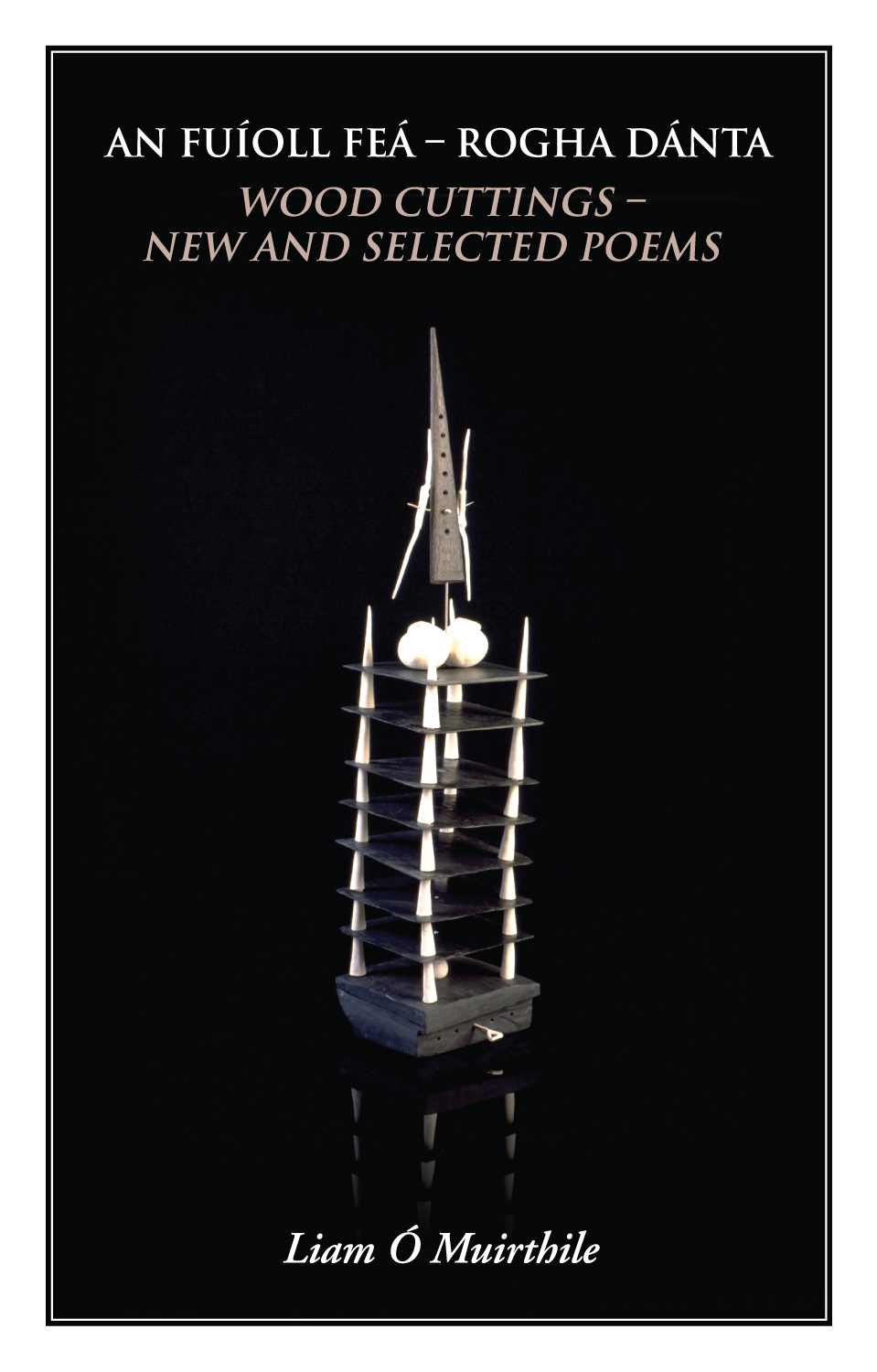
Liam’s latest work is called An Fuíoll Feá – Rogha Dánta or Wood Cuttings, new and selected poems, published by Cois Life and there’s more about it on their blog. Gabriel Rosenstock has translated the poems. The book is available in harback and softback (€30/€20). It also comes with a CD of O Muirthile reading some of his work.Fuíoll Feá - Rogha Dánta

Here is an edited version of what John Paul McCarthy has to say on the subject:-

In his essay on Irish swearing, the great Victorian chronicler of Gaelic Ireland, William Carleton, said “the Irish language actually flows with the milk and honey of love and friendship”. Irish for him was the medium of prayer and domestic tranquility. That aspect of Irish has struggled to get a hearing in our time, if only because of the relentlessly political focus that has disfigured large parts of modern Irish letters. The introspection of the Gaeltachtai has not helped matters either. Liam O Muirthile’s latest collection of poems, An Fuioll Fea-Wood Cuttings (Cois Life), is very much in the humane Carleton tradition though.

O Muirthile’s Irish is the Irish of the city street, the factory floor and the urban tavern. His focus is on what Patrick Kavanagh once called “ordinary plenty”….

Like Carleton again, O Muirthile found politics to be inescapable. He translates parts of Wolfe Tone’s diaries in a series of poems before tending to the Guildford Four. The Firing Squad suggests some fundamental ambivalence about revolutionary aristocrats, especially the ones who plague people with their consciences in pubs.

The last poem of this collection then, Thuaidh (or North) draws these disparate threads together. The poet is commemorating an ancient IRA ambush, and proceedings are rather hijacked by an abrasive northerner. “‘Daoine boga sibhse theas,’ arsa cara. ‘Muidne thuaidh cruaidh.'” (You lot are soft down south, we’re hard in the north)”.

SHENANDOAH PARK

Big Run Overlook in the Fall

Big Run Overlook in the Fall

Listening to the tenor Colin Morgan singing the American folk song “Shenandoah” on the Late Late Show brought back memories of a visit to this beautiful area in August 2009. In the Shenandoah National Park 75 miles from Washington DC in Virginia, there is a “skyline drive” on the crest of the Blue Ridge mountains, a scenic roadway taking you from one end of the park to the other (105 miles), with a speed limit of 35mph for cars. There is also lodge and cabin accommodation in different areas of the park. In some versions of the song, the name “Shenandoah” refers to an Indian chief, not to the Shenandoah Valley or Shenandoah River. However, an early rendition of the song includes verses that appear to allude to the Shenandoah River, which is partly in Virginia (wikipedia).

Irish Creek Valley

Irish Creek Valley

Passing through Shenandoah Park, you come to the Blue Ridge Parkway, along the Blue Ridge, part of the Appalachian Mountains. One of the many viewing places along the way was at Irish Creek Valley at milepost 43. It got its name from Ulster-Scots immigrants who settled along the banks of the river in the 1700s. For a 360° view click here. A few miles away are the remains of the Irish Creek Railway (logging railroad). There is a parking spot at Yankee Horse Ridge (MP35), where legend has it that a Union soldier’s horse fell and had to be shot.  Construction on the railroad began in 1918 and was completed two years later, with the length of the railroad stretching to 50 miles. The track was built to haul lumber during the pre-parkway logging days. In a document from 1918, one individual reported, “At present, however, a logging railroad is being built up Irish Creek to a point near Irish Creek post-office, and this would make transportation somewhat easier” (Henry G. Ferguson, Virginia Geological Survey).

ARAS AN UACHTARÁIN

Aras an Uachtaráin

Aras an Uachtaráin

A recent visit to Aras an Uachtaráin, the official residence of the President of Ireland, at Phoenix Park in Dublin enabled me to see some of the features of the building, following a reception by President Higgins. I had been at the Aras twice before to meet his predecessor, Mary McAleese. Since the inauguration of Michael D. Higgins as ninth President nearly fifteen months ago, there have been a few changes inside the Aras.

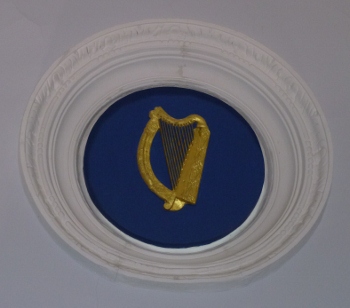
Presidential harp on ceiling

Presidential harp on ceiling

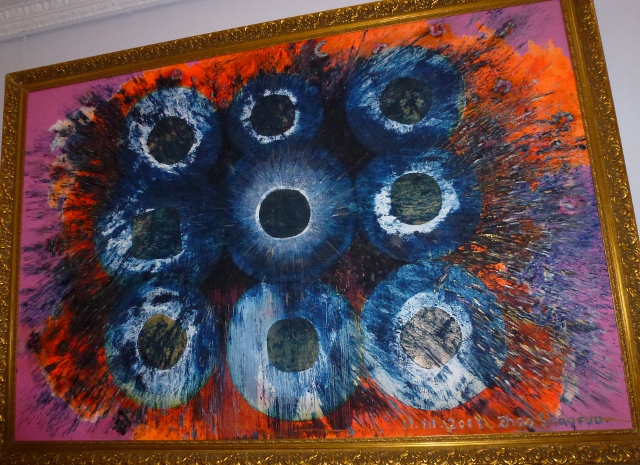
One of the first things to catch the eye of the visitor is a large painting in the entrance hallway by a Chinese artist Zhao Shao Rou dated 11-11-2011, when President Higgins was inaugurated at Dublin Castle.  The hall with its barrel-vaulted ceiling dates from 1751. One of the features is the golden harp on a blue background which is the same as the presidential standard.

Zhao Shao Ruo 11-11-2011

Zhao Shao Ruo 11-11-2011

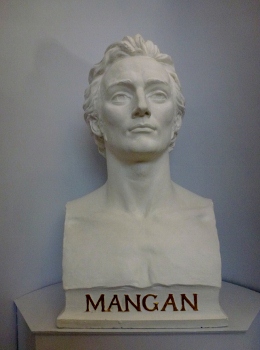
There are some plaster busts in the alcoves at the back. One of them is of James Clarence Mangan, who Yeats regarded as one of the best Irish poets. His poems were published in The Nation and among the best-known of his works is “Dark Rosaleen”. There is a memorial to him in St Stephen’s Green, a bust by Oliver Sheppard. It was commissioned by a committee that included Dr George Sigerson and DJ O’Donoghue, librarian at University College, who wrote a biography of him and who is also the person who completed William Carleton’s autobiography.

James Clarence Mangan

James Clarence Mangan

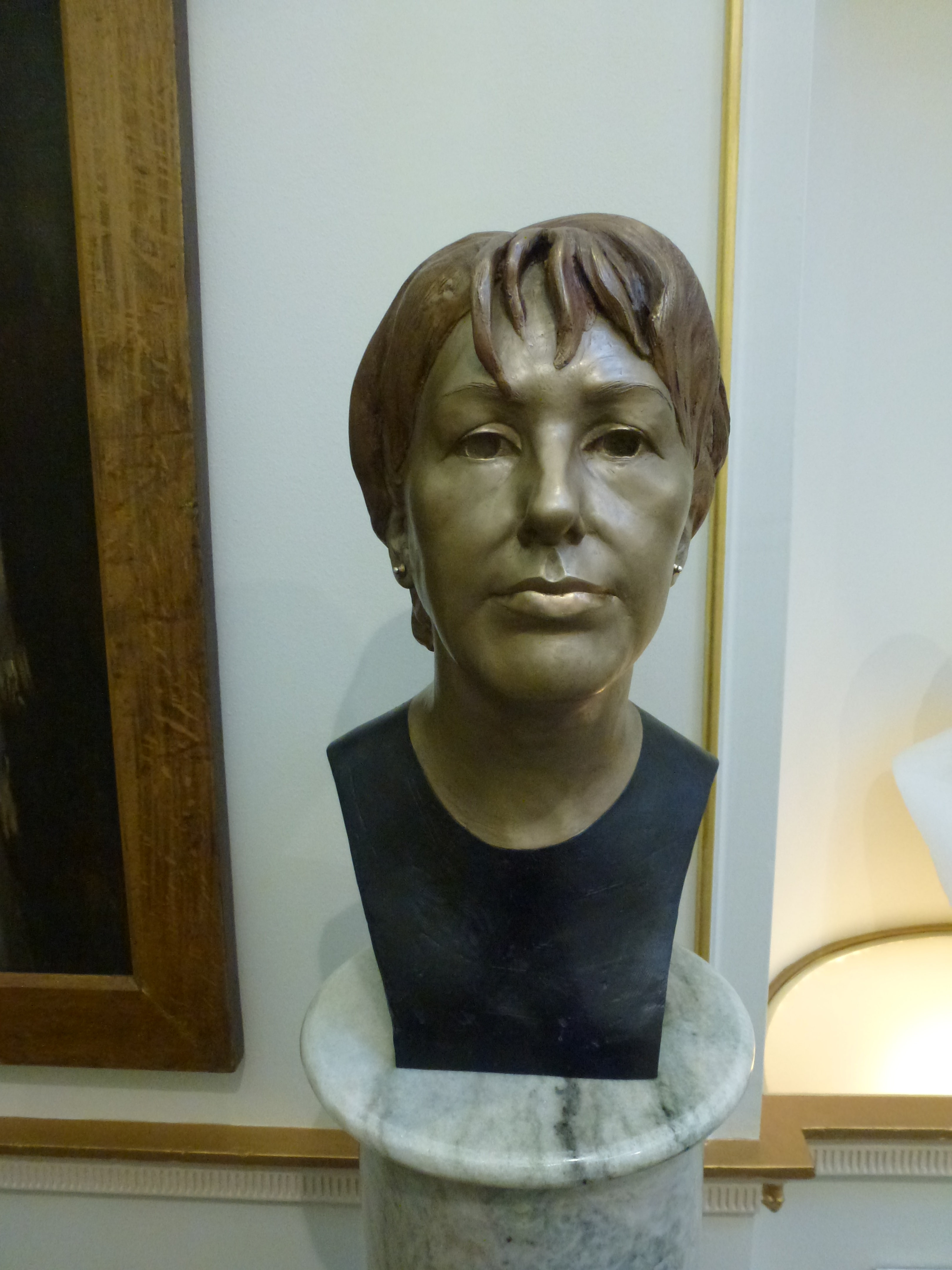
From the entrance hall, the visitor enters the Francini corridor, leading towards the state reception room. It contains the busts of past Presidents and was created in 1957 during the presidency of Sean T O’Ceallaigh. The one of Mary Robinson is a good likeness, in my view, but the most recent one of Mary McAleese is debatable. It was commissioned in 1999 and is by Carolyn Mulholland RHA from Lurgan. It cost €7,600.

Mary McAleese

Mary McAleese

There is also a portrait of Mrs McAleese which hangs alongside pictures of the other holders of the office. The Aras was built by Nathaniel Clements in 1751 and became the residence of British Viceroys until the creation of the Irish Free State (Saorstát Éireann) in 1922. More details about the building and pictures along with details of President Higgins can be found here

MOUNT JEROME CEMETERY

William Carleton's Grave

William Carleton’s Grave

Commemorating the 144th anniversary of the death in January 1869 of the leading Irish author William Carleton last weekend, I laid flowers at his grave at Mount Jerome Cemetery in Dublin. It also gave a group of us an opportunity to visit the graves of several other famous Irish people. The graveyard contains one of the finest collections of Victorian memorials, tombs, vaults and crypts in Ireland.

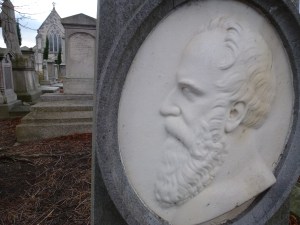
Carleton’s last resting place is relatively easy to find, as it is on close to the main avenue leading up to the church, on the right hand side. It is marked by a small obelisk, raised ‘to mark the place wherein rest the remains of one whose memory needs neither graven stone nor sculptured marble to preserve it from oblivion’. It includes a sculptured portrait of Carleton by James Cahill, set in stone. It was restored and unveiled on 15th August 1989, thanks to the William Carleton Memorial Committee that included the writer Benedict Kiely, Barbara Hayley (NUI Maynooth) and Vivien Igoe. In her book, “A Literary Guide to Dublin“, Methuen 1994, she recalls how:-

“Kiely said in his oration that Carleton, as a novelist, had taken up the issues of tenants’ rights, emigration and famine and had put down on record the Irish people as he remembered them before the famine, before they were practically wiped out. Irish people have not much changed, he said”.   
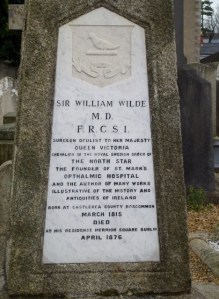
Sir William Wilde grave

Sir William Wilde grave

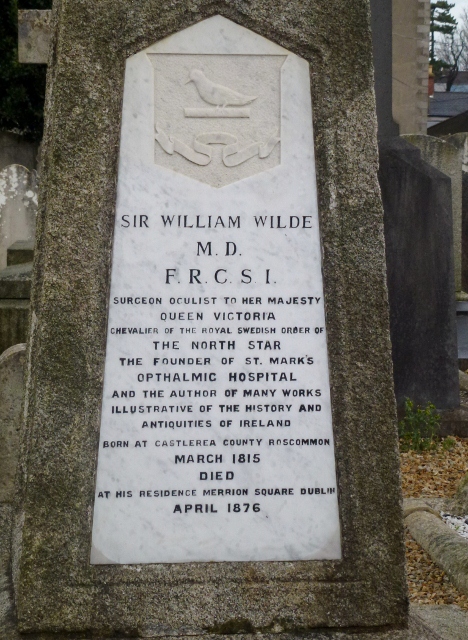
The next significant grave close to the entrance to the church is that of Dr William Wilde, eye and ear surgeon, father of Oscar and husband of Lady Jane Wilde, neé Elgee. She was an important figure in her own right, a poet and writer, who published under the name “Speranza” and played a part in the Irish literary revival. Oscar is buried in Paris. The side of the memorial carries the inscription: “In Memoriam Jane Francesca, Lady Wilde, ‘Speranza’ of The Nation, Writer, Translator, Poet and Nationalist, Author of Works on Irish Folklore, Early Advocate of Equality for Women and Founder of a Leading Literary Salon. Born Dublin 27 December 1821              Died London 3 February 1896.  Wife of Sir William and Mother of William Charles Kingsbury Wilde, Barrister and Journalist 1852-1899 Oscar Fingal O’Flahertie Wills Wilde, Poet Wit and Dramatist 1854-1900 Isola Francesca Emily Wilde 1857-1867 “Tread lightly, she is near, Under the snow, Speak gently, she can hear The lilies grow“.

JM Synge grave

JM Synge grave

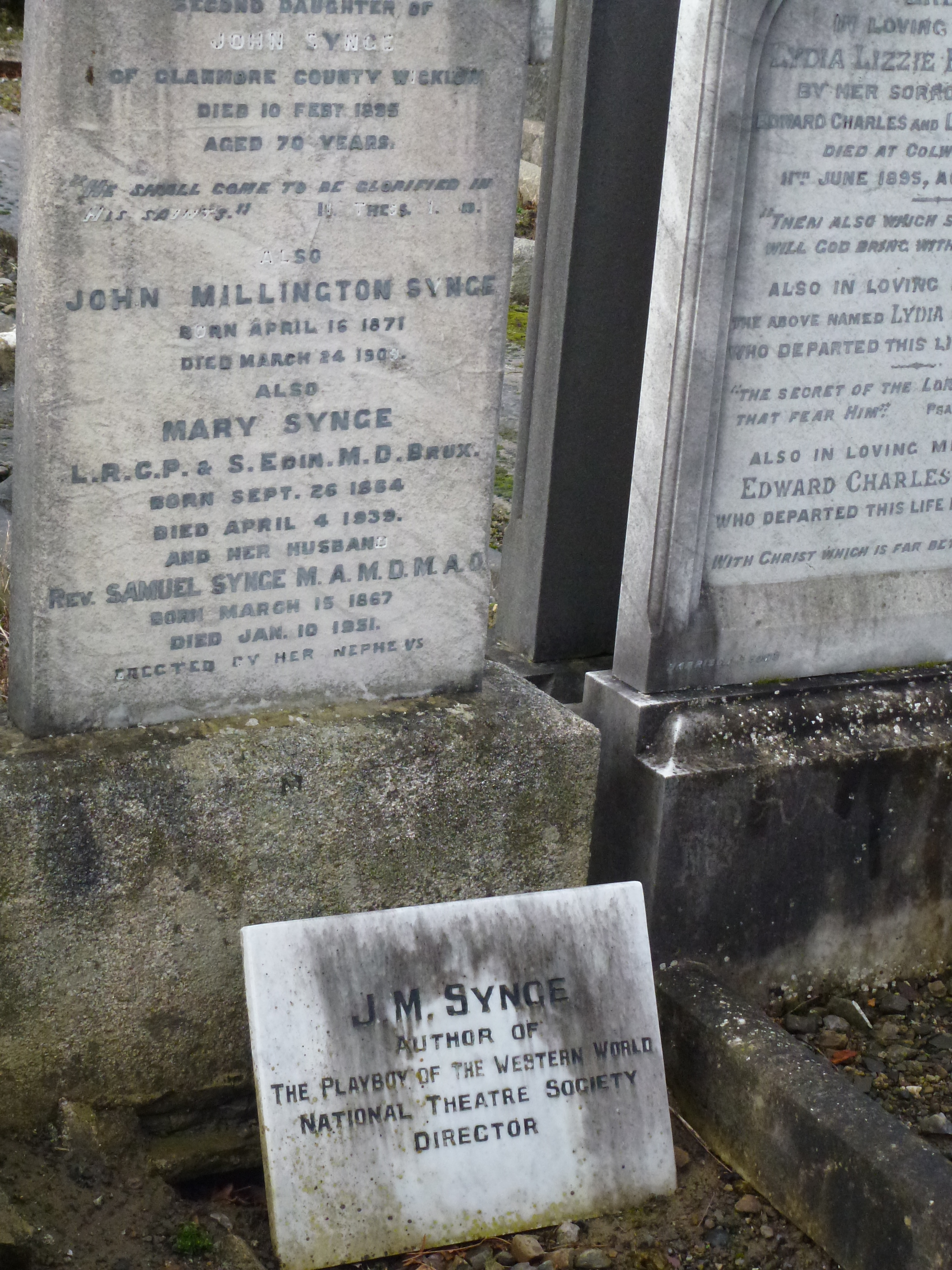
Another important figure in the Irish literary renaissance was the playright, John Millington Synge. His grave was more difficult to find. Synge was born in Rathfarnham, Co.Dublin on April 16th 1871 and died on March 24th 1909. He is best known for writing “The Playboy of the Western World“.  His brother, Reverend Samuel Synge who was a missionary in China is also buried there along with his wife Mary and his aunt Jane, second daughter of John Hatch Synge of Glanmore, Co.Wicklow.

Jack B. Yeats grave

Jack B. Yeats grave

WB Yeats was another leading figure in the Irish literary revival. His grave is in Drumcliff churchyard, under bare Ben Bulben’s head in Co.Sligo. But his brother, the painter Jack Butler Yeats, lies in Mount Jerome. He died on March 28th 1957, although the faded bronze lettering on the tombstone makes his grave difficult to spot. He was elected a member of the Royal Hibernian Academy in 1916. In 1999 one of his paintings was sold at Sotheby’s in London (where he was born in 1871) for over £1.2 million pounds. His wife Mary Cottenham Yeats predeceased him by ten years.

Buried in a different section is another member of the RHA, Sarah Purser. One of her paintings of a coastal scene in the West of Ireland was sold by Ross’s auctioneers of Belfast in 2007 f0r £2400. Not far from her grave is buried the writer Joseph Sheridan Le Fanu, but his exact burial spot could not be found, despite the assistance of a map. I think I saw two graves lying side by side near a tree and next to the path, but I could not find any inscription on the stones.

Sarah Purser grave

Sarah Purser grave

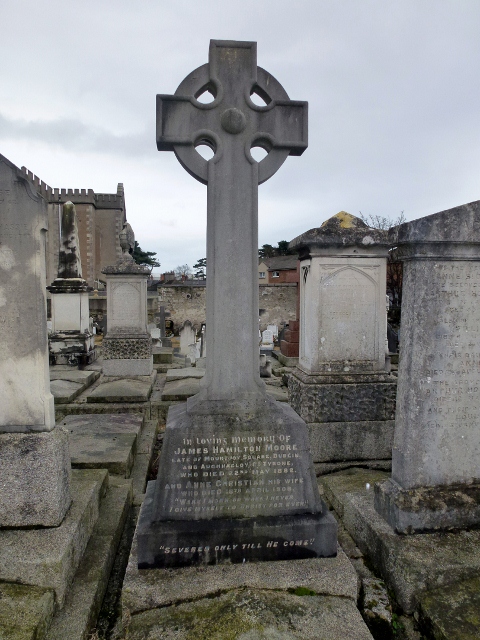
While wandering around I noticed a Celtic Cross and looked at the inscription. It turned out that the person buried there, James Hamilton Moore,  came from Aughnacloy, Co.Tyrone where some of my relatives on my mother’s side come from. Further research revealed his name in the British Parliamentary Papers on Ireland in a report on the (sectarian) riots in Belfast in July and September 1857. It seems things have not changed much in over 150 years! Moore is listed in an Appendix as part of evidence presented on behalf of the Orange Society (Order), of which he was a senior member.

James Hamilton Moore grave

James Hamilton Moore grave

Moore was Grand Treasurer of the Trinity College Grand District and was a solicitor with an address at 56 Lower Gardiner Street in Dublin (then a fashionable Georgian street). He is also listed as Deputy Grand Secretary of the Grand Orange Lodge of Ireland which met at Molesworth Street in Dublin in November 1856 and his address is given as Gardina Lodge, Monkstown, Co. Dublin.  So next time you have to attend a funeral or cremation at Mount Jerome, take the opportunity to think of all the others who found their place of eternal rest there. They include the writer AE (George Russell), Benjamin Guinness of the brewing family and Sir William Rowan Hamilton, mathematician and astronomer. Since the 1920s Catholics have been buried at the cemetery. In 1994 the remains of the well-known criminal Martin Cahill “The General” were brought there and his grave is now unmarked owing to vandalism.

LINCOLN

Abraham Lincoln

Abraham Lincoln

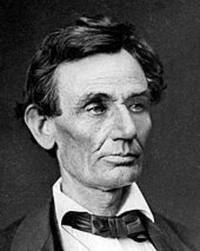
I enjoyed a visit to the cinema yesterday, although for a film nominated for twelve Academy awards, the attendance of seven at a late night Friday showing must have disappointed the owners. Lincoln is the type of film I like, an historical drama. Daniel Day-Lewis gives a convincing performance as the main character, United States President Abraham Lincoln. At one stage, Liam Neeson was being groomed for this role. The President’s wife Mary Todd Lincoln is played by Sally Field. Some of the best scenes are those in which the two interact. There are rows about Lincoln’s son Robert wanting to join the Union Army against his mother’s wishes.

In another dramatic sequence, the President is visiting a military hospital but Robert refuses to accompany him inside. When he sees an attendant wheeling a barrow dripping with blood, Robert follows the trail and discovers it is coming from amputated limbs of wounded soldiers being buried in the hospital grounds. This helps him to make up his mind to enlist in the army and he is posted to the staff of General Ulysses Grant.

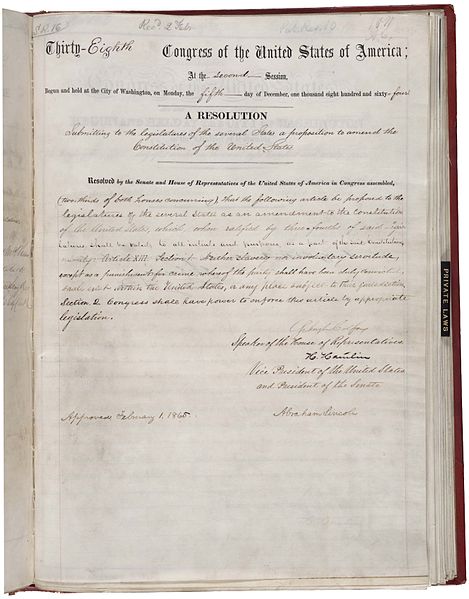
The narrative begins in January 1865, four months before Lincoln’s death and in the final stages of the Civil War, with two black soldiers and two white soldiers from the Union army talking to the President. But it is the politics of the House of Representatives that dominates the two and a half hour narrative, slightly too long in my view. Lincoln was seeking to outlaw slavery and the 13th amendment to the US Constitution was passed by the 38th Congress on January 31st 1865, and approved the following day, so the date I chose to watch the film coincided with that anniversary.

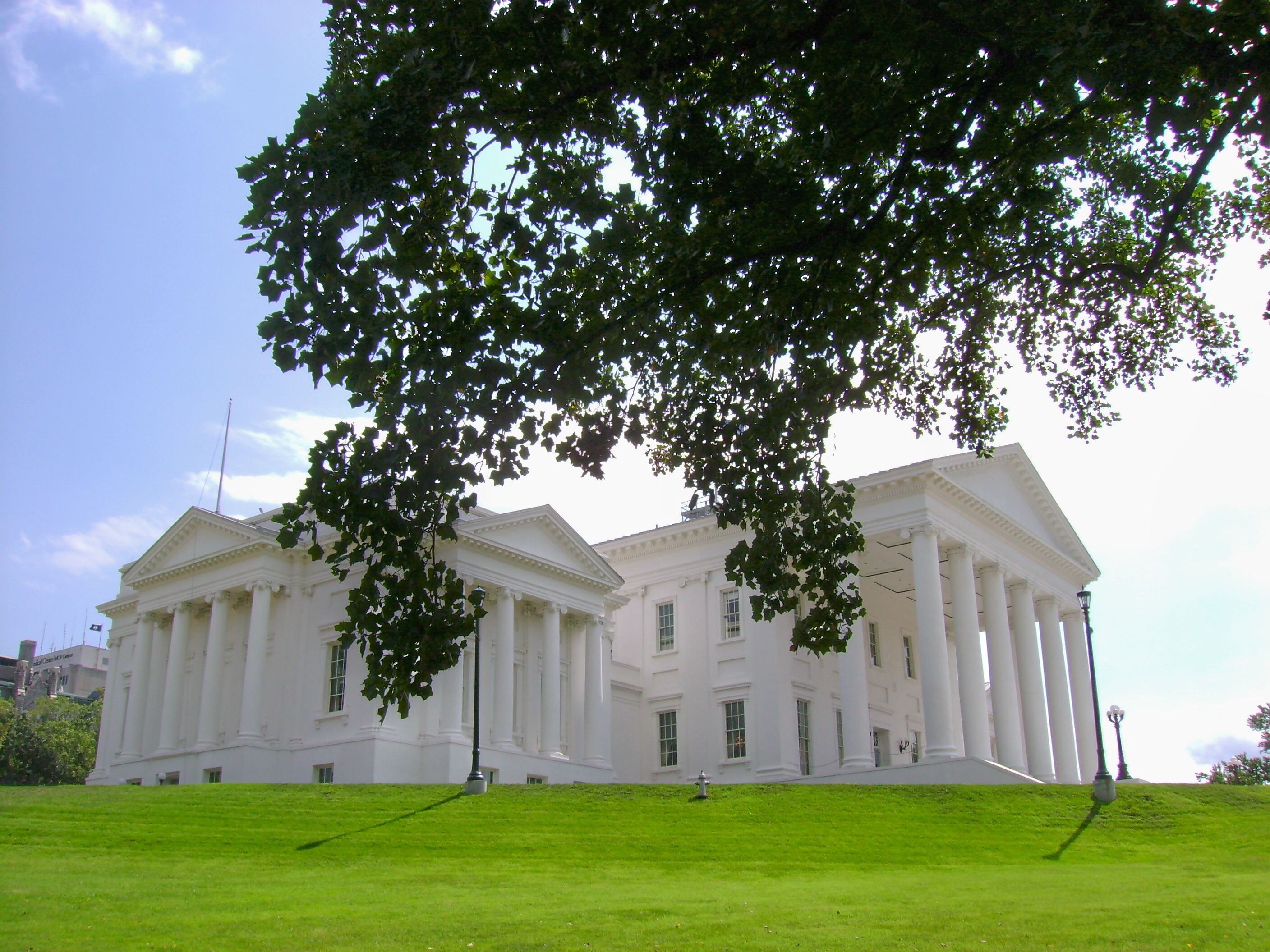
Virginia State Capitol

Virginia State Capitol

The scenes in the House of Representatives were not shot in Washington DC, but instead in the historic Virginia State Capitol building in Richmond, which I visited on holidays in 2007. I recognised the Chamber with its gallery and a marble statue in the Rotunda of George Washington. In order to get the amendment passed with the required two-thirds majority, Lincoln through his secretary of state William Seward had to engage in a lot of wheeling and dealing, using agents to offer Democrat representatives federal positions if they switched sides. This political intrigue provides an interesting aspect to the story. The amendment was eventually put through by 119 votes to 56, just two votes above the necessary margin.

Section 1. Neither slavery nor involuntary servitude, except as a punishment for crime whereof the party shall have been duly convicted, shall exist within the United States, or any place subject to their jurisdiction. Section 2. Congress shall have power to enforce this article by appropriate legislation.

13th Amendment US Constitution (Credit: NARA)

13th Amendment (Credit: NARA)

Catherine Clinton is a Professor of US History at Queen’s University Belfast. She has written a book about Mrs Lincoln and acted as a historical consultant for the film. She explained her role in an interview with BBC NI, as Peter Coulter explains.
MALCOLM BRODIE RIP

Irish_Football_Association-logo-A3B92E9ED1-seeklogo_comThe green and white army of Northern Ireland football was never a big priority for RTÉ, who always followed the fortunes of the green shirts of the Republic of Ireland. Occasionally there were stories of success, especially the World Cup victory over hosts Spain in 1982 and qualification for the second round. I also remember covering the appointment as NI manager of Lawrie Sanchez, a past hero of mine when he was with Wimbledon FC and who I was glad to see getting the job. There was however always one constant factor when speaking about soccer here in the North: Malcolm Brodie, who has now passed to his eternal reward.

Malcolm Brodie (BBC picture)

Malcolm Brodie (BBC picture)

The former sports editor of the Belfast Telegraph was a fount of knowledge about the international side and reported on fourteen World Cup finals. He was always willing to share that wisdom with other media colleagues, including news reporters who did not specialise in sport. He also looked after junior colleagues. I was interested to hear on Talkback (BBC Radio Ulster around 20:30) yesterday a tribute from Alan Green of the BBC.

Alan is the same age as myself and our paths crossed briefly in London in the 1970s. After graduating from Queen’s, he started as a BBC News Trainee  in April 1975, a year after I had. My traineeeship brought me to local radio Birmingham, where I got my chance to combine sports reporting with news, thanks to Jim Rosenthal and his successor Nick Owen. Alan got an attachment back to BH in Belfast and later moved to Manchester, to begin a lengthy career as a commentator with BBC Radio Sport.

Alan Green

Alan Green (BBC)

Alan mentioned to Wendy Austin how Malcolm had taken him under his wing when he was still a student at Methodist College, interested in sports reporting. He took him on as a “copy boy” at weekends over forty years ago. When Alan landed the sports job in Manchester, Malcolm asked the sports “mafia” there, who held him in high regard, to help the fledgling commentator.

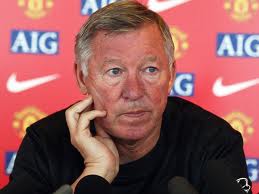
Speaking on the same programme, the Manchester United manager Sir Alex Ferguson said the journalist was a great friend:-

Alex Ferguson (Man.Utd.picture)

Alex Ferguson (Man.Utd.picture)

“He cut to the chase, quite simply that’s how he was, you know. He was straight-talking and one thing I always admired about him, he never changed his accent, which is very difficult living in a place like Belfast. He never lost the energy to do his job and he obviously enjoyed doing it and had enthusiasm about it. It’s very hard to retain enthusiasm for your job right up to your 80s.”

Malcolm was from Scotland and had been evacuated to County Armagh during the second world war. He began his career with a local newspaper in Portadown. He then moved in 1943 to the Belfast Telegraph, where he set up the first sports desk. His achievements as a journalist were recognised with the award of an MBE and the conferring of an honorary doctorate by the University of Ulster. He received the FIFA Jules Rimet award in 2004. The FIFA President Sepp Blatter, who was a personal friend, described him as “one of the true greats of sports journalism”. More tributes can be found here at the Irish Football Association. He was 86 and was a member of the Belfast and District Branch of the National Union of Journalists. However there are some former staff at the Belfast Telegraph who will tell you a very different story about his attitude to the union during a strike. His funeral service will take place on Monday (February 4th) at 12 noon in Cregagh Presbyterian Church, Belfast, then to Roselawn Crematorium for Committal at 2.30 p.m. Family flowers only. Donations in lieu of flowers have been requested to Chest/Heart/Stroke or Guide Dogs for the Blind.

Malcolm Brodie (Belfast Telegraph)

Malcolm Brodie (Belfast Telegraph) 1926-2013

THE BOOMTOWN RATS

Boomtown Rats

Boomtown Rats

The reformation of The Boomtown Rats gives me a chance to boast about my first broadcasting scoop. It was 1977 and no-one had ever heard of this pop group with the strange-sounding name. I interviewed the band (except Bob Geldof) for radio and ensured their first ever broadcast on the BBC. At that stage their single “Looking after No 1” had just appeared on a New Wave LP (first track on the “B” side) along with songs from The Ramones (“Judy is a Punk”; “Suzy is a Headbanger”) and various others of the punk rock variety. John Peel gave it an outing.

I was able to go one better, thanks to my sister in Dublin who knew this up and coming band from the Dún Laoghaire area. The group had completed an Irish tour in 1975 and the following year moved to London. I was working at Pebble Mill as a News Producer (reporter/presenter/producer) with BBC Radio Birmingham at the time. Being a local radio station, it meant that I could contribute to the sports programmes at the weekend. Nuneaton v Wimbledon was my first sports report. But I was also able to do interviews for various music programmes including Norman Wheatley’s “Gentlefolk”. I got to meet The Dubliners, The Chieftains, Frank Patterson and Eily O’Grady and Horslips when they came to the heart of England.

Malcolm Jay presented a Tuesday night rock show, “Heavy Pressure”. When I mentioned that this new rock band from Ireland who had appeared a month earlier at Birmingham town hall with Tom Petty and the Heartbreakers was coming to Wolverhampton and I might be able to get an interview with them, he sounded interested. So on July 20th 1977 my sister came over from Dublin and we drove to the La Fayette night club near the centre of Wolverhampton.

We arrived early and there was no sign of anyone. Eventually a van arrived with five of the Boomtown Rats and their gear. Lead singer Bob Geldof travelled separately. So while the band waited in an empty club, I sat down with the group, having been introduced to them by Carolyn. I had brought my UHER reel-to-reel tape recorder that we used for interviews. I spoke to each in turn, including the man with the funny name. Pete Briquette. Bob Geldof eventually turned up and said hello. The group performed that night to a crowd of less than 100. A few days later the interview (which I still have a copy of) was broadcast, along with Looking after no.1 and another track as well (possibly Mary of the fourth form).

cropped_the%20boomtown%20rats

I am glad I spotted the potential of the band at an early stage and followed their progress over the years. Then this morning courtesy of the John Murray show on RTÉ Radio 1 I listened to Pete Briquette explain the plans by the band (or at least himself, Geldof, Simon Crowe and Garry Roberts) to get back together again in time for the Isle of Wight festival from 13th-16th June at Seaclose Park. The Rats will join a line-up also featuring The Killers and Bon Jovi, who have already been announced as headliners for the first major festival of the summer.

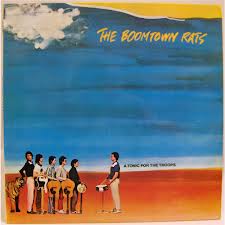
A Tonic for the Troops

A Tonic for the Troops

The BBC reports that Bob Geldof said: “I’ve always fancied playing the Isle of Wight Festival ever since I hitched there in the good/bad days when I was a kid.” The band have been playing live in recent years without Geldof. The Boomtown Rats were  the first Irish band to have a UK number one hit with Rat Trap. They followed that up with another number one with I Don’t Like Mondays, which was a hit around the world. They recorded six albums, three of which made the UK top 10, before splitting up in 1986.

The band’s last major live performance was at the 1985 Live Aid concert at Wembley, organised by Sir Bob Geldof.