HILL 62 SANCTUARY WOOD

Sanctuary Wood museum

In the last decade there has been a large increase in visitors to the Ypres Salient, and many have included a visit to the trenches at Sanctuary Wood, a few kilometres outside Ieper.

WWI shell and British Army cap badges

In the 1990s the trenches were covered in grass and the whole site was overgrown with undergrowth. Nowadays the ground around the trench line has been visited by so many pairs of feet that it is mostly bald with no grass or undergrowth.

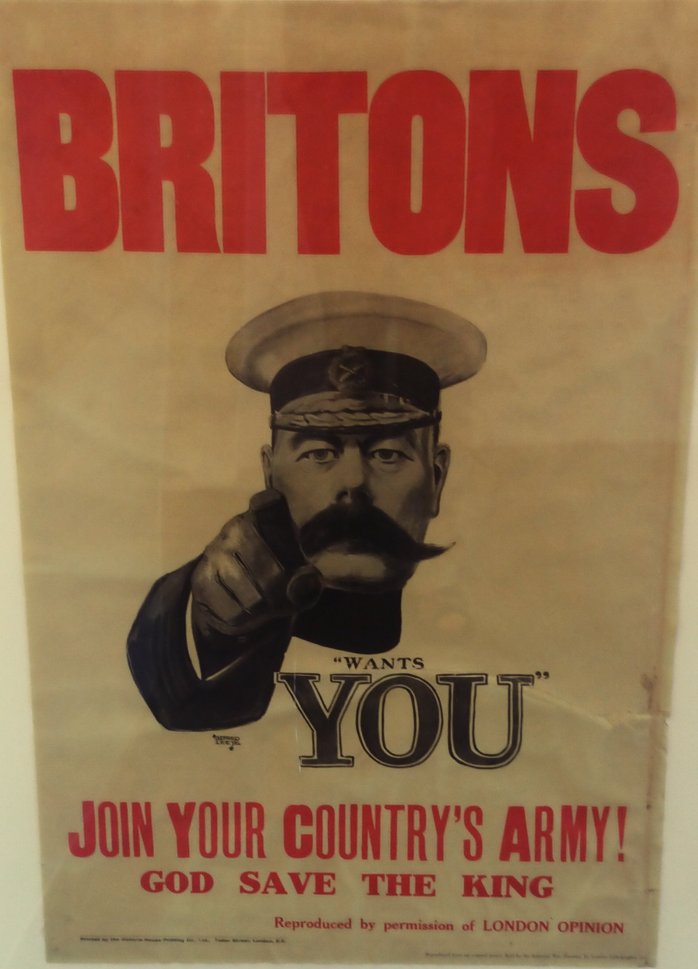
British Army WWI recruiting poster

The need for the preservation of battlefield areas makes for an interesting discussion. The natural desire to be allowed to walk freely amongst historical remains such as these trenches is one side of the argument, the possibility that they will be damaged in so doing is another.

Vickers machine gun

It’s been a topic of discussion for some years already by battlefield historians, local authorities and the people who live with the scarred landscape all around them.

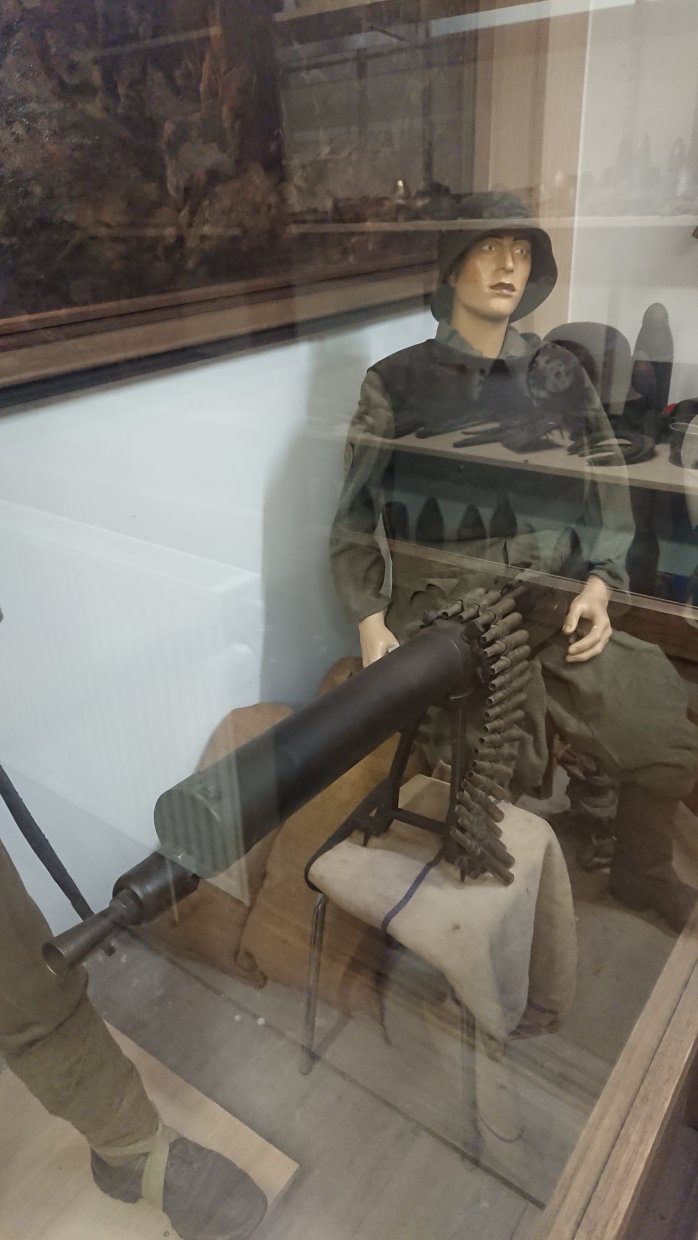
German machine gun

Sanctuary Wood is a fascinating example of how such war remains bring together the local people who own the ground and live with them daily, the people who come in their thousands each year to see them, historians who debate whether these trench remains are original or not, and the people who want to find ways to preserve endangered WW1 battlefield remains.

Belgian Royal Family Tree

The museum was developed by Jacques Schier, the grandson of the farmer who founded the museum and owned the site of the museum since before World War I. It has a unique collection of World War I items, including a rare collection of three-dimensional photographs, weapons, uniforms, decommissioned bombs and shells.

WWI British Army recruiting poster

On entering the museum through the café visitors will be in a room with display cases on tables in the centre of the room. Many interesting photographs are arranged on the walls. In this room you will find a large and rare collection of three dimensional photo images inside special viewing boxes. These 3D photographs were produced after the war and are absorbing and absolutely fascinating to look through.

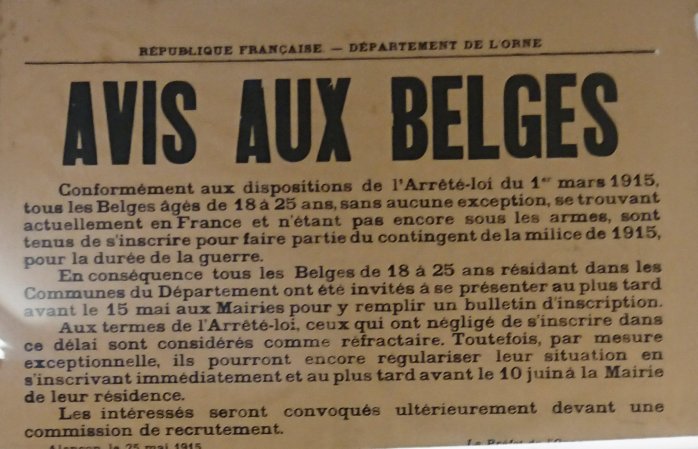
Calling on young Belgians 18-25 to enlist

The museum collection contains equipment removed from the battlefield in the vicinity of Sanctuary Wood. There are several German grave markers reclaimed from the battlefields. These were removed from their original burial location after the burials were presumably moved from outlying battlefield burial plots into a formal German military cemetery during the battlefield clearance after 1918.

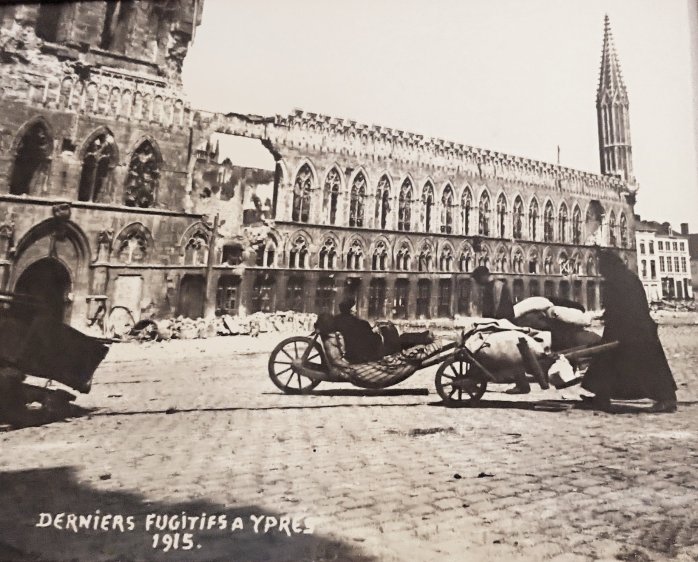
Last refugees in Ieper at the Cloth Hall 1915

Among the battlefield relics is a rare example of a British Army Cook’s Wagon. This was given a treatment of wood preserver in the 1980s by volunteers from the British Army’s Royal Corps of Transport serving near Antwerp.

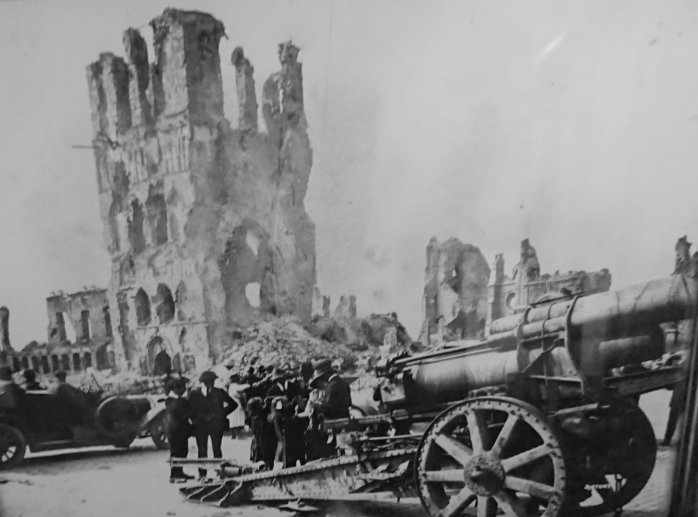
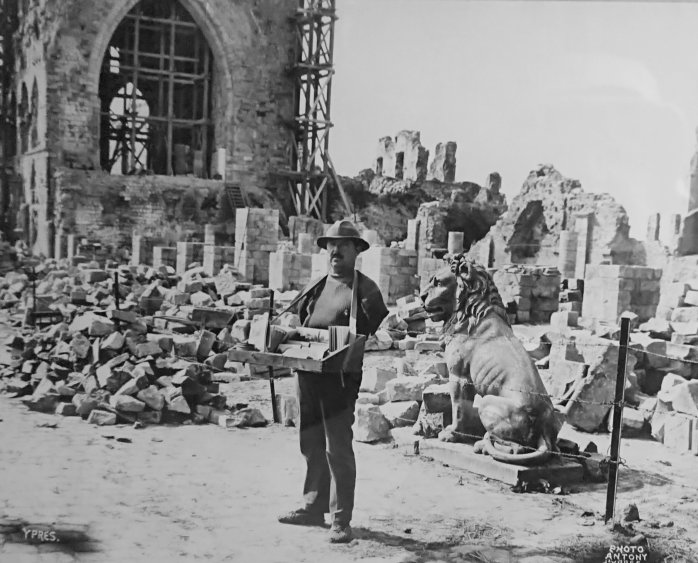
Ruins of Ieper

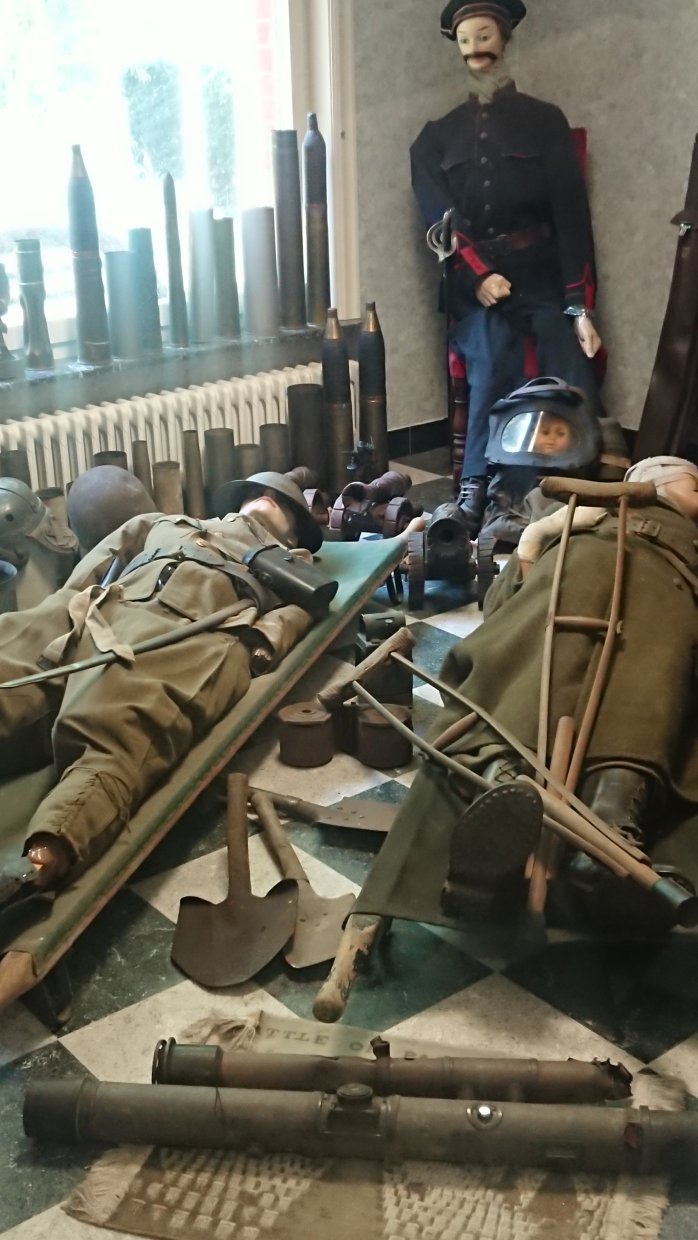
In what was once a house, several rooms are dedicated to various displays of wartime memorabilia. They include some fascinating posters and pictures, including several showing the devastation of Ieper (Ypres) by the Germans during World War One.

More pictures of the destruction in the centre of Ieper

FLANDERS DAY FOUR

WWI German trench mortar at Sanctuary Wood museum

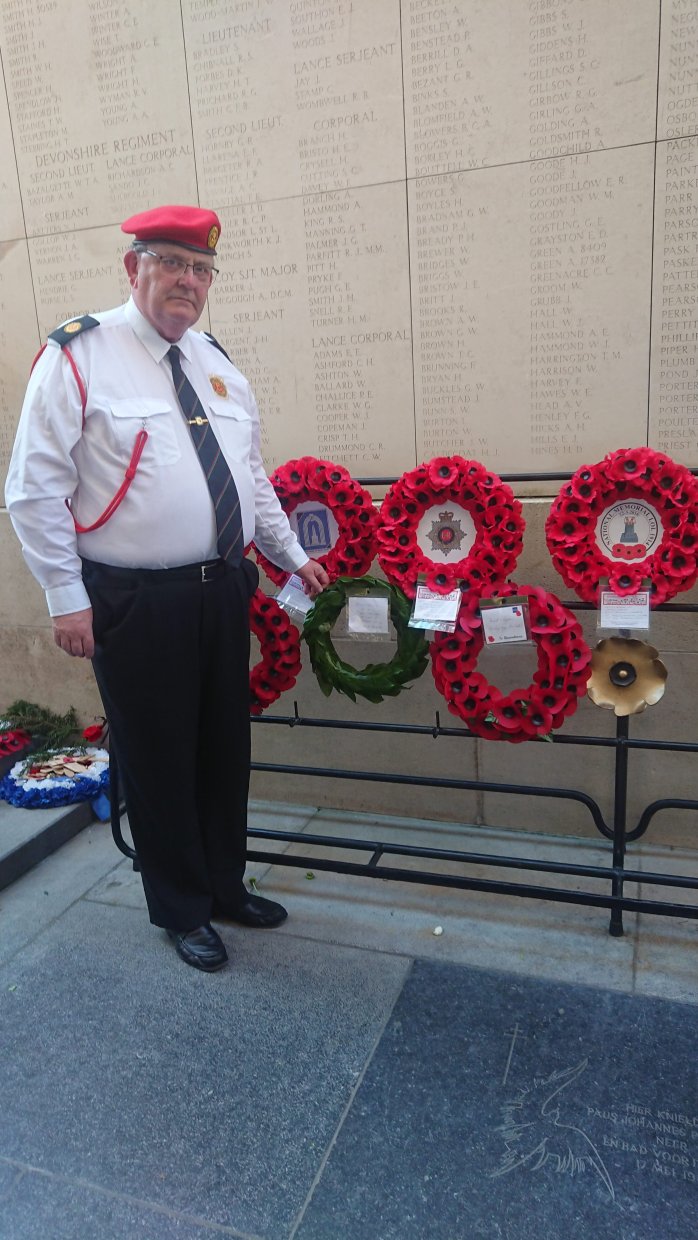
The fourth day included a highlight of the tour, attendance at the Last Post ceremony at the Menin Gate and participation in a wreath laying ceremony.

dsc_28146250370270623721567.jpg

Laying a wreath at the Menin Gate, Ypres, on Day Four

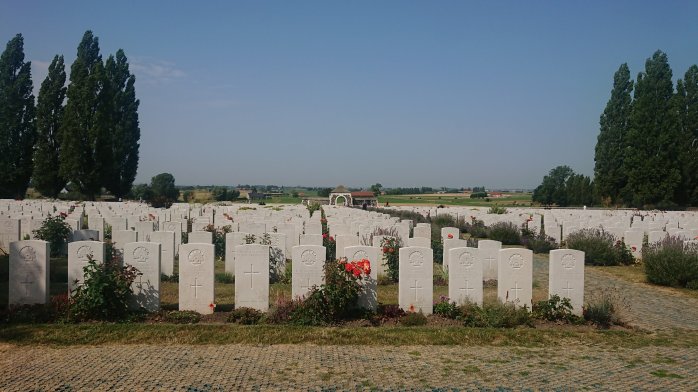
It also included a return visit (for me) to Tyne Cot cemetery, where I had taken part in the Paschendaele 100 service on 31st July 2017. These two important locations will be featured separately.

Tyne Cot Cemetery

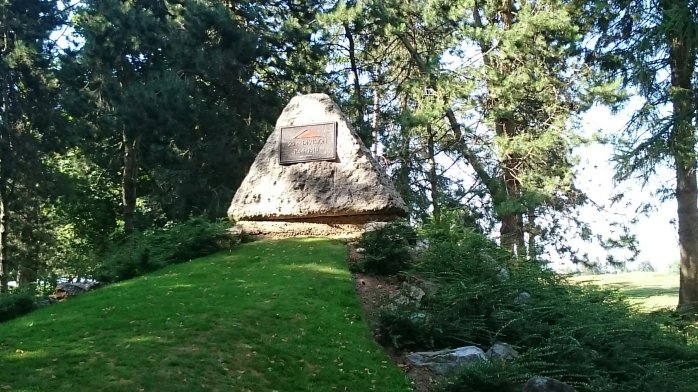
The day began with a visit to Hill 62 Zillebeke Museum, a few kilometres from Ieper. This is a privately owned collection. It is located in the vicinity of the Canadian Hill 62 Memorial and Sanctuary Wood Cemetery.

Picture: Attack on a German Trench

The museum was developed by Jacques Schier, the grandson of the farmer who founded the museum and owned the site of the museum since before World War I.      It has a unique collection of World War I items, including a rare collection of three-dimensional photographs, weapons, uniforms, decommissioned bombs and shells.

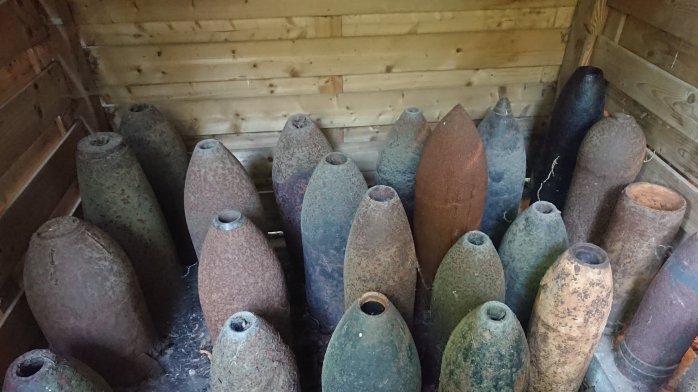
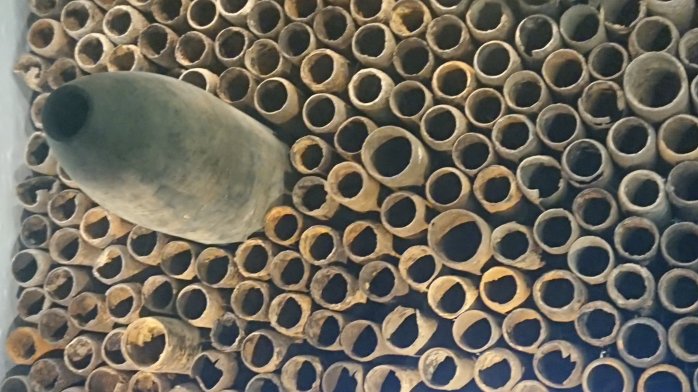
WWI shells at Hill 62 Sanctuary Wood museum

In the ground beside the museum there is a preserved section of the British trench lines, featuring a muddy maze of trenches. The attraction also has a small bar, café and gift shop.

Decommissioned ordnance on display inside the museum

The site is now one of the few places on the Ypres Salient battlefields where an original trench layout can be seen in some semblance of what it might have looked like. Elsewhere the trenches were filled in and ploughed over by returning farmers leaving only the occasional chalky outline of what had once been there.

Trenches at Hill 62 Sanctuary Wood

In the last decade there has been a large increase in visitors to the Ypres Salient, and many have, of course, included a visit to the trenches at Sanctuary Wood. In the 1990s the trenches were covered in grass and the whole site was overgrown with undergrowth. Interestingly, nowadays the ground around the trench line has been visited by so many pairs of feet that it is mostly bald with no grass or undergrowth.

Converted room in former house now used for exhibits

The need for the preservation of battlefield areas makes for an interesting discussion. The natural desire to be allowed to walk freely amongst historical remains such as these trenches is one side of the argument, the possibility that they will be damaged in so doing is another. It’s been a topic of discussion for some years already by battlefield historians, local authorities and the people who live with the scarred landscape all around them.

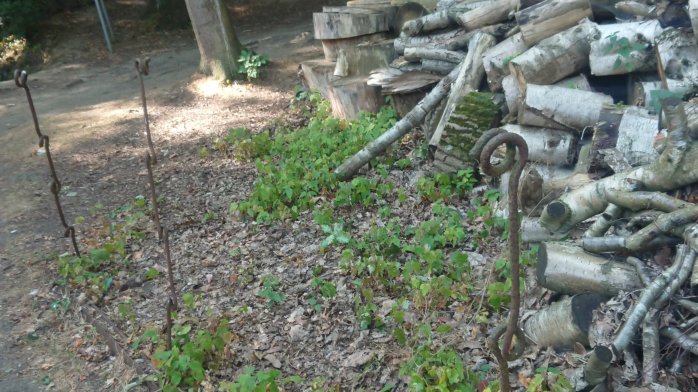
British ‘corkscrew’ barbed wire posts

Sanctuary Wood is a fascinating example of how such war remains bring together the local people who own the ground and live with them daily, the people who come in their thousands each year to see them, historians who debate whether these trench remains are original or not, and the people who want to find ways to preserve endangered WW1 battlefield remains.

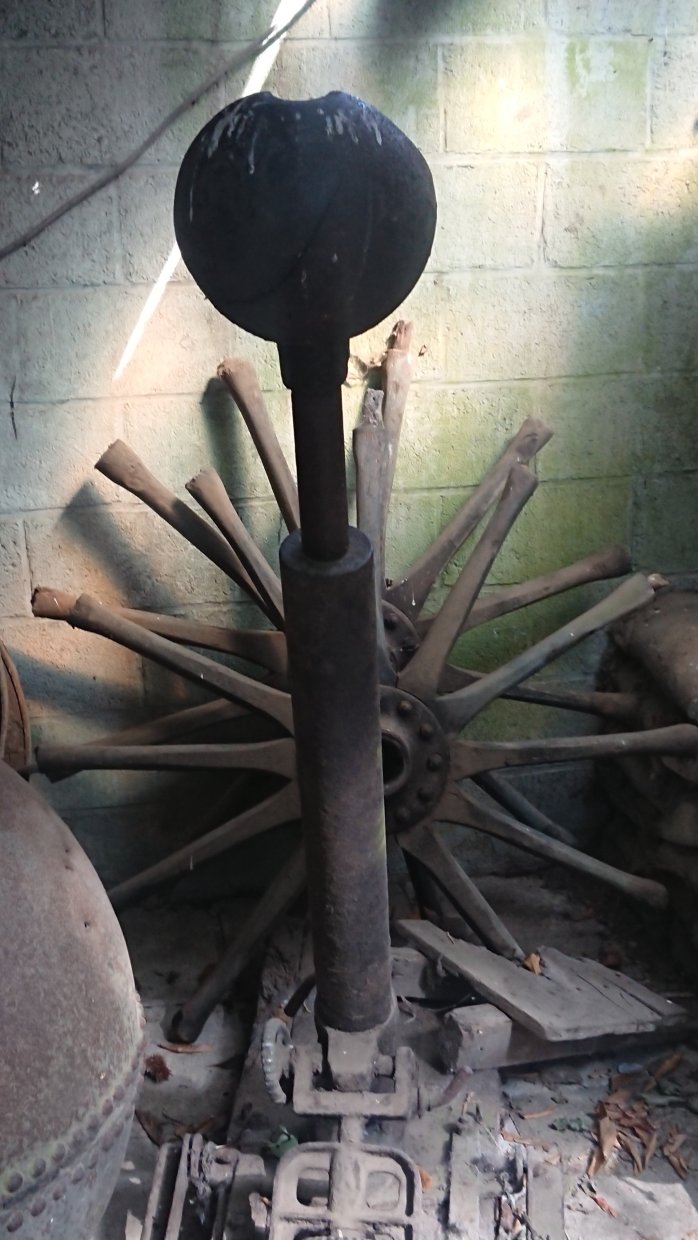
British WWI two-inch trench mortar known as the ‘toffee apple’

NEWFOUNDLAND MEMORIAL PARK

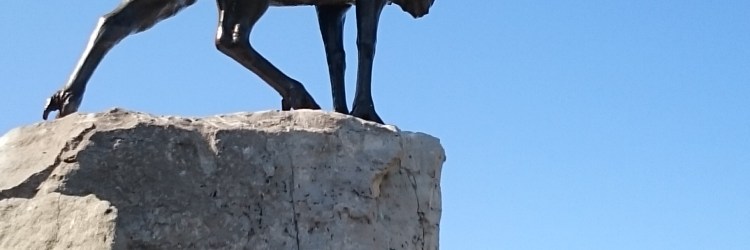
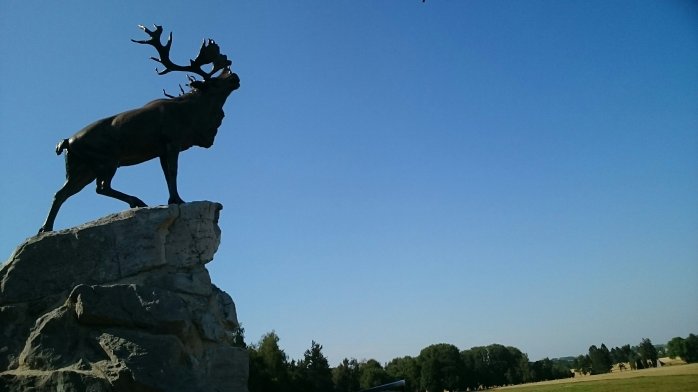
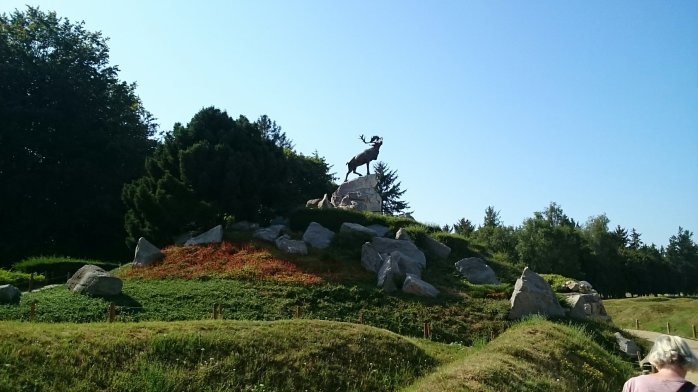
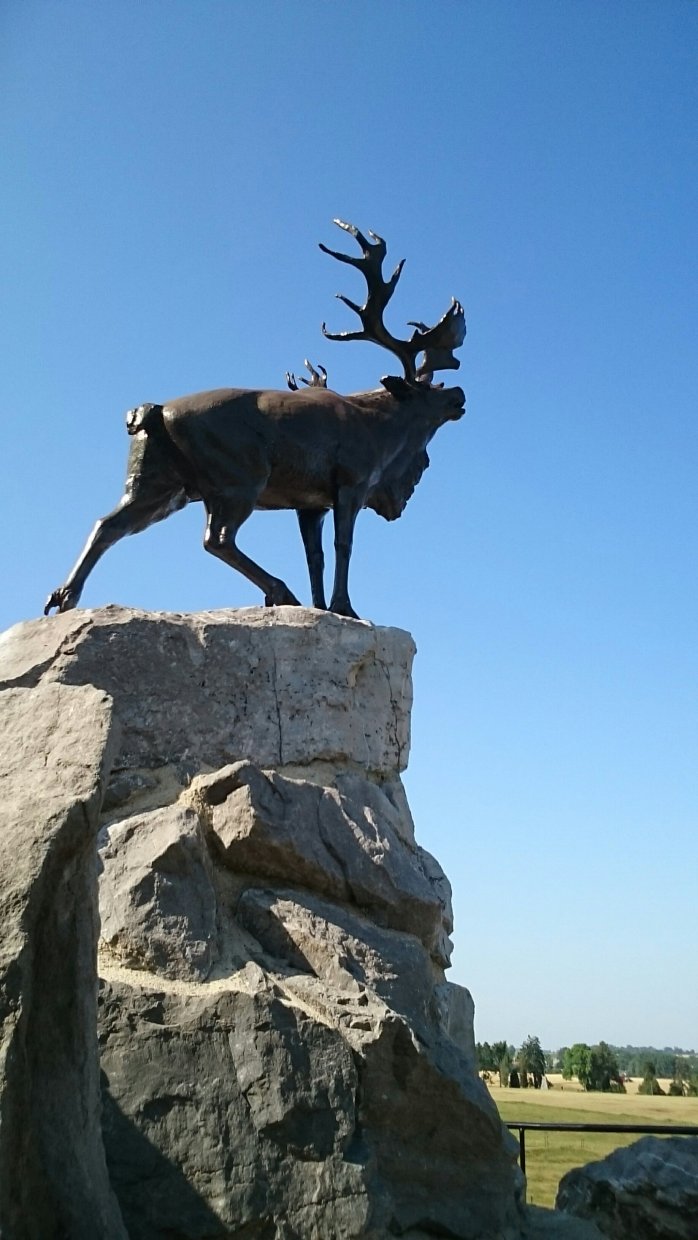
Newfoundland Memorial Park caribou memorial

Close to Thiepval and the Ulster Tower in the Beaumont Hamel area you will find the Newfoundland Memorial Park. The website greatwar.co.uk describes how it came to be situated there in an area that has particular significance for Canadians.

The Caribou is one of five such memorials on the Western Front which commemorate the location where the 1st Battalion of the Newfoundland Regiment was in action. The caribou is the emblem of the Newfoundland Regiment. The sculptor of the bronze caribou was an Englishman called Basil Gotto.

The Caribou memorial is situated on high ground at the western side of the park, behind the British front line of July 196, from where the 1st Battalion the Newfoundland Regiment began its advance into the attack on that fateful morning. The shrubs around the rocks are native plants from Newfoundland.

dsc_0856-2077539340.jpg

Caribou Memorial

Newfoundland Memorial Park is a site on the Somme battlefield near to Beaumont Hamel. The land was purchased by the Dominion of Newfoundland after the First World War. It was named after the Royal Newfoundland Regiment, which had provided one battalion of 800 men to serve with the British and Commonwealth armies.

Pointing the way to Newfoundland

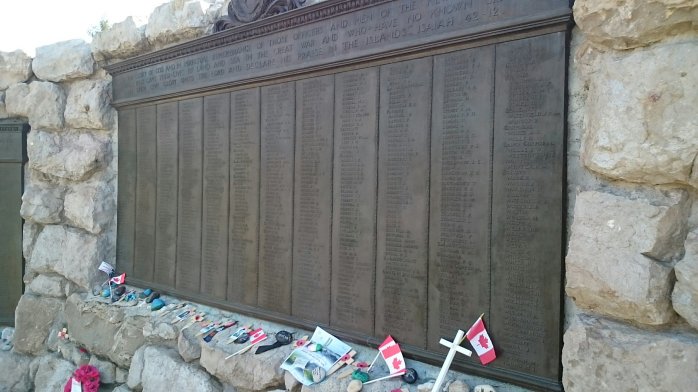
Its tragic part in the action of 1 July 1916 is remembered through this memorial park. The site is also a memorial to all the Newfoundlanders who fought in the First World War, most particularly those who have no known grave. At the base of the caribou memorial there are three bronze panels listing 814 names that make up the memorial to the Newfoundland missing, namely those who died on land or at sea during WWI and who have no known graves.

Memorial with names of those who died in WWI

The park does, nevertheless, preserve the memory of the men of the many other regiments from the French, British and German Armies who fought and died on this part of the Somme battleground from September 1914 into 1918.

dsc_0869-1691840694.jpg

29th Division Memorial

On the morning of 1st July 1916 as the Battle of the Somme began, the 29th Division was in action on the British front line in the location that now forms the Newfoundland Memorial Park. The Division suffered a high number of casualties as a result of the success of the German defence in this sector. Many were cut down before they got anywhere near the German front line. Many were killed and wounded as they moved forward from the rear of the front line to follow on in the attack. The divisional badge was a red triangle.

Newfoundland became a province of Canada in 1949. The Newfoundland Memorial Park is one of only two Canadian National Historic sites outside Canada. The other is also in France at Vimy Ridge. The landscape architect who designed the park was RHK Cochius.

dsc_086326227267.jpg

Remains of WW1 trenches seen from the caribou memorial

Beaumont-Hamel was attacked by the 29th Division on 1st July 1916 and although some units reached it, the village was not taken. It was finally captured by the 51st (Highland) and 63rd (Royal Naval) Divisions on the following 13 November. The 29th Division included the 1st Battalion of the Newfoundland Regiment, as it was then called. The attack on Beaumont-Hamel in July 1916 was the first severe engagement of the regiment, and the most costly.

On the first day of the Battle of the Somme, no unit suffered heavier losses than the Newfoundland Regiment which had gone into action 801 strong. The roll call the next day revealed that the final figures were 233 killed or dead of wounds, 386 wounded, and 91 missing. Every officer who went forward in the Newfoundland attack was either killed or wounded. For this reason, the government of Newfoundland chose the hill south-west of the village, where the front-line trenches ran at the time of the battle, as the site of their memorial to the soldiers (and also to the sailors) of Newfoundland.

Of the few battlefield parks in France and Belgium where the visitor can see a Great War battlefield much as it was, Beaumont Hamel is the largest. The actual trenches are still there and something of the terrible problem of advancing over such country can be appreciated by the visitor. The memorial itself stands at the highest point of the park and consists of a great caribou cast in bronze, emblem of the Royal Newfoundland Regiment. At the base, three tablets of bronze carry the names of over 800 members of the Royal Newfoundland Regiment, the Newfoundland Royal Naval Reserve and the Newfoundland Mercantile Marine, who gave their lives in the First World War and who have no known grave (CWGC information).

Caribou memorial

The Danger Tree is a petrified tree and the only original tree in this location to survive the 1914-18 fighting in this location. It had been part of a clump of trees located about halfway into No Man’s Land and had originally been used as a landmark by a Newfoundland Regiment trench raiding party in the days before the Battle of the Somme. As a result, the Regiment suffered a large concentration of casualties around the tree.

The Danger Tree in front of the German lines is to the left of the cross of sacrifice at the CWGC cemetery

CAMPBELL COLLEGE WWI

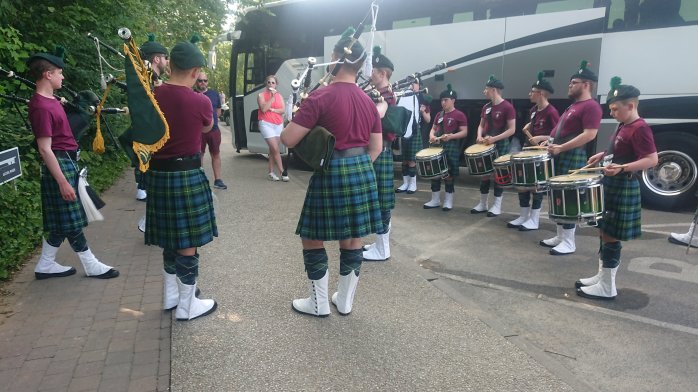
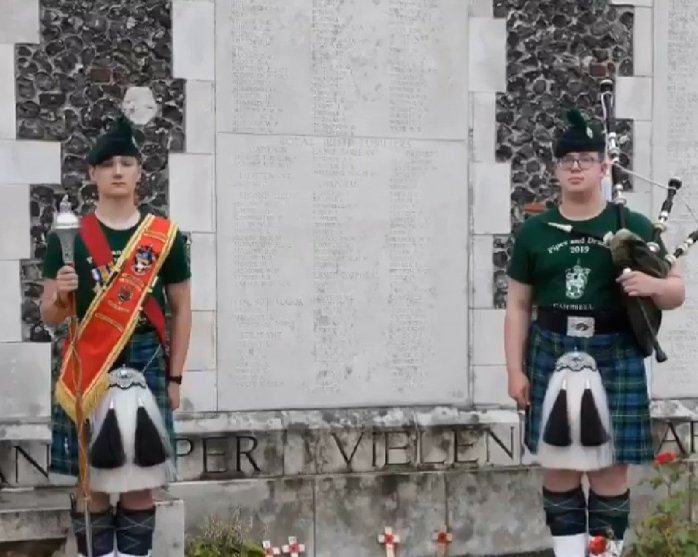
Cambell College CCF Pipe Band from Belfast laid a wreath at the Ulster Tower

Our visit to the Ulster Memorial Tower at Thiepval came just after a group from Campbell College in Belfast. We met the CCF Pipe Band as they were tuning up at the nearby Thiepval Memorial and we were just leaving, but it was nice to hear them playing.

Ulster Tower at Thiepval

The Campbell College group laid their wreath at the same time as a group from the Orange Order in Scotland, who we met the following evening at the Menin Gate Last Post ceremony in Ieper.

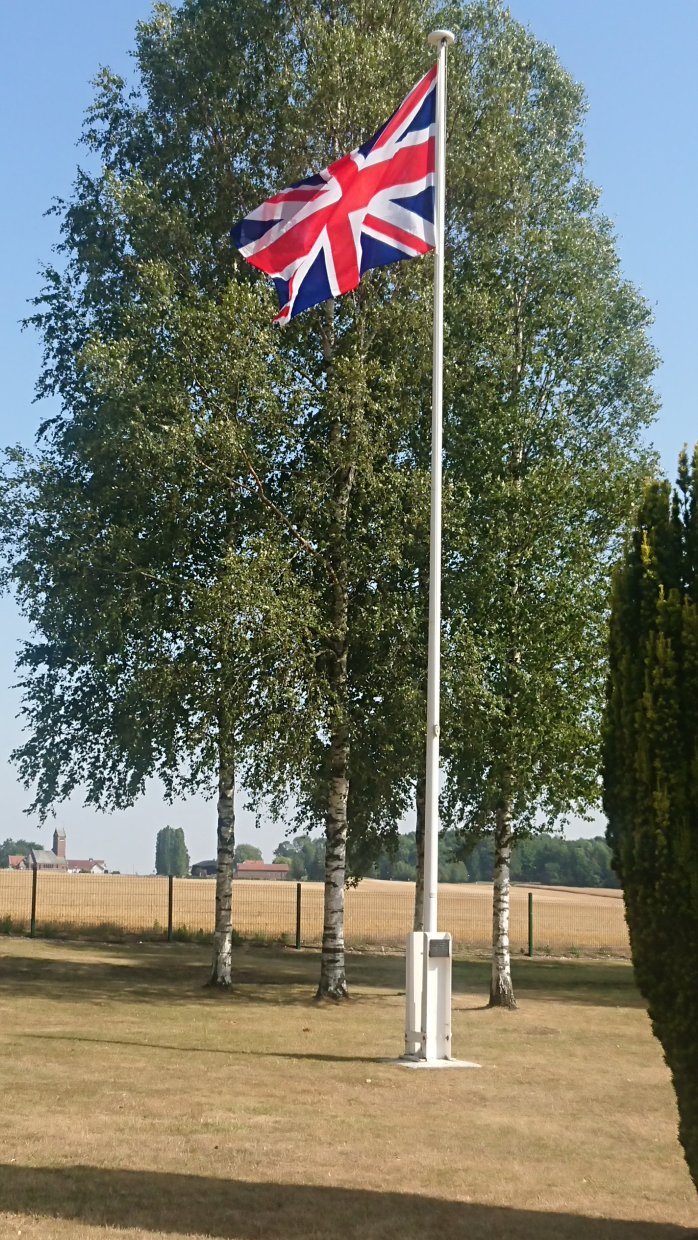
Union Flag flies at the Ulster Tower built in memory of the 36th Ulster Division

View from the Ulster Tower towards the Thiepval Memorial

Unfortunately we were a day too early for the Campbell College pipe band’s performance at the Last Post ceremony. We also missed them at Tyne Cot cemetery where some of their pipers paid tribute to the Royal Irish Fusiliers whose names are inscribed on the huge memorial as their bodies were never identified and they have no known graves.

Campbell College CCF Pipe Band from Belfast tuning up at Thiepval

The name on the bottom right of this panel is Private Hugh Dalzell of the 9th Battalion Royal Irish Fusiliers. Two years ago during the Passchendaele 100 commemoration I stood at this spot and read out his name as part of the live television broadcast by the BBC. We will remember them.

Campbell College at the Royal Irish Fusiliers memorial panel 140 at Tyne Cot cemetery

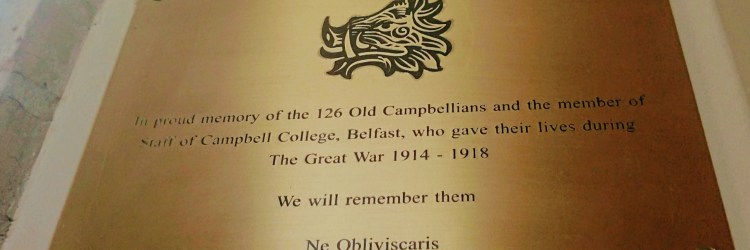
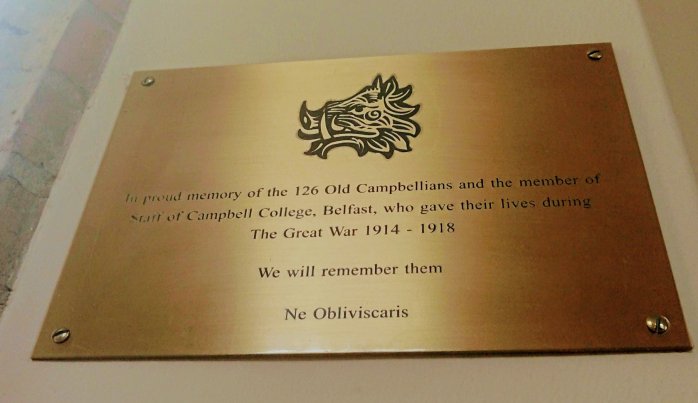
It was interesting to see a plaque the following day at St George’s Anglican Church in Ieper that commemorates all the past pupils of Campbell College who died in WWI and who the pipe band were remembering on their visit, organised by Anglia Tours.

We met some of the Campbell College group again on our fourth day when we went to Tyne Cot. They were visiting Poperinge where the Toc-H house founded by Reverend Talbot is situated. (There will be a separate story on that later).

The visit by the pipe band with some of their pictures (which they have kindly given me permission to use) featured in the News Letter. There is also an interesting website with the stories of the Old Campbellians and their part in WWI. They include a former Irish rugby international, Captain Alfred Taylor from Windsor Avenue North, off the Malone Road in South Belfast.

Their photos and stories have been turned into an exhibition ‘The Men Behind the Glass” currently on display in the PRONI, Belfast.

ULSTER TOWER, THIEPVAL

Ulster Tower, Thiepval

The Ulster Tower at Thiepval is modelled on Helen’s tower overlooking Newtownards, Co. Down, on the Clandeboye estate where the 9th Battalion Royal Irish Fusiliers (mainly men from Armagh, Monaghan and Cavan) and other units trained in 1914/15.

Plaque at entrance to the Ulster Tower

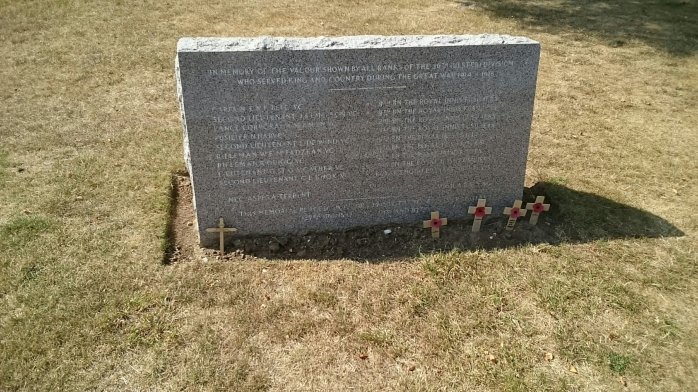
The Tower commemorates the men of the 36th Ulster Division and all those from the nine counties of Ulster who served in the First World War. The memorial was officially opened on 19th November 1921. At the entrance to the Tower is a plaque commemorating the names of the nine men of the Division who won the Victoria Cross during the Somme.

Remembering the members of the 36th Ulster Division decorated for their bravery at the Somme

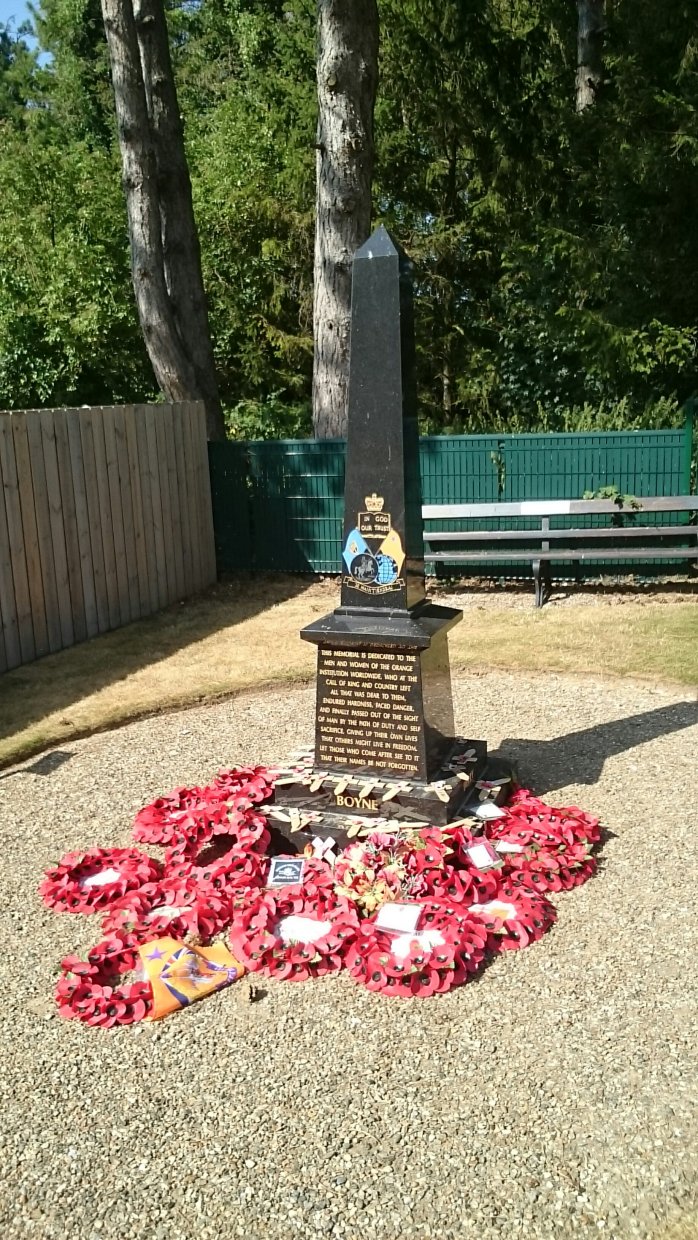
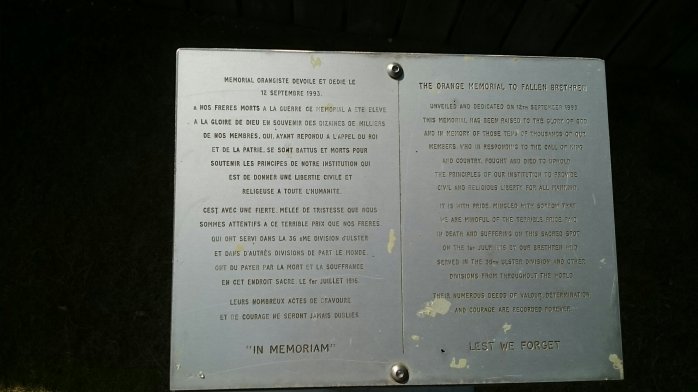
There is also a memorial here commemorating the part played by members of the Orange Order during the battle. The inscription on this memorial reads: “This Memorial is Dedicated to the Men and Women of the Orange Institution Worldwide, who at the call of King and country, left all that was dear to them, endured hardness, faced danger, and finally passed out of the sight of man by the path of duty and self sacrifice, giving up their own lives that others might live in Freedom. Let those who come after see to it that their names be not forgotten.”

Orange Order memorial behind the Ulster Tower

Explanatory plaque for the Orange Order memorial

LT THOMAS J. KENNEDY

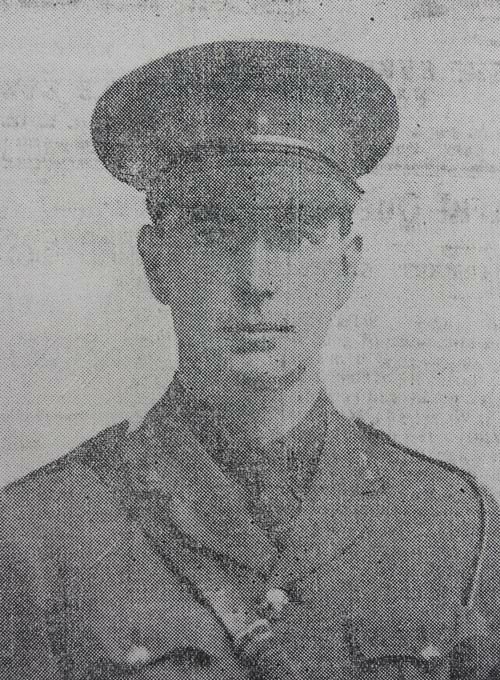
Lt TJ Kennedy of the Royal Inniskilling Fusiliers

Lt Thomas James Kennedy was Editor of The Northern Standard newspaper in Monaghan when he enlisted in the British Army. He was killed in action in France on 9th September 1916.

He was the eldest son of Samuel and Mary Kennedy, Terressan, Moneyhaw, County Derry near Cookstown, and brother of Mr. Joseph A. Kennedy, journalist, Lisburn.

DSC08301

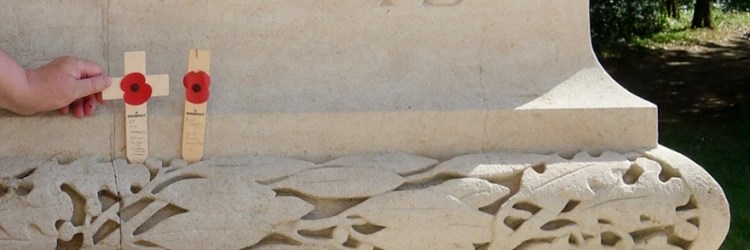
Placing a cross in memory of Lt Kennedy at Thiepval Memorial July 24th 2019

For five years previous to the outbreak of war Mr Kennedy was Managing Editor of the newspaper, The Northern Standard, in Monaghan. He was described as “a journalist of much ability”. In March 1915, he joined the 16th Battalion, Royal Irish Rifles. Shortly afterwards was given a commission in the 12th Battalion, Royal Inniskilling Fusiliers. He had served during the Easter Rising in Dublin and a month later on May 25th 1916, he was sent to France.

Lieutenant Kennedy was attached to the 8th Battalion, Royal Inniskilling Fusiliers at the Somme where he was killed in action on 9th September 1916.

Panel 4D on Thiepval Memorial with name of TJ Kennedy

His unit was part of the 16th Irish Division, composed mainly of former members of the National Volunteers, who played an important part in capturing the towns of Guillemont and Ginchy, although they suffered massive casualties. During these successful actions between 1st and 10th September, casualties amounted to 224 officers and 4,090 men.

The Irish conquest of Ginchy turned out to be one of the few victories the Allies could claim in the terrible year of 1916. It gave them control of a series of vital observation posts overlooking much of the Somme region that would prove to be a game-changer in the inch-by-inch battle for the Western Front.

DSC08288

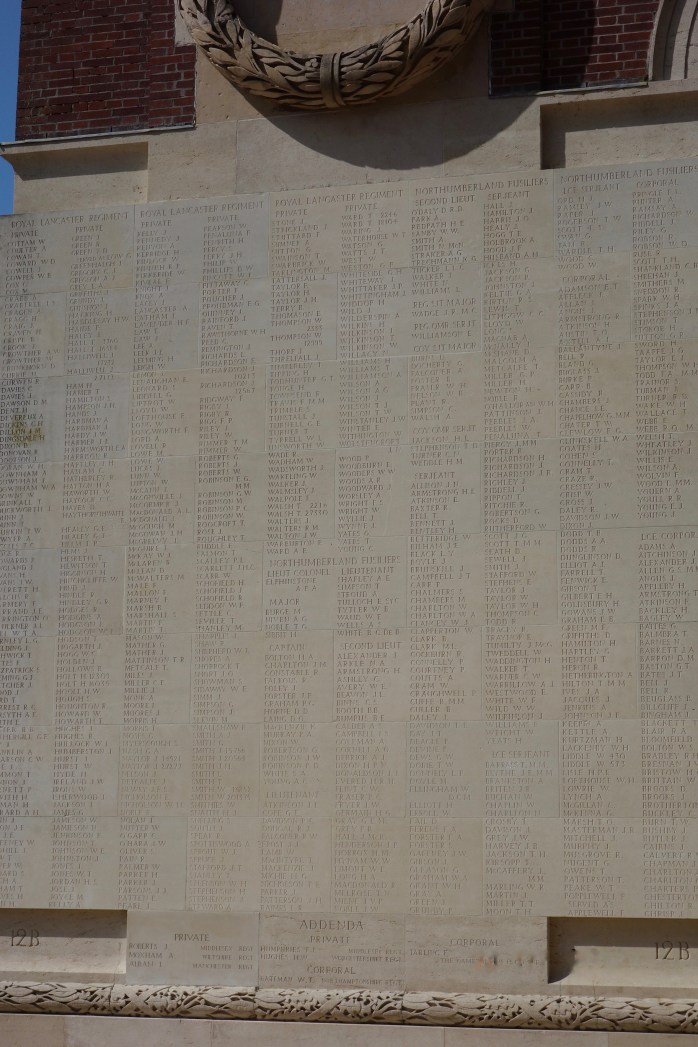
Thiepval Memorial

Lieutenant Tom Kettle was among the casualties recorded by the 16th Irish Division and he was commemorated in Dublin last week. His name and that of Lieutenant Kennedy would later be carved upon the Thiepval Monument to the Missing of the Somme along with 72,194 others whose remains were never identified.

Panel 4D on Thiepval Memorial

They include the names of Monaghan men from the 9thBattalion Royal Irish Fusiliers, part of the 36thUlster Division who were killed on the first day of the Battle of the Somme on July 1st1916 (see Northern Standard July 14th2016). When I visited the memorial in July 2016 for the Somme centenary commemoration I had not realised that all these names were on the memorial, especially that of a former journalist from the Northern Standard. So on this latest visit in July 2019 I checked the relevant panel with the help of an intern from the CWGC who told me she came from Belfast and that a relative had served in the same Battalion as Lt Kennedy.

Cross left by me at Thiepval Memorial remembering Lt TJ Kennedy

Thomas James Kennedy was born in County Tyrone about 1881. The 1901 census lists him as age 20 living with the family at house 4 in Terressan, Moneyhaw, near Cookstown. Thomas was working as a printer; his father was a farmer. Before the war he had served his apprenticeship in the offices of the Mid Ulster Mail as a reporter, and was well known in journalistic circles in Dungannon, Derry, Dublin and Dundalk.

****

From the Belfast Newsletter dated 10th March 1915:

A Journalist’s Commission. Compliment to Mr T J Kennedy, Monaghan. A deputation, representing the journalists of county Monaghan, waited on Mr. Thomas J Kennedy yesterday at the headquarters of the Ulster Division Cadet Corps at Brownlow House, Lurgan, and made him the recipient of a presentation on the occasion of his departure from Monaghan. Mr Kennedy, who has occupied the position of managing editor of the Northern Standard, Monaghan, for a period of five years is extremely popular in that town, and particularly so amongst his colleagues in journalism.

He is a member of the Ulster District of the Institute of Journalists, and is well-known in newspaper circles in Ireland. He has joined the Cadet Corps at Lurgan prior to taking up a commission in the Royal Irish Rifles. The presentation, which took the form of a handsome gold wristlet watch, with luminous dial, was made by Mr Samuel Bothwell, who succeeds Mr Kennedy in the position of managing editor. He paid an eloquent tribute to the many good qualities of Mr Kennedy as a journalist and gentleman , and wished him every success in his military career.

He also conveyed to him the sincere good wishes of Mr William Swan, the proprietor of the Northern Standard. Mr J J Turley spoke of his association with Mr Kennedy in Monaghan and of the kindly, cordial, and genial relationship that always existed between them. He regretted the temporary departure of such a warm personal friend, and trusted that Mr Kennedy would return decorated with high military honours.

Mr Kennedy, having suitably replied, the proceedings terminated.

******

During the Easter Rising in April 1916 he was recommended for promotion for services in the field. While attached to the 12th Inniskillings he was deployed to the Pro-Cathedral in Dublin, where he signalled to have the iron gates and doors open, and arranged to have his men cross under heavy fire without loss. It was through his courtesy afterwards that arrangements were made for a fifteen minute ceasefire so as to enable Mr. Richard Bowden, Administrator at the Cathedral, to procure provisions for a large number of refugees who were compelled to take refuge with the men in the building.

*****

Mid Ulster Mail Saturday 15thJanuary 1916

Second Lieutenant T J Kennedy, 12th (Reserve) Battalion Royal Inniskilling Fusiliers, has been promoted Lieutenant. He is a son of Samuel Kennedy, Tyressan, Cooktown, and well known in journalistic circles, commencing his career in the staff of the Mid Ulster Mail.

*****

Mid Ulster Mail Saturday 20thMay 1916

Local Soldiers (furlough)

During the last ten days, quite a number of soldiers have been home on furlough. Mr T J Kennedy (son of Mr Samuel Kennedy), formerly of the Mid Ulster Mail staff, who is a lieutenant of the Inniskillings and did valuable work in quelling the Sinn Fein rebellion.

******

Mid Ulster Mail Saturday 12thAugust 1916

Mr Samuel Kennedy, Tyresson, Cookstown, has received a telegram from the War Office that his son, Lieutenant T J Kennedy, has been wounded. Lieutenant Kennedy was a well-known journalist. He served his apprenticeship with the Mid Ulster Mail and prior to receiving his commission about eighteen months ago he was editor of the Northern Standard, Monaghan. Prior to going to France, he was on duty in Dublin during the Rebellion. He has written since that his wound was on his hand and that he hopes to be on duty again soon.

Lieutenant Kennedy was attached to the 8th Inniskillings at the Somme where he was killed in action on 9th September 1916.

******
DSC08305

Side section of Thiepval Memorial

Mid Ulster Mail Saturday 16thSeptember 1916

LATE NEWS Lt TJ Kennedy Killed

A telegram from the War Office was received on Friday afternoon informing Mr Samuel Kennedy, Tyresson, Cookstown, that his eldest son, Lieutenant Kennedy, of the Inniskillings, was killed in action in France on 9th September. He served his apprenticeship in the Mid Ulster Mail, and was well known in journalistic circles in Londonderry, Belfast, Dublin, Dundalk and Monaghan, and was the editor of the Northern Standard in the latter town when war was declared. He had been on the South Irish Horse, and volunteered for service, and was given a commission in the Ulster Division, being later transferred to the 16th Division. He was engaged during the Sinn Fein Rebellion with his battalion in Dublin, and his efforts were warmly commended by the administrator of the Pro-Cathedral, where he was stationed during most of Easter Week, and it was understood he was recommended for promotion.

*****

Tyrone Courier 21stSeptember 1916

Intimation has been received by Mr Samuel Kennedy, Tyresson, Cookstown, that his son, Lieutenant Thomas J Kennedy, Inniskilling Fusiliers, was killed in action on 9th September. Lieutenant Kennedy was a well known Ulster journalist, and for a time acted as a reporter for the Tyrone Courier, and proper to receiving his commission was editor of the Northern Standard, Monaghan. Before going to the front, he took part in the quelling of disturbances in Dublin. He was wounded on the 4th August last, but the injury, which was to the hand, was of a slight nature, and he was able to resume his duties in a short time.

***

Mid Ulster Mail Saturday 23rdSeptember 1916

(Death Notice)

KENNEDY – Killed in action on 9th September 1916. Lieutenant T J Kennedy, Royal Inniskilling Fusiliers, Ulster Division (attached to the Irish Brigade), eldest son of Samuel and Mary Kennedy, Tyresson, Cookstown. Deeply regretted by father, mother sisters and brothers.

***

Mid Ulster Mail Saturday 23rdSeptember 1916

Lt TJ Kennedy

A telegram from the War Office was received on Friday afternoon informing Mr Samuel Kennedy, Tyresson, Cookstown, that his eldest son, Lieutenant Kennedy, of the Inniskillings, was killed in action in France on 9th September. He served his apprenticeship in the Mid Ulster Mail, and was well known in journalistic circles in Londonderry, Belfast, Dublin, Dundalk and Monaghan, and was the editor of the Northern Standard in the latter town when war was declared. He had been on the South Irish Horse, and volunteered for service, and was given a commission in the Ulster Division, being later transferred to the 16th Division. He was engaged during the Sinn Fein Rebellion with his battalion in Dublin, and his efforts were warmly commended by the administrator of the Pro-Cathedral, where he was stationed during most of Easter Week, and it was understood he was recommended for promotion. The following letter was received from the Rev. Richard Bowden, B.A., Administrator of the Pro-Cathedral, dated 14th May 1916, and addressed to Sir John Maxwell K.C.B. (a copy of which is treasured by Lieutenant Kennedy’s parents), testified to the way he performed his duties. It runs:-

‘Sir. After the telephone message to the military to occupy the Pro-Cathedral, I deem it my duty to state to you my great appreciation of the efficiency and courtesy with which the occupation was carried out by the 12th Inniskillings. I wish to mention specially Mr Kennedy (Lieut), who signalled to have the iron gates and doors opened, and arranged for his men to cross under fire without loss, and through whose courtesy afterwards, arrangements were made to cease fire for fifteen minutes so as to enable me to procure provisions for the large number of refugees who were compelled by the fire to take refuge with us. Richard Bowden, Administrator, Pro Cathedral, (Dublin).’

The following information is from the Catholic Archdiocese of Dublin website:- Dublin Diocesan Archivist Noelle Dowling and Darren Maher have studied the accounts of those priests who ministered on the streets of the burning city in Easter 1916. Twenty priests, including a curate who would go on to become Archbishop of Dublin, were involved in ministering to those caught up in the events on both sides of the divide one hundred years ago.

Among the historic 1916 documents in the Diocesan Archives is an account of how over forty people sought refuge in the Pro-Cathedral when fighting broke out in the city centre. All around the Cathedral buildings were ablaze – the group were forced to stay inside the “Pro” for three days. Meanwhile, the priests of the Cathedral continued to come and go from the building to be with the wounded and dying. One Cathedral curate ran from the Pro to Wynne’s Hotel through streets raked with gunfire from all sides to attend to a wounded man who was badly injured.

Jervis Street Hospital quickly filled with the wounded and it was the busiest hospital in the city centre during the week of the Rising. A priest was in attendance at all times to cater for the many religious needs of the wounded and dying. The Very Rev. Fr. Richard Bowden, Administrator of the Pro Cathedral, ensured that clergy were always available. He stayed there constantly through Monday, Tuesday and left on Wednesday morning when curates, Fr. Edward Byrne (who would later become Archbishop of Dublin) and Fr. Joseph Mc Ardle took over.

***

Mid Ulster Mail Saturday 23rdSeptember 1916

Major A J Walkey, of the 8th Inniskillings wrote:-

‘I regret having to inform you that your son was killed while leading his men during an attack on the 9th September. I have gathered that he was going down a trench with his bombers, when they met a party of Germans, who put up a fight, one of them throwing a bomb which killed your son. I am glad to say that afterwards some of his men got him away and buried him in decency. Please accept my sincerest sympathies in your bereavement.’

***

Mid Ulster Mail Saturday 23rdSeptember 1916

Colonel Sir John Leslie Bart, of Glasslough, County Monaghan, commanding the 12th (R.) B., R. I. Fusiliers, (whose son Captain Norman Leslie was killed in France in 1914) writes to Mr Samuel Kennedy as follows:- ‘I cannot say how much I feel for you and your family in the loss you have sustained in the death of your gallant son. In this battalion, he was beloved by both officers and men, and none of us are more grieved by his loss than I am myself. I had always a very strong liking for him ever since the evening he offered me his services at Monaghan, where his talents as a journalist were fully recognised. No one helped me more than he did in forming the Battalion, where he was so quick to learn and impart the knowledge he had acquired. He accompanied me often on the recruiting platform, and none could speak better.’

***

Mid Ulster Mail Saturday 23rdSeptember 1916

Lieutenant Colonel J C Ker Fox, second in command of the 12th Inniskillings, writes from Finner Camp:- ‘I believer Sir John Leslie is writing to you on behalf of the battalion and himself to sympathise with you in your great loss. I myself have been away on duty for the last five days, and only returned on Saturday night, hoping that the news might not be correct, and was sorry to have it confirmed yesterday. I wish to tell you how much I personally regret the death of your gallant son. Although I am considerably more than twice his age, I had taken a great liking to him, and had seen a great deal of him, on and off duty. He was a brilliant young officer and if he had lived would, I am sure, have distinguished himself. He was very popular with all his brother officers, and deservedly so, for he was a kind hearted, good natured and cheery young fellow, whom we could ill spare. I wish I had words at my command to express my feelings better, but I bitterly regret his death, and feel most deeply and sincerely for his family and for you’.

***

Mid Ulster Mail Saturday 23rdSeptember 1916

Rev P.D. McCaul of St Eunan’s College, Letterkenny, writes as follows to Mr S Kennedy:-You have my deepest sympathy in your great sorrow caused by the death of your son. During the week of the Rebellion I met him a good deal, and I must say that Lieutenant Kennedy was a general favourite with all the people staying in the Hamman Hotel. He was more than kind to myself, personally. He was affable, gentlemanly, fearless, and good humoured. I am deeply touched by his death. The loss of such a noble son is a crushing blow. His parents and other members of the family have my deepest sympathy. May God comfort you in your sorrow is the earnest prayer of one who greatly admired your darling son.”

***

Mid Ulster Mail Saturday 23rdSeptember 1916

The following telegram has been received by Mr Kennedy:- ‘The King and Queen deeply regret the loss you and the Army have sustained by the death of your son in the service of his country. Their Majesties truly sympathise with you in your sorrow. Keeper of the Privy Purse’.

***

Tyrone Courier 1stFebruary 1917

The late Lieutenant T J Kennedy, a native of Cookstown, and formerly a member of Cookstown, and formerly a member of the Tyrone Courier reporting staff, and Lieut W E Wylie, the well known K.C. and member of the North West Circuit, are among those ‘mentioned’ for their services in Dublin during the rebellion.

In a letter to his father Major A.J. Walkey of the 8th Inniskillings wrote:

“I regret to inform you that your son was killed while leading his men during an attack on the 9th September. I have gathered that he was going down a trench with his bombers, when they met a party of Germans, who put up a fight, one of them throwing a bomb which killed your son. I am glad to say that afterwards some of his men got him away and buried him in decency.”

NORTHERN STANDARD Saturday 16thSeptember 1916

LIEUT. T. J. KENNEDY KILLED IN ACTION.

With extreme regret we announce the death in action of Lieutenant Thomas J. Kennedy, of the 8thBattalion, Royal Inniskilling Fusiliers. The sad news was conveyed to this office late this afternoon in a telegram from the deceased officer’s bereaved father, who resides at Cookstown, his gallant son having fallen on the 8thinst.

Lieutenant Kennedy was for nearly five years managing editor of the “Northern Standard”. In March 1915 he gave up his position to join the Cadet Corps of the 16thBattalion Royal Irish Rifles (Pioneers), shortly afterwards gaining a Commission. He was posted to the 12thInniskillings, and after a period of training with his battalion was sent to France a few months ago, since when he was transferred to the 8thInniskillings. He was slightly wounded on August 4th, but was able to take up duty again after a short period.

During his lengthened stay in Monaghan the late Lieut. Kennedy made hosts of friends by reason of his genial , friendly disposition, and his popularity with the public was enhanced by the patriotic response which he gave to the call of Duty. He took an active part in connection with the Monaghan Battalion of the U.V.F. prior to the war, his valuable services to the cause of Unionism both in this and other directions being highly appreciated. In athletic circles in Monaghan and elsewhere he was a prime favourite, and amongst all classes the greatest sympathy will be felt with the bereaved relatives in the loss they have sustained. He has made the supreme sacrifice in defence of the Empire, and we deeply deplore his death.

NORTHERN STANDARD Saturday 23rdSeptember 1916

THE LATE LIEUTENANT T.J. KENNEDY

MONAGHAN BOARD’S SYMPATHY

Sympathetic reference was made at Monaghan Board of Guardians on Monday to the death in action of Lieut. T.J. Kennedy. Mr. Jas. Loughead said it was with feelings of deepest regret he proposed a resolution of sympathy with the relatives of the late Lieut. T.J. Kennedy, “Northern Standard”. He was a gentleman who from time to time came amongst them as a member of the Press, one for whom every one of them had a warm corner in their hearts. He was one of nature’s gentlemen, who never drew a dividing line between members of that board, but was at all times considerate and courteous to all. He fought nobly for his country and fell like a hero on the plains of France. He proposed the adoption of the following resolution:-

“That we, the members of Monaghan Board of Guardians, have heard with deep regret of the death in action in France of Lieut. T.J. Kennedy, late managing editor of the ‘Northern Standard’. For many years he attended the meetings of this Board in his journalistic capacity, and at all times the members found him most courteous in his endeavor to further the interests of the Board of Guardians and of the ratepayers they represented. We desire to express our sincere sympathy on his death”.

Mr. Hugh O’Brien seconded. The late Lieut. Kennedy, he said, was a gentleman he knew personally for many years. He could not add anything to what Mr. Loughead had said regarding the deceased gentleman.

Mr. Jas. M’Quaid, J.P. — I desire to be associated with the feeling expression contained in the resolution. I had the pleasure of knowing Mr. Kennedy for many years. I bear out what was said about him as to his courtesy and efficiency as a journalist.

Mr. T.W. Hanna, J.P. — It is unnecessary for me to say anything. I wish to be associated with the resolution.

Several other members desired to be associated with the resolution.

The Chairman in putting the resolution to the meeting said he was sure they all symapthised with Lieut. Kennedy’s relatives on his sad death. As Mr. Loughead embodied in his resolution, he fell like a man fighting for his country. They all knew Lieut. Kennedy. He was a fine journalist and all regretted to learn of his death in a foreign country. He was sure his relatives had the sympathy of all the boards he attended.

The resolution was passed unanimously, all the members standing, and a copy was ordered to be sent to the relatives of the deceased officer.

Commemorating the former Editor of The Northern Standard, Lt TJ Kennedy

Thomas J. Kennedy was buried at the time of his death but his grave could not be found later by the Commonwealth War Graves Commission. He is therefore commemorated on the Thiepval Memorial to the Missing of the Somme. He is also commemorated on the Cenotaph in Cooktown and Molesworth Presbyterian Roll of Honour, Cookstown.

The reports in the Northern Standard at the time of the First World War show how the paper under the proprietorship of William Swan was a pro-unionist publication. It carried weekly reports of the war effort including details of local men who had died fighting for the British Army. The “Dublin rebellion” or Easter Rising featured only briefly in the columns of the paper in May 1916. Much of the information on Lt Kennedy has been taken from the records of www.cookstownwardead.co.uk as well as the files of The Northern Standard.

This article appeared in The Northern Standard on 15th September 2016 on the centenary of his death.

THIEPVAL VISITOR CENTRE

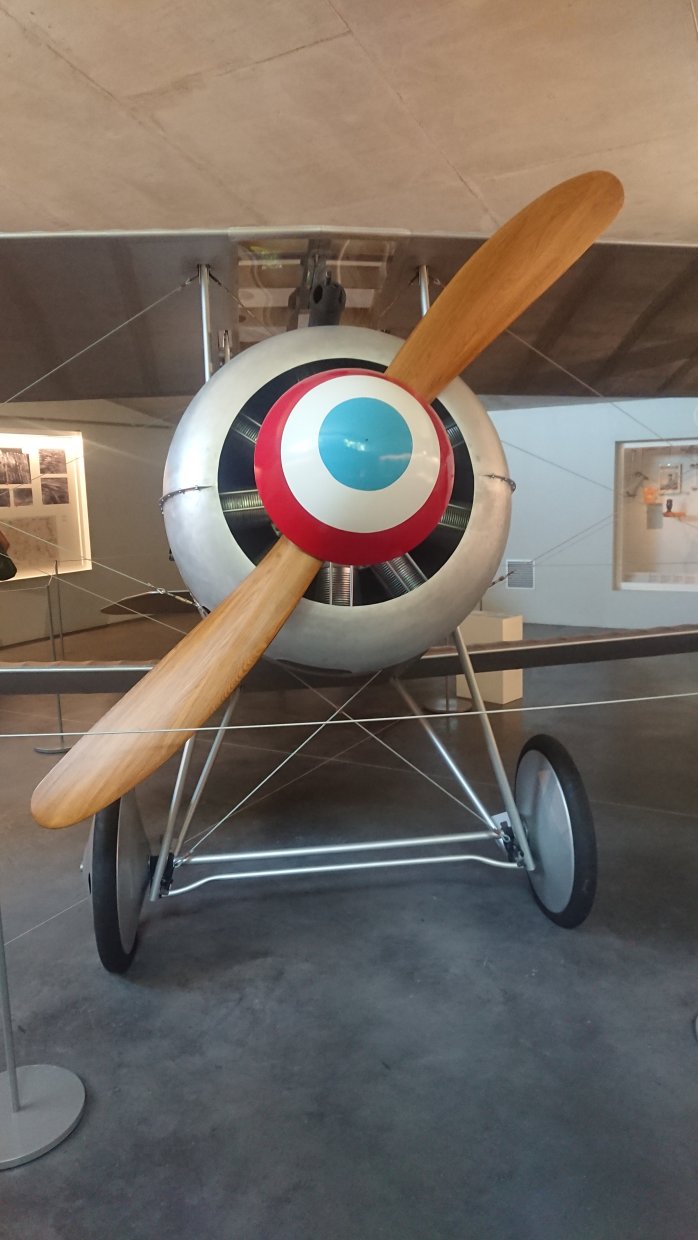
When you arrive at the CWGC memorial at Thiepval, there is a visitor centre you can enter. There is a museum with WWI artefacts, including a full scale replica of a Nieuport 17 ‘Vieux Charles V’ biplane piloted by Georges Guynemer, a famous French flying ace. He was reported as missing in action in 1917, after more than fifty successful combat missions against the Germans.

Replica of the WWI plane flown by Georges Guynemer

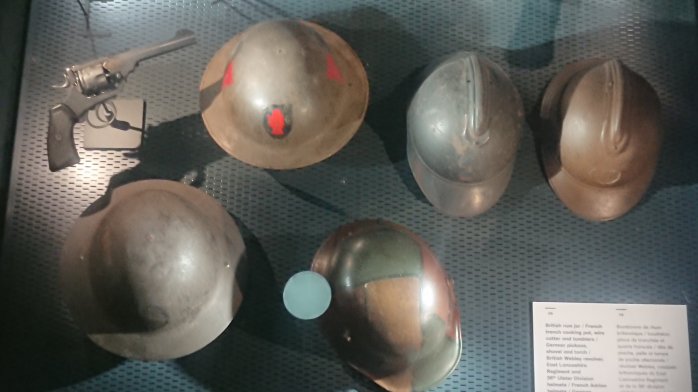
There are examples of ordnance including shells and weapons such as a Vickers machine gun. A helmet with the red hand symbol of the 36th Ulster Division can be seen in one of the exhibition cases.

Helmets including one from 36th Ulster Division

The visitor centre, built in 2004, also incorporates the Thiepval Museum. The museum opened in June 2016 to mark the centenary of the 1916 Battle of the Somme. The visitor centre and museum are located a short distance from the Thiepval Memorial to the Missing of the Somme and the Thiepval Anglo-French Cemetery. The idea for a visitor centre museum was first discussed at the annual ceremony of Remembrance on 1st July 1998. Sir Frank Sanderson led a small group in the campaign to build this educational centre. The Anglo-French project was brought to fruition with the help of generous donations to meet the British fundraising target of £660,000.

The visitor centre has been imaginatively constructed at ground level so that it does not impact as an obtrusive building on the local area around the Thiepval Memorial. It welcomes many thousands of visitors to the Thiepval Memorial to the Missing each year. At the centre the memorial is put in the context of the battlefield. Display panels in three languages — English, French and German — provide an overview of the course of the Great War from 1914-1918. Display panels focus on the events during the Battle of the Somme in 1916 which occurred at the small village of Thiepval and its surroundings.

Vickers machine gun

In British service, the Vickers gun fired the standard .303 inch cartridges used in the Lee Enfield rifle, which generally had to be hand-loaded into the cloth ammunition belts. There was also a 0.5 in calibre version used as an anti-aircraft weapon and various other calibres produced for foreign buyers. The gun was 3 feet 8 inches (112 cm) long and its cyclic rate of fire was between 450 and 600 rounds per minute. In practice, it was expected that 10,000 rounds would be fired per hour, and that the barrel would be changed every hour—a two-minute job for a trained team.

Vickers machine gun

Three films, each lasting approximately 10 minutes, have been specially compiled covering the subjects of Thiepval, The Battle of the Somme and Memory. The museum provides information, maps, photographs and audivisual experiences to help visitors understand the battles that took place in the Department of the Somme.

WWI shells at Thiepval museum

THIEPVAL MEMORIAL

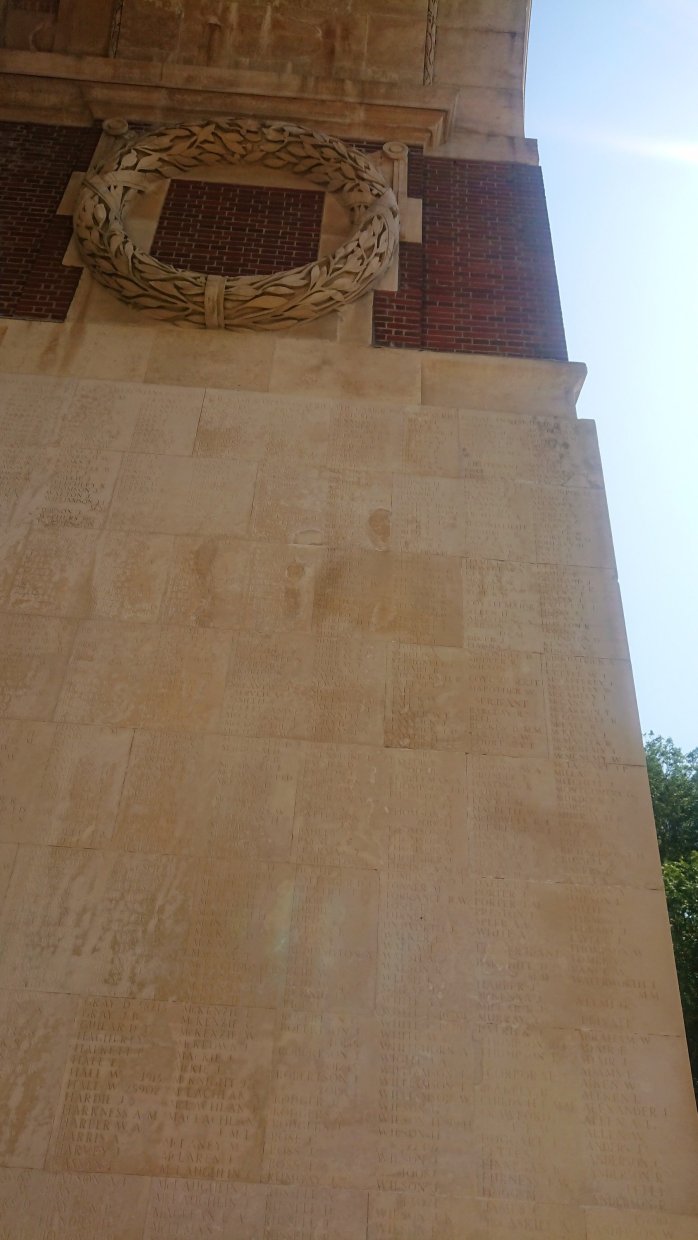
Thiepval Memorial

On high ground overlooking the River Ancre in France, where some of the heaviest fighting of the First World War took place, stands the Thiepval Memorial. Towering over 45 metres in height, it dominates the landscape for miles around. It is the largest Commonwealth memorial to the missing in the world and is maintained by the CWGC.

Thiepval Memorial

Thiepval Memorial was designed by the famous British architect Sir Edwin Lutyens and comprises a series of intersecting arches which increase in height and proportionate width. Construction began in 1928 following lengthy negotiations about the site with foundations dug to a depth of thirty feet. Wartime tunnels and unexploded ordnance were discovered during its construction.

Thiepval Memorial side detail

Thiepval Memorial was unveiled on 1st August 1932 by Prince Edward, the Prince of Wales. The ceremony was in English and French. Each year on the anniversary of the start of the Battle of the Somme (1916) on 1st July, a ceremony is held there.
On 1st July 2016, to mark the centenary of the Battle of the Somme, thousands of people attended a special ceremony including members of the British Royal family, UK Prime Minister David Cameron, Labour leader Jeremy Corbyn, French President François Hollande, President Michael D. Higgins and Minister Heather Humphreys from Monaghan, who was then responsible for Commemorations. I attended in my capacity as a member of the Irish veterans’ group, O.N.E. along with its Chief Executive Ollie O’Connor.

Michael Fisher and British Labour leader Jeremy Corbyn MP at the Somme 100 ceremony at Thiepval in July 2016

Behind the memorial is the Thiepval Anglo-French Cemetery. The cemetery contains the graves of 300 Commonwealth servicemen and 300 French servicemen. The majority of these men died during the Battle of the Somme, but some also fell in the battles near Loos and Le Quesnel.

OCEAN VILLAS WW1 MUSEUM

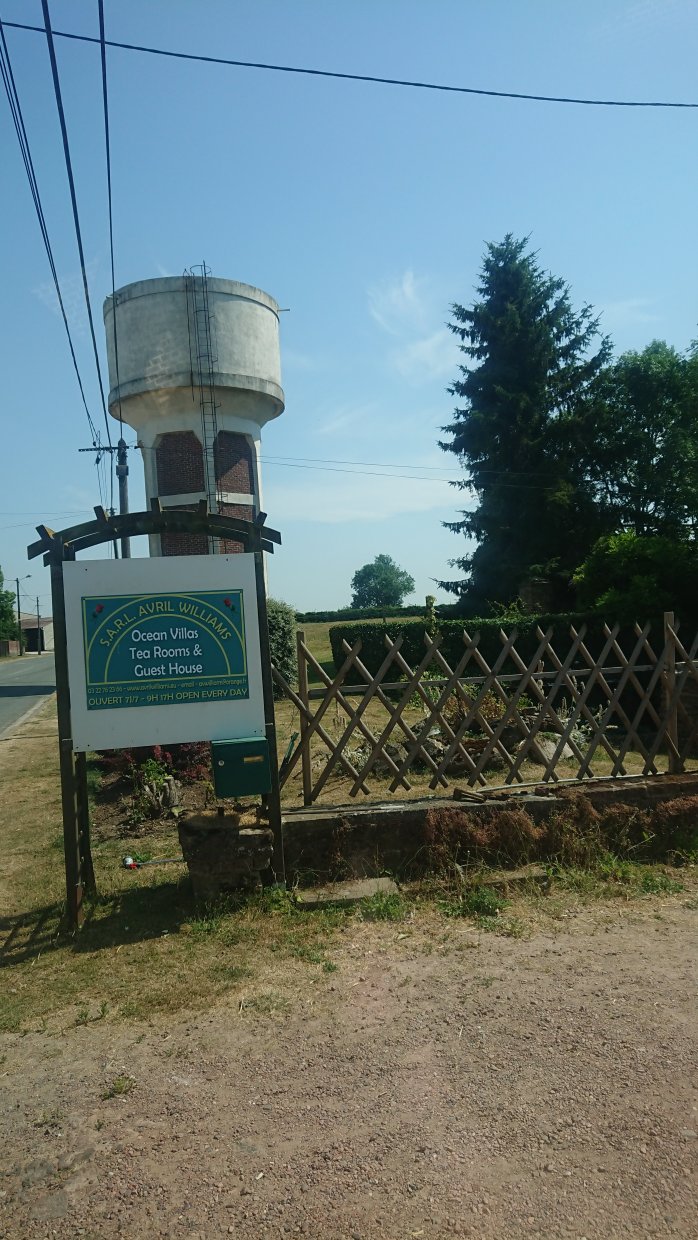
Sign for Ocean Villas Tea Rooms, Auchonvillers

In 1992 Avril Williams and her two children arrived at Auchonvillers and moved into an abandoned farmhouse. Over the past twenty-five years the family has renovated the farmhouse and it has become well-known as a popular venue for visitors to the Somme battlefields. Among the many regimental and other plaques on the wall was one left by my colleagues in the Military Police Association of Ireland, who were there last year.

MPAI plaque at Ocean Villas

The village of Auchonvilliers was renamed “Ocean Villas” by the British soldiers after they arrived on this part of the Somme battlefront in the summer of 1915.

Avril and her family named their farmhouse “Ocean Villas” and have expanded the site to comprise numerous educational facilities for visitors, including a venue for lectures, the museum and an orignal section of British trench.

This is a collection of rare and important militaria and memorabilia from the First and Second World Wars, gathered over many years by military historian and collector André Coillot. To prevent the collection from being dispersed Avril Williams purchased it in its entirety and has re-housed it in a refurbished building next to her guest house and tea rooms.

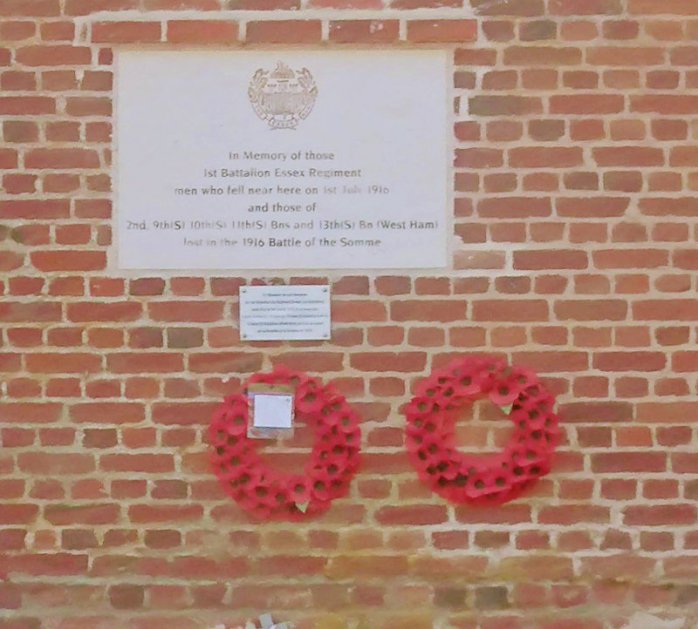
Plaque at Hamel for Essex Regiment, Battle of the Somme

This plaque on the side of the rebuilt church at nearby Hamel remembers the men of the 1st Battalion Essex Regiment killed there on the first day of the Battle, July 1st, and the other Essex battalions who fought on the Somme in 1916. It is not far from Thiepval Wood where the 39th Ulster Division went into action.

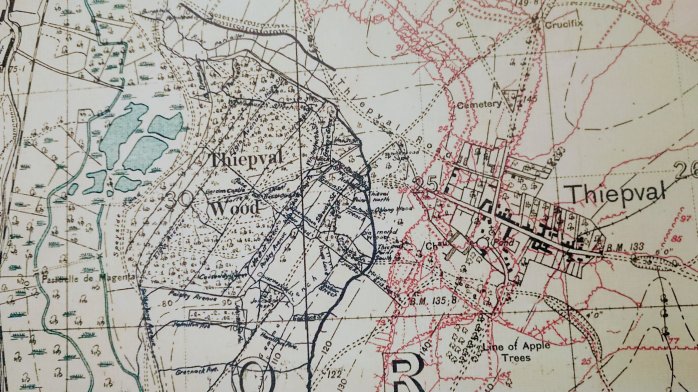
Map (table mat) of British lines around Thiepval 1916

This museum at Auchonvillers is the only military collection on the Somme battlefields which comprises First and Second World War artefacts. This museum was opened on 1st July 2008 by Major Tonie and Mrs Valmai Holt.

Plaques on the wall including MPAI at Ocean Villas tea rooms and museum

PTE THOMAS HUGHES VC

Private Thomas Hughes of the 6th Battalion Connaught Rangers was born in Corravoo, Castleblayney, in 1885. He was 29 when the Great War began. He was awarded the V.C. for actions at Guillemont in France during the Battle of the Somme on 3rd September 1916. Plaques at the Catholic church in Guillemont commemorate him and two other holders of the Victoria Cross. Our group visited the church on the third day of our visit to World War One sites.

The citation read: “For most conspicuous bravery and determination. He was wounded in an attack but returned at once to the firing line after having his wounds dressed. Later seeing a hostile machine gun, he dashed out in front of his company, shot the gunner and single handedly captured the gun. Though again wounded, he brought back three prisoners”.

4628754536_541x408-355600925.jpg

King George V presents Pte Hughes with his VC in Hyde Park in 1917

Walking with the aid of crutches, Hughes was personally awarded the Victoria Cross by King George V at an investiture at Hyde Park in London on 2nd June 1917. He also received the 1914–15 Star, British War Medal and Allied Victory Medal. Hughes was later promoted to the rank of Corporal. It was his custom each year to attend the Armistice Day ceremony at the Cenotaph in London. When he returned to Ireland, it was a very different country to the one he had left. Soldiers who had gone to fight in the British cause were often shunned and their exploits were largely forgotten.

Thomas Hughes died on 8th January 1942, aged 56, and is buried in the cemetery at St Patrick’s Church, Broomfield. His Victoria Cross medal is held by the National Army Museum, Chelsea in London.

16819128_1883349765278339_3642773320443749856_o-1405427655.jpg

Grave of Pte Hughes in Broomfield, Co. Monaghan Pic. Monaghan Heritage

Speaking at the unveiling of a blue plaque memorial for Pte Hughes in Castleblayney in February 2017, Minister Heather Humphreys said she had travelled to Thiepval and Guillemont in July and September in 2016, to mark the 100th anniversary of the Battle of the Somme, and to remember the many Irish men who died there from the 36th Ulster Division and the 16th Irish Division. In the small, beautiful church in Guillemont, a tiny village in Northern France, she saw the plaques on the wall in honour of Thomas Hughes.

Hughes is one of 27 Irish holders of the Victoria Cross for whom the British government arranged a paving stone to be placed at Glasnevin Cemetery in Dublin, paid for by the Commonwealth War Graves Commission.

4630431030_357x468

Stone for Pte Hughes VC unveiled at Glasnevin

Despite the romance sometimes portrayed in newspaper columns such as the Northern Standard, recruitment to the British Army remained very low for the county for the entire war. By October 1916 only 738 men from County Monaghan had answered the call to enlist, the majority being Protestants (although they represented approximately one-fifth of the population at the time). Slow recruitment was blamed several times on the prominence of agriculture in the county, with the farming classes accused of not wanting to go to war because they were prospering financially.

In total around 2,500 Monaghan men served in the Great War. There were notable contributions from some families. Seven Roberts brothers from Killybreen in Errigal Truagh all joined the British army at different stages. Seven sons of Sir Thomas Crawford of Newbliss served, and three of these were decorated for gallantry. Four Steenson brothers from Glaslough joined up and two were killed. In all, nearly 540 Monaghan men were killed in the war, about half of them Protestant and half Catholic.

img_20190818_185504-627168101.jpg

Blue plaque in Castleblayney for Private Thomas Hughes VC

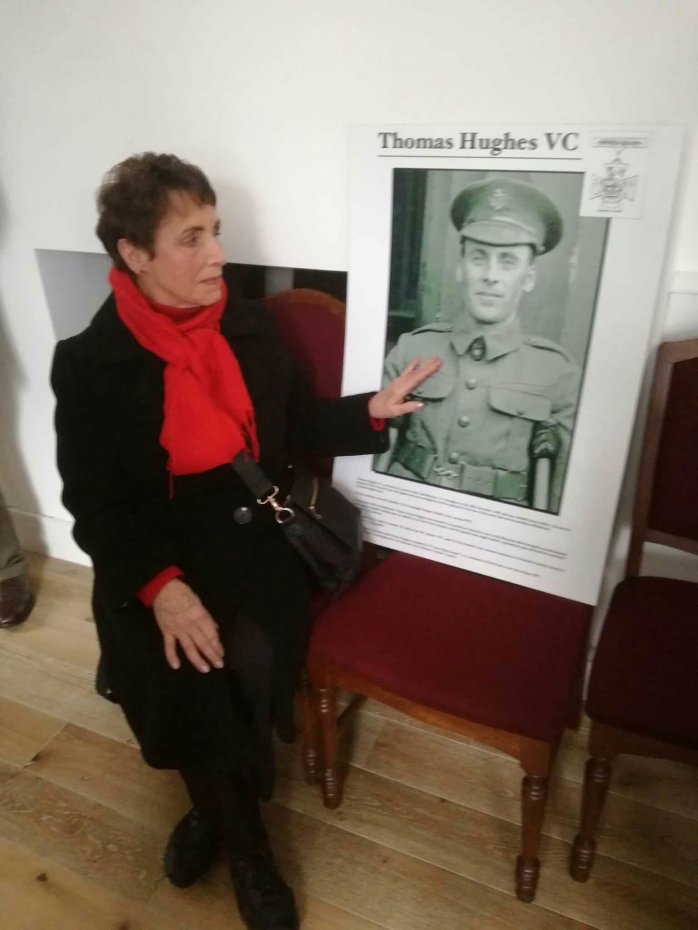
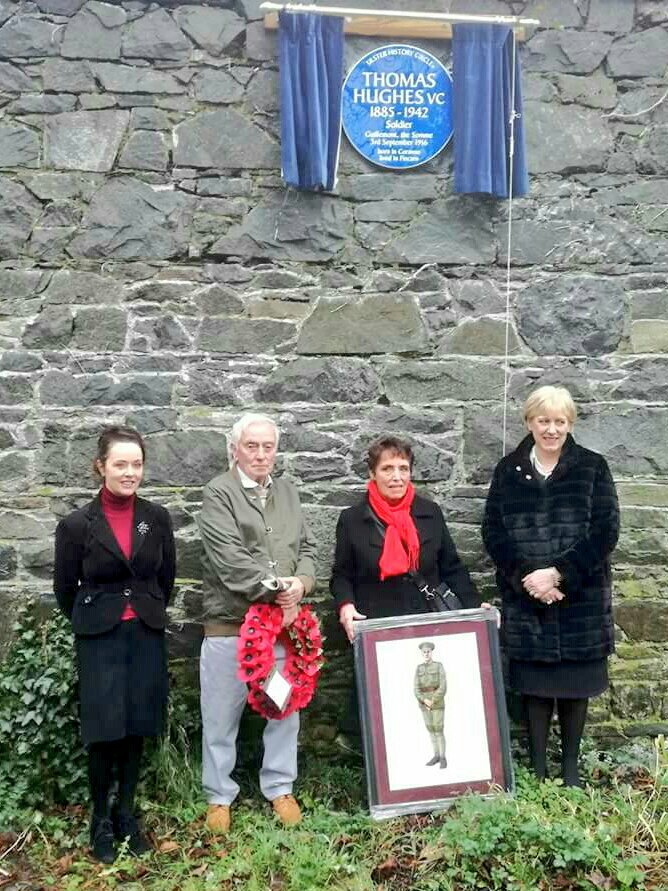
The unveiling of the Ulster History Circle blue plaque for Private Hughes in Castleblayney was attended by his niece Josephine (Hughes) Sharkey from Dundalk, and her daughter Siobhan. Other relatives included PJ McDonnell, (originally from Broomfield), Chair of the Monaghan Association in Dublin. His father’s mother and the mother of Thomas Hughes were sisters. Other relations came from the Donaghmoyne area, including Ann Christy, a grand niece, Brian Conway from Castleblayney, Pauline McGeough (Broomfield), Rosemary Hughes-Merry (Castleblayney), Angela McBride from Carrickmacross and a distant cousin, Frank Hughes, originally from Laragh.

img_20190818_185519-1750593536.jpg

Niece of Pte Hughes, Josephine Sharkey from Dundalk, with his portrait

The attendance included former members of the Irish Defence Forces from the Blayney Sluagh group, representatives of the Royal Inniskilling Fusiliers and the regimental museum in Enniskillen, members of the Lisbellaw and south Fermanagh WW1 Society (who also visited the grave of Private Hughes), and the curator of Monaghan County Museum, Liam Bradley, who had organised a number of events for the 1916 Somme centenary.

Siobhan (Hughes) Sharkey read a poem which had been specially composed for the occasion of the presentation of the Victoria Cross to Private Hughes in 1917. On his return to Castleblayney, the urban district council with Lord Francis Hope arranged an address of welcome for Hughes to celebrate his bravery on winning the “coveted trophy which is emblematical of the highest bravery on the battlefield”. Local dispensary Dr J.P. Clarke said it was with great pleasure he read in the press of the coveted decoration “being pinned to the breast of our hero.” He did not know whether it was time for poetry or not, but anyhow he could recite them a few lines he had composed for the occasion (in Castleblayney in 1917)…

POEM: THOMAS HUGHES V.C.

Before the Kaiser’s war began with frightfulness untold,

How many a peaceful hero worked in many a peaceful fold,

How many a valiant soldier strove to keep the home fires bright,

How saddened skies weep over their graves in pity through the night.

From Suvla Bay to doomed Ostend, from Jutland to Bordeaux,

They fought and bled and died to save these countries from the foe;

In Flanders, France and Belgium, from Seine to Grecian shore,

Brave were the deeds and bright the hopes of boys we’ll see no more.

‘Mongst them times forty thousand men picked out from Ireland’s sons,

Who went to fight the Austrians, the Bulgars, Turks and Huns,

How few returned with due reward their valour to repay,

But Thomas Hughes of Corravoo, V.C., is here to-day.

A Blayney man whose noble deeds uphold our country’s pride,

Who saved his comrades, took the gun, cast thought of self aside,

And changed defeat to victory in blood-soaked trenches when,

He ranked with bravest of the brave — the Connaught Rangers men.

Tom Hughes was reared where sun at dawn makes shadows lightly fall,

Across Fincarn’s ancient hill so sacred to us all;

For there tradition tells an Irish hero proudly rests,

Strong Finn McCool, the warrior, enshrined in Irish breasts,

Near by the road in Lackafin, beside lone Corravoo,

Remains of Irish chiefs are found in cromlech plain to view,

Among these scenes his youth was passed, no recreant was he,

For when his chance to fight arrived he well won his V.C.

He faced grim death while all around like Autumn leaves men fell,

He fought good fight and gained the day despite the raging hell

Of bullets, bayonets, shrapnel, Jack Johnson’s gas set free.

Now raise three cheers, and three times three, for Thomas Hughes V.C.!”

img_20190818_185512534402841.jpg

Unveiling of plaque in Castleblayney by Minister Heather Humphreys TD (right) and relatives of Pte Hughes VC