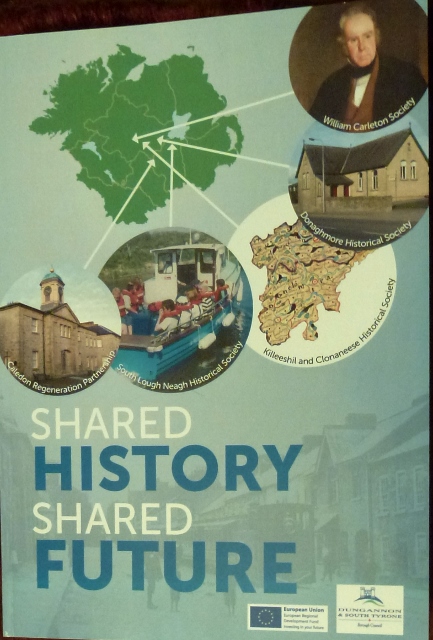
Shared History Shared Future booklet


Shared History Shared Future booklet
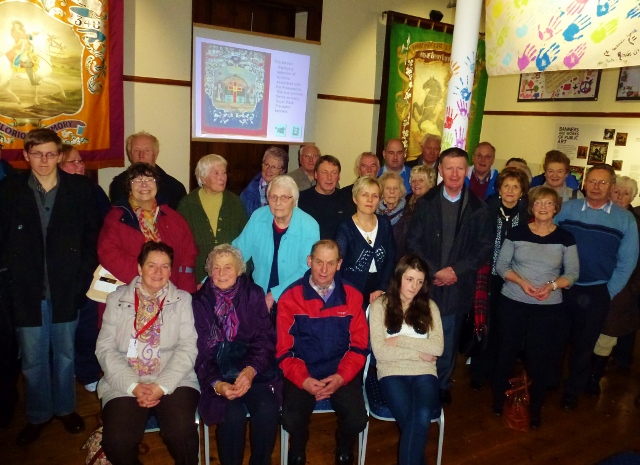
Members of the group at Cavan County Museum Photo: © Michael Fisher
Visit to Cavan County Museum, Ballyjamesduff, by members of the ‘Shared History, Shared Future’ project from South Tyrone. Members of the William Carleton Society joined the other groups on this study trip from Dungannon via Broomfield (coffee break at An Eaglais), the Boyne Valley and Navan to County Cavan. An evening meal was organised at the Lavey Inn.

Coffee Break at An Eaglais, Broomfield Co.Monaghan
Once again I am turning to the Reverend Patrick Comerford for today’s contribution. A very interesting talk about the Church of Ireland: Church, Culture and being relevant. It was part of a series of talks on Anglicanism being delivered by him at the Mater Dei Institute of Education in Dublin.
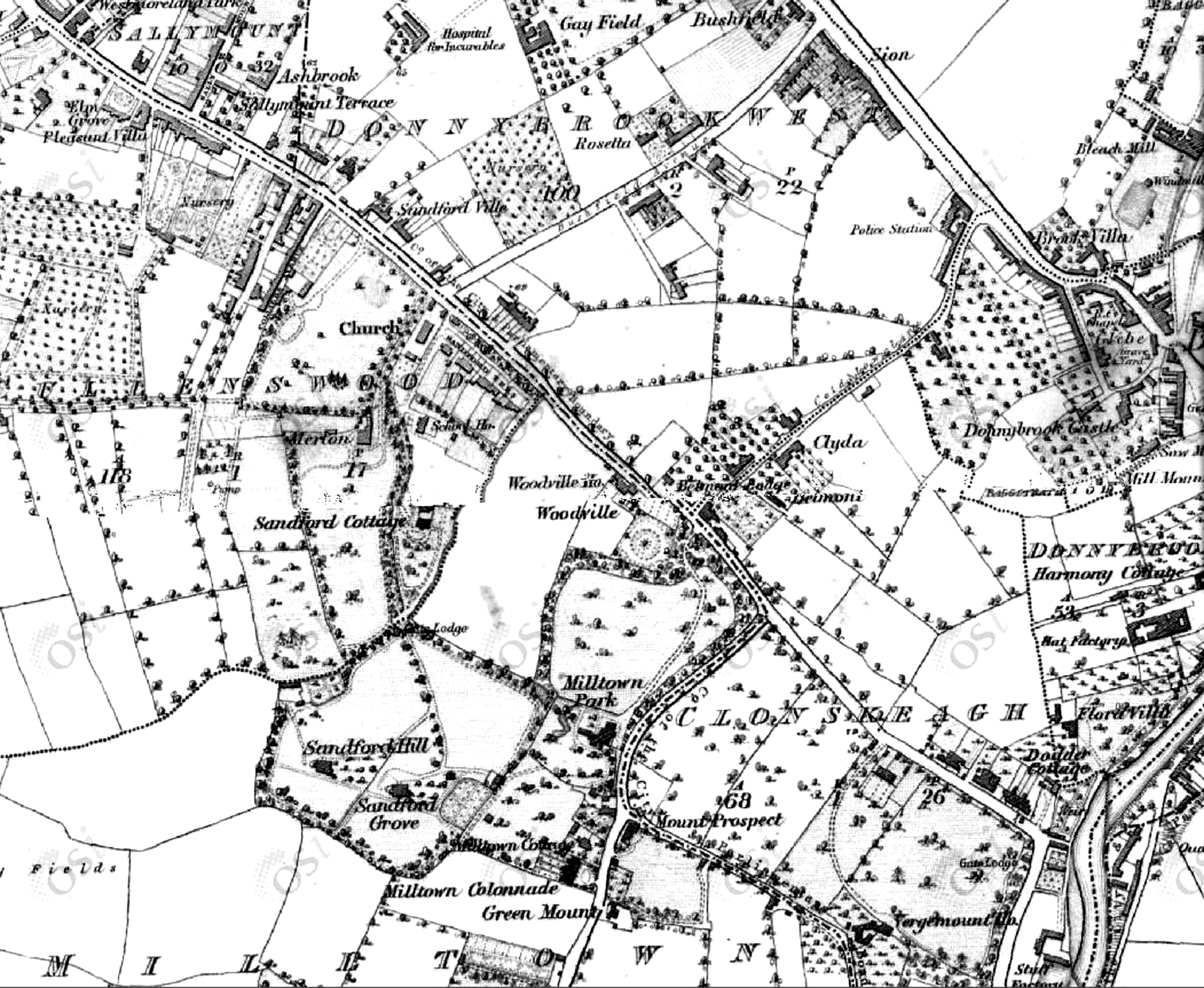
Map of Sandford Road Ranelagh c.1850 showing Woodville, where Carleton lived (Dublin City Library)
He might have added William Carleton (1794-1869) to the list of writers who were members of the Church of Ireland, although he came from a Catholic background and wrote mainly about the poor tenant farmers in the Clogher Valley: ‘Traits and Stories of the Irish Peasantry’. Carleton died in Ranelagh and is buried at Mount Jerome cemetery in Dublin and he spent most of his adult life in the city. This article on the Life of William Carleton was published in the William Carleton Society summer school booklet 2013 and is also included in a new publication due to be launched in Dungannon next Tuesday (19th November) on the ‘Shared History, Shared Future’ project involving five local historical and cultural societies.
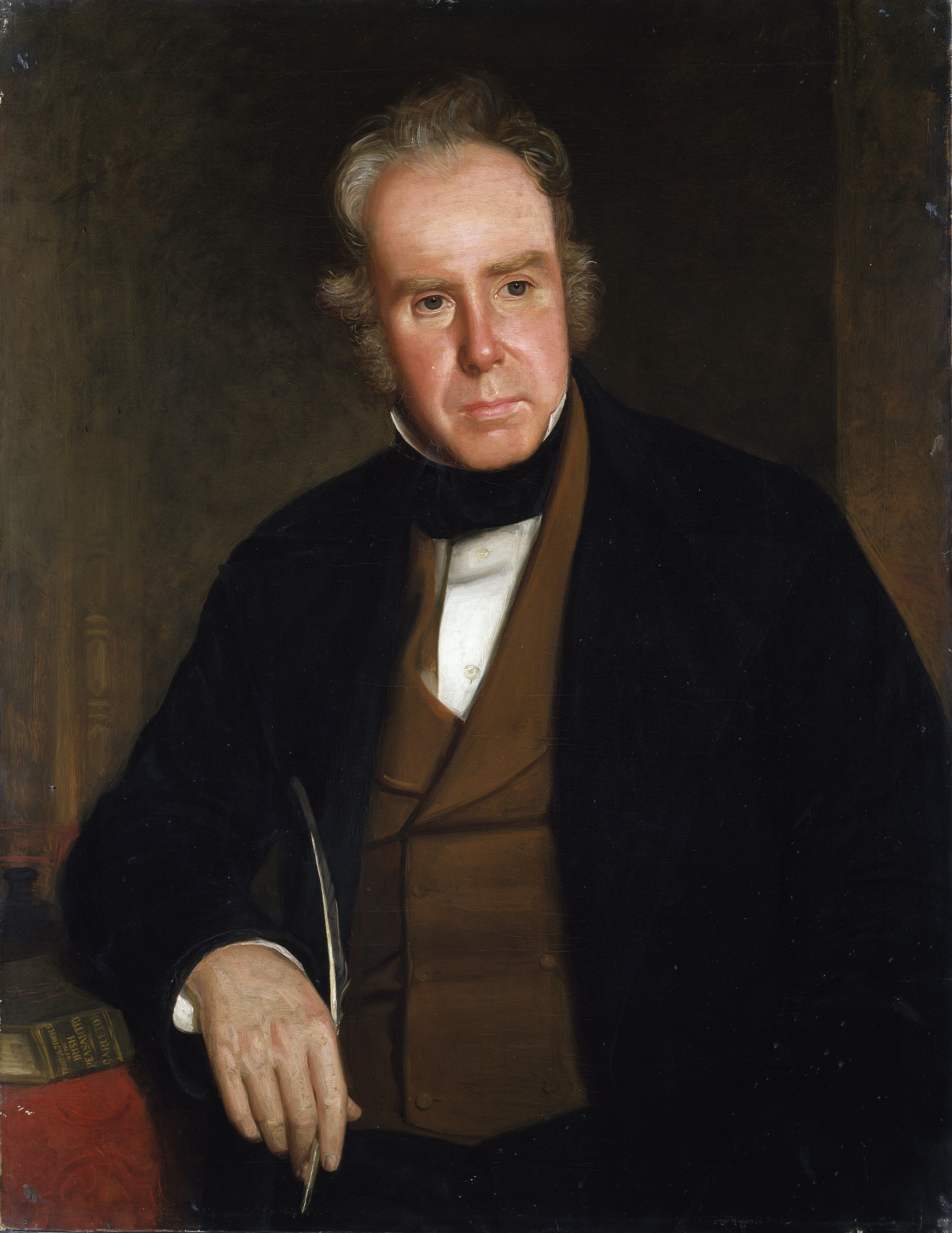
John Slattery portrait of William Carleton from National Gallery of Ireland
William Carleton (1794 – 1869) was born the youngest of a family of fourteen children in the townland of Prolusk (spelled ‘Prillisk’ in his autobiography) near Clogher in Co.Tyrone, on Shrove Tuesday, 20th February, 1794. Although there is little suggestion that the Carletons were upwardly mobile, they did move house frequently within the Clogher area and were established at the townland of Springtown when William left the family home. Carleton obtained his education at local hedge schools which he was to write about, fictionalising the pedagogue Pat Frayne as the redoubtable Mat Cavanagh. From other retrospections of his home district, we learn of Carleton’s delight in his father’s skill as a seanachie and the sweetness of his mother’s voice as she sang the traditional airs of Ireland; of his early romances- especially with Anne Duffy, daughter of the local miller; of Carleton the athlete, accomplishing a ‘Leap’ over a river, the site of which is still pointed out; of the boisterous open air dancing. Initially an aspirant o the priesthood, Carleton embarked in 1814 on an excursion as a ‘poor scholar’ but, following a disturbing dream, returned to his somewhat leisurely life in the Clogher Valley before leaving home permanently in 1817. Journeying via Louth, Kildare and Mullingar, he found work as a teacher, librarian and, eventually, as a clerk in the Church of Ireland Sunday School Office in Dublin. In 1820, he married Jane Anderson who bore him several children. By 1825, Carleton. who had left the Roman Catholic Church for the Anglican Church of Ireland, met a maverick Church of Ireland cleric, Caesar Otway, who encouraged him to put his already recognised journalistic talents to such prosletysing purposes as satirising the attitudes reflected in pilgrimages to ‘St Patrick’s Purgatory’ at Lough Derg, a totemic site in Irish Catholicism. Further writings in the Christian Examiner & Church of lreland Magazine led in 1829 and 1833 to the publication of what is arguably Carleton’s best known work: Traits and Stories of the Irish Peasantry. In these stories Carleton returned imaginatively to the Clogher Valley, drawing on comedy, farce, melodrama and tragedy to present a tableau of the life of the country people of the north of Ireland before the famines of the 1840s altered their pattern of existence for ever. Carleton went on to respond to the challenge of the novel, in his tirne a comparatively undeveloped genre amongst Irish writers, and published Fardorougha the Miser (1839), Valentine McClutchy (1845), The Black Prophet (1847), The Emigrants of Aghadarra (1848), The Tithe Proctor (1849), The Squanders of Castle Squander (1852). In these works he addresses many of the issues affecting the Ireland of his day such as the influence of the Established Church and landlordism, poverty, famine and emigration but does so with an earnestness that regrettably often caused his more creative genius to be swamped in a heavy didacticism. Carleton continued to write in a variety of forms, including verse, until his death in 1869, but critics are agreed that the quality of the work is uneven. Despite his prolific output, Carleton never really made a living from his writings and welcomed the pension voted to him by the government following the advocacy of such contrasting figures as the Ulster Presbyterian leader, Dr Henry Cooke, and Paul Cardinal Cullen, Catholic Archbishop of Dublin. His last project, uncompleted when he died, was his Autobiography, which was re-issued through the efforts of the Summer School Committee in 1996. Carleton was buried in the cemetery at Mount Jerome in Dublin and over his grave a miniature obelisk records the place “wherein rest the remains of one whose memory needs neither graven stone nor sculptured marble to preserve it from oblivion”.

IEC Cathaoirleach Gerry Curran addresses the BDC Photo: © Michael Fisher
Conferences for the NUJ in Ireland are held every two years. The wider union is also moving to a two-year cycle for the Delegate Meeting, which had already been shifted to an eighteen months interval in order to save money. The next DM will be held in Eastbourne in April and motions for it need to be submitted to our branch meeting by midday on Friday week (22nd November). Please contact Branch Secretary Gerry Carson.
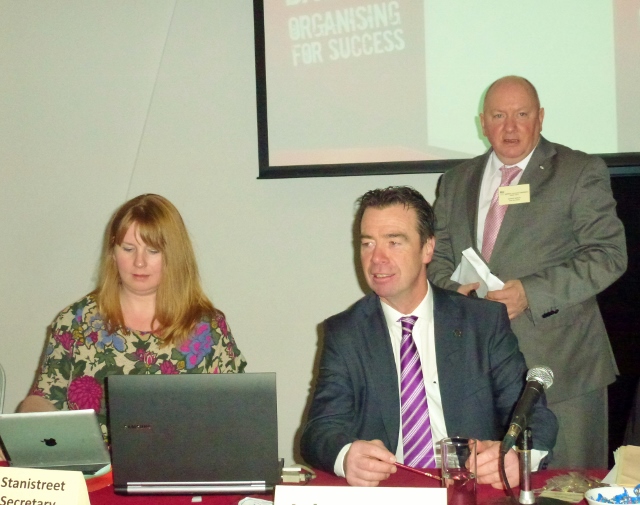
NUJ General Secretary Michelle Stanistreet with ICTU President John Douglas and Irish Secretary Seamus Dooley Photo: © Michael Fisher
On Saturday, ICTU President John Douglas addressed the NUJ in Ireland biennial delegate conference, which was held once again in the Cusack stand conference centre at the GAA headquarters at Croke Park. Another meeting was being held on the same level in a different section further along the corridor and above the GAA Museum on the ground floor.

Michael Cusack statue & stand, Croke Park Photo: © Michael Fisher
From our vantage point we could see that repair work was continuing on the pitch to protect it during the winter. In the Hogan stand, groups were being taken on tours of the impressive stadium.
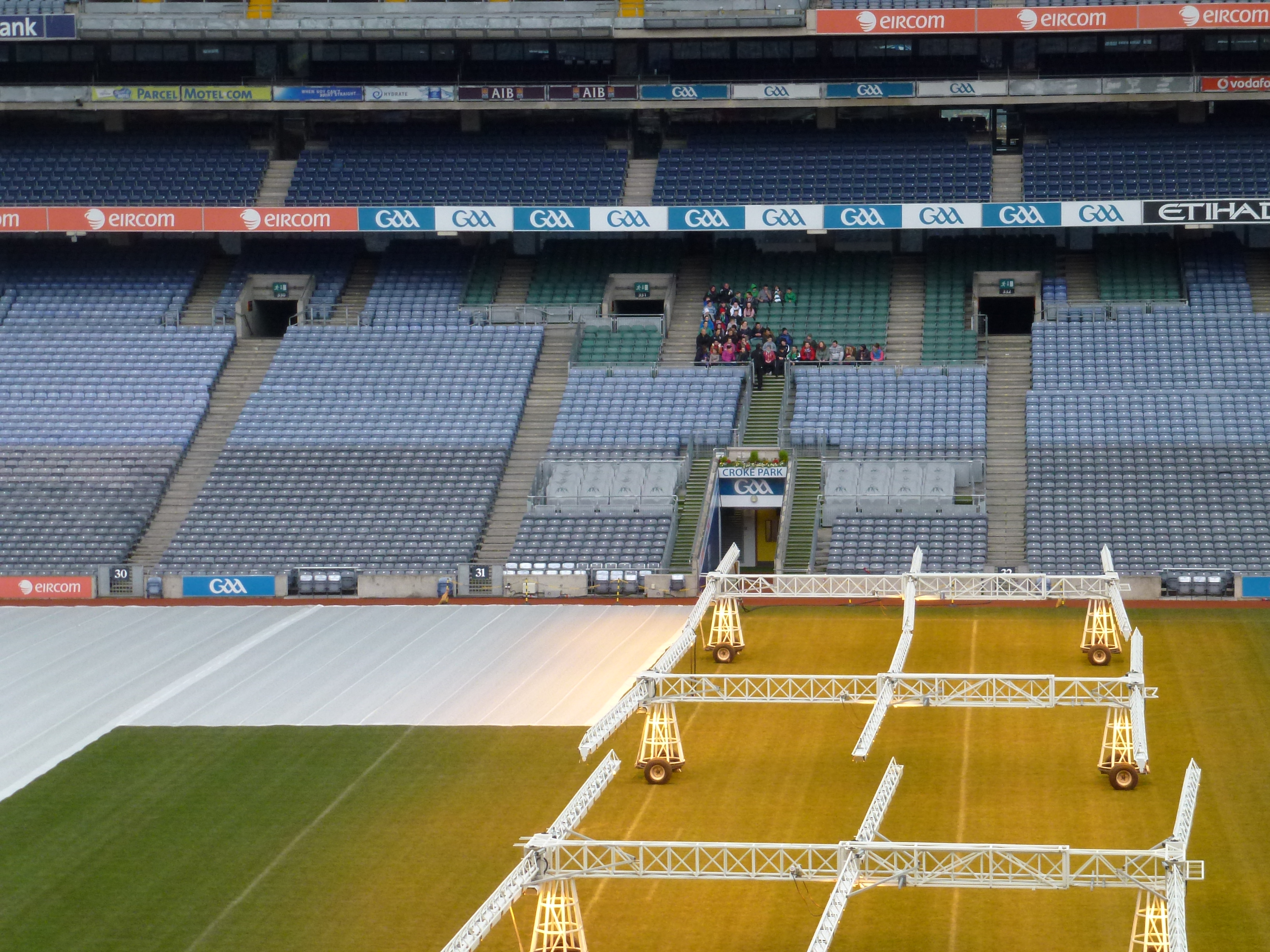
Croke Park pitch Photo: © Michael Fisher
The NUJ website contains some details of the proceedings. Good to see that the government has withdrawn amendments relating to the Freedom of Information legislation that would have introduced new charges.

NUJ General Secretary Michelle Stanistreet addressing the BDC Photo: © Michael Fisher
The union called for immediate publication of Irish government proposals for legislation guaranteeing workers the right to collective representation and bargaining. The NUJ also called for the appointment of a Minister for labour affairs of cabinet rank in order to give greater priority to the rights of workers.
In his report to the conference, Séamus Dooley, NUJ Irish Secretary, said the official commemoration of the 1913 Lock Out will be remembered as “a hypocritical charade”, if the government commitment to publish legislation on collective bargaining is not honoured by the end of this year. He said the inadequate protection for workers and the absence of the legal right to collective representation is a scandal which cannot be ignored. The NUJ and SIPTU, through the ICTU, are preparing a complaint to the Geneva-based International Labour Organisation on the denial of the right to representation.

ICTU President John Douglas addresses NUJ BDC Photo: © Michael Fisher
The report highlights the failure of successive governments to honour commitments to bring about legislative change to protect freelance workers. In the report, Séamus Dooley says:
“We consider the failure to implement the solemn commitments regarding the right of freelance workers to collective representation through amendment of Competition Law as a betrayal. It is ironic that the state should celebrate the contribution of Larkin, who organised self-employed workers, but force unions to seek relief through the ILO after more than a decade of broken promises,”
The last national agreement, Towards 2016, contains a specific commitment to reform of competition law which still has not been honoured. The union is also calling for the establishment of a minister for labour affairs of cabinet rank as a means of ensuring that employment rights are given greater priority, a call first made by the NUJ in 2007.
The NUJ conference also passed two motions dealing with the ‘JobBridge’ programme. In his report, Séamus Dooley called on the government to abandon the scheme. He said there was clear evidence that JobBridge was being used by a range of media organisations as a source of free labour.
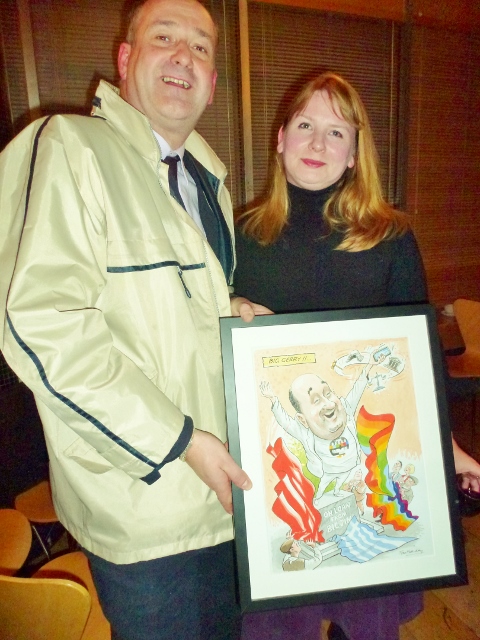
IEC Cathaoirleach Gerry Curran received a gift of a framed cartoon. Pictured with Michelle Stanistreet Photo: © Michael Fisher

Brendan Behan’s typewriter & NUJ Card: Photo: Dublin Writers Museum
Brendan Behan’s NUJ card and Remington portable no.2 typewriter along with a first edition of ‘The Quare Fellow’ (1954) are on display at the Dublin Writers Museum in Parnell Square. His membership of the union was discussed during a tour by an NUJ group of the graves of writers and other famous people at Glasnevin cemetery in Dublin on Sunday.
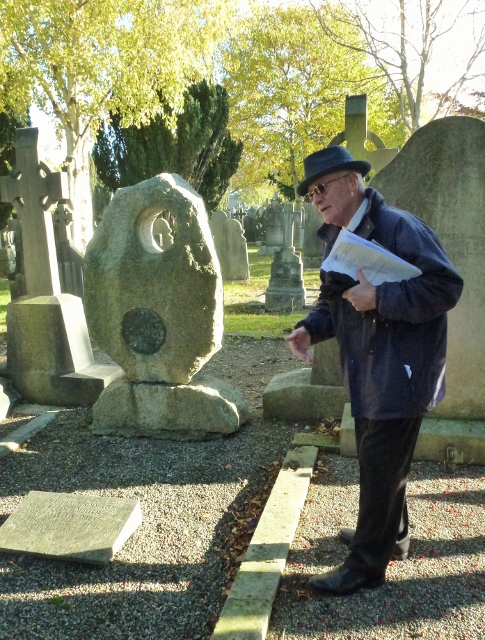
Tour Guide Paddy Gleeson points out Brendan Behan’s Grave Photo: © Michael Fisher
I am told that Joe Jennings (later CIÉ Press Officer) was his proposer when Behan started writing a weekly column and joined The Irish Press chapel in 1954. I also know that when my father was London Editor of The Irish Press (1954-1962), the playwright had called into the Fleet Street office, probably looking for an advance of some sort.
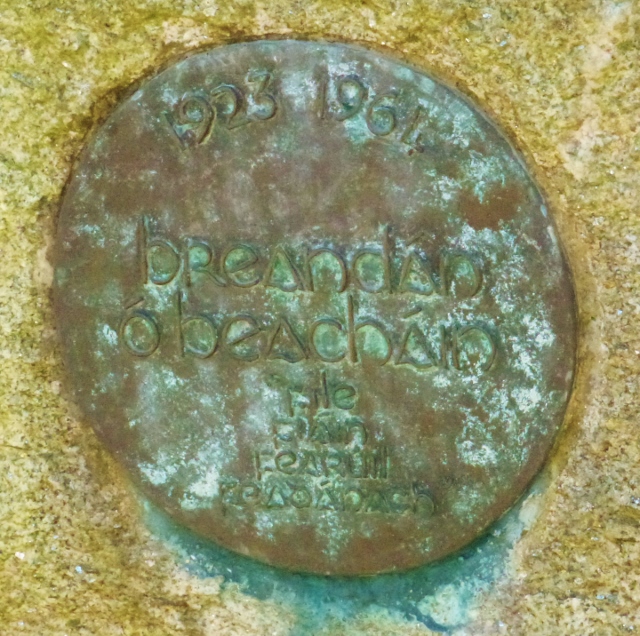
Plaque on Behan’s Grave Photo: © Michael Fisher
In May 1956, The Quare Fellow’ opened at the Theatre Royal Stratford East, in a production by Joan Littlewood’s Theatre Workshop. The play later transferred to the West End. Behan died on March 20th 1964, aged 41.
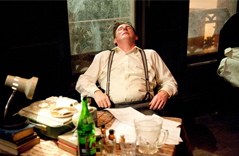
Adrian Dunbar in ‘Brendan at the Chelsea’ Photo: Lyric Theatre
In May 2011, a play called ‘Brendan at the Chelsea’, written by Behan’s niece, Janet Behan, was the first work to be performed in the Naughton Studio at the new Lyric Theatre in Belfast. The production tells the story of Behan’s residence at New York’s Hotel Chelsea in 1963. It was a critical success and was revived for a tour to the Acorn Theatre in New York in September, before returning to the Lyric in October. Again, it received favourable reviews.
“In Adrian Dunbar’s riveting central performance, Behan plays the stage Irishman to perfection, a song permanently on his lips, his slurring, alcohol-soaked wit delighting a succession of hangers-on with its scathing, self-deprecating observations.” (‘The Stage’)

Brendan Behan’s Grave Photo: © Michael Fisher
Starting tonight, the play has moved to the Project Arts Centre in Behan’s native Dublin and will run for five nights until Saturday. More information can be found here.
Adrian Dunbar plays Brendan Behan in this warm and funny drama of an Irish national treasure. It is 1960s New York in the legendary bohemian bolt hole, The Chelsea Hotel. Arthur Miller is just across the hall and the symphony of 24th Street is rising up and in through the open window of Brendan Behan’s room. He is broke, hung over and way past the delivery date of his latest book, the first line of which he is yet to write. He was told to stop drinking or he’d be dead in six months – that was two years ago. Today is not going well. His mistress keeps ringing, the bills aren’t paid and a wire arrives from Dublin with the kind of news that’s guaranteed to put his blood pressure through the roof…
Adrian Dunbar (who sings a song in Irish) and Janice Behan were interviewed on the John Murray Show this morning on RTÉ Radio 1.
Brendan Behan Source: John Murray Show website

Armistice Day Belfast Picture: BBC News NI
As the centenary of the start of the First World War approaches, a couple of important developments happened today on either side of the border on Armistice Day. Representatives of victims of the troubles were at Stormont to call on politicians to agree new mechanisms to investigate past human rights violations and abuses.
A Sinn Féin Lord Mayor of Belfast, Máirtín Ó Muilleoir. became the first member of his party to take part in the official ceremony at City Hall. BBC Northern Ireland report here. As I commented elsewhere (on twitter), this was in my view the ‘right call to attend Armistice Day event: your presence at a Belfast ceremony was significant, not about wearing a poppy’. He was accompanied by some of the chaplains he had appointed at the start of his mayoral term, among them Fr Des Wilson from West Belfast, and a couple of party colleagues including Councillor Tom Hartley, a local historian.
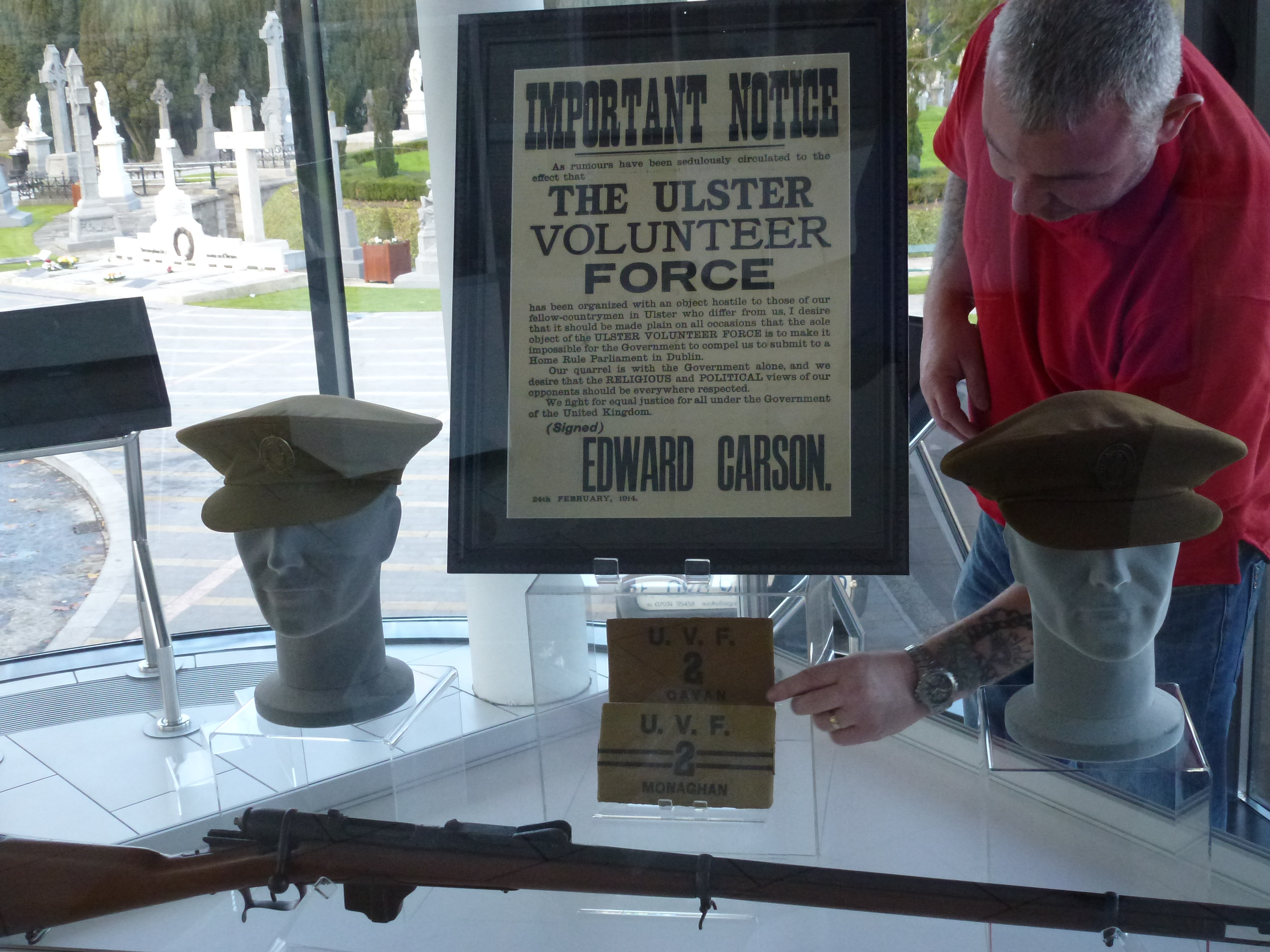
Preparing the exhibition at Glasnevin Photo: © Michael Fisher
Meanwhile in Dublin, an exhibition developed under the auspices of the Unionist Centenary Committee and containing the largest collection of UVF memorabilia ever seen in the Republic was opened in the visitor centre at Glasnevin cemetery. This is the burial ground for some of the best-known figures in Ireland’s history, such as Daniel O’Connell and Michael Collins, and including many republicans. The Unionist Centenary Committee was formed in 2010 as a steering group made up from stakeholders from the Unionist community to oversee the decade of centenaries between 2012-2021.
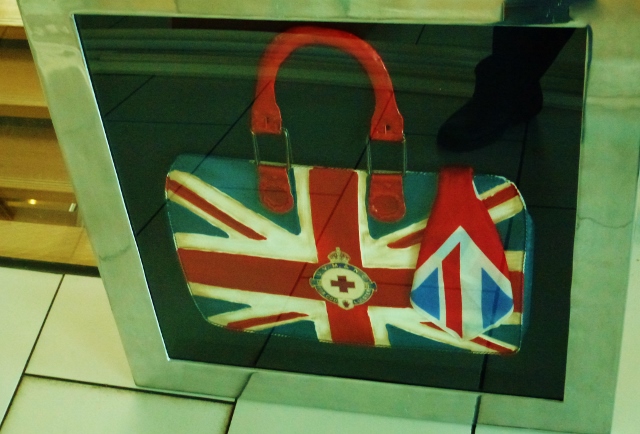
Bag used by UVF Medical & Nursing Corps Photo: © Michael Fisher

Arts Minister Jimmy Deenihan Photo: © Michael Fisher
The Ulster Volunteer Force was formed to resist plans to make Ireland self-governing, but many members went on to fight in the British Army in the First World War. The exhibition is called Home Rule Crisis… the unionist response. It covers the period from 1912-1914 and was officially opened by the Minister for Arts and Heritage Jimmy Deenihan, who had read a lesson at the Remembrance Sunday service at St Patrick’s Cathedral in Dublin yesterday.
Some unionist politicians also attended the Glasnevin event. A priest read prayers before people in UVF costumes laid wreaths at the war graves commission memorial to those from the Republic who died fighting for the allies in the two world wars.
The collection of artefacts from the Home Rule period includes personal items of James Craig, uniforms, and literature from that pivotal period. Tours of the exhibition will be provided free of charge. The exhibition focuses on the unionist reaction to events during 1912-1913, particularly the Ulster Covenant and the formation of the UVF.
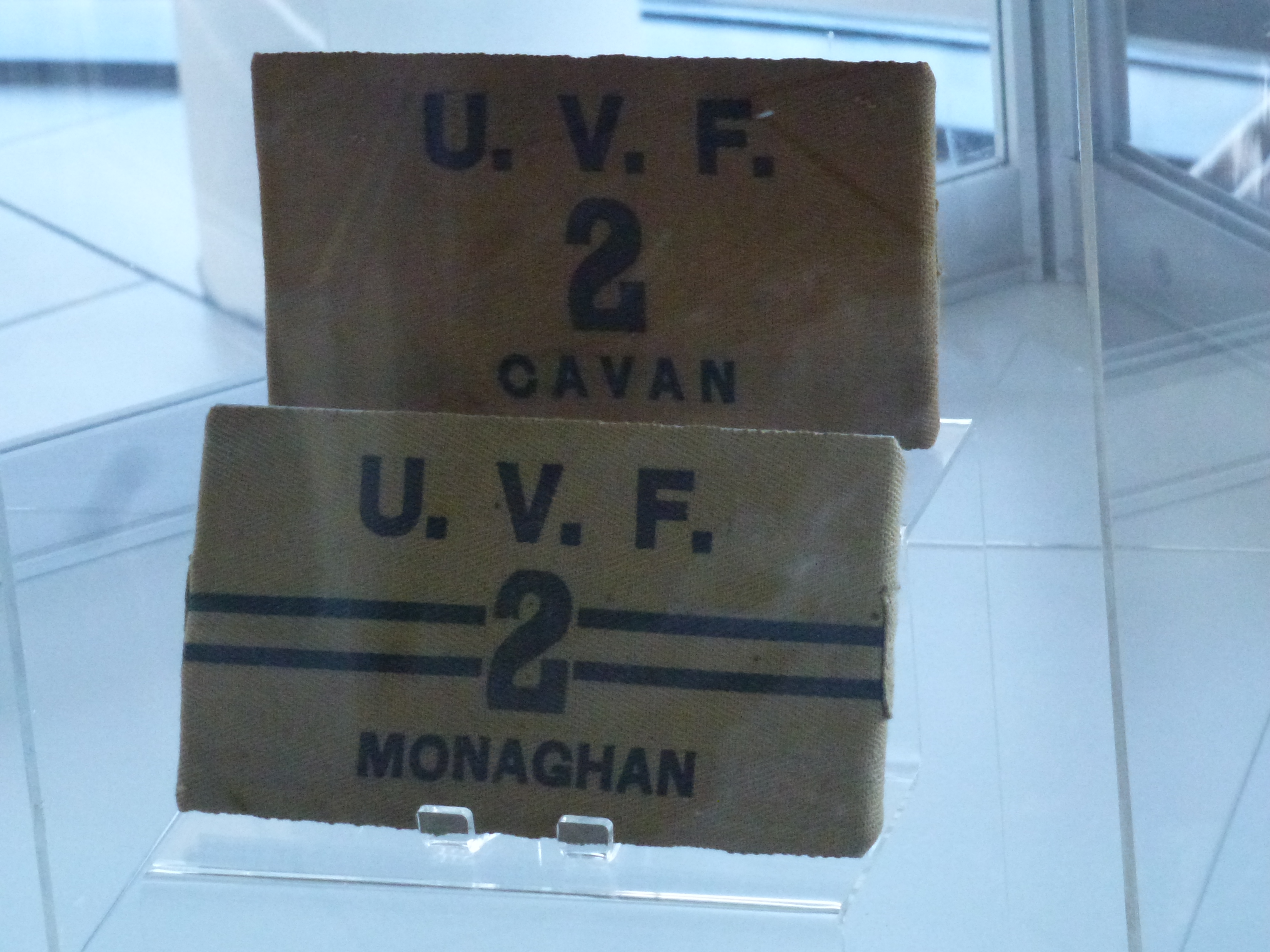
UVF armbands from Cavan and Monaghan Photo: © Michael Fisher
The launch included a talk by Philip Orr and a drama depicting discussions between Carson, Craig and Crawford at the time, and music. On Saturday 16th November, Quincey Dougan and Jason Burke will provide lectures on Unionism 100 years ago. The exhibition is free and will run for two weeks until the end of November. It will be followed by an exhibition on the Irish Volunteers, the formation of which was planned at a committee meeting 100 years ago today in Dublin.
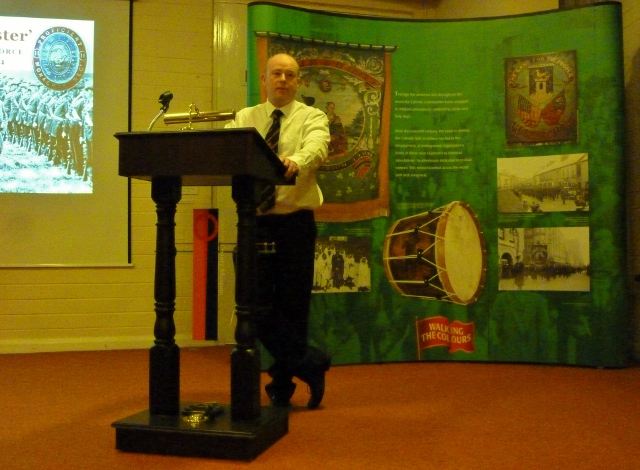
Quincey Dougan, talking about the UVF in Monaghan in June Photo: © Michael Fisher
Unionist Centenary Committee Chair David Hagan said:
“We are excited to be bringing such a major collection of Unionist artefacts to Glasnevin Cemetery. Traditionally a site steeped in Republican and Nationalist history, it shows the progress we are making in embracing and learning more about our shared history. Over the course of the week we are also holding lectures which provide a deeper insight into Unionist thinking at the time and we will have historians on hand around the exhibition to provide further information on the collection. We have already exhibited some of the collection around Northern Ireland and have received really positive feedback, so we are looking forward to offering the people of Dublin the opportunity to learn more about Unionism in Ireland 100 years ago.”

Figure of UVF member Photo: © Michael Fisher
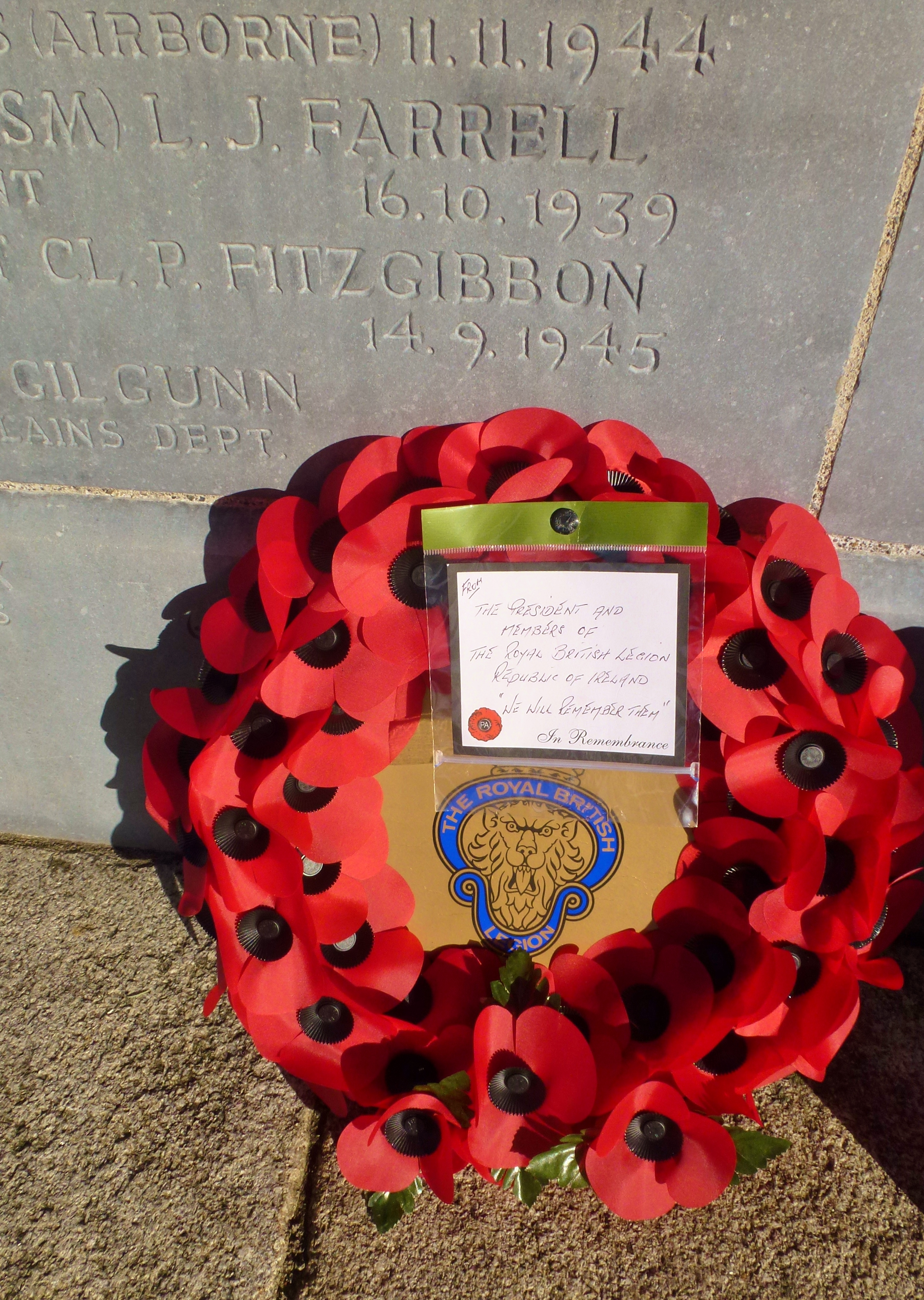
Glasnevin Cemetery, Dublin 11am Photo: © Michael Fisher
At 11am on Remembrance Sunday our group was gathering at the entrance to Glasnevin cemetery in Dublin for a tour of graves. One of the first I noticed was the memorial to Irishmen who had served as British soldiers in the Great War and the Second World War. The monument had been restored in 2011 by the Commonwealth Graves Commission. The Royal British Legion had placed a wreath there and on Monday there will be special ceremonies taking place on the 11th hour of the 11th day of November, with a number of VIPs expected to attend.
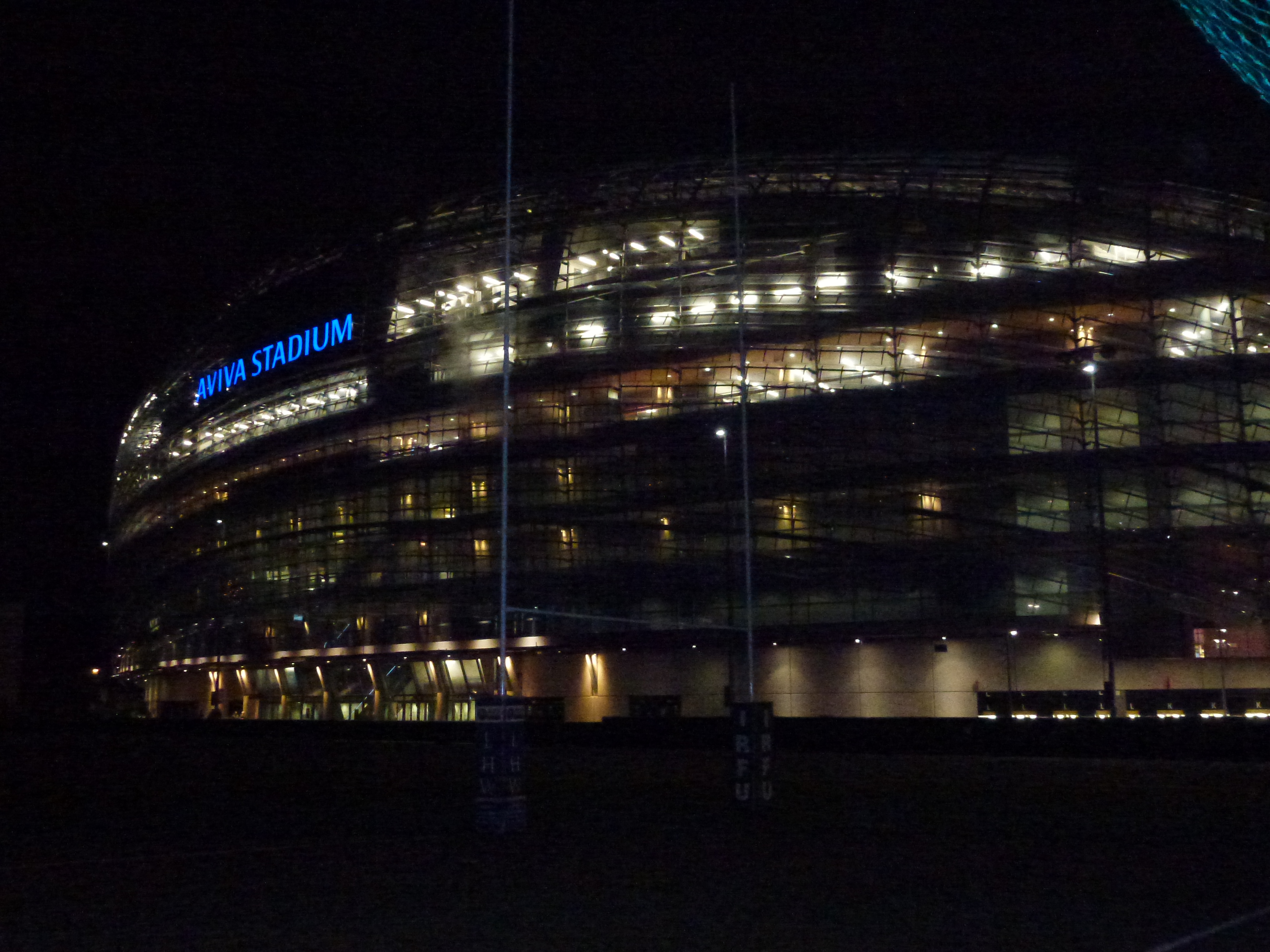
Aviva Stadium (Lansdowne Road) Photo: © Michael Fisher
Rugby: Ireland beat Samoa 40-9 in their first game under the management of Joe Schmidt at Lansdowne Road (Aviva stadium). Tougher games to come against Australia and New Zealand.
Ireland scored five tries, most of them in the second half. Ireland led 14-6 at the break.
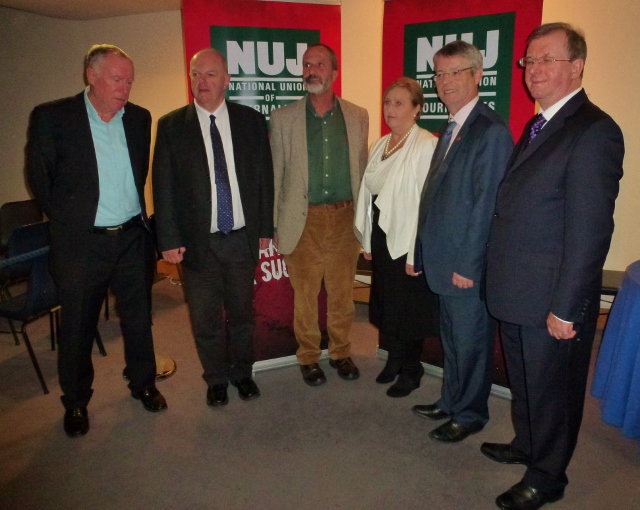
Five of the ten new NUJ life members in Dublin Photo: © Michael Fisher
NUJ President Barry McCall from Dublin was the guest of honour at the presentation of life memberships to ten members of the National Union of Journalists, most of them working in the Dublin area. The ceremony was held on Friday evening at Liberty Hall, as a prelude to the Biennial Delegate Conference of the Irish section of the NUJ. NUJ General Secretary Michelle Stanistreet came to congratulate the ten, who between them have over 400 years’ membership of the union.

Jim Eadie, Ray Managh, Michelle Stanistreet and Michael Fisher (Belfast & District Branch, NUJ)
Husband and wife team Clodagh Sheehy and Liam Kelly from the Irish Independent group were among the recipients. Des Ekin of the Sunday World, who joined the NUJ as a cub reporter in the Newtownards Chronicle before moving to the Sunday News also received the award. Another Northerner Ray Managh who has worked for many years as a freelance courts correspondent in Dublin was presented with his certificate. He began his career in the Tyrone Constitution in Omagh and his proposer for NUJ membership was Ivan McMichael. He sent warm regards to a former colleague and PA Ireland Editor Deric Henderson, celebrating forty years as a journalist in Belfast.

Ray Managh Photo: © Michael Fisher
IEC Cathaoirleach Gerry Curran (who has been re-elected to the post) thanked each of the members for their contribution to the NUJ.
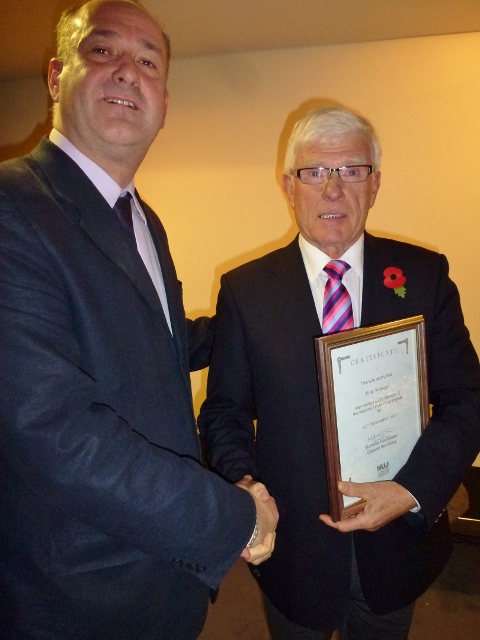
IEC Cathaoirleach Gerry Curran presents Ray Managh with his life membership award Photo: © Michael Fisher
The other recipients were Paul Barry, former deputy Sports Editor of the Irish Times, whose father, a photographer, had proposed him for NUJ membership; Michael Lavery, formerly of the Roscommon Herald and later with the Evening Herald; Con Power and Albert Smith (Independent Newspapers); Gerry Smyth, a poet, who worked for The Irish Times (I know from my mother that the Smyths are particular about the spelling of their surname!!); and Jim Smith (correct!), former Editor of the Dundalk Argus.
Working on a forthcoming booklet has meant that I have missed a few daily blogs recently. It has however been interesting to see that even without any new material, my page received 146 views, mainly of my coverage in August of the Ballygawley bus bomb commemoration. To make up the quota, I am republishing a recent blog by my nephew Sam on the site he co-hosts, Come Here to Me, which is all about Dublin. He has written this interesting article on the Jewish Community in Dublin during the Revolutionary Period (1916-23) and any commentary is his:
November 7, 2013 by Sam
In the early half of the twentieth century, there were roughly 3,700 Jews living in Ireland. This represented about 0.12% of the total population. Though their numbers were minuscule, members of the the Jewish community were disproportionately active in the fight for Irish independence. Melisande Zlotover in his 1966 memoir ‘Zlotover story: A Dublin story with a difference’ assessed the overall situation by writing that Dublin’s Jews “were most sympathetic [to the fight for Independence] and many helped in the cause”.
These included:
Michael Noyk (1884–1966) Jewish Dublin-born republican activist and lawyer who most famously defended republican prisoners during the War of Independence and afterwards. In the 1917 Clare East by-election he was a prominent worker for Eamon de Valera and in the 1918 general election was election agent for Countess Markievicz and Seán T. O’Kelly. He was later involved in renting houses and offices for all the ministries established under the first Dáil. During the War of Independence he regularly met Michael Collins in Devlin’s pub on Parnell Square and helped to run the republican courts. In 1921 he was to the fore in defending many leading members of the IRA, including Gen. Seán Mac Eoin and Capt. Patrick Moran, the latter of which was executed for complicity in the shooting of British intelligence officers.
While Arthur Griffith’s early anti-Semitic comments (c.1904) are frequently recalled, it should be noted that he was an extremely close fiend of Noyk’s from 1910 onwards and he remained Griffith’s solicitor until his death in 1922. So close did Griffith’s relationship with Noyk become that his own daughter would act as a flower girl at Noyk’s wedding as Manus O’Riordan reminded us in an excellent 2008 article.
In later years, Noyk became a founder-member of the Association of Old Dublin Brigade (IRA) and a member of the Kilmainham Jail Restoration Committee. Keenly interested in sport, he played soccer in his youth for a team based around Adelaide Road and was for many years the solicitor to Shamrock Rovers. He died on 23 October 1966 at Lewisham Hospital in London. A huge crowd, including the then taoiseach, Seán Lemass, attended his funeral and the surviving members of the Dublin Brigade rendered full military honours at his graveside. He is buried in Dolphin’s Barn cemetery.

Noyk is honoured with portrait. The Irish Times, 06 Apr 1960.
Robert Emmet Briscoe (1894–1969) was a Jewish Dublin-born republican and businessman who most famously ran guns for the IRA during the War of Independence. Named after revolutionary leader Robert Emmet, his father, a steadfast Parnellite called another son Wolfe Tone Briscoe. Politicised after the Easter Rising, he attended meetings of Clan na Gael in the United States, meeting Liam Mellows, who influenced his return to Ireland (August 1917) to join the headquarters staff of Na Fianna Éireann. The clothing factory that Robert Briscoe opened at 9 Aston Quay, and a subsequent second workshop in Coppinger’s Row, both served as headquarters for clandestine Fianna and IRA activities before and during the War of Independence. Unknown to government authorities owing to his lack of prior political involvement, Briscoe engaged in arms-and-ammunition procurement and transport, and gathering of intelligence. Transferred to IRA headquarters staff (February 1920), he was dispatched by Michael Collins to Germany, where, with his knowledge of the language and country, he established and oversaw a network of arms purchase and transport. He maintained a steady flow of matériel after the July 1921 truce, and from 1922 to the anti-treaty IRA, with which he maintained links for some years after the civil war. Returning to Ireland after the 1924 general amnesty, he managed Dublin operations of Briscoe Importing, a firm already established by two of his brothers.
During the summer of 1926 the IRA raided the offices and homes of moneylenders in both Dublin and Limerick. Manus O’Riordan wrote that:
Those who were raided were indeed predominantly Jewish, but the IRA explicitly stated that their attack was on moneylending itself, “not on Jewry”.
Historian Brian Hanley summed up the situation well when he said that the IRA:
…were supported in their claims by the prominent Jewish politician in Ireland, Robert Briscoe of de Valera’s Fianna Fáil Party. He argued that he did not see the raids as anti-Semitic, and wished it to be known that he and ‘many other members of the Jewish community’ abhorred moneylending and expressed his admiration for the IRA’s attempts to end ‘this rotten trade’.
A founding member of Fianna Fáil (1926), he served on its first executive committee, and worked on constructing the party’s national constituency organisation, transporting party workers countrywide in his recently purchased motor car. Defeated in the June 1927 general election and in an August 1927 by-election occasioned by the death of Constance Markievicz, in the September 1927 general election he was elected to Dáil Éireann, becoming the first Jewish TD, and commencing an unbroken tenure of thirty-eight years, representing Dublin South (1927–48) and Dublin South-West (1948–65). Twice Lord Mayor of Dublin (1956–7, 1961–2), he made a spectacularly successful whistle-stop tour of the USA (1957) – the first of several official visits, trade missions, and speaking tours – lauded by Irish- and Jewish-Americans as Dublin’s first Jewish Lord Mayor.

JFK meeting with IRA veteran Robert Briscoe, Lord Mayor of Dublin. 26 March 1962. Credit – jfklibrary.org.
Estella Solomons (1882–1968), who hailed from one of the longest established Jewish families in Dublin, was a celebrated artist who served in the women’s republican auxiliary movement Cumann na mBan (Rathmines branch). One of her first jobs was distributing arms and ammunition which she kept hidden under the vegetable patch at the family home on Waterloo Road. When her sister visited from London with her British Army husband,, Estella stole his uniform and passed it onto the IRA. Solomons sheltered IRA fugitives in her studio during the War of Independence, and concealed weapons under the pretence of gardening. Estella’s IRA contact was a milk delivery man, who acted as a perfect cover for moving arms and gathering information. She persuaded him to teach her to shoot, in exchange she painted a portrait of his wife. Taking the anti-Treaty side and sheltering Republicans during the Civil War, her studio was often raided by Free State troops.
Solomons was elected an associate of the Royal Hibernian Academy (RHA) in July 1925, but it was not until 1966 that Solomons was elected an honorary member. Her work was included in the Academy’s annual members’ exhibition every year for sixty years. As her parents were opposed to her marrying outside her faith, it was not until August 1925, when she was 43 and her husband 46, that she married Seumas O’Sullivan, the editor and founder of the influential literary publication Dublin Magazine.

Estelle Sollomons, self-portrait, 1926. Credit – mutualart.com.
Gerald Yael Goldberg (1912–2003), Cork-born solicitor, politician and writer, retained vivid childhood memories of the War of Independence and Civil War period, including the burning of central Cork by crown forces (during which his family had to leave their home temporarily). He attended the lyings‐in‐state of Tomàs MacCurtain and Terence MacSwiney both of whom he always revered. In later life he commissioned portraits of MacCurtain and MacSwiney for the City Hall while he was Lord Mayor. Goldberg also acquired a long-lasting respect for fellow Corkman Michael Collins after hearing him speak at a public meeting.
The Goldbergs moved to Cork after the anti‐Semitic Limerick riots, and subsequent boycott, of 1904, in which Gerald’s father Louis was assaulted. In secondary school, he and his brother got into trouble after they applied to be excused from Armistice Day (as a German pupil was excused) because the British had murdered MacCurtain and MacSwiney. In the 1930s Goldberg established a committee in Cork to help Jewish refugees from Nazi persecution; in later life he spoke bitterly of the refusal of the state to admit such refugees, and recalled how a German Jew who deserted a ship at Cobh was sent back to the concentration camps despite the Cork community’s willingness to assist him. A successful solicitor, he was elected president of the Cork Hebrew Congregation in 1943, and remained the public face of Cork Jewry until his death.
Goldberg was elected to Cork corporation as an independent alderman for the north‐west ward in 1967 but joined Fianna Fáil in 1970, stating that it was impossible for an isolated councillor to achieve anything on the corporation. In 1977, he was elected lord mayor of Cork, the first Jew to hold this office. During his term he researched the history of the civic regalia, including the mayoral chain (he published a pamphlet on its connection with Terence MacSwiney) and the mace (leading him to make a public appeal for the British Museum to return to Cork several former Cork maces it had acquired over the years). In 1982 he openly considered leaving Ireland after he received death threats and after a fire‐bomb attack on the Cork synagogue, which were linked to hostile relations between Irish peacekeeping forces in South Lebanon and Israeli and Israeli‐backed forces. He retired from Cork corporation in 1985. He died, at the age of 91, in Cork, on 31 December 2003, and received a civic funeral on 4 January 2004 to the Cork Jewish graveyard at Curraghkippane. Cork corporation members wore skullcaps in his honour.
Francis Rebecca ‘Fanny’ Goldberg (1893-?) and Molly Goldberg (1896-), sisters of Gerald, were active with Cuman na mBan. Dermot Keogh in his book ‘Jews In Twentieth Century Ireland’ (1998) mentions this fact but unfortunately no further information seems to be available about their activities.
Abraham Spiro (1880 – 1951), who moved to Dublin from Lithuania at the age of two was manager of the Pearl Printing Company in Drury Street. The IRA newspaper An t-Olgach was printer by Spiro during the early 1920s and he employed Oscar Traynor (Commanding Officer of the Dublin I.R.A.) as a compositor. Natalie Wynn in her essay ‘Jews, Antisemitism and Irish Politics : A Tale of Two Narrative’ suggests that the paper was printed by Leon Spiro (Abraham’s broher?) but only after he had been “forcibly detained” in his office. This information was gleaned from a unpublished memoir written by Leon’s daughter.
Cohen brothers
George White, member of ‘C’ Company 3rd Battalion Dublin Brigade IRA from 1917 and later Quartermaster Active Service Unit from 1921, recalled in his Witness Statement (no. 956) that a Jewish man by the name of Max Cohen lived in a house that was being used an arms dump at 3 Swifts Row beside Ormond Quay in Dublin city centre. Max “knew all about the dump but said nothing about it” to the authorities. His brother Abraham, who ran an antique shop at 20 Ormond Quay, told White and another IRA member that they could use his shop anytime “as a means of escape”.

M. Cohen & Sons antiques shop. Perhaps the one mentioned in the Witness Statement. Photograph taken by Tom Kennedy. Scanned from ‘A Sense of Ireland’ programme.
Unidentified Jew who sheltered Dan Breen
In the Witness Statement (no. 723) of Dr. Alice Barry, a close friend of many IRA leaders, she mentions that Dan Breen was taken in by a Jewish person while on the run in Fernside, Killiney, South Dublin. In October 1920, Breen, who had badly cut his legs while escaping from the Black and Tans, “wandered round looking for refuge” until he eventually found it in the home of a unnamed Jewish person who also “provided him with dry clothing”. (Unfortunately and somewhat ironically, Breen took a very strong pro-Axis side and had a portrait of Adolf Hitler hanging in his study until as late as 1948.)
Unidentified Jewish families who supported Sinn Fein and the IRA
Mrs. Sean Beaumont, a member of executive of Cumann na mBan, recalled in her Witness Statement (no. 385) that trained nurses within the organisation set up a bureau at 6 Harcourt Street in October 1918 to help the general public during the flu pandemic. Among those nursed “were many” Jewish families who showed their gratitude by providing financial support for the Republican movement and voting for Sinn Fein candidates in the years ahead.
General references
There are several other more general references to the Jewish community in the recently digitised witness statements.
After taking part in the Easter Rising, Captain Sean Kavananagh (WS 1670) mentions that the soldier who told him that were about to be deported to England was a “Dublin Jew” called Lieutenant Barron.
Thomas Pugh of the Irish Volunteers recalled in his Witness Statement (397) that after taking part in the Easter Rising, he was taken to Portobello Barracks where the person in charge of taking personal belongings from the prisoners was:
a Jew whom I knew very well. He was one of the Barrons, the furniture people. I am sure he knew me well, because I saved him once from a beating in the football grounds in Inchicore.
Further afield, a Jewish cinema owner in New York apologised to local Irish Republicans after his cinema inadvertently showed a British propaganda film called ‘Whom the gods would destroy’ (1916). Sidney Czira (Secretary of Cumman na mBan, New York) wrote in her Witness Statement (no. 909) that the film portrayed Irish volunteers like they were of “half-ape type”. As a result, a group of Republicans visited the cinema and explained the situation to the Jewish owner. Czira wrote that he was “quite unaware of its significance … apologised … and withdrew it at once”.
Another side note is that the badly damaged Hotel Metropole on O’Connell Street was bought after the Rising by Jewish cinema owner Maurice Elliman who turned it into the successful Metropole cinema.
In the summer of 1919, a successful raid took place on the Rotunda which was being used at the time as the temporary General Post Office. A number of IRA men were involved in the action in which “very valuable and confidential documents” destined for Dublin Castle were seized. Afterwards, a number of sympathetic postman overheard a colleague say to someone that “I know the fella in charge of this raid”. He was referring to Oscar Traynor who he knew through playing football. The postman in question was described by Traynor (WS 340) as an “English Jew” who lived on the North Circular Road . This “cockney Jew” was visited by a number of IRA men and was told to keep his mouth shut or else. As a result of being threatened, he decided to move back to London.
That same year, a group of Tipperary IRA men seized a gun from a Jewish businessman who ran a skin and hide business at the back of Connolly Street in Nenagh. Volunteer Edward John Ryan (WS 1392) was approached by a comrade who was employed in the business. In the raid, both the volunteer (to make not look like an inside job) and his Jewish employer were tied up. No-one was harmed in the robbery.
In the statement of Mary Flannery Woods (no. 624) of Cumann na mBan, she mentions that she bought a safe house for Michael Collins on Harcourt Terrace in 1920 that was owned by a Jew called Mr. Cantor. Seamus O’Connor and not Michael Noyk was the solicitor involved. In this house, a special hidden cupboard was built for arms and ammunition.
Dr. Josephine Clarke (no. 699), member of Cumann na mBan, wrote that her and her husband Liam moved into an “unfurnished flat in a Jew’s house in Sydenham Road” in roughly the same period.
In July 1920 the IRA shot dead Unionist landowner Frank Brooke, the Chairman of the Dublin South Eastern Railways, inside his office at Westland Row train station. Brooke was a secret member of the British Military Advisory Council and was signaled out specifically by Michael Collin’s Squad. Laurence Nugent (Lieutenant ‘K’ Company, 3rd Battalion Dublin Brigade IRA) remarked in his Witness Statement (no. 907) that they had planned to shoot another director of the Railways but spared him after a Jewish woman ‘Miss Zigmen’ asked the IRA to spare his life. Zigmen, who lived on Upper Baggot Street, was a private cigarette manufacturer and the unnamed director was a customer of hers. (Note: ‘Zigman’ may have been incorrectly transcribed as ‘Zigmen’).
In November of that year, Lieutenant Peter Ashmun Ames and Captain George Bennett were shot dead by the IRA in their rooms at 38 Upper Mount Street. Jewish solicitor Michael Noyk (WS 707) took up the defence of two volunteers including Patrick Moran from Roscommon who were arrested in the aftermath. Moran strongly protested his innocence and had a solid alibi since he was at Mass in Blackrock at the time and was seen there by several people including a member of the Dublin Metropolitan Police. Among the witnesses that Noyk called in to help Moran’s case was Joseph Mirrelson, a Jewish Turf Accountant from Dun Laoghaire. He had seen Moran on a tram on the morning of the shooting. Mirrelson knew Moran well as he used to frequent a pub in Dun Laoghaire called Lynch & O’Brien’s pub that Moran used to work in. Despite the evidence laid out that proved Moran and another Volunteer Thomas Whelan were not in the area of the shooting, both were hanged in Mountjoy Jail in March 1921.

Joe Mirrelson, Turf Accountant, Ranelagh, 1979. I assume the business was taken over by a son or relation of Joseph. Credit – dublincitypubliclibraries.com
Negative references
As this was a time when both ignorant and deep-rooted anti-Semitism was more prevalent, this seeps through in a couple of Witness Statements.
Seamus MacManus, one of the founders of the National Council (pre Sinn Fein), said that most French newspapers in 1890s “were under the thumb of the Jews financially” in his Witness Statement (no. 283).
Richard Walsh talked about a pub down by the London docks that was run by a English Jew and his Irish catholic wife. A strong Irish republican, the wife would act as a messenger for the IRA and her herself and her husband allowed the pub to be used for preparing arms packages for shipment. Walsh makes an anti-Semitic off-the-cuff mark in his Witness Statement (no. 136) describing this publican as a “Jew … (that) like all his race was cute and well able to conceal his feelings”.
Not forgetting the disgusting anti-Semitic remarks from John Devoy (called De Valera “a half-breed Jew”), J. J. O’Kelly, W. J. Brennan-Whitmore and a small number of Irish republicans in this time period.
Conclusion
In a February 1944 heated Dail debate about pensions for veterans of the Easter Rising and War of Independence, the toxic, anti-Semitic TD Oliver J. Flanagan proclaimed:
We had not got the rancher, the capitalist, the financier or the Jew in the Old I.R.A. We had the plain, poor, honest people.
Flanagan had obviously overlooked (or decided to forget) the roles that Robert Briscoe, Michael Noyk, Estella Solomon, the Goldbergs and (possibly) Abraham Spiro played in the War of Independence. It is only coming to light now the small but important day-to-day roles that ordinary Jews played by sheltering volunteers like Dan Breen or offering their premises as a means of escape like the Cohen brothers.
Sadly the Jewish community has a whole were targeted in 1923 by two Republican veterans of the War of the Independence who launched their own personal indiscriminate anti-Semitic crusade – shooting four, killing two.
Manchester-born Jewish jeweller and father-of-four Bernard Goldberg (42) was shot dead in the early hours of October 31st 1923 outside his home at 95 St. Stephen’s Green after being questioned by three men. His brother Samuel had a narrow escape. He was hit on the head but managed to run towards Cuffe Street, later discovering three bullet holes in his overcoat.
Two weeks later, a Dublin-born Jew Emmanuel ‘Ernest’ Kahn (24) of 36 Lennox Street who worked as a clerk at the Department of Agriculture, was gunned down on Stamer Street in Portobello on the evening of November 14th. His friend David Miller (21), who lived at 25 Victoria Street, was shot in the shoulder but survived.

First hand account of the second murder. The Irish Times, 16 Nov 1923.
The principal instigators of these two murders were Free State Army officers – James Patrick Conroy and Fred Laffan – who held an anti-Semitic vendetta after a “lady friend” of Conroy’s was allegedly assaulted by a Jewish dentist. Laffan’s brother Ralph, a taxi driver, was also implicated in the murders. James ‘Jimmy/Jim’ Conroy had a distinguished IRA career and was a member of Michael Collin’s squad.
The two Laffan brothers fled to Mexico while Conroy evaded justice (I believe he emigrated to the United States but returned to Ireland in the early 1930s). During a tetchy Dáil debate in February 1934, Sean MacEntee (Fianna Fáil Minister for Finance) accused Fine Gael TDs of knowing who killed Kahn and Goldberg saying “The man who committed these crimes, as I have already stated tonight, is a member of the Blue Shirt organisation at the present moment. He was allowed to go free even though those charged with the administration of the law at that time were well aware of the crimes he had committed”.
Postscript
Other Irish Jews became active in Irish left-wing and republican politics in the 1930s most notably Maurice Levitas and Harry Kernoff.
Communist ‘Morry’ Levitas who was born 8 Warren Street, Portobello, Dublin fought against Mosley’s Blackshirts during the Battle of Cable Street in London in 1936 and the following year joined the British battalion of the XV (International) Brigade to fight against Franco in Spain. First seeing action in the final days of the unsuccessful defence of Teruel, he was among the troops forced to retreat from Belchite on the second day of the massive fascist Aragon offensive (March 1938). After three weeks of costly engagements and repeated withdrawals, he was in a company (which also included IRA veteran Frank Ryan) that was captured by a Italian fascist unit at Calaceite (March 1938). His excellent entry in the Dictionary of Irish Biography describes his following 11 months of hell:
Imprisoned at San Pedro de Cardeña, near Burgos (April 1938–January 1939), in addition to interrogations, arbitrary beatings, and mock executions, he was subjected to the indignity of pseudo-scientific measurements by visiting German Gestapo agents testing Nazi theories regarding the physiognomy of Jews and ‘social deviants’. Transferred to San Sebastian prison (January–February 1939), he was among sixty-seven republicans released in a prisoner exchange sought by Mussolini. Soon after returning home to London, he visited Dublin to address a public meeting calling for the release of Ryan (27 February).
He later served in India and Burma with the Royal Army Medical Corps and then worked as a plumber, teacher and lecturer. In his later years Levitas renewed ties with his native Dublin, attending functions honouring the Irish who served in Sapin, and the unveiling of the statue of James Connolly in Beresford Place in 1996. He died 14 February 2001 in London. His brother Max Levitas, born in Dublin in 1915, was a Communist councillor in London borough of Stepney for twenty-five years and continues to be engaged in anti-Fascist activity.
Harry Kernoff, born in London in 1900, moved to Dublin at the age of 14. After winning the Taylor scholarship in 1923 he became a full-time day student, encouraged by established painters such as Seán Keating and Patrick Tuohy . He showed a particular interest in drawing Dublin, and was one of the few artists at work in the city whose work demonstrated a social conscience and awareness of the plight of the unemployed, as revealed in such paintings as ‘Dublin kitchen’ (1923). Strongly left-wing, he was a member of the Friends of Soviet Russia and his woodcuts were often used in republican and labour newspapers in the 1930s and 1940s. He designed the masthead of the communist weekly the Irish Workers’ Voice, was part of a delegation to visit Leningrad and Moscow (1930) and was involved in anti-fascist campaigns in Dublin. One of his most famous woodcuts is the (below) 1936 one of James Connolly. Thirty-four years previously Connolly had issued an election leaflet written in the Yiddish language to the Jewish voters of Dublin’s ‘Little Jerusalem’. Kernoff lived at 1 Stamer Street, Portobello, in the heart of this area, for the last 40 years of his life. He passed away in 1974.

Harry Kernoff signed woodcut of James Connolly (1936). Credit – .icollector.com
References: Dictionary of Irish Biography (Noyk/Briscoe/Solomons/Levitas/Kernoff); Bureau of Military Witness Statements; Saoirse Feb 2003 (Solomons); Natalie Wynn, ‘Jews, Antisemitism and Irish Politics : A Tale of Two Narrative’ (2012); Dermot Keogh ‘Jews In Twentieth Century Ireland (1998)’.
 Michael Fisher's News