KEMMEL CHATEAU CEMETERY

Kemmel Chateau Cemetery

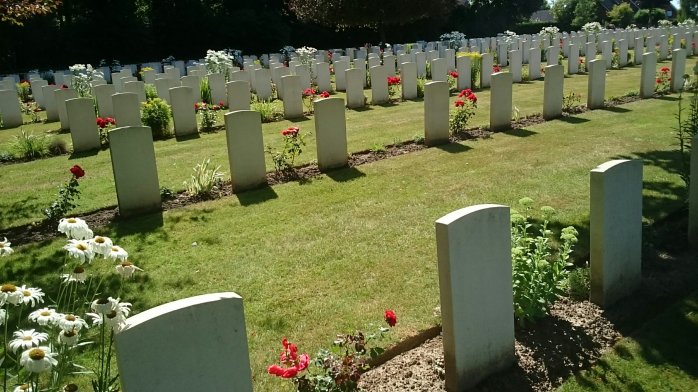
Kemmel Chateau Cemetery outside the village of Kemmel was one of the many such graveyards and memorials designed by the famous British architect Sir Edwin Lutyens, whose work included the Irish National War Memorial Gardens at Islandbridge in Dublin.

Kemmel Chateau Cemetery Cross of Sacrifice


The Chateau itself was north-east of Kemmel village which is on the road between Ieper and Armentières, close to the border with France. The cemetery was established on the north side of the chateau grounds in December 1914. It continued to be used by divisions fighting on the southern sectors of the Belgian front until March 1918, when after fierce fighting involving both Commonwealth and French forces, the village and cemetery fell into German hands in late April.

Kemmel Chateau Cemetery

The cemetery was retaken by the Allies later in 1918, but in the interval it was badly shelled and the old chateau was destroyed. There are now 1,135 Commonwealth burials of the First World War in the CWGC cemetery and 21 from the Second World War.

Kemmel Chateau Cemetery Cross of Sacrifice

Here I found several graves of members of the Royal Dublin killed between November 30th 1916, December including  St Stephen’s Day 1916 and March 8th 1917.


IRISH PEACE PARK MESSINES

This was the second time I visited the WW1 Irish Peace Park at Messines, or Mesen as it is now known in Flemish, not far from Ieper. The first occasion was to commemorate the centenary of the start of the Battle of Messines on 7th June 2017.

With An Taoiseach Enda Kenny at the Irish Peace Park on June 7th 2017 for the Battle of Messines centenary commemoration

An Taoiseach Enda Kenny TD and Britain’s Prince William joined Princess Astrid of Belgium and Lord Dunlop, Parliamentary Under-Secretary of State at the Northern Ireland Office to honour the soldiers who fought in the battle. They laid wreaths at the foot of the Round Tower memorial, before meeting invited guests including descendants of those who fought at the Battle.

The successful Allied offensive on June 7th 1917 was the first occasion the 36th Ulster and 16th Irish divisions fought together on the front line. The two divisions predominantly comprised men who were on opposing sides of the great political upheaval back in Ireland around whether the country should be granted self-governance from Westminster.

The Peace Park is dominated by a replica Irish round tower was intended as a symbol of reconciliation to bring together loyalists and nationalists, Protestants and Catholics, particularly from a younger generation in Northern Ireland and the Republic.

It was the brainchild of the late Paddy Harte from Co. Donegal and Glen Barr, a former loyalist paramilitary leader from Derry. There is a plaque remembering their joint efforts on the wall beside the exit.

Plaque remembering Paddy Harte and Glen Barr whose vision of a project of reconciliation came to fruition in the Peace Park

Round Tower at the Irish Peace Park

The Peace Tower is dedicated to all those from the island of Ireland who fought and died in the First World War 1914-18. It was erected by ‘a Journey of Reconciliation’ Trust, with the support of local people from Messines. On Remembrance Day 11th November 1998, eighty years after war came to an end, President McAleese unveiled a plaque in the presence of Britain’s Queen Elizabeth II and His Majesty King Albert II of Belgium.

Details of the casualties suffered by the three Divisions from the island of Ireland

The words of ‘Navvy poet’ and soldier Patrick MacGill from Donegal

In memory of the 36th (Ulster) Division

Stone memorials in the grounds of the Irish Peace Park

MAJOR WILLIE REDMOND

Major Willie Redmond of the Royal Irish Regiment was killed on the first day of the Battle of Messiness on 7th June 1917. He is buried at Locre (Loker) but in a separate grave alongside the British military cemetery at Locre Hospice.

The grave is marked by a stone cross, paid for by his family from Wexford. Someone has left a Wexford flag at the foot of the memorial as a reminder of the county of his birth.

Beside the grave there is a wooden structure containing a statue of Our Lady and a repository where the visitors’ book is kept.

dsc_25433704636949252974447.jpg

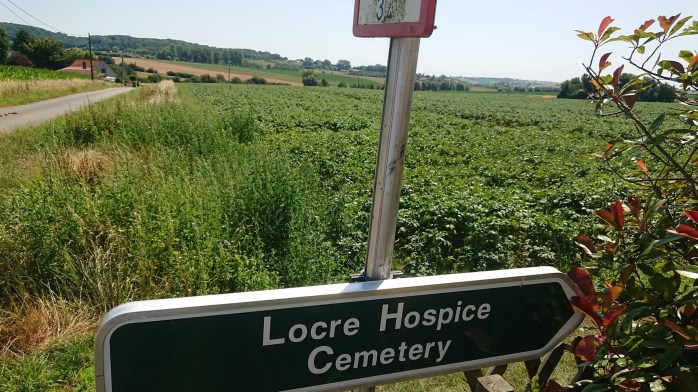
Locre Hospice Cemetery(CWGC) is beside the site where Major Redmond is buried

The following details about Major Redmond are taken from an article in Irish Legal News 05/04/19 by Seosamh Gráinséir:

“A famous Irish nationalist, William Hoey Kearney Redmond came from a (Catholic gentry) family of parliamentarians. His father, William Archer Redmond, was a Member of Parliament in Westminster for the Home Rule Party. His older brother, John Edward Redmond, was a Member of Parliament and leader of the Irish Parliamentary Party.

On 24th March 1884, Willie himself was sworn in as a new MP for his father’s old constituency, Wexford Borough, at the age of twenty-two. During his thirty-three years as an MP, Willie went on to represent Fermanagh North for seven years after the Wexford Borough constituency was abolished, and then East Clare for 25 years. Willie was succeeded in that constituency by Éamon de Valera, who won the by-election triggered by Willie’s death.

Like his father and brother, Willie was a passionate supporter of Home Rule, which he said was necessary because the Union “has depopulated our country, has fostered sectarian strife, has destroyed our industries and ruined our liberties”. An ardent opponent to landlords, Willie had been imprisoned a number of times for his work with the Land League agitation (Denman 1995).

Having served with the Royal Irish Regiment for a couple of years after finishing school, Willie was described as having always been a “soldier at heart”, the “spirit of comradeship and discipline” having appealed to him. When the Great War broke out in August 1914, he had already been involved with the Irish Volunteers. But he believed that if Germany won the war, Ireland was endangered too. Intent on joining the Royal Irish Regiment again and troubled by the idea of recruiting for the war effort without joining the fight himself, he wrote: “I can’t stand asking fellows to go and not offer myself”.

In this vein, Willie told the Irish Volunteers assembled outside the Imperial Hotel in Cork in November 1914: ‘I speak as a man who bears the name of a relation who was hanged in Wexford in ‘98 – William Kearney. I speak as a man with all the poor ability at his command has fought the battle for self-government for Ireland. Since the time – now thirty-two years ago – when I lay in Kilmainham Prison with Parnell. No man who is honest can doubt the single-minded desire of myself and men like me to do what is right for Ireland. And when it comes to the question – as it may come – of asking young Irishmen to go abroad and fight this battle, when I am personally convinced that the battle of Ireland is to be fought where many Irishmen now are – in Flanders and France – old as I am, and grey as are my hairs, I will say: ‘Don’t go, but come with me!’”

(Terence Denman, A Lonely Grave: The Life and Death of William Redmond, Irish Academic Press 1995).

House of Commons WWI Memorial with name of Major W. Redmond MP

Redmond is commemorated on Panel 8 of the Parliamentary War Memorial in Westminster Hall, one of 22 MPs who died during World War I to be named there. He is one of 19 MPs who fell in the war who are commemorated by heraldic shields in the Commons Chamber. A further act of commemoration came with the unveiling in 1932 of a manuscript-style illuminated book of remembrance for the House of Commons, which includes a short biographical account of the life and death of Redmond.

The people of Loker continue to attend to his symbolic grave with great respect, organising Commemorations, the last in 1967 (organised by a Catholic priest Father Debevere) and in 1997 (organised by Erwin Ureel), refusing to allow the grave to be moved. Redmond’s Bar, an Irish pub in nearby Loker, is named after him. I enjoyed a nice bottle of local Belgian beer (Hommelbier from Poperinge) that went down well with a mackerel salad and chips.

In Wexford town there is a bust of him by Oliver Sheppard in Redmond Park which was formally opened as a memorial to him in 1931 in the presence of a large crowd including many of his old friends and comrades and political representatives from all parts of Ireland. It was re-launched by the Wexford Borough Council in 2002.

An official wreath laying ceremony took place at Redmond’s grave on 19th December 2013, when the Taoiseach Enda Kenny TD and British Prime Minister David Cameron MP paid tribute to him. Enda Kenny reflected: “The thought crossed my mind standing at the grave of Willie Redmond, that was why we have a European Union and why I’m attending a European Council” (Lise Hand, The Irish Independent 19/12/2013).

FLANDERS DAY TWO

Lille Gate in Ieper (Ypres)

Leaving Ieper on the second day of the visit to Flanders, the group headed to Wijtschaete a village a few kilometres away to learn about the role of the 16th Irish Division in the Battle of Messines Ridge on 7th June 1917.

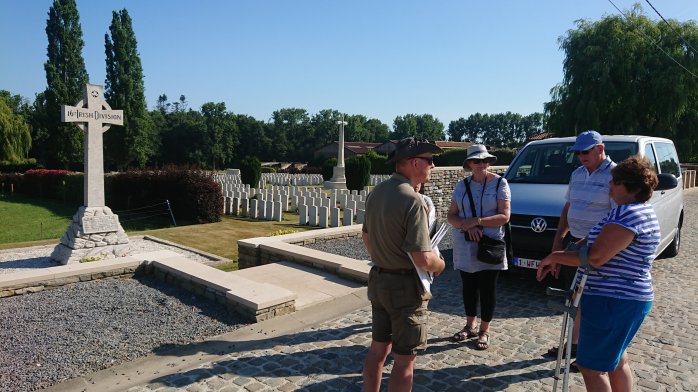
Group at 16th Irish Division Celtic Cross

MESSINES RIDGE, June 1917
The largely Catholic 16th (Irish) and mainly Protestant 36th (Ulster) Divisions went into battle together to take the Belgian village of Wijtschaete in the well-planned attack on the Messines Ridge. General Plumer had a scaled model of the Ridge made so troops could see what lay ahead. He had mines dug for explosives beneath German defences. About three million shells bombarded Messines for over a week.

dsc_24871888457686811490487.jpg

Paying my respects at 16th Irish Division Memorial Cross

Inscription at foot of the Cross

Memorial stone for 36th Ulster Division opposite 16th Irish Division Cross

dsc_24838301481994874581123.jpg

36th Ulster Division crest on memorial stone

The barrage eased just before Plumer detonated 9,500 tons of explosives under the Germans in nineteen mines. Willie Redmond MP and brother of John, leader of the Irish Party, died of wounds received in the attack.

20190804_1722455910514914466524394.jpg

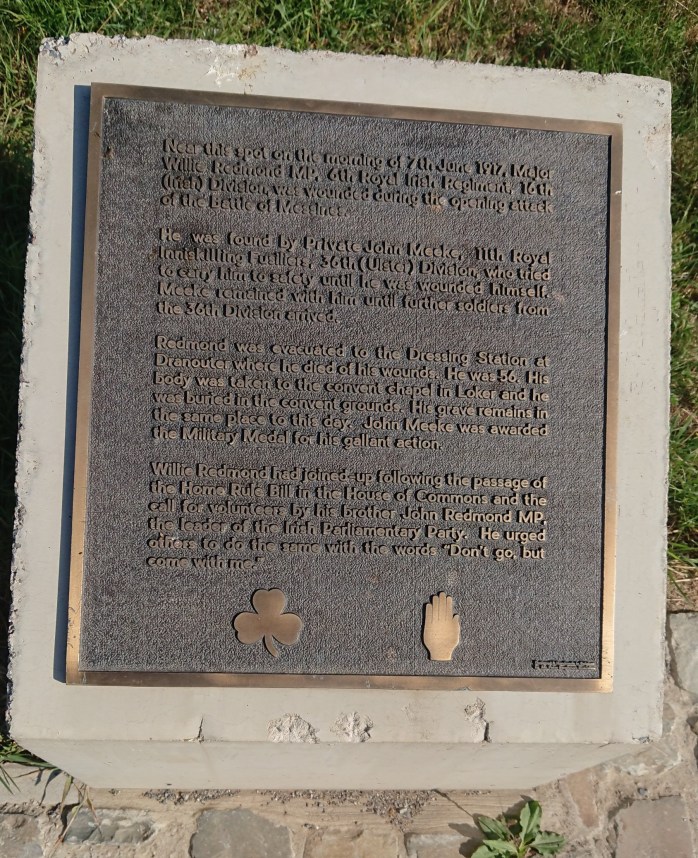
Plaque explaining how Pte Meeke removed Major Redmond from the battlefield

There is a memorial depicting an injured Major Willie Redmond being carried away for treatment. At this spot on the morning of June 7th 1917 Major Redmond of the 6th Royal Irish Regiment (16th Irish Division) was wounded during the opening attack of the Battle of Messines. He was found by Private John Meeke, 11th Royal Inniskilling Fusiliers (36th Ulster Division) who tried to carry him to safety until he himself was wounded. He was awarded the Military Medal for his gallant action. Redmond was evacuated to a dressing station at Locre hospice, run by nuns, where he died of his wounds.

dsc_2475714193985131941957.jpg

At the memorial marking the area where Major Willie Redmond was wounded during the battle

There is a statue in the centre of Mesen (Messiness), Belgium’s smallest town. It is a memorial to all soldiers of the New Zealand Division who fought at Messines Ridge.

dsc_25031153068257514189960.jpg

Statue of the New  Zealand soldier at Mesen

The sculpture by Andrew Edwards outside the new visitor centre of Mesen consists of two fibreglass figures, a German and an British soldier, about to shake hands at the moment when the two armies stopped fighting and played football on Christmas Day 1914. It was unveiled in Liverpool in December 2014 to mark the centenary of the event. The sculpture was taken to (Messines) Belgium where the UK Ambassador and Mayor of Mesen attended a ceremony in December 2015.

Sculpture unveiled in Mesen in December 2015 depicting the Christmas Truce 1914

ST SYMPHORIEN CEMETERY

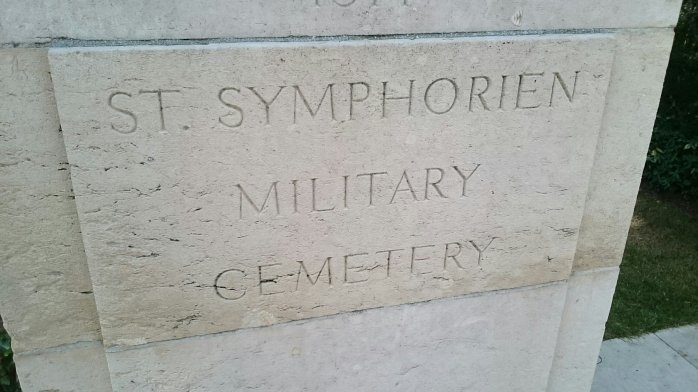
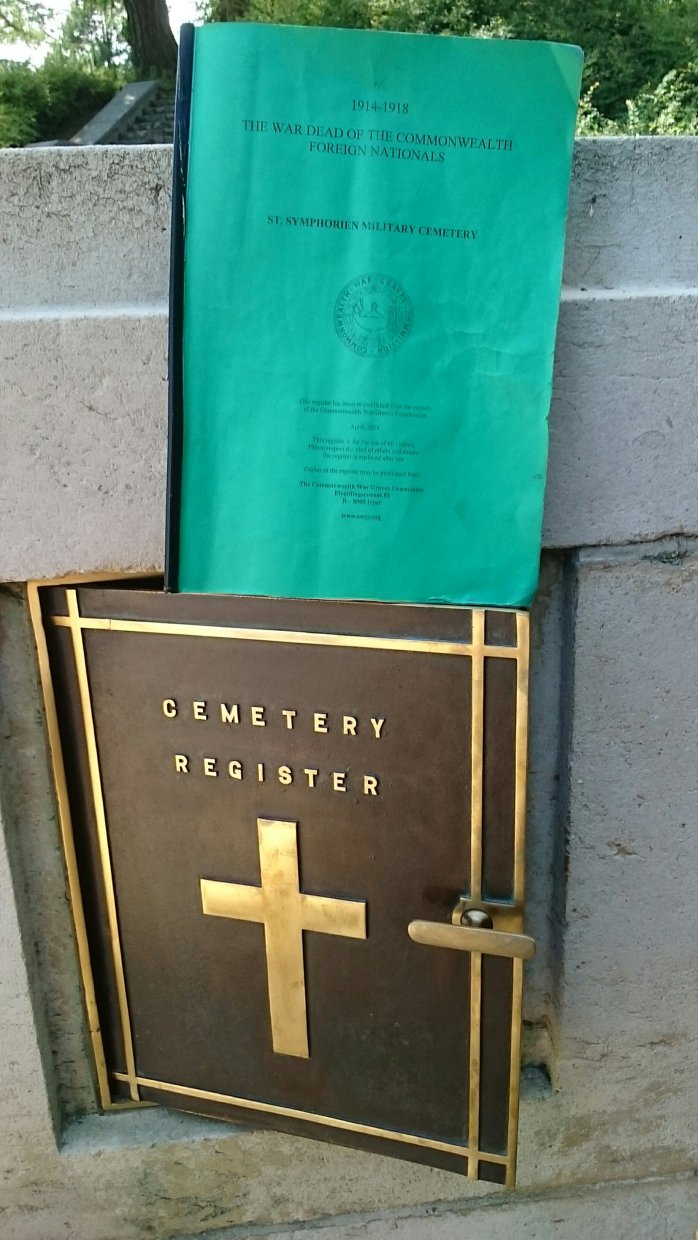
St Symphorien Cemetery is 2km east of Mons in Belgium and is maintained by the CWGC. The cemetery at St. Symphorien was established by the German Army during the First World War as a final resting place for British and German soldiers killed at the Battle of Mons. Among those buried here is Lt Maurice Dease VC.

Grave of Lt Maurice Dease VC   Pic. © Michael Fisher

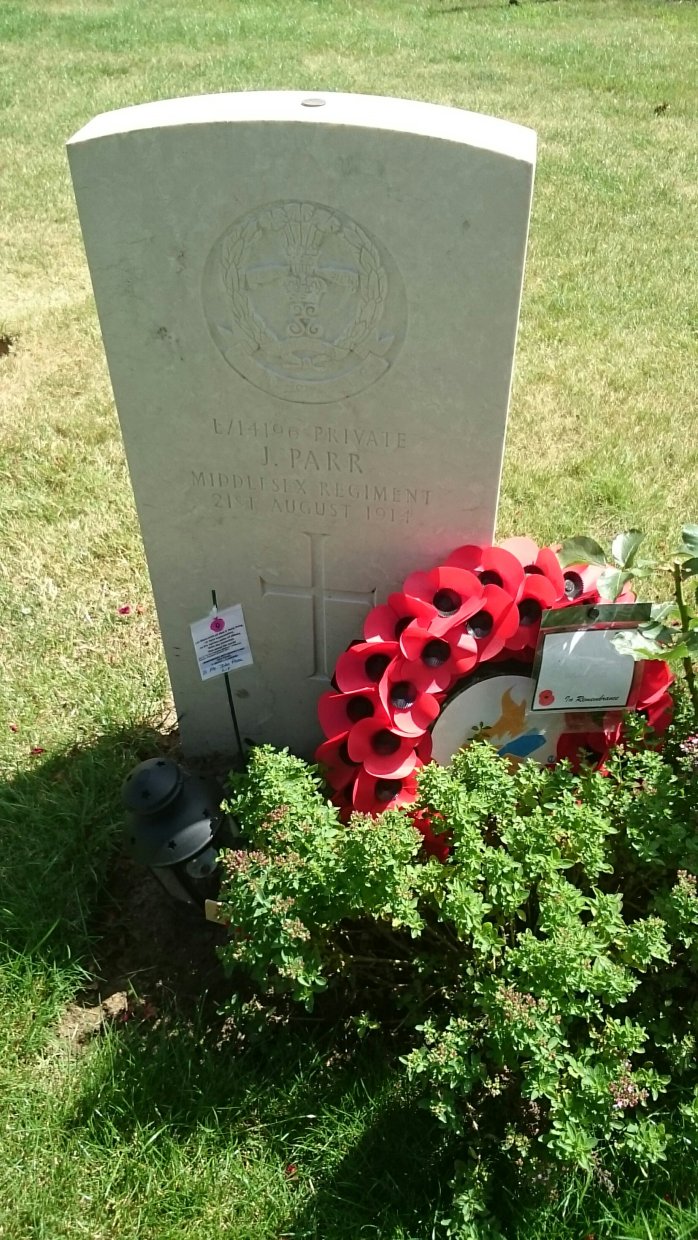
Another grave is that of Private John Parr of the Middlesex Regiment, who was fatally wounded during an encounter with a German patrol two days before the battle, thus becoming the first British soldier to be killed in action on the Western Front.

Grave of Pte John Parr, Middlesex Regiment

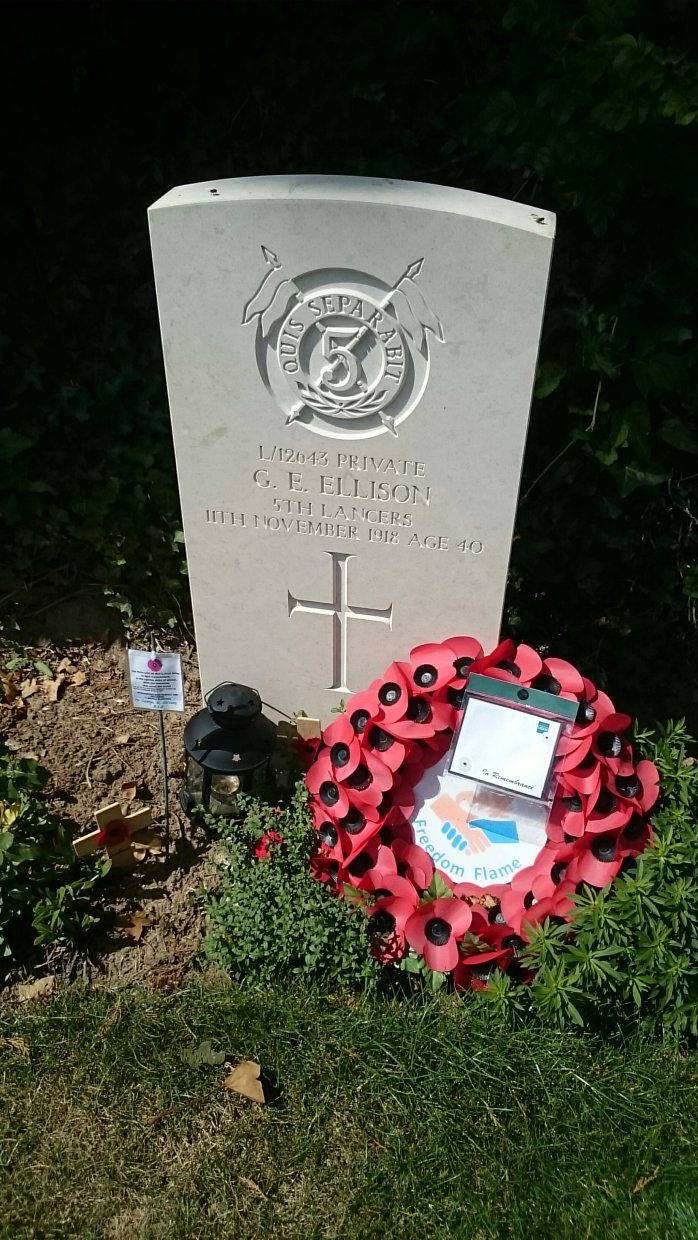
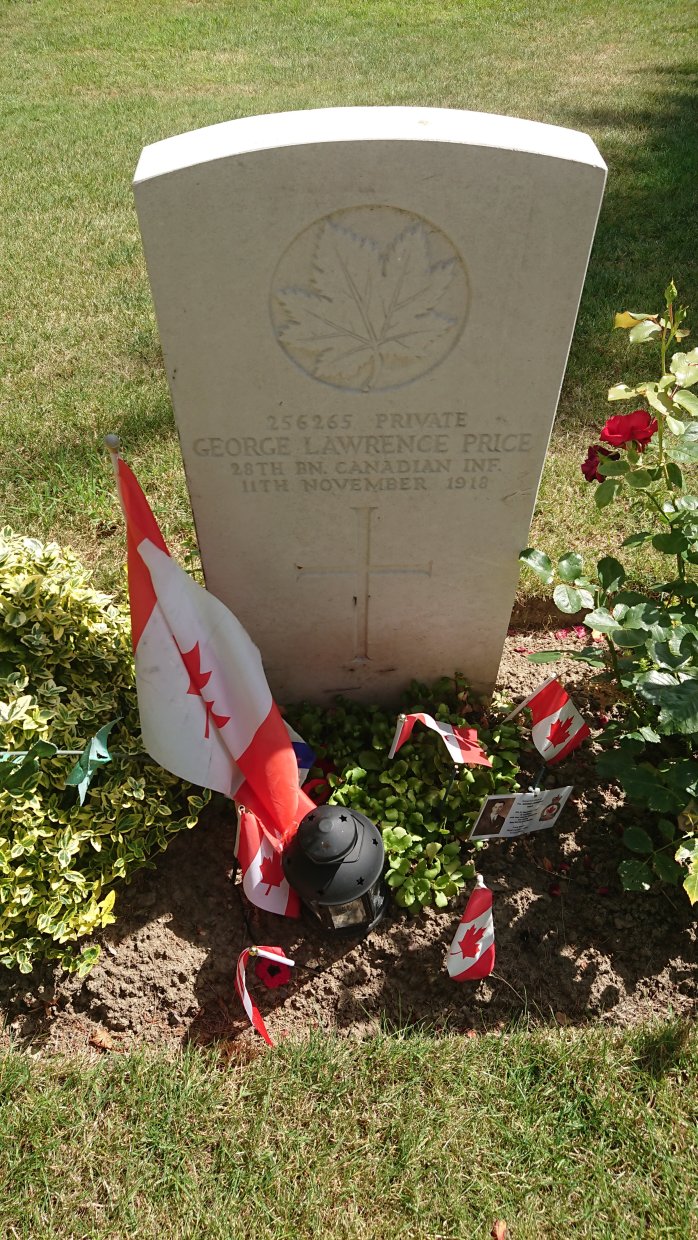
The cemetery remained in German hands until the end of the war, and afterwards came under the care of the Imperial (now Commonwealth) War Graves Commission. It also contains the graves of Commonwealth and German soldiers who died in the final days of the conflict, including Private George Ellison of the Royal Irish Lancers and George Price of the Canadian Infantry.

dsc_0602934720779.jpg

Grave of Pte George Ellison

Grave of Private George Price died 11th November 1918 last day of WWI

Ellison and Price were killed on 11 November 1918, and are believed to be the last Commonwealth combat casualties of the war in Europe. There are 229 Commonwealth and 284 German servicemen buried or commemorated at St Symphorien, of whom 105 remain unidentified.

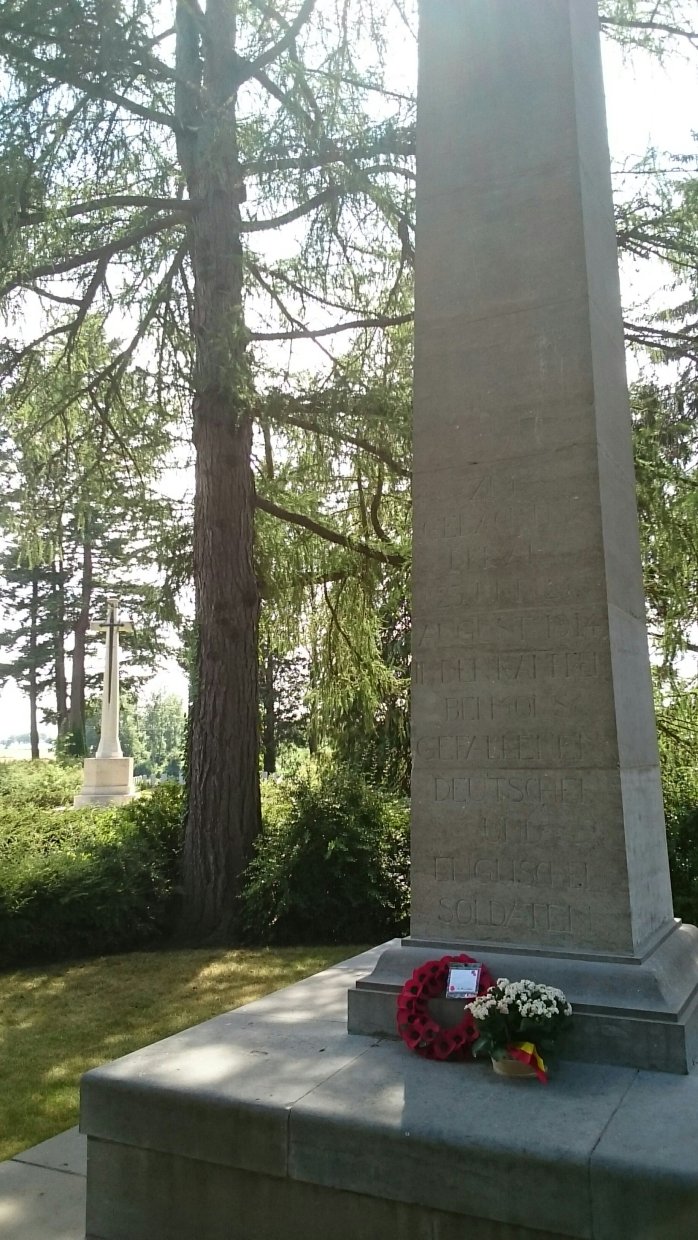
Memorial dedicated to German soldiers buried at St Symphorien

The Battle of Mons – By the evening of 22 August 1914, the men of II Corps of the British Expeditionary Force had taken up defensive positions along the Mons-Condé Canal, preparing for a major German attack expected to come from the north the next day. The opening shots of the Battle of Mons were fired at dawn on the morning of Sunday 23 August, when the 4th Battalion of the Middlesex Regiment repulsed German cavalry who were attempting to the cross the canal over a bridge at Obourg.

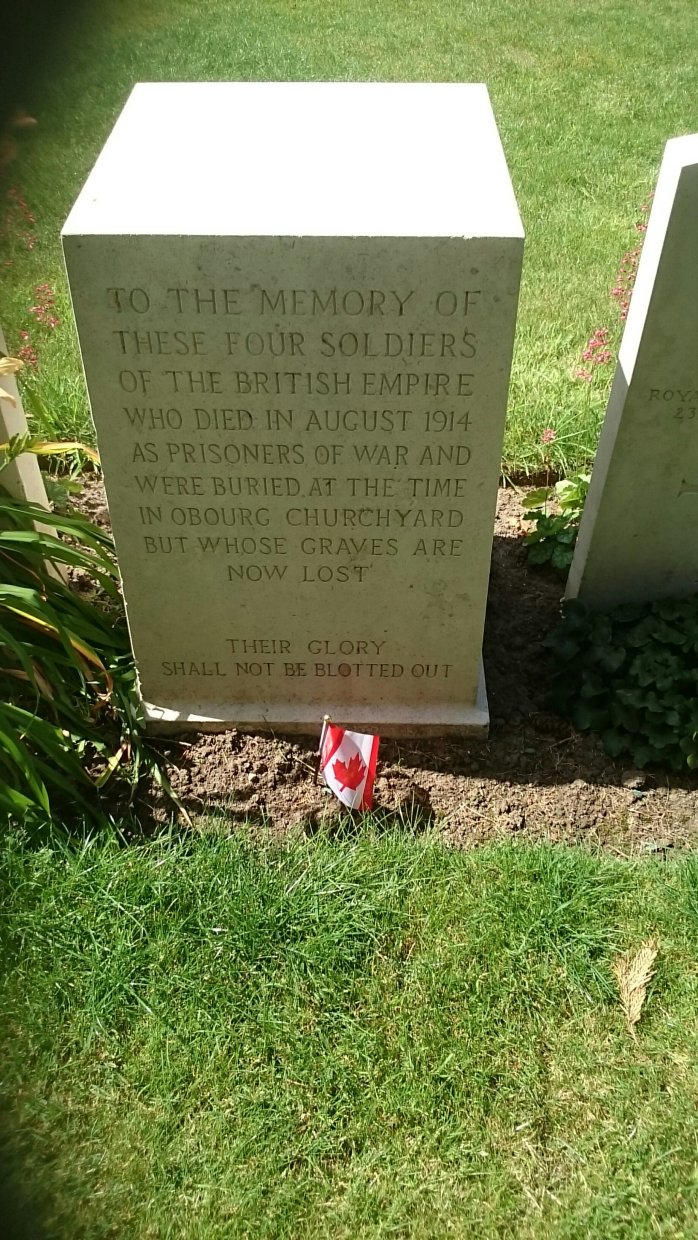
The remains of four soldiers buried at Obourg were transferred to St Symphorien

The early morning was misty and wet, and the British were still uncertain of the numbers of enemy troops on the far side of the canal. By 10 a.m., the day had brightened up, artillery fire had intensified, and it became clear that they were facing a large German force. Despite being outnumbered, the British soldiers on the south bank of the canal fought tenaciously throughout the day. Many were reservists who had returned to the army just weeks before, but they were well-drilled and disciplined, with a high-level of rifle training. Their relentless fire inflicted heavy casualties among the Germans.

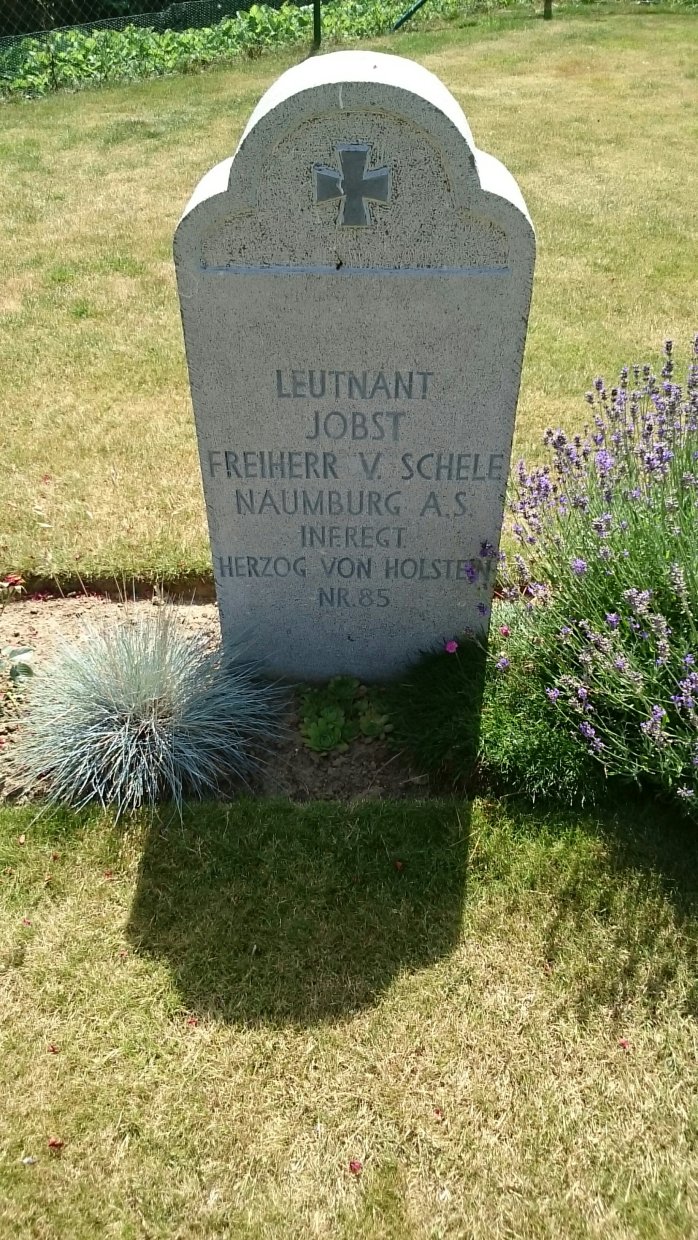
Grave of German officer (and Baron) Lt Jobst von Schele

Despite this stiff resistance, the sheer weight of German numbers and the accuracy of their artillery meant that the British struggled to hold their positions.By 10.30 a.m. the first German soldiers had crossed the canal and some British units had been forced back, and by mid-afternoon German infantry troops were crossing in force. By nightfall, the Battle of Mons was over and the British had begun a long, hard retreat towards Paris. (CWGC)

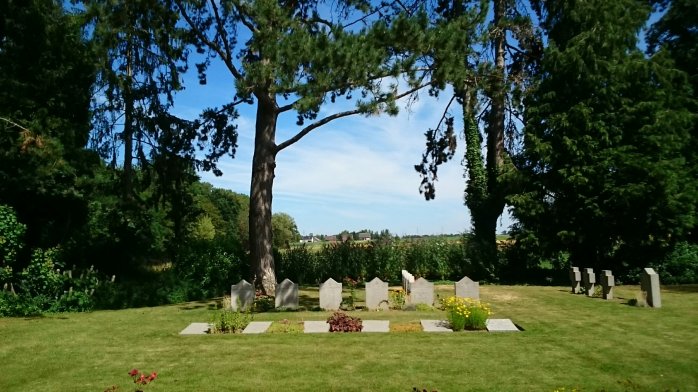
Six unmarked graves at St Symphorien Cemetery

Flags of various NATO countries at the entrance to SHAPE headquartersOn our way to Mons we passed SHAPE headquarters. Supreme Headquarters Allied Powers Europe is the main base for the North Atlantic Treaty Organisation’s Allied Command Operations centre (ACO).  Since 1967 it has been located at Casteau, north of Mons. Ireland is not a NATO member but is involved in Partnership for Peace and is a member of the Euro-Atlantic Partnership Council (EAPC).

dsc_244839852247562534791.jpg

Flags from various nations fly at the entrance to SHAPE HQ at Casteau near Mons

FLANDERS DAY ONE

Visit to WWI graves in Flanders. First and last shots of the Great War. Our group of six left Brussels Airport and headed for Mons. At this spot at Casteau, the British Expeditionary Force engaged with the Germans, firing the first shots on 22nd August 1914.

The memorial near Mons where the first shots were fired in August 1914

Major Tom Bridges, commander of C Squadron, 4th Battalion of the Royal Irish Dragoon Guards was on reconnaissance near Mons when he saw a German advance mounted guard and gave chase with his horsemen. During the pursuit Corporal Thomas became the first British soldier to fire a shot in anger in continental Europe since the battle of Waterloo (near Brussels) 100 years earlier.

This stone monument was unveiled on 20th August 1939 at the spot where Thomas had set off to chase four German cavalrymen. Thomas was a career soldier who had enlisted at the age of 14. He survived the war and was awarded the Military Medal.

Opposite this memorial is a bronze plaque marking the spot where troops of the 116th Canadian Infantry Battalion stopped on Armistice Day, 11th November 1918, during the liberation of Mons. The plaque was unveiled on 7th July 1956. For the British Empire, the War had ended at the precise spot where it had started four years earlier.

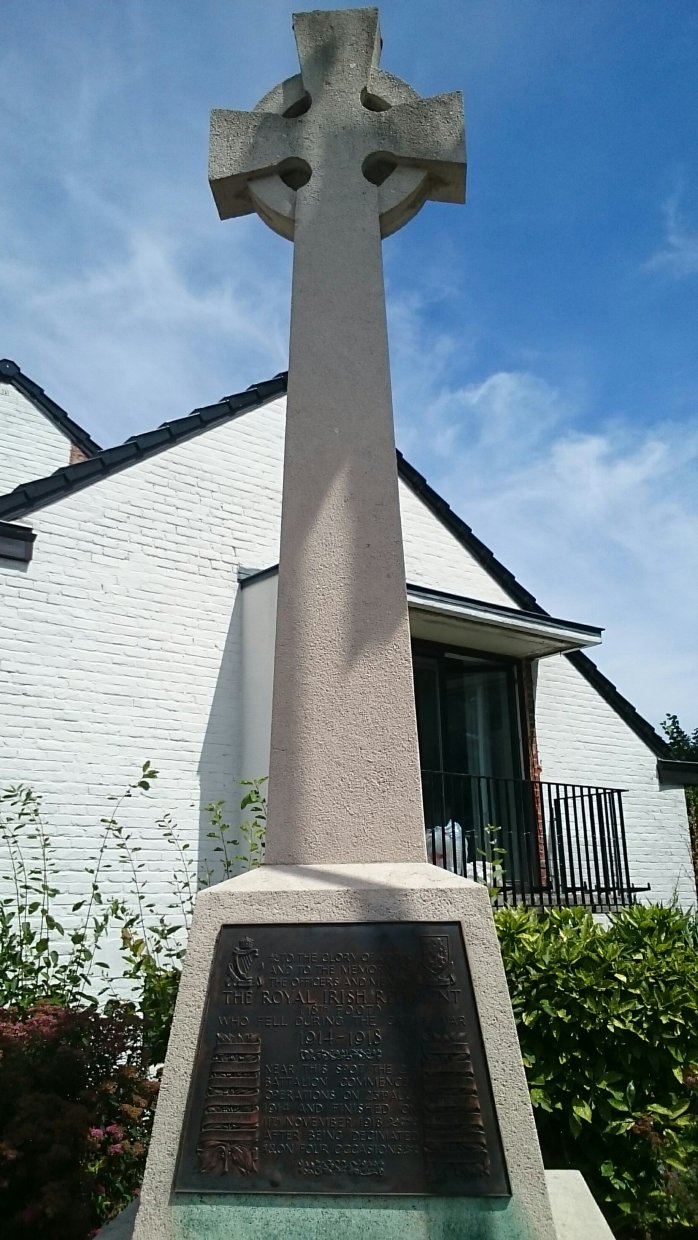
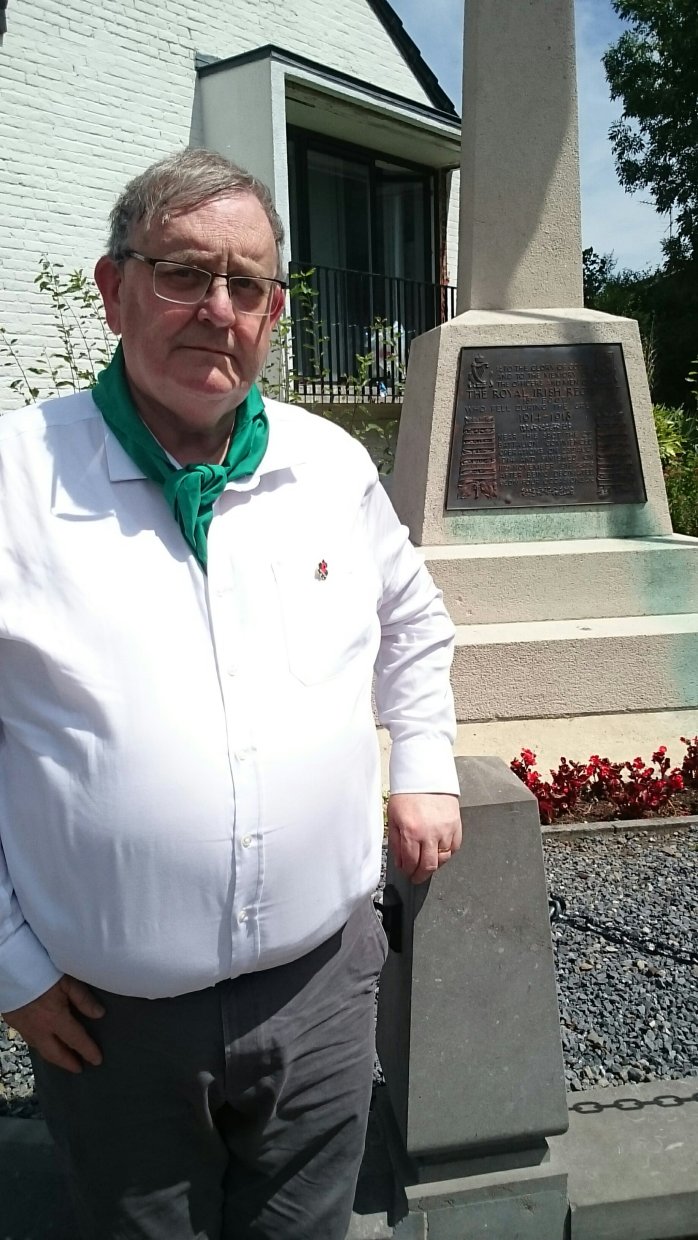
At a crossroads at La Bascule outside Mons there is a Celtic cross. The limestone monument, five metres high, is dedicated to the 2nd battalion of the Royal Irish Regiment, which recruited in the south-east counties of Wexford, Waterford, Tipperary and Kilkenny.

The inscription at the base reads: “To the glory of God and to the memory of the men and officers of the Royal Irish Regiment (18th Foot) who fell during the Great War 1914-1918. Near this spot the 2nd Battalion commenced operations on 23rd August 1914 and finished on 11th November 1918 after being decimated on four occasions.”

The cross is located at exactly the point where a motley outfit of cooks, store men, drivers and dispatch riders, about 50 in all, from the 2nd Royal Irish Regiment, held up the German advance for several hours. Machen had read newspaper reports of the battle and set his story in the Mons salient where the battalion made its gallant stand.

The soldier who inspired the story of the angels of Mons was Quartermaster Sergeant Thomas William Fitzpatrick from Enniscorthy, Co Wexford. Sensing the danger, it was he who gathered together the little band of Irish brothers to man a trench were the cross now stands. From there, they held up the German advance for hours.

He wrote his own gripping account of events that day more than 40 years later. “I saw no Mons angels,” he wrote in The Old Contemptible journal in 1955. “I honestly think that not one of my men had the faintest idea what they were fighting for. In fact, I was not sure myself – which illustrates the unconquerable spirit of the British soldier of that day – the Irish soldier in our case.” (Ronan McGreevy, The Irish Times, August 2016).

Celtic Cross at La Bascule near Mons

CASTLEBLAYNEY’S SWEDISH ROYAL CONNECTION

© Michael Fisher, The Northern Standard, June 6th 2019 p. 29

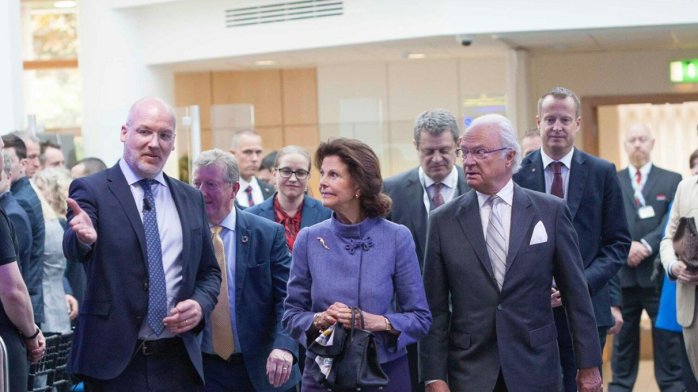
Whilst the official visit of President Trump to Ireland today has taken up all the headlines, a state visit last month by the King and Queen of Sweden went by almost without notice. Returning from a Local Ireland awards ceremony in Athlone a fortnight ago, I noticed a long convoy of official cars and Garda outriders on the bypass outside the town. Was it a dress rehearsal for the visit of the US President, I wondered. Or perhaps it was the Swedish royal couple, who had been in Dublin the day before.

Further investigation revealed that the Swedish royals visited the Ericsson research and development site in Athlone to discuss digitalisation and 5G in Europe as part of their three-day state visit. The King and Queen were joined by members of the Swedish Government, including Anders Ygeman, Minister for Energy and Digital Development and Sean Canney TD, Minister of State for Rural Affairs and Natural Resources.

King and Queen of Sweden Visited the Ericsson R&D Facility in Athlone

My thoughts turned to a connection between the Swedish Royal Family and County Monaghan that I had spoken publicly about in Castleblayney 25 years ago. The following information is based largely on the talk which was held in the Glencarn Hotel. It centred around Crown Princess Margaret of Sweden, a daughter of the Duke of Connaught, who lived with his family at Hope Castle in Castleblayney from 1900-1904 (David Hicks in “Irish Country Houses” 2012).

HOPE CASTLE

The Duke of Connaught, son of Queen Victoria, came to Castleblayney on his appointment as Commander-in-Chief of the British Army in Ireland. He was then 50, having been born at Buckingham Palace in London on 1st May 1850. It was said at the time that the Duke and Duchess experienced a great deal of difficulty in finding an Irish home as they did not wish to spend all their time in the official residence at the Royal Hospital in Kilmainham, Dublin. The Irishresidence associated with the office of Commander in Chief was not thought to be suitable for habitation by such high-ranking royals as the grounds of the residence were far from private and its location was thought to be in an inferiorpart of the city (Hicks). Several other houses such as Castletown House in Kildare were considered before the Duke settled on Hope Castle, which he leased from Lord Henry Francis Hope. It is believed that the Castleblayney residence was chosen as it was located near the home of Leonie Leslie, a prominent socialite at the time, who lived at Castle Leslie, Glaslough. She was a close friend of the Duke and Duchess, with the emphasis on the former.

The royal couple arrived in Castle Blayney in June 1900 and received a warm welcome from the local people; both the gates to the castle and the whole town were decorated with bunting and flags. The Duke had taken the castle for the summer season in 1900 with an option of leasing it for a further five years. It was thought at the time that Hope Castle would become an official royal residence and that Queen Victoria would visit her son here, but she died in 1901. The Duke of Duchess of Connaught ended their association with the Castle in 1904 (Hicks).

DUKE OF CONNAUGHT

Of her five children, Prince Arthur (William Patrick Albert) was Queen Victoria’s favourite son. By the time he arrived in ’Blayney, he already had a distinguished military career. He entered the Royal Military Academy in Woolwich in 1866, was created a Knight of the Order of St Patrick in 1869 and by the age of 21, was a Privy Counsellor. He received his title Duke of Connaught and Strathearn in 1874, then served as Assistant Adjutant General in Gibraltar for two years. He was promoted again in 1876, serving as personal ADC to Queen Victoria, a role he fulfilled for four of her successors. In 1879 he was married at St George’s chapel in Windsor Castle, near London.

His wife was Princess Louise of Prussia, who at the age of 18 was 10 years his junior. She had been born in Potsdam in 1860, third daughter of Prinz Friedrich Karl of Prussia. The couple had two children.

bagshot_park_morris_edited1475892211112337545.jpg

Bagshot Park in Surrey, England from Morris’s Country Seats from the time the Duke of Connaught lived there (1880)

Their first child was Margaret Victoria Augusta Charlotte Norah, born at Bagshot Park in Surrey on January 15th 1882 (this is now the private residence of Prince Edward and his wife Sophie, Countess of Wessex). Just under a year later, the second child, Arthur, was born at Windsor Castle. He later saw active service in the South African war and was Governor General there from 1920-23.

The Duke of Connaught became a General in 1893 after serving in Egypt and India and was appointed a Field Marshal in 1902, during the time he was in Castleblayney. He was a significant figure in British society, as can be seen by the rest of his career.

On completing his four years in Ireland, he was appointed Inspector General of the British Forces and President of the Selection Board 1904-07. For the next two years, he was Field Marshal and Commander-in-Chief in the Mediterranean. He opened the Union Parliament of South Africa, where his son later became Governor General, in 1910.

The following year, the Duke became Governor General of Canada, a post he held for five years and which aroused controversy as he attempted to meddle in Canadian military affairs. He served as Grand Master of the United Lodge of Freemasons from 1901 (a year after his appointment in Ireland) to 1939. He was decorated by several countries, including Spain, Turkey, France, Belgium, Italy, Sweden, Norway, Denmark, Greece, Japan (Order of the Chrysanthemum), Ethiopia, the Netherlands, Tunisia, Montenegro, Romania and finally, Monaco. The Duke died at Bagshot Park in Surrey on January 16th 1942, at the age of 91.

CROWN PRINCESS MARGARET

When Princess Margaret of Connaught was 23 and her younger sister Princess Patricia of Connaught was 18, both girls were among the most beautiful and eligible princesses in Europe. Their uncle, King Edward VII, wanted his nieces to marry a European king or crown prince. In January 1905, the Duke and Duchess of Connaught visited Portugal, where they were received by King Carlos and his wife, Amélie of Orléans whose sons Luís Filipe, Duke of Braganza, and Prince Manuel entertained the young British princesses. The Portuguese expected one of the Connaught princesses would become the future Queen of Portugal.

The Connaughts continued their trip to Egypt and Sudan. In Cairo, they met Prince Gustaf Adolf of Sweden, the future Gustaf VI Adolf of Sweden, grandson of the Swedish King Oscar II. Originally, Margaret’s sister Patricia had been considered a suitable match for Gustaf Adolf; without his knowledge, a meeting was arranged with the two sisters. Gustaf Adolf and Margaret fell in love at first sight, and he proposed at a dinner held by Lord Cromer at the British Consulate in Egypt, and was accepted. Margaret’s parents were very happy with the match. Gustaf Adolf and Margaret, then 23, married on 15th June 1905 in St George’s Chapel at Windsor Castle, where her father had also been married. The couple spent their honeymoon at Adare Manor in Co. Limerick and arrived in Sweden on 8th July 1905. One of Margaret’s wedding presents was the Connaught tiara, which remains in the Swedish royal jewellery collection today.

The Crown Prince of Sweden, Gustaf Adolf, was ten months younger than his bride. He came from a military background, like his father-in-law, having entered the Swedish army in 1902. Thirty years later, he became a General. His wife, however, did not survive that long.

During the First World War, she did a lot of work for the Red Cross and as can be seen in her connections with Castleblayney, she seemed to be a caring person. Known in Sweden as Margareta, she died thirty years before her husband’s accession to the throne of Sweden.

At 2 o’clock in the morning on 1st May 1920, her father’s 70th birthday, Crown Princess Margaret, aged 38, died suddenly in Stockholm of “blood poisoning” (sepsis).

Her husband re-married (the second wife was Lady Louise Mountbatten, sister of Earl Mountbatten). At the age of 68, Gustaf Adolf succeeded to the throne, reigning from 1950 to September 1973 as King Gustaf VI Adolf, the last Swedish monarch to hold real political power. He was a noted archaeologist and died aged 90. Since then, his grandson Carl XVI Gustaf has held the title of King and reigns along with Queen Silvia. They are the dignitaries who have just completed a state visit to Ireland.

Following her marriage in 1905, Crown Princess Margaret had five children. The first born in Stockholm on 22nd April 1906 was Gustaf Adolf, Duke of Vaesterbotten, later Prince. He was killed in a flying accident near Copenhagen in 1947, so when the time for succession came, in 1973, it was his son who took the throne and is now the King of Sweden.

He was followed by Sigvard, born at Drottningholm Palace in July 1907, an important year for the Swedish royal family, as Gustaf V came to the throne, shortly after the dissolution of the union between Sweden and Norway. The last three children were all born in Stockholm. Princess Ingrid in March 1910, Bertil in February 1912 and then carl, Duke of Dalecorlia, November 1916.

Some of the children are pictured in postcards which she sent from Stockholm over a period of five years, passing greetings to what she described as he friends in Castleblayney. All are addressed to Mrs JJ Kelly, a correspondence linking Castleblayney and Sweden.

THE KELLY CONNECTION

JJ Kelly was a Local Government Board Inspector and his wife Mary was the postmistress. They lived at Castle Square as it was then called, near the entrance to Hope Castle. Both are buried in the graveyard behind St Mary’s Church. Their daughter Rosa Kelly was a first cousin of my mother and details of the correspondence were kept by her following Rosa’s death in Surrey, where she is buried beside my aunt Dorothy Smyth. My mother then passed on details of the original correspondence including letters to the Swedish royal archives in Stockholm.

THE POSTCARDS

The first is not dated and it’s impossible to decipher the postmark. But the picture shows Crown Princess Margaret and her husband, who is holding a baby, Gustaf Adolf, the Duke of Vaesterbotten, who was born in April 1906. It reads:

“Princess Margaret send many thanks for the shamrock and hopes all the friends at Castle Blayney are well.” So it seems it might have been written in March 1907, some time after St Patrick’s Day (possibly 20th March). Some similar messages follow in the next few years. The Kellys must have sent Princess Margaret shamrock to wear, to remind her of Castleblayney.

“19th December 1909

A happy Xmas & 1910 to all from

Margaret”. The picture shows her with her two children, Gustaf Adolf aged 3, and Sigvard, aged 2.

“March 18 1910. Thank you so much for the shamrock. I hope you and all old friends in Castle Blayney and neighbourhood are well, Margaret.” The picture is probably of Gustaf Adolf again, aged three and wearing a similar outfit to the previous photo.

Postmark 1912

Picture of Prinsessan Margareta on front with a greeting to Mrs Kelly:

“A happy Christmas to you from Princess Margaret, Stockholm”

March 25 1914

Five months before the outbreak of World War I.

“Stockholm. The Crown Princess sends her best thanks for the shamrock and the kind thought which prompted the gift.”

No stamp or postmark. Might have been enclosed with a letter.

The picture is of the Crown Princess in what appears to be national costume with a white head-dress and reading a book.

March 21 1915

“The Crown Princess of Sweden sends most grateful thanks for the shamrock, which arrived here quite safely on St Patrick’s Day.”

Mrs Kelly’s address was given as ‘The Trees’, so by then she seemed to have finished her role as postmistress (according to the street directories). It’s also interesting that this correspondence was seven months after the start of WWI. The picture showed four of Margaret’s five children, Prince Gustaf Adolf, Sigvard, Bertil and Princess Ingrid.

December 15 1915

“The Crown Princess of Sweden sends an Xmas greeting to Castle Blayney”. The picture is of Margaret and captioned Vår Kronprinsessa / Our Crown Princess.

One card simply says: “Wishing you a Happy Christmas and New Year from Margaret.” Her portrait on the front seems to indicate it was from one of the earlier years.

The final postcard which appears to conclude the correspondence was posted in Stockholm and addressed to Mrs Kelly at The Trees, Castle Blayney.

April 17 1916

“The Crown Princess of Sweden sends grateful thanks for the shamrock. She was sorry to hear of your sad loss and sends sincere sympathy.” The reference was probably to the death of Joe Kelly in August 1915.

The picture shows four of Margaret’s children (the fifth wasn’t born until the following year), Gustaf Adolf, Sigvard, Bertil and Princess Ingrid.
The postcards provide a fascinating insight into Castleblayney’s connection with the Swedish Royal Family.

This was first published by me at a talk in Castleblayney in 1994, the third annual lecture in memory of the late Fr Peadar Livingstone..

PARTY FOR THE LATE SIR JACK

cy8lguxweaaiepb

Monaghan County Museum Curator Liam Bradley with Antonia Leslie, Eimear Quinn and Tarka Leslie-King  Pic. Michael Fisher

TRIBUTE TO SIR JACK LESLIE ON WHAT WOULD HAVE BEEN HIS 100th BIRTHDAY

Michael Fisher   Northern Standard  Thursday 8th December 2016 p.14

It was just what Sir Jack ordered. A party, not a wake, with champagne (prosecco) and orange, tea and coffee, sandwiches and cake. A time to remember this remarkable character who died just eight months short of his 100th birthday, after a colourful life of 36,305 days. He passed away in April aged 99 a few months after he had received France’s highest honour, the Légion d’honneur, for his part in the defence of that country in the Second World War. Four generations of the Leslie family were around him when he passed away peacefully. The magnolia trees were in bloom as the horse-drawn hearse carrying his remains made its way along the driveway at Castle Leslie to his final resting place outside the walls of St Salvator’s church, where Catholic members of the Leslie family are buried.

At Monaghan Museum video footage of the funeral was shown. Mark and Antonia Leslie helped to carry the remains. Tarka King read a message of sympathy from the Brigade of Guards. On Monday night the family members gathered again for what Curator Liam Bradley said was an evening of remembrance and celebration. He described Sir Jack as a very wonderful man and said he had got to know him well in the last few years.

Tuesday 6th December would have been Sir Jack’s 100th birthday. Before he died he had asked for an evening to remember him in a cheerful way and definitely not a sombre mood. His was a life well lived. Liam Bradley then introduced Sir Jack’s niece and two nephews to share their memories of the fourth Baronet of Glaslough and Pettigo. They were followed by former Eurovision Eimear Quinn from Carrickmacross, who sang a medley of songs chosen from different times of the past one hundred years marking different events in Jack’s life.

Tarka Leslie King said his uncle Jack was an example of bravery. From his mother (Anita) he learned that Jack had a really bad start in life when at the age of three he developed an ear mastoid that meant he sometimes screamed with the pain. Anita and Jack became very close. He was younger than her.

Tarka recalled: “When mother died in 1985 he (Jack) was bereft because he had lost his main pillar of support who was always there for him even when he was in the prisoner of war camp (during the Second World War) and they corresponding with letters. Then when she died he was alone in Italy and did not quite know where he was going with himself. He came home and he was given another start and became the Jack the Boyo that we all got to know from the 1990s onwards. He had an inner strength from that really tough start.”

Antonia Leslie said in the last five months of her uncle’s life she had the privilege of being his full time carer. She got to know him as he deteriorated. “Being with him 24/7 over that time as he went downhill he really opened up to me in a way that touched me”, she said. He was great with people telling stories. She went on: “I realised he was a special gorgeous man which he really didn’t know he was. He was one of the sweetest individuals I have ever come across.”

Cy8k3DvXAAAjIx7.jpg

Mark Leslie with Eimear Quinn and Monaghan County Museum Curator Liam Bradley  Pic. Michael Fisher

Mark Leslie curated the exhibition on ‘Castle Leslie: Between Two Worlds’ which is now at the Castle in Glaslough. He also redesigned the Monaghan Museum displays in 2004. He told the gathering it was a great honour and an opportunity to thank the people of the county for the wonderful role they had played in Jack’s life. “He was bereft when complications meant he had to abandon his wonderful home in Italy. When he returned here his sister who he adored had died.”

He went on: “Everyone in the room has their own personal Jack story. He knew so much about people. But how did he stay so young and keep his mind so clear? The secret was he never did all the things that trammel our brains like a 9-5 job or got married or rear children. He had his whole hard drive clear for people. He just collected them and filed them away and would remember everything about those he met and their genealogy. We always called him Jack-apedia. When he returned to Ireland he had come back to die. He had lost his purpose in life, his sister and his house in Rome. The craic and fun he got out of the people of Monaghan gave him another 25 rip-roaring years, the best years of his life, whether it was at a disco at The Squealing Pig or supporting Glaslough Villa FC. Monaghan people are great craic and they kept him endlessly amused with a whole supply of stories about the past because he would remember your great grandmother or great aunt or whatever. Well done and thank you to the people of Monaghan for making the last 25 years of his life such a laugh.”
miniature

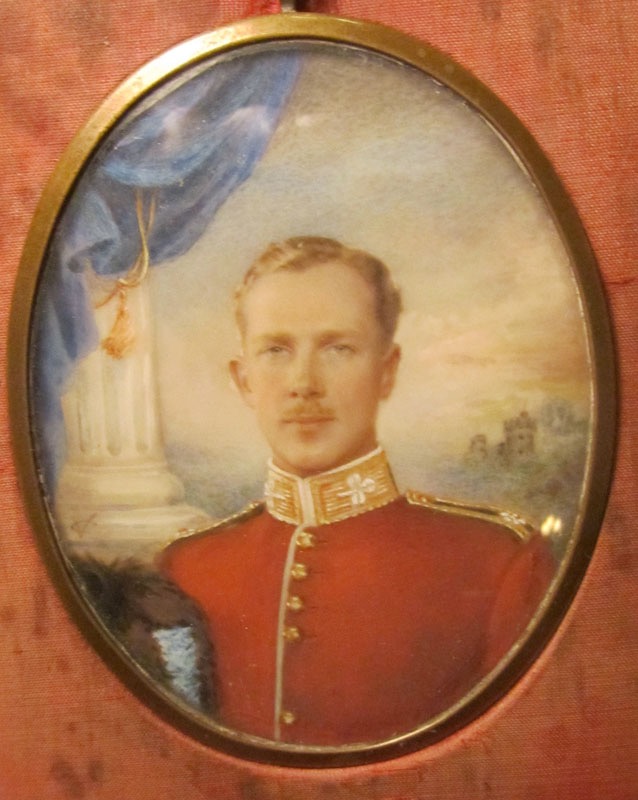
Miniature of Lt John (Jack) Leslie in Irish Guards uniform (courtesy of Mark Leslie)

Eimear Quinn’s Medley consisted of eight songs that reflected different periods in Jack’s life. A beautiful note on which to finish the evening.

1. The West’s Asleep by Thomas Davis

When all beside a vigil keep,

The West’s asleep, the West’s asleep-

Alas! and well may Erin weep,

When Connaught lies in slumber deep.

There lake and plain smile fair and free,

‘Mid rocks-their guardian chivalry-

Sing oh! let man learn liberty

From crashing wind and lashing sea…

And if, when all a vigil keep,

The West’s; asleep, the West’s asleep-

Alas! and well may Erin weep,

That Connaught lies in slumber deep.

But-hark! -some voice like thunder spake:

“The West’s awake, the West’s awake’-

Sing oh! hurra! let England quake,

We’ll watch till death for Erin’s sake!”

2. Rossmore’s Demesne (Dúchas Schools Collection Threemilehouse Vol. 0593 p.358-90)

“As I went a-walking

And for pleasure did rove

Down by Rossmore’s castle

And down by the grove

I s[ied a wee charmer

So neatly stepped she,

On the banks of yon river

Near the weeping ash tree.”
cy8lao-wqaa-0sk

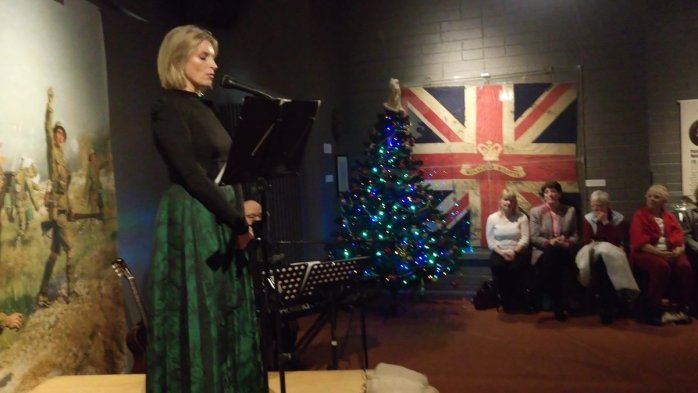
Eimear Quinn  Pic. Michael Fisher

3. Abide with Me (sung at times of sympathy)

“Abide with me; fast falls the eventide;

The darkness deepens; Lord, with me abide;

When other helpers fail and comforts flee,

Help of the helpless, oh, abide with me…

Swift to its close ebbs out life’s little day;

Earth’s joys grow dim, its glories pass away;

Change and decay in all around I see—

O Thou who changest not, abide with me…

I need Thy presence every passing hour;

What but Thy grace can foil the tempter’s power?

Who, like Thyself, my guide and stay can be?

Through cloud and sunshine, Lord, abide with me.”

4. Someone to Watch Over Me (Gershwin)

“I’m a little lamb who’s lost in a wood

I know I could always be good

To one who’ll watch over me

Although I/he may not be the man some girls think of

As handsome to my heart

She/he carries the key

Won’t you tell her/him please to put on some speed

Follow my lead, oh how I need

Someone to watch over me.”

5. Lili Marlene (made popular by Vera Lynn during WWII and sung by Eimear against a WWI backdrop from the current exhibition at the Museum)

“Underneath the lantern

By the barrack gate

Darling I remember

The way you used to wait

‘Twas there that you whispered tenderly

That you loved me

You’d always be

My Lili of the lamplight

My own Lili Marlene…

Resting in our billet

Just behind the line

Even though we’re parted

Your lips are close to mine

You wait where that lantern softly gleamed

Your sweet face seems

To haunt my dreams

My Lili of the lamplight

My own Lili Marlene

My Lili of the lamplight

My own Lili Marlene.”

6. Libiamo from La Traviata

“Let’s enjoy the wine and the singing,

the beautiful night, and the laughter.

Let the new day find us in this paradise.”

7. I Feel Love (reflecting Jack;s love of ‘boom-boom’ music)

Ooh it’s so good, it’s so good

It’s so good, it’s so good

It’s so good

Ooh I’m in love, I’m in love,

I’m in love, I’m in love

I’m in love

Ooh I feel love, I feel love

I feel love, I feel love

I feel love.

8. O Holy Night!

“O Holy Night!

The stars are brightly shining

It is the night of the dear Savior’s birth!

Long lay the world in sin and error pining

Till he appear’d and the soul felt its worth.

A thrill of hope the weary soul rejoices

For yonder breaks a new and glorious morn!

Fall on your knees

Oh hear the angel voices

Oh night divine

Oh night when Christ was born

Oh night divine

Oh night divine”.

Cy8k6nyWQAEBA0R.jpg

Eimear Quinn   Pic. Michael Fisher

SIR JOHN LESLIE Bart born December 6th 1916, died April 8th 2016 (extracts from a Daily Telegraph obituary)

John Norman Ide Leslie, always known as Jack, was born on December 6th 1916 in New York where his father Shane, a writer, diplomat, convert to Rome, and supporter of John Redmond’s moderate nationalist party had gone to counter Irish-Americans trying to keep the United States out of the war. Jack’s mother, born Marjorie Ide, was a well-connected American whose father had been governor general of the Philippines.

Young Jack caught the Spanish Flu in the epidemic of 1918 and was given up for dead when his temperature reached 106. His father, he recalled, asked the nuns next door to pray for him; that night his mother woke with a start to find his temperature had returned to normal. Soon afterwards, however, he developed a mastoid that left him deaf in his left ear.

Jack was almost three when in 1919 he and his elder sister Anita were brought back by their parents to Castle Leslie, to be received by his grandfather, Sir John Leslie, 2nd Bt, and his American wife Leonie, whose sister Jennie was the mother of Winston Churchill. The Leslies had lost their eldest son Norman in the Great War, making Jack the ultimate heir apparent to the title and the vast estates that went with it. But his parents were based in London and, apart from blissful holidays in Ireland, it was there that Jack was brought up.

“My world was populated by lords and ladies,” he recalled, “and naturally I believed that they were the people who ruled England and the enormous British Empire. Although our cousin Winston Churchill was Chancellor of the Exchequer, I thought the House of Commons was a purely advisory committee.” By this time (aged 15) he was at school at Downside. At Magdalene College, Cambridge, he rowed in the college VIII and joined the officer training corps. On graduation in 1938 he was commissioned in the Irish Guards and enjoyed a short period as a “Deb’s delight” before war intervened.

 Ordered to cross to Boulogne after the German invasion of Holland in May 1940, Leslie’s platoon were rendered helpless when their bullets bounced off the advancing German tanks. They surrendered and were marched across Germany to a prisoner of war camp in Bavaria, Leslie spent the rest of the war in captivity.

On release, he returned to civilian life. His grandparents had died and he found himself the major shareholder in the company that owned Castle Leslie. Having planted thousands of trees on the demesne, he embarked on a peripatetic life in Britain, continental Europe and the United States.

In 1953 Leslie settled in Rome in a 16th century house he had restored in Trastevere. As a connoisseur of art, Leslie found much to enjoy in Rome, and as a devout Catholic he relished its religious life and was a pillar of the Order of Malta. He restored an ancient monastery and was rewarded with a papal knighthood.

He returned in 1994 to live in Castle Leslie, which was by then being run by his niece Sammy. In 2001 he celebrated his 85th birthday by travelling to Ibiza to party at Privilege, then the world’s biggest nightclub. In 2006 at the age of 90 Leslie drew on his great memory to write his autobiography, ‘Never a Dull Moment’. In November last year he was among Irish veterans of the Second World War whom the French government appointed to the Légion d’ honneur at a ceremony at the French embassy in Dublin.


GYPROC PLASTERBOARD RECYCLING

PLASTERBOARD RECYCLING SERVICE LAUNCHED BY GYPROC AT KINGSCOURT PLANT

INVESTMENT OF €1.5m IN MAJOR SUSTAINABILITY INITIATIVE

Michael Fisher  Northern Standard  Thursday 8th December  p.6

dickclerkin

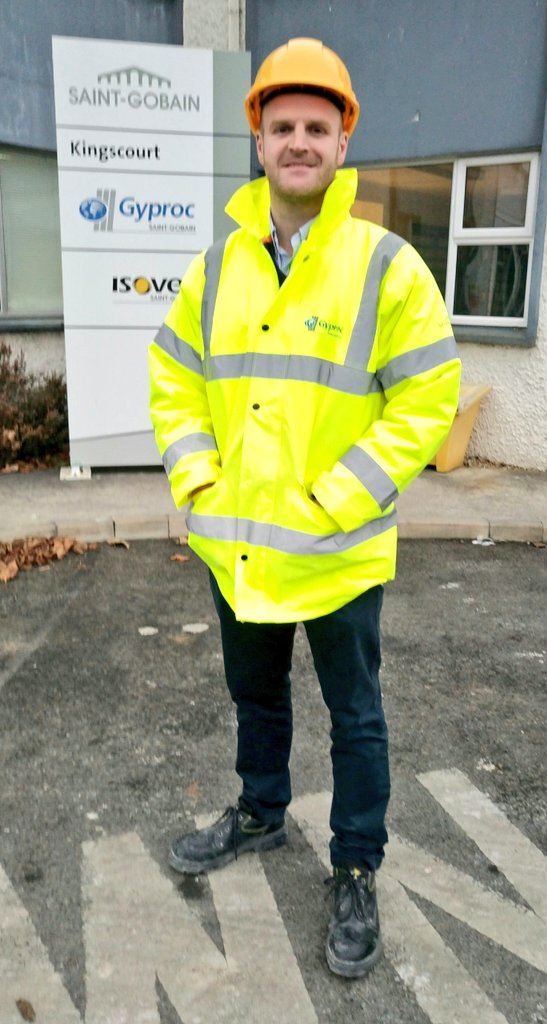
Dick Clerkin, Health Safety Environment & Quality Manager, Gyproc Kingscourt  Pic. Michael Fisher

Plasterboard manufacturer Gyproc has announced Ireland’s first plasterboard recycling service for its construction industry customers. In a major sustainability initiative involving an investment of €1.5 million, Gyproc will recover leftover plasterboard waste from across the island for recycling at its plant outside Kingscourt, Co. Cavan. The new service will offer customers a legal and cost-effective means of disposing of their plasterboard waste. Currently the dumping of such waste at landfill sites is illegal.
Gyproc is the market leader in plaster, plasterboard and drylining systems. Over the next ten years it hopes to recycle half a million tonnes of plasterboard, enough to fill Croke Park one and a half times over. The investment will bring the number of people employed at Kingscourt to 220, a 20% expansion over the past two years. The company is the only manufacturer of plaster and plasterboard in Ireland. The majority of employees live in the surrounding area.

On arrival at the plant it is clear that the top priority in all areas is safety. The company has an excellent record. Vigilance ensures that around 5000 days have passed with no accidents. One of the people who helps them ensure that regulations are adhered to such as the wearing of protective equipment, high-vizibility jackets and shoes is former Monaghan county footballer Dick Clerkin, who is Environmental, Health Safety and Quality Manager. The profitability of the company and the quality of the product are the other main concerns.

Brian Dolan, Managing Director of Gyproc, explained: “We’re very proud to be the first and only plasterboard manufacturer in the country to offer recycling of our products on the island. As a market leader in this sector we are determined to be at the forefront of innovation in new products and services, and in the sustainability and environmental benefits of those services.”

“The new recycling service we’re launching will help to secure local employment into the future by providing additional supplies of a diminishing raw material, namely gypsum rock. All our plasterboard is manufactured in Kingscourt, and we source gypsum from our Drummond mine in Magheracloone, Co. Monaghan, so the connection to the local economy and community is very important to us.”

Manufacturing Manager Fergus Robinson and Operations Manager Darragh Monaghan explained how Gyproc had developed a cost-effective process to take back and recycle the plasterboard waste in the manufacturing process.

They said waste management was a priority for Gyproc in Ireland. From initial design to on-site testing, through to manufacturing and installation the company always believed that effective waste management made good environmental and business sense. A plasterboard recycling service (PRS) customer team is available to set up new accounts, order additional services and answer questions about the service.

The company is part of the St Gobain group, based in France. As a manufacturing company, Gyproc helps to build the environments that are an essential part of everyday life, from schools to hospitals, businesses to homes. Minimising the impact construction projects have on the environment is an important part of the firm’s activities. According to the management, the most effective way to encourage best practice, is to make the building process sustainable for business and sustainable for the environment.

Fergus Robinson said that over many years, Gyproc have committed significant time and resources to ensure they achieve high standards of environmental sustainability, to the point where they now recycle over 97% of the waste produced from their own manufacturing process. To match this internal commitment, the plasterboard off-cut recycling service will help the construction industry reduce its impact on the environment.

The process has been designed from the contractor’s perspective, to minimise processing time and maximise simplicity. Depending on preference, the company through its sub-contractor Allied Recycling can provide a number of different size blue skips to collect the plasterboard off-cuts (14, 25 & 40 yard skips) and collect them from a building site at convenient times. The process is flexible and reliable, and can be scaled up or down to suit any construction project.

The Gyproc system records the total tonnage of waste of plasterboard off-cuts for a project and the average weight per skip, allowing builders to see the financial savings compared to less environmentally sound options. The company stresses that the collected skips must contain only Gyproc plasterboard off-cuts. Any other materials such as metal, timber or non Gyproc manufactured materials will result in a contamination charge being levied at a rate of €160 a tonne.

With over 12,000 employees across 135 sites in 56 countries, St Gobain has an extensive global network combined with in-depth knowledge of local markets. This gives clients immediate access to international best practice in their interior building systems and solutions. They say they value and invest in long-term customer relationships and train 20,000 staff each year, so that building contractors can continue to rely on the integrity of their people, products and processes.

At Kingscourt there is a purpose-built Academy where quality controls can be carried out and where dry liners and plasterers can be trained in working with the latest products. The St Gobain Academy along with one in Dublin offers courses to up-skill and educate trade professionals, merchant staff and customers in all aspects of Gyproc’s range of products and their application in accordance with current construction techniques and standards. All courses are presented by experienced personnel. The facilities include dedicated product display areas and working areas for hands-on practical plastering and plasterboard system demonstrations.

Gypsum board, commonly known as drywall, is the technical product name used by manufacturers for a specific board with a gypsum core and a paper facing. It is the premier building material for wall, ceiling, and partition systems in residential, institutional, and commercial structures and is designed to provide a monolithic surface when joints and fastener heads are covered with a joint treatment system. One principal advantage of gypsum board over plywood, hardboard, and fiberboard is its strong fire resistance.

To produce gypsum board, calcined gypsum is mixed with water and additives to form a slurry which is fed between continuous layers of paper on a board machine. As the board moves down a conveyor line, the calcium sulfate recrystallizes or rehydrates, reverting to its original rock state. The paper becomes chemically and mechanically bonded to the core. The board is then cut to length and conveyed through dryers to remove any free moisture.

Gyproc has been manufacturing in Ireland since 1936. Their products have been used in many of the biggest and most prestigious commercial building projects on the island of Ireland including the National Convention Centre, Titanic Belfast, the Bord Gais Energy Theatre and the landmark Terminal Two at Dublin Airport.

Minister Heather Humphreys said she was delighted to see Gyproc’s new recycling service being launched. “It will deliver economic and environmental benefits both for the sector and for the local community in Cavan and Monaghan. The company has gone from strength to strength, and it’s great to see a local business success story that is leading the way in sustainability and environmental innovation”, she said.

Caoimghín Ó Caoláin TD of Sinn Féin said: “I very much welcome the announcement by Gyproc Kingscourt of the new plaster board off-cut recycling service. This represents a significant investment, is job creative and environmentally important. Well done to all concerned.”

Fianna Fáil Deputy Niamh Smyth also congratulated the company and said the investment would create much needed jobs in Kingscourt. “I know it will see the company recover leftover plasterboard, before recycling it in its Kingscourt facility. The dumping of plasterboard in landfills is illegal. This too can only benefit the environment, in my view”, she said.

Deputy Smyth concluded: “This is a very exciting day for Kingscourt and Drummond and the local economy in general. It follows the opening of a major SuperValu store in Kingscourt a few weeks ago which, will also create and sustain much need employment in the town.”


UK AMBASSADOR AT MUSEUM

181116PF0906.jpg

Carmel Thornton (Monaghan Co. Council) with Ambassador Robin Barnett, Eamonn O’Sullivan CEO Monaghan Co. Council and Museum Curator Liam Bradley

British Ambassador visits Monaghan County Museum

The British Ambassador to Ireland, Robin Barnett CMG, paid a visit to Monaghan County Museum recently. The Ambassador was met by the Curator, Liam Bradley, Monaghan County Council Chief Executive Eamonn O¹Sullivan and Administrative Officer Carmel Thornton. The Ambassador was taken on a tour of the museum¹s current exhibition, “From a Whisper to a Roar: Exploring the Untold Story of Monaghan 1916.” Liam Bradley explained what life was like in the county directly before the Easter 1916 Rising politically, economically and socially and how that changed so dramatically following the bombshell of the historic events in Dublin and around the country.

The other focus of the display is the Battle of the Somme. The Curator noted it was estimated that nearly one hundred Monaghan men died during that terrible battle which took place from July 1st to November 18th 1916. Ambassador Barnett noted that this year of commemorations was an opportunity to explore the full story of this period in Irish history. He remarked on the recent event at Glasnevin Cemetery in Dublin, where a Castleblayney man, Thomas Hughes, was commemorated for receiving the Victoria Cross during the Battle of the Somme. Private Hughes VC is one of the key characters explored in the museum¹s exhibition on the historic year of Monaghan 1916.

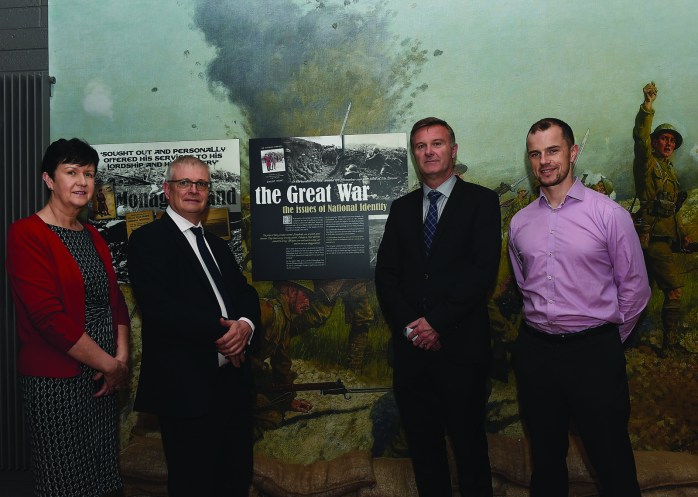
At the end of his visit the Ambassador thanked the Museum Curator and the staff of the museum for developing such a fascinating display. He expressed a keen interest to return when he had more time to view all of the museum displays. Chief Executive of Monaghan County Council Eamonn O’Sullivan thanked Ambassador Barnett for taking time out of his busy schedule to visit the museum and also thanked the museum staff. The exhibition formed the backdrop for the special celebration marking what would have been the 100th birthday of Sir Jack Leslie of Castle Leslie, Glaslough.