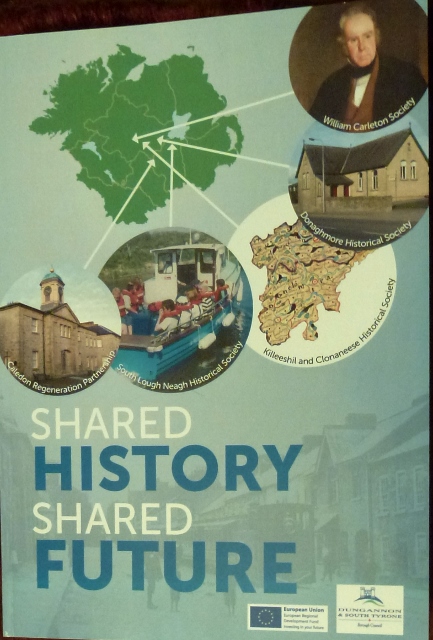
Shared History Shared Future booklet

Shared History Shared Future booklet
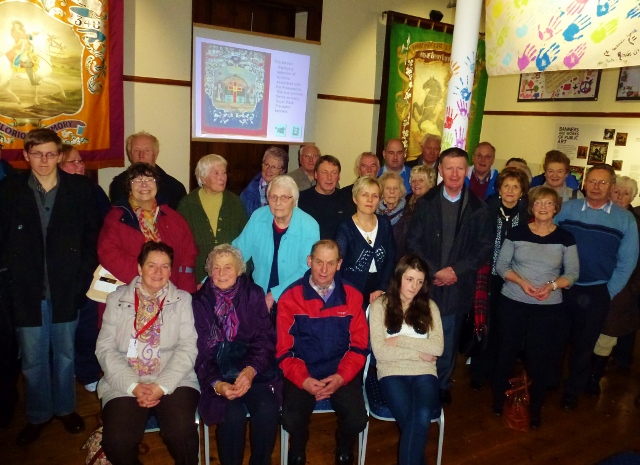
Members of the group at Cavan County Museum Photo: © Michael Fisher
Visit to Cavan County Museum, Ballyjamesduff, by members of the ‘Shared History, Shared Future’ project from South Tyrone. Members of the William Carleton Society joined the other groups on this study trip from Dungannon via Broomfield (coffee break at An Eaglais), the Boyne Valley and Navan to County Cavan. An evening meal was organised at the Lavey Inn.

Coffee Break at An Eaglais, Broomfield Co.Monaghan

Armistice Day Belfast Picture: BBC News NI
As the centenary of the start of the First World War approaches, a couple of important developments happened today on either side of the border on Armistice Day. Representatives of victims of the troubles were at Stormont to call on politicians to agree new mechanisms to investigate past human rights violations and abuses.
A Sinn Féin Lord Mayor of Belfast, Máirtín Ó Muilleoir. became the first member of his party to take part in the official ceremony at City Hall. BBC Northern Ireland report here. As I commented elsewhere (on twitter), this was in my view the ‘right call to attend Armistice Day event: your presence at a Belfast ceremony was significant, not about wearing a poppy’. He was accompanied by some of the chaplains he had appointed at the start of his mayoral term, among them Fr Des Wilson from West Belfast, and a couple of party colleagues including Councillor Tom Hartley, a local historian.
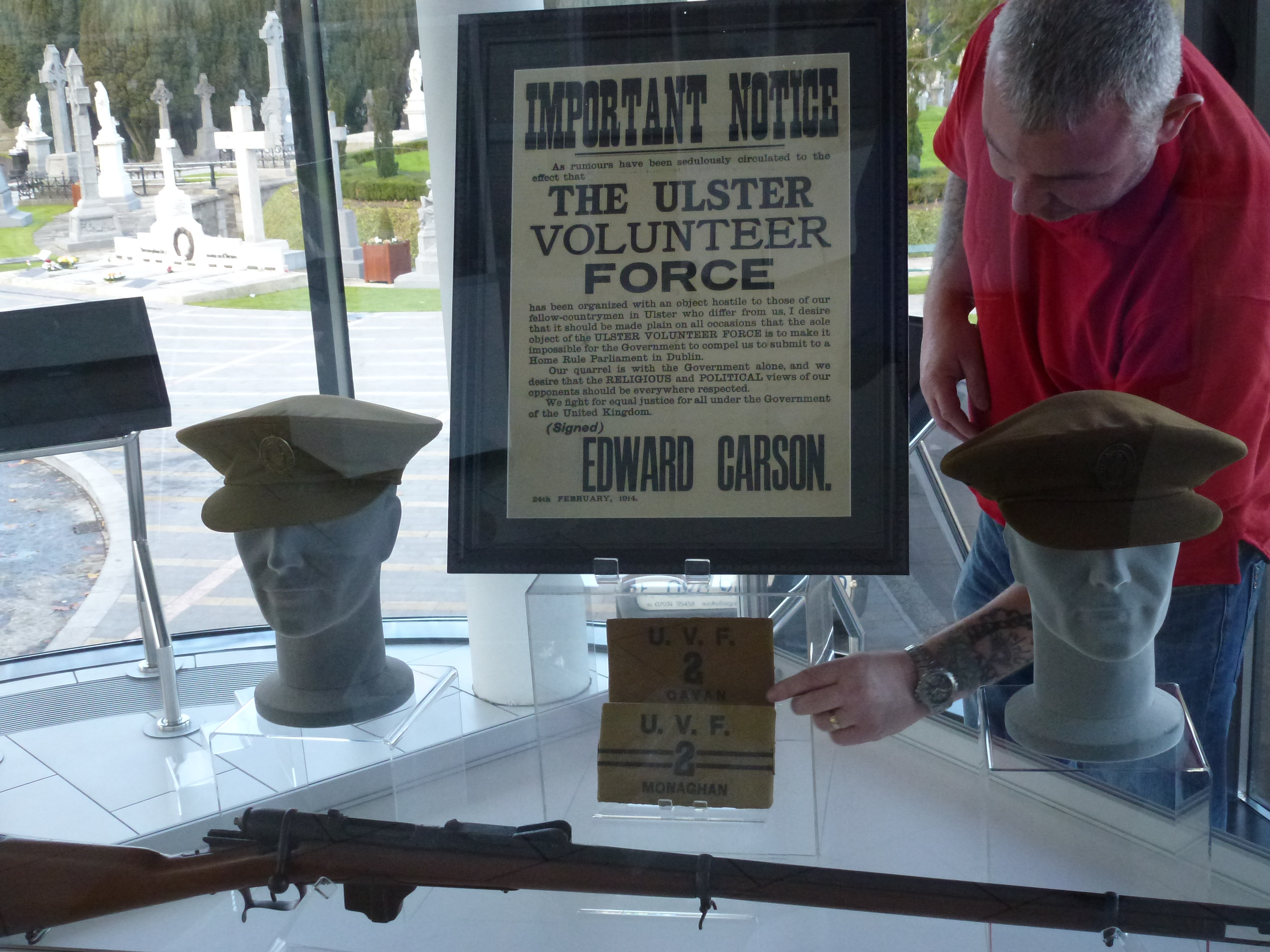
Preparing the exhibition at Glasnevin Photo: © Michael Fisher
Meanwhile in Dublin, an exhibition developed under the auspices of the Unionist Centenary Committee and containing the largest collection of UVF memorabilia ever seen in the Republic was opened in the visitor centre at Glasnevin cemetery. This is the burial ground for some of the best-known figures in Ireland’s history, such as Daniel O’Connell and Michael Collins, and including many republicans. The Unionist Centenary Committee was formed in 2010 as a steering group made up from stakeholders from the Unionist community to oversee the decade of centenaries between 2012-2021.
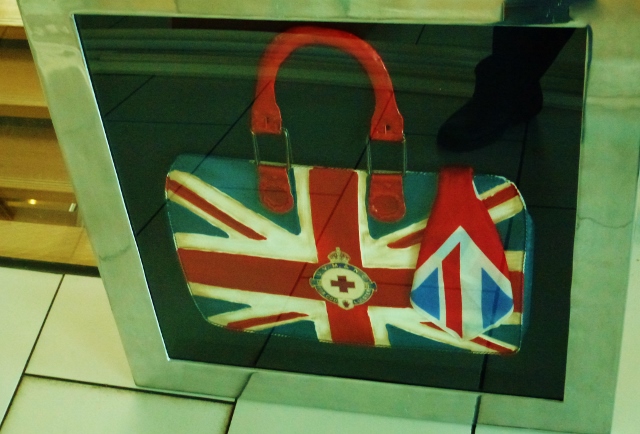
Bag used by UVF Medical & Nursing Corps Photo: © Michael Fisher

Arts Minister Jimmy Deenihan Photo: © Michael Fisher
The Ulster Volunteer Force was formed to resist plans to make Ireland self-governing, but many members went on to fight in the British Army in the First World War. The exhibition is called Home Rule Crisis… the unionist response. It covers the period from 1912-1914 and was officially opened by the Minister for Arts and Heritage Jimmy Deenihan, who had read a lesson at the Remembrance Sunday service at St Patrick’s Cathedral in Dublin yesterday.
Some unionist politicians also attended the Glasnevin event. A priest read prayers before people in UVF costumes laid wreaths at the war graves commission memorial to those from the Republic who died fighting for the allies in the two world wars.
The collection of artefacts from the Home Rule period includes personal items of James Craig, uniforms, and literature from that pivotal period. Tours of the exhibition will be provided free of charge. The exhibition focuses on the unionist reaction to events during 1912-1913, particularly the Ulster Covenant and the formation of the UVF.
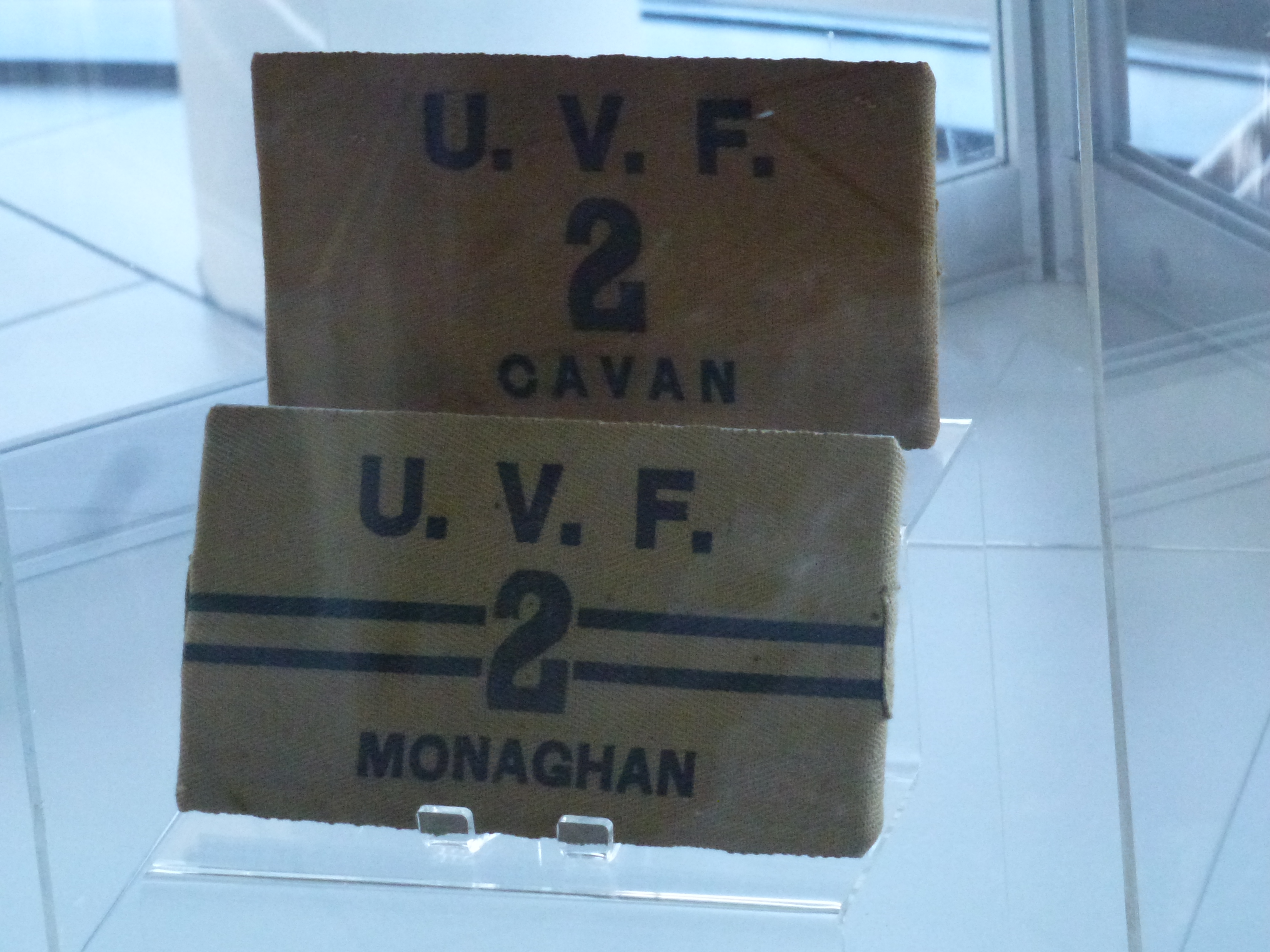
UVF armbands from Cavan and Monaghan Photo: © Michael Fisher
The launch included a talk by Philip Orr and a drama depicting discussions between Carson, Craig and Crawford at the time, and music. On Saturday 16th November, Quincey Dougan and Jason Burke will provide lectures on Unionism 100 years ago. The exhibition is free and will run for two weeks until the end of November. It will be followed by an exhibition on the Irish Volunteers, the formation of which was planned at a committee meeting 100 years ago today in Dublin.
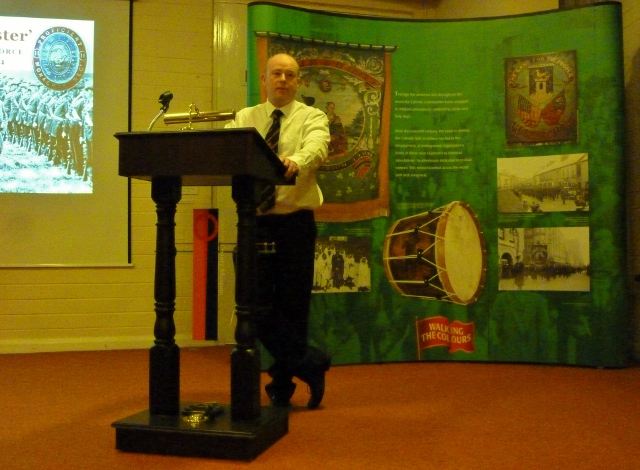
Quincey Dougan, talking about the UVF in Monaghan in June Photo: © Michael Fisher
Unionist Centenary Committee Chair David Hagan said:
“We are excited to be bringing such a major collection of Unionist artefacts to Glasnevin Cemetery. Traditionally a site steeped in Republican and Nationalist history, it shows the progress we are making in embracing and learning more about our shared history. Over the course of the week we are also holding lectures which provide a deeper insight into Unionist thinking at the time and we will have historians on hand around the exhibition to provide further information on the collection. We have already exhibited some of the collection around Northern Ireland and have received really positive feedback, so we are looking forward to offering the people of Dublin the opportunity to learn more about Unionism in Ireland 100 years ago.”

Figure of UVF member Photo: © Michael Fisher
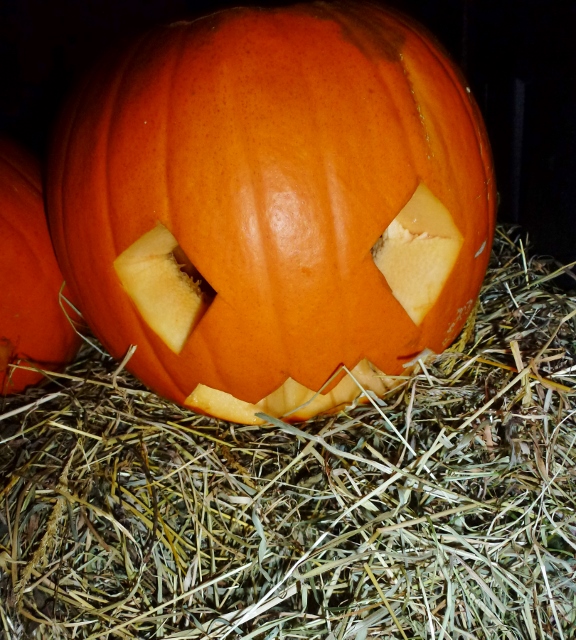
Barn Dance Photo: © Michael Fisher
Most Lions Clubs have a ‘tail twister’, an officer and the ‘pep master’ of each Club. His duties (I think I should add the alternative ‘her’ as well) are “to instil enthusiasm and good fellowship in the meetings, and to keep harmony. (S)He is empowered to impose, as well as collect, fines from the members. There shall be no appeal from the tail twister’s decision in imposing a fine, and he (she) may not be fined except by the unanimous vote of the members present.

Meet the new ‘tail twister’ of Monaghan Lions Club…! Photo: © Michael Fisher
Well it looks like Monaghan Lions Club who have several female members just got themselves a new tail twister, judging by the fellow I saw standing beside the stage at their barn dance tonight (Saturday 26th October) in Tyholland Community Centre. I think he said his name was Wayne….
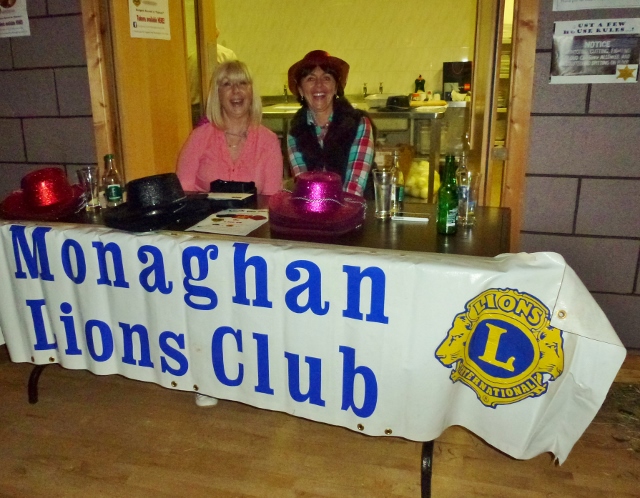
Burger and a hat all for €7: good value in a good cause! Photo: © Michael Fisher
Anyway he was one of the many all dressed up in cowboy/cowgirl attire. The appropriate dress for the night appeared to be jeans and checked shirts for the men and a variety of outfits for the ladies, most of whom brought along hats. The Club was also selling a variety of hats for €4 for those who wanted to enter into the spirit of the occasion.

The Outlaws Photo: © Michael Fisher
It was an enjoyable evening dancing to The Outlaws as Monaghan Lions Club revived their barn dance fundraiser in aid of Club charities. The Tyholland Centre doubled up as the barn and a marquee was erected alongside to serve as the ‘saloon’, serving drinks and burgers. Plenty of prizes in the raffle as well, including a number of pairs of tickets for forthcoming Ireland rugby international matches.
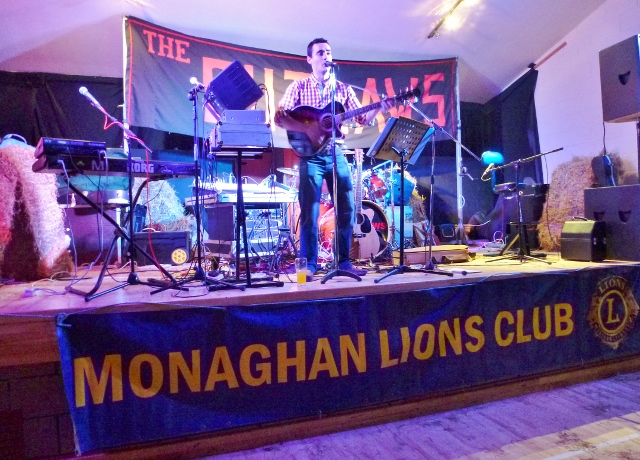
Aidan Clerkin at Monaghan Lions Club Barn Dance Photo: © Michael Fisher
On arrival, Aidan Clerkin was on stage, providing a variety of country and Irish music and doing his best to encourage them to dance, but it was a while before the crowd found their dancing shoes. The main act was The Outlaws from Castleblayney in County Monaghan. They comprise of Sean Hughes, JJ McCourt, Brian Walsh and brothers Craig and Adam Davis, who are both grand nephews of Irish country legend Big Tom McBride.

Michael Fisher, Belfast Lions Club supporting the Monaghan Lions event Photo: © Evelyn Fisher
Plus brilliant fiddle playing by Diane Traynor. who brings her own style and glamour to the band and her fiddle playing skills and sweet singing range enhance the band’s appeal. It’s just a pity that when they came to perform a ‘Siege of Ennis’ dance that there were only a few takers.
Monaghan Lions Club carry out projects throughout the year in service of the community. At Christmas, they hold an annual food appeal in conjunction with St Vincent de Paul. The Club meets on the first and third Monday of every month at 9pm at the Westenra Arms Hotel in The Diamond, Monaghan.

Monaghan Lions Club Poster
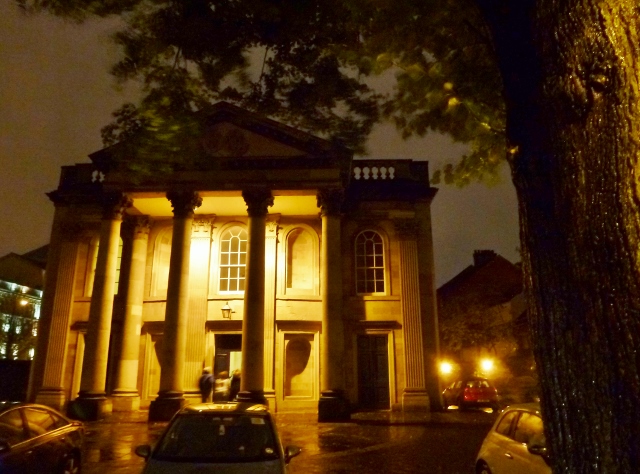
St George’s Church Belfast Photo: © Michael Fisher

Carlo Gébler Photo: © Michael Fisher
No sign of the moon but plenty of atmosphere provided mainly by candlelight as Carlo Gébler’s new play Belfast by Moonlight was given its world premiere at St George’s by the locally based Kabosh theatre company. It’s the oldest Anglican church in the city in use and will soon celebrate its bicentenary, so it proved to be a very appropriate setting for a drama based around 400 years of Belfast since the granting of a Royal Charter in 1613.
In a recent interview with CultureNorthernIreland for What’s On, Gébler explained how the work evolved. He said artistic director Paula McFetridge briefed him not to write a dramatized history but to produce something personal, possibly involving music, that would work in St George’s Church, a play that would be true to that space. He has certainly fulfilled his brief admirably.
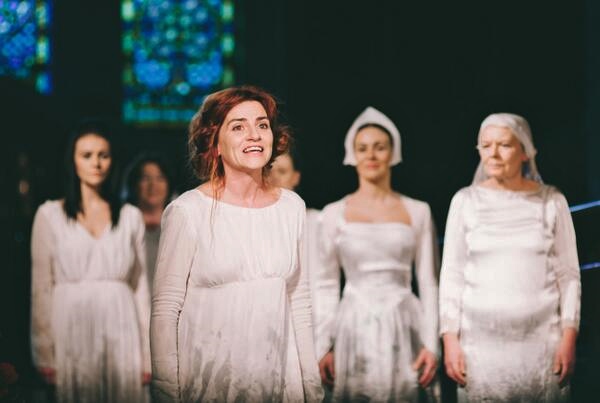
Belfast by Moonlight: Photo: Kabosh
Attending a rehearsal of another piece that Kabosh had also commissioned, Gébler came up with the idea that the cast would all be female and would play the role of ghosts or spirits from the past. Each of the six was to have a significant event in their lives that had occurred in or around the Church. It was a concept that worked well.

The six ‘spirits’ from Kabosh (in middle) are applauded along with the Choir Photo: © Michael Fisher
Gébler says this is not a realistic play. But when the action reached the 20th Century period up to today, I found there were elements of social commentary that had also featured in Crimea Square, the community-led drama I had seen the previous night on the Shankill Road. That play had scenes including the glue sniffers and young people growing up in the era of rock n’ roll. Géblers ghostly spirits materialised at the start, resurrected from the grave to tell their stories in the chancel area of the church. They included a woman who had given up her two year-old son for adoption in the 1960’s and a young woman who was a drug addict.
The play certainly had an impact on the young drama students in the audience: fifteen from Banbridge Academy and another group from various schools in Gébler’s base in Enniskillen. One was particularly moved by the story of one of the spirits from the time of the Great Famine around 1845: Joanna I think she was named. The spirit represented a cottier from County Monaghan where she had lived in a mud cabin. Her husband had died from fever and she came to Belfast with her two young children looking for support but her story too ended in tragedy.

Choir: Belfast by Moonlight Photo: © Michael Fisher
Around 40% of the play is sung by the main actors and the eight-strong female choir, with original music composed by cellist Neil Martin. The choir come from areas as far apart as Dungannon and Donegal. They were conducted by Nigel McClintock, Director of Music at St Peter’s Cathedral in Belfast and have been rehearsing under Emma Gibbins, Director of Music at St George’s.

Kabosh: Belfast by Moonlight at St George’s Church Photo: © Michael Fisher
The actors are Bernadette Brown, Maria Connolly, Roisin Gallagher, Laura Hughes, Carol Moore and Kerri Quinn. As the full moon rises, the six spirits they portray congregate to offer a haunting lament for Béal Feirste and to explore the rich past of the city..
St George’s is on High Street, where the River Farset used to flow. In the play, the rivers of Belfast are a recurring theme presented in song by the choir and the actors. The small rivers flow into the big rivers and the big rivers flow into the sea. Gébler has produced a chorus from their names: “the River Knock, the Connswater, the Purdysburn, the Ligoniel, Derriaghy, Colin, Blackstaff, Forth, Milewater, Cregagh, Farset, Lagan Navigation, the Ravernet”. For vimeo footage by NvTv of the Kabosh production in rehearsal, see here.
There is a stained glass window behind the main altar of the church with the Bible verses “O Death Where is Thy Sting/O Grave Where is Thy Victory”. Very appropriate for the six spirits performing in the Belfast moonlight.
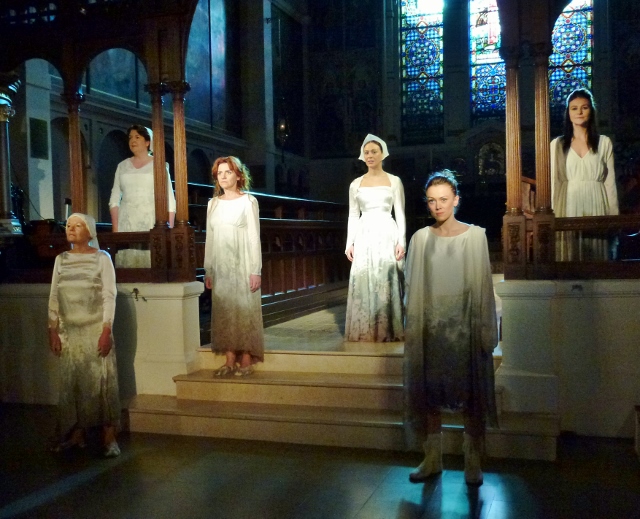
The six ‘spirits’ from Kabosh come to the end of their story by moonlight Photo: © Michael Fisher
Festival Guest Blogger Michael Fisher
@fishbelfast
St George’s Church Belfast Photo: © Michael Fisher
St George’s Parish Church in Belfast is the oldest Anglican church in the city in use and was a very appropriate setting for Carlo Gébler’s new play, looking back over 400 years of the city.
Carlo Gébler Photo: © Michael Fisher
It’s called Belfast by Moonlight but tonight unfortunately there was no sign of the moon. However the lighting effects (including candles) inside the church provided a suitable atmosphere for the dialogue and the accompanying music, provided by an eight-strong female choir who come from areas as far apart as Dungannon and Donegal. They were conducted by Nigel McClintock, Director of Music at St Peter’s Cathedral in Belfast and have been rehearsing under Emma Gibbins, Director of Music at St George’s.
Kabosh: Belfast by Moonlight at St George’s Church Photo: © Michael Fisher
The play began with six spirits (all female) appearing out of the darkness, as if resurrected from the tomb. Each was from a different period, starting from 1613 when Belfast received its Royal Charter from King James I granting it the right to form a Corporation and extending up to the present day. The six are Bernadette Brown, Maria Connolly, Roisin Gallagher, Laura Hughes, Carol Moore and Kerri Quinn, all members of the Kabosh theatre company under the artistic direction of Paula McFetridge. Each spirit is connected in some way to St George’s: one got married there; the spirit from the 1960s has a two year-old son who was given away for adoption at an office said to be in the church.
Around 40% of the play is sung by the main actors and the choir, with original music composed by cellist Neil Martin. Where the River Farset joins the mouth of the Lagan rests the chapel of the sandy ford; an inhospitable place for a city. As the full moon rises, the six spirits congregate to offer a haunting lament for Béal Feirste and explore the rich past of the city.
The six ‘spirits’ from Kabosh (in middle) are applauded along with the Choir Photo: © Michael Fisher
St George’s is on High Street, where the River Farset used to flow. In the play, the rivers of Belfast are a recurring theme presented in song by the choir and the actors. The small rivers flow into the big rivers and the big rivers flow into the sea. Gébler has produced a chorus from their names: “the River Knock, the Connswater, the Purdysburn, the Ligoniel, Derriaghy, Colin, Blackstaff, Forth, Milewater, Cregagh, Farset, Lagan Navigation, the Ravernet”. For vimeo footage by NvTv of the Kabosh production at the rehearsal stage, see here. There is a great picture of the stained glass window behind the main altar of the church, which contains the Bible verses from 1Corinthians 15:55-56 : “O Death Where is Thy Sting/O Grave Where is Thy Victory”. Again, very appropriate when the six spirits are gathered at the altar steps.
There will be post-show talks on 23rd and 26th October with matinee performances on Saturday 26th and Wednesday 30th October at 3pm. There are no Sunday performances. This event runs after the Festival until All Hallows’ Eve on Thursday 31st October (Halloween). Tickets are £14 (concession £10) and can be booked here. 
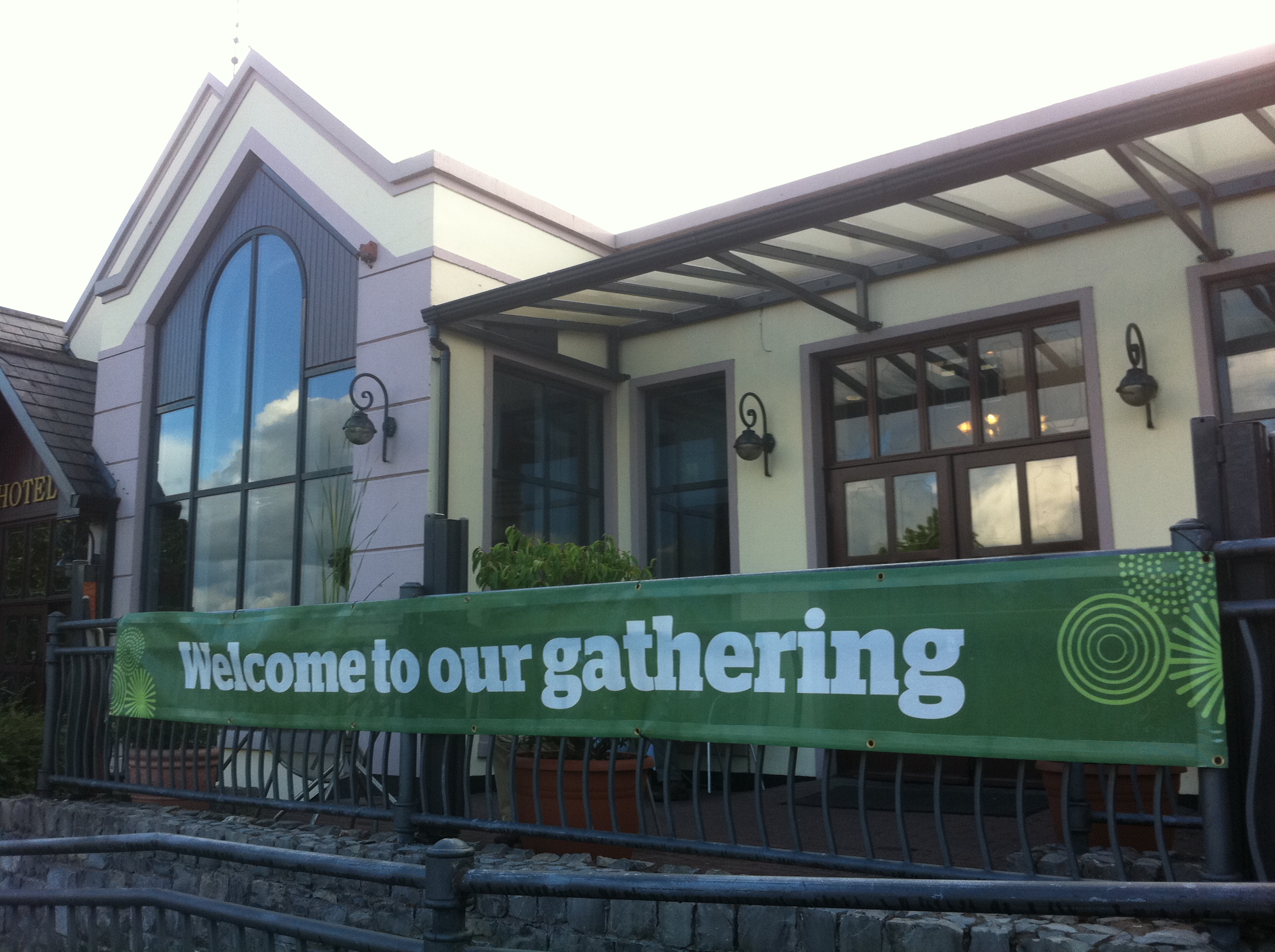
Four Seasons Hotel Monaghan Photo: © Michael Fisher
A major conference takes place in Monaghan tomorrow. In support of the objectives of Monaghan Age-Friendly Alliance, the local branch of the University of the Third Age U3A is hosting an event at the Four Seasons Hotel. The theme is “Positive Living in the Third Age – Enhancing the Golden Years”. This conference is one of the events in the Monaghan Gathering 2013 calendar
The conference will address the challenges, opportunities and policies to be pursued both within Ireland and the European Union to promote a rewarding and life enhancing older age for citizens. With people living longer and healthier lives this presents a major challenge for all policy makers. The conference will open at 11am with a civic reception given by the Monaghan County Mayor Councillor Sean Conlon.
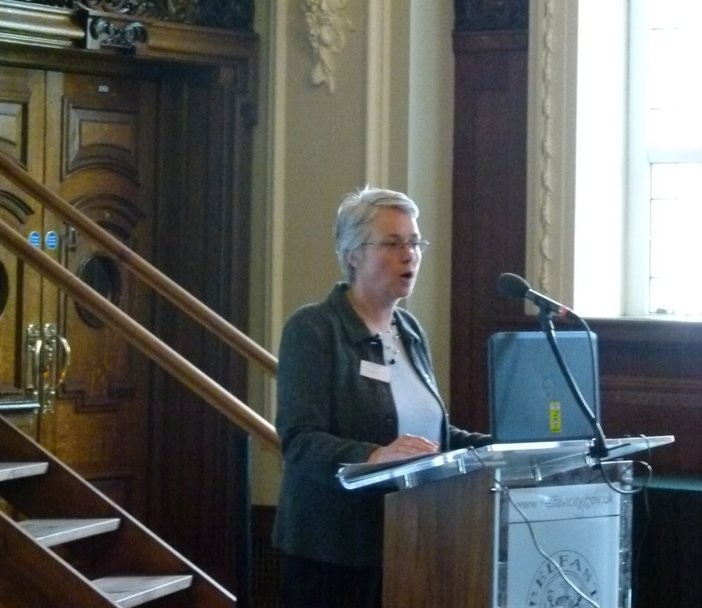
Claire Keatinge Commissioner for Older People NI
The speakers include Claire Keatinge, Commissioner for Older People for Northern Ireland, who will speak on “Self-help, volunteering and employment of the 50+ generation”; Marian Harkin, Member of the European Parliament will address “Active Ageing – An Age Friendly EU”. It is also hoped that Kathleen Lynch, Minister of State for Health with Responsibility for Older People will deal with national strategy for an ageing population in the Republic.
Other particpants are Stuart Pollard, Northern Ireland Regional Trustee for the Third Age Trust and Margaret Fitzpatrick, Education Officer with Age Action Ireland, both of whom will address issues to do with the U3A movement on both sides of the border. Those attending will also hear about the most up to date research on home safety for older adults from Lisa Jennings, PhD candidate at Queen’s University, Belfast. Monaghan members will give an outline of the development of the U3A movement in Monaghan and the contacts made with fellow U3A groups in Northern Ireland.
The sessions will be chaired by two eminent professionals from the field of research into ageing matters. Professor Thomas Scharf, Director of the Irish Centre for Social Gerontology at NUI Galway. At NUIG Professor Scharf is leading a major programme of work addressing issues relating to ageing in rural communities. Dr. Roger O’Sullivan, Director of the Centre for Ageing Research and Development in Ireland (CARDI). Dr O’Sullivan has undertaken a wide range of research on issues relating to older people including research for the Office of the First Minister and deputy First Minister of the Northern Ireland Assembly.
The conference will conclude with a humorous drama presentation by the newly formed Market House Players from Monaghan town as well as the first public performance by the newly formed U3A choir – with some help from the accomplished Oriel Singers.
Monaghan U3A has been in existence for four years and has nearly 150 members. The U3A is a worldwide movement of older people where members share their skills and life experiences – learners teach and teachers learn.
The Monaghan group participates in a variety of learning and social activities which include – a walking group; bowling shared with Knockatallon Bowling Club; social card playing; weekly computer workshops for beginners; gardening classes each autumn and spring; flower arranging; digital photography; spoken French and Irish. In addition the U3A host a very successful monthly talk and lunch at the YWCA premises and of course some very interesting day trips for members.
The conference fee is €20 or £18, which includes lunch and refreshments.
I attended a harvest service this afternoon at Errigal Truagh, County Monaghan, not far from the village of Aughnacloy in County Tyrone. The small Church of Ireland church there has many cross-border links.
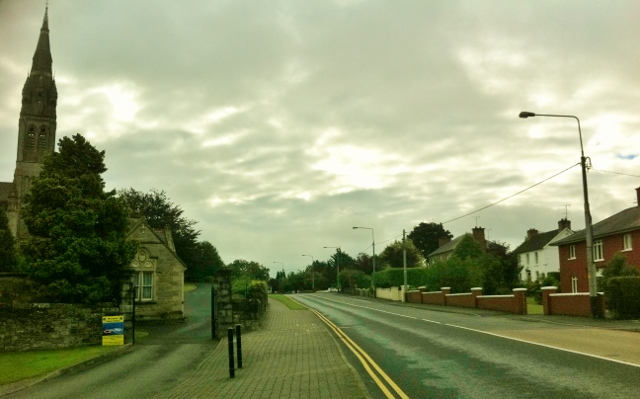
St Macartan’s Cathedral Monagan & Tirkeenan on Dublin Road Photo: © Michael Fisher
Congratulations and happy 65th wedding anniversary to my wonderful parents Peggy and Des (as of tomorrow both will be 93). It’s known as a blue sapphire anniversary. I passed Tirkeenan and St Macartan’s Cathedral Monaghan where they were married as I made my way to Dublin from Tydavnet this morning. On September 8th 1948 Mum only had to stroll across the road to the church, yet she exercised the prerogative of the bride to be late! The wedding breakfast followed at Tirkeenan on a Wednesday morning after 8:30am Mass celebrated by my uncle the late Fr Harry Smyth CM. Congratulations!
My father wrote a lovely poem for my mother based on Kavanagh’s Raglan Road, which incidentally is not far from their first Dublin 4 lodgings of their married life on Anglesea Road in Ballsbridge. The house was owned by the late Liam D.Bergin, proprietor of the Nationalist and Leinster Times in Carlow, where my father began his journalistic career.

St Macartan’s Cathedral Monaghan Photo: © Michael Fisher

Old Bridge over Ulster Canal near Clones, Co.Monaghan Photo: © Michael Fisher
It has been dubbed the “Clones Sheugh” by one blogger Irish waterways history, who believes the Canal restoration would be a folly. Another industrialheritageireland.info has questioned the viability of the planned restoration of a 13km section of the Ulster Canal and River Finn from Clones to Upper Lough Erne and wonders where the finance will come from to maintain the waterway and any associated buildings if the restoration goes ahead. But there are local groups which believe the project is viable and will help to preserve an important part of Ulster’s industrial heritage.

South Lough Neagh Historical Society at Ulster Canal Stores Clones Photo: © Michael Fisher
One such group of enthusiasts is the South Lough Neagh Historical Society which this afternoon visited the Ulster Canal Stores in Clones and took a trip along the section of canal due to be restored. The decision was announced at a meeting of the North/South Ministerial Council in Armagh in July 2007. I remember doing a report on the proposals having travelled along much of the same route as the visitors did today. However there are few visible signs of any progress in the past six years. The situation was discussed at the inaugural meeting of the North/South Inter-Parliamentary Association a year ago which produced a background paper on the cross-border plan.

Ulster Canal Stores Clones: could this become a marina? Photo: © Michael Fisher
The Ulster Canal opened in 1841 and linked Lough Neagh with Lough Erne. The plan was to create a navigable waterway connecting the ports of Belfast and Coleraine with the Shannon and onwards to Limerick or Waterford. It is 46 miles long with 26 locks. It left the River Blackwater below Moy and climbed through 19 locks to the summit on the far side of Monaghan. It ran through the counties of Fermanagh, Monaghan and Armagh. It originally passed through or close to Clones, Smithborough, Monaghan, Middletown, Tynan, Caledon, Milltown, Benburb, Blackwatertown, Moy and Charlemont.

Route of original Ulster Canal near Clones Photo: © Michael Fisher
 Michael Fisher's News