FLANDERS DAY THREE

Monument at Lochnagar Crater

Day three of our travels saw the group leave Ieper and head back across the border towards the town of La Boiselle in France. There we visited the Lochnagar crater.

Paying respect at Lochnagar Crater

Lochnagar Crater

Lochnagar Crater is in private ownership. The site was bought by Richard Dunning and the area is now run by a Trust.

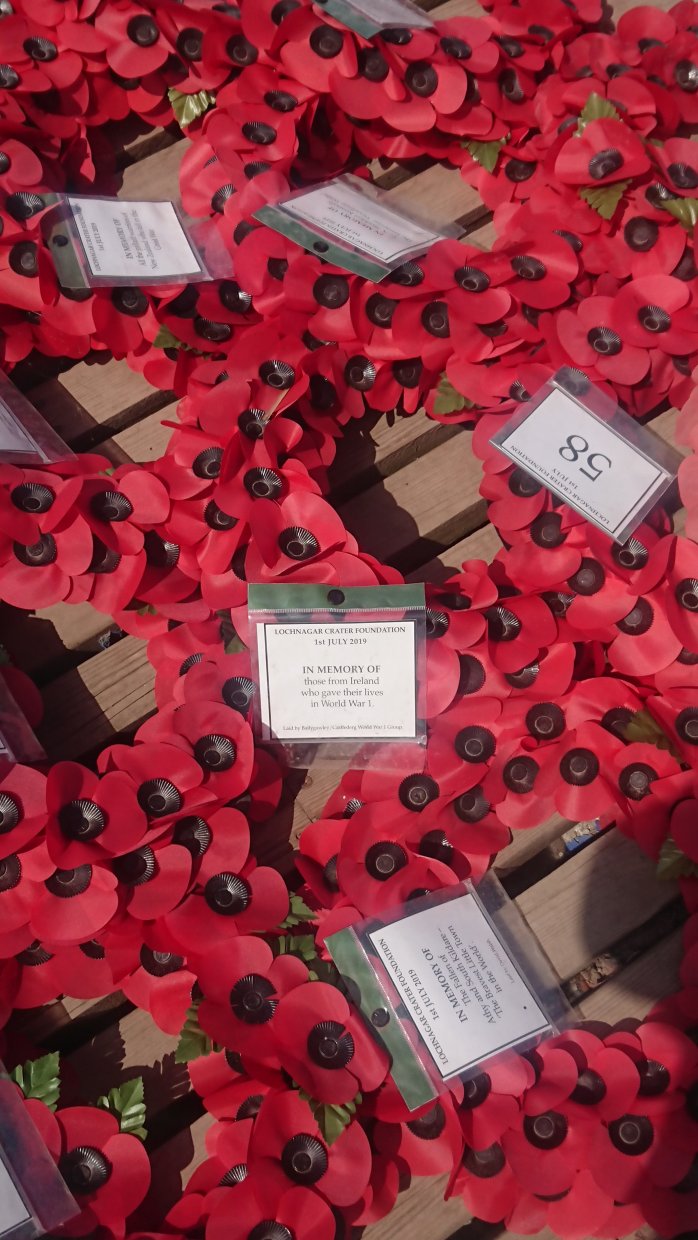
Wreaths left at the Lochnagar Crater

The British named the mine after Lochnagar Street, the British trench from which the gallery was driven. The charge at Lochnagar was one of nineteen mines that were placed beneath the German lines on the British section of the Somme front, to assist the infantry advance at the start of the battle.

The mine was sprung at 7:28 a.m. on 1 July 1916 and left a crater 98 ft (30 m) deep and 330 ft (100 m) wide, which was captured and held by British troops. The attack on either flank was defeated by German small-arms and artillery fire, except on the extreme right flank and just south of La Boisselle, north of the Lochnagar Crater. The crater has been preserved as a memorial and a religious service is held annually on 1st July.

Lochnagar Crater

More pictures of the Lochnagar Crater.

Path around the Lochnagar Crater which is owned by a Trust set up by Richard Dunning

Lochnagar Crater

Memorial to women who lost their lives serving in WWI

CHAPELLE D’ARMENTIÈRES CEMETERY

This CWGC cemetery where Captain Norman Leslie from Glaslough Co. Monaghan is buried is in France.

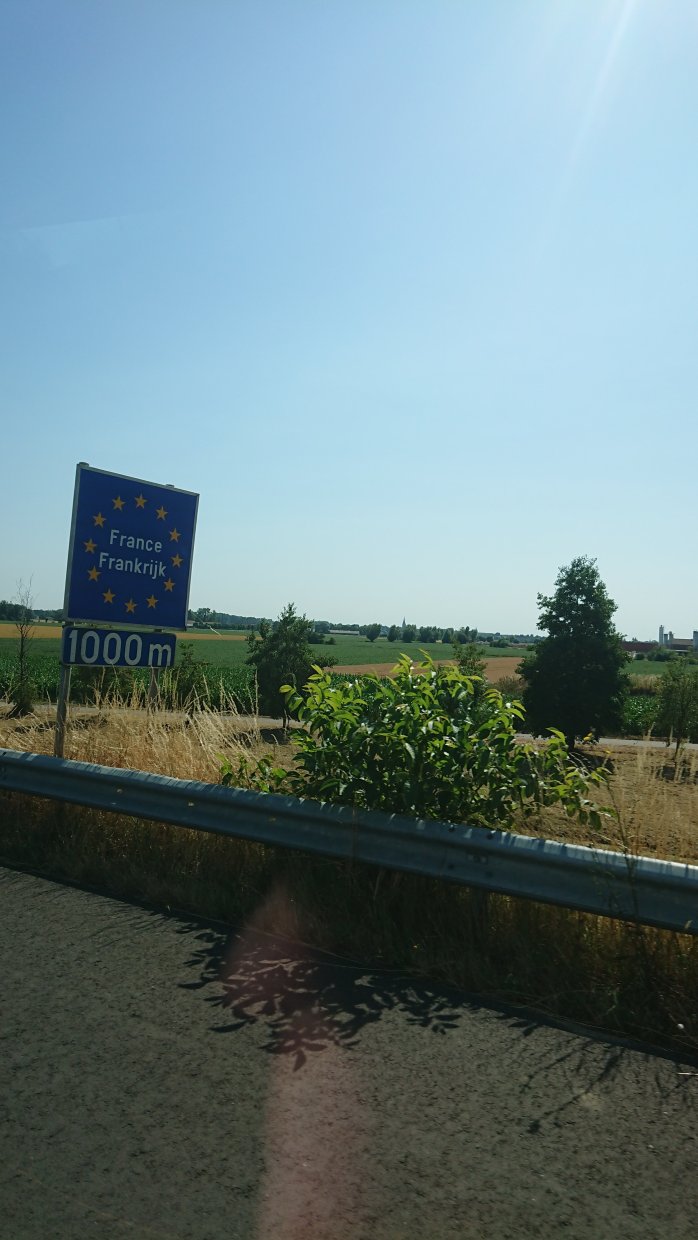
The seamless border between Belgium and France both in the Schengen Agreement

It is close to the border with Belgium at Houplines, and outside the village of La Chapelle-d’Armentieres, not far from Armentières itself.

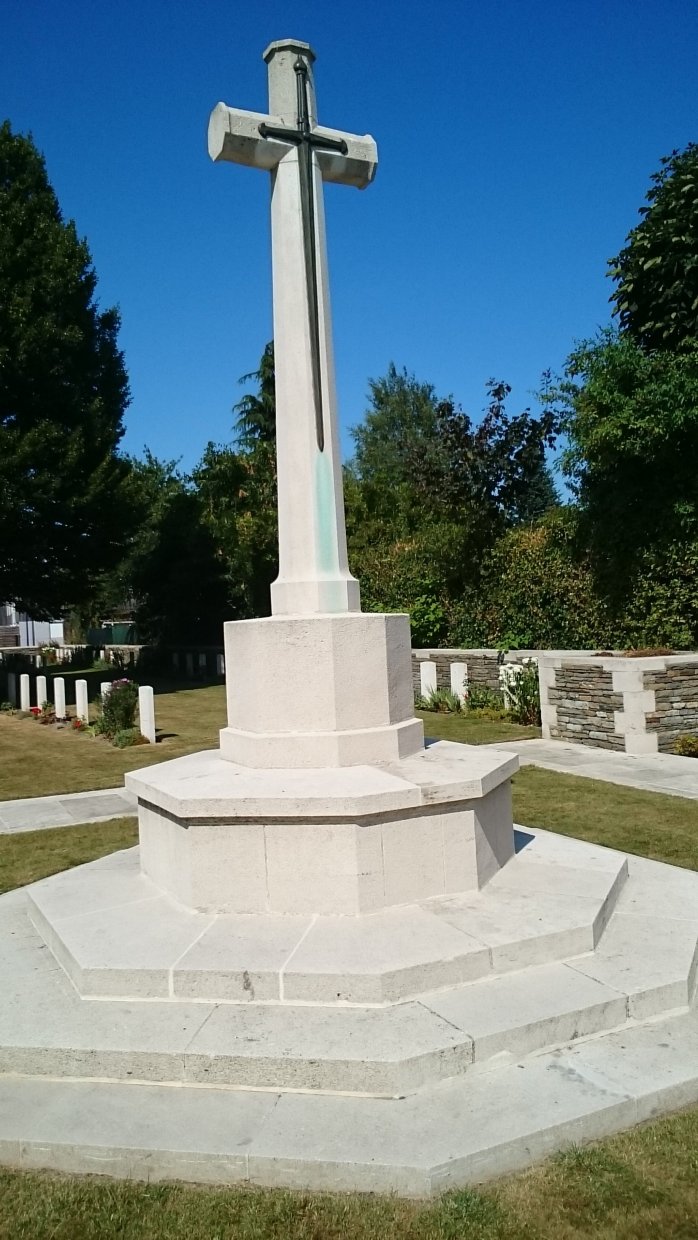
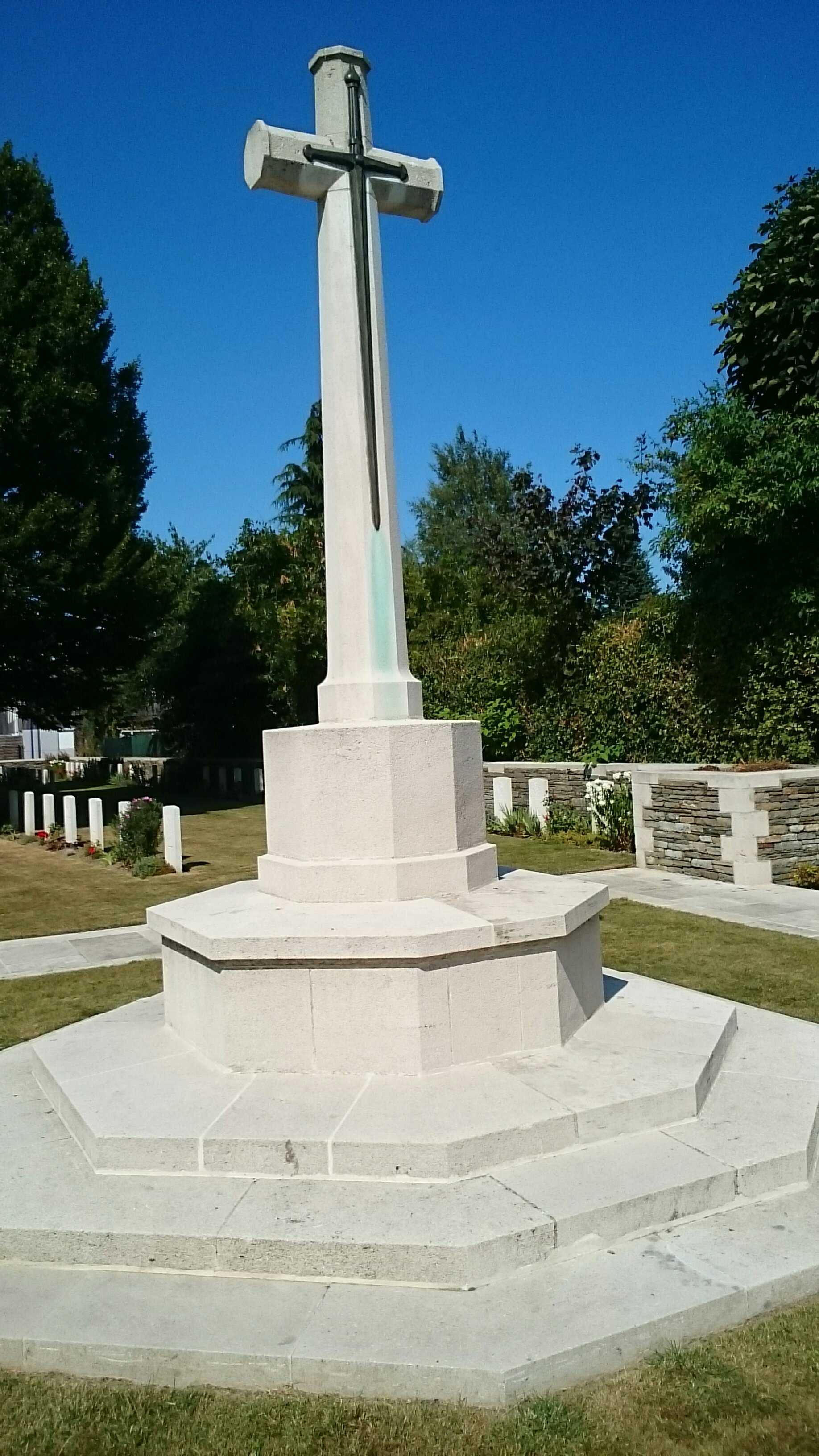
Cross of Sacrifice at Chapelle d’Armentières military cemetery

This area was in the hands of Commonwealth forces from October 1914 until the fall of Armentières on 10th April 1918. It was retaken in the following October.

Cross of Sacrifice at Chapelle d’Armentières military cemetery

During the Allied occupation, the village was very close to the front line and its cemeteries were made by fighting units and field ambulances in the earlier days of trench warfare.

Rifleman Brown of the Rifle Brigade

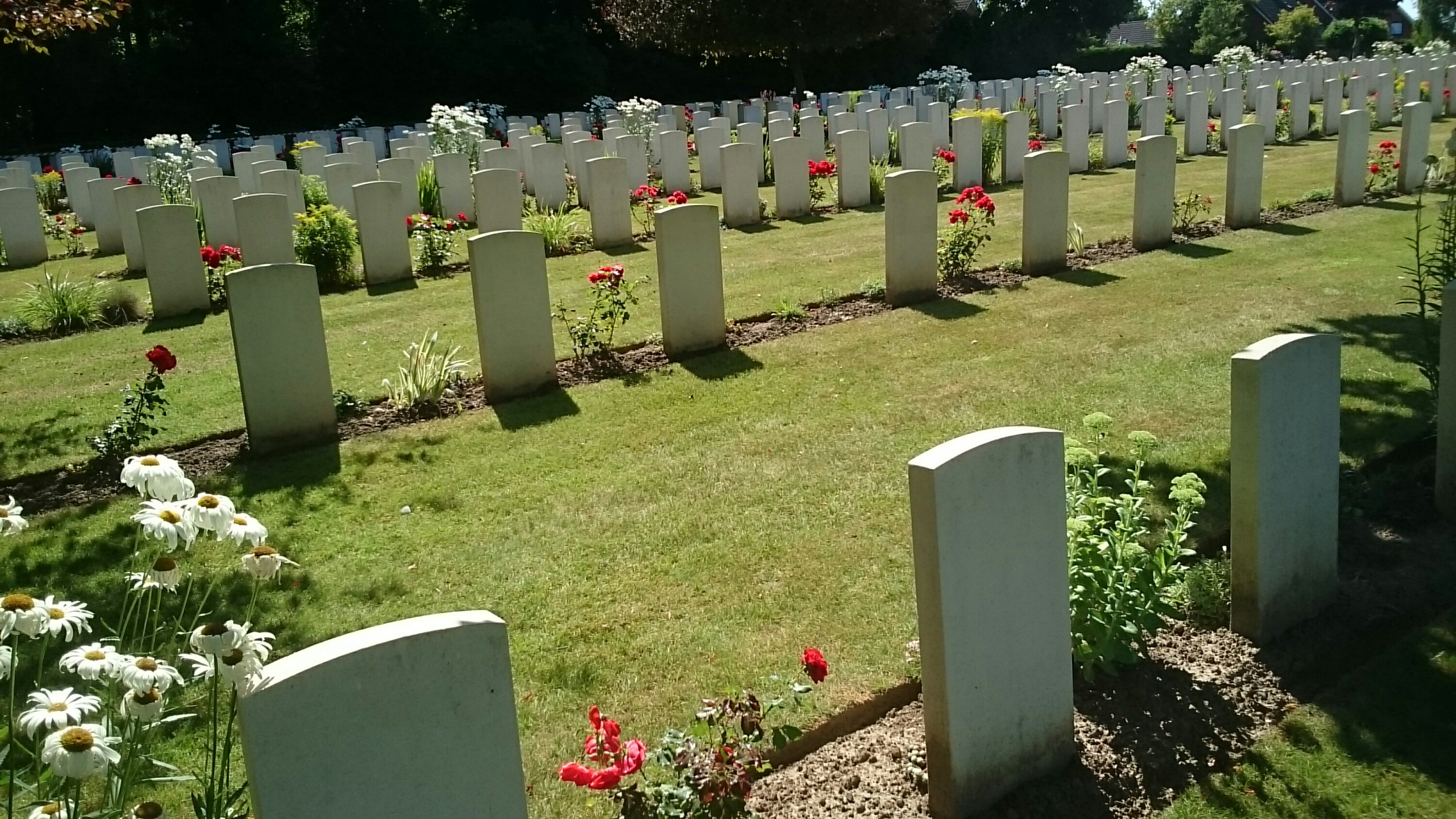
Chapelle-d’Armentières Old Military Cemetery was begun in October 1914 by units of the 6th Division and used until October 1915. The cemetery contains 103 First World War burials, three of them unidentified. The cemetery was designed by W H Cowlishaw.

Two graves of members of the Leinster Regiment

CAPTAIN NORMAN LESLIE


Untitled copy3edit

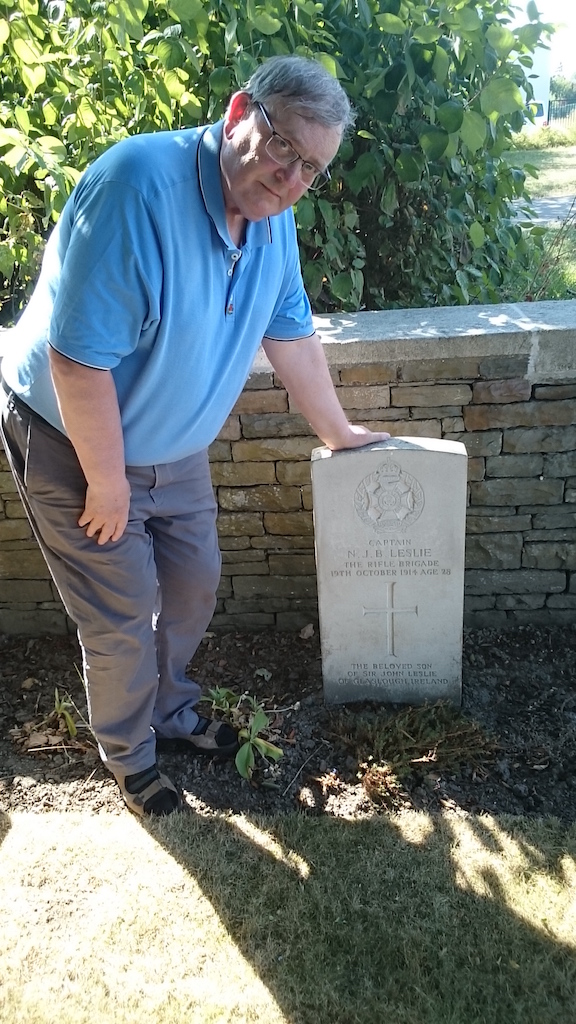
Paying respect at the grave of Captain Norman Leslie from Glaslough

Captain Norman Jerome Beauchamp Leslie from Castle Leslie, Glaslough died in the early stages of World War I. He served in the Third Battalion, the Rifle Brigade. 

Untitled copy4edit

Gravestone of Captain Norman Leslie

He was 28 when he was killed in action near Armentières on October 19th 1914. Mentioned in despatches. His grave is at La Chapelle d’Armentières military cemetery in France, not far from the border with Belgium.

Untitled copy1edit

Cross of Sacrifice 

He was the second son of Sir John Leslie 2nd Bart and Lady Leonie Leslie of Glaslough. His mother was a member of the wealthy Jerome family from New York and her sister Jennie married Lord Randolph Churchill, father of Winston. Rest in Peace.

Untitled copy2edit

Graves of Captain Norman Leslie and Captain George H Hume Kelly

Captain George Harvey Hume Kelly aged 34 of the First Battalion North Staffordshire Regiment died the day after Captain Leslie and is buried alongside him. His mother lived in East Putney, London.

LESLIE_NORMAN_JEROME_BEAUCHAMP

Around the time of the centenary of his death, Iain d’Alton wrote about the life of Captain Leslie in An Irishman’s Diary in The Irish Times. Here is some of the article:

“(Leslie) was educated at Eton and Sandhurst, was commissioned a 2nd Lieutenant in 1905 and joined the prestigious Rifle Brigade in October that year. He served as ADC to Sir John Maxwell (the suppressor of the Easter Rising) in Egypt from September 1908 to April 1910. In 1910, he was the last British officer to fight a duel – with a Turkish diplomat, over said diplomat’s wife. Packed off to India, he became ADC to Lord Carmichael, the governor of Bengal where, again, he had a scandalous romantic entanglement with a married woman.”

“When war broke out, he exhibited an almost unbelievable heartlessness about early casualties, writing to his mother in October 1914: ‘I can’t see that our losses have been heavy at all. What are 2,000 killed and 8,000 wounded out of a force of 80 or 90,000 British who repelled 200 or 300,000 Germans. It’s wonderfully small…only 2½% killed. One would imagine it would be much more like 10%.’ Leslie’s war was about the merit of being honourable. At its outbreak, he wrote to a friend: ‘Let us forget individuals and let us act as one great British unit, mixed and fearless. Some will live and many will die, but count the loss not. It is better far to go out with honour than survive with shame.'”

Less than three months after the War started, on October 18th, 1914, Captain Leslie  “was killed by a German sniper while on reconnaissance at Armentières, near Lille, and was hastily buried. His brother Shane, later a writer of renown, and serving in France, organised for his body to be recoffined in December 1914. He wrote to Leonie that: ‘He lies about a mile behind the trenches occupied by his regiment and within sound of the guns of both armies whose shells pass daily above his head . . . the sky was ripped with the flashes of the guns, while a gigantic German searchlight threw the surrounding countryside into sepulchral relief.’”

“Shane said that when the grave was opened, Norman’s clothes were unsoiled and clean. His hands were white and pink at the edges, and rested on the wound which killed him. To fit him in the new pine coffin, they had to unshoe him. Shane wrote that he did not cry until he saw ‘that lonely pair of boots’ sitting on the wretched earth. Norman, he said, seemed to have borne ‘no trace of suffering or contortion . . . as one who had reached his appointed end with credit and dignity’. Thus he acted his part, even beyond death.”

Lady Leonie Leslie “immediately wanted to visit her son’s grave, but Shane advised against it. ‘Stay at Glaslough where Norman’s memory is vivid in the minds of all whom you meet… stay there where the whole atmosphere yearns for him and where his name will outlive ours.’ But his parents could not stay away forever. Sir John Leslie wrote to his wife in late November 1918, a few days after the Armistice: ‘I should like to go to Armentières in the spring, not in cold dreary winter, and lay spring flowers on our boy’s grave, both of us together. His spirit knows what is going on, and that his life was not lost in vain.'”


KEMMEL CHATEAU CEMETERY

Kemmel Chateau Cemetery

Kemmel Chateau Cemetery outside the village of Kemmel was one of the many such graveyards and memorials designed by the famous British architect Sir Edwin Lutyens, whose work included the Irish National War Memorial Gardens at Islandbridge in Dublin.

Kemmel Chateau Cemetery Cross of Sacrifice


The Chateau itself was north-east of Kemmel village which is on the road between Ieper and Armentières, close to the border with France. The cemetery was established on the north side of the chateau grounds in December 1914. It continued to be used by divisions fighting on the southern sectors of the Belgian front until March 1918, when after fierce fighting involving both Commonwealth and French forces, the village and cemetery fell into German hands in late April.

Kemmel Chateau Cemetery

The cemetery was retaken by the Allies later in 1918, but in the interval it was badly shelled and the old chateau was destroyed. There are now 1,135 Commonwealth burials of the First World War in the CWGC cemetery and 21 from the Second World War.

Kemmel Chateau Cemetery Cross of Sacrifice

Here I found several graves of members of the Royal Dublin killed between November 30th 1916, December including  St Stephen’s Day 1916 and March 8th 1917.


IRISH PEACE PARK MESSINES

This was the second time I visited the WW1 Irish Peace Park at Messines, or Mesen as it is now known in Flemish, not far from Ieper. The first occasion was to commemorate the centenary of the start of the Battle of Messines on 7th June 2017.

With An Taoiseach Enda Kenny at the Irish Peace Park on June 7th 2017 for the Battle of Messines centenary commemoration

An Taoiseach Enda Kenny TD and Britain’s Prince William joined Princess Astrid of Belgium and Lord Dunlop, Parliamentary Under-Secretary of State at the Northern Ireland Office to honour the soldiers who fought in the battle. They laid wreaths at the foot of the Round Tower memorial, before meeting invited guests including descendants of those who fought at the Battle.

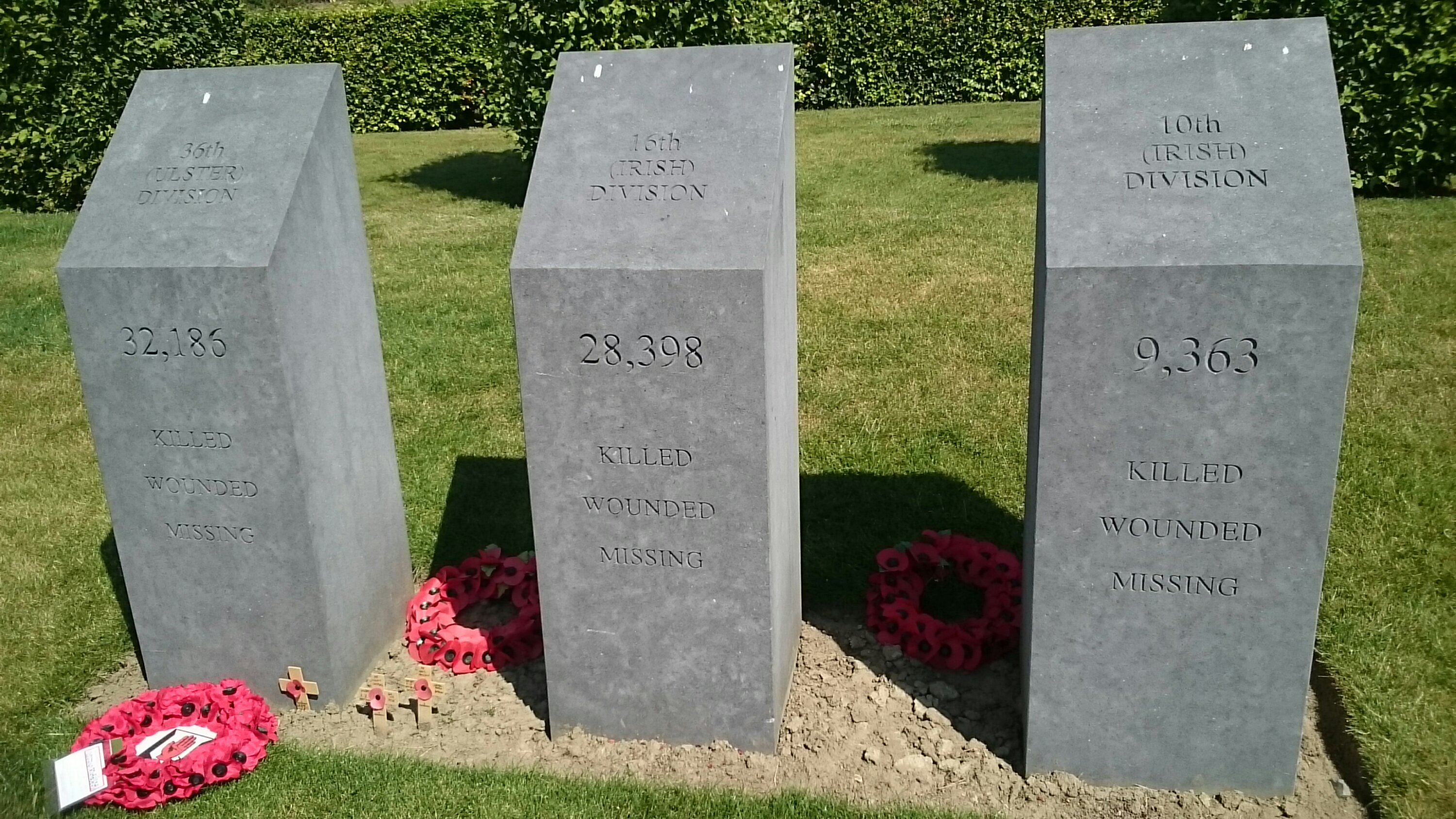
The successful Allied offensive on June 7th 1917 was the first occasion the 36th Ulster and 16th Irish divisions fought together on the front line. The two divisions predominantly comprised men who were on opposing sides of the great political upheaval back in Ireland around whether the country should be granted self-governance from Westminster.

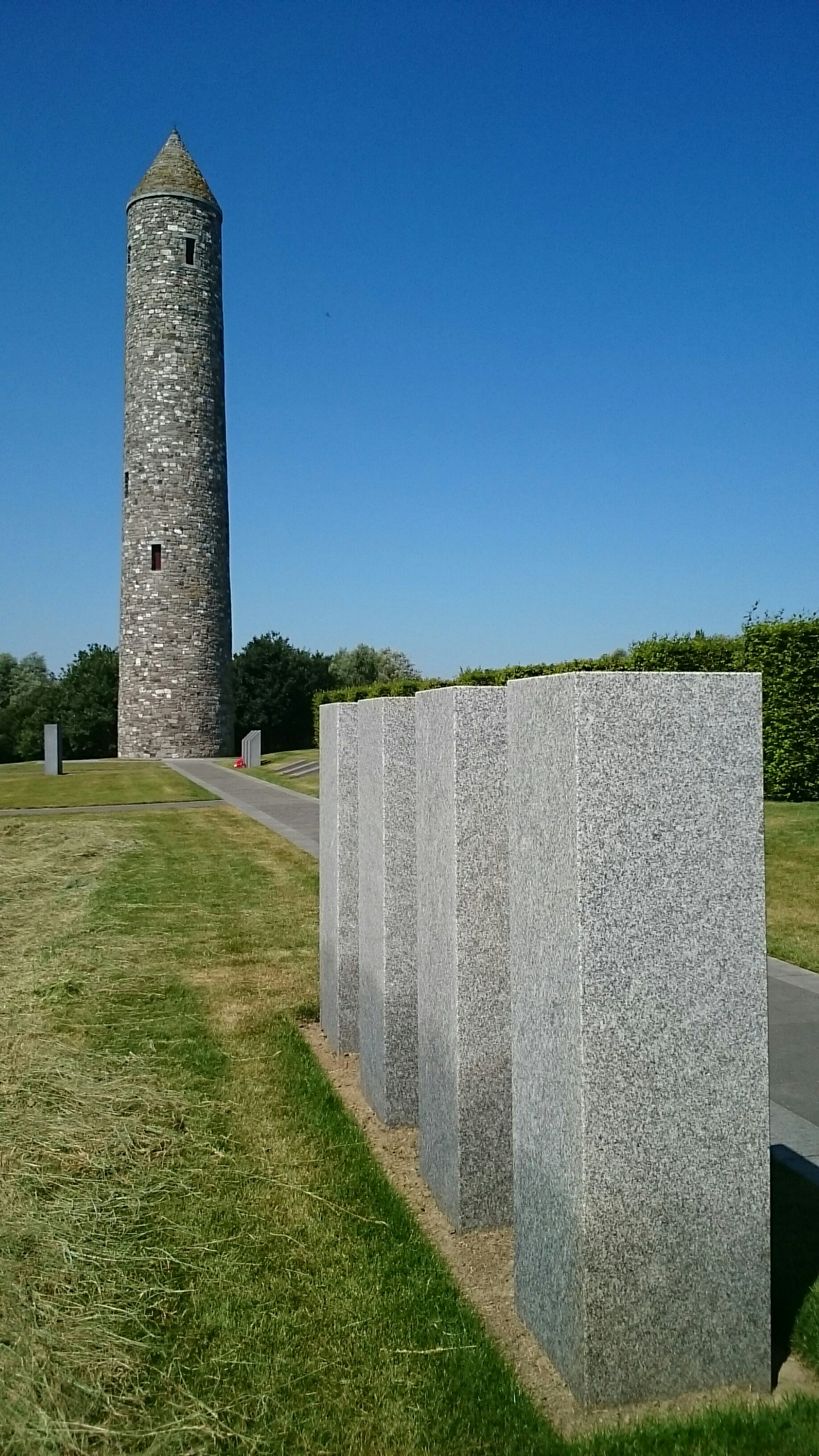
The Peace Park is dominated by a replica Irish round tower was intended as a symbol of reconciliation to bring together loyalists and nationalists, Protestants and Catholics, particularly from a younger generation in Northern Ireland and the Republic.

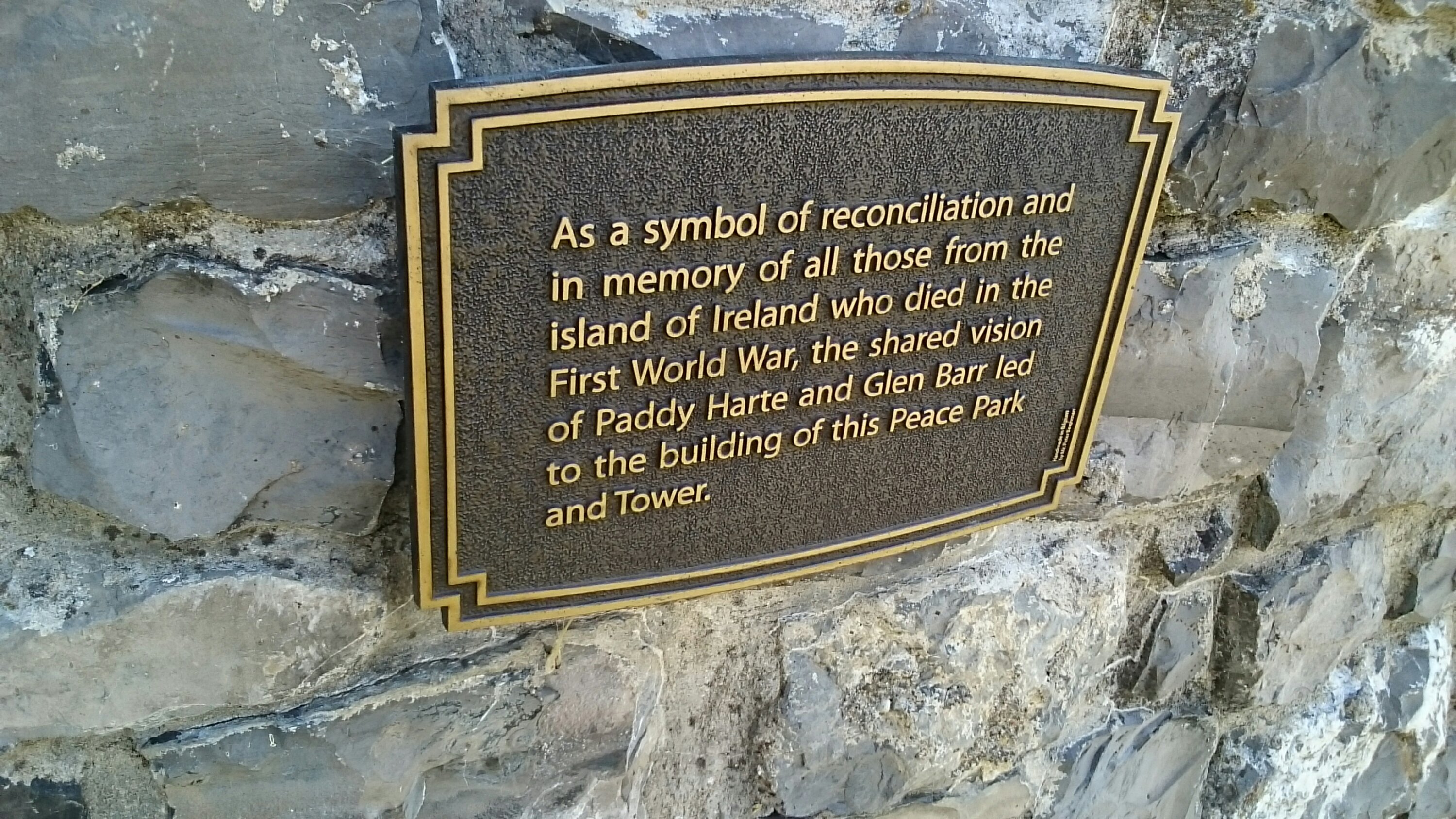
It was the brainchild of the late Paddy Harte from Co. Donegal and Glen Barr, a former loyalist paramilitary leader from Derry. There is a plaque remembering their joint efforts on the wall beside the exit.

Plaque remembering Paddy Harte and Glen Barr whose vision of a project of reconciliation came to fruition in the Peace Park

Round Tower at the Irish Peace Park

The Peace Tower is dedicated to all those from the island of Ireland who fought and died in the First World War 1914-18. It was erected by ‘a Journey of Reconciliation’ Trust, with the support of local people from Messines. On Remembrance Day 11th November 1998, eighty years after war came to an end, President McAleese unveiled a plaque in the presence of Britain’s Queen Elizabeth II and His Majesty King Albert II of Belgium.

Details of the casualties suffered by the three Divisions from the island of Ireland

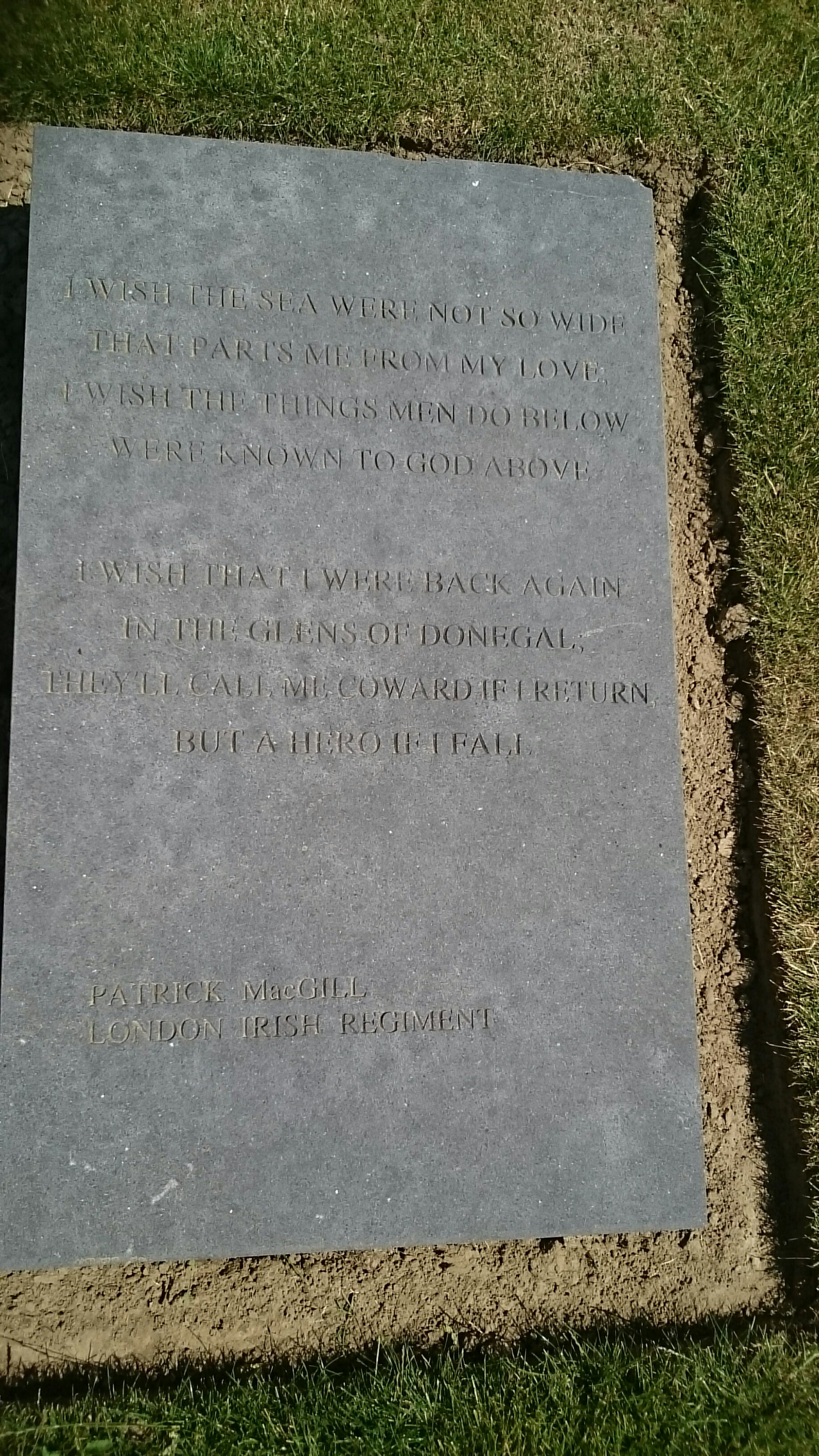
The words of ‘Navvy poet’ and soldier Patrick MacGill from Donegal

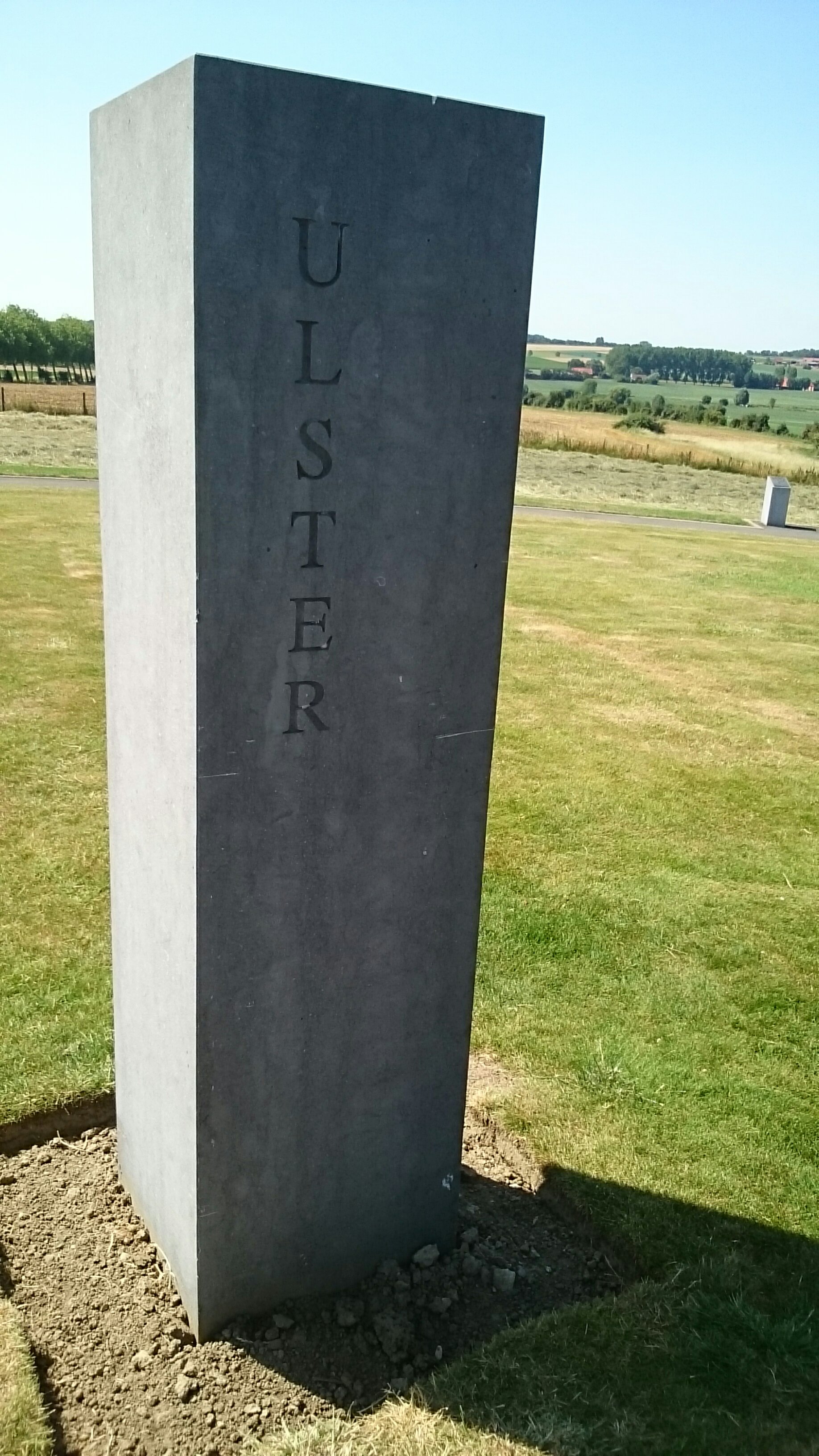
In memory of the 36th (Ulster) Division

Stone memorials in the grounds of the Irish Peace Park

MAJOR WILLIE REDMOND

Major Willie Redmond of the Royal Irish Regiment was killed on the first day of the Battle of Messiness on 7th June 1917. He is buried at Locre (Loker) but in a separate grave alongside the British military cemetery at Locre Hospice.

The grave is marked by a stone cross, paid for by his family from Wexford. Someone has left a Wexford flag at the foot of the memorial as a reminder of the county of his birth.

Beside the grave there is a wooden structure containing a statue of Our Lady and a repository where the visitors’ book is kept.

dsc_25433704636949252974447.jpg

Locre Hospice Cemetery(CWGC) is beside the site where Major Redmond is buried

The following details about Major Redmond are taken from an article in Irish Legal News 05/04/19 by Seosamh Gráinséir:

“A famous Irish nationalist, William Hoey Kearney Redmond came from a (Catholic gentry) family of parliamentarians. His father, William Archer Redmond, was a Member of Parliament in Westminster for the Home Rule Party. His older brother, John Edward Redmond, was a Member of Parliament and leader of the Irish Parliamentary Party.

On 24th March 1884, Willie himself was sworn in as a new MP for his father’s old constituency, Wexford Borough, at the age of twenty-two. During his thirty-three years as an MP, Willie went on to represent Fermanagh North for seven years after the Wexford Borough constituency was abolished, and then East Clare for 25 years. Willie was succeeded in that constituency by Éamon de Valera, who won the by-election triggered by Willie’s death.

Like his father and brother, Willie was a passionate supporter of Home Rule, which he said was necessary because the Union “has depopulated our country, has fostered sectarian strife, has destroyed our industries and ruined our liberties”. An ardent opponent to landlords, Willie had been imprisoned a number of times for his work with the Land League agitation (Denman 1995).

Having served with the Royal Irish Regiment for a couple of years after finishing school, Willie was described as having always been a “soldier at heart”, the “spirit of comradeship and discipline” having appealed to him. When the Great War broke out in August 1914, he had already been involved with the Irish Volunteers. But he believed that if Germany won the war, Ireland was endangered too. Intent on joining the Royal Irish Regiment again and troubled by the idea of recruiting for the war effort without joining the fight himself, he wrote: “I can’t stand asking fellows to go and not offer myself”.

In this vein, Willie told the Irish Volunteers assembled outside the Imperial Hotel in Cork in November 1914: ‘I speak as a man who bears the name of a relation who was hanged in Wexford in ‘98 – William Kearney. I speak as a man with all the poor ability at his command has fought the battle for self-government for Ireland. Since the time – now thirty-two years ago – when I lay in Kilmainham Prison with Parnell. No man who is honest can doubt the single-minded desire of myself and men like me to do what is right for Ireland. And when it comes to the question – as it may come – of asking young Irishmen to go abroad and fight this battle, when I am personally convinced that the battle of Ireland is to be fought where many Irishmen now are – in Flanders and France – old as I am, and grey as are my hairs, I will say: ‘Don’t go, but come with me!’”

(Terence Denman, A Lonely Grave: The Life and Death of William Redmond, Irish Academic Press 1995).

House of Commons WWI Memorial with name of Major W. Redmond MP

Redmond is commemorated on Panel 8 of the Parliamentary War Memorial in Westminster Hall, one of 22 MPs who died during World War I to be named there. He is one of 19 MPs who fell in the war who are commemorated by heraldic shields in the Commons Chamber. A further act of commemoration came with the unveiling in 1932 of a manuscript-style illuminated book of remembrance for the House of Commons, which includes a short biographical account of the life and death of Redmond.

The people of Loker continue to attend to his symbolic grave with great respect, organising Commemorations, the last in 1967 (organised by a Catholic priest Father Debevere) and in 1997 (organised by Erwin Ureel), refusing to allow the grave to be moved. Redmond’s Bar, an Irish pub in nearby Loker, is named after him. I enjoyed a nice bottle of local Belgian beer (Hommelbier from Poperinge) that went down well with a mackerel salad and chips.

In Wexford town there is a bust of him by Oliver Sheppard in Redmond Park which was formally opened as a memorial to him in 1931 in the presence of a large crowd including many of his old friends and comrades and political representatives from all parts of Ireland. It was re-launched by the Wexford Borough Council in 2002.

An official wreath laying ceremony took place at Redmond’s grave on 19th December 2013, when the Taoiseach Enda Kenny TD and British Prime Minister David Cameron MP paid tribute to him. Enda Kenny reflected: “The thought crossed my mind standing at the grave of Willie Redmond, that was why we have a European Union and why I’m attending a European Council” (Lise Hand, The Irish Independent 19/12/2013).

CASTLEBLAYNEY’S SWEDISH ROYAL CONNECTION

© Michael Fisher, The Northern Standard, June 6th 2019 p. 29

Whilst the official visit of President Trump to Ireland today has taken up all the headlines, a state visit last month by the King and Queen of Sweden went by almost without notice. Returning from a Local Ireland awards ceremony in Athlone a fortnight ago, I noticed a long convoy of official cars and Garda outriders on the bypass outside the town. Was it a dress rehearsal for the visit of the US President, I wondered. Or perhaps it was the Swedish royal couple, who had been in Dublin the day before.

Further investigation revealed that the Swedish royals visited the Ericsson research and development site in Athlone to discuss digitalisation and 5G in Europe as part of their three-day state visit. The King and Queen were joined by members of the Swedish Government, including Anders Ygeman, Minister for Energy and Digital Development and Sean Canney TD, Minister of State for Rural Affairs and Natural Resources.

King and Queen of Sweden Visited the Ericsson R&D Facility in Athlone

My thoughts turned to a connection between the Swedish Royal Family and County Monaghan that I had spoken publicly about in Castleblayney 25 years ago. The following information is based largely on the talk which was held in the Glencarn Hotel. It centred around Crown Princess Margaret of Sweden, a daughter of the Duke of Connaught, who lived with his family at Hope Castle in Castleblayney from 1900-1904 (David Hicks in “Irish Country Houses” 2012).

HOPE CASTLE

The Duke of Connaught, son of Queen Victoria, came to Castleblayney on his appointment as Commander-in-Chief of the British Army in Ireland. He was then 50, having been born at Buckingham Palace in London on 1st May 1850. It was said at the time that the Duke and Duchess experienced a great deal of difficulty in finding an Irish home as they did not wish to spend all their time in the official residence at the Royal Hospital in Kilmainham, Dublin. The Irishresidence associated with the office of Commander in Chief was not thought to be suitable for habitation by such high-ranking royals as the grounds of the residence were far from private and its location was thought to be in an inferiorpart of the city (Hicks). Several other houses such as Castletown House in Kildare were considered before the Duke settled on Hope Castle, which he leased from Lord Henry Francis Hope. It is believed that the Castleblayney residence was chosen as it was located near the home of Leonie Leslie, a prominent socialite at the time, who lived at Castle Leslie, Glaslough. She was a close friend of the Duke and Duchess, with the emphasis on the former.

The royal couple arrived in Castle Blayney in June 1900 and received a warm welcome from the local people; both the gates to the castle and the whole town were decorated with bunting and flags. The Duke had taken the castle for the summer season in 1900 with an option of leasing it for a further five years. It was thought at the time that Hope Castle would become an official royal residence and that Queen Victoria would visit her son here, but she died in 1901. The Duke of Duchess of Connaught ended their association with the Castle in 1904 (Hicks).

DUKE OF CONNAUGHT

Of her five children, Prince Arthur (William Patrick Albert) was Queen Victoria’s favourite son. By the time he arrived in ’Blayney, he already had a distinguished military career. He entered the Royal Military Academy in Woolwich in 1866, was created a Knight of the Order of St Patrick in 1869 and by the age of 21, was a Privy Counsellor. He received his title Duke of Connaught and Strathearn in 1874, then served as Assistant Adjutant General in Gibraltar for two years. He was promoted again in 1876, serving as personal ADC to Queen Victoria, a role he fulfilled for four of her successors. In 1879 he was married at St George’s chapel in Windsor Castle, near London.

His wife was Princess Louise of Prussia, who at the age of 18 was 10 years his junior. She had been born in Potsdam in 1860, third daughter of Prinz Friedrich Karl of Prussia. The couple had two children.
bagshot_park_morris_edited1475892211112337545.jpg

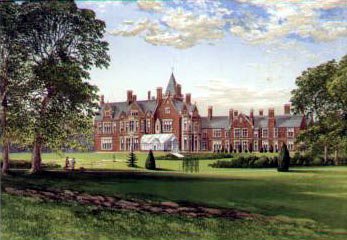
Bagshot Park in Surrey, England from Morris’s Country Seats from the time the Duke of Connaught lived there (1880)

Their first child was Margaret Victoria Augusta Charlotte Norah, born at Bagshot Park in Surrey on January 15th 1882 (this is now the private residence of Prince Edward and his wife Sophie, Countess of Wessex). Just under a year later, the second child, Arthur, was born at Windsor Castle. He later saw active service in the South African war and was Governor General there from 1920-23.

The Duke of Connaught became a General in 1893 after serving in Egypt and India and was appointed a Field Marshal in 1902, during the time he was in Castleblayney. He was a significant figure in British society, as can be seen by the rest of his career.

On completing his four years in Ireland, he was appointed Inspector General of the British Forces and President of the Selection Board 1904-07. For the next two years, he was Field Marshal and Commander-in-Chief in the Mediterranean. He opened the Union Parliament of South Africa, where his son later became Governor General, in 1910.

The following year, the Duke became Governor General of Canada, a post he held for five years and which aroused controversy as he attempted to meddle in Canadian military affairs. He served as Grand Master of the United Lodge of Freemasons from 1901 (a year after his appointment in Ireland) to 1939. He was decorated by several countries, including Spain, Turkey, France, Belgium, Italy, Sweden, Norway, Denmark, Greece, Japan (Order of the Chrysanthemum), Ethiopia, the Netherlands, Tunisia, Montenegro, Romania and finally, Monaco. The Duke died at Bagshot Park in Surrey on January 16th 1942, at the age of 91.

CROWN PRINCESS MARGARET

When Princess Margaret of Connaught was 23 and her younger sister Princess Patricia of Connaught was 18, both girls were among the most beautiful and eligible princesses in Europe. Their uncle, King Edward VII, wanted his nieces to marry a European king or crown prince. In January 1905, the Duke and Duchess of Connaught visited Portugal, where they were received by King Carlos and his wife, Amélie of Orléans whose sons Luís Filipe, Duke of Braganza, and Prince Manuel entertained the young British princesses. The Portuguese expected one of the Connaught princesses would become the future Queen of Portugal.

The Connaughts continued their trip to Egypt and Sudan. In Cairo, they met Prince Gustaf Adolf of Sweden, the future Gustaf VI Adolf of Sweden, grandson of the Swedish King Oscar II. Originally, Margaret’s sister Patricia had been considered a suitable match for Gustaf Adolf; without his knowledge, a meeting was arranged with the two sisters. Gustaf Adolf and Margaret fell in love at first sight, and he proposed at a dinner held by Lord Cromer at the British Consulate in Egypt, and was accepted. Margaret’s parents were very happy with the match. Gustaf Adolf and Margaret, then 23, married on 15th June 1905 in St George’s Chapel at Windsor Castle, where her father had also been married. The couple spent their honeymoon at Adare Manor in Co. Limerick and arrived in Sweden on 8th July 1905. One of Margaret’s wedding presents was the Connaught tiara, which remains in the Swedish royal jewellery collection today.

The Crown Prince of Sweden, Gustaf Adolf, was ten months younger than his bride. He came from a military background, like his father-in-law, having entered the Swedish army in 1902. Thirty years later, he became a General. His wife, however, did not survive that long.

During the First World War, she did a lot of work for the Red Cross and as can be seen in her connections with Castleblayney, she seemed to be a caring person. Known in Sweden as Margareta, she died thirty years before her husband’s accession to the throne of Sweden.

At 2 o’clock in the morning on 1st May 1920, her father’s 70th birthday, Crown Princess Margaret, aged 38, died suddenly in Stockholm of “blood poisoning” (sepsis).

Her husband re-married (the second wife was Lady Louise Mountbatten, sister of Earl Mountbatten). At the age of 68, Gustaf Adolf succeeded to the throne, reigning from 1950 to September 1973 as King Gustaf VI Adolf, the last Swedish monarch to hold real political power. He was a noted archaeologist and died aged 90. Since then, his grandson Carl XVI Gustaf has held the title of King and reigns along with Queen Silvia. They are the dignitaries who have just completed a state visit to Ireland.

Following her marriage in 1905, Crown Princess Margaret had five children. The first born in Stockholm on 22nd April 1906 was Gustaf Adolf, Duke of Vaesterbotten, later Prince. He was killed in a flying accident near Copenhagen in 1947, so when the time for succession came, in 1973, it was his son who took the throne and is now the King of Sweden.

He was followed by Sigvard, born at Drottningholm Palace in July 1907, an important year for the Swedish royal family, as Gustaf V came to the throne, shortly after the dissolution of the union between Sweden and Norway. The last three children were all born in Stockholm. Princess Ingrid in March 1910, Bertil in February 1912 and then carl, Duke of Dalecorlia, November 1916.

Some of the children are pictured in postcards which she sent from Stockholm over a period of five years, passing greetings to what she described as he friends in Castleblayney. All are addressed to Mrs JJ Kelly, a correspondence linking Castleblayney and Sweden.

THE KELLY CONNECTION

JJ Kelly was a Local Government Board Inspector and his wife Mary was the postmistress. They lived at Castle Square as it was then called, near the entrance to Hope Castle. Both are buried in the graveyard behind St Mary’s Church. Their daughter Rosa Kelly was a first cousin of my mother and details of the correspondence were kept by her following Rosa’s death in Surrey, where she is buried beside my aunt Dorothy Smyth. My mother then passed on details of the original correspondence including letters to the Swedish royal archives in Stockholm.

THE POSTCARDS
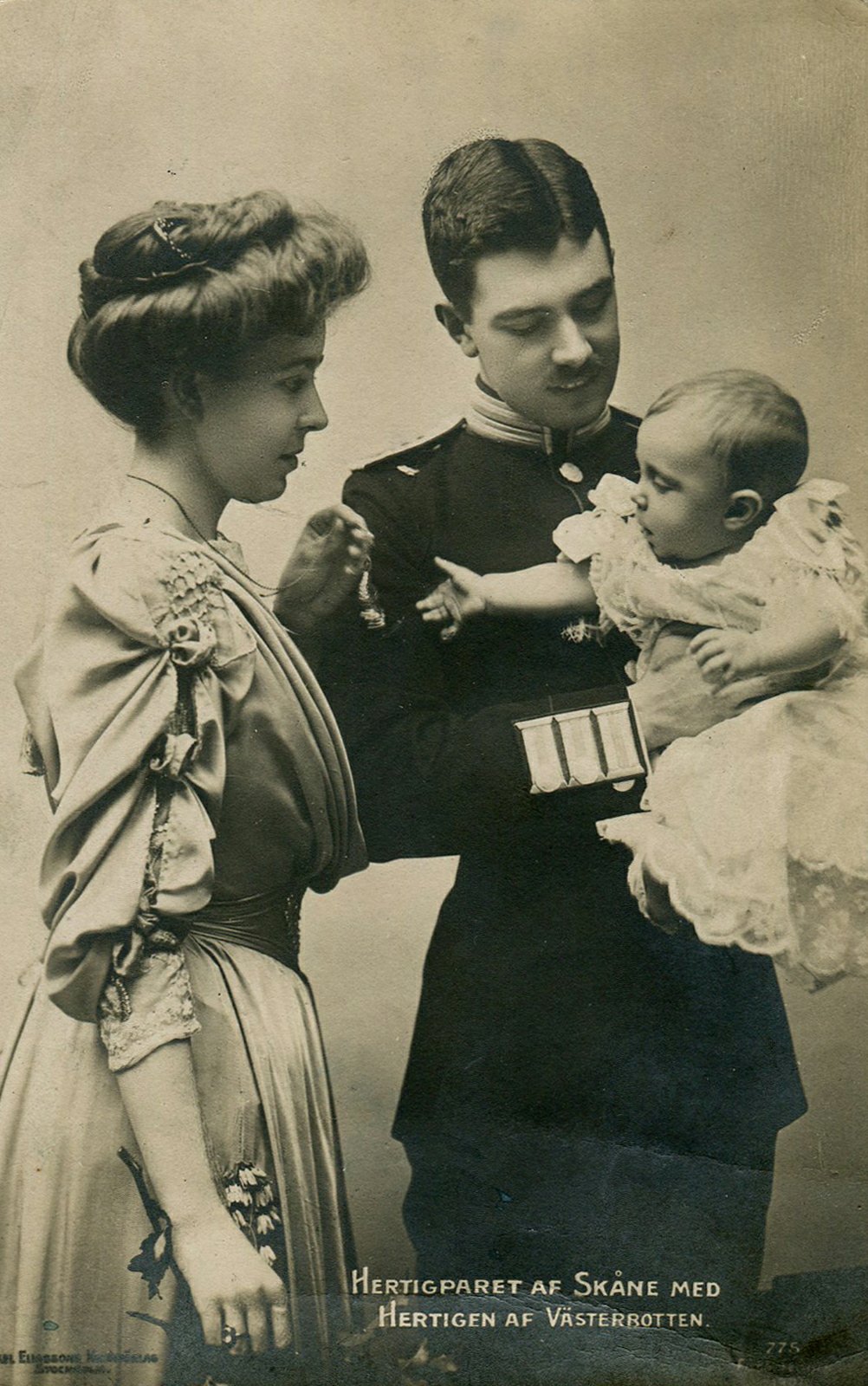
The first is not dated and it’s impossible to decipher the postmark. But the picture shows Crown Princess Margaret and her husband, who is holding a baby, Gustaf Adolf, the Duke of Vaesterbotten, who was born in April 1906. It reads:

“Princess Margaret send many thanks for the shamrock and hopes all the friends at Castle Blayney are well.” So it seems it might have been written in March 1907, some time after St Patrick’s Day (possibly 20th March). Some similar messages follow in the next few years. The Kellys must have sent Princess Margaret shamrock to wear, to remind her of Castleblayney.
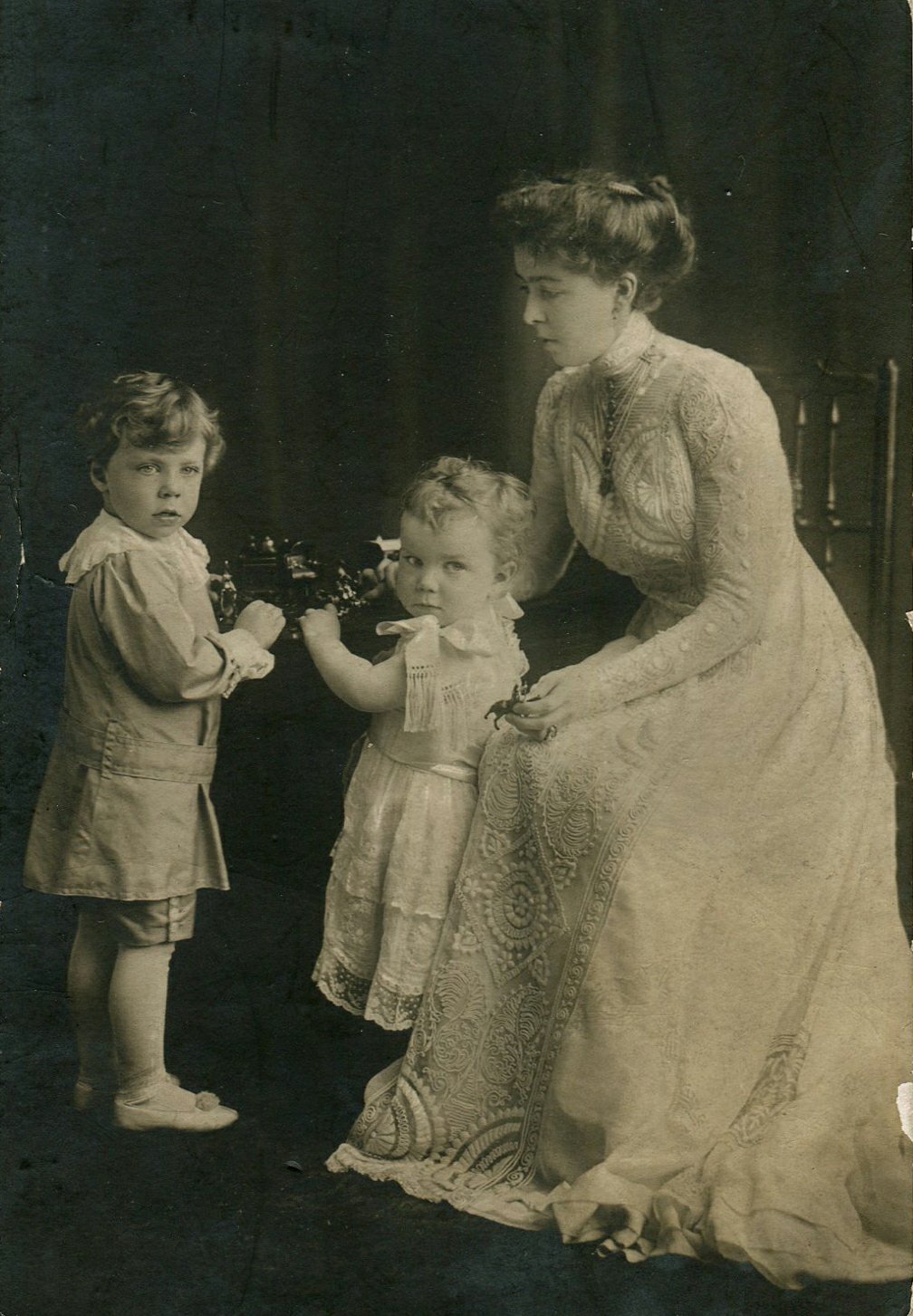
“19th December 1909

A happy Xmas & 1910 to all from

Margaret”. The picture shows her with her two children, Gustaf Adolf aged 3, and Sigvard, aged 2.

“March 18 1910. Thank you so much for the shamrock. I hope you and all old friends in Castle Blayney and neighbourhood are well, Margaret.” The picture is probably of Gustaf Adolf again, aged three and wearing a similar outfit to the previous photo.

Postmark 1912

Picture of Prinsessan Margareta on front with a greeting to Mrs Kelly:

“A happy Christmas to you from Princess Margaret, Stockholm”

March 25 1914

Five months before the outbreak of World War I.

“Stockholm. The Crown Princess sends her best thanks for the shamrock and the kind thought which prompted the gift.”

No stamp or postmark. Might have been enclosed with a letter.

The picture is of the Crown Princess in what appears to be national costume with a white head-dress and reading a book.

March 21 1915

“The Crown Princess of Sweden sends most grateful thanks for the shamrock, which arrived here quite safely on St Patrick’s Day.”

Mrs Kelly’s address was given as ‘The Trees’, so by then she seemed to have finished her role as postmistress (according to the street directories). It’s also interesting that this correspondence was seven months after the start of WWI. The picture showed four of Margaret’s five children, Prince Gustaf Adolf, Sigvard, Bertil and Princess Ingrid.

December 15 1915

“The Crown Princess of Sweden sends an Xmas greeting to Castle Blayney”. The picture is of Margaret and captioned Vår Kronprinsessa / Our Crown Princess.

One card simply says: “Wishing you a Happy Christmas and New Year from Margaret.” Her portrait on the front seems to indicate it was from one of the earlier years.

The final postcard which appears to conclude the correspondence was posted in Stockholm and addressed to Mrs Kelly at The Trees, Castle Blayney.

April 17 1916

“The Crown Princess of Sweden sends grateful thanks for the shamrock. She was sorry to hear of your sad loss and sends sincere sympathy.” The reference was probably to the death of Joe Kelly in August 1915.

The picture shows four of Margaret’s children (the fifth wasn’t born until the following year), Gustaf Adolf, Sigvard, Bertil and Princess Ingrid.
The postcards provide a fascinating insight into Castleblayney’s connection with the Swedish Royal Family.

This was first published by me at a talk in Castleblayney in 1994, the third annual lecture in memory of the late Fr Peadar Livingstone..

EUNICE AND THE ‘OTHER SISTER’

This story about Rosemary Kennedy contains extracts from a letter she wrote in 1940, the year before she underwent a lobotomy at the insistence of her father Joe. The writing is childlike but Rosemary’s bubbly personality shines through, just as it did in letters written in 1938 when my aunt Dorothy Smyth knew her in London.

Terry Marotta's avatarEXIT ONLY

eunice youngI could look at pictures of Eunice all day, hero that she was for trying to do for others what she couldn’t do at home. She was just 19 when sister Rosemary was lobotomized according to their father’s wishes. He didn’t even tell Rose he had ordered it done ’til the surgery was over and they realized to their horror that she would never again stand erect, never again write the kind of letter that appears below here. My mother and aunt owned and ran a girls’ camp called Fernwood and in the spring of 1940, Rose Kennedy asked to meet them in New York to talk about her 22-year-old ‘working’ there as a Junior Counselor. Mom used to say she should have known the minute Mrs. Kennedy arrived without her daughter that the girl was not as ‘able’ as Rose was leading them to believe and sure enough, her…
View original post 94 more words

JUDICIAL REVIEW

unknown

Notice on gate at entrance to farmland in Co. Meath along the route of proposed interconnector. Pic. © Michael Fisher

JUDICIAL REVIEW OF BORD PLEANÁLA DECISION ON ELECTRICITY INTERCONNECTOR

Anti-pylon campaigners representing landowners from Meath and part of Co. Monaghan are taking part in a court case in Dublin this week aimed at overturning the planning approval for the North-South electricity interconnector. An Bord Pleanála granted approval last December for the major infrastructure project involving almost 300 pylons and overhead high voltage wires running across countryside from the border at Lemgare, near Clontibret in Co.Monaghan, to a sub station at Woodland, near Batterstown in Co. Meath. EirGrid has said the overall cost of construction will be €286 million, €180m for the proposed development in the Republic and the balance for the shorter SONI section in Co. Armagh leading to a sub station at Turleenan near the Moy, Co. Tyrone.

In February the North East Pylon Pressure Campaign, which has led the opposition amongst landowners and residents to the 400kV overhead line since it was first proposed eight years ago, was granted leave to apply for a judicial review of the Bord Pleanála decision. The case is also in the name of Maura Sheehy, a farmer, of Teltown Road, Donaghpatrick, Co Meath, one of the hundreds of objectors who attended the lengthy public enquiry held in Carrickmacross last year.

As well as challenging An Bord Pleanála, the case is also against the Minister for Communications, Energy and Natural Resources; and the State. The developer, EirGrid, is a notice party. Nigel Hillis of the County Monaghan Anti Pylon Committee was among the interested observers at the Commercial Court on Tuesday when the hearing opened in front of Mr Justice Max Barrett.

unknown-1

High voltage electricity line and pylon. Pic. Michael Fisher

The court was told that in approving the development, An Bord Pleanála had failed to take into account the potential impact of the UK planning to leave the European Union. A lawyer for the applicants, Conleth Bradley SC, said the grounds of challenge included a failure by the Board to address properly the rights of the affected landowners as well as environmental issues and the implications of Brexit.

The judge will later hear two separate but similar challenges over the permission granted for the interconnector. They are being brought by David Malone, of Eurolaw Environmental Consultants, St Joseph’s Terrace, Portarlington, Co Laois, and Val Martin, a farmer and environmental campaigner of Gortnakesh, Co. Cavan. The case continues.

INTERCONNECTOR TIMELINE

Unknown-1.jpeg

High voltage line electricity pylon  Pic. Michael Fisher

Plan for second interconnector goes back 14 years
Line has been designated by EU as one of 195 key energy infrastructure projects

Michael Fisher  THE IRISH TIMES

Nearly 18 months ago EirGrid applied to build a high-capacity electricity interconnector between Dublin and Tyrone, the second between the Republic and Northern Ireland.
The proposed line stretches over approximately 135km, linking the existing transmission networks in both jurisdictions between an existing substation in Woodland, Co Meath, and one planned for Turleenan in Co Tyrone.

In the Republic the development, now approved by An Bord Pleanála, will pass through Monaghan, Cavan and Meath, requiring 299 steel lattice-style pylons, ranging from 26m to 51m in height, linked to an existing pylon line.
The line has been designated by the European Commission as one of 195 key energy infrastructure projects across the EU that have been dubbed as projects of common interest. Such projects, the Commission says, “are essential for completing the European internal energy market, and for reaching the EU’s energy policy objectives of affordable, secure and sustainable energy”.

The decision by An Bord Pleanála–- one that has come with conditions – followed a second oral hearing in a Carrickmacross hotel in Co Monaghan. It lasted 12 weeks, and was one of the longest such public inquiries in the State’s history. The plan for a second interconnector between the Republic and Northern Ireland goes back 14 years when an initial feasibility study was carried out on the possibility of building a 220KV line between Tyrone and Dublin.

However, as the peace process bedded down, plans became more ambitious, and a further North/South study was carried out in 2005, which this time investigated the potential and the need for a 275KV line. A year later the cross-Border interconnector that had been shut down during the Troubles following a bomb attack on pylons near Crossmaglen, Co Armagh, was finally restored.
Information days
Meanwhile, approval was given for planning for a second line – one that had now grown to a 400KV plan – which saw EirGrid hold information open days in Meath, Cavan and Monaghan. It launched an information telephone and email service in October 2007, though two years passed before it submitted a planning application to An Bord Pleanála under the Strategic Infrastructure Act.

Following a statutory consultation period, an oral hearing by An Bord Pleanála began in Carrickmacross in May 2010. However, it was brought to a sudden end within weeks, and Eirgrid withdrew the application.
The late Fine Gael councillor Owen Bannigan had revealed an error in EirGrid’s plans in the stated height of the proposed electricity pylons that would run across Monaghan on the 21st day of the oral hearing.
Two years later, Eirgrid’s then newly-appointed chief executive Fintan Slye told agendaNI magazine that a second North/South interconnector was “absolutely critical” for Northern Ireland’s future security of supply. In November 2014, EirGrid submitted its draft application file to Bord Pleanála for review. Four months later EirGrid republished its proposed line route, one that would form the basis of its planning application.
Alignment
The route plan followed a review of the December 2013 line design. The review resulted in some of the proposed tower locations being repositioned along the alignment, but the alignment itself was not changed. By June 2015, EirGrid was ready to place a public planning notice in newspapers, followed by the submission of an application shortly afterwards to the Strategic Infrastructure Division of An Bord Pleanála.
Ten weeks of public consultation followed, one that prompted 900 replies. Last January, Eirgrid offered to meet people in their homes or at one of their information offices or elsewhere to discuss their concerns.Throughout campaign groups in Monaghan and Meath have criticised the consultation, but most particularly EirGrid’s “insufficient attention” to alternatives.

Localised impacts
“In England they’re pulling down pylons; in Ireland we’re putting them up,” said one Meath resident. The final ruling from Bord Pleanála runs to 615 pages. In its conclusions the planning authority declares that it recognised that the pylons’ plan would “result in a limited number of localised impacts”. However, “having regard to the identified strategic need for the development”, the plan is in accordance with planning rules “subject to compliance with the mitigation measures” that the planning appeals board has laid down.