JOHN HORGAN ON DES FISHER

John Horgan  Photo: DCU

John Horgan Photo: DCU

Desmond Fisher – an appreciation by John Horgan 

Desmond Fisher, who died in December aged 94, was a journalist who was undoubtedly less well known than he deserved to be, but whose contribution to religious journalism in English in the twentieth century was in many senses significant. It spanned an era when Catholicism in particular was undergoing seismic changes – changes which he witnessed, and documented for a wide variety of media, with consummate professionalism, balance and a deep commitment to his own religious faith.

He never courted personal publicity, and of course he contributed much of his work in print rather than in broadcasting, and in another era – one in which Twitter and Facebook were unknown, and television was only coming of age. When he joined RTE as Deputy Head of News in 1967 – almost half a century ago – he had already had a stellar career in print journalism, of which most of RTE’s Young Turks in the 1960s would have been blissfully ignorant.

Doctrine and Life: February Issue

Doctrine and Life: February Issue

Almost two decades in journalism, most significantly as London Editor of the Irish Press Group, meant that he was, metaphorically, at the top of his game when he was approached in 1962 with an invitation to become editor of the Catholic Herald in London, possibly because his reports from Rome for the Irish Press on the first session of Vatican 2 had marked him out as that rarity – a newsman who understood, and could write fluently about, the epochal changes that were just beginning to impact on global Catholicism.

Catholicism in Britain was then, and remained for many years, something of a hybrid. Its membership ran from the aristocratic Duke of Norfolk to the working class masses of Irish origin who populated the great British industrial cities. His predecessor, Michael de la Bedoyère, was a Stonyhurst-educated scion of the former class, a somewhat languid intellectual who had been in post for almost three decades. Under his editorship the paper once printed its major leading article with a final editorial sentence reading: “Cut here – the rest is tripe.”
This may not have been a hanging offence, but the writing was on the wall in any case for other reasons, mainly because the English Catholic bishops found him too liberal, and the proprietors clearly wanted an editor more open to clerical orthodoxy, and to the large potential readership who were largely readers of the rival, and much more down-market, Universe. In the event, Des Fisher initially did not disappoint. He welcomed the opportunities offered by the Council with gusto, and his reports from Rome between then and 1966 not only burnished his reputation, but earned him the respect and friendship of a wide circle of international journalists – Henri Fesquet of Le Monde, Raniero La Valle of L’Avvenire, Jerszy Turowicz of Tygodnik Powszechn in Poland, Bob Hoyt of the National Catholic Reporter, and Bob Kaiser of Time magazine – as well as the trust and confidence of the kaleidoscopic collection of bishops, theologians, and others, clerical and lay, Protestant, Catholic and agnostic who descended on Rome en masse every autumn to watch, and participate, in that great event.

Douglas Woodruff, then editor of the Tablet, warned Des in a Roman restaurant just before the Council began that it was always dangerous to underestimate the Curia, whose motto was Qui pensiamo in seculi – here we think in centuries. It was a warning Des was happy to ignore even when – as events were to demonstrate – it was to his career disadvantage. His own post-Conciliar book, “The Church in Transition,” was typically modest and low-key. He was never one of those people who, in the memorable Irish phrase, had “a great welcome for himself,” but he could tap into the zeitgeist with the confidence and competence of a true professional.

Desmond Fisher

Desmond Fisher

Des’s tenure as editor of the Catholic Herald was marked not only by his professional expertise and dyed-in-the-wool fair-mindedness, but also by his courage. When the English theologian Charles Davis, one of the most progressive and prophetic voices of his generation, decided to leave the ministry –and ultimately to marry – it was Des who befriended him and sheltered him in his house in Wimbledon while the British tabloid press hunted him like a wild animal. He as courageous, too, in his unwillingness to cut his cloth by anyone else’s measure: this was to be tested when he discovered that his honeymoon as editor of the Catholic Herald was always subject to the whims of the English hierarchy. A number of bishops, Irish as well as English, disapproved of the tenor of his reports, and the Catholic Herald was banned in some parishes. All this was undoubtedly a key factor in a decline in its circulation, which strengthened the hands of his critics. Both the main owner of the Catholic Herald, Vernor Miles, and Cardinal Heenan, archbishop of Westminster, were deeply disturbed by the tenor of Des’s reporting and Miles arranged to have him recalled from Rome on the manifestly inaccurate grounds that the bulk of the Council’s work was over. Three months later he resigned, citing “policy differences with the Board.” His departure occasioned personal letters of regret from, among many others, Abbot Christopher Butler of Downside, the theologian Fr. Hubert Richards, and Archbishop Denis Hurley of Durban.

In Des’s case, however, it was – as ever – a case of reculer pour mieux sauter. With a courage rarely displayed by someone of his years, and with a young family to support, he took to free-lance journalism. He wrote a weekly column for the Anglican Church Times, and wrote exclusively on Catholic affairs for the National Catholic reporter and the St. Louis Review in the United States, as well as contributing to Commonweal, the Tablet, Doctrine and Life, and the Furrow, among many other publications. He might have become editor of Hibernia in Dublin if it had managed to attract new investment capital, and both Herder Correspondenz, and a Canadian Catholic weekly, were keenly interested in securing his services, before he was head-hunted by Jim McGuinness (an old acquaintance from Irish Press days) to take up a senior position at RTE. Like many a journalist, he was not really an organization man, and managed to escape the RTE bureaucracy from time to time to write about his interests in religion, in Irish media generally, and in the right to communicate. He was reminiscing in the Irish Times about Vatican 11 a half-century after it had ended, and had just finished, before his death, an annotated translation of the Stabat Mater, which is due for publication later this year.

He was, in a sense, a fine embodiment of that element of the populus Dei to which he would refer wryly from time to time, and which is, in these troubled but fascinating days, needed more than ever: the Church’s loyal opposition. It was not a concept with which the hierarchs he met ever really felt comfortable; but it is an apt description of the role he and many others played in those wondrous times – times which may, with luck, come again.

……………………………………………………………………………………

Postscript: I should declare an interest. I first met Des in London in his Irish Press office early in 1962, on the basis of an introduction from the editor of the Evening Press in Dublin, for which I had briefly worked. I was newly married, and unemployed, and expected little more than a few stern words of warning about the impossibility of getting into Fleet Street. The conversation turned – without my realising it – into a job interview, and at the end of it he offered me a job on the Herald when he moved there at the end of the month. Although I left the Herald after less than two years to join the Irish Times in Dublin, the training and encouragement I got from him in that small, busy office was to stand me in good stead for the rest of my professional life. Some of the information in this appreciation has been garnered, with his family’s permission, from a memoir of his own professional life which he wrote before his death and which is now, together with the rest of his papers, destined for the Media History Archive at Dublin City University, to which he bequeathed it.  John Horgan  21 January 2015

…………………………………………………..

The family of the late Desmond Fisher would like to thank all those who sent messages or letters of sympathy or Mass cards following his death on December 30th and helped them in their bereavement. Also to those who posted online. Thanks to everyone for your support during a time of grief. I will post more news about his 200-page book Stabat Mater nearer the time of publication: today was spent going through the second proofs and checking for any further corrections. Michael Fisher.
CORDUFF PIPE BAND

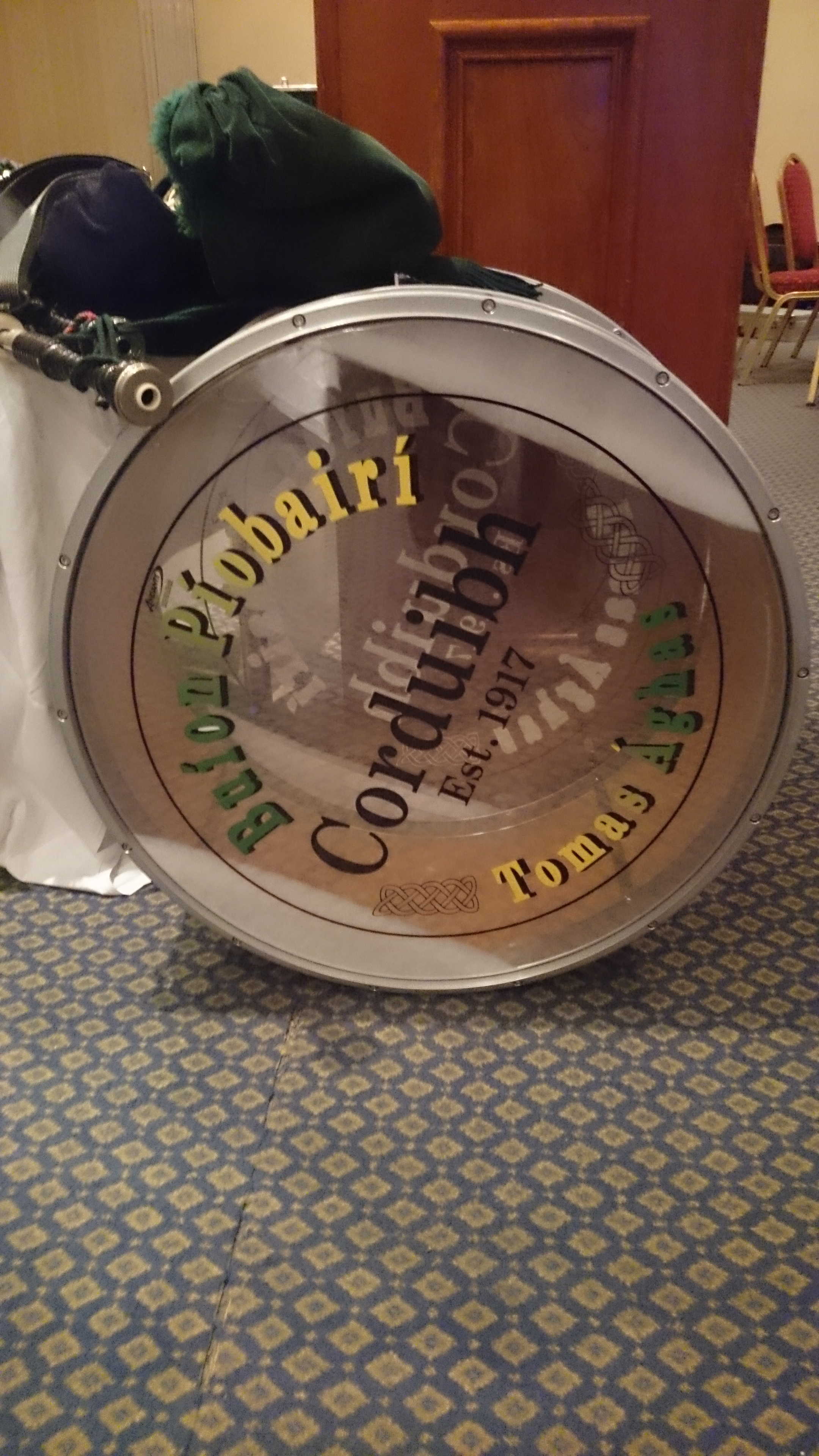
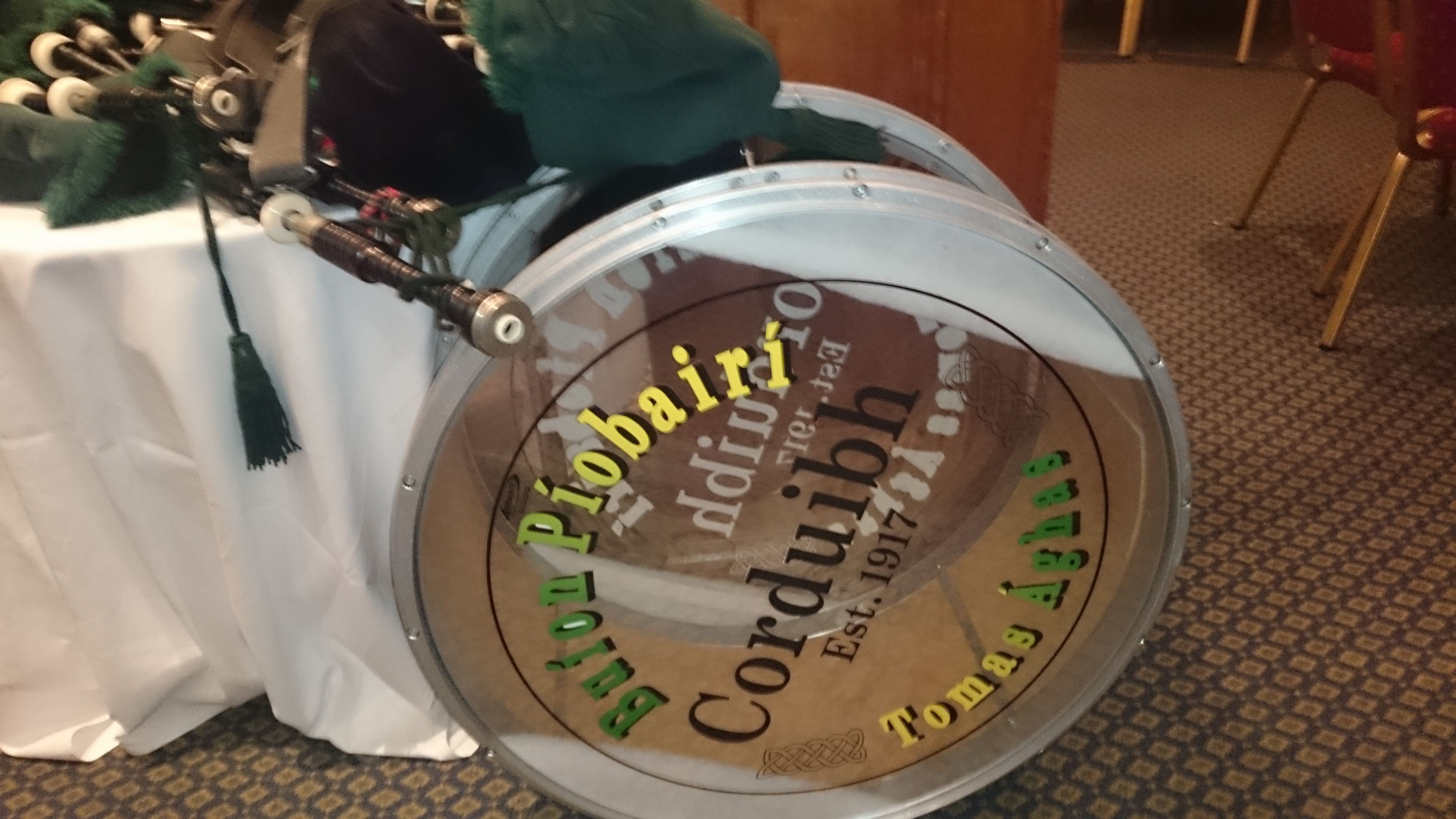
Corduff Pipe Band Big Drum Photo: © Michael Fisher

Corduff Pipe Band Big Drum Photo: © Michael Fisher

It was a great night out tonight for the members of Corduff Pipe Band near Carrickmacross in County Monaghan, along with their families and supporters. Over 100 gathered for a dinner at Corduff/Raferagh community centre, where the band practises every Thursday night at 8pm.

Corduff Pipe Band Big Drum Photo: © Michael Fisher

Corduff Pipe Band Big Drum Photo: © Michael Fisher

It’s a modern community hall, with a social club attached (The Mountain Dew), that was officially opened by President McAleese in December 2005.

Corduff Pipe Band Big Drum Photo: © Michael Fisher

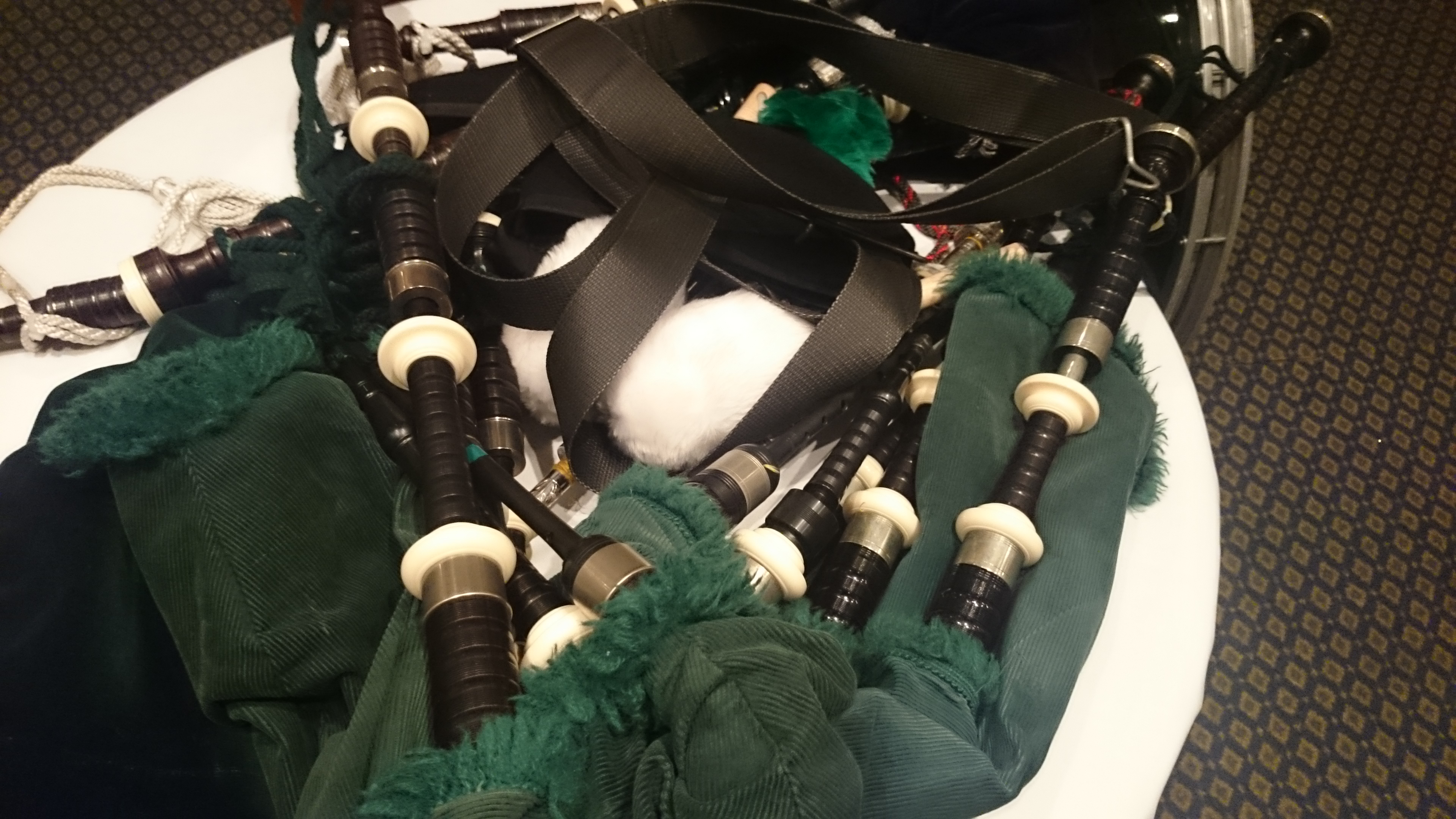
Corduff Pipe Band set of Bagpipes Photo: © Michael Fisher

The band are the current All-Ireland champions in the annual Fleadh Cheoil na hÉireann, organised by Comhaltas Ceoltóirí Éireann, having won the title in Sligo in 2014 and the previous year in Derry. Tonight they were presenting medals and certificates to around thirty band members. In at least two cases, there are three generations of the same family playing in the band.

The oldest member is eighty: President of the Band Patsy Finnegan. The youngest is eight years old, son of pipe major Sean Finnegan, whose father James is a drummer in the band. The band regularly appears at GAA County finals to entertain the crowd during the breaks.

The band was formed in 1917 as the Thomas Ashe Pipe Band. They won an All-Ireland title in 1973 and arising from it received an invitation to London to participate in the St Patrick’s Day parade in 1974 and to play in a concert at the Royal Albert Hall, one of the many memories Patsy Finnegan has. When he celebrated his 50th wedding anniversary with his wife Ann last October, the band paid them a special tribute by parading into the chapel at Corduff and performing Amazing Grace in front of the altar. They also played this stirring tune when they joined with four other local pipe bands and the Fuzzy Burgers group in a fundraiser for the restoration of Castleblayney’s former courthouse/Market House building.

Corduff Pipe Band at Castleblayney fundraiser in Glencarn Hotel Photo: © Michael Fisher

Corduff Pipe Band at Castleblayney fundraiser in Glencarn Hotel Photo: © Michael Fisher

ROAD REPAIRS

roadworksCOUNCILLOR SAYS ROADS BUDGET IS AN ABSOLUTE SCANDAL

Councillors in South Monaghan are arranging an urgent meeting with the Chief Executive of Monaghan County Council to discuss what one of them said was the “absolute scandal” of the roads budget for the coming year. Municipal District members from Carrickmacross-Castleblayney expect to meet Eugene Cummins at their Roads Area Meeting in Monaghan on Monday afternoon, following a meeting of the County Council.

Cllr PJ O'Hanlon  Photo: © Michael Fisher

Cllr PJ O’Hanlon Photo: © Michael Fisher

Councillor PJ O’Hanlon said they seemed to be going back to a budget that was as bad as fifteen years ago. It was one of the most important issues that had arisen since the new Council was introduced last year. The Councillors called for a meeting next week with the five Dáil deputies in the constituency, including the Arts Minister, and for a follow-up meeting to be arranged with the Minister for Transport, Tourism and Sport, Paschal Donohoe. Councillor Colm Carthy proposed and his party colleague Councillor Noel Keelan seconded a motion that the Municipal District should write to the Taoiseach and to the Transport Minister to request extra funding for roads in the constituency, in order to upgrade roads that are in serious disrepair. In addition the members called on local Oireachtas members to push this issue with the Departments involved. The motion was agreed.

Cllr Colm Carthy  Photo: © Michael Fisher

Cllr Colm Carthy Photo: © Michael Fisher

Councillor Colm Carthy referred to what he said was the ridiculous situation whereby Bus Eireann was refusing to allow a school bus service to drive along certain local roads because of their bad condition. He said the state of the roads was the top issue being referred to him regularly by members of the public.

Councillor O’Hanlon also referred to the withdrawal by Bus Eireann of a school bus service because of the bad state of repair of a local road. He proposed and Cllr Padraig McNally seconded a call for the Council to write to Bus Eireann and the Transport Minister to say that under no circumstances should a school bus and service bus be taken off the road due to the bad condition of the road without first notifying the relevant authority, i.e. County Council, and that a period of four weeks be given for the works to be done. This was passed unanimously.

Fianna Fáil Councillor PJ O’Hanlon claimed the Fine Gael-led government seemed to have no interest in the maintenance of roads in the county. They needed to sit down with the Transport Minister and ask him how they were expected to promote tourism on the one hand and on the other improve the roads in their area with the budget that had been allocated.

BOSE REDUNDANCY DEAL

boselogoUnion members at the Bose factory in Carrickmacross, due to be closed at the end of May with the loss of 140 jobs, have voted overwhelmingly in favour of redundancy proposals negotiated by their representatives. SIPTU Industrial Organiser Jim Mc Veigh welcomed the result of the ballot.

SIPTU Industrial Organiser Jim McVeigh   Photo: © Michael Fisher

SIPTU Industrial Organiser Jim McVeigh Photo: © Michael Fisher

He said: “We negotiated what we considered to be a fair and reasonable redundancy package. We recommended the proposals to our members and they have voted overwhelmingly in favour of the package. SIPTU will be continuing discussions with the company, the government and the IDA, to try to ensure that alternative investment might be found for the Bose site”.

It was announced without warning a month ago that the plant was to be shut down. The original closure date was April but following talks with union representatives and local politicians an extension of several weeks was given.

The situation was discussed by councillors at this week’s meeting of the Carrickmacross-Castleblayney Municipal District. Councillor Padraig McNally who is also Cathaoirleach of Monaghan County Council said the atmosphere at the plant was not great and the relationship with the US headquarters was strained. The last thing they wanted was for the plant to be closed and for the people involved not to know where their future lay, he said.

Bose factory, Carrickmacross  Photo:  © Michael Fisher

Bose factory, Carrickmacross Photo: © Michael Fisher

Councillor Colm Carthy a former Bose employee said the closure extension was not a great outcome, but it gave the employees a little bit of extra time to come to terms with the situation. He said the MEP Matt Carthy had been in touch with the Chief Executive of the IDA in Dublin asking him to give top priority to replacing the facility in Carrick as they needed to get more investment in the town.

Councillor Noel Keelan said he had been in continuing contact with the employees and was anxious that they should get their entitlements. They now needed to bring into the town some form of alternative employment.

The Cathaoirleach Jackie Crowe agreed that they needed to get someone in as quickly as possible to create the same number of jobs.

Councillor PJ O’Hanlon said it was his firm belief that when the IDA brought a factory into a town, the premises should never go into private ownership. With the site at Bose there was now going to be a commercial landlord looking for rent from a future tenant. This almost amounted to a “sharp practice” by the IDA, in his view, whereas the IDA, he felt, should be looking after such factory premises for any company that occupied it. He proposed a motion, seconded by Cllr McNally, “that this District Council calls on the Minister for Jobs, Richard Bruton, and the IDA, and Enterprise Ireland, that any new factories that are opened are not sold to private or commercial groups but are kept in ownership of the state agencies”. The motion was adopted unanimously and it was agreed to circulate it to all county councils in the state.

ICA MONAGHAN FEDERATION

ICA Monaghan Federation President Patricia Cavanagh and guest speaker Michael Fisher at the ICA meeting in Clones

ICA Monaghan Federation President Patricia Cavanagh and guest speaker Michael Fisher at the ICA meeting in Clones

Many people will know the story of the US Civil Rights activist Rosa Parks. But have they ever heard of Rosa Patterson? I hadn’t until tonight when I broke for the border, as it were, and landed in Clones where I was the guest of the Irish Countrywomen’s Association. The County Monaghan Federation held their quarterly meeting at the Protestant Hall (kindly granted). I addressed the crowd of about sixty women about publicity. Thank you for the invitation and the tea afterwards; keep up the good work and hopefully you will continue to provide the local media with news of your many activities.

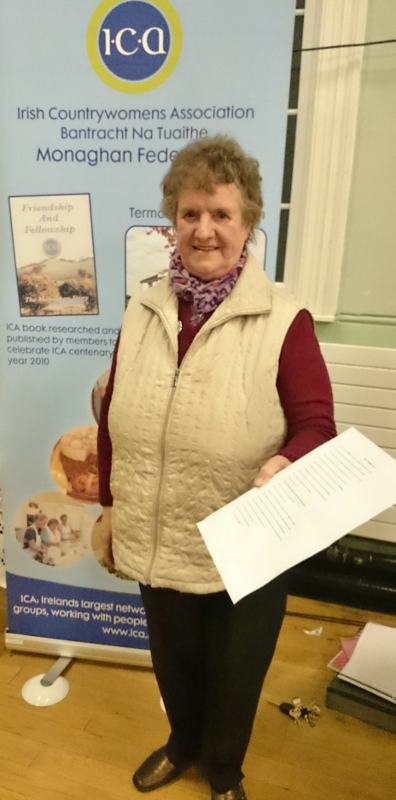
Maureen Gavin, ICA Aghabog Guild, with her winning poem on 60 Years of the ICA in Monaghan  Photo: © Michael Fisher

Maureen Gavin, ICA Aghabog Guild, with her winning poem on 60 Years of the ICA in Monaghan Photo: © Michael Fisher

Maureen Gavin from Aghabog won the contest for the best poem to celebrate 60 years of the ICA in the county. It told the story of Rosa Patterson, a teacher in Ballybay, who set up the first Guild in county Monaghan. The Clones Guild is well organised. One of its most famous members is Mamo McDonald, who went on to become ICA President in 1982 for a three-year term and is now an Honorary President of the Association. The group has over 10,000 members throughout the Republic of Ireland, in 500 Guilds.

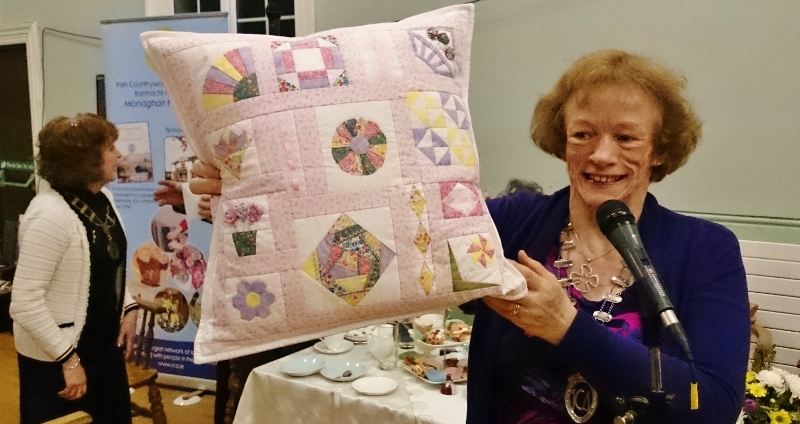
ICA Monaghan Federation President Patricia Cavanagh holds up a prizewinning quilted cushion Photo: © Michael Fisher

ICA Monaghan Federation President Patricia Cavanagh holds up a prizewinning quilted cushion Photo: © Michael Fisher

JUNO & THE PAYCOCK

image

The world’s in a state of chassis….
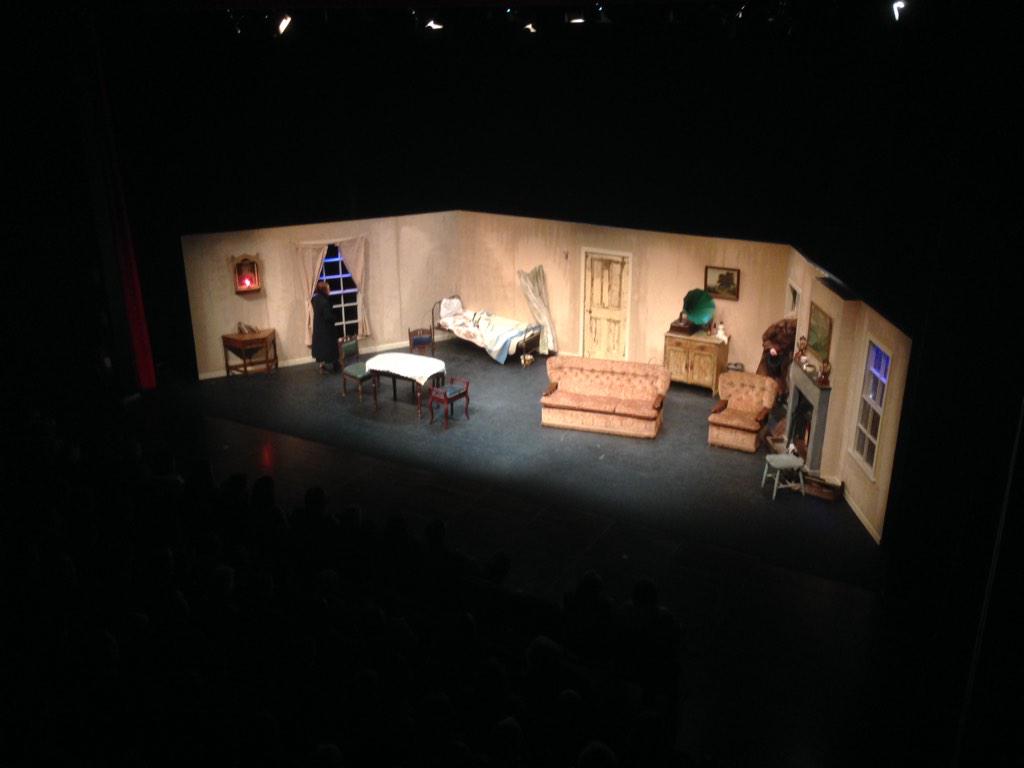
A very enjoyable production of the Sean O’Casey classic Juno and the Paycock by Castleblayney Players tonight at the Garage Theatre in Monaghan. PHOTO: Glenn Murphy who has just posted on Twitter!
image

Castleblayney Players are delighted to perform Juno and the Paycock, which has become a well loved classic since it was first performed in 1924. Audiences will sympathise with the Boyle family as they struggle with poverty, family relationships and civil war.
Seán O’Casey has given Irish drama some of its most memorable characters in this play: Juno (Ticky Mc Quillan) tries to hold her family together while her husband, Captain “the Paycock” Jack Boyle (Aidan Mc Quillan) is shy of work, their daughter Mary (Emma Duffy) is out on strike and has given up her boyfriend Jerry (Ricky Carragher) for her new man Charlie (Roraidh Irwin) while their son Johnny (Shane Cumiskey) is unable to work due to war injuries.
The Captain’s sidekick, Joxer (Jim O’Neill), is always lurking about, and along with Maisie Madigan (Andrea Beirne) they contribute much hilarity and sharp Dublin humour. Other neighbours and visitors (Paddy Crilly, Kelly O’Brien, Kevin Mc Geough, Francis G.Duffy, Eamon Mc Mahon, Pauline Clarke, Ryan Mc Mahon) bring colour and great vitality to the story.
Keeping the production together is director Nicky Hore assisted by an experienced and enthusiastic crew.
As the play is on the Leaving Cert this is a great opportunity for young students of drama to get to see O’Casey’s masterpiece on the stage.
The group also performed the play at the Iontas Theatre, Castleblayney, last weekend on Friday 13th and Saturday 14th February.
Watch out also for the forthcoming Castleblayney Drama Festival.

BOSE TALKS

Marian Harkin MEP meets SIPTU and Bose workers in Carrickmacross  Photo:  SIPTU

Marian Harkin MEP meets SIPTU and Bose workers in Carrickmacross Photo: SIPTU

Workers from the Bose factory which the company has announced will be closed by June have held a meeting held in Carrickmacross with the Independent MEP Marian Harkin. They were accompanied by the SIPTU Industrial Organiser Jim McVeigh. Monaghan Councillor Paudge Connolly also attended the discussions, which explored whether the European Globalisation Adjustment Fund (EGF) could be activated for the 140 workers due to lose their jobs.

Marian Harkin said afterwards the Fund could be used for retraining or increasing skills, or for workers who might like to set up their own business. In certain cases subsidies could be paid to local employers who would take on redundant Bose workers for a guaranteed period of time. The MEP is the author of the regulation for the Fund that is available for redundant workers across the EU. This Fund can be applied for wherever jobs are lost due to globalisation and the impact of the redundancies on the local area is significant. The fund is also available to any other workers who lose jobs that are involved in supplying the Bose factory or in transport, haulage, or related services, or any workers whose employment is dependent on the Bose factory.

Marian Harkin MEP  Photo: European Parliament

Marian Harkin MEP Photo: European Parliament

There is also an opportunity to apply to the Fund for an equal number of young people from the region who are not in employment, education or training. This means that up to 300 people might be able to avail of the Fund. Marian Harkin said the Fund might provide opportunities for workers made redundant and while it was only a start, it could at least be a stepping stone to future employment.

A public meeting is going to be organised in Carrick in the next few weeks for all the workers and members of the public who are interested. Details will be made available within the next few days. The MEP said she had worked with many other groups of workers who had accessed the Globalisation Fund, such as DELL workers and the Waterford Crystal workers. “ I would be more than happy to assist Bose workers in any application they might make for the Fund and its rollout”, Marian Harkin concluded.

CARRICKMACROSS WATER

Carrickmacross Water Treatment Plant, Nafferty

Carrickmacross Water Treatment Plant, Nafferty

The Environment Minister, Alan Kelly T.D., has officially opened  the new €3.5 million Carrickmacross Water Supply and Treatment Plant, situated at Nafferty on a hill on the outskirts of the town, near the Ballybay Road. A small group of protestors from Carrickmacross says No to Irish Water staged a protest near the entrance as the Minister arrived.

Construction of the plant began in May 2013 and it was commissioned in November 2014. Built on the site of the previous reservoir, the facility will supply water to domestic and business customers in Carrickmacross town and the surrounding area. Carrickmacross currently requires approximately 1.2 million litres of water a day for domestic, industrial and agricultural use. The new plant has the capacity to treat 160,000 litres of water per hour ensuring an adequate supply of treated water to meet current and future customer demands.

In 2009 the Environmental Protection Agency (EPA) issued a direction to Monaghan County Council placing the supply on a Remedial Action List. It was therefore critical that the new plant included a robust design, using proven technology for the treatment and continuous monitoring of water quality. The previous supply was susceptible to changing weather conditions, such as heavy rainfall or flash flooding, causing the quality of the ground water supply to change. The new plant is supplied by four different water sources with the quality of water from each being monitored on a continuous basis. In the event of any change in water quality an automatic alarm is notified to the operator and the water treatment process can be adjusted or a different water source can be selected to ensure customers always get a top quality water supply.

A full range of treatment processes including filtration, UV treatment, disinfection and fluoridation will also be deployed at the new plant ensuring compliance with current regulations. As a result Irish Water and Monaghan County Council successfully applied to the EPA and the HSE to remove the scheme from the Remedial Action List.

Commenting on today’s opening, Jerry Grant, Head of Assets, Irish Water said; “Providing a safe and secure water supply for our communities and businesses is vital and Irish Water has prioritised investment in improving drinking water quality standards. The recent EPA Drinking Water Report highlighted the inadequacy of a significant proportion of our treatment plants supplying drinking water and the scale of the investment needed to ensure all communities have access to clean drinking water. The opening of Carrickmacross Water Treatment Plant is a great example of how Irish Water working in partnership with Monaghan County Council can deliver real benefits in terms of security of supply, quality and value for money to the local community.”

Minister for the Environment, Alan Kelly T.D.

Minister for the Environment, Alan Kelly T.D.

Minister for the Environment, Community and Local Government, Alan Kelly, said: “I’m delighted to open this water treatment plant in Carrickmacross. This new facility has seen strong cooperation between Irish Water, Monaghan County Council and private sector partners to ensure the town and surrounding areas have a modern, state-of-the art water treatment facility. The project was delivered on time, and under budget and I congratulate all involved.

Having a secure, high quality water supply is vital to every town’s daily life and economic development. With this new water treatment plant Carrickmacross will have the reliable, drinking water supply it needs for the years and decades ahead, so that its families, firms and farms can go about their daily activities and the local economy can progress.

With the reform of the water sector and the establishment of Irish Water, investment in water infrastructure is increasing. I am confident that Monaghan will experience improved water services and sustainable water investment as a result of the Government’s reforms”, the Minister concluded, before being given a tour of the facility.

Jerry Grant along with local representatives accompanied Mr Kelly on a tour of the facility.

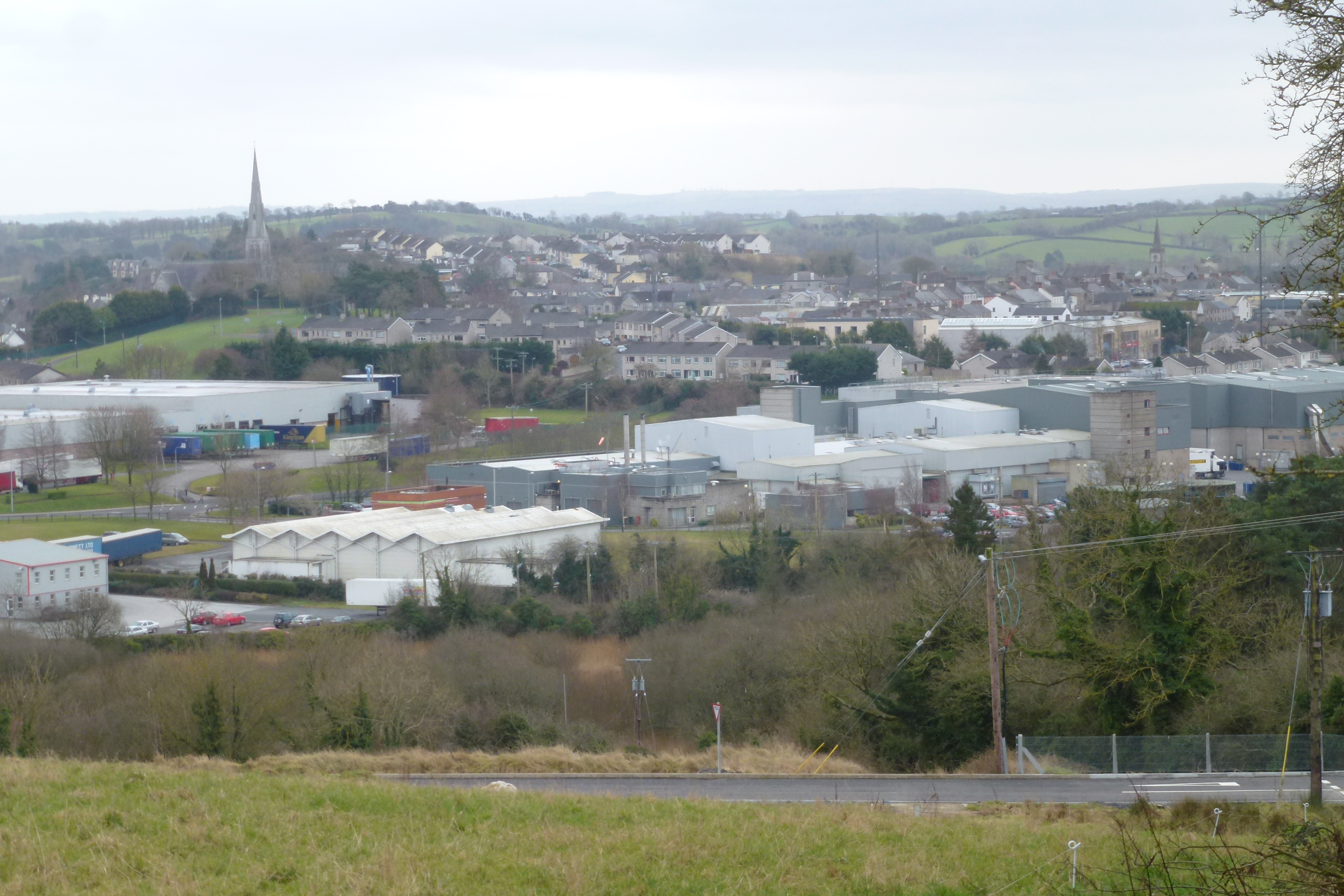
View of Carrickmacross from Nafferty  Photo: © Michael Fisher

View of Carrickmacross from Nafferty Photo: © Michael Fisher

Irish Water is responsible for 855 water treatment plants that supply over 1.6 billion litres of water every day to 3.3 million people. The company invested €340m in improving water and waste water services in 2014 and will invest over €410 million in improving water services during 2015, this spend will increase over subsequent years.


CREDIT UNION ART COMPETITION

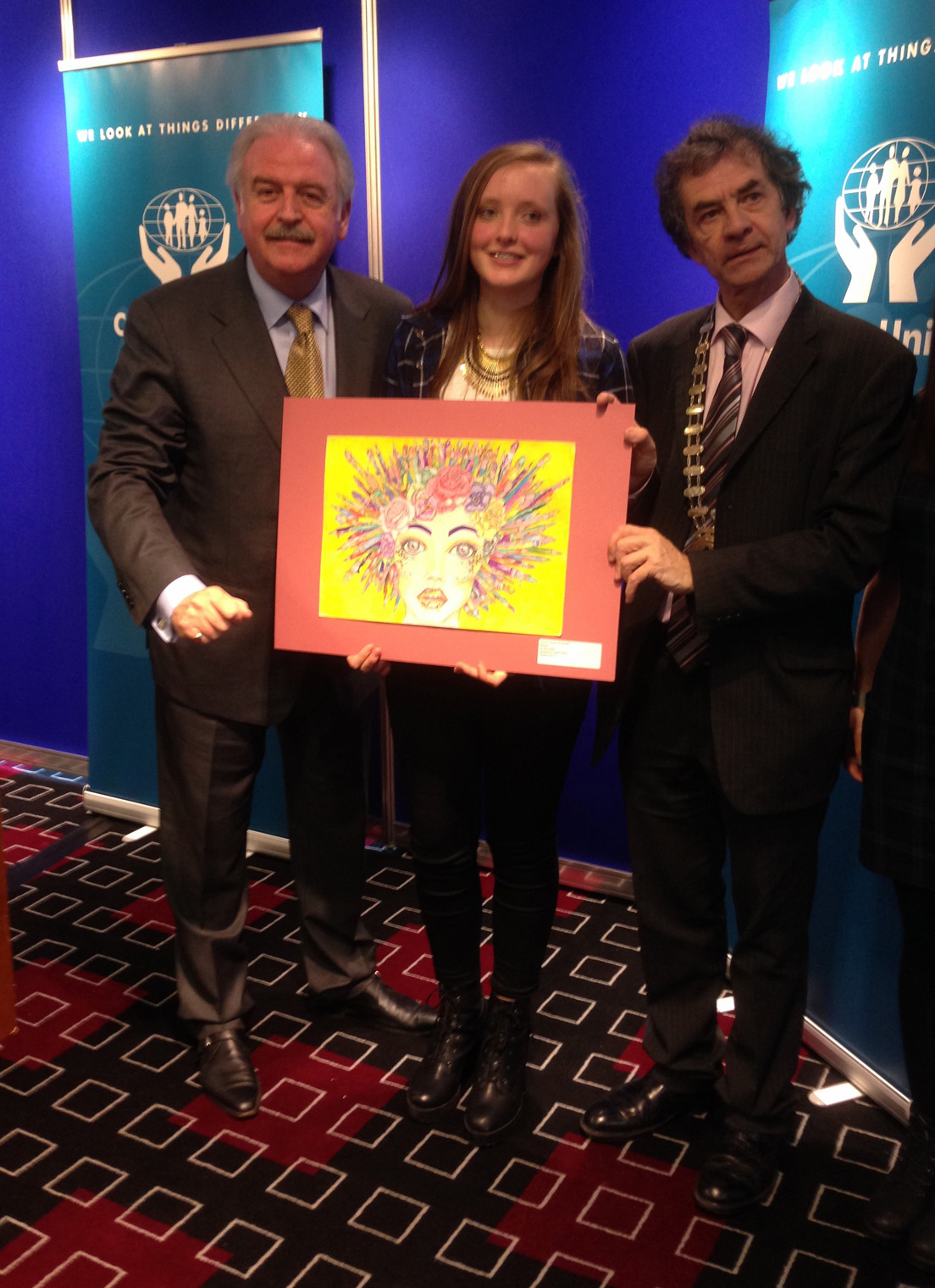
Sarah Leddy from Inniskeen is congratulated by compere Marty Whelan (left) and Martin Sisk, President ILCU (right), for winning first place in the Credit Unions' annual Art Competition (11-13 category). Photo: ILCU

Sarah Leddy from Inniskeen is congratulated by compere Marty Whelan (left) and Martin Sisk, President ILCU (right), for winning first place in the Credit Unions’ annual Art Competition (11-13 category). Photo: ILCU

INNISKEEN STUDENT WINS PRIZE IN NATIONAL ART COMPETITION
A secondary school student fom Inniskeen, County Monaghan, Sarah Leddy, has won first prize in the Irish League of Credit Unions annual art competition in the 11-13 year-olds category. She received her award at Croke Park last Sunday. Sarah is a past pupil of St Daigh’s National School, Inniskeen, and currently attends St Vincent’s Seconday School in Dundalk.

Her winning picture depicted the theme ‘ARTFEST’ and was singled out for special mention by the event compere, Marty Whelan of RTE. The competition, one of the biggest art of its kind for both children and adults, has been running for 31 years and is open to entrants of all ages.

This year it attracted over 30,000 entries through 300 credit unions nationwide.
The theme ‘ARTFEST’ was open to interpretation by each entrant and aimed to celebrate the creativity, imagination and vibrancy of the budding artists. The competition is about encouraging and rewarding self-expression, creativity and imagination among young artists throughout Ireland. Entrants are free to express their creativity using a wide variety of media.

The competition required entrants to draw or paint posters on the theme using pencil, charcoal, pen or ink, felt-tip markers, crayon, pastel, water colours, gouache, acrylics, oils, poster colour or collage.

Speaking at the awards ceremony, the President of the Irish League of Credit Unions, Martin Sisk, said: “We wholeheartedly support the artistic development of people young and old in our communities across the island of Ireland. The artists here should be extremely proud of themselves and the quality of the artwork displayed is truly outstanding. It is interesting to see how uniquely each of the artists interpreted the theme ‘Artfest’. Well done to everyone involved”.

Marty Whelan who was hosting the event for the fourth year running said he was delighted to be involved. “It is a pleasure to meet such an array of talented artists and give them the opportunity to showcase their creative ideas and gain national recognition for their ability. It is always great to see competitions like this support the arts and give people the opportunity to explore their creative side”, he said.

The judges for this year’s competition were: John Walsh, Creative Director FOCUS Advertising Agency; Ursula Retzlaff O’Connell, Artist; John Farrelly, Cartoonist and Graffiti Artist, VENTS.

ART COMPETITION WINNERS

GENERAL CATEGORY

Category Name Credit Union
7 yrs & under (G) Luke Collins Drogheda Credit Union
8 to 10 years Clodagh McDonagh Macroom Credit Union
11 to 13 years Sarah Leddy Inniskeen Credit Union
14 to 17 years Shania McDonagh St. Colman’s (Claremorris) Credit Union
18 years & over Alex Wright Rathmore and District Credit Union

SPECIAL CATEGORY

Category Name Credit Union
7 yrs & under (S) David Donoghue Tallaght and District Credit Union
8 to 10 years Frank Graham Naas Credit Union
11 to 13 years Aoife Brady Togher Credit Union
14 to 17 years Christina McConnell Derry Credit Union
18 years & over Venus Reilly Gorey Credit Union
Group Class 3, St. Brigid’s Special School Castlebar Credit Union

This Page 1 story and many more can be found in this week’s edition of The Northern Standard.  NSlogo

TITANIC RESTORATION

Harland & Wolff Drawing Offices Photo:  HLF website

Harland & Wolff Drawing Offices Photo: HLF website

Good to see some progress regarding the plans to restore the currently derelict Drawing Offices at the former Harland and Wolff headquarters, where the Titanic was designed. A £4.9 million grant from the Heritage Lottery Fund (HLF) will enable The Titanic Foundation Ltd. to restore the building, unlocking plans to transform the site into a luxury Four Star hotel.

The Harland and Wolff Headquarters Building and Drawing Offices on Queen’s Island in Belfast were the control centre for the largest shipyard in the world.  It was here that Belfast workers created and designed over 1,000 ships including the White Star Olympic Class Liners – Olympic, Titanic and Britannic and naval warships such as HMS Belfast. The Harland and Wolff building has been vacant since 1989 and has been considered ‘at risk’ for almost a decade.

The restoration of the B+ listed building into an 84-bedroom boutique hotel has the potential to create over 100 local jobs. The Lottery grant will specifically focus on developing the two historical drawing offices as spaces for public use. The boutique hotel will also tell the story of Belfast’s industrial heritage, focusing on the authentic spaces – Board Room, Telephony Room and Entrance Lobby – as well as the fixtures and fittings that relate to the local shipbuilding industry.

The grant has been awarded through HLF’s Heritage Enterprise programme. It is designed to help when the cost of repairing an historic building is so high that restoration simply is not commercially viable.

Kerrie Sweeney, Chief Executive of Titanic Foundation, was delighted with the announcement: “Titanic Foundation in partnership with Titanic Quarter Ltd has been working on this project over the last two years. It has been a long process but worth it. With HLF’s support we will safeguard the drawing offices for future generations and unlock the commercial potential of the entire building as a boutique hotel with heritage at its core. This is a truly unique and authentic project for Belfast that could not have happened without the support from Heritage Enterprise Scheme.”

Head of HLF NI, Paul Mullan  Photo:  HLF

Head of HLF NI, Paul Mullan Photo: HLF

Head of the Heritage Lottery Fun in Northern Ireland, Paul Mullan, looks at the history of the building where the Titanic was designed:

By the first half of the 20th century, Belfast was one of the world’s most dynamic industrial centres.  It was within the walls of Harland and Wolff’s HQ where the leading minds in ship design and engineering broke new ground to produce ships that were the envy of the world.

Sadly, the decline of city’s shipbuilding industry was mirrored in the steady decline of Harland and Wolff’s HQ.  Once a symbol of Belfast’s international importance, just over a decade ago it was placed onto Northern Ireland’s buildings at risk register.

But that memory of a dynamic shipyard has awoken in recent years. Today, Titanic Belfast is an incredibly successful tourist attraction. The SS Nomadic, which was built to ferry passengers to and from the Titanic, has been brought back to its former glory and is the highest rated tourism attraction in Belfast.  Close by, HMS Caroline is undergoing a transformation from being a forgotten piece of naval heritage into a museum which will tell a story of sea battles from both the First and Second World Wars.

The result is more than one million visitors to the Titanic Quarter each year. With this success comes a return to fortune for the derelict Harland and Wolff HQ.  £4.9m from our Heritage Enterprise programme will convert the building into an 83 bedroom hotel, with the potential to create over 100 jobs.

The £27m development will bring much wider economic benefits by bringing more visitors and investment to Belfast.  This unique hotel will gives new purpose to an important part of Northern Ireland’s built heritage, building on the Titanic theme of the Quarter whilst providing a stunning setting for visitors.

It also shows how we can use historic buildings creatively, in a way that helps people fully appreciate its past whilst enjoying its present uses and harnessing the collective resolve of both the private and public sector for the benefit of everyone.

We now need to bring this sense of purpose to our many other buildings at risk by challenging not-for-profit groups to partner with commercial operators to bring back into use those buildings which provide us with a direct link to our past.

This isn’t a nice to do but something that has a strong economic and revitalising value. Over two years ago a report on the economic value of Northern Ireland’s historic environment marked out this opportunity, making a strong case for this type of investment.  Today, in the Titanic Quarter and across the UK, Lottery money is helping people to realise the untapped potential of our vacant and underused historic buildings.