CHURCH DIVISIONS

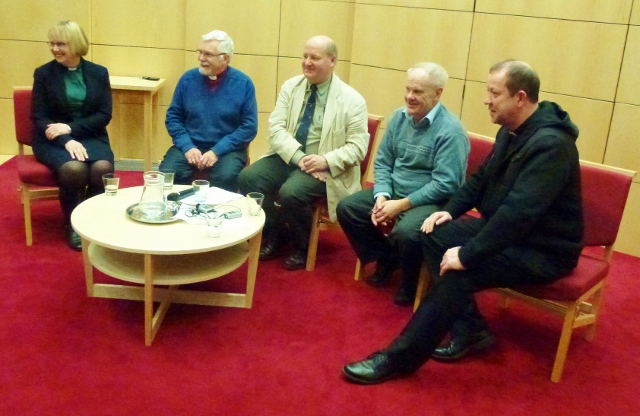
4Corners Festival at South Belfast Methodist Church  Photo: © Michael Fisher

4Corners Festival at South Belfast Methodist Church Photo: © Michael Fisher

There was an interesting meeting in South Belfast tonight at which representatives of the four main Christian churches in the city explored the topic ‘Is Christ Divided?’. It was held at the new Methodist centre on the Lisburn Road. It was part of the 4Corners Festival: Bringing Belfast Together.

The Church of Ireland Diocese of Connor website has the following details:-

In a special event as part of the Week of Prayer for Christian Unity, church leaders from four different traditions and four corners of Belfast will come together to tell their personal stories.

The theme for this year’s Week of Prayer for Christian Unity is the rhetorical question put by Paul to the church in Corinth: “Is Christ Divided?” and it is against the backdrop of this question  that the church leaders will speak. The four are:

Bishop Harold Miller: Anglican Bishop of Down and Dromore (East Belfast resident)
Rev Dr Norman Hamilton: Former Moderator and Minister of Ballysillan Presbyterian (North Belfast)
Father Ciaran Dallat: Assistant Priest in St. Peter’s Catholic Cathedral (West Belfast)
Rev. Dr. Heather Morris: President of the Methodist Church in Ireland and Director of Ministry at Edgehill Theological College (South Belfast).  Chaired by Professor John Brewer of Queen’s University, Belfast.

4Corners Festival at South Belfast Methodist Church  Photo: © Michael Fisher

4Corners Festival at South Belfast Methodist Church Photo: © Michael Fisher


Bishop Harold Miller at 4Corners Festival Photo: © Michael Fisher

Bishop Harold Miller at 4Corners Festival Photo: © Michael Fisher

TRUAGH GRIT!

Congratulations on a great finish and a win by the footballers from Truagh Gaels: on now to the All-Ireland Intermediate Club final in Croke Park on February 9th. Hard luck also to Emyvale GAA footballers  who lost by a single point against Twomilehouse from County Kildare. An interesting name for the opponents as there is a Threemilehouse in North Monaghan! Coverage of both matches with plenty of photographs can be found on Peadar MacMahon’s website emyvale.net.

No doubt there were plenty of divided loyalties in various families in the two neighbouring parishes. Emyvale is in the parish of Donagh, which stretches from Knocknagrave across to Edenmore (Tommie Bowe’s former school), the Blue Bridge at Inishdevlin, Emyvale and across to Glennan chapel and Glaslough. It also includes Corracrin opposite Anketell Grove on the main Dublin to Derry N2 road, where St Patrick’s chapel is located. Knockronaghan on the other side of the main road is also included. The McCarron family has connections both in Knocknagrave (original homestead) and Knockronaghan.

Heading out of Emyvale towards the border at Moybridge along the N2 main road, you pass the Silver Hill duck processing plant. Among the local groups they sponsor is Truagh Gaels GAA Club, whose clubhouse and pitch is further along the road. Red and black flags are flying outside many houses and on telephone poles. Errigal Truagh parish includes Clara, Carrickroe and Ballyoisin, where there are chapels. The latter is just off the main road on the right hand side heading towards Aughnacloy, before Moybridge. Beside the chapel there is a vibrant community centre and a national school.

HOLOCAUST MEMORIAL DUBLIN

Auschwitz camp entrance  Photo:  © Michael Fisher

Auschwitz camp entrance Photo: © Michael Fisher

Last year I wrote about the Holocaust Day service in Northern Ireland. There is also an annual service in Dublin on the nearest Sunday to January 27th. It is organised by the Holocaust Education Trust Ireland. The event honours the memory of all of the victims of the Holocaust — six million Jews as well as over five million other victims – persecuted because of their nationality, ethnicity, sexual orientation, disability, religious beliefs or political affiliations. The inclusion of all of the victim groups is essential to the commemoration, highlighting the importance of education about anti-Semitism and all forms of intolerance.

Auschwitz memorial  Photo: © Michael Fisher

Auschwitz memorial Photo: © Michael Fisher

The Holocaust Memorial Day commemoration demonstrates the Irish Government’s commitment to the Declaration of Stockholm, 2000, when the 44 signatory countries undertook to commemorate and teach about the Holocaust every year. Holocaust Education Trust Ireland advises and assists Government with organising the annual Holocaust Memorial Day commemoration.

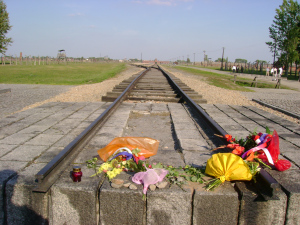
Rail tracks at Birkenau camp Photo:  © Michael Fisher

Rail tracks at Birkenau camp Photo: © Michael Fisher

The commemoration is held in the Round Room of the Mansion House and admission is by invitation from the Holocaust Education Trust.

RABBIE BURNS

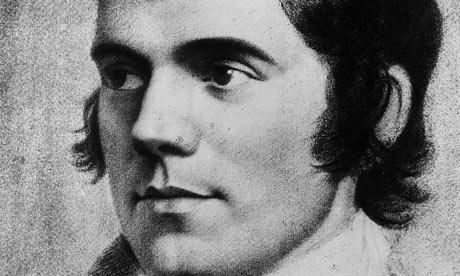
Robbie Burns

Robbie Burns

ROBERT BURNS 1759-1796

Celebrations are already underway for Burns night, which is technically tomorrow, January 25th, the date of the bard of Ayrshire’s birthday in 1759. This version of one of his songs was performed by the well-known journalist Hugh Jordan two years ago on the Frank Mitchell programme on U105. It will hopefully serve to provide the right mood for the weekend.

And there’s a hand, my trusty fiere!  And gie’s a hand o’ thine!

And we’ll tak’ a right guid-willie waught,  For auld lang syne.

The Robert Burns website tells us that the celebrations are on, or around the time of the Bard’s birthday, January 25th. You will also find more details there of the poems and songs of Burns.

Burns Suppers range from formal gatherings of aesthetes and scholars to uproariously informal gatherings.  Most Burns Suppers fall in the middle of this range, and adhere, more or less, to some sort of time-honoured form. This includes the eating of a traditional Scottish meal, such as haggis, the drinking of Scotch whisky, and the recitation of works by, about, and in the spirit of the Bard.

Every Burns Supper has its own special form and flavour, though there are probably more similarities than differences among these gastro-literary affairs. Some celebrants may contribute the composition of original songs or poems; some may excel at giving toasts or reciting verse; while others may be captivating storytellers. A particular group of celebrants will, over time, develop a unique group character which will distinguish their Burns Supper celebration from every other.


SPOTLIGHT ON REPORTING

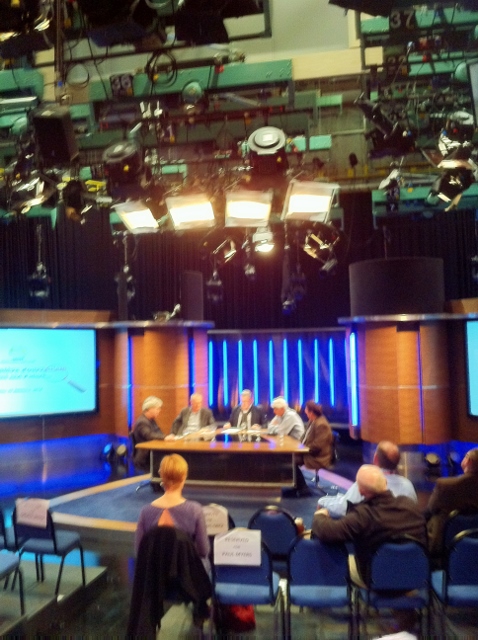
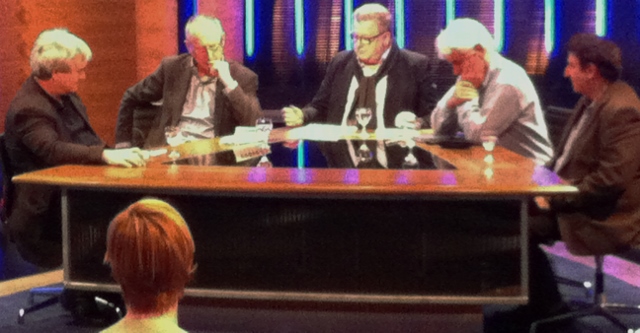
Panel discussion chaired  by Miriam O'Callaghan  Photo: Michael Fisher

Panel discussion chaired by Miriam O’Callaghan Photo: Michael Fisher

Good investigative journalism needs time for research, checking and double-checking facts and teamwork. BBC Northern Ireland’s Spotlight programme has been going for forty years. To mark the occasion the Corporation devoted a day at its Blackstaff studio normally used for the Nolan show to discuss why investigative journalism matters and to consider its future.

I did not attend the first session which included on the panel Senator Susan O’Keeffe, Michael Crick,  and Freedom of Information specialist and journalism Professor Heather Brooke. Her (London) City University colleague Professor George Brock also contributed to the seminar.

Miriam O'Callaghan introduces Sue Lloyd-Roberts, Stacey Dooley and John Sweeney  Photo: Michael Fisher

Miriam O’Callaghan introduces Sue Lloyd-Roberts, Stacey Dooley and John Sweeney Photo: Michael Fisher

The lunchtime session was chaired by RTÉ presenter Miriam O’Callaghan. Her guests included John Sweeney of Panorama, Sue Lloyd-Roberts and Stacey Dooley, who presents documentaries on BBC THREE. The latter gave us an insight into what it was like trying to make a programme in an area along the border in Mexico controlled by gangs.

Steve Hewlett chairing a panel discussion  Photo: Michael Fisher

Steve Hewlett chairing a panel discussion Photo: Michael Fisher

Many of the interesting insights into the world of investigative television reporting and the changes that have taken place came in the final session chaired by Salford Professor Steve Hewlett, a BBC Radio 4 presenter. The panellists included Roger Bolton, Darragh MacIntyre, and John Ware, who has done several investigations about Northern Ireland, the latest being on the activities of the British Army unit known as the Military Reaction Force in the 1970s. It was broadcast by the BBC last November.

Steve Hewlett chairing a panel discussion  Photo: Michael Fisher

Steve Hewlett chairing a panel discussion Photo: Michael Fisher

SECTION 31 ANNIVERSARY

Anti-Section 31 protestors in Dublin  Photo: An Phoblacht

Anti-Section 31 protestors in Dublin Photo: An Phoblacht

Twenty years ago this week (January 19th 1984) the Irish Section 31 broadcasting ban on Sinn Féin along  with republican and loyalist paramilitary groups or any proscribed organisation in Northern Ireland was lifted. This was at an important time just seven months before the IRA ceasefire. The order renewed on January 6th 1993 by the then Communications Minister Máire Geoghegan-Quinn (now an EU Commissioner) directed Raidió Telefís Éireann to refrain from broadcasting any interview or a report of an interview with spokesmen for any of these organisations. As the peace process began to take shape, the order was allowed to lapse by the Arts, Culture and Gaeltacht Minister, Michael D. Higgins (now Uachtarán na hÉireann) of the Labour party.

The republican newspaper An Phoblacht recounts how the broadcast media in the 26 Counties were now free to interview Sinn Féin spokespeople. The paper says the first such interview was with party President Gerry Adams on Dublin’s 98fm radio station. But on the BBC Northern Ireland website where I first noticed the story, it is reported that Highland Radio presenter Kevin Sharkey (now with the BBC) carried out the first such broadcast in their studio in County Donegal, where he interviewed Martin McGuinness and Pat Doherty.

TYNAN ABBEY KILLINGS

Entrance to Tynan Abbey estate  Photo:  © Michael Fisher

Entrance to Tynan Abbey estate Photo: © Michael Fisher

Ulster Unionist MLA from East Belfast Michael Copeland has reminded the public that today is the anniversary of the gun and bomb attack by an IRA gang on Tynan Abbey in County Armagh.

The IRA shot dead Sir Norman Stronge, aged 86, a former Unionist MP and Speaker of the Stormont Parliament. They also killed his son James. He was a merchant banker who had also been an Ulster Unionist MP at Stormont. He had served as an officer in the Grenadier Guards and was an RUC Reservist.

Sir Norman Stronge

Sir Norman Stronge

On Wednesday 21st January 1981, a group of men dressed in military-style uniforms forced their way into the Tudor-Gothic mansion where Sir Norman and son James lived with their family, close to the border with County Monaghan. Both father and son were alone in the library when they were sought out by the attackers and shot dead. After the men were killed, the IRA placed incendiary devices in the mansion and set it on fire destroying the mansion. They are buried at Tynan parish church.

Sir Norman was one of the oldest people killed during the troubles in the North. A local minister stated that he thought members of the Stronge family were in danger but he never suggested they move. The IRA said the Stronges had been chosen as what they called “the symbols of hated unionism”. Neither Sir Norman nor James Stronge had been prominent in unionist politics for some time.

Tynan Cross & Parish Church  Photo: © Michael Fisher

Tynan Cross & Parish Church Photo: © Michael Fisher

The IRA said the attack was a “direct reprisal for a whole series of loyalist assassinations and murder attacks on nationalist people and nationalist activists”.

PAISLEY DOCUMENTARY

Paisley: Genesis to Revelation with Eamonn Mallie  Photo: BBC NI website

Paisley: Genesis to Revelation with Eamonn Mallie Photo: BBC NI website

Ouch! Looks like the DUP handlers have been working overtime to get their retaliation in first, in advance of the broadcasting of the second part of Eamonn Mallie’s interview and documentary featuring the former DUP leader and former Free Presbyterian Moderator Lord Bannside. Worth remembering that Ian Paisley is now 87, as one of the party’s responses remind us.

Statement from Democratic Unionist Party Spokesman: “Lord Bannside is entitled to his own opinions – however, he is not entitled to his own facts. The Party deeply appreciates the contribution Lord Bannside made to Northern Ireland and to the growth of the DUP.  Despite the headlines regarding these programmes, the Party will not be losing focus. Our greatest ever electoral victory, in 2011, gave us a mandate to keep Northern Ireland moving forward. We will get on with that task.

We are saddened to see Lord Bannside harm his own legacy.  In his later years as Party leader, many colleagues shielded his frailty from public view, to avoid embarrassment and protect his legacy.  Those people are hurt by untrue and bitter comments contained in the documentary.

The party, unlike the media, has not been granted an advance viewing, however, the programme maker and the BBC have already been informed of the inaccuracy of those claims made in the programme about which they have notified us. The Party does not intend to respond to the personal opinions expressed in the programme – those making the comments must take responsibility for them – but it will not let untrue assertions dressed up as facts go unchallenged.

Dr Paisley, as he was then known, gave a number of interviews on the occasion of his retirement announcement.  In those interviews he stated that he had been considering his retirement for some time and had himself chosen the time to stand down.  Moreover he denied that he had been “pushed”.  The public may well ask whether then or now they have been misled. Worse, he now seeks to place the responsibility for his decision on those who protected him most when, at 82 years of age, his ability to perform his duties was seriously diminished and causing widespread concern.

Contrary to media speculation, the party has not mounted any form of legal challenge to this programme. When the Party sees the second programme, rather than relying on third party accounts, it will decide if any further response is necessary.”

Statement from Rt Hon Peter Robinson MLA, Democratic Unionist Party Leader: 

“There are many who will believe that in agreeing to participate in these interviews Lord Bannside will have done nothing to enhance his legacy. They will struggle to reconcile the spirit and tone he presents with that which they will have known and admired.  This is not the Ian Paisley we knew.

As someone who faithfully served Dr Paisley for many decades I will make one final sacrifice by not responding and causing any further damage to his legacy beyond that which he has done himself.  Rather than return insult for insult, let me bless him with the mercy of my silence and wish him well.”

Statement from Rt Hon Nigel Dodds MP, Democratic Unionist Party Deputy Leader: 

“I am personally very saddened to learn of the tone and contents of the latest programme on Lord Bannside.   All of us who worked hard for him and with him for many years wished only the best for him and for our country. It is to be deeply regretted that at 87 and retired that this programme may be what is remembered about him rather than the good things that he did.

Clearly the passage of time has diminished accurate recall of events.   What is being said now by Lord Bannside about meetings is inaccurate and stands in stark contrast to everything that he said and did at the time and, indeed, during the years since.  As Lord Bannside is not long out of hospital I wish him well in his recovery.”

Statement by Lord Morrow of Clogher Valley, Democratic Unionist Party Chairman:

“I have served as Chairman of the DUP for most of the period discussed in the programmes. During that time, I have some great memories of Dr Paisley.  I am saddened by this turn of events.  Throughout my political lifetime I was a loyal friend to Lord Bannside.  I wish him well in his recovery.  These latest utterances do not do justice to someone who was a giant in unionism in Northern Ireland.”

Statement from Timothy Johnston, former Special Advisor to First Minister Ian Paisley: 

“I am deeply saddened to learn of the general content and tone of the Ian Paisley programme to be broadcast by the BBC on Monday evening. After a long and distinguished career it is very regrettable that Dr Paisley, as well as Mrs Paisley, and those who now advise them, have co-operated in the making of two programmes that have significantly and irreversibly damaged his historical legacy.  Unsurprisingly the events of that time have not been accurately recalled and indeed the “research” used by the production staff is wrong in many significant respects.  Some of the programme content is simply untrue.

I totally refute any allegation, suggestion or implication that a survey conducted was “framed” by me or anyone else.  Dr Paisley commissioned the survey and was aware of its nature and its findings at the time.  At no point then or since has Dr Paisley or Mrs Paisley sought to raise these concerns with me despite having had every opportunity to do so.

I learned many valuable lessons while working for Dr Paisley, one of which was not to discuss internal party business in public.  I have no intention of departing from the advice he proffered at the height of his career.  While saddened by this turn of events I wish Dr Paisley well for the future.”

Whatever about the reaction from the politicians, it was interesting that the final quote came from Timothy Johnston, former special advisor to Ian Paisley when the DUP leader became First Minister in a power-sharing Exective with Sinn Féin, along with UUP and SDLP representatives in May 2007.

So there you have it. It just remains to see what exactly Ian Paisley has to say for himself at 10:35pm on BBC1 Northern Ireland. Paisley: Genesis to Revelation. Episode 2. Ian Paisley has been one of the most controversial political figures of the 20th century. From firebrand preacher to hard line politician and ultimately Northern Ireland’s first minister, he has lived a life in the public eye.

In this two-part series, Eamonn Mallie challenges Ian Paisley on his role in Northern Ireland’s troubled past and reveals the dramatic circumstances of his departure from politics and public life. Expect to hear Eamonn on a number of radio current affairs programmes this morning talking about the programme.

According to the Irish News front page, Ian Paisley is claiming that the DUP betrayed him and he alleges that senior party figures plotted his downfall as leader.

HEINEKEN RUGBY

ERC Heineken Cup

ERC Heineken Cup

Congratulations to Ulster Rugby on their Heineken Cup win over Leicester. The 19-22 victory over the Tigers at Welford Road thanks to the boot of Ruan Pienaar earned them a home quarter final at Ravenhill against Saracens. The semi-final draw also favours Ulster, and hopefully they can progress to a home tie against the winners of Clermont v Leicester. Ulster and Saracens met in the last eight last season and on that occasion the Londoners ran out winners 27-16.

The other semi-final could be an all-Irish affair with the winner of Toulon v Leinster hosting the winner of Munster v Toulouse. The quarter-finals take place from 4th-6th April with the semis following on 25th-27th April. The last eight line-up includes six past champions, with Saracens and last year’s beaten finalists Clermont the only survivors this season not to have won the tournament.

Quarter-finals: Ulster v Saracens; Clermont v Leicester; Toulon v Leinster; Munster v Toulouse.

Semi-finals: Ulster or Saracens v Clermont or Leicester; Toulon or Leinster v Munster or Toulouse.

Ulster Rugby

Ulster Rugby

‘PAPARAZZI’ IN SOUTH DUBLIN

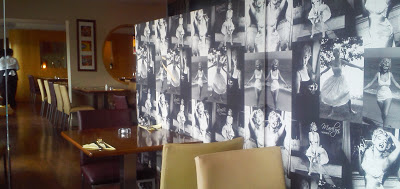
Paparazzi ... a theme behind the name of the restaurant in Templeogue (Photograph: © Patrick Comerford, 2014)

Paparazzi … a theme behind the name of the restaurant in Templeogue (Photograph: © Patrick Comerford, 2014)

Since I spent the first two years of my life in Terenure and my cousins lived there, I have retained an interest in the general area. So I was interested to see this blog from the Reverend Patrick Comerford, whose articles I have reproduced here from time to time, with permission of the author. This one is entitled:

‘Love All’ and ‘Paparazzi’ in the heart of suburban south Dublin 

Suburban south Dublin was looking beautiful in mid-January. Templeogue must be the archetypal south Dublin suburb, with its tennis club, sports facilities, cafés, fee-paying schools – and all 15 bus routes go through some part of Templeogue on their way to Terenure, Rathgar and Rathmines and on into the city centre.

But how big is Templeogue and how far does it extend? Like Terenure, it must have very porous boundaries, extending to parts of Ballyroan, Butterfield, Firhouse, Greenhills, Kimmage, Knocklyon, Limekiln, Old Orchard, Perrystown, Rathfarnham, Tallaght, Terenure, Tymon, and Whitehall.

In a moment of unguarded snobbery, a former colleague, point out that he lived in “Templeogue before the bridge” and not in more naff “Templeogue across the bridge.” He was not happy to hear that the original Templeogue was much nearer Tallaght than the present Templeogue village.

James Joyce mentions Templeogue in Finnegans Wake, the poet Austin Clarke lived in Bridge House beside Templeogue Bridge on the banks of the River Dodder, and Archbishop George Simms retired to live in Templeogue with his wife Mercy in 1991.

The Irish name, Teach Mealóg, means the “New Church of Saint Mel” or the house or Church of young Saint Mel, said to have been built ca 1273. By 1615, the church was in ruins, and the ruins can be seen in the graveyard at the top of Wellington Lane near the Spawell Leisure Centre. Nearby, Saint Michael’s House occupies the former Templeogue House, which incorporates parts of Templeogue Castle, built by the Talbot family.

Although Templeogue is only 6 km from the city centre, we had sweeping views across to the Dublin Mountains this afternoon during lunch at a window table in Paparazzi in Old River House, in the heart of Templeogue. We had a LivingSocial voucher for lunch, and had Tagliatelle Vegetarian, Seafood Risotto, two glasses of white wine, and two double espressos.

In the background, popular Italian folk songs from decades ago were unobtrusive. The walls were decorated with paparazzi photographs of Marilyn Monroe, and the mirrors gave the first floor restaurant a greater feeling of expansive space.
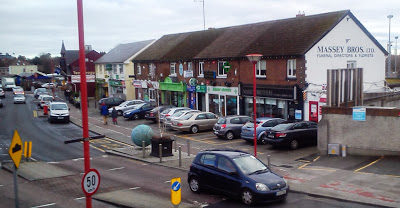
Looking out at Templeogue Village from a window in Paparazzi in Templeogue (Photograph: © Patrick Comerford, 2014)

Looking out at Templeogue Village from a window in Paparazzi in Templeogue (Photograph: © Patrick Comerford, 2014)

Immediately below us was Templeogue Tennis Club, and to the left the rows of shops that give Templeogue its village character, from Templeogue Barbers and Massey’s Funeral Home, passing the Templeogue Inn, known more popularly as ‘The Morgue,’ and on to Hollingsworth’s bicycle shop.

The Templeogue Inn is the one and only pub within the boundaries of the village. It is also known as The Morgue. When the old tram route passed through Templeogue, it is said, because the tram ran so close to the pub, there were many deaths and the corpses were often brought back into the pub and laid out on the tables.

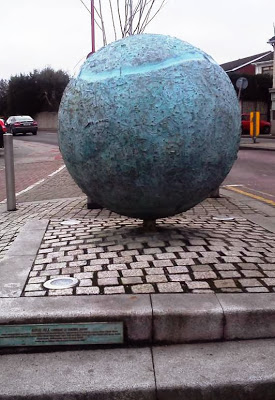
‘Love All’ ... Rachel Joynt’s sculpture in the heart of Templeogue Village (Photograph: © Patrick Comerford, 2014)

‘Love All’ … Rachel Joynt’s sculpture in the heart of Templeogue Village Photo: © Patrick Comerford 2014

Some years ago, when a betting shop opened a few doors down, between Massey Brothers and the tennis club, many residents took offence when it was given the name “Dead Cert.” Now in front of Massey’s, the barbers and the tennis club, the most noticeable landmark is Love All, a large bronze spherical sculpture about a metre in diameter. The bronze is patinated green and dramatically resembles a tennis ball from afar. At a closer look, however, is looks more like a scaled-down world with tiny details of houses, roads, cars and people emerging from the textured green surface, and seam of the tennis ball turns out to represent the River Dodder. Rachel Joynt was inspired by both the tennis club and the River Dodder as she worked on Love All. She also suggests the notion of a globe or the world by mounting the sculpture on an axle so that it rotates slowly if pushed.

“For me, a successful public artwork needs to have a sense of place, a freshness, some intrigue and playfulness, a bit like a frozen moment from a daydream,” she has said.
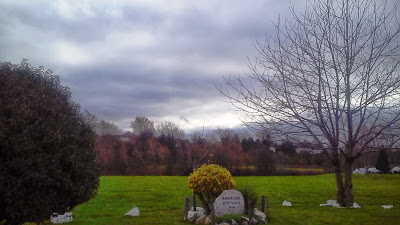
Riverside Cottages ... a semi-rural setting in the heart of suburban south Dublin (Photograph: © Patrick Comerford, 2014)

Riverside Cottages … a semi-rural setting in the heart of suburban south Dublin (Photograph: © Patrick Comerford, 2014)

Behind the village, the tennis club and Hollingsworths, we walked down the hidden laneway that drops down to an old semi-circle of houses at Riverside Cottages, built on the banks of the River Dodder over 100 years ago. Here there is a semi-rural setting in the heart of suburban south Dublin, and from here it is possible to walk along the river bank through Rathfarnham and much of south Dublin.

Later this evening, while I was in Harold’s Cross, I caught a glimpse to the east of the still full moon rising in a clear sky above the green copper dome of the church in Rathmines. It was a very different “bronze age” view than Rachel Joynt’s Love All in Templeogue.

Patrick Comerford January 17th 2014