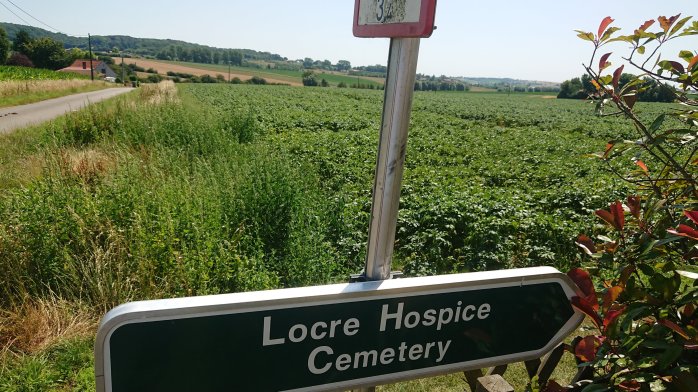
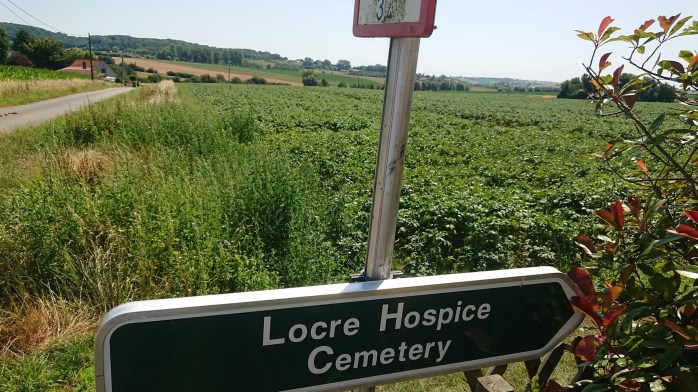
At Locre Hospice Cemetery maintained by the CWGC near the village of Locre (Loker as it is known in Flemish) there are some graves of soldiers from the Royal Irish Regiment. The grave of Major Willie Redmond was left outside the Cemetery close to the boundary wall in the corner of a field where it was cared for over many years by a nun from the nearby convent.
Locre Hospice Cemetery with grave of Major Redmond beside wall in middle of picture
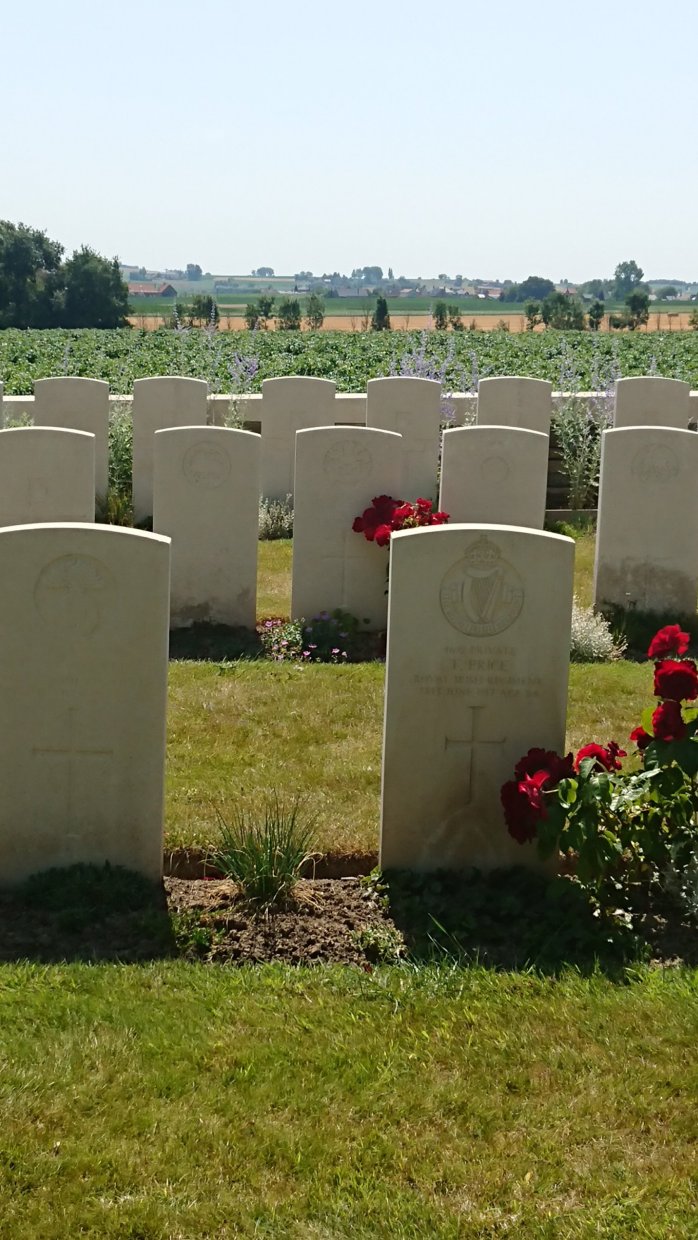
Private T Price (4692) from the 2nd Battalion Royal Irish Regiment is buried here. He was wounded and died on 7th June 1917, the same day as Major Willie Redmond of the same Regiment on the first day of the Battle of Messines. He came from Carrick-on-Suir, Co. Tipperary.
Grave of Pte T. Price died 7th June 1917
Graves at Locre Hospice Cemetery
Loker was in Allied hands during the greater part of the Great War, and field ambulances were stationed in the Convent of St Antoine. The village changed hands several times between 25th and 30th April 1918, when it was recaptured by the French. The hospice, or convent, was the scene of severe fighting on 20th May, but was not retaken until the first week in July.
The Hospice Cemetery was begun in June 1917 by field ambulances and fighting units, and was used until April 1918. After the Armistice four graves were transferred to it from the garden of the Hospice, which was ultimately rebuilt. The cemetery now contains 244 Commonwealth burials and commemorations of the First World War. Twelve of the burials are unidentified and ten graves destroyed by shellfire are now represented by special memorials. The fourteen Second World War burials date from late May 1940 and the withdrawal of the British Expeditionary Force to Dunkirk ahead of the German advance. There are also two German burials in the cemetery. The cemetery was designed by W H Cowlishaw.
A cross, marking the grave of Major W H K (Willie) Redmond, Member of Parliament for Wexford, stands 100 meters along a grass track on the northern side of the cemetery. Major Redmond was mortally wounded at the battle of Messines and was buried in the Convent garden of the Locre hospice. His widow erected this memorial to mark his grave. Until the late 1950’s the grave was maintained by a Sister from the (new) Locre hospice. In the 1990’s the land was purchased by the Belgian State and is now maintained by the Commonwealth War Graves Commission.
Major Willie Redmond of the Royal Irish Regiment was killed on the first day of the Battle of Messiness on 7th June 1917. He is buried at Locre (Loker) but in a separate grave alongside the British military cemetery at Locre Hospice.
The grave is marked by a stone cross, paid for by his family from Wexford. Someone has left a Wexford flag at the foot of the memorial as a reminder of the county of his birth.
Beside the grave there is a wooden structure containing a statue of Our Lady and a repository where the visitors’ book is kept.
Locre Hospice Cemetery(CWGC) is beside the site where Major Redmond is buried
The following details about Major Redmond are taken from an article in Irish Legal News 05/04/19 by Seosamh Gráinséir:
“A famous Irish nationalist, William Hoey Kearney Redmond came from a (Catholic gentry) family of parliamentarians. His father, William Archer Redmond, was a Member of Parliament in Westminster for the Home Rule Party. His older brother, John Edward Redmond, was a Member of Parliament and leader of the Irish Parliamentary Party.
On 24th March 1884, Willie himself was sworn in as a new MP for his father’s old constituency, Wexford Borough, at the age of twenty-two. During his thirty-three years as an MP, Willie went on to represent Fermanagh North for seven years after the Wexford Borough constituency was abolished, and then East Clare for 25 years. Willie was succeeded in that constituency by Éamon de Valera, who won the by-election triggered by Willie’s death.
Like his father and brother, Willie was a passionate supporter of Home Rule, which he said was necessary because the Union “has depopulated our country, has fostered sectarian strife, has destroyed our industries and ruined our liberties”. An ardent opponent to landlords, Willie had been imprisoned a number of times for his work with the Land League agitation (Denman 1995).
Having served with the Royal Irish Regiment for a couple of years after finishing school, Willie was described as having always been a “soldier at heart”, the “spirit of comradeship and discipline” having appealed to him. When the Great War broke out in August 1914, he had already been involved with the Irish Volunteers. But he believed that if Germany won the war, Ireland was endangered too. Intent on joining the Royal Irish Regiment again and troubled by the idea of recruiting for the war effort without joining the fight himself, he wrote: “I can’t stand asking fellows to go and not offer myself”.
In this vein, Willie told the Irish Volunteers assembled outside the Imperial Hotel in Cork in November 1914: ‘I speak as a man who bears the name of a relation who was hanged in Wexford in ‘98 – William Kearney. I speak as a man with all the poor ability at his command has fought the battle for self-government for Ireland. Since the time – now thirty-two years ago – when I lay in Kilmainham Prison with Parnell. No man who is honest can doubt the single-minded desire of myself and men like me to do what is right for Ireland. And when it comes to the question – as it may come – of asking young Irishmen to go abroad and fight this battle, when I am personally convinced that the battle of Ireland is to be fought where many Irishmen now are – in Flanders and France – old as I am, and grey as are my hairs, I will say: ‘Don’t go, but come with me!’”
(Terence Denman, A Lonely Grave: The Life and Death of William Redmond, Irish Academic Press 1995).
House of Commons WWI Memorial with name of Major W. Redmond MP
Redmond is commemorated on Panel 8 of the Parliamentary War Memorial in Westminster Hall, one of 22 MPs who died during World War I to be named there. He is one of 19 MPs who fell in the war who are commemorated by heraldic shields in the Commons Chamber. A further act of commemoration came with the unveiling in 1932 of a manuscript-style illuminated book of remembrance for the House of Commons, which includes a short biographical account of the life and death of Redmond.
The people of Loker continue to attend to his symbolic grave with great respect, organising Commemorations, the last in 1967 (organised by a Catholic priest Father Debevere) and in 1997 (organised by Erwin Ureel), refusing to allow the grave to be moved. Redmond’s Bar, an Irish pub in nearby Loker, is named after him. I enjoyed a nice bottle of local Belgian beer (Hommelbier from Poperinge) that went down well with a mackerel salad and chips.
In Wexford town there is a bust of him by Oliver Sheppard in Redmond Park which was formally opened as a memorial to him in 1931 in the presence of a large crowd including many of his old friends and comrades and political representatives from all parts of Ireland. It was re-launched by the Wexford Borough Council in 2002.
An official wreath laying ceremony took place at Redmond’s grave on 19th December 2013, when the Taoiseach Enda Kenny TD and British Prime Minister David Cameron MP paid tribute to him. Enda Kenny reflected: “The thought crossed my mind standing at the grave of Willie Redmond, that was why we have a European Union and why I’m attending a European Council” (Lise Hand, The Irish Independent 19/12/2013).
Graves of soldiers from the Royal Irish Rifles at Lone Tree Cemetery
Lone Tree Cemetery near Wijtschaete is close to the Lone Tree Crater, one of nineteen that were made immediately before the infantry attack at the Battle of Messines in June 1917. Nearly all the graves in the cemetery are those of soldiers who fell on the first day of the Battle.
The Cemetery is maintained by the CWGC and contains 88 First World War burials. The cemetery was designed by J R Truelove.
Nearly all the graves are of soldiers from the Royal Irish Rifles: Rifleman Thomas Boulding (14th Bn) died Thursday 7th June 1917 aged 27. He was from Ashford in Kent. Rifleman J Harris (8th Bn) who died the same day is listed as having a sister who lived at Upper Dorset Street in Dublin. Some of them were killed by the explosion of the large Spanbroekmolen mine (which was blown around 15 seconds later than planned) as they advanced.
The Spanbroekmolen Crater, also known as the Pool of Peace, is the largest and most imposing mine crater in the Westhoek area. It was created by the explosion of one of the 19 deep mines detonated at the opening of the Battle.
In1914 Spanbroekmolen was the site of a windmill (“molen” is the Dutch word for “mill”). At the end of the First Battle of Ypres in November 1914 the German Front Line was established in this location on the high ground of the Messines Ridge. Between then and the start of June 1917, the Germans spent a year and a half developing well-established positions with concrete bunkers and strong defensive positions.
The mine at Spanbroekmoelen was started by 171st Tunneling Company, Royal Engineers, on 1stJanuary. Six months later the mine was finished. To celebrate the mine’s completion two officers made their way into the chamber with four bottles of champagne and drinking glasses. The main charge for the mine was made up of 50 LB (pound) boxes of ammonol, totalling 90,000 lbs (pounds). The main charge was finally completed on 28thJune 1916 and officially completed, according to the War Diary, on 1st July 1916.
A branch gallery had also been driven in the direction of Rag Point, which was a German position about three quarters of a mile south of the Spanbroekmolen position. In February 1917 the Germans dug a tunnel underneath the British gallery. They set explosive charges to explode two camouflets. As a result the right hand branch of the British gallery was damaged and it was abandoned.
On 3rdMarch 1917 the Germans blew another camouflet which damaged about 900 feet of the main gallery. It broke the connection for the electric detonator leads for the explosive charge which had been lying silently in position under the Spanbroekmolen position since June the previous year.
A new gallery had to be mined to by-pass the damaged tunnel and the detonator leads had to be rerouted through this new tunnel to the chamber and explosives. There was serious difficulty with gas while the new tunnel was being dug. The mine was to be ready to blow at the launch of the major attack on the German lines on the Messines Ridge in June.
In a race against time the new by-pass gallery was completed and tamped. The detonating charge, consisting of 500 lbs (pounds) of ammonal and 500 lbs (pounds) of dynamite was laid on 1 June. The mine was to be fired by power and alternative firing by exploders was arranged in case the electric circuits did not function. The mine was finally completed on the night of 6thJune 1917. Major Hudspeth, commander of the 171st Tunnelling Company, sent a message to the headquarters of the 36th (Ulster) Division that night. This division was to attack the German position at Spanbroekmolen at the start of the British attack set for 03.10 hours the following morning, 7thJune. Major Hudspeth’s message confirmed that it was “almost certain” that the mine would blow the next morning. The commanders of the 36th (Ulster) Division could only wait in anticipation to see if it did.
The dimensions and details of the Spanbroekmolen mine are as follows:
depth of charge: 88 feet (26 metres)
diameter at ground level: 250 feet (76 metres)
width of the rim: 90 feet (27 metres)
depth below ground level: 40 feet (12 metres)
height of rim: 13 feet (4 metres)
diameter of complete obliteration: 430 feet (131 metres)
length of gallery: 1,710 feet (521 metres)
The crater has filled with water as a result of the high water table and the clay soil in the area. mine crater was purchased for Toc H by Lord Wakefield in the 1920s to be preserved as a memorial site on the Ypres Salient battlefields. The mine crater has subsequently been named the “Pool of Peace” and is still the property of Toc H in Poperinge (see separate article).
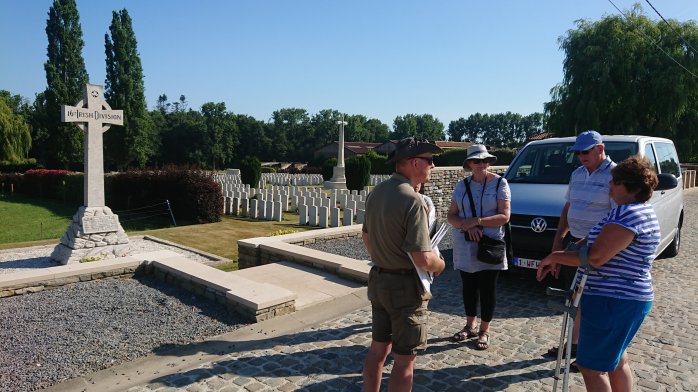
Leaving Ieper on the second day of the visit to Flanders, the group headed to Wijtschaete a village a few kilometres away to learn about the role of the 16th Irish Division in the Battle of Messines Ridge on 7th June 1917.
Group at 16th Irish Division Celtic Cross
MESSINES RIDGE, June 1917
The largely Catholic 16th (Irish) and mainly Protestant 36th (Ulster) Divisions went into battle together to take the Belgian village of Wijtschaete in the well-planned attack on the Messines Ridge. General Plumer had a scaled model of the Ridge made so troops could see what lay ahead. He had mines dug for explosives beneath German defences. About three million shells bombarded Messines for over a week.
Paying my respects at 16th Irish Division Memorial Cross
Inscription at foot of the Cross
Memorial stone for 36th Ulster Division opposite 16th Irish Division Cross
36th Ulster Division crest on memorial stone
The barrage eased just before Plumer detonated 9,500 tons of explosives under the Germans in nineteen mines. Willie Redmond MP and brother of John, leader of the Irish Party, died of wounds received in the attack.
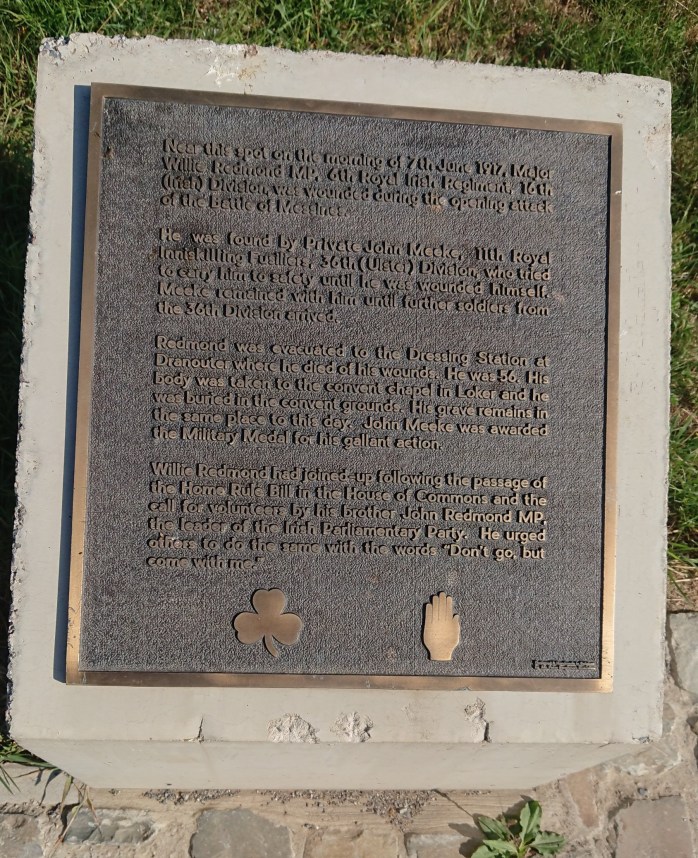
Plaque explaining how Pte Meeke removed Major Redmond from the battlefield
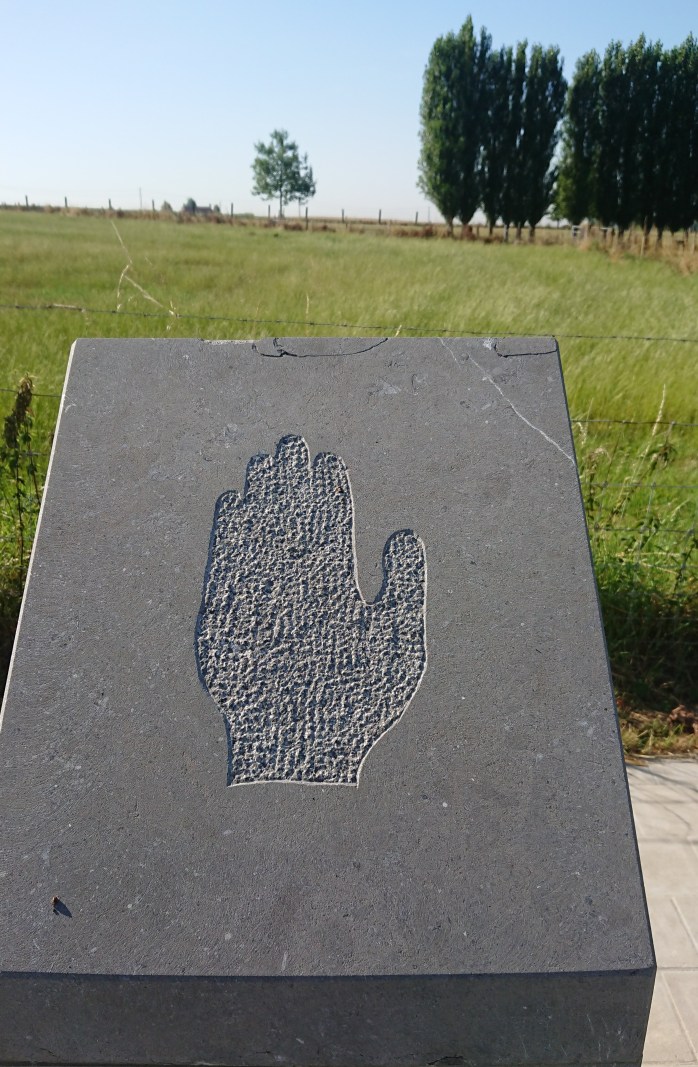
There is a memorial depicting an injured Major Willie Redmond being carried away for treatment. At this spot on the morning of June 7th 1917 Major Redmond of the 6th Royal Irish Regiment (16th Irish Division) was wounded during the opening attack of the Battle of Messines. He was found by Private John Meeke, 11th Royal Inniskilling Fusiliers (36th Ulster Division) who tried to carry him to safety until he himself was wounded. He was awarded the Military Medal for his gallant action. Redmond was evacuated to a dressing station at Locre hospice, run by nuns, where he died of his wounds.
At the memorial marking the area where Major Willie Redmond was wounded during the battle
There is a statue in the centre of Mesen (Messiness), Belgium’s smallest town. It is a memorial to all soldiers of the New Zealand Division who fought at Messines Ridge.
Statue of the New Zealand soldier at Mesen
The sculpture by Andrew Edwards outside the new visitor centre of Mesen consists of two fibreglass figures, a German and an British soldier, about to shake hands at the moment when the two armies stopped fighting and played football on Christmas Day 1914. It was unveiled in Liverpool in December 2014 to mark the centenary of the event. The sculpture was taken to (Messines) Belgium where the UK Ambassador and Mayor of Mesen attended a ceremony in December 2015.
Sculpture unveiled in Mesen in December 2015 depicting the Christmas Truce 1914
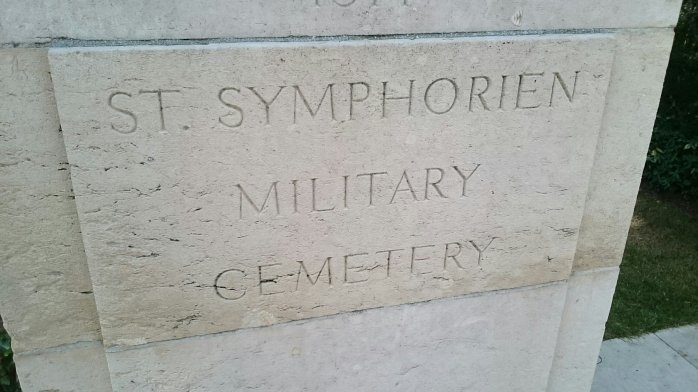
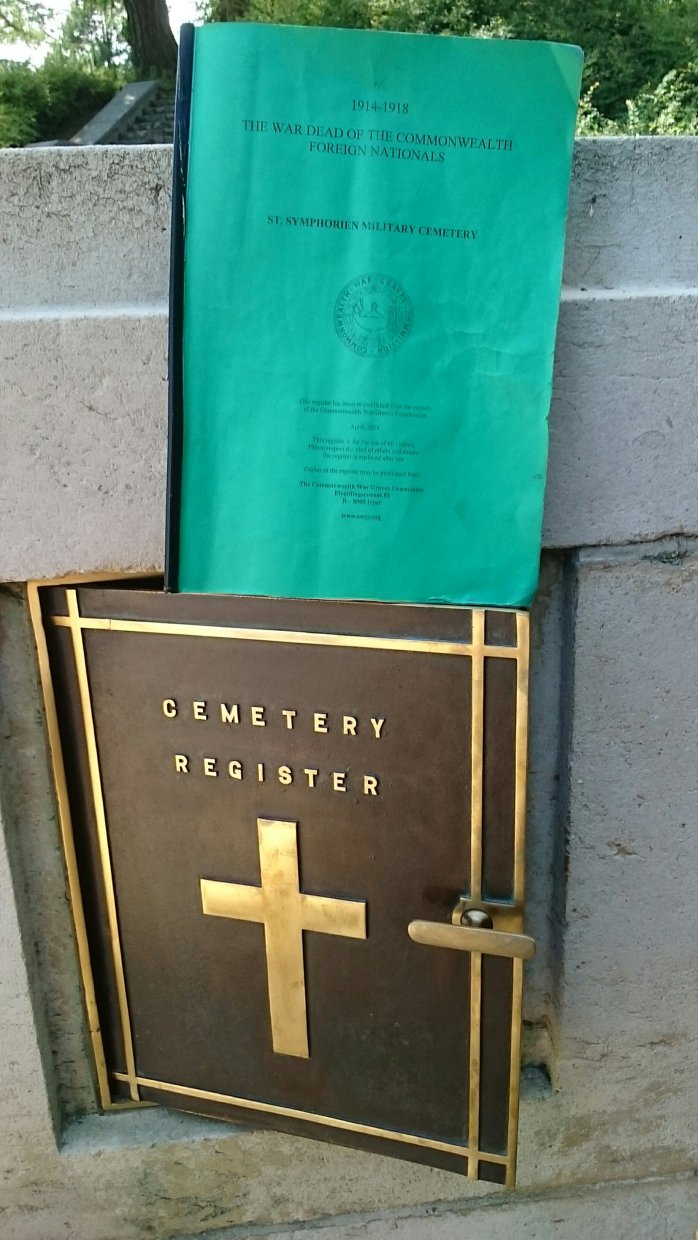
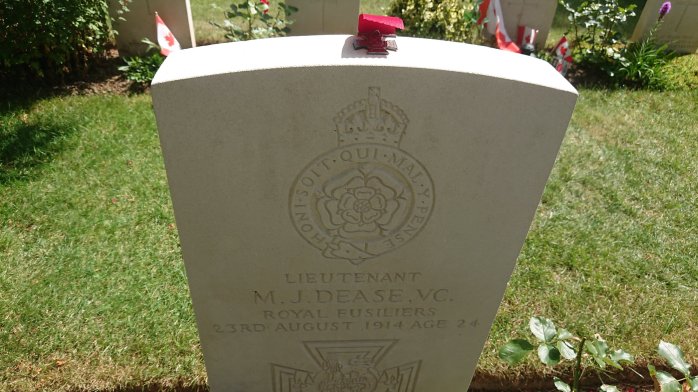
St Symphorien Cemetery is 2km east of Mons in Belgium and is maintained by the CWGC. The cemetery at St. Symphorien was established by the German Army during the First World War as a final resting place for British and German soldiers killed at the Battle of Mons. Among those buried here is Lt Maurice Dease VC.
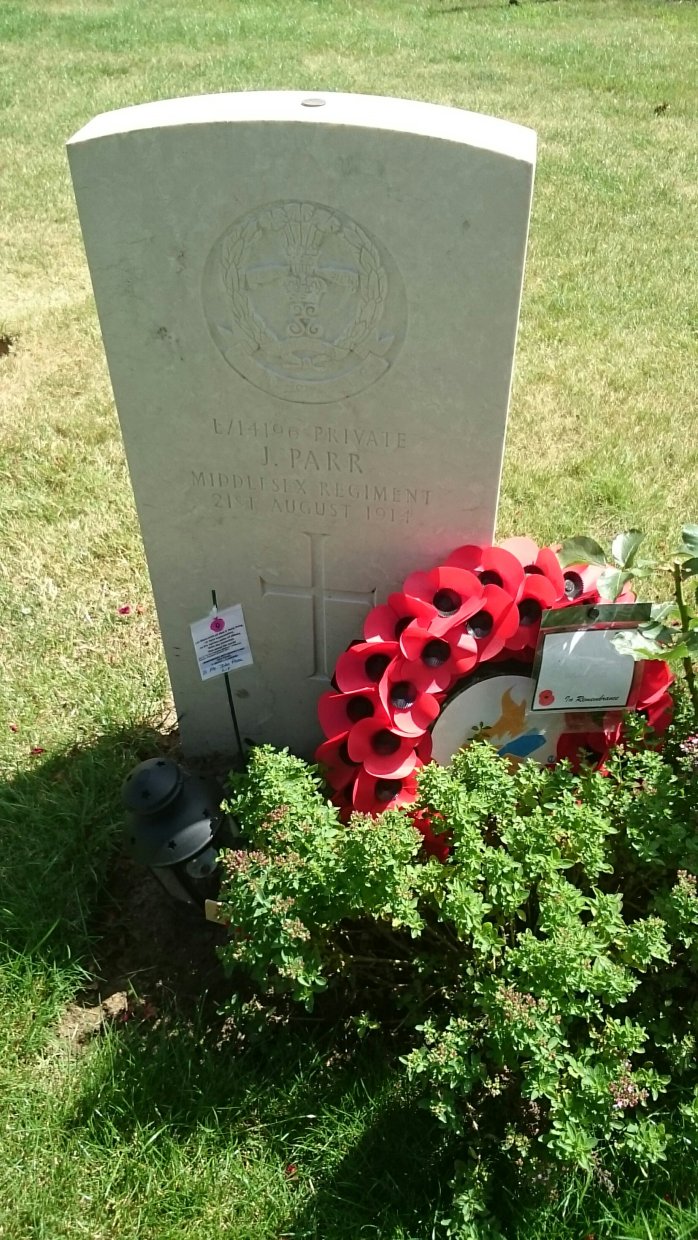
Another grave is that of Private John Parr of the Middlesex Regiment, who was fatally wounded during an encounter with a German patrol two days before the battle, thus becoming the first British soldier to be killed in action on the Western Front.
Grave of Pte John Parr, Middlesex Regiment
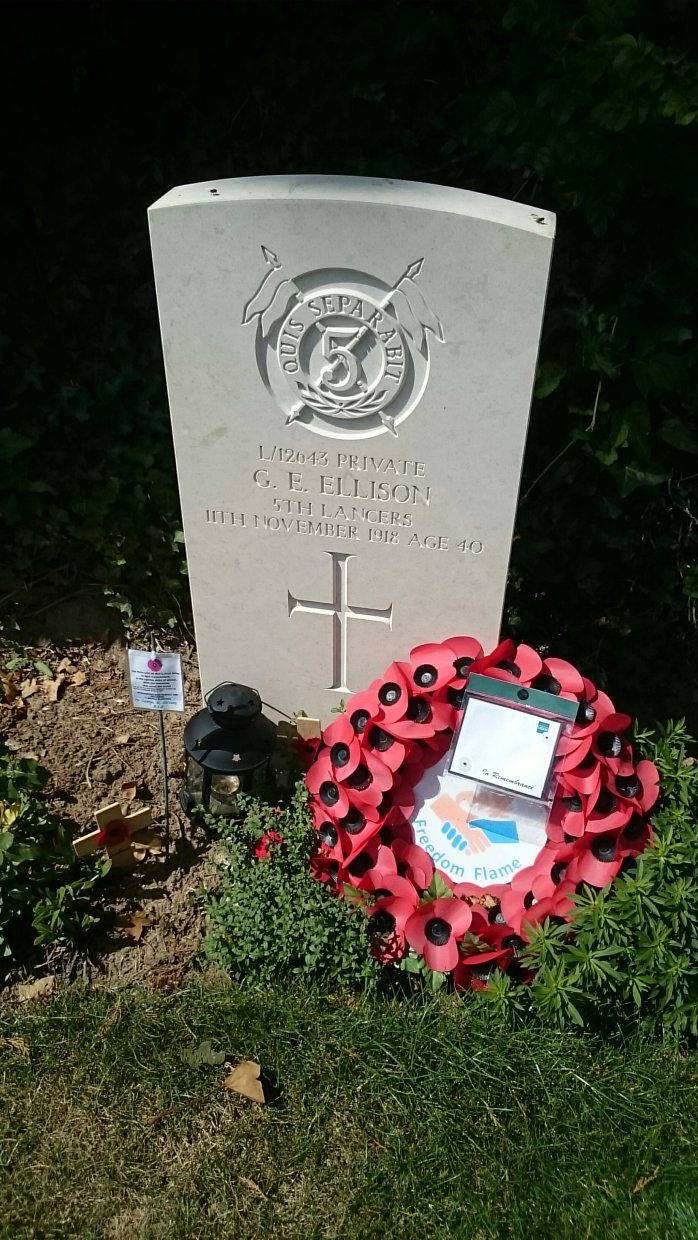
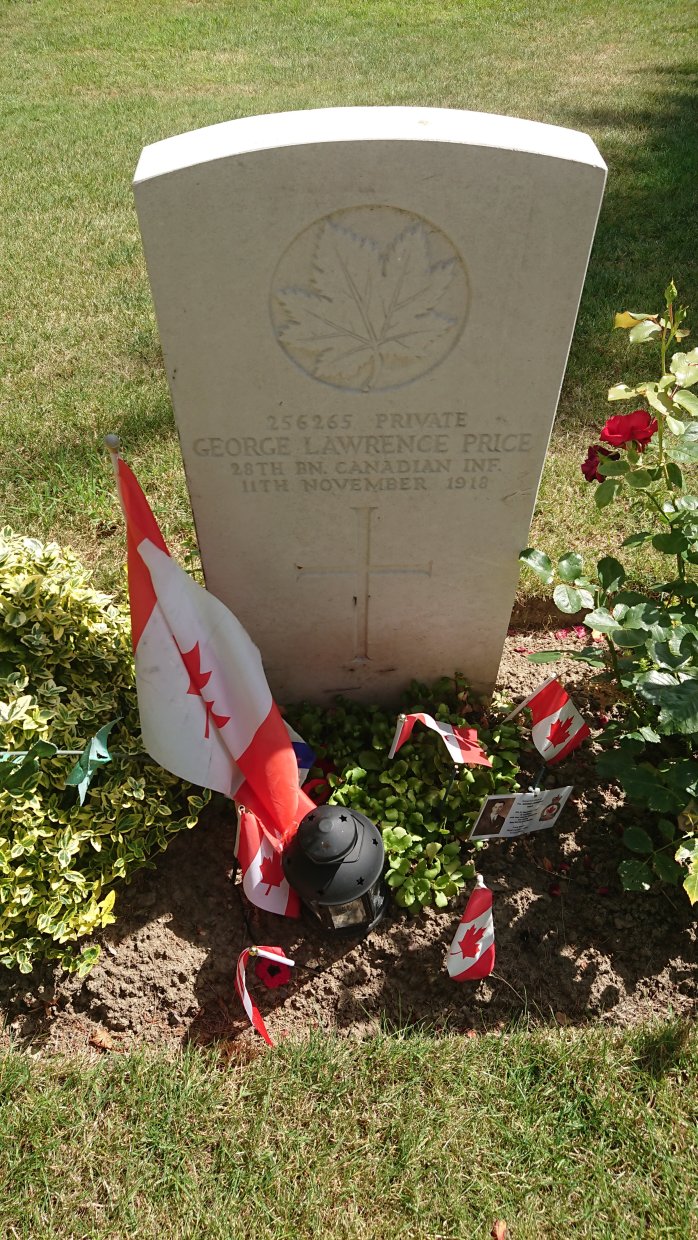
The cemetery remained in German hands until the end of the war, and afterwards came under the care of the Imperial (now Commonwealth) War Graves Commission. It also contains the graves of Commonwealth and German soldiers who died in the final days of the conflict, including Private George Ellison of the Royal Irish Lancers and George Price of the Canadian Infantry.
Grave of Pte George Ellison
Grave of Private George Price died 11th November 1918 last day of WWI
Ellison and Price were killed on 11 November 1918, and are believed to be the last Commonwealth combat casualties of the war in Europe. There are 229 Commonwealth and 284 German servicemen buried or commemorated at St Symphorien, of whom 105 remain unidentified.
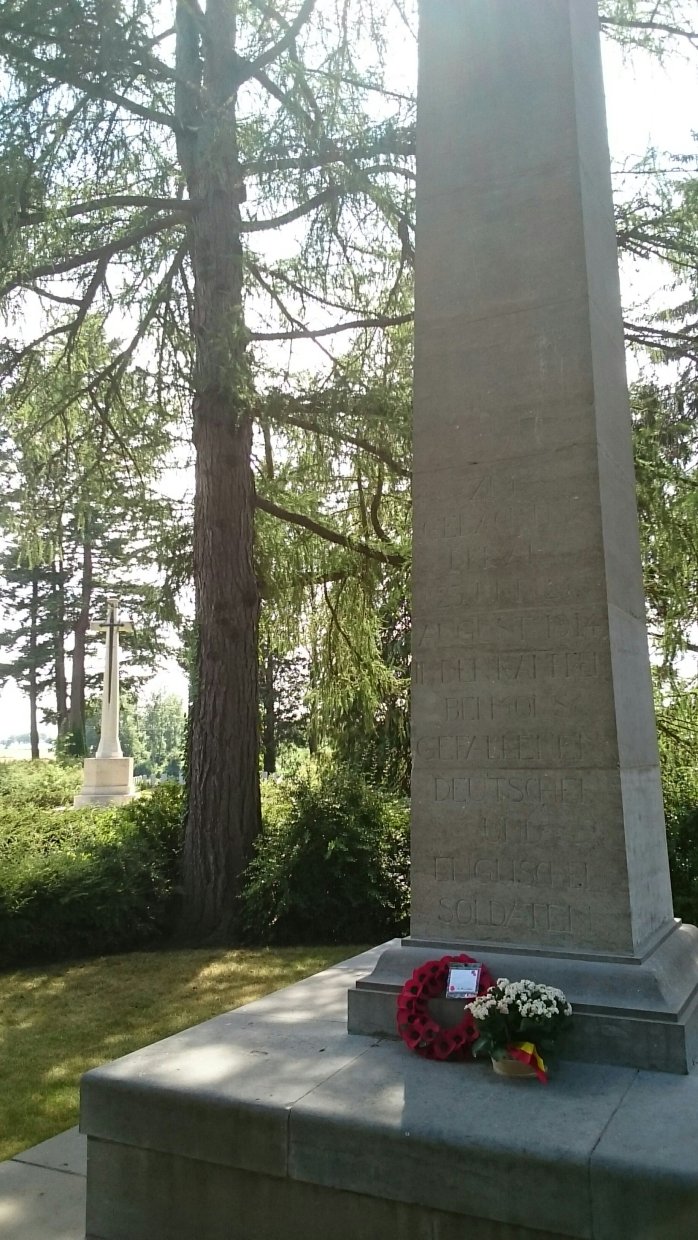
Memorial dedicated to German soldiers buried at St Symphorien
The Battle of Mons – By the evening of 22 August 1914, the men of II Corps of the British Expeditionary Force had taken up defensive positions along the Mons-Condé Canal, preparing for a major German attack expected to come from the north the next day. The opening shots of the Battle of Mons were fired at dawn on the morning of Sunday 23 August, when the 4th Battalion of the Middlesex Regiment repulsed German cavalry who were attempting to the cross the canal over a bridge at Obourg.
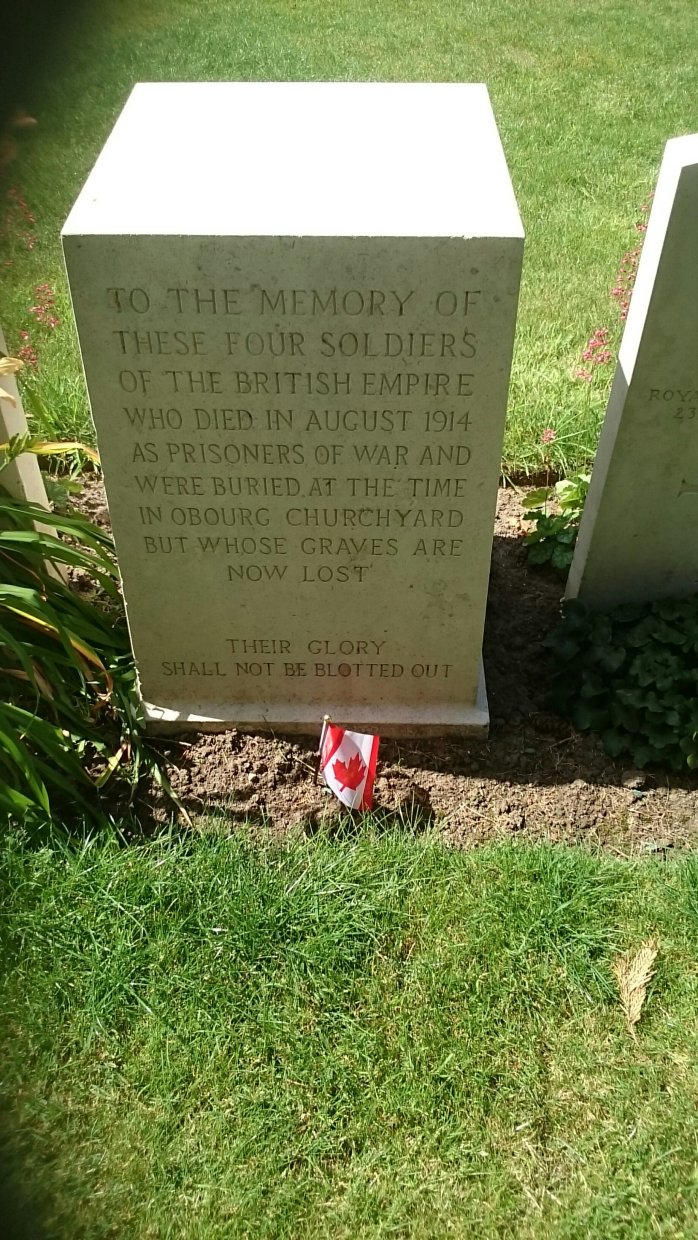
The remains of four soldiers buried at Obourg were transferred to St Symphorien
The early morning was misty and wet, and the British were still uncertain of the numbers of enemy troops on the far side of the canal. By 10 a.m., the day had brightened up, artillery fire had intensified, and it became clear that they were facing a large German force. Despite being outnumbered, the British soldiers on the south bank of the canal fought tenaciously throughout the day. Many were reservists who had returned to the army just weeks before, but they were well-drilled and disciplined, with a high-level of rifle training. Their relentless fire inflicted heavy casualties among the Germans.
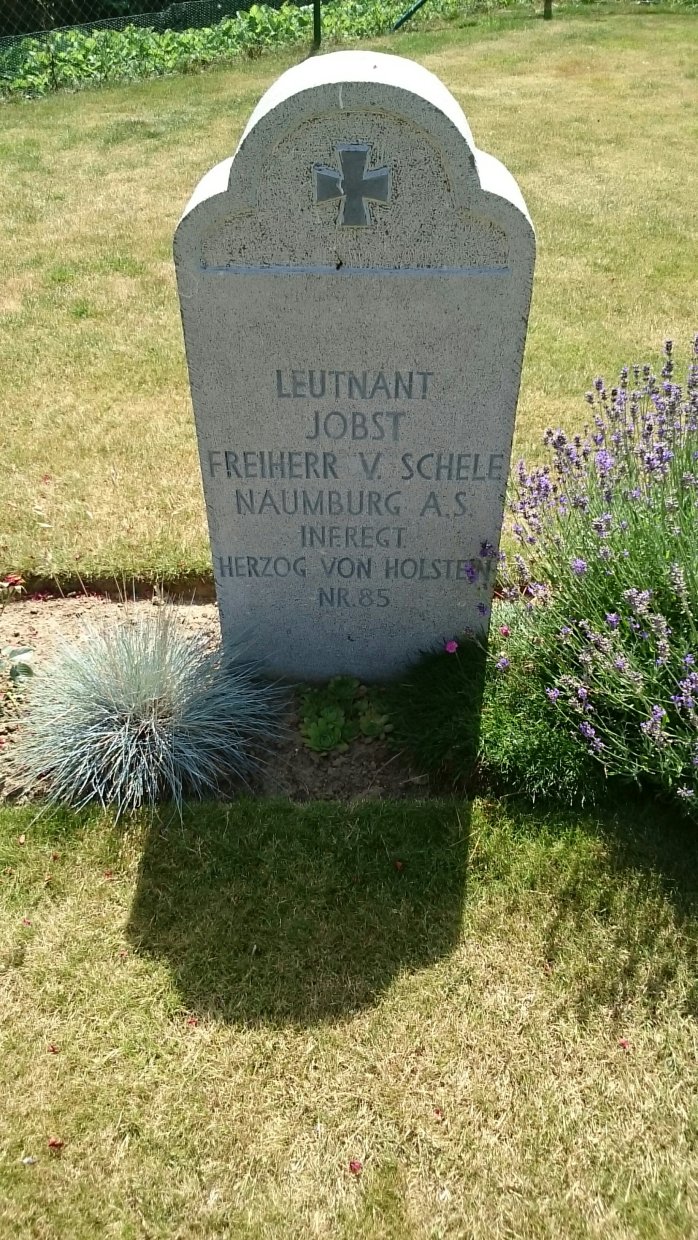
Grave of German officer (and Baron) Lt Jobst von Schele
Despite this stiff resistance, the sheer weight of German numbers and the accuracy of their artillery meant that the British struggled to hold their positions.By 10.30 a.m. the first German soldiers had crossed the canal and some British units had been forced back, and by mid-afternoon German infantry troops were crossing in force. By nightfall, the Battle of Mons was over and the British had begun a long, hard retreat towards Paris. (CWGC)
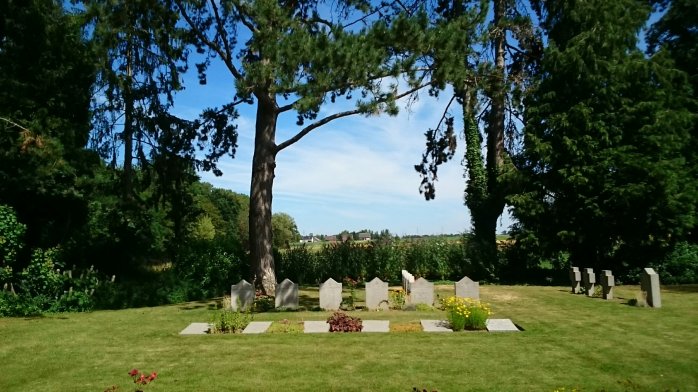
Six unmarked graves at St Symphorien Cemetery
Flags of various NATO countries at the entrance to SHAPE headquartersOn our way to Mons we passed SHAPE headquarters. Supreme Headquarters Allied Powers Europe is the main base for the North Atlantic Treaty Organisation’s Allied Command Operations centre (ACO). Since 1967 it has been located at Casteau, north of Mons. Ireland is not a NATO member but is involved in Partnership for Peace and is a member of the Euro-Atlantic Partnership Council (EAPC).
Flags from various nations fly at the entrance to SHAPE HQ at Casteau near Mons
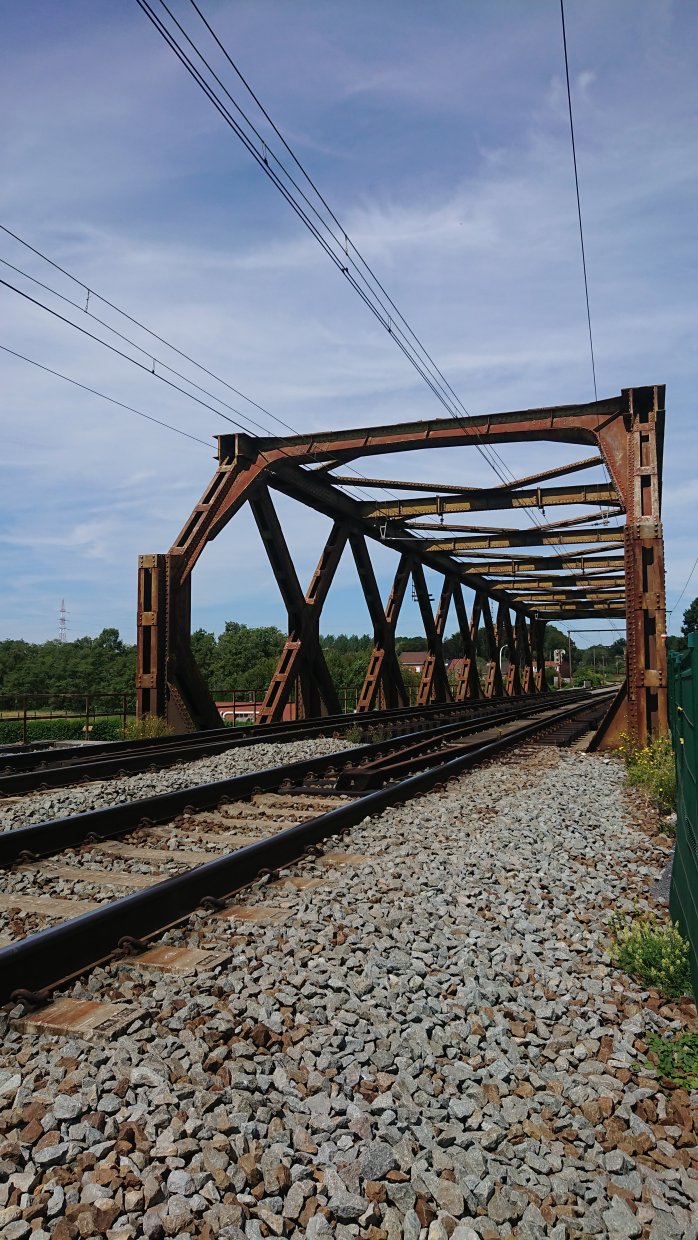
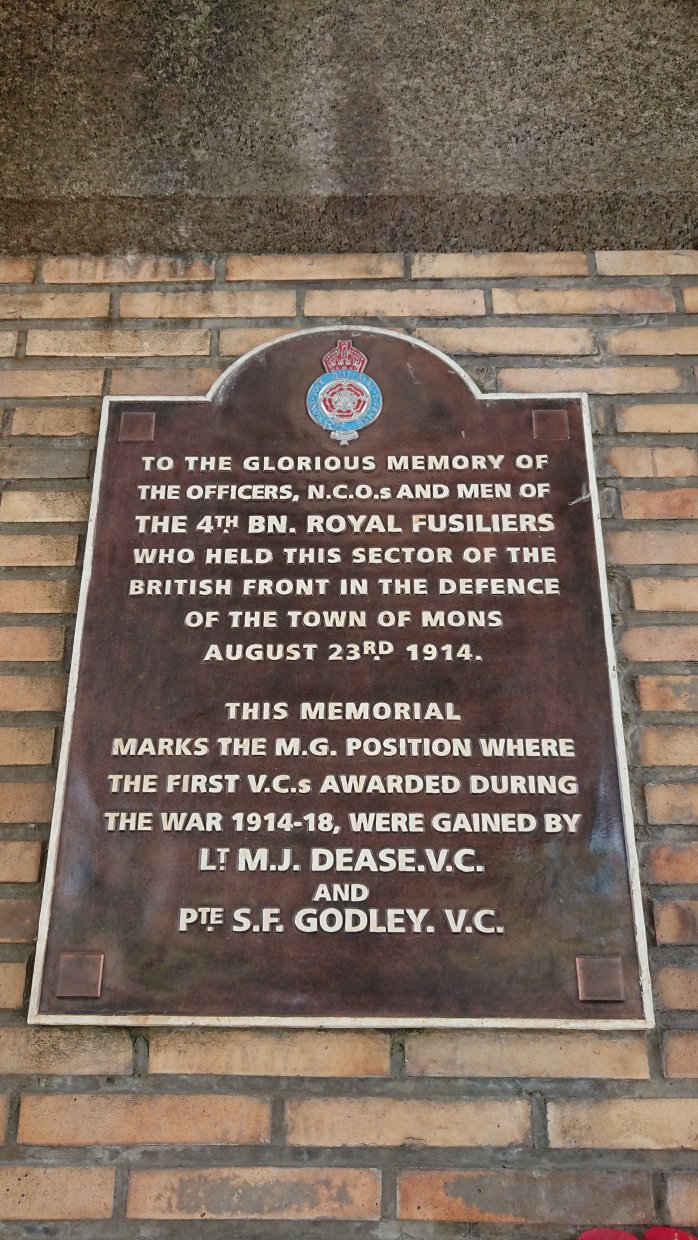
Visited Nimy Bridge where the railway line crosses the Canal. This is the spot where Lt Maurice Dease of the 4th Bn Royal Fusiliers earned the Victoria Cross, the first to be awarded (posthumously) during WWI.
Plaque underneath Nimy Bridge
Dease was of Anglo Irish stock. His parents came from Coole Co. Westmeath but at the time of his death, one month after the start of the war in August 1914, were resident in Culmullen Co. Meath. A plaque has been erected at St Martin’s Church there to commemorate him.
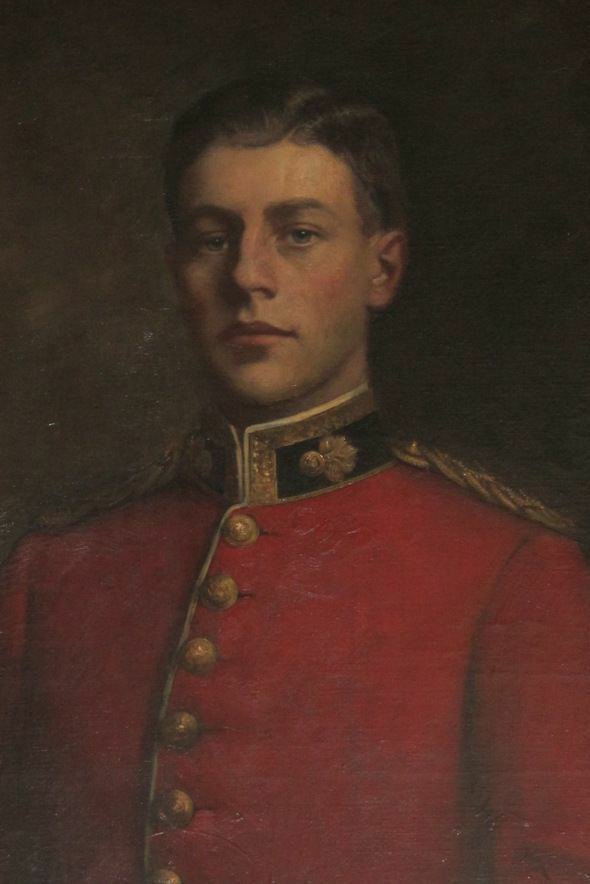
William Carter portrait of Lt Maurice Dease VC Royal Fusiliers Museum
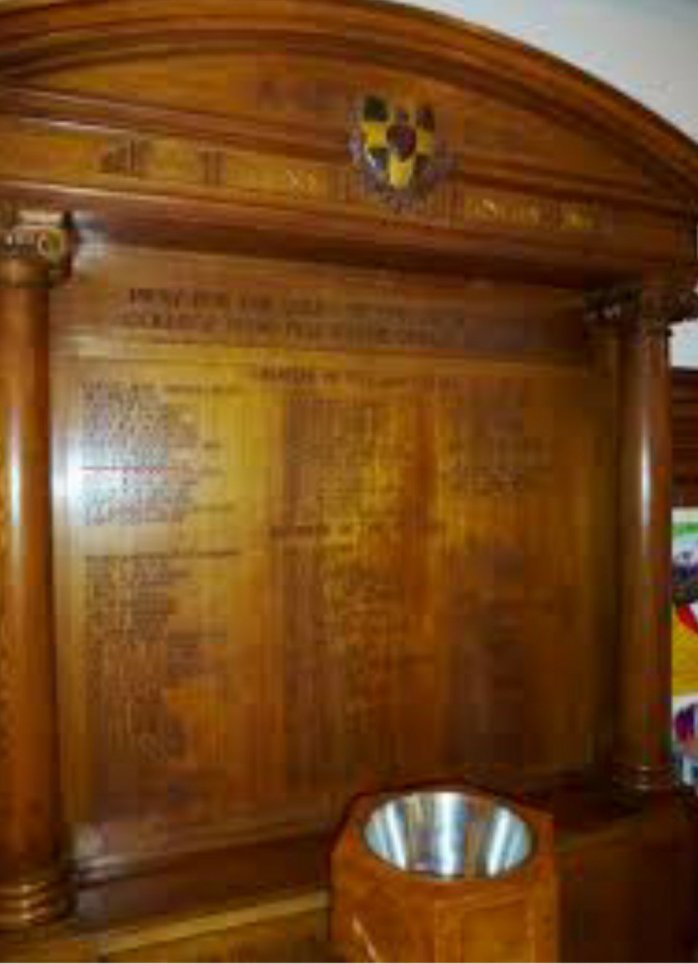
Dease was like many of his Irish contemporaries sent to a boarding school in England. He attended the Jesuit run Stonyhurst College then moved to another Jesuit linked educational establishment, the Army Department of Wimbledon College in London. His name is on the beautiful wooden panelled war memorial at the back of the Chapel in the school, which I used to pass frequently when going to Mass there. However in the four years I attended up to ‘O’ level, I never once heard his name mentioned or commemorated individually on Remembrance Sunday, when our scout troop (one of the largest Catholic ones in England) used to parade there.
War Memorial in Wimbledon College
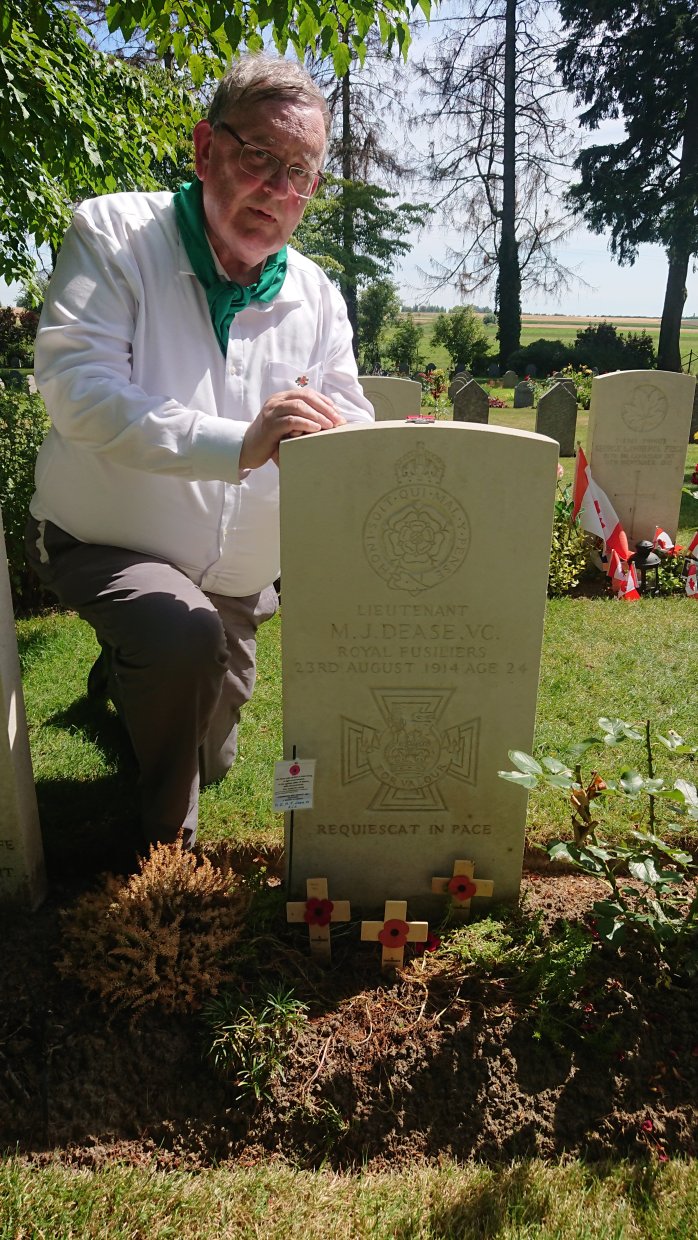
I was therefore pleased to get the opportunity to visit the site of his heroic action and subsequent death as well as his grave in the CWGC cemetery at St Symphorien. Rest in Peace., Respect. Ar dheis Dé go raibh a anam dhílis.
Visiting the grave of Lt Maurice Dease VC at St Symphorien cemetery
H. C. O’Neill wrote this account inThe Royal Fusiliers in the Great War:
“The machine gun crews were constantly being knocked out. So cramped was their position that when a man was hit he had to be removed before another could take his place. The approach from the trench was across the open, and whenever a gun stopped Lieutenant Maurice Dease… went up to see what was wrong. To do this once called for no ordinary courage. To repeat it several times could only be done with real heroism. Dease was badly wounded on these journeys, but insisted on remaining at duty as long as one of his crew could fire. The third wound proved fatal, and a well deserved VC was awarded him posthumously. By this time both guns had ceased firing, and all the crew had been knocked out. In response to an inquiry whether anyone else knew how to operate the guns Private Godley came forward. He cleared the emplacement under heavy fire and brought the gun into action. But he had not been firing long before the gun was hit and put completely out of action. The water jackets of both guns were riddled with bullets, so that they were no longer of any use. Godley himself was badly wounded and later fell into the hands of the Germans.
Grave of Lt Maurice Dease VC
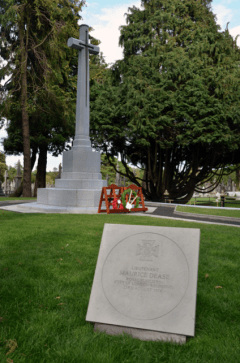
A commemorative paving stone for Dease was the first in a series to be unveiled at Glasnevin Cemetery in Dublin in August 2014 on the centenary of his death.
Visit to WWI graves in Flanders. First and last shots of the Great War. Our group of six left Brussels Airport and headed for Mons. At this spot at Casteau, the British Expeditionary Force engaged with the Germans, firing the first shots on 22nd August 1914.
The memorial near Mons where the first shots were fired in August 1914
Major Tom Bridges, commander of C Squadron, 4th Battalion of the Royal Irish Dragoon Guards was on reconnaissance near Mons when he saw a German advance mounted guard and gave chase with his horsemen. During the pursuit Corporal Thomas became the first British soldier to fire a shot in anger in continental Europe since the battle of Waterloo (near Brussels) 100 years earlier.
This stone monument was unveiled on 20th August 1939 at the spot where Thomas had set off to chase four German cavalrymen. Thomas was a career soldier who had enlisted at the age of 14. He survived the war and was awarded the Military Medal.
Opposite this memorial is a bronze plaque marking the spot where troops of the 116th Canadian Infantry Battalion stopped on Armistice Day, 11th November 1918, during the liberation of Mons. The plaque was unveiled on 7th July 1956. For the British Empire, the War had ended at the precise spot where it had started four years earlier.
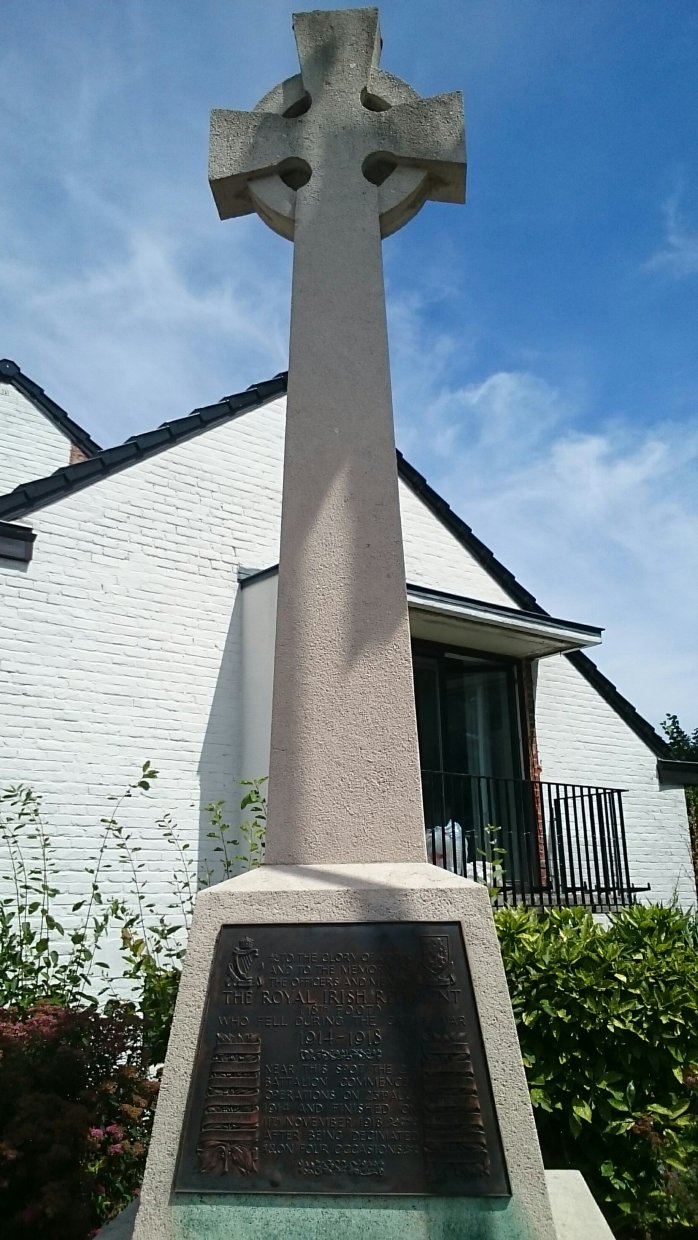
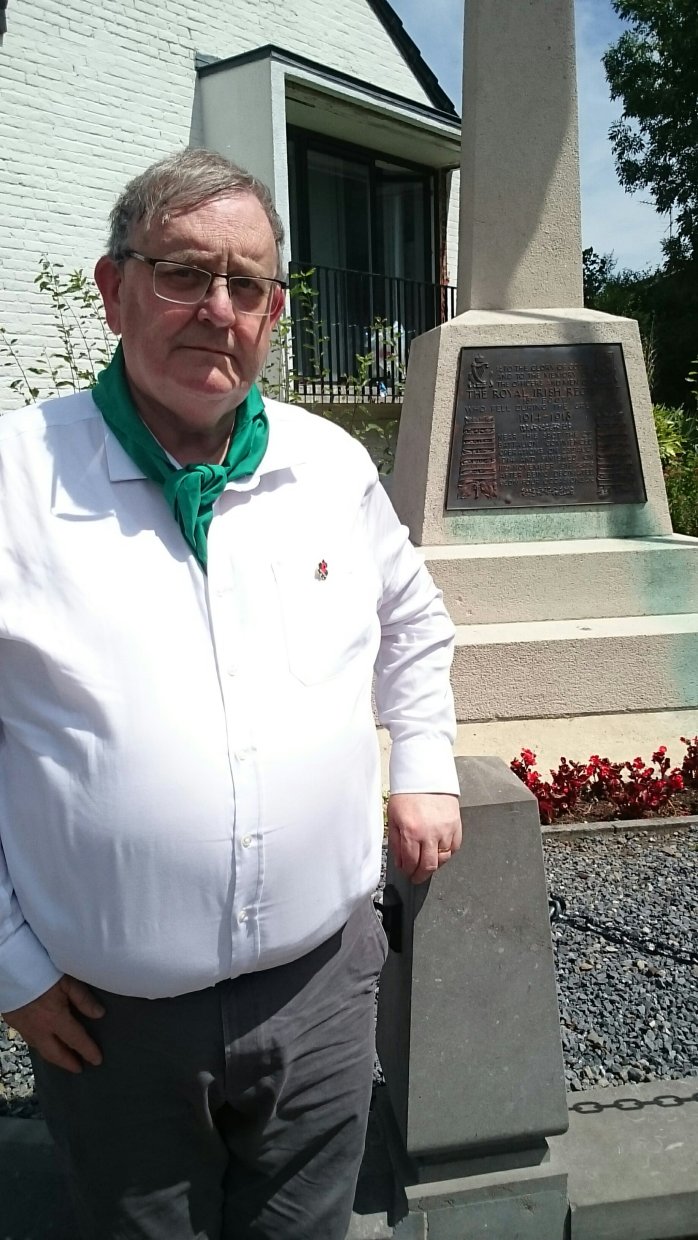
At a crossroads at La Bascule outside Mons there is a Celtic cross. The limestone monument, five metres high, is dedicated to the 2nd battalion of the Royal Irish Regiment, which recruited in the south-east counties of Wexford, Waterford, Tipperary and Kilkenny.
The inscription at the base reads: “To the glory of God and to the memory of the men and officers of the Royal Irish Regiment (18th Foot) who fell during the Great War 1914-1918. Near this spot the 2nd Battalion commenced operations on 23rd August 1914 and finished on 11th November 1918 after being decimated on four occasions.”
The cross is located at exactly the point where a motley outfit of cooks, store men, drivers and dispatch riders, about 50 in all, from the 2nd Royal Irish Regiment, held up the German advance for several hours. Machen had read newspaper reports of the battle and set his story in the Mons salient where the battalion made its gallant stand.
The soldier who inspired the story of the angels of Mons was Quartermaster Sergeant Thomas William Fitzpatrick from Enniscorthy, Co Wexford. Sensing the danger, it was he who gathered together the little band of Irish brothers to man a trench were the cross now stands. From there, they held up the German advance for hours.
He wrote his own gripping account of events that day more than 40 years later. “I saw no Mons angels,” he wrote in The Old Contemptible journal in 1955. “I honestly think that not one of my men had the faintest idea what they were fighting for. In fact, I was not sure myself – which illustrates the unconquerable spirit of the British soldier of that day – the Irish soldier in our case.” (Ronan McGreevy, The Irish Times, August 2016).
NEW MUNICIPAL DISTRICT CATHAOIRLEACHMichael Fisher, The Northern Standard, Thursday 13th July 2019
Cllr Sean Conlon is congratulated by last year’s Cathaoirleach Brian McKenna
Councillor Sean Conlon of Sinn Féin was elected as Cathaoirleach of the Monaghan Municipal District at their annual general meeting on Monday, the start of a new five-year term for the seven members. But the process was not entirely smooth.
Independent Councillor Paudge Connolly who had stormed out of a County Council meeting on Friday made a further complaint to his colleagues about the way they were dividing up the posts. He complained that they were not treating himself and his Independent colleague Seamus Treanor fairly.
Co-ordinator Donal McElwain took the Chair and after congratulating all members on their election, he called for nominations for Cathaoirleach. Councillor Brian McKenna, the previous holder of the post, said he had great pleasure in nominating Sean Conlon. He said his colleague had first been elected for Sinn Féin to Monaghan Urban District Council twenty years ago. He had been co-opted in 2004 to Monaghan County Council and subsequently elected to that body, which he had chaired on a number of occasions. So in his view, he had the expertise and necessary skill to take on the post. Cllr Cathy Bennett, whose electoral base of Scotstown and Knockatallon is now part of the MD, seconded the nomination. She complimented Cllr Conlon on all the hard work had had done for the Monaghan area since his election.
Cllr Paudge Connolly intervened and sought to raise a point of order.
He thought they should be given an idea of how the post would be filled over the next five years and wanted to know from the main parties if there was going to be any form of sharing power.
Cllr McKenna stated that following discussions Sinn Féin had had with Fine Gael, it was the intention that the Chair be rotated among the different groupings, with his party having the first year as they had the largest number of seats, then each of the other groups (Fine Gael, Fianna Fáil and the Independents) would be offered the Chair. The final (fifth) year would go to Sinn Féin. “That’s what we have suggested, with each group getting one year in the Chair and the final year going to Sinn Féin,” he said.
Cllr Connolly said he was astounded that along with the other Independent Cllr Treanor, he was being treated as a group, whereas at the County Council he wasn’t. They had to be consistent, in his view. He said he had done a calculation using the D’Hondt method of sharing. Under that system, they should receive 2/6ths of the posts.
This would give the Independents the Chair of the MD on two of the five occasions, in the second year and in the fifth year.
Cllr McKenna claimed Cllr Connolly’s remarks were ridiculous and that his proposal for sharing the post was “just not possible.”
Cllr Connolly said he was absolutely certain about his calculations, which had been done on the same D’Hondt basis as Dáil Éireann used in 2016. On that occasion, Sinn Féin had benefitted by being offered the Chair of one of the Oireachtas committees. He said he was sure the procedure being used was wrong.
Cllr McKenna stated that he was making a nomination only for this year. When Mr McElwain asked if there were any further nominations, Cllr Connolly proposed Cllr Seamus Treanor, who seconded himself.
A roll call vote then took place, resulting in:
SEAN CONLON: Aughey; Bennett; Conlon; Maxwell; McKenna
SEAMUS TREANOR: Connolly; Treanor.
Councillor Conlon was then declared elected and took the Chair.
Councillor Connolly stated that he would not take any further position, if offered. “I will not be taking any crumbs from the table of this Municipal District. I have made that clear.”
Nominations for Leas Cathaoirleach were then taken. Cllr Conlon proposed Cllr David Maxwell (Fine Gael) for the post and he was seconded by Cllr Raymond Aughey (Fianna Fáil). In the absence of any other nominations, Cllr Maxwell was duly elected to the post.
CLLR CONLON’S ADDRESS
The new Cathaoileach Cllr Conlon then addressed the meeting as follows:- “At the outset I want to thank my party colleagues Cllr Brian McKenna and Cllr Cathy Bennett for proposing and seconding my election as Cathaoirleach and I thank my Council colleagues for their support. I want to further convey appreciation to the electorate of the Monaghan Municipal District area for voting in three Sinn Féin candidates, equating to 43% of the total representation of this Council.”
“I extend my congratulations to Cllrs Treanor, Aughey, Maxwell and Connolly on their re-election. As I appeal to all of you for cooperation and support in this leadership role as Chairman for the next twelve months, I commit in the years ahead to similarly extending that goodwill to those among you who will also take up this esteemed role as we collectively apply ourselves to our duties and obligations.”
“Furthermore, to the twelve other candidates who participated in elections from the Monaghan town area, your participation enriched the democratic process. However, despite the wide choice of candidates, the low turnout of voters – at just under 50% – speaks volumes of the disconnect between voter and candidate. It shows an apathy that reflects poorly on the relationship between citizen and civic authority.”
“I am of the firm view that the abolition of Town Councils five years ago has widened and worsened that disconnect. As the saying goes, ‘democracy is a great thing but only when it works’; so, when every other eligible voter decides not to mark the ballot paper, it is cause for alarm.”
THE YEAR AHEAD
“For the year ahead in fulfilling my duty as Cathaoirleach, and with our joints efforts that seek to improve social, economic and community wellbeing, I believe it is through partnership, cooperation, inclusivity and fairness that must form the foundations of this Council’s plans and strategies. We have each been given a mandate to work out proposals and solutions that will enhance our towns, villages and rural hinterland.”
“Along with our efforts will be the expertise and experience of Council Executive and staff members. We seek to ensure, and implore of them, that no stone is left unturned in availing of Departmental supports and measures that will strengthen our shared endeavours in providing for both civic and community led initiatives.”
“Recent examples include the submission by Monaghan Municipal District of an application to the Department of Justice to avail of funding for the installation of CCTV in our town. It is unfortunate that delays have occurred in securing these vital devices required to combat ongoing anti-social behaviour and life threatening incidents. However, I emphasise that the most effective role in combating crime is an increased presence of An Garda Síochana on our streets and effective court imposed penalties.”
“I congratulate Cllr Brian McKenna for the work he did on this issue over the past twelve months. It’s great to see that the application for the cameras has now been made and they will help to deal with the problem of vandalism.”
“A praiseworthy club, parish and housing estate effort that I look forward to seeing replicated was undertaken last month in partnership with the Council through the ‘Street Feast’ and ‘Big Hello’ events. This creative outreach idea brought together neighbours and friends to celebrate a family fun day aimed at boosting community spirit and foster positive relations, something that can be overlooked with busy lifestyles. These actions also lend well to greeting visitors to our region.”
“The success of the Monaghan Town Heritage Trail should be broadened to attract and facilitate visitors to nearby attractions such as Rossmore Park, Glaslough village and the Sliabh Beagh area, having local guides as part of Council sponsored Tourism Town Teams in organising brief excursions.”
“Challenges to our local economy continue with the uncertainty of Brexit. Our local authority must remain resilient and responsive to the genuine concerns of business and traders acting as an encouraging force in providing assistance and supports in an environment where potential job losses and closures exist. Our ratepayers and industrious workforce deserve nothing less.”
Leas Cathaoirleach Cllr David Maxwell congratulated Sean Conlon on his appointment and thanked his predecessor Brian McKenna. He said he looked forward to serving all the people in the district and getting a chance to serve in the Chair in the next four years.
Cllr Brian McKenna also passed on his congratulations. He thanked the MD staff for all their support. He was pleased that the facilities at Rossmore Park were being improved. He said it was important to commend community groups for their efforts. “The contribution they’re making is incalculable,” he stated. He went on to name communities in Tydavnet, Emyvale, Knockatallon and Glaslough in particular. He also said the young people were to be commended for their activities.
Cllr Seamus Treanor passed on his congratulations and was followed by Cllr Raymond Aughey of Fianna Fáil. He also said that Brian McKenna had been a very fair chair last year. The Municipal District had done a lot. With the Rossmore playground now so busy, it was a tribute to the elected members, showing exactly what could be done with hard work. “It makes me happy to see what the MD can achieve when it puts its shoulder to the wheel and gets the work done; it’s phenomenal,” he said. He hoped there would be many more outstanding days for them to come in Rossmore Park.
Cllr Cathy Bennett thanked her two Sinn Féin colleagues for the work they had done on the Municipal District in the past year, especially at Rossmore Park. “There are some great things going to happen,” she said. She instanced her own area of Sliabh Beagh, Knockatallon and Scotstown and said she hoped members would keep then high on the agenda. She was delighted to have been elected to Monaghan MD, which she regarded as her “natural home”.
Cllr Conlon said he hoped there would be a partnership approach with Ballybay Clones MD on those areas which had been transferred into Monaghan.
Cllr Connolly was the last to speak and in passing on his congratulations, stated that he would represent the people of north Monaghan to the best of his ability. However, he turned down a request to join the rest of the MD members and staff to participate in an official photograph for this paper. He explained later that he was still very dissatisfied with the way Council and MD positions had been filled.
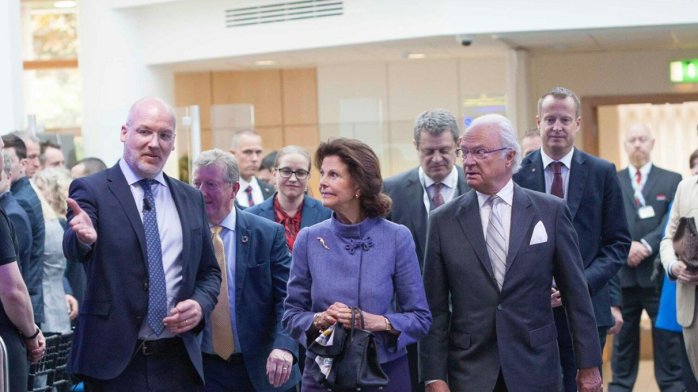
Whilst the official visit of President Trump to Ireland today has taken up all the headlines, a state visit last month by the King and Queen of Sweden went by almost without notice. Returning from a Local Ireland awards ceremony in Athlone a fortnight ago, I noticed a long convoy of official cars and Garda outriders on the bypass outside the town. Was it a dress rehearsal for the visit of the US President, I wondered. Or perhaps it was the Swedish royal couple, who had been in Dublin the day before.
Further investigation revealed that the Swedish royals visited the Ericsson research and development site in Athlone to discuss digitalisation and 5G in Europe as part of their three-day state visit. The King and Queen were joined by members of the Swedish Government, including Anders Ygeman, Minister for Energy and Digital Development and Sean Canney TD, Minister of State for Rural Affairs and Natural Resources.
King and Queen of Sweden Visited the Ericsson R&D Facility in Athlone
My thoughts turned to a connection between the Swedish Royal Family and County Monaghan that I had spoken publicly about in Castleblayney 25 years ago. The following information is based largely on the talk which was held in the Glencarn Hotel. It centred around Crown Princess Margaret of Sweden, a daughter of the Duke of Connaught, who lived with his family at Hope Castle in Castleblayney from 1900-1904 (David Hicks in “Irish Country Houses” 2012).
HOPE CASTLE
The Duke of Connaught, son of Queen Victoria, came to Castleblayney on his appointment as Commander-in-Chief of the British Army in Ireland. He was then 50, having been born at Buckingham Palace in London on 1st May 1850. It was said at the time that the Duke and Duchess experienced a great deal of difficulty in finding an Irish home as they did not wish to spend all their time in the official residence at the Royal Hospital in Kilmainham, Dublin. The Irishresidence associated with the office of Commander in Chief was not thought to be suitable for habitation by such high-ranking royals as the grounds of the residence were far from private and its location was thought to be in an inferiorpart of the city (Hicks). Several other houses such as Castletown House in Kildare were considered before the Duke settled on Hope Castle, which he leased from Lord Henry Francis Hope. It is believed that the Castleblayney residence was chosen as it was located near the home of Leonie Leslie, a prominent socialite at the time, who lived at Castle Leslie, Glaslough. She was a close friend of the Duke and Duchess, with the emphasis on the former.
The royal couple arrived in Castle Blayney in June 1900 and received a warm welcome from the local people; both the gates to the castle and the whole town were decorated with bunting and flags. The Duke had taken the castle for the summer season in 1900 with an option of leasing it for a further five years. It was thought at the time that Hope Castle would become an official royal residence and that Queen Victoria would visit her son here, but she died in 1901. The Duke of Duchess of Connaught ended their association with the Castle in 1904 (Hicks).
DUKE OF CONNAUGHT
Of her five children, Prince Arthur (William Patrick Albert) was Queen Victoria’s favourite son. By the time he arrived in ’Blayney, he already had a distinguished military career. He entered the Royal Military Academy in Woolwich in 1866, was created a Knight of the Order of St Patrick in 1869 and by the age of 21, was a Privy Counsellor. He received his title Duke of Connaught and Strathearn in 1874, then served as Assistant Adjutant General in Gibraltar for two years. He was promoted again in 1876, serving as personal ADC to Queen Victoria, a role he fulfilled for four of her successors. In 1879 he was married at St George’s chapel in Windsor Castle, near London.
His wife was Princess Louise of Prussia, who at the age of 18 was 10 years his junior. She had been born in Potsdam in 1860, third daughter of Prinz Friedrich Karl of Prussia. The couple had two children.
Bagshot Park in Surrey, England from Morris’s Country Seats from the time the Duke of Connaught lived there (1880)
Their first child was Margaret Victoria Augusta Charlotte Norah, born at Bagshot Park in Surrey on January 15th 1882 (this is now the private residence of Prince Edward and his wife Sophie, Countess of Wessex). Just under a year later, the second child, Arthur, was born at Windsor Castle. He later saw active service in the South African war and was Governor General there from 1920-23.
The Duke of Connaught became a General in 1893 after serving in Egypt and India and was appointed a Field Marshal in 1902, during the time he was in Castleblayney. He was a significant figure in British society, as can be seen by the rest of his career.
On completing his four years in Ireland, he was appointed Inspector General of the British Forces and President of the Selection Board 1904-07. For the next two years, he was Field Marshal and Commander-in-Chief in the Mediterranean. He opened the Union Parliament of South Africa, where his son later became Governor General, in 1910.
The following year, the Duke became Governor General of Canada, a post he held for five years and which aroused controversy as he attempted to meddle in Canadian military affairs. He served as Grand Master of the United Lodge of Freemasons from 1901 (a year after his appointment in Ireland) to 1939. He was decorated by several countries, including Spain, Turkey, France, Belgium, Italy, Sweden, Norway, Denmark, Greece, Japan (Order of the Chrysanthemum), Ethiopia, the Netherlands, Tunisia, Montenegro, Romania and finally, Monaco. The Duke died at Bagshot Park in Surrey on January 16th 1942, at the age of 91.
CROWN PRINCESS MARGARET
When Princess Margaret of Connaught was 23 and her younger sister Princess Patricia of Connaught was 18, both girls were among the most beautiful and eligible princesses in Europe. Their uncle, King Edward VII, wanted his nieces to marry a European king or crown prince. In January 1905, the Duke and Duchess of Connaught visited Portugal, where they were received by King Carlos and his wife, Amélie of Orléans whose sons Luís Filipe, Duke of Braganza, and Prince Manuel entertained the young British princesses. The Portuguese expected one of the Connaught princesses would become the future Queen of Portugal.
The Connaughts continued their trip to Egypt and Sudan. In Cairo, they met Prince Gustaf Adolf of Sweden, the future Gustaf VI Adolf of Sweden, grandson of the Swedish King Oscar II. Originally, Margaret’s sister Patricia had been considered a suitable match for Gustaf Adolf; without his knowledge, a meeting was arranged with the two sisters. Gustaf Adolf and Margaret fell in love at first sight, and he proposed at a dinner held by Lord Cromer at the British Consulate in Egypt, and was accepted. Margaret’s parents were very happy with the match. Gustaf Adolf and Margaret, then 23, married on 15th June 1905 in St George’s Chapel at Windsor Castle, where her father had also been married. The couple spent their honeymoon at Adare Manor in Co. Limerick and arrived in Sweden on 8th July 1905. One of Margaret’s wedding presents was the Connaught tiara, which remains in the Swedish royal jewellery collection today.
The Crown Prince of Sweden, Gustaf Adolf, was ten months younger than his bride. He came from a military background, like his father-in-law, having entered the Swedish army in 1902. Thirty years later, he became a General. His wife, however, did not survive that long.
During the First World War, she did a lot of work for the Red Cross and as can be seen in her connections with Castleblayney, she seemed to be a caring person. Known in Sweden as Margareta, she died thirty years before her husband’s accession to the throne of Sweden.
At 2 o’clock in the morning on 1st May 1920, her father’s 70th birthday, Crown Princess Margaret, aged 38, died suddenly in Stockholm of “blood poisoning” (sepsis).
Her husband re-married (the second wife was Lady Louise Mountbatten, sister of Earl Mountbatten). At the age of 68, Gustaf Adolf succeeded to the throne, reigning from 1950 to September 1973 as King Gustaf VI Adolf, the last Swedish monarch to hold real political power. He was a noted archaeologist and died aged 90. Since then, his grandson Carl XVI Gustaf has held the title of King and reigns along with Queen Silvia. They are the dignitaries who have just completed a state visit to Ireland.
Following her marriage in 1905, Crown Princess Margaret had five children. The first born in Stockholm on 22nd April 1906 was Gustaf Adolf, Duke of Vaesterbotten, later Prince. He was killed in a flying accident near Copenhagen in 1947, so when the time for succession came, in 1973, it was his son who took the throne and is now the King of Sweden.
He was followed by Sigvard, born at Drottningholm Palace in July 1907, an important year for the Swedish royal family, as Gustaf V came to the throne, shortly after the dissolution of the union between Sweden and Norway. The last three children were all born in Stockholm. Princess Ingrid in March 1910, Bertil in February 1912 and then carl, Duke of Dalecorlia, November 1916.
Some of the children are pictured in postcards which she sent from Stockholm over a period of five years, passing greetings to what she described as he friends in Castleblayney. All are addressed to Mrs JJ Kelly, a correspondence linking Castleblayney and Sweden.
THE KELLY CONNECTION
JJ Kelly was a Local Government Board Inspector and his wife Mary was the postmistress. They lived at Castle Square as it was then called, near the entrance to Hope Castle. Both are buried in the graveyard behind St Mary’s Church. Their daughter Rosa Kelly was a first cousin of my mother and details of the correspondence were kept by her following Rosa’s death in Surrey, where she is buried beside my aunt Dorothy Smyth. My mother then passed on details of the original correspondence including letters to the Swedish royal archives in Stockholm.
THE POSTCARDS
The first is not dated and it’s impossible to decipher the postmark. But the picture shows Crown Princess Margaret and her husband, who is holding a baby, Gustaf Adolf, the Duke of Vaesterbotten, who was born in April 1906. It reads:
“Princess Margaret send many thanks for the shamrock and hopes all the friends at Castle Blayney are well.” So it seems it might have been written in March 1907, some time after St Patrick’s Day (possibly 20th March). Some similar messages follow in the next few years. The Kellys must have sent Princess Margaret shamrock to wear, to remind her of Castleblayney.
“19th December 1909
A happy Xmas & 1910 to all from
Margaret”. The picture shows her with her two children, Gustaf Adolf aged 3, and Sigvard, aged 2.
“March 18 1910. Thank you so much for the shamrock. I hope you and all old friends in Castle Blayney and neighbourhood are well, Margaret.” The picture is probably of Gustaf Adolf again, aged three and wearing a similar outfit to the previous photo.
Postmark 1912
Picture of Prinsessan Margareta on front with a greeting to Mrs Kelly:
“A happy Christmas to you from Princess Margaret, Stockholm”
March 25 1914
Five months before the outbreak of World War I.
“Stockholm. The Crown Princess sends her best thanks for the shamrock and the kind thought which prompted the gift.”
No stamp or postmark. Might have been enclosed with a letter.
The picture is of the Crown Princess in what appears to be national costume with a white head-dress and reading a book.
March 21 1915
“The Crown Princess of Sweden sends most grateful thanks for the shamrock, which arrived here quite safely on St Patrick’s Day.”
Mrs Kelly’s address was given as ‘The Trees’, so by then she seemed to have finished her role as postmistress (according to the street directories). It’s also interesting that this correspondence was seven months after the start of WWI. The picture showed four of Margaret’s five children, Prince Gustaf Adolf, Sigvard, Bertil and Princess Ingrid.
December 15 1915
“The Crown Princess of Sweden sends an Xmas greeting to Castle Blayney”. The picture is of Margaret and captioned Vår Kronprinsessa / Our Crown Princess.
One card simply says: “Wishing you a Happy Christmas and New Year from Margaret.” Her portrait on the front seems to indicate it was from one of the earlier years.
The final postcard which appears to conclude the correspondence was posted in Stockholm and addressed to Mrs Kelly at The Trees, Castle Blayney.
April 17 1916
“The Crown Princess of Sweden sends grateful thanks for the shamrock. She was sorry to hear of your sad loss and sends sincere sympathy.” The reference was probably to the death of Joe Kelly in August 1915.
The picture shows four of Margaret’s children (the fifth wasn’t born until the following year), Gustaf Adolf, Sigvard, Bertil and Princess Ingrid.
The postcards provide a fascinating insight into Castleblayney’s connection with the Swedish Royal Family.
This was first published by me at a talk in Castleblayney in 1994, the third annual lecture in memory of the late Fr Peadar Livingstone..
An evening of celebration and acknowledgement of the contribution made by the St Louis Sisters to the lives and fabric of so many people in Carrickmacross and south Monaghan was held last Thursday evening at the Nuremore Hotel. Over five hundred people gathered to give their personal thanks to the nuns and to watch a new television documentary telling their story made by the videographer Pat Byrne. The evening was introduced by his friend and companion from schooldays, Brian Mohan, a retired Garda officer.
Mr Mohan told the audience the nuns of St Louis and their convent on the hill at Castle Street had been part and parcel of Carrickmacross over the last 130 years. In that time they had made a huge contribution, not only to education, but also to those in need. He said it was a matter of great sadness that the convent had closed its doors for the last time. “Fortunately Pat Byrne has completed a video documentary on the history, joys and sorrows of the convent in Carrickmacross and the personal stories of some of the sisters who resided there,” he said.
He continued: “I have known Pat for most of my life and as young teenagers we had a particular interest. In the convent, because girls lived there. Despite our best endeavours, we were unable to breach the nuns’ security! But we always kept out interest in the convent alive.”
“Pat has a wonderful knowledge of the origins of the convent building and those that lived within. He has painstakingly and respectfully put together a video documentary in which it is evident that there is a passion and emotion in its making. It is certainly something very special, which I’m sure will stir many memories for the viewers.”
TOLERANCE AND RESPECT
“We will get only a flavour of the video tonight. What you will see is only an edited version. The entire video is two hours long and I have no doubt that it is so interesting and yes, asks hard questions that anyone watching it will feel it was only a very short time.”
“The convent and its members have been a beacon of inclusiveness and a shining example of tolerance and respect. They have lived together down through the years with their neighbouring Church of Ireland community, and nurtured long and loving relationships.” He then introduced Minister Heather Humphreys.
IMPORTANT CELEBRATION
Minister for Business, Enterprise and Innovation, Heather Humphreys TD said it was an important celebration and commemoration for Carrickmacross. She commended “the amazing women of the St Louis Sisters,” and gave a special welcome to those who had travelled from overseas, including as far as South Africa, to be with them. “Your commitment to service, charity and education is a sign of hope in our modern world,” she said.
She continued: “You are an inspiration to us all, and I am very pleased to have the opportunity to say ‘thank you’ for your outstanding contribution to this town, county and region over 130 years. Our Lady’s Mount Convent, Carrickmacross, was your home from September 1888 to October 2018. We were all very sad to see you leave your historic home, but your legacy in Carrickmacross will live on for generations.
Not only have you made a hugely positive impact in the education of young women, you also revived and sustained Carrickmacross Lace, a world-famous local tradition and industry. For all of these reasons and more, Carrickmacross, County Monaghan – and indeed Ireland – owe you a debt of gratitude.
As we know, the Sisters of St Louis started out in 1888 by opening a small primary school, but gradually introduced a secondary curriculum to older pupils and, in 1899, a boarding school was built.
Today, the school is a vibrant Catholic Voluntary Secondary School for girls, and I know that the Board of Management and hardworking staff, under the leadership of the Principal, Karen Patton, inherited the great tradition of ‘high standards in a caring environment’ from the Sisters.
The school has a long history of academic and sporting successes, which lives on to this day. Only this year, for example, the Under 19 basketball team won the All Ireland Cup and League competitions.
The Convent’s many famous past pupils are a testament to the high standard of education provided by the Sisters over the years. They include Mary Daly, Professor of Modern Irish History at UCD; Monica Barnes, former Fine Gael TD; Natalie B. Coleman, the famous fashion designer; Catherine Martin TD; and of course, Kate Beagan, a well-known local artist, to name just a few.
Very importantly, the Convent also has links with schools in Liberia and Cambodia, running annual fundraisers and projects to support students in less fortunate countries. Thank you, Sisters, for instilling a tradition of social responsibility and charity in our young people here in Carrickmacross.
I’ve always been a big fan of Carrickmacross Lace. It is renowned all over the world and of course it was Carrickmacross Lace that was famously used on the wedding dresses of Princess Diana and indeed Kate Middleton.
For my own part, in December 2016, I was delighted to announce an investment of €150,000 towards the redevelopment of the Market House as the Carrickmacross Lace Gallery. However, none of this would have been possible without the dedication and commitment of the St Louis Sisters.
The area around Carrickmacross was very badly affected by the Famine. Lace-making made a great contribution to the survival of many families, but by the end of the nineteenth century, it was under threat of dying out as patronage ended and commercial demand declined.
In their fight against poverty in this town, the Sisters founded their own Lace School to revive the craft. The School kept the technique alive throughout the 20th century, rebuilding its high reputation and quality, which is known and respected all over the world.
In 1984, they assisted in the formation of the Carrickmacross Lace Co-operative, which maintains the tradition to this day. All that said, I don’t think they ever expected that their efforts would mean international media attention through Donald and Melania Trump!
But in all seriousness, without the Sisters, we most likely would have lost what is now one of Ireland’s greatest cultural assets, not to mention the economic lifeline it brought to the town throughout the years.
I would also like to take this opportunity to pay tribute to Pat Byrne, who has not only organised this event, but also made two documentaries to commemorate the history of the St. Louis Sisters, and Carrickmacross Lace. I know that Pat has put a huge amount of personal time and commitment into ensuring that this important part of County Monaghan’s rich heritage is protected and recorded. Thanks to Pat’s work, we have a record of their stories for present and future generations.
In closing, I would like to once again say ‘thank you’ to the St. Louis Sisters for the enormous contribution they have made to the town Your legacy will forever be woven into the story of Carrickmacross, County Monaghan and this wider region. We are deeply grateful everything you have done and continue to do.”
Brian Mohan then called on Pat Byrne, a school pal from national school days, to introduce his video documentary on the St Louis Sisters. It was the first of two DVDs he has recently produced, the other dealing with the history of Carrickmacross Lace.
Pat Byrne thanked Minister Humphreys for her support. He pointed out that she had been instrumental in getting the government to accept a piece of legislation drafted by local solicitor Tony Donagher and Professor John Wylie, a leading land law academic, as a result of his documentary on ground rent, “What’s next for Carrickmacross?”, presented by this reporter. “That bill was entered in the Seanad by Senator Robbie Gallagher, accepted by Minister Charlie Flanagan and received cross part support. The bill is now due to be entered into the Dail for its final stages. Hopefully we will have cause to celebrate this in the near future,” he said. He went on to thank Senator Robbie Gallagher for introducing the bill in the Seanad and Minister Humphreys for her continued support.
DOCUMENTING THE LIVES OF THE SISTERS
Pat Byrne explained: “When I started out on this project a few years ago, what I wanted to do was to document the Sisters going about their daily lives pictorially, such as a picture essay, with the view of having a photographic exhibition. But as time went by, I started to create video documentaries and to date with these two documentaries, it brings my total to six.”
“I approached Sister Marie Byrne with the idea of doing a video documentary; she agreed and asked if I would get a storyboard together on what I wanted and she would put it to the other Sisters. All was agreed by the Sisters but we did not have a starting date. A short time later I received a phone call from Sister Marie saying that if I was going to do something I should “start as soon as possible because the Sisters would soon have to vacate the Convent building, because of electrical problems.”
The first interview was conducted in April last year, when Pat got Sister Marie Byrne to interview Sister Mary Jo Hand in the parlour of the Convent. The only other interview in the Convent was with Sister Ann Matthews in the oratory, who provided a perfect ending for the documentary.
Pat continued: “It was obvious the Sisters were going through a difficult time, so I put a hold on interviews and concentrated on gathering footage to complement the documentary. The remainder of the interviews happened in various locations from Monaghan to Dublin. I knew at some stage I was going to have to face the problems the Sisters faced in leaving the Convent.”
“There were a number of topics I had to deal with:
1. What was going to happen to the building? 2. Where were the Sisters going to live ? 3. Who owns the building? and so on.”
“I hope you like what I have put together in this edited short version of the documentary I am showing. Finally, I would like to thank the St Louis Sisters for their generosity and encouragement in allowing me to tell their story through difficult times. I hope that both documentaries will be viewed as an historical and social record of the Sisters’ time in Carrickmacross. There are a lot of people including the Sisters who encouraged me to create this documentary, I hope they are happy with what I have produced.”
HOW THE CONVENT WAS BUILT
The first video which includes spectacular aerial footage shot by Ken Finegan from Ardee using a drone was then shown to the audience.
Brian Mohan used the opportunity before the DVD started playing to delve into some 19thC newspaper reports around the time the original Convent building was being extended.
On 20thApril 1889 The Dundalk Democrat carried a report on the new wing that was to be added to the Convent. It outlined how the good people of Carrickmacross put their own work in abeyance; got the stones, brick, sand and lime; placed themselves, their horses and carts at the disposal of the good nuns and delivered all to the site for the contractor.
“Not to be outdone by Carrickmacross, the people of Magheracloone sent horses and carts by the score to draw bricks from Kingscourt to the Convent. On hearing of this, brave old sterling Killanny stated that they would make a turn out for the new building that would astonish the natives. Donaghmoyne were eager to get in on the act and threatened to eclipse all other parishes.”
“So even then there was a rivalry between parishes to see which of them would perform the most work to lessen the expenses of a new building which the St Louis sisters found it necessary to erect for the efficient working of their schools. Obviously some things haven’t changed, with Killanny and Donaghmoyne still all talk and no action, and not a word from Corduff!” Mr Mohan said, prompting laughter amongst the audience.
Following the showing of the first documentary, a representative of the retired teachers at St Louis Secondary School, Chris Johnston, was invited to make a presentation to the sisters of a painting of the Convent by past pupil and Donaghmoyne native, Kate Beagan. Kathleen Tinnelly presented prints of the painting to Sr Maureen McShane for distribution to the other sisters. A bouquet of flowers was presented by former principal Art Agnew to Sr Enda McMullan. Sheila Murray presented Sr Hand with a book of well wishes.
HISTORY OF CARRICKMACROSS LACE
Introducing his second DVD entitled ‘200 Years of Carrickmacross Lace’, Pat Byrne explained that there was no way anyone could tell the story of the St Louis sisters without looking at Carrickmacross Lace and the involvement of the sisters in the lace industry. Carrickmacross Lace has a 200 year history, he said.
He continued: “I would like to thank Sister Enda McMullan for narrating the Carrickmacross Lace history, her help and support in this project was essential and apologise to her for cutting it in half in the edited version.
I am not going to spoil it on you by talking anymore about it only to say that the lace industry is still alive and thriving in Carrickmacross today. In the documentary I look at the different styles the lace has evolved into. Martha Hughes has developed her style into a unique 3D modern take on the lace and the way Theresa Kelly has taken her style of lace incorporating it with organic material. Its important that the lace continues to develop and grow. Elizabeth Daly Chairperson of the Carrickmacross Lace Gallery talks about the new gallery and their plans for the future and I wish them well.
Minister Humphreys was also interviewed for this documentary and a number of questions were asked of her in relation to the RDS Craft Fair, for the answers to those questions you will have to purchase the full version.
I would like to conclude by thanking everyone for coming out tonight and supporting this event along with the sponsors who contributed to the refreshments which will come later. To all the St. Louis Sisters, too many to mention. They all know who they are, but there are a number of sisters who should be thanked because without their input in the project none of us would be here tonight.
They are Sister Marie Byrne, Sister Mary Jo Hand, Sister Ann Matthews, Sister Bridin Maloney and Sister Enda McMullan.
There are a also a number of people I have bounced ideas off and have viewed and given constructive criticism that fed into the finished project. They are Sean Egan, Brian Mohan and Dr Rory and Teresa O’Hanlon. I would like to thank the staff of the Nuremore Hotel including PJ and Pat Dignam. This is not the first launch I have had in this hotel and hopefully there are more to come.
Thank you to Ken Finegan for his drone photography, thanks to Barry Jay Hughes for his music “Keystone”. To the people at the back of the hall that are selling the DVD’s thank you. When I asked them to do the job they never batted an eye they just said no problem, again thanks to each and everyone of you for that.
Thanks to PJ McCabe for the use of his Carrickmacross Lace and help with the opening scene and looking after the visitors’ book. Thanks to Liam Connolly on sound; he has always been supportive. Finally to my wife Marie for all her help and support with this project, I have no doubt that her input has also fed into this project for the better and I thank her for that.”
Before showing highlights of the second DVD on the history of Carrickmacross Lace (duration one hour), Brian Mohan introduced the group Starling Blue, consisting of Hannah O Brien, Liebe Kelly, Louise Steele and Patrice Doherty. Their unique acapella vocal sound has gained them much attention over the last number of years. One of the songs they performed was “The Parting Glass”.
He then explained that Martha Hughes, one of the leading figures in its recent revival, who was also interviewed for the documentary, was unable to be present owing to the death of her mother, Maddie Hughes, in Hollymount, Co. Mayo. He extended deepest sympathy to Martha and her family on behalf of everyone.
Mr Mohan again delved into the archives, explaining that in November 1964, Minister for Transport and Power and Monaghan TD Erskine Childers accompanied by Mr Ward from the National School and Mr (Pat) Drury, National School teacher, came to the Convent regarding Carrickmacross Lace. It was decided that classes for lace making directed by Miss Eithne Hughes would be held in the vocational school. He added that his own wife Gerladine had attended night classes at the vocational school, where she was taught lace making by Annie Finnegan. “Geraldine went on to make her wedding veil over an eighteen months period and it was featured on the front cover of a booklet issued by the Carrickmacross Lace Co-Op Society Ltd many years ago. Of course Geraldine was keeping up the century old royal tradition of having Carrickmacross lace incorporated in wedding dresses.”
He explained that the documentary was packed with history and interviews with lace makers, and how the tradition has been handed down from one generation to the next. “I sincerely hope that this tradition will continue for years to come,” he concluded.
Following the screening of the DVD, he called on Elizabeth Daly, Chairperson of Carrickmacross Lace Gallery, to make a presentation to Sr Enda McMullan on behalf of the Gallery, which he reminded everyone was now located in the restored Market House and they were welcome to visit.
Sr Marie Byrne expressed a heartfelt thanks to everyone on behalf of all the Sisters. It was good to see such large numbers had turned out and the night would be long remembered, she said. She thanked Minister Humphreys and Canon Patrick Marron (a native of Carrickmacross and now retired Parish Priest in Fintona, who had celebrated Mass in the Convent oratory) as well as the large cohort of retired teachers and Sisters and visitors who had come to upport the night. She thanked the sponsors for providing the reception.
“Pat Byrne has made an enormous contribution with his DVD. He was hard working and unobtrusive in his presence and it was a pleasure to work alongside him,” she said. The documentary had captured many reminiscences. Sr Marie thanked the people of Carrickmacross for always being so welcoming over the 130 years the nuns had been present at the Convent and caring for the Sisters. “It’s much appreciated,” she said.
Sr Marie thanked the retired teachers for the gift of the Kate Beagan painting, which she said was a delightful picture. :It will be treasured and have a special place in our (new) house,” she told the audience.
She also thanked the cantemus choir led by Lorraine Cotter, graduates of the musical tradition that existed at the St Louis Convent. Their repertoire ranges from haunting medieval to well-known standards, and from classical to rhythmic Celtic tunes.
SISTERS HAVE LEFT AN INDELIBLE STAMP ON COMMUNITY
Closing the proceedings, Brian Mohan thanked Sr Marie Byrne on behalf of the community of Carrickmacross, which he said had benefitted richly from the presence of the St Louis sisters. “May I take the opportunity to thank you all most sincerely for all that you have done and the indelible stamp you have left on so many people’s lives, who have reaped the rewards and benefits of your commitment to the education and betterment of people. He said the people of Carrickmacross were lucky to have someone like Pat Byrne in their midst and his documentaries had captured the essence of the nuns in the town. He hoped his work would stand the test of time for the next 100 years. He called on the Parish Priest of Carrickmacross, Monsignor Joseph McGuinness, to bring the proceedings to an end with a prayer. He said the spirit of the St Louis Sisters had been so closely woven into the fabric of the parish of Machaire Rois that, even when the physical manifestation of their presence had gone, their generous and benevolent spirit would continue to enrich the local community for many years to come. “There is a sadness in the parting, in the closing of a chapter, but also a deep sense of joy in what has been achieved, and an enduring sense of gratitude.”
Afterwards a collection was taken up for the St Louis missions in Africa, such as the communities in Ethiopia and Lagos in Nigeria, where the nuns are working with the survivors of human trafficking. It raised a total of €2270. Further report next week on the two DVDs by Ciarraige Productions which are now on sale at David O’Rourke’s in Carrickmacross and at the Lace Gallery for €20.











 St Symphorien Cemetery is 2km east of Mons in Belgium and is maintained by the







 Michael Fisher's News