WILLIAM CARLETON SUMMER SCHOOL

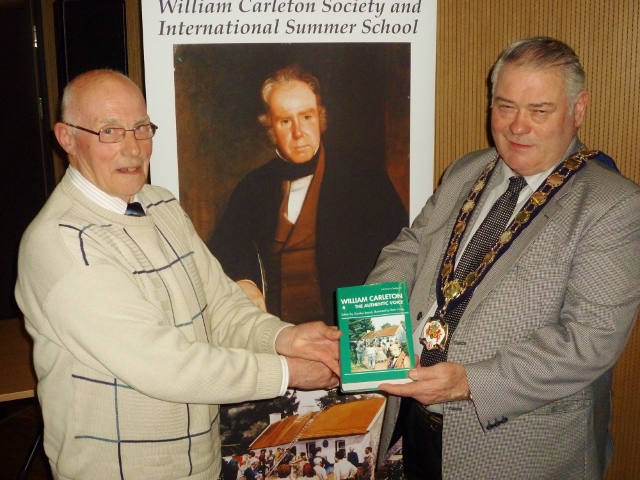
Pat Boyle presents a copy of The Authentic Voice to Mayor of Dungannon Cllr Phelim Gildernew

William Carleton Society Vice-Chair Pat Boyle presents “The Authentic Voice” to Mayor of Dungannon Cllr Phelim Gildernew

Details have been announced of the 22nd annual William Carleton summer school. The programme for 2013 was  launched at the Hill of the O’Neill Centre/Ranfurly House in Dungannon in the presence of the Mayor of Dungannon and South Tyrone Borough Council, Cllr Phelim Gildernew. He was presented with a copy of “The Authentic Voice”, edited by Gordon Brand and illustrated by Sam Craig, which contains articles about Carleton based on lectures to the summer school in previous years.

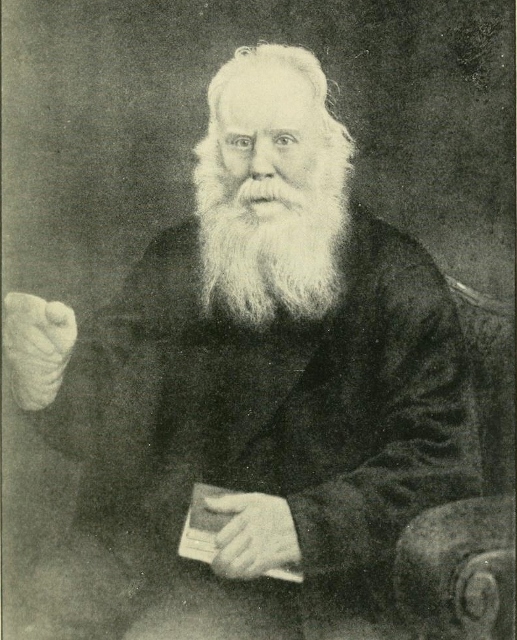
William Carleton

William Carleton

The summer school opens at 11:30am on Monday 5th August at Corick House Hotel in Clogher. The starting time has been put back to enable more people to attend who might have to travel, especially our friends and supporters in the Dublin area. Our Honorary Director Professor Owen Dudley Edwards will speak about Carleton, Caesar Otway and Irish literature. Otway was a Protestant clergyman in Dublin whose influence on the writer came at an important time in his career. Professor Thomas O’Grady from Boston will speak about “The Geography of the Imagination: Carleton’s story “The Donagh”. The final talk of the day will feature the broadcaster and poet Tom McGurk, who comes from Brackagh in County Tyrone, in conversation with one of his contemporaries at school, Aidan Fee, about Northern Ireland, past and present.

On Tuesday 6th August there will be a discussion about language in the 19thC Clogher Valley. Dr Ciaran Mac Murchaidh, St Patrick’s Drumcondra will talk about Irish and Ulster Scots will be the topic for  Dr Ian Adamson. There will be a session on literature with Ciaran Collins “The Gamal”, Tony Bailie, and Patricia Craig “Twisted Root”. Josephine Treanor will talk about her relative, Anne Duffy, the Miller’s Daughter from Augher, one of Carleton’s first loves.

Wednesday 7th August is devoted to dealing with the past and will feature Professor Jon Tonge (Liverpool), Mary O’Rourke on how different political strands can be accommodated, poet Siobhan Campbell and Mary Kenny talking about Edward Carson, unionist, Dubliner and Irishman. Actor Patrick Scully will present his one-man show on Carson, which he performed recently at the Lyric Theatre studio in Belfast.

Patrick Scully as Edward Carson

Patrick Scully as Edward Carson

The final day, Thursday 8th August, Gordon Brand and summer school deputy director Frank McHugh will act as guides for the annual coach tour. This year it will go to the neighbouring county of Fermanagh. It will focus on the work of Shan Bullock, who wrote “The Loughsiders”, based in the area around the Crom estate. The tour will depart from Corick House in Clogher at 10:30am and advance booking is necessary at wcarletonsociety@gmail.com.

Charles Gavan Duffy

Charles Gavan Duffy

This year there will be a number of events in Monaghan and Emyvale (which has a Carleton connection) preceding the summer school. On Friday 2nd August there will be a one-day conference at the Four Seasons Hotel, CARLETON, KAVANAGH and GAVAN DUFFY. Admission is free and the event is funded by the EU Peace III programme of Monaghan County Development Board.

Professor Thomas O’Grady from Boston will read some of his poems and talk about his research on the Monaghan poet, Patrick Kavanagh. Art Agnew from Inniskeen will read selected extracts from Kavanagh’s works, including The Green Fool. The afternoon is devoted to a study of Monaghan man Charles Gavan Duffy, a devotee of Carleton and one of the influential people who helped the writer to obtain a civil list pension in 1848. The speakers will be Brendan O Cathaoir from Bray and Aidan Walsh, a heritage consultant who was the first curator of Monaghan County Museum. Monaghan poet Mary O’Donnell, one of the William Carleton Society’s patrons, will read from some of her works. The programme will conclude with a talk on “The Shemus Cartoons” from the Freeman’s Journal by Felix M.Larkin from Dublin.

I am also pleased that the William Carleton Society will be hosting the launch of a book, “Memories Amidst the Drumlins: Cavan and Monaghan“, containing some of the poems and stories written about the area by the late Terence O’Gorman from Tydavnet and edited by his daughter, Patricia Cavanagh. Terence was a regular visitor to the summer school and many other similar events throughout Ireland.

On Saturday 3rd August, Grace Moloney of the Clogher Historical Society and Theresa Loftus (Monaghan Museum) will lead a walk through Monaghan town, starting at the Museum at Hill Street at 11am. This event is free. The following day, Sunday 4th August, there will be a ceremony to mark the Carleton plaque at the Blue Bridge near Emyvale. At 8pm in Emyvale Leisure Centre, the Carleton Players will perform a reading of the “Fair of Emyvale”, adapted by Liam Foley.   summerschoolad

Blue Bridge near Emyvale

Blue Bridge near Emyvale

WILLIAM CARLETON

William Carleton

William Carleton

Donaghmore Historical Society in County Tyrone concluded its season of talks in The Heritage Centre on Monday, 8th April, when Michael Fisher gave an illustrated talk entitled, “From Prillisk to Beechmount: a Tyrone man’s journey to Dublin: the story of William Carleton.” Born and reared as a Catholic in the Clogher Valley , where his father was a small farmer, Carleton has never had the recognition he deserves, either in his native area or in the ranks of Irish novelists. He spent most of his adult life in Dublin , where his works were written, including the famous “Traits and Stories of the Irish Peasantry,” the first such significant stories to be published in the English language in Ireland and Britain . When he settled in the capital city, he came under the influence of a Protestant clergyman, who persuaded him to change his religion in order to gain a living as a writer. His stories describe the society he grew up in, which often featured sectarian confrontation between orange and green factions, such as “The Party Fight and Funeral.”

Michael Fisher Talk

Michael Fisher Talk

Michael Fisher is Director of the William Carleton Society’s international summer school. A freelance journalist, he retired from RTÉ. News in Belfast in September 2010, having joined the broadcaster in Dublin in 1979. He is a former BBC. News trainee in London and worked in Birmingham as a local radio reporter. A native of Dublin , Michael has family connections with County Tyrone as well as County Monaghan . He is a graduate of UCD. and QUB., where he completed an MA. in Irish Studies in 2001, including a dissertation on The Big House in Counties Fermanagh and Monaghan. He was introduced to the works of Carleton during his time as a student at University College in Dublin by one of his lecturers on Anglo-Irish literature, Maurice Harmon, who is now a patron of the William Carleton Society.

Michael FisherTalk

Michael FisherTalk

Those who remember Michael’s soft modulated, dulcet tones from his days on our television screens will have a chance to see and hear him in person in The Heritage Centre on Monday night at 8 o’clock, when he will be telling the story of a County Tyrone writer, who, surprisingly enough, is virtually unknown in this part of the county.

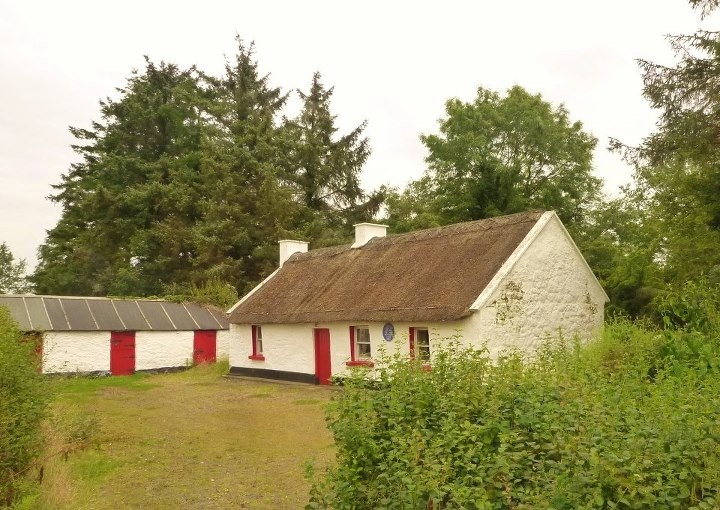
Carleton's Cottage, Springtown

Carleton’s Cottage, Springtown

William Carleton                    1794 – 1869

William Carleton was born the youngest of a family of 14 children in the townland of Prolusk (‘Prillisk’ in his autobiography) near Clogher in Co.Tyrone, on Shrove Tuesday, 20th February,1794. Although there is little suggestion that the Carletons were upwardly mobile, they did move house frequently within the Clogher area and were established at the townland of Springtown when William left the family home. Carleton obtained his education at local hedge schools which he was to write about, fictionalising the pedagogue Pat Frayne as the redoubtable Mat Cavanagh. From other retrospections of his home district, we learn of Carleton’s delight in his father’s skill as a seanachie and the sweetness of his mother’s voice as she sang the traditional airs of Ireland; of his early romances- especially with Anne Duffy, daughter of the local miller; of Carleton the athlete, accomplishing a ‘Leap’ over a river, the site of which is still pointed out; of the boisterous open air dancing. Initially an aspirant o the priesthood, Carleton embarked in 1814 on an excursion as a ‘poor scholar’ but, following a disturbing dream, returned to his somewhat leisurely life in the Clogher Valley before leaving home permanently in 1817. Journeying via Louth, Kildare and Mullingar, he found work as a teacher, librarian and,  eventually, as a clerk in the Church of Ireland Sunday School Office in Dublin. In 1820, he married Jane Anderson who bore him several children. By 1825, Carleton. who had left the Roman Catholic Church for the Anglican Church of Ireland, met a maverick Church of Ireland cleric, Caesar Otway, who encouraged him to put his already recognised journalistic talents to such prosletysing purposes as satirising the attitudes reflected in pilgrimages to ‘St Patrick’s Purgatory’ at Lough Derg, a totemic site in Irish Catholicism. Further writings in the Christian Examiner & Church of lreland Magazine led in 1829 and 1833 to the publication of what is arguably Carleton’s best known work: Traits and Stories of the Irish Peasantry. In these stories Carleton returned imaginatively to the Clogher Valley, drawing on comedy, farce, melodrama and tragedy to present a tableau of the life of the country people of the north of Ireland before the famines of the 1840s altered their pattern of existence for ever. Carleton went on to respond to the challenge of the novel, in his tirne a comparatively undeveloped genre amongst Irish writers, and published Fardorougha the Miser (1839), Valentine McClutchy (1845), The Black Prophet (1847), The Emigrants of Aghadarra (1848), The Tithe Proctor (1849), The Squanders of Castle Squander (1852). In these works he addresses many of the issues affecting the Ireland of his day such as the influence of the Established Church and landlordism, poverty, famine and emigration but does so with an earnestness that regrettably often caused his more creative genius to be swamped in a heavy didacticism. Carleton continued to write in a variety of forms, including verse, until his death in 1869, but critics are agreed that the quality of the work is uneven. Despite his prolific output, Carleton never really made a living from his writings and welcomed the pension voted to him by the government following the advocacy of such contrasting figures as the Ulster Presbyterian leader, Dr Henry Cooke, and Paul Cardinal Cullen, Catholic Archbishop of Dublin. His last project, uncompleted when he died, was his Autobiography, which was re-issued through the efforts of the Summer School Committee in 1996. Carleton was buried in the cemetery at Mount Jerome in Dublin and over his grave a miniature obelisk records the place “wherein rest the remains of one whose memory needs neither graven stone nor sculptured marble to preserve it from oblivion”.           (Summer School handbook 1998)

P1100802 (2)

Donaghmore Sunset

SWPeaceIII_logo_options_2b  DSTBC Logo