INTERCONNECTOR DAY28

DAY TWENTY-EIGHT

This section involved landowners and groups from Co. Monaghan. Part of it focused on the small townland of Cornasassonagh, which has twenty houses and is one of the most populated townlands in South Monaghan.

MARY MARRON, Corbane, spoke on behalf of her husband Philip and their two children. They owned farmland in Ummerafree and Cornasassonagh. Their extended family had lived and farmed in these townlands for generations and were horrified at the proposed development.

She said the construction of the proposed 400kV overhead power line would have a serious detrimental effect on the Monaghan countryside from a farming aspect. Owing to the drumlin landscape, field sizes tended to be small. By placing pylons in a field or along a hedgerow, it would have an enormous impact on the usable space relative to the size of the field. Trees and hedgerows contributed significantly to biodiversity and landscape character in County Monaghan.

From the family home, they could see as far as Derrylin, Co Fermanagh on a clear day and the wind turbines in Latton were clearly visible all year round. The visual impact of the proposed pylons would be immense. She told the inspectors she would be able to see at least six pylons from the front of her house and ten to twelve pylons from their stables.

Their land at Ummerafree consisted of four small fields, totalling 12 acres in size, representing one-third of their total farmland. They also rented approximately 20 acres on the opposite side of the road, where it was proposed that pylon no. 181 would be erected.

EirGrid proposed to enter their land through what they referred to as an existing track. It was in fact a rough path leading from the entrance gate across the river. The gateway into this “track” was 4m wide and wholly unsuitable for large machinery, she said. The lower sections of the fields were wet and marshy and not suitable for driving across for the majority of the year. EirGrid had not advised them what time of year they intended to complete the works. If it was to be during Spring/Summer, this would have an impact on slurry/fertiliser spreading and grazing. If they intended to complete the works during Autumn/Winter, the ground would be too wet to drive on and would be churned up. Our land would be irreversibly devalued by the development and any future development planned by our children would be restricted.

EirGrid proposed to erect the pylon on one of the steepest parts of the land and extensive excavation would be needed. With this excavation came the issue of the slippage of the remaining soil on the upper section of the hill and access to and from this site. To the best of her knowledge, EirGrid had not stated how they proposed to excavate the volume of soil necessary, whether they intended to dispose it or store it on site. The disposal and removal of spoil materials must be accounted for and not left to others to address, she said.

EirGrid mentioned that the land would be reinstated to its original condition once the development was completed. She wondered how long this would take. Because of the pylons, they would not be able to carry out normal farming practices such as slurry spreading, owing to the dangers involved. They would not be able to pass safely beneath the wires with tractors as the sag would be too low due to the gradient and the distance from the adjoining pylons. It would be unsafe to carry out drainage works, reseeding, etc in the vicinity of the pylons thus preventing them from carrying out land improvement works and furthering the business potential of the land.

They had two herds of pedigree Charolais cattle and bloodstock which they grazed both on the affected land and the rented land. Charolais cattle and bloodstock by their nature were highly strung and flighty and would be sensitive both to the volume and variety of traffic and people moving through the fields and the associated noise. They could become very aggressive when confronted by the unknown. This could lead to a bull or cow attacking construction personnel with deadly consequences. How will EirGrid mitigate against this?, she asked.

The health of our livestock is paramount, she said. The Department of Agriculture had very strict guidelines on the movement of cattle and the spread of disease and they would be concerned about disease being carried onto their lands from adjoining farms by the machinery. They were also extremely concerned about the issue of insurance.

They were concerned about the health and safety aspects of the development. They had serious concerns about the damage that would be caused to the roads, the safety of the community that used them and the safety of livestock that walked them. The road networks in Co Monaghan especially in the Corduff area were wholly unsuitable for the volume and type of vehicles that would be required if the development went ahead. Many were single lane roads on which two vehicles were incapable of passing unless one pulled into a gateway.

Noise pollution from overhead high voltage lines was of huge concern, particularly in wet weather. Mrs Marron said the noise from the 110kv power line currently running alongside her family home was horrendous during damp weather and it was like having someone welding outside the window.

It seems that once again, EirGrid had submitted a farcical planning application, with no regard to the landowners and local communities of the affected counties. It was beyond belief how this oral hearing had been permitted to proceed, when EirGrid had continuously shown themselves to be incompetent. The fact that they had been permitted to produce maps twice at this stage detailing new access routes was absurd and they had reserved the right to produce more if they deemed it necessary. Today they were actually redoing an access route as the observers looked on. EirGrid had produced a seriously flawed and misleading Environmental Impact Statement and were now being allowed to redo it as they went along, using information provided by the landowners and communities.

“Over the past five years I have as a member of the Monaghan Anti Pylon Committee attended meeting after meeting with EirGrid representatives, where they were always willing to take concerns on board, only to find out afterwards that it was a box- ticking exercise.”

She went on: “I have sat at this oral hearing and indeed the previous one listening to parents crying while putting their private business in the public domain pleading with Bord Pleanála to take their childrens’ medical needs into account when deciding the outcome of this application when EirGrid would not. I have watched changes to landowner maps being discussed and put in the public domain without landowners having received prior notification. I have watched as landowners have asked question after question without ever receiving a straight answer. EirGrid’s experts have hidden behind sub- sections and modules from day one and have been allowed to do so by you, the inspectors. In the event that they are being put under pressure the legal team comes to the rescue and if this is still not enough the questioner is then instructed to move on. There seems to be a rush to get this oral hearing finished. Why?

You the Board and EirGrid are being paid to be here and do your job. Landowners and other observers are here having taken time off work and putting our case forward at our own expense.”

Mary Marron concluded: “Observers have noted the huge complement of staff and legal expertise which EirGrid have at their disposal. A seemingly bottomless pit of money to get this project pushed through, who despite already having failed once seem to have learned nothing. The might of the State against the little man – though as Leicster City FC have proved, sometimes the little man can win.

From day one this project has had no public acceptance. Anything landowners and observers have witnessed in the conduct of this oral hearing has only served to reinforce their determination that this 400kV line will never be built overground through the counties of Monaghan, Cavan and Meath”.

CON CURTIN, agricultural consultant, said there were no effects on the health of livestock from electromagnetic fields. He also explained measures that the designated contarctor would be taking to prevent the spread of animal disease.

NOEL FOX, Tullyglass, said he had never been properly consulted by EirGrid and did not want EirGrid to put two pylons on his land. The construction work would completely disrupt his farm and work. There was only one access to his farm and he needed it at all times. He would not allow EirGrid in.

“This is my home”, he told the inspectors.

PEADAR CLINTON, Bocks Lower, said their forefathers had fought for the land one hundred years ago. Now the company was taking their freedom away, but the people of Monaghan and Cavan would not let EirGrid do so. He pointed out that there was a pond on his land where moorhen were breeding. He was afraid of the adverse effect the line would cause.

Dr PATRICK CRUSHELL, consultant ecologist for EirGrid said ecology impacts and precautionary mitigation regarding wildfowl, including moorhen, had been considered as part of the Environmental Impact Statement. The pond mentioned by Mr Clinton was identified in the habitat maps and report. Dr Crushell said moorhen would be expected to continue to use the pond notwithstanding the construction and operation of the proposed development.

OWEN and HELEN MCCABE with their neighbours PATSY and ANN IRWIN, Cornasassonagh, said the proposed line was going to have a massive visual impact on what was a very scenic area. Mr McCabe said the wires would be 62m from their kitchen table. His wife Helen said three towers would be visible from their house at all times. The nearest pylon would be 156m away from their home and farm.

SEAMUS MARRON, Cornasassonagh, questioned the access route for a guarding area that EirGrid had proposed. The map showed it going through an eight foot high wall at the end of his farmyard. There was also a well close to the guarding area.

ROBERT ARTHUR for EirGrid said they did not intend to remove the wall but would used another viable entrance to the field at that point. JOHN DILLON, a consultant environmental engineer, said they would monitor the water quality at the well and would take samples to ensure it was not affected by the construction work. In a number of similar cases he told landowners EirGrid would ensure that an alternative supply such as a water tanker was supplied and the well would be restored to its original condition, if any damage was caused.

DES MARRON, Cornasassonagh, said he had not been contacted by EirGrid and he had no intention of letting them put up a pylon on his land. Nobody wanted the pylons and they would all do whatever it took to stop them going up. Don’t waste any more money: put the wires underground, he told EirGrid.

PHILIP MALONE, Cornasassonagh, said the power lines would cause complete destruction to his farm and house. He was concerned that vibrations from the machinery used to access the construction site would cause damage to the foundations of an old stone house that he was renovating.

BARRY SHERIDAN, acoustic consultant, said they could monitor the building using sensors to ensure that any vibrations were within the prescribed limits.

PLUNKETT CORRIGAN, Cornasassonagh, said the proposed route of the lines would overlook one of the most scenic areas in Monaghan. There was a big area of wetlands in the area and he expressed concern about the potential effects on wildlife including whooper swans, snipe, badgers and birds. The EirGrid EIS report had not mentioned the wetlands, he claimed.

Dr PATRICK CRUSHELL, consultant ecologist for EirGrid, said the Bocks Lough site was not officially designated. He said the wetlands had been evaluated from the roadside and the development would not have an effect. The flight path of whooper swans did not regularly cross the route of the line here.

ALAN MCMAHON owns land at Corbane. He said he had not received maps from EirGrid for consultation. A lawyer for EirGrid said the first correspondence with Mr McMahon had been in May 2015. When EirGrid were asked to check their records, it was discovered that they had written to a previous title holder in 2013. After further questioning it was discovered that the company had been notified by the Property Registration Authority in October 2014 of a change in ownership. This was a blatant breach of consultation, according to Nigel Hillis of CMAPC.

EDGAR EAKINS, Corduff, posed a series of questions to EirGrid. He said the power lines would affect GPS equipment used by agricultural contractors. He had concerns about his children playing under the lines and the potential effects on health. “I do not want EirGrid coming onto my property. I am prepared to go to jail if this line goes ahead and if I go to jail, then my children will go as well”, he told the inspectors.

AIDAN GEOGHEGAN, EirGrid Project Manager, said overhead lines would not interfere with any GPS system as they were designed to be immune from interference from such lines.

Mr Eakins had further questions about the effect on farming practices and these were put to EirGrid by ALLEN MCADAM. He wanted to know what would happen if farmers were members of the new agri-environment scheme GLAS and needed to reinstate any ground that was damaged during the construction of pylons. Mr McAdam said that farmers in the scheme could be penalized for re-seeding low input and permanent pasture.

JIMMY MARRON and HUGH FINNEGAN, Ummerafree, raised questions about access routes and the devaluation of land which they believed the interconnector would cause. “The lines would go right across my farm and would put me out of business”, Mr Finnegan said.

ROBERT ARTHUR of ESB International said there would be no sterilisation of land outside the footprint of each pylon.

PAUL KEENAN, Sreenty, was concerned about the positioning of pylon 186 which he said would be sticking out like a sore thumb. It was probably the highest along the route and it would be on a par with Corduff mountain. There was a 360 degree panoramic view from the hill, and you could see as far as Dundalk Bay and the Mournes.

Mr Keenan said the project was being built to supply the UK at our expense. Local people should not be sacrificed for someone else’s power needs, in his view. EirGrid had no morals at all, he claimed. He said they were totally opposed to the plan. Under no circumstances would EirGrid be allowed on their land so that they would suffer in future, he concluded to applause from the other objectors present.

Some landowners posed a direct question to EirGrid staff and to the inspectors, asking them how they would like to live in a house beside a pylon and power lines.

JARLATH FITZSIMONS SC for EirGrid said individual opinions were not a determining factor. The process was about the proper planning and sustainable development of the project and submissions received that were relevant to the assessment to be made by the Board. He also said there would be no micro-siting of the proposed pylons. Their position had been identified and would not be subject to any deviation.

INTERCONNECTOR WEEK8

MONAGHAN LANDOWNERS TELL EIRGRID: NO PYLONS

MICHAEL FISHER  Northern Standard p.1  Thursday 28th April 2016

EirGrid has been accused of making up their application as they go along and turning the planning procedure into an absolute disgrace during the oral hearing into the proposed North/South electricity interconnector. It follows the introduction by the company for the third time of modified access routes along narrow country lanes that would be used by contractors building the latticed steel pylons and erecting the power lines. 32 separate changes have now been made by EirGrid since the hearing began last month.

On day 26 of the oral hearing a lawyer for EirGrid Jarlath Fitzsimons SC said there had been an ongoing review of the 584 temporary routes identified. Six new ones had been notified to An Bord Pleanála on the first day at the Nuremore Hotel on March 7th. Nineteen further changes were made a fortnight later following the discovery of discrepancies in mapping. Shortly before the close of the proceedings on Tuesday afternoon, Mr Fitzsimons revealed seven more modifications that had been made to the access routes. A further eleven mapping modifications were identified for the access routes, most of them minor. The lawyer said EirGrid had responded in a positive way to observations made by landowners during the hearing regarding specific tower locations.

Temporary access routes are included in the planning application to enable An Bord Pleanála to conduct an environmental assessment of all aspects of the proposed development. EirGrid spokesperson David Martin said: “With a total of 584 temporary access routes in the planning application, it is understandable that modifications to a small number have been proposed as information comes from observations made at the oral hearing and also from the continuing reviews.”

“In order to enter the area for the proposed development, we have identified 584 temporary access routes. Over the course of the oral hearing, we have listened with interest to the detailed submissions given by landowners along the proposed line route. Several landowners have focused on the detail of the temporary access routes. This feedback has been very helpful as we endeavour to provide the most convenient access routes possible for landowners.”

The hearing in Carrickmacross in front of two Bord Pleanála inspectors is now in its eighth week and is not expected to finish until the end of May. It’s one of the longest such planning enquiries into what is one of the largest ever infrastructure projects in the state. EirGrid is proposing to erect a 400kV high voltage line with 400 pylons from Woodland in Co. Meath across parts of Cavan and Meath into Co. Armagh and finishing at Turleenan near the Moy in Co. Tyrone.

Mary Marron of the County Monaghan Anti-Pylon Committee said what was going on was an absolute disgrace. She wondered if more information was going to be added during the rest of the hearing. People had been coming into the hearing and pointing out to EirGrid errors in the access routes. If this was what was going to happen continually then the remaining landowners due to make submissions would have to decide if there was any point.

Monaghan Fine Gael Councillor Sean Gilliland said he found EirGrid’s approach to be absolutely insulting to the An Bord and to the local communities in the county. EirGrid believed they had identified issues with access routes but it was the public who had done so. Earlier in the day a problem had been pointed out by a landowner with EirGrid’s proposed use of a 9m stone wall embankment as an access point to a field.

Cllr Gilliland wondered if the environmental impact reports were wrong then were the health reports flawed as well? The community did not have the capability or the qualifications that the other side had. Our lives and the future of our young people are in your hands, he told the inspectors.

Cllr Gilliland said the planning application was flawed. On behalf of people in this rural part of Ireland he said he was begging the inspectors to consider the recent submissions made by landowners and householders, all of whom objected to the overhead power lines. What was happening was unjust and absolutely contrary to democracy and civil rights. It was not morally right nor would it ever be. They were being pushed into the mud by EirGrid who were taking information and re-presenting it in submissions they did not understand.

He was warmly applauded as was Margaret Marron of the CMAPC. She told the hearing she was absolutely appalled at the new information that had emerged. It was just incredible and the landowners were doing all the work for EirGrid, she said. The hearing is due to sit on three days next week, from Tuesday until Thursday and provision has been made for it to run until the fourth week in May.

SITTING DATES: (Resuming with more Monaghan landowners)

Tuesday 3rd, Wednesday 4th, Thursday 5th May

Monday 9th May to Friday 13th May

Monday 23rd May to Friday 27th May

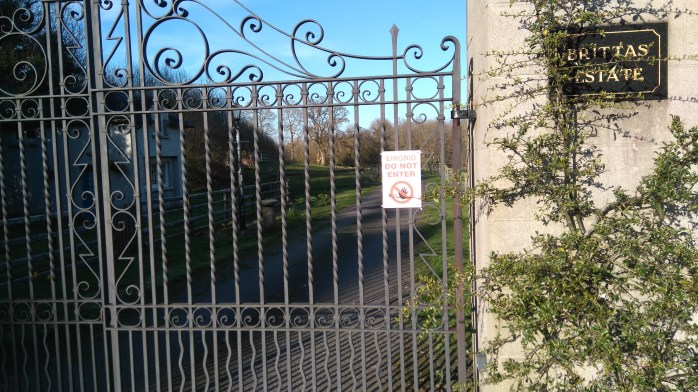
INTERCONNECTOR: BRITTAS ESTATE

BRITTASGATE.JPG

Entrance Gate and Gate Lodge at Brittas Estate, Nobber, Co. Meath, close to where the proposed power lines would pass  Pic: Michael Fisher

EFFECT OF EIRGRID’S INTERCONNECTOR PLAN ON BRITTAS ESTATE EXPOSED AT ORAL HEARING

MICHAEL FISHER Meath Chronicle Saturday 30th April (WEEK 7)

Probing questions to EirGrid by a lawyer acting for the Brittas estate near Nobber in Co. Meath have revealed what anti-pylon campaigners believe are several inadequacies in the planning application for the North/South interconnector. An oral hearing by two inspectors from An Bord Pleanála is now in its eighth week. EirGrid has said the detailed environmental impact statement it submitted has complied with the relevant Irish and EU regulations.

Michael O’Donnell BL acting for the owners of Brittas House and demesne Neville Jessop and Oinri Jackson asked EirGrid why no site specific details were provided regarding construction of the proposed pylons, the felling of a section of mature woodland, and the impact the proposed line would have on the views from a wing of the house built in 1732 and incorporating an earlier residence from 1672. The house was extended in the 18th Century and a ballroom wing, designed by Francis Johnston (architect of the GPO), was added in the early 19th Century. The house is located approximately 430m to the east of the proposed development.

Three ringforts are within 400m of the proposed line. According to an archaeological consultant for EirGrid, Declan Moore, these monuments will have their setting impacted on by the proposed development. The environmental impact statement explained that as much as was practicably possible the topography of the area had been used to keep impacts on the setting of Brittas House to a minimum. Mr Moore found that where the proposed development crossed the entrance avenue, there would be no views of the house and likewise in the vicinity of the house there were no views of the proposed development. But he added that there was the potential there may be views from some of the upstairs windows of the house, especially during the winter months. The impact on the setting of the house was in his view slight to moderate.

Questioned by Mr O’Donnell, Mr Moore said he had not entered the demesne as permission had not been granted but he had carried out from the public road a visual inspection of some of the three archaeological monuments inside it. He insisted that the development would have no direct physical impact on any such monument. He also repeated a number of times that there were no national monuments within the demesne.

This was disputed by the lawyer for the owners. He revealed that a ministerial letter had been sent out in July 1997 to the then owners referring to a monument in the townland of Brittas with details of preservation requirements.

At a previous module Neville Jessop explained how one of the access routes proposed by EirGrid to a pylon site would require concrete lorries to pass over an old bridge which had cracks in the stonework. He told the company the access bridge was not available because of its condition. Any repair work that needed to be done on the structure would require notification to the Minister for Arts Heritage and the Gaeltacht. A lawyer for EirGrid said on Tuesday it did not know the bridge had been closed for health and safety reasons.

The previous week Michael O’Donnell BL told the hearing sheer devastation would be caused to the Brittas estate if EirGrid’s proposed power line with pylons was allowed to proceed. He referred to the inadequacy of the EirGrid documentation and claimed it was not acceptable under Irish planning law or EU rules. The company was treating the public with a level of contempt, he said.

Mr O’Donnell pointed out that Brittas was a protected structure equal to any other great Irish house such as Castletown, Carton or Russborough. Every structure in the demesne had the same status. It was an extraordinarily important piece of landscape with its own eco system. It was about to be devastated by a 400kV line traversing it, going through a section of mature woodland that would have to be removed.

This part of the oral hearing has been devoted to specific landowner and public issues from Co. Meath and near Loughinlea mountain in Co. Cavan, a popular tourist area.

EirGrid was accused of spending its money on things like sponsorship of the Virginia pumpkin festival, the GAA (under 21 and Australian Rules), two local radio current affairs programmes and advertising in local media. A company spokesman said a key finding of a number of reviews of EirGrid’s operations and engagement with the wider community had shown the need for effective communication of the necessity for grid infrastructure to ensure a safe and sustainable electricity supply. As part of the company’s strategy to address this, it was placing an emphasis on improving how it communicated its role, including through advertising and sponsorship.

David Martin said “We welcome the strong engagement from landowners, public representatives and community members at the An Bord Pleanála oral hearing. The oral hearing provides an opportunity for all relevant information to be brought before An Bord Pleanála, and ensures that their concerns are addressed. We encourage all landowners and concerned residents to attend over coming weeks. If you would like more information on any aspect of the project, you can talk to our team on the ground, or drop in to our offices in Navan or Carrickmacross. Contact details for our Community Liaison Officer Gráinne Duffy and Agricultural Liaison Officer John Boylan are at www.eirgrid.com. Since submitting our planning application for the interconnector in June 2015, we have continued to engage with communities in Meath, Cavan and Monaghan.”

EirGrid said the consideration of alternatives to an overhead line, including underground cables (both cross-country and along public roads), had been outlined its planning application. This has relied on a suite of reports prepared by the government, third parties and EirGrid itself. One of these, prepared by PB Power, showed that an underground cable option is considerably more expensive, at €670 million more that overhead lines.

The government-appointed Independent Expert Commission found that an underground cable option would be €333million more expensive. The reason for the difference in these figures was that the PB Power report studied a cross-country option, while the IEC report considered a roadside route. The company said a further detailed study of roads in the project area had shown that the use of the M3 and local roads was simply not suitable for the interconnector project.

When considering alternatives for the project, cost was just one factor. Underground cables would also not be as reliable as overhead lines, causing greater complexity and greater risk. EirGrid said it also studied the use of disused railway lines and a subsea option for cables but they were not viable options for this project.

The presence of the North South Interconnector, should it receive planning permission, will provide benefit to communities in the North East, according to EirGrid. As with a bypass, the project would provide an alternative route for power flows, freeing up power in the region. This would allow large businesses to tap into the line, providing an opportunity for local investment and employment.

INTERCONNECTOR DAY26

DAY TWENTY-SIX

This section involved landowners and groups from Co. Monaghan

SEAN DUFFY, Drumguillew Lower, was represented by his mother Mary Duffy as he is in Australia at the moment. He had inherited ten acres of land from his uncle in February 2011. There had been no contact with EirGrid about their plans to build two pylons and a power line near the dwelling house. Mrs Duffy said there was also a plan to put two pylons on her daughter’s land at Drumhowan, one of which EirGrid had now moved across a ditch onto a neighbour’s land.

NIGEL HILLIS of the County Monaghan Anti-Pylon Committee said there could have been another technical solution without moving that particular pylon. He claimed that EirGrid had been in breach of the Aarhus Convention on public consultation and EU directives. The proposed line design stretched back to 2011 and was followed with a preferred solution report and then a final line design that the EirGrid board had approved according to the Chief Executive. The company had years to get it right and after all this they had decided to move eleven of the pylons on the proposed route when the planning application was submitted last year.

BRENDAN MARKEY, Greagh, was represented by Sean Gilliland. He did not want pylons on his land. Cllr Gilliland said the proposed access lane for construction of two pylons on Mr Markey’s land was only 8’6” wide with a water pipe below it and two other pipes alongside. It would most certainly be damaged if heavy machinery used it.

The lane was very special as there were visible badger tracks and badger setts that were monitored by the Department of Agriculture and NPWS. The power line would be a ruination of the rural countryside and way of life.

GABRIEL MOONEY, Greagh, was joined by his father Bernard in making a submission. They had huge concerns over the project. They lived 200m up a lane that EirGrid planned to use to access one of the pylons for construction. The lane was in frequent use by family members daily and they would be disrupted if heavy machinery was going to use the lane. He asked who would be responsible if there was an accident on the lane, or if it gave way under the heavy loads that would have to pass along it. Could EirGrid guarantee the safety of his young children while the proposed work was taking place? He also wondered if the company could guarantee that they would not in their lifetime experience any health effects from living beside the proposed high voltage lines.

He expressed concern that their homes and properties would be devalued and worth next to nothing in future. Nobody would want to live near these grotesque pylons, he said. The lines would destroy totally the aesthetic appearance of their locality.

He concluded: “We are all proud Irish people, proud of our democracy. We have the power to elect our public representatives; we have the power to decide if there are changes to our Constitution. We express our democratic right by voting and we accept the outcome. The people of Monaghan, Cavan and Meath had voted unanimously against this overhead power line. EirGrid should accept this fact and scrap this proposed project”.

LEO MARRON, Greagh, said the pylons would be an attack on our freedom to live according to our own traditions and own choices, currently and into the future. We could no longer sell our property or hand it onto the next generation. We could not develop it as a viable enterprise and make more of it as previous generations did.

I left my parcel of land with an estate agent in February and told him to be open and honest with all inquiries. The land was advertised locally and internationally but there have been no offers. Such is the mistrust that EirGrid have instilled among the people of our community that I took the land off the market as we feared EirGrid would use the opportunity to walk the land and gather information for their own purposes. I have no doubt that the threat of this pylon has affected the value of my land and other properties in the local area.

I face particular challenges with a disability that means I must meticulously plan my work days and weeks ahead and ensure I have adequate support to carry out my daily duties. EirGrid interference would interrupt this planning., becoming another obstacle I could live without and making farming almost impossible for the duration of the construction. The two months stated by EirGrid are only the tip of the iceberg though, as there will be continuous interference by EirGrid for a further three years and ongoing into the future. This will undoubtedly be the end of my way of life.

I have worked for years to increase the productivity of my land, digging shores to dry the land. Still it is soft in places and heavy construction would damage these land drains and undo the work I have laboured so hard over. Can EirGrid inform us here as to the weight of the pylons and measures they would take to mitigate the damage caused to my land? Or are EirGrid even aware of these factors? It appears that EirGrid have not properly assessed the land and have no idea really as to the possible consequences of building a huge pylon in my field. Also I wonder are EirGrid aware of the dangerous blind spot that exists on this apparently straight stretch of road? All households here are aware of how devious this stretch of road is. The heavy construction vehicles and increased traffic that EirGrid will bring will compound factors and make a fatal accident all the more likely. EirGrid have boasted of their strict timetabling of construction. This evidently could place pressure on contractors to reach deadlines and take short cuts on health and safety: which should come first? With so many homes surrounding the construction site I do not trust EirGrid to put the interests of families and children first. Rather it seems that profit and scheduling comes before the people and community. I wish to draw to your attention an article in the Farmers Journal dated October 11th 2014 which described the ESBs laissez-faire approach to pole removal that damaged a contractor’s harvester and left a hole in his pocket. It seems to me that EirGrid’s approach to planning and execution of these pylons will be no better and could leave many farmers out of out of pocket due to similar damage caused. EirGrid have forfeited all confidence in their abilities and no farmer would agree to allow them onto their land to destroy it.

The field on which EirGrid plan to construct this pylon is flat and poses a real and significant eyesore to a number of neighbours. It is cruel and unfair that their homes too should suffer the indignation of this towering pylon and the loss of value to their homes. To EirGrid this is all business and nothing personal but to us it’s very personal.

I also have more land in Ardragh where I am being affected by construction between pylons 190 and 191. The shared lane serves many farms and homes and as such heavy vehicles would pose a significant risk. Damage to the surface of the lane would be inevitable and have unfair and lasting consequences for those who rely on it. Furthermore there is a well that is under the lane which has historical significance that leads back to the famine era and has been minded for generations. I have an uncle who will turn 100 this year and used this well for drinking water from a child. Heavy vehicles would destroy this important piece of heritage and history and I doubt EirGrid are even aware of its existence. There are in fact several other errors in the proposed plan I could point out to EirGrid, but I would feel foolish pointing them out to such educated men.

ANN MCARDLE, Brackley, was represented by her son COLM MCARDLE. He said they were not happy about having pylons on their land. In their original application EirGrid had proposed an access route for construction that went through an embankment onto the pylon field. The access was then changed through their back yard. They wondered how this would affect the milking of cows and moving them around the farm.

BYRNE FAMILY, Brackley

Briege Byrne said the family home sits between proposed Pylon 162 and Pylon 163, The overhead power lines would run for 80 metres along our land and right over our sheep’s house. The overhead power lines will be 62.5 metres from our family home. This is the only land parcel we own and it is home to our livestock.

EirGrid wants to access our land to facilitate stringing of the overhead power line – they do not have our permission to enter our land.

EirGrid wants to use our private entrance to access our land with large, heavy construction machinery. They will have great difficulty navigating in a slope, off a busy main road, on a bad bend; onto wet boggy soft ground all year round which floods regularly.

Quote from EirGrid:

“The 0.7 hectare land parcel with beef enterprise is located in Brackley Co. Monaghan. The sensitivity is medium. There is a yard/farm building located approximately 30 meters north west of the proposed overhead power lines”.

The land parcel is not 0.7 of a hectare; it is only 0.5 of a hectare of land. The farmyard/building is not 30 metres from the overhead power lines it is right under the power lines.

EirGrid propose that they will need 65 metres of an access track to facilitate stringing of overhead Power lines at a loss of 10% of the land parcel. “Pre-mitigation the impact is moderate adverse”.

We use our field by split grazing, so the field is divided in half. The half EirGrid wants to access has our sheep’s house – which will have the overhead power line running over it – and is used to summer graze if possible as this is when it is at its driest, although our sheep will be rotated on it all year round as required.

“The construction disturbance impact is short term (generally less than 12 months) the magnitude of construction impact is low and the significance is slight adverse”.

How can EirGrid say it is short term? This is our home, our lives, our animals; the impact has already commenced and shall be engraved on the land for an eternity. EirGrid want access for 12 months. How are we going to split graze? How are we going to feed our sheep? How are we going to access our sheep’s house? To say the impact is low is hurtful and demoralising.

EirGrid say “There will be a low level of disturbance”.

This is not a true reflection. There will be a high level of disturbance. When EirGrid are finished we will be unable to use our field, we will be unable to feed our sheep, we will be unable to house our sheep and after 12 months of large heavy construction machinery, the land will be more like a building site than a grazing field – it will be ruined and we will be left with our home 62.5 metres from the overhead power line with a view of pylon 162, Pylon 163 and Pylon 164. We have 80 metres of overhead power line on our land, land we cannot use, left sterile due to the health risks this poses on us and our animals along with the constant humming and cracking sound of the overhead power lines. We see all of this as a high level of disturbance.

“There is a high impact on farm buildings and their potential expansion due to location of power lines 30 metres from yard”.

Our farm building is our sheep’s house and it is right under the power lines, this means our sheep cannot be housed in this area. Where shall we house our sheep as we only have a small parcel of land, which means we cannot build on our land.

“The impact magnitude is high and the significance of the residual impact is moderate adverse”. This overhead power line will have an immediate and detrimental impact on our health and the value of our home and land. EirGrid say this will have a low environmental impact. How can they say this? They have not stood on the land and how can they say what the environmental impact an overhead power line will have?

“Hedges land trees may be cut back within 30 metres of the overhead power lines”.

What about the hedgerow on our land? The power lines shall be running over this hedgerow. The hedgerow is home to wildlife and offers a feeding ground for many lives such as birds and bats. The river beside our land runs alongside this hedgerow. What about all the fish and creatures in the water? How can anyone say that there will be a low environmental impact when hedgerows shall be removed and rivers disturbed?

As well as the ground animals and birds we must also look up and realise that we are also on the flight path for swans and ducks. Just over the field from our home lies Barraghy Lake. The swans and ducks fly back and forth on a regular basis. These wires shall be in their direct flight pathway. We are worried that these birds may end up in the wires.

In short this is our field gone, our land gone, no grazing for our sheep, no roaming for our hens, the hedges gone: which has a knock-on effect – no birds, bats rabbits to name a few – the river that runs along the hedge tampered with and in effect gone.

What about our health and the health of our livestock? Our sheep are so close to this overhead power line. How can we be sure they will be safe? Could this cause the sheep to miscarry, have lambs born with deformities? Also our hens roam freely through the field. What about their wellbeing? They supply the family home with eggs – will we be able to keep our hens? Will we be able to consume their eggs? Our spring well is 50 feet from the overhead power lines – can we still use this water? These questions highlight that the environmental risk is high rather than low.

My child visits the family home on a regular basis. How can I visit the family home knowing that I run the risk of putting my child’s health at risk for e.g. leukaemia and other disorders? I cannot do this to the next generation.We should be protecting them not putting them at risk. Life is precious and should be cherished not put at risk because EirGrid want to erect pylons.

Along with my child’s physical wellbeing I am also extremely concerned about the physical and mental wellbeing of my parents, they have reared their children and put a lot of time and love into building a safe environment for me and my siblings and for us to be able to bring our children back to the family home, but this will be shattered. From the day that talk of this interconnection commenced it has had an impact on our emotional wellbeing. We are upset and stressed due to the possible erection of this interconnection. We will have nothing left by the time EirGrid are finished. We also need to be aware that there is a physical strain placed on every single person who is here today and is affected by EirGrid’s proposals. We can see the physical strain on people. We also need to be mindful of the mental strain this project is placing on people; this is very concerning as we sit and listen to families plead for their lands to be left untouched. We are getting a taste of how people feel as we listen to the stories of how a power line can rip through a person and put them under emotional and physical strain. Is it worth putting people under this pressure and strain? The answer is NO!

PEADAR CONNOLLY, Chairman of Lough Egish Community Development Company Ltd that runs the Food Park said overhead pylons would have a detrimental effect on the wellbeing of all in the Aughnamullen community. He explained the history of the food park which he said provided food to people from all corners of the island, from meat to dairy to eggs and dry foods. He pointed out that he had difficulty accessing any environmental impact statement on EirGrid’s web page.

(This was immediately checked by the company’s representatives who told the inspectors all the relevant EIS information had been put on a dedicated website set up at the request of An Bord Pleanála and which was found to be working properly).

Mr Connolly said he was extremely concerned about the adverse effect the overhead power line would have on the food park and the livelihood of local people. EirGrid, he claimed, had failed to demonstrate the safety distance for the food industry and employees regarding EMF emissions from 400kV power lines. He feared that a stigma might arise from the location of their food products not far from the high voltage cables and once it arose then they would be out of business. It was a risk he was not willing or able to take. He urged An Bord to ignore any pressures that might be exerted on them to fast-track the proposed project and to be mindful that the health and wellbeing of all citizens in the affected areas and generations to come were in their hands.

INA and CHARLES HEGAN, Brackley, made a submission in which they said the EirGrid plan would have a number of disastrous consequences for their farm, house, family and livestock. One pylon would be close to the front of their house. There would be a severe visual impact. There would be an immediate and detrimental effect on the value of their farm. The overhead cables would create a substantial risk to using farm machinery. There had been no proper consultation with them, she said.

DOMINIC HARTE, Brackley, also expressed concern about devaluation of his home and property and the visual impact of the pylons. He also questioned whether sufficient provision had been made for flight diverters on the power lines to take account of the flight paths of wildlife at two local lakes. He also enquired about the procedure that would be used for inspecting the power lines, if they got approval.

MICHAEL HALPIN, Barraghy, was represented by Briege Byrne. My home sits between pylons 163 and 164. The power line will run on the edge of my land. EirGrid propose to access pylon 164 by using a lane which is owned by my neighbours Mr and Mrs Charlie Hagan. This lane runs parallel with my own driveway and on past the front door of my house into Mr Hagan’s field where pylon 164 is to be erected. This lane is not capable of taking heavy farm machinery as it is soft ground that runs along a river. From the picture you will see that the edge of the lane which is not defined by a hedgerow is about 4 feet from my front door. This would pose a serious problem for EirGrid. How do they propose to turn in off the road on a bend, go up a soft narrow lane 4 foot from my front door with heavy construction machinery? It is not possible. The machinery would be rubbing off my porch, I would not be fit to use my front doorway. EirGrid will need to cut down my mature trees which are very close to my house. These mature trees are home to a lot of wildlife and bats. This is not acceptable.

Over the last number of years I have spent a lot of time and money updating my house and land. These pylons and overhead power lines are so close to my home that both my home and my land would be worthless, devaluing everything I have worked for. It would leave living in my own home very hard due to the impact on my health and wellbeing.

PAURIC CONNELLY, Barraghy, was represented by Sean Gilliland. EirGrid had not convinced him that there was no medically adverse activity arising from the pylons. The proposed line would be a desecration of the landscape.

Cllr Gilliland asked if EirGrid could inform the hearing how much his land would be devalued if the project was allowed. He had very real concerns and wanted to know if he would get planning permission for any sites to provide new homes if they were near the power lines.

EILEEN MCGUIGAN a neighbour said her home was her castle. She had six grandchildren and was concerned about possible health hazards if a pylon was built nearby. “No pylons—NO-NO-NO!” she stressed. She was applauded as she concluded.

PHIL GEOGHEGAN, Drumillard, was represented by Sean Gilliland. Mr Geoghegan shared access to his holding with seven other people. It was a private lane and they had all contributed to tarring it and contributing to the upkeep. If damage was caused by contractors’ traffic using the lane for access to a pylon construction site, he wanted to know who would pay for it? Mr Geoghegan was totally and utterly opposed to the proposed pylon on his land. Cllr Gilliland pointed out that there were already three power lines crossing his farm and now there could be seven or eight. There would not be much room left on his land holding. He also mentioned that problems had arisen regarding compensation at another infrastructure development in the county.

PATRICK MARRON, was also represented by Sean Gilliland.

Mr Marron, a farmer, had not received any information to date from EirGrid regarding a plan to use part of his land as a guarding location for one of the pylons. He was anxious about this and wondered how EirGrid had managed to put in a planning application without conculting the person who owned the ground for the planned tower. Cllr Gilliland also pointed out that the proposed access route belonged to someone else, a Mr Connolly (see below).

ROBERT ARTHUR of ESB International said in many instances access to pylons went across third party land. He would endeavour to get the details regarding that particular holding.

SEAN GILLILAND pointed out that this landowner was known to EirGrid as maps had been sent to him regarding the previous application. So the company was very well aware of the owner. There had been correspondence with Mr Marron in December 2013, so this was not a case where EirGrid was not aware of who owned the parcels of land.

PATRICK CONNOLLY, Tooa, a landowner, told the hearing he had not received any communication from EirGrid regarding a proposed access route to pylon 170 on the land of the Ward family. When this divergence of opinion became clear a coffee break was called by the presiding inspector.

Upon investigation, EirGrid lawyer Jarlath Fitzsimons said a letter had been sent by tracked mail to Damian and Patrick Connolly on 29th May 2015. It was delivered on to an address at Tooey, Shantonagh, Castleblayney at 9:31am on 4th June 2015, according to a postal track and trace.

Cllr Gilliland said it was strange that a separate letter had not gone out to the two names on the holding, if two parties were involved. He continued to press for information about the proposed access routes that were being used to pylons. One of them, he said, was so overgrown that you could not even wheel a wheelbarrow in there, let alone deliver any concrete unless it was in a bucket.

Following this exchange EirGrid introduced new information regarding seven access routes and eleven minor changes arising from map inaccuracies.

JARLATH FITZSIMONS SC for EirGrid said the application before the Board was for an overhead line and there was no proposal to underground the line. Let’s be clear about it, he told the inspectors. He also said a number of issues raised regarding land valuation, health and tourism had already been answered in previous modules.

INTERCONNECTOR DAY25

DAY TWENTY-FIVE

This section involved landowners and groups from Co. Monaghan

HUGH WOODS, Cornamucklagh North, and his nephew DAMIEN WOODS were represented by a neighbour Jim McNally. Hugh Woods is 88 and is a bachelor. Mr McNally said Mr Woods was in hospital at the moment. The whole planning process had contributed to the worry and stress that he had to cope with, since it first came to his notice in 2007.

Hughie Woods came from a different generation, who worked very hard all their lives to maintain their farm holdings in the best possible condition and in harmony with the landscape. They had a personal knowledge by name of all their animals, their lineage, maintaining their welfare and the welfare of the environment where they grazed. The land parcel description provided by EirGrid stated that the sensitivity was medium, and noted that there were yard/farm buildings located approximately 60m NW of the proposed overhead line.

Mr McNally said Hughie Woods had telephoned him early on after the project was announced. He stated he was afraid to return to his house when he saw a car (with an EirGrid official) arriving unannounced and without prior appointment. He got a leaflet from EirGrid in the door on that particular day. He went on: “This policy employed by EirGrid to “cold call” on elderly farmers with a view to seeking access onto their landholdings is reprehensible in my view and as I have stated previously socially unacceptable. Elderly people are easily duped, are trusting of people they meet and accept people at face value.”

With regards to consultation, Mr Woods would freely admit that he has never used a computer and would not know what the internet is. He got as far as third or fourth class in National School before the war in the1930’s, when computers were not even invented. He had to leave school early to work on the family farm. Mr Woods travels everywhere in his Massey Ferguson tractor: to the local church in Annyalla on Sunday, about three miles, and to his local towns Castleblayney and Ballybay which are about five miles away. The location of an Information office in Carrickmacross, nearly twenty miles away, was well outside the range of Hughie’s tractor travels and was therefore not a viable option. To get a taxi there would be prohibitively expensive on a man who survived on a meagre income. Even if Hughie had received the enormous amount of material provided by EirGrid, he would have encountered great difficulty in interpreting the information and the personal impact it would have on his own farm holding.

The proposed 400kV powerline would cut a swathe through the centre of Hughie’s farmholding. There would be little room left to maintain a viable farm enterprise. The proposed access route had a mature tree located between a hayshed and outbuildings that had not identified by the Lidar orthophotography. If Lidar orthophotography imagery could not identify static features on the ground, such as significant mature trees and outbuildings, what therefore were the chances of it identifying the detailed features of hedgerows, protected species of flora and fauna such as bats and badger? Desk-based studies were no substitute for site specific visits and could not be relied upon by An Bord in evaluating the accuracy of the environmental impact statement and planning application. It was necessary to walk the ground in order to prepare a proper planning application that was accurate and could be relied upon.

Hughie’s outhouses and calfsheds would have to be demolished to facilitate access. The trauma such construction or demolition activity would have on an 88 year-old man could not be measured or summarised in a submission. These buildings were part of Hughie’s history and heritage and were embedded in his memory. Access was not possible for Eirgrid through Hughie’s pumphouse and a mature tree, which were between the hayshed and the outbuildings.

Pylon 126 would be 80m from Hughie’s house. He would be reminded daily as he sat in his living room of the overbearing presence of a large steel structure and powerlines within a short viewing distance from his window. The peaceful rural countryside lifestyle and sounds of the dawn chorus in springtime would be replaced by the rasping noise of a corner pylon and powerlines. The impact this would have on Hughie’s mental wellbeing was immeasurable; his way of life would be irrevocably changed.

At the stringing location, north of tower 126, EirGrid proposed to make an access through an unbroken mature hedge into an adjoining field. There was a badger sett entrance in the hedgerow. Badgers and their setts were strictly protected under the Wildlife Amendment Act 2000. There was widespread evidence on the ground that badgers were very active in this area, but the EIS at this location made no reference to them.

Hughie Woods and his nephew were totally opposed to this proposed intrusion onto his farm by EirGrid, which has worried him greatly over the last few years and is having a detrimental impact on his health. The method employed by EirGrid of “cold calling” on Hughie Woods, with a view to seeking access on to his landholding, without him having advance notice, or the opportunity of having a family representative present, was inexcusable and could not be condoned under any circumstances. The consultation process was non existent and out of reach for Hughie Woods. The access route up a narrow laneway, through his gate post and outbuildings, is not practical and highlighted the inadequacies of Lidar orthophotography, the dissection of his landholding rendering it useless over an extended period and the impact on long established and legally protected badger setts in his hedgerows is contrary to proper environmental planning.

Mr McNally asked the inspectors to take in to consideration the concerns of elderly landowners who had dedicated their lives to farming their small farmholding during difficult times and who wished to be left alone in their twilight years to enjoy their retirement without excessive worry. He urged An Bord Pleanála to reject the proposed overhead powerline in favour of an alternative and achievable HVDC underground option.

MALACHY SMYTH, Derryhalla, spoke on his own behalf and that of his wife, three children, his brother Gerry, neighbours Eugene Brennan and Gerry Carragher and his mother. EirGrid was proposing to put a power line close to his home and his mother’s home. His three girls aged 13, 11 and 7 often played football with their friends in the field that the 400kV line would cross. This was their playground.

This field was safe. He could carry out farm work and keep a close eye on them. Why should his children and friends fall victim of EirGrid’s greed, so they could build a cheap power line? “Are they second class citizens? To me they are certainly not”, he said. The pylons were being put in either non-residential farmland or elderly farmers’ land. Did EirGrid think these people were soft targets? That was not the case.

EirGrid had put a notice in the Northern Standard every week which said “We’re here to talk.” Today I am here to talk, Mr Smyth said. He hoped EirGrid were there to listen.

“I sat in this hotel for two days last week watching EirGrid experts and legal teams trying NOT to answer questions put to them. I felt they made a pretty good job of doing this. If one expert had difficulty achieving this, then it was quickly passed on to a colleague. Even Mr Google was called into action on their laptops on a few occasions. This process has now been going on for the last nine years. How much longer has it to continue until EirGrid get the message that we will not accept these pylons, he said.

I have concern about my small dairy herd of 25 cows, access routes to pylons 128-129, my brother’s only right of way to his farm. I am sure as everyone from EirGrid and thir legal teams leave this lovely hotel today having listened to us farmers and landowners moan about our problems with this 400kV power line they will like to get home to their communities, relax and unwind with their family. I also like to unwind with my family. I like to take my children around the farm, let them see the wonderful gift of nature at work, the birds building their nests, plants starting to grow, the young calves, lambs playing in the field.

If this 400kV power line is approved by ABP this wonderful way of unwinding will be taken away from me and my family forever. I will be living in the shadow of big ugly pylons. The powerlines these pylons carry will be sending down pain on my children. Poison I will not be able to see, feel or touch. From what I heard last week I will hear it on a damp day. I have a small milking herd of cows. If milk becomes unsafe for human consumption who is responsible? What would happen if there was an accident on the access lane?

PEADAR MCSKEANE, Cargaghramer, was accompanied by his daughter CIARA BRENNAN. She said EirGrid was planning to put up a pylon on a field where her father had an outfarm and very close to site where her brother proposed to build a house. Her father was now in a limbo situation, waiting to see if the line would be put underground, while his son was living in rented accommodation.

She pointed out that the proposed access route for construction of the pylon was along a neighbour’s lane that was only suitable for residential traffic and not heavy machinery. There was a Mass rock on the site where Mass was celebrated every year. The proposed power line with a monstrosity of a pylon was unreal and they did not want it on their land. It would be a serious inconvenience, she said.

JOHN HUGHES, Drumroosk, was represented by Nigel Hillis. EirGrid was planning to build a pylon on his land. The foundation for two of the four legs would be in very wet ground. Mr Hillis questioned how the tower would be constructed in order to have the least impact and ensure there was no pollution to a nearby spring wxell that served the house and farm. There was an existing 110kV power line beside Mr Hughes’ home and if the overhead interconnector went ahead he would be surrounded by power lines. The devaluation of his land would be immense and would impact on farming practices.

ROSEMARY MOORE, Secretary of Doohamlet District Community Development Association said the proposed interconnector route would pass through the area in the townlands of Crinkill, Cornamucklagh South, Terrygreeghan and Rausker. The line of the pylons would be just over 1km from the heart of the village. That might seem insignificant, but the scale, obtrusiveness and implications of the development would impact on the whole community.

Many experts and specialists had spoken on the health impacts of the development. We cannot add to this discussion, except to say that if there is any question about the health implications of this development, we appeal to An Bord Pleanála to refuse the development to protect the health and wellbeing of our community.

The proposed route and associated pylons have been sited on high points across the Doohamlet area, as evidenced from two photomontages. We do not feel that the locations chosen for these photomontages best illustrate the visual intrusion of the development on the landscape, nor do they clearly show the impact of the proposed bird flight diverters. The proposed route would impact visually on a much wider area than the corridor of land it would occupy.

The power lines across the valleys between these pylons will be very visible, particularly from the R183 Ballybay to Doohamlet road, where travelling east from Ballybay a panoramic view of the drumlin landscape opens up to drivers from a lower lying plain at Ballintra. The pylons will be extremely visible and will be the most intrusive part of the development. They will tower above and dominate our landscape. Where the power lines cross the Ballybay to Castleblayney Road R183 the top of pylon 144 would be 55m higher than road level.

The pylons are elevated compared to the top of the drumlins, and also compared to the lower lying valleys between the drumlins from which the pylons and powerlines will be extremely visible.

Furthermore, bird flight diverters were proposed along the wires, adding to the visual intrusion. There appears to have been no effort made to run the route of the proposed pylons through the natural valleys between the drumlins, which would have reduced the visual intrusion and impact on the landscape.

The unspoilt scenery of Co Monaghan and in particular that of the Doohamlet region was a significant factor and a primary reason in attracting tourists to the area. The many small and tranquil lakes were a major destination for European fishermen during the fishing season.

Tonyscallon Lake where the development association plans to create a walkway and fishing stands is located just 1km east of the proposed route. In one case the tower would be 73m above the landscape. The scale and location of the proposed pylons was totally out of keeping with the area. The proposed interconnector would detract from any recreational and accommodation facilities developed locally. It was essential that the quality and character of the valuable tourist resource be protected now and for generations to come.

Ms Moore said the proposed development would impact significantly on the protected whooper swan. They wanted to safeguard the local whooper swan population for future generations to enjoy and appreciate.

We commend Eirgrid for having thorough surveys undertaken at Ballintra plain and do not question their integrity, but there is a huge variation in the numbers of whooper swans their ornithologists counted over a seven year period 2007-2013. We note that whooper swans were only at the site on 21 of these 111 days. We know whooper swans are common and frequent visitors to our area. They have been present for decades. We have no doubt that the surveys were undertaken in accordance with best practice, however the surveys clearly do not adequately record whooper swan numbers in our area. Our concern is that this data and future surveys will ultimately inform decisions as to whether the development should proceed. Given the unpredictability of the whooper swan population day by day, will negative decisions on their protection be taken, both now and in the future?

To mitigate against the detrimental impact the power lines will have on the whooper swan population, bird flight diverters are proposed. We have many questions and concerns about the proposed monitoring and mortality surveys. The proposed bird flight diverters offer no protection to the whooper swans during periods of fog or low visibility. Both the roost and feed sites are regularly prone to localised fog. The lands the whooper swans feed on at Ballintra Plain are at a level of 85m. Their flight path means they must rise up over the drumlin topography to clear drumlins at levels of between 126m and 136m. The power lines are located on the top of the drumlins, meaning the height the whooper swans must clear is even higher – is there a chance that the height of the power lines is directly in the flight path of the whooper swans as they cross the drumlins in this area? Has Eirgrid observed or determined the height of the existing whooper swan flight line as they cross the route of the pylons and compared it with the proposed level of the power lines?

In the absence of any meaningful information about the protection of the whooper swans, we can only assume references to ongoing monitoring and mitigation within the planning application is either lip service or an afterthought, in which case the best interests of the whooper swans and our environment is not a priority for Eirgrid.

We are also concerned at the impact this proposed development will have on other wildlife, in particular the buzzards which have re-colonised the county, and other protected species in the area.

The R183 Ballybay to Castleblayney Road passes through Doohamlet village. It is narrow, with narrow footpaths on both sides. Doohamlet GFC, Church, Community Centre and Community Garden and Doohamlet National School all directly front this busy road. We are already concerned about traffic volumes and traffic speeds. The DDCDA has made many representations to Monaghan County Council in relation to road safety and speed limit issues. We are obviously concerned for the safety of our local residents and the long-standing impacts the additional traffic will have on the local roads infrastructure.

Our community is concerned about the implications of this development on health, sustainable development, the environment and infrastructure, and believes the proposed interconnector will negatively affect all of these aspects of our lives. Our community is opposed to the proposed development and we insist the proposed interconnector should not proceed.

IRENE WARD represented Ballybay Concerned Residents as well as her own land holding at Terrygreeghan. She said the beautiful vista from a housing development at the top of Wylie’s Hill, Ballybay, would be impacted by the power lines and pylons which an EirGrid consultant estimated were approximately 2.7km away. There were also concerns about whether it would affect sporting and social activities at the local GAA pitch on the Castleblayney Road.

JAMES RICE, Derryhallagh, said he would be living close to two pylons if the project went ahead but EirGrid had not extended him the courtesy of sending him a map showing the location of the line. As a person who had worked for twenty years in the area of health and safety, he expressed concern about the possible effects of electric and magnetic fields. He worried about the possible devaluation of his house if the interconnector was approved in its present form. If it went underground, as it should in any civilised society, then he would have peace.

TREVOR FIELD, Terrygreeghan, said he and his wife had received planning permission from Monaghan County Council in November 2011 to build a house in a field owned by his mother-in-law. This was after EirGrid had withdrawn their previous planning application in June 2010. The first indication they had that EirGrid was re-considering the project was in 2013 when maps were sent to his mother-in-law showing the line crossing between their houses and a proposed huge angle pylon on the farmland. It seemed that EirGrid had intentionally decided to punish them for daring to build their new dream home under their wires. There would now be a massive cumulative impact on two houses, a farmyard and a small dairy farming operation both during the construction and the operational phase.

Mr Field expressed concerns about the potential effects of EMF radiation. He said the proposed line was too close to their house. The risk to their health and that of their children was totally unacceptable. There seemed to be no duty of care in this regard.

His wife’s mother had a pacemaker and was given medical advice to keep away from any machinery that had a high electric field. EirGrid had not given her health and safety any consideration, he claimed.

Mr Field said their new house would be totally devalued by the proposed pylon and power lines. Even if they wanted to they could never sell it and move away. The farm would also be devalued. (In an earlier module) EirGrid had said some American study showed that power lines do not devalue property. But what relevance had some study in North America got to do with the small fields and farms in Co. Monaghan? Absolutely none whatsoever in his opinion and it was an insult to people’s intelligence to try to tell them that their houses and farms would not be devalued.

In conclusion Mr Field told the inspectors: “We do not want this inflicted on us and on future generations hopefully yet to be born. We ask you to recommend that this application is rejected or put underground”.

BARRY DUFFY, Dunmaurice, Doohamlet is a home owner.

I represent my family and staff and pupils at All Saints Doohamlet NS. 127 pupils and 15 staff. As a father of three young children I am horrified at the thought of what this project in its present form will bring. First, the health implications, which EirGrid are denying. The list of health risks EirGrid are unleashing upon my family is far too serious for me to accept. Why should this be inflicted upon me and my family?

My home is situated between Ballybay and Doohamlet. We live in a cul-de-sac 1km off the main road. We are nestled among the drumlin hills and beautiful surroundings in the heart of the countryside. I regularly take my children on nature walks around our home on the top of a hill behind our house. We would sit and look across the county and far beyond of which the view is breathtaking.

We are surrounded by wildlife such as buzzards, pheasants, swans to name b?ut a few. The wetlands in front of our house the rivers passes are regularly fished where otters, stoats, foxes and many more. Is it right as humans to damage their habitat?

The visual impact of these steel monstrosities strung across the drumlin hills and far beyond is irreversible to the beautiful land upon which they would stand.It is my belief if this project were to go ahead it would leave a sterile corridor of land vacant of community spirit.

I know that EirGrid would have us believe is in the interest of us all in order to ensure a more reliable electricity supply grid. The truth in my opinion is that the real purpose of this line is to facilitate a handful of multinational corporations to export their wind power out of the state. These same nameless, faceless, greedy capitalists with their deep pockets think they can flout the laws and tramp on people’s civil liberties in order to achieve their goals.

These empress of greed and their cohorts need to be taught a lesson and listen to the communities which this project affects.

The land of this country does not belong to you or I or EirGrid. We are merely keepers of it for our short stay and it is our moral obligation and duty to preserve it and leave it as we found it.

The teachers of Doohamlet NS celebrated the 1916 Rising with the children of the school. They have taught them about the forefathers of the Republic. Men who sacrificed all to give us our freedom. Freedom that is now being eroded by EirGrid. EirGrid is aware of the pupils’ disapproval of this project and yet they try to push ahead with it. EirGrid cold-called to Doohamlet NS unannounced. We here in 2016 need to be more revolutionary in our thinking: why should we do things the easy way because it’s the cheapest way? This is very short-sighted.

We as Irish people are better than that. This state has been very pioneering in the recent past. We were the first in the world to introduce a workplace smoking ban in order to protect people’s health and the rest of the world quickly followed. The levy of plastic bags to protect our environment was another great success. Why not here in this instance? And let the profit-making corporate companies be a little more accountable, for there’s no shortage of zeros on the bottom of their balance sheets at year end. Can we not be the makers of our own destiny and not be dictated to by the wealthy elite of capitalism?

CHARLIE MULLIGAN, Clogher also represented his neighbour EUGENE SHANNON. He had listened to EirGrid at the start of the oral hearing outlining their plan, which he said seemed to stress the importance of minimizing the different impacts their proposal might have. In his own case the proposed access route to a pylon, far from having minimal impact, would in fact have a very substantial impact.

He told the presiding inspector he had been sent a map outlining the proposed access route, without any prior consultation or communication. There were a number of serious issues regarding the proposed access route. The proposed location of the pylon was on an adjacent farm with its own right of way and access from the public road. However it was being proposed that access to the pylon be gained via a completely different and much more damaging route. He said the present access route plan proposed to come through his private laneway and subsequently right through the middle of his farmyard.

Mr Mulligan said there were a number of serious concerns regarding health and safety, damage to property and major inconvenience. Firstly the laneway was in recent years tarred at considerable expense. This laneway is built on bogland and as such did not have the capacity to handle heavy goods traffic of the nature that would be required for the erection of such pylons. When he had the lane tarred he said he stopped milking cows in order to put an end to milk tankers using the route as it was not capable of handling such traffic.

Secondly the proposed route would go through the middle of his farmyard thus restricting him from carrying out day to day activities on the farm. There were also a number of animals housed in this area and the kind of heavy traffic proposed would be a major cause of distress to them. In addition, the damage that would be done to his lane and farm would be irreparable. It seemed obvious that the EirGrid had little or no knowledge of the ground plan of the laneway and farm. If they had then they would be aware that a lot of the land they proposed to go through was heavy soil and had been shored. The effect of heavy goods traffic would be to burst and close shores, leaving the fields permanently wet, rendering the land useless until such time as it would be returned to its existing state.

The impact on people’s health was not at all clear. This very high powered line would give off strong EMF, which could hardly be good for human or animal life, something that was a major concern not just for himself but for individuals and communities living or working anywhere near the lines.

Another concern was the level of noise from the lines, particularly in wet conditions. These levels had not been quantified and in time would most likely turn out to be another major problem. The negative visual impact of this monstrous line of pylons could not be overstated. Could anyone explain how the visual impact of such a line going in and around the drumlins of the mid-Monaghan region could be minimised?

EirGrid talked of minimising the impact of this monstrous development which would simply destroy the tranquil and unspoilt landscape for ever. It would leave farms that it passed through or passed over worthless. There could be no justification that a person’s private property, livelihood and standard of living could be devalued in this way. One pylon would be on his land. At the beginning of this proposed project this pylon was supposed to be situated on a ditch; then as time went on he received a map showing a new position. On this map the location of the planned pylon moved roughly 100m on in the direction of the next tower, away from the ditch and out into the field. Mr Mulligan said he was not consulted about the proposed move.

He asked EirGrid why they had changed the position of the proposed pylon from the centre of a ditch out into the field and up to higher ground. Did they propose to adjust the height of this pylon to take account of the higher ground level, as this was one of the highest pylons in the proposed project. Why leave a distance between the pylon and the ditch, to leave it most difficult to work silage machinery around? Finally, what diameter was the cabling?

Consultation and communication had been severely lacking in EirGrid’s whole approach to this proposal. If it was to be forced onto people as presently outlined, it would have a catstrophic effect on the environment, the area and the people who lived and worked there. Such a proposal simply could not be allowed to move forward with total disregard for the people it would affect and completely against their will.

He suggested to Bord Pleanála to be very careful in approving the proposal. At the stroke of a pen they could leave life a misery for so many people for ever. If the members of An Bord were in any doubt as to why people were objecting, what the inspectors needed to do for one minute was to imagine living their lives in the shadow of this 400kV line. If those were the circumstances, would you like to see this proposal getting planning permission? With 92% of landowners opposed to the method proposed by EirGrid—and time had not weakened their resolve—it was now time for EirGrid to consider the underground option, where they would be working in harmony with the people.

The proposal by EirGrid would be vigorously opposed by him and people like him, he said. If there was to be any future n the proposed project then there needed to be more communication and consultation, as had happened in other parts of the country in order to reach an agreement that was acceptable to all parties concerned.

CLARE AND JOHN REILLY, Drumguillew Lower, have three children aged from 9 to 12. Mrs Reilly told the hearing they built their house on her family’s farm and it incorporated a sun room at the side to ensure they had a good view of the valley between two drumlins. EirGrid proposed to erect a tower right in the middle of this view, 65m from their site boundary. They would always be looking through this monstrosity no matter what window they looked out of. She said it was indescribable how devastating this would be for them and if they had dreamt it was going to happen, they would not have built their house on that site.

The fact that two towers were proposed to be built so close to their house and they did not own the property they would be built on left them in an extremely vulnerable and helpless position, as it impacted on them the most yet they had no rights over the land EirGrid were proposing to build on.

They made objections to the original proposal and in July 2013 received a letter from EirGrid saying their requests had been considered and the tower that affected them the most was going to be located in a field across the road, out of sight of their sun lounge windows and 180m away from the house. In March 2015 a subsequent letter from EirGrid said they were rescinding this ‘concession’ and that they could no longer accommodate the request. Instead of 180m the tower would be 65m from the site boundary. This was a blow to us. The most recent plans in 2015 have this tower in an even lower level of the field than the proposed location prior to 2013, but it is more of an obstruction to the view.

We have serious concerns on how these pylons affect the value of our property. How can anyone say that a towering steel pylon 65m from your house would not influence someone’s decision to buy the house or how much they are prepared to pay for it? I know EirGrid have issued statements to say property values are not affected. But please do not insult our intelligence by thinking we would believe this.

We also have personal serious concerns on the health implications of these pylons, and in particular childhood cancer. EirGrid cannot state categorically that there are no direct links between electric magnetic fields from high voltage power lines and childhood cancer; on the other hand there are studies that show there is a possible link and in particular a study that was done in England and Wales (case control study year 2010 by Kroll ME, Swanson J., Vincent TJ, Draper GJ). In the cited study the magnetic fields of the home address at birth were calculated for each child where they looked at children suffering from cancer and then reviewed where they lived. The study showed a number of these children were living 200m from these high power pylons. Why would we gamble with children’s lives when EirGrid cannot categorically say there are no links. Do we want to take this gamble?

As such we are requesting that EirGrid provide us with the full confirmation in writing that they have completed a full validation and verification study that clearly indicates that 400kV lines do not present any health/cancer implication to residents within 200m of such lines.

Within our home we also have concerns about how these pylons would impact mobile phone signals, broadband or reception of satellite TV signals. There are no certainties around these and how they will be impacted. We would often work from home: how can we be sure these important tools for our work are not going to be affected?

In relation to noise and in particular wind gusting between power lines causing major whirring noise, we will always have this in the background. What is now a quiet locality will soon be a constant drone of whistling noise.

Please be assured we are not against commercial progress and would not do anything to stand in its way, especially when alternative solutions are available i.e. the underground cables.

As such we appeal to you to consider some environmentally friendly alternative to this that blends into the countryside instead of railroading a string of monstrous steel towers through our beautiful natural countryside that we are all so proud of, and why Ireland has got the name for a natural safe environment for crops/grass/animals etc.


INTERCONNECTOR STAGE2

COMMUNITY AND POLITICIANS CALL FOR EIRGRID INTERCONNECTOR TO BE PUT UNDERGROUND

Michael Fisher THE NORTHERN STANDARD

EIGHT TDs from the three main parties expressed unanimous opposition to EirGrid’s plan for a North/South high voltage electricity transmission line when stage two of the Bord Pleanála oral hearing into the planning application began in Carrickmacross on Monday (11th April). All pointed out that local communities and landowners were strongly opposed to the overhead line and the 300 pylons that would be erected across Monaghan, Cavan and Meath.

EirGrid again defended its choice not to put the cables underground for reasons of cost and security. But they were told by a Cavan farmer their plans to put a pylon near his house and the remains of a fort were a total disgrace. Paul Reilly from Gallonboy near Kingscourt said he did not know what EirGrid were up to. It was as though EirGrid were taking a bulldozer and pushing everything away in this big tourism area near the site of the Muff Fair. They were going backwards (in technology).

He explained to the planning inspectors that as a farmer he bought an up to date tractor; he did not buy a donkey. He had worked on the underground gas pipeline in County Meath and there was no problem about it at all. Mr Reilly was applauded by other land owners as he stated bluntly: either EirGrid put the cables underground or the project won’t go at all.

A number of other landowners, mainly farmers repeated the same message during yesterday’s proceedings. On Monday 18th April, individual land owners along the line from County Monaghan will make their submissions, starting with where the proposed overhead line crosses the border at Lemgare near Clontibret, close to the Monaghan Way. The hearing is expected to last until the middle of next month.

Sinn Féin TD for Cavan/Monaghan Caoimhghín Ó Caoláin said the vehement opposition to EirGrid’s plans he had witnessed and had experienced at successive public meetings knew no political or religious boundaries or borders. That opposition from Meath through Cavan and Monaghan to Armagh and Tyrone equated with a mighty roar and one that must be heard, heeded and respected. His party was not opposed to the development of a North/ South interconnector, a point that was also raised by former Stormont Agriculture Minister and former MP Michelle Gildernew. What they were against was the plan to put the power lines overhead, suspended on steel pylons. He also called for the project to proceed by putting the cables underground.

Fianna Fáil TD Niamh Smyth expressed her total objection to the proposed development in its current form and said it could not go ahead without public acceptance. Her constituency colleague Brendan Smith TD claimed people in the North East were being treated as second class citizens compared to other parts of the country.

As well as the TDs, evidence was also given to the inspectors by a former Fine Gael TD Sean Conlan and by eleven of the eighteen Monaghan Councillors. Cathaoirleach of Monaghan County Council, Cllr Noel Keelan, said he wanted to put on record the total opposition by the people of the county to the project in its current form. There was a sense of déjà vu: nothing had changed in the past six years since the previous application, he claimed.

Cllr Keelan later asked the presiding inspector what would be the response from An Bord Pleanála when a new government was formed and the new Dáil would have representatives from three main parties opposed to an overhead line, as had been made clear on Monday. He was informed that the Board would have to have regard to current government policy when it made its decision. 

 Following the submissions by public representatives EirGrid project manager Aidan Geoghegan again explained why the company had opted for the cross-country overhead route. He also denied that they had not consulted about an underground option and referred to a booklet that had been produced for stakeholders in 2009 containing a summary of a report by consultants. Mr Geoghegan also dismissed claims that the interconnector would bring no benefit to the three counties in the Republic that the proposed line would cross.


INTERCONNECTOR DAY21

This section was devoted to specific landowner and public issues from Co. Meath and around Kingscourt Co. Cavan

The hearing was told about specific landowner concerns in Co. Meath along the proposed line from Kilmainhamwood as far as Woodland, where it would enter the existing sub-station.

EirGrid was accused of spending its money on things like sponsorship of the Virginia pumpkin festival, the GAA (under 21 and Australian Rules), two local radio current affairs programmes and advertising in local media. A company spokesman said a key finding of a number of reviews of EirGrid’s operations and engagement with the wider community had shown the need for effective communication of the necessity for grid infrastructure to ensure a safe and sustainable electricity supply. As part of the company’s strategy to address this, it was placing an emphasis on improving how it communicated its role, including through advertising and sponsorship.

David Martin said “We welcome the strong engagement from landowners, public representatives and community members at the An Bord Pleanála oral hearing. The oral hearing provides an opportunity for all relevant information to be brought before An Bord Pleanála, and ensures that their concerns are addressed. We encourage all landowners and concerned residents to attend over coming weeks. If you would like more information on any aspect of the project, you can talk to our team on the ground, or drop in to our offices in Navan or Carrickmacross. Contact details for our Community Liaison Officer Gráinne Duffy and Agricultural Liaison Officer John Boylan are at www.eirgrid.com. Since submitting our planning application for the interconnector in June 2015, we have continued to engage with communities in Meath, Cavan and Monaghan.”

EirGrid said the consideration of alternatives to an overhead line, including underground cables (both cross-country and along public roads), had been outlined its planning application. This had relied on a suite of reports prepared by the government, third parties and EirGrid itself. One of these, prepared by PB Power, showed that an underground cable option is considerably more expensive, at €670 million more that overhead lines.

The government-appointed Independent Expert Commission found that an underground cable option would be €333million more expensive. The reason for the difference in these figures was that the PB Power report studied a cross-country option, while the IEC report considered a roadside route. The company said a further detailed study of roads in the project area had shown that the use of the M3 and local roads was simply not suitable for the interconnector project.

When considering alternatives for the project, cost was just one factor. Underground cables would also not be as reliable as overhead lines, causing greater complexity and greater risk. EirGrid said it also studied the use of disused railway lines and a subsea option for cables but they were not viable options for this project.


INTERCONNECTOR DAY20

BRITTASGATE

Entrance Gates and Gate Lodge, Brittas Estate Co. Meath

This section was devoted to specific landowner and public issues from Co. Meath and around Kingscourt Co. Cavan

 On behalf of the Brittas estate near Nobber in Co. Meath, Michael O’Donnell BL said the proposed line, which would cross one of the main entrance roads to the historic house, close to an occupied gate lodge, amounted to sheer devastation. He referred to the inadequacy of the EirGrid documentation and said it was not acceptable under Irish planning law or EU rules. The company was treating the public with a level of contempt, he said.

Mr O’Donnell pointed out that Brittas was a protected structure equal to any other great Irish house such as Castletown, Carton or Russborough. Every structure in the demesne had the same status. It was the oldest unfortified and continuously occupied residence in the country dating back to the early 17th century. It was an extraordinarily important piece of landscape with its own eco system. It was about to be devastated by a 400kV line traversing it, going through a section of mature woodland that would have to be removed.


INTERCONNECTOR DAY19

DAY 19

EIRGRID’S RESPONSE

EirGrid lawyer Jarlath Fitzsimons SC said the photomontages were not a clever manipulation, nor were they dishonest. It was unhelpful and inaccurate suggest this. He said a full suite of tools had been used in making assessments and a number of significant impacts along the route had been clearly identified regarding specific residences.

Consultant landscape architect for EirGrid Jeorg Schulze gave an extensive reply to the concerns about photomontages raised by Fine Gael Cllr Sean Gilliland. He said they helped to give an assessment of the visual impact of the line on specific vistas identified in the county development plan. In response to several queries about why houses had not been shown in the photomontages, Mr Schulze said it was the landscape that was being assessed. He pointed out that the residential impact assessment for residences had covered 1070 houses within 500m either side of the proposed line in the Monaghan area. At no point had they tried to hide any impact there would be on residences.

He said the environmental impact statement stated the impact on individual houses and gave conclusions. They did not need photomontages from all locations to come to those conclusions. He himself had seen some of the areas from the public road and had walked along part of the Monaghan Way. Cllr Gilliland listened to the explanation and said EirGrid were being “economic with the truth” and he would leave it at that.

Monaghan County Council Cathaoirleach Cllr Noel Keelan, asked the presiding inspector what would be the response from An Bord Pleanála when a new government was formed and the new Dáil would have representatives from three main parties opposed to an overhead line, as had been made clear on Monday. He was informed that the Board would have to have regard to current government policy when it made its decision.

Fine Gael Cllr Aidan Campbell asked the inspectors what weight was placed by An Bord Pleanála on the county development plan, which had been worked on by all the councillors and the planning officers. The EirGrid response was not what they wanted because it contravened a number of things in the plan. So what was the point of having one, he asked. Presiding inspector Breda Gannon confirmed that the Board also had to have regard for county development plans (as well as government policy) in coming to their decisions.

This section dealt with concerned residents’ groups from Co. Meath

The inspectors heard submissions from eleven groups of residents who had come together to lodge joint submissions to An Bord Pleanála. The effect of the planned line on historic areas such as Teltown and Donaghpatrick was again made clear. Many had sent in objections when the previous application had made. By making one objection, it meant each group had to make only one payment of €50. The hearing was told that as almost 1000 submissions had been made to the Board, this would have brought in nearly €50,000 in revenue.

INTERCONNECTOR DAY18

DAY 18

This section was devoted to elected representatives from Monaghan, Cavan and Meath

Michael Fisher      The Northern Standard

Public representatives from the three main parties in Meath and Cavan/Monaghan were united in their opposition to EirGrid’s plan for a North/South electricity interconnector when stage two of a Bord Pleanála oral hearing into the planning application began on Monday. All pointed out that local communities and landowners were strongly against the overhead line. EirGrid again defended its decision not to put the cables underground on grounds of cost and security.

CAVAN/MONAGHAN TDs

CAOIMHGHÍN Ó CAOLÁIN T.D. party spokesperson on health and Cavan/Monaghan TD said there was very real anger and anguish in families and communities along the proposed route of the interconnector and further afield. He had experienced the vehement opposition to EirGrid’s plans at public meeting after public meeting. It knew no political or religious boundaries or borders. That vehement opposition equated with a mighty roar and one that must be heard, heeded and respected.

Like the overwhelming number of those directly affected by EirGrid’s plans, his party did not oppose the development of a North/South interconnector. What they opposed was the proposal to introduce this infrastructure by means of pylon supported overhead power lines. They supported the project proceeding by underground cabling, a technically feasible and very affordable method of delivering what they were told was a necessary power delivery link-up. Undergrounding was not only the most cost effective way to proceed, it was the only way to proceed. Holding to the overhead pylon approach meant facing continuing strong resistance, including protracted and costly court appearances and likely physical blockading and ever deepening entrenchment, with growing public disquiet and negativity towards EirGrid.

He said the company had shown scant regard for the wellbeing of the targeted and unwilling host families and communities in the affected area. Those who lived in close proximity to the proposed route had suffered grievously from stress and anxiety that had impacted on their physical health and mental wellbeing.

He claimed people were suffering from depression, sleep disorders, concentration difficulties, nervousness, loss of appetite and from fatigue. Men and women, fathers and mothers, had lost the yen for life, he said, and the interest in investing their energies and talents into developing and improving their holdings, their homes, their enterprise.

While they were told that overhead power lines were low-frequency, there was no disputing the fact that the electromagnetic fields they created caused a heating effect in matter within a given proximity and this was increased by the degree of energy in transit. He quoted from a World Health Organisation report (2004) on ‘Electromagnetic Hypersensitivity’ that said between 1% and 3% of the world’s population were affected by electromagnetic hypersensitivity syndrome. Mr Ó Caoláin claimed this meant, by extension, that between one and three in every 100 people across five counties from Meath to Tyrone who would be exposed to the overhead power line EMFs would, because of their natural make-up and disposition, develop one or any number of potential ill effects.

NIAMH SMYTH T.D. Fianna Fáil expressed her total objection to the proposed development in its current form and said it could not go ahead without public acceptance. Local people were distraught by this development on the grounds of health, devaluation of land, destruction of local heritage, flora and fauna along with many other reasons, she said.

She told the inquiry government policy had been to allow such development to take place in the west as an underground project. She urged An Bord Pleanála to use the same social conscience for the people of Cavan, Monaghan and Meath. She accepted the need for the North-South interconnector but vehemently disagreed with both the scale of the proposal and the choice of overhead transmission lines instead of underground cables. She said people’s concerns had not been adequately answered by EirGrid to give them peace of mind. Therefore this application did not have the basic principle in place of “public acceptance” and could not go ahead.

The reasons why local people were so distraught by this proposed development related to health, devaluation of land, and destruction of local heritage, flora and fauna
along with many other reasons. She referred to the beautiful and historical Lough-an-Leagh mountain, a major tourist attraction in East Cavan with nature walks such as Adrian’s Way and home of the sacred grounds of an ancient mass rock which attracted thousands of visitors every year. This was in very close proximity to Muff National School with 130 children. There was also the famous and oldest festival in the country, “The Fair of Muff”. The proposed line would run near these locations.

People in that area were very concerned that if the North/South interconnector was approved, it would soon be followed by a major substation near Kingscourt. EirGrid had conceded the interconnector could only be built if public acceptance existsed. Why then was undergrounding being dismissed as if the will of the people was irrelevant? Great play was being made by the company on the ‘urgency’ of this project and on the risks to consumers in the North if it did not go ahead. If it was genuinely so urgent, then surely undergrounding was the best way forward, even if ‘sub-optimal’?

In the North it had been decided for the same project to have two separate stages to the public hearing: firstly determine if the application was valid, then and only then engage the public in the oral hearing process. Why was this not considered in the Republic, to reduce the public’s potential waste of time and resources? Why has NEPPC to go to the courts basically to achieve the same parity of esteem automatically accorded to the people in Northern Ireland?

BRENDAN SMITH T.D. her Cavan/Monaghan constituency colleague claimed people in the North East were being treated as second class citizens compared to other parts of the country. He said the proposed monstrous pylons were not acceptable. Undergrounding was not estimated to be 1.5 times the cost of an overhead line and the EirGrid Chief Executive had said it was ‘technically feasible’.

EIRGRID RESPONSE ON UNDERGROUNDING

Following the submissions by public representatives EirGrid project manager Aidan Geoghegan again explained why the company had opted for the cross-country overhead route. He also denied that they had not consulted about an underground option. Mr Geoghegan also dismissed claims that the interconnector would bring no benefit to the three counties in the Republic that the proposed line would cross.

MONAGHAN COUNCILLORS

As well as the TDs, evidence was also given to the inspectors by a former Fine Gael TD Sean Conlan and by eleven of the eighteen Monaghan Councillors.

CLLR NOEL KEELAN, Cathaoirleach of Monaghan County Council, said he wanted to put on record the total opposition by the people of the county to the project in its current form. There was a sense of déjà vu: nothing had changed in the past six years since the previous application, he claimed. It was unacceptable that people in this area were being treated totally differently than elsewhere by EirGrid. He claimed the application showed a number of possible breaches of the county development plan 2013-19.

CLLR PAT TREANOR of Sinn Féin (Ballybay-Clones) said at each meeting between the Council and EirGrid representatives the members had sought further information on undergrounding of the cables to allow construction of the interconnector on that alternative basis. But none had been forthcoming. He said there was almost absolute unanimity on this issue, with an estimated 97% of landowners in Monaghan opposing the application but supporting undergrounding. The plan before the Board did not have public or community confidence or acceptance, he said.

Cllr Treanor said the appointment of liaison officers and EirGrid’s references to ‘community gain’ were seen overwhelmingly as an attempt to divide communities. The call for real and meaningful engagement, with a full consideration of all options, including undergrounding, had long been voiced by residents, landowners, campaign groups and public representatives. But he had no confidence that this had happened.

The County Monaghan Development Plan stated that undergrounding should be considered in the first instance. The Planning and Development (Strategic Infrastructure) Act 2006 (Section 36) required the applicant to submit information to allow An Bord Pleanála to decide on its jurisdiction over the project. But there had been so many amendments by EirGrid to the original application that in his view, An Bord did not have the proper information in order to make a decision. He urged the Board to reject the application. 

FIANNA FÁIL COUNCILLORS

CLLR SEAMUS COYLE introduced the Fianna Fáil representatives. He said the access routes EirGrid proposed to use for construction work were generally narrow country roads with no lay-bys for traffic to pass and their structural condition was already very poor. EirGrid had not carried out a detailed investigation about the road structures. They were proposing to use for access to pylon sites (in several cases) small private laneways that had been designed for a horse and cart.

The elected representatives in Monaghan strongly felt that the proposed overground option instead of undergrounding would provide long-term negative health, amenity and financial impacts for the residents and landowners in the affected areas. They felt the underground alternative had not been properly researched by EirGrid. In the case of the Grid Link and Grid West projects numerous alternative detailed options had been offered and the most advantageous solution accepted.

The potential for short-term cost saving gain had to be measured against the long-term overall implications for the most important factor: the residents of the area who would have to live their lives against the backdrop of unsightly intrusive pylons, a damaged roads infrastructure, potential pollution of ground waters, dramatically reduced land values and visual eyesores that would remain there for generations to come.

Cllr Coyle noted that this was a Project of Common Interest (PCI) as it was a transboundary application between two jurisdictions. In his party’s view, the quality of the applications should have been equal in detail. The major difference between the applications was that in the Northern Ireland application, access was given by landowners for Northern Ireland Electricity (NIE) to access their lands to carry out detailed surveys and assess the land terrain and access lanes, wildlife and hedgerows.

The absence of detailed measured and levelled surveys for each individual site was a source of concern. Access lane widths and road widths should be accurately measured to ensure that the proposed access by construction vehicles was possible, as well as determining if hedgerows needed to be removed to facilitate sight visibility splays. He said the proposal did not satisfactorily address the policies in the current Development Plan for County Monaghan that as councillors they had helped to prepare.

From an environmental viewpoint the protection of rivers and watercourses as well as the roads infrastructure was vital. The proposal did not in their opinion address these concerns to a satisfactory level, he said.

Protecting the landscapes and the tourism and amenity value of the county was another aspect that the elected representatives would fight hard to maintain. The EirGrid proposal did not provide enough information to ensure these core issues would be protected. The Fianna Fáil group strongly believed that the overground cable proposal selected by EirGrid was totally unsuitable for the project. They believed the provision of an underground cable network, clearly defined, offered the best way to achieve a sustainable and environmentally friendly solution. Facilitating the supply of power to another jurisdiction should not compromise the natural beauty of our countryside or result in long-term scarring of our landscape. Short-term gain would lead to long-term pain in this instance, he concluded.

CLLR PADRAIG MCNALLY said in more than thirty years as a councillor he had never before witnessed such a galvanisation against any project. There had been a lack of proper communication with the community by EirGrid, he said. They could not allow the company to come along and put a blot on the landscape in Monaghan among the hills, because the county was hoping to adopt a new strategy to attract tourism in the next few years.

Cllr McNally said EirGrid had lost a lot of credibility owing to the errors in the previous application. He referred to a planning application he had made to Monaghan county council, which he said operated strict criteria. One letter of the townland name in the address had been spelt incorrectly. He had been asked to withdraw it and re-apply because of that small mistake.

CLLR PJ O’HANLON queried why EirGrid had applied to open a temporary storage yard outside Carrickmacross for the sections of steel pylons and for soil removed from the various pylon sites beside one of the finest hotels in Ulster, where they were attending the oral hearing (a short distance from the Nuremore Hotel on a stretch of abandoned road beside the N2 Carrick bypass). That showed the amount of concern EirGrid had regarding tourism in the area, he claimed.

In the Corduff/Raferagh area the pylons would be placed close to one of the largest poultry producers in Ireland. Who was concerned about the effect on the chicken farmers? He claimed EirGrid was only thinking of its own balance sheet. All political parties were united against this application and it should be rejected, he said.

FINE GAEL COUNCILLORS

CLLR SEAN GILLILAND queried the photomontages that had been produced by EirGrid taken at various vantage points along the route. He showed the inspectors a series of photographs which he said gave more realistic views of the effects of individual pylons close to property and sited on top of drumlins. He claimed the line would be seen from a high point at Mullyash mountain even though it was 6km away.

He said EirGrid had gone to great length to persuade An Bord Pleanála that they had taken immense pains to minimalise the visual impact of the pylons on the environment. He said his photographs would show that (even at its least intrusive) a scar of 108 Pylons through the county of Monaghan would have a devastating impact on the visual environment, the people who lived there and their ability to promote the Farney county to potential tourists.

Cllr Gilliland pointed out that the shaping of the visual topography of County Monaghan was the legacy of the vast ice sheets during the last ice age and the deliberate human management over 5000 years of human settlement. EirGrid had described the landscape as ‘sparsely populated’, suggesting it was ‘uninhabited’. Nothing could be further from the truth, he said. County Monaghan was a patchwork of small residential farms adjacent to their land holdings. Families had inherited these small enterprises from their predecessors along with traditions and community bonds. The value of this inheritance and the value of the land and homes was inalienable. But if EirGrid got permission to overground the project then the farm and home would become worthless. Families would have nothing to hand onto the next generation; people would leave and then the land would become uninhabited.

The deliberate and careful management of the landscape had been ongoing for thousands of years; the issue at the heart of the matter was its protection. He would illustrate that the overgrounding of the North/South interconnector in no way protected the landscape; it defiled it.

EirGrid intended to place 65% of its 108 pylons on the top half or directly on top of hills and drumlins. This would have the effect of magnifying the visual impact of the pylon in the immediate environs. Many pylons would be towering over homes and in full view of scenic walks such as the Monaghan Way.

Cllr Gilliland observed that EirGrid had provided a series of photomontages to illustrate the visual impact. He claimed the company had been dishonest in the placement of many of the photos and it was his intention to provide additional photos so that presiding inspector could get a better understanding of the devastation the pylons would have on the environment. He suggested that the inspector should visit proposed sites herself as that was the only way to appreciate the damage that would be caused and what people were set to lose. (EirGrid responded later on the methodology used for the photomontages. The consultant involved said they had been out together in accordance with international guidelines).

CLLR CIARA MCPHILLIPS said EirGrid had not adequately responded to some of the issues raised by Monaghan County Council and the elected members. As the Board was aware, and as had been highlighted by other objectors, EirGrid had failed to identify a number of access points for tower construction. As even the most lay person applying for planning permission knew, and as common sense alone would dictate, an applicant must identify how the proposed development would be accessed.

A further point related to access to lands adjacent to the proposed access points. The applicant had, during the course of this hearing, provided details to affected landowners of the proposed location of access points. However, it was not clear whether the applicant had contacted the owners of adjoining land parcels. This was important and necessary in view of the County Monaghan Development Plan 2013-2019, which required at a very basic level and in line with national policy that sight splays or sight lines of up to 150m be available in some instances, varying on the seniority of the road upon which the access point protruded.

What was different in Monaghan though, was a requirement in the County Development Plan that there must be not only agreement with those landowners but also that permission to cut back trees, hedges and vegetation is registered as a burden on the adjoining landowner’s property. This clause was in place to ensure an ongoing and continuous ability to comply with a grant of planning permission.

Cllr McPhillips questioned if the applicant had identified the adjoining landowners? Had EirGrid contacted these landowners? Had the applicant consulted these landowners?

The company might argue that they intended to use, in at least some cases, existing access points. In that case, had they shown that the proposed development would not increase or intensify the use of the existing access point by more than 5%? Surely such a claim was utterly unfounded, particularly regarding construction phase?

The applicant stated that they might use flagmen during construction phase in order to allow for the safe movement of traffic to and from sites. Was that really a safe solution? Also, what would happen in 10-15 years’ time when the applicant wanted to access the site? Would they use flagmen then? Who would police this? A grant of planning permission should have the capability of being definitely complied with, without the need for ongoing policing, she added.

Sight lines and sight splays and the necessity in this county to register the right to cut back adjoining hedges on adjoining land folios was an onerous obligation on all applicants for planning permission within the county. In order to ensure road safety it remained an integral part of planning law within the area. All applicants must comply, even the applicant who might seek to rely on ESB wayleaves.

In relation to the potential for property devaluation, the applicant had stated that there was very little research in Ireland or Britain on the effect of overhead lines on adjacent property. The applicant sought to rely on research carried out in North America. She said comparing Irish farmland values to those in North America was an insufficient basis to make such a claim in circumstances where Irish agriculture was expected to meet European standards, and depended greatly on its reputation for overseas exports.

Pylon construction traffic would move from one land holding to another. This presents a risk of disease being spread, such as foot and mouth. What preventative measures would be in place? She said EirGrid seemed confused as to whether they would wash and disinfect lorries or not.

Cllr McPhillips then addressed a number of heritage issues. She expressed concern about the effect of the proposed line coming within 750m of St Patrick’s Church of Ireland church Ardragh and also near to Corvally Presbyterian church and former national school. She pointed out that the County Monaghan Development Plan resisted developments which “upset the setting” of heritage points. No specific mitigation measures were in place regarding St Patrick’s. Corvally Presbyterian Church and the former Corvally school were both included in the national inventory of architectural heritage, but neither appeared in Appendix 14.3, “Architectural Heritage”. The school was included in photomontage 30 and was in the vicinity of two towers. She wanted to know why these sites had been excluded.

Cllrs David Maxwell and Aidan Campbell also expressed their opposition to the overhead line.

INDEPENDENT COUNCILLORS

CLLR HUGH MCELVANEY said there was a clear need to put the cables underground. He posed a series of questions that he said must be answered by EirGrid. What benefit would the line be to County Monaghan? The answer was none, because there would be no substation built in the county or in close proximity that would be of benefit to the county.

Agriculture was the single biggest industry in the Republic. Monaghan farmers and landowners rightly claimed the project would devalue their land. They felt the plans to erect pylons would affect their livestock and turn their land into construction sites and had questioned the methods EirGrid would use for accessing their property.

Farmers he met told him the company had not gone out onto the ground and looked at the situation regarding access to their property for the construction work on the pylons. Was EirGrid aware this was contrary to the Monaghan County Council development plan 2013-19 and the sustainable development of the county? What had Eirgrid to say regarding farmers’ and landowners’ concerns regarding traffic on the local access roads needed for EirGrid construction work which would be totally unfit for purpose in areas such as Corduff and Raferagh?

Was it true that EirGrid representatives had not gone out onto the ground to inspect properties that would be affected, but had instead done an aerial survey? Why do the photomontages supplied by EirGrid not show the actual proximity of the pylons and their route to dwellings? Was it also true that EirGrid had not taken into account the implications for fauna and wildlife in the countryside as well as heritage spots such as ancient burial grounds?

The recent launch of new farming schemes showed certain requirements that were needed in order to be granted acceptance to the schemes. This meant land would be let go wild for gaming and wild bird cover. So if farmers on the grid were planning to let some of their crops go wild in order to meet these requirements, then the Department of Agriculture would find itself in contention with the Department for Energy, who are supporting the erection of pylons. It did not make sense when on the one hand the government was trying to help farmers, and this meant letting land go wild, and on the other hand, the same government was trying to let EirGrid go ahead.

Regarding the question of electricity supply: whose supply are we talking about here? EirGrid says there needs to be a 400kV line fit to carry 1500 megawatts of power, but the existing Louth to Tandragee interconnector can carry 1200MW and can be upgraded to carry 1500MW. Why can this not be done? Does this just not entail upgrading or using the existing system and pylon sites, a method which has already been conceded as an alternative in the south east of the country?

This line is being developed solely to supply electricity to Northern Ireland, plain and simple, and is not of strategic importance to the Republic of Ireland, he said.

Regarding the upgrading of our electricity supply, Why has EirGrid downsized the proposed Grid West project from Mayo to Roscommon and the proposed Grid Link Cork to Kildare project? Grid West was downgraded from a 400kV line to a 220kV line capable of carrying 500MW with an option that 30km of cabling capable of being undergrounded.

Regarding Grid Link which runs from Kildare to Cork the proposal is to now to underground a cable carrying 700MW.  So why can’t the proposed N/S interconnector be undergrounded?

Are our citizens and their families being asked to sanction an overhead line through their land and in sight of their homes (with possible health risks) so that the cost of electricity to Northern consumers is reduced?

SONI and EirGrid, the Transmission System Operators  (TSOs) for Northern Ireland and the Republic of Ireland respectively, publish an annual generation capacity statement which outlines the expected electricity demand and the level of generation capacity available over the next 10 years, together with an analysis of the adequacy of this generation to meet demand.

In the foreword to the most recent Generation Capacity Statement, published in January 2016, Mr Fintan Slye, the EirGrid CEO states , “ The medium term situation for security of supply in Northern Ireland has been alleviated by the recent signing of a contract which should provide sufficient generation capacity from 2016.” He does go on to say that the preferred solution is the installation of the North /South interconnector but this then begs the question as to the need for it at all as there is already an alternative supply contract now in place in Northern Ireland which could be enhanced in years to come.

Lots of questions arise out of this document not least of which is, are we, in this state, to subject our citizens, our tax and ratepayers, our farming community, and not least of all our children’s health to risk and ignore their concerns in order to bolster a failed electricity service in Northern Ireland?

Neither I nor any other right thinking EU citizen would oppose any such co-operation, including costs being borne equally between member states and indeed I will be the first to support this proposal if it was to be undergrounded but there are so many concerns regarding pylons and this planning process that neither I nor the electorate I represent can support the current proposal.

As you know the North-South interconnector project, announced in 2007, will stretch 140 km from Meath to Tyrone, with 40kms of that cutting through County Monaghan. This will entail the erection of hundreds of unsightly pylons through our county which is striving to attract tourism but worse still the proposal has raised major health concerns throughout our population. In particular, many people have expressed concerns about the effect on children’s health for those living along the route of the pylons.

A great deal of research has been carried out, with mixed results. However, the largest body of evidence relates to childhood leukaemia.. In 2005, the ‘Draper study’ was published in the British Medical Journal. This is the largest single study of childhood cancer and power lines. The authors reported an increased risk of leukaemia in children whose birth address fell within 600 metres of a high voltage overhead powerline. If there is any possibility of human health being affected, why then are Eirgrid insisting on putting huge pylons creating enormous EMF’s just 50 metres from some dwellings along the proposed route?  Indeed can Eirgrid explain why is it that those 50 metres is measured from the centre of the pylon and not as it should be measured from the actual cable nearest to the dwelling/building?

Locally the questions are : What benefit will this be to County Monaghan and the answer is none because there will be no substation built in the county or in close proximity to it which will be of benefit to the county. How do Eirgrid answer the charge that this project, despite 97% landowner opposition, is the only EirGrid project that remains unchanged since 2009 following its exclusion from the EirGrid national review? Why have there been no public or site notices about the proposed access routes for construction of the pylons?

Is it not true that report after report, including one published by the government appointed International expert commission have clearly proved that undergrounding of the power lines is both feasible and possible? Is it not also true that the Chief Executive of EirGrid told the Oireachtas Communications Committee that it is ‘technically feasible’ to put the lines underground?

I respectfully submit that all my questions must be answered to the satisfaction of, not only my electorate in County Monaghan, but to all concerned citizens of this state living along the proposed route of the interconnector. However it is my contention that the answer to all of them is clear….underground the cables!

CLLR PAUDGE CONNOLLY said archaeological sites such as the Black Pig’s Dyke were not being dealt with properly. The tombs and monuments along the route belonged to the people of Ireland, he said. There were also issues regarding wildlife such as otters and badgers.

CONLAN SAYS PYLONS WOULD LEAVE HUGE SCAR

The first person to address the inspectors on Monday was former Fine Gael TD Sean Conlan who lost his seat at the recent election and who acted as legal advisor to the Co. Monaghan anti-pylon committee. He said EirGrid’s refusal to include the underground option in the application was a grave error. There were concerns among property and land owners how the prices of their holdings would be affected by the proposed line. If it went ahead, farmers would not be able to farm the land for a period of up to three years. By planning a visually intrusive line with pylons situated on the top of drumlins leaving a huge scar on the landscape, the tourism potential of County Monaghan would be affected. It would be in EirGrid’s interests to withdraw the application now and to go back to the drawing board. EirGrid had put in nineteen new access routes after the event and this was a fundamental flaw in the application, which left the company’s action open to a legal review (a potential move which the NEPPC already has in train).

MEATH COUNCILLORS

CLLR DARREN O’ROURKE, leader of the Sinn Féin group on Meath County Council spoke about the serious and adverse visual impact the proposed 74 pylons and power line would have in scenic and historic areas such as Trim Castle, the Hill of Tara, Tailteann and Domhnagh Phádraig.

It would also affect the demesne landscapes of Ardbraccan, Brittas, Mountainstown, Gibstown, Teltown, Philpotstown, Rahood and Whitewood. He questioned whether the planning application was valid, and claimed the environmental impact statement was totally inadequate in terms of detailed information on flora and fauna, farming activities, soils and geology.

He said he found it incredible that Eirgrid announced, without any prior notice, 25 new access route changes to landowners’ properties. This included access entrances as far away as 135 metres from those submitted in the planning application. It also included now using private residence entrances as a means of access. Landowners had not been notified or consulted.

Cllr O’Rourke said the use of underground cable technology would solve all the issues created by the use of overhead lines and pylons. The cables can be placed alongside existing road infrastructure, without the need to pass through areas of historic importance such as Brittas or Teltown, and without the associated negative visual impact.

EirGrid has opted for what it sees as the easiest and most familiar technology of overhead transmission lines. It refuses to operate outside its comfort zone. The cost of this approach is for the County of Meath to bear the brunt of the negative impact of this technology, with zero benefit to its citizens.