INTERCONNECTOR WEEK8

MONAGHAN LANDOWNERS TELL EIRGRID: NO PYLONS

MICHAEL FISHER  Northern Standard p.1  Thursday 28th April 2016

EirGrid has been accused of making up their application as they go along and turning the planning procedure into an absolute disgrace during the oral hearing into the proposed North/South electricity interconnector. It follows the introduction by the company for the third time of modified access routes along narrow country lanes that would be used by contractors building the latticed steel pylons and erecting the power lines. 32 separate changes have now been made by EirGrid since the hearing began last month.

On day 26 of the oral hearing a lawyer for EirGrid Jarlath Fitzsimons SC said there had been an ongoing review of the 584 temporary routes identified. Six new ones had been notified to An Bord Pleanála on the first day at the Nuremore Hotel on March 7th. Nineteen further changes were made a fortnight later following the discovery of discrepancies in mapping. Shortly before the close of the proceedings on Tuesday afternoon, Mr Fitzsimons revealed seven more modifications that had been made to the access routes. A further eleven mapping modifications were identified for the access routes, most of them minor. The lawyer said EirGrid had responded in a positive way to observations made by landowners during the hearing regarding specific tower locations.

Temporary access routes are included in the planning application to enable An Bord Pleanála to conduct an environmental assessment of all aspects of the proposed development. EirGrid spokesperson David Martin said: “With a total of 584 temporary access routes in the planning application, it is understandable that modifications to a small number have been proposed as information comes from observations made at the oral hearing and also from the continuing reviews.”

“In order to enter the area for the proposed development, we have identified 584 temporary access routes. Over the course of the oral hearing, we have listened with interest to the detailed submissions given by landowners along the proposed line route. Several landowners have focused on the detail of the temporary access routes. This feedback has been very helpful as we endeavour to provide the most convenient access routes possible for landowners.”

The hearing in Carrickmacross in front of two Bord Pleanála inspectors is now in its eighth week and is not expected to finish until the end of May. It’s one of the longest such planning enquiries into what is one of the largest ever infrastructure projects in the state. EirGrid is proposing to erect a 400kV high voltage line with 400 pylons from Woodland in Co. Meath across parts of Cavan and Meath into Co. Armagh and finishing at Turleenan near the Moy in Co. Tyrone.

Mary Marron of the County Monaghan Anti-Pylon Committee said what was going on was an absolute disgrace. She wondered if more information was going to be added during the rest of the hearing. People had been coming into the hearing and pointing out to EirGrid errors in the access routes. If this was what was going to happen continually then the remaining landowners due to make submissions would have to decide if there was any point.

Monaghan Fine Gael Councillor Sean Gilliland said he found EirGrid’s approach to be absolutely insulting to the An Bord and to the local communities in the county. EirGrid believed they had identified issues with access routes but it was the public who had done so. Earlier in the day a problem had been pointed out by a landowner with EirGrid’s proposed use of a 9m stone wall embankment as an access point to a field.

Cllr Gilliland wondered if the environmental impact reports were wrong then were the health reports flawed as well? The community did not have the capability or the qualifications that the other side had. Our lives and the future of our young people are in your hands, he told the inspectors.

Cllr Gilliland said the planning application was flawed. On behalf of people in this rural part of Ireland he said he was begging the inspectors to consider the recent submissions made by landowners and householders, all of whom objected to the overhead power lines. What was happening was unjust and absolutely contrary to democracy and civil rights. It was not morally right nor would it ever be. They were being pushed into the mud by EirGrid who were taking information and re-presenting it in submissions they did not understand.

He was warmly applauded as was Margaret Marron of the CMAPC. She told the hearing she was absolutely appalled at the new information that had emerged. It was just incredible and the landowners were doing all the work for EirGrid, she said. The hearing is due to sit on three days next week, from Tuesday until Thursday and provision has been made for it to run until the fourth week in May.

SITTING DATES: (Resuming with more Monaghan landowners)

Tuesday 3rd, Wednesday 4th, Thursday 5th May

Monday 9th May to Friday 13th May

Monday 23rd May to Friday 27th May

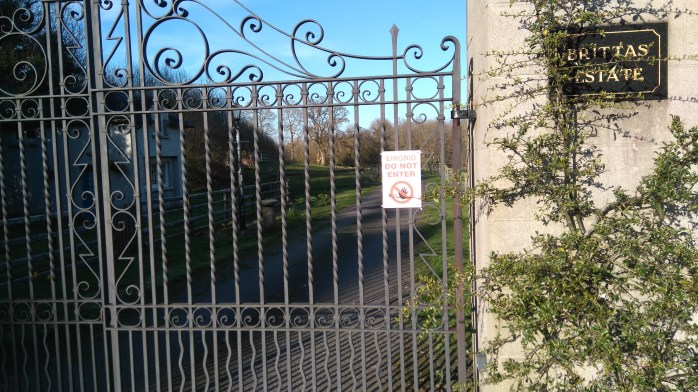
INTERCONNECTOR: BRITTAS ESTATE

BRITTASGATE.JPG

Entrance Gate and Gate Lodge at Brittas Estate, Nobber, Co. Meath, close to where the proposed power lines would pass  Pic: Michael Fisher

EFFECT OF EIRGRID’S INTERCONNECTOR PLAN ON BRITTAS ESTATE EXPOSED AT ORAL HEARING

MICHAEL FISHER Meath Chronicle Saturday 30th April (WEEK 7)

Probing questions to EirGrid by a lawyer acting for the Brittas estate near Nobber in Co. Meath have revealed what anti-pylon campaigners believe are several inadequacies in the planning application for the North/South interconnector. An oral hearing by two inspectors from An Bord Pleanála is now in its eighth week. EirGrid has said the detailed environmental impact statement it submitted has complied with the relevant Irish and EU regulations.

Michael O’Donnell BL acting for the owners of Brittas House and demesne Neville Jessop and Oinri Jackson asked EirGrid why no site specific details were provided regarding construction of the proposed pylons, the felling of a section of mature woodland, and the impact the proposed line would have on the views from a wing of the house built in 1732 and incorporating an earlier residence from 1672. The house was extended in the 18th Century and a ballroom wing, designed by Francis Johnston (architect of the GPO), was added in the early 19th Century. The house is located approximately 430m to the east of the proposed development.

Three ringforts are within 400m of the proposed line. According to an archaeological consultant for EirGrid, Declan Moore, these monuments will have their setting impacted on by the proposed development. The environmental impact statement explained that as much as was practicably possible the topography of the area had been used to keep impacts on the setting of Brittas House to a minimum. Mr Moore found that where the proposed development crossed the entrance avenue, there would be no views of the house and likewise in the vicinity of the house there were no views of the proposed development. But he added that there was the potential there may be views from some of the upstairs windows of the house, especially during the winter months. The impact on the setting of the house was in his view slight to moderate.

Questioned by Mr O’Donnell, Mr Moore said he had not entered the demesne as permission had not been granted but he had carried out from the public road a visual inspection of some of the three archaeological monuments inside it. He insisted that the development would have no direct physical impact on any such monument. He also repeated a number of times that there were no national monuments within the demesne.

This was disputed by the lawyer for the owners. He revealed that a ministerial letter had been sent out in July 1997 to the then owners referring to a monument in the townland of Brittas with details of preservation requirements.

At a previous module Neville Jessop explained how one of the access routes proposed by EirGrid to a pylon site would require concrete lorries to pass over an old bridge which had cracks in the stonework. He told the company the access bridge was not available because of its condition. Any repair work that needed to be done on the structure would require notification to the Minister for Arts Heritage and the Gaeltacht. A lawyer for EirGrid said on Tuesday it did not know the bridge had been closed for health and safety reasons.

The previous week Michael O’Donnell BL told the hearing sheer devastation would be caused to the Brittas estate if EirGrid’s proposed power line with pylons was allowed to proceed. He referred to the inadequacy of the EirGrid documentation and claimed it was not acceptable under Irish planning law or EU rules. The company was treating the public with a level of contempt, he said.

Mr O’Donnell pointed out that Brittas was a protected structure equal to any other great Irish house such as Castletown, Carton or Russborough. Every structure in the demesne had the same status. It was an extraordinarily important piece of landscape with its own eco system. It was about to be devastated by a 400kV line traversing it, going through a section of mature woodland that would have to be removed.

This part of the oral hearing has been devoted to specific landowner and public issues from Co. Meath and near Loughinlea mountain in Co. Cavan, a popular tourist area.

EirGrid was accused of spending its money on things like sponsorship of the Virginia pumpkin festival, the GAA (under 21 and Australian Rules), two local radio current affairs programmes and advertising in local media. A company spokesman said a key finding of a number of reviews of EirGrid’s operations and engagement with the wider community had shown the need for effective communication of the necessity for grid infrastructure to ensure a safe and sustainable electricity supply. As part of the company’s strategy to address this, it was placing an emphasis on improving how it communicated its role, including through advertising and sponsorship.

David Martin said “We welcome the strong engagement from landowners, public representatives and community members at the An Bord Pleanála oral hearing. The oral hearing provides an opportunity for all relevant information to be brought before An Bord Pleanála, and ensures that their concerns are addressed. We encourage all landowners and concerned residents to attend over coming weeks. If you would like more information on any aspect of the project, you can talk to our team on the ground, or drop in to our offices in Navan or Carrickmacross. Contact details for our Community Liaison Officer Gráinne Duffy and Agricultural Liaison Officer John Boylan are at www.eirgrid.com. Since submitting our planning application for the interconnector in June 2015, we have continued to engage with communities in Meath, Cavan and Monaghan.”

EirGrid said the consideration of alternatives to an overhead line, including underground cables (both cross-country and along public roads), had been outlined its planning application. This has relied on a suite of reports prepared by the government, third parties and EirGrid itself. One of these, prepared by PB Power, showed that an underground cable option is considerably more expensive, at €670 million more that overhead lines.

The government-appointed Independent Expert Commission found that an underground cable option would be €333million more expensive. The reason for the difference in these figures was that the PB Power report studied a cross-country option, while the IEC report considered a roadside route. The company said a further detailed study of roads in the project area had shown that the use of the M3 and local roads was simply not suitable for the interconnector project.

When considering alternatives for the project, cost was just one factor. Underground cables would also not be as reliable as overhead lines, causing greater complexity and greater risk. EirGrid said it also studied the use of disused railway lines and a subsea option for cables but they were not viable options for this project.

The presence of the North South Interconnector, should it receive planning permission, will provide benefit to communities in the North East, according to EirGrid. As with a bypass, the project would provide an alternative route for power flows, freeing up power in the region. This would allow large businesses to tap into the line, providing an opportunity for local investment and employment.

INTERCONNECTOR DAY26

DAY TWENTY-SIX

This section involved landowners and groups from Co. Monaghan

SEAN DUFFY, Drumguillew Lower, was represented by his mother Mary Duffy as he is in Australia at the moment. He had inherited ten acres of land from his uncle in February 2011. There had been no contact with EirGrid about their plans to build two pylons and a power line near the dwelling house. Mrs Duffy said there was also a plan to put two pylons on her daughter’s land at Drumhowan, one of which EirGrid had now moved across a ditch onto a neighbour’s land.

NIGEL HILLIS of the County Monaghan Anti-Pylon Committee said there could have been another technical solution without moving that particular pylon. He claimed that EirGrid had been in breach of the Aarhus Convention on public consultation and EU directives. The proposed line design stretched back to 2011 and was followed with a preferred solution report and then a final line design that the EirGrid board had approved according to the Chief Executive. The company had years to get it right and after all this they had decided to move eleven of the pylons on the proposed route when the planning application was submitted last year.

BRENDAN MARKEY, Greagh, was represented by Sean Gilliland. He did not want pylons on his land. Cllr Gilliland said the proposed access lane for construction of two pylons on Mr Markey’s land was only 8’6” wide with a water pipe below it and two other pipes alongside. It would most certainly be damaged if heavy machinery used it.

The lane was very special as there were visible badger tracks and badger setts that were monitored by the Department of Agriculture and NPWS. The power line would be a ruination of the rural countryside and way of life.

GABRIEL MOONEY, Greagh, was joined by his father Bernard in making a submission. They had huge concerns over the project. They lived 200m up a lane that EirGrid planned to use to access one of the pylons for construction. The lane was in frequent use by family members daily and they would be disrupted if heavy machinery was going to use the lane. He asked who would be responsible if there was an accident on the lane, or if it gave way under the heavy loads that would have to pass along it. Could EirGrid guarantee the safety of his young children while the proposed work was taking place? He also wondered if the company could guarantee that they would not in their lifetime experience any health effects from living beside the proposed high voltage lines.

He expressed concern that their homes and properties would be devalued and worth next to nothing in future. Nobody would want to live near these grotesque pylons, he said. The lines would destroy totally the aesthetic appearance of their locality.

He concluded: “We are all proud Irish people, proud of our democracy. We have the power to elect our public representatives; we have the power to decide if there are changes to our Constitution. We express our democratic right by voting and we accept the outcome. The people of Monaghan, Cavan and Meath had voted unanimously against this overhead power line. EirGrid should accept this fact and scrap this proposed project”.

LEO MARRON, Greagh, said the pylons would be an attack on our freedom to live according to our own traditions and own choices, currently and into the future. We could no longer sell our property or hand it onto the next generation. We could not develop it as a viable enterprise and make more of it as previous generations did.

I left my parcel of land with an estate agent in February and told him to be open and honest with all inquiries. The land was advertised locally and internationally but there have been no offers. Such is the mistrust that EirGrid have instilled among the people of our community that I took the land off the market as we feared EirGrid would use the opportunity to walk the land and gather information for their own purposes. I have no doubt that the threat of this pylon has affected the value of my land and other properties in the local area.

I face particular challenges with a disability that means I must meticulously plan my work days and weeks ahead and ensure I have adequate support to carry out my daily duties. EirGrid interference would interrupt this planning., becoming another obstacle I could live without and making farming almost impossible for the duration of the construction. The two months stated by EirGrid are only the tip of the iceberg though, as there will be continuous interference by EirGrid for a further three years and ongoing into the future. This will undoubtedly be the end of my way of life.

I have worked for years to increase the productivity of my land, digging shores to dry the land. Still it is soft in places and heavy construction would damage these land drains and undo the work I have laboured so hard over. Can EirGrid inform us here as to the weight of the pylons and measures they would take to mitigate the damage caused to my land? Or are EirGrid even aware of these factors? It appears that EirGrid have not properly assessed the land and have no idea really as to the possible consequences of building a huge pylon in my field. Also I wonder are EirGrid aware of the dangerous blind spot that exists on this apparently straight stretch of road? All households here are aware of how devious this stretch of road is. The heavy construction vehicles and increased traffic that EirGrid will bring will compound factors and make a fatal accident all the more likely. EirGrid have boasted of their strict timetabling of construction. This evidently could place pressure on contractors to reach deadlines and take short cuts on health and safety: which should come first? With so many homes surrounding the construction site I do not trust EirGrid to put the interests of families and children first. Rather it seems that profit and scheduling comes before the people and community. I wish to draw to your attention an article in the Farmers Journal dated October 11th 2014 which described the ESBs laissez-faire approach to pole removal that damaged a contractor’s harvester and left a hole in his pocket. It seems to me that EirGrid’s approach to planning and execution of these pylons will be no better and could leave many farmers out of out of pocket due to similar damage caused. EirGrid have forfeited all confidence in their abilities and no farmer would agree to allow them onto their land to destroy it.

The field on which EirGrid plan to construct this pylon is flat and poses a real and significant eyesore to a number of neighbours. It is cruel and unfair that their homes too should suffer the indignation of this towering pylon and the loss of value to their homes. To EirGrid this is all business and nothing personal but to us it’s very personal.

I also have more land in Ardragh where I am being affected by construction between pylons 190 and 191. The shared lane serves many farms and homes and as such heavy vehicles would pose a significant risk. Damage to the surface of the lane would be inevitable and have unfair and lasting consequences for those who rely on it. Furthermore there is a well that is under the lane which has historical significance that leads back to the famine era and has been minded for generations. I have an uncle who will turn 100 this year and used this well for drinking water from a child. Heavy vehicles would destroy this important piece of heritage and history and I doubt EirGrid are even aware of its existence. There are in fact several other errors in the proposed plan I could point out to EirGrid, but I would feel foolish pointing them out to such educated men.

ANN MCARDLE, Brackley, was represented by her son COLM MCARDLE. He said they were not happy about having pylons on their land. In their original application EirGrid had proposed an access route for construction that went through an embankment onto the pylon field. The access was then changed through their back yard. They wondered how this would affect the milking of cows and moving them around the farm.

BYRNE FAMILY, Brackley

Briege Byrne said the family home sits between proposed Pylon 162 and Pylon 163, The overhead power lines would run for 80 metres along our land and right over our sheep’s house. The overhead power lines will be 62.5 metres from our family home. This is the only land parcel we own and it is home to our livestock.

EirGrid wants to access our land to facilitate stringing of the overhead power line – they do not have our permission to enter our land.

EirGrid wants to use our private entrance to access our land with large, heavy construction machinery. They will have great difficulty navigating in a slope, off a busy main road, on a bad bend; onto wet boggy soft ground all year round which floods regularly.

Quote from EirGrid:

“The 0.7 hectare land parcel with beef enterprise is located in Brackley Co. Monaghan. The sensitivity is medium. There is a yard/farm building located approximately 30 meters north west of the proposed overhead power lines”.

The land parcel is not 0.7 of a hectare; it is only 0.5 of a hectare of land. The farmyard/building is not 30 metres from the overhead power lines it is right under the power lines.

EirGrid propose that they will need 65 metres of an access track to facilitate stringing of overhead Power lines at a loss of 10% of the land parcel. “Pre-mitigation the impact is moderate adverse”.

We use our field by split grazing, so the field is divided in half. The half EirGrid wants to access has our sheep’s house – which will have the overhead power line running over it – and is used to summer graze if possible as this is when it is at its driest, although our sheep will be rotated on it all year round as required.

“The construction disturbance impact is short term (generally less than 12 months) the magnitude of construction impact is low and the significance is slight adverse”.

How can EirGrid say it is short term? This is our home, our lives, our animals; the impact has already commenced and shall be engraved on the land for an eternity. EirGrid want access for 12 months. How are we going to split graze? How are we going to feed our sheep? How are we going to access our sheep’s house? To say the impact is low is hurtful and demoralising.

EirGrid say “There will be a low level of disturbance”.

This is not a true reflection. There will be a high level of disturbance. When EirGrid are finished we will be unable to use our field, we will be unable to feed our sheep, we will be unable to house our sheep and after 12 months of large heavy construction machinery, the land will be more like a building site than a grazing field – it will be ruined and we will be left with our home 62.5 metres from the overhead power line with a view of pylon 162, Pylon 163 and Pylon 164. We have 80 metres of overhead power line on our land, land we cannot use, left sterile due to the health risks this poses on us and our animals along with the constant humming and cracking sound of the overhead power lines. We see all of this as a high level of disturbance.

“There is a high impact on farm buildings and their potential expansion due to location of power lines 30 metres from yard”.

Our farm building is our sheep’s house and it is right under the power lines, this means our sheep cannot be housed in this area. Where shall we house our sheep as we only have a small parcel of land, which means we cannot build on our land.

“The impact magnitude is high and the significance of the residual impact is moderate adverse”. This overhead power line will have an immediate and detrimental impact on our health and the value of our home and land. EirGrid say this will have a low environmental impact. How can they say this? They have not stood on the land and how can they say what the environmental impact an overhead power line will have?

“Hedges land trees may be cut back within 30 metres of the overhead power lines”.

What about the hedgerow on our land? The power lines shall be running over this hedgerow. The hedgerow is home to wildlife and offers a feeding ground for many lives such as birds and bats. The river beside our land runs alongside this hedgerow. What about all the fish and creatures in the water? How can anyone say that there will be a low environmental impact when hedgerows shall be removed and rivers disturbed?

As well as the ground animals and birds we must also look up and realise that we are also on the flight path for swans and ducks. Just over the field from our home lies Barraghy Lake. The swans and ducks fly back and forth on a regular basis. These wires shall be in their direct flight pathway. We are worried that these birds may end up in the wires.

In short this is our field gone, our land gone, no grazing for our sheep, no roaming for our hens, the hedges gone: which has a knock-on effect – no birds, bats rabbits to name a few – the river that runs along the hedge tampered with and in effect gone.

What about our health and the health of our livestock? Our sheep are so close to this overhead power line. How can we be sure they will be safe? Could this cause the sheep to miscarry, have lambs born with deformities? Also our hens roam freely through the field. What about their wellbeing? They supply the family home with eggs – will we be able to keep our hens? Will we be able to consume their eggs? Our spring well is 50 feet from the overhead power lines – can we still use this water? These questions highlight that the environmental risk is high rather than low.

My child visits the family home on a regular basis. How can I visit the family home knowing that I run the risk of putting my child’s health at risk for e.g. leukaemia and other disorders? I cannot do this to the next generation.We should be protecting them not putting them at risk. Life is precious and should be cherished not put at risk because EirGrid want to erect pylons.

Along with my child’s physical wellbeing I am also extremely concerned about the physical and mental wellbeing of my parents, they have reared their children and put a lot of time and love into building a safe environment for me and my siblings and for us to be able to bring our children back to the family home, but this will be shattered. From the day that talk of this interconnection commenced it has had an impact on our emotional wellbeing. We are upset and stressed due to the possible erection of this interconnection. We will have nothing left by the time EirGrid are finished. We also need to be aware that there is a physical strain placed on every single person who is here today and is affected by EirGrid’s proposals. We can see the physical strain on people. We also need to be mindful of the mental strain this project is placing on people; this is very concerning as we sit and listen to families plead for their lands to be left untouched. We are getting a taste of how people feel as we listen to the stories of how a power line can rip through a person and put them under emotional and physical strain. Is it worth putting people under this pressure and strain? The answer is NO!

PEADAR CONNOLLY, Chairman of Lough Egish Community Development Company Ltd that runs the Food Park said overhead pylons would have a detrimental effect on the wellbeing of all in the Aughnamullen community. He explained the history of the food park which he said provided food to people from all corners of the island, from meat to dairy to eggs and dry foods. He pointed out that he had difficulty accessing any environmental impact statement on EirGrid’s web page.

(This was immediately checked by the company’s representatives who told the inspectors all the relevant EIS information had been put on a dedicated website set up at the request of An Bord Pleanála and which was found to be working properly).

Mr Connolly said he was extremely concerned about the adverse effect the overhead power line would have on the food park and the livelihood of local people. EirGrid, he claimed, had failed to demonstrate the safety distance for the food industry and employees regarding EMF emissions from 400kV power lines. He feared that a stigma might arise from the location of their food products not far from the high voltage cables and once it arose then they would be out of business. It was a risk he was not willing or able to take. He urged An Bord to ignore any pressures that might be exerted on them to fast-track the proposed project and to be mindful that the health and wellbeing of all citizens in the affected areas and generations to come were in their hands.

INA and CHARLES HEGAN, Brackley, made a submission in which they said the EirGrid plan would have a number of disastrous consequences for their farm, house, family and livestock. One pylon would be close to the front of their house. There would be a severe visual impact. There would be an immediate and detrimental effect on the value of their farm. The overhead cables would create a substantial risk to using farm machinery. There had been no proper consultation with them, she said.

DOMINIC HARTE, Brackley, also expressed concern about devaluation of his home and property and the visual impact of the pylons. He also questioned whether sufficient provision had been made for flight diverters on the power lines to take account of the flight paths of wildlife at two local lakes. He also enquired about the procedure that would be used for inspecting the power lines, if they got approval.

MICHAEL HALPIN, Barraghy, was represented by Briege Byrne. My home sits between pylons 163 and 164. The power line will run on the edge of my land. EirGrid propose to access pylon 164 by using a lane which is owned by my neighbours Mr and Mrs Charlie Hagan. This lane runs parallel with my own driveway and on past the front door of my house into Mr Hagan’s field where pylon 164 is to be erected. This lane is not capable of taking heavy farm machinery as it is soft ground that runs along a river. From the picture you will see that the edge of the lane which is not defined by a hedgerow is about 4 feet from my front door. This would pose a serious problem for EirGrid. How do they propose to turn in off the road on a bend, go up a soft narrow lane 4 foot from my front door with heavy construction machinery? It is not possible. The machinery would be rubbing off my porch, I would not be fit to use my front doorway. EirGrid will need to cut down my mature trees which are very close to my house. These mature trees are home to a lot of wildlife and bats. This is not acceptable.

Over the last number of years I have spent a lot of time and money updating my house and land. These pylons and overhead power lines are so close to my home that both my home and my land would be worthless, devaluing everything I have worked for. It would leave living in my own home very hard due to the impact on my health and wellbeing.

PAURIC CONNELLY, Barraghy, was represented by Sean Gilliland. EirGrid had not convinced him that there was no medically adverse activity arising from the pylons. The proposed line would be a desecration of the landscape.

Cllr Gilliland asked if EirGrid could inform the hearing how much his land would be devalued if the project was allowed. He had very real concerns and wanted to know if he would get planning permission for any sites to provide new homes if they were near the power lines.

EILEEN MCGUIGAN a neighbour said her home was her castle. She had six grandchildren and was concerned about possible health hazards if a pylon was built nearby. “No pylons—NO-NO-NO!” she stressed. She was applauded as she concluded.

PHIL GEOGHEGAN, Drumillard, was represented by Sean Gilliland. Mr Geoghegan shared access to his holding with seven other people. It was a private lane and they had all contributed to tarring it and contributing to the upkeep. If damage was caused by contractors’ traffic using the lane for access to a pylon construction site, he wanted to know who would pay for it? Mr Geoghegan was totally and utterly opposed to the proposed pylon on his land. Cllr Gilliland pointed out that there were already three power lines crossing his farm and now there could be seven or eight. There would not be much room left on his land holding. He also mentioned that problems had arisen regarding compensation at another infrastructure development in the county.

PATRICK MARRON, was also represented by Sean Gilliland.

Mr Marron, a farmer, had not received any information to date from EirGrid regarding a plan to use part of his land as a guarding location for one of the pylons. He was anxious about this and wondered how EirGrid had managed to put in a planning application without conculting the person who owned the ground for the planned tower. Cllr Gilliland also pointed out that the proposed access route belonged to someone else, a Mr Connolly (see below).

ROBERT ARTHUR of ESB International said in many instances access to pylons went across third party land. He would endeavour to get the details regarding that particular holding.

SEAN GILLILAND pointed out that this landowner was known to EirGrid as maps had been sent to him regarding the previous application. So the company was very well aware of the owner. There had been correspondence with Mr Marron in December 2013, so this was not a case where EirGrid was not aware of who owned the parcels of land.

PATRICK CONNOLLY, Tooa, a landowner, told the hearing he had not received any communication from EirGrid regarding a proposed access route to pylon 170 on the land of the Ward family. When this divergence of opinion became clear a coffee break was called by the presiding inspector.

Upon investigation, EirGrid lawyer Jarlath Fitzsimons said a letter had been sent by tracked mail to Damian and Patrick Connolly on 29th May 2015. It was delivered on to an address at Tooey, Shantonagh, Castleblayney at 9:31am on 4th June 2015, according to a postal track and trace.

Cllr Gilliland said it was strange that a separate letter had not gone out to the two names on the holding, if two parties were involved. He continued to press for information about the proposed access routes that were being used to pylons. One of them, he said, was so overgrown that you could not even wheel a wheelbarrow in there, let alone deliver any concrete unless it was in a bucket.

Following this exchange EirGrid introduced new information regarding seven access routes and eleven minor changes arising from map inaccuracies.

JARLATH FITZSIMONS SC for EirGrid said the application before the Board was for an overhead line and there was no proposal to underground the line. Let’s be clear about it, he told the inspectors. He also said a number of issues raised regarding land valuation, health and tourism had already been answered in previous modules.

INTERCONNECTOR DAY24

Michael Fisher  Northern Standard 21/04/16 p.14

More Monaghan Landowners

ANN MURRAY from Lemgare expressed her strong objection to the erection of giant pylons across the unspoilt drumlin landscape of Monaghan and neighbouring counties.She said the 400kV line was being foisted upon her family and neighbours. It was a situation over which they had no control and no choice. She said the line would inhibit future development of sites in the area for family members. Their property would be devalued.

There would be an impact on wildlife such as swans, buzzards, badgers, snipe and the protected marsh fritillary butterfly which was to be found in Drumgallon bog. There would be issues over rights of way. There was a health issue. Burying the power line would mean it would be safer and more acceptable to local communities and it would have a lot less impact on health, property devaluation and visual impact.

Her late parents had lived in Lisdungormal all their lives and called it a little bit of heaven here on earth. But with overhead power lines it would certainly change the lives of her family and neighbours.

She pointed out that Lemgare Rocks was a very important part of their heritage and the heritage of county Monaghan. Yet EirGrid wanted to place giant pylons on top of these rocks. Lemgare Mass Rock was also listed as an important piece of history and was an important spiritual and religious site for the community.

There were a number of abandoned mine shafts in Lemgare Rocks and throughout the local area. She wondered if EirGrid had taken this into consideration with regard to construction impacts causing possible collapses of tunnels and collapses of land.

She went on: “From our garden we can see the beautiful scenic view of the Lemgare Rocks and the natural drumlins of County Monaghan in a setting that is breathtaking – a landscape that has taken hundreds of years to mature to its current appearance.

Placing pylons in the visual foreground will detrimentally affect this tranquil setting and is totally inappropriate for a rural landscape. I also believe that these pylons will also produce noise which we do not want to be subjected to, but won’t have an option if permission is granted.”

She pointed out that the pylons would also cross over the pathway of the Monaghan Way. On a summers day you will see lots of hikers walking the route, but if this project got the go- ahead, no-one would want to walk there. She did not understand how EirGrid expected to use narrow laneways to carry construction machinery weighing up to 30 or 40 tonnes bearing a load without having a negative impact.

Multiple loads of concrete and steel would need to be reversed into these laneways and this would not be possible as the local roads were far too narrow and the laneways were only cart tracks with no foundations to withstand multiple heavy loads.

Placing pylons on the side or top of drumlins would pose a health and safety risk for farmers using farm machinery while working their farms. Coupled with this during the construction phase of the project there would be major health and safety risks both to farmers, their families, their livestock and the general public and indeed the workers erecting these pylons. The only way to eliminate such risks was to place these power lines underground.

“Eirgrid have been asked question after question over and over again and we are still waiting on answers and they have lists and lists of unanswered questions from the people of the North East. To us it looks like we are second class citizens”, she said.She called on EirGrid to provide in detail an adequate assessment of the evaluation of alternative routes for this proposal.

Mrs Murray concluded: “Why should my family and the people of County Monaghan, Meath and Cavan pay an unacceptable social and economic price for supplying power to the rest of Ireland and subject themselves to totally unacceptable potential heath risks and also to a total devaluation of our properties which we have worked hard to build and maintain. I trust that An Bord Pleanála as an independent public body will have the courage to take our observations into consideration when making a decision on this project.”

ARLENE BRENNAN from Tasson, Clontibret, said her main concern was in relation to health, as a mother of three young children. She said studies had shown that exposure to EMFs can increase the risk of childhood leukemia. This was any parent’s nightmare to have to live close to these lines with constant worrying about what might happen in the future. Each day of their lives they would have to pass under them on visits to school, football and Irish dancing. Would they now have to consider not going to social activities?

The next concern was the devaluation of their property and farm, which she and her husband worked extremely hard to build it up. In the event that their property might have to be sold, who in their right mind would buy a house or farm near power lines or even an enormous pylon? She also had concerns regarding possible planning permission which might be needed for future generations.

The visual impact of this proposal would be catastrophic, she said. “We have the most beautiful scenery in Co. Monaghan with our rolling drumlins and beautiful lakes. The visitors that call to our house are blown away by the views and beautiful scenery that they can see. If this proposed interconnector gets the go-ahead overground, it would mean that as I open my front door or even glance out my window, the first thing that will catch my eye is a massive steel structure hovering over the skyline.”

Mrs Brennan said she had concerns regarding animal health and in relation to wildlife, something that was very important in rural Ireland. All wildlife needed to be protected. She regularly saw swans flying overhead and on occasion had spotted whooper swans near the lake. It would be awful to see these birds being destroyed, she told the hearing.

She believed the area would be adversely affected by these proposed lines and pylons with regard to tourism. Visitor numbers most likely would decline, as most tourists were fishermen, who travelled by car throughout our drumlin landscape.

The proposed power lines were just passing through Co. Monaghan. Initially EirGrid had tried to fob them off that the power would be of good benefit to them. But now the truth had been unearthed that this was of no benefit to the rural tight-knit community where people actually cared about each other. In her opinion EirGrid did not care about any of them and they were being treated as second class citizens.

EirGrid did not care how this should work; they just wanted to bully their way in across ordinary, decent people who just like her were trying to get on with their lives, work hard and rear their children the best possible way they could. This line was just a supply to power Northern Ireland and the authorities there had not made provision for security of supply within their own jurisdiction, she pointed out. The bottom line was if these proposed lines had to be installed, they must be placed underground.

MATTHEW GORMAN is an agricultural contractor from Tasson. He said the line would form a horse shoe right around his family’s home. He came to the hearing to object totally against overhead lines and ugly pylons in their area on the grounds of health, visual impact, property devaluation and loss of business.

“As an agri contractor I know the lands and laneways in the area like the back of my hand. Some of the narrow laneways and gaps they propose to use for access for construction are only fit for horses and carts. We had to purchase fold-up machinery to access these lands. Has EirGrid taken into consideration the effect high powered lines have on modern machinery?

We have invested heavily in the last number of years. We use a GPS navigation system to measure our work. It will not work under high voltage lines—that’s a fact. The spinning rolls of plastic in the twin satellite wrapper generate electricity. When it comes in contact with a high voltage line it can blow the monitor in the cab €2800 to replace. There’s a brain in the balers when they operate. If there is a jump in frequency under the power lines it can cause a short, blowing the brain and possibly the monitor in the cab cost €4500 in total. In fact when you cross under a power line of smaller voltage the monitor freezes, having a massive effect on the operation.”

Mr Gorman said tractors had an electronic gearbox powered by an ECU. It was known that power lines had a big effect on them too. If this was to go ahead it would have a massive effect on them financially, not counting the downtime working around pylons and the danger to himself and the men manoeuvring around pylons on the side of a hill in the drumlins of the neighbourhood.

He went on: “I think it is desperate that EirGrid think they can just walk over communities and farmers who have been there for generations. Before you make your decision on this, Inspector, think of this going through your back garden and your community. Would you give them permission or would you stand up for family, property and neighbours? We’ll not stop until these lines are buried.”

MARTIN MCGARRELL, Cashel, Annyalla, in an individual submission said the proposed pylon development raised issues about the effects on the health of humans and animals; health and safety; the impact on tourism and the equality of treatment with other parts of the country which he believed Monaghan residents were not being shown. The county would not benefit from the development of an overhead line as there was no sub-station planned by EirGrid along the line. In the west, the story had changed regarding development of the electricity grid and an overhead line had been abandoned and there was talk of an underground route instead. All the money wasted so far in the nine years since the project was first proposed would go a long way to filling the gap between the cost of undergrounding against an overhead line.

Mr McGarrell expressed concerns regarding the impact on wildlife such as buzzards and badgers. He showed the hearing a picture of a badger hole he had taken recently close to where two pylons would be built. The grassland area close to Tasson bog was environmentally sensitive and could take years to recover if it was disturbed.

He said working under the power lines would be dangerous for farmers, such as when they were spreading slurry. The pylons would destroy the landscape and would have a profound effect on tourism. He questioned the proposed access route for construction of two of the pylons which he said would require machinery to go up a narrow lane and across a hedge and sheugh where EirGrid would have to put in a bridge. The proposed development would affect three farm businesses and he wanted to know who would compensate farmers if cattle got a disease.

NOEL MCGARRELL questioned EirGrid about what provision the company would make for him to continue farming while pylons were being constructed. He said the company had not come to him for permission to use access routes they had chosen using aerial photographs and maps.

MARK LEATHAM, owner of land beside Mr McGarrell’s, claimed that no information had been sent out by EirGrid to landowners and that they had been excluded from the consultation process. He wondered how contractors working on behalf of EirGrid would manage to get concrete that would first be offloaded into dumper trucks up to the pylon construction sites without spilling some of the load over the fields.

JOHN MCGUINNESS an 80 year-old farmer from Annagh, Annyalla said he had a 20 acre holding, spread over three-quarters of a mile. One pylon would be beside his house and another near his farmyard. He claimed EirGrid were taking land off people through the back door. He questioned how one of the towers would be built when it would have two legs built into a rock and the other two legs 15ft lower down in a bog.

CIARAN KERR, his neighbour, said the overhead line would be a monumental insanity. It had no community support, despite EirGrid’s sponsorship of events. None of their children when grown up would want to live in a house close to a power line. They would want to move elsewhere. Was EirGrid going to compensate them for that?, he wondered. They had been saying all along they wanted the line out underground but all they got was a ‘No’. Undergrounding was the future and overhead lines were the past, he said.

Mr Kerr also asked the company’s representatives to explain what would happen if ice formed on the power lines and whether the weight would bring them closer to the ground because of sagging. A simple engineering question, he said, to which he wanted to know the answer.

COLETTE MCELROY claimed that EirGrid had moved a proposed tower closer to their home in the latest proposed route compared with the previous application. She spoke about the effect the power lines and the noise they could emit would have on her son, who has autism.

EIRGRID RESPONSE

EirGrid said it would arrange to bring back its environmental expert at an agreed date to answer questions that arose about the sound from power lines and the possible effects on children with autism. The company also provided some responses to invidual landowners about the proposed access routes for constructing pylons and details of machinery that would be used to carry out the work.

Robert Arthur of ESB International explained how concrete lorries would arrive at a suitable location on the public roadway close to the pylon sites. The concrete would then be offloaded into tracked machinery or a wheeled dumper truck. It would not be filled to full capacity. Shuttering would be used at the side to ensure that the concrete did not spill out when it was traversing laneways and fields. He said the type of machinery available would be able to go along narrow lanes and they would be cutting hedgerows to ground level to provide access to some sites.

EirGrid engineering consultant Tom Cannon explained that a traffic management plan would be drawn up by the contractors for the access routes. Flag men would be posted at various points to communicate with the drivers of vehicles and liaise with landowners about traffic movements. At one of the pylon sites in the area near Clontibret, approximately 33 lorry loads of concrete would be required for building the tower foundation. The deliveries would be spread out over three days.

A lawyer for EirGrid Jarlath Fitzsimons SC explained that the company’s practice had been to engage with land owners regarding access to land once planning permission had been granted. Statutory powers for access would only be used as a last resort.

Regarding a claim by Mark Leatham that there had been no contact with the landowner, Mr Fitzsimons said there was a comprehensive record of correspondence with the person who was the registered landowner, now deceased. A search of property registration the previous day showed the name of the owner had not yet been changed.

EirGrid landscape consultant Jeorg Schulze was asked to explain why pylons had been located in some cases close to houses. But he said they had were within the recommended distance from the line. He was asked about photographs that had been displayed to the inspectors showing panoramic views from the top of hills that would be spoilt by the pylons.

Mr Schulze said the photomontages he had produced were all taken from public roadways, in accordance with international guidelines. Asked about some of the residential impact assessments regarding what could be seen of the proposed power line from a particular house, he said the methodology used had been consistent both in the Republic and in the North.

Regarding compensation to farmers for any losses, William Mongey of EirGrid said there was a code of practice in place between the ESB and the IFA. This set out their policy throughout the country. The terms of compensation for farmers on whose land a pylon was being erected were described in an earlier module.

On the question of ice on power lines, Robert Arthur of EirGrid said there were no national or EU design standards requiring a particular ground clearance for ice loading. The standards were for normal weather. Ice loading had therefore not been factored into the figure for clearance of the wires above the ground.

Mr Arthur also said he was confident the type of leg extensions the ESB had for latticed steel pylons would suffice for building the tower in the area where Mr McGuinness had expressed concern. They could be used for two of the four legs on the lower side of the tower foundation.

The hearing will sit on Monday and Tuesday of next week when it will continue to hear submissions from Monaghan landowners.


INTERCONNECTOR DAY23

MARTIN MCGARRELL from Cashel, Annyalla, explained he was acting as spokesperson for the Co. Monaghan landowner group consisting of 115 landowners who were totally opposed to pylons on their lands. This represented 92% of landowners in the area stretching from border at Lemgare to S. Monaghan almost to Cavan border.

As had already been pointed out, 99% of people who attended three open days in Monaghan in May 2013 indicated they had no acceptance of the current project. This remained the case despite the vast amount of money EirGrid had spent trying to infiltrate our communities by way of sponsorship of local radio stations and the GAA.

This advertising in the local media which had been ongoing since the application was lodged in June 2015 and particularly intense since this oral hearing began is prejudicial to a fair outcome and totally contrary to natural justice, not to mention a complete waste of taxpayers’ money.

They may be here to talk but the talk had been of rebuttal, denial, stonewalling, constant changing of evidence, filibustering, legalistic and technical jargon and point blank refusal to supply reasonable information that was requested.

EirGrid say that 25% of the lands have been accessed and surveyed but yet no maps have been produced to prove this. We firmly believe that nowhere near 25% of lands were accessed in Monaghan and if they were then it was done by trespass without the knowledge of the owner.

The landowners are full supportive of the stance taken by both CMAPC and NEPPC when they withdrew from part one of the hearing. Both the Cavan/Meath landowners and Monaghan landowners unanimously endorsed this stance at hugely attended meetings in Navan on Holy Thursday and Aughnamullen on Easter Monday.

What EirGrid was allowed to do by way of submitting maps in the EIS without firstly informing the landowners concerned was a total insult to not only the 25 affected landowners but to all the landowners in general. An insult to one is an insult to all.

To compound this insult the amended maps were delivered some days and indeed weeks later in the case of the first six by courier on Good Friday and Easter Tuesday, after they had been presented to this oral hearing, without any consultation with the landowners whatsoever.

MARIA FITZPATRICK from Lemgare claimed people in Monaghan were not being given the same treatment as the rest of the country where partial undergrounding of electricity lines was being allowed. She expressed concerns about the access route EirGrid proposed to use to get to the proposed pylon site. She said it would bring construction traffic along a laneway lines with hawthorn hedges and it was not suitable for that. She also wanted to know what would happen to the horses she kept when work on the towers was taking place. They would not have access to water if the laneway was blocked. They were also sensitive animals and she was concerned for their safety. She said it would also affect her husband’s business. 

MARTIN TRAYNOR from Lemgare said the power line would have a devastating impact as it would split his farm in two. He would have no choice but to travel under the lines several times daily to carry out his work. His elderly mother lived next door and her residence would be about 44m from the outer conductor of the line. He had a shed that was less than 30m away from the outer conductor of the line.

Mr Traynor claimed that the construction of the foundations for one of the towers had the potential to ruin the spring well from which he drew his water supply. There would be knock-on impacts for his farming enterprise and suckler cow herd, depriving him of earning a living from the land.

PHILIP AND ANNA COLLINS, Lisdrumgormley, had their submission presented by Jim McNally. They had expanded their our poultry house egg production in 2011 to accomodate 32,000 laying hens. However this new poultry house had not been included on the developer’s maps in the planning application.

EirGrid had admitted their property was very highly sensitive in the EIS, but had made no attempt to change the route, or to actively engage with, or accommodate them at any time in a positive or constructive manner. NIE in the North had redirected the line in South Tyrone near the Moy to avoid poultry housing.

No great effort was made by the developer to look at putting this powerline underground using DC technology along national roadways which would have avoided a very high sensitive poultry egg producing unit such as theirs. The omission of the new poultry unit from the EirGrid maps in their view rendered the EIS and the planning application incomplete, given that their poultry business should be classified as “very highly sensitive” in line with EirGrid’s own parameters.

Mr Mc Nally also presented a submission for KATHLEEN HUGHES of Lisdrumgormley. She expressed concerned about the real potential disturbance to the animals on the family farm and the access restrictions to the land in real terms during construction. She was concerned about the ongoing interruption to farming work and the potential for the spread of disease among animals. The access route for proposed pylon 109 was near a bend, off a local road, and would require the removal of wire fencing and hedgerow and bulldozing, to level off high ground and uneven surfaces in the field. No clarification on how each of these issues would be addressed had ever been explained to her.

INTERCONNECTOR DAY22

This dealt with the potential effects on the Brittas estate Co. Meath

Probing questions to EirGrid by a lawyer acting for the Brittas estate near Nobber in Co. Meath revealed what anti-pylon campaigners believe are several inadequacies in the planning application for the North/South interconnector. EirGrid has said the detailed environmental impact statement it submitted has complied with the relevant Irish and EU regulations.

Michael O’Donnell BL acting for the owners of Brittas House and demesne Neville Jessop and Oinri Jackson asked EirGrid why no site specific details were provided regarding construction of the proposed pylons, the felling of a section of mature woodland, and the impact the proposed line would have on the views from a wing of the house built in 1732 and incorporating an earlier residence from 1672. The house was extended in the 18th Century and a ballroom wing, designed by Francis Johnston (architect of the GPO), was added in the early 19th Century. The house is located approximately 430m to the east of the proposed development.

Three ringforts are within 400m of the proposed line. According to an archaeological consultant for EirGrid, Declan Moore, these monuments will have their setting impacted on by the proposed development. The environmental impact statement explained that as much as was practicably possible the topography of the area had been used to keep impacts on the setting of Brittas House to a minimum. Mr Moore found that where the proposed development crossed the entrance avenue, there would be no views of the house and likewise in the vicinity of the house there were no views of the proposed development. But he added that there was the potential there may be views from some of the upstairs windows of the house, especially during the winter months. The impact on the setting of the house was in his view slight to moderate.

Questioned by Mr O’Donnell, Mr Moore said he had not entered the demesne as permission had not been granted but he had carried out from the public road a visual inspection of some of the three archaeological monuments inside it. He insisted that the development would have no direct physical impact on any such monument. He also repeated a number of times that there were no national monuments within the demesne.

This was disputed by the lawyer for the owners. He revealed that a ministerial letter had been sent out in July 1997 to the then owners referring to a monument in the townland of Brittas with details of preservation requirements.

At a previous module Neville Jessop explained how one of the access routes proposed by EirGrid to a pylon site would require concrete lorries to pass over an old bridge which had cracks in the stonework. He told the company the access bridge was not available because of its condition. Any repair work that needed to be done on the structure would require notification to the Minister for Arts Heritage and the Gaeltacht. A lawyer for EirGrid said on Tuesday it did not know the bridge had been closed for health and safety reasons.


INTERCONNECTOR STAGE2

COMMUNITY AND POLITICIANS CALL FOR EIRGRID INTERCONNECTOR TO BE PUT UNDERGROUND

Michael Fisher THE NORTHERN STANDARD

EIGHT TDs from the three main parties expressed unanimous opposition to EirGrid’s plan for a North/South high voltage electricity transmission line when stage two of the Bord Pleanála oral hearing into the planning application began in Carrickmacross on Monday (11th April). All pointed out that local communities and landowners were strongly opposed to the overhead line and the 300 pylons that would be erected across Monaghan, Cavan and Meath.

EirGrid again defended its choice not to put the cables underground for reasons of cost and security. But they were told by a Cavan farmer their plans to put a pylon near his house and the remains of a fort were a total disgrace. Paul Reilly from Gallonboy near Kingscourt said he did not know what EirGrid were up to. It was as though EirGrid were taking a bulldozer and pushing everything away in this big tourism area near the site of the Muff Fair. They were going backwards (in technology).

He explained to the planning inspectors that as a farmer he bought an up to date tractor; he did not buy a donkey. He had worked on the underground gas pipeline in County Meath and there was no problem about it at all. Mr Reilly was applauded by other land owners as he stated bluntly: either EirGrid put the cables underground or the project won’t go at all.

A number of other landowners, mainly farmers repeated the same message during yesterday’s proceedings. On Monday 18th April, individual land owners along the line from County Monaghan will make their submissions, starting with where the proposed overhead line crosses the border at Lemgare near Clontibret, close to the Monaghan Way. The hearing is expected to last until the middle of next month.

Sinn Féin TD for Cavan/Monaghan Caoimhghín Ó Caoláin said the vehement opposition to EirGrid’s plans he had witnessed and had experienced at successive public meetings knew no political or religious boundaries or borders. That opposition from Meath through Cavan and Monaghan to Armagh and Tyrone equated with a mighty roar and one that must be heard, heeded and respected. His party was not opposed to the development of a North/ South interconnector, a point that was also raised by former Stormont Agriculture Minister and former MP Michelle Gildernew. What they were against was the plan to put the power lines overhead, suspended on steel pylons. He also called for the project to proceed by putting the cables underground.

Fianna Fáil TD Niamh Smyth expressed her total objection to the proposed development in its current form and said it could not go ahead without public acceptance. Her constituency colleague Brendan Smith TD claimed people in the North East were being treated as second class citizens compared to other parts of the country.

As well as the TDs, evidence was also given to the inspectors by a former Fine Gael TD Sean Conlan and by eleven of the eighteen Monaghan Councillors. Cathaoirleach of Monaghan County Council, Cllr Noel Keelan, said he wanted to put on record the total opposition by the people of the county to the project in its current form. There was a sense of déjà vu: nothing had changed in the past six years since the previous application, he claimed.

Cllr Keelan later asked the presiding inspector what would be the response from An Bord Pleanála when a new government was formed and the new Dáil would have representatives from three main parties opposed to an overhead line, as had been made clear on Monday. He was informed that the Board would have to have regard to current government policy when it made its decision. 

 Following the submissions by public representatives EirGrid project manager Aidan Geoghegan again explained why the company had opted for the cross-country overhead route. He also denied that they had not consulted about an underground option and referred to a booklet that had been produced for stakeholders in 2009 containing a summary of a report by consultants. Mr Geoghegan also dismissed claims that the interconnector would bring no benefit to the three counties in the Republic that the proposed line would cross.


INTERCONNECTOR DAY21

This section was devoted to specific landowner and public issues from Co. Meath and around Kingscourt Co. Cavan

The hearing was told about specific landowner concerns in Co. Meath along the proposed line from Kilmainhamwood as far as Woodland, where it would enter the existing sub-station.

EirGrid was accused of spending its money on things like sponsorship of the Virginia pumpkin festival, the GAA (under 21 and Australian Rules), two local radio current affairs programmes and advertising in local media. A company spokesman said a key finding of a number of reviews of EirGrid’s operations and engagement with the wider community had shown the need for effective communication of the necessity for grid infrastructure to ensure a safe and sustainable electricity supply. As part of the company’s strategy to address this, it was placing an emphasis on improving how it communicated its role, including through advertising and sponsorship.

David Martin said “We welcome the strong engagement from landowners, public representatives and community members at the An Bord Pleanála oral hearing. The oral hearing provides an opportunity for all relevant information to be brought before An Bord Pleanála, and ensures that their concerns are addressed. We encourage all landowners and concerned residents to attend over coming weeks. If you would like more information on any aspect of the project, you can talk to our team on the ground, or drop in to our offices in Navan or Carrickmacross. Contact details for our Community Liaison Officer Gráinne Duffy and Agricultural Liaison Officer John Boylan are at www.eirgrid.com. Since submitting our planning application for the interconnector in June 2015, we have continued to engage with communities in Meath, Cavan and Monaghan.”

EirGrid said the consideration of alternatives to an overhead line, including underground cables (both cross-country and along public roads), had been outlined its planning application. This had relied on a suite of reports prepared by the government, third parties and EirGrid itself. One of these, prepared by PB Power, showed that an underground cable option is considerably more expensive, at €670 million more that overhead lines.

The government-appointed Independent Expert Commission found that an underground cable option would be €333million more expensive. The reason for the difference in these figures was that the PB Power report studied a cross-country option, while the IEC report considered a roadside route. The company said a further detailed study of roads in the project area had shown that the use of the M3 and local roads was simply not suitable for the interconnector project.

When considering alternatives for the project, cost was just one factor. Underground cables would also not be as reliable as overhead lines, causing greater complexity and greater risk. EirGrid said it also studied the use of disused railway lines and a subsea option for cables but they were not viable options for this project.


INTERCONNECTOR DAY20

BRITTASGATE

Entrance Gates and Gate Lodge, Brittas Estate Co. Meath

This section was devoted to specific landowner and public issues from Co. Meath and around Kingscourt Co. Cavan

 On behalf of the Brittas estate near Nobber in Co. Meath, Michael O’Donnell BL said the proposed line, which would cross one of the main entrance roads to the historic house, close to an occupied gate lodge, amounted to sheer devastation. He referred to the inadequacy of the EirGrid documentation and said it was not acceptable under Irish planning law or EU rules. The company was treating the public with a level of contempt, he said.

Mr O’Donnell pointed out that Brittas was a protected structure equal to any other great Irish house such as Castletown, Carton or Russborough. Every structure in the demesne had the same status. It was the oldest unfortified and continuously occupied residence in the country dating back to the early 17th century. It was an extraordinarily important piece of landscape with its own eco system. It was about to be devastated by a 400kV line traversing it, going through a section of mature woodland that would have to be removed.


INTERCONNECTOR DAY19

DAY 19

EIRGRID’S RESPONSE

EirGrid lawyer Jarlath Fitzsimons SC said the photomontages were not a clever manipulation, nor were they dishonest. It was unhelpful and inaccurate suggest this. He said a full suite of tools had been used in making assessments and a number of significant impacts along the route had been clearly identified regarding specific residences.

Consultant landscape architect for EirGrid Jeorg Schulze gave an extensive reply to the concerns about photomontages raised by Fine Gael Cllr Sean Gilliland. He said they helped to give an assessment of the visual impact of the line on specific vistas identified in the county development plan. In response to several queries about why houses had not been shown in the photomontages, Mr Schulze said it was the landscape that was being assessed. He pointed out that the residential impact assessment for residences had covered 1070 houses within 500m either side of the proposed line in the Monaghan area. At no point had they tried to hide any impact there would be on residences.

He said the environmental impact statement stated the impact on individual houses and gave conclusions. They did not need photomontages from all locations to come to those conclusions. He himself had seen some of the areas from the public road and had walked along part of the Monaghan Way. Cllr Gilliland listened to the explanation and said EirGrid were being “economic with the truth” and he would leave it at that.

Monaghan County Council Cathaoirleach Cllr Noel Keelan, asked the presiding inspector what would be the response from An Bord Pleanála when a new government was formed and the new Dáil would have representatives from three main parties opposed to an overhead line, as had been made clear on Monday. He was informed that the Board would have to have regard to current government policy when it made its decision.

Fine Gael Cllr Aidan Campbell asked the inspectors what weight was placed by An Bord Pleanála on the county development plan, which had been worked on by all the councillors and the planning officers. The EirGrid response was not what they wanted because it contravened a number of things in the plan. So what was the point of having one, he asked. Presiding inspector Breda Gannon confirmed that the Board also had to have regard for county development plans (as well as government policy) in coming to their decisions.

This section dealt with concerned residents’ groups from Co. Meath

The inspectors heard submissions from eleven groups of residents who had come together to lodge joint submissions to An Bord Pleanála. The effect of the planned line on historic areas such as Teltown and Donaghpatrick was again made clear. Many had sent in objections when the previous application had made. By making one objection, it meant each group had to make only one payment of €50. The hearing was told that as almost 1000 submissions had been made to the Board, this would have brought in nearly €50,000 in revenue.