MAY DAY MARCH

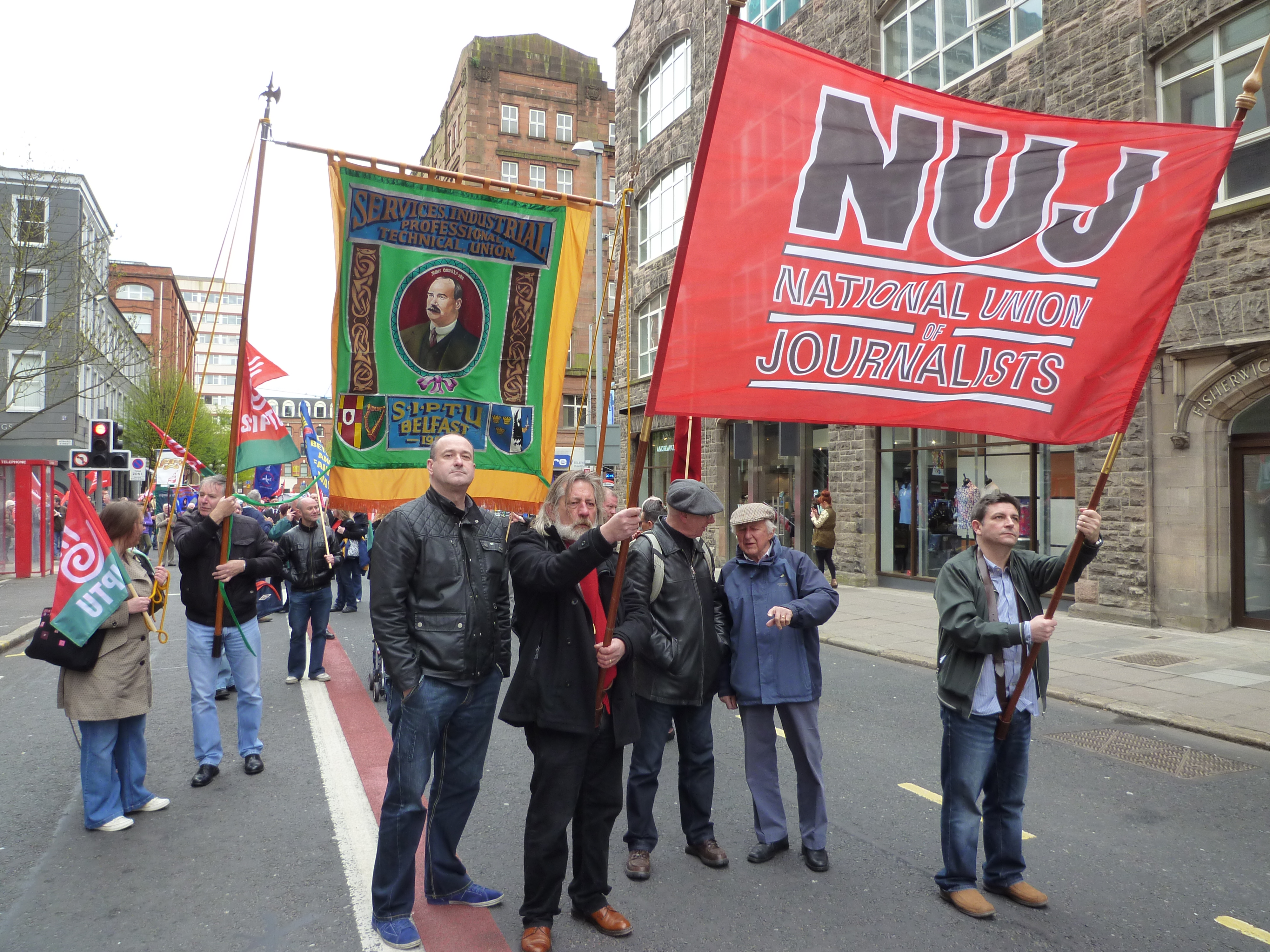
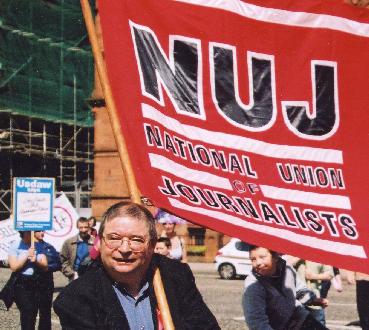
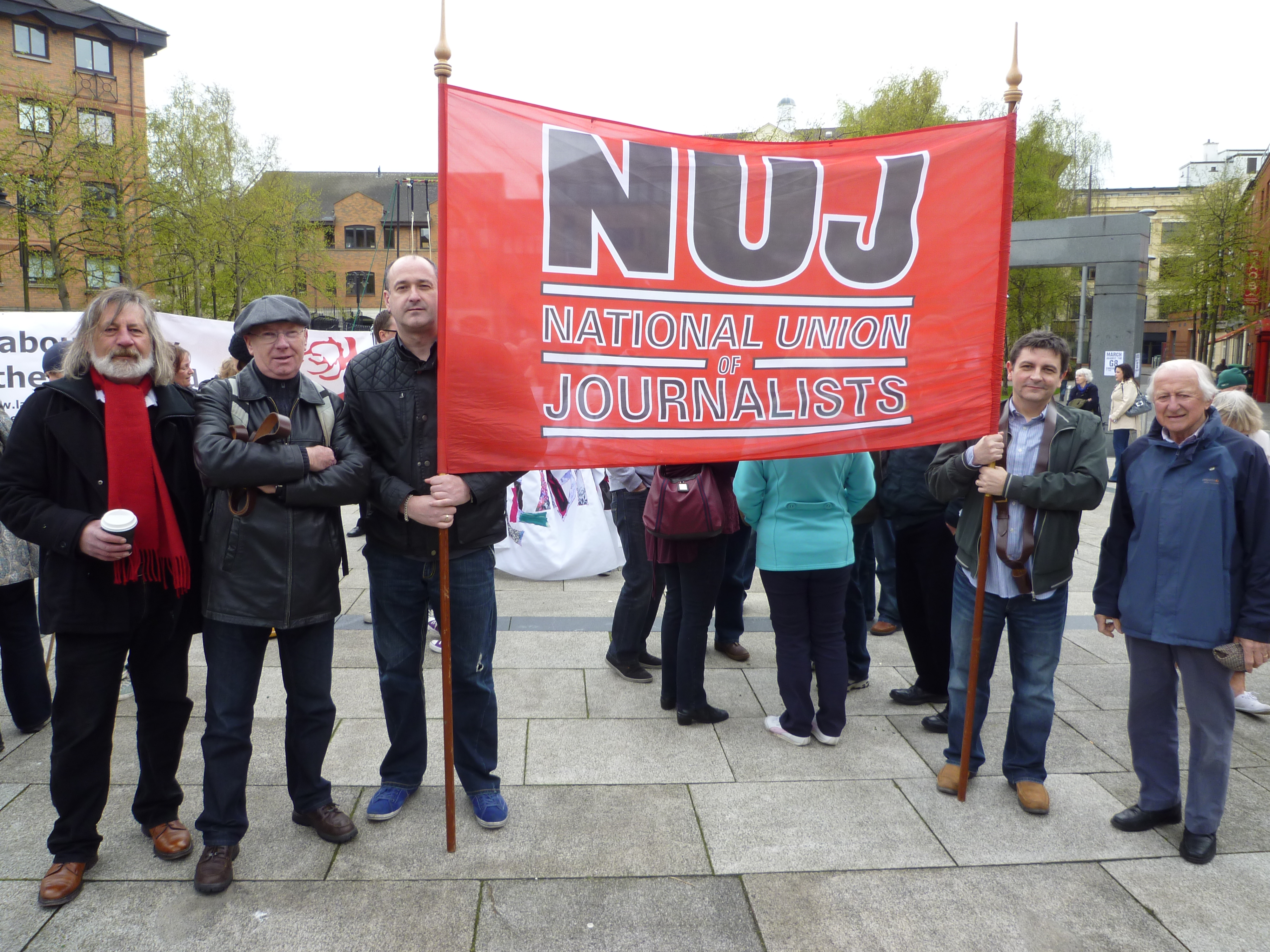
NUJ Members at May Day March

NUJ Members at May Day March

The annual ICTU May Day rally and parade was held in Belfast on Saturday 4th May. A number of members gathered beside the NUJ banner at Writers’ Square near St Anne’s Cathedral at 12 noon for speeches followed by a march through the city centre accompanied by brass, pipe and samba bands. The march took a slightly different route and finished back at Writers’ Square. It was one of a series of events organised by Congress on the occasion of the centenary of the 1913 Dublin lockout.

May Day Rally, Belfast

May Day Rally, Belfast

The May Day march is among the biggest in the UK and Ireland, and featured speeches from leading union activists. With sponsorship from the European Union Regional Development Fund, Belfast City Council and the Community Relations Council, are presenting an extended festival programme with events for everyone, including walking tours, exhibition launches, lectures and the May Day and Diversity Festival.

NUJ & SIPTU

NUJ & SIPTU

Amongst the numerous events taking place will be the collaborative exhibition World of Work (WOW) at the Golden Thread Gallery, to celebrate the essence of May Day and showcase the often hidden value of trade union learning initiatives. The gallery will also host the Through the Lens Photographic Exhibition. Over the last six months groups of trade union members and activists have worked to interpret ‘Diversity’ through digital photography. They have come up with images of diversity in all its forms.

There was a good turnout from the main unions including Unison, Unite, NIPSA and the GMB.

NIPSA contingent

NIPSA contingent

MAY DAY PARADE

maydayThe annual ICTU May Day rally and parade is taking place in Belfast on Saturday 4th May. Gather beside the NUJ banner at Writers’ Square near St Anne’s Cathedral at 12 noon for speeches followed by a march through the city centre accompanied by brass, pipe and samba bands. The march will finish back at Writers’ Square where food and entertainment will be provided. Help celebrate the wins and achievements of the trade union movement over the years and show that we are proud to be trade unionists. It’s one of a series of events organised by Congress on the occasion of the centenary of the 1913 Dublin lockout.

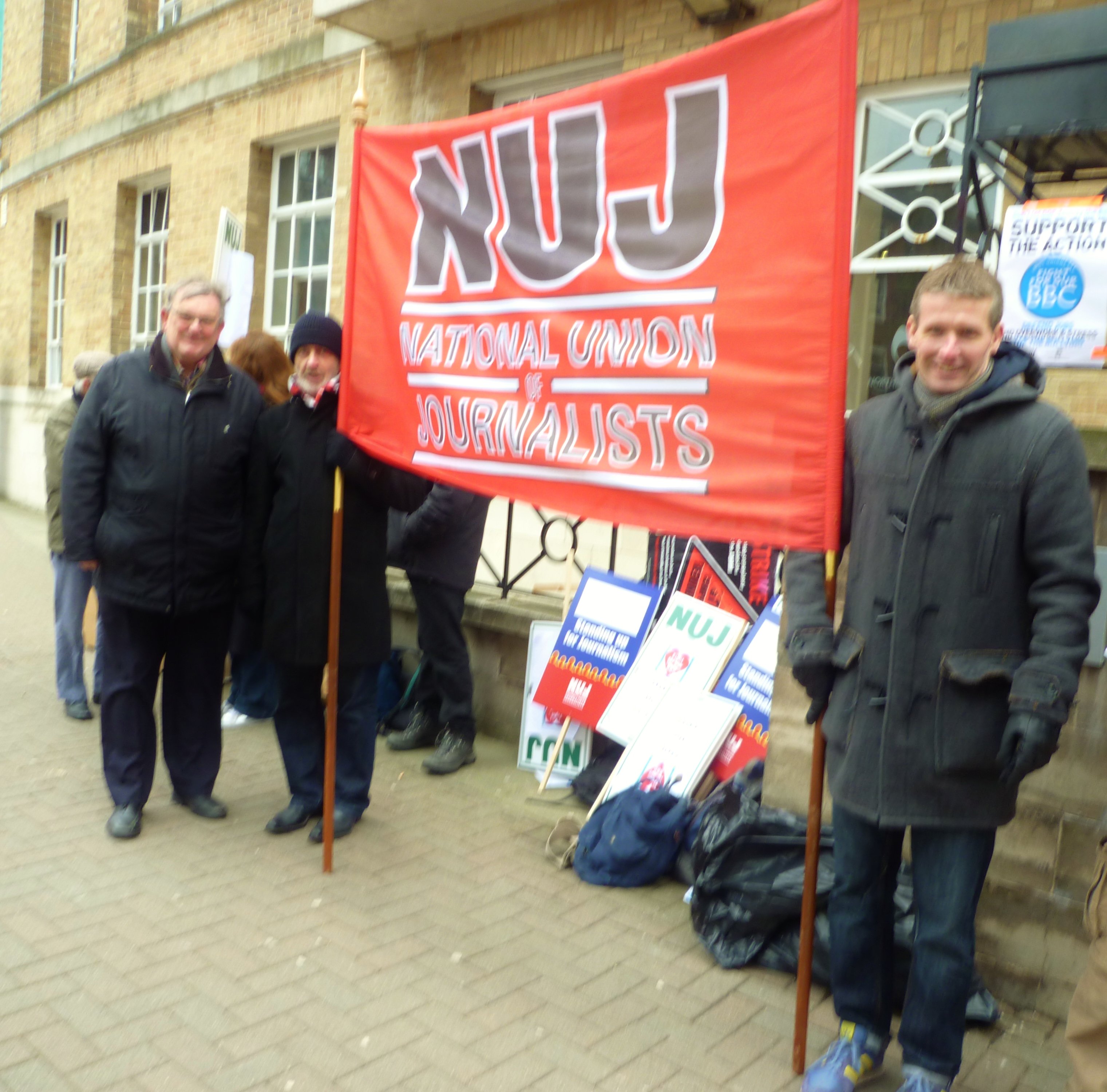
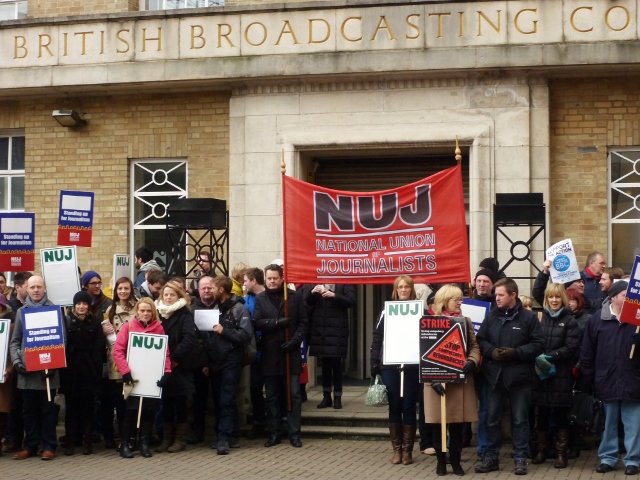
BBC Strike, March 2013

BBC Strike, March 2013

The May Day march is among the biggest in the UK and Ireland, and will feature speeches from leading union activists. With sponsorship from the European Union Regional Development Fund, Belfast City Council and the Community Relations Council, are presenting an extended festival programme with events for everyone, including walking tours, exhibition launches, lectures and the May Day and Diversity Festival. Amongst the numerous events taking place will be the collaborative exhibition World of Work (WOW) at the Golden Thread Gallery, to celebrate the essence of May Day and showcase the often hidden value of trade union learning initiatives. The gallery will also host the Through the Lens Photographic Exhibition. Over the last six months groups of trade union members and activists have worked to interpret ‘Diversity’ through digital photography. They have come up with images of diversity in all its forms. The opening night will include a DJ set from Love Music Hate Racism and a performance piece from Scream Blue Murmur.

PRESS FREEDOM DAY

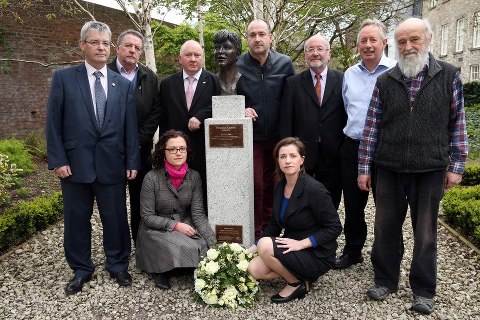
Wreath laid at Veronica Guerin statue

Wreath laid at Veronica Guerin statue

Representatives of journalists in Ireland have been marking world press freedom day. In Dublin the President of the National Union of Journalists Barry McCall demanded action to protect media plurality across Europe. He joined senior NUJ and Amnesty International Ireland figures in laying a wreath at the Veronica Guerin statue in Dublin Castle in memory of all the journalists who have been killed in the course of their work. He said: “It is our duty to ensure that each one of those journalists is remembered. Here in Ireland we know the pain felt by the murders of Martin O’Hagan and Veronica Guerin, both NUJ members committed to the highest principles of journalism. We salute those who have died in the cause of the truth. We also need to protect our ability to communicate the truth on a global basis and across all platforms in the future.”

Martin O'Hagan at Belfast May Day March:            Photo © Kevin Cooper

Martin O’Hagan at Belfast May Day March:                          Photo © Kevin Cooper

The International Federation of Journalists (IFJ) who will hold their triennial Congress at Dublin Castle next month and the NUJ have also written to the embassies of the four countries in the world with the highest numbers of imprisoned journalists to demand their release. Signed by IFJ President Jim Boumelha the letters have been sent to the embassies of China, Iran, Turkey and Eritrea, to express the IFJ’s concern about the lack of press freedom in these countries, where journalists are routinely detained in violation of  their fundamental freedoms and human rights. As a sign of unity and solidarity, the IFJ is also calling on its affiliates to send similar letters to the embassies of the same countries in their regions. General Secretary Michelle Stanistreet has written on behalf of the NUJ.

This year the IFJ is marking world press freedom day by focusing on the issue of journalist safety and journalists imprisoned around the world. This reflects the ongoing concern over the numbers of our colleagues who continue to languish in prisons in many countries as a result of their profession. In Iran, according to the Association of Iranian Journalists (AoIJ), at least 24 journalists are currently in prison on charges of allegedly violating Iranian laws. In Turkey, the Turkish Union of Journalists, estimates that at least 66 journalists are currently in prison, awaiting trial on charges of allegedly isolating the Turkish penal code or anti-terror laws. The European Federation of Journalists is running a campaign with the Turkish Union of Journalists to ‘Set Journalists Free in Turkey’. In Eritrea, according to reliable sources, at least 18 journalists have been detained without charges since the authorities imposed a ban on independent media in September 2001. In China, it was reported in 2012 that potentially over 30 journalists were imprisoned, awaiting trial on charges of allegedly violating the Chinese penal code or anti-terror laws.

At a meeting of Dublin branch in Liberty Hall the NUJ President Barry McCall called for public support for the European Citizens Initiative which calls on the European Commission to bring forward measures to protect media pluralism and press freedom. Mr McCall said: “It is standard practice for governments and competition authorities to intervene when a firm becomes dominant in any sector. But the media industry is even more sensitive to such dominance as with it comes potentially immense political power and influence. This is why different standards and thresholds must be applied to this bulwark of democracy and why the NUJ is supporting the European Citizens’ Initiative aimed at gathering a million signatures to a petition calling on the European Commission to bring forward to protect media pluralism and press freedom. We need 9,000 signatures from Ireland to play our part in this critically important initiative. The NUJ will be campaigning to get its own members to sign up to the petition and we are calling on all trade unions, political parties, and the Irish people generally to get behind it so that we can prevent abuses of media power in this country in future.”

Irish Executive Council Cathaoirleach Gerry Curran told the branch that media freedom involved taking a stand in defence of journalism at home and abroad. Highlighting the fact that the NUJ will host the IFJ World Congress in Dublin next month he said the international focus on Ireland would give the NUJ a special role in highlighting the abuse of journalists throughout the world. NUJ Irish secretary Séamus Dooley joined Amnesty International Ireland in calling for the release of journalists like Ali Mahmoud Othman who are detained in Syria. Noeleen Hartigan, Programmes Director of Amnesty International Ireland, said: “Syria is now the world’s most dangerous place to be a journalist. Scores of journalists have been detained, tortured or killed over the last two years. Others, like Ali Mahmoud Othman are detained in secret locations. Together with the NUJ we are today calling for the release of all journalists detained solely for their work to tell the world what is happening in Syria today.”

Adrián Silva Moreno

Adrián Silva Moreno: Photo Proyecto Impunidad

In 2012, 84 journalists in 25 countries died while covering the news. On May 13, their names will be added to the Journalists’ Memorial at the Newseum in Washington DC. In Mexico, Adrián Silva Moreno, a freelance journalist and contributor to the newspaper Puntual, was shot to death while covering a raid of a warehouse near Tehuacan. Silva was leaving when his car was fired on by unknown gunmen.

In a ceremony at the Newseum on Wednesday it was revealed that the percentage of the world’s population that has access to a free press declined during 2012, according to an annual survey released by Freedom House, which has documented media independence since 1980. 197 countries were monitored. Of that total, 32 percent were “free;” 36 percent were “partly free;” and 32 percent were “not free.” In 2012, the press status in eight countries changed. Karin Karlekar, project director at Freedom House, said this marked the first time in history that all country changes were in a negative direction.  The worst of the worst countries for press freedom were Belarus, Cuba, Equatorial Guinea, Eritrea, Iran, North Korea, Turkmenistan and Uzbekistan. Three countries — Greece, Mali and Israel — changed from “free” to “partly free” Five countries — Egypt, Paraguay, Ecuador, Guinea-Bissau and Thailand — changed from “partly free” to “not free”. Norway and Sweden remain the most free in the world. Both have constitutions that guarantee press freedom. Newspaper readership is high, and internet access is widely available and unrestricted. For more information on the survey, visit www.freedomhouse.org. I am grateful to fellow blogger Darach MacDonald for bringing it to our attention on facebook.

Also in Dublin, the Irish section of the Association of European Journalists marked world press freedom day with a talk over lunch by the Chairman of the Irish Press Council, Dáithí O’Ceallaigh.  Press%20Council

ROSALINE KELLY RIP

Rosaline Kelly, Jim Corrigal (President) & Michael Fisher Photo: © Kevin Cooper

Rosaline Kelly (Belfast 2005), Jim Corrigal (President) & Michael Fisher Photo: © Kevin Cooper

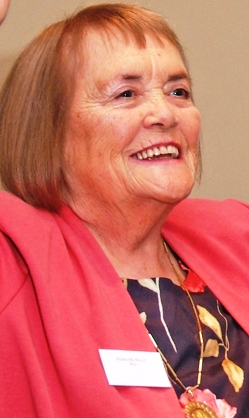
Tributes have been paid to Rosaline Kelly, the first woman elected President of the National Union of Journalists.  Ms Kelly (90) died at St Columcille’s Hospital, Loughlinstown, County Dublin following a short illness. Ms Kelly worked as a magazine journalist in London and served as President of the NUJ from 1975 to 1977. On retiring from active journalism she returned to Ireland.  She lived in Wicklow and was instrumental in establishing the retired members section of the NUJ in Ireland. She was also made a Member of Honour of the union.

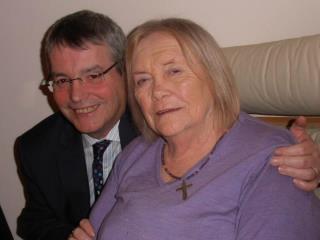
Barry McCall & Rosaline Kelly at her 90th birthday

Barry McCall & Rosaline Kelly at 90

NUJ President Barry McCall described Ms Kelly as an NUJ institution and said her passing would be mourned throughout the union. Mr McCall said:  “Before the phrase ‘glass ceiling’ was coined Rosaline Kelly was setting a headline for woman activists. She was elected to the union’s National Executive Council in 1972 and quickly established a reputation for commitment, energy and a direct debating style which was to become her hallmark.  Rosaline had a long association with the NUJ Standing Orders Committee and was regarded as an expert on procedures. She had a strong commitment to the welfare of members and this was reflected in her deep involvement in the union’s charities and in the establishment of a retired members section in Ireland.  She never lost her enthusiasm and only ill health prevented her from attending our delegate meeting in Newcastle on Tyne last October. It would have been her 50th consecutive delegate meeting.  Rosaline Kelly was an NUJ institution and her passing will be mourned throughout the union.”

 NUJ General Secretary Michelle Stanistreet also paid tribute to Ms Kelly. She said: “Rosaline Kelly was one of the outstanding characters within the NUJ. She retained throughout her life an abiding commitment to the principles of social justice. Rosaline was fiercely proud of the NUJ and took particular pride in the Code of Conduct.  Rosaline believed in the highest professional standards and was a strong supporter of our work at the Leveson Inquiry. Decades after her retirement from journalism she was sharing her advice and wise counsel. Her presence at union gatherings will be greatly missed.”

Rosaline Kelly 1923-2013

Rosaline Kelly 1922-2013

NUJ Irish Secretary Séamus Dooley expressed sympathy on behalf of the Irish Executive Council. He said: “Rosaline spent her working life in England but in retirement she became active in Ireland, becoming the voice of retired members and ensuring that their interests were represented at all times. She hated the term ‘Woman President’.

“I was a President who happened to be a woman. You won’t find the term ‘Woman President’ in the Rule Book,” she once chided a branch officer who thought he was doing the right thing by referring to Rosaline’s historic role in breaking through the male dominated fortress that was the NEC. But there is no doubt she was a role model for women in a male dominated industry.  She will be remembered for her qualities of integrity, her selfless dedication and her commitment.”

 “In Ireland Rosaline and (former Irish Secretary) Jim Eadie formed and shaped the retired members section.  As Chair for more than a decade she dominated committee meetings.  I recall watching with fascination as she whipped into shape seasoned union activists. She was a stickler for procedure and protocol and refused to grant special dispensations to anyone – President,  General Secretary or committee member, who she deemed to have transgressed  her standing orders.”

“With the former Irish Secretary Jim Eadie she led the way in ensuring that retired members continued to play a role. She will be remembered for her style, her humour and her forthright manner.  Rosaline disliked the term ‘woman president’ but there is no doubt she was a role model for women in a male dominated industry.  Her integrity, her selfless dedication and her commitment made Rosaline a role model for all union members and it’s for those qualities that she will be remembered”, Mr Dooley said.

Imbued with a sense of justice and fairness Rosaline was also a long standing supporter of the union’s charities, which she served with distinction. Kevin Cooper’s picture at the top shows her on a visit to Belfast, when she accepted a cheque for £7000 on behalf of the NUJ Provident Fund, being the proceeds of the Belfast Press Ball 2004. That commitment reflected a deep personal and largely private faith. While delegates recovered from late night carousing Rosaline would inevitably find a church in whatever obscure corner in which ADM or the Irish Delegate Conference was being held to attend Sunday Mass. On her return she would occasionally tease atheistic colleagues that she had prayed  for their souls or lit a candle for members of SOC as they tried to conclude Sunday’s agenda.

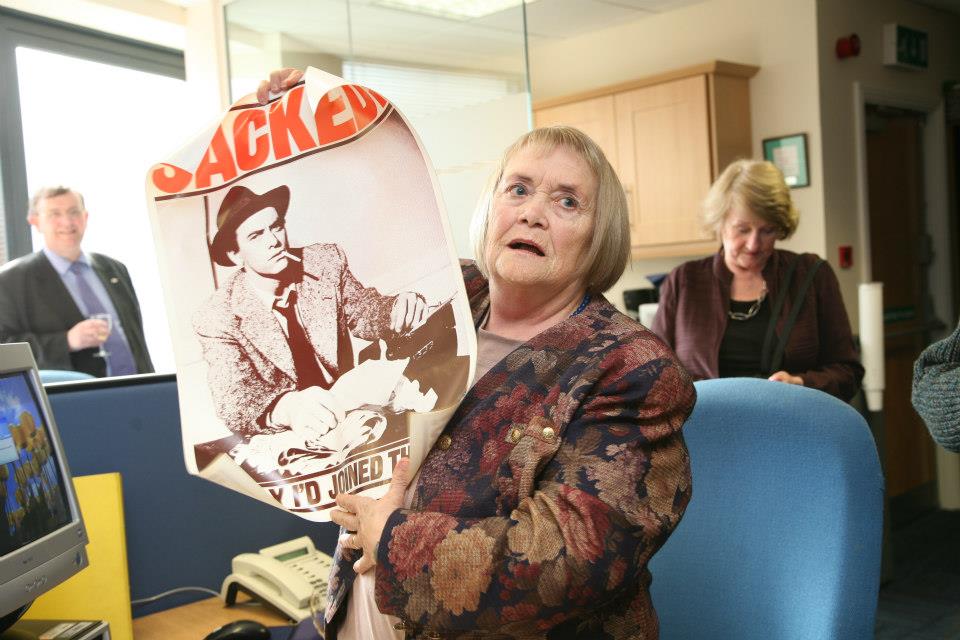
Séamus Dooley also recalled how Rosaline liked visiting the NUJ offices and kept in touch with staff and retired employees. She never arrived empty handed and usually brought boxes of sweets.  When the new Irish office was opened she presented the IEC with her collection of vintage style NUJ posters. Recently the Dublin office got around to framing them and they hang in the foyer in her memory.

Rosaline Kelly presents NUJ posters

Rosaline Kelly presents NUJ posters

Rosaline’s remains were brought on Friday evening to St Patrick’s church in Wicklow town. Requiem Mass was held  at 10am Saturday April 13th in St Patrick’s,  followed by cremation at 12.30pm in Mount Jerome, Harold’s Cross, Dublin.

Among the mourners at the removal were her niece Evelyn and her nephew Patrick, a former NUJ President (1973-74) John Bailey (and his wife Maureen) who was a great friend of Rosaline, John Brophy, Kieran Fagan, Patrick Kinsella and myself representing her many NUJ colleagues.

Damien Tiernan (Irish South East branch) who kept in contact with Rosaline in her latter years was among the mourners at the Mass in Wicklow, where a guard of honour paid her a final NUJ tribute. It included the IEC Cathaoirleach Gerry Curran. John Bailey delivered a eulogy and at the crematorium, Seamus Dooley gave a short oration, followed by former Irish Secretary Jim Eadie. Rest in Peace.

Irish Times death notice: KELLY Rosaline – April 11, 2013, aged 90, Wicklow, London, Drogheda. Member of Honour and first woman elected President of NUJ, (peacefully), after short illness, in St. Colmcille’s Hospital, Loughlinstown. Reposing at McCrea’s Funeral Home Dublin Road, Wicklow Town with removal to St. Patrick’s Church, Wicklow Town today (Friday) at 6.15 o’clock arriving at 6.45 o’clock Funeral Mass tomorrow (Saturday) at 10 o’clock followed by cremation Service at Mount Jerome Crematorium, Harold’s Cross, Dublin at 12.30 o’clock Rosaline will be a force missed by her niece Evelyn and nephew Patrick and the wider family, friends, neighbours and trade union colleagues here and abroad. Family flowers only. Donations, if desired, to Bothar – care of McCrea’s Funeral Directors, Dublin Road, Wicklow Town, County Wicklow. Rest In Peace. 

St Louis Convent Carrickmacross

St Louis Convent Carrickmacross

It was only after we had said our farewells to Rosaline and I was talking to Jim Eadie that I discovered she had a Monaghan connection. Her niece confirmed that her aunt who came from Drogheda had attended the Convent of St Louis in Carrickmacross as a boarder. The boarding school closed in 1979. The nuns who came to the town in 1888 helped to establish the famous Carrickmacross lace by setting up a lace school. So because I was passing Carrickmacross on my way back to Monaghan after the service at Mount Jerome, I stopped at the convent and reflected on whether that was where Rosaline had learned her skills of managing conference standing orders and re-writing motions to ensure they were correct!

Former NUJ President John Devine who was another great friend of Rosaline’s and was among the mourners in Dublin reflected on those skills she had:-

“Rosaline, whom I have know since she came on the NEC, was from a generation that could parse, analyse and conjugate and she did not let anyone forget it. She did The Times crossword up until a couple of months ago and still drove her car through Wicklow Town and did most of her own shopping until last Autumn. Have any of you seen the streets of this historic town? She emerged from Magazine and Book at a time when “the suits” were on the wane. M and B generationally, socially and politically was new order just as Hutt and Heald and co. were orthodox and holding on magnificently to the power they wielded in the NUJ. Rosaline’s trade unionism wasn’t based on whims, or short-term causes, or single issues. Her commitment to the uplifting of wages and conditions for media workers across the board required the discipline she applied to what she did on the shop floor. Sloppiness or populism she discouraged within her sphere of influence, not always successfully but mostly. I worked with her on the NEC and on Standing Orders in the days when the ADM could be an organisational nightmare and learned to admire her ability to spoon-fillet people who tried to be smart-assed when their co-operation was being required when several motions and amendments were being composited. The only combination I saw sharper than Rosaline and the late Phil Cutler were Rosaline and Pauline Norris, both lifetime pals. Towards the end of last summer she invited herself to stay with myself and Fran in Bangor, Co. Down. That was her way. She said soon after arrival: “you know I have never seen Lough Neagh the biggest lake in these islands.” I told her that would be arranged. Next day we went to the shores of Lough Neagh first at Lurgan and then near Maghery. We had lunch, for which she paid, and then she adjourned to the external balcony of Edenmore Golf and Country Club in the middle of beautiful pastoral countryside and puffed and puffed on her cigarettes. The receptionist, after providing the second light of the afternoon, brought her a cigarette lighter which she assured Rosaline she could keep. Her great friend John Bailey, whom she appointed to look after her affairs when the end came, organised for himself, Maureen his wife, Lionel Morrison and Liz his and myself and my wife Fran to go to Wicklow last November to organise a 90th birthday party for Rosaline without her knowledge. We took a house for a week and moved into Wicklow and lived as natives. Rosaline had been expecting Fran and I to come down anyway to take her out for a meal but we never mentioned birthday. Once the party was organised, to which The President, and John Brophy were invited and attended, I phoned Rosaline and told her would be along to pick her up. When driving out of her road I turned right heading out of the town. She said “you’re going the wrong way.” I said I had to make a call and say hello to a few friends for a few minutes and maybe she would be good enough to come with us. She agreed. Liz, whom she did not recognise answered the door, and welcomed her enthusiastically. Then when she entered the room and saw all the old friends she was dumbfounded for all of a minute (some class of a record for Rosaline) before announcing that it was the best birthday she ever had. I had my ups and downs with Rosaline during the long years of our acquaintance but she would never let me quit. She never let anybody quit. On the shores of Strangford Lough she sang: ” The sea oh the sea, is grá geal mo chroi, Long may it roll between England and me, it’s a sure guarantee that some day we’ll be free, Thank God we’re surrounded by water.” When chided about being ungrateful to England, where she made her life and developed some of the great friendships of her life, she just laughed.” (John Devine April 12th 2013)

John Devine, Lionel Morrison & Barry McCall with Rosaline

John Devine, Lionel Morrison & Barry McCall with Rosaline

NUJ ON UKIP-NI

nujlogo_burgundyThe President of the National Union of Journalists Barry McCall has called on the Chairman of the UK Independence Party in Northern Ireland Cllr Henry Reilly “to clearly and unambiguously” withdraw his description of the local media in Armagh and Down as “Provos”. He said he was shocked and dismayed at the attack on local journalists made last night (Monday 8th April) at a meeting of Newry and Mourne District Council and at the unwarranted accusation of bias against professional journalists employed by newspapers serving their local communities.
Cllr Henry Reilly UKIP

Cllr Henry Reilly UKIP

Cllr Henry Reilly made his comments during a debate on strip-searching in prisons arising from a motion tabled by Cllr Davy Hyland. During the debate Cllr Henry Reilly, speaking in the third person, declared “The press, looking at Reilly with disgust when he talks, they are Provos too probably”.

In response to a request from fellow councillors he declined to fully withdraw the remarks and Cllr Henry Reilly declared: “I haven’t called the press…any particular journalist a Provo. I will make generalised statements that some papers have a nationalist/republican bias. It is a commonly held perception among the unionist community.”
nmdc-logoThe five journalists in attendance presented Mayor John McArdle with a signed request for Cllr Henry Reilly to withdraw the remarks. Cllr Henry Reilly insisted that he had made no charge against any individuals and therefore no precise apology was needed. 
The NUJ President said the journalists concerned had no right of reply at the meeting and should not have been subjected to verbal abuse by Cllr Henry Reilly. “He should clearly and unambiguously withdraw his description of the media as Provos. The media in the area serve the community and to imply that any of the publications represented at the meeting were linked with an illegal organisation was entirely unacceptable.”

NUJ Irish secretary Seamus Dooley also strongly condemned the comments made and said: “This is an outrageous attack on the local media which should not go unchallenged. Elected representatives need to be mindful of the potential implications of public utterances of this type. Cllr Henry Reilly has abused his position and failed to avail of the opportunity given to withdraw his statement. He occupies a leadership position with UKIP Northern Ireland and I call on the party’s MLA David McNarry to disassociated himself from the comments of Cllr Henry Reilly. As a public representative he is entitled to express strong opinions but not in a manner which is unacceptable or seeks to tarnish the reputation of individuals”.

PAUL ROBINSON BURSARY

Bursary Presentation

Bursary Presentation

For the past four years, the National Union of Journalists in Northern Ireland in association with the BBC and Chest, Heart and Stroke has run a bursary scheme for young journalists in memory of Paul Robinson. Paul was a producer in the BBC and NUJ member,who died in February 2009 of heart-related problems. In his memory, the BBC and NUJ jointly fund a £1,000 bursary for a journalism student in Northern Ireland. The BBC also offers a two weeks work experience placement to the winner.

This year the bursary was won by Iain McDowell from Rathfriland in County Down. His winning entry was an audio package entitled “Battling Stress: Letitia’s Story“. Former BBC and UTV journalist Letitia Fitzpatrick talked about her struggle with stress in this report into one of the biggest mental health problems in the UK. In the opinion of the two judges, it was skilfully produced. There was good content throughout and the package was well constructed and a good story, well told. The mixes of background sound were good, with decent editing and the right level of noise to ensure it was not intrusive.

Áine O’Doherty from the North West Regional College was commended for her video entry “Old Library Trust Healthy Living Centre” in the Creggan area of Derry. The judges are David Lynas of the BBC and myself, pictured above presenting an NUJ cheque for £500 to Iain along with Vanessa Elder of CHS at our branch meeting in Belfast.

Lisa Nelson 2012 award winner

Lisa Nelson 2012 award winner

The competition was open to all NVQ Level 4 students in journalism and journalism degrees students in Northern Ireland. Previous winners include Lisa Nelson (2012 for her online entry) now with the NCTJ Journalism Diversity Fund, Dean McLaughlin of the North West Regional College for a video report (2011) and David Thompson (2010) of the Universiy of Ulster at Coleraine for his audio package “Raymond’s Story“.


NUJ ACTION

BBC Belfast Strike

BBC Belfast Strike

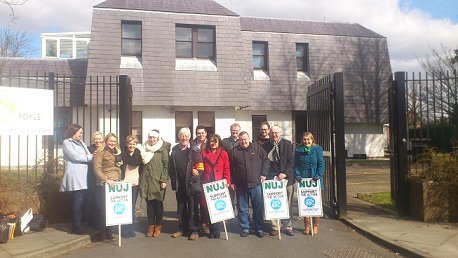
This was a busy day for NUJ activity. First, union members at Broadcasting House in Belfast (and at BBC Radio Foyle in Derry) joined journalist colleagues around the UK in walking out at midday to hold a twelve hours strike.

BBC Radio Foyle picket

BBC Radio Foyle picket  © NUJ website

The first Radio Ulster programme affected was Talkback. The presenter and long-standing member Wendy Austin was among those joining the line outside the main entrance. Inside, members of management kept some output on the air including radio news bulletins. The NUJ action along with the broadcasting union BECTU is over job cuts, compulsory redundancies, harassment and bullying within the Corporation.

At BBC picket line

At BBC picket line

At the meeting of Belfast and District Branch of the NUJ, members expressed their solidarity with their colleagues on strike. Later some of the branch members including myself joined the chapel members on the picket line. It was an interesting branch meeting, during which we endorsed a statement by the union’s National Executive Council at its meeting last Friday that criticised the First Minister Peter Robinson:-

The National Executive Council of the NUJ has called on First Minister Peter Robinson to withdraw his remarks for the people of Northern Ireland to “stop reading the Irish News. The NEC considers the First Minister’s controversial remarks ill-considered and demands that he withdraws the boycott of the newspaper immediately. The Irish News and its journalists have the right to pursue legitimate questioning in the public interest and the NUJ will defend its members’ rights to do so.”

NUJ Belfast & District Branch meeting

NUJ Belfast & District Branch meeting

The Branch also heard from Ridwaan Haji, a Somali journalist and NUJ member based in London, about the serious situation facing journalists in the Horn of Africa. He told us that eighteen journalists had been killed there last year and so far this year three had died, almost all of them in the capital, Mogadishu. Last Sunday a female radio journalist 21 year-old Rahma Abdulkadir was shot dead near her house by three young men carrying pistols. The Guardian reports that her main focus was human rights in Somalia, particularly womens’ rights. The International Federation of Journalists (IFJ) has condemned the killing.

reviews the list of murdered journalists

Ridwaan reviews the list of murdered journalists

Tonight the UNESCO Director General Irina Bokova denounced the murder and called for an investigation into the crime. Members of the media killed during conflict will be remembered during the IFJ Congress in Dublin later this year and it is hoped that the Branch will have a stand at the conference hall in Dublin Castle on June 6th. Preparations are also continuing for a one-day safety conference for journalists and media workers in Northern Ireland to be held before July.

NUJ MATTERS

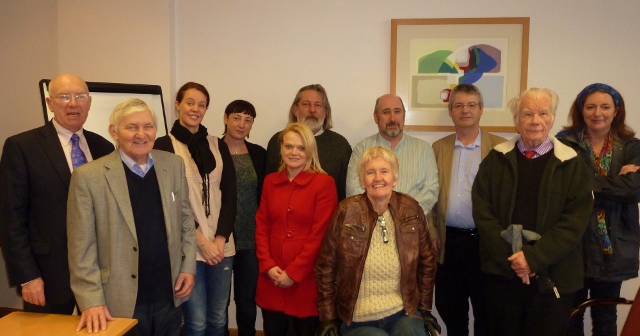
NUJ Belfast Branch

NUJ Belfast Branch

The President of the National Union of Journalists Barry McCall from Dublin (third from right) was in Belfast for meetings proving that membership of the NUJ matters. Barry is the second Irish member in succession to hold the post, which is for an eighteen months term until the next delegate meeting in London in April 2014. From that date onwards, the President will serve for a two-year period, to tie in with the biennial delegate meetings. The decision to move to a meeting every two years was taken at the DM in Newcastle-on-Tyne last October, in an attempt to make financial savings.

Barry McCall & Claire Savage

Barry McCall & Claire Savage

Belfast and District Branch supported the cost-cutting measures proposed by the National Executive Council and has decided to write to the General Secretary Michelle Stansistreet to congratulate her on the way she and the officials dealt with the very difficult situation facing the union. The President reported that good progress had been made but that the pensions issue would be the subject of consultation with the union’s staff in the new financial year in April.

The day began with a meeting of the Northern Ireland sub-committee of the Irish Executive Council, which I chaired. One of the main matters to be discussed was journalist safety, following recent attacks on and threats to members of the media. It was proposed that a two-day exhibition be held at Dublin Castle in June, during the Congress of the International Federation of Journalists, during which members of Belfast and District and Derry & North West branches would be available to network with visitors.

It is also intended to hold a half day briefing session open to all media workers and employers in the North about the safety of reporters, camera operators and photographers covering public disorder. One of the issues that will be raised will be the use of social media during riot situations. The committee also noted the Irish Secretary’s expression of “grave disappointment” at the announcement last month by the Director of Public Prosecutions in Northern Ireland that there will be no prosecution in the Martin O’Hagan murder case. Martin was shot dead by loyalist paramiltaries in Lurgan as he walked home in 2001.

The branch also received a letter of thanks from the BBC chapel, who had been on strike yesterday at Broadcasting House. A chapel representative said the support was appreciated. It was also pointed out that there was a good level of support for the strikers from members of the public.

MARTIN O’HAGAN

nujlogo_burgundyThe announcement by the Director of Public Prosecutions in Northern Ireland that there will be no prosecution in the case of the killing of NUJ member and former Belfast Branch Secretary Martin O’Hagan is extremely disappointing and has been criticised by the union. I can understand the reaction of his family. His brother Fintan, quoted by BBC NI, said there was a witness who wanted to tell a court who killed Martin, yet the Public Prosecution Service was depriving that witness the opportunity of telling the court his account and further depriving the court of the opportunity to consider the truthfulness or otherwise of that evidence and depriving the family, and indeed the public, of the opportunity to see justice in action. “Justice needs not just to be done, it needs to be seen to be done”, he added.    PPSNI

He was responding to the statement by DPP Barra McGrory that after very careful consideration of all the available evidence, including that of an assisting offender, Neil Hyde, a decision had been taken not to prosecute in the murder case. This was owing to the absence of any corroboration of the evidence. When Hyde was jailed in February 2012 for three years, the judge told him that if he had not agreed to identify the alleged culprits in Mr O’Hagan’s murder and give evidence about the activities of the outlawed LVF, he would have been jailed for 18 years. Mr O’Hagan, a Sunday World journalist, was shot dead as he was walking home with his wife in Lurgan in 2001.

Sunday World Northern Editor Jim McDowell said he was angry and annoyed at Friday’s announcement. “Myself and the staff have worked hard since that black Friday in September 2001 to try to get justice for Martin O’Hagan. It now seems, that old adage, while there there may be law in this country, where is the justice?” He said the decision would not diminish in any way the paper’s resolve to continue to try to get justice for Martin.

The National Union of Journalists (NUJ) has expressed grave disappointment at the announcement by the Director of Public Prosecutions in Northern Ireland that a decision has been taken not to prosecute in the Martin O’Hagan murder case. Irish Secretary Seamus Dooley said the union was disturbed by the announcement. “This union does not accept that the State can walk away from this case. The murder of Martin O’Hagan was an outrageous act of violence which cannot go unpunished. We will continue to campaign for a full investigation leading to the conviction of those responsible for the murder of our friend and colleague“, he said.

STRABANE COUNCIL

Anyone who has reported on council business will know how important it is to have access to different sub committees and minutes of meetings, as well as to the full council meetings. Increasingly, some councils attempt to keep sensitive issues private by discussing them in committee. The role of the media to report on democracy in action and although district (or local) councils have limited powers, the press have a duty to report on the actions of councillors and to take them to task when necessary. I was therefore surprised to see that there is a proposal by Strabane District Council to restrict the attendance of press representatives at its weekly committee meetings. According to the interim chief executive Daniel McSorley

Daniel McSorley

Daniel McSorley (Council photo)

(for whom I have a lot of admiration following the excellent job he has done during often difficult times in Omagh) quoted in the Strabane Chronicle, the proposed change in committee proceedings “would lead to more openness and transparency”. He added that no decision has yet been taken. I for one hope that the council does not decide to go down this route. I am glad to see a statement on the issue from the President of the National Union of Journalists, Barry McCall.

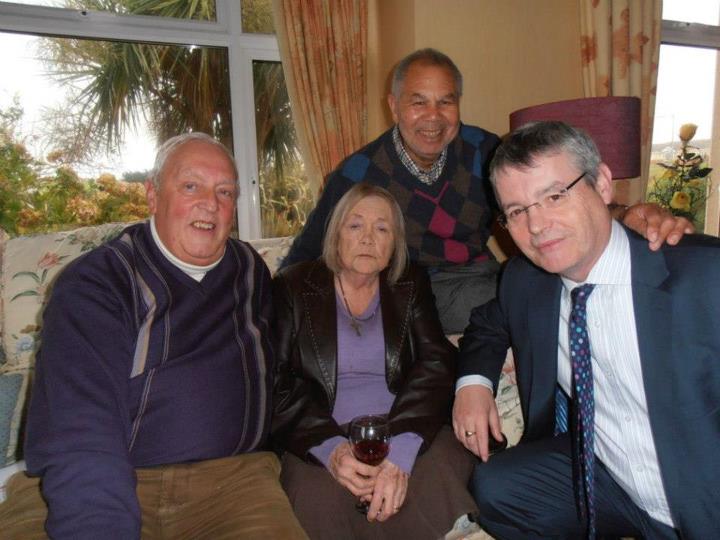
Michael Fisher & NUJ President Barry McCall

Michael Fisher & NUJ President Barry McCall

Mr McCall says that any attempt to exclude the press from council matters is “an attack on democracy” and he has vowed to take it up with Mr McSorley as a matter of urgency. He said any plans to ban the press from local council committee meetings would be a direct attack on democracy and an attack on press freedom. They are repugnant to an open and democratic society, he said, and would be strongly resisted by the NUJ. The union will raise its concerns with the District Council immediately.

Strabane Chronicle reporter Conor Sharkey said the paper had not submitted an objection at this stage but would probably do so. He told Hold the Front Page:-

 “It would be a big deal for ourselves as a newspaper but I think it would be a bigger deal for the ratepayers. The issues that are being discussed are not national security, it is bread and butter issues such as waste management and leisure. It is ordinary issues that affect the men and women in the street. I think the ratepayers have a right to know about them. It is a huge concern to us. We pick up a lot of news stories from these meetings.”

Only eight local authorities in Northern Ireland are believed to restrict access to such committee meetings at the moment.

MICHAEL FISHER is Chair of the NUJ Irish Executive Council Northern Ireland sub-committee