WILLIAM CARLETON SOCIETY

William Carleton

William Carleton

After two years running the annual William Carleton international summer school, I have handed over the reins. Dr Frank Brennan who is based in Dublin is the new Director and I wish him well. Already there are exciting plans being made for the 2014 event which will be held at Corick House Hotel in Clogher, Monday 4th to Thursday 7th August.

Jack Johnston, President William Carleton Society Photo: © Michael Fisher

Jack Johnston, President William Carleton Society Photo: © Michael Fisher

At the Annual General Meeting of the William Carleton Society at Corick House, a new committee was elected for 2013/14. I will henceforth be acting as Membership Secretary and also handling the publicity as PRO.

WILLIAM CARLETON SOCIETY 2013-14

President: Jack Johnston, Ratory, Clogher

Vice President: Liam Foley, Clogher

Chair: Gordon Brand, Enniskillen

Vice Chair: Pat Boyle, Dungannon

Secretary: Frank McHugh, Enniskillen contactable at wcarletonsociety@gmail.com

Membership Secretary: Michael Fisher, Belfast contactable at wcarletonsociety@gmail.com

Treasurer: Tom McKeagney, Belfast

Assistant Treasurer: Isabel Orr, Clogher

PRO: Michael Fisher, Belfast contactable at wcarletonsociety@gmail.com

Webmaster: Frank McHugh http://www.williamcarletonsociety.org

Summer School Director: Frank Brennan

Honorary Director: Owen Dudley Edwards

Deputy Directors: Paddy Fitzgerald; Aidan Fee

Patrons: Dr Joseph Duffy; Jim Cavanagh; Mary O’Donnell; Sam Craig; Noel Monahan

Executive Committee: Gordon Brand, Pat Boyle, Jim Cavanagh, Frank McHugh, Tom McKeagney, Isabel Orr, Michael Fisher, Peter Cavanagh, Patricia Cavanagh, Jack Johnston, Liam Foley, Frank Brennan, Paddy Fitzgerald, Aidan Fee, Malcolm Duffey, Bill McCrory, Beverley Weir.

Dr Frank Brennan, Summer School Director

Dr Frank Brennan, Summer School Director

BBC PAYOUTS

bbcPlenty of questions remain about the extent of payouts made to senior executives at the BBC during the tenure of Mark Thompson as Director General. One Conservative MP Chris Heaton-Harris quoted in The Guardian said today’s hearing by the Public Accounts Committee at Westminster was “the most bizarre game of whack-a-mole I’ve ever seen in my life, where you hit something down and it throws up another load of questions”.

At the end of a three hour hearing by the committee, former DG Thompson and the Chair of the BBC Trust Lord Patten disagreed over who knew what about the executive payoffs. In July a report by the National Audit Office found that in nearly a quarter (14) of 60 cases it reviewed, the BBC had paid departing senior managers more salary in lieu of notice than they were contractually entitled to. A total of 150 senior managers had received severance payments totalling £25m. A supplementary report published a week ago confirmed that 22 former executives received £1.4m more than what the Corporation was contracted to offer in the severance payoffs agreed in the three years to December 2012 (NAO). The NAO said weak governance arrangements had led to payments that exceeded contractual requirements and put public trust at risk. The BBC Trust accepted at the time there had been a “fundamental failure of central oversight and control” at the Corporation.

nujlogo_burgundySpeaking before the PAC meeting the General Secretary of the National Union of Journalists Michelle Stanistreet said “this sorry tale is one of a management that became out of touch with its staff and with the ethos of public service broadcasting. The BBC should have put the interests of licence-fee payers first, rather than fill the pockets of its own”. In total more than £25m was given out in redundancy payments to executives.

The written evidence presented in advance to the PAC by former DG Mark Thompson, Lucy Adams BBC HR Director, Andrew Scadding BBC Head of Corporate Affairs, Marcus Agius, non-executive director, BBC Executive Board and former Chairman of the BBC Executive Board Remuneration Committee, as well as by the BBC Trust can be found here.

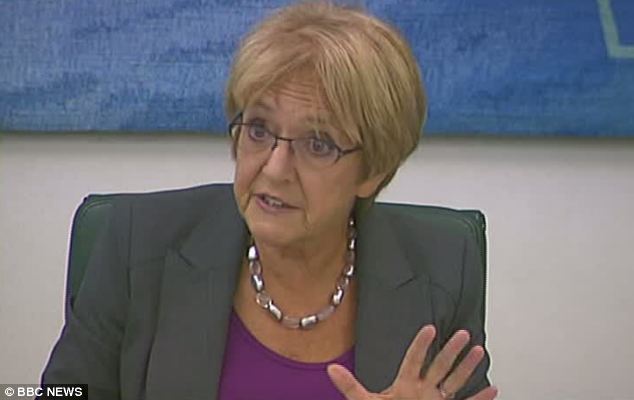
Margaret Hodge MP Photo: BBC News

Margaret Hodge MP Photo: BBC News

The PAC Chair Margaret Hodge MP described the appearance by the BBC executives as “grossly unedifying” and said it could only “damage the standing and reputation” of the BBC. “At the best I think what we have seen is incompetence, a lack of central control, a failure to communicate. At its worse we may have seen people covering their backs by being less than open”, she said.

Former BBC Chair Lord Grade told Newsnight the Corporation had “a lost sense of the value of money”.


SPECIAL 65TH WEDDING ANNIVERSARY

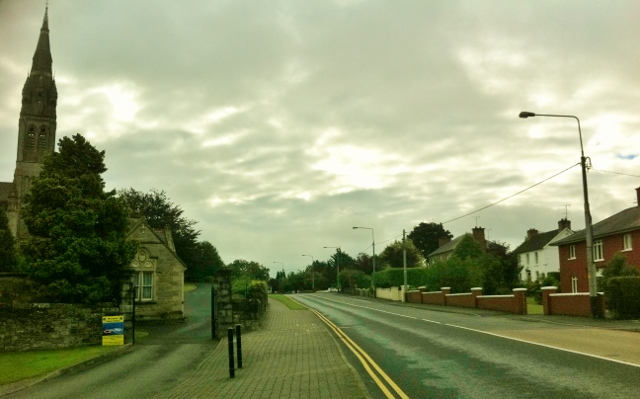
St Macartan's Cathedral Monagan & Tirkeenan on Dublin Road Photo: © Michael Fisher

St Macartan’s Cathedral Monagan & Tirkeenan on Dublin Road Photo: © Michael Fisher

Congratulations and happy 65th wedding anniversary to my wonderful parents Peggy and Des (as of tomorrow both will be 93). It’s known as a blue sapphire anniversary. I passed Tirkeenan and St Macartan’s Cathedral Monaghan where they were married as I made my way to Dublin from Tydavnet this morning. On September 8th 1948 Mum only had to stroll across the road to the church, yet she exercised the prerogative of the bride to be late! The wedding breakfast followed at Tirkeenan on a Wednesday morning after 8:30am Mass celebrated by my uncle the late Fr Harry Smyth CM. Congratulations!

My father wrote a lovely poem for my mother based on Kavanagh’s Raglan Road, which incidentally is not far from their first Dublin 4 lodgings of their married life on Anglesea Road in Ballsbridge. The house was owned by the late Liam D.Bergin, proprietor of the Nationalist and Leinster Times in Carlow, where my father began his journalistic career.

St Macartan's Cathedral Monaghan Photo: © Michael Fisher

St Macartan’s Cathedral Monaghan Photo: © Michael Fisher

ULSTER CANAL CLONES

Old Bridge over Ulster Canal near Clones, Co.Monaghan Photo: ©  Michael Fisher

Old Bridge over Ulster Canal near Clones, Co.Monaghan Photo: © Michael Fisher

It has been dubbed the “Clones Sheugh” by one blogger Irish waterways history, who believes the Canal restoration would be a folly. Another industrialheritageireland.info has questioned the viability of the planned restoration of a 13km section of the Ulster Canal and River Finn from Clones to Upper Lough Erne and wonders where the finance will come from to maintain the waterway and any associated buildings if the restoration goes ahead. But there are local groups which believe the project is viable and will help to preserve an important part of Ulster’s industrial heritage.

South Lough Neagh Historical Society at Ulste Canal Stores Clones Photo: © Michael Fisher

South Lough Neagh Historical Society at Ulster Canal Stores Clones Photo: © Michael Fisher

One such group of enthusiasts is the South Lough Neagh Historical Society which this afternoon visited the Ulster Canal Stores in Clones and took a trip along the section of canal due to be restored. The decision was announced at a meeting of the North/South Ministerial Council in Armagh in July 2007. I remember doing a report on the proposals having travelled along much of the same route as the visitors did today. However there are few visible signs of any progress in the past six years. The situation was discussed at the inaugural meeting of the North/South Inter-Parliamentary Association a year ago which produced a background paper on the cross-border plan.

Ukster Canal Stores Clones: could this become a marina? Photo: © Michael Fisher

Ulster Canal Stores Clones: could this become a marina? Photo: © Michael Fisher

The Ulster Canal opened in 1841 and linked Lough Neagh with Lough Erne. The plan was to create a navigable waterway connecting the ports of Belfast and Coleraine with the Shannon and onwards to Limerick or Waterford. It is 46 miles long with 26 locks. It left the River Blackwater below Moy and climbed through 19 locks to the summit on the far side of Monaghan. It ran through the counties of Fermanagh, Monaghan and Armagh. It originally passed through or close to Clones, Smithborough, Monaghan, Middletown, Tynan, Caledon, Milltown, Benburb, Blackwatertown, Moy and Charlemont.

Route of original Ulster Canal near Clones Photo: © Michael Fisher

Route of original Ulster Canal near Clones Photo: © Michael Fisher


BOOMTOWN RATS REVISITED

The Boomtown Rats: 2013 Photo: www.boomtownrats.com

The Boomtown Rats: 2013 Photo: http://www.boomtownrats.com

Tonight’s appearance by The BOOMTOWN RATS on the Late Late Show on RTE gives me a chance to reprint my story from seven months ago relating to the reformation of the band after 27 years for a tour of Ireland and Britain.  Bob Geldof on vocals, Pete Briquette on bass, Simon Crowe on drums and Garry Roberts on guitar. They will be at the Ulster Hall in Belfast on October 18th. It also allows me to boast about my first broadcasting scoop.

Boomtown Rats

Boomtown Rats

It was 1977 and no-one had ever heard of this pop group with the strange-sounding name. I interviewed the band (except Bob Geldof) for radio and ensured their first ever broadcast on the BBC. At that stage their single “Looking after No 1” had just appeared on a New Wave LP (first track on the “B” side) along with songs from The Ramones (“Judy is a Punk”; “Suzy is a Headbanger”) and various others of the punk rock variety. John Peel gave it an outing.

I was able to go one better, thanks to my sister in Dublin who knew this up and coming band from the Dún Laoghaire area. The group had completed an Irish tour in 1975 and the following year moved to London. I was working at Pebble Mill as a News Producer (reporter/presenter/producer) with BBC Radio Birmingham at the time. Being a local radio station, it meant that I could contribute to the sports programmes at the weekend. Nuneaton v Wimbledon was my first sports report. But I was also able to do interviews for various music programmes including Norman Wheatley’s “Gentlefolk”. I got to meet The Dubliners, The Chieftains, Frank Patterson and Eily O’Grady and Horslips when they came to the heart of England.

Malcolm Jay presented a Tuesday night rock show, “Heavy Pressure”. When I mentioned that this new rock band from Ireland who had appeared a month earlier at Birmingham town hall with Tom Petty and the Heartbreakers was coming to Wolverhampton and I might be able to get an interview with them, he sounded interested. So on July 20th 1977 my sister came over from Dublin and we drove to the La Fayette night club near the centre of Wolverhampton.

We arrived early and there was no sign of anyone. Eventually a van arrived with five of the Boomtown Rats and their gear. Lead singer Bob Geldof travelled separately. So while the band waited in an empty club, I sat down with the group, having been introduced to them by Carolyn. I had brought my UHER reel-to-reel tape recorder that we used for interviews. I spoke to each in turn, including the man with the funny name. Pete Briquette. Bob Geldof eventually turned up and said hello. The group performed that night to a crowd of less than 100. A few days later the interview (which I still have a copy of) was broadcast, along with Looking after no.1 and another track as well (possibly Mary of the fourth form).

cropped_the%20boomtown%20rats

I am glad I spotted the potential of the band at an early stage and followed their progress over the years. Then this morning courtesy of the John Murray show on RTÉ Radio 1 I listened to Pete Briquette explain the plans by the band (or at least himself, Geldof, Simon Crowe and Garry Roberts) to get back together again in time for the Isle of Wight festival from 13th-16th June at Seaclose Park. The Rats will join a line-up also featuring The Killers and Bon Jovi, who have already been announced as headliners for the first major festival of the summer.

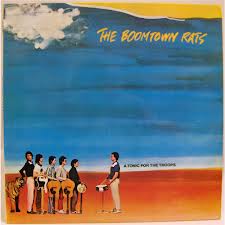
A Tonic for the Troops

A Tonic for the Troops

The BBC reports that Bob Geldof said: “I’ve always fancied playing the Isle of Wight Festival ever since I hitched there in the good/bad days when I was a kid.” The band have been playing live in recent years without Geldof. The Boomtown Rats were the first Irish band to have a UK number one hit with Rat Trap. They followed that up with another number one with I Don’t Like Mondays, which was a hit around the world. They recorded six albums, three of which made the UK top 10, before splitting up in 1986.

The band’s last major live performance was at the 1985 Live Aid concert at Wembley, organised by Sir Bob Geldof.

ROYAL VISITOR

Prince Edward meets WPFG organisers at Hillsborough Castle Photo: © Michael Fisher

Prince Edward meets Dame Mary Peters & WPFG organisers at Hillsborough Castle Photo: © Michael Fisher

A British royal visitor Prince Edward came and went without any major disruption, except perhaps for the residents of Hillsborough who found some traffic and parking restrictions during the afternoon. The occasion was the annual Secretary of State’s garden party at Hillsborough Castle. Earlier the Earl of Wessex had presented a group of young people with their Duke of Edinburgh awards in a brief ceremony at the Belfast Harbour Commissioners building. The Lord Lieutenant of Belfast Dame Mary Peters was there to greet him along with the deputy Lord Mayor Alderman Christopher Stalford.

Dame Mary was also present at Hillsborough but in a different capacity, this time as patron of the World Police and Fire Games 2013. She introduced His Royal Highness to representatives of the local organising committee.

WPFG: BELFAST GIANTS

Todd Kelman of the Belfast Giants doing the quiz Photo: © Michael Fisher

Todd Kelman of the Belfast Giants doing the quiz Photo: © Michael Fisher

The World Police and Fire Games said thank you to its volunteers by offering them free seats at a recent pre-season friendly match involving the Belfast Giants and Bolzano/Bozen Foxes from Südtirol in Italy.

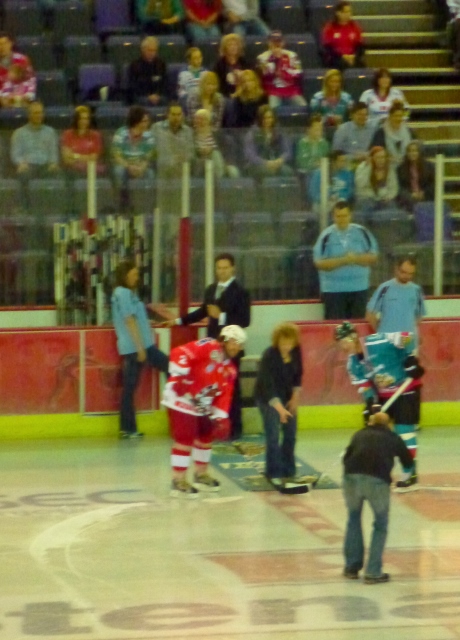
DCAL MInister Carál Ní Chuilín throws in the puck Photo: Michael Fisher

DCAL MInister Carál Ní Chuilín throws in the puck Photo: Michael Fisher

The Stormont Department of Culture and Sport paid for the tickets and the Minister Carál Ní Chuilín threw in the puck at the face-off. The giveaway was organised through Todd Kelman, General Manager of the Giants. He had been co-ordinator for the ice hockey at the WPFG event and thanks to his enthusiasm and a great team of volunteers which I was delighted to be part of, over 52,000 people passed through the Odyssey to see the various matches in the space of a fortnight.

The previous night had been a special one for Todd as the number 44 jersey he had worn with distinction as a player with the Giants was officially retired.   It was the sixth jersey retirement in the Giants’ history. Todd wore the no.44 jersey on 419 occasions for the Giants across eight seasons and retired from on-ice duties as the all-time leader in games played as well as the leading scoring defenceman in the team’s history with 73 goals and 141 assists. He stopped playing to take up the role of General Manager over seven years ago and since then the Giants have won all 4 major titles up for grabs in the Elite League winning the Knock Out Cup and Challenge Cup in 2009, the playoff title in 2010 and the Elite League Title in 2012.

Todd Kelman, Belfast Giant Photo © Michael Fisher

Todd Kelman, Belfast Giant Photo © Michael Fisher

Todd Kelman spoke about the honour:-

It is my pleasure to be your General Manager of your wonderful city and I’m happy to now call it mine & my family’s city. Belfast has been very good to me and I love the people here. It is only right to thank one very important person – Jim Gillespie. Without Jim’s influence on me and giving me this job, I certainly would not be where I am today. More importantly without Jim Gillespie there would be no Belfast Giants.”

Michael Fisher as announcer at the Odyssey during WPFG 2013

Michael Fisher as announcer at the Odyssey during WPFG 2013

Thank you Todd for taking me and the other volunteers and games officials under your wing and allowing us to experience the thrills and spills of ice hockey. Some volunteers had never been to see a match before the police and fire games started; others like me had seen the Giants in action on a couple of occasions; then there was the experienced team of volunteers, many of whom I met back on duty at the Odyssey over the weekend. It was also a chance to see the Giants’ mascot Finn McCool back in action on the ice during the ‘chuck a puck’.

Finn McCool in action Photo: Michael Fisher

Finn McCool in action Photo: Michael Fisher

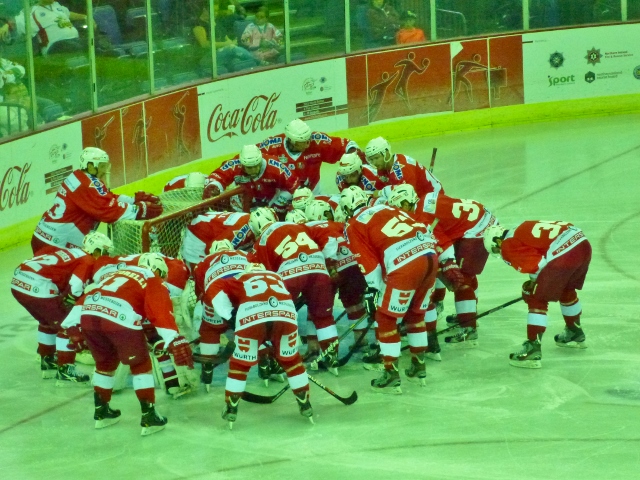
Belfast Giants huddle before game

Belfast Giants huddle before game Photo: © Michael Fisher

Belfast Giants won 2-1 with a goal after 25 seconds of overtime. The first and second periods were scoreless. The Giants went ahead and then the Foxes equalised so at the end of normal time it was 1-1. The Giants had won the previous night 6-3.

Bolzano/Bozen Foxes check the goal area! Photo: © Michael Fisher

Bolzano/Bozen Foxes check the goal area! Photo: © Michael Fisher

EBAF: LOAD OF AUL’ FOLK

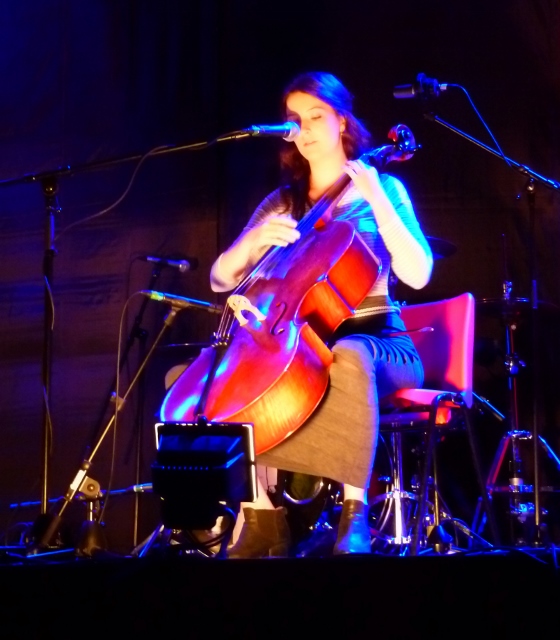
Singer & Songwriter Alana Henderson Photo: © Michael Fisher

Singer & Songwriter Alana Henderson Photo: © Michael Fisher

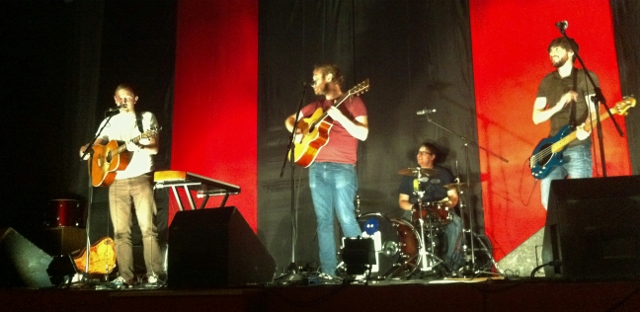
This was a great end to the second East Belfast Festival, on its fifth day. The promise of ‘A Load of Aul’ Folk’ attracted me to the Strand Arts Centre on the Holywood Road. The names on the bill did not mean anything to the aul’ folk of my generation so it was refreshing to hear the vibrant talent of a new generation of performers: Master and Dog, Katie and the Carnival, Emerald Armada, Alana Henderson and Mike Donaghy and Border Crossing.

These young musicians are all very talented and deserve recognition by a wider audience. Alana Henderson is a singer and songwriter who comes from Dungannon in County Tyrone. She is a cellist who released her debut EP ‘Wax & Wane’ in February 2013. Alana learned how to play the tin whistle when she was 7 and went to Armagh  Pipers Club. She started playing the cello when she was 9. She now teaches tin whistle to 7 year olds for the APC herself. Her performance in February on BBC Radio Ulster’s Ralph McLean Show can be viewed here.

Mike Donaghy & Border Crossing Photo: © Michael Fisher

Mike Donaghy & Border Crossing Photo: © Michael Fisher

Mike Donaghy from Bangor in started the night with a group called Border Crossing, one of whom is from Newry. Perhaps this is why the backdrop for the stage was a glorious mixture of black and red, the Down colours (as one of the later performers remarked!). Their genre which has been described as Celtic/Americana is a blend of folk, blues, country and rock and it was very easy to sit back and enjoy their set. A couple of numbers stood out: one was a song about whiskey. The other was called The Fisherman’s Daughter, from his 2011 debut album ‘I Wish You Well’, which you can also listen to here. I notice that the proceeds from the album were donated towards the Northern Ireland Children’s Hospice.

Mike is now trying to raise funds for the band to make a trip next year to Nashville, where an American producer has invited them to showcase their music and second album, ‘No-one can hear me’. Accompanying Mike are Andrew Dorrian and Brian McClean with Lynsey Smyth.  They have toured Ireland and played festivals and tours in Europe.  They have also toured and shared stages with the likes of Brian Kennedy, Sands Family, Paul Brady and Finbar Furey.

Katie Richardson & Darren Photo © Michael Fisher

Katie Richardson & Daragh Gillen: Photo © Michael Fisher

The next act was billed as Katie and the Carnival. There was certainly a carnival atmosphere but it turned out to be the singer/songwriter Katie Richardson with just one person accompanying her, Daragh Gillen, who provided a wonderful sound on harp. Katie’s voice and the setting of the old (but comfortably renewed) Strand cinema transported me back to the pre-Second World War era in Berlin when cabaret was fashionable. I notice that Katie herself had just returned from Berlin and I hope she enjoyed the visit to my favourite city abroad. Her performance reminded me of when I had listened to Agnes Bernelle singing at an evening at the arts centre in Annaghmakerrig, near Newbliss in County Monaghan. But Katie plays the guitar, so that gives her added attraction!

Master and Dog: Photo © Michael Fisher

Master and Dog: Photo © Michael Fisher

After a break following over ninety minutes of varied music, it was the turn of Master and Dog (formerly John, Shelly & the Creatures) who started up in 2007. The band’s original name came from a chance meeting with two Irish twins named John and Shelly but they changed their title this year to Master & Dog for various reasons, the name originating from one of the band’s favourite songs “Master & Dog” by Quasi.

They are made up of Kevin Carlisle (Drums, percussion & vox), Philip Watts d’Alton (guitar, vox, keys, bass, mandolin), Ger Gormley (bass, vox, guitar, mandolin, keys) and Walter (guitar, vox, keys, mandolin and drums). They say they are influenced by a wide variety of genres and are unafraid to mix things up when it comes to recording and playing live. Plenty of one-liners from Walter who played the melodica on one of the songs as he attempted to interact with the audience. Maybe he thought he was at the Empire! Good craic anyway.

To see what they sound like I would recommend a video they made for their song ‘Canada’, which I would have called ‘Take My Hand’ based on the chorus. The video has been shot in Dublin. If you look closely enough at the road signs, you can see that the opening scenes were filmed around Chamber Street in the Coombe area. The closing sequence is shot around Irishtown, not far from Sandymount Strand as you can see the Pigeon House chimneys. The Pigeon House ‘B’ electricity generating plant is now redundant and the landmark chimneys are no longer sending plumes of smoke into the sky above Dublin Bay. Their track ‘Long May you Reign’ was used in television advertisements in Spring 2009 to promote Northern Ireland tourism and featured on The Late Late Show on RTÉ.

The Emerald Armada: Photo © Michael Fisher

The Emerald Armada: Photo © Michael Fisher

The Emerald Armada brought the folk night to a wonderful close. The members are Neil Allen, Gary Lynas, Ben Hamilton, Dermot Moynagh and Tony McHugh. Their song ‘I Don’t Mind’ the title track of their new EP was released a year ago and can be viewed here. Great bodhran playing by Dermot.

In summary, a great opportunity to listen to a new generation of musicians performing live in a very relaxed setting. With a bit more advance promotion this gig would surely have attracted a lot more punters to the cinema complex, where two previous nights were ‘Sold Out’ for Kandu Theatre Company’s ‘The 39 Steps’. My thanks to the organisers of the East Belfast Festival for giving me access to the different performances, which I enjoyed. Sorry I did not get to see any of the events on Saturday or the one man show by Noel Magee ‘I, Kavanagh’.

HEANEY LAID TO REST

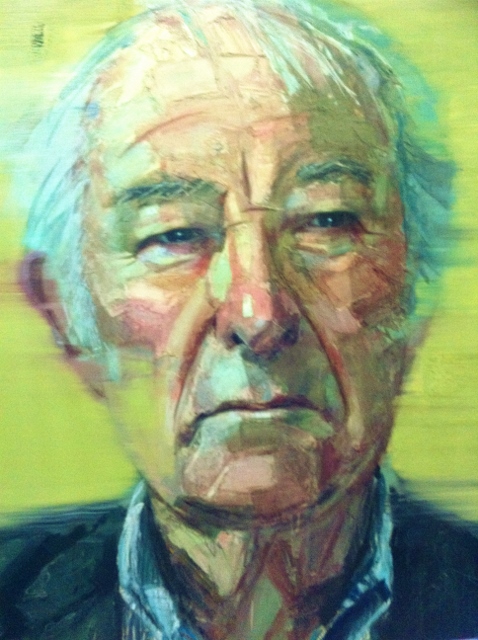
Seamus Heaney Portrait: © Colin Davidson 'Between the Words'

Seamus Heaney Portrait: © Colin Davidson ‘Between the Words’

It was very appropriate that this new portrait of Seamus Heaney by Belfast artist Colin Davidson should go on display at Queen’s University Belfast while the Nobel Laureate was being laid to rest in his native parish of Bellaghy in South Derry. Earlier in Dublin hundreds of people led by President Higgins gathered for his funeral Mass at the Church of the Sacred Heart at Donnybrook. The chief celebrant was a priest from the diocese of Derry “with a Northern accent” (which he said the poet might have liked), Monsignor Brendan Devlin from Rouskey near Gortin in County Tyrone.

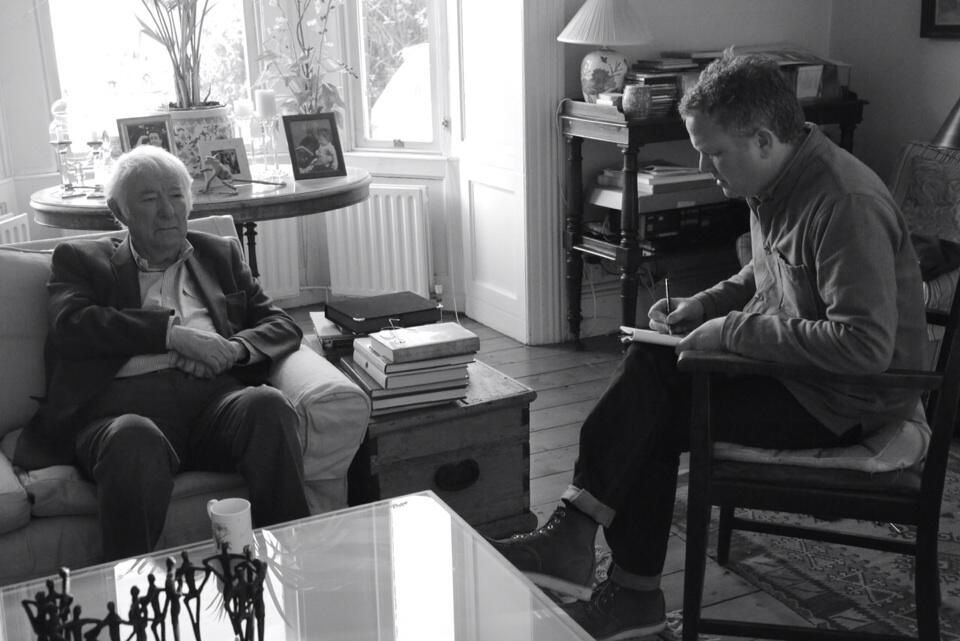
Seamus Heaney sitting for Colin Davidson portrait © Mark Carruthers

Seamus Heaney sitting for Colin Davidson portrait © Mark Carruthers

Heaney had a long association with the university. In 1957 he enrolled at Queen’s, graduating with a first class honours degree in English Language and Literature in 1961. He became a lecturer in the English department at Queen’s in 1966 and was there for six years, one of which was spent as a visiting Professor at Berkeley. He was awarded an Honorary Fellowship by the QUB Institute of Irish Studies and when in February 2004 the School of English opened a new Poetry Centre, it was named after him. It houses the Heaney Media Archive. A book of condolences has been opened at the Welcome Centre, Lanyon building at Queen’s and there is also one at Belfast City Hall, at the Guildhall in Derry and at the Mansion House in Dublin.

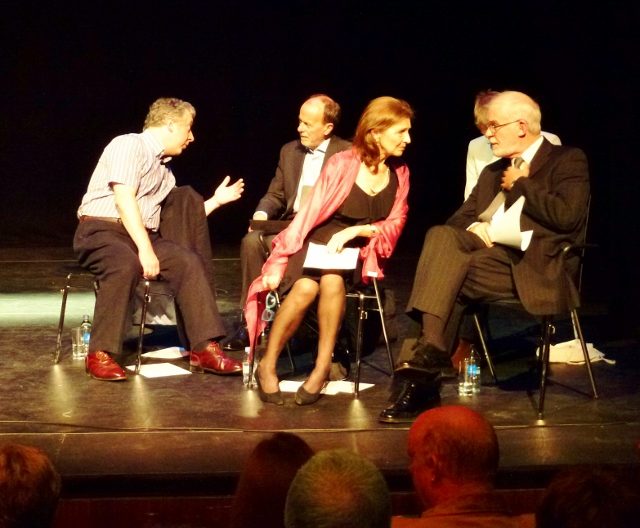
Cellist Neil Martin talks to Bob Collins; Stella McCusker chats to Ian McIlhenny

Cellist Neil Martin talks to Bob Collins; Stella McCusker chats to Ian McIlhinney

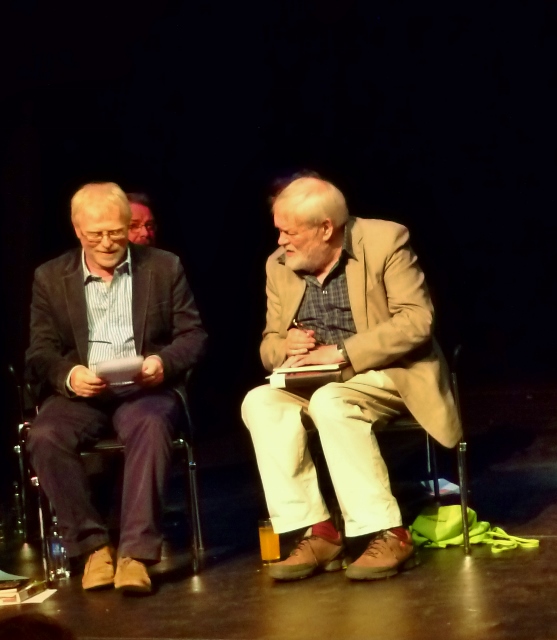
The portrait was on display at the Lyric theatre in Belfast on Saturday night. A full house attended a special commemoration put together at short notice by theatre trustee Stuart Douds. It included a rendition of Port na bPúcaí, a tune that inspired Heaney to write The Given Note, by cellist Neil Martin, who also played at the poet’s funeral. There were  readings by some of his fellow poets and friends. Robert McMillen who I met before the commemoration gave this summary of the participants:-

Michael Longley Photo: © Michael Fisher

Michael Longley Photo: © Michael Fisher

Stella McCusker read from Heaney’s speech at the Lyric in April 2012; Michael Longley… (who read with Heaney at the Merriman summer school a fortnight ago) shared some anecdotes and read a poem called Boat (about his and Seamus’s mortality) as well as two poems by Heaney himself. Belfast poet laureate Sinead Morrissey fought successfully to hold back the tears as she read Tollund Man, a poem she taught students in Schleswig-Holstein (a province in Germany near the border with Denmark). She was less successful later as the stage lights caught the tears in her eyes and her trembling hands. Damian Gorman read the poem Postscript and one of his own, After the Poet about Victor Jara but which was apt too for the night that was in it.”

I notice that Damian has published the poem on his facebook page:

AFTER THE POET
A bird can sing
With broken wings, or none at all.
All that it needs
Is a full throat, and a hearing.

All it needs
Is not to be too afraid
Of singing.
All that it needs
Is to be – or have been –
A bird.

Copyright: © Damian Gorman  (For HP, Zenica, August 2013)

Frank Ormsby & Michael Longley Photo: © Michael Fisher

Frank Ormsby & Michael Longley Photo: © Michael Fisher

Robert goes on to described how “Eamon Hughes gave an academic but very personal account of Heaney, man and work, while Frank Ormsby read the heart-rending poem about Sean Armstrong who was murdered during the troubles, A Postcard from North Antrim. Glenn Patterson read from his new book before Neil Martin returned to play a tune…..called The Parting of Friends. It was left to Mark Carruthers to thank the people who had given so generously of their time to partake in this tribute to Seamus Heaney before Ian McIlhinney read probably the Bellaghy man’s most quoted poem, The Cure at Troy”. 

Stella McCusker chats to Ian McIlhinney with writer Glenn Patterson Photo: © Michael Fisher

Stella McCusker chats to Ian McIlhinney with writer Glenn Patterson Photo: © Michael Fisher

Belfast Lord Mayor, Máirtín Ó Muilleoir, dropped in to read a song/poem in Irish, An Chéad Mháirt de Fhómhar which beautifully captures the sorrow and anger at the loss of a loved one. Arts Council of Northern Ireland Chair Bob Collins who was Director General of RTÉ when I worked there), gave a wonderful eulogy in which he spoke of how Heaney had a great understanding of broadcasting as a public service. He has allowed me to reprint this tribute:

HEANEY CELEBRATION Lyric Theatre

“When in 1995, I first read Seamus Heaney’s Nobel acceptance speech, Crediting Poetry, I was transported back more than forty years to the aerial wire coming through a hole bored in the frame of our kitchen window by his recollection of listening to the wireless as a child in the 1940s. But I was also dramatically struck by the relevance of his words to the work I was doing at that time in broadcasting in RTÉ where I spent thirty years of my life. When he said:

I had to get close to the actual radio set in order to concentrate my hearing and in that intent proximity to the dial I grew familiar with the names of foreign stations … I also got used to hearing the short bursts of foreign languages as the dial hand swept round from BBC to Radio Éireann, from the intonations of London to those of Dublin and even though I did not understand what was being said in those first encounters with the gutturals and sibilants of European speech, I had already begun a journey into the wideness of the world.”

With those words, he encapsulated much of the possibility and the responsibility of broadcasting as a public good, as public service. I thanked him for it and quoted him often. Perhaps it was that intuitive understanding that prompted him to give so much of himself to BBC and to RTÉ. His contributions have enriched the schedules and the archives of both, for this and, now, for all future generations. But they were a powerful way for him to play a role as a public person, as a thinker who posed challenges for all who had ears to hear.

Recalling his own childhood – and by extension all our childhoods – he spoke of being “schooled for the complexities of his adult predicament, a future where he would have to adjudicate among promptings variously ethical, aesthetical, moral, political, metrical, sceptical, cultural, topical, typical, post-colonial and, taken all together, simply impossible.”

Part of his calling, his choice, was to be a source of assistance to all of us in those adjudications. He knew the risks of that public role and expressed them. Writing in 1974, he said that “the idea of poetry as an art is in danger of being overshadowed by a quest for poetry as a diagram of political attitudes.” And in his Nobel speech, he spoke of “having to conduct oneself as a poet in a situation of political violence and public expectation. A public expectation, it has to be said, not of poetry as such but of political positions variously approvable by mutually disapproving groups.”

For him, it was simple. “The poet“, he said, “is on the side of undeceiving the world. It means being vigilant in the public realm.”

And he never ceased from lifting deception from the world. He spoke with clarity and rigour. He became a measure, a yardstick, an index of what was good. A moral force. And in the process, he became a spokesman for the entire society, his poetry the voice of the entire community. John Henry Newman said that writers were the “spokesmen and prophets of the human family.” Seamus Heaney discharged that duty to the full. In From the Republic of Conscience, he challenged “public leaders to weep to atone for their presumption to hold office.” Public leaders mind you, not just political leaders but all who wished to hold public positions. After the ceasefire and before the Belfast Agreement he wrote that “violence was destructive of the trust upon which new possibilities would have to be built.” How right and how farsighted he was.

He also said something in ‘Government of the Tongue’ that we might well reflect on in these times in both jurisdictions on the island when he wrote of poetry that “it does not propose to be instrumental or effective. Instead, in the rift between what’s going to happen and what we would wish to happen, poetry holds attention for a space, functions not as a distraction, but as pure concentration, a focus where our power of concentration is concentrated back on ourselves.” It has resonance for our consideration of all the arts.

Last night there was a clip of an interview with Seamus in an RTÉ bulletin. In it he said “If poetry and the arts do anything they can fortify your inner life – your inwardness. Listening together and knowing things together – which is what a culture is. If you know things together that you value, that is a kind of immunity system against things.” This wisdom in an interview conducted quickly on the fringes of a public event.

It is difficult to put into words and to convey fully how intimately his person and his poetry had become bound up with the life of the people, especially, I think and in my experience, in the Republic. How deeply he had become embedded in the affection of the people and in the life of the society – as no artist I can think of has ever quite achieved before. He had an extraordinary place in the public realm. But that place in the public realm, his presence at state and solemn occasions was not as a symbol of state or as part of state but as a reminder to state of the importance of values, of the challenge of office, of the meaning of society, of the responsibility of leadership to the people, of the place of conscience. Through his life and through his poetry he spoke to the people. And the people listened.

He was intuitively trusted; his integrity appreciated; his directness reciprocated; his dignity sublime.

Two weeks ago, last night, I was in Lisdoonvarna, at the Merriman summer school at which he and Michael Longley gave a public reading. It was an unbelievable experience, powerfully moving and indelibly impressive. The intimacy of the relationship with the capacity audience and their appreciation of the work of both poets will remain forever in the memory. These were two poets who had done much to give poetry back to the people. This was Seamus Heaney being the voice of the community within the community. I had the particular pleasure of being next to them both at dinner before the reading and, with our spouses – Marie, Edna and Mary, in the small bar of Sheedy’s hotel afterwards for nightcap, story, reflection, friendship and fun. It was a delight. More than that, it was a blessing.

Like his life, a blessing whose cup of bounty will flow all the days of our lives”.

Bob Collins 31/08/13

Curtain call at the Seamus Heaney commemoration at the Lyric Theatre Photo: © Michael Fisher

Curtain call at the Seamus Heaney commemoration at the Lyric Theatre Photo: © Michael Fisher

COMMEMORATION OF 1913 LOCKOUT

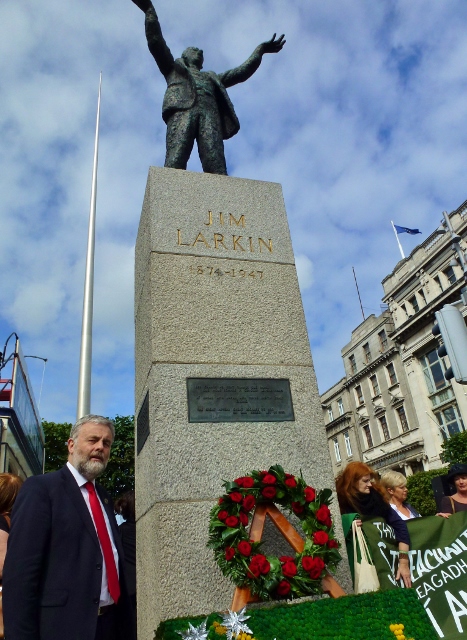
SIPTU President Jack O'Connor at Jim Larkin statue Photo: © Michael Fisher (NUJ)

SIPTU President Jack O’Connor at Jim Larkin statue Photo: © Michael Fisher (NUJ)

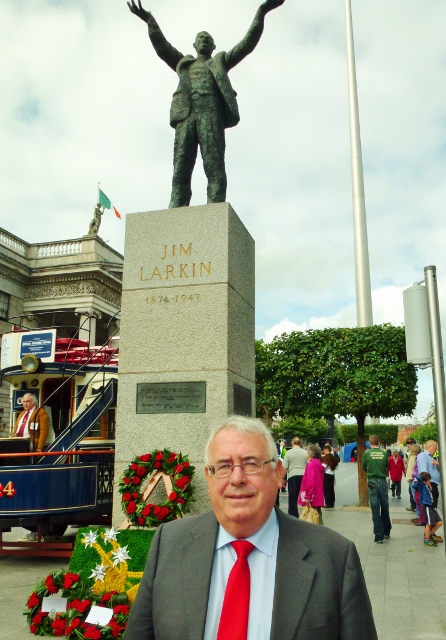
Thousands of people gathered in Dublin’s O’Connell Street yesterday (Saturday 31st August) to commemorate the 1913 Lockout in which an estimated 20,000 workers had been involved. President Higgins laid  a wreath at the Jim Larkin statue after a salute by the Army No 1 band. Tánaiste Eamon Gilmore attended along with Ministers Ruairi Quinn, Pat Rabbite, Jimmy Deenihan and Minister of State Joe Costello. Trade unionists were led by ICTU General Secretary David Begg and included SIPTU President Jack O’Connor (the successor of the ITGWU, founded by Larkin).

In traditional costumes and dress people recreated scenes from the 100-year old events, chanting “Down with Murphy, up with Larkin” while DMP police stood by. Readings from the novel Strumpet City were performed by by Bryan Murray and Angela Harding and an excerpt from the play “Lockout 1913”,  set on top of a tram placed in front of the GPO.

The Lord Mayor of Dublin Oisin Quinn welcomed everyone to the event saying it was about paying tribute to “thousand of working men and women who took part in this campaign to achieve decent treatment and fairness of work”. Hundreds of people dressed in period costumes as dockers, some as Jacobs workers and others as the poor of Dublin. This part of the event was organised by the North Inner City Heritage Group with Dublin Council of Trade Unions. The President remained as a spectator for a dramatisation of Larkin’s famous speech from a hotel window off O’Connell Street, his subsequent arrest and the riot that led to a police baton charge resulting in more than 300 injuries.

Joe Costello TD, Minister for Trade & Development at Jim Larkin statue Photo: © Michael Fisher (NUJ)
Joe Costello TD, Minister for Trade & Development at Jim Larkin statue Photo: © Michael Fisher (NUJ)