

Proposed Interconnector Vital for Society and Economy in North East: EirGrid
Michael Fisher Northern Standard
DAY FOUR
This section dealt with the need for the development
Nigel Hillis addressed the oral hearing on behalf of the Co. Monaghan Anti Pylon Committee. He said up until now the group had never challenged the need for the project. But in the light of the unbelievable scrapping of the 400kV overhead line for Grid Link and the downsizing of Grid West to an alternative 220kV with multiple underground options they now had the right to and indeed must challenge the need for the project in its current form.
“How did EirGrid get it so very wrong with regards to those other two flagship projects. Can they now be trusted when they say that this project can only be delivered as an overhead 400kV line or is this all just a huge face saving exercise?” he said. “There is now no doubt that the need for this interconnector is not our need – it is Northern Ireland’s need”.
EirGrid’s Your Grid, Your Views, Your Tommorow states: “In the Re-examination of generation assumptions carried out in this update, the requirement for increased power to flow between Ireland and Northern Ireland in future years is confirmed. This is mainly driven by changes to the future all-island generation portfolio, plant retirements and the relative operational costs of generation plant in each jurisdiction.
The plant retirements referred to here are in Northern Ireland where very dirty plant must close down by 2021 and other, lets say, not quite so dirty plant must be restricted from 2023 onwards.
It is clear from the statements and speeches made by high level politicians and the Ulitility Regulator in Northern Ireland, in recent months, that panic has now set in regarding this situation which seemingly can only be addressed by the delivery of the North South Interconnector.
No provision is being made to address this security of supply issue within their own jurisdiction by way of replacing these dirty plants with modern clean ones. Indeed, the utterances and statements that have emanated from political, regulatory, business and economic commentators on both sides of the border but particularly from Northern Ireland, since this application was lodged with An Bord Pleanala, have been persistently vociferous to the extent that if this were a legal case it would be totally prejudiced at this stage.
This is clear proof that there is only one game in town with regards the need for the project and that is security of supply for Northern Ireland to prevent the “lights going out”. There is no talk about how it will be of mutual benefit to us down here – it’s all about Northern Ireland. Some of the statements have been hysterical to the extent that there would be a risk to life and limb in the absence of the Interconnector.
It would seem to us that all this has been a carefully orchestrated and choreographed effort intended to bring maximum pressure to bear on the respective decision makers and put them in a position whereby they could not possibly refuse permission.
I want to give you some examples of what I am talking about. EirGrid have often used the analogy of a three legged stool with regards to this development and the three legs are:
Security of supply; to facilitate increased renewable energy (mostly wind); to enhance the operation of the Single Electricity Market.
Security of supply
At the 2010 oral hearing EirGrid gave clear evidence that the security of supply in the North East region would be below acceptable standards by 2012. This was why there was a critical need for the sub-station at Kingscourt to link into the North East. In fact it was stated that even if planning permission for the interconnector was refused in Northern Ireland, the section from Woodland to Kingscourt would still be required to reinforce the North East. So it was with complete astonishment that in May 2011 less than a year after the previous oral hearing collapsed EirGrid stated in their Preliminary Re-evaluation Report that the sub-station at Kingscourt would not be required for at least 10 years. That would have brought us up to 2021 at that time. Their stated position regarding the sub-station in these application documents is the exact same – it will not be required for at least 10 years bringing us now up to 2026.
Will it ever be required? In March 2015 EirGrid published a series of consultation documents entitled “Your Grid, Your Views, Your Tomorrow”. A discussion paper on Ireland’s Grid Development Strategy.
In Appendix 1 entitled EirGrd Technical Analysis page 34 with regards to the North East region it states “The north east region has renewable energy resources and conventional generation sources. There is an excess of generation in the area”. The need for the sub-station in the Kingscourt area now seems to be an unanswerable question.
The renowned economist Colm McCarthy is on public record many times in many different forums, television, print media and public meetings as saying that Ireland is “awash with generating capacity” and any more whether it is wind, gas, biomass or whatever is simply not needed and makes no economic sense whatsoever.
How did EirGrid get it so wrong? In effect EirGrid applied to An Bord Pleanala in 2009 for permission under the Strategic Infrastructure Act for permission to construct a large 400kV sub-station that was not needed then, is not needed now and may never be needed in the future. But yet they built a technical and needful case for it at the oral hearing in 2010 that on the face of it could not be challenged. In fact, whatever about EirGrid’s record regarding public consultation and all the other discrepancies in the previous application no-one, at the previous oral hearing ever questioned their assessment of the need for the development or the sub-station – only the form in which it should be delivered i.e. overhead or underground. However this time the need for the development insofar as it is of benefit to this jurisdiction must be questioned.
A second link to Northern Ireland has nothing to offer us with regards to security of supply as they simply just want the interconnector to replace the old dirty generating plants that have to be retired. The CEO of EirGrid supported by his senior management team appeared twice last year in front of the Oireachtas Committee for Transport and Communications on the 21st April and 4th November.
The April meeting was specifically to discuss the North South Interconnector and the November meeting was to discuss Grid Link but ended up with most of the discussion on the North South Interconnector. At both meetings the one thing that the EirGrid could not explain to the satisfaction of the Committee members was why the proposed second interconnector needed to be rated at 1,500 MW. The big picture that the members of the Oireachtas Committee saw straight away was that there was already a double circuit 1,200 MW interconnector in place that could easily be upgraded to 1,500 MW. The existing Moyle interconector from Scotland to N. Ireland is rated at 500 MW. EirGrid’s own East West interconnector from Wales to Dublin is 500 MW and the new interconnector from France to Ireland is proposed to be 700 MW. Why did the second interconnector linking into Northern Ireland, which only has a peak daily demand of approx 1,200 MW, need to be rated at 1,500 MW.
The Oireachtas members did not question that there was a need for extra connectivity but they did robustly question the need for it to be at 1,500 MW. It did not make sense to them the need for effectively two interconnectors both to potentially carry 1,500 MW to link into the Northern Ireland grid that has no demand for anything close to that amount of power flow. It must also be said that Colm McCarthy, despite his opposition to any more generating capacity being built does recognise that there is a need for some sort of enhanced connection between Northern Ireland and Ireland, but nothing to do with security of supply down here.
If we have extra generating capacity down here then nobody wants to deprive our fellow citizens on the island from sharing in it to meet their needs and “keep the lights on”. However, the figures that I have seen would suggest that approx 400 megawatts of dirty plant will have to be retired but 250 megawatts of that will be replaced when the Moyle interconnector is repaired (on schedule of the middle of this year last I heard) which leaves a security of supply deficit of approx. 200 MW. Indeed EirGrid’s own graph bears this out.
Building a second 1,500 MW interconnector to address this deficit is like taking a hurley stick to swat a fly. This deficit could easily be addressed by a 500 or 700 megawatt HVDC underground cable laid along public roads which is one of the options for Grid West and was an option for Grid Link before it was scrapped altogether. It must be remembered that both Grid West and Grid Link were brought forward as 400kV 1,500 MW overhead lines to address the perceived need of both those major projects.
Now Grid Link has been scrapped and no line either overhead or underground is needed at all and Grid West can be downgraded to 220kV overhead line or an underground 500 MW HVDC cable. In this light it is right and proper to question EirGrid’s assumption that an overhead 400kV 1,500 MW line is needed. This has not been satisfactorily or clearly demonstrated. Unfortunately the question must be asked in the light of now no requirement for the sub-station at Kingscourt, in the light of the unbelievable volte face regarding Grid Link and the multiple options now on the table for Grid West – the question must be asked can EirGrid be believed regarding the need for a 1,500 MW interconnector?
This was the question posed by the members of the Oireachtas Commmittee last year and this is the question we are posing now at this oral hearing. We accept that there is a need for enhanced power flow into Northern Ireland but not at this level. Grid Link was initially proposed as a 400kV overhead line but that was not needed. Initially EirGrid proposed to underground it using VSC HVDC at a power rating of 700 MW costing 1.57 times the cost of overhead. And then it was scrapped altogether.
What is required here is an Interconnector defined by EirGrid as an electrical link, facilities and equipment that connect the transmission network of one EU member state to another. We would submit that the additional electrical link required to address the security of supply issue in Northern Ireland does not need to be 1,500 MW. Once this is accepted then other alternatives open up which will be addressed in the next module.
Renewables (wind)
Power lines are required to conduct electricity from one place to another on demand. It is a demand and not a supply driven system. Maybe smart grids and smart devices in home appliances may change that somewhat is the future but that is quite a long way down the road. So at present what we have is a demand driven power system and the available supply at any one time must meet the demand to, in EirGrid’s favourite colloquialism, “keep the lights on”.
Conversely it cannot be more than the demand or load will have to shed somewhere along the line. Unlike water it cannot be produced and stored in a large reservoir and drawn down as required. It must be produced in real time to exactly meet the demand. So on the island of Ireland we have a daily peak demand usually in that 5 – 7 pm time frame that must be satisfied and obviously a much reduced demand during the night hours.
The power that flows in the lines is normally a mix produced from various generating plants i.e the base load plants such as the coal burning Moneypoint, peat fired plants, the peaking plants such as gas, we have a little bit of hydro and of course wind. Hydro, wind and biomass are lumped in together under the heading of renewables but by far the biggest one is wind. The amount of wind in the mix obviously varies according to how windy it is but on my last electricity bill from ESB Networks it was 19.4% renewables which is mostly wind. I would hazard a guess that the full 19% was wind and the 0.4% hydro.
So, it does not matter in the slightest how much wind is available or none at all, whatever the demand is at that particular time of the day then that is all the electricity that is required. There may be the potential to produce twice the demand or even three times the demand but it cannot be produced because it cannot be stored to any great extent. Storage is what is referred to in the industry as the holy grail.
The only reason that an upgrade of a power line or a new power line is required is that wind has what is called priority dispatch. In other words because of CO2 targets wind energy must be prioritised and allowed onto the system to the greatest extent that can be safely accommodated without risking system failure. So for example in Grid West the need for the power line is allow priority dispatch to get the potential wind energy out of Mayo which the existing lines cannot carry.
Now of course in giving priority dispatch to wind means that other plant, invariably gas plants have to close down or more likely ramp down but still keep what is called a spinning reserve in order to come in again quickly when the wind dies down. It seems now that unless the wind farms in Mayo receive planning permission, bearing in mind that a large one has already been shot down by ABP, Grid West will go the way of Grid Link and not be required at all.
So in that regard it was very much a bespoke power line to cater for priority dispatch of wind from a single outlying area in Mayo. The planned overall wind energy production in the Mayo region was approx. 640 Megawatts, before this large wind farm was shot down. 140 Megawatts can be accommodated on existing 110kV lines and therefore the new line is required to carry 500 Megawatts. This is exactly the power rating of the HVDC underground option for Grid West. It is essentially a one way street.
With regards to the North South Interconnector there is no wind power in the midlands that requires any such bespoke power line to cater for wind. However as we have already seen there is the RIDP in the North West waiting in the wings, so to speak with a potential of up to approx 500 MW, much the same as Grid West, if it was fully developed between now and 2025. The RIDP as I have said is situated in the North West of N. Ireland and in Donegal and will require grid reinforcement which as Mr Fitzsimons pointed out last week has been superficially addressed in EirGrid’s Grid 25 SEA Implementation Report but only within the jurisdictional boundaries of the ROI.
The RIDP, if it is developed to its fullest extent, and I say if because there are obviously other factors in play here, has essentially nowhere to go without the North South Interconnector. So again this is very much the same scenario as Grid West – to get wind power from an outlying region to the market. However, it is unlike Grid West in this regard. If 500 megawatts of wind power from Mayo could be got onto the grid and I am not at all sure that it could for technical reasons. EirGird DS3. It would simply act like the East West Interconnector from Wales and just in simple terms shoot 500 megawatts up the line straight into the substation at Flagford. That is not what would happen with regards to the RIDP if 500 megawatts were to be produced from wind because due to the fact that it will be taken onto the existing grid, which has to be reinforced, as outlined in the SEA report, then a lot of that 500 megawatts would be disappeated onto the local grid before it got to the interconnector.
So, the point I am making is that regardless of where the power comes from only so much is required at any one time to meet demand and a second interconnector at 1,500 MVA is not required to meet demand nor is it required to meet priority dispatch of wind either from ROI or NI.
The Single Electricity Market SEM
The SEM went live on the island of Ireland in 2007. It is a pool system whereby all generators over 10 Megawatts come together in a wholesale market pool and essentially the retail providers draw out of that pool by what is called an order of merit. In other words the cheapest are taken first. Now on the face of it that seems like a good system except that every generator in merit gets paid the marginal rate. So how does this marginal rate work? EXPLAIN. There are approx 80 generators participating in the market pool etc.
And then we have wind energy – now wind does not participate in the pool because wind is free. Or so the wind lobby would have us believe. As we have already seen wind has priority dispatch and it gets paid at that marginal rate, the highest rate. So as more wind comes onto the system it will start displacing other generating plants, which may reduce the marginal rate because they will be taken off line from the top down. However, if the marginal rate drops too much then a floor price kicks in to support wind. It just depends what the marginal rate is at the time if there is any actual saving or not.
Indeed a recent report commissioned by IWEA dated March 2015 entitled the Value of Wind Energy to Ireland concluded that when all factors were taken into account wind was cost neutral on the system. This report concludes that wind generation will decrease wholesale prices, resulting in savings to the consumer, but will be offset by other system costs. The report states:
“It is not transparently clear what proportion of EirGrid’s planned investment in the electricity network is required solely for the development of wind capacity. Nor has it been determined how the system services outlined in the DS3 program will be paid for. But if all these are passed through to customers, they offset the wholesale price benefit, meaning household and industrial electricity prices rise slightly”.
EirGrid say that there will be an immediate saving of €20 million per annum and rising over the years depending on various visions within the wholesale market. These forecasts have been reviewed by the CER and in evidence given to the Oireachtas Committee on Transport and Communications in June last year they said they were happy with at least a saving of €10 million. However, this saving is only in the wholesale market by way of “pass through” costs but the CER cannot guarantee that these savings will be passed through to the consumer in the final analyses. When energy prices started to fall dramatically in 2014 it eventually took a direct intervention by Minister Alex White to put pressure on the retail suppliers to ensure that even a small percentage was passed back to consumers by way of direct reductions.
In the UK the utility regulator Ofgem has referred the energy market to the Competition and Markets Authority CMA for a full investigation. In the light of this what confidence can the consumer have that any savings with regards to these hidden pass through costs will be passed back in any transparent and verifiable manner. I would confidently say absolutely none whatsoever. Remember these savings, if they actually exist at all are in the wholesale market and we are totally at the mercy of the half dozen or so retail suppliers to pass them back. Their track record to date in this respect is not encouraging to say the least.
In any event just to do some maths let us be generous and give the benefit of the doubt to the higher number €20 million. There are approx. 2.5 million electricity consumers (bill payers) on the island of Ireland. 1.8 in the South and 0.7 in the North. Just do simple arithmetic and divide €20 million by €2.5 million = €8 per year or 2 cent per day. We have just withdrawn the 1 cent and 2 cent coins because they were worthless. Take the average annual domestic electricity bill to be €800 – its actually around €900 but lets keep the maths simple. A saving of €8 represents 0.01% of the annual bill.
Let us do the maths another way. The value of the electricity market last year on the island of Ireland according to the SEMO website was €1,854,638,645. If my calculator is giving me the right answer then €20 million represents 0.01% of that market value. We have done the maths two ways and we get the same answer 0.01% saving and that is assuming it is even passed back. How do you see a saving of 0.01% on your electricity bill never mind verify it is totally beyond me.
These figures of €20 million rising to €40 million by 2030 that EirGrid and the Regulator in N. Ireland are bandying about may seen nice chunky figures but they are absolutely miniscule in the context of the overall market. Both Grid Link and Grid West were initially confirmed as 400kV overhead lines on the basis of long and extensive studies costing tens of millions.
Now the situation is that Grid Link as a 400kV 1500 MW line or indeed even as a 700 MW underground cable is no longer needed. What increased power flow can Series Compensation cater for? 200 MW 300 MW whatever it is then that was all that was realistically needed in the first place.
Likewise for Grid West when the need changed the options changed as well.
From our prospective there is no need for this development in its current form as we do not see any tangible benefits accruing to the consumers on this side of the border. It is not needed to “keep the lights on” down here. The scale of it is not required for renewables and in our opinion the savings are illusionary. If there is a need for it from Northern Ireland’s perspective, which there undeniably seems to be, then that need can be solved by underground cabling.
EirGrid’s statutory brief as they constantly remind us is to operate and ensure the maintenance of and, if necessary, develop a safe, secure, reliable, economical and efficient electricity transmission system, and to explore and develop opportunities for interconnection of its system with other systems, in all cases with a view to ensuring that all reasonable demands for electricity are met and having due regard for the environment;
Statutory Instrument 445 (2000)
We do not believe that this SI applies to Northern Ireland and we would contend that in that context all reasonable demands for electricity in this state are currently being met with absolutely no danger of the “lights going out” due to generation or transmission inadequacies in the foreseeable future.
A second interconnector of 400kV 1500 MW has not, in our opinion, been robustly justified to satisfy the need for the development which in our view is simply to get power into Northern Ireland to replace generating plants that must be retired to meet EU emissions legislation.
EIRGRID RESPONSE
EirGrid Manager of Transmission Network Planning Mark Norton told the oral hearing this afternoon (in response to the issues raised by observers) why the company needed to develop a second North/South electricity interconnector. Answering a question from Nigel Hillis of Co. Monaghan Anti-Pylon Committee, he revealed that the main flow on the interconnector operating at near its capacity (1100MW) would be for one to two hours per year.
Mr Norton explained why there had to be a sustainable solution for a long-term economic benefit and provide flexibility for future regional and national development. If the network in the Republic was not meshed this way with the system in the North then there could be a system-wide loss of capacity if it was not built to cater for a 1500MW flow. It would instead be necessary to have multiple routes in order to match existing capability.
Mr Norton said that for long-term planning the interconnector would provide sufficient capacity for the market to make best use of the generation portfolio in both jurisdictions. It was the equivalent of building a motorway in order to cater for the traffic expected today and into the future.
The EirGrid representative said it would help to increase the network capability in the North East in order to meet demand and economic growth. Continuing the transport analogy he said it would act in the same way as a road by-pass, diverting power for the regions network. A high capacity line would permit the development of large-scale industry, he said.
In summary, Mr Norton said a second interconnector was required because modifying the existing smaller interconnector would not address future need. It would ensure security of supply. It would ensure an efficient single electricity market. It would integrate the generation of renewables. Finally, it would serve in the long term to reinforce the position of the North East area (of Cavan/Monaghan) in the Republic.
CMAPC CHALLENGE EIRGRID FIGURES
Nigel Hillis of County Monaghan Anti-Pylon Committee claimed that in his presentation Mr Norton had failed to show that EirGrid had provided a detailed cost benefit analysis for the project, taking all the facts into consideration such as the option for undergrounding compared to the costs of an overhead line. No details had been produced for example about the economic impact on tourism in County Monaghan. The type of analysis they had used was not a business model that would be sustainable in any other sphere, he said.
Mr Norton said that the semi-state company had complied with the statutory requirements and had looked at the wider impact.
Nigel Hillis asked Mark Norton about how often the proposed interconnector was to be used at full capacity for transferring electricity, 1500 MW in either direction S/N or N/S. Mr Norton explained that according to their modelling it would generally run up to 1100 MW total transfer capacity. When pressed by Mr Hillis how frequently it would be required at this level, the EirGrid representative revealed it would be between one and two hours per year. So on that basis (of one to two hours per year) EirGrid intended to construct a 1500MW high voltage interconnector, Mr Hillis said, adding that this was “unbelievable”.
BICYCLE FOR A MOTORWAY
A representative of the North East Pylon Pressure Campaign was also surprised at the revelation by Mr Norton. Colin Andrew used the analogy of EirGrid proposing to build a three-lane motorway for use by a bicycle.
NEPPC
Mr Andrew who is a chartered engineer said the group was not objecting in principle to the proposed EirGrid overhead electricity interconnector. But it was opposed to the technology applied, along with the associated giant pylons that would carve the heart out of the community in Meath, Cavan and Monaghan.
Colin Andrew told the presiding planning inspector Breda Gannon that over the past nine years since the project was initially made public, NEPPC believed EirGrid had singularly failed to demonstrate conclusively beyond any reasonable doubt the real need for the interconnector. This failure had involved contradictory statements more designed to provide arguments against counter proposals to use underground cabling or even alternatives such as the use of HTLS conductors on existing infrastructure.
Mr Andrew said an “open cheque book” proposal had been brought before the Planning Board that EirGrid could not cost as they had no land owner agreements and they did not know the cost of legal actions for devalued properties nor the costs associated with a vastly extended construction period due to access difficulties.
EirGrid have claimed that delay costs equate to €30 million per annum but refuse to accept that such annual costs are very likely to continue indefinitely as the project faces almost universal community and landowner opposition, until alternative technological proposals are presented to communities along the route.
Mr Andrew said the NEPPC believed that the need for the link had not been unequivocally demonstrated and thus any plans for such an interconnector were premature, ill-founded and unachievable.
Referring to EirGrid media and public statements about the ‘lights going out’ in the event of the delayed construction of the interconnector, Mr Andrew accused the company of scaremongering and being irresponsible. These scare tactics were being used to manipulate people into believing that life and limb would be put in danger if it did not go ahead.
He claimed that the second interconnector would be of no real benefit to the North-East area in the Republic. He also criticised EirGrid for failing to provide any economic model and hiding behind the veil of commercial sensitivity.
NEPPC contend that EirGrid have singularly failed to demonstrate that there is any strategic need or financial model that shows any form of cost-benefit analysis to justify this proposed interconnector and that technology exists to upgrade existing infrastructure, Mr Andrew said. This upgrading would offer substantial savings over the lifetime of the project resulting in significant reductions in power costs to the end user and being of significant benefit to the economy.
In conclusion Mr Andrew said the “open cheque book” approach by EirGrid to a “white elephant” project such as this was not only spendthrift but wholly unnecessary as it faced universal opposition from threatened communities and virtually all landowners. Thus the project even if permitted cannot be built as EirGrid have admitted. If the need really existed, then the only solution was to adopt underground cables or to upgrade existing infrastructure.
Earlier the hearing was told that the EirGrid plan is a key project forming part of the government’s energy policy. It would allow access to a wider electricity market in Europe and would bring benefit to all electricity users.
The overhead power line with up to 300 pylons in the Republic would run from Woodland near Batterstown in Co. Meath through part of Cavan and into County Monaghan, where 42 townlands would be affected. It would cross the border at Lemgare near Clontibret, into County Armagh and would terminate at Turleenan near the Moy in County Tyrone. The proposed interconnector would be in addition to the current double circuit AC 275 kV overhead transmission line that runs on a single set of pylons between the Louth sub-station in the Republic and Tandragee in Northern Ireland.
GOVERNMENT POLICY
Day four began with a section on the need for the development. The first person to address the two Bord Pleanála inspectors was Kevin Brady, principal officer in charge of strategic energy policy at the Department of Communications, Energy and Natural Resources. He said a green paper on Irish energy policy had been issued in May 2014. Ten weeks had been given for comments to be made in response and during that time 1250 written submission had been received. Four regional workshops had been held and the department had heard the views of a wide range of people including community groups, businesses and trades unions.
In accordance with EU energy policy a white paper on energy (Ireland’s Transition to a Low carbon Energy Future) was approved by the government in December last year, setting out a vision and framework for energy policy from 2015-2030. It set out the context of the significant role played by EU institutions in determining market regulations.
He said Ireland valued its relationship with Northern Ireland including energy matters and they were part of an all-island electricity market. Mr Brady said the need for an appropriate energy infrastructure including interconnectors underpinned all energy policy. But the government was not seeking to determine specific details of the interconnector.
EU energy strategy reiterated support for an all-island single electricity market and this was established in 2007. But the current system did not operate efficiently as there was limited interconnectivity between Ireland and Northern Ireland and it can’t operate as a single system, so it limits the benefits of the single electricity market. A second interconnected was necessary, he said, and this would lead to benefits to energy consumers across the island of Ireland.
The proposal had been designated as an EU project of common interest. They needed to ensure there was access to wider markets and both Ireland and Northern Ireland would benefit from security of supply by having a single system across the island.
EirGrid was the established national transmission operator. It played a key role in economic and social development, creating a modern (transmission) infrastructure. Effective management of it was critical to achieving Ireland’s strategic energy objectives.
In conclusion, the Department’s representative said the interconnector would help to reduce electricity transmission costs across the island and ensure competitiveness. It would ensure the efficient working of the single electricity market to the benefit of all users, offering access to a wider electricity market. It was a key project supported by government policy, Mr Brady said.
Nigel Hillis of the County Monaghan Anti Pylon Committee later welcomed a clarification from the Department of Energy representative. Kevin Brady said national policy does not seek to determine the specific details of schemes. The policy statement clearly states: “The Government does not seek to direct EirGrid and ESB Networks or other energy infrastructure developers to particular sites or routes or technologies”.the white paper on energy gave very clear direction regarding government policy. The department was very much involved in energy policy but it was not directing EirGrid regarding sites, routes or technology or where to draw lines on a map regarding the interconnector.
COMMISSION FOR ENERGY REGULATION
Next to address the hearing was the chair of the Commission for Energy Regulation, Gareth Blaney. He outlined the role of the Commission as a regulator. The CER is the independent economic regulator responsible for the natural gas and electricity sectors in Ireland. Its remit is to ensure the security of supply of Ireland’s electricity system and that Irish consumers have access to fair and reasonable electricity prices.
The CER is also a member of the Single Electricity Market Committee which is the body responsible for implementing and overseeing the electricity markets of Ireland and Northern Ireland as a single All Island electricity market (SEM), and thus must protect consumers across the island.
The CER reviews and monitors the expenditure of Eirgrid, which has a statutory role to develop the electricity transmission network, to ensure that these are delivered efficiently and so minimise the costs to the Irish and all-island consumer.
Mr Blaney said the regulator believed that the North-South Interconnector was an important development for the electricity network and would provide a range of benefits for the electricity consumers in both Ireland and Northern Ireland.
The interconnector would increase the security of supply of electricity against both long term and short term events. It would also help to reduce the wholesale cost of electricity on the island of Ireland, by allowing the system operator to have better access to the most efficient set of electricity generators for the whole island, benefitting both electricity consumers in both jurisdictions.
Mr Blaney said the lack of a second interconnector was a major constraint on the all-island system. This results in additional constraint costs that are borne by the all-island consumer.
The cost of this constraint would be in the order of €20m p.a. in 2020 rising to €40-60m by 2030. This figure was based on constraint costs alone and did not value the other strategic benefits from the development proceeding, including security of supply benefits.
In terms of numbers, the ESRI looked at this in 2013 and estimated that the new North-South interconnector would reduce wholesale electricity prices by 0.9% by virtue of being better able to schedule the most efficient or lowest cost generators. Wholesale prices make up about half the electricity cost to consumers. On an average household bill of €1,200 per year that would equate to a saving of €6 per year.
Mr Blaney explained that the CER had approved an allowance for the expenditure on this project on the basis of the application EirGrid had submitted to An Bord Pleanála. “We will encourage EirGrid to ensure all transmission developments, including this one, is delivered in a cost effective manner”, he said.
On the basis of those benefits, the CER considered there was a clear need for the construction and commissioning of the North- South interconnector. Material delay of the North South Interconnector is, in our view, against the interests of Irish and all-island electricity consumers.
ELECTRICITY ASSOCIATION OF IRELAND
Chief Executive Owen Wilson spoke on behalf of the Electricity Association of Ireland, representing over 90% of electricity generation and supply activities and all distribution activities within the Single Electricity Market. Neither EirGrid nor SONI are members.
In considering compliance with EU and national policies, Mr Wilson said the development as proposed was confirmed Governmental policy, and was central to the delivery of a number of key government objectives in the field of energy and environment, in particular the maintenance of a single market. It was in the national interest both in terms of Ireland’s strategic economic and social development and Ireland’s relationship with a neighbouring state.
He explained that approximately 70% of electricity demand on the island lay east of a line from Cork to Belfast. The proposed development would provide the backbone for this corridor and create the opportunity to maximise the efficient development of renewable generation. It would also support growth in demand through substitution of fossil fuels by low-carbon electricity in line with the expectations of the EU.
In parallel with developments in energy policy the EU Commission has been undertaking a review of energy markets, including electricity. The review again highlights the critical importance of interconnection if effective balancing and intraday markets are to be established and the goal of a fully integrated energy market achieved. Legislation in this area is anticipated towards the end of this year, which will again reiterate the call for cross-border interconnections to be further developed.
Regarding complince with national policies, the EAI Chief Executive said documentation supporting the proposed development had highlighted the need for the project to support national energy and environmental policy in Ireland. The most recent reiteration of policy support for the proposed project had been given in the Energy and Climate White Paper published in December 2015. This commits the Government to promote and facilitate interconnection with other countries and regions and reaffirms the July 2012 Government policy statement on the Strategic Importance of Transmission and other Energy Infrastructure. This Statement specifically endorsed delivery of the North-South interconnector as Government policy.
With respect to Northern Ireland, the EAI said the development was in the strategic national interest of Ireland as it maintained and enhanced a critical relationship with a neighbouring jurisdiction. Non-delivery of the project or even delayed delivery beyond 2020 would have energy, environmental, economic and social policy implications for the North that were proportionately much more significant than those arising in Ireland. It would place a significant cost burden on Northern Ireland electricity consumers and taxpayers as the region attempted to meet its Renewable Energy Sources and Greenhouse Gas emission reduction commitments and maintain security of supplies locally.
Northern Ireland Ministers, policy makers and regulators have expressed with increasing frequency their concern and frustration at the delayed delivery of this infrastructure, the costs already being incurred as a result of this delay, the longer-term risk it poses to the security of electricity supply and affordability of that electricity and the consequences for more general social and economic development and the delivery of climate and renewables policy obligations in Northern Ireland.
The NI Utility Regulator commented in October at an EirGrid conference in Belfast that security of supply was becoming a dominant concern of the energy “trilemma” in Northern Ireland and emphasised that the North- South Interconnector must be delivered by 2021. In her view an underground solution cannot be delivered in sufficient time to avoid a real risk of blackouts. Her view has been endorsed by Minister Bell (DETI) who commented in December 2015 that “The requirement for this project is irrefutable as it is critical to long term security of supply for Northern Ireland.” and that “We all need to do everything we can to get behind bringing it to fruition”
In addition to the above, the previous comments in respect of European policy have similar effect in NI and the development of the proposed project will have equal benefit in this regard. While we in Ireland have time to make decisions on this proposal that luxury does not exist for our neighbouring jurisdiction whose future economic well-being is intimately linked to this project. EAI is of the view that a loss of trust by Northern Ireland policymakers arising from the delay or failure or delay in delivering this infrastructure risks significant damage to the national interest.
In terms of the need for this development from an industrial perspective I would like to draw the Board’s attention to a report published in January 2015 by EY “Powering the economy” which was commissioned by EAI. It noted that: “The high quality of its electricity system plays an important role in the All-Island’s economic competitiveness. Surveys carried out by the World Economic Forum for their Global Competitiveness Report rank ROI and NI highly in terms of the quality of electricity supply compared to many other countries. The survey asked participants about the reliability of electricity supplies in their country, specifically in terms of supply interruptions and voltage fluctuations. The results show that the quality of electricity supply in the All-Island market is high.”
Using data from the updated 2016 WEF report, Ireland’s electricity system maintains its ranking at 17th among the 151 countries surveyed – ahead of Germany, Italy, and Spain and equal with the USA. The EY report also noted that two-thirds of indigenous and multinational companies view access to a high-quality electricity supply as ‘very important’ to their continuing operations in Ireland. This is reflective of Government policy in seeking to attract energy intensive, high-technology companies.
The proposed development enhances the robustness of the network infrastructure on the island ensuring the needs of the exiting industrial base continue to be met and maintains the relative advantage of both jurisdictions in attracting FDI.
The National Competiveness Council, which reports and makes policy recommendations to Government, notes in its latest Competitiveness Report published in December 2015 that: “Ireland remains a relatively expensive location for energy compared to most of our EU peers. Electricity costs are a particular issue for energy intensive sectors and many SMEs. Average SME expenditure on electricity amounts to 9 per cent of total non-wage costs”.
It further notes in respect of Grid 2025 that: “it is important that investment to address key competitiveness gaps is prioritised and the investment is efficient.” adding that “Competitiveness, sustainability and security of energy supply are critical issues for Ireland and for enterprise. Achieving an appropriate balance between these three pillars requires the availability of an adequate energy infrastructure framework. It is important that such investment is at least cost and delivered in a timely manner.”
In its “Electricity Costs and Competitiveness Bulletin” published in June 2015 the NCC commented that: “Changes in relative energy price competitiveness can have far-reaching effects on investment, production and trade patterns in internationally trading sectors, and directly affect the ability of enterprise to retain and grow output and employment.
The NCC recommended that: Policy should aim to deliver energy infrastructure investment at least cost: Ireland needs to ensure adequate network capacity to meet additional enterprise demand, especially in the main urban centres. This is particularly relevant for large, energy intensive manufacturing activity.
In the context of the NCCs commentary it is important to recognise that the electricity system in Ireland and Northern Ireland is structurally different in a number of respects from our competitors in Europe and elsewhere. These structural differences relate to the island’s remote geographical location and small size, topography unfavourable to hydro development and a geographically distributed population that increases the length of network required to serve customers. Our position in the investment cycle relative to international competitors is also a factor. All of the foregoing mean electricity prices are already structurally more expensive in Ireland and emphasise the need for cost efficiency in all aspects of the sector in support of national competitiveness.
The project as proposed will enhance and ensure into the future the quality and stability of the electricity network, improve system efficiency and reduce costs. IN so doing it will also improve the electricity price competitiveness of Ireland. Alternative measures do not provide the same level of quality, efficiency or cost saving.
Additionally, because of the relative ease and low cost of making new connections to the development as proposed along its route, the overhead line provides an easily accessible gateway in support of economic and industrial development in line with the BMW regional and county development plans for Monaghan, Cavan and Meath. The opportunity to access the proposed infrastructure becomes significantly more expensive and, consequently, of reduced value in terms of supporting such regional and local development, where underground cabling is used.
Home energy needs
The members of my Association engage with almost every household on the island. These companies are acutely aware of the weakened financial circumstances of a significant proportion of electricity customers, exacerbated by the recent severe recession. As an organisation we have put in place on a voluntary basis additional measures to support those customers experiencing difficulty in paying their bills.
I raise this point because we are not talking here about a small minority. The 2015 CSO Survey on Income and Living Conditions indicates some 16% of individuals suffer energy deprivation in Ireland rising to 31% for those at risk of poverty (income below 60% of the national median). Statistics are calculated on a slightly different basis in the UK, nonetheless the 2015 Annual Fuel Poverty report published by DECC indicates that while in the UK on average some 17% of households experience fuel poverty this rises to 42% in Northern Ireland. Thus a significant cohort of the population North and South have difficulties paying for energy today.
The Strategy to Combat Energy Poverty, published by Government in February 2016, highlights the significant consequences of fuel poverty for individuals and families, stressing in particular the negative health impacts of such deprivation and the additional strain imposed on the health services as a consequence. The Strategy specifically states that “the portion of energy costs that DCENR can control, i.e. those related to the delivery of Government policy on climate change and security of supply, need to be minimised as far as possible. This will involve ensuring that the energy market works for consumers, and that the distributional impact of policy decisions, which have an effect on energy costs, are assessed”.
Government Strategy notes that fuel poverty is a function of the thermal efficiency of dwellings, household income and energy prices. The proposed development, if constructed as submitted, will directly affect energy prices as it will deliver savings to customers from avoided costs in the order of €20m by 2020 and incrementing annually thereafter as a result of the more efficient operation of the electricity system on the island. It also has the potential to indirectly impact household income as it improves the competitiveness of the overall economy which in turn improves the employment environment.
As a consequence of the scale of the numbers of people affected by energy poverty and Government policy as articulated in the Fuel Poverty Strategy, it is appropriate for Eirgrid to ensure that the proposed project is delivered at the lowest practicable cost. This, in our view, is the case with the current application. Imposing additional costs can only exacerbate an existing challenging situation.
EAI suggests that the Board, in taking its decision in relation to this application, should also recognise the need for this project in terms of improving energy affordability for households and in particular the significant proportion of households affected by fuel poverty.
EAI wish to make a number of points In terms of the technical need for the project.
- The latest Generation Capacity Statement (2016-2025) published in February 2016 confirms that under all growth scenarios there will be a shortfall in generation capacity in NI from 2021 absent completion of the proposed development. This Statement incorporates the current out-of-market intervention by the Utility Regulator to assure supplies over the coming 3 years which is adding costs for consumers in Northern Ireland.
- An AC connection permits the full integration of NI and RoI networks and the additional system stability and supply security this provides. A less robust level of integration is delivered using a DC option.
- We note that current modelling indicates unconstrained flows in a meshed system of more than 1,000 MW. In our view this supports the scale of the proposed project and reflects a prudent assessment of future demand. In this context we would suggest that confidence in the demand forecasts is improved as a consequence of additional recent policy decisions including:
- The delegation of powers to adjust Corporate Tax rate to the NI Assembly which all policy-makers anticipate will add to economic activity and
- The impact of EU 2030 framework and related implementing measures on encouraging the provision of future energy demand in the heating and transport sectors from low-carbon electricity
- We are conscious that the capacitance factors place a physical limit on the length of underground AC cable nationally and are of the view this resource should be kept available for locations where public safety is an over-riding factor
- We reiterate our previous point that an OH AC option facilitates quick, low-cost tie-ins in support of local economic development along line route
- We are not convinced that the availability and average repair times for DC cable approximate to that of OH lines (it is too early to say given the very limited amount of cables installed in Europe to date and their age). This is relevant given the importance of enhancing security of supply as a feature of this development
- We are satisfied the development proposed by Eirgrid is in line with ENTSO-E standards.
The original evaluation of the regulatory authorities in 2004 still stands in that a strengthened meshed network on the island will best protect the interest of electricity consumers – which is their principal duty. Upgrading the exiting interconnector would assist in this regard, however this would not remove the risk associated with failure of a single line, including through physical damage. Given the social and economic importance of secure electricity supplies a physically separate second interconnector minimises this risk.
In conclusion, EAI members remain convinced that the development as proposed by Eirgrid fully respects Government energy, environmental, economic and social policy, supports the national interest in respect of Ireland’s relationship with Northern Ireland, meets the needs of affected regional and county development plans and is in the best interests of our domestic and business customers across the island.
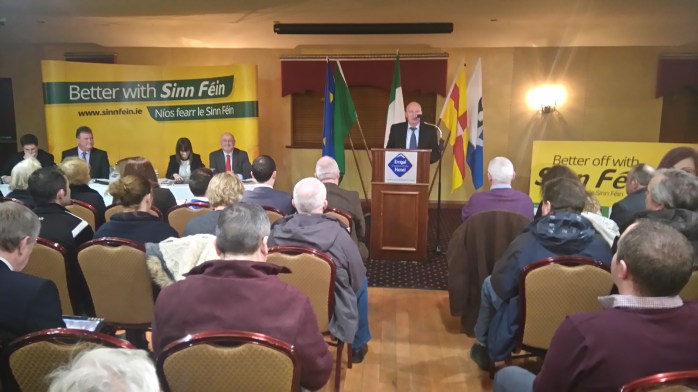
 A Bord Pleanála oral hearing begins on Monday 7th March into EirGrid’s latest proposal for a North/South electricity interconnector, one of the largest ever infrastructure projects in the history of the state. Two inspectors from the Planning Board began hearing submissions at the Nuremore Hotel in Carrickmacross.


 Interesting to see a leaflet issued on behalf of Alan Shatter T.D. seeking his re-election. He is getting in ahead of the posse in Dublin Rathdown. Interesting because it is a personalised leaflet with no Fine Gael logo or picture of the man himself, who is currently on the FG back bench, having served as Minister for Justice. On the reverse side there is a direct attack on Sinn Fein policies and a stout defence of a government led by Fine Gael. It calls for a vote #2 for FG constituency colleague Cllr Josepha Madigan, whose face has already appeared on dozens of election-type posters advertising public meetings in the past year. Finally it calls for a supporting vote for Energy Minister Alex White TD of Labour. As I reported in these columns recently Alex White was the subject of a no-vote protest by anti- wind farm and anti-pylon Campaigners.


 Michael Fisher's News