Get me outta here!

Michael Fisher's News

© Michael Fisher MMXXII

Menu

Skip to content
  • Home
  • About

Author Archives

borderroamerhttps://fisherbelfast.wordpress.comThe Northern Standard, Monaghan. Reporter.
borderroamer's avatar

BAFTA GAMES AWARDS

12/02/2013 by borderroamer
BAFTA Game Awards 2013

BAFTA Games Awards

You might think that BAFTAs were just for films. But that’s not the case. The British Academy also has its own “Oscars” for video games. So congratulations go to County Monaghan man Terry Cavanagh on his latest success (with potentially more to come!).

Terry Cavanagh

Terry Cavanagh

His parents from Tydavnet who are over in Cambridge at the moment tell us he is in the running for a BAFTA award for his Super Hexagon game. It’s one of six nominations in the “British game” category, which has been added for the first time this year.

Dara O Briain

Dara O Briain

The host for the gala evening at the London Hilton hotel on Tuesday 5th March is another Irishman, Dara O Briain. It will be shown on the UK’s Challenge television channel (Sky 125, Freeview 46, Virgin 139).  Another of Terry’s game creations, VVVVV, won an award for being the most fun and compelling game at the Indiecade showcase for games developers in Los Angeles in October 2010. So let’s wait and see if he gets another “Oscar” under his belt!   gamegames-awards-logo-2926

BRITISH GAME:

1. Dear Esther

Daniel Pinchbeck, Robert Briscoe, Jessica Curry

Thechineseroom/thechineseroom

2. Forza Horizon

Development Team

Playground Games/Turn 10 Studios/Microsoft Studios

3. LEGO: The Lord of the Rings

Development Team

TT Games/Warner Brothers Interactive Entertainment

4. Need for Speed Most Wanted

Development Team

Criterion Games/EA

5. The Room

Mark Hamilton, Rob Dodd, Barry Meade

Fireproof Games/Fireproof Games

6. SUPER HEXAGON

Terry Cavanagh, Niamh Houston, Jenn Frank

Terry Cavanagh/Terry Cavanagh

Share this:

  • Share on Facebook (Opens in new window) Facebook
  • Share on X (Opens in new window) X
Like Loading...
NEWS UNCATEGORISED BAFTAgames developerIndieCadeSuper HexagonTerry CavanaghTydavnetvideo gamesVVVVV Leave a comment

SETANTA CUP

11/02/2013 by borderroamer
Shamrock Rovers v Coleraine

Shamrock Rovers v Coleraine

SHAMROCK ROVERS 0 COLERAINE 1

Back in the days of my youth, I remember seeing one of the matches in a cross-border competition, the Blaxnit Cup. It might have been the second leg of the final at Dalymount Park in May 1968, when Shamrock Rovers lost 2-1 to Crusaders from Belfast, but took the first trophy 3-2 on aggregate. The following season, Rovers were again in the final but lost 4-3 to Coleraine, who went on to retain the trophy the following year by defeating Sligo Rovers in 1970. The Irish League side re-appeared in the 1972 final but went down to Cork Hibernians over two legs. The competition featured four clubs from the League of Ireland and four from the Irish League and it ran until 1974, when it was replaced by the Texaco Cup and then after a break, the Tyler Cup until 1980.

For that reminder about Coleraine’s previous Blaxnit success. I am grateful to David McClarty MLA, who was following my tweets from the ground on facebook. In one of my tweets I mentioned that one of Coleraine FC’s stalwart fans is the actor James Nesbitt, Chancellor of the University of Ulster, who was in Dublin on Saturday for the IFTA awards ceremony.

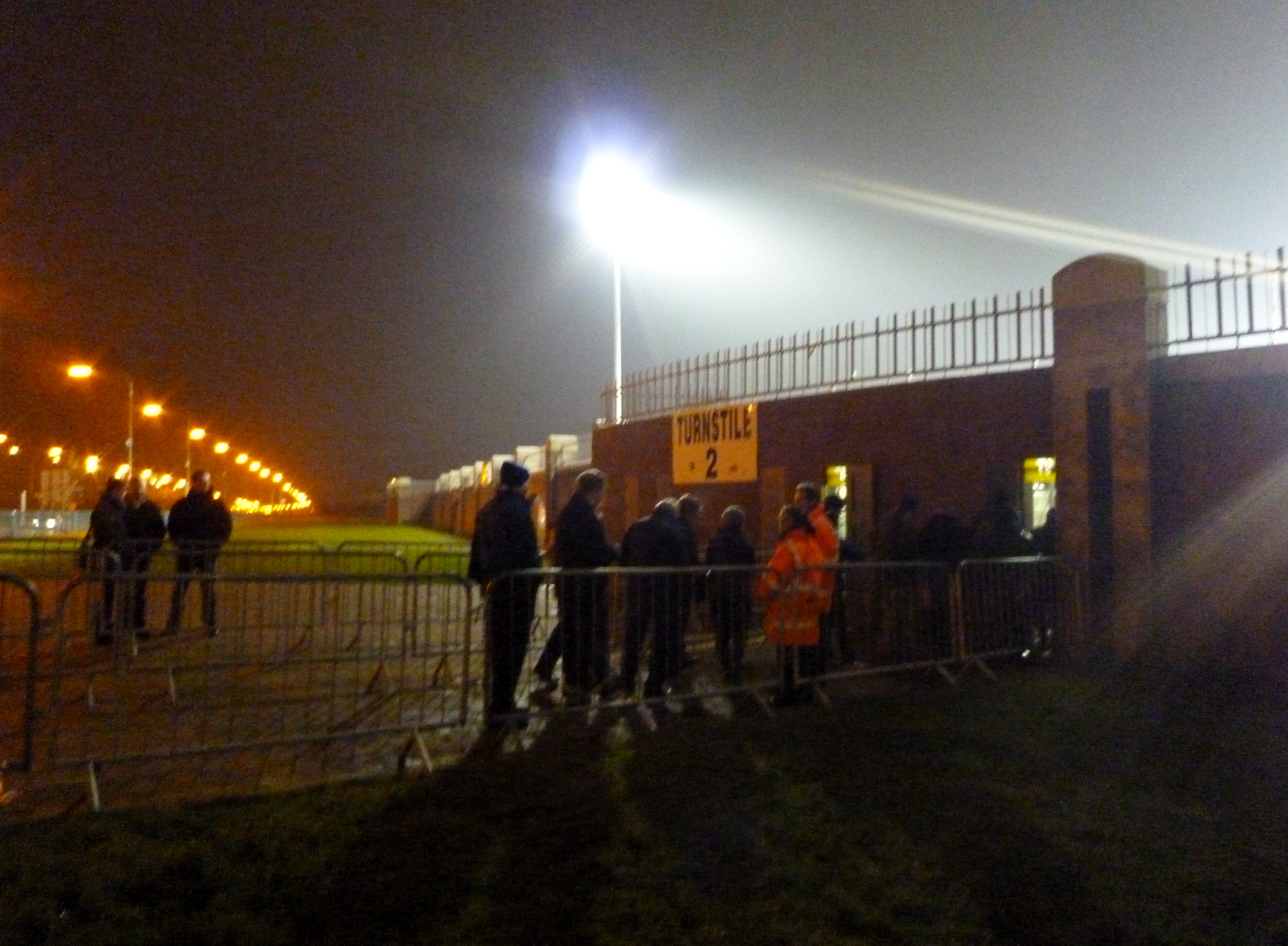
Since 2005 the all-island club competition has been known as the Setanta Sports Cup. This evening at Tallaght, the Hoops and the Bannsiders renewed their rivalry in the first leg of a first round match. I have been following Rovers at their new stadium over the last two seasons, but I don’t think I have ever seen Coleraine in “live” action.  I was impressed by the visitors and their vocal bunch of around 200 supporters who made the long trip to Dublin from the North-West.

Full Time

Full Time

The new-look home side were playing their first competitive senior game this year, because of the difference in soccer seasons in Northern Ireland and in the Republic. Before the game, one minute’s silence was strictlly observed by the teams and the crowd in memory of Tony Clare, a Rovers supporter who passed away recently. Then it was into action, but I missed the usual roar of the home fans and only one stand was in use. I also noticed that one of the banners behind the goalmouth had a picture of Rovers’ former striker Gary Twigg on it. He is now playing for Portadown in the Irish League, who lost 3-2 at Drogheda in the same competition.

Shamrock Rovers had most of the goal opportunities in the first half, with Mark Quigley unsuccessful on at least three occasions. Five minutes before the break, an injury to Ruairi Harkin forced him to retire and he was replaced by David Scullion. In what was to prove the decisive move of the whole match, in the third minute of first-half injury time, Scullion picked up the ball from Paul Owens and coolly lifted it over the top of the advancing Rovers’ keeper Barry Murphy.  Coleraine had taken the lead against the run of play.

Scullion nearly managed to double his side’s lead ten minutes into the second half. Quigley was replaced in the Hoops attack by Gary McCabe, who was involved in a few good moves along with Sean O’Connor. O’Connor came close with a free kick and McCabe likewise in the dying seconds of the game, when Coleraine had their goalie Michael Doherty to thank for keeping their advantage.

Coleraine fans at Tallaght

Coleraine fans at Tallaght

So the 200 or so Coleraine fans left Tallaght in a very orderly fashion and singing the praises of their team. The two sides will meet again next Monday at The Showgrounds, Ballycastle Road. There were three other cup games (first leg) tonight:-

ST PATRICK’S ATHLETIC 0 GLENTORAN 0

CORK CITY 4 Morrissey 16, Turner pen 26, 45+1, Kavanagh 69 CLIFTONVILLE 0

DROGHEDA UTD 3 R Brennan 8, O’Connor 14, G Brennan 60 PORTADOWN 2 A Burns 25, Braniff 43

SHAMROCK ROVERS 0 COLERAINE 1 Scullion 45+3

Share this:

  • Share on Facebook (Opens in new window) Facebook
  • Share on X (Opens in new window) X
Like Loading...
SPORT Blaxnit CupColeraineDavid McClarty MLADavid ScullionJames NesbittSetanta Sports CupShamrock RoversTallaght Leave a comment

CARLETON AND IRISH

10/02/2013 by borderroamer
William Carleton

William Carleton

The historian John Paul McCarthy immediately caught my attention in his column in the Sunday Independent p.16 10/02/13 with his mention of William Carleton in the sub-heading. He is writing about the poet Liam O Muirthile from Cork. Under the heading “Language of love and friendship”, he says that Liam’s latest collection of peoms is in the humane Carleton tradition. He goes on to make a very interesting comparison of the works of both men.  I am therefore publishing his comments here because of my interest in Carleton.

It is good to see the work of Liam O Muirthile getting recognition. I worked with him in the RTÉ newsroom in Dublin, where he was part of the Nuacht team. After he left RTÉ, he devoted his time to literature and he used to have a regular column in The Irish Times.

Liam O Muirthile, file (poet)

Liam O Muirthile, file (poet)

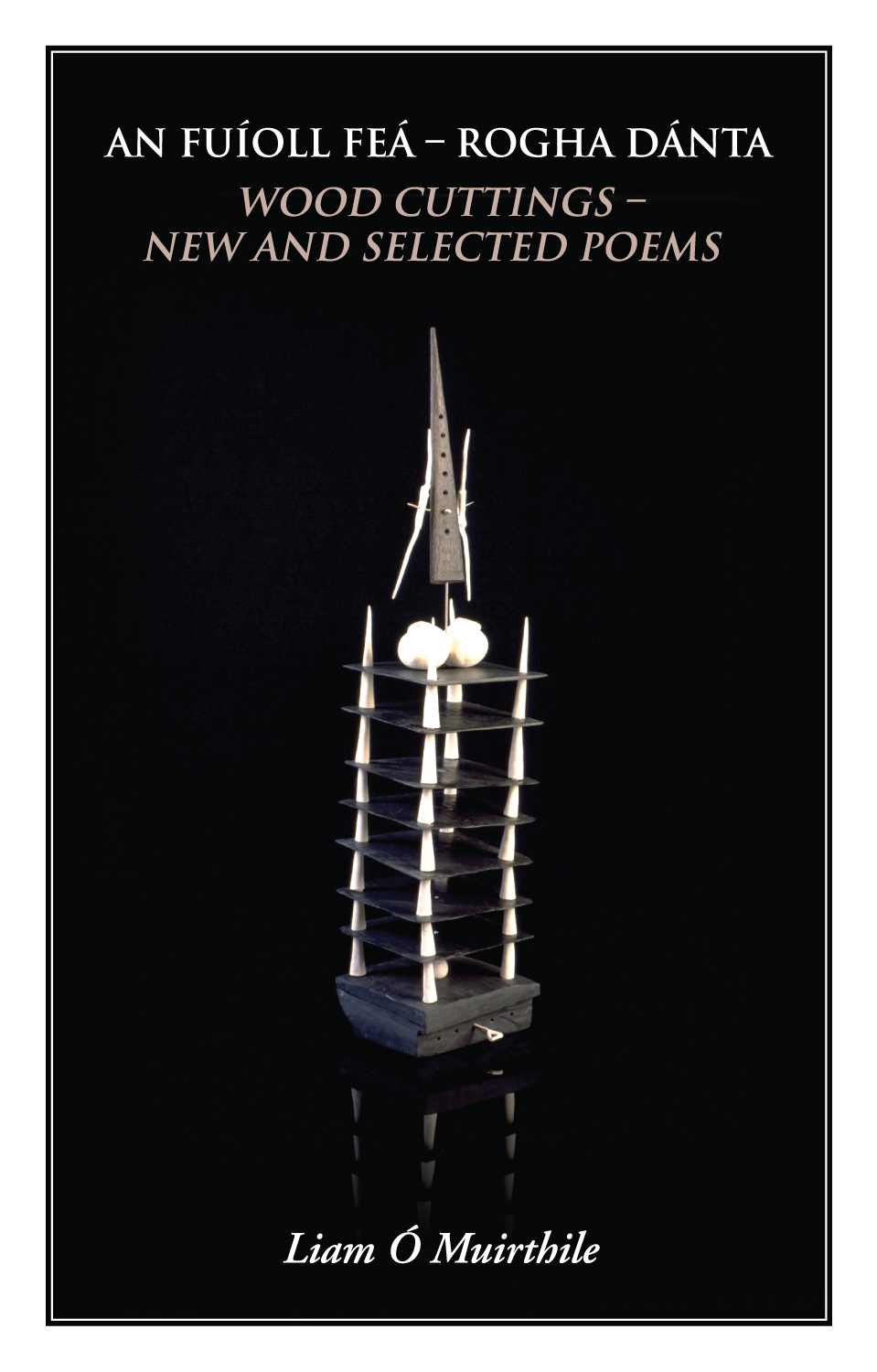
Liam’s latest work is called An Fuíoll Feá – Rogha Dánta or Wood Cuttings, new and selected poems, published by Cois Life and there’s more about it on their blog. Gabriel Rosenstock has translated the poems. The book is available in harback and softback (€30/€20). It also comes with a CD of O Muirthile reading some of his work.Fuíoll Feá - Rogha Dánta

Here is an edited version of what John Paul McCarthy has to say on the subject:-

“In his essay on Irish swearing, the great Victorian chronicler of Gaelic Ireland, William Carleton, said “the Irish language actually flows with the milk and honey of love and friendship”. Irish for him was the medium of prayer and domestic tranquility. That aspect of Irish has struggled to get a hearing in our time, if only because of the relentlessly political focus that has disfigured large parts of modern Irish letters. The introspection of the Gaeltachtai has not helped matters either. Liam O Muirthile’s latest collection of poems, An Fuioll Fea-Wood Cuttings (Cois Life), is very much in the humane Carleton tradition though.

O Muirthile’s Irish is the Irish of the city street, the factory floor and the urban tavern. His focus is on what Patrick Kavanagh once called “ordinary plenty”….

Like Carleton again, O Muirthile found politics to be inescapable. He translates parts of Wolfe Tone’s diaries in a series of poems before tending to the Guildford Four. The Firing Squad suggests some fundamental ambivalence about revolutionary aristocrats, especially the ones who plague people with their consciences in pubs.

The last poem of this collection then, Thuaidh (or North) draws these disparate threads together. The poet is commemorating an ancient IRA ambush, and proceedings are rather hijacked by an abrasive northerner. “‘Daoine boga sibhse theas,’ arsa cara. ‘Muidne thuaidh cruaidh.'” (You lot are soft down south, we’re hard in the north)”.

Share this:

  • Share on Facebook (Opens in new window) Facebook
  • Share on X (Opens in new window) X
Like Loading...
CARLETON NEWS UNCATEGORISED An Fuíoll FeáCois LifeGabriel RosenstockJohn Paul McCarthyLiam O MuirthileWilliam Carleton Leave a comment

MONAGHAN HURLING

09/02/2013 by borderroamer
Dr Croke Cup

Dr Croke Cup

The words “Monaghan” and “hurling” don’t sit naturally together. Monaghan is a footballing county, although the Farney men have never succeeded in winning the Sam Maguire Cup. But after this evening’s result in the Allianz National League, when Monaghan were defeated by neighbours Cavan at Breffni Park, perhaps the time has come for a change! If you look closely enough at the reflection in the silver of the cup, you can see how I managed to include the Tipperary colours of my tie in the picture!

This afternoon during a visit to my mother-in-law in Castleblayney, which is also my mother’s home town, I was pleased to get an opportunity to see the spoils of Kilkenny’s hurling victories. There was the Liam McCarthy Cup, presented to the All-Ireland senior champions. Alongside it was the Dr Croke Cup, the trophy for the National Hurling League champions of 2012, having defeated Cork in the final (www.gaa.ie report).

National League Champions Kilkenny

National Hurling League Champions 2012 Kilkenny (gaa.ie photo)

The trophies came to Castleblayney in the custody of Kilkenny kit manager Denis “Rackard” Cody, an important member of the county’s backroom team. I did not get a chance to ask him if his nickname came from the famous Wexford hurlers! The cups were brought to Ulster with a purpose: to encourage the development of hurling at secondary school level. The under-12s and under-14s from Our Lady’s secondary school and their counterparts from East Cavan Gaels took part in a match and coaching session run by Cody.

Kilkenny GAA

Kilkenny GAA

He joined the Kilkenny set-up in 1977 and has served as kit manager for the past ten  years. He refereed 15 county finals in all grades, and officiated also at National League level. He was elected the first Mayor of Graignamanagh in 1982 (Kilkenny People). He brings his knowledge and passion for hurling around the country. In November he visited one of the cradles of hurling, the Glens of Antrim, as a guest of the Robert Emmet club in Cushendun and helped run an underage competition.

Hurling can continue to be successful in Ulster and can only benefit from the expertise of the Noresiders. Title holders Loughgiel Shamrocks from the Glens were playing this afternoon in an All-Ireland club semi-final, which ended in a draw after extra time and will have to go to a replay. I also recall walking through the grounds of UCD in Belfield, near the sports centre, when I spotted a young lad with a Monaghan GAA top…..carrying a hurley. Such a rare sight that I felt it necessary to go up to him and congratulate him on his perseverance!

Share this:

  • Share on Facebook (Opens in new window) Facebook
  • Share on X (Opens in new window) X
Like Loading...
MONAGHAN NEWS SPORT CastleblayneyDr Croke CupEast Cavan GaelshurlingKilkennyMonaghan GAANational Hurling LeagueRackard Cody Leave a comment

SHENANDOAH PARK

08/02/2013 by borderroamer
Big Run Overlook in the Fall

Big Run Overlook in the Fall

Listening to the tenor Colin Morgan singing the American folk song “Shenandoah” on the Late Late Show brought back memories of a visit to this beautiful area in August 2009. In the Shenandoah National Park 75 miles from Washington DC in Virginia, there is a “skyline drive” on the crest of the Blue Ridge mountains, a scenic roadway taking you from one end of the park to the other (105 miles), with a speed limit of 35mph for cars. There is also lodge and cabin accommodation in different areas of the park. In some versions of the song, the name “Shenandoah” refers to an Indian chief, not to the Shenandoah Valley or Shenandoah River. However, an early rendition of the song includes verses that appear to allude to the Shenandoah River, which is partly in Virginia (wikipedia).

Irish Creek Valley

Irish Creek Valley

Passing through Shenandoah Park, you come to the Blue Ridge Parkway, along the Blue Ridge, part of the Appalachian Mountains. One of the many viewing places along the way was at Irish Creek Valley at milepost 43. It got its name from Ulster-Scots immigrants who settled along the banks of the river in the 1700s. For a 360° view click here. A few miles away are the remains of the Irish Creek Railway (logging railroad). There is a parking spot at Yankee Horse Ridge (MP35), where legend has it that a Union soldier’s horse fell and had to be shot.  Construction on the railroad began in 1918 and was completed two years later, with the length of the railroad stretching to 50 miles. The track was built to haul lumber during the pre-parkway logging days. In a document from 1918, one individual reported, “At present, however, a logging railroad is being built up Irish Creek to a point near Irish Creek post-office, and this would make transportation somewhat easier” (Henry G. Ferguson, Virginia Geological Survey).

Share this:

  • Share on Facebook (Opens in new window) Facebook
  • Share on X (Opens in new window) X
Like Loading...
TRAVEL UNCATEGORISED Blue Ridge MountainsIrish Creek ValleyShenandoahVirginia Leave a comment

SHERGAR

07/02/2013 by borderroamer
Ballymany Stud

Ballymany Stud

Thirty years ago as an RTÉ television news reporter I stood outside the gates at the main entrance to Ballymany Stud owned by the Aga Khan near The Curragh in County Kildare on the trail of the racehorse Shergar. He still hasn’t turned up, although there are many rumours about his fate. It became one of the most famous cases in the world of an animal being kidnapped. The 1981 Derby winner  was taken from his box by a group of armed men on February 8th 1983.

Shergar was a celebrity in his own right and was beginning his second year out to stud.  Three armed men wearing masks entered the grounds in a car with a horse trailer attached and then threatened the head groom Jim Fitzgerald and his family. Gardaí at Naas led by trilby-wearing Chief Superintendent Jim “Spud” Murphy immediately began an investigation into the whereabouts of the famous stallion. Several different ransom demands were made but the identity of the thieves has never been discovered, nor has the last resting place of Shergar. There have been plenty of theories about the group responsible. One suggestion is that it was an IRA gang intent on raising money to buy arms and that when they bundled the five year-old horse into the trailer he became excitable and unmanageable so the gang decided to shoot him. But the paramilitary group never claimed any connection. The story became international news and remains so today, for example on CNN.

Shergar (Getty Images via CNN)

Shergar (Getty Images via CNN)

The video of my piece to camera outside the stud keeps re-appearing in the RTÉ series “Reeling in the Years” and other programmes such as Mario Rosenstock’s “Twenty Moments that Shook Irish Sport” in 2007 (video link here at 1:17). If I was on commission for each time it was played, I would probably be a rich man by now!

Shergar: a racing legend, an IRA kidnap & ransom, a bungled investigation and an enduring myth.
Shergar was an acclaimed racehorse. Winner of the 1981 Epsom Derby by a record ten lengths, he was named European horse of the year that same year and retired from racing that September. Two years later, on the 8th of February, he was kidnapped from Ballymany Stud, near the Curragh. Despite a massive hunt and with the country gripped by Shergar-fever, the horse was never found. It is believed the IRA unit who kidnapped him killed him a few days later when negotiations for a two million pounds sterling ransom collapsed. However, to this day, Shergar’s remains have never been found and his disappearance has been one of the greatest myths of recent Irish times.

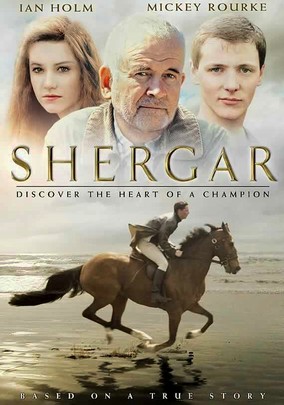
The story was also the subject of a film, made on the Isle of Man in 1998 and released the following year. It starred Sir Ian Holm, Mickey Rourke, David Warner and Gary Cady. My cousin in Belfast the photographer Phil Smyth has just reminded me that he saw the film when he was in Sydney, Australia, and that it used the news report with my piece to camera in it!film

Share this:

  • Share on Facebook (Opens in new window) Facebook
  • Share on X (Opens in new window) X
Like Loading...
NEWS SPORT Aga KhanBallymany studEpsom DerbyIan HolmJim FitzgeraldJim MurphyMickey RourkeShergar Leave a comment

BUSBY BABES

06/02/2013 by borderroamer
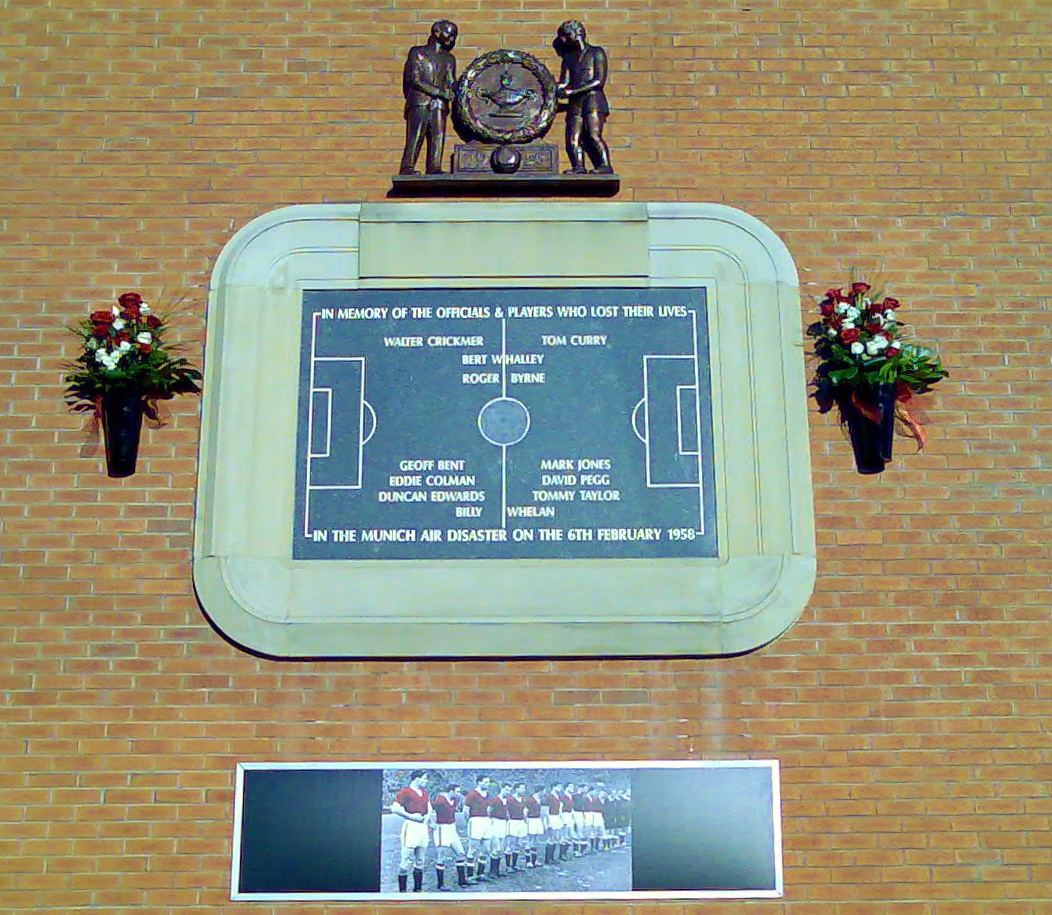
Old Trafford Memorial

Old Trafford Memorial

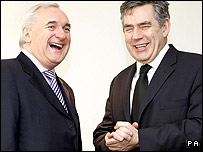
Five years ago when then Taoiseach Bertie Ahern needed a quick summit meeting with the British Prime Minister Gordon Blair to discuss the problem over the devolution of  justice and policing powers in Northern Ireland, he went to Manchester. They met on a Sunday morning in a conference room at Manchester airport. Mr Ahern was accompanied by the Irish government press secretary Eoghan Ó Neachtain (now TG4 rugby pundit). Myself and an RTÉ News cameraman from Belfast were the only ones allowed to do the “pool” pictures, along with a local stills photographer from PA.

Bertie Ahern & Gordon Brown (PA Pool Picture)

      Bertie Ahern & Gordon Brown (PA Picture)

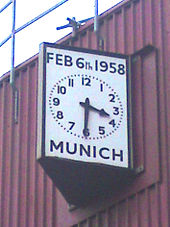
No questions were allowed to be asked as they sat down together, it was just a photocall. An Taoiseach however did agree to answer a couple of questions for me after the meeting. Both he and Mr Brown then left separately to go to Old Trafford, where Manchester United were remembering the 50th anniversary of the Munich plane crash. I did not get into the ground, where the two leaders were sitting in a VIP box, but spoke to some supporters as they arrived for the game. It gave me a chance to see the Munich memorial attached to a wall at the side of one of the stands, and the memorial clock attached to the south-east corner of the stadium. A special match programme was also issued to remember those who died.

Munich Clock

Munich Clock

Eight Manchester United players from the “Busby Babes” team, among them Billy Whelan from Cabra in Dublin, lost their lives when the Airspeed Ambassador plane they were travelling back to England in crashed on the runway during snowy conditions at Munich airport. Three staff from the club and a number of well-known English sports journalists were also killed. Others were lucky to survive, such as Bobby Charlton and goalkeeper Harry Gregg (then 24) from Northern Ireland. He attended the funeral of veteran sports journalist Malcolm Brodie in Belfast on Monday. Thinking now of the victims and survivors of the crash.

The Flowers of Manchester

One cold and bitter Thursday in Munich Germany

Eight great football stalwarts conceded victory

Eight men will never play again who met destruction there

The Flowers of English football the Flowers of Manchester

Matt Busby’s boys were flying home returning from Belgrade

This great United family all masters of their trade

The pilot of the aircraft the skipper Captain Thain

Three times they tried to take off and twice turned back again

The third time down the runway disaster followed close

There was slush upon that runaway and the aircraft never rose

It ploughed into the marshy ground it broke it overturned

And eight of the team were killed as the blazing wreckage burned

Roger Byrne and Tommy Taylor who were capped for England’s side

And Ireland’s Billy Whelan and England’s Geoff Bent died

Mark Jones and Eddie Colman and David Pegg also

They all lost their lives as it ploughed on through the snow

Big Duncan he went too with an injury to his brain

And Ireland’s brave Jack Blanchflower will never play again

The great Matt Busby lay there the father of his team

Three long months passed by before he saw his team again

The trainer, coach and secretary and a member of the crew

Also eight sporting journalists who with United flew

and one of them Big Swifty who we will ne’er forget

the finest English ‘keeper that ever graced the net

Oh England’s finest football team its record truly great

its proud successes mocked by a cruel turn of fate

Eight men will never play again who met destruction there

the Flowers of English football the Flowers of Manchester

Author: Eric Winter (1958)

Share this:

  • Share on Facebook (Opens in new window) Facebook
  • Share on X (Opens in new window) X
Like Loading...
NEWS POLITICS SPORT Bertie AhernBilly WhelanBobby CharltonBusby BabesGordon BrownHarry GreggManchester UnitedOld Trafford Leave a comment

POLITICS OF BROADCASTING

05/02/2013 by borderroamer

P1100145 - Copy (263x350)Martina Purdy political correspondent of BBC NI said she would never go into politics. Tracey Magee acting political editor of UTV believed the skills of journalism does not translate into politics. Both were asked if it was time for a female journalist to go into politics during a discussion at the Long Gallery at Parliament Buildings in Stormont, hosted by the Royal Television Society NI. Martina told the audience that journalists (with few exceptions) do not make good politicians. Those who remember the experience of RTÉ’s George Lee who was elected as a Fine Gael TD in June 2009 and resigned nine months later will agree with that.

If you want to gain a further insight into the discussion for which former UTV News Editor Rob Morrison acted as question master, you can follow it on twitter @RTS_NI. Twitter itself was the subject of one of the questions about the role of social media in coverage of politics in Northern Ireland. Tracey’s view was that twitter is far more immediate and can make things very difficult for journalists covering a story. She felt there was a lack of understanding about how it works. When she tweeted the words of a politician, she was reporting and was not giving her own opinion. Yet some users failed to make the distinction.    P1100147 - Copy

For Martina as a working journalist, twitter can be “a bit of a nightmare”. It can be very very annoying at news conferences in her view, and she would like to ban it on such occasions. She gave one example when Jim Allister of the TUV referred to Eamon Mallie as a “tweet freak”.  Michael Wilson managing director of UTV who organised the meeting on behalf of the RTS said he believed there was a good balance of political coverage in Northern Ireland and some of the Assembly’s best work goes unreported.

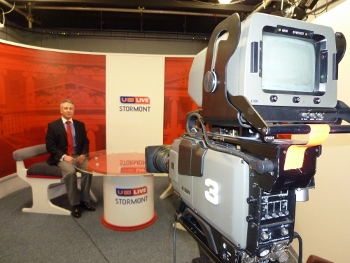
Earlier the visitors were given a briefing in the Senate chamber by Susie Brown, Head of Communications of the NI Assembly and Norah Anne Baron MD of Pi Communications, which has the contract for the broadcasting of proceedings. The group was then given a tour of the studios, including the Pi Communications control room and the UTV studio, which Tracey Magee broadcasts from.

Aidan Browne in UTV Studio

Aidan Browne in UTV Studio

Share this:

  • Share on Facebook (Opens in new window) Facebook
  • Share on X (Opens in new window) X
Like Loading...
NEWS POLITICS Aidan BrowneBBC NIMartina PurdyMichael WilsonParliament BuildingsPi CommunicationsRoyal Television SocietyStormontTracey MageeUTV Leave a comment

ARAS AN UACHTARÁIN

04/02/2013 by borderroamer
Aras an Uachtaráin

Aras an Uachtaráin

A recent visit to Aras an Uachtaráin, the official residence of the President of Ireland, at Phoenix Park in Dublin enabled me to see some of the features of the building, following a reception by President Higgins. I had been at the Aras twice before to meet his predecessor, Mary McAleese. Since the inauguration of Michael D. Higgins as ninth President nearly fifteen months ago, there have been a few changes inside the Aras.

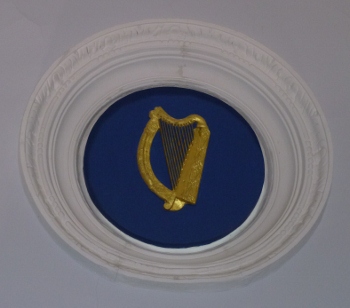
Presidential harp on ceiling

Presidential harp on ceiling

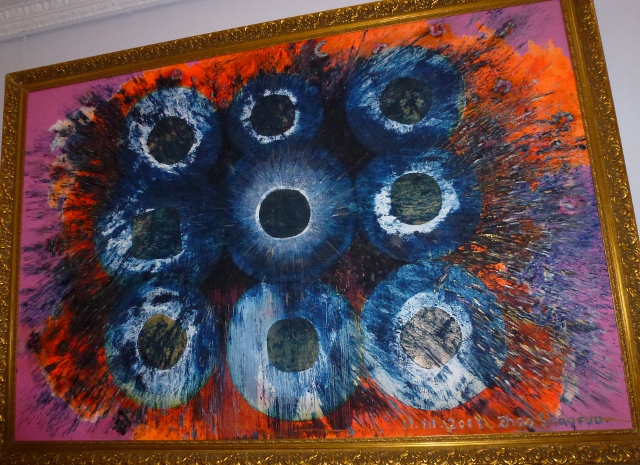
One of the first things to catch the eye of the visitor is a large painting in the entrance hallway by a Chinese artist Zhao Shao Rou dated 11-11-2011, when President Higgins was inaugurated at Dublin Castle.  The hall with its barrel-vaulted ceiling dates from 1751. One of the features is the golden harp on a blue background which is the same as the presidential standard.

Zhao Shao Ruo 11-11-2011

Zhao Shao Ruo 11-11-2011

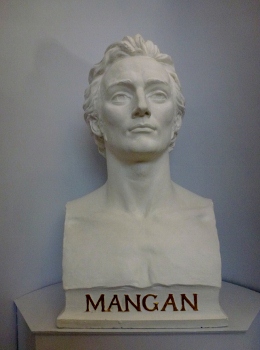
There are some plaster busts in the alcoves at the back. One of them is of James Clarence Mangan, who Yeats regarded as one of the best Irish poets. His poems were published in The Nation and among the best-known of his works is “Dark Rosaleen”. There is a memorial to him in St Stephen’s Green, a bust by Oliver Sheppard. It was commissioned by a committee that included Dr George Sigerson and DJ O’Donoghue, librarian at University College, who wrote a biography of him and who is also the person who completed William Carleton’s autobiography.

James Clarence Mangan

James Clarence Mangan

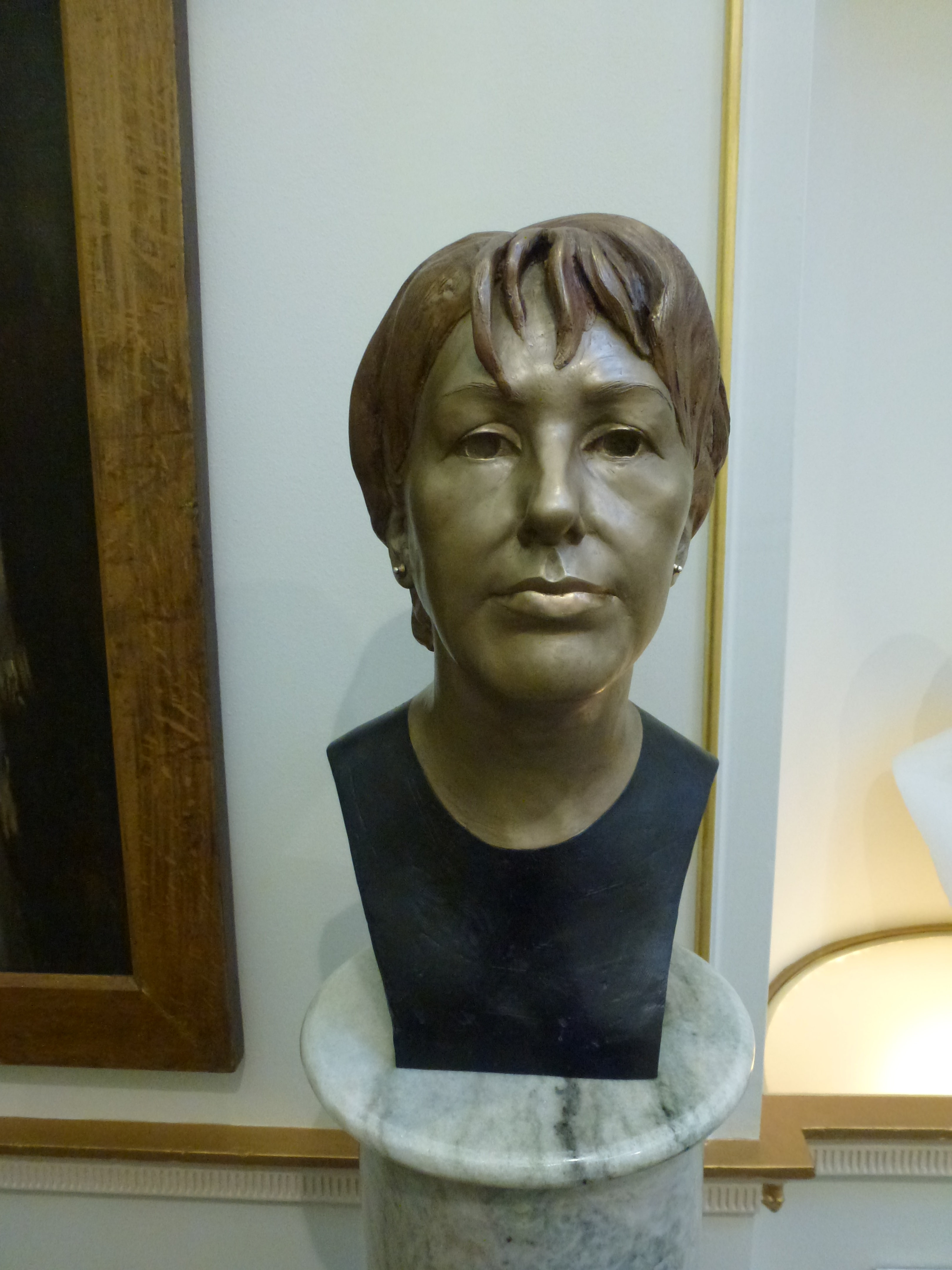
From the entrance hall, the visitor enters the Francini corridor, leading towards the state reception room. It contains the busts of past Presidents and was created in 1957 during the presidency of Sean T O’Ceallaigh. The one of Mary Robinson is a good likeness, in my view, but the most recent one of Mary McAleese is debatable. It was commissioned in 1999 and is by Carolyn Mulholland RHA from Lurgan. It cost €7,600.

Mary McAleese

Mary McAleese

There is also a portrait of Mrs McAleese which hangs alongside pictures of the other holders of the office. The Aras was built by Nathaniel Clements in 1751 and became the residence of British Viceroys until the creation of the Irish Free State (Saorstát Éireann) in 1922. More details about the building and pictures along with details of President Higgins can be found here. 

Share this:

  • Share on Facebook (Opens in new window) Facebook
  • Share on X (Opens in new window) X
Like Loading...
NEWS UNCATEGORISED Aras an UachtaráinMary McAleesePresident Higgins Leave a comment

MOUNT JEROME CEMETERY

03/02/2013 by borderroamer
William Carleton's Grave

William Carleton’s Grave

Commemorating the 144th anniversary of the death in January 1869 of the leading Irish author William Carleton last weekend, I laid flowers at his grave at Mount Jerome Cemetery in Dublin. It also gave a group of us an opportunity to visit the graves of several other famous Irish people. The graveyard contains one of the finest collections of Victorian memorials, tombs, vaults and crypts in Ireland.

Carleton’s last resting place is relatively easy to find, as it is on close to the main avenue leading up to the church, on the right hand side. It is marked by a small obelisk, raised ‘to mark the place wherein rest the remains of one whose memory needs neither graven stone nor sculptured marble to preserve it from oblivion’. It includes a sculptured portrait of Carleton by James Cahill, set in stone. It was restored and unveiled on 15th August 1989, thanks to the William Carleton Memorial Committee that included the writer Benedict Kiely, Barbara Hayley (NUI Maynooth) and Vivien Igoe. In her book, “A Literary Guide to Dublin“, Methuen 1994, she recalls how:-

“Kiely said in his oration that Carleton, as a novelist, had taken up the issues of tenants’ rights, emigration and famine and had put down on record the Irish people as he remembered them before the famine, before they were practically wiped out. Irish people have not much changed, he said”.   

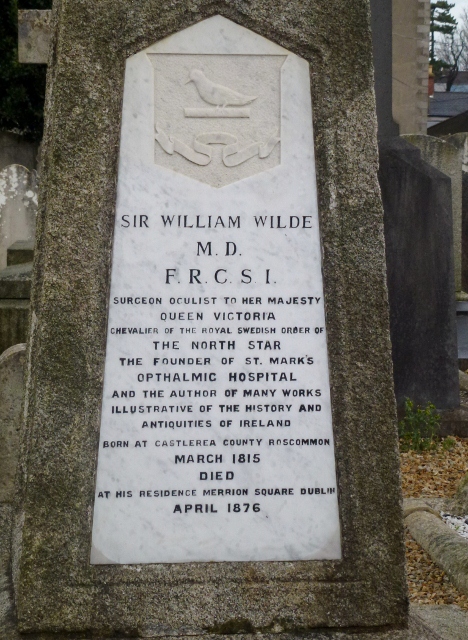
Sir William Wilde grave

Sir William Wilde grave

The next significant grave close to the entrance to the church is that of Dr William Wilde, eye and ear surgeon, father of Oscar and husband of Lady Jane Wilde, neé Elgee. She was an important figure in her own right, a poet and writer, who published under the name “Speranza” and played a part in the Irish literary revival. Oscar is buried in Paris. The side of the memorial carries the inscription: “In Memoriam Jane Francesca, Lady Wilde, ‘Speranza’ of The Nation, Writer, Translator, Poet and Nationalist, Author of Works on Irish Folklore, Early Advocate of Equality for Women and Founder of a Leading Literary Salon. Born Dublin 27 December 1821              Died London 3 February 1896.  Wife of Sir William and Mother of William Charles Kingsbury Wilde, Barrister and Journalist 1852-1899 Oscar Fingal O’Flahertie Wills Wilde, Poet Wit and Dramatist 1854-1900 Isola Francesca Emily Wilde 1857-1867 “Tread lightly, she is near, Under the snow, Speak gently, she can hear The lilies grow“.

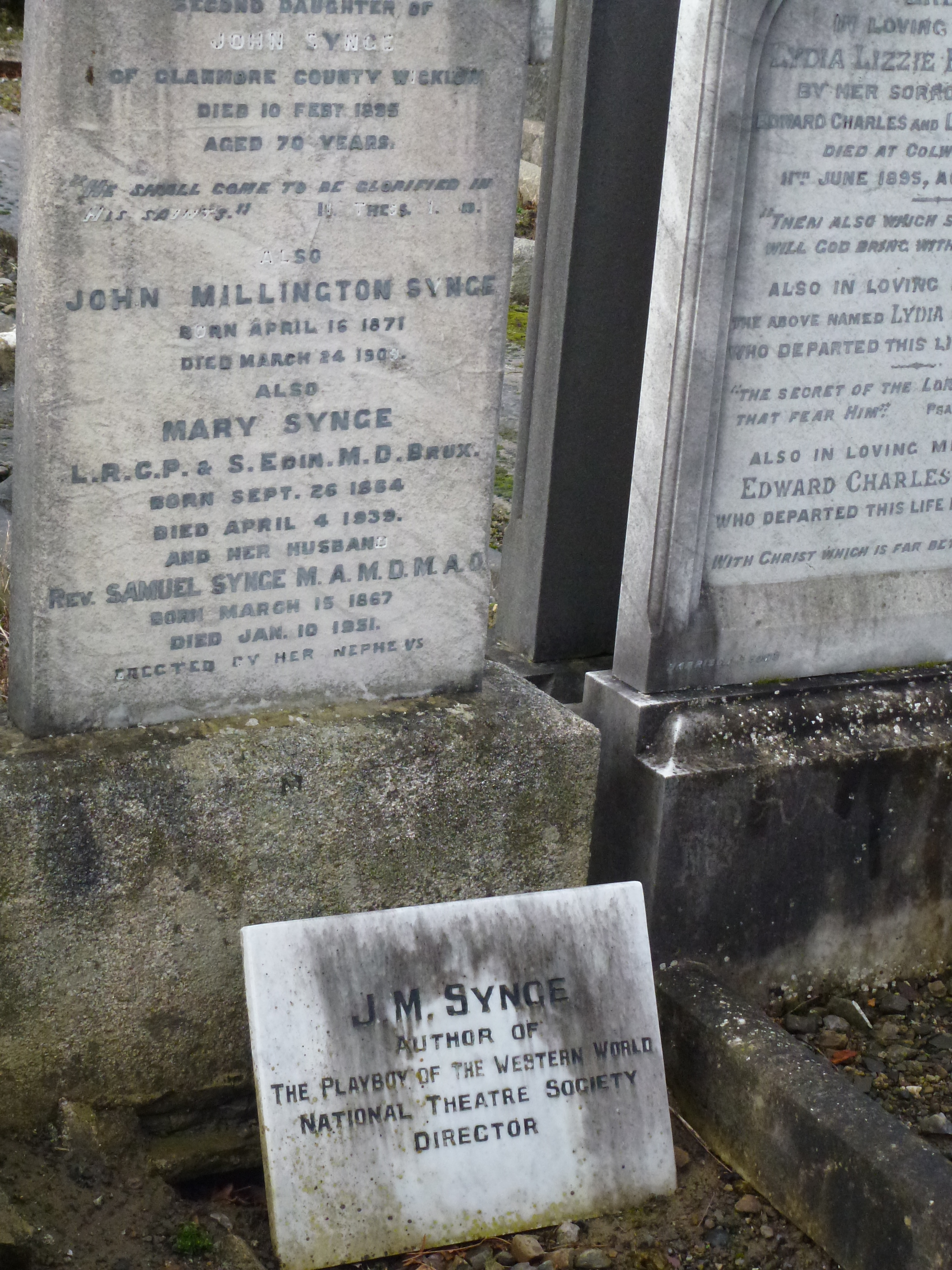
JM Synge grave

JM Synge grave

Another important figure in the Irish literary renaissance was the playright, John Millington Synge. His grave was more difficult to find. Synge was born in Rathfarnham, Co.Dublin on April 16th 1871 and died on March 24th 1909. He is best known for writing “The Playboy of the Western World“.  His brother, Reverend Samuel Synge who was a missionary in China is also buried there along with his wife Mary and his aunt Jane, second daughter of John Hatch Synge of Glanmore, Co.Wicklow.

Jack B. Yeats grave

Jack B. Yeats grave

WB Yeats was another leading figure in the Irish literary revival. His grave is in Drumcliff churchyard, under bare Ben Bulben’s head in Co.Sligo. But his brother, the painter Jack Butler Yeats, lies in Mount Jerome. He died on March 28th 1957, although the faded bronze lettering on the tombstone makes his grave difficult to spot. He was elected a member of the Royal Hibernian Academy in 1916. In 1999 one of his paintings was sold at Sotheby’s in London (where he was born in 1871) for over £1.2 million pounds. His wife Mary Cottenham Yeats predeceased him by ten years.

Buried in a different section is another member of the RHA, Sarah Purser. One of her paintings of a coastal scene in the West of Ireland was sold by Ross’s auctioneers of Belfast in 2007 f0r £2400. Not far from her grave is buried the writer Joseph Sheridan Le Fanu, but his exact burial spot could not be found, despite the assistance of a map. I think I saw two graves lying side by side near a tree and next to the path, but I could not find any inscription on the stones.

Sarah Purser grave

Sarah Purser grave

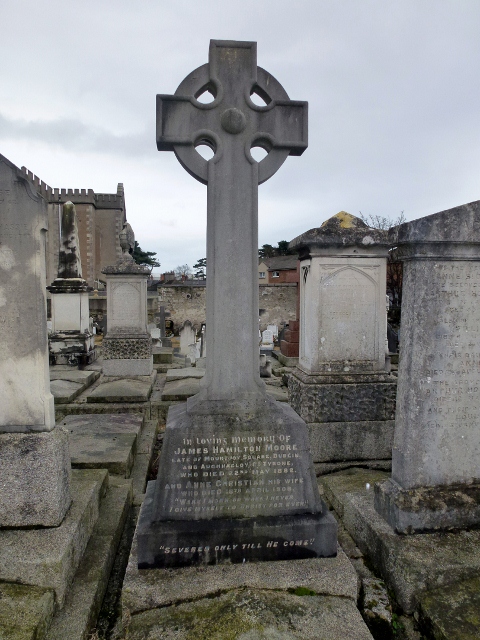
While wandering around I noticed a Celtic Cross and looked at the inscription. It turned out that the person buried there, James Hamilton Moore,  came from Aughnacloy, Co.Tyrone where some of my relatives on my mother’s side come from. Further research revealed his name in the British Parliamentary Papers on Ireland in a report on the (sectarian) riots in Belfast in July and September 1857. It seems things have not changed much in over 150 years! Moore is listed in an Appendix as part of evidence presented on behalf of the Orange Society (Order), of which he was a senior member.

James Hamilton Moore grave

James Hamilton Moore grave

Moore was Grand Treasurer of the Trinity College Grand District and was a solicitor with an address at 56 Lower Gardiner Street in Dublin (then a fashionable Georgian street). He is also listed as Deputy Grand Secretary of the Grand Orange Lodge of Ireland which met at Molesworth Street in Dublin in November 1856 and his address is given as Gardina Lodge, Monkstown, Co. Dublin.  So next time you have to attend a funeral or cremation at Mount Jerome, take the opportunity to think of all the others who found their place of eternal rest there. They include the writer AE (George Russell), Benjamin Guinness of the brewing family and Sir William Rowan Hamilton, mathematician and astronomer. Since the 1920s Catholics have been buried at the cemetery. In 1994 the remains of the well-known criminal Martin Cahill “The General” were brought there and his grave is now unmarked owing to vandalism.

Share this:

  • Share on Facebook (Opens in new window) Facebook
  • Share on X (Opens in new window) X
Like Loading...
CARLETON NEWS UNCATEGORISED AughnacloyJack B YeatsJames Hamilton MooreJM SyngeLady WildeMount Jerome Cemeteryorange orderWilliam Carleton 1 Comment

Post navigation

← Older posts
Newer posts →

Recent Posts

  • DESMOND FISHER 1920-2014 30/12/2020
  • GAJ AWARDS 2020 24/12/2020
  • COVID-19 REPORTING AWARD 20/12/2020
  • HAPPY 100TH BIRTHDAY 31/03/2020
  • NUJ VOTING REMINDER 26/01/2020
  • WORLD PRESS FREEDOM 20/01/2020
  • REMINDER TO VOTE 18/01/2020
  • BOND, WE’VE BEEN EXPECTING YOU! 17/01/2020
  • NUJ MEMBERS IN IRELAND 09/01/2020
  • NUJ BLAST FROM THE PAST 08/01/2020

Archives

  • Dec 2020 (3)
  • Mar 2020 (1)
  • Jan 2020 (13)
  • Oct 2019 (10)
  • Sep 2019 (30)
  • Aug 2019 (31)
  • Jun 2019 (2)
  • May 2019 (1)
  • Sep 2018 (1)
  • Jul 2017 (1)
  • Dec 2016 (12)
  • Sep 2016 (2)
  • Aug 2016 (5)
  • Jul 2016 (5)
  • Jun 2016 (10)
  • May 2016 (15)
  • Apr 2016 (19)
  • Mar 2016 (14)
  • Jan 2016 (26)
  • Dec 2015 (2)
  • Aug 2015 (1)
  • Jul 2015 (30)
  • Jun 2015 (30)
  • May 2015 (32)
  • Apr 2015 (30)
  • Mar 2015 (31)
  • Feb 2015 (28)
  • Jan 2015 (31)
  • Dec 2014 (31)
  • Nov 2014 (14)
  • Mar 2014 (2)
  • Feb 2014 (2)
  • Jan 2014 (31)
  • Dec 2013 (19)
  • Nov 2013 (17)
  • Oct 2013 (29)
  • Sep 2013 (30)
  • Aug 2013 (31)
  • Jul 2013 (31)
  • Jun 2013 (30)
  • May 2013 (28)
  • Apr 2013 (32)
  • Mar 2013 (31)
  • Feb 2013 (28)
  • Jan 2013 (31)
  • Dec 2012 (3)
  • Oct 2012 (1)
  • Sep 2012 (1)
  • Aug 2012 (2)
  • Jul 2012 (3)
  • Jun 2012 (3)
  • May 2012 (3)
  • Apr 2012 (5)
  • Mar 2012 (1)
  • Jan 2012 (1)
  • Dec 2011 (1)
  • Nov 2011 (1)
  • Jun 2011 (1)
  • May 2011 (1)
  • Apr 2011 (2)
  • Dec 2010 (1)
  • Nov 2010 (3)
  • Oct 2010 (6)
  • Aug 2010 (1)
  • Jul 2010 (7)

Categories

Meta

  • Create account
  • Log in
  • Entries feed
  • Comments feed
  • WordPress.com

Enter your email address to follow this blog and receive notifications of new posts by email.

36th Ulster Division 2013 WPFG AFC Wimbledon An Bord Pleanála Ballinode Balmoral Show Barry McCall Battle of Somme BBC belfast Belfast Festival Belfast Lions Club Big Music Week Birmingham BOSE Bristol Carlow Carrickmacross Castleblayney Catholic Herald Clogher Clones CMAPC Defence Forces Derry Desmond Fisher Dublin EirGrid Emyvale Fine Gael GAA Geel Glaslough Heather Humphreys TD Iarnród Éireann Ice Hockey Ieper Inniskeen Irish Press Kingsmeadow London Meath Michael Fisher Monaghan Monaghan County Council NEC NEPPC Newbridge North/South Interconnector Northern Standard NUJ Odyssey Arena Patrick Comerford Pope Francis Poperinge Private Robert Hamilton PSNI Royal Irish Fusiliers RTÉ SDLP Shamrock Rovers Shared History Shared Future SIPTU St Macartan's Cathedral Tallaght Tydavnet Tyrone Ulster rugby Vatican II William Carleton William Carleton Society William Carleton summer school WW1 WWI WWII

Blog Stats

  • 244,003 hits
Blog at WordPress.com.
Michael Fisher's News
Blog at WordPress.com.
  • Subscribe Subscribed
    • Michael Fisher's News
    • Join 173 other subscribers.
    • Already have a WordPress.com account? Log in now.
    • Michael Fisher's News
    • Subscribe Subscribed
    • Sign up
    • Log in
    • Report this content
    • View site in Reader
    • Manage subscriptions
    • Collapse this bar
 

Loading Comments...
 

    %d