FAREWELL LORD JIM

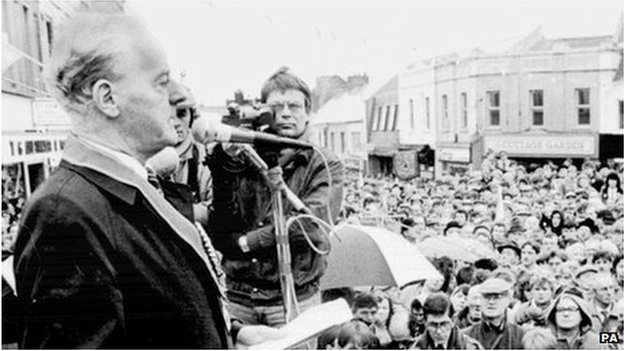
UUP leader James Molyneaux being filmed at a rally by RTÉ News cameraman John Coughlan. Looks like mid-1980s. Photo: Press Association/BBC website

UUP leader James Molyneaux being filmed at a rally by my former colleague RTÉ News cameraman John Coughlan. Judging by the camera, it looks like mid-1980s.  Photo: Press Association/BBC website

I was sorry to hear of the passing of the former Ulster Unionist Party leader (1979-85), Lord Molyneaux. He was always a very courteous man, willing to give interviews to RTÉ News to put across his party’s position. He never came across well on television, however, but that did not bother him much, I reckon. A few years before I retired (so that must be at least six years ago) a former reporter passed on a hint that Jim (as he was usually referred to) was on his last legs and that it might be time to prepare an obituary. Thankfully he remained with us for many more years and died at the age of 94.

Among the things that I remember about Lord Molyneaux are that he served during the Second World War in the Royal Air Force and was among a group of Allies that liberated  Belsen concentration camp in 1945. There is a very powerful description of this event in a documentary made by the BBC a few years ago. He was an Orangeman, who served for a time as Sovereign Grand Master of the Royal Black Preceptory (1971-95).   He was from Killead, beside Aldergrove in County Antrim. While his health allowed him, he used to join in the choir on Sundays at the local parish church beside the former RAF base. The BBC’s Mark Devenport has filed a very good obituary on their website.

James Molyneaux, M.P. at an Orange rally  Photo: Press Association/BBC website

James Molyneaux, M.P. at an Orange rally Photo: Press Association/BBC website

His political career spanned more than three decades. He joined the party in 1946 and went on to become one of its longest-serving leaders from 1979 to 1995. At the end of World War Two, he was among the first British troops to enter the newly liberated Belsen concentration camp in Germany. He was knighted in 1996 and was granted a life peerage in the 1997 Birthday Honours list, becoming Lord Molyneaux of Killead.

Ulster Unionist Party leader Mike Nesbitt said: “He brought a stability to the unionist party at a time when it was much needed. “Times were fraught, not just in terms of the exceptional level of barbaric terrorism that was being imposed upon the people of Northern Ireland, but this very difficult political situation where the then-prime minister Margaret Thatcher was persuaded to sign the Anglo-Irish Agreement with the government of the Republic of Ireland, which was incredibly destabilising for Northern Ireland.”

James Molyneaux held his party together in the face of a continued challenge from DUP leader Ian Paisley. He was MP for South Antrim from 1970 to 1983 and for Lagan Valley from 1983 to 1997. In 1979, he succeeded Harry West as UUP leader.

Lord Trimble, who succeeded Lord Molyneaux as Ulster Unionist leader in 1995, said: “He was one who did things quietly and consensually – there was plenty of discussion about the way in which things were evolving – there was a collective leadership and it was effective.”

Current DUP leader Peter Robinson said Lord Molyneaux was “first and foremost a committed unionist”.
“Through his service in the RAF in World War Two and 27 years as a member of parliament, he was marked by a quiet determination and diplomacy,” he said.
“Jim’s leadership encompassed many difficult years for unionism and his skills were key to ensuring that the Ulster Unionist Party held together when there were competing viewpoints about how to move forward.”

Former Prime Minister John Major described Lord Molyneaux as one of the “unsung heroes of the peace process”. Secretary of State for Northern Ireland, Theresa Villiers, paid tribute to his “fortitude, courage and unswerving commitment to democracy”. “It is right that we remember his distinguished years of public service, as a parliamentarian and leader of the Ulster Unionist Party,” she added. “In that role he helped to steer Northern Ireland through its darkest days from the 1970s to the 1990s and for that we should all be grateful.”

President Michael D Higgins said Lord Molyneaux became an “icon in the Unionist tradition” and would be missed by many “who were appreciative of a life devoted to public service and the world of politics”.  Sinn Féin president Gerry Adams said: “Famously, he described the 1994 IRA cessation as one of the most destabilising events for unionism and the Orange state since partition, and he campaigned against the Good Friday Agreement. “We had obvious and strong political differences, but this is a sad time for Mr Molyneaux’s family and friends and I wish to extend on my own behalf and that of Sinn Féin our condolences and sympathy to them.”

Ulster Unionist assembly member Danny Kennedy said: “He fought for our nation in war, and gave strong and determined leadership in the most difficult period of our country’s history. “He was highly regarded and respected as leader of our party, and his legacy remains in the values he represented and passed on.”
Former Ulster Unionist MP Lord Kilclooney said: “He was a quiet man of politics, but a very genuine gentleman who gave great leadership to the Ulster Unionist Party at a time when it was riven by division.”
Pat Ramsey of the SDLP paid tribute to Lord Molyneaux’s “distinguished career”. “For many years he was a household name and a key player in Northern Irish politics,” he told the Assembly.

Alliance Party leader David Ford said Lord Molyneaux’s experience at the liberation of Belsen “must have touched him enormously and gave him a commitment and drive for public service”. He told the Assembly: “He was the leader of his party for 16 years, something that few of us in this chamber can appreciate exactly how he managed to do this, and he certainly had an impact over some of the most turbulent years in this region as he carried through that role of leadership.”
TUV leader Jim Allister said: “He was a giant in our political scene who moved through it in that quiet, unassuming way that characterised him, and he was above all, a unionist through and through.”
Ulster Unionist Party chairman Lord Empey said: “Affectionately known to his senior colleagues as ‘the wee man’, Jim Molyneaux was never one to be carried away by the high offices he held over the years.
“Whether as a long serving member of parliament, as party leader or as a member of the House of Lords, Jim was always a no-frills politician.”
CARRICKMACROSS ST PATRICK’S DAY

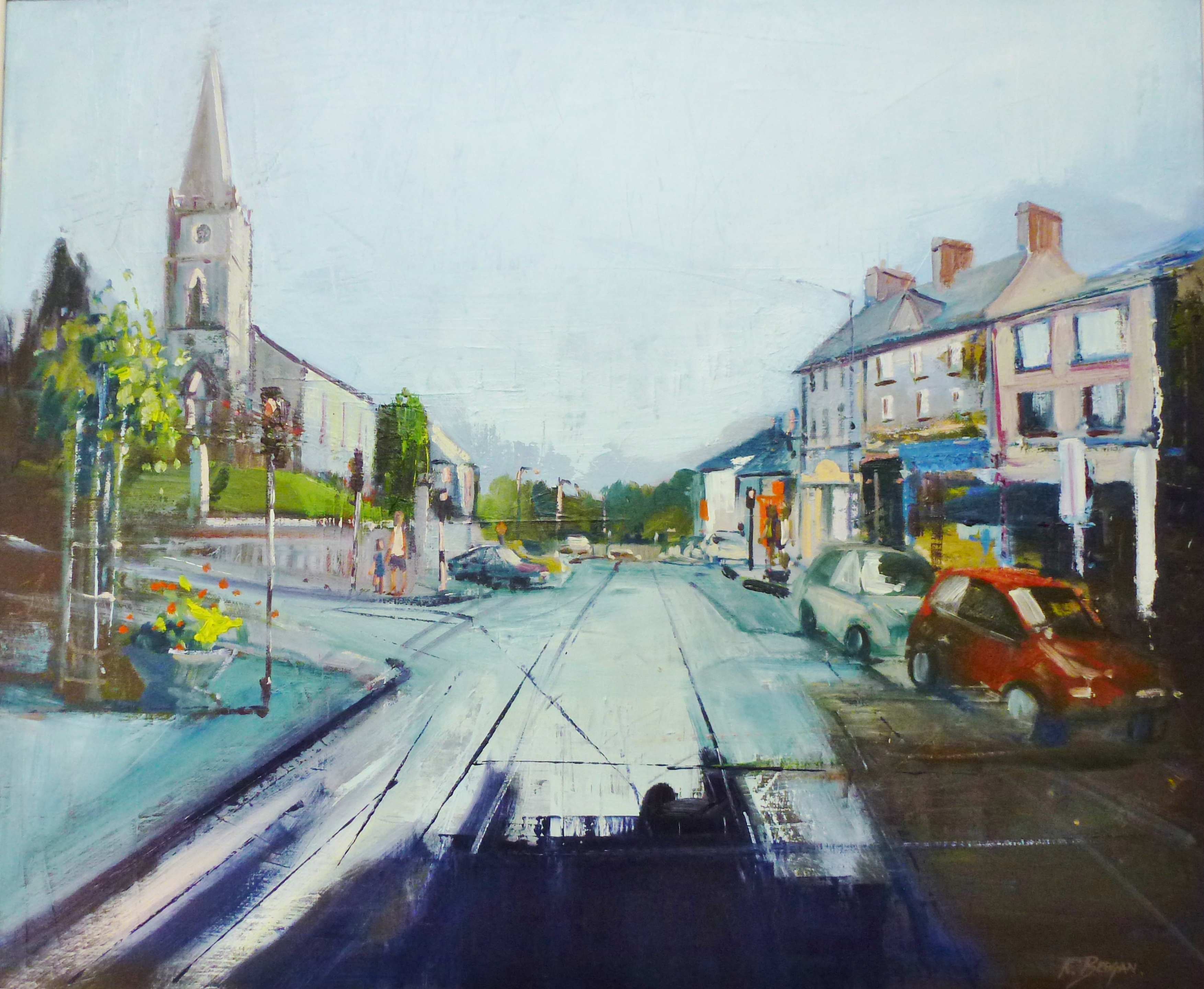
Main Street Carrickmaross Painting Photo: © Kate Beagan

Main Street Carrickmaross Painting Photo: © Kate Beagan

The annual St Patrick’s Day parade will be held through the town on Tuesday 17th March beginning on the Dundalk Road at 3pm, and passing along Farney Street to Main Street, where there will be a reviewing stand. Comhaltas members will be playing traditional music on the bandstand at 2.30pm in advance of the parade.

There will be a prize of €100 for the best dressed shop window in the town.

If you require more information or wish to take part, you should contact Carrickmacross civic offices, telephone (042) 9661236 or email: carrickmacross@monaghancoco.ie.

Courthouse, Carrickmacross  Photo: © Michael Fisher

Courthouse, Carrickmacross Photo: © Michael Fisher

Earlier in the day, the tricolour will be raised outside the Courthouse at 11.15am, with music by the Stedfast Shoes Brass Band.

Looking for something to do afterwards?

Hudson’s funfair will be in operation in the car park at Drummond Etra from Sunday 15th March.

On St Patrick’s Day, Carrickmacross Baptist Church will be providing live traditional music, a professional artist and hot drinks, all free of charge.

Music starts at 4pm in the marque outside the SoSaD offices at Bridewell Lane. International artist Ross Wilson will give a contemporary presentation on St Patrick at 5:30pm. All funds raised will go to Save our Sons and Daughters.

St Finbarr's Church, Carrickmacross  Photo: © Michael Fisher

St Finbarr’s Church, Carrickmacross Photo: © Michael Fisher

ON YER BIKE WITH CARRICK LIONS

Gerry Murphy, RTÉ Weather Presenter

Gerry Murphy

RTE weather presenter Gerry Murphy has been invited by Carrickmacross Lions Club to launch their 4th annual Charity Cycle.  He will be at The Shirley Arms Hotel, Carrickmacross, today Saturday 7th March at 1pm, along with representatives from all the local cycling clubs in the North-East region. This will be Gerry’s second year associated with The Lions Club Cycle. Last year he launched the event and then cycled the 90km Drumlin Route. The proceeds from this year’s cycle will go to the Monaghan Branch of Down Syndrome Ireland.

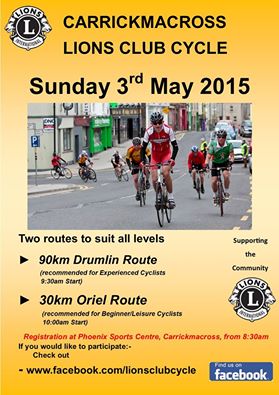
Carrickmacross Lions Club Cycle for Charity 2015

Carrickmacross Lions Club Cycle for Charity 2015

The Carrickmacross Lions Club Cycle on Sunday 3rd May will appeal to cyclists of all abilities. Lions Club President Claire Cunningham appealed to anybody with a bike to “get back on the saddle and help support the Lions Club and those in our communities with Down Syndrome”. The 30km Oriel Route for beginner and leisure cyclists will be on a flat route to the picturesque village of Tallanstown in County Louth, where the local Tidy Towns Committee will provide refreshments for the cyclists. The 90km Drumlin Route will provide a challenge for the more experienced cyclists and will take advantage of the rolling terrain of counties Monaghan and Cavan.

Carrickmacross Lions Club Cycle

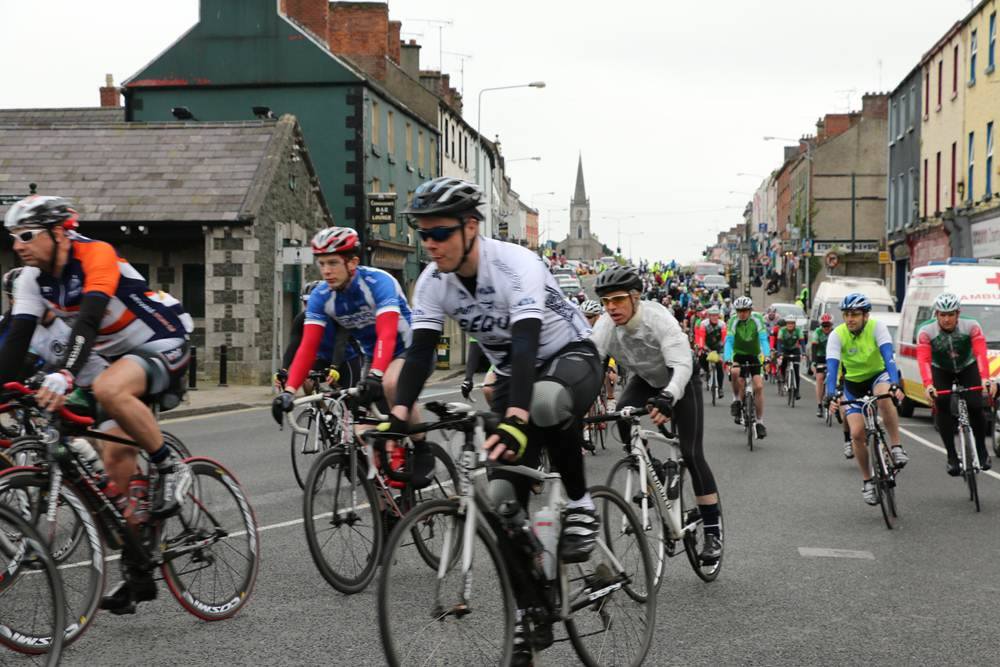
Carrickmacross Lions Club Cycle 2014

Everybody is welcome to attend the event launch. The Lions Club are especially interested in hearing from people who would like to help them in the running the event which has become one of the highlights in the cycling calendar. The Carrickmacross Lions Club Cycle is supported by Monaghan Sports Partnership and further information is available on www.carrickmacrosslionsclub.com or on http://www.facebook.com/lionsclubcycle.

Carrickmacross Lions Club Cycle 2014

Carrickmacross Lions Club Cycle 2014

BARRY JAY HUGHES EP LAUNCH

Carrickmacross Singer/Songwriter Barry Jay Hughes  Picture: COPYRIGHT © Pat Byrne

Carrickmacross Singer/Songwriter Barry Jay Hughes Picture: COPYRIGHT © Pat Byrne

Barry Jay Hughes to launch new EP in April with Íontas Performance 

Fresh from his appearance on TG4 and some well-earned praise from one of the judges Síle Seoige, singer/songwriter Barry Jay Hughes from Carrickmacross is bringing his acoustic show to the Íontas Theatre in Castleblayney next month. He will be launching his new EP “This Way Up” at the venue on April 10th.

The new release was recorded and mixed in Westland Studios Dublin in the last few months with the help of engineer Alwyn Walker. Westland Studios has seen its fair share of famous faces down through the years. Def Lepard, Bryan Adams, Hozier, Sinead O Connor and Thin Lizzy are among the names on their client list.

For those who have not yet heard this young County Monaghan artiste, next month’s event is a perfect opportunity to witness his great potential. Barry has been a keen musician from a very young age and in recent years decided to concentrate full-time on his music career, after spending over thirteen years working in the hospitality industry.

Barry is currently preparing for the launch night at the Íontas Theatre and promises us a great show, with support by Sinead Mc Nally, a well established songwriter and performer from Knockbridge, Co. Louth, who has many musical achievements under her belt. Barry will also be joined by percussionist extraordinaire Nick Bailey who has worked with shows such as Celtic Woman, Riverdance and collaborated with Kelly Clarkson.

Barry told The Northern Standard that the show will be a pleasant mix of high energy performance with heart and soul as well as some laid back and “chilled” moments and above all he guarantees a great night’s entertainment. The show will cover many genres and will appeal to all musical tastes showcasing Barry’s new material as well as some much loved covers. He added that he is very much looking forward to meeting all his fans and friends on the night.

“This Way Up” is a collection of songs penned by Barry himself along with a cover of Georgie Boy, a song that was written and released by Jack L back in 1999. Another track which found its roots back in 1999 is “Judgement Day” which features on the new EP. Barry says it’s a song he is delighted to have recorded after writing it almost sixteen years ago. The EP is predominantly Pop–Rock in sound, with subtle elements of traditional and folk music. barryhughesiontas

Tickets for The Íontas Theatre Show are available at www.iontascastleblayney.ie or by calling +353 (0)42-9753400. For further information on Barry Jay Hughes and  details of his upcoming gigs, log on to: www.facebook.com/barryhughesmusic.

MAYO HONOURS MONAGHAN MAN

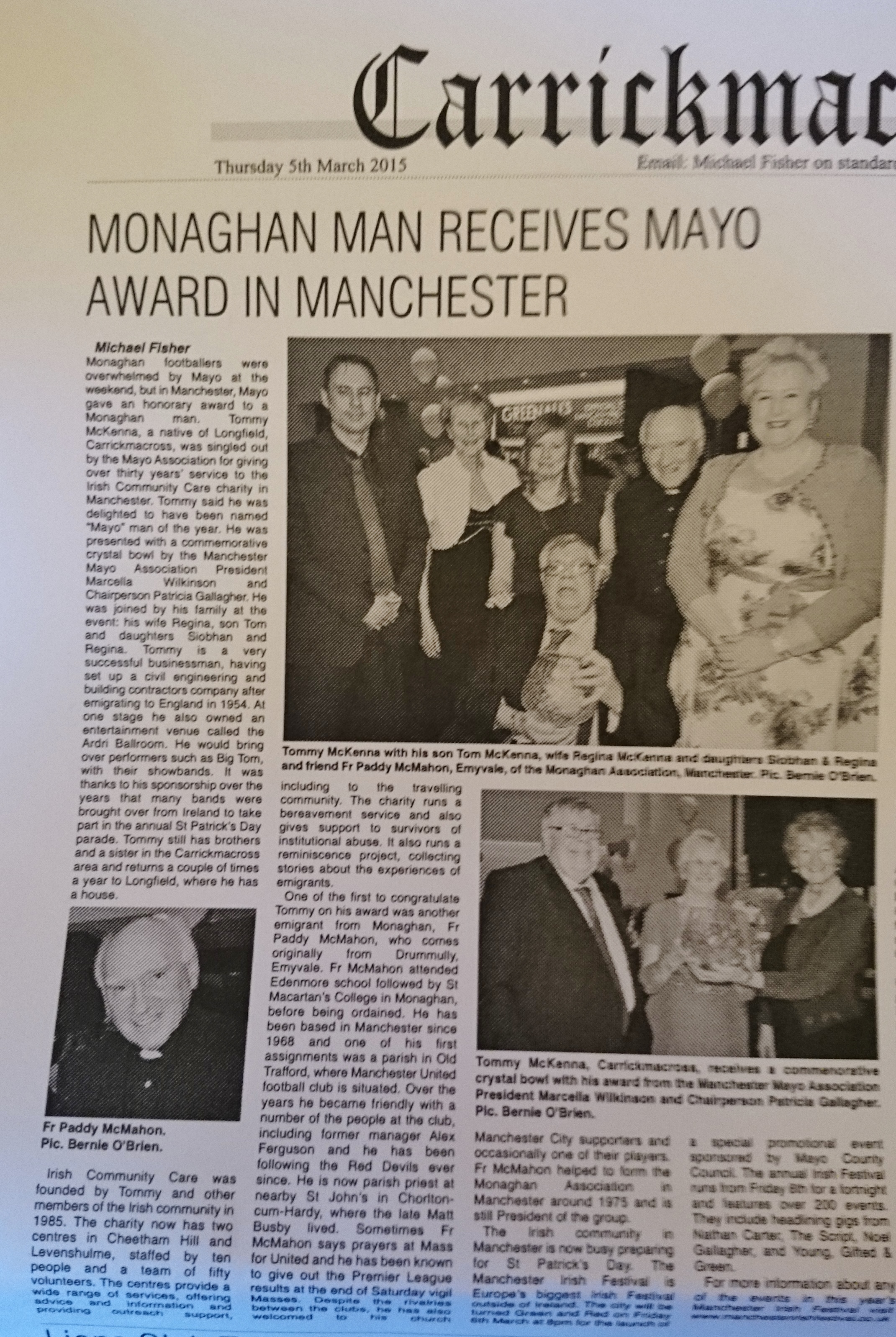
Tommy McKenna with his son Tom McKenna, wife Regina McKenna and daughters Siobhan & Regina and friend Fr Paddy McMahon, Emyvale, of the Monaghan Association, Manchester. Photo: © Bernie O'Brien.

Tommy McKenna with his son Tom McKenna, wife Regina McKenna and daughters Siobhan & Regina and friend Fr Paddy McMahon, Emyvale, of the Monaghan Association, Manchester. Photo: © Bernie O’Brien.

MONAGHAN MAN RECEIVES MAYO AWARD IN MANCHESTER

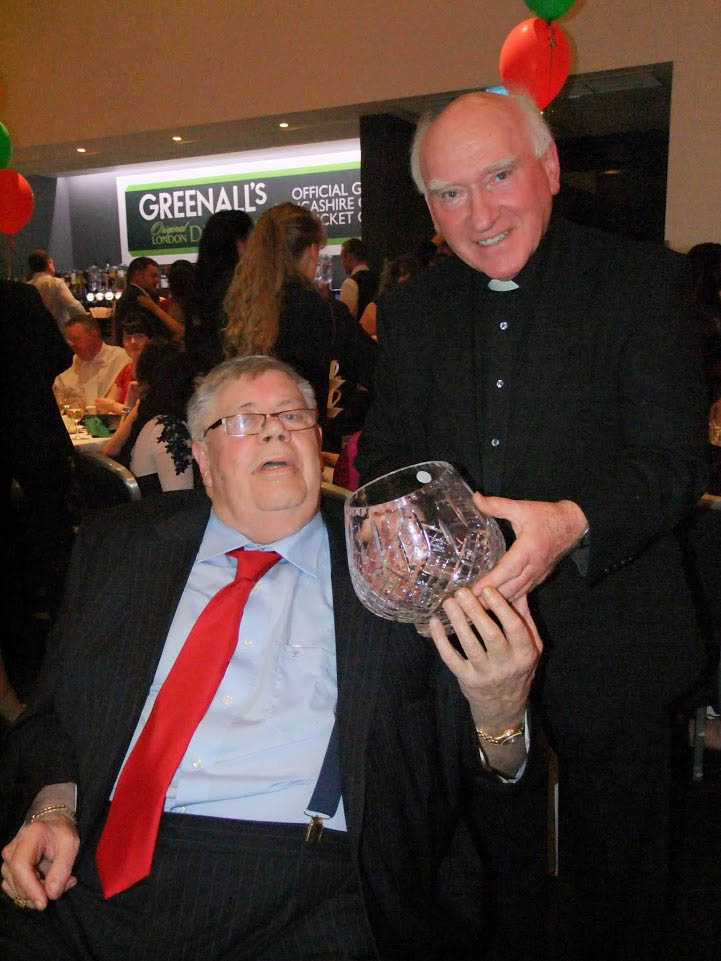
Monaghan footballers were overwhelmed by Mayo at the weekend, but in Manchester, Mayo gave an honorary award to a Monaghan man. Tommy McKenna, a native of Longfield, Carrickmacross, was singled out by the Mayo Association for giving over thirty years’ service to the Irish Community Care charity in Manchester. Tommy said he was delighted to have been named “Mayo” man of the year. He was presented with a commemorative crystal bowl by the Manchester Mayo Association President Marcella Wilkinson and Chairperson Patricia Gallagher. He was joined by his family at the event: his wife Regina, son Tom and daughters Siobhan and Regina.

Tommy is a very successful businessman, having set up a civil engineering and building contractors company after emigrating to England in 1954. At one stage he also owned an entertainment venue called the Ardri Ballroom. He would bring over performers such as Big Tom, with their showbands. It was thanks to his sponsorship over the years that many bands were brought over from Ireland to take part in the annual St Patrick’s Day parade. Tommy still has brothers and a sister in the Carrickmacross area and returns a couple of times a year to Longfield, where he has a house.

Irish Community Care was founded by Tommy and other members of the Irish community in 1985. The charity now has two centres in Cheetham Hill and Levenshulme, staffed by ten people and a team of fifty volunteers. The centres provide a wide range of services, offering advice and information and providing outreach support, including to the travelling community. The charity runs a bereavement service and also gives support to survivors of institutional abuse. It also runs a reminiscence project, collecting stories about the experiences of emigrants.

Tommy McKenna, Carrickmacross, is congratulated by Manchester Monaghan Association President, Fr Paddy McMahon from Emyvale. Photo: © Bernie O'Brien.

Tommy McKenna, Carrickmacross, is congratulated by Manchester Monaghan Association President, Fr Paddy McMahon from Emyvale.  Photo: © Bernie O’Brien.

One of the first to congratulate Tommy on his award was another emigrant from Monaghan, Fr Paddy McMahon, who comes originally from Drummully, Emyvale. Fr McMahon attended Edenmore school followed by St Macartan’s College in Monaghan, before being ordained. He has been based in Manchester since 1968 and one of his first assignments was a parish in Old Trafford, where Manchester United football club is situated. Over the years he became friendly with a number of the people at the club, including former manager Alex Ferguson and he has been following the Red Devils ever since.

He is now parish priest at nearby St John’s in Chorlton-cum-Hardy, where the late Matt Busby lived. Sometimes Fr McMahon says prayers at Mass for United and he has been known to give out the Premier League results at the end of Saturday vigil Masses. Despite the rivalries between the clubs, he has also welcomed to his church Manchester City supporters and occasionally one of their players. Fr McMahon helped to form the Monaghan Association in Manchester around 1975 and is still President of the group.

Tommy McKenna, Carrickmacross, receives a commenorative crystal bowl with his award from the Manchester Mayo Association President Marcella Wilkinson and Chairperson Patricia Gallagher. Photo: © Bernie O'Brien

Tommy McKenna, Carrickmacross, receives a commenorative crystal bowl with his award from the Manchester Mayo Association President Marcella Wilkinson and Chairperson Patricia Gallagher. Photo: © Bernie O’Brien

The Irish community in Manchester is now busy preparing for St Patrick’s Day. The Manchester Irish Festival is Europe’s biggest Irish Festival outside of Ireland. The city will be turned Green and Red on Friday 6th March at 8pm for the launch of a special promotional event sponsored by Mayo County Council. The annual Irish Festival runs from Friday 6th for a fortnight and features over 200 events. They include headlining gigs from Nathan Carter, The Script, Noel Gallagher, and Young, Gifted & Green.

For more information about any of the events in this year’s Manchester Irish Festival visit: www.manchesteririshfestival.co.uk.

Note: These pictures are copyright B. O’Brien. My thanks to photographer Bernie O’Brien in Manchester for giving permission to use these photographs, which I used in the article in this week’s Northern Standard (see Carrickmacross News p.35).

Northern Standard: Carrickmacross News Thursday 5th March 2015 p.35

Northern Standard: Carrickmacross News Thursday 5th March 2015 p.35


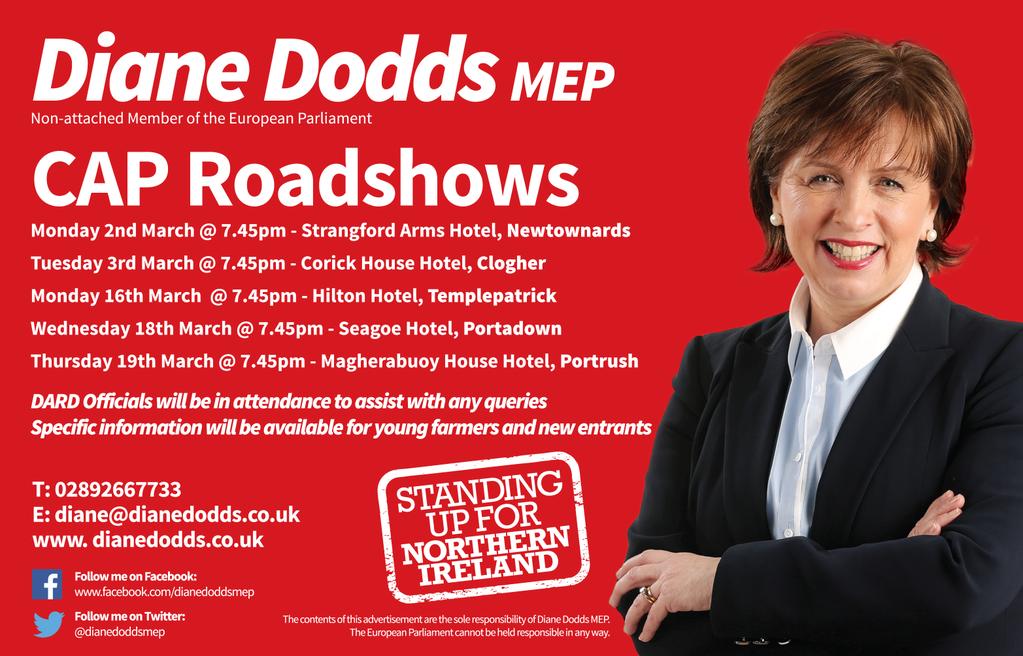
DIANE DODDS MEP CAP ROADSHOW

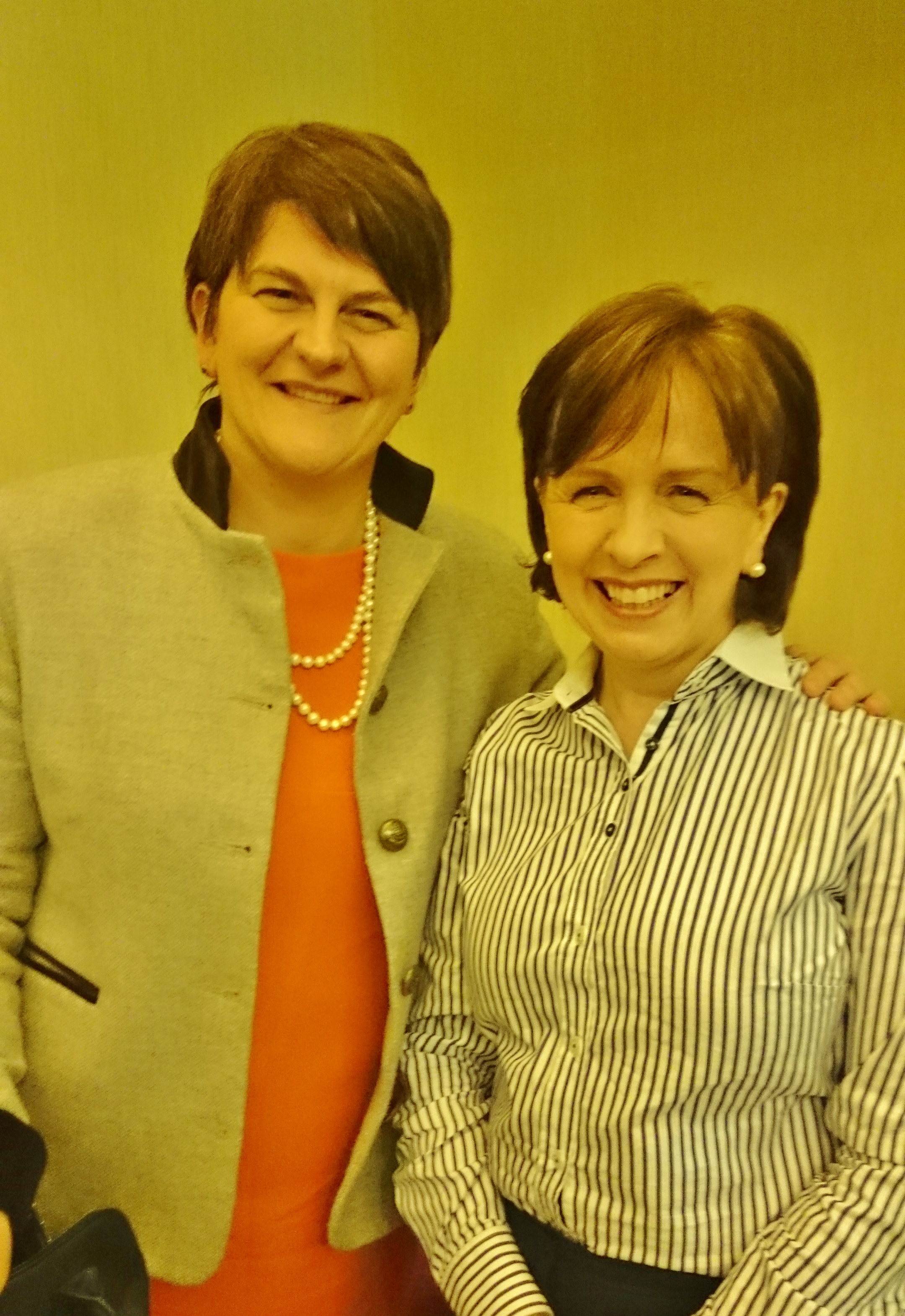
Arlene Foster MLA and Diane Dodds MEP Photo: © Michael Fisher

Arlene Foster MLA and Diane Dodds MEP Photo: © Michael Fisher

Apart from weddings and large-scale social events, Corick House Hotel in Clogher has hardly ever been so packed for a public meeting. Around 250 farmers from the Clogher Valley and Fermanagh attended the second in a series of roadshows on CAP reform, organised by the DUP Member of the European Parliament, Diane Dodds. They had expected around 80 and some latecomers had to sit outside the room to follow the proceedings. One of the first people I met at the hotel was my colleague from the Guild of Agricultural Journalists (Northern Ireland), Brian Donaldson of the Impartial Reporter. Now if only our William Carleton Society summer school in August (which we were planning tonight at Corick) could attract such a crowd this year to the same room…

The MEP was joined by senior DARD officials, who outlined the detail around how the new Common Agricultural Policy will be implemented in Northern Ireland. The meetings will move on to Templepatrick, Portadown and Portrush over the next two weeks and consist of a question and answer session which allows an opportunity for individual concerns to be addressed. One farmer had concerns about the effect of flooding on good farming land caused when waters rose up to fifteen feet in the Colebrooke River. He wondered if it would affect his grant application, if an inspector from the Department came around to check on the extent of his land immediately after the flooding. The answer involved something about force majeure coming into play.

Diane Dodds MEP

Diane Dodds MEP

Announcing the meetings, Diane Dodds said: “As someone who has been heavily involved in the reform of the common agricultural at a European level and one of its greatest critics the outworkings are now reaching farmers on the ground. I have organised in conjunction with DARD, a range of meetings to update and clarify for the implementation of the policy will take effect in Northern Ireland.

“The reform of the common agricultural policy will be the main emphasis for these meetings, given the upcoming single application deadline in May 2015 and ongoing decisions which will ultimately have a lasting impact on the farm business for years to come.

“During the course of the meetings, there will be a presentation on the upcoming requirements of the new CAP scheme, and within this a wide range of topics will be covered, including the basic payment scheme, active farmer definition, eligibility criteria, greening, young farmer and national schemes, cross compliance and the farm business improvement scheme.

Diane Dodds MEP addressing the packed room at Corick House Hotel Photo: © Michael Fisher

Diane Dodds MEP addressing the packed room at Corick House Hotel Photo: © Michael Fisher

“I also recognise that farmers have individual questions and I will ensure that a question and answer session is available. I want to provide an opportunity for farmers to have as much information as possible in a timely fashion to make decisions and prepare for the upcoming changes. DARD has now received clarity and made decisions on the majority of the reformed CAP implementation and have produced guidance. Hence why I feel this is a unique opportunity to gain additional clarity.

“I would strongly urge the farming community to make use of this opportunity, which will help prepare for the single application form in May 2015,” she said.

A farmer asks a question about flooding at the CAP roadshow Photo: © Michael Fisher

A farmer asks a question about flooding at the CAP roadshow Photo: © Michael Fisher

Diane Dodds was joined at the event by her party colleagues Lord Morrow and the Enterprise Minister Arlene Foster. The DUP point out that agriculture is the back-bone to much more than the Northern Ireland economy; it is the fabric of local communities. Agri-food is a key driver of the NI economy. It sustains an estimated 100,000 jobs and contributes some £5 billion in sales. It is also a key exporter of produce, with some £2.6 billion in external sales.

NIAMH KINDLON

Monaghan Ladies Footballer Niamh Kindlon Photo:  © Brendan Moran/SPORTSFILE

Monaghan Ladies Footballer Niamh Kindlon Photo: © Brendan Moran/SPORTSFILE

Monaghan All-Star footballer Niamh Kindlon from Magheracloone is profiled as one of the modern greats of ladies football in next week’s popular GAA documentary series Laochra Gael. It will be broadcast tonight (Tuesday March 3rd) by TG4 at 8pm. A special preview screening took place last Thursday evening at McNally’s bar in Carrickmacross for Niamh, her family and friends. It was attended by the TG4 Ceannaire (Director General) Pól Ó Gallchóir.

Pól Ó Gallchóir, Ceannaire TG4

Pól Ó Gallchóir, Ceannaire TG4

Each of the ten programmes in the new season contains an extended interview with the subject, archive footage of her or his finest hour on the pitch and an assessment from friends, rivals and team-mates.

Niamh started out under the guidance of her father Maurice as an enthusiastic nine year-old with her club Magheracloone and has been a leading light for Monaghan ladies ever since. Aged sixteen and in her first season with the senior team she played a crucial role in the 1997 All-Ireland final. Ten minutes before half-time, Niamh drilled the ball high into the top right-hand corner of the net at the Canal End goal from twenty yards. Michael Ryan, who managed the Waterford ladies, said that “even to this day, it’s the greatest goal I’ve ever seen scored in ladies’ football”.

The following year the two counties clashed once again in two epic All-Irelands after the first final ended in a draw. Unfortunately for Monaghan, Waterford won the second time round but the rivalry set a new standard for ladies football.

Niamh Kindlon on Laochra Gael, TG4

Niamh Kindlon on Laochra Gael, TG4

Niamh captained Monaghan back to Croke Park in 2002 when they took on the cream of the crop from Mayo but the Westerners took the cup home once again, leaving Niamh heartbroken, “There’s bigger things than football but when you’re in that moment it’s very hard to think past it because you’re so upset about it. It’s still hard to put on your boots on again after it”, she reveals. 2003 was no easier for Niamh when she suffered the first of two cruciate injuries but she was determined not to let injury dictate the end of her career. “I didn’t want my cruciate to be the reason I retired from county football.”

Niamh and Monaghan both made the comeback but a new force in Ladies Gaelic had emerged to dominate the game: Cork. Over the following years they defeated Monaghan in three finals 2008, 2011 and 2013. Niamh talks especially about her personal disappointment at not been selected to play a full part in the latter two finals.

While there have been many ups and downs it is clear that Niamh loved every minute since she joined the county team as a teenager and her haul of three League titles, three All Stars and an All-Ireland medal attest to her consistency as one of the leading Ladies’ Gaelic Footballers in recent decades. She has also won several Ulster medals with Monaghan.

Niamh who is now 33 is a plumber by trade. Apart from Gaelic football, her other interests included basketball and for a time, soccer. As well as an extensive interview with Niamh the programme also features interviews with teammate Christina Reilly, Cork’s Juliet Murphy, Dubliner Fiona Ní Chorcoráin and Robbie Ó Grifín

The documentary on Niamh is the fourth of ten in the series, which will also feature Fan & Philly Larkin from Kilkenny, Dublin’s Barney Rock, Brendan Cummins from Tipperary, Michael Duignan from Offaly, Kerry’s Ogie Moran and Ryan McMenamin of Tyrone. Catch the programme every Tuesday at 8pm on TG4, with a repeat broadcast every Sunday evening after GAA BEO. Laochra Gael is produced by Nemeton TV for TG4.


SEARCH FOR THE DISAPPEARED

Dympna Kerr and her brother, Oliver McVeigh at the Mass in Carrickroe    Photo:  © Michael Fisher

Dympna Kerr and her brother, Oliver McVeigh at a Mass in Carrickroe, Emyvale, County Monaghan, at which a new appeal was made for information about the location of Columba McVeigh’s remains Photo: © Michael Fisher

The Minister for Justice Frances Fitzgerald has confirmed the Irish government will continue its commitment to help fund the search for the so-called ‘disappeared’. Following the Good Friday Agreement in 1998, the Irish and British Governments set up the Independent Commission for the Recovery of Victims Remains. Its aim was to locate the remains of those killed by republican paramilitaries and secretly buried during the ‘troubles’ – people commonly referred to as the ‘disappeared’.

RTÉ’s Northern Editor Tommie Gorman in a special Nationwide programme tonight reported on the ongoing work of the Commission, with the remains of six people still to be recovered.

The Commission has a confidential telephone number and post box, and the information it receives can only be used to help recover the dead. In many of the ten cases where remains have been found, republicans and/or others used these facilities to provide crucial information.

Frances Fitzgerald T.D., Minister for Justice and Equality  Photo: Fine Gael

Frances Fitzgerald T.D., Minister for Justice and Equality Photo: Fine Gael

With a search for one of the six still missing, Belfast-born Joe Lynskey, due to begin in County Meath this month, the Minister for Justice has confirmed the Irish government’s ongoing commitment to help fund the work. Frances Fitzgerald said the government remained as strongly committed now to the humanitarian aim of locating the victims for their families as at the outset of the process, and would continue to support the ongoing efforts to locate those victims who have yet to be found. The Minister said she would encourage anyone with information that could help to locate those still missing to give that information, in full confidence, to the ICLVR without delay. “The families of the missing victims have suffered enough.  Out of common human decency, I appeal to anyone who can help bring an end to that suffering to do so”, she said.

Of the six people still missing, five are thought to be buried south of the Irish border and a sixth, Seamus Ruddy, is believed to be buried in a forest in France. The INLA admitted killing Seamus Ruddy.  The five other deaths are attributed to the IRA. The remaining ‘Disappeared’

In February 2010 Joe Lynskey was added to the official list of the disappeared. He was a member of the IRA. He went missing from his west Belfast home during the summer of 1972; his body has never been recovered. Joseph Lynskey was a former Cistercian monk from the Beechmount area of west Belfast. A new search for his remains is due to begin in Co Meath later this month.

Columba McVeigh  Photo: Irish Times

                                                                    Columba McVeigh Photo: Irish Times

Columba McVeigh disappeared on November 1st 1975 and his body has never been recovered. He was from Donaghmore, County Tyrone. He had been working as a painter in Dublin and had only returned to the North a few days earlier. Although extensive searches, based on information received, have been carried out at Bragan Bog near Emyvale in North Monaghan, his remains have not yet been discovered.

Kevin McKee and Seamus Wright disappeared on 2 October 1972. The two of them were from Belfast – Seamus Wright worked as an asphalt layer.  He was aged 25 and married when he went missing. It is thought they were both members of the IRA and were suspected of passing on information to the security forces. The Commission has carried out extensive but unsuccessful searches in the Coghalstown area of Co Meath for the remains of the men.

Captain Robert Nairac disappeared in 1977.  He was an officer with the British Army’s Grenadier Guards on a tour of duty in Northern Ireland when he went missing. It’s thought he was on an intelligence-gathering operation and was singing republican songs at a pub in Silverbridge, South Armagh, on the night of his abduction.  He was 29.  A man was convicted of his murder in 1977 and served a prison sentence. Captain Nairac received a posthumous George Cross.

Seamus Ruddy disappeared in Paris on 9 May 1985. A native of Newry, he had links to the INLA and its political wing, the IRSP.  He was involved in negotiations on behalf of INLA prisoners in the MAZE during the 1981 Hunger Strikes and helped to carry the coffin of hunger striker, Michael Devine, at his funeral in Derry.  In May 1985 he was working as an English teacher in Paris.  It is thought he got into a dispute with INLA members who were attempting to procure weapons in France. . In December 1995 the INLA admitted responsibility for his death. In February 1999 information emerged to suggest that his body was buried in Rouen, France, but despite searches having been carried out his remains have not yet been recovered.

It is believed that information provided by republicans and/or others assisted in eight of the ten cases where remains were recovered.  With Jean Mc Conville (2003) and Eugene Simons (1984), the discoveries were made by chance.

Brendan Megraw was 23-years-old when he was taken from his flat in Twinbrook, west Belfast by the IRA in April 1978.  His wife was expecting their first child at the time. His remains were recovered at Oristown Bog, near Kells in County Meath in autumn 2014.

Peter Wilson was 21 when he went missing in West Belfast in 1973.  Described as a vulnerable person with learning difficulties, his remains were located at Waterfoot beach in County Antrim in November 2010.

Gerard Evans from Crossmaglen in South Armagh was last seen hitch-hiking in County Monaghan in March 1979. In March 2008 his aunt received a map, claiming to identify the location of his remains.  They were eventually recovered from the site near Hackballscross in County Louth in October 2010.

Charlie Armstrong was a 54-year-old father of five who had no connections with paramilitary organisations.  He went missing one Sunday morning in 1981 when he left his Crossmaglen home to collect a neighbour to go to Mass.  His remains were located in a County Monaghan bog in 2010, 29 years after his abduction.

Danny McIlhone went missing from his West Belfast home in 1981.  His remains were found in the Wicklow mountains in November 2008 – two earier, unsuccessful searches were carried out in the area.

Jean McConville was a widowed mother of ten, she was taken from her Belfast flat by the IRA in 1972.  A man out walking on Shelling Beach near Carlingford in County Louth found her remains in August 2003.

Eamon Molloy was abducted from his home in North Belfast in 1975. His body was discovered in a coffin left in Faughart graveyard, close to the border, near Dundalk in 1999.

Brian McKinney was aged 22 when he went missing in Belfast in 1978. His remains were located in a Co Monaghan bog in 1999.

John McClory was aged 17 when he went missing with his friend, Brian McKinney in Belfast in 1978. Their remains were found in the same area of Co Monaghan bogland 21 years later.

Eugene Simons was a 26 year old who went missing form his home near Castlewellan in Co Down in January 1981.  His body was discovered by chance in May 1984 in a bog near Dundalk, Co Louth.

JOHN HORGAN ON DES FISHER

John Horgan  Photo: DCU

John Horgan Photo: DCU

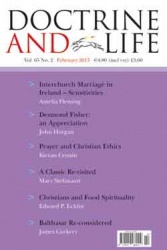
Desmond Fisher – an appreciation by John Horgan 

Desmond Fisher, who died in December aged 94, was a journalist who was undoubtedly less well known than he deserved to be, but whose contribution to religious journalism in English in the twentieth century was in many senses significant. It spanned an era when Catholicism in particular was undergoing seismic changes – changes which he witnessed, and documented for a wide variety of media, with consummate professionalism, balance and a deep commitment to his own religious faith.

He never courted personal publicity, and of course he contributed much of his work in print rather than in broadcasting, and in another era – one in which Twitter and Facebook were unknown, and television was only coming of age. When he joined RTE as Deputy Head of News in 1967 – almost half a century ago – he had already had a stellar career in print journalism, of which most of RTE’s Young Turks in the 1960s would have been blissfully ignorant.

Doctrine and Life: February Issue

Doctrine and Life: February Issue

Almost two decades in journalism, most significantly as London Editor of the Irish Press Group, meant that he was, metaphorically, at the top of his game when he was approached in 1962 with an invitation to become editor of the Catholic Herald in London, possibly because his reports from Rome for the Irish Press on the first session of Vatican 2 had marked him out as that rarity – a newsman who understood, and could write fluently about, the epochal changes that were just beginning to impact on global Catholicism.

Catholicism in Britain was then, and remained for many years, something of a hybrid. Its membership ran from the aristocratic Duke of Norfolk to the working class masses of Irish origin who populated the great British industrial cities. His predecessor, Michael de la Bedoyère, was a Stonyhurst-educated scion of the former class, a somewhat languid intellectual who had been in post for almost three decades. Under his editorship the paper once printed its major leading article with a final editorial sentence reading: “Cut here – the rest is tripe.”
This may not have been a hanging offence, but the writing was on the wall in any case for other reasons, mainly because the English Catholic bishops found him too liberal, and the proprietors clearly wanted an editor more open to clerical orthodoxy, and to the large potential readership who were largely readers of the rival, and much more down-market, Universe. In the event, Des Fisher initially did not disappoint. He welcomed the opportunities offered by the Council with gusto, and his reports from Rome between then and 1966 not only burnished his reputation, but earned him the respect and friendship of a wide circle of international journalists – Henri Fesquet of Le Monde, Raniero La Valle of L’Avvenire, Jerszy Turowicz of Tygodnik Powszechn in Poland, Bob Hoyt of the National Catholic Reporter, and Bob Kaiser of Time magazine – as well as the trust and confidence of the kaleidoscopic collection of bishops, theologians, and others, clerical and lay, Protestant, Catholic and agnostic who descended on Rome en masse every autumn to watch, and participate, in that great event.

Douglas Woodruff, then editor of the Tablet, warned Des in a Roman restaurant just before the Council began that it was always dangerous to underestimate the Curia, whose motto was Qui pensiamo in seculi – here we think in centuries. It was a warning Des was happy to ignore even when – as events were to demonstrate – it was to his career disadvantage. His own post-Conciliar book, “The Church in Transition,” was typically modest and low-key. He was never one of those people who, in the memorable Irish phrase, had “a great welcome for himself,” but he could tap into the zeitgeist with the confidence and competence of a true professional.

Desmond Fisher

Desmond Fisher

Des’s tenure as editor of the Catholic Herald was marked not only by his professional expertise and dyed-in-the-wool fair-mindedness, but also by his courage. When the English theologian Charles Davis, one of the most progressive and prophetic voices of his generation, decided to leave the ministry –and ultimately to marry – it was Des who befriended him and sheltered him in his house in Wimbledon while the British tabloid press hunted him like a wild animal. He as courageous, too, in his unwillingness to cut his cloth by anyone else’s measure: this was to be tested when he discovered that his honeymoon as editor of the Catholic Herald was always subject to the whims of the English hierarchy. A number of bishops, Irish as well as English, disapproved of the tenor of his reports, and the Catholic Herald was banned in some parishes. All this was undoubtedly a key factor in a decline in its circulation, which strengthened the hands of his critics. Both the main owner of the Catholic Herald, Vernor Miles, and Cardinal Heenan, archbishop of Westminster, were deeply disturbed by the tenor of Des’s reporting and Miles arranged to have him recalled from Rome on the manifestly inaccurate grounds that the bulk of the Council’s work was over. Three months later he resigned, citing “policy differences with the Board.” His departure occasioned personal letters of regret from, among many others, Abbot Christopher Butler of Downside, the theologian Fr. Hubert Richards, and Archbishop Denis Hurley of Durban.

In Des’s case, however, it was – as ever – a case of reculer pour mieux sauter. With a courage rarely displayed by someone of his years, and with a young family to support, he took to free-lance journalism. He wrote a weekly column for the Anglican Church Times, and wrote exclusively on Catholic affairs for the National Catholic reporter and the St. Louis Review in the United States, as well as contributing to Commonweal, the Tablet, Doctrine and Life, and the Furrow, among many other publications. He might have become editor of Hibernia in Dublin if it had managed to attract new investment capital, and both Herder Correspondenz, and a Canadian Catholic weekly, were keenly interested in securing his services, before he was head-hunted by Jim McGuinness (an old acquaintance from Irish Press days) to take up a senior position at RTE. Like many a journalist, he was not really an organization man, and managed to escape the RTE bureaucracy from time to time to write about his interests in religion, in Irish media generally, and in the right to communicate. He was reminiscing in the Irish Times about Vatican 11 a half-century after it had ended, and had just finished, before his death, an annotated translation of the Stabat Mater, which is due for publication later this year.

He was, in a sense, a fine embodiment of that element of the populus Dei to which he would refer wryly from time to time, and which is, in these troubled but fascinating days, needed more than ever: the Church’s loyal opposition. It was not a concept with which the hierarchs he met ever really felt comfortable; but it is an apt description of the role he and many others played in those wondrous times – times which may, with luck, come again.

……………………………………………………………………………………

Postscript: I should declare an interest. I first met Des in London in his Irish Press office early in 1962, on the basis of an introduction from the editor of the Evening Press in Dublin, for which I had briefly worked. I was newly married, and unemployed, and expected little more than a few stern words of warning about the impossibility of getting into Fleet Street. The conversation turned – without my realising it – into a job interview, and at the end of it he offered me a job on the Herald when he moved there at the end of the month. Although I left the Herald after less than two years to join the Irish Times in Dublin, the training and encouragement I got from him in that small, busy office was to stand me in good stead for the rest of my professional life. Some of the information in this appreciation has been garnered, with his family’s permission, from a memoir of his own professional life which he wrote before his death and which is now, together with the rest of his papers, destined for the Media History Archive at Dublin City University, to which he bequeathed it.  John Horgan  21 January 2015

…………………………………………………..

The family of the late Desmond Fisher would like to thank all those who sent messages or letters of sympathy or Mass cards following his death on December 30th and helped them in their bereavement. Also to those who posted online. Thanks to everyone for your support during a time of grief. I will post more news about his 200-page book Stabat Mater nearer the time of publication: today was spent going through the second proofs and checking for any further corrections. Michael Fisher.

ROAD REPAIRS

roadworksCOUNCILLOR SAYS ROADS BUDGET IS AN ABSOLUTE SCANDAL

Councillors in South Monaghan are arranging an urgent meeting with the Chief Executive of Monaghan County Council to discuss what one of them said was the “absolute scandal” of the roads budget for the coming year. Municipal District members from Carrickmacross-Castleblayney expect to meet Eugene Cummins at their Roads Area Meeting in Monaghan on Monday afternoon, following a meeting of the County Council.

Cllr PJ O'Hanlon  Photo: © Michael Fisher

Cllr PJ O’Hanlon Photo: © Michael Fisher

Councillor PJ O’Hanlon said they seemed to be going back to a budget that was as bad as fifteen years ago. It was one of the most important issues that had arisen since the new Council was introduced last year. The Councillors called for a meeting next week with the five Dáil deputies in the constituency, including the Arts Minister, and for a follow-up meeting to be arranged with the Minister for Transport, Tourism and Sport, Paschal Donohoe. Councillor Colm Carthy proposed and his party colleague Councillor Noel Keelan seconded a motion that the Municipal District should write to the Taoiseach and to the Transport Minister to request extra funding for roads in the constituency, in order to upgrade roads that are in serious disrepair. In addition the members called on local Oireachtas members to push this issue with the Departments involved. The motion was agreed.

Cllr Colm Carthy  Photo: © Michael Fisher

Cllr Colm Carthy Photo: © Michael Fisher

Councillor Colm Carthy referred to what he said was the ridiculous situation whereby Bus Eireann was refusing to allow a school bus service to drive along certain local roads because of their bad condition. He said the state of the roads was the top issue being referred to him regularly by members of the public.

Councillor O’Hanlon also referred to the withdrawal by Bus Eireann of a school bus service because of the bad state of repair of a local road. He proposed and Cllr Padraig McNally seconded a call for the Council to write to Bus Eireann and the Transport Minister to say that under no circumstances should a school bus and service bus be taken off the road due to the bad condition of the road without first notifying the relevant authority, i.e. County Council, and that a period of four weeks be given for the works to be done. This was passed unanimously.

Fianna Fáil Councillor PJ O’Hanlon claimed the Fine Gael-led government seemed to have no interest in the maintenance of roads in the county. They needed to sit down with the Transport Minister and ask him how they were expected to promote tourism on the one hand and on the other improve the roads in their area with the budget that had been allocated.