BALLYGAWLEY BOMB REMEMBERED

Ballygawley Bus Bomb Commemoration Photo: © Michael Fisher

Ballygawley Bus Bomb Commemoration Photo: © Michael Fisher

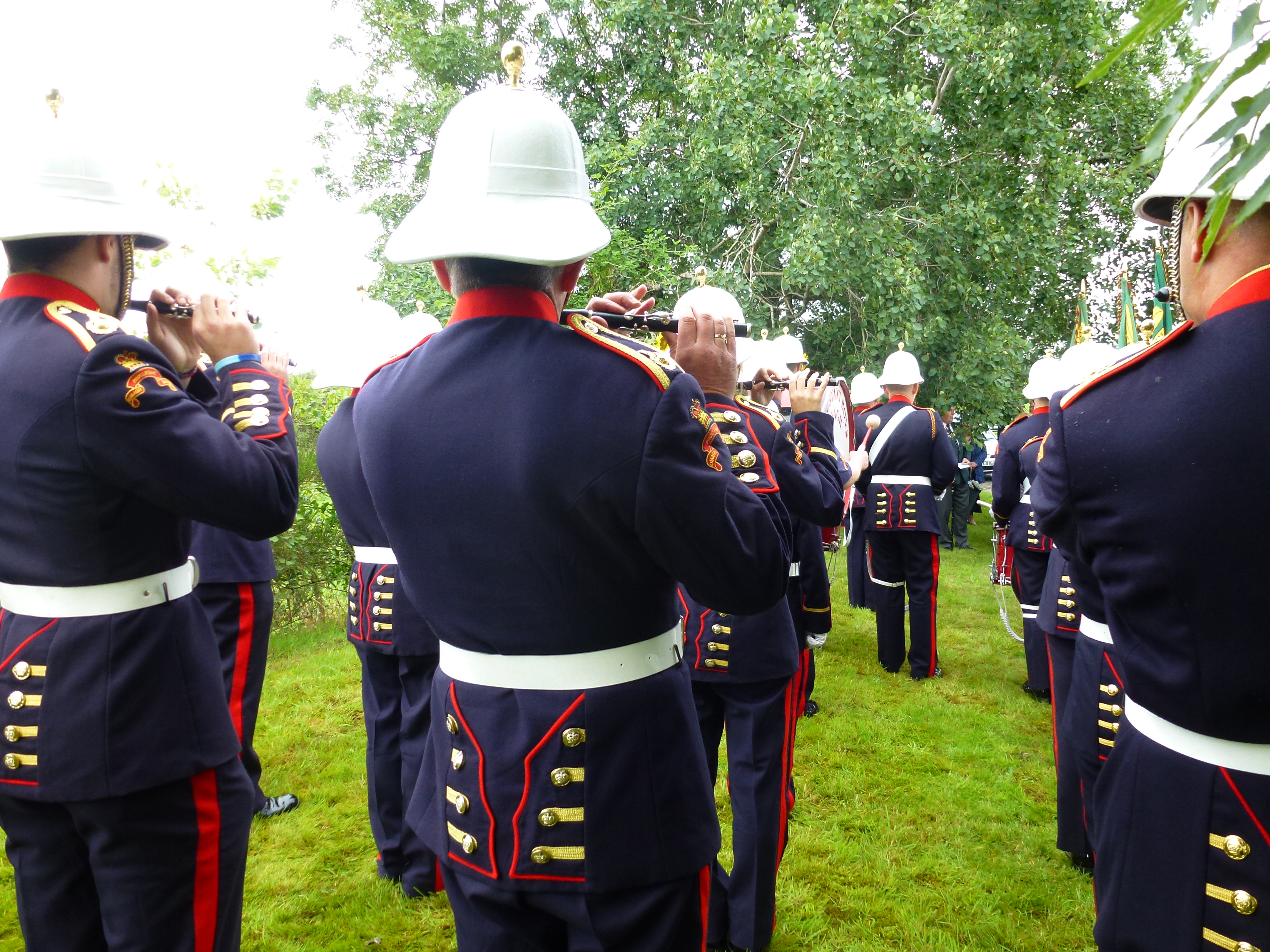
They stood and reflected as the Omagh Protestant Boys Flute Band played solemn music. For some of these women, the last time they were at this spot was 25 years ago. That night, 20th August 1988, they came across a scene of devastation, immediately after an IRA roadside bomb had exploded as a busload of soldiers went past on the main road from Ballygawley to Omagh. It became known as the Ballygawley bus bomb and was one of the worst losses of life sustained by the British Army during the troubles in Northern Ireland. Eight members of the Light Infantry between 18 and 21 were killed.
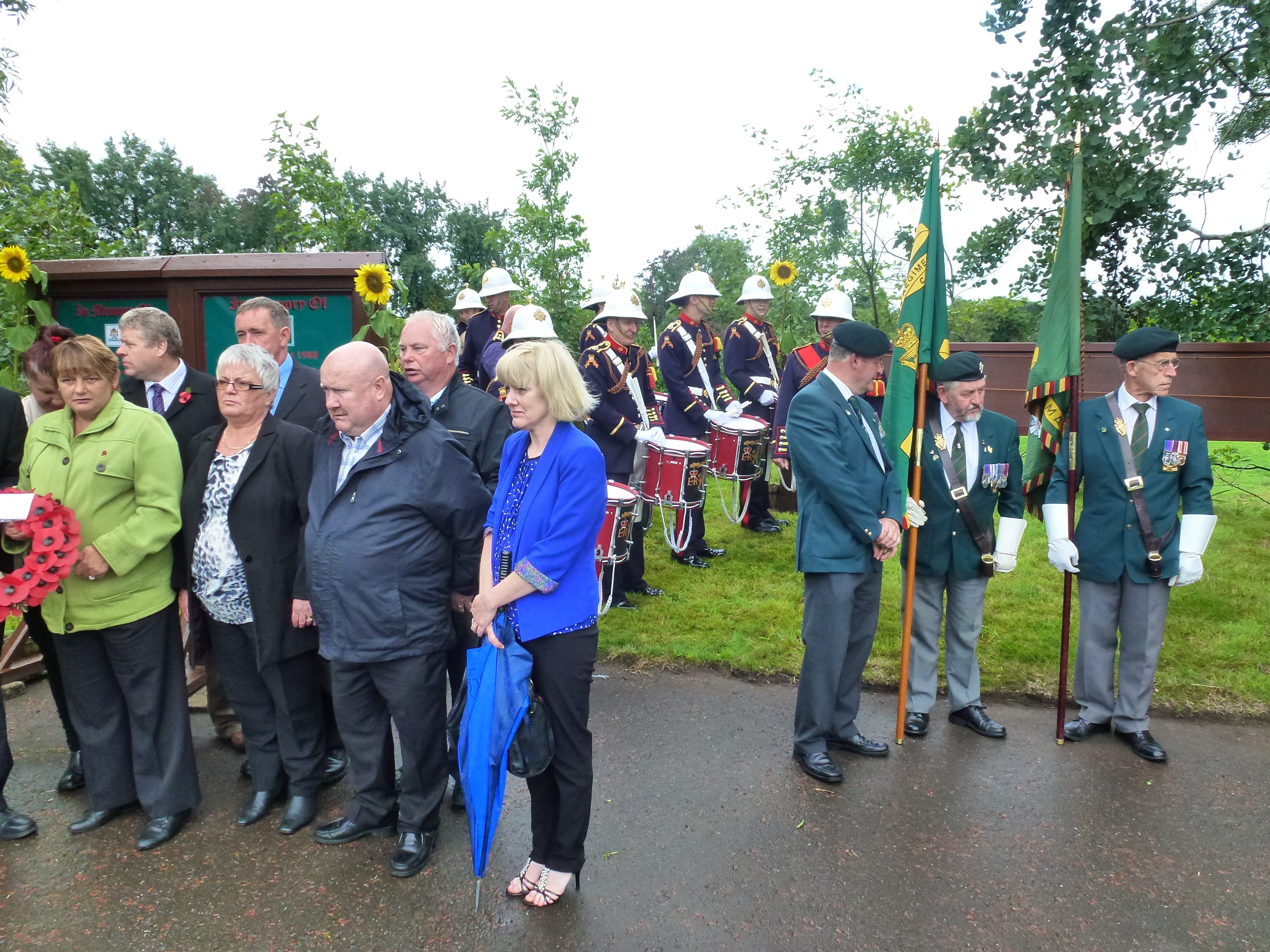
Ballygawley Bus Bomb Commemoration Photo: © Michael Fisher

Ballygawley Bus Bomb Commemoration Photo: © Michael Fisher

A witness who arrived at the scene said:-

“There were bodies strewn all over the road and others were caught inside the bus and under it. There were people running around stunned, screaming and bleeding, and shouting for someone to come to their aid.”  (Lost Lives, McKittrick et al, p.1141)

Ballygawley Bus Bomb Commemoration Photo: © Michael Fisher
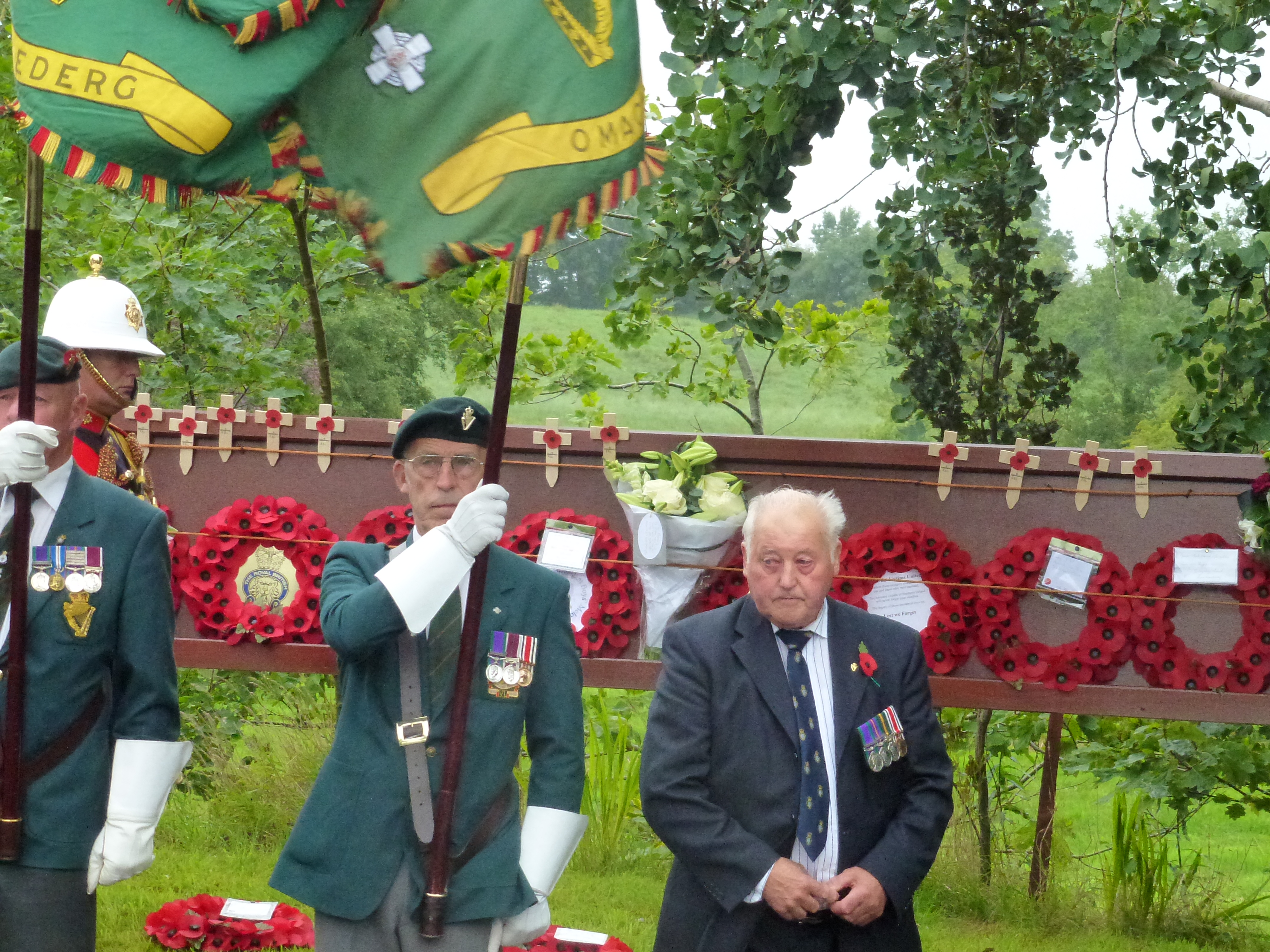
Ballygawley Bus Bomb Commemoration Photo: © Michael Fisher

Immediately before the roadside service on Sunday, a local newspaper reporter asked these ladies from Derry about the reason for their presence. They trembled as memories of that dreadful night came back to them. They told how they were with the Star of the Valley band from Tullyally in Londonderry and had been travelling in a bus some distance behind the soldiers. They saw a flash and heard the explosion as the device blew the bus off the road.

One of the ladies explained how she had managed to make a 999 call to the emergency services but the initial response was one of caution, in case it turned out to be a trap. This lady then contacted a relative who worked at a British Army base in Derry and stressed to her the situation was not a hoax, but was unfortunately the real thing and asked her to contact the police.

Piper plays lament Photo: © Michael Fisher

Piper plays lament Photo: © Michael Fisher

The band members immediately helped to tend the injured, as did the Omagh Protestant Boys flute band, who like the Tullyally members had been returning from a parade in Portadown. One young soldier had managed to find his way across to a barn on the other side of the road, but he died at the scene. Ken Maginnis, an ex-UDR officer and then Ulster Unionist MP recalled how he along with others had found a young soldier who had managed to crawl away from the ruins of the bus and was in a barn on the other side of the road. He tried to reassure the Private he was now safe, but the young lad died at the scene. Mr Maginnis is now an independent member of the House of Lords and was among the gathering on Sunday.
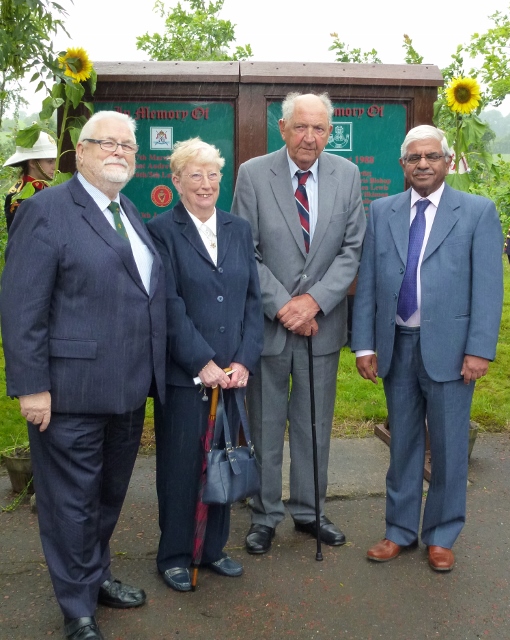
Lord Ken Maginnis, Dr Clifford McCord GP Aughnacloy & Dominic Pinto Omagh

Lord Ken Maginnis, Dr Clifford McCord GP Aughnacloy & Dominic Pinto Omagh

Other soldiers were taken for treatment initially at Tyrone County Hospital, where consultant surgeon Dominic Pinto and his colleagues worked through the night to deal with the injured. Dr Clifford McCord was then a GP in Aughnacloy. He tended to the injured soldiers, helped by Cllr Allan Rainey, who lives not far from the scene and who was one of the organisers of the roadside commemoration.

Cllr Paddy McGowan MBE, former fireman

Cllr Paddy McGowan MBE, former fireman

Another person who witnessed the immediate aftermath of the bomb was Fire Officer Paddy McGowan MBE. He remembers searching the field and hedges beside the bomb crater trying to find any other injured soldiers. This was before the area had been checked by the British Army for any further devices. He described the scene when he and his four colleagues from Omagh answered the emergency call as “pandemonium”. Now a councillor, he said the bombing had strengthened his resolve to oppose violence (Ulster Herald).

Dr Clifford McCord retired GP Aughnacloy & Cllr Allan Rainey MBE Photo: © Michael Fisher

Dr Clifford McCord retired GP Aughnacloy & Cllr Allan Rainey MBE Photo: © Michael Fisher

The roadside commemoration was followed by a service at Newtownsaville Church of Ireland church, led by John Irvine. Among the congregation was Michael Gallagher of the Omagh Support & Self-Help Group, whose son Aiden was one of the victims of the 1998 Omagh bomb.
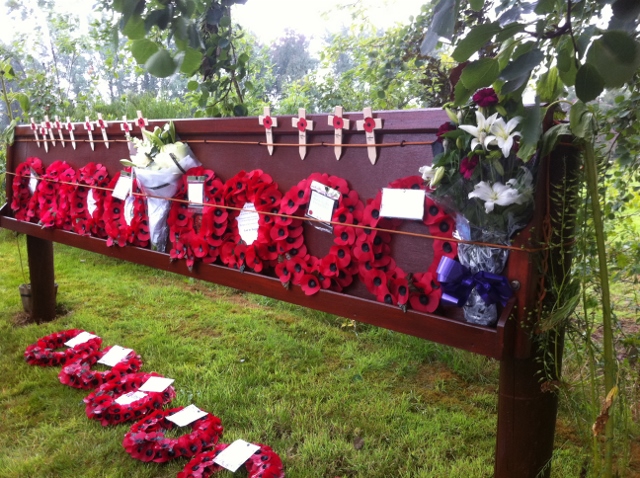
BALLYGAWLEY BUS BOMB

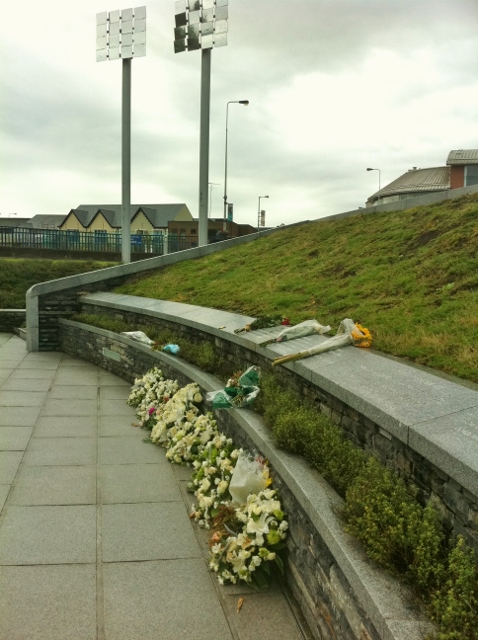
Ballygawley Bus Bomb Memorial

Ballygawley Bus Bomb Memorial Photo: © Michael Fisher

It was a simple and very dignified ceremony. As motorists were passing by on the main A5 Dublin to Derry road, they might have wondered what was going on at the side of the road at Curr, between Ballygawley and Omagh. People gathered there on Sunday morning to pay their respects to eight British soldiers who had been killed in what became known as the Ballygawley bus bomb, 25 years ago today on August 20th 1988.

Omagh Protestant Boys Flute Band Photo: © Michael Fisher

Omagh Protestant Boys Flute Band Photo: © Michael Fisher

The music by the Omagh Protestant Boys flute band set the mood. You can see my video on youtube here.

Ballygawley Bus Bomb Remembrance Photo © Michael Fisher

Ballygawley Bus Bomb Remembrance Photo © Michael Fisher

The soldiers were returning to their base in Omagh, having flown into RAF Aldergrove. They were being transported in an unmarked coach, driven by a soldier. Reports at the time suggested that although the A5 road was meant to be ‘out of bounds’ for military transport, diversion signs had been put in place and that was why the driver travelled that way from Ballygawley. But that claim was disputed at the inquest. A 200lbs roadside bomb consisting of Semtex and fertiliser exploded, killing eight members of the 1st Battalion, Light Infantry Regiment and injuring 28 of their colleagues.

Roll of Honour read out Photo: © Michael Fisher

Roll of Honour read out Photo: © Michael Fisher

In the brief commemoration at the scene of the blast, the Last Post was sounded and the Roll of Honour was read with the following names:-

Private Blair Bishop (19), Private Peter Bullock (21), Private Jayson Burfitt (19), Private Richard Greener (21), Private Alexander Lewis (18), Private Mark Norsworthy (18),  Private Stephen Wilkinson (18) and Private Jason Winter (19).

In addition, four UDR members killed in a landmine at Gort, Errigal Keerogue, near Ballygawley were also remembered. They died on July 13th 1983, 30 years ago. They were:- Private Ronald Alexander (19), Corporal Thomas Harron (25), Private John Roxborough (19) and Private Oswell Neely (20). 

A thirteenth name was added to the roll of honour, Lieutenant Andrew Somerville (20), a member of 15th/6th Lancers, killed in a landmine attack near Ballymacilroy, Ballygawley on March 27th 1973, 40 years ago.

Ballygawley Bus Bomb Commemoration Photo: © Michael Fisher

Ballygawley Bus Bomb Commemoration Photo: © Michael Fisher

FUNERAL OF KEVIN FEENEY RIP

Members of the Davy family await the arrival of the remains of Kevin Feeney

Members of the Davy family await the arrival of the remains of Kevin Feeney

Andrew Feeney lives in Australia and was in Melbourne when news reached him of his father’s sudden death. Another of Kevin’s four children was in Russia and apparently had difficulty with an exit visa as he was in the middle of a tour. Andrew spoke very movingly at the end of the funeral Mass at the Church of the Sacred Heart in Donnybrook, Dublin.

Fr Charlie Davy SJ

Fr Charlie Davy SJ

This wasn’t Kevin’s parish but the church of the Three Patrons in Rathgar is undergoing renovations and the interior has scaffolding erected for painting, so it would not have been able to handle the large crowd of mourners who gathered to say their farewells to Kevin and to sympathise with Kevin’s relatives and family led by his widow Geraldine, a member of the well-known Davy family. His brother-in-law Fr Charlie Davy SJ, Galway, Chair of the Pioneer Total Abstinence Association, was the chief celebrant of the Mass, along with nine other priests.

Andrew Feeney told the packed church he was “so proud to have had him (Kevin) as a father”. “We feel he went out on a high as he was at his happiest in Ballycotton” (his holiday home in County Cork), he said. One of his own great memories was attending the Italia 90 Ireland-Italy game with his father.

Remains of Kevin Feeney arrive at Sacred Heart Church

Remains of Kevin Feeney arrive at Sacred Heart Church

In an address at the end of the Mass, the President of the High Court Mr Justice Nicholas Kearns said that although Kevin had been fiercely competitive in the courtroom, he did not like the public spotlight. “He was a very, very private man, who put family and friends first”, he said. He told mourners the late Judge had a unique sense of humour and rarely lost his temper. He spoke of his great interest in sports: rugby, golf, hockey and cricket. “We’re all still in a state of disbelief at his sudden death,” Mr Justice Kearns continued. Family “always remained extremely close…he was devastated when (his brother) John died so tragically” (in a 1984 plane crash at Eastbourne in England).

Funeral of Kevin Feeney

Funeral of Kevin Feeney

He recalled that Kevin, who was 62, had exhibited a sense of justice at an early age. His brother Jim was 16 and Kevin 8 when Jim got a bicycle. “He protested with a placard outside his father’s study which read ‘No Bicycle. No Justice’.”

Kevin Feeney 1951-2013: Photo Peter Cuffe

Kevin Feeney 1951-2013: Photo Peter Cuffe

His “courtroom advocacy skills were superb” and when appointed to the High Court “he took over a difficult case list. He never complained about being overworked or under-resourced. As a lover of sport he was for many years a member of the Phoenix Cricket Club, where “he defended the wicket like the Spartans at Thermopylae”, usually coming into bat at number eight.

Kevin Feeney's funeral at Donnybrook Church

Kevin Feeney’s funeral at Donnybrook Church

Mr Justice Kearns then recalled a golfing trip to Scotland Kevin had organised for colleagues on the bench as part of an outing for the judiciary in the UK and Ireland. The estate car he hired was not large enough for four passengers and all their baggage and equipment. It resulted in one eminent Irish judge sitting on another’s knee while a third ended up sitting on a case in the boot!

Funeral of Kevin Feeney RIP

Funeral of Kevin Feeney RIP

The Irish Times website report carried the following details: “Chief mourners were Geraldine Feeney and their children Andrew, Peter, Kevin Barbara, and Justice Feeney’s brothers Jim and Peter. The President was represented by Cmdt James Galvin and the Taoiseach by Cmdt Mick Treacy. Government Ministers present included Frances Fitzgerald TD and Alex White TD.

A large contingent from the judiciary was led by Chief Justice Susan Denham, and former Chief Justice John Murray Other members of the Supreme Court there included Justices Adrian Hardiman, Frank Clarke, John MacMenamin, as well as Gerard Hogan and George Birmingham of the High Court, Katherine Delahunt and Alison Lindsay of the Circuit Court. Retired judges included Ronan Keane, Hugh O’Flaherty, Tom Finlay, Yvonne Murphy. Also there was NUI Chancellor Maurice Manning.

There too were former Attorneys General Peter Sutherland, Michael McDowell and John Rogers, as well as many from the Law Library, including senior counsel Garret Cooney, John O’Donnell, Eoin McCullagh, Conor Maguire, and David Andrews. Journalists there, present and former, included Mairead Ní Nuadhain, John O’Shea, Stephen O’Byrnes, Mike Burns, Ed Mulhall, Sam Smyth, Betty Purcell, Michael Fisher, Bride Rosney, Joe Little and Liz O’Donnell”.

Funeral of Kevin Feeney at Sacred Heart Church, Donnybrook

Funeral of Kevin Feeney at Sacred Heart Church, Donnybrook

Kevin was in class with me when I attended Gonzaga College 1967-69. Among the former classmates to attend the funeral were Michael McDowell SC, Paul McNally, Denis Brennan, Bobby Becker, Michael Gaffney and Peter Mathews TD. Ar dheis Dé go raibh a hanam dílis.

BALLYGAWLEY & OMAGH

Market Street Omagh: Bomb Memorial

Market Street Omagh: Bomb Memorial Photo: © Michael Fisher

It was a journey I didn’t want to make. Fifteen years ago on this same Sunday, I left Tydavnet around 8am and headed for Omagh. I attended Mass at St Matthew’s, Garvaghey (the chapel associated with John Montague) and then made my way to the county town. Market Street was full of debris and the whole area was cordoned off as a police investigation got underway. This morning I repeated the journey, passing the chapel at Garvaghey at 8:30am and heading to the Sacred Heart church in Omagh for Sunday Mass.

Omagh Bomb Memorial Park

Omagh Bomb Memorial Park

I was surprised that there was no mention of those who died in the 1998 bomb, although the priest did ask for prayers for those in Egypt and Syria. Perhaps the bomb victims were remembered at Mass last weekend. There was also a commemoration in the town on Thursday 15th, the exact day of the atrocity. This morning there was a very different view along Market Street, looking towards the Courthouse, as my first picture shows.

The previous afternoon in 1998, after coming home from the Tydavnet Show, which I was also at yesterday, the news had come through about a major bomb attack in Omagh, with several casualties. I headed off to Omagh that Saturday evening and reported from Tyrone County Hospital as the extent of the fatalities and the injuries became clear.

Dominic Pinto, former consultant surgeon, Tyrone County Hospital

Dominic Pinto, former consultant surgeon, Tyrone County Hospital

Some Spanish women were desperately trying to find out more information from the hospital staff. In the operating theatres, Dr Dominic Pinto, who I met later this morning at a separate commemoration for the victims of the Ballygawley bus bomb, and his colleagues were working non-stop trying to deal with the injured. Many had to be transferred to other hospitals for further treatment. Mr Pinto described the scene at the time:

When I came to the front of the hospital, it was absolutely quiet. What greeted me when I got into the main corridor was sheer pandemonium. This was not a major incident, but a major disaster of battlefield proportions. There were people lying in corridors of the    accident and emergency department, overflowing into the radiology department. Some 240    injured people arrived within the first 45 minutes“. (www.wesleyjohnston.com)

The Spanish connection later turned out to be a group of students who had been studying English in Buncrana and who had got caught up in the explosion during a trip to Omagh. One 12 year old Spanish boy Fernando Blasco Baselga from Madrid died as well as a 23 year-old teacher from Spain, Rocio Abad Ramos, also from Madrid.  Three young boys from Buncrana, Oran Doherty aged 8, 12 year-old Sean McLaughlin, and James Barker, also 12, were killed in the explosion. In April 2000, the body of James was re-buried in a small graveyard at his former school in England, St George’s in Weybridge. I remember visiting it in 2008 when I interviewed his father Victor.

Rest in Peace: Avril Monaghan

Rest in Peace: Avril Monaghan

Three generations of women from one family in County Tyrone were killed in the Omagh bomb: a 65 year old grandmother, Mary Grimes from Beragh, her 30 year old daughter Avril Monaghan who was expecting twins, and an 18 month-old granddaughter, Maura Monaghan from Aughindarragh in Augher. I remembered them as I visited the peaceful graveyard at the Forth Chapel, Ballynagurragh (St Macartan’s), where my McCann relatives are interred close to Avril’s grave.

British Legion Aughnacloy representative with Michael Gallagher & Stephen Gault

British Legion Aughnacloy representative with Michael Gallagher & Stephen Gault

Then at the Ballygawley bus bomb commemoration I met Michael Gallagher of the Omagh Support and Self Help Group. His 21 year-old son Aiden was killed in the Omagh attack. Michael went on to attend the service at Newtownsaville Church of Ireland church for the Ballygawley bus victims (eight British soldiers) and five other members of the security forces who had been killed in two other incidents in the surrounding area. Another victims’ campaigner to attend the Ballygawley commemoration was Stephen Gault, who was injured and who lost his father in the Enniskillen bomb on Remembrance Sunday in November 1987.

PARNELL SUMMER SCHOOL

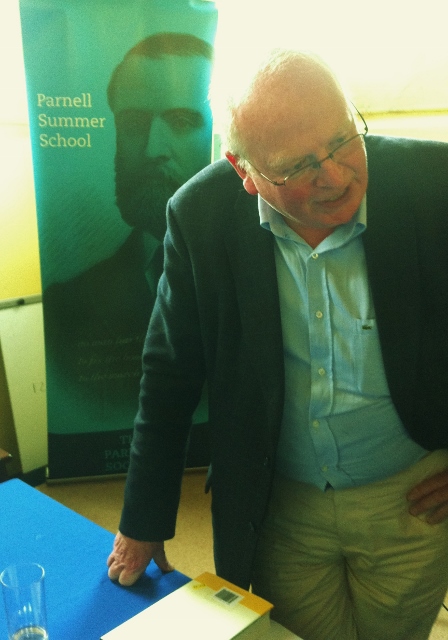
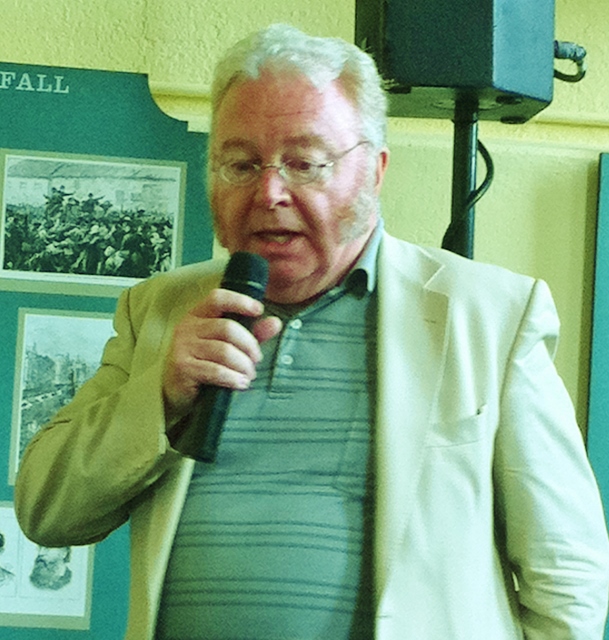
Michael McDowell Photo: © Michael Fisher

Michael McDowell Photo: © Michael Fisher

I have known Michael McDowell for over 45 years since we went to school together when I returned to Dublin from Wimbledon in 1967. Peter Mathews TD was in the same year and the three of us along with half a dozen or so more classmates joined the FCÁ together, but only a few completed a five year term, including some full-time duties with the army. I have seen therefore at first hand how much Michael believes in the concept of service to the state and loyalty to the nation.

Update: Since writing this the sad news has emerged of the death of one of our classmates, High Court Judge Kevin Feeney, who was a keen tennis player and had served in the same FCÁ unit I referred to. May he rest in peace. Michael McDowell had earlier told me about the recent death of another well-known Dublin lawyer who served with us in the Military Police, James Gilhooly SC. My sympathy goes to both families.

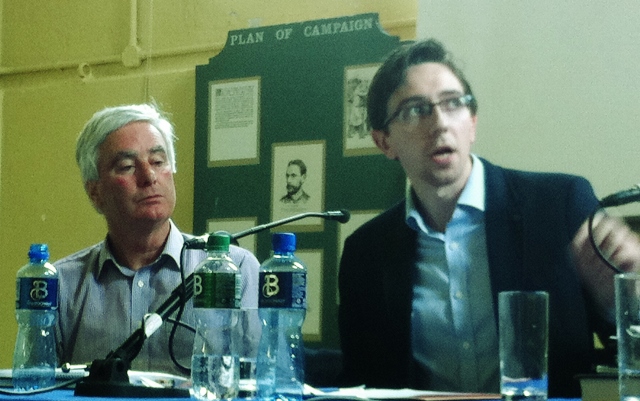
Steohen Collins & Simon Harris TD Photo: © Michael Fisher

Steohen Collins & Simon Harris TD Photo: © Michael Fisher

It was therefore very interesting to hear him speak at Avondale House at the Parnell Summer School alongside the Wicklow/Carlow East  TD Simon Harris (from Michael’s former party Fine Gael, which I recall he joined at UCD) and Stephen Collins, Political Editor of the Irish Times, on the subject of public service. My former RTÉ News colleague Bryan Dobson chaired the session. This is how the Irish Times is reporting his speech:-

In the Chair: Bryan Dobson, RTÉ News Photo: © Michael Fisher

In the Chair: Bryan Dobson, RTÉ News Photo: © Michael Fisher

The former Justice Minister told the summer school Ireland was not a “failed state” and its people should not accept phoney reform in abolishing the Seanad. Addressing the theme ‘Parnell & Kennedy: Lost Leaders’ this afternoon, and taking a cue from JF Kennedy’s dictum; “Ask not what your country can do for you, ask what you can do for your country”, Mr Mc Dowell called for a new sense of patriotism and loyalty to the Constitution. He said some commentators seemed to enjoy wallowing in what he termed as a ‘middle-class self-hatred’ or negativity. “It is easy to be critical; it is hard to be constructive, especially during times of economic crisis,” he said.

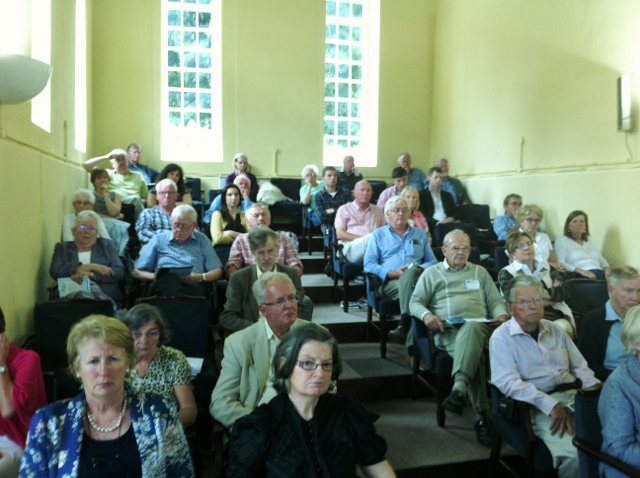
Audience at Parnell summer school Photo: © Michael Fisher

Audience at Parnell summer school Photo: © Michael Fisher

He recalled the 1998 amendment to the Constitution which he said redefined the nation as one which aspires to include all the people of Ireland, “in all the diversities of their identities and traditions”. “Those words are important” he said, arguing that the State had opened up its sense of patriotism and republicanism “to build and develop on this island a republican State which is not mainly or exclusively Catholic, but is open to all traditions and identities”. But he said “a particularly striking historical nonsense” was the belief by the “post-Marxist left” that republicanism equated with socialism, and a failure to deliver on socialism was a betrayal of the Republic. “The two ideals are not equivalents” he said.

He said loyalty to the State and the Constitution demanded loyalty to the institutions of government which “by and large have served the citizens well”. He also said the Constitution had not failed the people and the three pillars of government – legislature, the executive and the judiciary – were not failed institutions “in concept”.

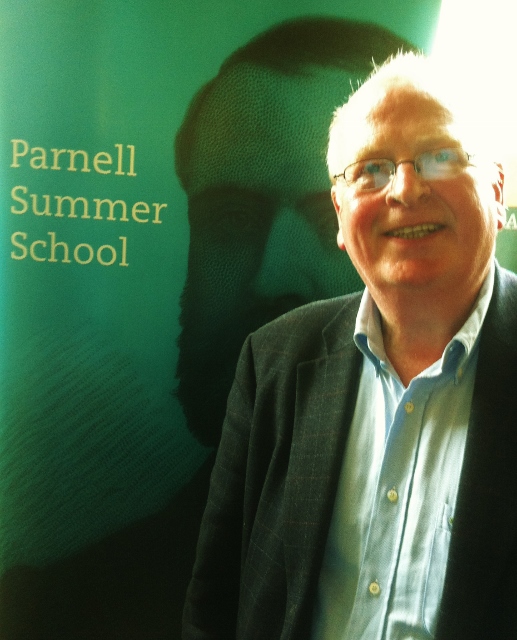
Felix Larkin, Academic Director Parnell Summer School  Photo: © Michael Fisher

Felix Larkin, Academic Director Parnell Summer School Photo: © Michael Fisher

Mr McDowell said proposals for reform may be worthy and legitimate only if they were motivated by a desire for improvement in the way the State functions. But he said the proposals to abolish the Seanad based on cost were “threadbare and illegitimate”. He said the actual cost of the Seanad was about €1.60 per year for each citizen and “abolitionists” wanted to postpone any supposed savings for three years – spending €14 million now on a referendum to achieve “small savings” in three years, he argued.

“Do we really want now to slam the door shut on non-TD expert participants in Government such as [former minister] James Dooge?” he asked. “Do we also want to turn down the possibility of having Northern voices such as Gordon Wilson or Seamus Mallon, or people such as Mary Robinson and Ken Whitaker in our parliament?” He suggested abolition of the Seanad was “a crude attempt to ride the wave of public disillusionment with phony reform based on phony cost arguments”.

Michael McDowell at Parnell summer school Photo: © Michael Fisher

Michael McDowell at Parnell summer school Photo: © Michael Fisher

Mr McDowell said he believed loyalty to the State involved a duty on every citizen to participate and be responsible in shaping the democratic process, but “corrosive cynicism about politics” damaged democracy. “Our commentariat, in the last analysis, must acknowledge that we as citizens choose our politicians” he said, adding that politicians were not the enemy. “Politics is the process that we as citizens choose it to be. We should not cannibalise the Constitution in the name of reform,” he said.

Stephen Collins, Political Editor, Irish Times Photo: © Michael Fisher

Stephen Collins, Political Editor, Irish Times Photo: © Michael Fisher

O’ROURKE ON GRAND COALITION

Dr Frank Brennan (William Carleton Society) with Mary O'Rourke and Mary Kenny Photo: © Michael Fisher

Dr Frank Brennan (William Carleton Society) with Mary O’Rourke and Mary Kenny Photo: © Michael Fisher

A leading article in today’s Irish Times newspaper (based in Dublin) carries the following editorial, based on Mary O’Rourke’s address to what the Irish Examiner without naming us rather unfortunately called an ‘unfashionable’ summer school in Clogher, County Tyrone. You can view the speech in full here.

The William Carleton Society’s annual international summer school since its inception in 1992 has welcomed over 300 guests of such stature as the Nobel Prize winner Seamus Heaney, John Montague, Polly Devlin, Barry Devlin, Eugene McCabe, Gerald Dawe, Frank Ormsby, John Wilson Foster, Michael and Edna Longley, Bernard McLaverty, Sam McAughtry, Theo Dorgan, Susan McKay, Diarmaid Ferriter, Declan Kiberd, John F Deane as well as our patrons Dr Joseph Duffy, Maurice Harmon, Noel Monahan, Mary O’Donnell, Jim Cavanagh and Sam Craig, our honorary director Owen Dudley Edwards and the late Norman Vance, Gus Martin and one of our most enthusiastic supporters, Benedict Kiely.

Mary O'Rourke signing copies of her Memoir

Mary O’Rourke signing copies of her Memoir

A Grand Coalition?

There was nothing new in a suggestion by former Fianna Fáil minister Mary O’Rourke that her party and Fine Gael should put aside past differences and participate in a future coalition government. What was different was her attempt to present such a development as the desired legacy of her late nephew and minister for finance Brian Lenihan.

Mrs O’Rourke is a canny political operator, a trait that appears to run in the genes of the Lenihan family. Her speech to the William Carleton summer school and subsequent radio interviews were designed to open up public discussion on a possible realignment of political forces while undermining the ambitions of Sinn Féin. After decades of disparate coalition governments, the notion of a Fianna Fáil/Fine Gael arrangement may pose less of a visceral challenge to voters than the prospect of Sinn Fein entering government.

That’s the nub of the issue. Should the present Government complete its term of office or break up under fiscal pressure, Sinn Féin is likely to be in a powerful position to offer support to either Fianna Fáil or Fine Gael in a bid for power. Rather than see that happen, the former Fianna Fáil education minister has proposed a grand alliance of traditional opponents.

Such an outcome, she acknowledged, would depend on the electorate. In attributing the “thought” of such a coalition to her much-loved nephew, however, she exaggerated. Certainly he delivered a powerful speech at Beal na Blath, commemorating Michael Collins and acknowledging his contribution to the State. But he did not suggest a coalition of the civil war parties. He spoke of accepting differences of approach in good faith and of a need to work together to build a viable economy, even as keen competition remained. At the time, support for Fianna Fáil had collapsed and a deal with Fine Gael was unthinkable. By raising the prospect of coalition now, as an effective political memorial, Mrs O’Rourke is being, as always, pragmatic.  

Honorary Director WCS summer school Owen Dudley Edwards gives Mary O'Rourke a copy of Carleton's autobiography, with Bonnie Dudley Edwards Photo: © Michael Fisher

Honorary Director WCS summer school Owen Dudley Edwards gives Mary O’Rourke a copy of Carleton’s autobiography, with Bonnie Dudley Edwards Photo: © Michael Fisher

CARLETON: MARY O’ROURKE

Mary O'Rourke at the Willia Carleton summer school, Clogher

Mary O’Rourke at the Willia Carleton summer school, Clogher

Mary O’Rourke’s speech at the William Carleton summer school in Clogher, County Tyrone, made headlines when she proposed a coalition between her party Fianna Fáil and Fine Gael. She also gave an interview to Lise Hand of the Irish Independent. This is her speech:

“I was very pleased to accept Michael Fisher’s invitation to come here today to Clogher and to talk on the theme “How Differences Can Be Accommodated”.  I appreciate that the theme and the speakers to it will be mostly reviewing the Northern Ireland situation.  I have chosen to talk about my own mixed political background to the theme of the Summer School. I tell in my Book “Just Mary” of my parents’ mixed political backgrounds. My father and mother met as students in University College Galway in their very late teens and early ’20s, my father studying Arts and Law and my mother studying languages on her BA course.   My father came from a pro-treaty background from his own father.   As a student, he fought in the Free State Army in Athenry and later in other skirmishes in the Civil War.  My mother’s family were strongly republican. Her mother, my grandmother, providing a safe house in Drumcliff in County Sligo at the foot of the Benbulbin Mountains.  My mother’s brother, Roger, was the boy soldier on the mountain who alerted and brought down the bodies from the skirmish on that mountain in which Michael Mac Dowell’s uncle, Brian MacNeill, was shot.  The bodies were laid out firstly in the small dairy, which was part of my grandmother’s house.  She had been left a very young widow in her late 20’s with a clutch of young children and her husband brought home to her mortally wounded in a local skirmish. I have elaborated on these details in my Book. When love struck them both political differences went out the window but I and my two brothers and one sister were always conscious of that mixed parental political background. In 1943 my father ran for the local Athlone Urban District Council. Despite the generosity of Seán Lemass and the admiration my father felt for him, he ran as a Rate Payer’s Association candidate which was then understood to be another term for Fine Gael. He made it to head the poll on that occasion and on his later Local Authority forays he ran as a Fianna Fáil candidate.  Seán Lemass and Éamon de Valera must have swayed him in that regard. He in time became Mr Fianna Fáil Athlone and later on entered the Dáil for five short years before his death. So why am I telling all of this story?   It is because I feel it will explain my later thoughts. Fast forward to Sunday, the 22nd August 2010 in County Cork when Brian Lenihan, the then Minister for Finance, spoke at the Annual Commemoration of the life and legacy of Michael Collins. Brian Lenihan was greatly honoured to havend  August 2010 in  Béal  na mBláth received this “quite unexpected offer from the Collins Family and the Commemoration Committee” and he expressed so publicly on that occasion. I have spoken to Dermot Collins since then, who initiated the invitation to Brian and he was quite emphatic that he and the Committee were unanimous in wanting Brian Lenihan to have this privilege.

I went to Béal na mBláth on that occasion with two friends from Athlone and will always be glad that I did so as I have the eternal memory of Brian standing clear and tall and confident but humble as he spoke at that hallowed spot.  I quote directly now from his Speech:

“The differences between Fianna Fáil and Fine Gael today are no longer defined by the Civil War nor have they been for many years.  It would be absurd if they were. This period of our history is  graadually moving out of living memory. We ask and expect those in Northern Ireland to live and work together despite the carnage and grief of a much more recent and much more protracted conflict. Nevertheless, keen competition between Fianna Fáil and Fine Gael remains as I am very aware every time I stand up in the Dáil but the power of symbolism cannot be denied, all the more so as we move towards the centenaries of the Easter Rising and all that follows. If today’s commemoration can be seen as a further public act of historical reconciliation, at one of Irish history’s sacred places, then I will be proud to have played my part”.

Brian went on to say in his talk that he had taken:

a particular interest in Michael Collins’ work as Minister for Finance between 1919 and 1922.   In a meeting room in the Department of Finance, where I have spent many hours over the last two years, hang pictures of all previous Ministers.  They are in sequence.   Eoin Mac Néill’s portrait is the first because he was actually the first to own that office in the first Dáil though he served for less than ten weeks.  The picture of Collins is placed second and regularly catches my eye.   He is the youngest and I dare say, the best-looking, of us all”.

Brian went on to say “there is no substantive connection between the economic and financial position we come from today and the totally different challenges faced by Collins and his contemporaries. But as I look at those pictures of my predecessors on the wall in my meeting room, I recognise that many of them, from Collins through to Ray MacSharry, had in their time to deal with immense if different difficulties.  I am comforted by what their stories tell me about the essential resilience of our country, of our political and administrative system and above all of the Irish people.

That is why I am convinced that we have the ability to work through and to overcome our present difficulties, great though the scale of the challenges may be, and devastating though the effects of the crisis have been on the lives of so many of our citizens.” Brian’s closing lines on that memorable day in Béal na mBláth were “the spirit of Collins is the spirit of our Nation and it must continue to inspire all of us in public life, irrespective of Party or tradition”. Here we are now in 2013 and here I am too, somebody who was in successive General Elections elected on behalf of the Fianna Fáil Party and proudly representing my constituency of Longford/Westmeath. And yet and yet surely it is not too fanciful for me to put forward today as the theme of this Summer School that it is time that Fianna Fáil and Fine Gael would bridge the political divide between them and give serious thought to coming together in a political coalition come the next General Election.  I know quite well that there are plenty who will dismiss my reflections here today as ‘Summer School Speak’ or even the wild rantings of somebody who has left the political system. It is very easy to dismiss my thoughts in that cavalier fashion. We, as a people, have long forgotten that the bone of contention between us as Parties since the Civil War is the Treaty signed in London in those far off days.   I put the thought out there conscious that I can do so coming, as I am, from a lifetime of observing the tribal political theatre that is Dáil Éireann – coming, as I am, from someone who has reflected in historical terms long and hard on the thoughts I am putting forward today and coming as I am from a mixed political pedigree.

I am inspired to do so by the generous thoughts and reflections in the Speech Brian Lenihan made in Béal na mBláth.  It is, to my mind one of the most generous non-tribal speeches ever made by anyone in either Fianna Fáil, Fine Gael or Labour. But I am most of all inspired by what has been able to be done in Northern Ireland, of the differences which have been overcome and  accommodated.   Is it not time to bury the totem poles and fly the common flag of Michael Collins and Éamon de Valera?   I quote finally from Brian Lenihan’s speech:

But even if we can never know how the relationship between Collins and de Valera might have evolved, surely now we have the maturity to see that in their very different styles, both made huge contributions to the creation and development of our State. Neither was without flaws but each had great strengths.  Each was, at different periods, prepared to operate with the constraints of the realities facing him without losing sight of his greater vision of a free, prosperous, distinctive and united Ireland”.

Is it not time now in this year of 2013 to note the similarities and to forgo the differences?   Is it not time now for us to think the unthinkable – to allow our minds to range over the possibilities which could emerge from the voices of the electorate in 2-3 years’ time.   It is enough that the mind is engaged and that is all I ask for.  To engage the mind on this possibility and to reflect on the courage and vision of those who have gone before us.

EMYVALE PLAQUES

Donagh Oratory: Site of former courthouse and parochial hall

Donagh Oratory: Site of former courthouse and parochial hall

I happened to be passing through Emyvale, County Monaghan, on Monday on William Carleton summer school business when I was introduced to the Minister of State for the Office of Public Works and Public Service Reform, Brian Hayes TD. Accompanied by Fine Gael TD Heather Humphreys, he was carrying out a number of engagements in the constituency. He was shown around the village by a group that has erected stone plaques marking the history of five buildings.

Presentation made to Brian Hayes TD Photo: © Michael Fisher

Presentation made to Brian Hayes TD Photo: © Michael Fisher

One of the plaques is at a former orange hall LOL 581 at Bog Lane. The Minister was told it is hoped that this building at the top of the village close to the duck farm will eventually be transformed into a heritage centre. Other plaques mark the site of the old Market House, the former RIC/Garda Barracks, the former Courthouse and Parochial Hall (now the Oratory), and the former Village Inn and Courthouse.

Minister of State, Brian Hayes TD

Minister of State, Brian Hayes TD

In a separate initiative some time ago, an original name stone has been placed beside the entrance to the Leisure Centre and incorporated into a flower bed. It was the sign for a primitive Wesleyan Methodist Preaching House and Mission School (1836) that stood on the site. Emyvale Leisure Centre is the venue for a reading of William Carleton’s story, ‘Fair of Emyvale’, on Sunday 4th August at 7pm. Please note that this time is subject to change. The short story has been adapted by Liam Foley from Clogher and will be performed by the Carleton Players, who will be joined by local actor Pat Deery in the role of narrator. Admission FREE.

Name stone outside Leisure Centre

Name stone outside Leisure Centre

A BRIDGE TOO FAR?

In March I wrote about the ongoing controversy over the plan for a new cross-border bridge at Narrow Water linking County Down near Warrenpoint with Omeath in the Carlingford peninsula in County Louth. Now the project has been given the go-ahead by the Northern Ireland Finance Minister Sammy Wilson of the DUP and the way has been cleared for funding of €17.4m to be obtained from the Special EU Programmes Body under the INTERREG scheme. The BBC reports that the scheme for the bridge 660 metres (2,165 feet) long will be subject to various conditions in relation to its upkeep by Newry and Mourne Council as well as Louth County Council.

Proposed Narrow Water Bridge

Proposed Narrow Water Bridge

They have been talking about the project since 1976 when the East Border Region committee was formed by ten councils on both sides of the border, years before the Anglo-Irish agreement or the Good Friday agreement. The provisional EU offer of help last year was welcomed by the EBR Committee Chair, Councillor Jackie Crowe, a Sinn Féin member from Monaghan.

Proposed Bridge

Proposed Bridge

The approved scheme is for a single carriageway cable-stayed bridge across Carlingford Lough, which will be able to open to enable tall ships, leisure craft and other marine vessels access to Victoria Lock and the Albert Basin in Newry. The total length of the scheme is 660m while the towers have a height of 90m and 37m respectively. The design is by Roughan O’Donovan Consulting Engineers, who were also responsible for the new Boyne Bridge on the M1 near Drogheda.

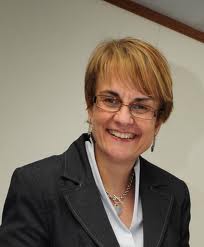
Margaret Ritchie MP

Margaret Ritchie MP

The SDLP MP for South Down Margaret Ritchie has taken a keen interest in the project since her involvement with the East Border Region Committee as a Councillor in 1985. She paid tribute to people such as her predecessor Eddie McGrady, Jim McCart, Donal O’Tierney and Barney Carr, who she said had never faltered from their belief in the bridge and who had shaped the economic debate for it and kept the project alive during very difficult political times in the North. In March she had raised questions with Sammy Wilson and accused him of dragging his feet in approving the Stormont contribution to the project.

Following a meeting with the Minister today Ms Ritchie said she was delighted to confirm that residual funding had been secured to allow the construction of the Narrow Water Bridge, which she described as one of the most important North South projects to be brought forward.

“Narrow Water Bridge will enable, not only many jobs to be provided in construction, but also will be a vital gateway to the Mournes on completion. It will be an important catalyst for economic investment and tourism not only in South Down and the Cooley Peninsula but throughout the island of Ireland. The project is a shining example of how far we have come as a community and in our North South relations. It also symbolises the future of our economy, which is in our tourism product, and this is now something, thanks to the peace process that we can export worldwide“, she said.

The MP said she had been making robust representations to secure funding for this project for considerable time and previously had met with all other funders including the Taoiseach, the Secretary of State for Northern Ireland and the Good Friday Agreement Committee in Dublin. She said today was a very positive day for the Narrow Water Bridge project, the people of Warrenpoint, Kilkeel and the Mournes and she thanked everybody who she said had worked so hard to bring the project to this now very advanced stage.

Narrow Water project

Narrow Water project

UPDATE: Tuesday 9th July
But wait a second! Just when it seemed that Northern approval for the project was almost ready, there’s been a development on the other side of the border with Louth County Council placing the project on hold, owing to high tendering costs (and I wonder how much has been spent already on design fees and other preparatory work).

South Down SDLP MP Margaret Ritchie has demanded a meeting with the Taoiseach over the delay and says she wants both the British and Irish Governments to provide alternative resources to ensure the delivery of the Narrow Water Bridge project. She said:-

“I am disappointed by the decision of Louth County Council to put the Narrow Water Bridge project on hold due to the fact that tenders for the construction of the bridge were much higher than the financial envelope available for the project. I acknowledge the fact that Louth County Council has put the project on hold whilst they pursue alternative sources of funding.

I have already requested a meeting with the Taoiseach to impress upon him the importance of delivering this important piece of North/South infrastructure, and the fact that this project, on completion, would act as a stimulus to the local economy through increased visitor numbers, business investment opportunities, and make a contribution to job creation in the construction industry.
Already, the Bridge has received planning and marine consent as well as the financial support of the Special European Union Programmes Body, the Irish Government and the Northern Ireland Executive.
Furthermore, we await the outcome of the decision on the Bridge Order from the Minister for Regional Development, and only yesterday I had urged Minister Kennedy to process that application for the Bridge Order to approval stage as quickly as possible. Due to the importance of this bridge to under-pinning economic investment in the local area, I would be urging the Taoiseach to explore and to try and provide additional funding for the project and to examine if the European Union might have resources to assist with reducing the shortfall.

Undoubtedly, this will be a blow for the local community in Warrenpoint and in the Cooley Peninsula who fought hard for the project, and knowing their determination, I know they will not allow this setback to daunt them in pursuit of the Narrow Water Bridge. I and my colleagues in the SDLP are determined to continue our fight for this project along with the local community, the Chambers of Commerce, and other public representatives to ensure that this important piece of North/South tourist infrastructure is delivered to the Carlingford Lough area. At this time, the financial support and solidarity of both the British and Irish Governments as well as the Northern Ireland Executive is required to deliver this project which would assist in making a contribution to the local economy in South Down and the Cooley Peninsula in County Louth.”

So perhaps it will be a bridge too far, after all the talk.

BOSTON TAPES & HET

Boston College

Boston College

Crisis In Historical Enquiries Team Probe Of NI’s Past Shows Need For A Fresh Start And An End To Boston College Probe.

Statement from Ed Moloney & Anthony McIntyre on the failures of the Historical Enquiries Team (HET):

Following the decision by the Policing Board of Northern Ireland to suspend all reviews by the HET of military cases and in light of the board’s expression of no confidence in the leadership of the HET on foot of a damning report by the British Inspectorate of Constabulary into the HET’s performance, we call upon the British authorities to immediately suspend the ongoing PSNI investigation resulting from the subpoenas served on Boston College.

Anthony McIntyre

Anthony McIntyre

Ed Moloney

Ed Moloney

We also urge both the US and British governments to immediately withdraw the subpoenas served against Boston College’s Belfast Archive.

It is clear from the HMIC report, from the rigorous investigations carried out by Dr Patricia Lundy, from our own examination of the HET’s record and from the response of public and politicians to this crisis that there is no confidence in the way the British authorities are dealing with the sensitive and all important issue of Northern Ireland’s troubled past.

The way the authorities have invested so much time and money pursuing the Boston archives is in stark contrast to the slipshod and half-hearted efforts that the HET has put into investigating state sponsored violence, especially killings carried out by the British Army. This, we believe, is symptomatic of the double standards that have infected the HET-based approach to dealing with the past.

We urge the British and Irish governments to suspend all criminal and non-criminal inquiries into the past until agreement has been reached by all parties on a credible way forward and a mechanism to deal with the past has been created in such a way that it commands widespread confidence and support.