TOUGH TALKS ON AGRICULTURE

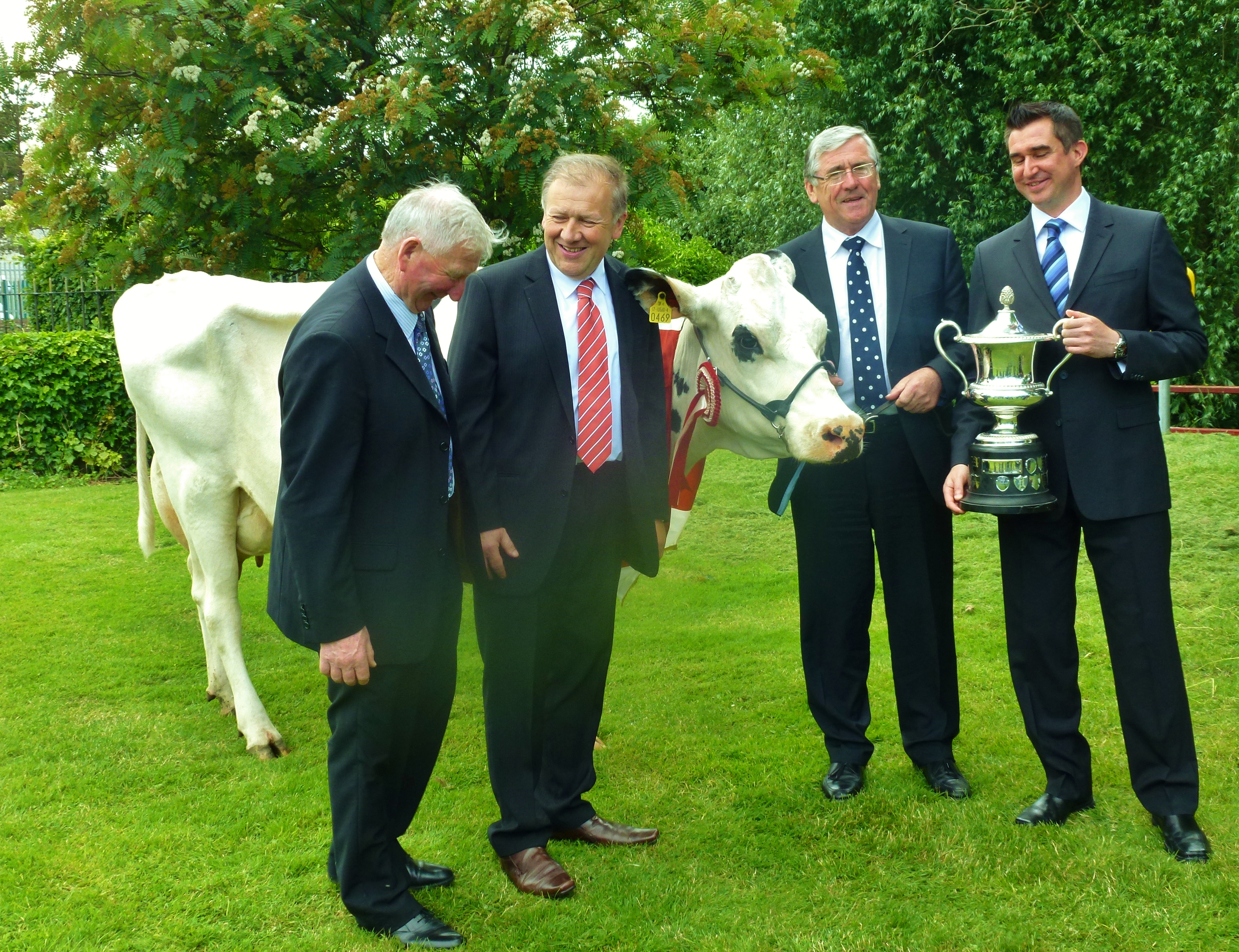
Minister of State Tom Hayes TD at Diageo Baileys

Minister of State Tom Hayes TD at Diageo Baileys

It’s that time of year again when the agricultural community shows off its best livestock and produce. One of the best known shows in the country is held annually at Virginia in County Cavan, beside the shores of Lough Ramor. This year’s event will be on Wednesday 21st August, four days after the Tydavnet show in North Monaghan. The Virginia Show has like many others several competitions in the different classes. But there is one cup in particular which the dairy farmers are interested in, the Baileys Champion Cow, now in its 30th year. More about that on another occasion.

The launch of this year’s event was at the Diageo Bailey’s global production plant at Clondalkin in Dublin. Mr Hayes spoke at a lunch with representatives from the company, the show and members (including myself) of the Guild of Agricultural Journalists. The recently appointed Minister of State at the Department of Agriculture (with responsibility for Forestry, Horticulture, the Greyhound Industry and Food Safety) is from Golden in County Tipperary and is a beef farmer, so he has a good knowledge of the agri-food sector.

The Minister praised the wonderful work and commitment of the various show committees who give their services to the community every year on a voluntary basis.  The Minister said the past few months with the fodder shortage had been difficult for farmers. But he was hopeful that with the sun appearing, things would improve over the summer. He referred to the important negotiations due to be held in Brussels next week on the future of the EU’s Common Agricultural Policy. He said he would be joining his colleague the Minister for Agriculture Simon Coveney who will be chairing the talks. He said the Irish Presidency (which runs until the end of this month) had brought the negotiations a long way. He was hopeful they could bring the CAP talks through to a conclusion, but it was a difficult task because there are now 27 EU member states at the negotiating table. It was going to be a tough week, he said, but he was looking to see the finalisation of the process by Tuesday evening or Wednesday, or as was more likely to be the case, by early on Thursday morning as these discussions had a habit of going down to the wire.

Minister of State Tom Hates TD & Liam Lavelle, President GAJ

Minister of State Tom Hayes TD & Liam Lavelle, President GAJ

In a week which has seen a controversy over sponsorship of sports by the drinks industry, the Minister commended Diageo for what he said was a very good sponsorship of the Bailey’s Cow. Diageo’s head of Irish operations David Smith spoke about the company’s plans for the future and said they were still committed to Ireland. On Monday the company, which also owns Guinness, denied it would scale down its plants in Ireland if drink companies were banned from advertising at big sporting events. Mr Smith referred to the investment of nearly €160m in what he said would be the most advanced brewery in the world at St James’s Gate in Dublin. The new Guinness brewery is under construction giving employment to 900 workers and is due to be fully operational next year. He also pointed to their investment of €3m at its Smithwick’s visitor centre in Kilkenny, recently announced.

G8 PROTEST ENNISKILLEN

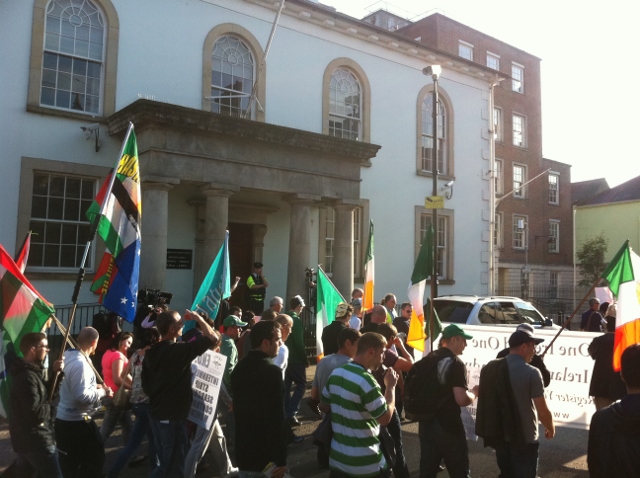
IRSP protestors at G8 security cordon

IRSP protestors at G8 security cordon

So after all the hype about demonstrators converging on Enniskillen. the protest against the G8 summit taking place at the Lough Erne resort outside Enniskillen passed off without major incident. The crowd was nothing like the 3000 forecast, although up to 2000 (a conservative estimate on my part) had marched through the town centre before proceeding the two miles or so out to the steel barrier fence which had been erected to prevent unauthorised access to the summit. By then the numbers had dwindled to less than 1000.

Police lined the route of the G8 protest march

Police lined the route of the G8 protest march

Anti-G8 Protestors: telling the leaders they are not welcome in Fermanagh

Anti-G8 Protestors: telling the leaders they are not welcome in Fermanagh

At the end of the rally at the police outer cordon, a small number of protesters briefly crossed the outer wire perimeter but were warned not to proceed any further by a string of riot police who had assembled beyond the hedge in the next field.

It probably did not disturb the G8 leaders from the United States (President Barack Obama), UK (Prime Minister David Cameron), France (President François Hollande), Germany (Chancellor Angela Merkel), Italy (Prime Minister Enrico Letta), Japan (Prime Minister Shinzō Abe), Russia (President Vladimir Putin) and Canada (Prime Minister Stephen Harper) are taking part in the summit and they were joined this afternoon by Taoiseach Enda Kenny, Chair of the Irish Presidency of the European Council, due to end shortly.

Groups protesting against fracking in Fermanagh and the border counties, tax evasion and world hunger took part in a mainly good-natured six-mile G8 Not Welcome march. Dozens of onlookers stood in shop fronts and at doors in the town centre as the demonstrators passed by. A number of republican groups took part including the IRSP, Éirígí and the Irish Republican Prisoners’ Welfare Association. This latter group paraded past the war memorial, where eleven people were killed in an IRA bomb in November 1987, carrying tricolours and shouting slogans including “Brits out, Brits out now”. The same happened as they walked past the courthouse on East Bridge Street. A complete contrast to the dignity shown when Enda Kenny laid a laurel wreath on Remembrance Sunday last year and former Irish soldiers including a colour party with the Irish flag from the ONE Tanagh branch in Co.Monaghan joined members of the Royal British Legion in a parade after a service at St Macartin’s Cathedral.

IRPWA protestors pass Enniskillen courthouse: their placards called for the release of Martin Corey and an end to "selective internment"

IRPWA protestors at Enniskillen courthouse: their placards called for release of Martin Corey and an end to “selective internment”

Trade unionists were among those who walked the three miles around the town and then out the Belleek road. I bumped into (literally!) Mary Cahillane from the Socialist Party. I walked for a time alongside my #NUJ colleagues from the Derry and North West branch, among them Anton McCabe (Secretary), Darach McDonald who has some great pictures on his Frontier Post blog and Eamonn McCann from Derry, who was one of the speakers at the rally. Dublin photographer Paula Geraghty was busy working on a video.

NUJ Derry & North West Branch taking part in protest

NUJ Derry & North West Branch taking part in protest

Richard Boyd Barrett TD addresses rally

Richard Boyd Barrett TD addresses rally

Jimmy Kelly, UNITE

Jimmy Kelly, UNITE

Other participants and speakers included the Unite union regional secretary Jimmy Kelly, People before Profit TD from Dún Laoghaire, Richard Boyd-Barrett, Socialist Party TD for Dublin West Joe Higgins and a local anti-fracking campaigner Claire Falconer, an artist.

eJoe Higins TD on the march

eJoe Higins TD on the march

ULSTER & IRISH VOLUNTEERS

Quincey Dougan on the UVF

Quincey Dougan on the UVF

A very interesting night on Wednesday at Monaghan County Museum, where the CaDoLeMo group that promotes orange bands and culture in the border counties of Cavan, Donegal, Leitrim and Monaghan held a talk on the two rival sets of Volunteers that emerged in the early 1900s before partition. It was an appropriate setting as the museum is currently displaying the Walking the Colours exhibition, which I wrote about in April.

Monaghan UVF Flag

Monaghan UVF Flag

Quincey Dougan spoke about Monaghan unionists, in particular their contribution to the formation of the Ulster Volunteer Force. For a more detailed look at the subject, you can find his article on the subject here. One of the flags included in the exhibition comes from the 2nd Battalion of the UVF in Monaghan, which Quincey explained had its headquarters in Clones under the command of Lt Colonel Madden of Hilton Park outside the town. After the outbreak of World War I, Madden was replaced by a prominent solicitor Michael Knight, also Grandmaster of the County Orange.

According to Dougan, in August 1913 it was listed as having just 408 men, but within 12 months it had became bigger than the first battalion with 1058 men enlisted. The main drill areas were Drum, which included Scotshouse, Corrygarry, Drum and Carn; Clones including Clones, Stonebridge and Drumully, and Ballybay which included Laragh and Aughnamullen. Newbliss had a section, as did Dartrey in the form of Doohat and Dartrey. The Castleblayney and Carrickmacross area was not listed on the original returns and appears to have been slow to organise, but by early 1914 it also had men drilling. The Mullyash area of East Monaghan had a large unionist presence, but its natural hinterland was the South Armagh town of Newtownhamilton and it appears that the area drilled with County Armagh.

Professor Terence Dooley

Professor Terence Dooley

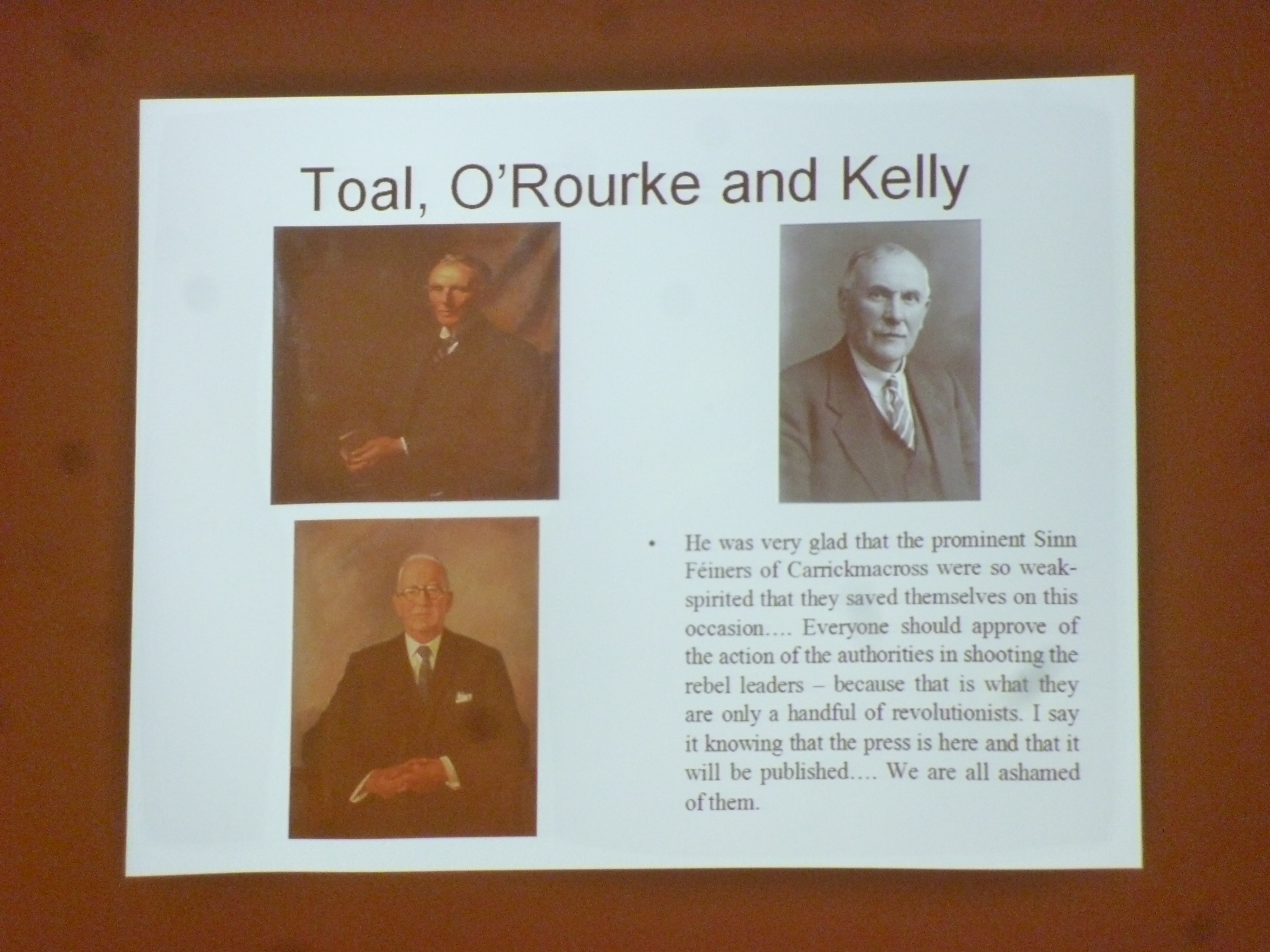
The second part of the evening was devoted to the story of the Irish Volunteers in County Monaghan. The guest speaker was Professor Terence Dooley, NUI Maynooth, who comes from Killanny near Carrickmacross. It was fascinating to hear the story of three Monaghan nationalists who went on to become politicians, Thomas Toal of Smithborough, Edward “twister” Kelly and ? O’Rourke.

Story of Toal, O'Rourke & Kelly

Story of Toal, O’Rourke & Kelly

MONAGHAN WELCOMES GEEL

Civic reception by Monaghan County Council for Geel group

Civic reception by Monaghan County Council for Geel group

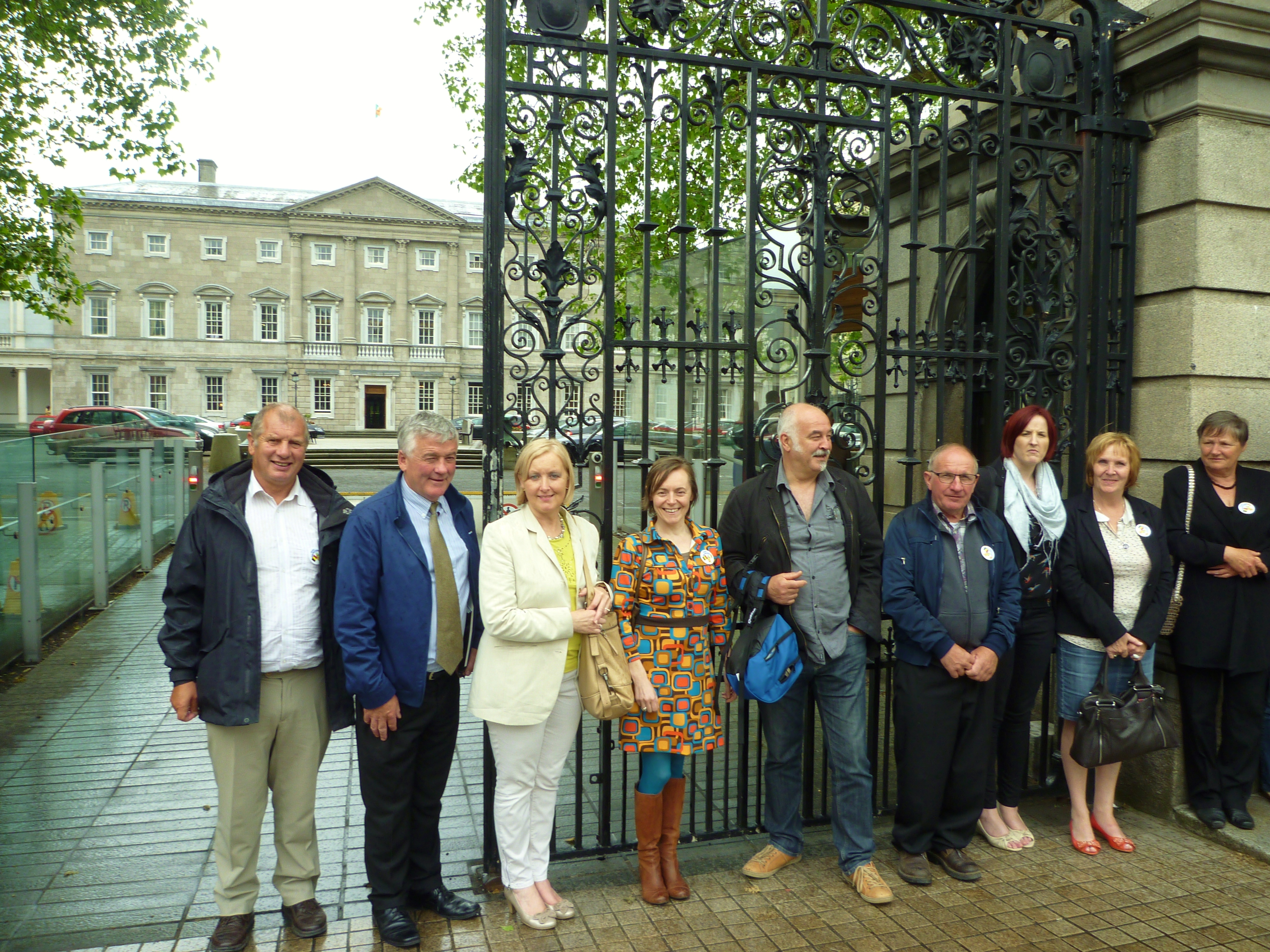
Geel group led by Mayor Vera Celis visits Leinster House

Geel group led by Mayor Vera Celis visits Leinster House

WELKOM! Tydavnet in County Monaghan has welcomed a group of fifteen visitors from Geel in Belgium, led by the new Mayor Vera Celis. Tydavnet is twinned with Geel in the province of Antwerp through the common link of St Dympna (Davnet). The group, some of whom have been here before, are staying with host families in the parish. They flew in to Dublin airport from Brussels and were then taken on a tour of Leinster House organised by Cllr Paudge Connolly, followed by lunch in the members’ restaurant. During the visit the Taoiseach Enda Kenny met them briefly, which was appreciated as it was a busy day for him in the Daíl.

An Taoiseach Enda Kenny TD and Burgemeester van Geel Vera Celis, New Flemish Alliance party, Flemish Parliament

An Taoiseach Enda Kenny TD and Burgemeester van Geel Vera Celis, New Flemish Alliance party, Flemish Parliament

I met the group as they departed for Tydavnet, where they were entertained last night in the community centre, having stopped to visit the restored workhouse building in Carrickmacross en route . Last August I joined a group from Tydavnet and Monaghan that went to Geel for the “Eurofeesten” involving twelve European countries. On Thursday the visitors were taken on a walking tour of the St Davnet’s complex in Monaghan. They were then given a civic reception at the Westenra Hotel, hosted by the Mayor of County Monaghan Hugh McElvaney and the Monaghan town Mayor, Seamus Treanor, both of whom participated in the visit to Geel last year. Councillor McElvaney presented Vera Celis with a framed piece of Clones lace and the Burgemeester made presentations to Tydavnet group organiser Sheila McKenna and to the county Mayor. This afternoon the group was taken to visit the new educational campus and the Garage theatre on the Armagh road and they were then due to be taken on a walk around Monaghan town. They will visit Derry on Saturday and will attend Sunday Mass in Tydavnet.

Group from Geel at Leinster House

Group from Geel at Leinster House

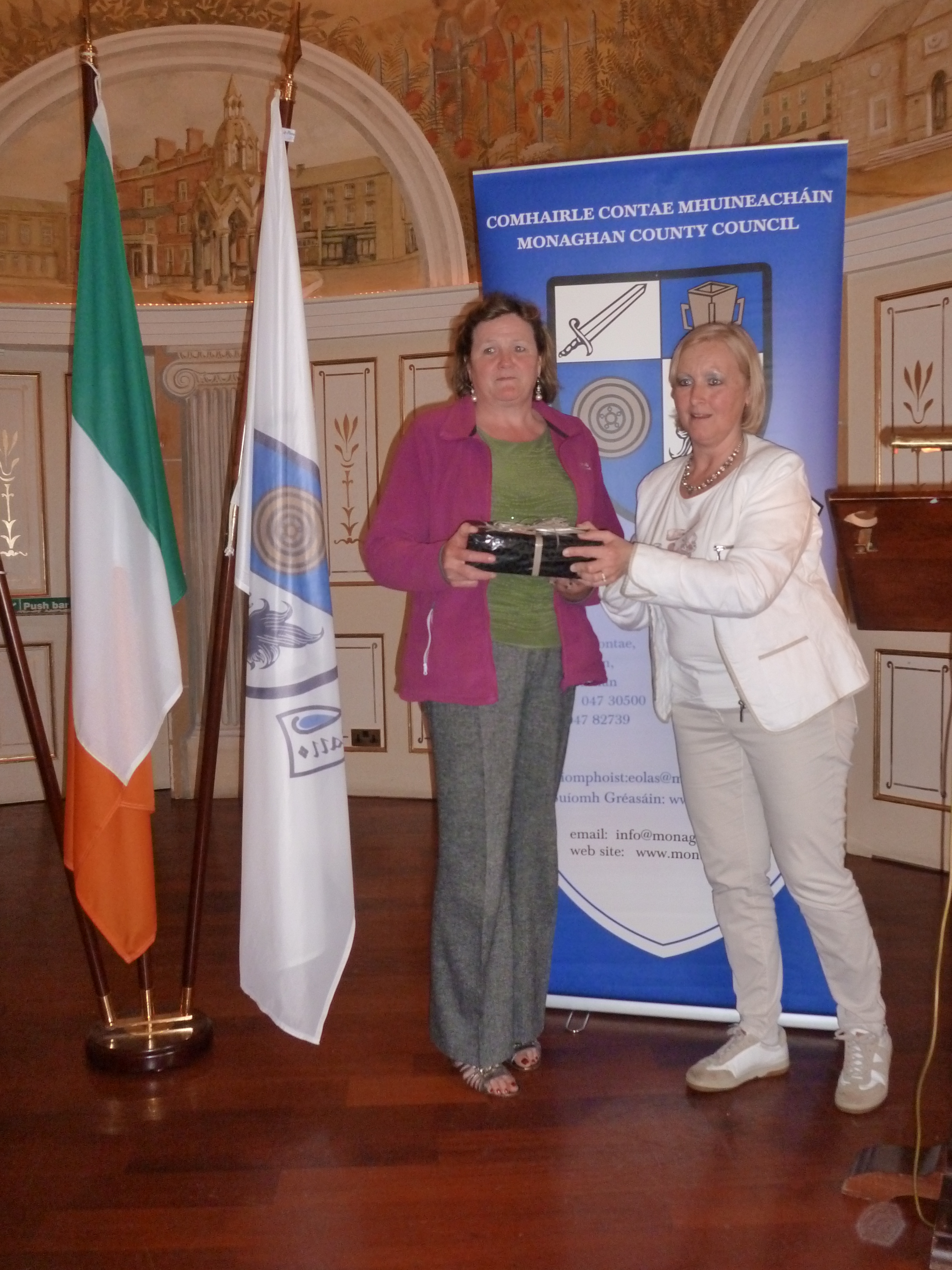
Monaghan Mayor Hugh McElvaney presents a gift of Clones Lace to Geel Mayor Vera Celis

Monaghan Mayor Hugh McElvaney presents a gift of Clones Lace to Geel Mayor Vera Celis

Tydavnet Group organiser Sheila McKenna is presented with a gift by Mayor of Geel Vera Celis

Tydavnet Group organiser Sheila McKenna is presented with a gift by Mayor of Geel Vera Celis

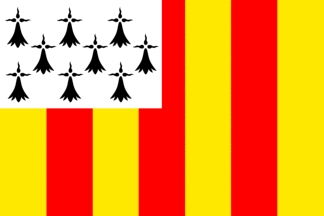
Flag of Geel

Flag of Geel

NUALA O’LOAN

Baroness Nuala O'Loan

Baroness Nuala O’Loan

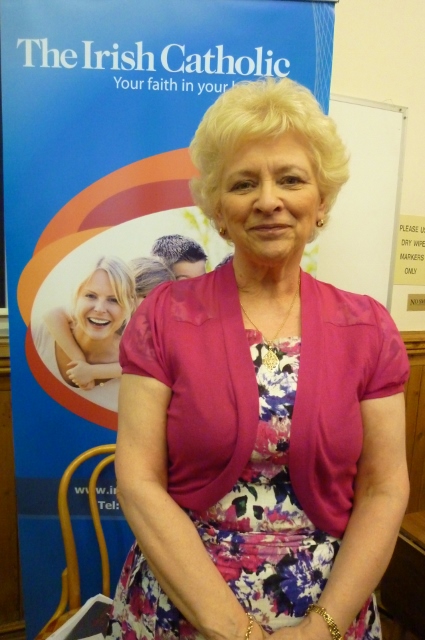
Baroness Nuala O’Loan was the first Police Ombudsman in Northern Ireland, who carried a number of reports into some of the most controversial killings during the troubles. Originally from England, she was a solicitor and then a senior law lecturer at the University of Ulster. As a member of the House of Lords, she is a legislator. She has spoken about her Catholic faith on a number of occasions, visiting parishes in different parts of Ireland. So I listened to her talk at the Irish Catholic 125 years conference at All Hallows College in Dublin with particular interest. She made a number of interesting observations about the Irish government’s proposed legislation on abortion, including its provision where suicide is threatened by the mother. In order to give readers the chance to consider her remarks, I looked for a copy of her speech, which she kindly provided and I now publish in full:-

“It is  a great honour to be invited to speak to you at this important conference, important because it marks 125 years of publication by the Irish Catholic, and important too because we meet at a time of great hope for this Church of ours.  I would like to congratulate the Irish Catholic and its loyal staff for all that it has achieved over the years, and for being a source of light and understanding for those of us who read its columns, and who seek accessible answers to some of the great questions which arise in relation to our life and our faith.  Accessibility, in terms of format, but much more importantly in terms of content is profoundly important.  One of the problems which we face is that much of the authoritative written material about faith is articulated in language which can be very dense and of great complexity.  The Irish Catholic makes a great contribution in this and in the range of its coverage and photography!
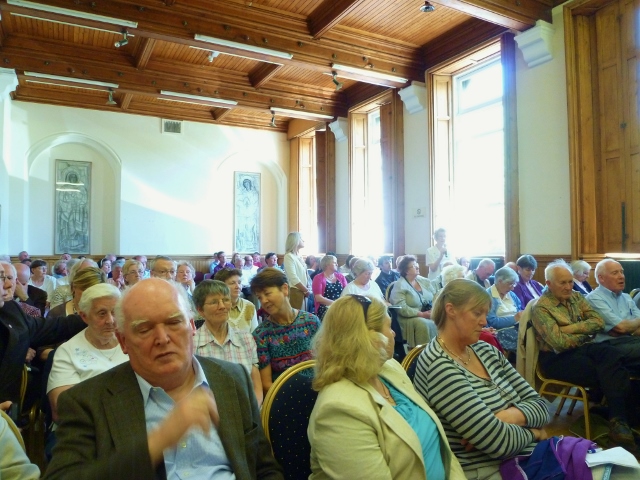
Audience at Irish Catholic conference

Audience at Irish Catholic conference

It is wonderful, too, that as we meet the world here in Ireland is glorious, blue skies, wonderful sunshine.  I as thinking about it yesterday as I drove around the north – it seem as if all the flowers are blooming at once, flowers of every colour: deep pinks, crimson, lilac, the golden yellow of laburnum, the blues and whites – all so beautiful and all telling of the wonder of God’s creation and the beauty of His work.

I have been asked to speak about Catholicism in public life. The reality is that the complexities and challenges of faith are never more obvious than when one actually tries to live them, especially when one moves outside the comfort zone of church and people of a like mind into the public place.  That is, of course what we are all called to do, and that is what Jesus himself did, at the greatest personal cost.  Being called to Catholicism is not an easy thing, although the fundamentals of our faith are profoundly pure and simple.  We know them well.  We are called to love God and to love one another as he has loved us, to act justly, to love tenderly, to walk humbly.  We know that those who feed the hungry, visit the sick, comfort those who mourn, visit the imprisoned, etc. are blessed.   All very simple in theory.  All quite complex in the playing out of daily life, both at home and in the public sphere.

I wondered what I should say to you today about Catholicism in public life.  I wondered too what you might be expecting me to say.  The reality, as I am sure you know, is that each of us plays some role in public life, if we define public life as that part of the world which exists alongside our family and private life.  Our daily lives are lived in the public sphere – in community, in work, in school, college and university, in politics, in recreation and leisure pursuits. For some of us our public lives are more public than others.  For many of you your decision making will be your private business.  Very often people will not know whether you have agonised over the morality of something, whether it is ethical to act in a particular way.  For others their decision making is the subject to analysis and comment, some of it offensive, much of it robust.  Those of us who move across the public arena, whether by way of journalistic contribution or in politics or others can be very much aware of this.  it is part of our lives.  It can take courage to articulate the truth when it is not a commonly held or easily accepted  view.   We are much blessed, for example, by the integrity of columnists like Breda O’Brien who writes so informatively and so compellingly in defence of the right to life of the unborn. In a world which proclaims the defence of freedom of speech, and human rights, it can seem as if the right of freedom of religion, conscience and thought is not accorded the same respect as the other rights.  We have to reclaim that territory and speak with courage about what we believe.

There are those who said that we live in post Catholic Ireland, that religion has no part to play in public life.  To say this is to misunderstand the nature of Catholicism.  Robert Barron wrote of Christianity in his book, ‘The Strangest Way: Walking the Christian Path’:

‘Christianity, before all else, is a form of life, a path that one walks. It is a way of seeing, a frame of mind, an attitude, but more than this, it is a manner of moving and acting, standing and relating. It is not simply a matter of the mind but of the body as well. In fact, one could say that Christianity is not real until it has insinuated itself into the blood and the bones, until it becomes an instinct, as much physical as spiritual. Perhaps, the most direct description is this: Christianity, the way of Jesus Christ, is a culture, a style of life supported by a unique set of convictions, assumptions, hopes, and practices. It is like a game with distinctive texture, feel and set of rules’ [The Strangest Way 2002].

For those of us who are Catholic there cannot be and should not be any disconnect between our daily lives in the public place and our religious faith.  So a life lived in the community of the Church,  a life as part of the Body of Christ which is the Church, must be led in a way which reflects its divine maker and which acknowledges the responsibilities and great joys inherent in our greatest gift – our faith.  Once we accept the chain of connectedness from our baptism to our membership of that community, and, through the Eucharist to the fact that Christ lives in each of us, that he lives also in the lives of friends and stranger, that he is constantly to be encountered in the lives of all His people, even in the paedophile, even in the murderer, (utterly challenging as that may be), we live in a very different public place.  We no longer really have the option of behaving as if we really matter more than anyone else.  We no longer have the option of ignoring the common good and of not attempting to make a contribution to our brothers and sisters in Christ. To do so would be to ignore that Christ whom we profess to love as we walk along the way, deciding whether or not to pass by on the other side!

This faith of ours makes many calls on us.  As Christians, as Catholics we know that our faith calls us to honesty and integrity, but above all to holiness – as the Catechism tells us, to ‘do the will of the Father in everything, that they may wholeheartedly devote themselves to the glory of God and to the service of their neighbour’ [Catechism para 2013.2014]. And of course the reality is that so many Catholics do recognise this.  They do make a significant contribution.  John XXIII wrote of this 50 years ago, in his 1963 encyclical Pacem in Terris, Peace on Earth.  Talking of human society, he said:

‘through it, in the bright light of truth, men should share their knowledge, be able to exercise their rights and fulfil their obligations, be inspired to seek spiritual values; mutually derive genuine pleasure from the beautiful, of whatever order it be; always be readily disposed to pass on to others the best of their own cultural heritage; and eagerly strive to make their own the spiritual achievements of others. These benefits not only influence, but at the same time give aim and scope to all that has bearing on cultural expressions, economic, and social institutions, political movements and forms, laws, and all other structures by which society is outwardly established and constantly developed’.

And so it is – the Catholic Church has a proud reputation in terms of its contribution to the development of society across the world.  In country after country its missionaries, lay and religious have established the schools, the hospitals, the health centres, the social centres, the programmes for the relief of poverty, the development of agriculture, all the structures of a modern society, and in so doing have contributed to the growth of society.  In saying this I do not ignore the terrible scourge of child abuse, or the unfaithfulness of some members of our church, nor do I ignore the shocking failures at the heart of the Vatican.  But it is important to remember the good that was done, the sacrifice which was made by so many here and in foreign lands.  We had African visitors last month, a man on his 40s, his wife and their four children.  we had known him as a very bright but very poor, and often hungry  schoolboy for whom education had brought liberation. He is now a civil engineer working on water projects across Africa, and he had  had travelled with his family across the world,  to see the place which had brought the missionaries who built the schools he had attended.  It was both warming and humbling to see our world through their eyes, and to sit around our dinner table as his little daughter prayed the grace, praying for me who had cooked her dinner, giving thanks to God for all the fun they had and praying for all the little children in the world who do not have enough to eat. Life brings us many blessings, doesn’t it?

We all have to make choices about what is right and that which we know to be unethical or wrong in legal or moral terms.   It can challenge us all.  We often don’t think of the consequences of our decisions.   We could decide to drive too fast.  We could decide not to point out to a waiter that fact that there are drinks missing from the bill when we get it.  We could conclude that the taxman does not need our money as much as we do, and not declare all our income.  All these things, and many many more, are not ways which we should behave if we are followers of the man who walked the dusty roads of the Holy Land for such a brief time, before he allowed himself to be taken away and crucified.

Faith calls us to walk in a different way, acknowledging our call to give all we have for others, even when it is inconvenient, or too demanding, or frightening, or even when we are just feeling a bit lazy.  Our faith, though, is not a threat to others though some may interpret it as such.  For all of us, but particularly for those who carry responsibilities as influencers of political, social and religious development, as decision makers, as representatives of authority, our lives as Catholics should  permeate and enable every part of our beings, every conscious thought.   When we feel isolated or concerned about our capacity to do what is right, we need only remember the words of Jesus on so many occasions: at the Transfiguration, when he walked on the water, when he met the women at the tomb who could not find his crucified body: ‘be not afraid’.  Those words have comforted men and women over the ages, they have comforted me when I have feared because of what my public life called me to do.  Jesus left us himself in word and sacrament, we know, and in the words of scripture we find not only challenge (and there is plenty of that) but also comfort and viaticum, food for the journey.    I was very privileged towards the end of his life to come to know Cardinal Daly  who was wonderfully supportive to me at times of difficulty.  He did not tolerate self pity or anything like that, but he would pray with such love to the Father, calling him so tenderly, Abba Father, and he would quote, with a twinkle in his eye St Paul, who said: ‘I can do all things through him who strengthens me’ [Philippians 4:13].

Those called to public life in the world today will face many challenges.  The dilemmas are not new.  Speaking of this in Westminster Hall in 2010, Pope Benedict recalled:

‘the figure of Saint Thomas More, the great English scholar and statesman, who is admired by believers and non-believers alike for the integrity with which he followed his conscience, even at the cost of displeasing the sovereign whose “good servant” he was, because he chose to serve God first. He spoke of The dilemma which faced More in those difficult times, the perennial question of the relationship between what is owed to Caesar and what is owed to God’ .

He went on to say:

‘Religion… is not a problem for legislators to solve, but a vital contributor to the national conversation. In this light, I cannot but voice my concern at the increasing marginalization of religion, particularly of Christianity, that is taking place in some quarters, even in nations which place a great emphasis on tolerance. There are those who would advocate that the voice of religion be silenced, or at least relegated to the purely private sphere. There are those who argue that the public celebration of festivals such as Christmas should be discouraged, in the questionable belief that it might somehow offend those of other religions or none. And there are those who argue – paradoxically with the intention of eliminating discrimination – that Christians in public roles should be required at times to act against their conscience. These are worrying signs of a failure to appreciate not only the rights of believers to freedom of conscience and freedom of religion, but also the legitimate role of religion in the public square. I would invite all of you, therefore, within your respective spheres of influence, to seek ways of promoting and encouraging dialogue between faith and reason at every level of national life’ [http://www.thepapalvisit.org.uk/Replay-the-Visit/Speeches/Speeches-17-September/Pope-Benedict-s-address-to-Politicians-Diplomats-Academics-and-Business-Leaders].

The call could not be clearer.  People do seek to put pressure, as they always have done,  on Christians to act against their conscience. We can see it in Ireland today in the context of the Heads of Bill on abortion.  There is no duty on the state under Human Rights Law to provide abortion on demand. The current proposals,  as they stand, would result in a situation in which  Ireland faces the prospect under the proposed law of terminating the pregnancy of a mother whose baby has been in her  womb for up to nine months, because she is threatening to commit suicide.  Women in this situation require every assistance and support, they need compassion and pragmatic solutions to the problems  they face. But to suggest that abortion will solve the problem of threatened suicide not only fails to acknowledge and protect the little child in her womb, but, as research in 2011 shows, actually  increases the risk of suicidal behaviour by 155%.

The reality is that the only way in which abortion can be conducted in the later stages of pregnancy is either through normal delivery or Caesarian Section.  The mother must give birth. She is carrying a child and what will be removed from her womb will not be foetal tissue, but will in most cases be very recognisable as a little boy or a little girl. Who in their right minds can believe that going through the process of giving birth to a little child, which is intended to die because it has been deliberately born too early, will bring peace of mind to a girl or woman who is suicidal?

We face difficult ethical and moral issues in the UK too.  I think of the Bill which has been laid before Parliament this session which will permit assisted suicide, and which we must both challenge and debate very soon.  I am very clear that this bill must not be passed because it will leave sick, elderly and vulnerable people in a perilous situation in which issues of financial costs of care, and decisions about the value of their lives could be made, which might lead to them being euthanased.  In the Netherlands where euthanasia is lawful the most recent Report on the matter stated that over 300 people were put to death without their consent.  As we contemplate the horrendous suffering of some individuals, and as in some cases they approach the courts and legislators seeking changes to the law to permit assisted suicide or euthanasia, there is a temptation to think that it would be the hallmark of a civilised society to allow them to die at a time and in the manner of their choosing.  But it is not as simple as that.   All human life is sacred to God.  It is not ours to dispose of.  Rather it is our duty on all occasions to do all we can to protect it.

It can be easy to take the articulated majority view on things.  For elected politicians there is a great temptation to vote and behave in a way which they think will secure their seats at the next election.  That is very human.  But the reality is  that those who speak loudest are not necessarily the majority.  They are simply the people who speak loudest.  They may be presenting considered views, but the legislator must look at the exact words of any proposed text and work out what they mean and what the consequences will be.  He  or she must then make decisions about how to act. An interesting document from the Congregation for the Doctrine of the Faith, issued in 2002 is as resonant today on these issues as it was when it was issued:

‘The complex array of today’s problems branches out from here, including some never faced by past generations. Scientific progress has resulted in advances that are unsettling for the consciences of men and women and call for solutions that respect ethical principles in a coherent and fundamental way. At the same time, legislative proposals are put forward which, heedless of the consequences for the existence and future of human beings with regard to the formation of culture and social behaviour, attack the very inviolability of human life. Catholics, in this difficult situation, have the right and the duty to recall society to a deeper understanding of human life and to the responsibility of everyone in this regard. John Paul II, continuing the constant teaching of the Church, has reiterated many times that those who are directly involved in law-making bodies have a «grave and clear obligation to oppose» any law that attacks human life. For them, as for every Catholic, it is impossible to promote such laws or to vote for them.[19] As John Paul II has taught in his Encyclical Letter Evangelium vitae regarding the situation in which it is not possible to overturn or completely repeal a law allowing abortion which is already in force or coming up for a vote, «an elected official, whose absolute personal opposition to procured abortion was well known, could licitly support proposals aimed at limiting the harm done by such a law and at lessening its negative consequences at the level of general opinion and public morality»’ [Evangelium Vitae, 73  JPII from DOCTRINAL NOTE on some questions regarding The Participation of Catholics in Political Life].

It is very difficult to find one’s self in the position in which one must vote for something one knows to be wrong  in order to try and prevent a greater harm.  This is what John Paul was telling us we must do.
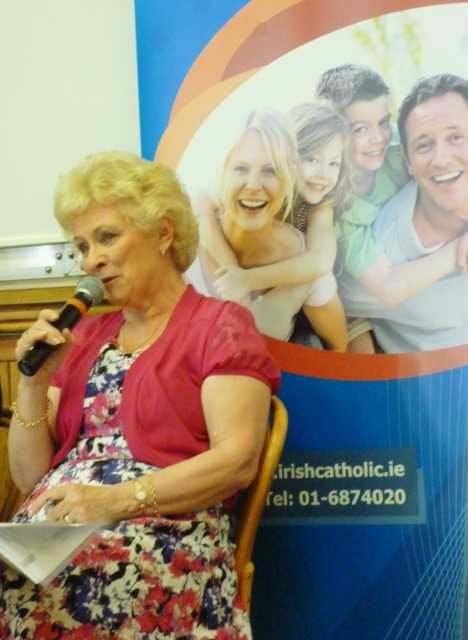
Baroness Nuala O'Loan

Baroness Nuala O’Loan

I think, too, of the Marriage (Same Sex) Bill which is currently before the House of Lords and on which I spoke and voted on Tuesday last. The Church is very clear in her teaching that those who have a same sex orientation must be accepted with respect, compassion and sensitivity, and every sign of unjust discrimination in their regard should be avoided. The European Court of Human Rights stated in 2012 that there is no discrimination in excluding same sex couples from marriage.

The UK Government, in their rush to pass this legislation and to provide equality, as they describe it, for same sex couples, have produced a bill which will create two types of marriage – marriage between a man and a woman which will continue to involve a lifelong commitment, has a sexual aspect involving consummation, and has a presumption that the husband is the father of any child born to the mother during the marriage, and that the partners will remain loyal to each other. That legal definition of marriage is the same as the Catholic definition of marriage.  Under the proposed English Law there will then be a second type of marriage which will be between same sex couples, has no requirement for consummation, in which any child of a mother cannot be presumed to be the child of the other partner, and in which a same sex partner cannot be divorced on grounds of adultery with another same sex person.  Effectively as I said, there will be two sets of rules: one for same sex couples, one for opposite sex couples. Is this equality?  Can it be right?  Will it not lead to endless legal challenges as parties to one type of  marriage seek to assert rights against the UK government in the European Court which are available to parties in the other type of marriage but not to them.  And what does the proposed law do to the institution of marriage and its role in society?

These are the types of issues which legislators must face.  I often walk through Westminster Hall and pass the spot on which Thomas More faced the judges and was sentenced to death for his refusal to yield to Henry V111’s demands.  He could have lived had he denied his faith.  He chose to go to his death rather then deny God.  We do not face such challenges today in most parts of the world.  We are subject to all sorts of derision and to contempt however.  For elected politicians there is always the risk that doing the right thing will lead to loss of an election, status, income and their whole life style.  Politicians, like influences and decision makers everywhere need your prayers and your support.

For all of us, as we contemplate the richness and wonder of the faith that is ours, as we thank God for the beauty of our world, for the great gifts he has given us there is still a need to be aware that we must constantly and consciously, if we really are part of the body of Christ, live our lives in the constant awareness that we are in the presence of Christ.  If we do this we will lead lives of prayerful alertness.  We will acknowledge our obligation to understand the teaching of our church, to distinguish between that which is doctrinal and binding on us and that which has evolved and will continue to evolve.  Under Canon Law, Catholics should:

 ‘distinguish carefully between the rights and the duties which they have as belonging to the Church and those which fall to them as members of the human society. They will strive to unite the two harmoniously, remembering that in every temporal affair they are to be guided by a Christian conscience, since no human activity, even of the temporal order, can be withdrawn from God’s dominion’ [Catechism paras  912, 913].

‘Formation and enrichment’ of all members of the Church, John Paul II said  will enable ‘the proclamation of Christ to reach people, mould communities, and have a deep and incisive influence in bringing Gospel values to bear in society and culture’. The United States Conference of Catholic Bishops wrote in 2004 that:

‘Catholics who bring their moral convictions into public life do not threaten democracy or pluralism but enrich them and the nation. The separation of church and state does not require division between belief and public action, between moral principles and political choices, but protects the right of believers and religious groups to practice their faith and act on their values in public life. Catholics need to act in support of these principles and policies in public life. It is the particular vocation of the laity to transform the world’.

Finally then I want to return to that aspect of life which is critical for all of us  if we are to be able to fulfil this vocation which has so many aspects – from the call to holiness to the call to transform the world. We will only be able to do this if we make sure that we know that God holds us in the palm of his hand and if we make space in our lives for the Lord who loved us so much that he gave his life for us.  Maybe like me you can be very busy, you can feel that there is not much time for prayer, for reading of scripture, even for church and sacrament.  it is an easy trap to fall into.  The deepest traps are always the easiest to fall into, and the challenge for each of us is to ensure that we do not think that doing the work of the Lord is enough, that we pray by what we do and that will suffice.  We can delude ourselves, especially when things are going well.  We must make time too for the Lord of the work, for it is in and through and with Him that we will be able for the work, and that we will be gifted with that courage and energy which will enable us to do what we should do.

As we gather together today, we do so in hope: that hope of eternal life, which is already happening as we walk our journey home to God, for death it was written is an horizon  and “an horizon is nothing save the limit of our sight” [Rossiter, W Raymond  1840-1918] but also in the hope that our Church, which has been much battered will grow stronger, more attuned to the call of scripture, and will be a body which truly is the body of Christ here on earth.   As Pope Francis said last week, the Church is ‘the work of God, born of His love and progressively built in history”  “born of God’s desire to call all men and women to communion with him, to friendship with him, even further, to participate as his children in his very divinity’.   

It is perhaps appropriate to end with some words which are attributed to St. Augustine of Hippo [354-430AD] :

‘God of our life, there are days when the burdens we carry chafe our shoulders and weigh us down; when the road seems dreary and endless, the skies grey and threatening; when our lives have no music in them,  and our hearts are lonely, and our souls have  lost their courage.  Flood the path with light, run our eyes to where the skies are full of promise; tune our hearts to brave music; give us the sense of comradeship with heroes and saints of every age; and so quicken our spirits that we may be able to encourage the souls of all who journey with us on the road of life, to Your honour and glory’.

Baroness Nuala O'Loan

Baroness Nuala O’Loan

VIGIL FOR LIFE

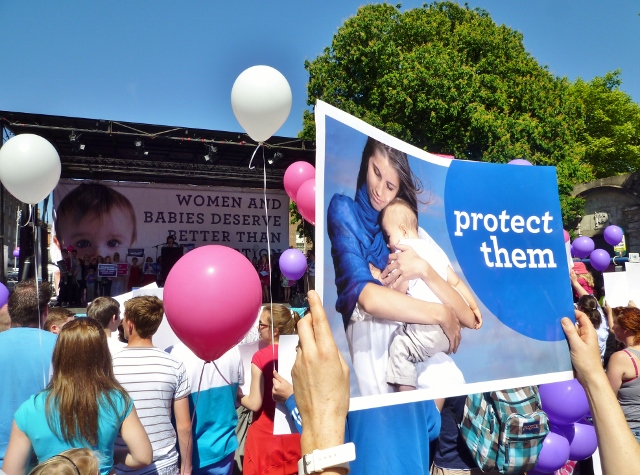
Message from rally to Leinster House legislators

Message from Vigil for Life rally to Leinster House legislators

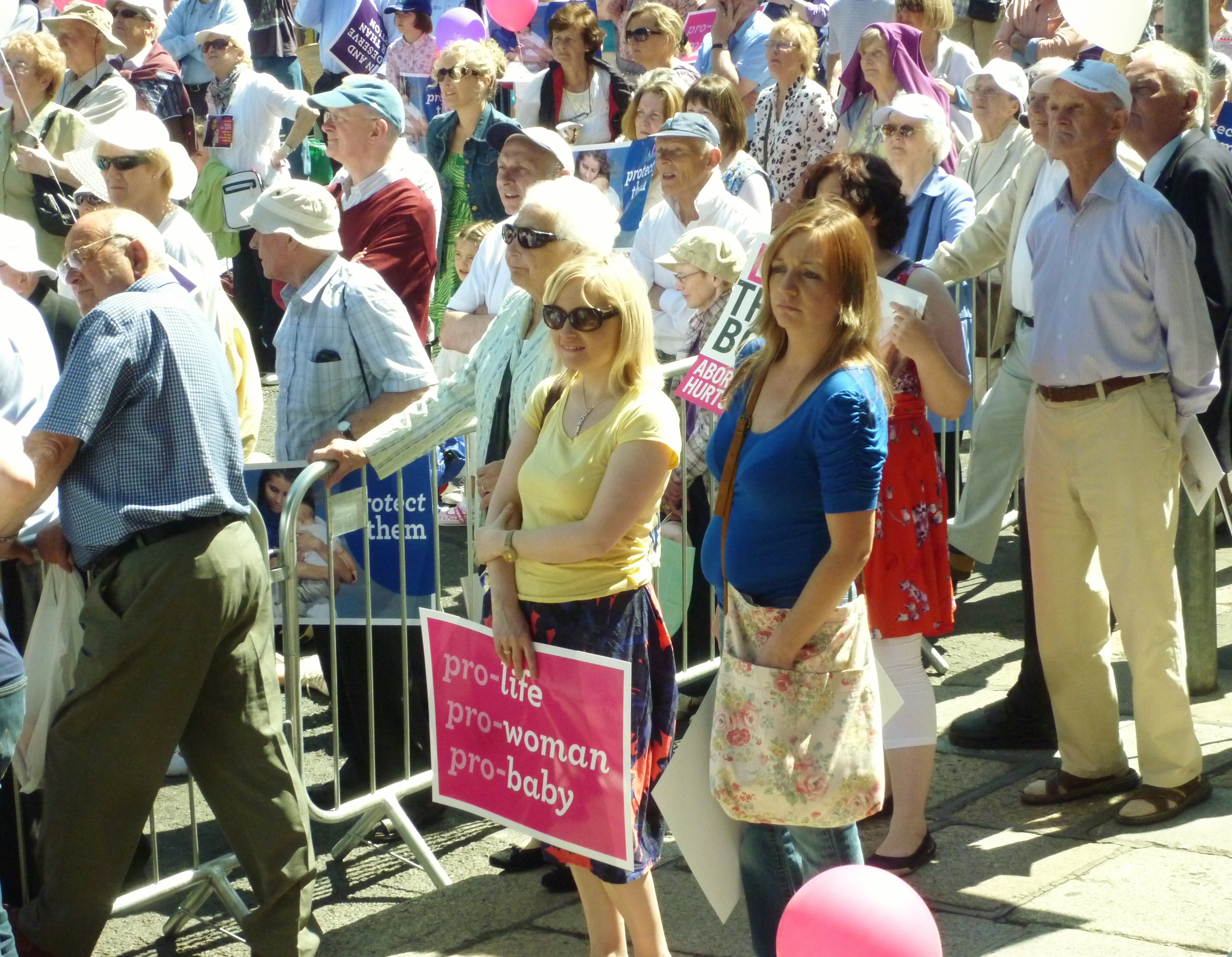
They came in their coachloads from all parts of the island: North, South East and West. Organisers say a crowd of 50,000 people, young, old and middle-aged, attended the national Vigil for Life on Saturday (8th June) at Merrion Square in Dublin city centre. Among the slogans they chanted: “We are Pro-Life” and “Kill the Bill”.

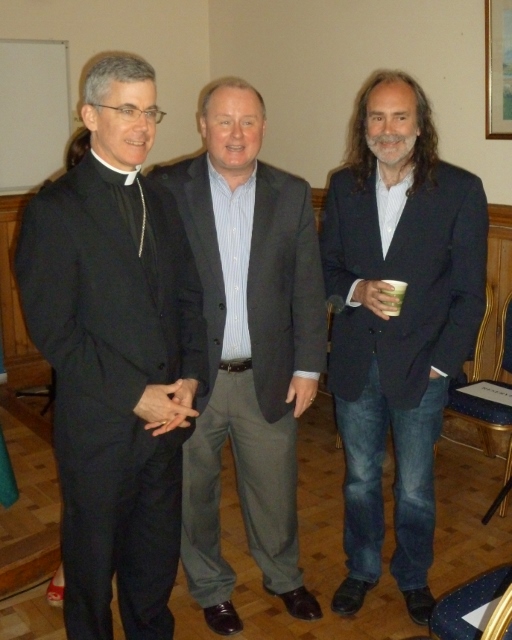
Mickey Harte and Peter Mathews TD

Mickey Harte and Peter Mathews TD

One of the first people I noticed near the platform was the Fine Gael TD for Dublin South, Peter Mathews. He is a former classmate of mine in secondary school in Dublin. I mentioned him in a recent blog on Mount Anville. Close by was another TD, Peadar Tóibín of Sinn Féin (Meath West) and also the current Tyrone GAA football manager, Mickey Harte. Mickey applauded following the video contribution by his son-in-law John McAreavey. Mr McAreavey warned against the development of an abortion culture and said there was no more positive thing than standing up for the human rights of another person, especially the most vulnerable, and unborn children in danger of abortion were about as vulnerable as it got.

Mickey Harte watches John McAreavey's contribution
Mickey Harte watches John McAreavey
Meath West TD Peadar Tóibín, Sinn Féin

Meath West TD Peadar Tóibín, Sinn Féin

Peter Mathews became the first government TD to break ranks and commit to voting against the proposed abortion legislation when it comes before the Daíl. He told the Irish Independent:- “I will do what I have to do and that is vote against the bill”, because it is “mistaken in its foundation……It is a very badly formulated bill, on bad foundations and it should be withdrawn…..I will not support the bill as it stands. I will vote against”, he said. In his view, legislation for the X Case is not required. He told the newspaper he is prepared to face the consequences of voting against the party whip. “Anything I do in life has its consequences and I will deal with the consequences when and if they arise”, Mr Mathews told Gareth Naughton.

Crowd in Merrion Square

Crowd in Merrion Square

The Fine Gael member made his pledge after the Taoiseach Enda Kenny had rejected a call from the Archbishop of Dublin Dr Diarmuid Martin for deputies to be given a free vote on the proposals. For further details of Archbishop Martin’s views, see his interview in the Irish Independent on Saturday. The Fianna Fáil leader Micheál Martin has given his TDs a free vote, although this was against his original wishes and was granted largely to avoid a damaging split in his parliamentary party.

Vigil for Life

Vigil for Life

In looking through the photographs I took at the rally I noticed many smiling faces among the crowd. I have already referred to the range of age groups reflected in the gathering. What was also noticeable was that most of the platform speakers and contributors were women and there seemed to be a female majority amongst the attendance. One of the video contributions was by Celeste Beal King, grand-niece of the assassinated US civil rights leader Martin Luther King.

Crowd at Vigil for Life

Crowd at Vigil for Life

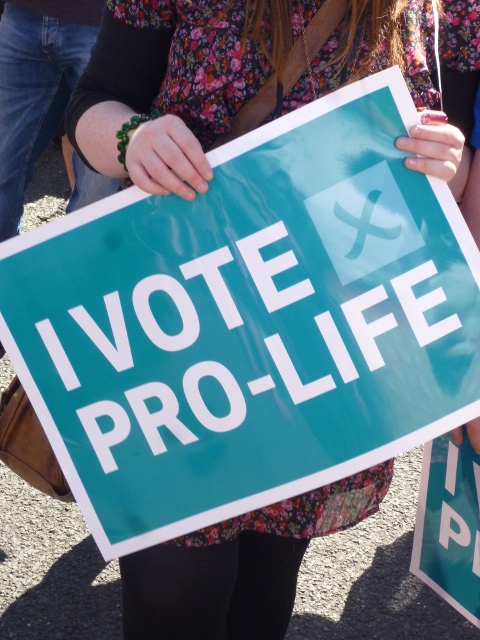
Placard carried at Rally

Placard carried at Rally

Maria Steen, Iona Institute, addressing rally

Maria Steen, Iona Institute, addressing rally

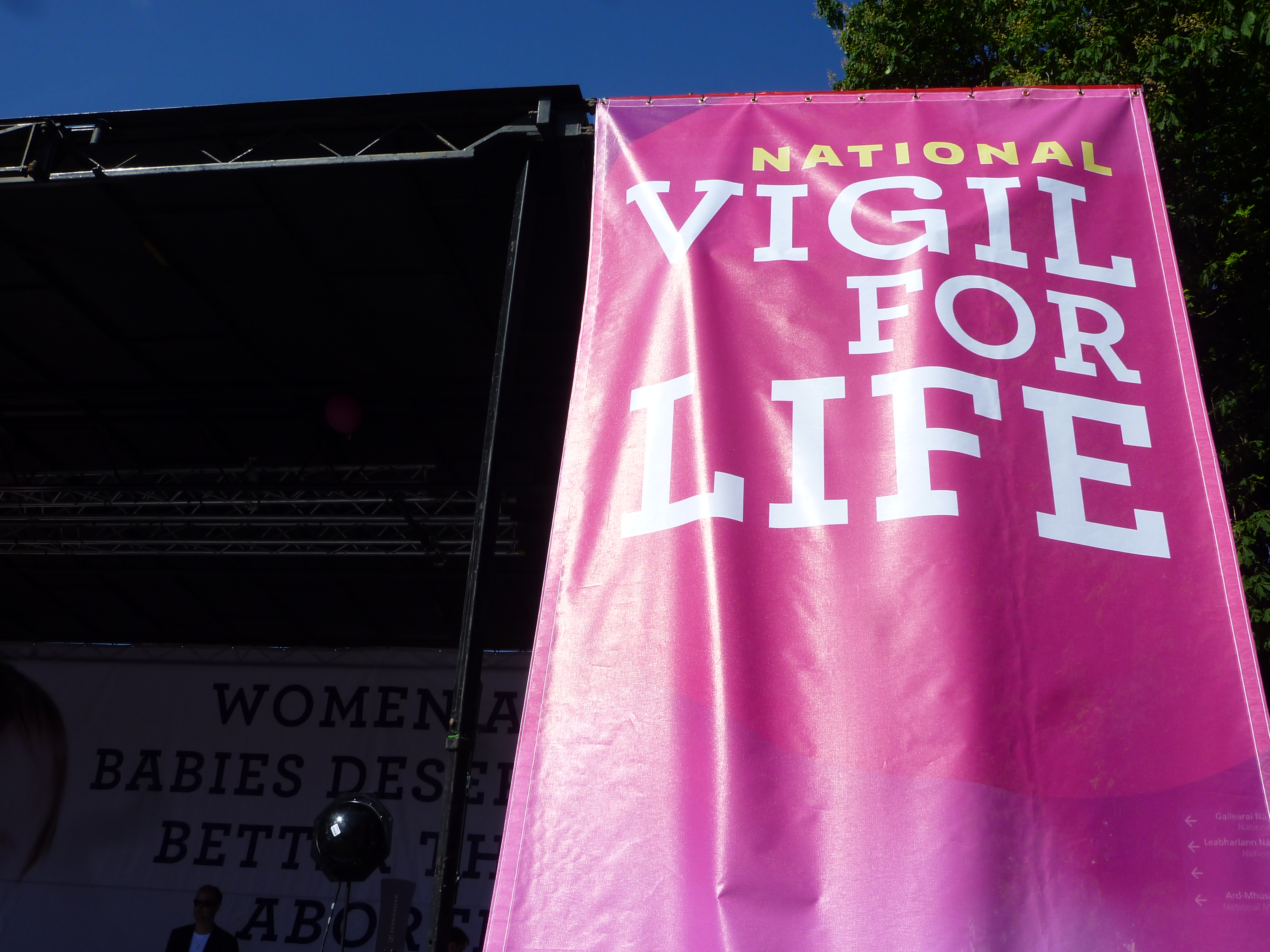
Banner at Rally

Banner at Rally

IC125 CONFERENCE ALL HALLOWS

All Hallows College, Dublin

All Hallows College, Dublin

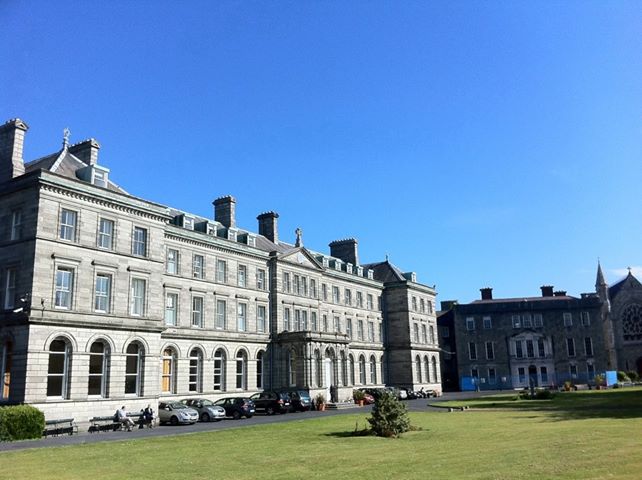
Celebrating 125 years of the Irish Catholic newspaper, a conference was held at All Hallows College in Dublin entitled Horizon of Hope. I have only been there once or twice before. My uncle the late Fr Harry Smyth CM was a member of the Vincentian order and occasionally stayed there when visiting Dublin.

Fr Harry Smyth CM & his sister at time of ordination

Fr Harry Smyth CM & his sister at time of ordination

He was one of the 6000 Irish missionaries trained there who have been sent out into various countries over the past 170 years of the College. But now according to Fr Pat McDevitt CM, President of the College, said a different kind of missionary was needed for the world today: the students come from wide variety of communities.

Archbishop Charles Brown, Fr Pat McDevitt CM, John Waters

Archbishop Charles Brown, Fr Pat McDevitt CM, John Waters

One common interest among the “new” missionaries was concern for the needs of the poor, Fr McDevitt told the opening of #IC125. He was appointed to All Hallows in November 2001 when he was Associate Professor of Education at de Paul University in Chicago, his place of birth in the United States. The College is now part of Dublin City University and recently launched a plan to build its reputation as a centre of excellence for innovative teaching & learning, community-based service learning,  transnationality and applied/community-based research.

Editor, Irish Catholic: Michael Kelly

Editor, Irish Catholic: Michael Kelly

Papal Nuncio Archbishop Charles Brown was introduced by the Editor of the Irish Catholic, Michael Kelly. He told the conference he saw signs of hope in Ireland during visits to dioceses: shoots of new life springing up. One of the signs of new hope is the Irish Catholic newspaper, the principal voice of Catholics in the print media, according to Archbishop Brown and the perfect answer to clericalism. Columnist John Waters then spoke. He said Catholicism had nourished Irish culture for 1500 years. In his address he also made the point that it was the absence of questions that was most terrifying: the questions that were being eliminated from our culture. A ‘benign tolerance’ towards Catholicism is the best you will get in the present day mainstream media, he said.

Sarah Carey

Sarah Carey

Breda O'Brtien

Breda O’Brtien

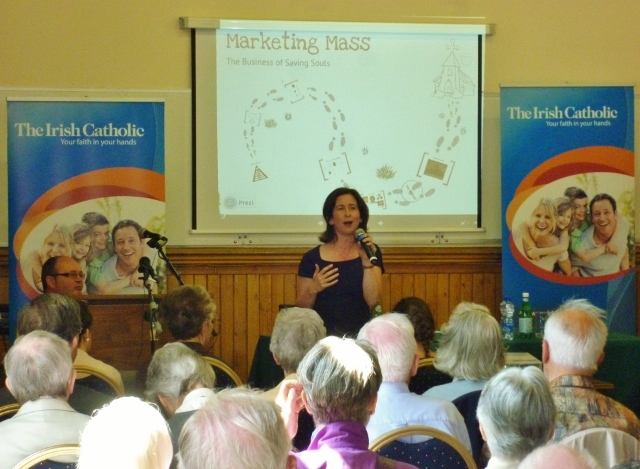
Breda O’Brien spoke about “Catholic spirituality — our best hope”. Despair is not an option a Christian can afford to indulge in”, she said. She said the huge sense of the sacred in our religion eg Eucharist/Holy Communion had been lost, a point also raised by an audience member. Sarah Carey’s presentation was about marketing the Mass. ESRI Mass attendance survey: 42% of Catholics weekly, mainly over 65s (70%).

Baroness Nuala O'Loan

Baroness Nuala O’Loan

Former Northern Ireland Police Ombudsman Baroness Nuala O’Loan spoke very strongly on the proposed change to Irish law on abortion in cases where a threat of suicide existed. For those who wish to see her comments, I have published her script in a later blog. Other contributors to the conference included writer, author and playwright Mary Kenny, David Quinn of the Iona Institute and a “Youth Perspective” delivered by Maura Garrihy who went on to participate in the Vigil for Life national rally and the Meath footballer Joe Sheridan. The conference was brought to a close with a panel discussion, chaired by Eileen Dunne, newscaster and presenter of “The God Slot” on RTÉ Radio 1.

Eileen Dunne chairing panel discussion

Eileen Dunne chairing panel discussion

David Quinn, Iona Institute with Michael Kelly, Irish Catholic

David Quinn, Iona Institute with Michael Kelly, Irish Catholic

Mary Kenny

Mary Kenny

NARROW WATER BRIDGE

In March I wrote about the ongoing controversy over the plan for a new cross-border bridge at Narrow Water linking County Down near Warrenpoint with Omeath in the Carlingford peninsula in County Louth. Now the project has been given the go-ahead by the Northern Ireland Finance Minister Sammy Wilson of the DUP and the way has been cleared for funding of €17.4m to be obtained from the Special EU Programmes Body under the INTERREG scheme. The BBC reports that the scheme for the bridge 660 metres (2,165 feet) long will be subject to various conditions in relation to its upkeep by Newry and Mourne Council as well as Louth County Council.
Proposed Narrow Water Bridge

Proposed Narrow Water Bridge

They have been talking about the project since 1976 when the East Border Region committee was formed by ten councils on both sides of the border, years before the Anglo-Irish agreement or the Good Friday agreement. The provisional EU offer of help last year was welcomed by the EBR Committee Chair, Councillor Jackie Crowe, a Sinn Féin member from Monaghan.

Proposed Bridge

Proposed Bridge

The approved scheme is for a single carriageway cable-stayed bridge across Carlingford Lough, which will be able to open to enable tall ships, leisure craft and other marine vessels access to Victoria Lock and the Albert Basin in Newry. The total length of the scheme is 660m while the towers have a height of 90m and 37m respectively. The design is by Roughan O’Donovan Consulting Engineers, who were also responsible for the new Boyne Bridge on the M1 near Drogheda.

Margaret Ritchie MP

Margaret Ritchie MP

The SDLP MP for South Down Margaret Ritchie has taken a keen interest in the project since her involvement with the East Border Region Committee as a Councillor in 1985. She paid tribute to people such as her predecessor Eddie McGrady, Jim McCart, Donal O’Tierney and Barney Carr, who she said had never faltered from their belief in the bridge and who had shaped the economic debate for it and kept the project alive during very difficult political times in the North. In March she had raised questions with Sammy Wilson and accused him of dragging his feet in approving the Stormont contribution to the project.

Following a meeting with the Minister today Ms Ritchie said  she was delighted to confirm that residual funding had been secured to allow the construction of the Narrow Water Bridge, which she described as one of the most important North South projects to be brought forward.

“Narrow Water Bridge will enable, not only many jobs to be provided in construction, but also will be a vital gateway to the Mournes on completion. It will be an important catalyst for economic investment and tourism not only in South Down and the Cooley Peninsula but throughout the island of Ireland. The project is a shining example of how far we have come as a community and in our North South relations. It also symbolises the future of our economy, which is in our tourism product, and this is now something, thanks to the peace process that we can export worldwide“, she said.

The MP said she had been making robust representations to secure funding for this project for considerable time and previously had met with all other funders including the Taoiseach, the Secretary of State for Northern Ireland and the Good Friday Agreement Committee in Dublin. She said today was a very positive day for the Narrow Water Bridge project, the people of Warrenpoint, Kilkeel and the Mournes and she thanked everybody who she said had worked so hard to bring the project to this now very advanced stage.

Narrow Water project

Narrow Water project


A-MAZING! DAY 2 AT BALMORAL

Riding for the Disabled group in shadow of former Maze prison

Riding for the Disabled group in shadow of former Maze prison

It was an a-mazing second day at the Balmoral Show. Standing in the shadow of two watchtowers, a security wall and other reminders of the former high-security jail, I met  a group from the Riding for the Disabled Association (whose President is the Princess Royal, sister of Prince Edward, who opened the show yesterday). They came from clubs in Newtownards, Banbridge and included some members of the RDA Ireland from Monaghan.

I was at the Maze only once during its previous existence as a high-security prison. Making a radio programme for BBC Radio Birmingham in the mid-1970s, I spent a night with a British Army regiment known as the Birmingham Gunners (39 Medium Regiment Royal Artillery) in the military base on one part of the site.

I remember it was around the time of St Patrick’s Day and I eventually found a suitable spot to drown the shamrock. Next day I was taken in a Land Rover on one of their perimeter security patrols and was also shown into one of the watchtowers. From there I could see a group of prisoners exercising in one of the H-blocks. One of them was running around the large cage and when he spotted a face in the observation post, he made a two-fingered gesture and shouted towards his “audience”.

The Gunners did four “emergency” tours of duty in the North in the 1970s, the first to Fort George in Derry in 1973, which, like the Maze, is now earmarked for a regeneration project. At the time of their deployment at the Maze, the squaddies were also in Craigavon and some were stationed at the border checkpoint at Aughnacloy. Some years previously in 1969 while on exercise in Libya, the Regiment found itself caught up in the military coup of the then Captain Muammar Gadaffi against the government of King Idris.

Main Arena Balmoral Show 2013 DayTwo

Main Arena Balmoral Show 2013 Day Two

Now after some 37 years I was back at the Maze, but in a very different context. With thousands of cars parked on hard standing all paths from the car park led to the main entrance of the 145th annual Royal Ulster Agricultural Society show. This event transferred from the King’s Hall complex at Balmoral in Belfast is helping to bring a promising future to the site of the former jail.

The transformation is being carried out by the Maze Long Kesh Development Corporation. Programme Director Kyle Alexander confirmed to reporters this evening that funding for the development of a Peace-building and Conflict Resolution Centre is expected to be in place by the end of this year. Although the Corporation wants to emphasise that the 347 acres should be a shared site, some unionist politicians and loyalists have protested that the preserved hospital and one H-block from the prison should not be allowed to become a “shrine” for the republican hunger strikers who died there.

RUAS President John Bamber at Balmoral Show entrance

RUAS President John Bamber at Balmoral Show entrance

Meanwhile the show will continue for a third day, with initial traffic problems apparently sorted, although the delays in arriving now seem to have been transferred to departure from the site. There are plans to build a slip road to the nearby M1 motorway in 2015, which would ease congestion along the narrow access roads around the complex. RUAS President John Bamber was pleased with the opening day of the show and said he hoped the traffic management plan put into place with the PSNI and Roads Service would help to ease congestion, especially for those travelling from West of the Bann.

FERMANAGH AWAITS G8

Lough Erne Resort

Lough Erne Resort

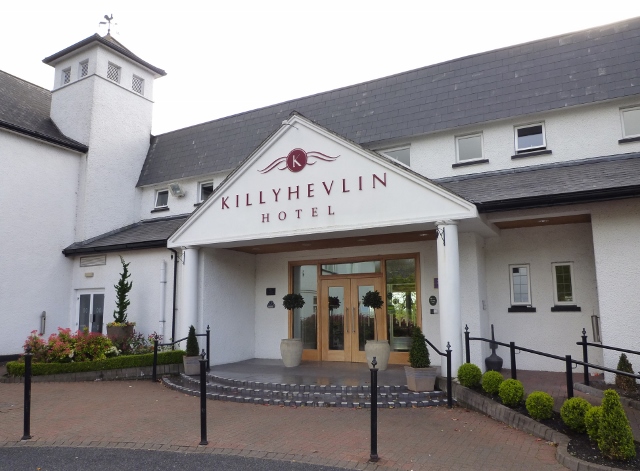
Fermanagh is preparing to host the G8 summit next month. The meeting of the heads of state of eight of the most powerful nations in the world will be held at the Lough Erne resort outside Enniskillen. Already arrangements are being made for a big influx of media personnel from all over the world. The Killyhevlin hotel in Enniskillen will serve as a media centre and indications are that it is booked up.

Killyhevlin Hotel, Enniskillen

Killyhevlin Hotel, Enniskillen

The BBC reports that the summit is expected to boost business in Northern Ireland by £40 million. Barclays Bank found almost 85% of businesses believe holding the summit in County Fermanagh will be good for the region. It said there was also longer-term potential to boost tourism, exports and foreign investment. A total of 213 telephone interviews were conducted with businesses in NI. The research was carried out by the Northern Ireland Centre for Economic Policy within the University of Ulster on behalf of Barclays. Across all sectors and geographically across Northern Ireland, two thirds of businesses expect the G8 Summit to have a positive or very positive effect on the economy. Businesses in the hospitality and tourism sector were the most positive about the summit (73%), though support was strong across all sectors with 69% of professional services supportive and 58% of manufacturers.

It is anticipated that demand for a total of 35,000 to 45,000 nights of accommodation could be generated in Northern Ireland as a result of the trips from the delegates, their entourages, security, international media and associated officials. The report from Barclays indicated that this could “feasibly generate” £5.5m to £7.5m for the tourist industry, predominantly in Fermanagh.

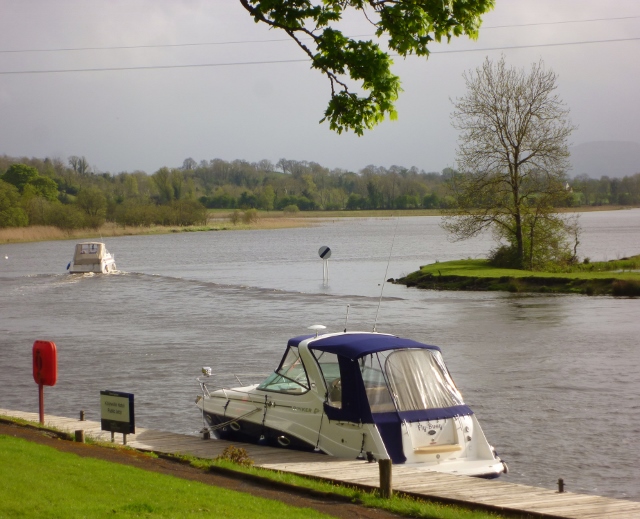
Lough Erne at Killyhevlin Hotel

Lough Erne at Killyhevlin Hotel