EBAF: WOMAD MUSIC & ARTS

WOMAD Flags flying at Skainos Centre Photo: © Michael Fisher

WOMAD Flags flying at Skainos Centre Photo: © Michael Fisher

OK, first I had better explain all these acronyms. For the past few days my blogs have concentrated on EBAF, the East Belfast Arts Festival, which runs until Sunday (1st September) and is now in its second year. The Lord Mayor of Belfast Councillor Máirtín Ó Muilleoir paid tribute to the “hardworking committee at East Belfast Arts Fest” when he met them at Belmont Tower. On his twitter account @newbelfast he described their five day programme as “a magnificent event, lifting the entire city”.

Getting ready for the concert Photo: © Michael Fisher

Getting ready for the concert Photo: © Michael Fisher

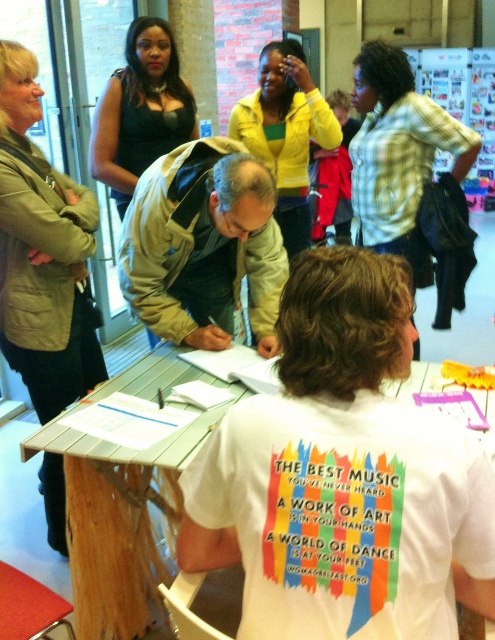
WOMAD brought to the Skainos Centre (East Belfast Mission) on the Newtownards Road the World of Music, Arts and Dance (sorry, I couldn’t fit the dancers into the title!). It was founded by rock icon Peter Gabriel in 1982, when he envisaged a concert involving artists from Africa. Since then concerts have been held in over 20 countries in front of live audiences totalling over one million people. It is now officially recognised in the Guinness Book of Records as the world’s biggest international music festival.

WOMAD: World of Music Arts & Dance  Photo: © Michael Fisher

WOMAD: World of Music Arts & Dance Photo: © Michael Fisher

Beyond Skin are delivering an outreach programme using international music, arts and dance to bridge cultural relations and  promote cultural learning. The all day event ranged from Uganda Gaze Dance to South American Charango & Ukulele to Indian Warli Art displays.

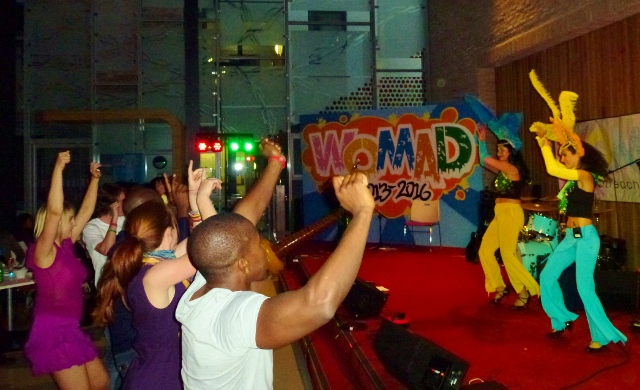
Brazilian Dance at WOMAD  Photo: © Michael Fisher

Brazilian Dance at WOMAD Concert: Photo: © Michael Fisher

The outreach showcase culminated in a concert that brought a range of unique world culture never seen before in East Belfast.

WOMAD Concert: Photo © Michael Fisher

Brazilian Dance at WOMAD Concert: Photo © Michael Fisher

The event featured performances from two of the most exciting musicians to come out of Senegal in the last decade, Oumar Sow (best known lead guitarists with Youssou N’Dour) and Singer/Guitarist Laye Sow. Supported by guest artists and the Reggae & Ska group, Boss Sound Manifesto. The five are Marty Malone on drums, Kieran ( sauce) Mc Curry on Guitar, Máirtín Ó Briain on Bass, Brendy Mc Curry on organ and guitar and Cormac (Buzz) Ó Briain on vocals and tenor sax.

WOMAD Concert  Boss Sound Manifesto Reggae & Ska Band Photo: © Michael Fisher

WOMAD Concert Boss Sound Manifesto Reggae & Ska Band Photo: © Michael Fisher

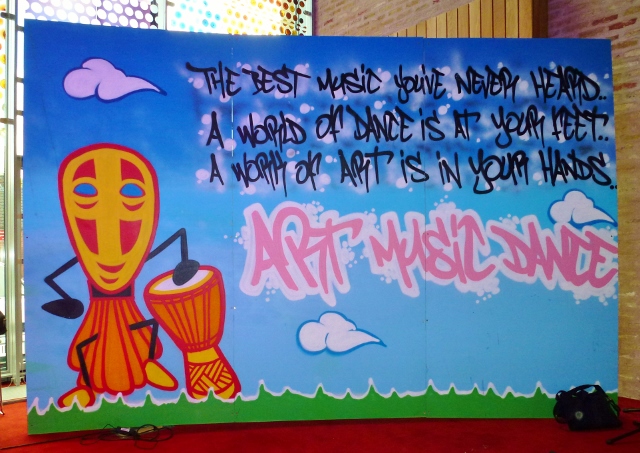
WOMAD Arts Music & Dance Photo © Michael Fisher

WOMAD Arts Music & Dance Photo © Michael Fisher

The event was part funded by Belfast City Council’s Creative Legacies project supported under the Belfast PEACE III Plan by the European Union’s European Regional Development Fund through the PEACE III Programme and East Belfast District Policing & Community Safety Partnership.  EU flag2colors

EBAF: GAP IN THE HEDGE

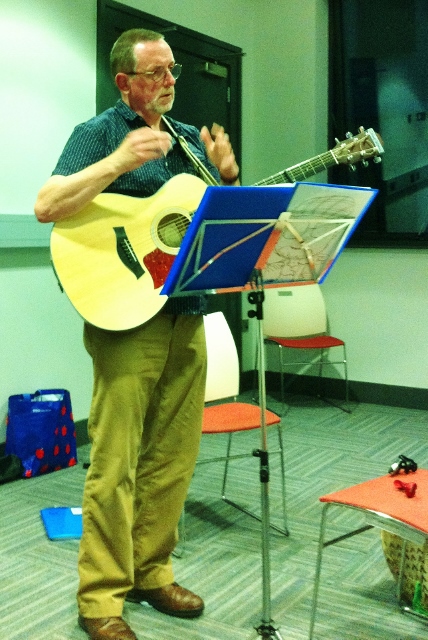
Stephen Hall tunes his guitar Photo: © Michael Fisher

Stephen Hall tunes his guitar Photo: © Michael Fisher

If you have heard ‘The Wee Wee Man‘ from County Antrim on the radio, you would have enjoyed the ‘Gap in the Hedge’ night at the East Belfast Arts Festival. Before I go any further I should explain to readers outside Ulster that ‘wee’ is merely local dialect for small and a common expression in this part of the island of Ireland and in Scotland. Stephen Hall who wrote the song is a graphic designer who now devotes his time to storytelling and songwriting. He has written, illustrated and published popular books that look at the theme of identity through popular myth, using accessible styles and writing techniques to introduce these works to a broader audience.

Randall Stephen Hall Photo: © Michael Fisher

Randall Stephen Hall Photo: © Michael Fisher

Stephen sometimes uses a Kenyan drum to accompany his songs. The programme told us that he has a deep interest in how we see ourselves as a community in Northern Ireland. I notice that one of the songs on his album, released in 2010, is called The Reiver and the Gael, which refers to the period before Plantation.

Randall Stephen Hall Photo: © Michael Fisher

Randall Stephen Hall Photo: © Michael Fisher

One review remarked on the “melodic mandolin and catchy chorus” of that particular track. As John Baucher explained in that article in culturenorthernireland.org:-

“What Hall is doing, in my view, is asking people to look beyond the obvious and politicised traditions by arguing that we are a mix of the old and new. We are of a mongrel bloodline: a hotchpotch of Irish, Scottish, Welsh and English, to name a few of the obvious strands of DNA flowing here in Northern Ireland. As Hall states in the musical poem ‘The Lang Staine’: ‘So culture vultures listen. Listen long and hard. Ulster Scots a hybrid. Nae dull aul lump of lard. A shiny shiny dappled thing. A mongrel through and through’. “

The album is “an inventive mixture of poetry and song in the Ulster-Scots Irish tradition”. The CD with 21 tracks of songs and poems was recorded in a work East room at the top of Stephen’s house, his ‘moon shed’, and was launched at The Black Box in Belfast in September 2010. Further details are available on BBC Northern Ireland’s Ulster-Scots page.

https://myspace.com/randallstephenhall/music/song/the-wee-wee-man-71577431-78868353  RSH-Cover-_thumb

EBAF: ‘THOU SHALT NOT KILL’

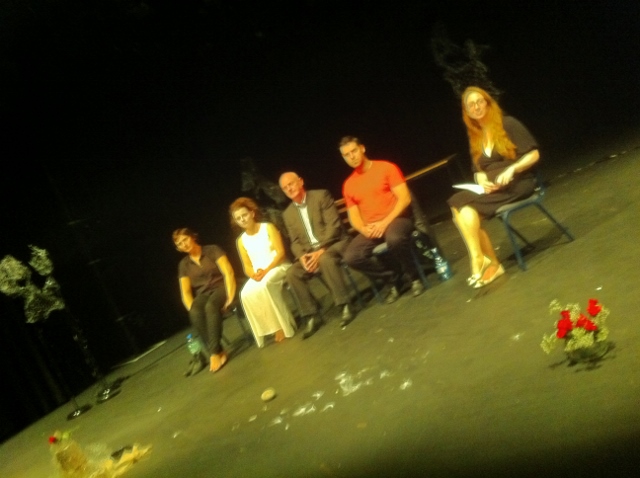
Post-performance discussion with actors Photo: © Michael Fisher

Post-performance discussion with actors Photo: © Michael Fisher

Sectarianism, racism and homophobia are alive and well in our schools in Northern Ireland. That’s the view of a former teacher Jim Arbuckle from London/derry, who works as a Good Relations Facilitator alongside the Smashing Times Theatre Company, who performed tonight in the East Belfast Arts Festival.

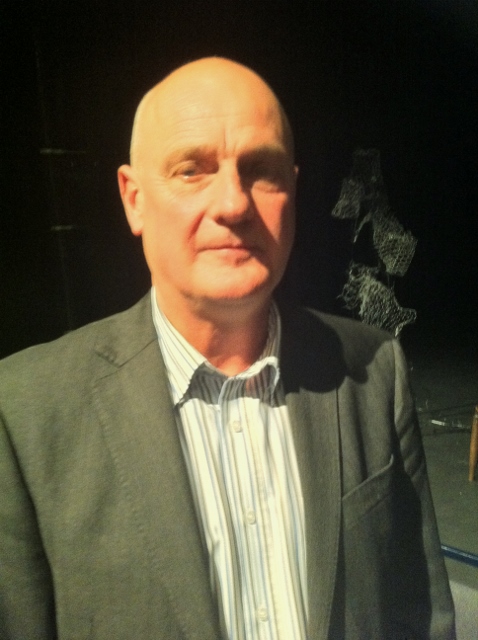
Jim Arbuckle

Jim Arbuckle

The group which has carried out a lot of reconciliation work in border areas through storytelling and drama staged a performance of Thou Shalt not Kill  tonight in the BMC campus at Tower Street, off the Newtownards Road. For the second night running I was in a part of Belfast I would not usually visit at night. The College building is beside a flashpoint area at the Short Strand, where there have been disturbances in the past and where a police car kept watch in case of trouble. A block away is a road junction where I remember a man was shot dead eight years ago (and seven years after the Good Friday agreement) by the UVF during a loyalist paramilitary feud.

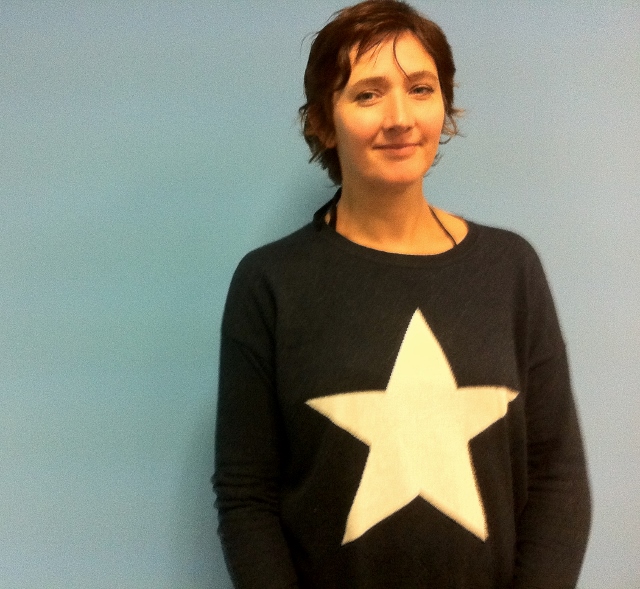
Fiona Bawn-Thompson, Smashing Times Theatre Company Photo: © Michael Fisher

Fiona Bawn-Thompson, Smashing Times Theatre Company Photo: © Michael Fisher

I thought of those times as I watched the performance. It began with Fiona Bawn-Thompson portraying in dance and mime a ghost of the past. Dressed in white. she appeared like a Greek muse in an Athenian tragedy. Her role at the start, in the middle between the two monolgues and at the end was a useful device in tying the two stories together, around a wreath of red roses. Fiona is a dance teacher and has used her skills to good effect in facilitating specialist workshops on racism, sectarianism and childrens’ rights.

Cathy White Smashing Times Theatre Company Photo: © Michael Fisher

Cathy White Smashing Times Theatre Company Photo: © Michael Fisher

The two other members of the cast gave very strong performances telling stories of two different victims of the ‘troubles’, one on the Protestant/loyalist side from Belfast which was counterbalanced with the story of a former republican paramilitary from Strabane. Cathy White is from Belfast but is living in Dublin and has worked for the Abbey Theatre and the Lyric. You might have seen her in the TG4 and BBC NI series Scúp, an eight part drama series by Colin Bateman, set in a Belfast newspaper.

Cathy plays the role of Alice Thompson from a loyalist area in Belfast. Alice worked in a flower shop on the Lisburn Road from the age of 17 and soon afterwards met a young Catholic lad Eamonn, who delivered flowers including red roses for her on Valentine’s Day. They started going out with each other, but her family was then threatened by loyalist paramilitaries who sent her a bullet in the post with her boyfriend’s name written on a note. Alice attempted to get the threat removed by going to a paramilitary in her area ‘Robbie McFarlane’. His response was that by going out with a Catholic, she was spitting on the graves of his colleagues and other Protestants who had been killed by the IRA.

It was a few months later as they began to plan a low-key wedding that her fiancé Eamonn was shot dead as he made a delivery to a shop on the Holywood Road. As two RUC members brought her the news, Alice described how the earth had opened up and swallowed her. She was wrapped in a comfort blanket of love by family and friends yet she could not be comforted.  There were more twists in the story before the end.

Adam Traynor Smashing Times Theatre Company Photo: © Michael Fisher

Adam Traynor Smashing Times Theatre Company Photo: © Michael Fisher

Dubliner Adam Traynor played the role of Tom Mulhern, a republican from Strabane who had been a member of a paramilitary group and had been involved in attacks on the RUC and planting a bomb in Magherafelt in which a child died. He was on the run in Donegal and could not cross the border when his father died of cancer, in case he was detained at a checkpoint in the North. This was another very moving story and the topic of racism was also subtly introduced through the person of Audrey, a black woman fro Chicago who lived in Letterkenny. The story was also quite topical as it included a mention of Castlederg, where a republican march earlier this month to commemorate two IRA bombers led to protests by relatives of security force members and others killed by the IRA.

Thou Shalt Not Kill was commissioned by Smashing Times Theatre Company. It is presented in the form of ‘living theatre’ installations to explore themes of conflict and trauma. Using the body as a site of performance, memory and emotion and centering on peoples’ experience of living in Northern Ireland, ‘Thou Shalt not Kill’ imagines the future through a remembrance of things past and explores themes of trauma, conflict, forgiveness and moving forward.

  • Created by Mary Moynihan
  • Written by Paul Kennedy
  • Performed by Fiona Thompson, Adam Traynor and Cathy White
  • Directed by Mary Moynihan and Bairbre Ni Chaoimh

    Discussion Panel

    Discussion Panel

As part of The Memory Project, Smashing Times Theatre Company is making a television documentary showing how the creative processes of drama and theatre can be used to explore memories and experiences of conflict and to promote peace and non-violence. This project is run by Smashing Times Theatre Company in partnership with Corrymeela Community and in association with CAIN (Conflict Archive on the Internet) and the University of Ulster INCORE International Conflict Research Institute. The project is funded through the EU’s PEACE III Programme, managed by the Special EU Programmes Body.  EU flag2colors

JIM CANTWELL

 Jim Cantwell RIP 1938-2013

Jim Cantwell RIP 1938-2013

Jim Cantwell who died on Thursday aged 75 was “a seeker after the truth in his professional and private life”, according to a priest at his funeral this morning at St Michael’s church in Dún Laoghaire. The man who skilfully oversaw the worldwide coverage of Pope John Paul II’s visit to Ireland in 1979 was the first director of the Catholic Press and Information Office in Ireland. He was present in Rome for many of the major events in the Catholic Church over the decades.

The former Head of Religious Programming at RTE, and chief celebrant of the requiem Mass, Fr Dermod McCarthy, described Mr Cantwell as a “mine of information” on the famous papal conclaves to elect a new pope. “He led the media coverage of the papal visit in 1979, which was an enormous event, with 1.4 million people descending on the Phoenix Park,” he said. He was in Rome to pass on the finer details to reporters of major events, such as the canonisation of Saint Oliver Plunkett, the death of Pope Paul VI and the elections of Pope John Paul I and Pope John Paul II.

Fr McCarthy said the retired journalist and native of Waterford had originally faced some opposition when he first returned from London, where he had been reared and had worked at ‘The Universe’, to become head of the Catholic Press and Information Office in Dublin in 1975. “Not everyone in the church or the media either approved or understood the church needing a press office in the first place,” explained Fr McCarthy. It was a very difficult decision to make to come to Dublin with his wife and family.

Fr McCarthy told mourners that Jim’s qualities as summed up by his family included his optimism, his gentleness and his humour. “He was an articulate and knowledgeable man and throughout his career he was always well liked and highly respected by fellow journalists”, he said. He had educated the hierarchy about the media and had also enlightened journalists about Catholic church teaching.

The Mass was concelebrated with auxiliary Bishop of Dublin Éamonn Walsh, Monsignor Daniel O’Connor PP Dún Laoghaire and Fr Eugene Kennedy, a schoolmate. Cardinal Séan Brady represented the church in Ireland and he was accompanied by the Archbishop of Dublin, Dr Diarmuid Martin.

The former Bishop of Derry, Dr Edward Daly, who was tasked with setting up the press office, told in a statement yesterday how Mr Cantwell served in the post for the next 25 years until he retired in 2000. “Jim Cantwell was a man who served the church and people who worked in the media with unfailing courtesy, respect and professionalism,” he said. “In his latter years, he had the most difficult task of dealing with the fallout from the various issues that beset the church in the 1990s.”

Bishop Daly said Jim Cantwell had been a good friend and colleague. He recalled how it had decided at a special meeting of the Irish Episcopal Conference in Mulrany in 1974 that, in line with recommendations of the Second Vatican Council, a Press and Information Office should be established to serve the Irish Church and the Irish and international media. Dr Daly was tasked with setting up the office, which was opened at Booterstown Avenue in South Co. Dublin in February 1975. Jim Cantwell was chosen from a multitude of candidates to head the office and was appointed as the first Press and Information Officer for the Irish Episcopal Conference.

Bishop Daly described Jim as a fine journalist and a most pleasant, affable person. He was greatly respected and liked by his fellow journalists and bishops. He gained an encyclopaedic knowledge of the Church here in Ireland and around the world. Jim had vast knowledge of conclaves and papal elections and was the author of various authoritative articles on these matters. He always prepared his work methodically and with great diligence. Jim Cantwell was a man who served the Church and people who worked in the media with unfailing courtesy, respect and professionalism.

Mr Cantwell is mourned by his wife Eileen and his four children Nina, Rhona, Paul and Michael. Ar dheis Dé go raibh a anam dílis.

Jim Cantwell Photo: RTÉ News

Jim Cantwell Photo: RTÉ News

WILLIAM CARLETON SUMMER SCHOOL

peaceIIImonaghan

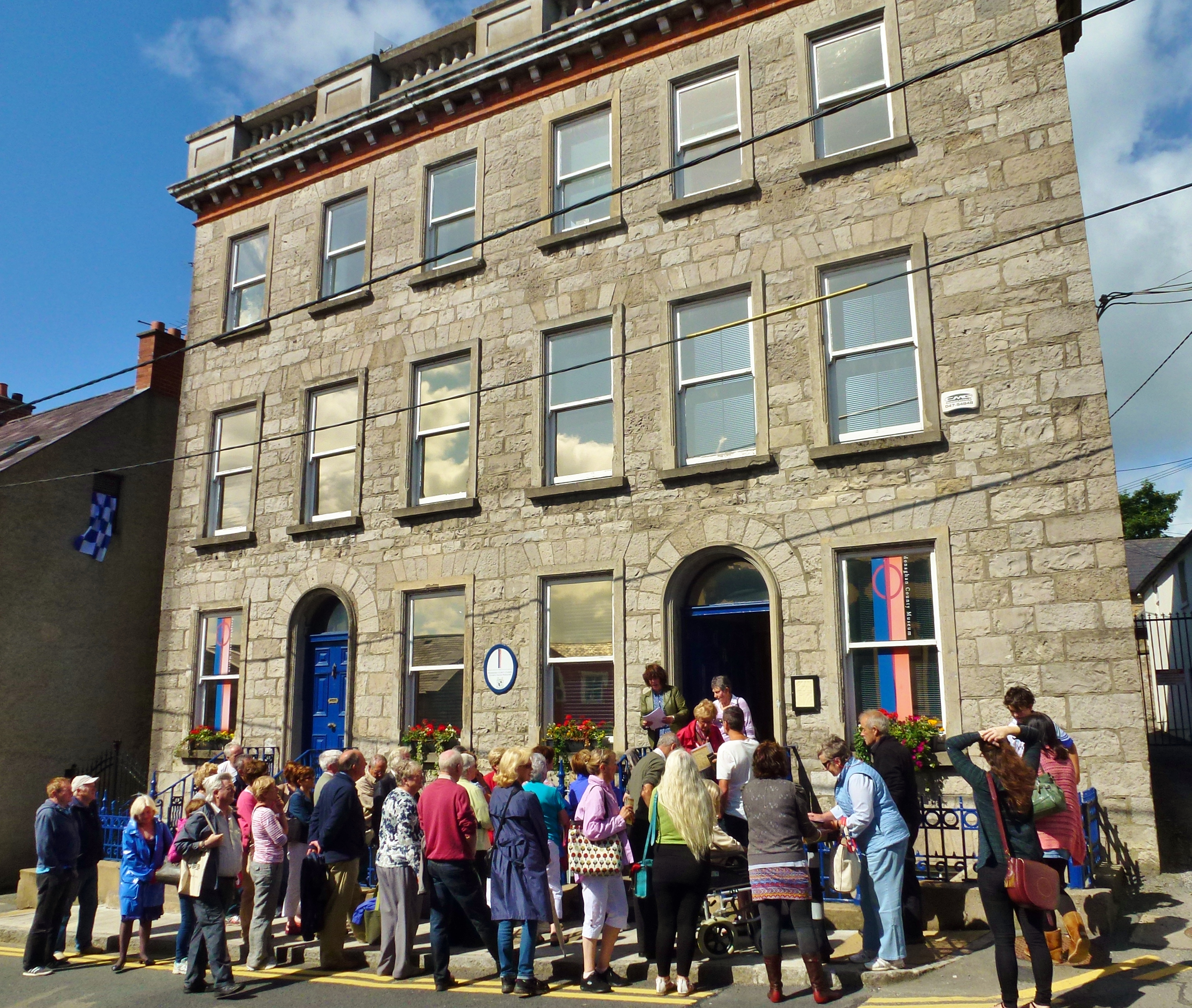
Walking tour of Monaghan town led by Grace Moloney and Theresa Loftus assembles at Monaghan County Museum, Hill Street. Photo:  © Michael Fisher

Walking tour of Monaghan town led by Grace Moloney and Theresa Loftus assembles at Monaghan County Museum, Hill Street. Photo: © Michael Fisher

NSlogo

                    WILLIAM CARLETON SUMMER SCHOOL 2013 GREAT SUCCESS

Monaghan Gospel Choir under the direction of David Drum brought to an end one of the most successful summer schools ever held by the William Carleton Society with a concert at Fivemiletown Wesleyan Hall. The Choir sang some of their favourite numbers including ‘By the Rivers of Babylon’ and ‘How Great Thou Art’. But the big hit of the night was the guest appearance by Gloria from Tydavnet. She sang with them the song which gave her a number one hit in 1978, ‘One Day at a Time’, before going on to delight the crowd with several other songs. There was a rousing finale when the Murley Silver Band directed by William Hill returned to the stage to accompany the Choir in two songs, bringing an end to a most enjoyable night.

The previous night members of the Clogher Valley Walking Club led a group of ramblers on part of the Carleton trail in the area of Fardross forest. The route passed by an old Mass rock, thought to date back to penal times. The walkers were met by two pipers, Jim Brady and Frank Gildernew as they arrived back at Somers cafe. The Ulster Scots juvenile pipe band also played for the guests and inside the cafe the McKenna family from Clogher provided traditional music.

On the Monday night at the Rathmore Bar in Clogher there was a music session with a new traditional group called SÍoda, one of whom is from Emyvale. They were joined at one stage by SeosamhÍn Ní Bheaglaioch from Dublin, a sean-nós singer and well-known broadcaster who sang a number of songs in Irish. On Sunday, she sang unaccompanied during a ceremony at the Blue Bridge at Inishdevlin, Emyvale. Summer school events in Emyvale and Monaghan were part-financed by the European Regional Development Fund through the PEACE III Programme managed by the Special EU Programmes Body and delivered through the Monaghan PEACE III Partnership.

The summer school director Michael Fisher unveiled a plaque which had been restored with the help of local craftsmen by Emyvale Development Association. In 1997, Monaghan County Council in conjunction with the Association erected a Plaque there but weather conditions eventually rotted the  plaque backing and it came away from the wall. The programme began at 4pm in Emyvale Leisure Centre with light refreshments and then a move to the Blue Bridge. Some walked while transport was laid on for the remainder. At the Bridge Peadar McMahon, chairman Emyvale Development Association,  began proceedings giving some background and then introduced entertainment from the Murphy family of Jack, Chloe and Lauren playing traditional music, Seosamhín Ní Bheaglaioch, and Edelle McMahon singing the ‘Romance of the Merrow Queen’, which has local connections.
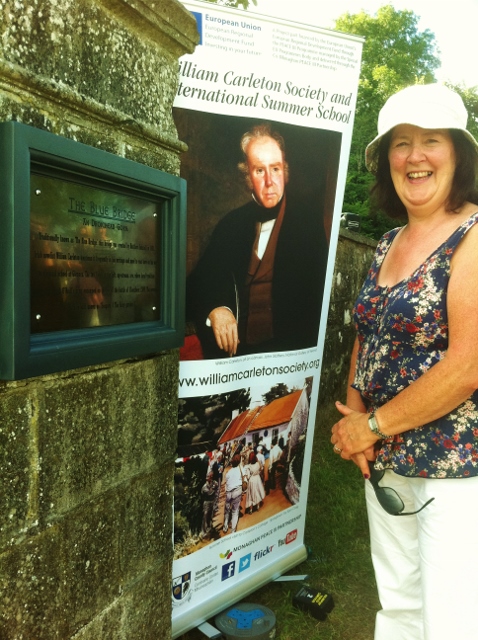
Breege Lenihan, Tullyvogey, Tydavnet inspects the restored plaque at the Blue Bridge Photo: © Michael Fisher

Breege Lenihan, Tullyvogey, Tydavnet inspects the restored plaque at the Blue Bridge Photo: © Michael Fisher

Michael Fisher then addressed the crowd and spoke about Carleton and also about another great poet and writer, Terence O’Gorman, whose works have just been launched in book form by his daughter, Patricia Cavanagh. He read a poem about Emyvale, written by Terence and contained in the book. He thanked the Bowe family and Seamus McAree for their part in the preparations for this event and then unveiled the restored Plaque. Seamus McCluskey then added some historical notes and interesting facts about the Blue Bridge, Carleton and the area in general. Finally Peadar McMahon thanked those who assisted – Truwood; Connolly Furniture; Murphy Sound and Video; The Murphy family musicians; Seosamhín and Edelle; Richard McCarron (local stonemason who, with Declan McMahon, erected the plaque and advised on stonework); the Photographers; Moran’s Transport; Norah Ryan; Jim Balfe and Paddy Sherry; George McCarron; Emyvale Leisure Centre Committee; The Emyvale Development Committee and all who attended; There was special thanks to Paul and Ann Bowe for their assistance and support, which was greatly appreciated. He then invited all to return to the Leisure Centre for a reading by the Carleton Players of the ‘Fair of Emyvale’, adapted by Liam Foley. On Saturday, around sixty people took part in a walking tour of Monaghan town led by Grace Moloney of the Clogher Historical Society and Theresa Loftus from Monaghan County Museum.

For the first time, the summer school had opened in Monaghan, with a conference on William Carleton, Patrick Kavanagh and Charles Gavan Duffy. Art Agnew from Carrickmacross who grew up in Inniskeen put in a lively performance as Kavanagh, delivering extracts from ‘The Green Fool’ and other works. International guest Professor Thomas O’Grady from Boston read some of his own poetry, including verses about Prince Edward Island, where he was born. He also talked about Kavanagh and Benedict Kiely. Earlier the summer school was officially opened by the Mayor of Monaghan Cllr Sean Conlon, who was accompanied by the Mayor of Dungannon and South Tyrone, Cllr Sean McGuigan. Mary O’Donnell who comes originally from Monaghan and is a patron of the William Carleton Society read some of her poems. Dr Brendan O Cathaoir and former Monaghan Museum curator Aidan Walsh spoke about Charles Gavan Duffy, while the final talk was given by Felix Larkin, director of the Parnell summer school in Avoca, on the Shemus Cartoons in the ‘Freeman’s Journal’.

The proceedings switched to Clogher on the Monday, in the presence of the Bishops of Clogher Right Reverend John McDowell and Dr Liam MacDaid, and Bishop Emeritus Dr Joseph Duffy, a patron of the William Carleton Society. Among the speakers were Professor O’Grady, Professor Owen Dudley Edwards, honorary director of the summer school, and the television presenter and commentator Tom McGurk, who spoke about his upbringing in Brockagh, County Tyrone.

This part of the summer school is supported by the Office of First Minister and Deputy First Minister and funded through  Dungannon and South Tyrone Borough Council under the District Council Good Relations Programme and the William Carleton Society committee gratefully acknowledges this funding.OFMDFM (1)

On Tuesday the guests included Dr Ciaran Mac Murchaidh from St Patrick’s College Drumcondra, who spoke about the Irish language in the 19thC Clogher Valley area and Dr Ian Adamson on Ulster-Scots. William Carleton Society President Jack Johnston gave a talk on the history of Augher. Josephine Treanor from Knockatallon spoke very movingly about her great great grandmother Anne Duffy, the miller’s daughter from Augher and Carleton’s first love.   Dungannon_logo

Wednesday’s session attracted national headlines with the speech of Mary O’Rourke about a proposed grand coalition between Fianna Fail and Fine Gael. There was also an interesting session on the current state of the Orange Order by Professor Jon Tonge from Liverpool. The audience included former Police Ombudsman in the North Dame Nuala O’Loan and her husband Declan, an SDLP Councillor in Ballymena.

Mary Kenny’s talk on Edward Carson, Dubliner, Irishman and Unionist was well received and provided a fitting end to the formal part of the summer school. The seventh day was devoted to a literary tour of Fermanagh, led by Gordon Brand (Secretary, William Carleton Society) and Frank McHugh, deputy director of the summer school. The tour headed to the Crom estate near Newtownbutler on Upper Lough Erne, where our guide was Vicky Herbert from Lisnaskea. She took the group on a walk to the old Crom Castle and past the famous yew trees, some of the oldest in Ireland. She also pointed out the house where the author Shan Bullock had lived as a child. His book ‘The Loughsiders’ is based around Crom and the neighbouring villages.

The Wiiliam Carleton summer school was brought to a successful end with a literary tour of Fermanagh, finishing with a visit to the Ceili House near Enniskillen. Host Tom McGowan has assembled a range of unusual objects from road signs to old rowing boats and oars to radios. The group led by summer school director Michael Fisher was met by the Chair of Fermanagh District Council, Alex Baird.

The Wiiliam Carleton summer school was brought to a successful end with a literary tour of Fermanagh, finishing with a visit to the Ceili House near Enniskillen. Host Tom McGowan has assembled a range of unusual objects from road signs to old rowing boats and oars to radios. The group led by summer school director Michael Fisher was met by the Chair of Fermanagh District Council, Alex Baird.

The day finished with a visit to the Ceili House, a private establishment run by Tom McGowan outside Enniskillen. Based in a former quarry, it includes a vast collection of memorabilia including old radios, road signs and rowing boats and oars. The group met the Chair of Fermanagh District Council, Alex Baird and after a pleasant dinner, returned to Corick House to round off a hectic week of engagements.  EU flag2colors

FUNERAL OF KEVIN FEENEY RIP

Members of the Davy family await the arrival of the remains of Kevin Feeney

Members of the Davy family await the arrival of the remains of Kevin Feeney

Andrew Feeney lives in Australia and was in Melbourne when news reached him of his father’s sudden death. Another of Kevin’s four children was in Russia and apparently had difficulty with an exit visa as he was in the middle of a tour. Andrew spoke very movingly at the end of the funeral Mass at the Church of the Sacred Heart in Donnybrook, Dublin.

Fr Charlie Davy SJ

Fr Charlie Davy SJ

This wasn’t Kevin’s parish but the church of the Three Patrons in Rathgar is undergoing renovations and the interior has scaffolding erected for painting, so it would not have been able to handle the large crowd of mourners who gathered to say their farewells to Kevin and to sympathise with Kevin’s relatives and family led by his widow Geraldine, a member of the well-known Davy family. His brother-in-law Fr Charlie Davy SJ, Galway, Chair of the Pioneer Total Abstinence Association, was the chief celebrant of the Mass, along with nine other priests.

Andrew Feeney told the packed church he was “so proud to have had him (Kevin) as a father”. “We feel he went out on a high as he was at his happiest in Ballycotton” (his holiday home in County Cork), he said. One of his own great memories was attending the Italia 90 Ireland-Italy game with his father.

Remains of Kevin Feeney arrive at Sacred Heart Church

Remains of Kevin Feeney arrive at Sacred Heart Church

In an address at the end of the Mass, the President of the High Court Mr Justice Nicholas Kearns said that although Kevin had been fiercely competitive in the courtroom, he did not like the public spotlight. “He was a very, very private man, who put family and friends first”, he said. He told mourners the late Judge had a unique sense of humour and rarely lost his temper. He spoke of his great interest in sports: rugby, golf, hockey and cricket. “We’re all still in a state of disbelief at his sudden death,” Mr Justice Kearns continued. Family “always remained extremely close…he was devastated when (his brother) John died so tragically” (in a 1984 plane crash at Eastbourne in England).

Funeral of Kevin Feeney

Funeral of Kevin Feeney

He recalled that Kevin, who was 62, had exhibited a sense of justice at an early age. His brother Jim was 16 and Kevin 8 when Jim got a bicycle. “He protested with a placard outside his father’s study which read ‘No Bicycle. No Justice’.”

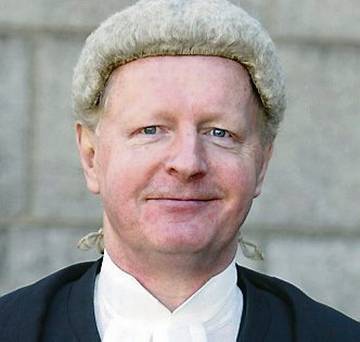
Kevin Feeney 1951-2013: Photo Peter Cuffe

Kevin Feeney 1951-2013: Photo Peter Cuffe

His “courtroom advocacy skills were superb” and when appointed to the High Court “he took over a difficult case list. He never complained about being overworked or under-resourced. As a lover of sport he was for many years a member of the Phoenix Cricket Club, where “he defended the wicket like the Spartans at Thermopylae”, usually coming into bat at number eight.

Kevin Feeney's funeral at Donnybrook Church

Kevin Feeney’s funeral at Donnybrook Church

Mr Justice Kearns then recalled a golfing trip to Scotland Kevin had organised for colleagues on the bench as part of an outing for the judiciary in the UK and Ireland. The estate car he hired was not large enough for four passengers and all their baggage and equipment. It resulted in one eminent Irish judge sitting on another’s knee while a third ended up sitting on a case in the boot!

Funeral of Kevin Feeney RIP

Funeral of Kevin Feeney RIP

The Irish Times website report carried the following details: “Chief mourners were Geraldine Feeney and their children Andrew, Peter, Kevin Barbara, and Justice Feeney’s brothers Jim and Peter. The President was represented by Cmdt James Galvin and the Taoiseach by Cmdt Mick Treacy. Government Ministers present included Frances Fitzgerald TD and Alex White TD.

A large contingent from the judiciary was led by Chief Justice Susan Denham, and former Chief Justice John Murray Other members of the Supreme Court there included Justices Adrian Hardiman, Frank Clarke, John MacMenamin, as well as Gerard Hogan and George Birmingham of the High Court, Katherine Delahunt and Alison Lindsay of the Circuit Court. Retired judges included Ronan Keane, Hugh O’Flaherty, Tom Finlay, Yvonne Murphy. Also there was NUI Chancellor Maurice Manning.

There too were former Attorneys General Peter Sutherland, Michael McDowell and John Rogers, as well as many from the Law Library, including senior counsel Garret Cooney, John O’Donnell, Eoin McCullagh, Conor Maguire, and David Andrews. Journalists there, present and former, included Mairead Ní Nuadhain, John O’Shea, Stephen O’Byrnes, Mike Burns, Ed Mulhall, Sam Smyth, Betty Purcell, Michael Fisher, Bride Rosney, Joe Little and Liz O’Donnell”.
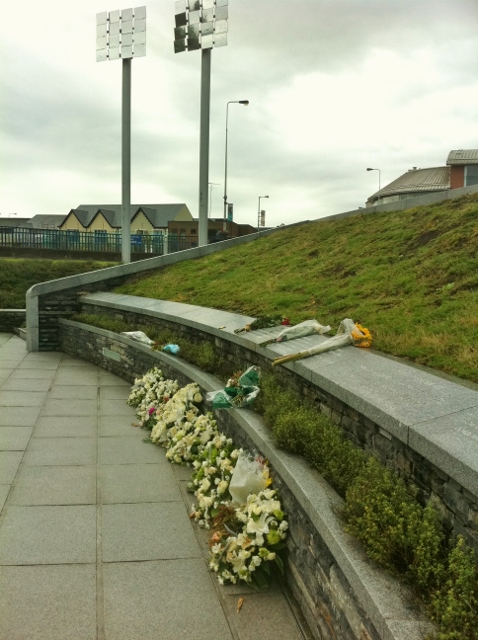
Funeral of Kevin Feeney at Sacred Heart Church, Donnybrook

Funeral of Kevin Feeney at Sacred Heart Church, Donnybrook

Kevin was in class with me when I attended Gonzaga College 1967-69. Among the former classmates to attend the funeral were Michael McDowell SC, Paul McNally, Denis Brennan, Bobby Becker, Michael Gaffney and Peter Mathews TD. Ar dheis Dé go raibh a hanam dílis.

BALLYGAWLEY & OMAGH

Market Street Omagh: Bomb Memorial

Market Street Omagh: Bomb Memorial Photo: © Michael Fisher

It was a journey I didn’t want to make. Fifteen years ago on this same Sunday, I left Tydavnet around 8am and headed for Omagh. I attended Mass at St Matthew’s, Garvaghey (the chapel associated with John Montague) and then made my way to the county town. Market Street was full of debris and the whole area was cordoned off as a police investigation got underway. This morning I repeated the journey, passing the chapel at Garvaghey at 8:30am and heading to the Sacred Heart church in Omagh for Sunday Mass.

Omagh Bomb Memorial Park

Omagh Bomb Memorial Park

I was surprised that there was no mention of those who died in the 1998 bomb, although the priest did ask for prayers for those in Egypt and Syria. Perhaps the bomb victims were remembered at Mass last weekend. There was also a commemoration in the town on Thursday 15th, the exact day of the atrocity. This morning there was a very different view along Market Street, looking towards the Courthouse, as my first picture shows.

The previous afternoon in 1998, after coming home from the Tydavnet Show, which I was also at yesterday, the news had come through about a major bomb attack in Omagh, with several casualties. I headed off to Omagh that Saturday evening and reported from Tyrone County Hospital as the extent of the fatalities and the injuries became clear.

Dominic Pinto, former consultant surgeon, Tyrone County Hospital

Dominic Pinto, former consultant surgeon, Tyrone County Hospital

Some Spanish women were desperately trying to find out more information from the hospital staff. In the operating theatres, Dr Dominic Pinto, who I met later this morning at a separate commemoration for the victims of the Ballygawley bus bomb, and his colleagues were working non-stop trying to deal with the injured. Many had to be transferred to other hospitals for further treatment. Mr Pinto described the scene at the time:

When I came to the front of the hospital, it was absolutely quiet. What greeted me when I got into the main corridor was sheer pandemonium. This was not a major incident, but a major disaster of battlefield proportions. There were people lying in corridors of the    accident and emergency department, overflowing into the radiology department. Some 240    injured people arrived within the first 45 minutes“. (www.wesleyjohnston.com)

The Spanish connection later turned out to be a group of students who had been studying English in Buncrana and who had got caught up in the explosion during a trip to Omagh. One 12 year old Spanish boy Fernando Blasco Baselga from Madrid died as well as a 23 year-old teacher from Spain, Rocio Abad Ramos, also from Madrid.  Three young boys from Buncrana, Oran Doherty aged 8, 12 year-old Sean McLaughlin, and James Barker, also 12, were killed in the explosion. In April 2000, the body of James was re-buried in a small graveyard at his former school in England, St George’s in Weybridge. I remember visiting it in 2008 when I interviewed his father Victor.

Rest in Peace: Avril Monaghan

Rest in Peace: Avril Monaghan

Three generations of women from one family in County Tyrone were killed in the Omagh bomb: a 65 year old grandmother, Mary Grimes from Beragh, her 30 year old daughter Avril Monaghan who was expecting twins, and an 18 month-old granddaughter, Maura Monaghan from Aughindarragh in Augher. I remembered them as I visited the peaceful graveyard at the Forth Chapel, Ballynagurragh (St Macartan’s), where my McCann relatives are interred close to Avril’s grave.

British Legion Aughnacloy representative with Michael Gallagher & Stephen Gault

British Legion Aughnacloy representative with Michael Gallagher & Stephen Gault

Then at the Ballygawley bus bomb commemoration I met Michael Gallagher of the Omagh Support and Self Help Group. His 21 year-old son Aiden was killed in the Omagh attack. Michael went on to attend the service at Newtownsaville Church of Ireland church for the Ballygawley bus victims (eight British soldiers) and five other members of the security forces who had been killed in two other incidents in the surrounding area. Another victims’ campaigner to attend the Ballygawley commemoration was Stephen Gault, who was injured and who lost his father in the Enniskillen bomb on Remembrance Sunday in November 1987.

MEETING OF THE WATERS

Meeting of the Waters: Photo © Michael Fisher

Meeting of the Waters: Photo © Michael Fisher

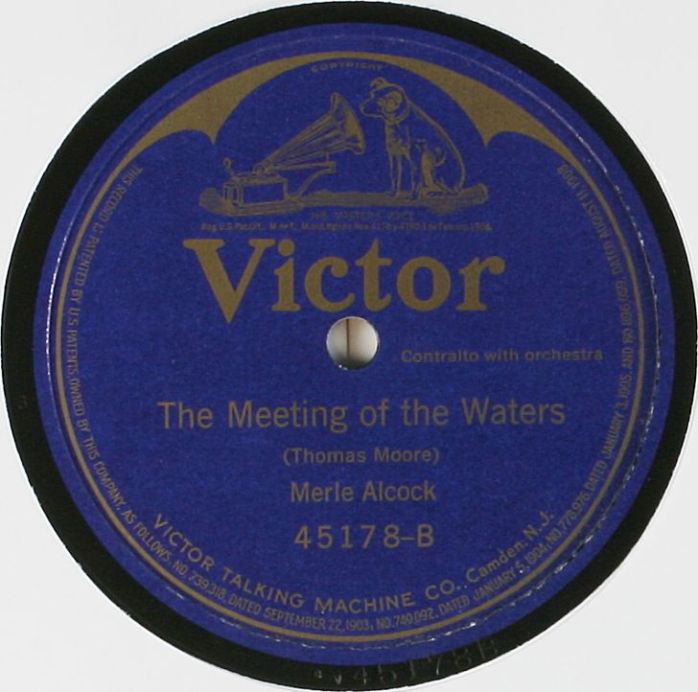
Heading home from the Parnell summer school on Wednesday afternoon, I decided to revisit a spot I had not been in for a while in the Vale of Avoca. It’s known as the Meeting of the Waters and it has been immortalised in Thomas Moore’s song. I have discovered on the website of the Library of Congress an old recording of the ballad. It was made in Camden, New Jersey in April 1919 by contralto Merle Alcock for Victor records. The harp is played by Francis J. Lapitino and the conductors are Charles Adams Prince and Josef Pasternack. Credits: Source of original recording: Department of Special Collections, Davidson Library, University of California, Santa Barbara. Inclusion of the recording in the National Jukebox, courtesy of Sony Music Entertainment.

Victor Record Label: The Meeting of the Waters

Victor Record Label: The Meeting of the Waters

Thomas Moore was born at Aungier Street in Dublin on May 28th 1779. He was educated at Trinity College. His time at Trinity came amidst the ongoing turmoil following the French Revolution and a number of his fellow students such as Robert Emmett were supporters of the United Irishmen movement, although Moore himself never was a member.

Thomas Moore, by Martin Shee c.1817. © National Gallery of Ireland

Thomas Moore, by Martin Shee. 1818. © National Gallery of Ireland

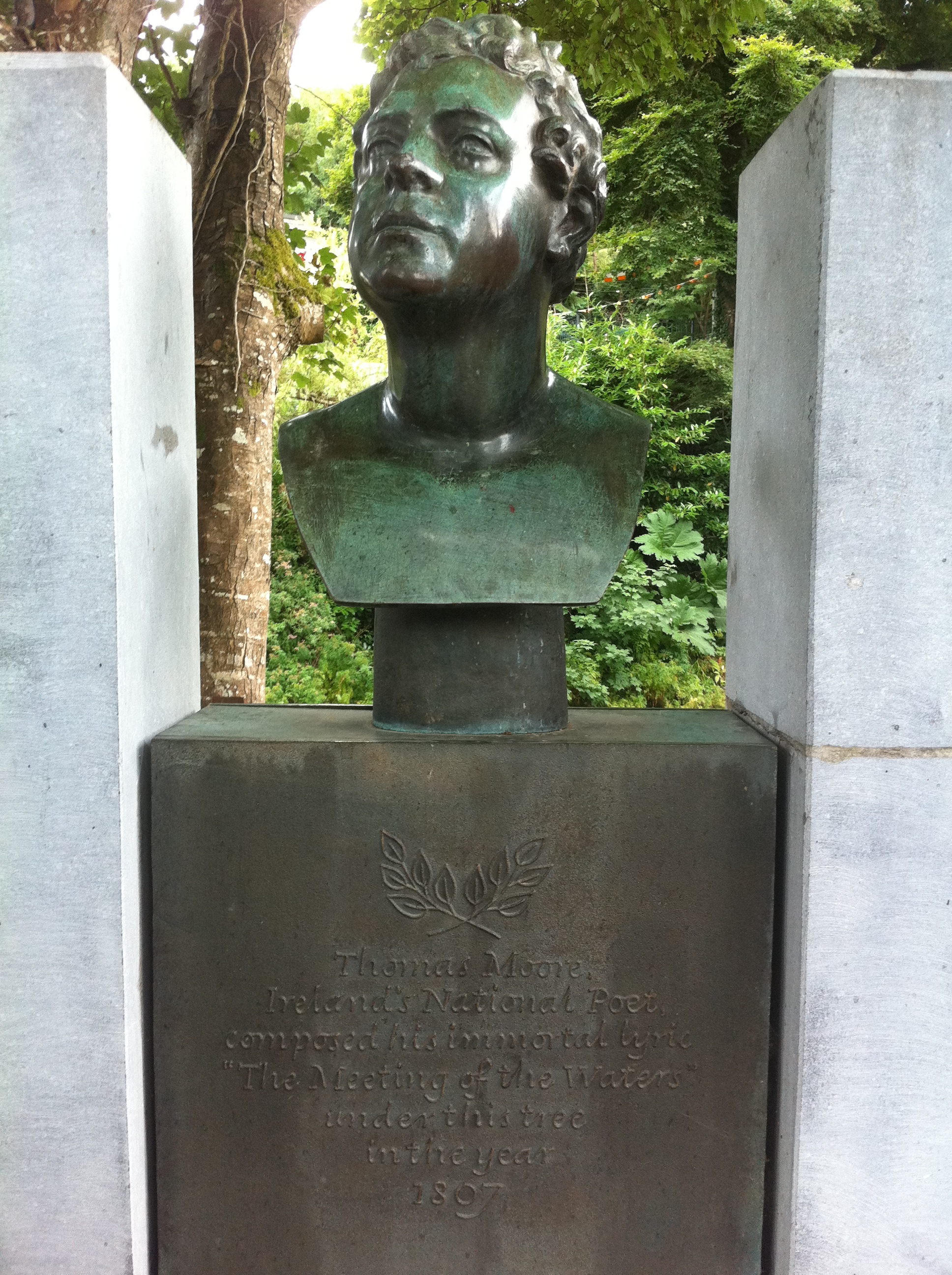
Moore is considered Ireland’s National Bard and is to Ireland what Robert Burns is to Scotland. He is commemorated in several places: by a plaque on the house where he was born, by busts at The Meeting of the Waters and at Central Park, New York, as well as by a large bronze statue near Trinity College Dublin. Many composers have set his poems to music. They include Gaspare Spontini, Robert Schumann, Hector Berlioz, Charles Ives, William Bolcom, Lori Laitman, Benjamin Britten and Henri Duparc.

Thomas Moore Bust at the Meeting of the Waters Photo:  © Michael Fisher

Thomas Moore Bust at the Meeting of the Waters Photo: © Michael Fisher

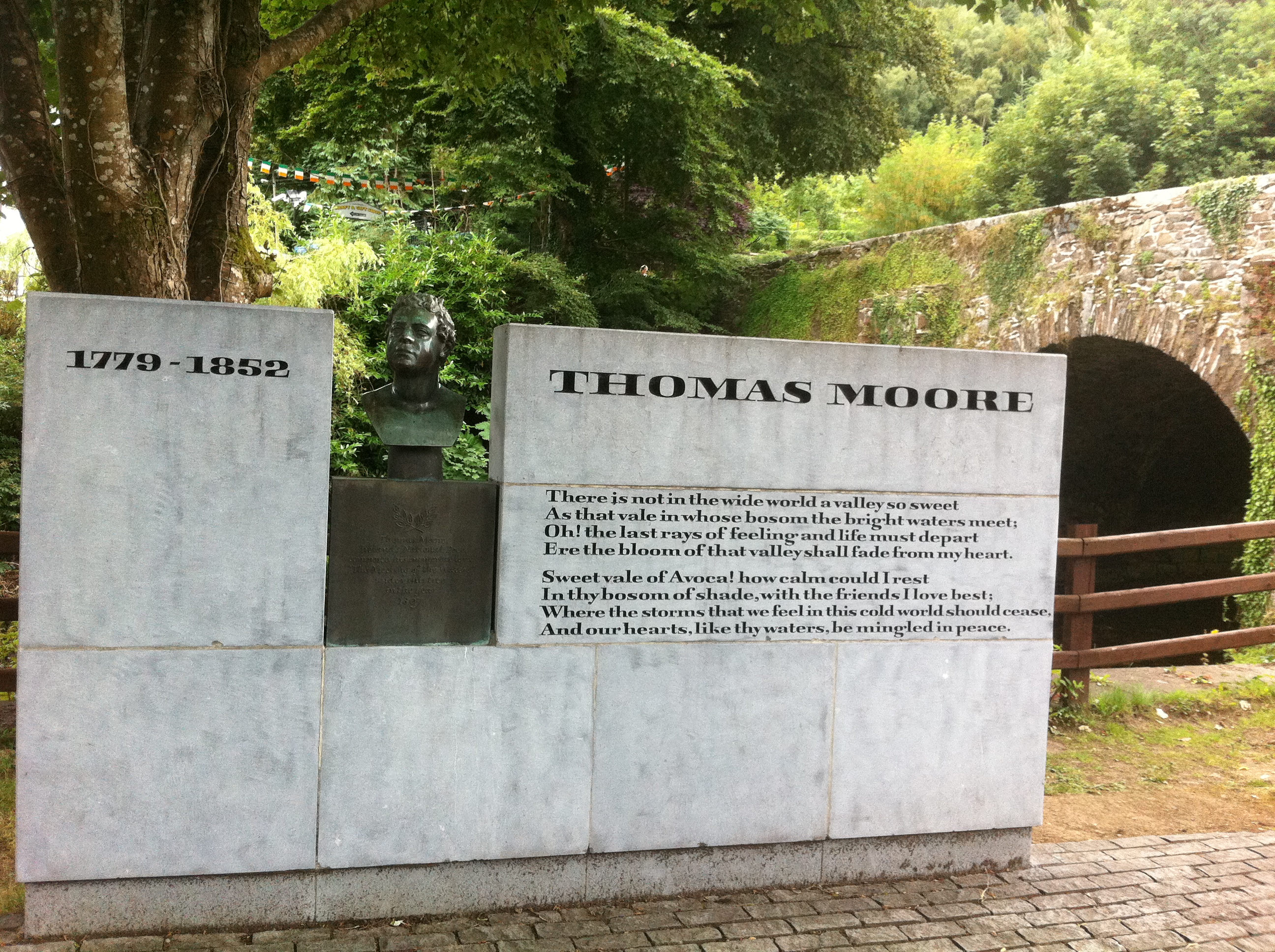
The Avoca River starts life as two branches, the Avonmore (Abhainn Mhór, meaning “Big River”) and the Avonbeg (Abhainn Bheag, meaning “Small River”). These join together at the Meeting of the Waters in the Vale of Avoca, which is considered a local beauty spot, and was celebrated by Thomas Moore in the following verses:

There is not in the wide world a valley so sweet, As the vale in whose bosom the bright waters meet; Oh, the last rays of feeling and life must depart, Ere the bloom of that valley shall fade from my heart.”

Thomas Moore Memorial Park, Meeting of the Waters Photo: © Michael Fisher

Thomas Moore Memorial Park, Meeting of the Waters Photo: © Michael Fisher

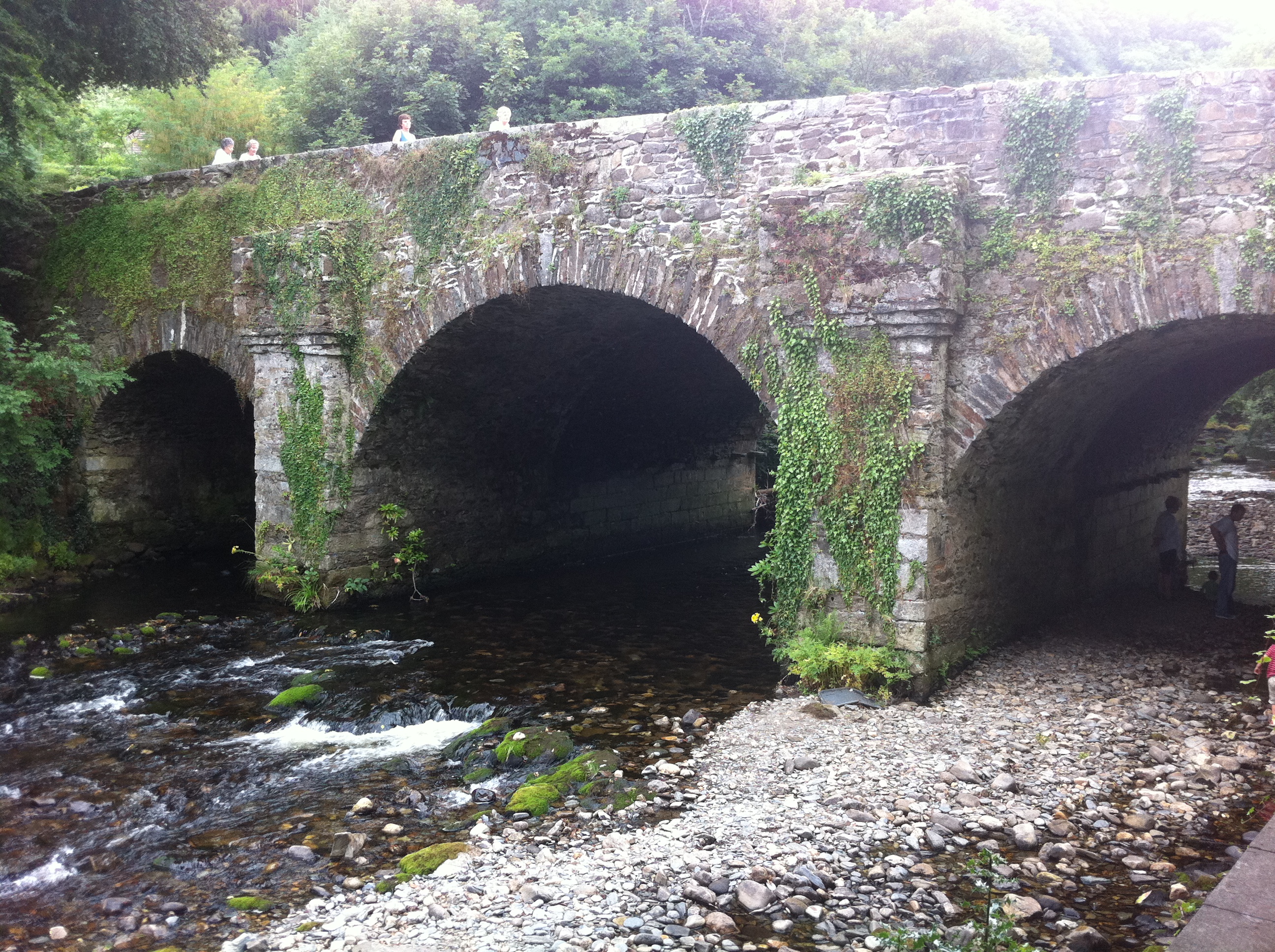
The village of Avoca is situated on the river. The Avoca flows into the Irish Sea at Arklow where it widens into a large estuary, giving the town its name in Irish: An t-Inbhear Mór (the big inlet).

Bridge at Meeting of the Waters Photo: © Michael Fisher

Bridge at Meeting of the Waters Photo: © Michael Fisher

MR JUSTICE KEVIN FEENEY 1951-2013

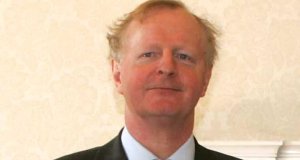
Kevin Feeney: Photo Des Barry

Kevin Feeney: Photo Des Barry

“If God is as fair a judge as Kevin we are OK”. Searching the web for news about the sudden death yesterday of Mr Justice Kevin Feeney at his holiday home in County Cork, I came across this post on politics.ie from Eoin Corr. It seemed to me one of the most appropriate quotes for my former classmate at Gonzaga College 1967-69. I transferred from one Jesuit establishment in Wimbledon to another in Dublin when I was 15, having just completed ‘O’ levels, so I was the youngest in class. I didn’t know anyone at the time. Kevin was always welcoming and although I was not a great sportsman, I played rugby alongside him in the forward line.

Michael McDowell who I met yesterday in County Wicklow before the sad news came through about Kevin’s sudden death was a skilful debater and went on to become Attorney General. Kevin was one of the few who could successfully take him on, using his wit and always smiling. A smile that is captured well in Des Barry’s photograph.

Kevin Feeney: Photo Peter Cuffe

Kevin Feeney: Photo Peter Cuffe

At the L&H in UCD he demonstrated those same witty qualities in debates with a range of speakers, many of whom went on like him to become top lawyers. In addition to Michael McDowell, the L&H group included Adrian Hardiman, John McMenamin, Frank Clarke, William Early, Kevin Cross, Alison Lindsay and Mary Finlay. Some of our other classmates from Gonzaga also progressed to become successful lawyers, namely Tom Finlay, Michael Coghlan, Paul McNally and Barry Halton. Most of our class including Kevin joined the FCÁ in Collins Baracks at the same time in 1968 and some served a full five year term.

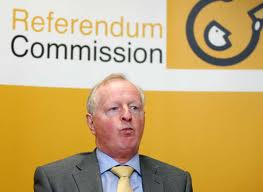
Kevin Feeney: Referendum Commission

Kevin Feeney: Referendum Commission

Kevin was described quite rightly yesterday as one of the greatest lawyers of his generation. He was educated at UCD and King’s Inns and qualified as a barrister in 1973. He was appointed to the High Court in 2006 and served as chair of the Referendum Commission last year. He was a member of the Courts Service Board. An older brother, John Feeney, was a journalist with the ‘Evening Herald’ who died in the Beaujolais air crash in England in November 1984 with eight others. John was also well-known as a left-wing student activist at UCD. I remember at school another brother, Peter Feeney, who was a year ahead of him in Gonzaga College. He is a former Head of Television Current Affairs and a former Head of Public Policy at RTE. Their father John Kevin Feeney was Professor of Gynaecology and Obstetrics in University College Dublin and Master of the Coombe Hospital in Dublin.

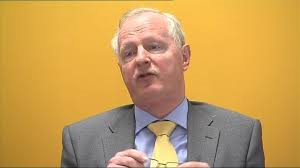
Kevin Feeney: Photo RTÉ News

Kevin Feeney: Photo RTÉ News

Kevin was married to Geraldine and had four adult children, Kevin (junior), Andrew, Peter and Barbara. My sympathy goes to all his family and relations. His funeral will be on Monday morning, according to the death notice in the Irish Times:-

FEENEY, Kevin T. (unexpectedly), August 14, 2013, beloved husband of Geraldine and loving father of Andrew, Peter, Kevin and Barbara, and brother of the late John. Deeply regretted by his brothers Jim and Peter, Andrew’s girlfriend Fiona, sisters-in-law, brothers-in-law, nieces, nephews, colleagues, relatives and friends.

May he rest in peace.

Reposing at his home on Sunday from 4pm until 7pm. Removal on Monday morning to the Church of the Sacred Heart, Donnybrook, arriving at 11.15am for Funeral Mass at 11.30am and then to Glasnevin Cemetery. 

Kevin Feeney

Kevin Feeney

Minister for Justice Alan Shatter paid the following tribute:-

I wish to express my deepest sympathy to Mr Justice Kevin Feeney’s wife Geraldine and his children on their sudden and very sad loss. Kevin was a judge of exceptional ability who graced the High Court bench with courtesy and good humour. Given his dedication to public  service, his death at such a young age is a loss for the entire country. He will be sadly missed by everyone who had the privilege of knowing him”. 

Attorney General Maire Whelan said Judge Feeney had served with great distinction in the High Court since his appointment. Ms Whelan said as a judge, he had combined enormous intellectual ability with a compassion and courtesy which left an abiding impression on litigant and lawyer alike.

His deft handling of the Criminal Assets Bureau cases was illustrative of his absolute professionalism and his mastery of a developing area of the law. As counsel, he acted in a series of landmark commercial actions, and he was unquestionably the leading defamation lawyer of his generation, making the sometimes recondite nature of libel law accessible for a jury. He brought the skills he acquired from his practice in the law library to the Bench, where his judgments were informed by his deep knowledge of the law, his robust common sense and his zeal for fairness“, she said.

Ms Whelan said the judge left a legal legacy of incalculable value in his body of reported case law, which would continue for many years to be the bedrock of jurisprudence in matters which concern the recovery of the proceeds of crime. “He was a man of great ability and integrity, and his sudden and unexpected death left a great void in the Irish legal community.

Kevin Feeney: Photo Irish Independent

Kevin Feeney: Photo Irish Independent

The president of the High Court, Nicholas Kearns, said everyone’s thoughts and prayers were with his colleague’s wife Geraldine and family. “I would just like to say we have all learnt with deep shock and sorrow of the death of Mr Justice Kevin Feeney,” he told the packed courtroom ahead of the court list hearings. He was a judge held in the highest esteem by the entire judiciary and legal profession and his many friends. Over the coming days many tributes, well deserved, will be made to him”, he said.

Ar dheis Dé go raibh a hanam dílis.

CARLETON IN CLOGHER

Bishops of Clogher: Rev. John McDowell & Dr Liam MacDaid with Dr Joseph Duffy

Bishops of Clogher: Rev. John McDowell & Dr Liam MacDaid with Dr Joseph Duffy

Day Four of the William Carleton international summer school was centred in Corick House Hotel, Clogher, County Tyrone. The programme continued across the border, having started in Monaghan on Friday and Saturday, then moving to Emyvale on Sunday. For more on the events in Emyvale see emyvale.net.

Caesar Otway

Caesar Otway

The opening address by the Honorary Director of the William Carleton international summer school Professor Owen Dudley Edwards was on Carleton, Caesar Otway and Irish literature.

Professor Thomas O’Grady of the University of Massachussets, Boston, spoke about Carleton’s story, ‘The Donagh’, in which he revealed the connection with the Carnmore area of Sliabh Beagh near Roslea. He later went to see the are himself for the first time.

Gerry McCullough & Raymond McCullough

Gerry McCullough & Raymond McCullough

Author of ‘Belfast Girls’ and several other books, Gerry McCullough and her singer/songwriter husband Raymond made an interesting contribution to the summer school. The programme finished with committee member Aidan Fee in conversation with well-known broadcaster and columnist Tom McGurk, who hails from Brockagh in County Tyrone. He began by recollecting his early years in the parish at a primary school where conditions were at times primitive.

Deputy Mayor of Dungannon/S.Tyrone Cllr Robert Mulligan with Jack Johnstonm President William Carleton Society

Deputy Mayor Dungannon/S.Tyrone Cllr Robert Mulligan with Jack Johnston President WCS

The day was rounded off with a session in a local pub where guests were entertained by singer Seosamhín Ní Bheaglaoich and a new Irish traditional music group, Síoda.

William Carleton Society committee members: Frank McHugh, Sam Craig, Gordon Brand, Isabel Orr

William Carleton Society committee members: Frank McHugh, Sam Craig, Gordon Brand, Isabel Orr