Get me outta here!

Michael Fisher's News

© Michael Fisher MMXXII

Menu

Skip to content
  • Home
  • About

Author Archives

borderroamerhttps://fisherbelfast.wordpress.comThe Northern Standard, Monaghan. Reporter.
borderroamer's avatar

BRISTOL BUILT BY BRUNEL

14/03/2013 by borderroamer
Brunel's original station

Brunel’s original station

Look around you in Bristol and the influence of one man is clear to see: the engineer, Isambard Kingdom Brunel (1806-59). If you arrive by train at Temple Meads station, you will see on your right hand side as you leave the main entrance to walk down to the main road the original station built by Brunel for the Great Western Railway of which he was chief engineer. Opened in 1840, it served the route to London Paddington and continues to do so. I noticed there is now also a connection run by South Western trains to London Waterloo, taking an hour longer but possibly cheaper, depending on the time of travel.

Brunel's station

Brunel’s station

Brunel built his railway using a broad gauge  measuring 7 feet 0 1⁄4 inches. This helped to provide additional comfort for passengers but made construction more expensive. Later a standard gauge was introduced of  4 feet 8 1⁄2 inches, although in Ireland a slightly wider gauge was chosen of 5 feet 3 inches. Temple Meads station is now owned by Network Rail and is one of the busiest railway hubs outside London.  It is operated under a franchise by First Great Western, who provide the majority of trains to London, along with local services and routes to destinations such as Cardiff, Southampton, Portsmouth and Weymouth.

Clifton Suspension Bridge

Clifton Suspension Bridge

One of Brunel’s best known projects is the Clifton Suspension Bridge, spanning the gorge above the River Avon and linking Clifton in Bristol with Leigh Woods in North Somerset, a National Trust property. With a span of over 700 feet, this made it the longest span of any bridge in the world at the time of its construction, which started in 1831. Brunel did not live to see its completion in 1864, five years after his death. Work had been suspended for a number of years owing to a lack of funding. At the bottom of the cliff where there is a winding path up to the level of the bridge, there is a derelict building. It still carries the sign “Clifton Rocks Railway”.

Clifton Rocks Railway

Clifton Rocks Railway

This was a water-powered funicular railway to take visitors up to the top of the cliff.  I have just noticed that I was passing the site almost to the day that coincided with the 120th anniversary of its opening. It closed in 1934 and during the second world war it was used a a secret transmission base for the BBC. I never realised that when I was working for the BBC in Bristol! The information can be found on the website of the trust which is trying to restore the railway, the top entrance to which is located beside the Avon Gorge Hotel. Details of the trust’s open days can be found here.

SS Great Britain

SS Great Britain Stern

The other significant project for which Brunel is known is the construction of the SS Great Britain. Brunel had become convinced of the superiority of propeller-driven ships over paddle wheels. After tests, he incorporated a large six-bladed propeller into his design for the 322-foot Great Britain, which was launched in 1843. She is considered to be the first modern ship, being built of metal rather than wood, powered by an engine rather than wind or oars, and driven by propeller rather than paddle wheel. She was the first iron-hulled, propeller-driven ship to cross the Atlantic Ocean. Her maiden voyage was made in August and September 1845, from Liverpool to New York. In 1846, she ran aground at Dundrum Bay, off the County Down coast. She was salvaged and then re-entered service  for the route to Australia. The ship was also used to carry troops such as the 57th Regiment of Foot, along with their horses and supplies, heading to the Crimean campaign.

SS Great Britain Dundrum Bay 1846

SS Great Britain Dundrum Bay 1846

There are a number of statues dotted throughout Britsol. I saw one for the Irish orator and MP Edmund Burke, one of Queen Victoria and another for Edward Colston, a businessman and benefactor. But I did not see any memorial for Brunel, apart from his works. There is one at Temple in London. So reader, if you seek his monument, look around you, or as the Latin inscription  on the tomb of Sir Christopher Wren at St Paul’s Cathedral states ” LECTOR SI MONUMENTUM REQUIRIS CIRCUMSPICE“.

Share this:

  • Share on Facebook (Opens in new window) Facebook
  • Share on X (Opens in new window) X
Like Loading...
TRAVEL UNCATEGORISED BristolBrunelClifton Rocks RailwayClifton suspension bridgeSS Great BritainTemple Meads stationWren Leave a comment

WHAT IF?

13/03/2013 by borderroamer
CAFOD campaign

CAFOD campaign

During a visit to Bristol, I heard about the Enough Food for Everyone IF campaign. I saw a banner on display near Bristol’s Anglican Cathedral, a fine building. CAFOD along with over 100 charities in the UK is part of a coalition pushing for action by the G8 on the issue of global hunger, so that 2013 can be the beginning of the end of global hunger. The G8 leaders are due to meet at the Lough Erne resort, near Enniskillen in County Fermanagh in June.

Deacon David Brinn

Deacon David Brinn

CAFOD is the official overseas aid agency of the Catholic church in England and Wales. The group’s organiser in the Diocese of Clifton is Deacon David Brinn, who is based in the parish of Frome in Somerset. He was invited to speak at a Mass at the university chaplaincy in Bristol, at which he set out the aims of the campaign. He said there are four main “ifs”:-

There is Enough Food for Everyone….

IF  we force governments and investors to be honest and open about the deals they make in the poorest countries that stop people getting enough food.

IF  governments keep their promises on aid, invest to stop children dying from malnutrition and help the poorest people feed themselves through investment in small farmers.

IF  we stop poor farmers being forced off their land, and use the available agricultural land to grow food for people, not biofuels for cars.

IF  governments stop big companies dodging tax in poor countries, so that millions of people can free themselves from hunger.

CAFOD is a sister organisation of Trócaire, set up by the Irish Catholic Bishops forty years ago for overseas aid. This week representatives of Trócaire are at the 57th session of the Commission on the Status of Women at the United Nations. Both groups are affiliates of Caritas International. More details of the CAFOD campaign including details of how to lobby MPs can be found here. One in eight people in the world go hungry.

One final observation about the Catholic community in Bristol. While walking around the city centre I came across the church of St Mary on the Quay, Colston Street. In the pastoral care of the Divine Word Missionaries (SVD), it was a Jesuit parish from 1861 until 1996, when a lack of priests meant that the order had to withdraw their services. Now, for similar reasons, the Jesuits are leaving the Sacred Heart parish in Wimbledon, where I used to live.

St Ignatius of Loyola SJ

St Ignatius of Loyola SJ

Among the statues there which shows the Jesuit influence is one of St Ignatius of Loyola, founder of the Society of Jesus. Perhaps I should have taken the hint and speculated what if the new Pope were to be a Jesuit! Certainly the election of Cardinal Bergoglio from Buenos Aires as Pope Francis I is very welcome. I hope the first Jesuit to become Pontiff will bring a wind of change with him, as we were promised during the Papacy of John XXIII.

Share this:

  • Share on Facebook (Opens in new window) Facebook
  • Share on X (Opens in new window) X
Like Loading...
NEWS BristolCAFODDeacon David BrinnJesuitsPope Francis ISacred Heart WimbledonSVDTrócaire 1 Comment

OPERATION SOUTHEND

12/03/2013 by borderroamer
Operation Southend

Operation Southend

Southend FC 1 AFC Wimbledon 3
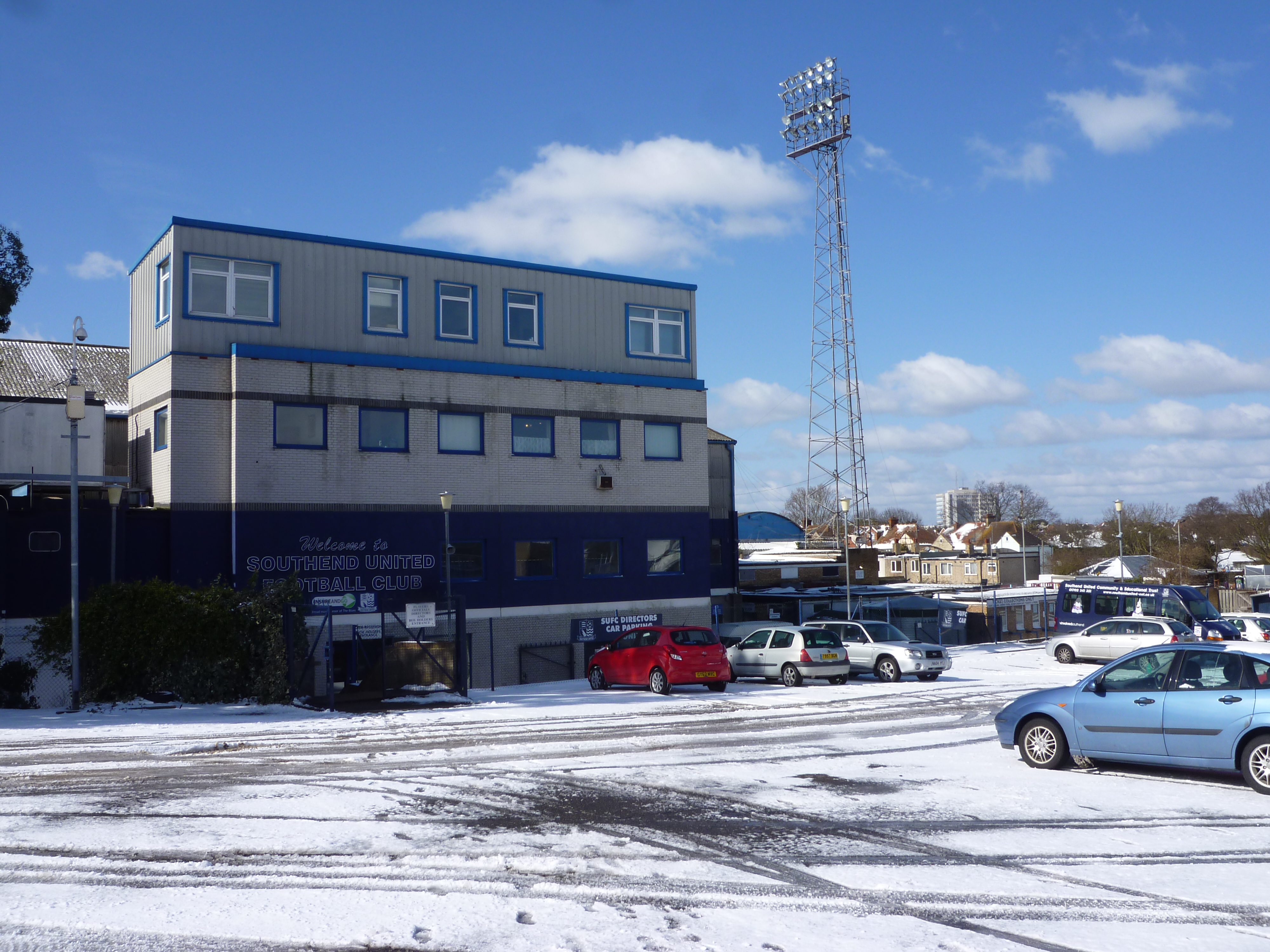
Three well deserved points for the Dons. The win takes them up to 18th in League 2. The work I helped to do clearing snow from the pitch this morning paid dividends! Flying into Southend airport on Tuesday morning, all I could see from the plane window was a blanket of snow covering streets, gardens and playing pitches. A quick phone call to Southend FC established that they were still hopeful the match against my club AFC Wimbledon would go ahead, but expected there would not be any definite news until lunchtime.

I asked if the pitch was being cleared and the receptionist confirmed that an operation was underway and that volunteers had been called in to help. She confirmed that an AFC Wimbledon helper would be welcome, when I offered my services. I had booked my match ticket in advance via the Dons’ online service, so I was hoping my flight over to England would not be wasted. A three minutes journey on the train from the airport to the next stop along the line brought me to Prittlewell, and I could see the floodlights of the Club in the distance. On arrival at Roots Hall, this was the scene that greeted me in the car park and inside the stadium:-

Roots Hall Stadium

Roots Hall Stadium

Roots Hall Pitch 11am

         Roots Hall Pitch 11am       

One of the first people I met outside the main entrance was the chief executive of the club, Steve Kavanagh, who acknowledged my offer of help. I was the first to add my name to the list of volunteers. On entering the pitch, the first person I spoke to turned out to be a fellow Dub, assistant manager Graham Coughlan from Clondalkin.  He started playing soccer as a youth for Cherry Orchard and his first senior club was Bray Wanderers in the League of Ireland. He also plays in the team as a central defender, but did not line out last night.

Snow clearance

Snow clearance

At this stage (11am), most of the snow had been removed from the covers in the penalty box area at one goalmouth, so over three-quarters of the pitch was still covered with a layer of white. Using snow shovels and wheelbarrows, the snow was removed section by section and more volunteers arrived to help. By noon, almost half the pitch had been cleared and I was able to send a photo to AFC Wimbledon and keep them updated via twitter. The sun was shining and the white of the snow was being gradually replaced by the green of the pitch, which remained soft underneath.

Another two hours’ work ensured that the remaining areas of the pitch were cleared and work began to ensure that the stand on one side of the ground where the snow had drifted in was cleared and made safe for spectators. As a “thank you” for their work, each volunteer was offered a free ticket for the game (although there seemed to be more interest in the tickets for the Johnstones Paint FA Trophy final against Crewe at Wembley next month: Southend have sold their allocation of 20,000 seats). I was given a refund for my ticket and the gesture was appreciated.

Share this:

  • Share on Facebook (Opens in new window) Facebook
  • Share on X (Opens in new window) X
Like Loading...
NEWS SPORT AFC WimbledonGraham CoughlanRoots HallsnowSouthend FCSteve Kavanagh Leave a comment

ADAM CLARKE: LEADING METHODIST

11/03/2013 by borderroamer
John Wesley's Chapel, Bristol

John Wesley’s Chapel, Bristol

During a visit to Bristol, I went to visit an important place for the Methdist Church in Britain and Ireland. John Wesley established a new chapel in the city centre in 1739, when it became the first Methodist building in the world. It was called the “New Room” in the Horsefair. I referred to it in a previous blog.

Pulpit

Pulpit

The two-decker pulpit followed the custom of those days. The upper part was used for the sermon and the lower part for the rest of the service. The present upper part is a replica. The communion table is that which was used by Wesley. The people sat on plain benches. Wesley gave the clock. The Snetzler Chamber Organ of 1761 on the right hand side of the gallery, as you face the pulpit, was brought here in the present century. Wesley presided at eighteen Conferences here.

Upstairs is the Common Room, with quarters for the Methodist preachers who came to Bristol. The bedrooms contain displays about the history of the Church and the spreading of Methodist teachings to the USA and elsewhere.

On one of the walls, I found a portrait of another significant figure in Methodism, Adam Clarke. A note beside it said he was born in Ireland and on checking a reference book, I discovered he was from County Londonderry.

Adam Clarke

Adam Clarke

Clarke was born in Moybeg Kirley, a townland on the edge of Tobermore off the road towards Draperstown, in the parish of Kilcronaghan, gateway to the Sperrin Mountains. His father was a schoolmaster and farmer. John Wesley invited him to become a pupil at a seminary he established at Kingswood in Bristol. He went on to become an eminent scholar and theologian. He is best known for his commentary on the Bible: “The Holy Bible: containing the Old and New Testaments, according to the authorized translation; with all the parallel text and marginal readings. To which are added, notes and practical observations, designed as a help to a
correct understanding of the sacred writings” (1810-1837).

Thanks to a former Belfast TV news colleague David Blevins for pointing out that there is a memorial to Adam Clarke in Portrush, Co.Antrim. A biography, The Life of the Rev. Andrew Clarke (JW Etheridge, 1859) says in a footnote p.399 that:-

“The Adam Clarke Memorial, (under the patronage of the Right Hon. the earl of Antrim, and John Crombie, Esq., J.P., D.L.,) is to consist of a “school, church, and minister’s house, at Port-Stewart, and an obelisk and statue at Port-Rush, near Coleraine.” The foundation stone of the obelisk was laid in September, 1857, with great public solemnities. The base is seven feet square and eight feet high, from which the monument will rise to a height of forty-two feet; which, taking the elevation of the site, will be equal to one hundred and twenty feet above the level of the sea. Close to the base will be the statue of Dr. Clarke, contributed by public offerings in America”.

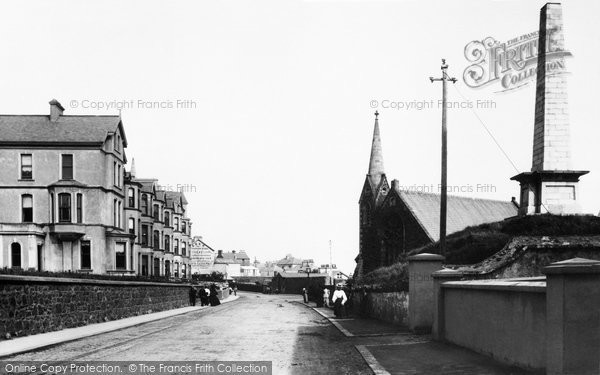
The Francis Frith collection of photographs has an interesting picture of the obelisk beside the Methodist church at Portrush in 1897:

Photo of Portrush, Adam Clarke's Memorial 1897, ref. 40407

Reproduced courtesy of Francis Frith.

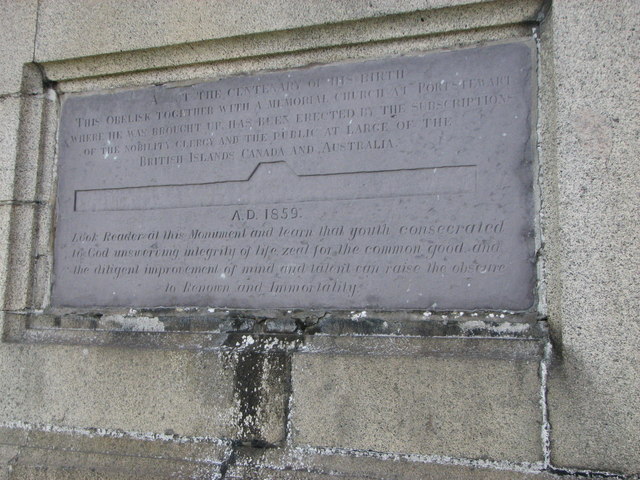
Willie Duffin has more recent photographs (2009) of the information plaques on the side of the obelisk and also a circular plaque on the wall of the church.

Adam Clarke Obelisk Plaque

Adam Clarke Obelisk Plaque © Copyright Willie Duffin and licensed for reuse under Creative Commons Licence

Adam Clarke Obelisk Plaque © Copyright Willie Duffin and licensed for reuse under Creative Commons Licence

Adam Clarke Obelisk Plaque © Copyright Willie Duffin and licensed for reuse under Creative Commons Licence

Adam Clarke Plaque © Copyright Willie Duffin and licensed for reuse under Creative Commons Licence

Adam Clarke Plaque on Church Wall           © Copyright Willie Duffin and licensed for reuse under Creative Commons Licence

Share this:

  • Share on Facebook (Opens in new window) Facebook
  • Share on X (Opens in new window) X
Like Loading...
TRAVEL UNCATEGORISED Adam ClarkeBristolDraperstownJohn WesleyMethodismNew Room BristolTobermore 1 Comment

S.S.GREAT BRITAIN

10/03/2013 by borderroamer
SS Great Britain

SS Great Britain

This is the story of Brunel’s ship, now preserved at Bristol Docks after being rescued from the Falkland Islands in 1970. Launched in 1843, she was the world’s largest ship and the first iron-hulled passenger vessel. Thousands flocked to her launch in Bristol. The ship became a huge success, travelling 32 times around the globe and clocking up nearly 1 million miles at sea.

Dundrum Bay 1846 But in 1846, a few years after the launch, there was a near disaster for the ship. The Dundrum Bay story of 1846 is featured in part of the exhibition in the former dock building alongside the preserved ship. The web page devoted to the ship’s designer, Isambard Kingdom Brunel, tells the story as follows:-

“On 22nd September 1846, the Great Britain sailed from Liverpool on her fifth voyage with 180 passengers, the most that she had ever carried. Later that night while passing the coast of County Down, she ran aground in Dundrum Bay. It was a squally night with rain and Chicken Rock Light on the Isle of Man had not been sighted and the ship ran too far before turning up the Irish coast. There were no casualties and the passengers were embarked next day but the Great Britain was stuck fast and holed. It was nearly twelve months before the ship was towed back to Liverpool at the end of August 1847. The cost of repairs were estimated at £22,000 but the ship was under insured and the company did not have the resources to cover the difference. Consequently, the company was forced to sell its two famous ships the Great Western and the Great Britain“.

SS Great Britain

SS Great Britain

Entrance to the ship and dockside museum costs £12.95 (£10.95 concession over 60).

Share this:

  • Share on Facebook (Opens in new window) Facebook
  • Share on X (Opens in new window) X
Like Loading...
TRAVEL BristolBrunelDundrum BaySS Great Britain Leave a comment

BATH TIME

09/03/2013 by borderroamer
Roman Baths, Bath

Roman Baths, Bath

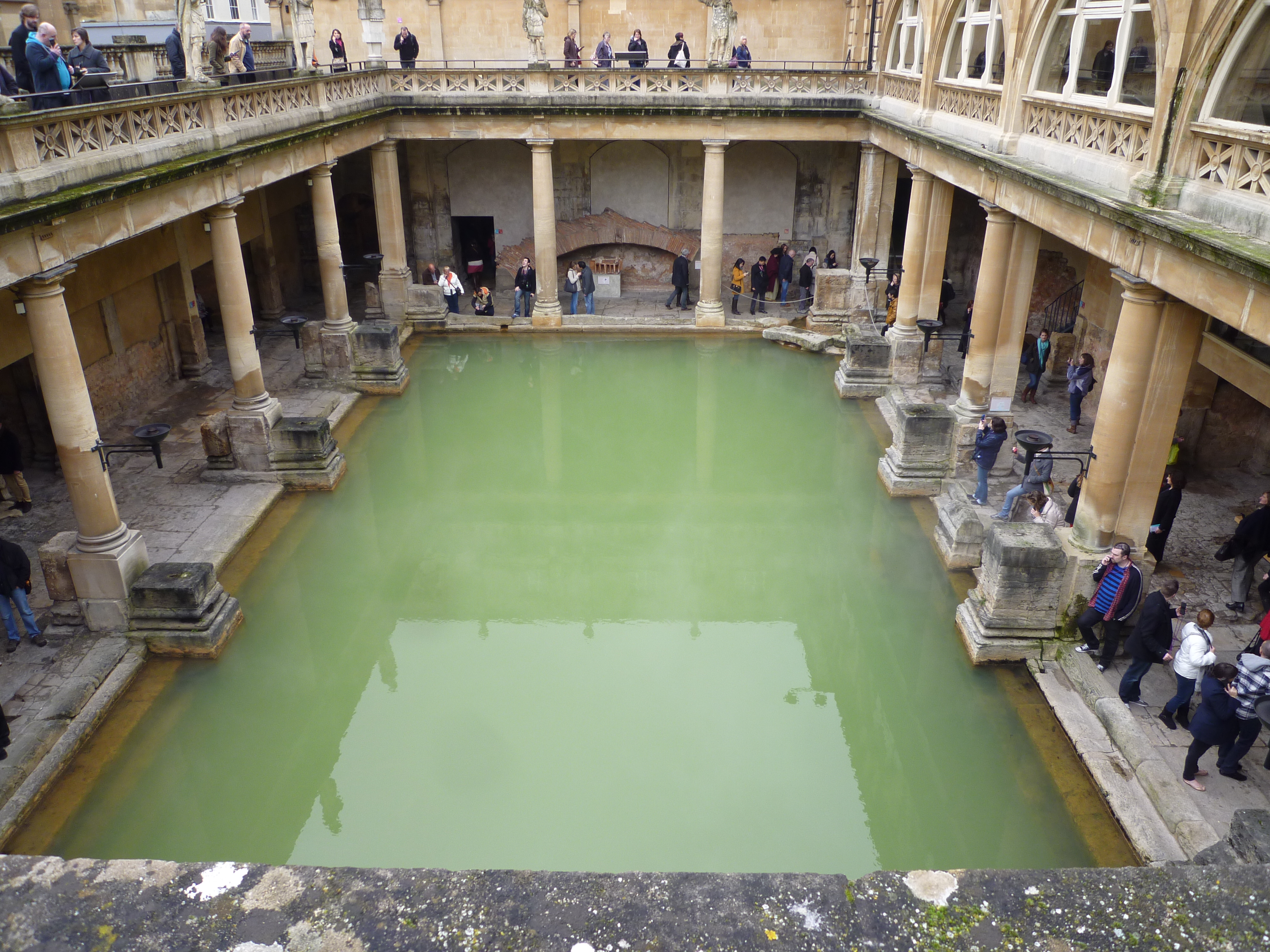
A very interesting visit to Bath to see the Roman Baths. The last time I was here was probably in 1975. Since then, more excavations have revealed further parts of the Roman complex. With the aid of a good audio guide, which was included in the admission price (£12.75 for adults), we spent two hours here. It’s easy to see why this is one of Britain’s top tourist attractions.  

Under floor heating!

Under floor heating!

Even on a dull day in March, there were queues to enter the complex, but the waiting time was not long. The Roman engineering and architectural skills were very similar to that in Pompeii, which I saw last August.

Bath Crescent

Bath Crescent

After visiting the Baths, it was time to see a bit more of Bath, including the famous Georgian Crescent and Bath Abbey, with its beautiful fan-vaulted roof and an impressive entrance door, where a Trident missile protest was being held.   

Bath Abbey entrance

Bath Abbey entrance


We took the train to and from Bristol. Less then a quarter of an hour’s journey for just over £2 each way on a group ticket (six travelling).  Very good value indeed for public transport.

Share this:

  • Share on Facebook (Opens in new window) Facebook
  • Share on X (Opens in new window) X
Like Loading...
TRAVEL UNCATEGORISED BathBath AbbeyBath CrescentBristolRoman Baths Leave a comment

BACK IN BRISTOL

08/03/2013 by borderroamer

Many years ago in 1975 I worked in Bristol for a few months on an attachment with the BBC regional newsroom. I haven’t been back to the city until today, and will spend a weekend there with friends. So I expect to notice some changes, in particular the area around the former docks.

Bristol was once an important centre in the slave trade, a past it probably wants to forget. Anti-slavery campaigners, inspired by non-conformist preachers such as John Wesley, started some of the earliest campaigns for abolition of the trade. The campaign itself proved to be the beginning of movements for reform and women’s emancipation.

John Wesley

John Wesley

Wesley founded the very first Methodist Chapel, The New Room in Broadmead in 1739, which is still in use in the 21st century. Wesley had come to Bristol at the invitation of George Whitfield. He preached in the open air to miners and brickworkers at Kingswood and Hanham, on the eastern outskirts of the city (Wikipedia). Bristol has an importance second only to London in the history of Methodism.

Bristol is also known as an important centre for the aircraft and aerospace industry. When I arrived here at St Augustine’s Reach, I was reminded that this was also a major city for shipbuilding. The area around the old harbour has been developed with bars and restaurants and is now a very lively place, compared to what it was like over 35 years ago!

St Augustine's Reach

St Augustine’s Reach

Share this:

  • Share on Facebook (Opens in new window) Facebook
  • Share on X (Opens in new window) X
Like Loading...
TRAVEL UNCATEGORISED BristolJohn Wesleyslave trade 2 Comments

ONE DAY AT A TIME

07/03/2013 by borderroamer
One Day at a Time

One Day at a Time

One of Ireland’s most popular country music singers, Gloria, has come out of retirement to record a fresh version of her chart-topping single “One Day at a Time”. She has teamed up with the Monaghan Gospel Choir, under the direction of David Drum. The choir was formed in 2007 and has just acquired new premises in Monaghan town (appropriately perhaps, a former gospel hall) for rehearsals.

The well-known country and Western-style Christian gospel song was written by Marijohn Wilkin and Kris Kristofferson. Under the watchful eye of Marijohn it was recorded in Nashville by Gloria who released it as a single in Ireland in August 1977. It remained in the Irish charts for 90 weeks in the top 30 until 1979 and was Number One from 30th September to 11th November in 1978. This made it the longest run by any song in Irish chart history and it still holds that record.

David Drum

David Drum

David Drum says that after nearly 40 years Gloria is delighted to re-release this Gospel Song along with the Monaghan Gospel Choir. He thanked the members of the choir for their work in this release and for their musical endeavours since their formation. He also thanked Gloria for the warm way she had embraced the request because, he said, songs like this never die, they just get better and more meaningful as the years go by.

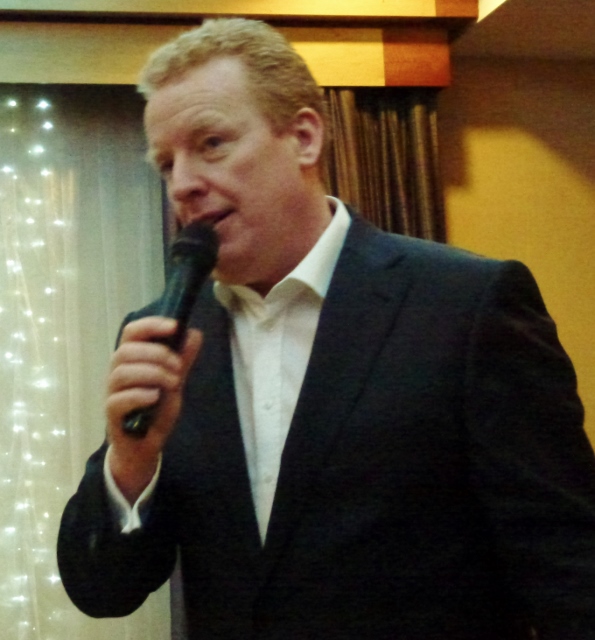
Joe Finnegan

Joe Finnegan, Northern Sound

The album was launched tonight at the Hillgrove Hotel in Monaghan. The Compere for the evening  was Joe Finnegan from Shannonside – Northern Sound FM. The CD which was recorded at Attic Studios in Monaghan can be purchased via the Choir’s website for €4.99. It will also be available through iTunes. The accompanist for the Choir is Seamus Mc Fadden, who also performed with Gloria in her band for over ten years.

Monaghan Gospel Choir has a membership of 80 people, male and female, divided into three sections, 40 Adults, 10 Junior Leaders, 30 juniors and they represent all parts of County Monaghan. They age from the youngest member aged 7 to 70 plus. The children are not performing tonight because of school commitments.

Gloria & Monaghan Gospel Choir

Gloria & Monaghan Gospel Choir

Gloria was born in Monaghan and lives in the parish of Tydavnet. Her first experience on stage was aged 10 when she danced and played accordion with her father’s showband. After leaving school, she found work playing piano with another band, but it was as a singer that she made her name in the 1970s. Gloria toured around Ireland singing alongside Johnny McEvoy during the early 1970s before breaking out on her own. When she released “One Day at a Time” originally, she was very popular in the dancehalls, along with her backing band, The Mississippi. Gloria retired in May 2001, when she turned 50.

Share this:

  • Share on Facebook (Opens in new window) Facebook
  • Share on X (Opens in new window) X
Like Loading...
MONAGHAN NEWS David DrumGloriaHillgrove HotelJoe FinneganKris KristoffersonMonaghan Gospel ChoirNorthern SoundOne Day at a TimeSeamus McFadden 1 Comment

AUSCHWITZ: A SURVIVOR

06/03/2013 by borderroamer
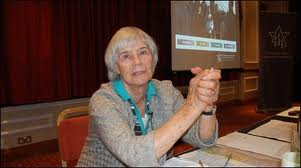
Kitty Hart-Moxon

Kitty Hart-Moxon

I am watching the story of a survivor of Auschwitz. Stephen Nolan on BBC1 Northern Ireland is talking to Kitty Hart-Moxon and hearing her “Story of a Lifetime”. She was sent to the Auschwitz labour camp in 1943 at the age of 16, where she survived for two years. She  was also imprisoned at other camps. Shortly after her liberation in April 1945 by American soldiers, she moved to England with her mother, where she married and dedicated her life to raising awareness of the Holocaust. She has written two autobiographies entitled I am Alive and Return to Auschwitz.

She was born Kitty Felix in 1926, in Bielsko in southern Poland. She had one brother, Robert, who was five years older. Her father operated an agricultural supply business. As a child, she represented Poland as part of the Youth Swimming Team in 1939. She won a bronze medal and was the youngest selected on the squad.

During a holiday when Kitty was 12, her parents decided to leave Bielsko because of the anti-Semitic mood that had swept the town, which was close to the borders with Germany and Czechoslovakia. To escape the danger, Kitty’s family moved to Lublin, in central Poland. They left on 24 August 1939. On September 1st 1939, Hitler’s Germany invaded Poland. A priest obtained false documents for her and her mother and the family split up to help their chances of survival. They blended in with a group of Poles heading for work in Germany and ended up at a rubber factory in Bitterfeld. They were rounded up with a number of other Jews and sent to Auschwitz.

Auschwitz

Auschwitz

Well over 1 million Jewish men, women and children died in Auschwitz/Birkenau. Other groups of people who died included Polish political prisoners, Soviet prisoners of war, gypsy families, homosexuals, people with disabilities and prisoners of conscience or religious faith (including several hundred Jehovah’s Witnesses). Kitty was 16 when she was taken to Birkenau. She witnessed the German soldiers sorting children and adults. Many were sent directly to the gas chambers. The buildings in this section now lie in ruins and for anyone who visits the site it is an emotional experience, reflecting on the mass murder that occurred. When I was there a few years ago, a group of orthodox Jews, some with Israeli flags, paused among the rubble to pray.

It was Kitty’s job at the concentration camp to sort through the mens’ jackets and remove all the valuables. In an exhibition there are piles of possessions, along with the hair removed from victims before they died and later used to make cloth. Block 25 was known as the death block. Female prisoners were held there before being taken to the gas chambers.

Kitty was fortunate to survive. Now she tells her story to others, to remind people about the genocide, in the hope that new generations can learn from the horrors of the past.

Share this:

  • Share on Facebook (Opens in new window) Facebook
  • Share on X (Opens in new window) X
Like Loading...
NEWS AuschwitzBirkenauholocaust survivorKitty Hart-Moxon Leave a comment

TERRY’S SUPER HEXAGON

05/03/2013 by borderroamer
Terry Cavanagh

Terry Cavanagh

A big night in London tonight for Terry Cavanagh from Tydavnet in County Monaghan, developer of Super Hexagon. It was in the running for a BAFTA video games award in the Best British game category. Terry is based in Cambridge and his parents were with him at the finals at the Hilton Hotel in the West End. Dara O Briain was compere. Here’s how The Guardian described the ceremony:-

10.31pm:

Now it’s time to turn to the award for British game. Not the game that best embodies Britishness (croquet? cricket? cluedo?) but the best game made by a Brit. A difficult award to judge this. The nominees are:

·  Forza Horizon ·  LEGO: The Lord of the Rings ·  Need for Speed Most Wanted · (these three are “hefty multiplatform blockbusters” according to the blog)

· Dear Esther · The Room ·  Super Hexagon (Terry’s game is among three independent creations, self-funded by their developers). These two different groups “exemplify the current tussle at the creative and commercial heart of the industry”, says the Guardian video games journalist, Simon Parkin.

10.34pm:

And the winner is: The Room, an iOS puzzle game that’s heavy on atmosphere and light on scarves.

The game, according to a BBC report, challenges players to solve puzzles in a 3D environment in order to reveal the secrets of a mysterious box. It was created by Guildford-based Fireproof Studios and had previously won Apple’s 2012 iPad game of the year.

Well done Terry, who no doubt might disagree strongly with that description of the category namely “the best game made by a Brit”!!    gamegames-awards-logo-2926

For a full list of the nominations in the nineteen categories, you can go to the BAFTA website here. The Best Game award went to Dishonored, as the BBC News technology section reports. This was the fifth year O’Briain acted as master of ceremonies. The Guardian said he took to the stage and opened his remarks “by expressing his dismay at continually being asked to defend video games in the role of ‘token’ game playing celebrity”.

Dara O Briain

Dara O Briain

Share this:

  • Share on Facebook (Opens in new window) Facebook
  • Share on X (Opens in new window) X
Like Loading...
MONAGHAN NEWS BAFTA video games awardsSuper HexagonTerry CavanaghTydavnet Leave a comment

Post navigation

← Older posts
Newer posts →

Recent Posts

  • DESMOND FISHER 1920-2014 30/12/2020
  • GAJ AWARDS 2020 24/12/2020
  • COVID-19 REPORTING AWARD 20/12/2020
  • HAPPY 100TH BIRTHDAY 31/03/2020
  • NUJ VOTING REMINDER 26/01/2020
  • WORLD PRESS FREEDOM 20/01/2020
  • REMINDER TO VOTE 18/01/2020
  • BOND, WE’VE BEEN EXPECTING YOU! 17/01/2020
  • NUJ MEMBERS IN IRELAND 09/01/2020
  • NUJ BLAST FROM THE PAST 08/01/2020

Archives

  • Dec 2020 (3)
  • Mar 2020 (1)
  • Jan 2020 (13)
  • Oct 2019 (10)
  • Sep 2019 (30)
  • Aug 2019 (31)
  • Jun 2019 (2)
  • May 2019 (1)
  • Sep 2018 (1)
  • Jul 2017 (1)
  • Dec 2016 (12)
  • Sep 2016 (2)
  • Aug 2016 (5)
  • Jul 2016 (5)
  • Jun 2016 (10)
  • May 2016 (15)
  • Apr 2016 (19)
  • Mar 2016 (14)
  • Jan 2016 (26)
  • Dec 2015 (2)
  • Aug 2015 (1)
  • Jul 2015 (30)
  • Jun 2015 (30)
  • May 2015 (32)
  • Apr 2015 (30)
  • Mar 2015 (31)
  • Feb 2015 (28)
  • Jan 2015 (31)
  • Dec 2014 (31)
  • Nov 2014 (14)
  • Mar 2014 (2)
  • Feb 2014 (2)
  • Jan 2014 (31)
  • Dec 2013 (19)
  • Nov 2013 (17)
  • Oct 2013 (29)
  • Sep 2013 (30)
  • Aug 2013 (31)
  • Jul 2013 (31)
  • Jun 2013 (30)
  • May 2013 (28)
  • Apr 2013 (32)
  • Mar 2013 (31)
  • Feb 2013 (28)
  • Jan 2013 (31)
  • Dec 2012 (3)
  • Oct 2012 (1)
  • Sep 2012 (1)
  • Aug 2012 (2)
  • Jul 2012 (3)
  • Jun 2012 (3)
  • May 2012 (3)
  • Apr 2012 (5)
  • Mar 2012 (1)
  • Jan 2012 (1)
  • Dec 2011 (1)
  • Nov 2011 (1)
  • Jun 2011 (1)
  • May 2011 (1)
  • Apr 2011 (2)
  • Dec 2010 (1)
  • Nov 2010 (3)
  • Oct 2010 (6)
  • Aug 2010 (1)
  • Jul 2010 (7)

Categories

Meta

  • Create account
  • Log in
  • Entries feed
  • Comments feed
  • WordPress.com

Enter your email address to follow this blog and receive notifications of new posts by email.

36th Ulster Division 2013 WPFG AFC Wimbledon An Bord Pleanála Ballinode Balmoral Show Barry McCall Battle of Somme BBC belfast Belfast Festival Belfast Lions Club Big Music Week Birmingham BOSE Bristol Carlow Carrickmacross Castleblayney Catholic Herald Clogher Clones CMAPC Defence Forces Derry Desmond Fisher Dublin EirGrid Emyvale Fine Gael GAA Geel Glaslough Heather Humphreys TD Iarnród Éireann Ice Hockey Ieper Inniskeen Irish Press Kingsmeadow London Meath Michael Fisher Monaghan Monaghan County Council NEC NEPPC Newbridge North/South Interconnector Northern Standard NUJ Odyssey Arena Patrick Comerford Pope Francis Poperinge Private Robert Hamilton PSNI Royal Irish Fusiliers RTÉ SDLP Shamrock Rovers Shared History Shared Future SIPTU St Macartan's Cathedral Tallaght Tydavnet Tyrone Ulster rugby Vatican II William Carleton William Carleton Society William Carleton summer school WW1 WWI WWII

Blog Stats

  • 243,999 hits
Blog at WordPress.com.
Michael Fisher's News
Blog at WordPress.com.
  • Subscribe Subscribed
    • Michael Fisher's News
    • Join 173 other subscribers.
    • Already have a WordPress.com account? Log in now.
    • Michael Fisher's News
    • Subscribe Subscribed
    • Sign up
    • Log in
    • Report this content
    • View site in Reader
    • Manage subscriptions
    • Collapse this bar
 

Loading Comments...
 

    %d