DAG SHOT DOWN, SAY EXPERTS

Desmond Fisher report in The Irish Press, 21st September 1961

Desmond Fisher report in The Irish Press, 21st September 1961

Following on from yesterday’s post about Dag Hammarskjöld, this is how my late father Desmond Fisher reported the fatal plane crash in the Congo in 1961. His report was filed from Leopoldville and appeared in The Irish Press on September 21st 1961. He was London Editor at the time and on assignment in the Congo to report on the Irish contingent serving with the United Nations).

DAG SHOT DOWN, SAY EXPERTS (From Desmond Fisher)

LEOPOLDVILLE, Wednesday —  The plane in which United Nations Secretary General Mr. Dag Hammarskjoeld and 14 others — including an Irishman, Mr. Francis Eivers, U.N. Security Guard — lost their lives on Monday night, was almost certainly shot down by long-distance rocket fire from a Katanga Fouga jet fighter.

This conviction is growing among leading U.N. experts here but they say the world will never be told the true story. Fill disclosures of the facts might, they think, act as a spark to touch off a major world explosion.

The experts quote, as grounds for their belief, three pieces of evidence: 

1–The report from Ndola Airport control tower that an unidentified aircraft circled the field shortly before the crash.

2–Eyewitness accounts of seeing two or three explosions in the sky.

3–Reports from the lone survivior, U.N. Security Officer, Harold Julien, who is still seriously ill but reported to be “holding his own”.

Sergeant Julien is reported to have said that the plane was rocked by several explosions just before the crash.

Three Swedish experts are on their way to the scene of the crash to conduct the official investigation. The Northern Rhodesian Government, I understand, has refused to let any other investigators in.

Jet bitterness 

Meanwhile, I learned authoritatively tonight that the three Ethiopian jet fighters held up in Kano, Nigeria, for the past four days, will fly to the Congo tomorrow. There is bitter indignation in U.N. circles here at what is regarded as deliberate British stalling tactics in refusing to give the jets clearance.

Many U.N. officials believe that if the jets had been allowed to leave Kano when they were first due to take off, Mr. Hammarskjoeld would be alive today.

The new jets are expected to give the U.N. force air superiority in Katanga. They are far faster and more heavily armed than the two Fouga jets which operate from Kolwezi and which are believed to be flown against U.N. targets by a pilot of Rhodesian nationality.

If the Katangan fighting is resumed, and the Fougas take to the air, the U.N. jets will attack. They will probably be flown by Swedish pilots of the U.N. air command.

Desmond Fisher report in The Irish Press, 21st September 1961

Desmond Fisher report in The Irish Press, 21st September 1961

DAG HAMMARSKJöLD

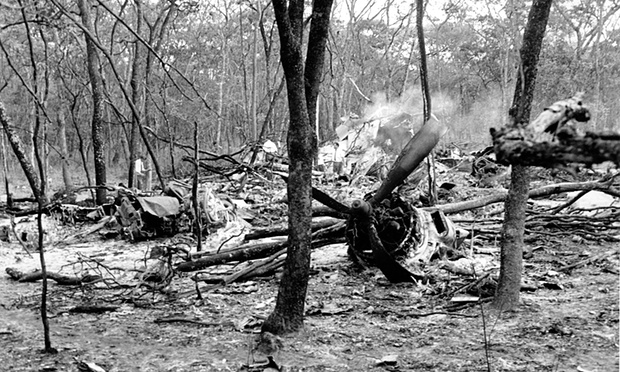
The wreckage of Dag Hammarskjöld’s aircraft at Ndola on 19th September 1961. Photo: AP

The wreckage of Dag Hammarskjöld’s aircraft at Ndola on 19th September 1961. Photo: AP

Dag Hammarskjöld: evidence suggests UN chief’s plane was shot down — The Guardian

New information uncovered by a UN panel on the death of former secretary-general Dag Hammarskjöld (aged 56) should be investigated to establish whether his plane was attacked just before it crashed in southern Africa, the UN chief said on Monday (July 6th). After receiving the report, the secretary-general, Ban Ki-moon, said “a further inquiry or investigation would be necessary to finally establish the facts” surrounding the mysterious crash more than 50 years ago.

The panel “found new information, which it assessed as having moderate probative value, sufficient to further pursue aerial attack or other interference as a hypothesis of the possible cause of the crash”, said UN spokesman Farhan Haq. The answers may lie in classified documents from the United States and Britain that the panel was unable to consult, despite requests for access. Ban said he would follow up on the requests. 

Dag Hammarskjöld, UN Secretary General  Photo: UN

Dag Hammarskjöld, UN Secretary General Photo: UN

The UN’s second secretary-general, Hammarskjöld died when his plane crashed on 17 or 18 September 1961 near Ndola in Northern Rhodesia, now known as Zambia. The Swedish diplomat was on his way to negotiate a ceasefire for mining-rich Katanga province in what was the Republic of the Congo, which had proclaimed independence from Belgium.

The three-person panel spoke to witnesses in Zambia who testified that there was more than one aircraft in the air when the plane made its approach to Ndola, or that the plane was on fire before it hit the ground. These accounts seemed to corroborate information contained in a 2013 report by a separate commission that concluded that there was “convincing evidence” that the plane was shot down as it prepared to land.

A former US air force security officer, Paul Abram, told the panel that he heard transmissions about the shooting down of an aircraft near Congo while serving at a National Security Agency listening post in Greece. The panel said it could not authenticate Abram’s claims.

The US government wrote in a letter to the panel last month that a search had not revealed any documents on radio transmissions but added that other files classified as top secret from the National Security Agency would not be released. Among the new information uncovered by the panel was a declassified report from a senior British diplomat to a secret service agent, Neil Ritchie, who details how he helped the Katanga leader Moise Tshombe travel to Ndola for his meeting with Hammarskjöld.

The report did not mention the possible crash but “its existence and content serves as new information about the presence of the British intelligence agency in the area”, said the UN panel. The British government responded last month in a letter to the panel that it would not be able to provide more information on the case due to security concerns.

The UN General Assembly in late December adopted a resolution, drafted by Sweden, that called for the new investigation to finally shed light on the top diplomat’s death. Led by the Tanzanian prosecutor Mohamed Chande Othman, the panel also included Kerryn Macaulay of Australia and Henrik Larsen of Denmark.

This report is from The Guardian three weeks ago. Five years ago my late father, who was reporting for The Irish Press from the Congo at the time of the crash in September 1961, wrote this article about the event in which an Irish UN security guard (ex Garda) Frank Ievers was also killed:

Death of top UN official still shrouded in mystery

Secretary-general killed in suspicious plane crash en route to broker a ceasefire in the Congo, writes Desmond Fisher  

The late Desmond Fisher, former London Editor, The Irish Press  Photo:  © Michael Fisher

The late Desmond Fisher, former London Editor, The Irish Press Photo: © Michael Fisher

PUBLISHED  September 19th 2010  Sunday Independent

On this weekend 49 years ago, the world was shaken by news of a mysterious air crash in Africa. The bodies of 16 people were recovered from the wreck. Some had multiple bullet wounds in their heads and bodies. The airport’s handling of the pre-crash warnings was sub-standard. Other aircraft were seen in the area. Strange lights were reported over the airport. And a famous man, on a mission to prevent what might degenerate into a world war, was among the dead. It was September 18th, 1961. And the dead man was Dag Hammarskjöld, secretary-general of the United Nations. His death shocked the world. The previous afternoon, Hammarskjöld’s DC-6B plane had left Leopoldville (now Kinshasa) in the Congo en route to Ndola in Northern Rhodesia (now Zambia). He had arranged a meeting with Moise Tshombe, president of the rebel State of Katanga, which was now engaged in a war to become independent from the Congo.

Katangese soldiers were fighting UN peacekeeping forces sent in to prevent civil war. With the UK, the US and Belgium clandestinely helping the rebels, Russia making bellicose noises and a world war threatening, Hammarskjöld was trying to arrange a ceasefire.

In the early morning, the news came that his plane had crashed. At the time, I was in a crowded pressroom at UN HQ in Leopoldville. Senior UN officials and hardened war correspondents sobbed uncontrollably. Every one of them was of one mind. Hammarskjöld had been assassinated.

Ireland was deeply involved in the Congo crisis. Lt Gen Sean McKeown was in command of all UN peacekeeper troops there to support the government in its efforts to prevent Katanga from seceding. Dr Conor Cruise O’Brien was Hammarskjöld’s special representative in Katanga. A battalion of Irish soldiers was engaged in heavy fighting. Only three days earlier, Trooper Pat Mullins from Kilbehenny, Co Cork, was killed in an ambush. And 150 Irish soldiers were prisoners of the Katangese.

What happened to Hammarskjöld and 15 others is still disputed. Former US president Harry Truman said bluntly that he was killed. Allegations that his plane had been shot down, deliberately given wrong instructions, or sabotaged, were never proven.

Thirty-seven years after the crash, the South African Truth and Reconciliation Commission quoted recently discovered letters linking MI5, the CIA and the South African secret services with the crash, including the suggestion that a bomb was placed in the plane’s wheel bay to explode when the plane touched down. And as recently as 2005, a Norwegian soldier who was the first UN official to see Hammarskjöld’s dead body said it had a hole in the head that was air-brushed out of the post-mortem photos.

Hammarskjöld’s death was regarded as a major blow to the UN. But the moral force that is the organisation’s greatest weapon was greatly reinforced by what was seen as the assassination of a spiritual man who was regarded by some as the ‘secular Pope’.

Only (47 – incorrect) 56 when he died, Hammarskjöld came from a family with many generations of public service, his father having been prime minister of Sweden. Among his earliest decisions as secretary-general was to appoint only non-partisan and fair-minded officials to his 4,000 staff. His ultimate aim was to establish an independent UN force.

Hammarskjöld was a highly introspective man. He did not give interviews and I had to rely on the influence of Freddie Boland, that year’s president of the General Council, to arrange for me to see him. He did not invite me to sit and reacted animatedly only when I asked him how he rated Ireland’s contribution to the UN. He spoke highly of the way Ireland, as a non-aligned country, was able to act as an “honest broker” and help to solve many of the UN’s problems. And he praised genuinely and enthusiastically Ireland’s contribution to the UN’s mission to the Congo.

Hammarskjöld kept what he called his ‘journal’ — a combination of diary entries and spiritual thoughts cloaked in haiku-style poetry — published after his death as Markings. In it, he wrote: “Everything will be all right when people stop thinking of the United Nations as a weird Picasso abstraction and see it as a drawing they made themselves.”

He regarded his own writings as “negotiations with myself and with God”. One such aphorism gives an idea of his tortuous mind:

Tomorrow we shall meet

Death and I —

And he shall thrust his sword

Into one who is wide awake.

TSR2: WE GAVE IT ALL AWAY

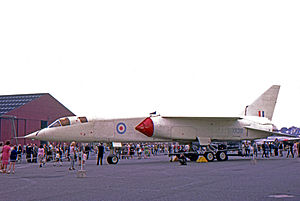
The only TSR-2 to fly, XR219, in anti-flash white finish, at BAC's Warton factory in 1966 Photo: wikipedia

The only TSR-2 to fly, XR219, in anti-flash white finish, at BAC’s Warton factory in 1966 Photo: wikipedia

An opportunity lost: we gave it all away. Some of the sentiments expressed in a fascinating BBC4 series on ‘Cold War, Hot Jets‘. At the end of the second world war, Britain was the leader in the field of jet propulsion. Twenty years of research went into developing the TSR2 strike and reconnaissance airccraft, a light bomber that could reach supersonic speed and could operate both at high and low-level altitude.

Harold Wilson enters No. 10 in October 1964  Photo: thejc.com

Harold Wilson enters No. 10 in October 1964 Photo: thejc.com

Harold Wilson’s win in the October 1964 general election and his elevation to 10 Downing Street as Prime Minister changed all that. The new Labour government initiated cutbacks in the defence programme and the TSR2 was scrapped. I remember (as a grammar school pupil in London) I had a picture postcard of this stunning jet as well as having it on a poster which showed other RAF aircraft.

Denis Healey, Defence Minister in Wilson’s Cabinet said at the time of the cancellation in April 1965: “The trouble with the TSR-2 was that it tried to combine the most advanced state of every art in every field. The aircraft firms and the RAF were trying to get the Government on the hook and understated the cost. But TSR-2 cost far more than even their private estimates, and so I have no doubt about the decision to cancel.”

Aeronautical engineer Sir Sydney Camm said of the TSR-2: “All modern aircraft have four dimensions: span, length, height and politics. TSR-2 simply got the first three right”, a quotation used on the tv documentary.

The TSR2 was developed by the British Aircraft Corporation (BAC) for the Royal Air Force in the late 1950s and early 1960s. The jet was designed to penetrate a well-defended forward battle area at low altitudes and very high speeds, and then attack high-value targets in the rear with nuclear or conventional weapons. Another intended combat role was to provide high-altitude, high-speed stand-off, side-looking, radar and photo imagery and signals intelligence, reconnaissance. Some of the most advanced aviation technology of the period was incorporated in order to make it the highest-performing aircraft in the world in its projected missions. 

The TSR-2 was the victim of ever-rising costs and inter-service squabbling over Britain’s future defence needs, which led to the controversial decision to scrap the programme in 1965. With the election of a new government, the TSR-2 was cancelled due to rising costs, in favour of purchasing an adapted version of the General Dynamics F-111, a decision that itself was later rescinded as costs and development times increased. The replacements included the Blackburn Buccaneer and Mc Donnell Douglas F-4 Phantom II, both of which had previously been considered and rejected early in the TSR-2 procurement process. Eventually, the smaller swing-wing Panavia Tornado was developed and adopted by a European consortium to fulfil broadly similar requirements to the TSR-2.

According to the Flight Envelope diagram, TSR2 was capable of sustained cruise at Mach 2.05 at altitudes between 37,000 ft (11,000 m) and 51,000 ft (16,000 m) and had a dash speed of Mach 2.35 (with a limiting leading edge temperature of 140 degrees Celsius). Its theoretical maximum speed was Mach 3 in level flight at 45,000 ft (14,000 m).

There were considerable problems with realising the design. Some contributing manufacturers were employed directly by the Ministry rather than through BAC, leading to communication difficulties and further cost overruns. Equipment, an area in which BAC had autonomy, would be supplied by the Ministry from “associate contractors”, although the equipment would be designed and provided by BAC, subject to ministry approval. The overall outlay of funds made it the largest aircraft project in Britain to date.

Unlike most previous projects, there were to be no prototypes. Under the “development batch” procedure pioneered by the Americans (and also used by English Electric for the Lightning), there would instead be a development batch of nine airframes, to be built using production jigs. The choice of proceeding to production tooling turned out to be another source of delay, with the first aircraft having to adhere to strict production standards or deal with the bureaucracy of attaining concessions to allow them to exhibit differences from later airframes. Four years into the project, the first few airframes had effectively become prototypes in all but name, exhibiting a succession of omissions from the specification and differences from the intended pre-production and production batches.

Testing

Serial number XR222 was one of only three “flight ready” TSR-2s completed, photographed at the Supermarine Spitfire 60th Anniversary Airshow, Duxford, 1996

Despite the increasing costs (which were inevitable, given the low original estimates), the first two of the development batch aircraft were completed. Engine development and undercarriage problems led to delays for the first flight which meant that the TSR-2 missed the opportunity to be displayed to the public at that year’s Farnborough Airshow. In the days leading up to the testing, Denis Healey, then the Opposition defence spokesman, had criticised the aircraft saying that by the time it was introduced it would face “new anti-aircraft” missiles that would shoot it down making it prohibitively expensive at £16 million per aircraft (on the basis of only 30 ordered).

Test pilot Roland Beamont finally made the first flight from the Aeroplane and Armament Experimental Establishment (A&AEE) at Boscombe Down, Wiltshire, on 27 September 1964. Initial flight tests were all performed with the undercarriage down and engine power strictly controlled—with limits of 250 kn (460 km/h) and 10,000 ft (3,000 m) on the first (15-minute) flight. Shortly after takeoff onXR219’s second flight, vibration from a fuel pump at the resonant frequency of the human eyeball caused the pilot to throttle back one engine to avoid momentary loss of vision.

Only on the 10th test flight was the landing gear successfully retracted—problems preventing this on previous occasions, but serious vibration problems on landing persisted throughout the flight testing programme. The first supersonic test flight (Flight 14) was achieved on the transfer from A&AEE, Boscombe Down, to BAC Warton. Over a period of six months, a total of 24 test flights were conducted. Most of the complex electronics were not fitted to the first aircraft, so these flights were all concerned with the basic flying qualities of the aircraft which, according to the test pilots involved, were outstanding. Speeds of Mach 1.12 and sustained low-level flights down to 200 ft (above the Pennines) were achieved. Undercarriage vibration problems continued, however, and only in the final few flights, when XR219 was fitted with additional tie-struts on the already complex landing gear, was there a significant reduction in them. The last test flight took place on 31 March 1965.

Although the test flying programme was not completed and the TSR-2 was undergoing typical design and systems modifications reflective of its sophisticated configuration, “[t]here was no doubt that the airframe would be capable of accomplishing the tasks set for it and that it represented a major advance on any other type.”

Costs continued to rise, which led to concerns at both company and government upper management levels, and the aircraft was also falling short of many of the requirements laid out in OR.343, such as takeoff distance and combat radius. As a cost-saving measure, a reduced specification was agreed upon, notably reductions in combat radius to 650 nmi (1,200 km), the top speed to Mach 1.75 and takeoff run up increased from 600 to 1,000 yards (550 to 910 m).

Project cancellation

XR220 at the RAF Museum, Cosford, 2007. The two cockpit canopies are coated with a thin film of gold to protect the occupant’s eyes from a nuclear flash

By the 1960s, the United States military was developing the swing-wing F-111 project as a follow-on to the Republic F-105 Thunderchief, a fast low-level fighter-bomber designed in the 1950s with an internal bay for a nuclear weapon. There had been some interest in the TSR-2 from Australia for the Royal Australian Air Force (RAAF), but in 1963, the RAAF chose to buy the F-111 instead, having been offered a better price and delivery schedule by the American manufacturer. Nonetheless, the RAAF had to wait 10 years before the F-111 was ready to enter service, by which time the anticipated programme cost had tripled. The RAF was also asked to consider the F-111 as an alternative cost-saving measure. In response to suggestions of cancellation, BAC employees held a protest march, and the new Labour government, which had come to power in 1964, issued strong denials.

However, at two Cabinet meetings held on April 1st 1965, it was decided to cancel the TSR-2 on the grounds of projected cost, and instead to obtain an option agreement to acquire up to 110 F-111 aircraft with no immediate commitment to buy. This decision was announced in the budget speech of 6 April 1965. The maiden flight of the second development batch aircraft, XR220, was due on the day of the announcement, but following an accident in conveying the airframe to Boscombe Down, coupled with the announcement of the project cancellation, it never happened. Ultimately, only the first prototype, XR219, ever took to the air. A week later, the Chancellor defended the decision in a debate in the House of Commons, saying that the F-111 would prove cheaper.

Source: Wikipedia

MEMORIAL TO DR PADDY MAC CARVILL

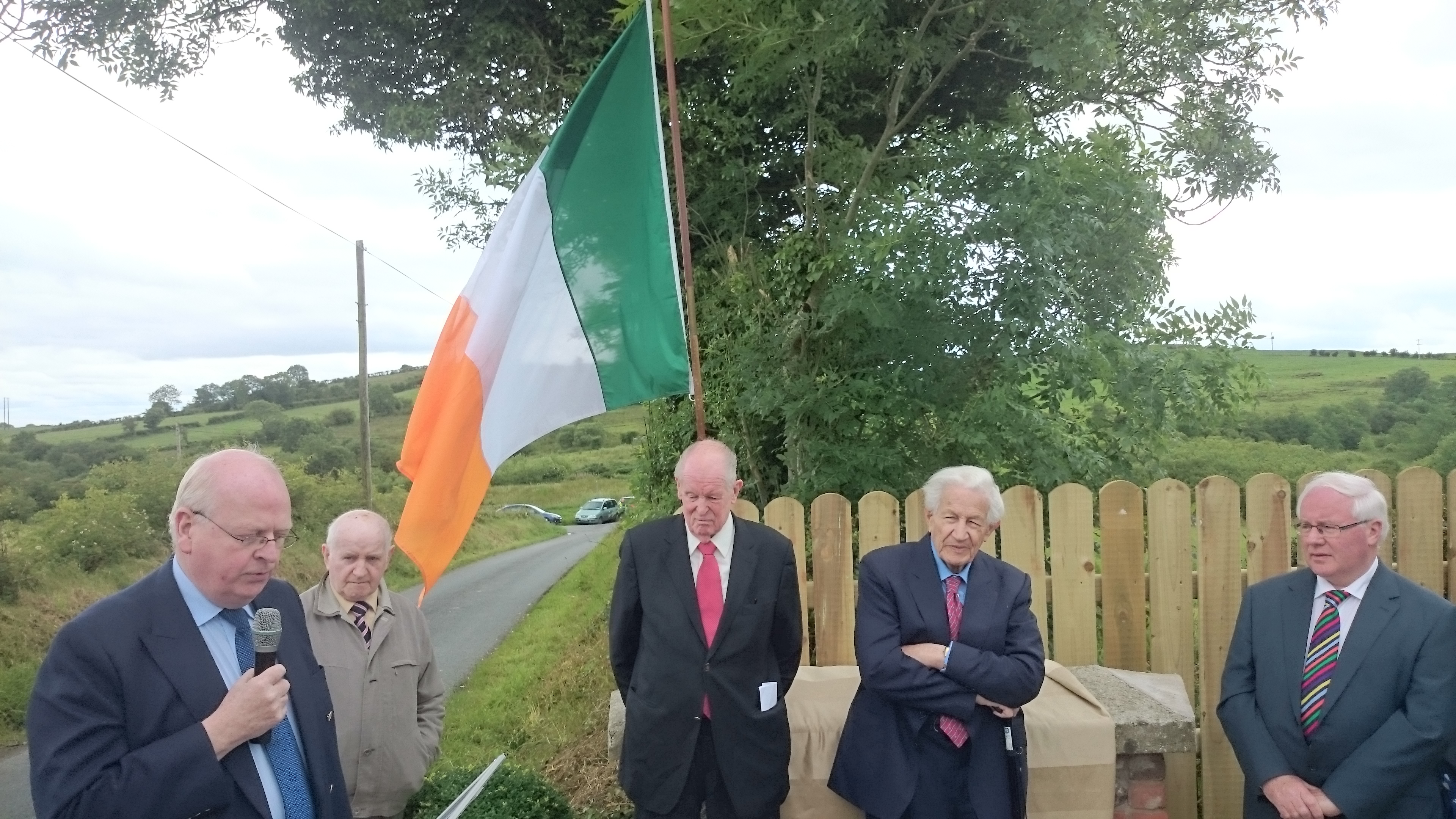
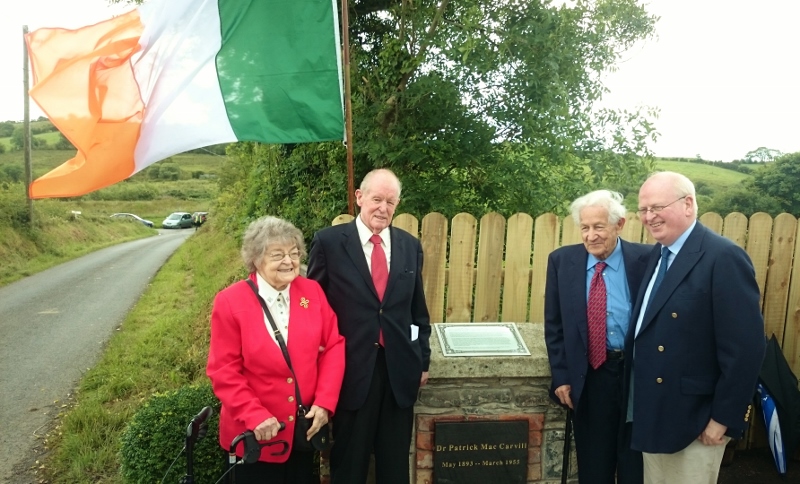
Guest speaker Michael McDowell SC with Eamonn Mulligan, Niall Mac Carvill (Pady's son), his cousin Mackie Moyna and Brendan Smith T.D. Photo:  © Michael Fisher

Guest speaker Michael McDowell SC with Eamonn Mulligan, Niall Mac Carvill (Pady’s son), his cousin Mackie Moyna and Brendan Smith T.D. Photo: © Michael Fisher

MEMORIAL UNVEILED TO FORMER MONAGHAN T.D. DR PADDY MAC CARVILL

Michael Fisher   Northern Standard   Thursday  16th July
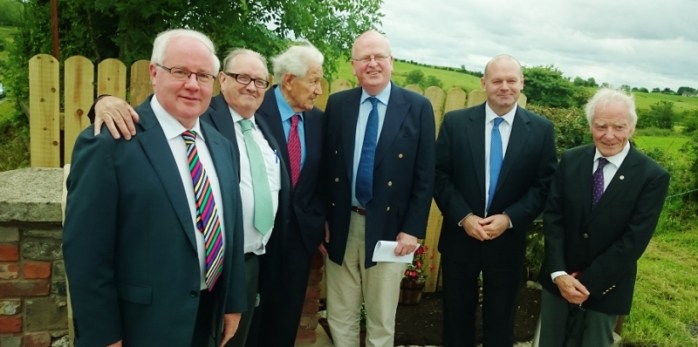
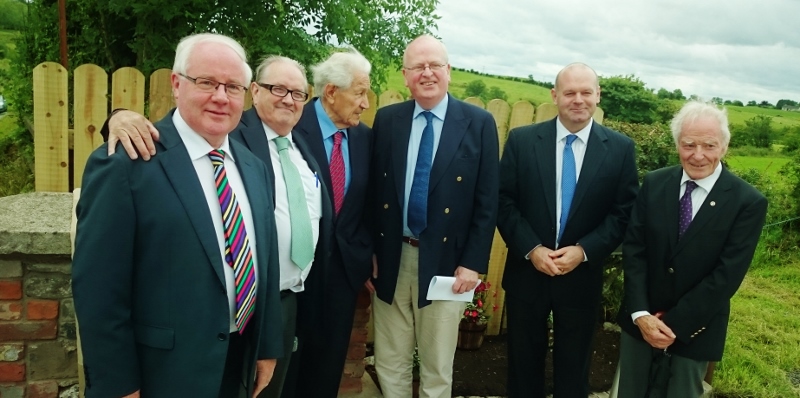
Brendan Smith T.D. with Mackie Moyna Jnr., Mackie Moyna, guest speaker Michael McDowell S.C., Senator Diarmuid Wilson and Dr Rory O'Hanlon, former Ceann Comhairle  Photo:  © Michael Fisher

Brendan Smith T.D. with Mackie Moyna Jnr., Mackie Moyna, guest speaker Michael McDowell S.C., Senator Diarmuid Wilson and Dr Rory O’Hanlon, former Ceann Comhairle Photo: © Michael Fisher

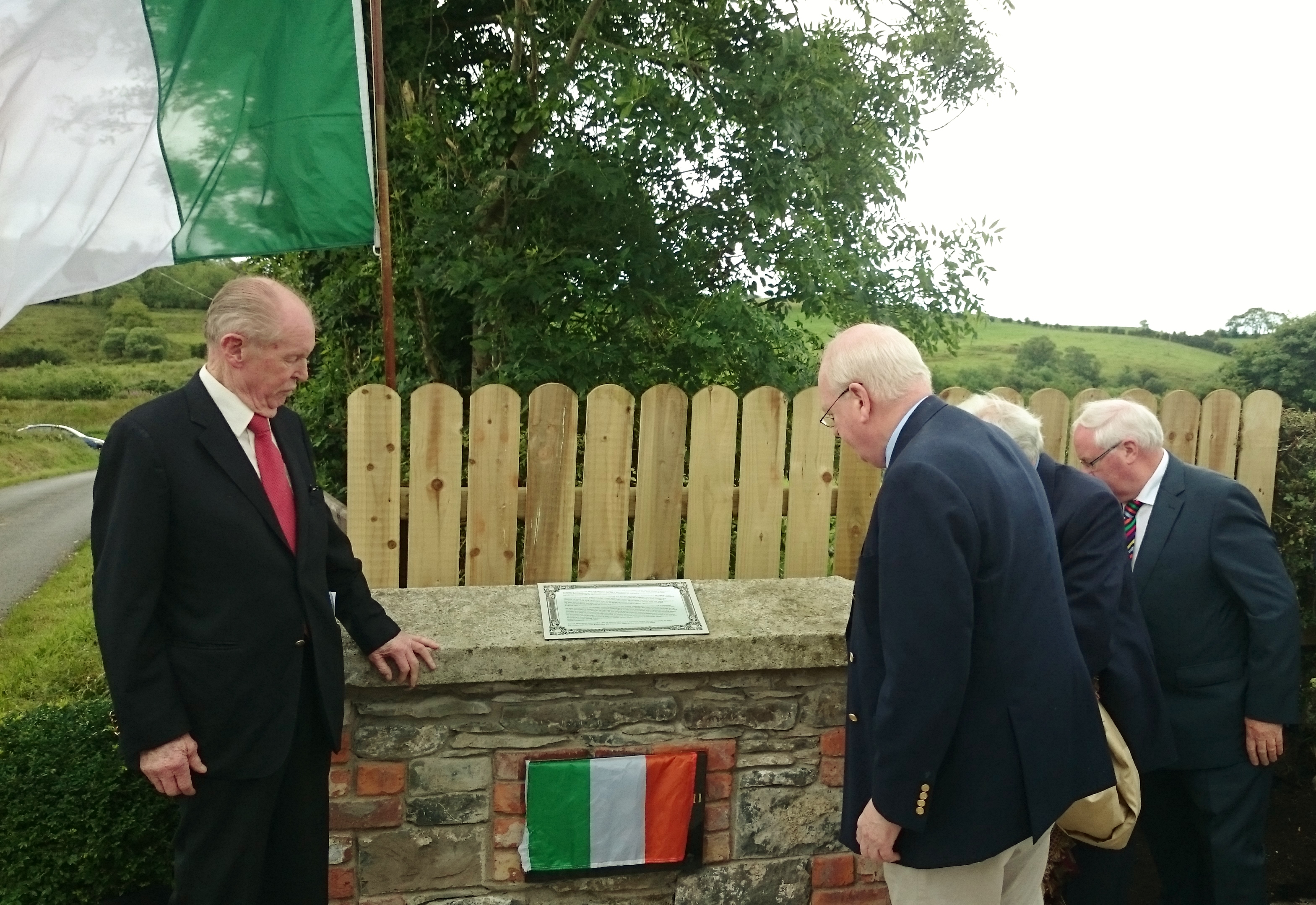
Memories of the War of Independence in County Monaghan and Civil War which divided the allegiances of some families were evoked during the unveiling near Threemilehouse on Sunday of a memorial plaque to honour former Monaghan TD Dr Paddy Mac Carvill.
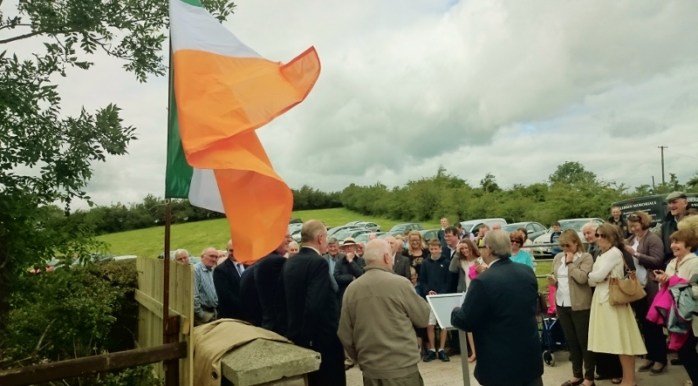
Crowd listens as Mackie Moyna Jnr addresses the gathering Photo:  © Michael Fisher

Crowd listens as Mackie Moyna Jnr addresses the gathering Photo: © Michael Fisher

The ceremony was performed by the former Tánaiste and Minister for Justice, Michael McDowell S.C., who is married to Niamh Brennan, a granddaughter of Dr Mac Carvill. The former leader of the Progressive Democrats said Dr Mac Carville whose background and history, elected three times to Dáil Éireann, contained lessons for us all. He told the assembled crowd he was proud that his three sons had the blood in their veins of such a patriot, scholar and gentleman. It was most important that his memory and great patriotism be kept and observed in his native county, especially in this decade of centenaries.
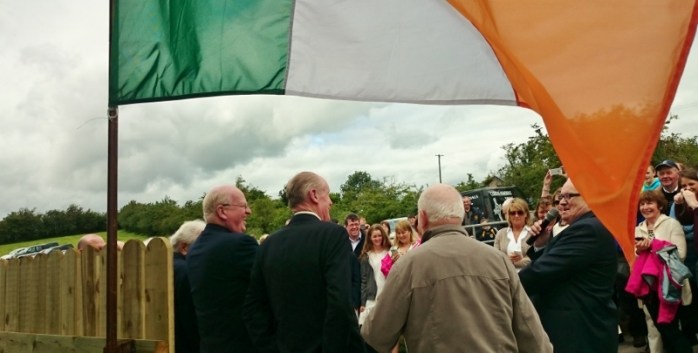
Mackie Moyna Junior (Dublin) raises a laugh as he addresses the gathering Photo:  © Michael Fisher

Mackie Moyna Junior (Dublin) raises a laugh as he addresses the gathering Photo: © Michael Fisher

The simple black stone plaque is engraved with the name of Dr Mac Carvill and the dates May 1893 – March 1955. The plaque is set into a rebuilt stone wall at the entrance to the former MacCarvill homestead at Blackraw in the parish of Corcaghan.

Michael McDowell SC is watched by Paddy Mac Carvill's son Niall (left) and Brendan Smith T.D. (right) as he unveils the plaque and memorial at Blackraw  Photo:  © Michael Fisher

Michael McDowell SC is watched by Paddy Mac Carvill’s son Niall (left) and Brendan Smith T.D. (right) as he unveils the plaque and memorial at Blackraw Photo: © Michael Fisher

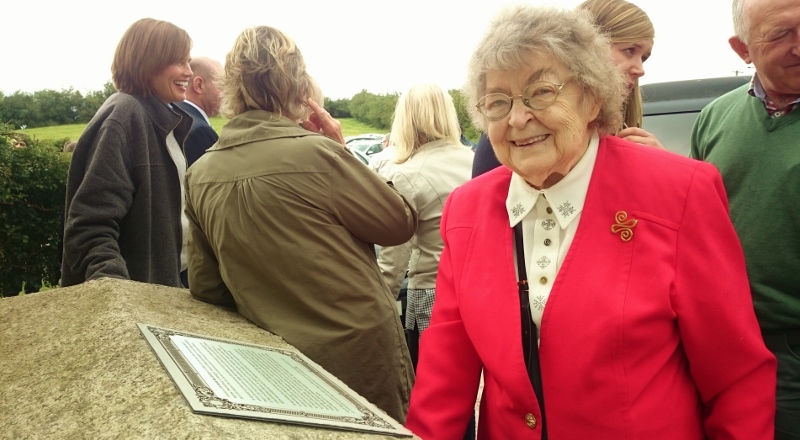
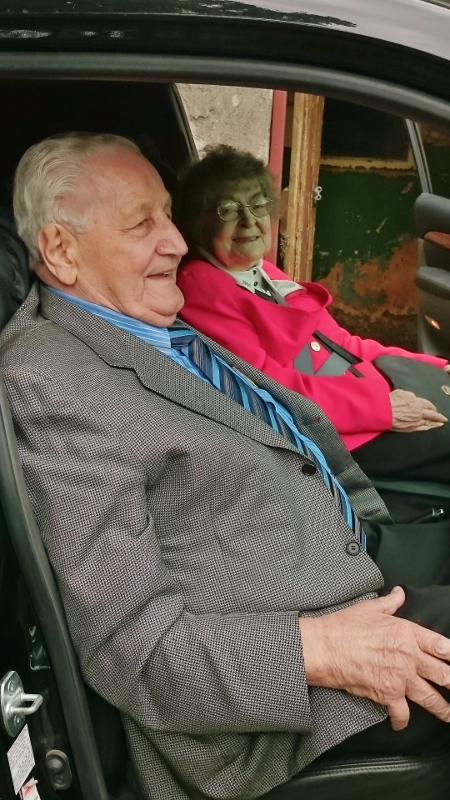
Dr Mac Carvill’s daughter, 90 year-old Maire Brady from Cork, travelled to Monaghan for the occasion as did his son Niall from Dublin. Two of his five children, Éilish and Éimhear (also a medical doctor) passed away in recent years. The Moyna family were also represented, with twins Mackie (Dublin) and Tommy both present, as well as Tommy (junior), Scotstown. Mackie Moyna (junior) read a speech on behalf of his uncle.
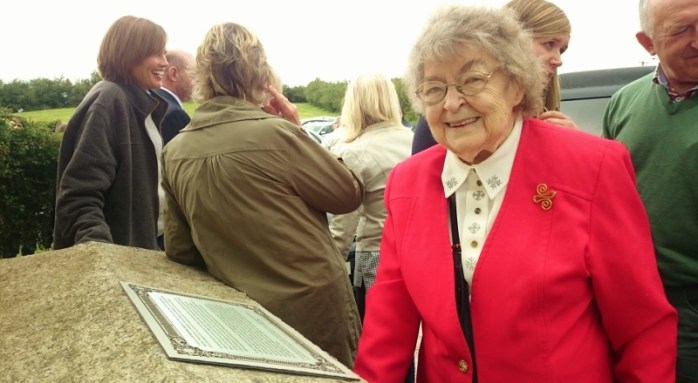
Dr Mac Carvill's daughter Maire Brady from Cork at the memorial to her father Photo:  © Michael Fisher

Dr Mac Carvill’s daughter Maire Brady from Cork at the memorial to her father Photo: © Michael Fisher

Following the unveiling, some of the relatives took the opportunity to stroll up the lane and visit the former family homestead, now derelict and owned by the Reilly family. It used to be a thatched house with two bedrooms and the sleeping accommodation for Paddy and his four brothers was in the loft.

Two of Dr Mac Carvill's children, Maire Brady (Cork) and Niall Mac Carvill (Dublin), with their cousin Mackie Moyna (Dublin) and guest speaker Michael McDowell Photo:  © Michael Fisher

Two of Dr Mac Carvill’s children, Maire Brady (Cork) and Niall Mac Carvill (Dublin), with their cousin Mackie Moyna (Dublin) and guest speaker Michael McDowell Photo: © Michael Fisher

In the speech read out on behalf of Mackie Moyna, he detailed how Paddy’s mother Susan was a Moyna before marriage and it was thanks to the generosity of her brother Fr Michael Moyna, Dean of the diocese of Toronto, that the ten children of John and Susan Mac Carvill received an education.

Caoimhghín Ó Caokain T.D. speaking to Mackie Moyna after the unveiling of the plaque  Photo:  © Michael Fisher

Caoimhghín Ó Caokain T.D. speaking to Mackie Moyna after the unveiling of the plaque Photo: © Michael Fisher

Paddy, the youngest of the clan, attended Drumsheeny National School until he was twelve and then entered St Macartan’s College in Monaghan as a boarder, followed by St Michael’s in Enniskillen, where his older brother, Fr Michael, was a curate. At 18 he entered UCD as a medical student and took first place in Ireland in his final exams.

Two of Dr Mac Carvill's children, Maire Brady (Cork) and Niall Mac Carvill (Dublin), with Brendan Smith T.D. (left)  Photo:  © Michael Fisher

Two of Dr Mac Carvill’s children, Maire Brady (Cork) and Niall Mac Carvill (Dublin), with Brendan Smith T.D. (left) Photo: © Michael Fisher

As a young doctor Patrick Mac Carvill and his brother Johnny were involved in the IRA in Monaghan in 1919 in the war against the Black and Tans. He was elected as a Republican TD, imprisoned at different times by the British and Free State governments in Belfast, Wormwood Scrubs in London, Dartmoor, as well as Mountjoy and Kilmainham in Dublin. He also went on hunger strike at one stage. His fiancée and future wife, Eileen McGrane, was Michael Collins’s secretary when he was on the run, was captured and imprisoned by the British and later by the Free State government, joining McCarvill on hunger strike.
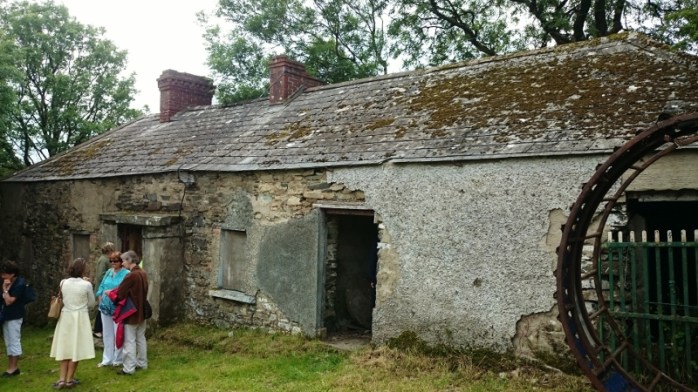
Some of Dr Mac Carvill's relatives visiting the family home after the unveiling of the plaque  Photo:  © Michael Fisher

Some of Dr Mac Carvill’s relatives visiting the family home after the unveiling of the plaque Photo: © Michael Fisher

Paddy Mac Carvill was medical officer to the 5th Northern Division of the IRA and was at the rescuing of Matt Fitzpatrick from the County Hospital in Monaghan.

In August 1923 President Cosgrave dissolved the Dáil and announced a snap General Election for the fourth Dáil.  This election caught the anti-Treaty Sinn Féin party unprepared, yet 44 members were elected and one of those was Paddy Mac Carvill, representing his county of Monaghan as he had also done in the election of June 1922.

In 1924 Paddy Mac Carvill returned to live in Dublin and in 1925 he married his fiancée Eileen McGrane, who hailed from Co Westmeath and who had been a prisoner in Mountjoy when Paddy was transferred there from Dartmoor.

In the June 1927 eletion Paddy Mac Carvill stood as a Fianna Fáil candidate and again was elected for County Monaghan.  He took his seat in August but when a snap election was called the following month he decided to retire from politics and concentrated on his medical practice.  .

Paddy Mac Carvill gained eminence in his profession, becoming a specialist in dermatology and lecturing on the subject in UCD. He was a consultant to St Anne’s and St Luke’s Hospitals as well as Temple Street Children’s Hospital and the National Maternity Hospital at Holles Street.

On May 22 1946, Paddy Mac Carvill wrote to de Valera regarding the sacking of his brother Johnny from his position as manager and secretary of Monaghan Bacon Company, of which Dr Con Ward T.D. was managing director.  Mr de Valera established a tribunal to investigate the allegations. The tribunal did not report that Dr. Ward was guilty of any improper conduct in the actual execution of the duties that pertained to his role as Parliamentary Secretary in the Department of Local Government and Public Health but he offered his resignation and it was accepted on July 12th 1946, exactly 69 years ago on Sunday.

Éamon de Valera called a snap general election in February 1948.  Paddy Mac Carvill came out of political retirement and stood again in Monaghan as a candidate for Séan Mac Bride’s Clann na Poblachta, as did his brother-in-law Aodh de Blacam for Co Louth.  Neither was elected. Representatives of the de Blacam family attended the plaque unveiling.

Tommy Moyna and his cousin Maire Brady (Mac Carvill) visiting the old family home  Photo:  © Michael Fisher

Tommy Moyna and his cousin Maire Brady (Mac Carvill) visiting the old family home Photo: © Michael Fisher

Reflecting on his other family connections, Michael McDowell, whose grandfather was Eoin Mac Neill, commented: “From the constitutional, nationalist Redmondite lawyer to the anti-Treaty Republican hunger strikers, my three sons’ eight great-grandparents span a broad spectrum of nationalist and separatist activity in those years (around 1919-22). Three of them became parliamentarians; three served multiple prison terms. They each endured a great deal of personal tragedy and sacrifice.”

Patrick Brady from Cork, grandson of Dr Mac Carvill, with his wife and daughter at the former Mac Carvill home   Photo:  © Michael Fisher

Patrick Brady from Cork, grandson of Dr Mac Carvill, with his wife and daughter at the former Mac Carvill home Photo: © Michael Fisher

In the Bureau of Military History records for 1913-21 there is a statement made in 1954 by a Monaghan man James McKenna, then a Garda Superintendent in Bandon Co. Cork, and a native of Aughaloughan, Glaslough. He was Captain of Donagh Company IRA, O/C North Monaghan Brigade, 5th Northern Division, in which Dr Paddy Mac Carvill served. Superintendent McKenna recounts the activities of the North Monaghan Flying Column:

“In September 1920 I joined a Flying Column which was organised by Comdt. D. Hogan who was i/c of the unit. It consisted of about sixteen men. Tom Coffey, Clones, was one Section Leader and I was the other. The other members were Matt Fitzpatrick, Frank Tummin, John Donohue, James Murphy, James Winters, Dr. P. McCarville, Phil Marron, Paddy McCarron, Tom Cosgrave, Billy McMahon, Paddy McGrory, Tom Clerkin and James Flynn. As a column we lay in position awaiting patrols on the Clones/Newbliss road, around Scotstown and near Clogher, Co. Tyrone, but in vain. We took the mails off the Belfast 8. to Clones; train at Smithboro and burned a military repair van at Bragan. The three members of the Column from Newtownbutler, Co. Fermanagh, Matt Fitzpatrick, Frank Tümmin and John Donohue, also John McGonnell, expressed their desire to return to their respectiye units as they felt that While our living quarters were in the Knockatallon Mountains we could not contact the enemy except in units too strong for our strength and equipment. Dan Hogan consented to their request and they immediately left for their units. Early next morning we heard the sound of army lorries coming. Some of them rushed up a mountain road (leading to a shooting lodge of Lord Rossmore) in an effort to cut us off. We all escaped except Dr. McCarville. He and Billy McMahon had stayed the previous night in a house which was nearer the main road than the house we: occupied. The Company Captain, John Brennan, who lived up the mountainside, rushed inland (on hearing the sound of the lorries) to guide the doctor and McMahon to safety. He took them by the course we had gone. As they approached a gap in a mountain ridge the military had advanced more than when we had passed, and fired an occasional shot at the three men. The doctor got nervous and took cover behind the bank of a mountain stream and was captured. Brennan and McMahon continued on and escaped safely. We were also under long range fire when retreating. There was snow on the mountains, not sufficient to completely cover the heather, which made visibility poor and favoured us. We fired an occasional shot on the military to delay their advance as we expected the doctor and McMahon to follow us. The military burned our living quarters and we all returned to our units.”  

Plaque and Memorial to Dr Patrick Mac Carvill at the family homestead in Blackraw, Threemilehouse, Co. Monaghan Photo:  © Michael Fisher

Plaque and Memorial to Dr Patrick Mac Carvill at the family homestead in Blackraw, Threemilehouse, Co. Monaghan Photo: © Michael Fisher

CEREMONY AT ISLANDBRIDGE

Heather Humphreys T.D.  Photo:  © Michael Fisher

Heather Humphreys T.D.
Photo: © Michael Fisher

Minister for the Arts, Heritage and the Gaeltacht and Cavan/Monaghan T.D. Heather Humphreys has had a very busy diary of engagements since her appointment to the Cabinet just less than twelve months ago. Yesterday she was with An Taoiseach launching the new online search facility for genealogists at the National Library, where old Catholic parish registers that were on microfilm have been digitised.

Today Minister Humphreys attended the Royal British Legion’s annual ceremony at the National War Memorial Gardens at Islandbridge in Dublin. She read a lesson and also laid a laurel wreath. Tomorrow there will be a national day of commemoration at the Royal Hospital in Kilmainham at 11am. Speaking ahead of the ceremony the Minister said: Speaking ahead of the ceremony Minister Humphreys said:

“This ceremony remembers the Irish men and women who died during the two world wars. Just last week I travelled to the Somme to mark the 99th anniversary of what was the bloodiest battle of World War One, claiming thousands of Irish lives.

“Through the World War One commemorative events, we have gained a much greater understanding of the scale of Irish sacrifice and suffering. Families have, for the first time, discovered that their relatives went to the Front to fight, and many of them never returned home.

“One hundred years on, Ireland is respectfully remembering its sons and daughters who served in what was a horrific conflict. Events such as this one help us not only to pay respect to those who died, but also to recognise how far we have come over the last century.”

Royal British Legion Ceremony of Remembrance

Royal British Legion Ceremony of Remembrance

In the Irish Times, Marie O’Halloran reports as follows:

“The Sinn Féin Lord Mayors of Dublin and Belfast and the Sinn Féin Speaker of the Northern Ireland Assembly have laid wreaths at a ceremony in Dublin to commemorate the dead of the first and second World Wars. Minister for Arts, Heritage and the Gaeltacht Heather Humphreys led the wreath­laying at a ceremony organised by the Royal British Legion in Ireland at the National War Memorial Gardens in Islandbridge, Dublin. Members and veterans of the British Armed Forces, along with members of the Defence Forces, attended the annual commemoration, which was first held in 2006 to mark the 90th anniversary of the Battle of the Somme. It is now held on an annual basis on the Saturday before the National Day of Commemoration.

Ms Humphreys laid a laurel wreath at the cenotaph, as did newly elected Dublin Lord Mayor Cllr Críona Ní Dhálaigh and Lord Mayor of Belfast Cllr Arder Carson. Poppy wreath Ceann Comhairle Sean Barrett laid a poppy wreath, while Speaker of the Assembly Mitchel McLaughlin laid a laurel wreath. Poppy and laurel wreaths were laid by representatives of the diplomatic corps and others from a number of states including the Vatican, Japan, Republic of Cyprus, the UK, the Russian Federation, Netherlands, Australia, India, France, Nigeria, Lithuania, Germany, the US and Kenya. In all more than 100 wreaths were laid during the ceremony, introduced by Lt Col Ken Martin, chairman of the Royal British Legion in the south.

He told almost 1,000 people in attendance that they were in a “garden of exquisite beauty” in the centre “of what can only be described as the finest national memorial to the sacrifice of a nation, in Europe”. They were there, he said, to remember the sacrifice for the defence of small nations. Archdeacon of Ferns Christopher Long said that every war was cruel, but the first World War “was unlike any other ­ unspeakable carnage, the unbearable loss, the almost unbelievable bravery”. He said it was a conflict that spread from the western front to the deserts of the Mediterranean, from the plains of Poland to the frozen mountains of Austria, touching and ending millions of lives. Dismissed as ‘pointless war’ “Too often it is dismissed as a pointless war, wrought by people who didn’t know why they were fighting. I believe that to be wrong. Men signed up to prevent the domination of a continent, to preserve the principle of freedom that we cherish today.” He added that “we should never fail to cherish peace in our country, and never underestimate the patient work it has taken to build and to maintain that peace”.

Members of the Royal British Legion paraded at the start of the ceremony to the accompaniment of the Army No 1 Band, and during the ceremony as the wreaths were laid the band was accompanied by the Tramore Ladies Choir. The lament ‘Oft in the Stilly Night’ was played as wreaths were laid at the memorial. Ms Humphreys read a lesson during the ecumenical ceremony.

Head of the Defence Forces Chaplaincy Monsignor Eoin Thynne HCF

Head of the Defence Forces Chaplaincy Monsignor Eoin Thynne HCF

Head chaplain of the Defence Forces, Msgr Eoin Thynne read the bidding prayers for all those who suffered as a result of conflict. He prayed “for peace­makers and peace­keepers who seek to keep this world secure and free”. Minute’s silence The Last Post was played and president of the Royal British Legion in the south Major Gen The O’Morchoe read the exhortation: “They shall grow not old, as we that are left grow old. Age shall not weary them, nor the years condemn. At the going down of the sun and in the morning, we will remember them.” A minute’s silence was observed and the Reveille played and the dedication then read: “When you go home, tell them of us and say, for your tomorrow we gave our today.”

Speaking to reporters after the ceremony, Ms Humphreys said: “So many thousands of Irish men lost their lives in the first World War…It didn’t matter whether they were unionist or nationalist, it didn’t matter whether they were Protestant or Catholic ­ the bombs and the bullets of war treated them all the same. So it’s nice that we’re all here today to remember those who lost their lives in the first World War.”

AIR CORPS TWIN PILOTS

The two Air Corps Lieutenant Mohans with their grandmother Teresa (centre), parents Brian and Geraldine and brother Barry (left) and sister Aoife Swarbrick (right)  at the ceremony in Baldonnel. Photo courtesy of Brian Mohan

The two Air Corps Lieutenant Mohans with their grandmother Teresa (centre), parents Brian and Geraldine and brother Barry (left) and sister Aoife Swarbrick (right) at the ceremony in Baldonnel. Photo courtesy of Brian Mohan

HIGH FLYING MOHAN TWINS CELEBRATE AIR CORPS COMMISSIONS  

Northern Standard  Carrickmacross News Thursday 16th April

It was a proud moment for grandmother Teresa Mohan from Woodlands in Carrickmacross as she saw her twin grandson Frankie Mohan receive his Air Corps pilot’s wings and his commission as an army Lieutenant. There was a double reason for celebration at the Air Corps headquarters at Baldonnel in County Dublin. Frankie was joining his twin brother Eugene, who had been commissioned in February last year, and is already serving in the Air Corps. The two Lieutenants were accompanied by their parents, Garda Inspector Brian Mohan (based in Dundalk) and Geraldine, who is originally from Essexford, Killany.

Brian’s brother Niall Mohan, his wife Lorraine and son Barry, all from Carrickmacross, were at the ceremony, along with his sister Sadie Maloney, now living in Ennis. His brother-in-law Francie Thornton and his wife Anne, also from Carrickmacross, were there along with other family and friends. They included the twins’ sister Aoife, who is married to Dave Swarbrick, an airline captain based in Dubai, and their five months old son Harry.

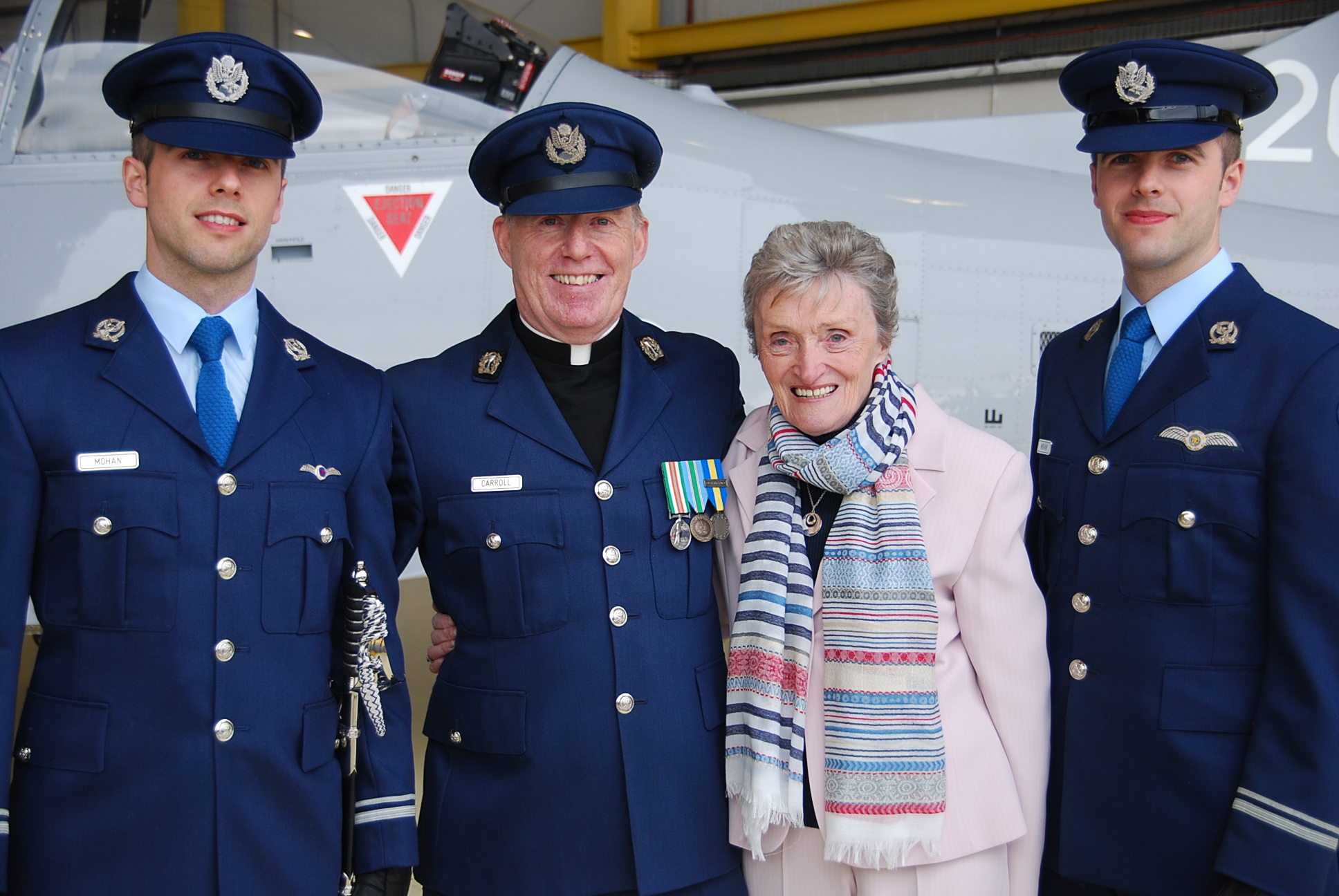
Lieutenants Frankie and Eugene Mohan with Air Corps Chaplain Fr Jerry Carroll and their grandmother Teresa Mohan from Carrickmacross.  Photo courtesy of Brian Mohan

Lieutenants Frankie and Eugene Mohan with Air Corps Chaplain Fr Jerry Carroll and their grandmother Teresa Mohan from Carrickmacross. Photo courtesy of Brian Mohan

The ceremony at Baldonnel began with Mass celebrated by the Air Corps chaplain, Fr Jerry Carroll from Carrickmacross. He is a former pupil of St Macartan’s College, Monaghan, which he attended along with Brian Mohan. Fr Jerry anointed the hands of the new pilots, who were presented with their wings by the General Officer Commanding the Air Corps, Brigadier General Paul Fry. In the presence of the Defence Forces Chief of Staff, Lieutenant General Conor O’Boyle, they were then presented by the Minister for Defence Simon Coveney T.D. with their presidential commissions. The other four class members were

Mark Doyle, David Finnegan, Kevin Fitzgerald and James Northover. During the Wings ceremony, Brigadier General Fry congratulated the new pilots on their achievements and thanked their families and friends for supporting them throughout their cadetship.

Frankie Mohan was one of five in the 31st Regular Air Corps Cadet Class and began his cadetship in September 2012. The first ten months was the most challenging, as it was spent on military socialisation in the Curragh. It involved rigorous physical training, military drills, deportment, field craft and weapons handling.

Frankie went to Baldonnel to begin his flight training in July 2013. This lasted for eight months and involved instruction on fifteen diverse aviation related subjects, ranging from principles of flight to human performance and limitations. The class trained internally in the Flight Training School and externally with the Irish Aviation Authority, qualifying them to EASA Airline Transport Pilots License standard.

Eugene Mohan was one of three members of the 30th Air Corps Cadet Class and began his cadetship in September 2011. He went through the same arduous training and has recently completed his training as a helicopter pilot. Their parents Brian and Geraldine extended a huge congratulations to the twins, who they said had worked extremely hard to achieve their dreams. Eugene, who studied engineering at DIT Bolton Street had applied to join the Cadets on five occasions and never gave up hope that one day he would be an Air Corps pilot. Frankie, an engineering graduate of TCD, gave up a lucrative commercial diving engineer’s job to realise his dream of becoming a pilot. Now the Mohan twins are flying high together, in the service of the state.

“PARADE: FALL OUT”

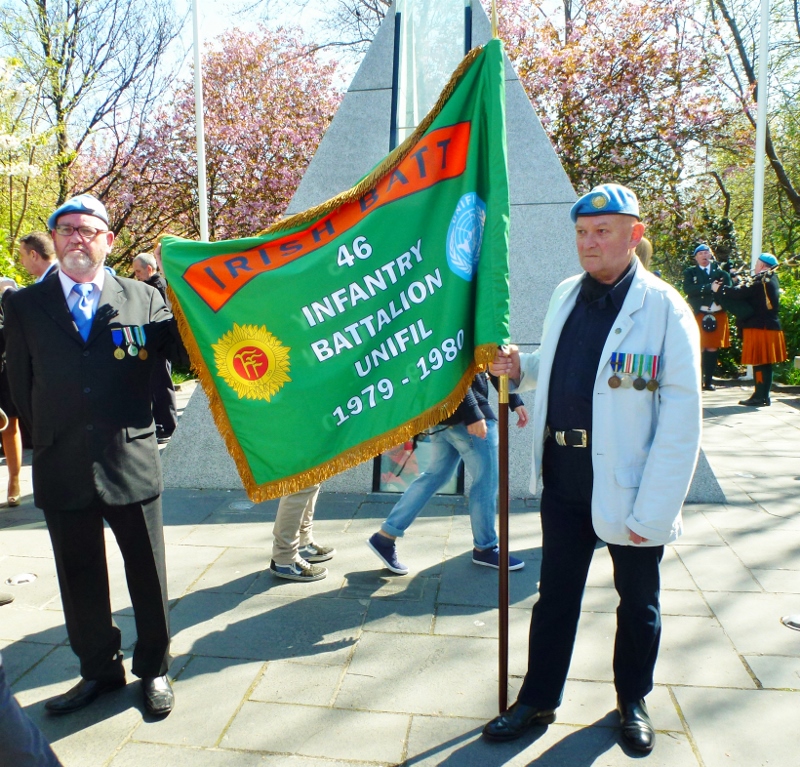
Flag of 46th Infantry Battalion UNIFIL at the National Memorial  Photo © Michael Fisher

Flag of 46th Infantry Battalion UNIFIL at the National Memorial Photo © Michael Fisher

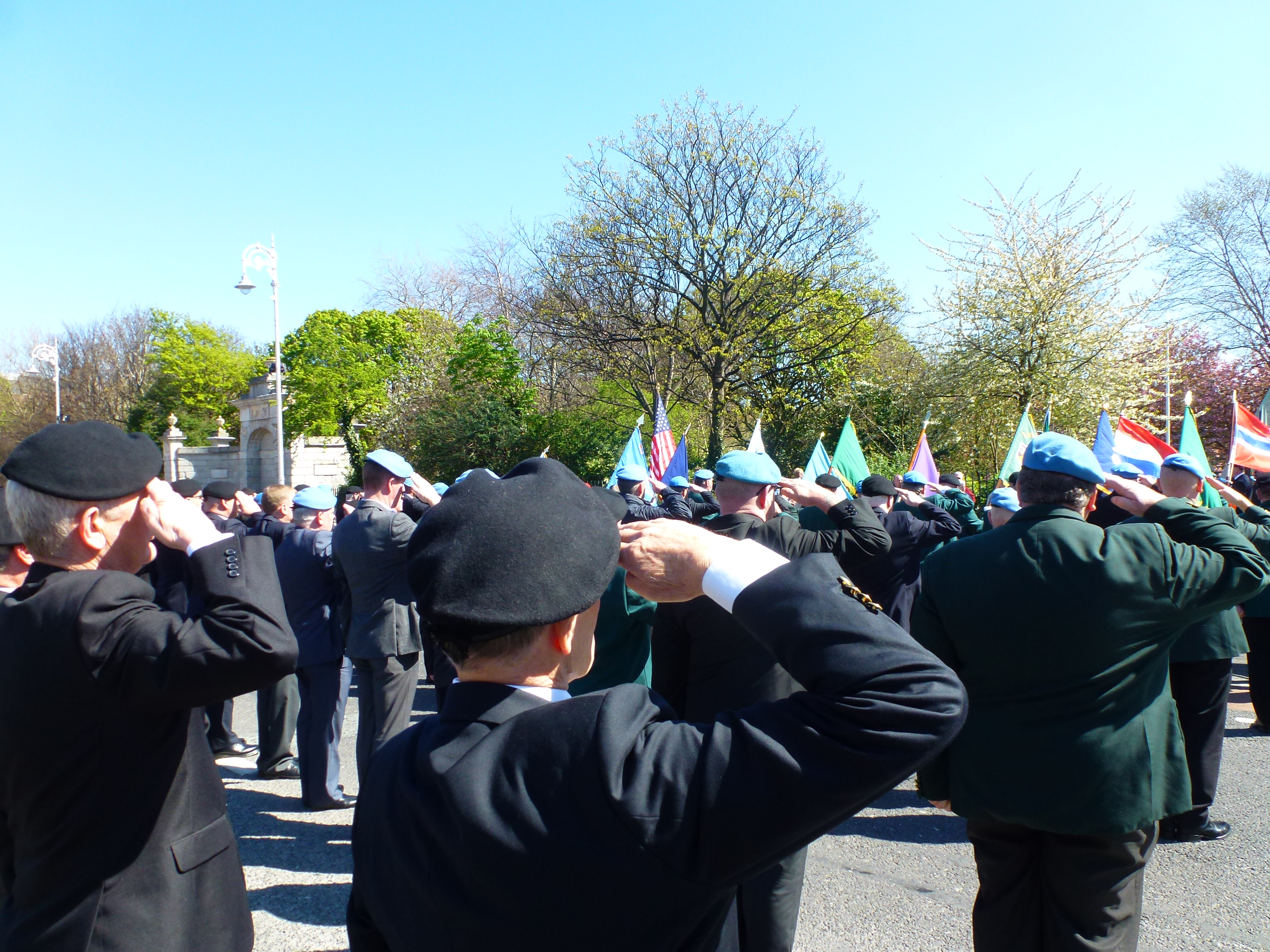
Paráid Aire! Paráid Lig Amach! The Irish UN veterans and ex-servicemen were on parade and the commands and the response to them (Parade: Attention! Parade: Fall Out!) were carried out with military precision and bearing. Pride of place in the parade at Merrion Square was given to members of the 46th Infantry Battalion. Wreaths were laid at the National Memorial to members of the Defence Forces who gave their lives in the service of the state. It was a very fitting end to the Smallhorne and Barrett campaign, which has now been stood down.

The pyramid shape of the memorial, which was designed by Brian King and opened in November 2008, captures references to burial and is a standing testament to the dead. It also reflects the shape of a military tent. Within the pyramid, four bronze figures, representing all elements of the Defence Forces, stand guard over the eternal flame that emanates from the badge of the Defence Forces. The flame burns in perpetual memory of those members of the Defence Forces who have made the ultimate sacrifice.

Last July a parade by former soldiers was held in Ballsbridge to the US Embassy seeking the extradition to Lebanon of 71 year-old Mahmoud Bazzi, the main suspect in the murder of the two Irish soldiers Private Derek Smallhorne and Private Thomas Barrett in Lebanon 34 years ago.

Minister for Defence Simon Coveney welcomed the arrest later that month of Mr Bazzi. He said he hoped it was the start of a process to bring the alleged perpetrator of a “heinous crime” to justice and said the Irish government would do “everything possible” to pursue justice.

The ice cream seller originally from Lebanon, was arrested at his home in Dearborn, Michigan by US immigration officials. He was subsequently deported to Lebanon in January.

Private Smallhorne and Private Barrett were abducted and shot dead in 1980 in south Lebanon after their UN peacekeeping convoy was stopped by armed members of a Lebanese militia. A third soldier, John O’Mahoney, was shot and injured but survived. The killings were believed to be revenge attacks after Irish soldiers killed a Lebanese militia member in an exchange of fire.

“The United States Government is asserting that Mr Bazzi does not have legal status in the United States and should not be present in the United States,” Vincent Picard of US immigration told RTÉ Radio. The deaths of the two Irish soldiers “was part of the investigation” into Mr Bazzi, he said.

Pte Barrett’s daughter Karen Barrett said the family have sought justice for her father’s killing for the past 34 years and exhausted all avenues in the Irish legal system.

Defence Minister Simon Coveney described it as a “first step” on what will “possibly be a further long and difficult road”. He and the government would “ do everything possible to pursue justice” for the peacekeepers, he said. Mr Coveney said the matter had been “continually pursued” over the years with all available channels in the Lebanon and US by successive Ministers for Defence, Foreign Affairs, officials and military authorities.

Taoiseach Enda Kenny raised the issue with the Lebanese authority during a visit last year to Irish troops serving with UNIFIL, he said. He said thoughts should be with the families of Privates Barrett and Smallhorne whose efforts and those of comrades “have ensured this issue was never forgotten”.

Campaigning on the families behalf, the group called Justice for Smallhorne and Barrett, met with American officials in Dublin last June to request US action against Bazzi. Ms Barrett said the families were ‘eternally grateful’ to the support group for their commitment and described the 34 year campaign for justice as ‘extremely difficult.’

Bazzi entered the US just over 20 years ago without proper documentation and admitted lying to obtain lawful immigraion status. He could ultimately stand trial for the abduction, torture and double killings while serving with a Christian militia. Mr Bazzi was transported in January on a commercial flight from Detroit, where he had been living, to Beirut under escort by officers with the Enforcement and Removal Operations agency. He was handed over to Lebanese authorities. Reacting to the news Karen Barrett, daughter of the late Thomas Barrett, said at the time the Barrett family was delighted to hear the Lebanese authorities had now detained Mr Bazzi.

She said it has been a long fight for justice and they hope the Lebanese authorities would give them justice for their father, Derek Smallhorne and John O’Mahony (who was shot an injured in the incident). She added her father gave his life protecting the Lebanese and the family hope this matter will now be addresssed. Ms Barrett also thanked those who have assisted them getting to this point including Simon Coveney and the Justice for Barrett and Smallhorne campaign.

Minister for Defence Simon Coveney welcomed the arrest and detention of Mr Bazzi. “I believe that this is a significant step in the pursuit of justice for Privates Thomas Barrett and Derek Smallhorne who lost their lives while on United Nations peace-keeping duty in Lebanon almost 35 years ago. It is an important day for the families and I wish to commend them for their continued commitment to securing justice for their loved ones.”

Mr Coveney added be believed the development to be very positive. Privates Smallhorne and Barrett were on duty with the UN Interim Force in Lebanon near the Israeli border on 18th April 1980 when they were captured. They had been in a three-vehicle convoy that was stopped by the South Lebanese Army, which was controlling the war-torn region at the time and in conflict with the Palestinian Liberation Organisation. Tension was high in the area on the day of the attack as the peacekeepers moved supplies to a border post. Twelve days earlier clashes between the SLA and Dutch and Irish soldiers serving with the UN left an Irish man and a militia man dead. The SLA had vowed to avenge the killing.

The field officer director for the Enforcement and Removal Operations agency Rebecca Adducci said: “ERO will continue to focus enforcement resources on individuals who lie and commit fraud to gain status in the United States. This removal should provide a stark warning to those who seek to game the system to obtain immigration benefits. This removal is the culmination of a sophisticated and meticulous investigation by several ICE components,” said Marlon Miller, special agent in charge of Homeland Security Investigations Detroit. “ICE is committed to ensuring the United States does not serve as a safe haven for individuals seeking to distance themselves from their pasts.”

The Final Salute  Photo © Michael Fisher

The Final Salute Photo © Michael Fisher

MONAGHAN ARMY MEMORIAL

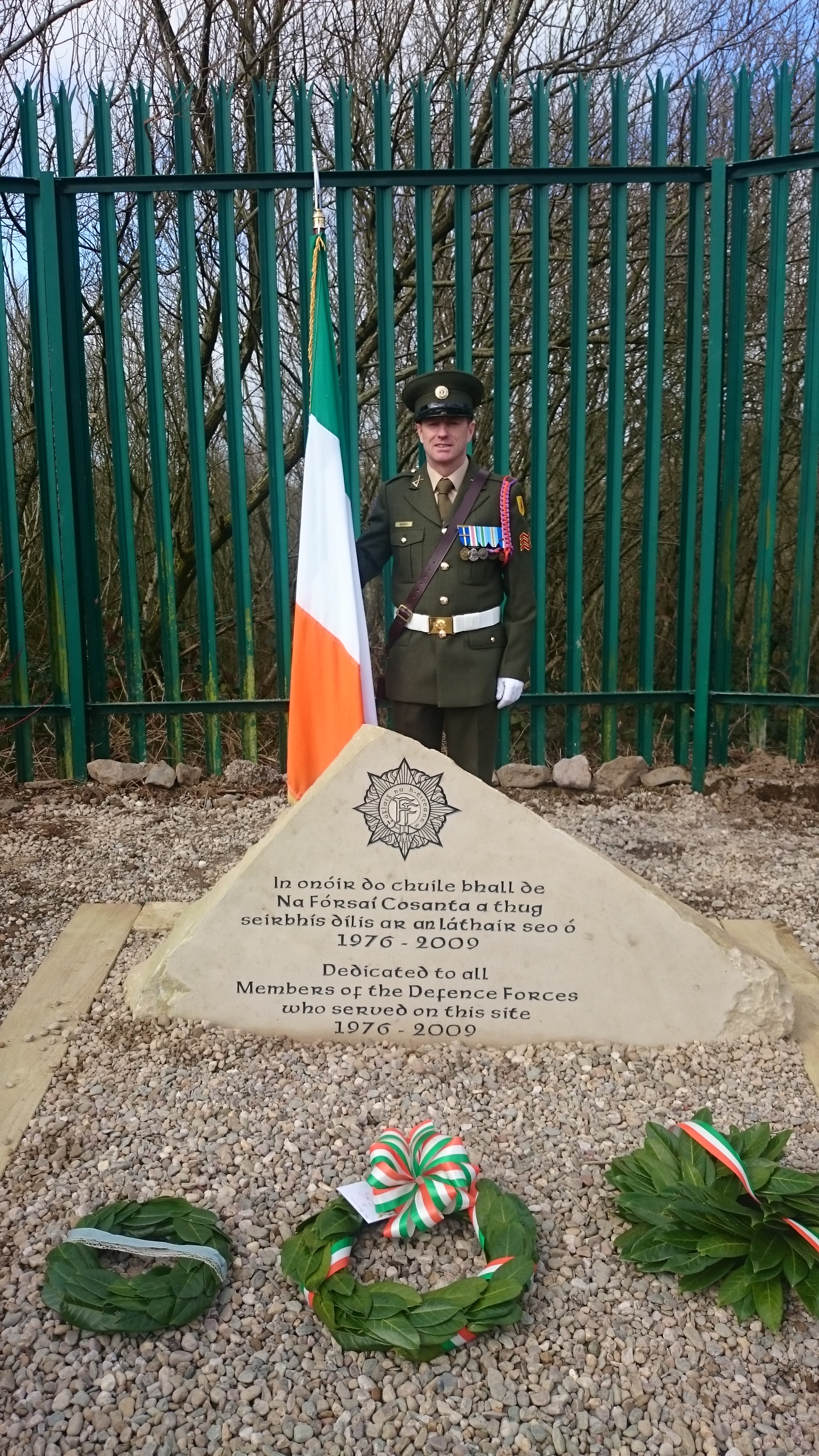
Commemorative stone for DF members who served in Monaghan Barracks 1976-2009, designed by Marc Kelly, Emyvale. Photo:  © Michael Fisher

Commemorative stone for DF members who served in Monaghan Barracks 1976-2009, designed by Marc Kelly, Emyvale. Photo: © Michael Fisher

ARMY’S CONTRIBUTION TO MONAGHAN COMMEMORATED AT FORMER BARRACKS SITE

MICHAEL FISHER  The Northern Standard  Thursday March 26th p.

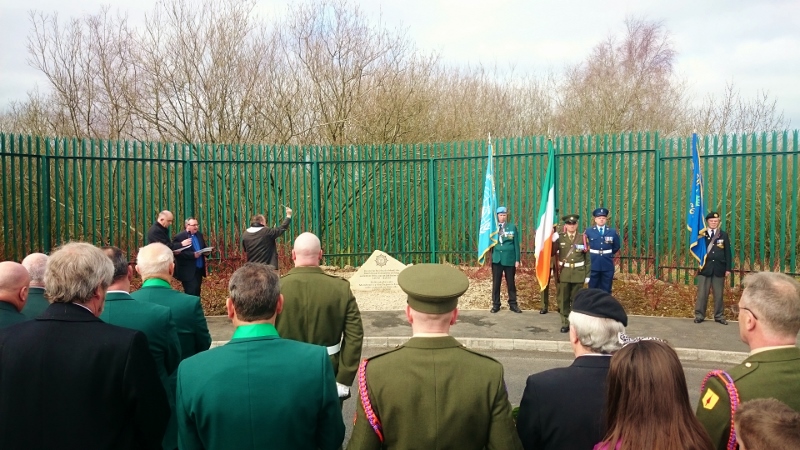
Blessing of commemorative stone by army chaplain Fr Bernard McKay Morrissey, CF Dundalk  Photo:  © Michael Fisher

Blessing of commemorative stone by army chaplain Fr Bernard McKay Morrissey, CF Dundalk Photo: © Michael Fisher

The tricolour was lowered for the last time at Monaghan Army Barracks in January 2009 and the gates were closed as the Defence Forces moved out. It was one of four army posts put up for sale by the government. Most of the soldiers based there transferred to the Headquarters of the 27th Infantry Battalion at Aiken Barracks in Dundalk.

Former Sgt Dennis Barry (centre), Monaghan Barracks Association with colour party: Mick Donoghue IUNVA Post 15 Cavan (left) and Wally Barry ONE Tanagh Branch (right) Photo:  © Michael Fisher

Former Sgt Dennis Barry (centre), Monaghan Barracks Association with colour party: Mick Donoghue IUNVA Post 15 Cavan (left) and Wally Barry ONE Tanagh Branch (right) Photo: © Michael Fisher

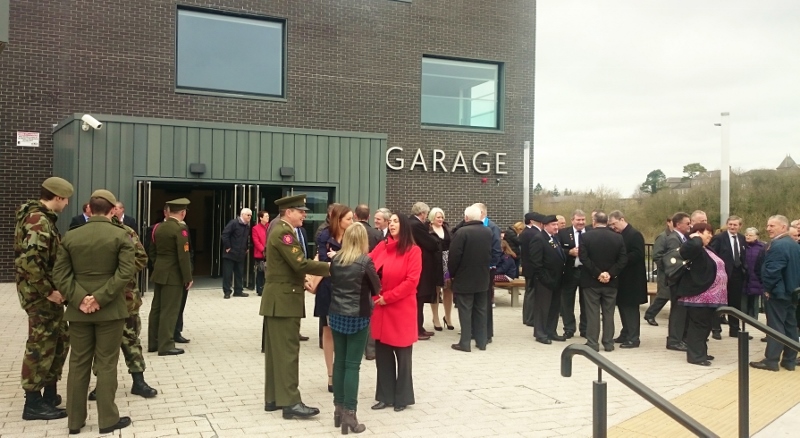
It might have remained a derelict site for many years. But it has since been transformed into an Education Campus that includes a new Garage Theatre, as well as two schools and the Monaghan Institute. The complex which was developed by the Cavan Monaghan Education Board under its Chief Executive Martin O’Brien was officially opened last month by An Taoiseach Enda Kenny.

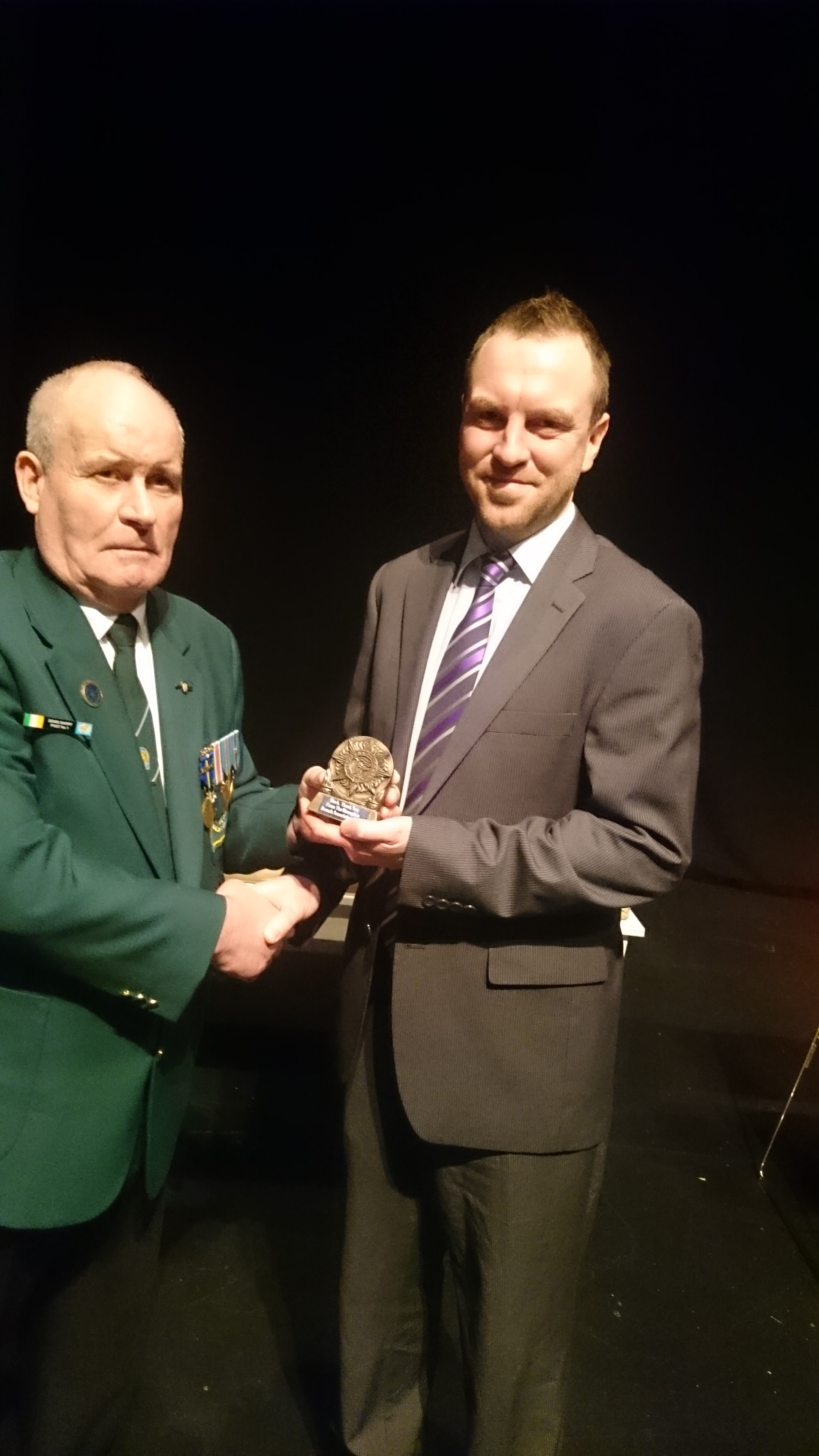
Dennis Barry presents sculptor Marc Kelly with a DF crest to mark the occasion Photo:  © Michael Fisher

Organiser Dennis Barry presents sculptor Marc Kelly with a DF cap badge crest to mark the occasion Photo: © Michael Fisher

In order to remember the contribution of thousands of army personnel who passed through the post, a Monaghan Barracks Association was formed by a former Sergeant, Dennis Barry. A native of Clonmel in County Tipperary, he was stationed at the Armagh Road complex for many years. Their way of marking the contribution of the military and their colleagues from the Air Corps and Navy was to commission a stone from Emyvale sculptor Marc Kelly.

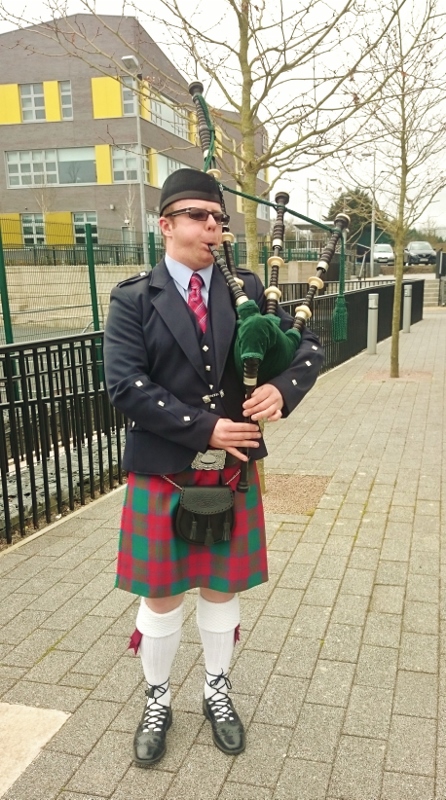
Piper Kevin Murphy, 27 Inf Bn Dundalk, who played a lament as the stone was unveiled Photo:  © Michael Fisher

Piper Kevin Murphy, 27 Inf Bn Dundalk, who played a lament as the stone was unveiled Photo: © Michael Fisher

Last Saturday (March 21st) former army colleagues including UN veterans joined serving members of the 27th Infantry Battalion and the Reserve, along with their families and friends, at the unveiling of the stone.

It was blessed by former Monaghan barracks chaplain, Fr Seán McDermott from Ballinagh, Co. Cavan, Canon Ian Berry, Rector of Monaghan, and Fr Bernard McCay-Morrissey, chaplain of the 27th Infantry Battalion in Dundalk.

Nathan Healy, Castleshane, unveiled the commemorative stone  Photo:  © Michael Fisher

Nathan Healy, Castleshane, unveiled the commemorative stone Photo: © Michael Fisher

The honour of unveiling the stone was given to 10 year-old Nathan Healy from Cavancreevy, Castleshane. His father Private John Healy of the 27th Infantry Battalion came from Dublin and joined the army when he was 19. Private Healy died in October and was given military honours at his funeral in Monaghan.

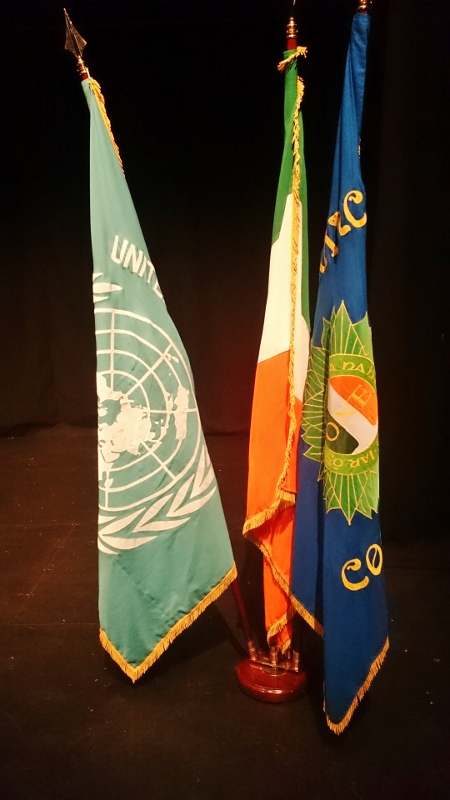
Flags on the stage during the Mass Photo:  © Michael Fisher

Flags on the stage during the Mass Photo: © Michael Fisher

The memorial stone is dedicated to all members of the Defence Forces who served on the site 1976-2009.

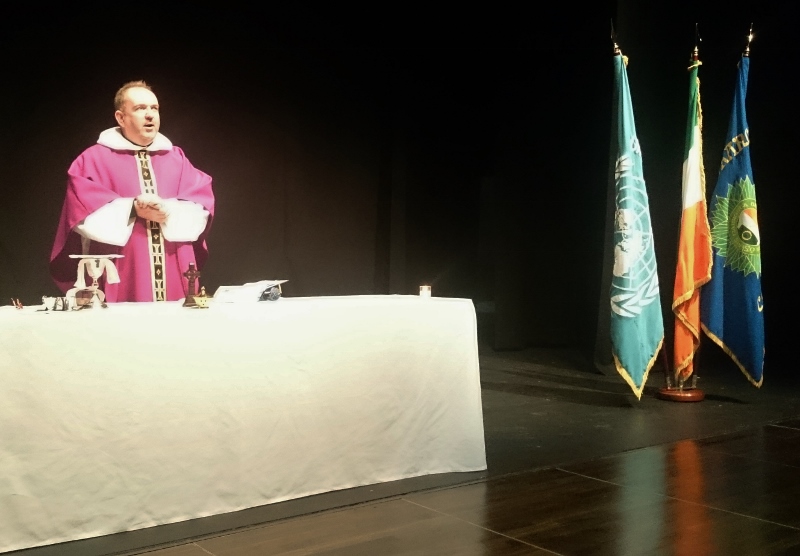
Army Chaplain Fr Bernard McKay Morrissey, CF Dundalk celebrated Mass at the Garage Theatre, Monaghan  Photo:  © Michael Fisher
Army Chaplain Fr Bernard McKay Morrissey, CF Dundalk celebrated Mass at the Garage Theatre, Monaghan Photo: © Michael Fisher

At the start of the commemoration, a Mass was held in the Garage Theatre, celebrated by Fr McCay-Morrissey. He said when the announcement of the closure of the barracks came, it was unexpected. It was a time of anxiety and uncertainty for those affected. But good things had eventually emerged from it, although some were still adapting to the move to Dundalk. Prayers were said for all those who had worked in the barracks, the NCOs and officers and the staff.

Reflection during Mass by John Wilson, remembering all who had been stationed at Monaghan Barracks Photo:  © Michael Fisher

Reflection during Mass by John Wilson, remembering all who had been stationed at Monaghan Barracks Photo: © Michael Fisher

Fr Seán McDermott was chaplain when the barracks closure was announced and recalls that he was with some members of the unit serving overseas at the time.

Colour Party escorting the tricolour Photo:  © Michael Fisher

Colour Party escorting the tricolour Photo: © Michael Fisher

The decision to construct a barracks in Monaghan was made in November 1973 and the complex was opened in December 1976 by then Taoiseach Liam Cosgrave at the height of the troubles in the North. The soldiers who were then part of the 29th Infantry Battalion operated border patrols and served in aid of the civil power (Gardaí). They often found themselves called out to monitor unnapproved border crossings where local residents were filling in craters that had been caused by the British Army. The troops also supported the Department of Agriculture during the foot and mouth, BSE and poultry disease crises.

Not many local people signed up for military service initially, but as the years went by, more recruits came from the Monaghan area. Soldiers of the 27th Infantry Battalion have served in numerous peacekeeping missions around the world, most notably in Lebanon.

Colour party marches off at end of unveiling and blessing Photo:  © Michael Fisher

Colour party marches off at end of unveiling and blessing Photo: © Michael Fisher

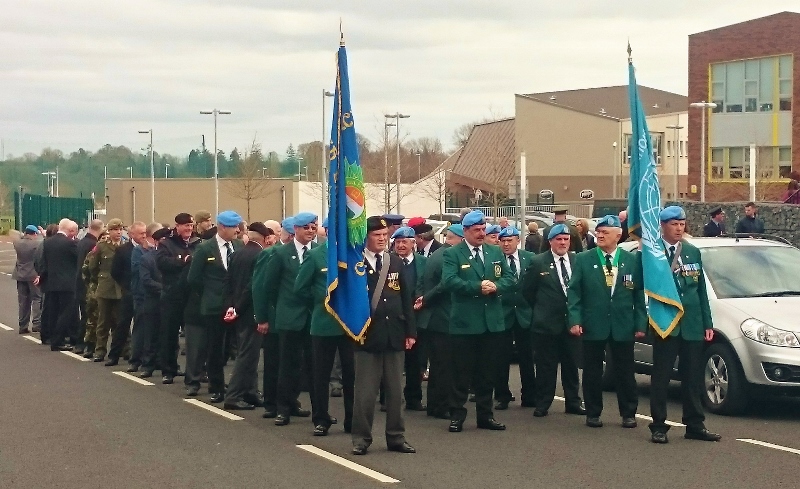
UN veterans were among those who paraded from the Garage theatre to the site of the memorial stone in what was once the transport yard of the barracks.

Parade from Garage Theatre to memorial stone in former transport yard Photo:  © Michael Fisher

Parade from Garage Theatre to memorial stone in former transport yard Photo: © Michael Fisher

Following the ceremony, refreshments were served in the school canteen and young Nathan Healy from Castleshane was given the task of cutting the special cake that had been made for the occasion.

Nathan Healy, Castleshane, cuts the Monaghan Barracks Association cake Photo:  © Michael Fisher

Nathan Healy, Castleshane, cuts the Monaghan Barracks Association cake Photo: © Michael Fisher

MONAGHAN MILITARY REMEMBRANCE

Current and former Defence Forces members gather at Monaghan Education Campus Photo:  © Michael Fisher

Current and former Defence Forces members gather at Monaghan Education Campus Photo: © Michael Fisher

Monaghan’s military past was commemorated at the weekend with the unveiling of a stone at the site of the former army barracks. The site has been redeveloped and is now the Monaghan Education Campus on the Armagh Road, which was formally opened by An Taoiseach last month.

27th Infantry Battalion Shoulder Flash

27th Infantry Battalion Shoulder Flash

The barracks was opened in 1976 as a base for members of the 29th Infantry Battalion who were assigned to border duties and assisting the civil power (Gardaí). The 29th also had a base in Cavan. The Monaghan element was later combined with Castleblayney to become the 27th Infantry Battalion, which has a headquarters at Aiken Barracks in Dundalk. This is where most of the seving personnel transferred to when the tricolour was lowered for the last time at Monaghan barracks in January 2009.

ST PATRICK’S AT THE MAZE

Returning from a brief visit to Birmingham yesterday on Saint Patrick’s Day, I flew into Belfast International Airport. I was at the funeral of a former colleague at BBC Radio Birmingham, now Radio WM, Ken Dudeney. I then remembered that 39 years ago in 1976 I had flown into Aldergrove airport as it was then known as a BBC Radio Birmingham reporter on a very different mission. I had been tasked to do a programme about a British Army regiment doing a tour of duty in the North, the Birmingham Gunners. Their correct title was 39 Medium Regiment Royal Artillery. They had been deployed there for four months on December 4th 1975 and served on that occasion until April 6th 1976. The BBC local radio station had been offered the opportunity by the British Army to meet and record interviews with some of the squaddies an their officers. During that tour of duty, H Battery was on duty securing the perimeter of the Maze prison near Lisburn. 132 Battery was on the border at Aughnacloy, manning the checkpoint on the main Dublin to Derry road. A third section 176 Battery covered Lurgan and Criagavon. Thus it was that on St Patrick’s Day in April 1976 I spent the night at the British Army base at HMP Maze. More of this story later.