UK AMBASSADOR AT MUSEUM

181116PF0906.jpg

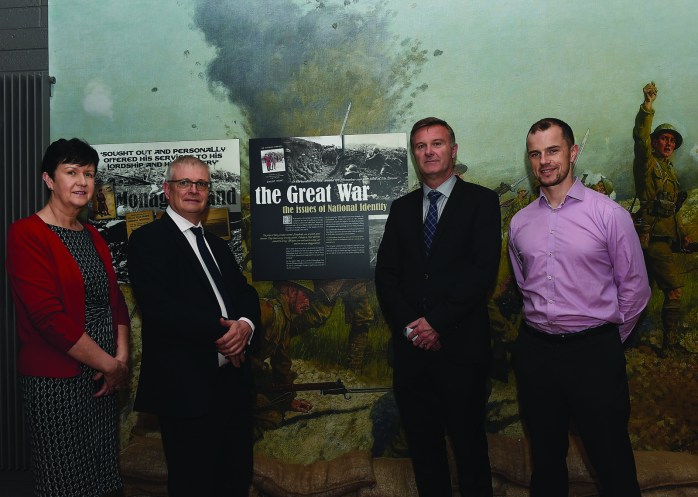
Carmel Thornton (Monaghan Co. Council) with Ambassador Robin Barnett, Eamonn O’Sullivan CEO Monaghan Co. Council and Museum Curator Liam Bradley

British Ambassador visits Monaghan County Museum

The British Ambassador to Ireland, Robin Barnett CMG, paid a visit to Monaghan County Museum recently. The Ambassador was met by the Curator, Liam Bradley, Monaghan County Council Chief Executive Eamonn O¹Sullivan and Administrative Officer Carmel Thornton. The Ambassador was taken on a tour of the museum¹s current exhibition, “From a Whisper to a Roar: Exploring the Untold Story of Monaghan 1916.” Liam Bradley explained what life was like in the county directly before the Easter 1916 Rising politically, economically and socially and how that changed so dramatically following the bombshell of the historic events in Dublin and around the country.

The other focus of the display is the Battle of the Somme. The Curator noted it was estimated that nearly one hundred Monaghan men died during that terrible battle which took place from July 1st to November 18th 1916. Ambassador Barnett noted that this year of commemorations was an opportunity to explore the full story of this period in Irish history. He remarked on the recent event at Glasnevin Cemetery in Dublin, where a Castleblayney man, Thomas Hughes, was commemorated for receiving the Victoria Cross during the Battle of the Somme. Private Hughes VC is one of the key characters explored in the museum¹s exhibition on the historic year of Monaghan 1916.

At the end of his visit the Ambassador thanked the Museum Curator and the staff of the museum for developing such a fascinating display. He expressed a keen interest to return when he had more time to view all of the museum displays. Chief Executive of Monaghan County Council Eamonn O’Sullivan thanked Ambassador Barnett for taking time out of his busy schedule to visit the museum and also thanked the museum staff. The exhibition formed the backdrop for the special celebration marking what would have been the 100th birthday of Sir Jack Leslie of Castle Leslie, Glaslough.

KILLEEVAN GAA HISTORY

ONE HUNDRED YEARS OF KILLEEVAN GAA AND PARISH

Michael Fisher

13178660_10156918796010228_2146363502208284064_n

JP Graham signs the book

John Patrick (JP) Graham from Killeevan is best known for his reports and commentaries on GAA matters. But the journalist is also a local historian. Earlier this year he produced a wide-ranging history of his local Club and parish entitled: “Killeevan Sarsfields GFC: A Centenary History 1915-2015 and a Parish Record”. The book (price €20) has been re-launched in time for the Christmas market and makes an ideal gift for those who have left the area and are living away from home, to remind them of their roots.

13256472_10156918797860228_4652693704130454139_n

GAA Director General Paraic Duffy at the launch of the book

JP set out to record and document the efforts of the founding fathers and the successive generations of people who contributed to the parish. The Director General of the GAA, Paraic Duffy, described the publication as very impressive. He paid tribute to the author for his ‘labour of love’ and for his unfailing, lifelong commitment to the GAA at club and county level. The book is dedicated to JP’s grandson and godson, Aaron Patrick Graham and his other five grandchildren are included in that dedication.

This book traces the story of Killeevan Sarsfields from its foundation back in 1915 when the club was formed by amalgamating the two clubs that existed in the parish at that time, Greenan’s Cross Tir na nOgs and Ture Davitts. The centenary publication traces the development of the club through its glory years in the 1920s, 1930s and 1940s when Killeevan were regarded as Kings, winning the Monaghan senior double of league and championship in 1944. Thereafter the club enjoyed something of a chequered history and went out of existence for one year. But they rose from the ashes to win the intermediate double in 1974 and enjoyed further success in junior ranks in the 1990s.

The official opening of Sarsfield Park in 1983 was a highlight and the book covers in some detail the last couple of decades. Success on the field proved elusive, but a major infrastructural development programme was completed in time for the centenary year. Other aspects of parish history and life are included, with sections on Newbliss village and the development of education in the parish, including records from the old Killeevan National School.

In his introduction JP Graham says he has “tried to give a flavour of all aspects of club activity and the people involved…with a special emphasis on the games and the players. I have also tried to factor in some aspects of the social life of Killeevan club and parish, because the club is central to the parish and touches practically every family in the area”.

The book (published by R&S Printers Monaghan) contains 370 pages and is on sale in Martin’s Londis, Newbliss, Matthews of Clones, and the Eason Bookshop, Monaghan, or directly from the author.

Is leabhar iontach shuimiúil é an leabhar seo, faigh ceann roimh a imionn siad go léir. Maith thú J.P. as an obair iontach a chuir tú isteach.

MCMAHON BURIAL VAULTS INNISKEEN

14207747_10208090917568200_6254796866809712953_o

Surviving walls of the McMahon burial vaults, Inniskeen old graveyard Pic. Mary Kerley/Monaghan Heritage

CONSERVATION PLAN FOR MCMAHON VAULTS INNISKEEN

(Thanks to Joe Callan for the information) Northern Standard Thursday 8th December

Inniskeen Heritage was reformed at a meeting in the Community Centre on Monday last. Great interest has been generated in heritage recently by the publication of Matt Kearney’s book on the McMahon burial vaults in the old graveyard. A heritage plan for the graveyard is being drawn up and the group intends to seek LEADER funding for the conservation of the vaults and the surveying and promotion of the whole village with respect to its early Christian heritage.

The group acknowledges the advice and assistance of the County Heritage Officer, Shirley Clerkin and of Larry McDermott, a member of the original group who now sits on Monaghan Heritage Forum.

At the initial meeting the following officers were elected: Chairperson: Brian Dooley; Vice Chairperson: Tom Lennon; Secretary: Joe Callan; Treasurer: Micheal Magee; Assistant Treasurer: Sean Rafferty and Public Relations Officer: Seamus Mulligan.

It is hoped to stimulate a wider interest locally in the history of the parish. The group plans to hold a public consultation meeting in the near future. You can contact them via email at: inniskeenheritagegroup@gmail.com or speak to any of the committee members with suggestions or contributions.

Monaghan County Council Heritage Office has sought to commission three conservation management plans and a programme of community engagement for a total of four Early Christian era sites. This action comes under the County Monaghan Heritage Plan 2012-2017. The project is funded by Monaghan County Council and the Heritage Council.

The four sites are:

  1. Inniskeen Glebe: Inniskeen round tower and graveyard (McMahon Vaults).
  2. Clones, Crossmoyle, Clones round tower and graveyard.
  3. Killahear, Corlat, Killahear graveyard (Lough Egish).
  4. Errigal Truagh medieval church.

The sites have a wide range of significance values including archaeological, historical, cultural, religious, social, natural and economic. They are geographically spread, and as a result involve a number of parishes and their associated communities. In all cases local groups exist that are keen to manage and understand these sites more effectively.

Historically, the sites are linked during the early Christian period, as well as thematically using contemporary heritage meanings. Inniskeen and Clones have round towers. Errigal Truagh and Killahear have church ruins. The sites have links to four Irish saints, St Daig (Inniskeen), St Tighernach (Clones), St Ceara (Killahear) and St Maudain (Errigal Truagh).

It’s proposed that three conservation plans in an appropriate and agreed format for the Early Christian sites at Clones, Inniskeen and Killahear should be developed with the communities. A series of evening and/or weekend workshops with the local communities who manage the sites would be held to develop an understanding of early Christian Ireland, monasticism and an appreciation of the wide range of heritage values associated with each place.

According to the County Council, the groups including Inniskeen are very enthusiastic about the project. They intend to help channel that enthusiasm into positive outcomes for the sites. It is intended that the groups will work together on common themes and will focus separately on the site in their own community.

TITLE FIGHT CANCELLED

TITLE FIGHT CANCELLED

Michael Fisher     Northern Standard  Thursday 1st December 2016

christina

Christina McMahon in Carrickmacross    Pic. Michael Fisher

‘Lightning’ Christina McMahon was due to be in the ring this Saturday in one of the toughest challenges in her career. But instead the professional boxer will be at home in Carrickmacross after the fight was cancelled. She told he supporters on her Facebook page she had received “unfortunate news that my opponent pulled out. No surprise in my world of professional boxing.” The boxer displayed her resilience saying that she wa snow fine, but had been “in a state of shock and annoyance” when the news reached her. Christina commented: “Its a tough cruel game and just too late to sort another opponent for the show, therefore the show is cancelled. Thank you for tremendous support and help. We won’t give up without a fight.”

The boxer thanked Frank Stacey of FS Promotions for trying to put the show on at the National Stadium in Dublin, the other boxers who had been willing to get in and box on the night and everyone who had already bought tickets to support her. 
Anyone who purchased a ticket (€40 for the gallery and €65 for ringside) was promised a refund via Paddy Kwan (087)9907876.

“This is not the end of the journey, just a frustrating situation that will look small in the years to come”, Christina said. She also expressed her appreciation to Shivana Inalsingh of the WBA and female boxing Advocate Eddie Montalvo for working hard with Frank Stacey on alternative options.

“Lightning” was due to face “Triple L” Linda Laura Lecca from Peru for the vacant World Boxing Association female flyweight title. 43 year-old McMahon controversially lost in Mexico to Zulina Muñoz in March and was afterwards promised a rematch. With the WBC continuing to stall on a return bout, her husband and coach Frick McMahon revealed in irishboxing.com a list of alleged indiscretions by the governing body, including glove irregularities, anti-doping procedural failings, and a failure to review the scorecards correctly. Christina was then informed by the WBC she had been suspended by that organization, but remains licensed by the Boxing Union of Ireland.

CHRISTMAS CRACKER FOR CARRICK

NEW CARRICKMACROSS LACE GALLERY GETS APPROVAL

Michael Fisher  Northern Standard  Thursday 1st December p.1

cyk0bagwgaezcbx

Current Carrickmacross Lace Gallery, Market House  Pic. Michael Fisher

The approval of funding for a new Lace Gallery in Carrickmacross could provide a major boost for tourism in the south Monaghan area and help to open up the town. That’s the view of Bill Cotter, chair of the South Monaghan Tourism Forum and honorary member of the Lace Co-op. The former Fine Gael TD said the tourism group had been working actively to promote Carrick and the grant was long overdue. The development of a lace centre in what used to be a branch library in Market Square would give the group confidence to continue their efforts to bring in visitors from different parts of the world, he said.

Mr Cotter was reacting to the announcement on Monday by the Minister for Arts, Heritage, Regional, Rural and Gaeltacht Affairs, Heather Humphreys TD, that the sum of €100,000 had been approved to develop the Market House site for multipurpose use including a new Lace Gallery, and to develop enterprise sites. Clones is also to receive funding as a heritage centre under the €5.3 million REDZ (Rural Economic Development Zones) initiative. (see separate story). The programme aims to stimulate economic development in rural towns and their hinterlands. The money is being spent on 41 projects nationwide, with €1.9 million going to projects in the northern and western region.

CyjQrABWEAAW108.jpg

Elizabeth Daly, Chair, Carrickmacross Lace Gallery  Pic. Michael Fisher

The good news reached the Lace Gallery Co-op Chair Elizabeth Daly on Tuesday afternoon. She said the members of the group were absolutely delighted at the prospect of moving to an enlarged and far superior display area next year. It would help to put lace at the forefront of tourism in south Monaghan.

Looking at the visitor book in the small unit that the gallery currently occupies, the entries range from Ireland (Dublin, Sligo, Glenties), Hillsborough and Bangor in Co. Down, England (Cambridge and London), France (Carhaix), Australia and several from the USA. The Co-op continues to receive orders from visitors and online. An order for a long lace veil for a wedding was recently completed for a bride from Virginia in the USA. She collected the finished work (which took seven months to produce) just in time for her wedding in County Wicklow.

cykz9hzxgae49nd

                 Elizabeth Daly, Chair, Carrickmacross Lace Gallery Pic. Michael Fisher

Almost 3000 people have called into them this year. Moving across to the other side of the Market Square and with more space to display their craftwork and range of gifts could potentially treble the number of visitors annually, according to the gallery. At the moment, a coach tour of fifty people has to be split up into small groups of six or seven if they want to visit the display. The larger area will enable them to handle the larger groups and to enhance the display of Carrickmacross lace, with its five special characteristics such as loops.

The Co-op began in 1984 and the first share was purchased by a St Louis nun Sr Cronin who had been involved with the promotion of lace at the convent in Carrickmacross. “Your mission is to keep this skill alive”, she told them. Elizabeth Daly now teaches lace-making and has organised a series of workshops in recent years. The new location will hopefully provide room for the classes.

cyjqpjrwqae2-jv

Carrickmacross Market House  Pic. Michael Fisher

The Co-op was originally situated in the old Shirley tollhouse but moved to the opposite side of Main Street in 1990. The renovation of the Market House building which dates back to 1861 was approved by Monaghan County Council in June last year. The idea is that the square should become a central focus for tourism in the town, where more walking trails are being developed. The nine-bay central section has a large gabled carriage entrance which will be transformed into a foyer between two large units. The one of the right which used to house a branch library will become the new Lace Gallery. The unit on the other side is earmarked for a shop and studio. The public toilets will be re-arranged and windows and doors will be refurbished with the objective of securing the preservation of this site of architectural and historical interest.

The Cathaoirleach of Carrickmacross Castleblayney Municipal District Cllr Aidan Campbell said he was delighted that the money had come through for the project. He looked forward to seeing the development started in the New Year and said it was very timely. He pointed out that Castleblayney had benefited in the past year from the same scheme, which had enabled buildings to be painted and new signage erected.

Announcing the funding, Minister Humphreys said: “The REDZ scheme aims to improve links between rural towns and their hinterlands to stimulate activity at a local level. It is one of a number of schemes which my department has been rolling out to boost economic activity and improve living standards across rural Ireland.”

“This initiative encourages local authorities to work with local communities, Chambers of Commerce, business interests and other state bodies, to identify areas of greatest economic need which can make better use of their local assets to generate economic activity. This is all about the regeneration of rural towns and villages and empowering local communities to provide local residents with local opportunities”, she added.

Other initiatives recently introduced by the government as part of this programme include the new €10 million Town and Village Renewal Scheme, the approval of almost €7.5 million to support rural recreation infrastructure, the establishment of a national taskforce to identify practical measures which can be taken in the short-term to improve broadband and mobile phone coverage in rural areas, and the establishment of two regional broadband action groups to prepare for the roll-out of broadband under the National Broadband Plan.

Carrickmacross is well known for the attractive lace bearing its name. The lace is worked in an individual style, devised by Mrs Grey Porter, wife of the rector of Donaghmoyne, who introduced it in 1820. When she left the district the teaching of lacemaking was continued by Miss Reid of Rahans, but it was only after the 1846 famine, when a lace school was set up by the managers of the Bath and Shirley estates at Carrickmacross as a means of helping their tenants, that the lace became known and found sales.

In the last decade of the 19th century the Sisters of St Louis founded their own lace school to revive the craft, and this was quite profitable for several years. Although the outbreak of the 1914–18 war marked the virtual end of commercial production of hand-made lace in Europe, the lace school kept the technique alive throughout most of the 20th century. Carrickmacross lace also featured on the late Princess Diana’s wedding dress.


MUSHROOMS CRISIS

mushroom

MUSHROOM INDUSTRY ‘IN TURMOIL’ SINCE BREXIT VOTE

IFA SEEKS GOVERNMENT ASSISTANCE FOR PRODUCERS

Michael Fisher    Northern Standard  Thursday 29th September p.1

The Irish mushroom industry has been thrown into turmoil since the UK voted to withdraw from the European Union, according to producers. Chief Executive of Monaghan Mushrooms Ronnie Wilson said they were facing a very difficult crisis, partially caused by the change in the rate between the Euro and sterling. The IFA’s mushroom committee chairman Gerry Reilly said €7m worth of exports and 130 jobs had been lost since the Brexit vote in June.

Both men made a presentation on Tuesday to the Oireachtas agriculture committee alongside Micheál McGovern, chair of Monaghan-based Commercial Mushroom Producers (CMP), Lesley Codd of Codd Mushrooms from Tullow, Co Carlow; and Rowena Dwyer, IFA chief economist.

Among the legislators who heard their evidence was Senator Robbie Gallagher from Monaghan (Fianna Fáil). He said it was imperative the government in the forthcoming budget provided the industry with a bridge to get them over this difficult period.

mushyrooms.jpgCurrently, Irish growers produce around 70,000 tonnes of mushrooms, of which 80%, worth €120m at farm gate (double the value of Irish potatoes), is marketed to UK multiples through a network of marketing agents. There are around sixty growers and they employ 3,500 people, most of them in rural Ireland, especially Monaghan. Only four European countries produce more than Ireland.

Mr Reilly told the committee: “Since the UK vote to leave the EU, the mushroom industry in Ireland has been thrown into turmoil, and growers are in loss-making territory, resulting from the sudden and significant weakening of sterling,” he said.

WEAKENING OF STERLING

The weakening of the sterling is having such a damaging effect because the marketing companies that sell Irish mushrooms negotiate their contracts in sterling. In addition, mushroom prices are forward agreed, generally for contract periods of up to twelve months. As they are fixed contracts, mushroom producers cannot renegotiate the price the receive.

MMushrooms.jpgThe immediate difficulty is that contracts have been agreed in sterling, when sterling was at a much stronger position against the Euro. For the first six months of this year, the average exchange rate was £0.78 to €1. This meant a payment of £1 was worth €1.28 to Irish producers. Today, that same pound is worth only €1.16, sterling having weakened by over 13% since the Brexit vote. CMP estimates that €10m will be lost on an annual basis across the CMP farms in the Republic, translating to an average loss per farm of somewhere between €250,000 and €300,000.

greilly.jpg

IFA Horticulture Chair Gerry Reilly

Mr Reilly reminded the Oireachtas members: “mushrooms are a perishable product with a relatively short shelf life, produced 52 weeks a year. The ‘best before’ date is five – seven days after harvesting. There is no viable alternative market for such a highly perishable fresh product.

Currently the UK is our only market. We send more than 50 Artic loads to the UK, seven days a week, 365 days a year. Resulting from the closure of the Russian market, mushrooms from eastern Europe, produced at much lower production costs, are now entering the UK retail market and displacing Irish produce.

mushroomwhite.jpgSHORT-TERM SUPPORTS

On behalf of the IFA and CMP, Mr Reilly called on the government to introduce a number of short-term supports:

  1. Immediate payment by the government of the producer organisation (PO) funding due to the CMP (53 producers) for their 2015 programme.
  2. A temporary reduction in the lower rate of employer PRSI (from 8.5% to 4.25%) to be introduced in October’s budget to directly affect employment costs for mushroom producers.
  3. An extension of the tax relief measure for startup companies to existing companies in the mushroom sector. This would be capped at €15,000 per annum, thereby recognising the limitations imposed by State aid rules for the agriculture sector.
  4. No increase in excise rates on agricultural diesel or other road fuels.
  5. Direct support to mushroom producers through CAP market support measures.
  6. Agricultural Diesel – there must be no increase in excise rates for Marked Gas Oil (agricultural diesel). In addition, given the importance of maintaining competitiveness, the IFA would have to question any move by the Government to increase excise rates on other road fuels at this time.

mushroooms.jpgPOLISH PRODUCT

The IFA submission stated that a significant and longer-term market pressure for Irish producers is the foothold that has been gained in the UK retail market by Polish product. This is very worrying as their cost base is only a fraction of ours e.g. their labour rate is 28% of the minimum wage in Ireland.

The dominant power of the retailers and significant food price deflation in fresh produce, has resulted in serious downward price pressure on our mushroom exports, which has now been compounded by the sterling decline.

Mushroom production is highly labour intensive and the threats now faced by the industry could result in significant job losses. It will also impact on the tillage sector, as the mushroom industry is a significant purchaser of wheaten straw and on the poultry sector, as poultry litter is used in mushroom compost.

In the past, a reduction in production or closure of a mushroom business was replaced by increased production from fellow growers. However, market share lost by the Irish mushroom industry as a result of the current crisis will simply be replaced by other European suppliers.

The IFA has met the Minister for Horticulture Andrew Doyle to impress on him the immediate need to take a number of actions to support our mushroom sector in the wake of the light of Brexit and the weakening of sterling. We also note the recent comments by Minister for Agriculture Michael Creed acknowledging the particular issues of the mushroom sector, and his commitment to provide support to the sector in the Budget process, Mr Reilly said.

Wilson.jpg

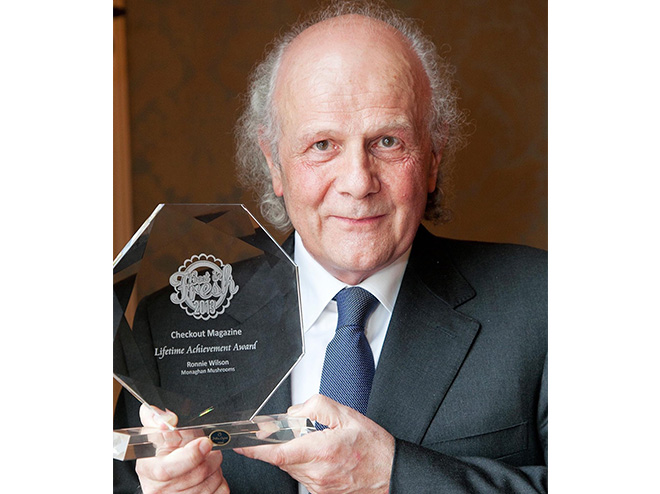
Ronnie Wilson, CEO Monaghan Mushrooms

A DIFFICULT CRISIS

Ronnie Wilson of Monaghan Mushrooms said the situation now was very different from eight years ago when the industry was expanding and they were able to compete throughout Europe. He said the two problems for producers were retail discounters and food deflation. The concept of cheap food was now politically very acceptable, he told the committee.

“It’s a very difficult situation. If we let the industry go into freefall that really would be a disaster”, he said. We must stop the industry from going into freefall, he emphasised. Already they were not able to supply all their contracts which were mainly with UK multiples. They were currently purchasing product in Poland and Holland to service the UK contracts.

“We can continue to do so for a little while but can’t go on very long”, he said. The first thing they had to ensure was to stop producers closing, because contracts would be under threat if that happened.

Mr Wilson said one measure the government could take that would be very supportive of the industry would cost very little. The industry required flexibility of labour and worked unsociable hours. He wondered if it would be possible to have a permit scheme introduced to bring in harvesters from non-EU countries in eastern Europe and that would be a very advantageous element, in his view. One or two growers had stopped operating because of the currency exchange rate, but there was also an element of some labour difficulties.

The chair of the committee Pat Deering TD told him that was a suggestion they could include in their budget submission as well.

Gallagher.jpg

Senator Robbie Gallagher

EFFECT ON MONAGHAN

Senator Robbie Gallagher from Monaghan (Fianna Fáil) congratulated the mushroom industry representatives on their achievements over the past thirty years. He said they deserved great credit for building up the industry and creating 3500 jobs.

He knew Ronnie Wilson quite well, who he said had been a leading name in the mushroom industry for up to thirty years. He was a very large employer and they were fortunate to have him in County Monaghan. Of the 3500 jobs in the industry, around 1000 are in Monaghan and of those up to half were employed by Mr Wilson.

So it was a particularly difficult issue for a county like Monaghan. No other county was more exposed to this crisis than Monaghan, he said. Senator Gallagher told the committee he was sure this was a particularly stressful time for everybody in the industry, when external factors over which they had very little control could determine the future. “I can only imagine what you and everybody in the industry is going through”, he told the committee.

Words like ‘crisis’ and ‘freefall’ had been used in the presentation and it was clear to see that they were not being overused. Senator Gallagher said it was imperative that the government stepped in at this time to give the mushroom producers a bridge to get over this difficult period and to reasses where they were going.

It seemed to him that there were two main issues, namely the current threat from the fluctuation of sterling and the threat from Polish producers. The Irish producers seemed to have more concern about the first threat, he said, judging by their presentation. He wondered where they saw the industry going in future and were they confident about it? In view of the freefall in the industry he also wondered if they had had any contact with any government department in the aftermath of the Brexit referendum in the UK.

DIAGEO CHAMPION DAIRY COW

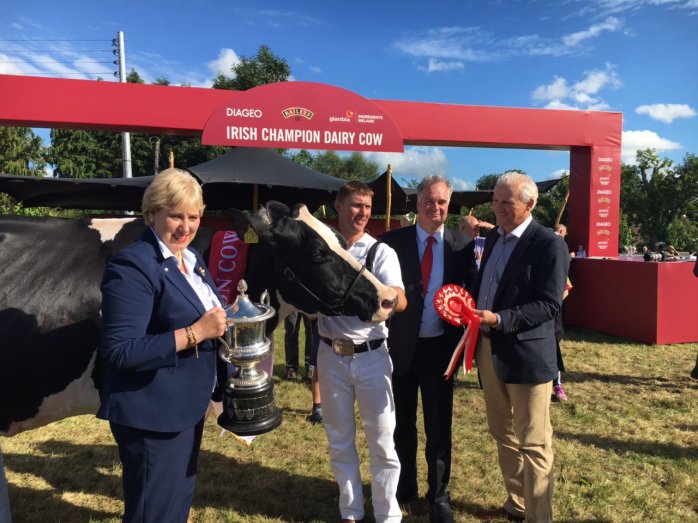
BaileysCow.jpegBEST DAIRY COW IS FROM WEXFORD

Minister for Arts, Heritage, Regional, Rural and Gaeltacht Affairs Heather Humphreys T.D. hands over the Virginia Milk Products Cup for the Diageo Baileys Champion All Ireland Cow at the 75th Virginia Show. The top prize of €2500 went to Hallow Advent Twizzle 3, from the Holstein herd owned by Philip and Linda Jones from Killowen, Gorey, Co. Wexford.

‘LIGHTNING’ STRUCK BY SUSPENSION

BOXER.jpg

Christina McMahon was given a warm reception in Carrickmacross last year after her WBC interim bantamweight title win  Pic. Michael Fisher

CHRISTINA MCMAHON SUSPENDED BY BOXING REGULATOR

Michael Fisher    Northern Standard  Thursday 25th August 2016 p.5

Carrickmacross boxer ‘Lightning’ Christina McMahon has been suspended by the World Boxing Council after she gave interviews about a number of concerns she had before, during and after her WBC super flyweight title challenge against Zulina Munoz in Mexico in March. She was controversially defeated by Munoz on points. Her husband and manager Frick recently revealed evidence of what he claims was glove tampering and improper anti-doping procedures in addition to dubious scorecards.

Christina McMahon still ranks as the WBC interim World Bantamweight Champion received a Facebook message yesterday (Wednesday) from the Chair of the WBC Female Championship Committee Malte Müller-Michaelis informing her of her suspension in the wake of revelations to a number of media outlets which cast serious doubt over the result of the fight in Juarez. She made her comments during the Olympic Games in Rio, when an Irish boxer Michael Conlan was judged to have been beaten by a Russian opponent.

RURAL RENEWAL

NEW €380,000 FUND TO HELP REVITALISE MONAGHAN TOWNS AND VILLAGES

Minister Humphreys Urges Local Communities to Apply

Michael Fisher   NORTHERN STANDARD   Thursday 11th August 2016 p.1

The government aims to publish a new Action Plan for Rural Ireland by the end of this year. This was revealed during a visit to Clones on Tuesday by the Minister for Arts, Heritage, Regional, Rural and Gaeltacht Affairs, Heather Humphreys T.D. She was launching a scheme to assist rural regeneration.
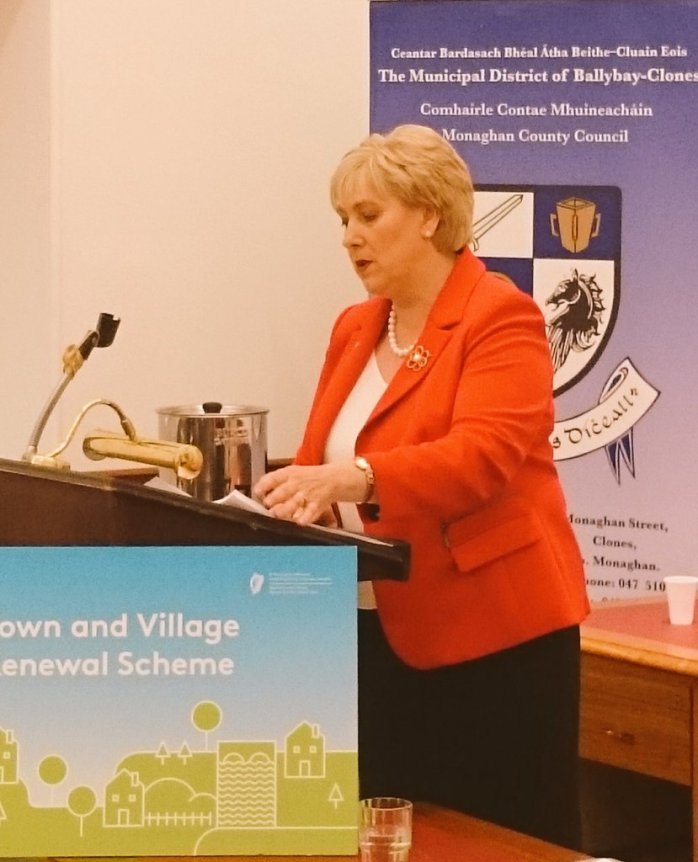
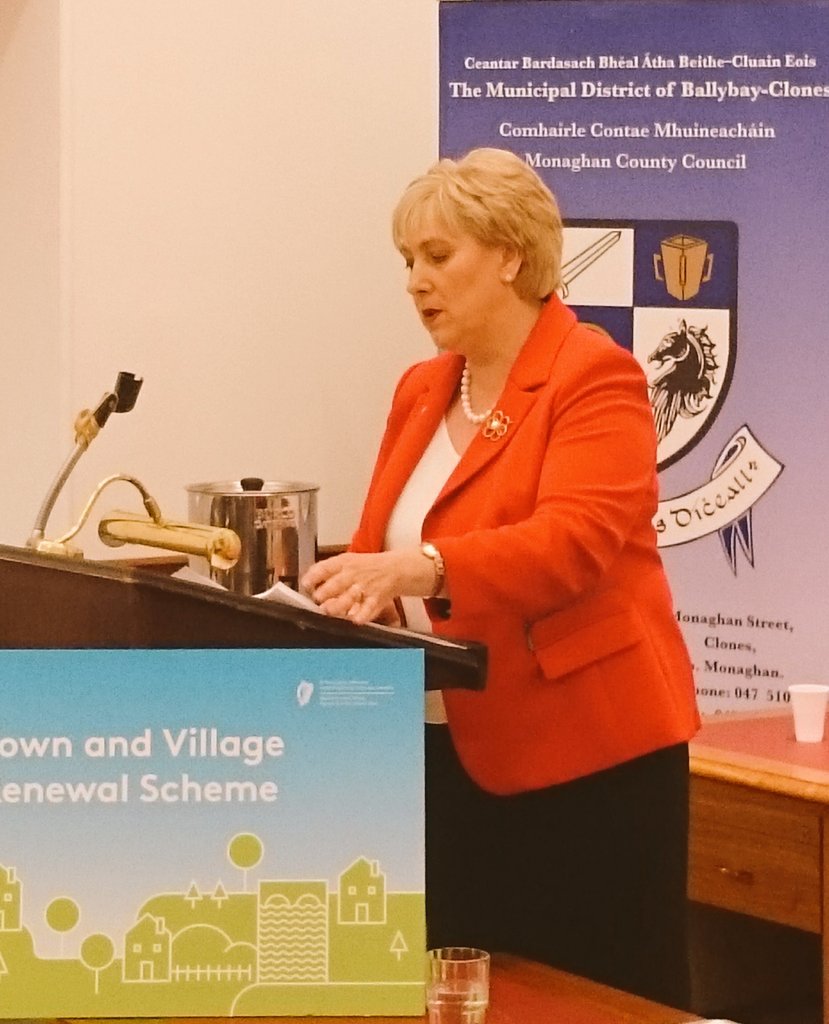
Minister Humphreys announced that her department was making available a fund of €10 million this year to local authorities throughout the state in order to support the renewal of rural towns and villages. An allocation of €380,000 has been set aside for County Monaghan and each of the other 25 counties to go towards projects.
This was by no means a silver bullet to solve all the problems in rural Ireland, but it was a positive start, she said. They would work from the ground up in order to get the best solutions. The Minister said she did not have all the ideas and did not want to be prescriptive about how the funding should be used. She told the Northern Standard it was up to local authorities in conjunction with local groups to sit down and decide the priorities to be tackled, such as derelict buildings. Local people could identify things they needed to make a difference to bring back life to the towns and villages.

The Minister hoped there would be a quick turn-around time for grant approval, with allocations being made before the end of the year. If it brought back people into towns and villages then it would be a success. She said there were many examples of modern day living, with people turning historic sites into accommodation. She wanted to see people living in towns, creating companionship and community spirit.

She said this first tranche of funding under the Town and Village Renewal scheme represented a serious commitment by government to offer support to rural towns and villages. Each county can apply for grants for up to eight separate town or village projects. Minister Humphreys called on local communities and businesses to submit outline plans to her department for approval in September. Up to 200 towns and villages across the country will benefit from the scheme this year.

A particular focus will be placed in 2016 on supporting smaller towns, with populations of less than 5,000. A maximum of two projects can be supported in each county for those towns with a population of up to 10,000. Funding will be allocated to local authorities to meet up to 85% of the total cost of each project.
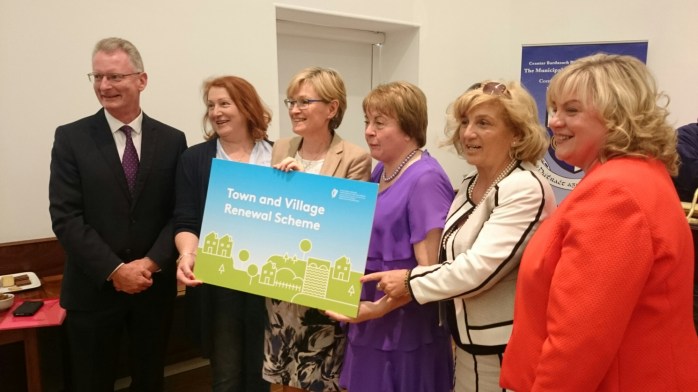
In County Monaghan, applications for the scheme will be forwarded through the regeneration committees in Clones, Ballybay, Monaghan, and Castleblayney, as well as the Carrickmacross Chamber of Commerce, in conjunction with the respective Municipal Districts. Funding will be released to local authorities once projects are approved by the Department of Arts, Heritage, Regional, Rural and Gaeltacht Affairs. The minimum grant for any single project is €20,000 and the maximum is €100,000. The Department says this phase of the Town and Village Renewal Scheme will be reviewed and adapted as necessary for 2017.
Speaking at the restored courthouse building in Clones, the Minister said rural development was a key priority in the Programme for a Partnership Government. Ireland’s towns and villages were at the heart of our rural communities, but the economic downturn had a significant impact on many of them. She said it was incumbent on them (as a government) to help these areas achieve a recovery.

Minister Humphreys went on: “I am launching the Town and Village Renewal Scheme to begin breathing life back into our rural towns and villages. It is critical that towns and villages become areas where economic activity can flourish, where people can live and work, and where people can meet at a social level.”

The Minister continued: “Consultation and collaboration will be key elements of the scheme. It will be administered through the local authorities, which will be required to partner with local businesses and local communities to develop and implement ideas that can make a real and lasting impact in revitalising rural towns and villages.”

She said the scheme was part of the government’s commitment to ensuring that the benefits of economic recovery were felt in every part of the country. The scheme also addresses one of the recommendations in the Commission for the Economic Development of Rural Areas report, published in 2014.

Measures taken under the Town and Village Renewal Scheme should have a sustainable and visible impact on the area in question. The type of project to be funded under the scheme could include measures to:

  • increase the attractiveness of the town or village as a local commercial and social centre, and increase its sustainability as a place in which to live and work;
  • enhance its environment and amenity in the interests of residents, businesses and visitors;
  • enhance the culture and local heritage assets of the town/village and promote tourism;
  • tackle minor physical infrastructural deficits and land assembly issues.

The Minister was welcomed to the town along with other guests by Finbarr Dunwoody of the Clones Chamber of Commerce. The procedures for applying for the fund were outlined by William Parnell, assistant secretary at the Department of Arts, Heritage, Regional, Rural and Gaeltacht Affairs, whose brief covers regional development and rural affairs, said the roll-out of rural broadband was a priority and the department was working in conjunction with the Minister for Communications Denis Naughten.

Louise Lennon of Irish Rural Link (an organisation based in Moate, Co. Westmeath) stressed that a good broadband infrastructure was needed. She said the scheme announced by the Minister was a first step in the right direction for the development of rural towns and villages that had been hit by the economic crisis a few years ago. She said it was important to bring facilities back into towns so that younger people could remain there.
Peter Hynes, Chief Executive of Mayo County Council, welcomed the initiative on behalf of the County and City Management Association. He said it showed the importance the government attached to rural Ireland. The local authorities, he said, shared that priority. There were big challenges in the areas of building housing, creating employment and climate change. Balanced regional development and rural regeneration was of critical importance, he added.

Mr Hynes said a key part of that was getting people back into towns and villages. The extent of the challenge was daunting: towns and villages were at the eye of the storm, challenged by the spread of online retailing. He reminded the gathering that it would take time, commitment and resources to tackle the problem, but it could be done. He cited the example of Westport in Co. Mayo where he was appointed town manager in 1996 with a brief for regeneration. Twenty years on, it had been a success. He looked forward to local authorities taking on the challenge so that towns and villages could realise their potential. They would be collaborating with businesses, the department and in particular with local communities to make it happen. This scheme was a big step in the right direction, he said.

Patrick McCarville of the Clones Regeneration Partnership said their committee set up last year would probably concentrate initially on the development of the Fermanagh Street and Diamond area. The town renewal scheme would be another potential source of funding in addition to LEADER.

Mr McCarville said the committee would be meeting at the end of the month to try to identify sites that businesses could do up. But the improvements would not happen overnight and as they heard, had taken some twenty years in Westport. One thing they were not going to do was to attempt to cloak the dereliction by erecting fake shop fronts to give the impression the buildings were occupied, as had been done in Enniskillen during the G8 summit in 2013.

Minister Humphreys told them that Clones with its monastic heritage was a fitting location to launch a scheme that aimed to support the revitalisation of towns and villages all over Ireland. Clones was also a town that had suffered more than most down through the years. Its close proximity to the border during the troubles had a severe impact on economic activity locally and sadly that resulted in a legacy of decline in the town. Unfortunately the scars were there for all to see today.

She went on: “while Fermanagh Street is always a hive of activity and thronged with people on Ulster Final day, the sad reality is that when the crowds move off, we are left with a main street that has far too many vacant premises. That’s a pity because it undermines the good work that is taking place in Clones. And there is an awful lot of good work going on here.”

“You have the superb PEACE Link facility, the recently opened Barry McGuigan Park, the new soccer pitch for Clones Town FC, as well as St Tiarnach’s Park – the home of Ulster GAA and of course a state of the art modern secondary school in Largy College. These are amenities that would be the envy of many towns in the country but unfortunately it’s all about first impressions. And the fact is when you walk on to a main street that has a number of empty and derelict premises, that vital first impression is not good.”

In launching the first phase of the Town and Village Renewal Scheme she said it was critical that town centres – and even small villages – became areas where economic activity was supported and encouraged, where people could visit and enjoy themselves and most importantly where people could live and work with a sense of pride of place.

“I have increased the allocation for the scheme in my department’s vote this year, from €4 million to €10 million, reflecting the government’s commitment to the development of rural Ireland. I want to acknowledge the excellent work which is already being carried out by businesses, communities and local authorities throughout the country to revitalise town centres. There are some fine examples of good practice and I hope that this new scheme will help other towns and villages to replicate and adapt those examples, or develop their own unique solutions to town and village renewal. I am encouraging the local authorities to engage fully with the scheme in order to maximise the benefit for the towns and villages in their area”, the Minister said.

She welcomed the presence at the launch of a number of business people and representatives of local community groups from across Monaghan and Cavan. “You are the people who are best placed to know how we can help your local town. We want your ideas and we want you to work with you. In this regard, consultation and collaboration will be key pre-requisites of the scheme”, she told them.

A project committee, representative of local community and business interests and the local authority, should be established for each project to help design a strategy which should be aligned with broader development plans and opportunities for the area. The most important part of the scheme, however, will be taking practical measures to support the town or village’s social, cultural and economic development, Minister Humphreys said.

She told them that a number of other measures would be announced in the Autumn to support rural development. These would be announced in due course by herself and Minister of State for Regional Economic Development Michael Ring. The Minister observed that there were many vacant or partially vacant heritage buildings in town centres all over the country which she believed offered real opportunity to bring life back into town centres.

If a real and lasting impact was to be made on the regions and on rural Ireland, then every government department needed to make a meaningful contribution to the effort, whether it was in relation to jobs, education, transport, housing or other economic or social policy area. With that in mind, her department would shortly commence work on an Action Plan for Rural Ireland. It would include clear objectives, with regular and structured progress reports that would be presented to the Cabinet Committee on Regional and Rural Affairs chaired by An Taoiseach. This would ensure co-ordination of the rural agenda across government, the Minister stated.

Included in this process will be the consideration of regional and rural issues in the design of the National Planning Framework. This framework is the follow-up to the National Spatial Strategy and its development will be led by the Department of Housing, Planning, Community and Local Government. The National Planning Framework (NPF) is a Long-term, 20-year National Plan outlining a high level spatial vision for Ireland. It will be the overarching plan from which other regionally and locally based plans will emanate.

The Action Plan format, successfully developed through the Action Plan for Jobs, takes a strategic approach based on implementation. Government departments are given key objectives which they must meet in the context of regional and local priorities.

Chief Executive of Chambers Ireland Ian Talbot said, “We welcome the commitment by Government to invest €10 million into the regeneration of rural towns and villages with the central aim to improve the living and working environment of local communities and support their potential to increase economic activity. We anticipate that this investment will be a positive step to help revitalise rural Ireland. Ireland has a high number of towns and villages with a population less than 10,000. There are 552 villages with a population of less than 100. Many of these towns and villages across Ireland will benefit from the funding announced by the Minister.”

“Consultation and collaboration with local citizens, business owners and Chambers will be vitally important to the success of the projects chosen for investment under this scheme. We encourage local business to engage with other stakeholders and to work closely with the local authority to develop innovative projects that can deliver long term and sustainable economic benefits, not only for the individual town or village but in turn for the wider county and region.”

Mr Talbot also welcomed the government’s commitment to produce an Action Plan for Rural Ireland similar to the Action Plan for Jobs. He said the courthouse restoration in Clones was a testament to what could be done with a small amount of money towards regeneration.

Mairead McGuinness, MEP for Monaghan and Vice-President of the European Parliament encouraged community groups to avail of the immediate opportunity to work with their local authorities to enhance and upgrade their towns and villages under the new scheme. The MEP said it was a good opportunity for those who had projects and ideas ready to activate to put in their applications by September.

“This funding scheme is due for distribution by the end of the year so those with projects already in mind will be in pole position to benefit. There will be further tranches coming down the line during 2017 and beyond. This part of the scheme will assist those with initiatives to help regenerate their towns and villages and give a boost to those working to bring vibrancy and economic recovery back into communities,” she said.

Mairead McGuinness was joined at the launch by local Fine Gael Councillors Sean Gilliland and Ciara McPhillips (Ballybay/Clones MD). Cllr David Maxwell from Monaghan MD was also present.

In a speech last month Minister Humphreys outlined how she was working closely with the Minster for Communications Denis Naughten, to deliver key elements of the National Broadband Plan and to accelerate and prioritise the rollout of the programme in rural areas. The aim is to deliver high speed broadband to every home, school and business by 2020 through a combination of commercial investment and state intervention.

The state will intervene in areas where commercial providers are failing to reach. The Minister said the Department of Communications was continuing to manage the procurement process for the state contract, which was expected to be awarded in summer 2017. In the meantime, her new Department was working with local authorities to eliminate any roadblocks, so as to ensure that towns and villages and rural areas were ready for broadband when the contract was signed.

She said it was difficult to overestimate the challenge they were facing. The broadband blackspots in need of state intervention accounted for 750,000 addresses, and covered 96% of our landmass. This represented about 100,000km of road network, traversing areas which were home to 1.8 million people. “Put simply: it’s a very big job – it’s akin to rural electrification.

But it will be worth the effort, and it will have a transformative effective on rural Ireland. High quality broadband is one of the many tools we can use to empower rural communities. The revitalisation of rural Ireland must be based on sustainable development”, the Minister added.

“We must learn from the mistakes of the past. We are all well versed on the mistakes of the construction bubble, when our young men were recruited and trained in their droves in an industry which was built on sand. The old approach of ‘an IDA factory for every town’ didn’t work either. It was false promise, and one that was generally never fulfilled.”

“Through the implementation of regional jobs plans, the government is encouraging each region to focus on its strengths. By supporting indigenous businesses and linking education with industry, we can give each region the best possible chance of success. Take for example, a business in my own constituency of Cavan-Monaghan.”

“Combilift is a home grown Monaghan success story – a jewel in the crown of Enterprise Ireland. Since it was first started by Martin McVicar and Robert Moffett 18 years ago, the company has grown into a global leader in forklift manufacturing. It now exports to over 75 countries. Last year, Combilift announced major expansion plans and the creation of 200 new jobs.

Crucially, the company has teamed up with Cavan Monaghan Education and Training Board to develop a series of new apprenticeship programmes, to ensure those jobs can be filled by local graduates. It’s a formula that works, and one I want to see replicated nationwide.”

The Minister told the MacGill Summer School in Glenties that sustainable development should also mean national decisions about rural Ireland were not taken in isolation. The report by the Commission for the Economic Development of Rural Areas – published under the last government – looked at how to revitalise rural Ireland. One of its most important findings was the realisation that in order to fully support sustainable rural development there was a critical need for a more integrated approach across all government departments and agencies. “This is not a new concept and indeed much of the relevant sectoral frameworks accept the need for this kind of approach”, she said.

Minister Humphreys added: “this government’s increased commitment to supporting sustainable rural development in an integrated way has already been formalised through its commitments in the Charter for Rural Ireland published earlier this year and the creation of my new portfolio.”

 

GEMMA PRINCE

Dungannon soprano and harpist, Gemma Prince

Dungannon soprano and harpist Gemma Prince performed some of Thomas Moore’s Irish Melodies at St Macartan’s Cathedral Clogher. “Sing, Sweet Harp” provided a fine opening to the 25th annual William Carleton Society Summer School. The school director Aidan Fee introduced Gemma, with a talk on Moore. Cathedral organist Diane Whittaker provided the music at the start and finish of the performance.