HERITAGE CONFERENCE IN MONAGHAN

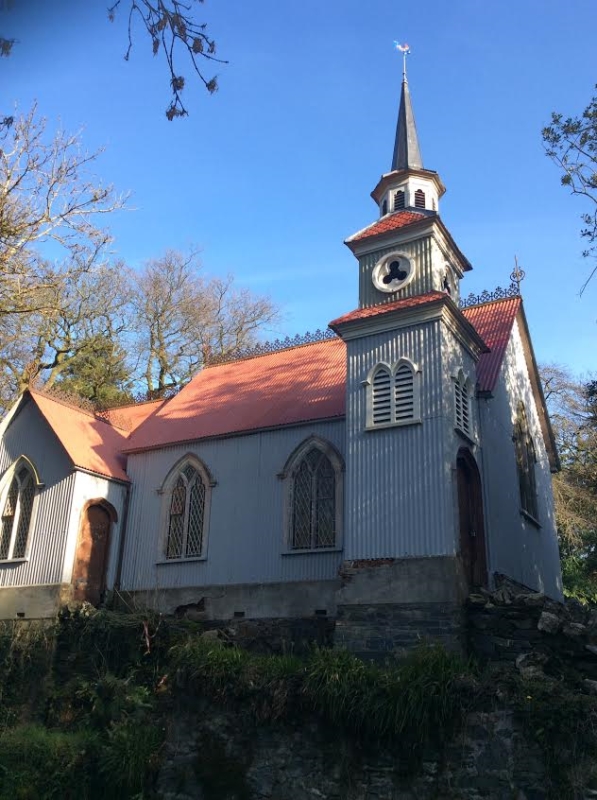
Tin Church, Laragh, Co. Monaghan  Photo: European Heritage Days

Tin Church, Laragh, Co. Monaghan Photo: European Heritage Days

Summer School Explores Historic Buildings of Monaghan and Armagh  Northern Standard Thursday 25th June

The Ulster Architectural Heritage Society and Irish Georgian Society came together in an exciting new initiative to provide a cross border summer school in Monaghan and Armagh from Thursday until Saturday. Conservation without Frontiers explored and discussed built heritage in the context of both counties, showcasing the best they have to offer in terms of their history and historic buildings, such as Castle Leslie in Glaslough and the Tin Church in Laragh.

St Macartan's Cathedral, Monaghan

St Macartan’s Cathedral, Monaghan

The first section of the summer school was opened on Thursday in Armagh by a representative of the Northern Ireland Department of Environment Minister Mark H. Durkan. It then moved to Monaghan, where Minister for the Arts, Heritage and the Gaeltacht opened day two. The Summer School concluded on Saturday at the Tyrone Guthrie Centre in Annaghmakerrig near Newbliss with a celebratory picnic lunch.

In Armagh, the school undertook visits to both Cathedrals, the former Primate’s Chapel and Palace, the Mall and the Market Square. In Monaghan the participants visited Castle Leslie, Glaslough, and community-led projects such the Dawson Mausoleum, Dartrey and St Peter’s Church, Laragh. Tours and visits were guided by experts in the field including well known academics, architectural historians, architects, planners, conservation and heritage officers. A walking tour of Monaghan on Friday will be led by Kevin V. Mulligan from Carrickmacross. Speakers included Dawson Stelfox, Dr Andrew McClelland, Professor Alistair Rowan, and Bishop Emeritus Dr Joseph Duffy. The event brought together local people, enthusiasts, students and practitioners to learn from the unique buildings of both counties.

Twenty students from the the island of Ireland, Britain and Europe benefited from funded places to complement their ongoing studies and help develop their knowledge of conservation issues. They also took part in a heritage based competition proposing new ideas for  the restoration of Hope Castle, Castleblayney and an empty site on Upper English Street in Armagh. The event was supported by Monaghan County Council, Armagh City and District Council, the Heritage Council and the Department of Arts, Heritage and the Gaeltacht.

Minister Durkan said: ‘I am particularly supportive of this initiative as it brings together heritage expertise from both sides of the border to help develop and realise our mutual  interest in conservation and regeneration for community benefit.  Our built heritage is a catalyst for so many things that are vital to the lifeblood of our villages, towns and cities.  It is therefore important that we work together to realise its full potential. My  department  continues to work in partnership with the Ulster Architectural Heritage Society and I commend both it  and the Irish Georgian Society for their vision in arranging this summer school.’

ANNALITTEN SCHOOL CELEBRATIONS

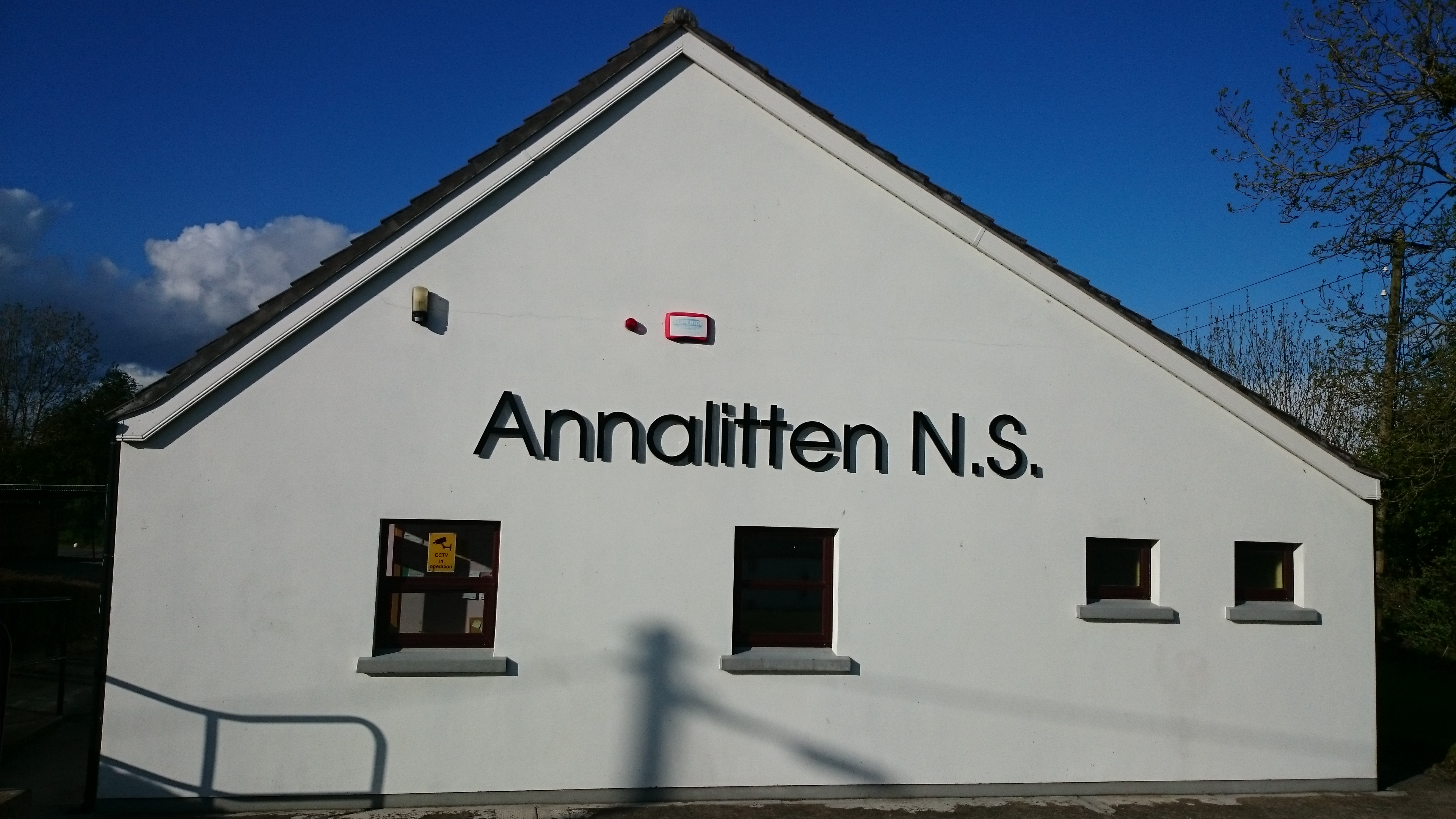
Annalitten National School near Castleblayney Photo:  © Michael Fisher

Annalitten National School near Castleblayney Photo: © Michael Fisher

BIG REUNION FOR ANNALITTEN NS         Michael Fisher   Northern Standard

It’s fifty years since the pupils of Annalitten National School outside Castleblayney in the parish of Muckno made the big move from the Old School to the New School. To mark this milestone, the past pupils organised a school reunion on Saturday 27th June. The event marked the 50th anniversary of the move in 1965 to the current premises. It took place at the school at 4pm and many former students were in attendance, as was the Minister for Arts, Heritage and the Gaeltacht, Heather Humphreys T.D. After the reminiscing at the school, a social evening was held at the Glencarn Hotel, Castleblayney.

Stone plaque with name of school scratched out during WWII Photo:  © Michael Fisher

Stone plaque with name of school scratched out during WWII Photo: © Michael Fisher

The organising committee put together a selection of photographs of people who went to Annalitten school. Annalitten is a two-classroom co-educational Catholic primary school with a fascinating history. Elizabeth Brannigan was one of the organisers of the reunion. Five generations of her family have attended Analitten school, including herself.

Stone plaque for Annalitten NS celebrations  Photo:  © Michael Fisher

Stone plaque for Annalitten NS celebrations Photo: © Michael Fisher

Past pupil John McBride has researched the story of the school and to launch the reunion shared some interesting facts about the old building:

Annalitten Car Park’s Amazing Secret

If you were to walk past Annalitten’s fine National School, chances are you would hardly give a second glance to or even notice the adjoining car park. But this spot has a secret.  It was the site of a building with a remarkable claim to fame. That building, the’ Old School’, was no ordinary school around the corner, as it was born with a roar that would be heard as far as the Westminster Parliament.

1888 was a year of beginnings, including the founding of the National Geographic Society, Celtic FC playing its first official match, and the birth of John Painter, who would live to the 21st century and become the world’s oldest man.  The Castleblayney townland of Annalitten celebrated its own ‘first’ with the opening of a National School.  You might think that this local affair would hardly cause a stir, even in ‘Blayney.  But events would prove otherwise.

Soon after Annalitten NS opened, the RIC called on three local families.  Leading Irish MP, Tim Healy, heard about the police visits.  In May 1888, in the House of Commons, he questioned the Chief Secretary Arthur Balfour about the incident. Balfour replied that some children had been moved to Annalitten from the nearby mixed religion schoool. Three Catholic families kept their children at the mixed school. It’s believed that the local church was putting pressure on these families to send their children to Annalitten. The famililes were visited by the local police in order to establish the full facts.

The full text of the discussion can be read in the Hansard Parliamentary report for May 14th 1888 p.144. In the document, the politicians are referred to as ‘Mr. T. M. Healy (Longford, N.)’ and ‘A. J. Balfour (Manchester, E.)’. Annalitten is spelt as ‘Annalitton’

Annalitten being mentioned at Westminster is a great feat, but the central characters in the discussions make it even more special. They were both political giants. Arthur Balfour would  serve as British Prime Minister from 1902 to 1905. Tim Healy would go on to become the first Governor General of the Irish Free State in 1922.

The ‘Old School’ at Annalitten was replaced by a new building, a short distance away, in 1965.  The old building went on to serve as a community centre until it was demolished in the early 21st century, its longevity surpassing John Painter’s by just a few years. There is now a car park on the site, surely making it one of the most historic parking lots in Monaghan and Ireland.
© John E. McBride 2015

PAT FINUCANE MURDER INVESTIGATION

Geraldine Finucane with investigative journalist John Ware in Belfast

Geraldine Finucane with investigative journalist John Ware in Belfast

The quest for truth continues by the Finucane family into the killing of husband and father Pat Finucane, a Belfast solicitor, by the UDA in 1989. The High Court in Belfast has backed the refusal by the British Prime Minister David Cameron to hold a public inquiry into the killing of the well-known human rights lawyer. He was shot dead in front of his family at his North Belfast home by loyalists believed to have been acting in collusion with British security forces.

A judicial review rejected an appeal by Mr Finucane’s family for a public inquiry into the shooting, saying Mr Cameron’s 2011 decision not to hold one was lawful. Mr Cameron instead commissioned an independent investigation, whose report was published in 2012. The report by Desmond de Silva QC severely criticised members of the British intelligence services and army and the RUC for colluding in the killing and covering it up.

The solicitor’s family has long campaigned for a full independent public inquiry, but Mr Cameron insisted such an exercise would not shed any more light on the events. He instead commissioned a review of the case papers by Mr de Silva, whose report detailed shocking levels of state involvement.

It included spreading malicious propaganda that Mr Finucane was sympathetic to the IRA; one or possibly more police officers proposing him as a target to loyalists; and the mishandling of state agents inside the UDA who were involved in the murder. While Mr de Silva found no evidence of an overarching conspiracy by the authorities to target the 38-year-old lawyer, he said the actions of a number of state employees had “furthered and facilitated” the UDA shooting while there had also been efforts to thwart the subsequent criminal investigation.

As he accepted the report’s findings in the House of Commons in December 2012, Mr Cameron reiterated an apology to the Finucane family and also pledged that the government would examine the review in detail to identify potential lessons.

The judicial review focused on a commitment made by the UK government at Weston Park in 2001 during peace process negotiations with the Government. The Weston Park talks resulted in Canadian judge Peter Cory being asked to examine the grounds for public inquiry in a number of controversial Troubles deaths. The British government said such inquiries would be implemented if the judge recommended that course of action. Judge Cory subsequently did recommend public inquiries for a number of killings, including Mr Finucane’s. But while the British government ordered inquiries into the other deaths, it did not give the green light for one in the Finucane case.  PFCTALK (2) (452x639)

Speaking following the judgment, Minister for Foreign Affairs Charlie Flanagan T.D. said: “I note this morning’s judgment in the judicial review and will be studying it closely. The Irish Government’s position remains unchanged. We continue to believe that an independent public inquiry into the murder of Pat Finucane, in line with the political commitments made by the British and Irish governments at Weston Park in 2001, should be honoured.”

“This is a matter which the Government has consistently raised with the British Government. I raised it most recently with Secretary of State for Northern Ireland Theresa Villiers on 19 May, and the Taoiseach discussed the case with Prime Minister Cameron when they met in London last week. My thoughts at this time are with Geraldine Finucane and all the Finucane family, who have campaigned so tirelessly for more than a quarter of a century in pursuit of the full truth in the case of Pat Finucane, including the role of collusion in his murder.”

Relatives for Jutsice

Relatives for Jutsice

Mike Ritchie of Relatives for Justice gave the following assessment in a blog on the RFJ website:

“In an 86 page judgement, Judge Ben Stephens rejected Geraldine Finucane’s challenge to David Cameron’s refusal of a public inquiry into her husband’s murder. He chose to conclude that any government must be able to change policy and laid out the legal framework that must underpin such a change at the macro political level. He held that the change of view was properly considered and laid out the government’s decision-making process which, he said, was composed of rational grounds.

Mike Ritchie, Relatives for Justice  Pic. RFJ

Mike Ritchie, Relatives for Justice Pic. RFJ

While Geraldine Finucane did have a legitimate expectation that the government should fulfil its promise to have an inquiry as stated at Weston Park, there was no absolute right to be consulted before a change of view, particularly in circumstances that included a change of government after a general election.

While dismissing the application, the judgment nevertheless set out in great detail the variety of investigations and reviews of documentation that had occurred in this case. It also addressed the question as to whether there remained a requirement to hold an article 2 (right to life) compliant investigation. The judge concluded that, whatever about whether previous investigations – including prosecutions – amounted to a fulfilment of the article 2 procedural requirement, the review by Desmond De Silva had uncovered and published significant new information that had not been considered by criminal investigators and/or the public prosecution authorities. In the judgment he sets out in detail the disturbing findings of collusion that were the conclusions of the De Silva review.

Judge Stephens therefore held that there is a continuing requirement on the authorities to complete an article 2 investigation into these matters and he invited submissions from the parties on how these might be concluded.

The major problem with this lies in the fact that, after the De Silva review was published, the PSNI Chief Constable asked the now defunct Historical Enquiries Team (HET) to consider the new material. With the HET out of the picture, lacking sufficient independence to carry out impartial investigations, the matter presumably falls to the Legacy Investigation Branch (LIB) of the PSNI. However, this unit has been found by the Westminster Parliament’s Human Rights Committee not to be sufficiently independent to deal with legacy matters. RfJ agrees with this view.

Furthermore, correspondence from DCC Drew Harris and ACC Will Haire to the judge has also outlined budgetary constraints which have impeded the PSNI in its examination of the De Silva material. In RfJ’s experience, lack of resources has simply become the latest excuse preventing the truth of collusion emerging into the light. Nor can the LIB be trusted to carry out an independent, thorough investigation in a manner capable of leading to the “identification and prosecution of the perpetrators” as required by Article 2.

The Finucanes’ quest for the truth continues. It’s not clear that Judge Ben Stephens proposed route ahead takes us very much further forward.”

HANNA A SHOO-IN FOR SOUTH BELFAST

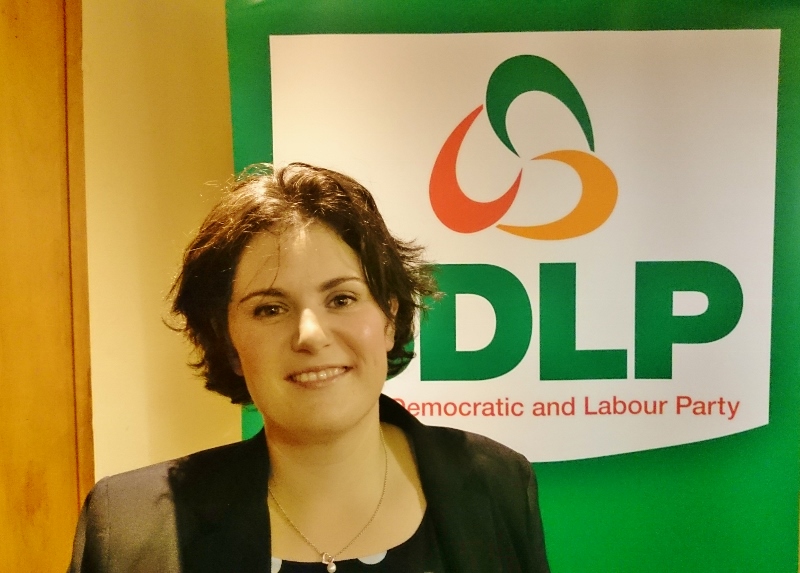
Councillor Claire Hanna  at the SDLP Assembly selection meeting in South Belfast  Photo:  © Michael Fisher

Councillor Claire Hanna at the SDLP Assembly selection meeting in South Belfast Photo: © Michael Fisher

Councillor Claire Hanna has been selected by the SDLP to replace the party leader and Westminster MP Dr Alasdair McDonnell in the Northern Ireland Assembly. Dr McDonnell tendered his resignation as an MLA last Sunday in order to comply with the procedure. Cllr Hanna’s selection was approved by a meeting of South Belfast SDLP members last night at the Wellington Park Hotel, where she was also selected along with Fearghal McKinney MLA to run in the 2016 Assembly election.

Councillor Hanna has served on Belfast City Council since 2011 and was re-elected to serve the Balmoral area in the election for the new district councils last year. She is the daughter of Eamon and Carmel Hanna, both of whom have given great service to the SDLP over the years: Carrmel as a Councillor and MLA in South Belfast, and Eamon as general secretary.

SDLP Councillor Claire Hanna (centre) with her parents Carmel and Eamon Hanna  Photo:  © Michael Fisher

SDLP Councillor Claire Hanna (centre) with her parents Carmel and Eamon Hanna Photo: © Michael Fisher

Claire Hanna said: “It has been a privilege to serve on Council since 2011 and I am deeply grateful to have been selected to continue representing the people of South Belfast in the Assembly. I’m committed to the challenges of defending the SDLP’s second seat in this constituency, refocusing our party and restoring public faith in local politics, which has been in decline for a number of years.”

“As I have in Council, I will be standing up for the diversity of South Belfast, for excellence in public services, a strong and sustainable local economy and for core SDLP values of partnership, reconciliation and social justice. The SDLP are now in a strong position to fight for South Belfast and Northern Ireland at Westminster, in the Assembly and at Council. Our South Belfast representatives, Alasdair as MP and Fearghal and I as MLAs, and our Councillors, Declan Boyle, John Gallen, Brian Hanvey and Kate Mullan are united in this aim.”

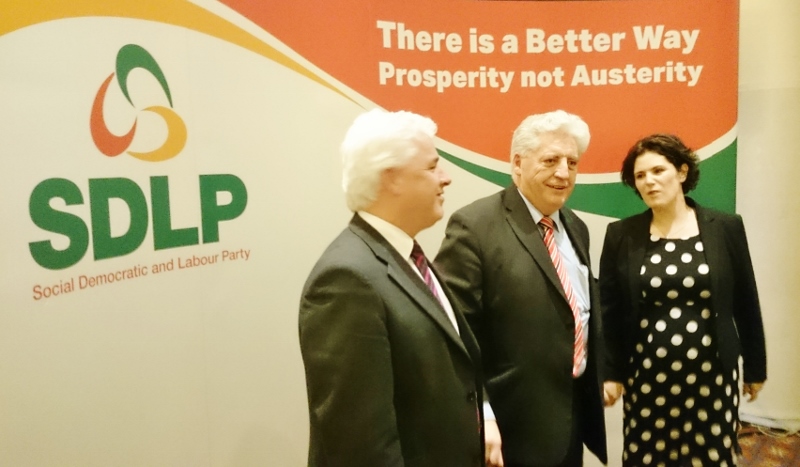
SDLP leader Dr Alasdair McDonnell MP congratulates Cllr Claire Hanna and Feaghal McKinney MLA at the Assembly selection meeting in South Belfast  Photo:  © Michael Fisher

SDLP leader Dr Alasdair McDonnell MP congratulates Cllr Claire Hanna and Feaghal McKinney MLA at the Assembly selection meeting in South Belfast Photo: © Michael Fisher

Dr McDonnell said: “Representing the people of South Belfast as an MLA for 17 years has been an honour and I know that Claire will serve our constituents with the same dedication and passion that she has demonstrated so often in Council. In Claire and Fearghal we have selected the two strongest choices of any party in South Belfast. I am confident that they will be successful in retaining two seats in this constituency in 2016 and continue to provide people here with effective representation and progressive politics.”

SDLP leader Dr Alasdair McDonnell MP congratulates Cllr Claire Hanna and Feaghal McKinney MLA at the Assembly selection meeting in South Belfast  Photo:  © Michael Fisher

SDLP leader Dr Alasdair McDonnell MP congratulates Cllr Claire Hanna and Feaghal McKinney MLA at the Assembly selection meeting in South Belfast Photo: © Michael Fisher

Fearghal McKinney added: “In South Belfast the SDLP’s aim is to retain two seats in the upcoming election and I am honoured that my party has selected me again to represent the people of South Belfast. It has been a privilege to serve as Health spokesperson for the party and if I am returned to the Assembly I hope to continue to spearhead the campaign to make new cancer drugs available in Northern Ireland, fight for the needs of older people and challenge the failure to implement the Transforming Your Care plan.” 

Fearghal McKinney MLA with Claire Hanna  of the SDLP at the Assembly selection meeting in South Belfast  Photo:  © Michael Fisher

Fearghal McKinney MLA with Claire Hanna of the SDLP at the Assembly selection meeting in South Belfast Photo: © Michael Fisher

“We now need to focus on the economy to cement our peace and politics and deliver real prosperity. We need to make Northern Ireland work and pay its own way”, he said.

The announcement came a day after the Ulster Unionist Party released details of who will replace Tom Elliott and Danny Kinahan in the Assembly after they were both elected as MPs in the recent General Election. Neil Somerville from Clogher will replace Mr Elliott in Fermanagh/South Tyrone while Adrian Cochrane-Watson will replace Mr Kinahan in South Antrim.

WALK IN CARRICKMACROSS (4)

Holy Well, Carrickmacross   Photo:  © Michael Fisher

Holy Well, Carrickmacross Photo: © Michael Fisher

Walk Around Carrickmacross

Northern Standard Carrickmacross News Thursday 28th June

4. HOLY WELL AND PENNY BRIDGE

Holy Well, Carrickmacross   Photo:  © Michael Fisher

Holy Well, Carrickmacross Photo: © Michael Fisher

Leaving the Fever Hospital, the walk route proceeds from the Shercock Road and turns back towards the town towards Mullinary Street, formerly known as Penny Street as it is close to Penny Bridge. The name was formally changed by referendum in 1956. At the footpath on the right hand side (heading towards town) there was a holy well, the site of which is marked by a large stone. The inscription on the stone contains a cross with the sign ‘IHS’ (a symbol for Jesus) at the top. It proclaims that this water supply was erected by EPS (EP Shirley, the landlord) in the year of 1876. There is also a Bible quotation from John, chapter 4:

“Who drinks hereat shall thirst again

But waters are in store

So pure so deep that all who will

May drink and thirst no more”.

The well was covered in and was replaced by a pump, which now forms an attractive part of the annual Tidy Town display.

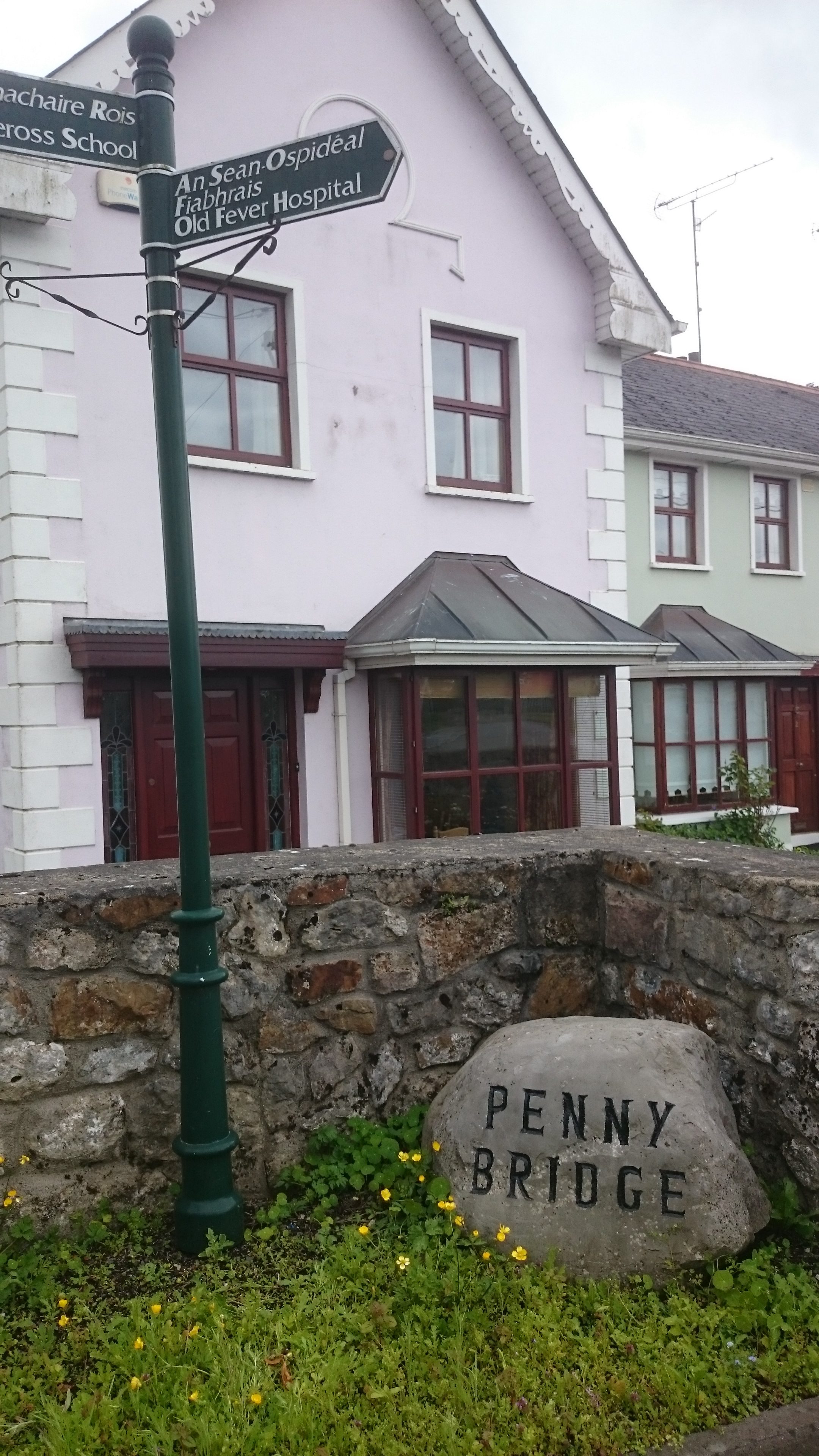
Penny Bridge, Carrickmacross   Photo:  © Michael Fisher

Penny Bridge, Carrickmacross Photo: © Michael Fisher

Nearby a stone marks the site of what was once the Penny Bridge on one of the entrances to the town. It got its name from the one penny cost of the toll that used to be charged for those using the bridge over the river that feeds into Lough na Glack. According to Henderson’s Carrickmacross directory for 1856, boot and shoemaker Patrick Tumelty had a premises at the Penny Bridge and other members of the Tumelty clann were in the same trade at Main Street and Monaghan Street.

WALK IN CARRICKMACROSS (3)

Former Fever Hospital, Carrickmacross  Photo:  © Michael Fisher

Former Fever Hospital, Carrickmacross Photo: © Michael Fisher

WALK AROUND CARRICKMACROSS   Northern Standard  Carrickmacross News  Thursday 18th June

3. FEVER HOSPITAL

Leaving the Toll House the guided walk proceeds through the mall of the new shopping centre and takes the road down the hill towards the Shercock Road roundabout.

Stone Plaque above front entrance at former Fever Hospital, Carrickmacross, showing construction date 1842   Photo:  © Michael Fisher

Stone Plaque above front entrance at former Fever Hospital, Carrickmacross, showing construction date 1842 Photo: © Michael Fisher

The first building on the left hand side is the old fever hospital. It was designed by architect George Sudden and according to the stone plaque above the main entrance, it opened in 1842. Like many other buildings on the tour, it was constructed from local limestone. In those days medical staff had very little training and care was primitive. The nurses and doctors were called to deal with infections such as TB, pneumonia, typhoid, and smallpox.

A plaque recalls the occasion when the Inniskeen poet Patrick Kavanagh, then in his 20s, was treated there for typhoid fever and quotes from his prose work “The Green Fool”. One of the three great laughs he had in his life, he says, was caused by a joke told by the night nurse in the hospital. The hospital was in use until the 1950s. In 1962 the building was purchased by the Fane Valley Co-Operative and was used for a time as a jam factory.

Across the road from the hospital is the restored Workhouse building. Opened in 1843 it was one of 157 that were built in the era of the Great Famine. The Workhouse is not included on the walking tour but is open to visitors during the week.

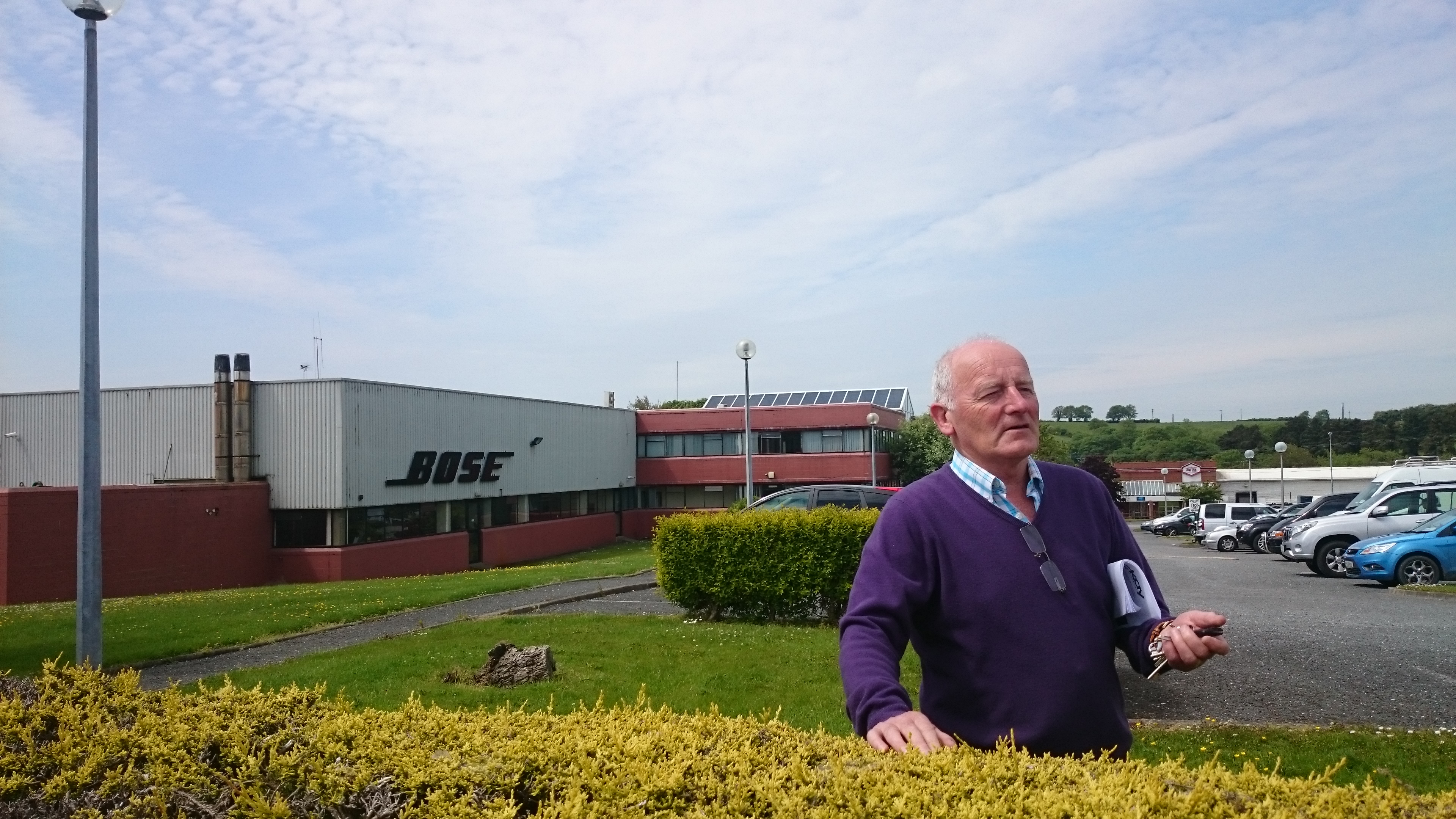
BOSE SALE CARRICKMACROSS

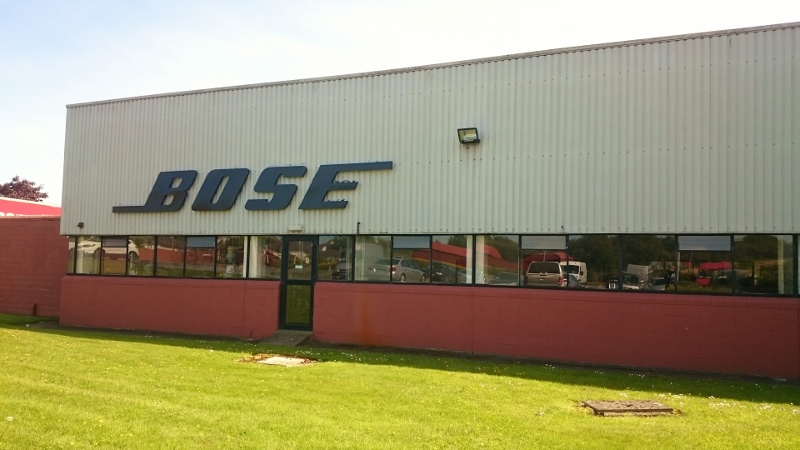
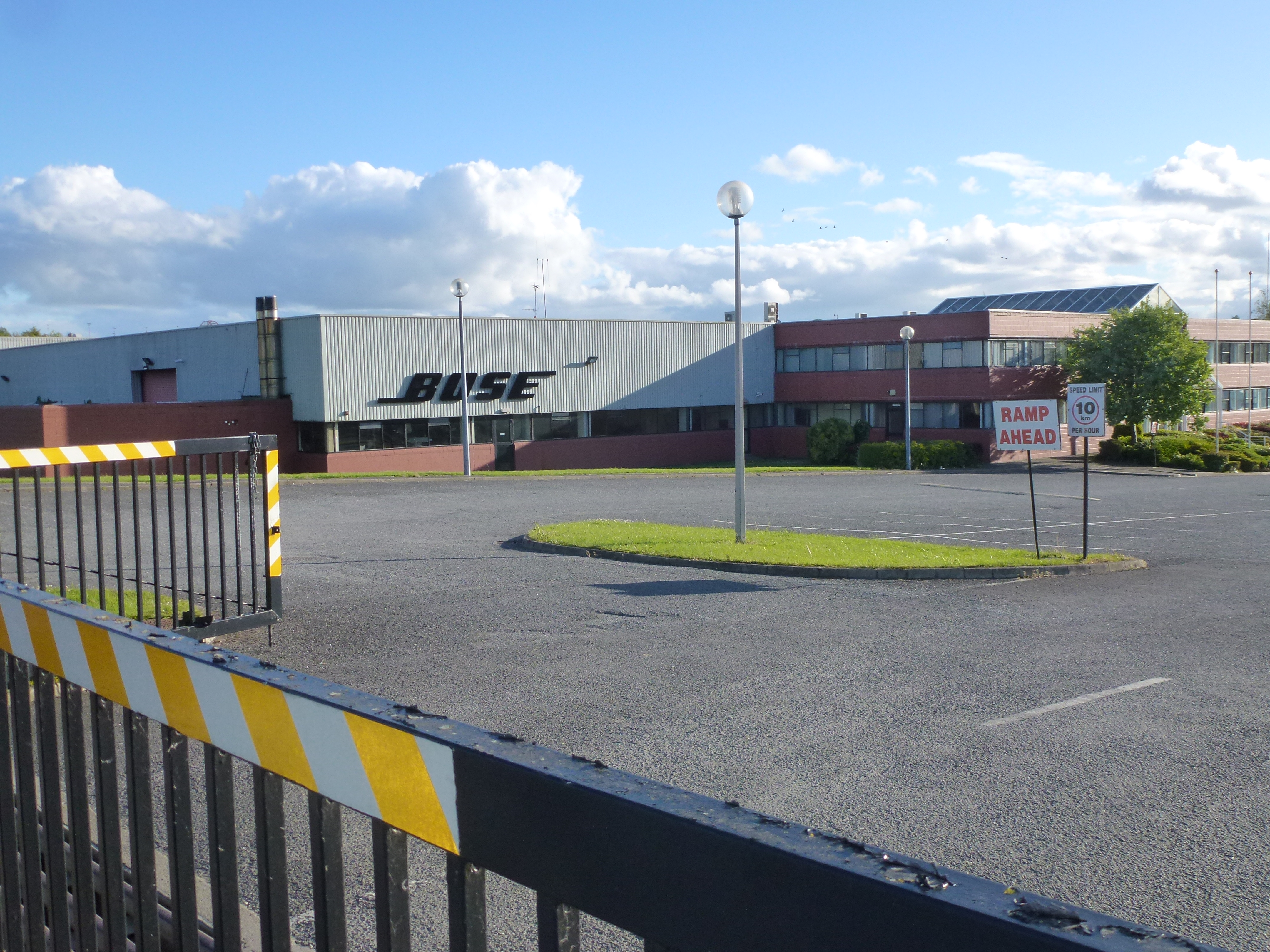
Former Bose factory, Carrickmacross   Photo:  © Michael Fisher

Former Bose factory, Carrickmacross Photo: © Michael Fisher

SALE OF BOSE MACHINERY AND EQUIPMENT

Michael Fisher    Northern Standard   Carrickmacross News   Thursday 18th June p.43

There was a steady stream of visitors to the former Bose factory in Carrickmacross last Thursday 11th and Friday 12th June. Among them were a number of local business people, checking out the plant and machinery that had been put up for sale by the US-based company. 140 workers were made redundant at the start of June, following the sudden announcement in January that the factory would be closing. For a number of them, Bose had been their only employer and the company had always looked after them since it set up a European base in County Monaghan in 1978.

Former Bose factory, Carrickmacross  Photo:  © Michael Fisher

Former Bose factory, Carrickmacross Photo: © Michael Fisher

The company had been founded by a sound engineer and entrepreneur, Dr Amar Bose in 1964 in Natick, Massachusetts. It developed a revolutionary 901 speaker system. Its acoustic wave system was introduced in 1984. One of the reasons the company came to Carrickmacross was because of the local expertise in furniture making. There was a skilled workforce which made cabinets for the sound systems.

Former Bose Factory, Carrickmacross  Photo:  © Michael Fisher

Former Bose Factory, Carrickmacross Photo: © Michael Fisher

Former Bose workers say the plant continued to be profitable and that staff had fulfilled their targets and had undertaken any necessary work practices to ensure that orders were met. There was never an industrial dispute at the factory. Now some are too old to find another job. But there could be some hope for others.

Padraig McEneaney, CEO Celtic Pure Ltd   Photo:  © Michael Fisher

Padraig McEneaney, CEO Celtic Pure Ltd Photo: © Michael Fisher

According to Padraig McEneaney CEO of Celtic Pure Ltd in Corcreagh, near Carrickmacross, five former Bose workers have been taken on at their bottled water plant. After inspecting the inside of the Bose premises, Mr McEneaney said the plant had been very well maintained. He put bids on a number of items, which had to be in by midday on Friday. Then the tenders were opened on Tuesday, to see which was the highest bid.

Main entrance to former Bose Factory, Carrickmacross  Photo:  © Michael Fisher

Main entrance to former Bose Factory, Carrickmacross Photo: © Michael Fisher

Over 1000 lots were listed in the catalogue and the sale was conducted by McKay Auctioneers from Dublin. Mr McEneaney said this was a slightly unusual way of doing business and he would await the outcome of the tendering process. The businessman said he hoped a replacement business would be found over the next twelve months. Although Carrick was a thriving town, Bose would be sadly missed. There would be a knock-on effect for several contractors such as couriers and suppliers. He pointed out that there were some top quality and highly skilled staff from Bose and he hoped they would find new employment. Mr McEneaney also stressed the advantages Carrickmacross had as a place to locate a business. It was only one hour from Dublin and close to the motorway and the airport.

Paddy Gollogly, Carrickmacross Lions Club    Photo:  © Michael Fisher

Paddy Gollogly, Carrickmacross Lions Club
Photo: © Michael Fisher

Paddy Gollogly, a founder member of Carrickmacross Lions Club, was another visitor to the Bose auction. He said the company had been good for Carrickmacross and had sponsored the Lions’ annual charity cycle run in the early years. Their withdrawal would leave a big loss for charities in the area. He recalled the major contribution the Bose social club had made to groups such as Carrick Cancer, and it was going to be hard to raise money without a similar large group of volunteers to help them. He thanked the workers for their fundraising efforts over the past 37 years.

Kevin Gartlan, Carrickmacross Workhouse.  Photo:  © Michael Fisher

Kevin Gartlan, Carrickmacross Workhouse. Photo: © Michael Fisher

Kevin Gartlan of Carrickmacross Workhouse wanted to find out if there were any heritage items that were worth preserving. He hoped that a few items of local interest would be preserved. He also hoped that local small businesses would be successful in their tenders for machinery and other items as it was necessary to keep as many jobs as possible locally.

Jim Hand, President, Carrickmacross Chamber of Commerce Photo:  © Michael Fisher

Jim Hand, President, Carrickmacross Chamber of Commerce Photo: © Michael Fisher

Jim Hand, President of Carrickmacross Chamber of Commerce, said he hoped the IDA and Enterprise Ireland would be successful over the next year in attracting a new company to take over the lease on the factory. It was still a state of the art building. There was a broadband connection and a good infrastructure, with Carrick close enough to Dublin for any investor. He also thanked the loyal Bose workforce for their service and their commitment and the contribution they had made to Carrickmacross for nearly forty years. He hoped the staff would get fixed up elsewhere.

Former Bose Factory, Carrickmacross  Photo:  © Michael Fisher

Former Bose Factory, Carrickmacross Photo: © Michael Fisher

ST KEVIN’S PARK DUBLIN

Saint Kevin's Park, Dublin. Photo:  © Michael Fisher

Saint Kevin’s Park, Dublin. Photo: © Michael Fisher

SAINT KEVIN’S PARK
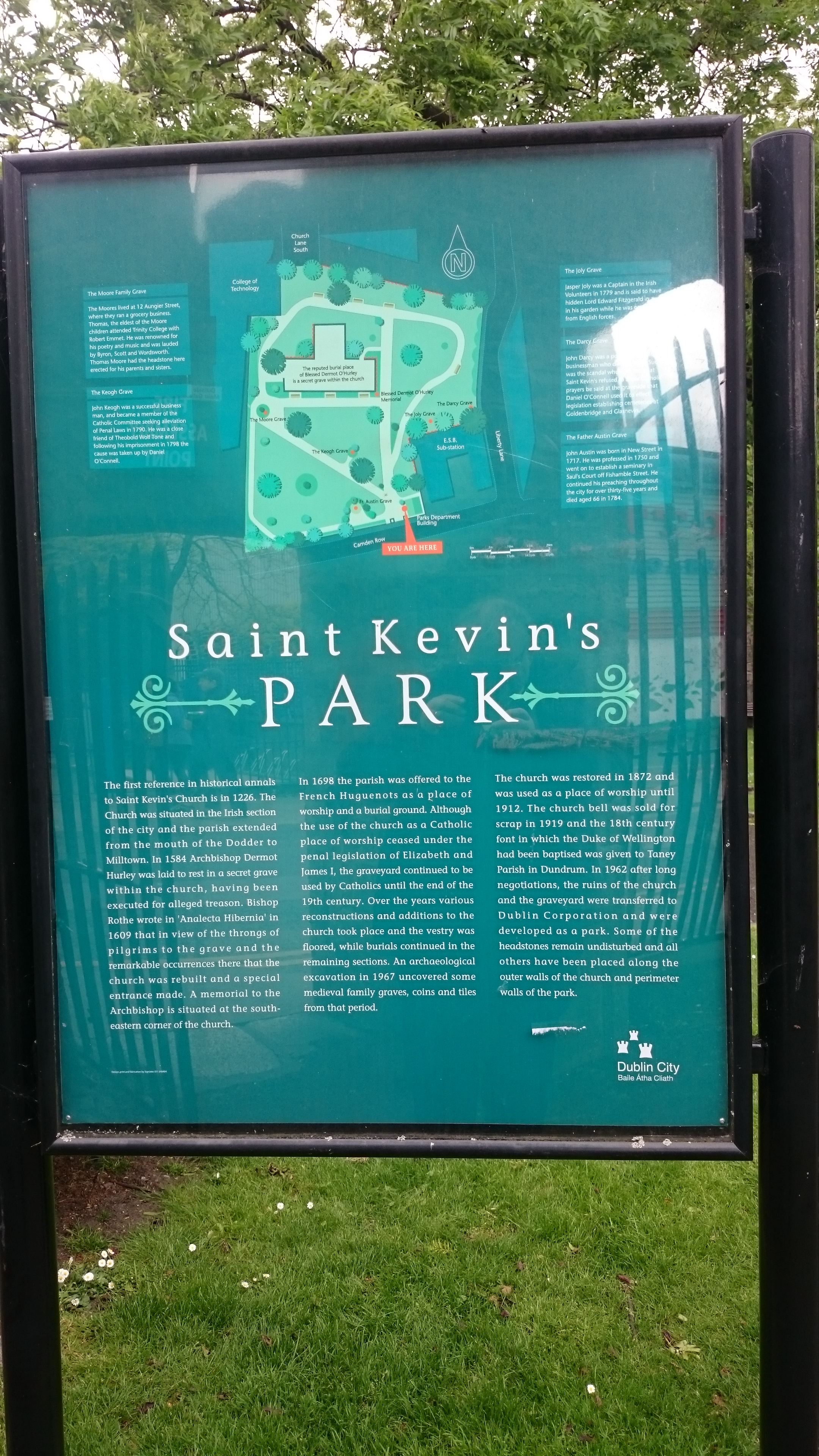
The first reference in historical annals to Saint Kevin’s Church is in 1226. The Church was situated in the Irish section of the city and the parish extended from the mouth of the Dodder to Milltown. In 1584 Archbishop Dermot Hurley was laid to rest in a secret grave within the church, having been executed for alleged treason. Bishop Rothe wrote in ‘Analecta Hibernia’ in 1609 that in view of the throngs of pilgrims to the grave and the remarkable occurrences there that the church was rebuilt and a special entrance made. A memorial to the Archbishop is situated at the south-eastern corner of the church.

In 1698 the parish was offered to the French Huguenots as a place of worship and a burial ground. Although the use of the church as a Catholic place of worship ceased under the penal legislation of Elizabeth and James I, the graveyard continued to be used by Catholics until the end of the 19th century. Over the years various reconstructions and additions to the church took place and the vestry was floored, while burials continued in the remaining sections. An archaeological excavation in 1967 uncovered some medieval family graves, coins and tiles from that period.

The church was restored in 1872 and was used as a place of worship until 1912. The church bell was sold for scrap in 1919 and the 18th century font in which the Duke of Wellington had been baptised was given to Taney church in Dundrum. In 1962 after long negotiations, the ruins of the church and the graveyard were transferred to Dublin Corporation and were developed as a park. Some of the headstones remain undisturbed and all others have been placed along the outer walls of the church and perimeter walls of the park.

The Keogh Grave, St Kevin's Park Photo:  © Michael Fisher

The Keogh Grave, St Kevin’s Park Photo: © Michael Fisher

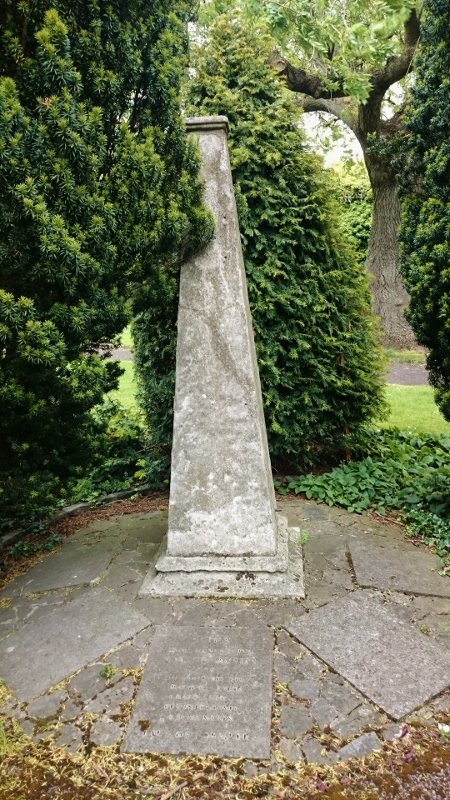
THE KEOGH GRAVE
John Keogh, Mount Jerome, one of the founders of the Catholic Convention of 1792, died Nov. 13th 1817, aged 77.
Also his wife Mary, died Dec. 1st 1823, aged 66.
Also his father Cornelius Keogh, died August 19th 1774, aged 66.
Also his mother Abigail Keogh, died Sept. 20th 1779, aged 66.
Also his daughter Mary Keogh, died April 20th 1804, aged 18.
John Keogh was a successful businessman, and became a member of the Catholic committee seeking alleviation of Penal Laws in 1790. He was a close friend of Theobald Wolfe Tone and following his imprisonment in 1798 the cause was taken up by Daniel O’Connell.

The Moore Grave, St Kevin's Park Photo:  © Michael Fisher

The Moore Grave, St Kevin’s Park Photo: © Michael Fisher

THE MOORE GRAVE
John Moore Esq. Formerly Barrack Master at Islandbridge, (in the County of) Dublin, died Dec. 17th 1825, aged 84 (years).
Also Anastasia Moore, alias Coda, his wife, died May 8th 1832, aged 68.
Also six of their children who died young and their daughter Ellen, died Feb. 4th 1846.
Deeply mourned by her brother, Thomas Moore, the bard of his much beloved country, Ireland.
The Moores lived at 12 Aungier Street, where they ran a grocery business. Thomas, the eldest of the Moore children, attended Trinity College with Robert Emmett. He was renowned for his poetry and music and was lauded by Byron, Scott and Wordsworth. Thomas Moore had the headstone here erected for his parents and sisters.

The Darcy Grave, St Kevin's Park Photo:  © Michael Fisher

The Darcy Grave, St Kevin’s Park Photo: © Michael Fisher

THE DARCY GRAVE
Belongs to John Darcy, Brewer, Usher’s St.
His father, Mathew Darcy, died August 6th 1824.
Also his mother, Mrs Mary Darcy, died March 30th 1814.
Also his eldest brother, Arthur Darcy, died Sept. 7th 1823.
John Darcy was a popular Catholic businessman who died in 1825. Such was the scandal when the rector at St Kevin’s refused to allow Catholic prayers be said at the graveside that Daniel O’Connell used it to effect legislation establishing cemeteries at Goldenbridge and Glasnevin.

The Joly Grave, St Kevin's Park Photo:  © Michael Fisher

The Joly Grave, St Kevin’s Park Photo: © Michael Fisher

THE JOLY GRAVE
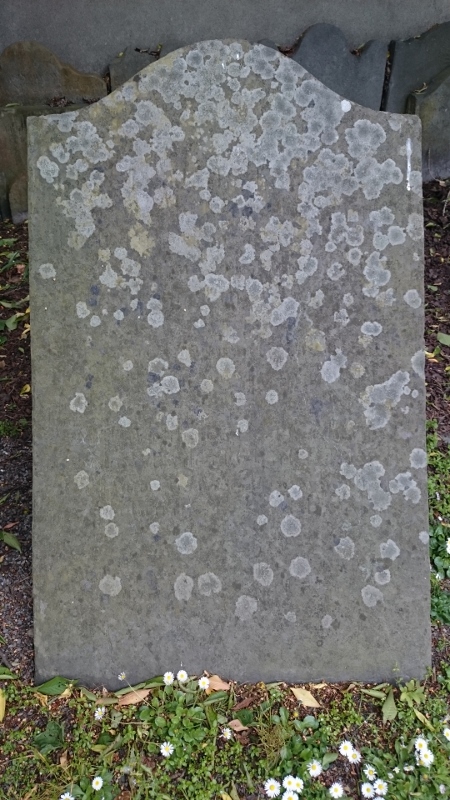
Jasper Joly, died Nov. 9th 1823, aged 84.
Also his wife Mary, died Dec. 13th 1825, qged 84.
Also Catherine, wife of Charles Joly of Harcourt Tce. Died Feb. 27th 1858, aged 43. Also Charles Joly.
Jasper Joly was a Captain in the Irish Volunteers in 1779 and is said to have hidden Lord Edward Fitzgerald in a well in his garden while he was on the run from English forces.

Memorial to Archbishop of Cashel Dr Dermot O'Hurley in St Kevin's Park, Dublin Photo:  © Michael Fisher

Memorial to Archbishop of Cashel Dr Dermot O’Hurley in St Kevin’s Park, Dublin Photo: © Michael Fisher

BLESSED DERMOT O’HURLEY ARCHBISHOP OF CASHEL 1531-1584 (see article yesterday)

The Fr John Austin Grave, St Kevin's Park Photo:  © Michael Fisher

The Fr John Austin Grave, St Kevin’s Park Photo: © Michael Fisher

FR JOHN AUSTIN SJ GRAVE  (as transcribed by Bowden)
“To the memory of
Rev John Austin
Of the City of Dublin, a Priest,
And until the suppression of the Society of Jesus,
A professed Jesuit;
During six and thirty years
A pious learned and indefatigable labourer
In the vineyard (sic.) of the Lord.
Who after deserving well
Of the rich, whom he admonished,
Of the poor, whom he relieved,
Of youth, whom he instructed,
Of the orphan, to whom he was a father,
Of all ranks of men whom he,
By making himself all in all,
Was active in opening to Jesus Christ.
On the 29th September, 1784
Closed, in the 66 year of his age,
A life, worn out in the sight of the Lord.
Religion
Weeping for her faithful Minister,
On the 8th December 1786,
With grateful hand
Erected this monument”

The Fr John Austin Grave, St Kevin's Park Photo:  © Michael Fisher

The Fr John Austin Grave, St Kevin’s Park Photo: © Michael Fisher

John Austin was born in New Street in 1717. He was professed (as a priest) in 1750 and went on to establish a seminary in Saul’s Court, off Fishamble Street. He continued his preaching throughout the city for over thirty-five years and died aged 66 in 1784.

The Fr John Austin SJ Grave, St Kevin's Park Photo:  © Michael Fisher

The Fr John Austin SJ Grave, St Kevin’s Park Photo: © Michael Fisher

Perhaps the Parks Department along with the Jesuits might consider a tidy-up of the grave sign and surrounding this summer, in time for Fr Austin’s anniversary in September. It seems a while since any maintenance was undertaken.

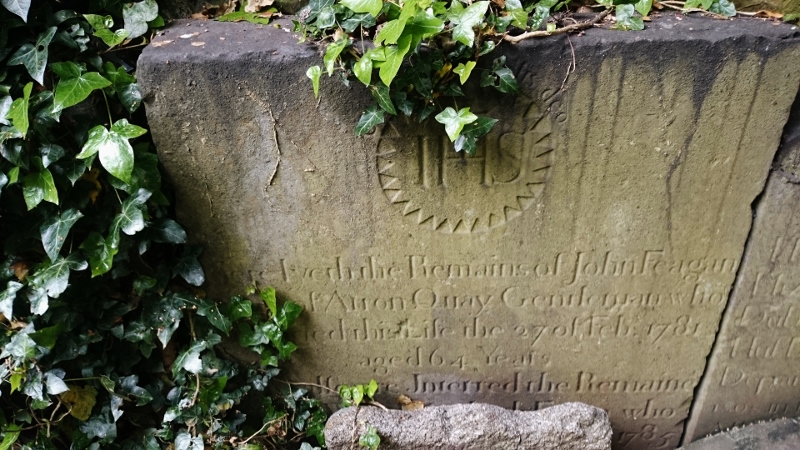
Headstone with 'IHS' sign for grave of nJohn Feagan, Gentleman of Arron (Arran) Quay, Dublin, in St Kevin's Park.  Photo:  © Michael Fisher

Headstone with ‘IHS’ sign for grave of nJohn Feagan, Gentleman of Arron (Arran) Quay, Dublin, in St Kevin’s Park. Photo: © Michael Fisher

MARTYRDOM IN DUBLIN: 431 YEARS AGO

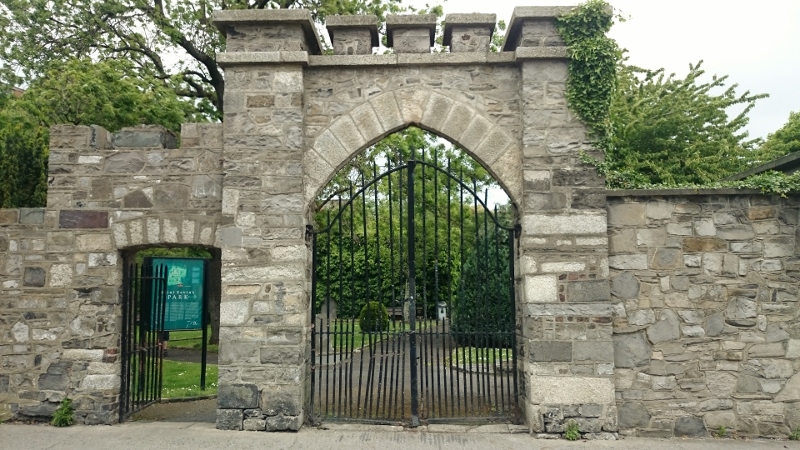
Entrance to St Kevin's Park, Dublin Photo:  © Michael Fisher

Entrance to St Kevin’s Park, Dublin Photo: © Michael Fisher

Visiting a hidden-away part of Dublin city centre earlier this month near Aungier Street, I came across a little-known story about a significant event in the history of the Irish Catholic church 431 years ago on this day. By coincidence, June 20th 1584 was also a Saturday. Walking along Camden Row off Wexford Street, I came across a small green area behind a wall, with an interesting arch and gate at the entrance: Saint Kevin’s Park. I decided to take a look. There is a very helpful information board at the entrance, provided by the Parks Division of Dublin Corporation (now Dublin City Council).

Entrance to St Kevin's Park, Dublin Photo:  © Michael Fisher

Entrance to St Kevin’s Park, Dublin Photo: © Michael Fisher

This is the story of one of the Irish Catholic Martyrs during the reign of Queen Elizabeth I. On 27th September 1992, he was beatified by Pope John Paul II, alongside sixteen other Irish martyrs, who share this feastday. Another martyr, Saint Oliver Plunkett, was beatified in 1920 and canonised in 1975.

Ruins of St Kevin's Church in St Kevin's Park, Dublin Photo:  © Michael Fisher

Ruins of St Kevin’s Church in St Kevin’s Park, Dublin Photo: © Michael Fisher

Inside the park you can see the ruins of Saint Kevin’s church. Beside the wall at the south-eastern corner, there is a stone memorial resembling a pulpit, with the bishop’s coat of arms on the front and on top, a bronze plaque with a dedication to Archbishop O’Hurley.

Memorial to Archbishop of Cashel Dr Dermot O'Hurley in St Kevin's Park, Dublin Photo:  © Michael Fisher

Memorial to Archbishop of Cashel Dr Dermot O’Hurley in St Kevin’s Park, Dublin Photo: © Michael Fisher

BLESSED DERMOT O’HURLEY ARCHBISHOP OF CASHEL 1531-1584

Memorial plaque with story of Archbishop Dermot O'Hurley in St Kevin's Park, Dublin Photo:  © Michael Fisher

Memorial plaque with story of Archbishop Dermot O’Hurley in St Kevin’s Park, Dublin Photo: © Michael Fisher

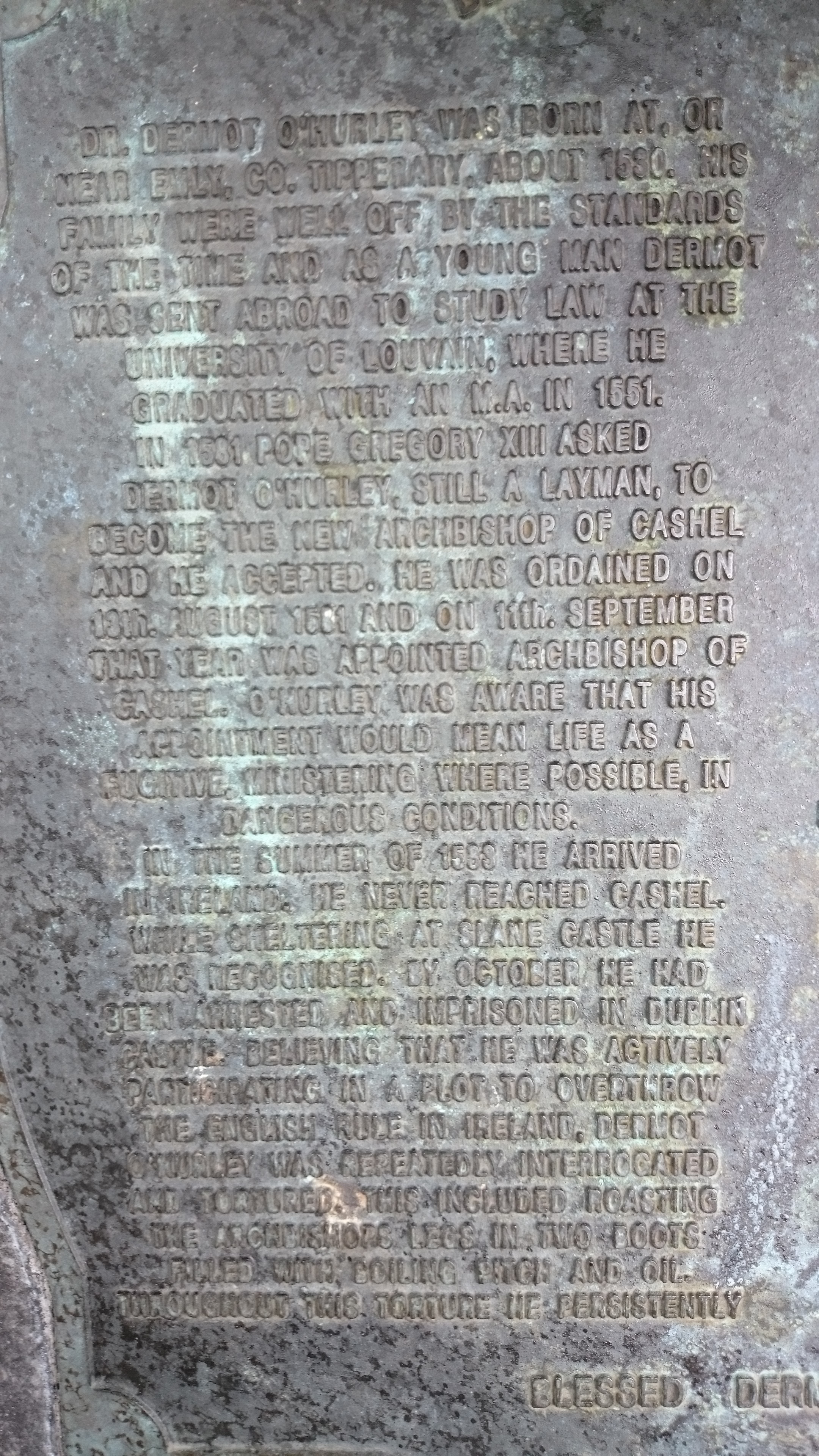
Dr Dermot O’Hurley was born at, or near, Emly, Co. Tipperary, about 1530. His family were well off by the standards of the time and as a young man Dermot was sent abroad to study law at the University of Louvain, where he graduated with an M.A. in 1551. In 1581 Pope Gregory XIII asked Dermot O’Hurley, still a layman, to become the new Archbishop of Cashel and he accepted. He was ordained on 13th August 1581 and on 11th September that year was appointed Archbishop of Cashel. O’Hurley was aware that his appointment would mean life as a fugitive, ministering where possible, in dangerous conditions. In the summer of 1583 he arrived in Ireland. He never reached Cashel. While sheltering at Slane Castle he was recognised. By October he had been arrested and imprisoned in Dublin Castle. Believing that he was actively participating in a plot to overthrow the English rule in Ireland, Dermot O’Hurley was repeatedly interrogated and tortured. This included roasting the Archbishop’s legs in two boots filled with boiling pitch and oil. Throughout the torture he persistently

Memorial plaque with story of Archbishop Dermot O'Hurley in St Kevin's Park, Dublin Photo:  © Michael Fisher

Memorial plaque with story of Archbishop Dermot O’Hurley in St Kevin’s Park, Dublin Photo: © Michael Fisher

protested that his mission was one of peace and that he had no information to give to his captors. The authorities also resorted to bribery. This proved to be equally fruitless and an order for his execution was received from England on Saturday 20th June, 1584. Dermot O’Hurley was taken, very early on a midsummer morning from his cell in Ship Street, to Hoggin Green, near St Stephen’s Green, (then a swampy area with wildfowl) to be hanged. He got an opportunity to speak a few words to people who were in the Green that morning.  

‘I am a priest anointed and also a Bishop, although unworthy of so sacred dignities, and no cause could they find against me that might in the least degree deserve the pains of death, but merely my function of priesthood wherein they have proceeded against me in all points cruelly contrary to their own laws’. 

The Very Rev. Dean (Thomas H.) Kinane P.P., V.G. in his book “The Life of Dr O’Hurley Archbishop of Cashel” published in 1893 states ‘Mr William Fitzsimmons a citizen of Dublin (let his name be emblazoned in gold and held up to

Memorial plaque with story of Archbishop Dermot O'Hurley in St Kevin's Park, Dublin Photo:  © Michael Fisher

Memorial plaque with story of Archbishop Dermot O’Hurley in St Kevin’s Park, Dublin Photo: © Michael Fisher

the admiration of posterity) got private possession of the holy relic of the body of the martyr, lovingly and reverentially encased in a wooden urn, the best that could be procured under the circumstances and consigned it to it’s (sic.) mother earth in the ruinous church of St Kevin’. The Catholic Bishop of Ossory, David Rothe, in ‘Analecta Hibernia’ written about 1609 and published in Cologne in 1717, relates that the church was rebuilt ‘in view of the throng of pilgrims to the grave “in vicino oratorio” (in the vicinity of the oratory) of Saint Kevin and the remarkable occurrances (sic.) there’.  Rev. S. O Muirthuile  S.J. in ‘A Martyred Archbishop of Cashel’ (1935) writes ‘we may be sure that this holy place played its part in strengthening the faith of the Catholic people of Anglo-Irish Dublin during the glorious history of persecution. It was a strange disposition of God’s providence that he who had been consecrated to spend his life in the apostolate of Cashel became in death a most eloquent apostle of Dublin’. 

Memorial plaque with story of Archbishop Dermot O'Hurley in St Kevin's Park, Dublin Photo:  © Michael Fisher

Memorial plaque with story of Archbishop Dermot O’Hurley in St Kevin’s Park, Dublin Photo: © Michael Fisher

The above reference to Slane Castle caught my attention and I decided to investigate it further. The Castle referred to is not the present building, the home of the Conyngham family since 1703. The Castle was for many years the seat of the Flemings, an Anglo-Catholic family. The tenth Baron Slane Thomas Fleming (died 1601) was a member of the Parliament of Ireland of 1585. He was the son of James Fleming, a grandson of James Fleming, 7th Baron Slane.

An entrance to the current Slane Castle, Co. Meath Photo:  © Michael Fisher

An entrance to the current Slane Castle, Co. Meath Photo: © Michael Fisher

His mother was Ismay Dillon, daughter of Sir Bartholomew Dillon, Lord Chief Justice of Ireland. He succeeded to the barony after the death of his cousin James Fleming, 9th Baron Slane. He was the only noble to serve with Walter Devereux, 1st Earl of Essex against Turlough Luineach O’Neill, the ruler of Ulster, in March 1574. He was one of the leaders of the opposition to the policies of Sir John Perrot, the Lord Lieutenant of Ireland, in the 1580s. His relative the thirteenth Baron Slane was (Catholic) Archbishop of Dublin, a Franciscan priest who, like O’Hurley, had studied at Louvain.

Coat of arms of Archbishop Dermot O'Hurley of Cashel on memorial in St Kevin's Park, Dublin Photo:  © Michael Fisher

Coat of arms of Archbishop Dermot O’Hurley of Cashel on memorial in St Kevin’s Park, Dublin Photo: © Michael Fisher

The episcopal motto for Archbishop O’Hurley was “Ardente Fide” (burning, or ardent faith) and the coat of arms forms part of the memorial in the park. So on this anniversary let us remember him and the other Irish martyrs who died for their faith. Semper et ubique fidelis, in the words of our school motto in Dublin.

EIRGRID PLANS FOR N/S INTERCONNECTOR

eirgridLogoEIRGRID PLAN FOR N/S INTERCONNECTOR WOULD AFFECT 42 TOWNLANDS IN COUNTY MONAGHAN 

Michael Fisher  Northern Standard  Thursday 18th June p.10

(A copy of my article in this week’s newspaper. I expect that reaction will be published next week and in the coming months.)

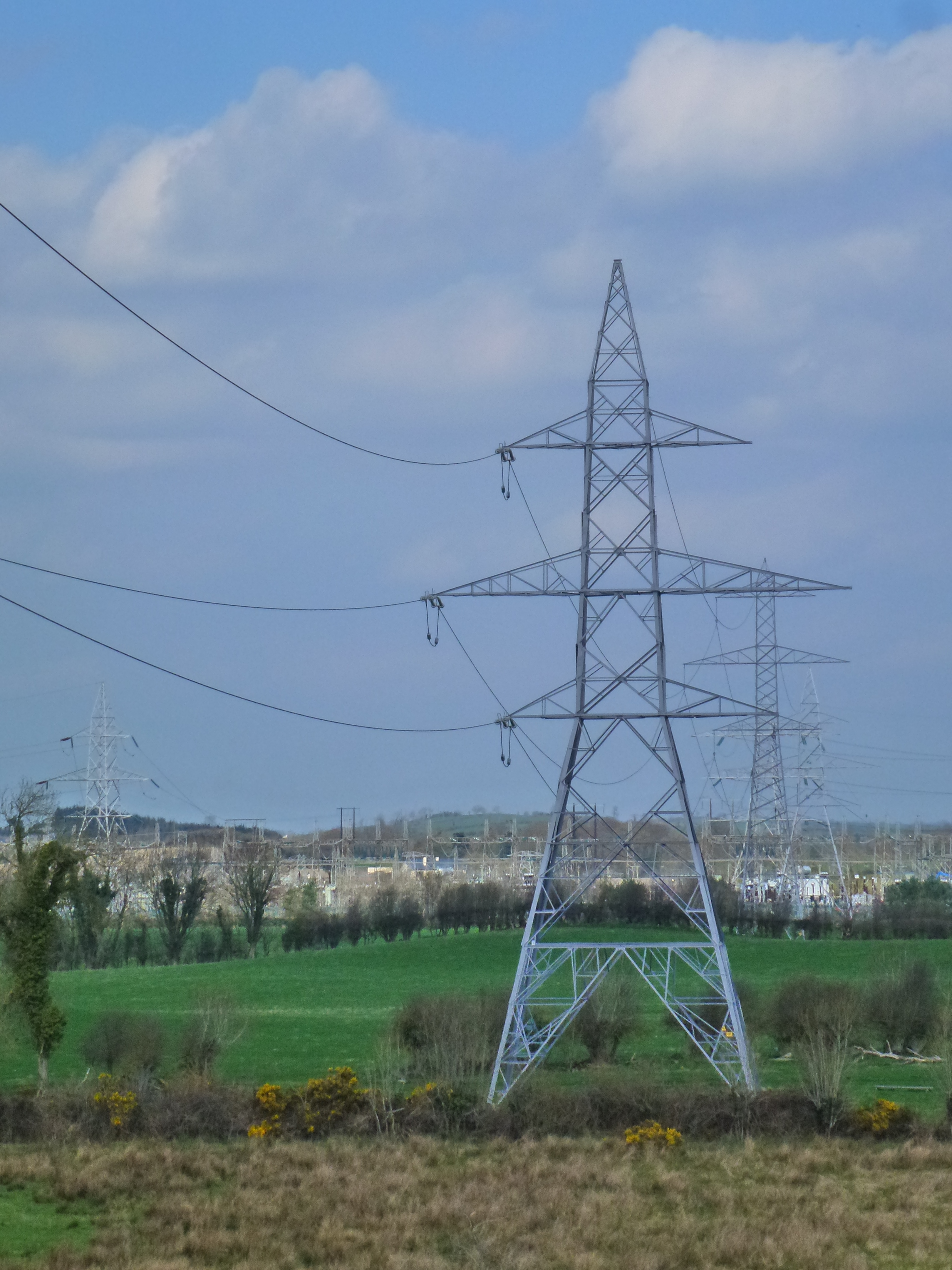
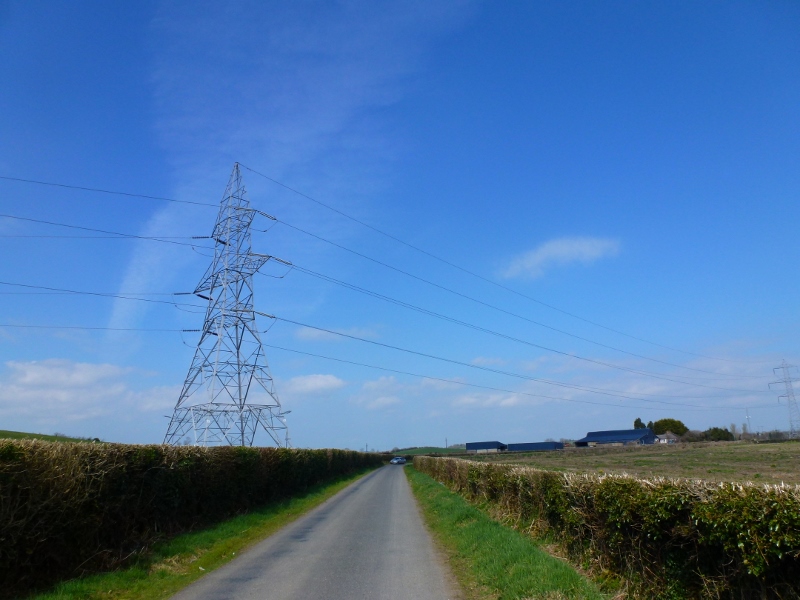
EirGrid pylons in County Louth  Photo:  © Michael Fisher

EirGrid pylons in County Louth Photo: © Michael Fisher

The electricity supplier EirGrid has published its controversial plan for a new North/South interconnector, submitted last week to An Bord Pleanála in Dublin. A sum of €100,000 was lodged by the company with the planning Board. EirGrid and its northern counterpart System Operator for Northern Ireland want to build 401 new pylons carrying an overhead 400kV supply line across five counties including Monaghan, Cavan and Meath. 109 of the towers would be erected in Monaghan. Part of the application refers to a plan to operate a temporary yeard for the storage of construction materials at Monaltyduff and Monaltybane outside Carrickmacross near the N2 by-pass.
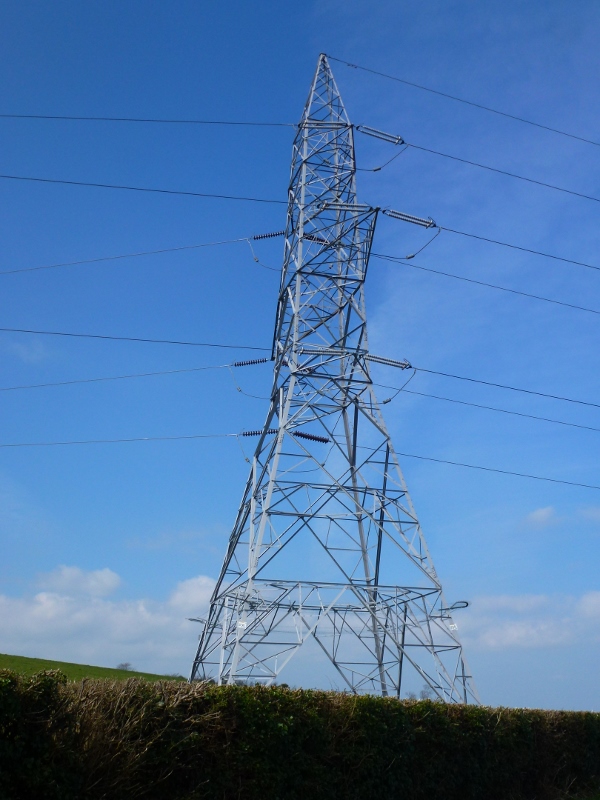
EirGrid pylon in County Louth  Photo:  © Michael Fisher

EirGrid pylon in County Louth Photo: © Michael Fisher

The power line from Woodland near Batterstown in County Meath to Turleenan near Dungannon in County Tyrone and passing across the border at Lemgare near Clontibret into County Armagh would be one of the biggest infrastructure developments on the island and so it was designated a Project of Common Interest by the European Commission. Such projects are deemed necessary for EU energy policy and are allocated the status of the highest national significance.

Public Consultation

There is now a ten weeks period of statutory public consultation, running until Monday August 24th. The full application documentation, including the Environmental Impact Statement and Natura Impact Statement is available online at http://www.eirgridnorthsouthinterconnector.ie

Hard copies are also available at a number of venues, including the offices of Monaghan County Council and Eirgrid’s local Project Information Centre at the Workhouse, Shercock Road in Carrickmacross, which is open on Mondays and Thursdays from 12 noon to 6pm.
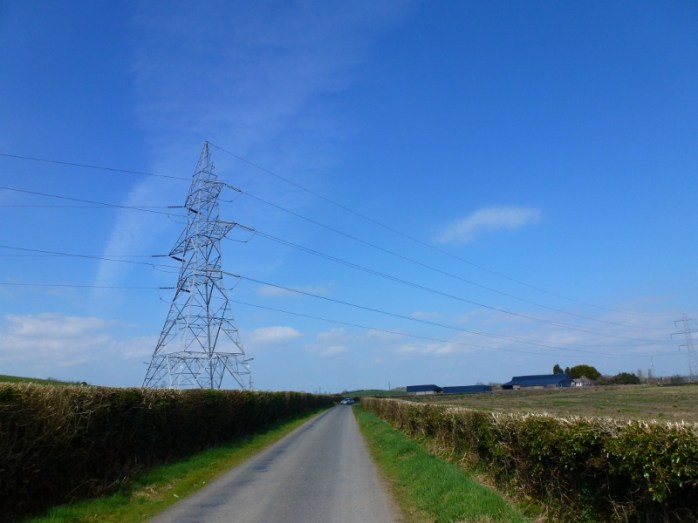
EirGrid pylon on farmland at Ballykelly in County Louth  Photo:  © Michael Fisher

EirGrid pylon on farmland at Ballykelly in County Louth Photo: © Michael Fisher

 Submissions

Submissions and/or observations in relation to the EirGrid application can be made only to An Bord Pleanála, 64 Marlborough Street, Dublin 1, from Tuesday 16th June until Monday 24th August, accompanied by the statutory fee of €50. 

EirGrid pylon in County Louth  Photo:  © Michael Fisher

EirGrid pylon in County Louth Photo: © Michael Fisher

This is an edited version of the EirGrid application form to An Bord Pleanála.

Application Form for Permission/Approval in respect of a Strategic Infrastructure Development 

Please specify the statutory provision under which your application is being made:

Section 182A of the Planning and Development Act, 2000 (as amended)

  1. Applicant:

Name of Applicant:  EirGrid plc, with the consent and approval of the Electricity Supply Board (ESB)  Address:  EirGrid plc, The Oval, 160 Shelbourne Road, Ballsbridge, Dublin 4.

Telephone No:  + 353 (1) 2370000

Email Address (if any): northsouth@eirgrid.com

  1. Where Applicant is a company (registered under the companies Acts:

Name(s) of company director(s):

John O’Connor, Fintan Slye, Dr. Joan Smyth, Richard Sterling, Regina Moran, Dr. Gary Healy, Liam O’Halloran, Bride Rosney, Doireann Barry

  1. Person / Agent acting on behalf of the Applicant (if any): 

Name: Leah Kenny, Operations Director

Address:  RPS Planning and Environment, West Pier Business Campus, Dun Laoghaire, Co. Dublin. Telephone No. + 353 (1) 4882900

Email address (if any): info@rpsgroup.com   

Contact Name and Contact Details (Phone number) for arranging entry on site if required/appropriate:  Aidan Geoghegan (EirGrid Project Manager): + 353 (1)  2370000

  Person responsible for preparation of Drawings and Plans: 

CAVAN MONAGHAN STUDY AREA (CMSA) AND TEMPORARY 

CONSTRUCTION MATERIAL STORAGE YARD, CO. MONAGHAN 

Name: Robert Arthur, Project Leader

Firm/Company: ESBI Engineering & Facility Management Ltd.

Address: ESB International, Stephen Court, 18-21 St. Stephen’s Green, Dublin 2.  Telephone No: + 353 (1) 7038000  Email Address (if any): marketing@esbi.ie

Details all plans/drawings submitted – title of drawings/plans, scale and no. of copies submitted. This can be submitted as a separate schedule with the application form.

See Drawing Register in Schedule 1 attached to this Application Form. 

  1. Site:  

Site Address/Location of the Proposed Development (as may best identify the land or structure in question)

(i) A new single circuit 400 kV overhead transmission line covering a distance of approximately 100.5km  across the following townlands in the counties of Monaghan, Cavan and Meath:

County Monaghan: Lemgare, Lisdrumgormly, Annaglogh, Latnakelly, Tassan, Cashel, Annagh (Cremorne Barony (By)), Carrickanure, Clarderry, Cornamucklagh North, Derryhallagh (Monaghan By), Drumroosk, Cargaghramer, Cornanure (Monaghan By),  Rausker, Terrygreeghan, Cornamucklagh South, Crinkill, Clogher, Drumguillew Lower, Drumhawan, Greagh (Cremorne By), Brackly (Cremorne By), Tullynahinnera,  Cooltrimegish, Boraghy, Aghmakerr, Drumillard (Cremorne By), Tooa, Tullyglass, Cornasassonagh, Corrinenty, Ummerafree, Sreenty, Ardragh, Corvally (Farney By), Raferagh, Cornalaragh, Doagh, Corlea (Electoral District Drumcarrow), Scalkill and  Ballaghnagearn. 

(ii)  Modifications are required to three existing 110 kV overhead lines in the following locations:

 The vicinity of where the proposed 400 kV overhead transmission line intersects with the Lisdrum–Louth 110 kV transmission line, in Drumroosk, County Monaghan.

 The vicinity of where the proposed 400 kV overhead transmission line intersects with the Louth-Rathrussan 110 kV transmission line, in Corrinenty and Corbane, County Monaghan.

 The vicinity of where the proposed 400 kV overhead transmission line intersects with the Arva-Navan 110 kV transmission line, in Diméin Bhaile Ghib (Gibstown Demesne and Tailtin (Teltown), County Meath.

(v)   An associated temporary construction material storage yard to be located in the townlands of Monaltyduff and Monaltybane, Carrickmacross, County Monaghan.

A full description of the proposed development is provided at Item 9, below.

Ordnance Survey Map Ref No (and the Grid Reference where applicable)

Transmission Line: 

OSI Discovery Series 1:50,000:

Monaghan: 2632, 2832, 2630, 2830, 2628, 2828.

OSI 1:10,560 (6”):

Monaghan: 14, 15, 19, 20, 24, 27, 30, 33.

OSI 1: 2,500:

Monaghan: 1159, 1160, 1220, 1221, 1219, 1285, 1286, 1354, 1355, 1423, 1424, 1490, 1557, 1624, 1625, 1694, 1695, 1763, 1764, 1766, 1824, 1825.

Existing 110 kV Overhead Lines Modifications:   

OSI Discovery Series 1:50,000:

Monaghan: OS2630, OS2632

OSI 1:10,560 (6”):

Monaghan: 19, 24, 27

OSI 1: 2,500:

Monaghan: 1219, 1220, 1286, 1285, 1625

Temporary Construction Material Storage Yard:  (Carrickmacross)

Irish Grid Coordinates: E 286200, N 302169  ITM Coordinates E 686132, N 802180

Area of site to which the application relates in hectares:

The primary element of the proposed development is a linear transmission line.

The proposed transmission line (comprising both a new single circuit, and addition of a new circuit along the currently unused northern side of the existing Oldstreet to Woodland 400 kV transmission line) is approximately 103.35km in length.

The proposed development includes 2 No. site-specific elements:

 Woodland 400 kV Substation:   0.544ha

 Temporary Construction Material Storage Yard: 1.4ha

Site zoning in current Development Plan for the area:

Transmission Line:  None

Woodland 400 kV Substation:  None

Temporary Construction Material Storage Yard:  None

Existing use of the site & proposed use of the site:

Transmission Line:

Existing Use:  Primarily Agriculture

Proposed Use: Agriculture and transmission infrastructure (agricultural practices can still be carried out under the line and the land on which the structures will be located will be used for transmission of electricity)

Existing 110 kV Overhead Lines Modifications:    

Existing Use:                  Primarily Agriculture and transmission infrastructure

Proposed Use:               Primarily Agriculture and transmission infrastructure

Temporary Construction Material Storage Yard:   

Existing Use:                 Agriculture

Proposed Use:              Temporary Construction Material Storage Yard

Name of the Planning Authority(s) in whose functional area the site is situated:

Monaghan County Council

  1. Legal Interest of Applicant in respect of the site the subject of the application   

Please tick appropriate box to show applicant’s legal interest in the land or structure:

Owner /Occupier/ Other  x

Where legal interest is “Other”, please expand further on your interest in the land  or structure.

EirGrid plc is the licensed Transmission System Operator for Ireland pursuant to the provisions of the Electricity Regulation Act, 1999.  Pursuant to the provisions of S.I. No 445/2000, EirGrid plc has the exclusive function to operate and ensure the maintenance of and, if necessary, develop a safe,secure, reliable, economical and efficient electricity transmission system.

The Electricity Supply Board is the licensed Transmission System Owner for Ireland pursuant to Section 14 of the Electricity Regulation Act, 1999.

The proposed transmission infrastructure will be constructed by the Electricity Supply Board pursuant to statutory powers.

If you are not the legal owner, please state the name and address of the owner and supply a letter from the owner of consent to make the application as listed in the accompanying documentation.

The owner of the Temporary Construction Material Storage Yard to be located in the townlands of Monaltyduff and Monaltybane, Carrickmacross, County Monaghan is Mr. Peter Kelly, Dunanny, Carrickmacross, County Monaghan.  A letter of consent and approval to the making of the application from Mr. Kelly is included in Schedule 2 attached to this Application Form.

Does the applicant own or have a beneficial interest in adjoining, abutting or adjacent lands.  If so, identify the lands and state the interest.

EirGrid plc, the applicant for approval, does not have a beneficial interest in adjoining, abutting or adjacent lands.

Site History 

Details regarding site history (if known):  

Has the site in question ever, to your knowledge, been flooded?

Transmission Line:   Yes:  [ ✓  ]     No: [    ]

Some localised flooding may have occurred in particular locations along the length of the line route.

Existing 110 kV Overhead Lines Modifications:   Yes:  [ ✓  ]     No: [    ]

Some localised flooding may have occurred in particular locations along the length of the line route. 

Temporary Construction Material Storage Yard:  Yes:    [   ]     No: [ ✓ ]

While EirGrid is not aware of any flooding on this site, historical geological data indicates that a turlough may have occurred on this site.  However, more recent and up-to-date information suggests the site is not a turlough.

If yes, please give details e.g. year, extent:

Are you aware of previous uses of the site e.g. dumping or quarrying?

Transmission Line:  Yes:  [   ]     No: [✓ ]

Existing 110 kV Overhead Lines Modifications:   Yes:  [   ]     No: [✓ ]

Temporary Construction Material Storage Yard:   Yes:    [  ✓ ]     No: [  ]

If yes, please give details: It is understood that this site was previously used as a  construction depot for the N2 Carrickmacross By-pass project

Are you aware of any valid planning applications previously made in respect of this land / structure?  

Transmission Line: Yes:  [✓  ]     No: [    ]

Existing 110 kV Overhead Lines Modifications: Yes:  [  ]     No: [  ✓ ]

Temporary Construction Material Storage Yard:   Yes:    []     No: [  ✓ ]

If yes, please state planning register reference number(s) of same if known and details of applications                              See below.

Reg. Ref. No:                 Nature of Proposed Development 

Nature of Final Decision of Application Grant or Refusal by Planning Authority/An Bord Pleanála

Transmission Line 

VA0006 (An Bord Pleanála SI Reg Ref) The Meath-Tyrone 400 kV Interconnection Development.        Withdrawn

Temporary Construction Material Storage Yard    

N/A N/A: however, it is understood that this site was previously used as a temporary storage site during the construction of the  N2 Carrickmacross By-pass and was subsequently restored to agricultural use               N/A

If a valid planning application has been made in respect of this land or structure in the 6 months prior to the submission of this application, then any required site notice must be on a yellow background in accordance with Article 19(4) of the Planning and Development regulations 2001 as amended.      Not Applicable

Is the site of the proposal subject to a current appeal to An Bord Pleanála in respect of a similar development?  Yes:  [   ]  No:[ ✓ ]

  1. Description of the Proposed Development  

Brief description of nature and extent of development

The proposed North-South 400 kV Interconnection Development located in Counties  Monaghan, Cavan and Meath, which will be the subject of the application for approval, is approximately 103.35km long and consists of the following principal elements:

  (i)  A new single circuit 400 kV overhead transmission line (covering a distance of approximately 100.5km  in the counties of Monaghan, Cavan and Meath) extending in a generally southerly alignment from the jurisdictional border with Northern Ireland (between the townland of Doohat or Crossreagh, County Armagh, and the townland of Lemgare, County Monaghan) to the townland of Bogganstown (Electoral District (ED) Culmullin), County Meath.  In addition the proposed transmission line crosses the jurisdictional border with Northern Ireland at two points –  from the townland of Lemgare, County Monaghan into the townland of Crossbane, County Armagh and back into the townland of Lemgare, County Monaghan.  This transmission line comprises 299 No. new lattice steel support structures (ranging in height from approximately 26m to 51m over ground level), with associated conductors, insulators, and other apparatus.

The proposed new transmission line extends across the following townlands of County Monaghan, County Cavan and County Meath:

County Monaghan: (see Section 6 – Site)

(ii)  Modifications are required to three existing 110 kV overhead lines.  The modifications comprise the insertion of additional polesets and / or replacement of existing structures with polesets of shorter height (ranging in height from approximately 11.5m to 19m over ground level) in the following locations:

 The vicinity of where the proposed 400 kV overhead transmission line intersects with the Lisdrum–Louth 110 kV transmission line, in Drumroosk, County Monaghan.

 The vicinity of where the proposed 400 kV overhead transmission line intersects with the Louth-Rathrussan 110 kV transmission line, in Corrinenty and Corbane, County Monaghan.

 The vicinity of where the proposed 400 kV overhead transmission line intersects with the Arva-Navan 110 kV transmission line, in Diméin Bhaile Ghib (Gibstown Demesne and Tailtin (Teltown), County Meath.

 (v)   An associated temporary construction material storage yard to be located in the townlands of Monaltyduff and Monaltybane, Carrickmacross, County Monaghan, on a site of approximately 1.4ha, including associated site works, new site entrance onto the L4700 Local Road, associated 2.6m high boundary palisade fencing  (with noise barrier affixed) and associated ancillary staff facilities and parking.

(vi) All associated and ancillary development including works comprising or relating to permanent and temporary construction and excavation.   

NOTE: See Schedule 7 attached to this Application Form which outlines the heights of the existing and proposed towers. 

 11. Where the application relates to a building or buildings*: 

(*Note:  temporary staff accommodation is proposed for the construction compound site – precise details will be agreed with the planning authority)    

  1. Where the application refers to a material change of use of any land or structure or the retention of such a material change of use: 

Existing use (or previous use where retention permission is sought)

Temporary Construction Material Storage Yard – Existing use is agriculture.

Proposed use (or use it is proposed to retain)

Temporary Construction Material Yard – Proposed use is as a Temporary Construction Material Storage Yard.

Nature and extent of any such proposed use (or use it is proposed to retain).

See Description of Development  Item 9

  1. Development Details  Please tick appropriate box:  If answer is yes please give details  YES/NO                                                   

Does the proposed development involve the demolition of a Protected Structure(s), in whole or in part?   NO

Does the proposed development consist of work to a protected structure and/or its curtilage or proposed protected structure and/or its curtilage?  NO

Note: The proposed development passes through the grounds of a number of protected structures that relate to associated demesne landscapes.

Does the proposed development consist of work to the exterior of a structure which is located within an architectural conservation area (ACA)?   No

Does the application relate to development which affects or is close to a monument or place recorded under section 12 of the National Monuments (Amendment) Act, 1994.   Yes

The line route passes near a number of monuments or places recorded under section 12 of the National Monuments (Amendment) Act, 1994. (See Chapter 14, Volumes 3C and 3D of the EIS)

Does the application relate to work within or close to a European Site or a Natural Heritage Area? Yes

The proposed electricity transmission line will oversail two European sites (the River Boyne and Blackwater cSAC, and River Boyne and Blackwater SPA) in two locations; no towers are proposed to be constructed within these designated areas.  The closest tower (Tower 355) is at a distance of 6m from the River Boyne and Blackwater cSAC boundary.

Does the development require the preparation of a Natura Impact Statement? Yes.  Enclosed.  (See Volume 5 of the application documentation)

Does the proposed development require the preparation of an Environmental Impact Statement?  Yes.  Enclosed. (See Volume 3 of the application documentation) 

Do you consider that the proposed development is likely to have significant effects on the environment in a transboundary state? Yes 

The proposed development is likely to have significant effects on the  environment of an area of a Member State of the European Union (i.e. Northern Ireland).  

  16. Services

Proposed Source of Water   

Temporary Material Storage Yard: 

Other (please specify):  If potable / drinking water is required, it will be brought to the site in tanks.

Proposed Wastewater Management / Treatment:    

Temporary Material Storage Yard: 

Other on site treatment system: [  ✓ ] Please Specify:  Portaloos

Proposed Surface Water Disposal: 

Temporary Material Storage Yard: 

Public Sewer / Drain:[   ]  Soakpit:[   ] Watercourse: [   ] Other: [ ✓  ] Please specify:

Settlement pond & grass swale

  1. Notices

Details of public newspaper notice – paper(s) and date of publication

The public notice was published in the following newspapers:

Irish Times published  Tuesday 2nd June 2015 (Notice in English)

Irish Independent published  Tuesday 2nd June 2015 (Notice in English)

An Seachtain insert of the Irish Independent published  Wednesday 3rd  June 2015 (Notice in Irish) 

Meath Chronicle published on Wednesday 3rd June 2015 but dated Saturday 6th June 2015  (Notice in English)

The Northern Standard published and dated Thursday  4th June 2015 (Notice in English)
The Anglo Celt published on Wednesday 3rd June 2015 but dated Thursday 4th June (Notice in English)
Copy of page(s) of relevant newspaper enclosed Yes: [✓ ]   No:[  ]

Refer to Schedule 3 attached to this Application Form.

Details of site notice, if any, – location and date of erection

The approximate locations of the site notices are as follows:

County Monaghan (near the jurisdictional border with Northern Ireland, in the townland of Lemgare, County Monaghan): Irish Grid Coordinates: E 279779, N 328349  ITM Coordinates: E 679704, N 828355
Temporary Construction Material Storage Yard  (at the junction of the  L4700 Local Road and the link road to the N2 in the townland of Monaltyduff, Carrickmacross, County Monaghan):  Irish Grid Coordinates: E 286083, N 302232

ITM Coordinates E 686015, N 802243

Details of other forms of public notification, if appropriate e.g. website  The application may be viewed on the following website: http://www.eirgridnorthsouthinterconnector.ie.

Other forms of public notification include: mass mailing to project stakeholders, including landowners, which includes the PCI Public Information Leaflet and a Community Update Brochure; and local print and radio activity to promote the opening hours of the Project Information Centres.

  1. Pre-application Consultation:

Date(s) of statutory pre-application consultations  with An Bord Pleanála 

2nd December 2010

31st July 2013

15th October 2013

18th December 2013

23rd December 2013

Schedule of any other pre application consultations name of person/body and date of consultation to be provided as appropriate and also details of any general public consultations  i.e. methods, dates, venues etc. This can  be submitted as a separate schedule with the application form.  

Enclosed:  See Schedule 5 attached to this Application Form.

Also see Volume 2B of the application documentation (Public and Landowner Consultation Report) and Chapter 3 of Volume 3B the EIS.

Yes:  [✓]  No:[    ]

Schedule of prescribed bodies to whom notification of the making of the application has been sent and a sample copy of such notification.

Enclosed: See Schedule 6 attached to this Application Form which identifies the Prescribed Authorities notified of the making of the application and copies of the letters notifying them of the making of the application.

Yes:  [✓ ]  No:[    ]

  1. Application Fee.

Fee Payable €100,000

I hereby declare that, to the best of my knowledge and belief, the information given in this form is correct and accurate and that the application documents being deposited at the planning authority offices, and any other location specified by the Board in pre application consultations, including a website (if any) will be identical to the application documents being deposited with the Board. 

Signed:  Aidan Geoghegan,  EirGrid Project Manager Date: 9th June 2015