ULSTER GAA PRESIDENT

Martin McAviney

Martin McAviney

It’s been an important weekend for the GAA in County Monaghan. First there was confirmation that the new Uachtarán Chomairle Uladh (President of the Ulster Council) is Ballybay man Martin McAviney. Many in the border area and the Press Golf Society will remember the great work done by his late brother John, a photographer.

At the same time, the GAA Ard Stiúrthóir Paraic Duffy was back in Monaghan to attend a gala ball organised by his alma mater, St Macartan’s College, where he was also the Principal for many years. It was celebrating the 100-year history of the GAA in the College, which includes winning the MacRory Cup on nine occasions, but not since 1956 although they have appeared in two finals in the past decade. On Wednesday week (27th February) the “Sem” will take on St Paul’s Bessbrook (Armagh) in the semi-final of the competition under lights in Armagh (7:30pm).

Martin McAviney is a member of the Pearse Brothers club in Ballybay. He is a member of the Club Committee and a Club Trustee. He has previously served as Club Secretary and Club Chairman and received the Coiste Chontae Mhuineachain Senior Official of the year 1984. He joined the Monaghan County Board as Ulster Representative in 1987 and held the position until being elected as P.R.O. of Comhairle Uladh in 2004, a role he carried out very effectively.

During his term as P.R.O., Martin was awarded the Ulster GAA Writers Communications Award in 2005. Martin took up a position of Cisteoir (Treasurer) of the Ulster Council in 2007, and in March 2010, he was elected as Leas-Uachtarán (Vice President). On his first full day in the new job, Martin was at the Athletic Grounds in Armagh to watch the interprovincial hurling and football semi-finals, previously known as the Railway Cup.

The competition was reinstated to the GAA calendar last year, but has failed to attract the support it used to get in the 1950s and 60s when large crowds would turn up at Croke Park on St Patrick’s Day for the finals. The club finals have taken over the slot and continue to bring in the numbers, but it seems the appetite for interprovincial competitions has faded, judging by the attendances at the semis. So the final of the football competition at Croke Park next Sunday has now been fixed to coincide with AIB Club junior final. The hurling final will be a week later.

Joe Kernan

Joe Kernan

HURLING:  MUNSTER 3-20 ULSTER 1-14 

FOOTBALL: ULSTER 1-14 MUNSTER 1-13

Nice to see former Armagh boss Joe Kernan back in action as coach of the Ulster football side. He expressed his concern at the low attendance, given the quality of football on display. Monaghan made an important contribution to the Ulster side with Conor McManus scoring four points. The team was captained by Scotstown’s Darren Hughes, whose brother Kieran came on as a substitute.

Darren Hughes, Ulster

Darren Hughes, Ulster
TRIBESMEN ADVANCE

Conor Cooney

Conor Cooney

 I wrote the other day about Monaghan hurling: it’s the Cinderella sport in a footballing county. So it was nice to be able to see a top class game of hurling in Clones. The All-Ireland club championship semi-final replay between St Thomas’ from the Kilchreest and Peterswell area of County Galway and the Loughgiel Shamrocks from the Glens of Antrim, one of the cradles of hurling. The long and wide dimensions of the pitch at St Tiarnach’s Park make it very suitable for hurling and watching the highlights now on TG4 it loohs really well on television. On the other side of the coin, I noticed that one of the All-Ireland club football semi-finals between sides from Kerry and Dublin was played at Semple Stadium in Thurles, a very important place for the GAA and a ground that is more associated with hurling!

St Thomas's supporters

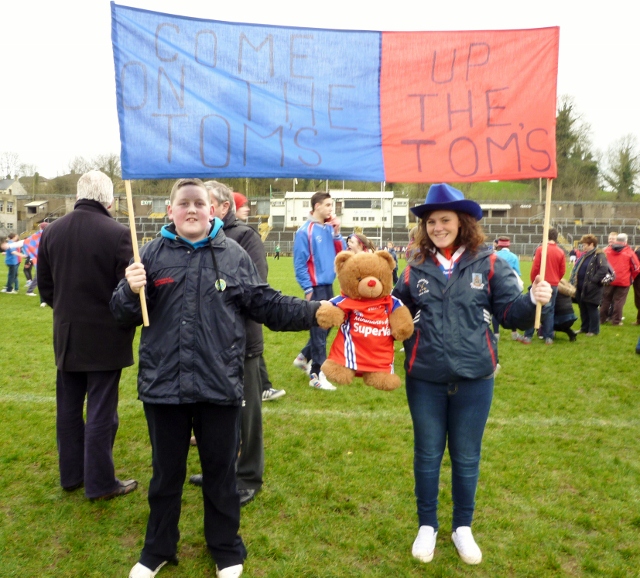
St Thomas’s supporters

ST THOMAS’ (Galway) 0-15 LOUGHGIEL SHAMROCKS 0-07

Conor Cooney was the top scorer for the Galwaymen, with a series of frees in the second half that helped to see off the challenge of the men from the Glens of Antrim. Loughgiel for whom Liam Watson put six frees between the posts were trailing by a single point at the break, 0-6 to 0-5. Two Watson frees in the second half were all the Shamrocks could manage. Eddie McCloskey scored their only point from play just before the break, to keep his side in the contest after the first thirty minutes.  But it could have been a very different result if a beautifully struck shot from Benny McCarry had found the net instead of glancing off the post in the first five minutes.

Bernard Burke is congratulated

Bernard Burke is congratulated

St Thomas’ must be fairly unique as it has three sets of brothers on the team, six of them from the Burke family. The club concentrates only on hurling and won their first Galway senior championship last year. Precedent was on their side as no Galway club had ever lost in a club semi-final replay. Likewise, no Antrim side had ever won a replay at this stage. So congratulations to the tribesmen, who go on to meet Kilcormac-Killoughey from County Offaly in the final at Croke Park on St Patrick’s Day as part of a double bill in which Ballymun Kickhams are up against Roscommon and Connacht champions St Brigid’s in the club football final. So no Ulster involvement in the finals this year.

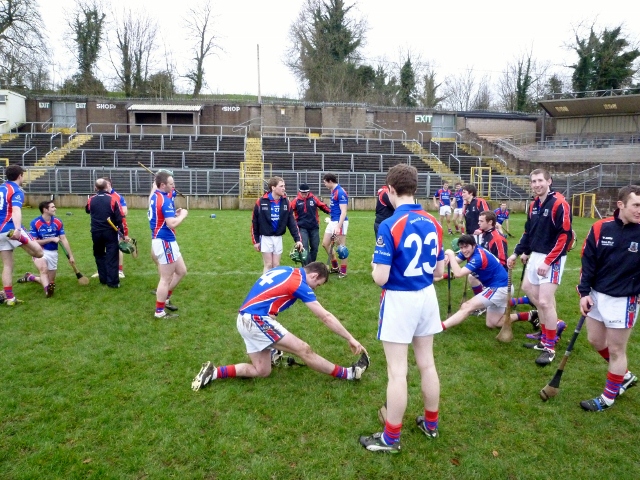
St Thomas's players wind down

St Thomas’s players wind down

SETANTA CUP

Shamrock Rovers v Coleraine

Shamrock Rovers v Coleraine

SHAMROCK ROVERS 0 COLERAINE 1

Back in the days of my youth, I remember seeing one of the matches in a cross-border competition, the Blaxnit Cup. It might have been the second leg of the final at Dalymount Park in May 1968, when Shamrock Rovers lost 2-1 to Crusaders from Belfast, but took the first trophy 3-2 on aggregate. The following season, Rovers were again in the final but lost 4-3 to Coleraine, who went on to retain the trophy the following year by defeating Sligo Rovers in 1970. The Irish League side re-appeared in the 1972 final but went down to Cork Hibernians over two legs. The competition featured four clubs from the League of Ireland and four from the Irish League and it ran until 1974, when it was replaced by the Texaco Cup and then after a break, the Tyler Cup until 1980.

For that reminder about Coleraine’s previous Blaxnit success. I am grateful to David McClarty MLA, who was following my tweets from the ground on facebook. In one of my tweets I mentioned that one of Coleraine FC’s stalwart fans is the actor James Nesbitt, Chancellor of the University of Ulster, who was in Dublin on Saturday for the IFTA awards ceremony.

Since 2005 the all-island club competition has been known as the Setanta Sports Cup. This evening at Tallaght, the Hoops and the Bannsiders renewed their rivalry in the first leg of a first round match. I have been following Rovers at their new stadium over the last two seasons, but I don’t think I have ever seen Coleraine in “live” action.  I was impressed by the visitors and their vocal bunch of around 200 supporters who made the long trip to Dublin from the North-West.

Full Time

Full Time

The new-look home side were playing their first competitive senior game this year, because of the difference in soccer seasons in Northern Ireland and in the Republic. Before the game, one minute’s silence was strictlly observed by the teams and the crowd in memory of Tony Clare, a Rovers supporter who passed away recently. Then it was into action, but I missed the usual roar of the home fans and only one stand was in use. I also noticed that one of the banners behind the goalmouth had a picture of Rovers’ former striker Gary Twigg on it. He is now playing for Portadown in the Irish League, who lost 3-2 at Drogheda in the same competition.

Shamrock Rovers had most of the goal opportunities in the first half, with Mark Quigley unsuccessful on at least three occasions. Five minutes before the break, an injury to Ruairi Harkin forced him to retire and he was replaced by David Scullion. In what was to prove the decisive move of the whole match, in the third minute of first-half injury time, Scullion picked up the ball from Paul Owens and coolly lifted it over the top of the advancing Rovers’ keeper Barry Murphy.  Coleraine had taken the lead against the run of play.

Scullion nearly managed to double his side’s lead ten minutes into the second half. Quigley was replaced in the Hoops attack by Gary McCabe, who was involved in a few good moves along with Sean O’Connor. O’Connor came close with a free kick and McCabe likewise in the dying seconds of the game, when Coleraine had their goalie Michael Doherty to thank for keeping their advantage.

Coleraine fans at Tallaght

Coleraine fans at Tallaght

So the 200 or so Coleraine fans left Tallaght in a very orderly fashion and singing the praises of their team. The two sides will meet again next Monday at The Showgrounds, Ballycastle Road. There were three other cup games (first leg) tonight:-

ST PATRICK’S ATHLETIC 0 GLENTORAN 0

CORK CITY 4 Morrissey 16, Turner pen 26, 45+1, Kavanagh 69 CLIFTONVILLE 0

DROGHEDA UTD 3 R Brennan 8, O’Connor 14, G Brennan 60 PORTADOWN 2 A Burns 25, Braniff 43

SHAMROCK ROVERS 0 COLERAINE 1 Scullion 45+3

MONAGHAN HURLING

Dr Croke Cup

Dr Croke Cup

The words “Monaghan” and “hurling” don’t sit naturally together. Monaghan is a footballing county, although the Farney men have never succeeded in winning the Sam Maguire Cup. But after this evening’s result in the Allianz National League, when Monaghan were defeated by neighbours Cavan at Breffni Park, perhaps the time has come for a change! If you look closely enough at the reflection in the silver of the cup, you can see how I managed to include the Tipperary colours of my tie in the picture!

This afternoon during a visit to my mother-in-law in Castleblayney, which is also my mother’s home town, I was pleased to get an opportunity to see the spoils of Kilkenny’s hurling victories. There was the Liam McCarthy Cup, presented to the All-Ireland senior champions. Alongside it was the Dr Croke Cup, the trophy for the National Hurling League champions of 2012, having defeated Cork in the final (www.gaa.ie report).

National League Champions Kilkenny

National Hurling League Champions 2012 Kilkenny (gaa.ie photo)

The trophies came to Castleblayney in the custody of Kilkenny kit manager Denis “Rackard” Cody, an important member of the county’s backroom team. I did not get a chance to ask him if his nickname came from the famous Wexford hurlers! The cups were brought to Ulster with a purpose: to encourage the development of hurling at secondary school level. The under-12s and under-14s from Our Lady’s secondary school and their counterparts from East Cavan Gaels took part in a match and coaching session run by Cody.

Kilkenny GAA

Kilkenny GAA

He joined the Kilkenny set-up in 1977 and has served as kit manager for the past ten  years. He refereed 15 county finals in all grades, and officiated also at National League level. He was elected the first Mayor of Graignamanagh in 1982 (Kilkenny People). He brings his knowledge and passion for hurling around the country. In November he visited one of the cradles of hurling, the Glens of Antrim, as a guest of the Robert Emmet club in Cushendun and helped run an underage competition.

Hurling can continue to be successful in Ulster and can only benefit from the expertise of the Noresiders. Title holders Loughgiel Shamrocks from the Glens were playing this afternoon in an All-Ireland club semi-final, which ended in a draw after extra time and will have to go to a replay. I also recall walking through the grounds of UCD in Belfield, near the sports centre, when I spotted a young lad with a Monaghan GAA top…..carrying a hurley. Such a rare sight that I felt it necessary to go up to him and congratulate him on his perseverance!

SHERGAR

Ballymany Stud

Ballymany Stud

Thirty years ago as an RTÉ television news reporter I stood outside the gates at the main entrance to Ballymany Stud owned by the Aga Khan near The Curragh in County Kildare on the trail of the racehorse Shergar. He still hasn’t turned up, although there are many rumours about his fate. It became one of the most famous cases in the world of an animal being kidnapped. The 1981 Derby winner  was taken from his box by a group of armed men on February 8th 1983.

Shergar was a celebrity in his own right and was beginning his second year out to stud.  Three armed men wearing masks entered the grounds in a car with a horse trailer attached and then threatened the head groom Jim Fitzgerald and his family. Gardaí at Naas led by trilby-wearing Chief Superintendent Jim “Spud” Murphy immediately began an investigation into the whereabouts of the famous stallion. Several different ransom demands were made but the identity of the thieves has never been discovered, nor has the last resting place of Shergar. There have been plenty of theories about the group responsible. One suggestion is that it was an IRA gang intent on raising money to buy arms and that when they bundled the five year-old horse into the trailer he became excitable and unmanageable so the gang decided to shoot him. But the paramilitary group never claimed any connection. The story became international news and remains so today, for example on CNN.

Shergar (Getty Images via CNN)

Shergar (Getty Images via CNN)

The video of my piece to camera outside the stud keeps re-appearing in the RTÉ series “Reeling in the Years” and other programmes such as Mario Rosenstock’s “Twenty Moments that Shook Irish Sport” in 2007 (video link here at 1:17). If I was on commission for each time it was played, I would probably be a rich man by now!

Shergar: a racing legend, an IRA kidnap & ransom, a bungled investigation and an enduring myth.
Shergar was an acclaimed racehorse. Winner of the 1981 Epsom Derby by a record ten lengths, he was named European horse of the year that same year and retired from racing that September. Two years later, on the 8th of February, he was kidnapped from Ballymany Stud, near the Curragh. Despite a massive hunt and with the country gripped by Shergar-fever, the horse was never found. It is believed the IRA unit who kidnapped him killed him a few days later when negotiations for a two million pounds sterling ransom collapsed. However, to this day, Shergar’s remains have never been found and his disappearance has been one of the greatest myths of recent Irish times.

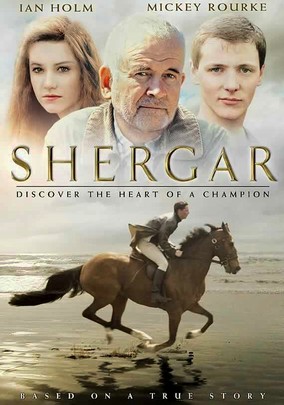
The story was also the subject of a film, made on the Isle of Man in 1998 and released the following year. It starred Sir Ian Holm, Mickey Rourke, David Warner and Gary Cady. My cousin in Belfast the photographer Phil Smyth has just reminded me that he saw the film when he was in Sydney, Australia, and that it used the news report with my piece to camera in it!film

BUSBY BABES

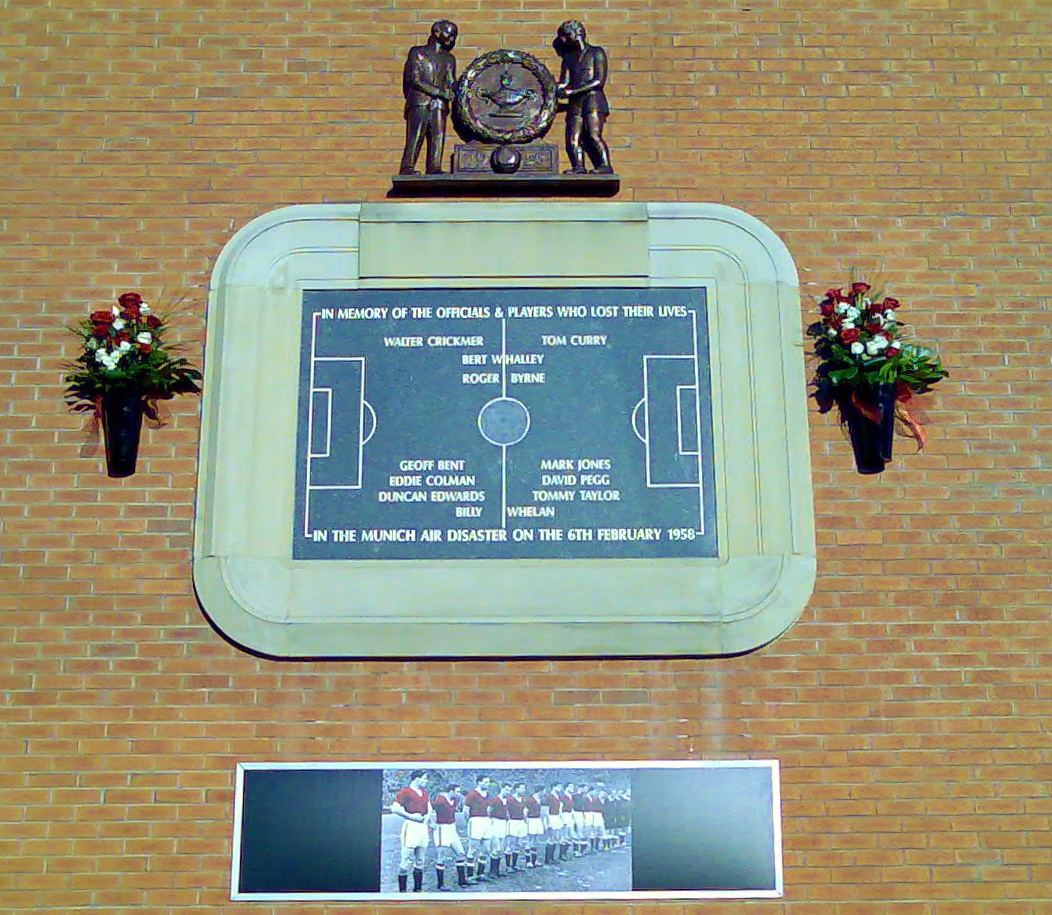
Old Trafford Memorial

Old Trafford Memorial

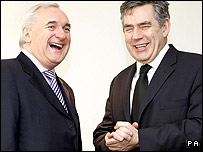
Five years ago when then Taoiseach Bertie Ahern needed a quick summit meeting with the British Prime Minister Gordon Blair to discuss the problem over the devolution of  justice and policing powers in Northern Ireland, he went to Manchester. They met on a Sunday morning in a conference room at Manchester airport. Mr Ahern was accompanied by the Irish government press secretary Eoghan Ó Neachtain (now TG4 rugby pundit). Myself and an RTÉ News cameraman from Belfast were the only ones allowed to do the “pool” pictures, along with a local stills photographer from PA.

Bertie Ahern & Gordon Brown (PA Pool Picture)

      Bertie Ahern & Gordon Brown (PA Picture)

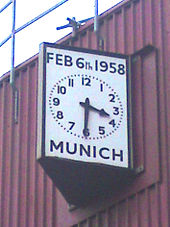
No questions were allowed to be asked as they sat down together, it was just a photocall. An Taoiseach however did agree to answer a couple of questions for me after the meeting. Both he and Mr Brown then left separately to go to Old Trafford, where Manchester United were remembering the 50th anniversary of the Munich plane crash. I did not get into the ground, where the two leaders were sitting in a VIP box, but spoke to some supporters as they arrived for the game. It gave me a chance to see the Munich memorial attached to a wall at the side of one of the stands, and the memorial clock attached to the south-east corner of the stadium. A special match programme was also issued to remember those who died.

Munich Clock

Munich Clock

Eight Manchester United players from the “Busby Babes” team, among them Billy Whelan from Cabra in Dublin, lost their lives when the Airspeed Ambassador plane they were travelling back to England in crashed on the runway during snowy conditions at Munich airport. Three staff from the club and a number of well-known English sports journalists were also killed. Others were lucky to survive, such as Bobby Charlton and goalkeeper Harry Gregg (then 24) from Northern Ireland. He attended the funeral of veteran sports journalist Malcolm Brodie in Belfast on Monday. Thinking now of the victims and survivors of the crash.

The Flowers of Manchester

One cold and bitter Thursday in Munich Germany

Eight great football stalwarts conceded victory

Eight men will never play again who met destruction there

The Flowers of English football the Flowers of Manchester

Matt Busby’s boys were flying home returning from Belgrade

This great United family all masters of their trade

The pilot of the aircraft the skipper Captain Thain

Three times they tried to take off and twice turned back again

The third time down the runway disaster followed close

There was slush upon that runaway and the aircraft never rose

It ploughed into the marshy ground it broke it overturned

And eight of the team were killed as the blazing wreckage burned

Roger Byrne and Tommy Taylor who were capped for England’s side

And Ireland’s Billy Whelan and England’s Geoff Bent died

Mark Jones and Eddie Colman and David Pegg also

They all lost their lives as it ploughed on through the snow

Big Duncan he went too with an injury to his brain

And Ireland’s brave Jack Blanchflower will never play again

The great Matt Busby lay there the father of his team

Three long months passed by before he saw his team again

The trainer, coach and secretary and a member of the crew

Also eight sporting journalists who with United flew

and one of them Big Swifty who we will ne’er forget

the finest English ‘keeper that ever graced the net

Oh England’s finest football team its record truly great

its proud successes mocked by a cruel turn of fate

Eight men will never play again who met destruction there

the Flowers of English football the Flowers of Manchester

Author: Eric Winter (1958)

MALCOLM BRODIE RIP

Irish_Football_Association-logo-A3B92E9ED1-seeklogo_comThe green and white army of Northern Ireland football was never a big priority for RTÉ, who always followed the fortunes of the green shirts of the Republic of Ireland. Occasionally there were stories of success, especially the World Cup victory over hosts Spain in 1982 and qualification for the second round. I also remember covering the appointment as NI manager of Lawrie Sanchez, a past hero of mine when he was with Wimbledon FC and who I was glad to see getting the job. There was however always one constant factor when speaking about soccer here in the North: Malcolm Brodie, who has now passed to his eternal reward.

Malcolm Brodie (BBC picture)

Malcolm Brodie (BBC picture)

The former sports editor of the Belfast Telegraph was a fount of knowledge about the international side and reported on fourteen World Cup finals. He was always willing to share that wisdom with other media colleagues, including news reporters who did not specialise in sport. He also looked after junior colleagues. I was interested to hear on Talkback (BBC Radio Ulster around 20:30) yesterday a tribute from Alan Green of the BBC.

Alan is the same age as myself and our paths crossed briefly in London in the 1970s. After graduating from Queen’s, he started as a BBC News Trainee  in April 1975, a year after I had. My traineeeship brought me to local radio Birmingham, where I got my chance to combine sports reporting with news, thanks to Jim Rosenthal and his successor Nick Owen. Alan got an attachment back to BH in Belfast and later moved to Manchester, to begin a lengthy career as a commentator with BBC Radio Sport.

Alan Green

Alan Green (BBC)

Alan mentioned to Wendy Austin how Malcolm had taken him under his wing when he was still a student at Methodist College, interested in sports reporting. He took him on as a “copy boy” at weekends over forty years ago. When Alan landed the sports job in Manchester, Malcolm asked the sports “mafia” there, who held him in high regard, to help the fledgling commentator.

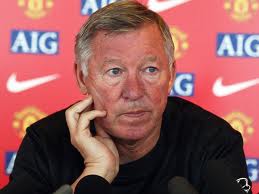
Speaking on the same programme, the Manchester United manager Sir Alex Ferguson said the journalist was a great friend:-

Alex Ferguson (Man.Utd.picture)

Alex Ferguson (Man.Utd.picture)

“He cut to the chase, quite simply that’s how he was, you know. He was straight-talking and one thing I always admired about him, he never changed his accent, which is very difficult living in a place like Belfast. He never lost the energy to do his job and he obviously enjoyed doing it and had enthusiasm about it. It’s very hard to retain enthusiasm for your job right up to your 80s.”

Malcolm was from Scotland and had been evacuated to County Armagh during the second world war. He began his career with a local newspaper in Portadown. He then moved in 1943 to the Belfast Telegraph, where he set up the first sports desk. His achievements as a journalist were recognised with the award of an MBE and the conferring of an honorary doctorate by the University of Ulster. He received the FIFA Jules Rimet award in 2004. The FIFA President Sepp Blatter, who was a personal friend, described him as “one of the true greats of sports journalism”. More tributes can be found here at the Irish Football Association. He was 86 and was a member of the Belfast and District Branch of the National Union of Journalists. However there are some former staff at the Belfast Telegraph who will tell you a very different story about his attitude to the union during a strike. His funeral service will take place on Monday (February 4th) at 12 noon in Cregagh Presbyterian Church, Belfast, then to Roselawn Crematorium for Committal at 2.30 p.m. Family flowers only. Donations in lieu of flowers have been requested to Chest/Heart/Stroke or Guide Dogs for the Blind.

Malcolm Brodie (Belfast Telegraph)

Malcolm Brodie (Belfast Telegraph) 1926-2013

AFC WIMBLEDON ON THE BOX

IMG_4538 (2)AFC WIMBLEDON 2 BRADFORD 2 

A draw tonight for the Dons but if you are looking for a match report, look further down! I am going to reflect first of all on how my past was catching up with me today, taking in Dublin, Belfast and of course London, where the League Two match was played. I started the day in Dublin and as I began my journey northwards this afternoon, passed Milltown Park, where the Jesuit Provincialate is based. The complex used to be used for the training of Jesuit priests but now many of the buildings are leased. The Irish School of Ecumenics has its headquarters there. I was investigating the story of William Carleton, which I will be writing about on Saturday when we visit Sandford church.

I was on the trail of a Fr John Carbery SJ, who was based at Milltown Park and was in touch with Carleton, a neighbour, before his death in 1869. I was given some helpful information about the Jesuit archives. As I left the building I saw a rugby pitch which is now leased to nearby Gonzaga College, where I went to school for two years. In those days, the school rugby pitches were beside Glenmalure Park, home of Shamrock Rovers FC. I have written about their history and revival at Tallaght here.

Sacred Heart Church, Wimbledon

Sacred Heart Church, Wimbledon

In conversation with a Jesuit brother, I discussed how the order has decided to withdraw from the Sacred Heart parish in Wimbledon, where I grew up, owing to the shortage of priests. It was during my schooldays at Wimbledon College from 1963 that I started following Wimbledon FC at Plough Lane, then in their last season in the Isthmian League, having won the FA Amateur Cup thanks to Eddie Reynolds.  The following season they entered the Southern League first division as semi-professionals. Tonight as I followed them live on Sky Sports, I was wearing a Wimbledon supporters’ badge dating to the 1974/75 season when they were Southern League champions.

I went to (the) Chelsea to watch the match: my local bar on the Lisburn Road in Belfast. Another London connection! Anyway the televisions were showing some music channel but the bar staff kindly offered to turn over to Sky so that I could see the Dons in action, minus the commentary. I was delighted to see Jack Midson getting the opening score and then making it a double strike thanks to a penalty. His was one of the few recognisable names as the players came out of the tunnel before the kick-off. AFC Wimbledon were then unlucky I thought to concede a goal to Port Vale just before half time, making it 2-1. A lucky bounce on a well-struck drive eluded the keeper Neil Sullivan.

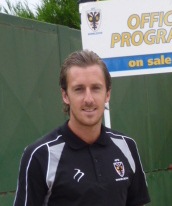
Jack  MIdson

Jack Midson

The second half saw some good chances for AFC Wimbledon including an effort by Midson that could have brought his hat-trick but was ruled offside. Then a bad back pass by Mat Mitchel-King and a mistake by Sullivan saw Port Vale equalising 2-2. The Dons held out against the league leaders and manager Neil Ardley will be pleased enough to come away with one point. But the Dons are still perilously close to the bottom place in the table and need to start winning a few games if they are to escape relegation back to the Conference. A full report on the match “Plucky Dons Deny Vale” can be found on the club ‘s website.

FROM BRADFORD TO WEMBLEY

Bradford City FCIt was, as the BBC reporter described it, the stuff of fairy tales. Minnows Bradford City became the first League Two (fourth tier) side in English football to reach the final of the League Cup in fifty years. The last was Rochdale in 1962. Getting to Wembley is expected to earn the club £1 million pounds. Not bad going for a side who had two pre-season friendlies in Ireland (both wins) against Wexford Youths and Bray Wanderers. Shortly afterwards at the start of the season, they hammered the team I support, AFC Wimbledon, 5-1 at the Coral Windows stadium at Valley Parade in front of a crowd of nearly 9,500. On the bench that day was a young Donegal lad Carl McHugh from Lettermacaward, who had just joined the Bantams and made his League Cup debut a few days later against Watford. In October the 19 year-old defender had his Football League debut and the following month his header helped Bradford to win their FA Cup match against Watford.

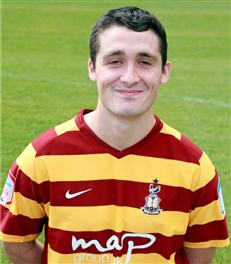
Carl McHugh, Bradford City

Carl McHugh, Bradford City

It was another header from McHugh that helped City win the first leg of their semi-final in the League Cup against Aston Villa. Although going down 2-1 last night in the return leg at Villa Park, their home win meant they went through 4-3 on aggregate. Ironically the first leg goal by McHugh was put past one of his football heroes, Irish international keeper Shay Given, who is also a Donegal man. Mc Hugh is clearly a rising star. He began on a scholarship with Reading when he was 16, then played on loan for Swindon Supermarine and then Dundalk in the Eircom League. He has represented his country at under 17 and under 19 level.

This is the biggest achievement by Bradford since they won the FA Cup in 1911. Looking at their history, I discover that like Wimbledon, they were once in the Premiership. At the end of the 1999/2000 season,  “Sunday 14th May saw Liverpool at the Bradford & Bingley Stadium (as it was then called) and Bradford knew they had to better Wimbledon’s result, who were playing at Southampton, to ensure they stayed in the Premiership and condemn fellow strugglers the Dons, who were level with City on points but had a better goal difference. A 12th minute header from David Wetherall and a 2-0 defeat for Wimbledon sent the whole of Bradford into raptures and saw Premiership football at Valley Parade for another season.”  It was the finish of a fourteen year stay in the top tier for the Dons, who were managed by Terry Burton at the time and were playing their home games at Selhurst Park. It was also the beginning of the end for the club, as moves began against the wishes of most fans to relocate to Milton Keynes, sixty miles away.    capitalonecup

I wish Bradford every success on February 24th at Wembley against Swansea City, who had a goalless draw against Chelsea tonight and won on aggregate 2-0. But I very much hope AFC Wimbledon’s form will have improved by February 16th, when their home match against Bradford is scheduled. The Dons lost to Stevenage 3-1 in the first round of the Capital One Cup in August. They are currently struggling second from bottom, in the relegation zone of nPower League Two but you can watch them in action tomorrow night against Port Vale LIVE on Sky Sports, kick-off 19:45 (weather permitting). Today a major snow-clearing operation was mounted with the help of 60 supporters and under-18 players, in order to ensure that the pitch at Kingsmeadow would be playable.

LONDON INVASION

heinekencupimagesI heard it first on RTÉ Radio sport: the possibility of an Irish rugby invasion of London at the start of April. And so it has come to pass. The remaining Heineken Cup pool fixtures this afternoon have deprived Ulster of a home draw in the quarter final. Instead Mark Anscombe’s team will be travelling to play Saracens on the weekend of April 5th/6th/7th just after Easter. They have been coached since 2009 by Mark McCall. He used to be in charge of the Ulster side so he will know the squad well and what to expect from the opponents. Their home games up to now have been played at Vicarage Road, the home of Watford FC. But they are about to move to a new stadium at Barnet with an artificial pitch. If they are to use the Allianz stadium at Copthall for the game, they will require permission from the local authority to increase the capacity from 10,000 to 15,000.

The other Irish side in the quarter-finals will be Munster, who will be up against Aviva Premiership champions Harlequins, coached by former Irish international Conor O’Shea. They had home and away victories over Connacht in pool 3. Their matches are normally at The Stoop at Twickenham, beside the RFU headquarters. Meanwhile the Heineken Cup holders Leinster despite a win yesterday are out of the competition but now get a place in the Amlin Cup. They will play another London side, Wasps, who play at the Adams stadium in High Wycombe, Buckinghamshire. Stand up for the Irishmen! The semi-final draw made at Leicester this evening produced the following pairings:-

Semi-final 1:  Saracens or Ulster Rugby v Toulon or Leicester Tigers
Semi-final 2:  ASM Clermont Auvergne or Montpellier v Harlequins or Munstermckennacuppowerni images

It was also a busy afternoon in Gaelic games and at the Athletic grounds in Armagh (attendance 4155), the line-up was decided for the McKenna Cup final at the same venue under the floodlights next Saturday evening at 7:30pm. Monaghan beat Down 1-12 to 0-12 and Tyrone beat Fermanagh 2-09 to 0-07. So Monaghan will get a chance to win their fourteenth McKenna Cup if they can manage to beat neighbours Tyrone.