EASTER SUNDAY

St Macartan's Cathedral, Monaghan

St Macartan’s Cathedral, Monaghan

A day for reflection and enjoyment in the company of family, so I will not venture into any lengthy diatribe today. It was my mother’s 93rd birthday, which she celebrated at home in Dublin. Meanwhile I was attending a birthday celebration in Monaghan for my first daughter, who had invited around her cousins, aunts and uncles. We were also fortunate to have our second daughter return home from London on an Easter break.

I attended Easter Sunday Mass at Saint Macartan’s Cathedral in Monaghan and there was a large attendance at the lunchtime service. I reflected on how my grandparents (on my mother’s side) would have attended the major liturgical events here sixty years ago and more. Since they lived at Tirkeenan beside the entrance to the Cathedral, they were frequent attenders at Mass, as my grandfather’s diaries from the time recorded.

I then took the opportunity to visit the graveyard at Latlurcan, where I had attended two funerals earlier this month. My aunt Marie and her husband and my uncle Finbarr Smyth are buried there. Finbarr died in an air crash in the Isle of Wight when I was five and living in London in November 1957. He had been flying out to Madeira on a holiday with Cosmo Meldrum, a friend from Sligo, where he was manager of the Yeats Country Hotel at Rosses Point. The Aquila Airways Short Solent flying boat G-AKNU (pictured here at Funchal Bay) crashed shortly after take-off at Southampton docks.

Short Solent G-AKNU taking off from Funchal Original Photo © J Arthur Dixon, via Wikipedia

Short Solent G-AKNU taking off from Funchal
Original Photo © J Arthur Dixon, via Wikipedia

During a holiday in Madeira in 2011 I discovered more details about the airline and the planes it used since 1949 to bring holidaymakers to the island, as it developed a tourist industry. There was a small exhibition about the flying boats beside the shop at the Madeira Story Centre museum in Funchal. Upstairs there was also a display that included a mock-up of part of the aircraft’s cabin, including the roof racks used to store luggage. Black-and-white archive film played on small monitors showing the planes taking off. It was an emotional experience. I notice that there is now a plaque at St Mary’s church in Brook, close to Chessel Down, containing the names of all those who died in the crash. At some stage I will go to visit it.

Short Solent Cabin Reconstruction, Madeira

Short Solent Cabin Reconstruction, Madeira

45 people died in the crash, seven of them members of the crew. May they rest in peace. Thirteen people managed to survive, among them a former British Army officer Major PW Colan, from Cloyne in County Cork. British commercial flying-boat operations ceased ten months later on 30th September 1958 when Aquila Airways withdrew its Madeira service. The flying boats for passenger traffic were a variation of the Sunderlands which provided important service from Lough Erne and other RAF bases in the Second World War. They were built by Short Brothers and Harland in Belfast.

KILBURN

Saint Patrick

Saint Patrick

The statue of Saint Patrick at the Sacred Heart Church in Kilburn, London, stands as a reminder of the large Irish community who used to worship here. The chapel at Quex Road was built in 1878/9 and there had been an Irish presence in the area since 1841. In the 1950s and 60s there was an influx of Irish labourers as the suburb was redeveloped, and it became known as Ireland’s 33rd county. But the Irish nature of the parish has now diminished, following the arrival of immigrants from the Indian subcontinent and elsewhere.

The parish is run by the Oblates of Mary Immaculate (OMI) and the parish priest is from Waterford. But his assistants are from areas as diverse as Sri Lanka, the Congo and the Philippines, along with one local man from Willesden, who was ordained in Ireland.

Sacred Heart Church, Kilburn

Sacred Heart Church, Kilburn

The priest from the Congo said the Mass I was at on Sunday morning. The three servers he had on the altar (two of them girls) were coloured and I noticed only a few people in the congregation who seemed to be Irish or were of Irish extraction. But on Sunday March 17th there will be celebrations for the feast of St Patrick.

Irish Papers

Irish Papers

Go out onto the nearby Kilburn High Road and you will still see an Irish influence. Not far from the former State cinema that once house the National Ballroom, I came across a newsagents shop, with a wide selection of Irish provincial newspapers for sale. The last time I saw such a selection was in Easons in Dublin. I was disappointed that among the papers missing were the Northern Standard (Monaghan), the Anglo-Celt (Cavan) and the (Carlow) Nationalist and Leinster Times.  But I’m sure if you went in and asked for any of the other titles, the newsagent would probably order them for you.

Many of the Irish emigrants who came to London never got the chance to return home. There are still some who are living on their own, who were never married and who have lost touch with Ireland. To provide accommodation for them, the Irish Centre Housing (ICH) group has developed a new hostel, close to the Sacred Heart church.

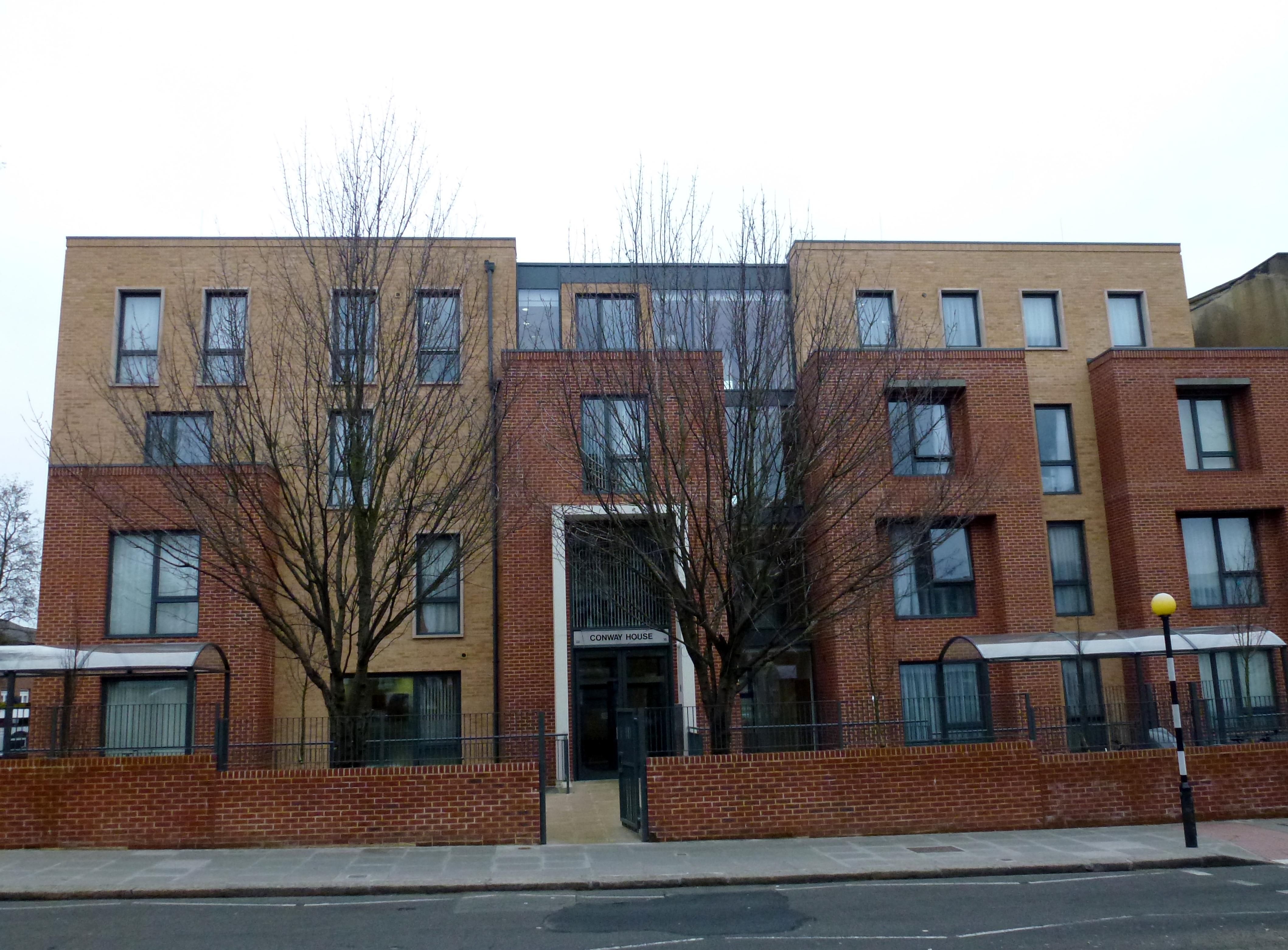
Conway House

Conway House

Conway House was originally the site of a nursing home, acquired from the Sisters of Hope in 1973. The new building costing £4 million contains 60 en-suite rooms for single people. There is an annexe with six flats for renting for family acommodation. The first new residents moved in two months ago at the start of December.  ICH provides accommodation and support for the homeless and those with alcohol, drug and mental health issues, as well as affordable housing for those on local authority waiting lists. The development was financed through Clydesdale Bank and was carried out in association with the London Borough of Camden’s Hostels Pathway project.

AIDAN McANESPIE

Aidan-McAnespie

Aidan McAnespie

The killing of Aidan McAnespie (24) at a border checkpoint outside Aughnacloy in County Tyrone 25 years ago today was one of the most controversial killings during the “troubles”.  It led to a diplomatic row between London and Dublin. At the request of Charles Haughey’s government, Deputy Garda Commissioner Eugene Crowley was sent to Monaghan to investigate, although his report was never made public. Prime Minister Margaret Thatcher said the Irish government could investigate anything it wished, but not North of the border.

Grenadier Guardsman David Holden claimed his hands were wet after cleaning the sangar in the watchtower and that he had accidentally fired three rounds from a heavy machine gun as he moved it. Three days after the shooting Guardsman Holden appeared at Cookstown magistrates court where he was charged with the unlawful killing of Mr McAnespie. The same day, Irish and British Ministers held an Anglo-Irish conference in Dublin.

P1100296 (2)

Memorial near Aghaloo GFC

I remember seeing the soldier standing in the dock as the charge was put to him. His lawyer said he would plead innocent to the charge. The magistrate remanded him into police custody. The charge was withdrawn six months later after a decision by the Director of Public Prosecutions on the basis that in his judgement there was insufficient evidence to sustain it.

Twenty years after the killing, a PSNI Historical Enquiries Team report concluded that the soldier’s account of events that the fatal shot which hit Aidan in the back was “a tragic accident” was the least likely explanation of what had occurred. The report said that:-

an impartial and independent observer must question the likelihood of an accidental random discharge striking the roadway only a few feet behind what would be from the vantage point of the machine gun post a miniscule figure at a distance of 283.4 meters. The statistical odds, as outlined by (an) independent ballistic expert…..are strongly against the accidental discharge theory.”

This finding in October 2008 brought huge relief to the McAnespie family. His niece Una McCabe said the claim that Aidan had been killed by a ricochet bullet fired at random because a soldier had wet slippy fingers which inadvertently came in contact with the trigger and that Aidan was not being tracked at that precise moment had been firmly rebutted. She said the official scenario, as accepted by the British Army and the prosecution service, could be regarded as so remote that it could be virtually disregarded.

The memory of Aidan lives on. Tonight the former Tyrone football star and current Fermanagh manager Peter Canavan will be in Aughnacloy to address a candlelit vigil near the spot where Aidan died. Alongside the road where he was killed, there is a small stone memorial and a cross, which has been freshly painted. This evening a crowd will assemble beside the site of the former lookout post, which dominated the main  road to Dublin.

Roadside Cross

Roadside Cross

Speaking ahead of the event, Peter Canavan said the killing of Aidan had sent huge shock waves around the country. He said the GAA community, particularly in counties Tyrone and Monaghan, had been stunned that one of its members had been callously cut down following what he said had been years of threats and torment by the British army.

Outside the McAnespie house in Aughnacloy flies the flag of the largest GAA Club in Boston in the United States. It is named after Aidan, a sign of how his death took on international significance. His mother Elizabeth and his sister Eilish have now passed away. But his father John remembers how in the few months before the incident, his wife always used to walk with Aidan to and from the security checkpoint, when he was going to work in Monaghan, or returning. He said Aidan always used to park his car beyond the watchtower, close to the GAA Club, because of the continual harassment he used to get from soldiers, who tracked his movements. A year before the incident, John McAnespie was stopped by a British soldier at the checkpoint, who told him: “We have a bullet here (in the gun) for him”. 

John McAnespie

John McAnespie

On that day on Sunday February 21st  1988 the Aghaloo Gaelic football team from Aughnacloy, whose pitch is alongside the main road and close to the border with County Monaghan was due to play Killeeshil. Aidan had been walking past the checkpoint and was on his way to the club when he was killed. To mark the anniversary a number of Aghaloo and Killeeshil players from that era, with others, will line out on Saturday 23rd February at 4.00pm to compete for the Aidan McAnespie Trophy. The event will be attended by leading GAA personalities and officials, including Tyrone County Chair Ciaran McLaughlin, Ulster GAA Secretary Danny Murphy and the former GAA President, Dr Mick Loftus from Mayo.

Aghaloo GFC

Aghaloo GFC

Northern Standard report 21/02/13

Northern Standard report 21/02/13

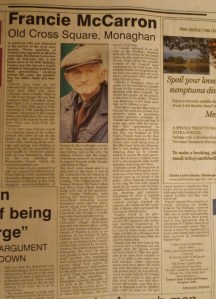
FRANCIE MCCARRON RIP

Francie McCarron (picture: Northern Standard)

Francie McCarron (picture: Northern Standard)

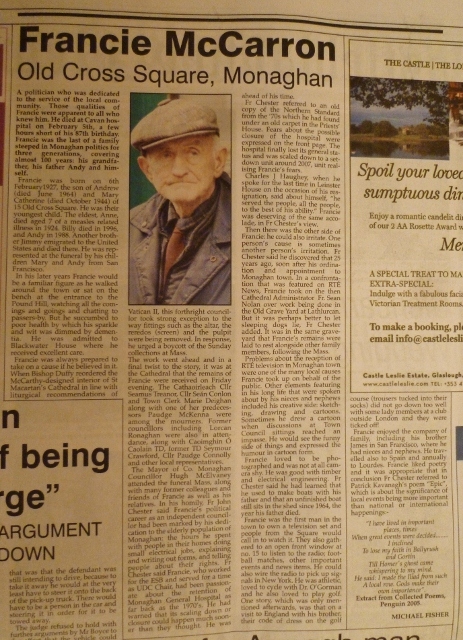
OBITUARY: FRANCIE MCCARRON             Old Cross Square, Monaghan             Northern Standard Feb.14th 2013

A politician who was dedicated to the service of the local community. Those qualities of Francie were apparent to all who knew him. He died at Cavan hospital on February 5th, a few hours short of his 87th birthday. Francie was the last of a family steeped in Monaghan politics for three generations, covering almost 100 years: his grandfather, his father Andy and himself.

Francie was born on 6th February1927, the son of Andrew (died June 1964) and Mary Catherine (died October 1944) of 17 Old Cross Square. He was their youngest child. The eldest, Anne, died aged 7 of a measles related illness in 1924. Billy died in 1996, and Andy in 1988. Another brother Jimmy emigrated to the United States and died there. He was represented at the funeral by his children Mary and Andy from San Francisco.

In his later years Francie would be a familiar figure as he walked around the town or sat on the bench at the entrance to the Pound Hill, watching all the comings and goings and chatting to passers-by. But he succumbed to poor health by which his sparkle and wit was dimmed by dementia. He was admitted to Blackwater House where he received excellent care.

Francie was always prepared to take on a cause if he believed in it. When Bishop Duffy reordered the McCarthy-designed interior of St Macartan’s Cathedral in line with liturgical recommendations of Vatican II, this forthright councillor took strong exception to the way fittings such as the altar, the reredos (screen) and the pulpit were being removed. In response, he urged a boycott of the Sunday collections at Mass.

The work went ahead and in a final twist to the story, it was at the Cathedral that the remains of Francie were received on Friday evening. The Cathaoirleach Cllr Seamus Treanor, Cllr Seán Conlon and Town Clerk Marie Deighan along with one of her predecessors Paudge McKenna were among the mourners. Former councillors including Lorcan Ronaghan were also in attendance, along with Caoimghin Ó Caolain TD, former TD Seymour Crawford, Cllr Paudge Connolly and other local representatives.

The Mayor of Co. Monaghan Councillor Hugh McElvaney attended the funeral Mass, along with many former colleagues and friends of Francie as well as his relatives. In his homily, Fr John Chester said Francie’s political career as an independent councillor had been marked by his dedication to the elderly population of Monaghan: the hours he spent with people in their homes doing small electrical jobs, explaining and writing out forms, and telling people about their rights. Fr Chester said Francie, who worked for the ESB and served for a time as UDC Chair, had been passionate about the retention of Monaghan General Hospital as far back as the 1970’s. He had warned that its scaling down or closure could happen much sooner than they thought. He was ahead of his time.

Fr Chester referred to an old copy of the Northern Standard from the ‘70s which he had found under an old carpet in the Priests’ House. Fears about the possible closure of the hospital were expressed on the front page. The hospital finally lost its general status and was scaled down to a set-down unit around 2007, unit realising Francie’s fears.

Charles J Haughey, when he spoke for the last time in Leinster House on the occasion of his resignation, said about himself, “he served the people, all the people, to the best of his ability.” Francie was deserving of the same accolade, in Fr Chester’s view.

Then there was the other side of Francie: he could also irritate. One person’s cause is sometimes another person’s irritation. Fr Chester said he discovered that 25 years ago, soon after his ordination and appointment to Monaghan town. In a confrontation that was featured on RTÉ News, Francie took on the then Cathedral Administrator  Fr. Sean Nolan over work being done in the Old Grave Yard at Lathlurcan. But it was perhaps better to let sleeping dogs lie, Fr Chester added. It was in the same graveyard that Francie’s remains were laid to rest alongside other family members, following the Mass.

Problems about the reception of RTÉ television in Monaghan town were one of the many local causes Francie took up on behalf of the public. Other elements featuring in his long life that were spoken about by his nieces and nephews included his creative side: sketching, drawing and cartoons. Sometimes he drew a cartoon when discussions at Town Council sittings reached an impasse. He would see the funny side of things and expressed the humour in cartoon form.

Francie loved to be photographed and was not at all camera shy. He was good with timber and electrical engineering. Fr Chester said he had learned that he used to make boats with his father and that an unfinished boat still sits in the shed since 1964, the year his father died.

Francie was the first man in the town to own a television set and people from the Square would call in to watch it. They also gathered to an open front window at no. 17 to listen to the radio; football matches, other important events and news items. He could also wire the radio to pick up signals in New York. He was athletic, loved to cycle with Dr. O’Gorman and he also loved to play golf.  One story, which was only mentioned afterwards, was that on a visit to England with his brother, their code of dress on the golf course (trousers tucked into their socks) did not go down too well with some lady members at a club outside London and they were ticked off!

Francie enjoyed the company of family, including his brother James in San Francisco, where he had nieces and nephews. He travelled also to Spain and annually to Lourdes. Francie liked poetry and it was appropriate that in conclusion Fr Chester referred to Patrick Kavanagh’s poem “Epic”, which is about the significance of local events being more important than national or international happenings:-

I have lived in important places, times
When great events were decided……..

I inclined
To lose my faith in Ballyrush and Gortin
Till Homer’s ghost came whispering to my mind.
He said: I made the Iliad from such
A local row. Gods make their own importance”.

[Extract from Collected Poems, Penguin 2005]

MICHAEL FISHER
P1100203 (2) (463x640)


LONDON INVASION

heinekencupimagesI heard it first on RTÉ Radio sport: the possibility of an Irish rugby invasion of London at the start of April. And so it has come to pass. The remaining Heineken Cup pool fixtures this afternoon have deprived Ulster of a home draw in the quarter final. Instead Mark Anscombe’s team will be travelling to play Saracens on the weekend of April 5th/6th/7th just after Easter. They have been coached since 2009 by Mark McCall. He used to be in charge of the Ulster side so he will know the squad well and what to expect from the opponents. Their home games up to now have been played at Vicarage Road, the home of Watford FC. But they are about to move to a new stadium at Barnet with an artificial pitch. If they are to use the Allianz stadium at Copthall for the game, they will require permission from the local authority to increase the capacity from 10,000 to 15,000.

The other Irish side in the quarter-finals will be Munster, who will be up against Aviva Premiership champions Harlequins, coached by former Irish international Conor O’Shea. They had home and away victories over Connacht in pool 3. Their matches are normally at The Stoop at Twickenham, beside the RFU headquarters. Meanwhile the Heineken Cup holders Leinster despite a win yesterday are out of the competition but now get a place in the Amlin Cup. They will play another London side, Wasps, who play at the Adams stadium in High Wycombe, Buckinghamshire. Stand up for the Irishmen! The semi-final draw made at Leicester this evening produced the following pairings:-

Semi-final 1:  Saracens or Ulster Rugby v Toulon or Leicester Tigers
Semi-final 2:  ASM Clermont Auvergne or Montpellier v Harlequins or Munstermckennacuppowerni images

It was also a busy afternoon in Gaelic games and at the Athletic grounds in Armagh (attendance 4155), the line-up was decided for the McKenna Cup final at the same venue under the floodlights next Saturday evening at 7:30pm. Monaghan beat Down 1-12 to 0-12 and Tyrone beat Fermanagh 2-09 to 0-07. So Monaghan will get a chance to win their fourteenth McKenna Cup if they can manage to beat neighbours Tyrone.

DR MCKENNA CUP

mckennacuppowerni images

Power NI Dr McKenna Cup competition

Driving back to Belfast tonight along the M1 I saw a strong white light emanating from the direction of the Castleblayney Road near Dundalk. It was the floodlights from  Pairc Grattan at Inniskeen, County Monaghan, a ground which has been developed in recent years to accommodate county team matches. Monaghan were playing neighbours Fermanagh in their third Dr McKenna Cup match in Section A. Victory by 1-12 to 0-07 meant that the home side has qualified for the knock-out stages. Their next opponents will be Down, at the Athletic Grounds Armagh at 2pm on Sunday. I passed Newry as they were seeing off the challenge from their neighbours Armagh by 2-11 to 1-10 in Section B. In other matches, a weakened Donegal side narrowly beat St Mary’s 1-14 to 2-10 and in Section C, Tyrone easily beat UUJ 1-18 to 0-09 and Derry drew 1-13 apiece with Antrim. So the other semi-final on Sunday will see Tyrone meet Fermanagh, the best runner-up.

ulstergaaimages

Ulster Council GAA

This year there has been controversy over the decision by some county managers to include QUB students in their squads. It has led to the withdrawal of Queen’s University from the competition, as they believed they were being put at a disadvantage. The competition has a very interesting history. The cup is called after a fomer Bishop of Clogher Dr Patrick McKenna from Truagh parish in County Monaghan, who presented it to the Ulster Council of the GAA in 1925. The first competition was in 1927. Monaghan are the most successful side in the tournament with thirteen wins, the last being 2003. Maybe they can make it fourteen this year! For two years, 2001 and 2002, the competition was not held but it was resurrected in 2003. Since 2007 it has been sponsored and the latest company to do so is Power NI, formerly NI Electricity, appropriate now that (as I observed at the start) many of the matches like tonight’s are played under floodlights!

monaghangaa

Monaghan GAA Crest

GEEL DISCOVERY

Extraordinary discovery in Geel (Het Nieuwsblad)

Extraordinary discoveries in Geel                   (Het Nieuwsblad)

St Dympna is the connection between Tydavnet (Tigh Damhnait) in Monaghan and the town of Geel in the province of Antwerp in Belgium, with which it is twinned.  I have visited Geel on a number of occasions, most recently in August last year. So I was interested to see an online article in the Belgian paper Het Nieuwsblad about an important archaeological discovery showing evidence of prehistoric remains, including a large graveyard from the Bronze Age. The find was made in the area called Sint-Dimpna, close to the church of that name, I think, at a site being excavated to make room for a new sports centre. I have used Google to attempt to translate the article, to find out a bit more about the discovery. This is what the report says, give or take a phrase or two!

Extraordinary discoveries in Geel (caption for photo).
Unique archaeological traces at St. Dympna:
Geel Historical Society has worked with the city archives to organise a lecture on the results of the excavations at St. Dympna. The archaeologists will explain how their research was done, what traces were found and what they mean. The excavations were carried out for the construction of the new sports and play park. During the investigation many archaeological traces from different periods came to light. The researchers found four main buildings from the Iron Age (circa 800-50BC), a yard from the Middle Ages (10th-12th century AD) and numerous smaller outbuildings or nails that served as storage for food. There were also some wells found (dating from) the Middle Ages. Besides these traces of habitation there were also traces of a large graveyard from the Bronze Age (2000-50 BC) that came to light. And it is this last discovery that makes the archeological site so unique and interesting. Finding such burial sites is extremely rare for archaeologists in Flanders. “The combination of the cemetery and a settlement is truly exceptional. In Geel everything was also very well preserved, “said Connie Leysen from the Geel city archives. The lecture will take place on Friday 25th January at 8pm in the Winery.

GRAFFITI

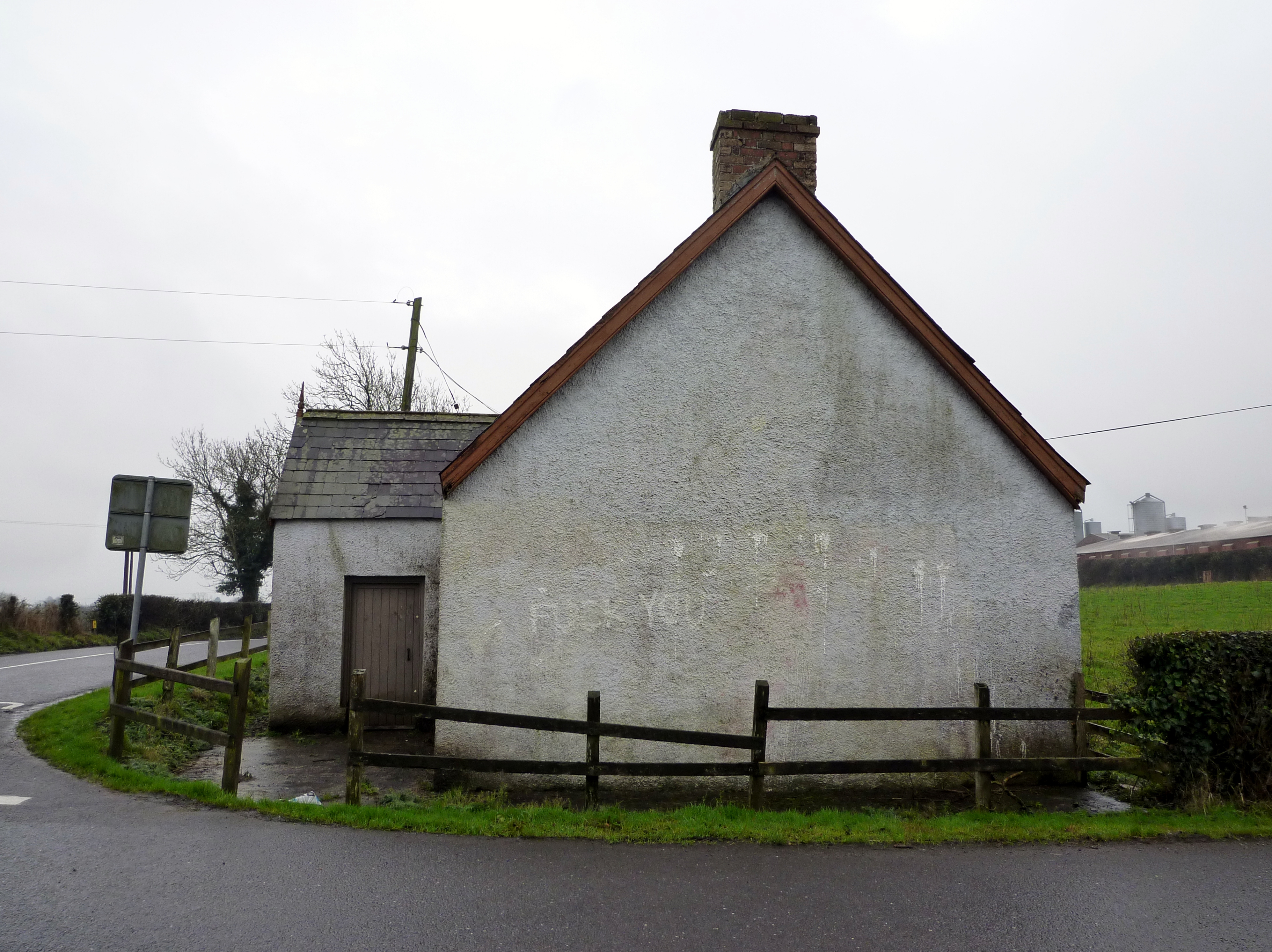
Corragh Orange Hall

Corragh hall

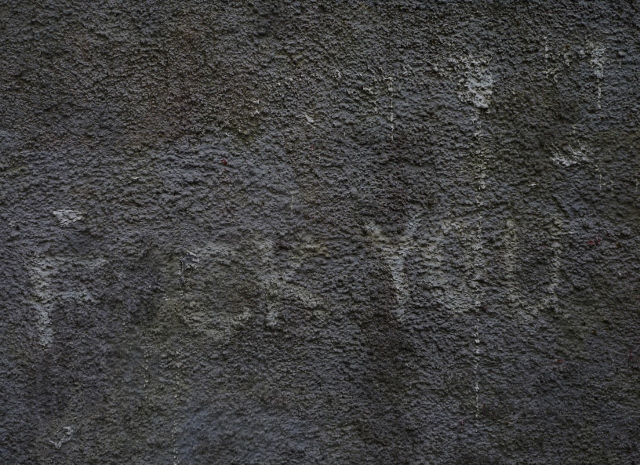
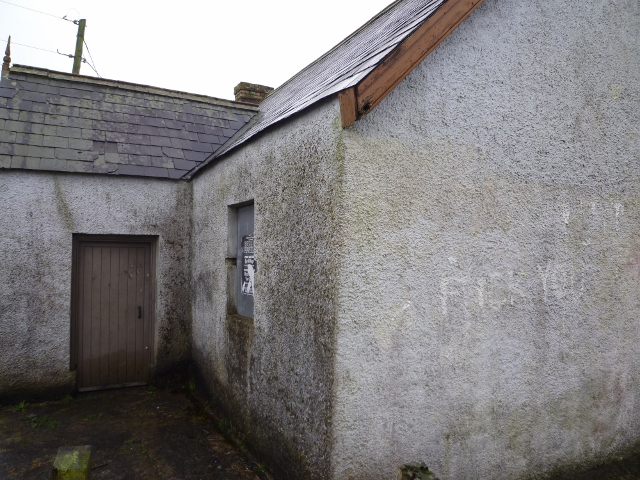
Driving past a small orange hall in a rural part of County Monaghan at Corraghbrack near Tydavnet on Saturday night the car headlights revealed two offensive words “F**K YOU” had been painted on the gable wall and came up very clearly in the car headlights. The hall is used infrequently and does not have any sign outside and I have been past it many times before. My initial reaction posted yesterday and now corrected here was that this could be described as a sectarian act, possibly in reaction to the flags row in the North. Going back to visit the scene in daylight hours, the offensive slogan was not as apparent, depending on what angle you looked at it. But the wall showed signs of previous acts of graffiti having been painted out. Damage was done to the windows and front door of the hall in 2005, when a nearby hall in Glaslough was also attacked. On that occasion the local parish priest in Donagh, Fr Sean Clerkin, spoke out strongly at Mass against the attack.

Hopefully action will be taken to remove the unwanted graffiti. Further enquiries have revealed that the paintwork (which at the time seemed fresh to me) is not recent and there are no slogans accompanying the crude message to suggest it is a political act. It seems it is not intended in any way as a sign to the people who own the property. As I stated previously, Tydavnet and other parts of Monaghan generally have very good relations between Catholics and Protestants. It is to be hoped that this unsightly work will be attended to in due course and that the good relations between all sides of the community will prevail.

ORANGE HALL GRAFFITI

Corragh Orange Hall

Corragh Orange Hall

THIS STORY HAS SINCE BEEN UPDATED. FOR THE LATEST VERSION SEE GRAFFITI PUBLISHED MONDAY 14th JANUARY.

Sectariansim in the Republic: Driving past a small orange hall in a rural part of County Monaghan near Tydavnet last night (Saturday) the car headlights revealed what can only be described as an act of sectarian abuse. Two words “F**K YOU” had been painted on the gable wall and came up very clearly in the car headlights. The orange hall is used infrequently but is one of several small ones remaining since partition. Members of the Orange Order from County Monaghan can often be seen parading in Northern Ireland and I have seen them on several occasions taking part in the main parade in Belfast.

Graffiti on wall (edited)

Graffiti on wall (edited)

Going back to visit the scene in daylight hours, the offensive slogan was not as apparent, depending on what angle you looked at it. But the wall showed signs of previous acts of graffiti having been painted out. Sadly, this is not the first time the building has been targeted. Damage was done to the windows and front door in 2005, when a nearby hall in Glaslough was also attacked. At the time, the Orange Order called on President McAleese to condemn the attacks. Some time later, she visited Brakey orange hall near Bailieborough in County Cavan, which had been damaged and repaired. It is worth quoting from her speech on that occasion: 

“It is possible to be both Irish and British, possible to be both Orange and Irish. We face into a landscape of new possibilities and understandings. The momentum of these times is, of course, difficult for some and so they lash out in intemperate acts of vandalism that have been visited on some Orange Halls, including Brakey. Such acts are a throw-back to another time, and we condemn them utterly and unequivocally”.

Across the nearby border in Northern Ireland several rural orange halls have been attacked and burned down. Attacks on the orange order and its members are often carried out in a tit-for-tat retaliation for something the other (green) side disapproves of. In this case, one explanation might be the ongoing row involving loyalists protesting over the restrictions placed on the flying of the union flag at Belfast City Hall. Leading politicians from North and South will meet in Belfast next Thursday to discuss the situation. In the meantime, I expect politicians of all shades in the Republic will be united in condemning another apparent attack on the minority community in Monaghan.

Corragh Orange Hall entrance

Corragh Orange Hall entrance

Hopefully action will be taken to remove the offensive and unwanted graffiti. It does not reflect the sentiment of the majority community locally. Tydavnet and other parts of Monaghan generally have very good relations between Catholics and Protestants. Members from both religions turn up at each other’s church services such as funerals or weddings. At a funeral Mass this morning local priest Fr Sean Clerkin spoke about value and respect for people. Sadly there are some people out there who do not think those sentiments are important. Sectarianism south of the border reared its ugly head a year after the Good Friday agreement was signed when Ian Paisley’s Free Presbyterian church at Coragarry, Drum in County Monaghan was targeted. Unfortunately it still seems to be with us.

TYRONE TRAGEDY

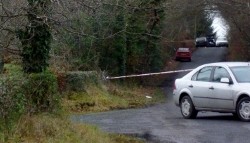
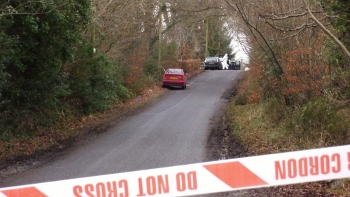
Police cordon at Aghindarragh Road

Police cordon at Aghindarragh Road

TYRONE has seen many tragedies over the years, including ones that have affected the GAA community, both directly and indirectly. I have reported on some in the past. The latest tragic death in the county took place in the countryside around Augher, in the parish of Clogher, close to the border with County Monaghan. As the crow flies, it is only a few miles to the scene of another community in mourning, the parish of Donagh, where the body of 19 year-old Jason McGovern (Knocknagrave, Tydavnet) was returned home in a candlelit vigil last night. The links between the two areas, cut off when the main cross-border road was blocked, remain close. Jason’s father Seamus comes from the parish of Clogher. The two deaths however are unconnected.

The PSNI say they have begun a murder enquiry following the death of a 60 year-old man whose body was found at Aghindarragh Road near Augher on Friday evening. The location is not far from the historic site known as St Patrick’s chair and well in Altdaven wood. An 18 year-old man was arrested and is continuing to help police with their enquiries. The man who died was Wishie (Aloysius) Hackett. He worked as a joiner and was a prominent member of St Macartan’s GAA Club in Augher. Clogher parish priest Canon Lawrence Dawson said the family were numb and could not explain what had happened. He described Mr Hackett as a wonderful community man who had done much for the area and for local (Gaelic) football. A statement from the GAA club said the family had appealed for privacy at this time of mourning. A one minute’s silence in memory of Mr Hackett was held before Tyrone’s Dr McKenna Cup match against Derry at Healy Park in Omagh. Sinn Féin MP Michelle Gildernew said she expressed her sympathies to all concerned especially family and friends who were sadly dealing with this news. She said her thoughts and prayers were with those affected by the death. Ulster Unionist councillor Allan Rainey said the man’s death had shocked and numbed the community. “They just can’t really take it in that something of this nature could happen,” he added. A forensic team spent most of Saturday carrying out investigations beside a house and the surrounding area was cordoned off for several hours.

House at Aghindarragh Road

House at Aghindarragh Road

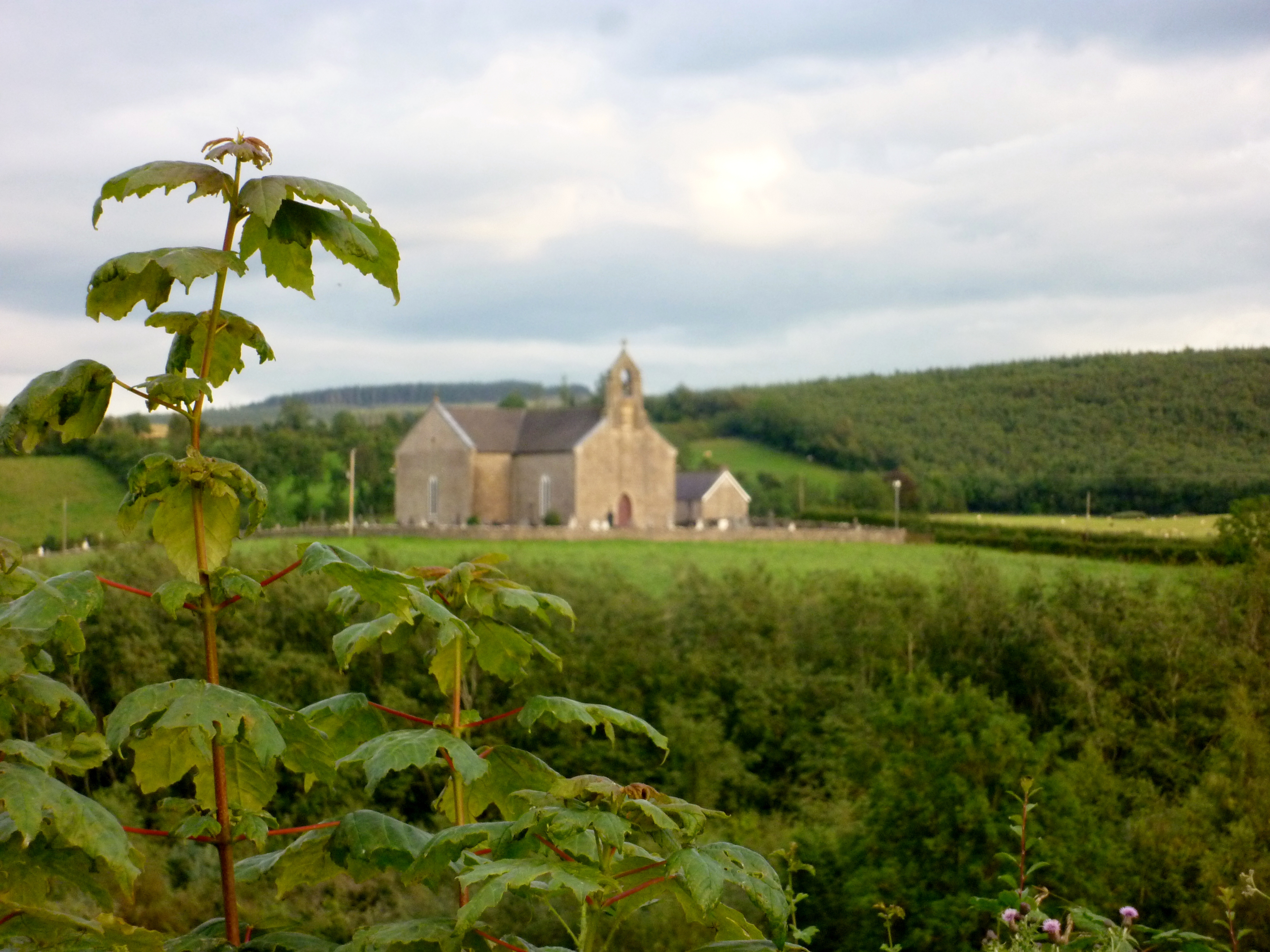
UPDATE:  An 18 year-old man has been charged with the murder of Wishie Hackett. The teenager, who was detained on Friday, was charged after detectives were given until (tonight) Monday evening to charge or release him. He is due to appear before Omagh Magistrates’ Court on Tuesday. The PSNI say a 17-year-old youth arrested in connection with the incident on Sunday has been released, pending a report to the Public Prosecution Service. It is believed three of Mr Hackett’s children were out of the country when news of his death emerged. They are travelling home for his funeral which is due to take place at St Macartan’s Church (the Forth chapel) at Ballynagurragh near Augher on Wednesday.

St MacCartan's church, Augher

St Macartan’s church, Augher

Photos: © Michael Fisher 2013