KILBURN

Saint Patrick

Saint Patrick

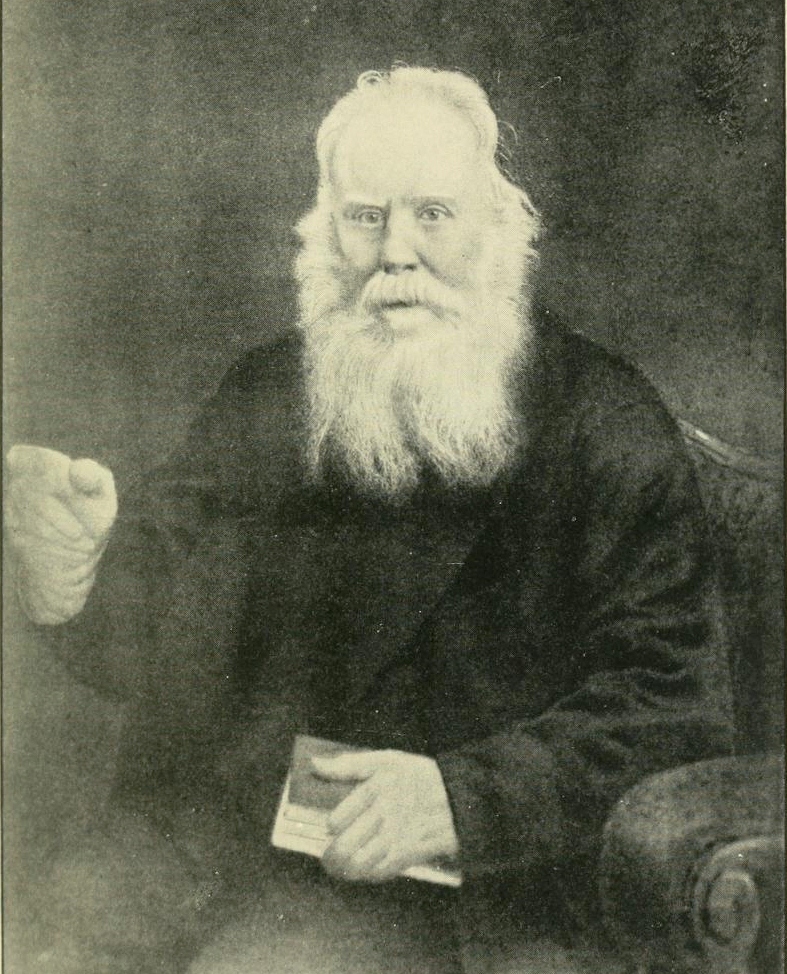
The statue of Saint Patrick at the Sacred Heart Church in Kilburn, London, stands as a reminder of the large Irish community who used to worship here. The chapel at Quex Road was built in 1878/9 and there had been an Irish presence in the area since 1841. In the 1950s and 60s there was an influx of Irish labourers as the suburb was redeveloped, and it became known as Ireland’s 33rd county. But the Irish nature of the parish has now diminished, following the arrival of immigrants from the Indian subcontinent and elsewhere.

The parish is run by the Oblates of Mary Immaculate (OMI) and the parish priest is from Waterford. But his assistants are from areas as diverse as Sri Lanka, the Congo and the Philippines, along with one local man from Willesden, who was ordained in Ireland.

Sacred Heart Church, Kilburn

Sacred Heart Church, Kilburn

The priest from the Congo said the Mass I was at on Sunday morning. The three servers he had on the altar (two of them girls) were coloured and I noticed only a few people in the congregation who seemed to be Irish or were of Irish extraction. But on Sunday March 17th there will be celebrations for the feast of St Patrick.

Irish Papers

Irish Papers

Go out onto the nearby Kilburn High Road and you will still see an Irish influence. Not far from the former State cinema that once house the National Ballroom, I came across a newsagents shop, with a wide selection of Irish provincial newspapers for sale. The last time I saw such a selection was in Easons in Dublin. I was disappointed that among the papers missing were the Northern Standard (Monaghan), the Anglo-Celt (Cavan) and the (Carlow) Nationalist and Leinster Times.  But I’m sure if you went in and asked for any of the other titles, the newsagent would probably order them for you.

Many of the Irish emigrants who came to London never got the chance to return home. There are still some who are living on their own, who were never married and who have lost touch with Ireland. To provide accommodation for them, the Irish Centre Housing (ICH) group has developed a new hostel, close to the Sacred Heart church.

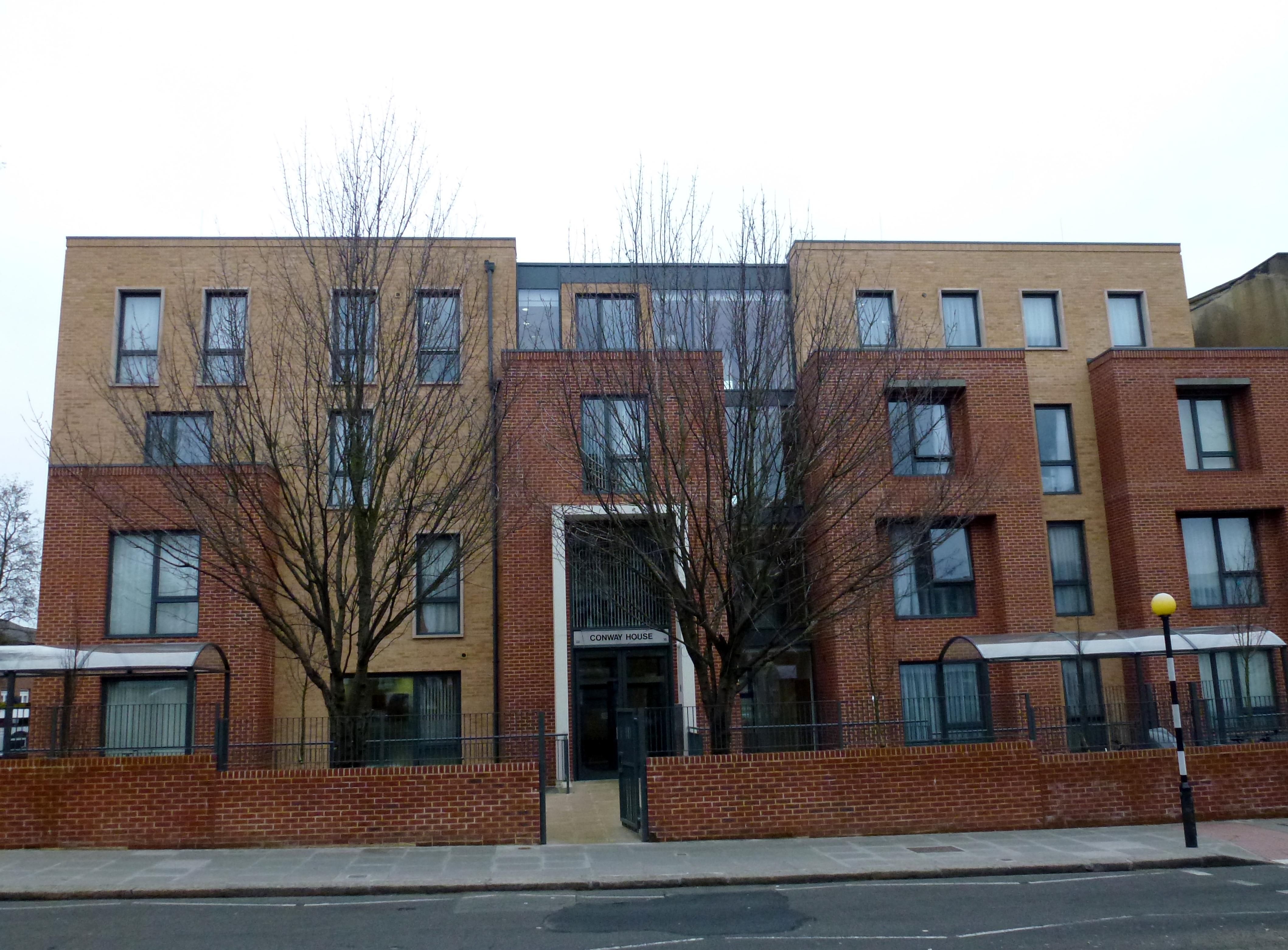
Conway House

Conway House

Conway House was originally the site of a nursing home, acquired from the Sisters of Hope in 1973. The new building costing £4 million contains 60 en-suite rooms for single people. There is an annexe with six flats for renting for family acommodation. The first new residents moved in two months ago at the start of December.  ICH provides accommodation and support for the homeless and those with alcohol, drug and mental health issues, as well as affordable housing for those on local authority waiting lists. The development was financed through Clydesdale Bank and was carried out in association with the London Borough of Camden’s Hostels Pathway project.

EMYVALE QUIZ

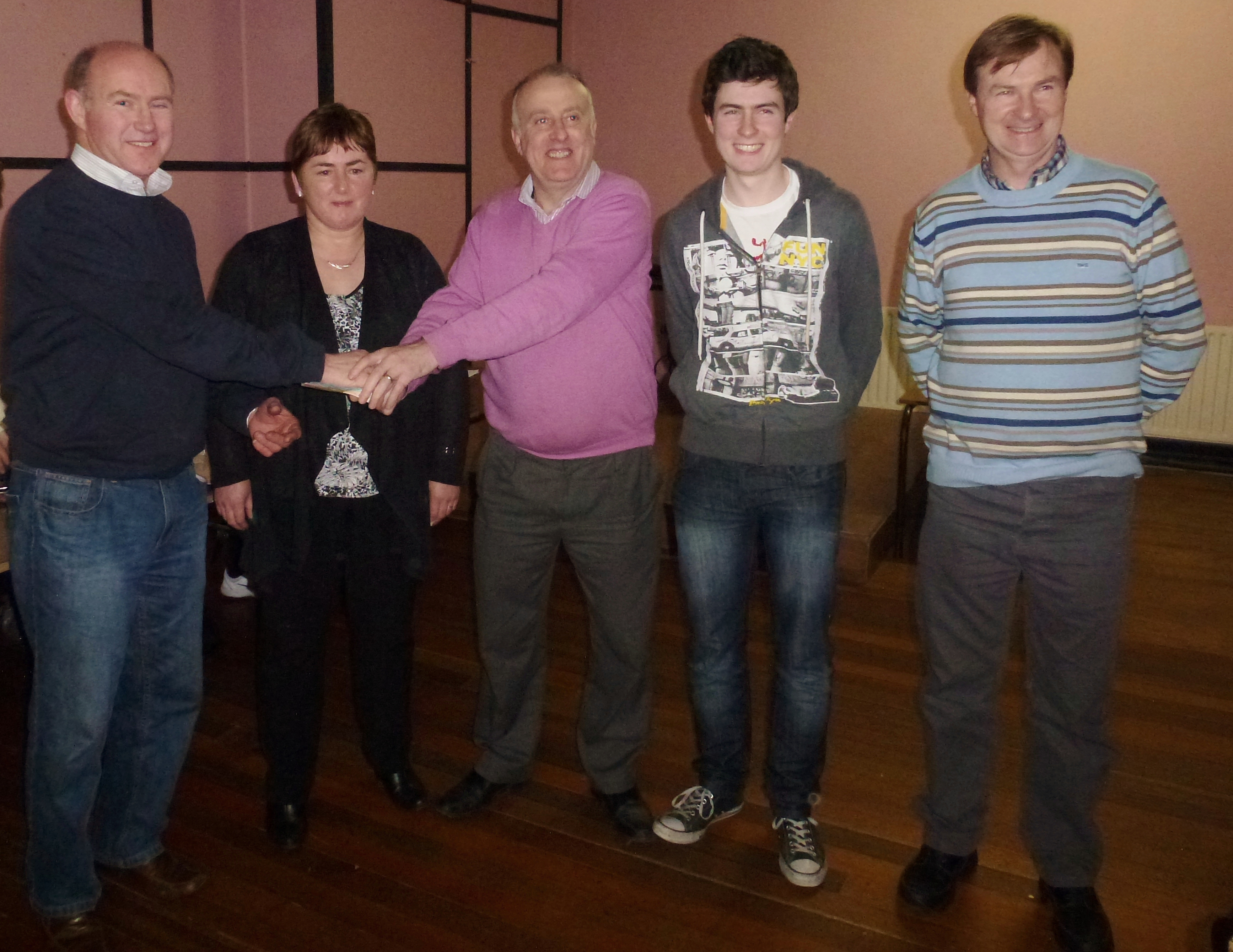
Quiz Winners

Quiz Winners

Table quizzes are very popular, especially in the winter. So it proved in Emyvale, County Monaghan, with two contests running side by side in neighbouring pubs. The Blackwater Steelers, a basketball club, were at the Red Boys. Over at the High House, I was asking the questions for the annual quiz run by Emyvale Cycling Club. I had to do some quick thinking when I inadvertently gave away an answer for one of the questions, which was supposed to be “Ash Wednesday”. Not many of the 18 teams were able to guess who Tommy Bowe’s Ulster rugby colleague is who has just received a call-up for the Ireland team against Scotland at out-half: Paddy Jackson. The winners (on table 5) of the E200 prize were a team from Tydavnet, including Alice Daly. Congratulations to them and to all who took part to make it an enjoyable evening. Thanks also to those who supported the raffle by buying tickets or donating prizes.

AIDAN McANESPIE

Aidan-McAnespie

Aidan McAnespie

The killing of Aidan McAnespie (24) at a border checkpoint outside Aughnacloy in County Tyrone 25 years ago today was one of the most controversial killings during the “troubles”.  It led to a diplomatic row between London and Dublin. At the request of Charles Haughey’s government, Deputy Garda Commissioner Eugene Crowley was sent to Monaghan to investigate, although his report was never made public. Prime Minister Margaret Thatcher said the Irish government could investigate anything it wished, but not North of the border.

Grenadier Guardsman David Holden claimed his hands were wet after cleaning the sangar in the watchtower and that he had accidentally fired three rounds from a heavy machine gun as he moved it. Three days after the shooting Guardsman Holden appeared at Cookstown magistrates court where he was charged with the unlawful killing of Mr McAnespie. The same day, Irish and British Ministers held an Anglo-Irish conference in Dublin.

P1100296 (2)

Memorial near Aghaloo GFC

I remember seeing the soldier standing in the dock as the charge was put to him. His lawyer said he would plead innocent to the charge. The magistrate remanded him into police custody. The charge was withdrawn six months later after a decision by the Director of Public Prosecutions on the basis that in his judgement there was insufficient evidence to sustain it.

Twenty years after the killing, a PSNI Historical Enquiries Team report concluded that the soldier’s account of events that the fatal shot which hit Aidan in the back was “a tragic accident” was the least likely explanation of what had occurred. The report said that:-

an impartial and independent observer must question the likelihood of an accidental random discharge striking the roadway only a few feet behind what would be from the vantage point of the machine gun post a miniscule figure at a distance of 283.4 meters. The statistical odds, as outlined by (an) independent ballistic expert…..are strongly against the accidental discharge theory.”

This finding in October 2008 brought huge relief to the McAnespie family. His niece Una McCabe said the claim that Aidan had been killed by a ricochet bullet fired at random because a soldier had wet slippy fingers which inadvertently came in contact with the trigger and that Aidan was not being tracked at that precise moment had been firmly rebutted. She said the official scenario, as accepted by the British Army and the prosecution service, could be regarded as so remote that it could be virtually disregarded.

The memory of Aidan lives on. Tonight the former Tyrone football star and current Fermanagh manager Peter Canavan will be in Aughnacloy to address a candlelit vigil near the spot where Aidan died. Alongside the road where he was killed, there is a small stone memorial and a cross, which has been freshly painted. This evening a crowd will assemble beside the site of the former lookout post, which dominated the main  road to Dublin.

Roadside Cross

Roadside Cross

Speaking ahead of the event, Peter Canavan said the killing of Aidan had sent huge shock waves around the country. He said the GAA community, particularly in counties Tyrone and Monaghan, had been stunned that one of its members had been callously cut down following what he said had been years of threats and torment by the British army.

Outside the McAnespie house in Aughnacloy flies the flag of the largest GAA Club in Boston in the United States. It is named after Aidan, a sign of how his death took on international significance. His mother Elizabeth and his sister Eilish have now passed away. But his father John remembers how in the few months before the incident, his wife always used to walk with Aidan to and from the security checkpoint, when he was going to work in Monaghan, or returning. He said Aidan always used to park his car beyond the watchtower, close to the GAA Club, because of the continual harassment he used to get from soldiers, who tracked his movements. A year before the incident, John McAnespie was stopped by a British soldier at the checkpoint, who told him: “We have a bullet here (in the gun) for him”. 

John McAnespie

John McAnespie

On that day on Sunday February 21st  1988 the Aghaloo Gaelic football team from Aughnacloy, whose pitch is alongside the main road and close to the border with County Monaghan was due to play Killeeshil. Aidan had been walking past the checkpoint and was on his way to the club when he was killed. To mark the anniversary a number of Aghaloo and Killeeshil players from that era, with others, will line out on Saturday 23rd February at 4.00pm to compete for the Aidan McAnespie Trophy. The event will be attended by leading GAA personalities and officials, including Tyrone County Chair Ciaran McLaughlin, Ulster GAA Secretary Danny Murphy and the former GAA President, Dr Mick Loftus from Mayo.

Aghaloo GFC

Aghaloo GFC

Northern Standard report 21/02/13

Northern Standard report 21/02/13

ULSTER GAA PRESIDENT

Martin McAviney

Martin McAviney

It’s been an important weekend for the GAA in County Monaghan. First there was confirmation that the new Uachtarán Chomairle Uladh (President of the Ulster Council) is Ballybay man Martin McAviney. Many in the border area and the Press Golf Society will remember the great work done by his late brother John, a photographer.

At the same time, the GAA Ard Stiúrthóir Paraic Duffy was back in Monaghan to attend a gala ball organised by his alma mater, St Macartan’s College, where he was also the Principal for many years. It was celebrating the 100-year history of the GAA in the College, which includes winning the MacRory Cup on nine occasions, but not since 1956 although they have appeared in two finals in the past decade. On Wednesday week (27th February) the “Sem” will take on St Paul’s Bessbrook (Armagh) in the semi-final of the competition under lights in Armagh (7:30pm).

Martin McAviney is a member of the Pearse Brothers club in Ballybay. He is a member of the Club Committee and a Club Trustee. He has previously served as Club Secretary and Club Chairman and received the Coiste Chontae Mhuineachain Senior Official of the year 1984. He joined the Monaghan County Board as Ulster Representative in 1987 and held the position until being elected as P.R.O. of Comhairle Uladh in 2004, a role he carried out very effectively.

During his term as P.R.O., Martin was awarded the Ulster GAA Writers Communications Award in 2005. Martin took up a position of Cisteoir (Treasurer) of the Ulster Council in 2007, and in March 2010, he was elected as Leas-Uachtarán (Vice President). On his first full day in the new job, Martin was at the Athletic Grounds in Armagh to watch the interprovincial hurling and football semi-finals, previously known as the Railway Cup.

The competition was reinstated to the GAA calendar last year, but has failed to attract the support it used to get in the 1950s and 60s when large crowds would turn up at Croke Park on St Patrick’s Day for the finals. The club finals have taken over the slot and continue to bring in the numbers, but it seems the appetite for interprovincial competitions has faded, judging by the attendances at the semis. So the final of the football competition at Croke Park next Sunday has now been fixed to coincide with AIB Club junior final. The hurling final will be a week later.

Joe Kernan

Joe Kernan

HURLING:  MUNSTER 3-20 ULSTER 1-14 

FOOTBALL: ULSTER 1-14 MUNSTER 1-13

Nice to see former Armagh boss Joe Kernan back in action as coach of the Ulster football side. He expressed his concern at the low attendance, given the quality of football on display. Monaghan made an important contribution to the Ulster side with Conor McManus scoring four points. The team was captained by Scotstown’s Darren Hughes, whose brother Kieran came on as a substitute.

Darren Hughes, Ulster

Darren Hughes, Ulster

FRANCIE MCCARRON RIP

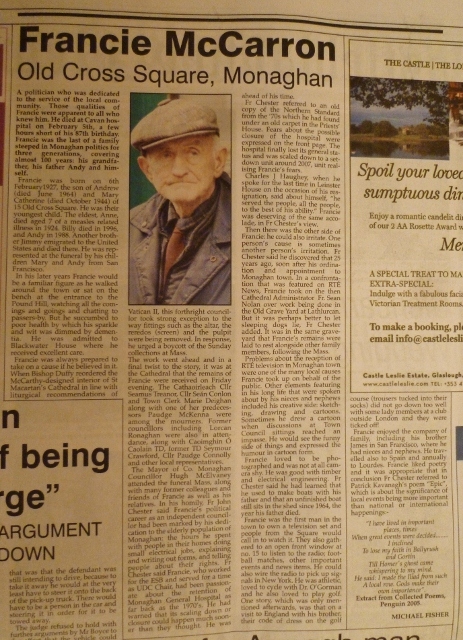
Francie McCarron (picture: Northern Standard)

Francie McCarron (picture: Northern Standard)

OBITUARY: FRANCIE MCCARRON             Old Cross Square, Monaghan             Northern Standard Feb.14th 2013

A politician who was dedicated to the service of the local community. Those qualities of Francie were apparent to all who knew him. He died at Cavan hospital on February 5th, a few hours short of his 87th birthday. Francie was the last of a family steeped in Monaghan politics for three generations, covering almost 100 years: his grandfather, his father Andy and himself.

Francie was born on 6th February1927, the son of Andrew (died June 1964) and Mary Catherine (died October 1944) of 17 Old Cross Square. He was their youngest child. The eldest, Anne, died aged 7 of a measles related illness in 1924. Billy died in 1996, and Andy in 1988. Another brother Jimmy emigrated to the United States and died there. He was represented at the funeral by his children Mary and Andy from San Francisco.

In his later years Francie would be a familiar figure as he walked around the town or sat on the bench at the entrance to the Pound Hill, watching all the comings and goings and chatting to passers-by. But he succumbed to poor health by which his sparkle and wit was dimmed by dementia. He was admitted to Blackwater House where he received excellent care.

Francie was always prepared to take on a cause if he believed in it. When Bishop Duffy reordered the McCarthy-designed interior of St Macartan’s Cathedral in line with liturgical recommendations of Vatican II, this forthright councillor took strong exception to the way fittings such as the altar, the reredos (screen) and the pulpit were being removed. In response, he urged a boycott of the Sunday collections at Mass.

The work went ahead and in a final twist to the story, it was at the Cathedral that the remains of Francie were received on Friday evening. The Cathaoirleach Cllr Seamus Treanor, Cllr Seán Conlon and Town Clerk Marie Deighan along with one of her predecessors Paudge McKenna were among the mourners. Former councillors including Lorcan Ronaghan were also in attendance, along with Caoimghin Ó Caolain TD, former TD Seymour Crawford, Cllr Paudge Connolly and other local representatives.

The Mayor of Co. Monaghan Councillor Hugh McElvaney attended the funeral Mass, along with many former colleagues and friends of Francie as well as his relatives. In his homily, Fr John Chester said Francie’s political career as an independent councillor had been marked by his dedication to the elderly population of Monaghan: the hours he spent with people in their homes doing small electrical jobs, explaining and writing out forms, and telling people about their rights. Fr Chester said Francie, who worked for the ESB and served for a time as UDC Chair, had been passionate about the retention of Monaghan General Hospital as far back as the 1970’s. He had warned that its scaling down or closure could happen much sooner than they thought. He was ahead of his time.

Fr Chester referred to an old copy of the Northern Standard from the ‘70s which he had found under an old carpet in the Priests’ House. Fears about the possible closure of the hospital were expressed on the front page. The hospital finally lost its general status and was scaled down to a set-down unit around 2007, unit realising Francie’s fears.

Charles J Haughey, when he spoke for the last time in Leinster House on the occasion of his resignation, said about himself, “he served the people, all the people, to the best of his ability.” Francie was deserving of the same accolade, in Fr Chester’s view.

Then there was the other side of Francie: he could also irritate. One person’s cause is sometimes another person’s irritation. Fr Chester said he discovered that 25 years ago, soon after his ordination and appointment to Monaghan town. In a confrontation that was featured on RTÉ News, Francie took on the then Cathedral Administrator  Fr. Sean Nolan over work being done in the Old Grave Yard at Lathlurcan. But it was perhaps better to let sleeping dogs lie, Fr Chester added. It was in the same graveyard that Francie’s remains were laid to rest alongside other family members, following the Mass.

Problems about the reception of RTÉ television in Monaghan town were one of the many local causes Francie took up on behalf of the public. Other elements featuring in his long life that were spoken about by his nieces and nephews included his creative side: sketching, drawing and cartoons. Sometimes he drew a cartoon when discussions at Town Council sittings reached an impasse. He would see the funny side of things and expressed the humour in cartoon form.

Francie loved to be photographed and was not at all camera shy. He was good with timber and electrical engineering. Fr Chester said he had learned that he used to make boats with his father and that an unfinished boat still sits in the shed since 1964, the year his father died.

Francie was the first man in the town to own a television set and people from the Square would call in to watch it. They also gathered to an open front window at no. 17 to listen to the radio; football matches, other important events and news items. He could also wire the radio to pick up signals in New York. He was athletic, loved to cycle with Dr. O’Gorman and he also loved to play golf.  One story, which was only mentioned afterwards, was that on a visit to England with his brother, their code of dress on the golf course (trousers tucked into their socks) did not go down too well with some lady members at a club outside London and they were ticked off!

Francie enjoyed the company of family, including his brother James in San Francisco, where he had nieces and nephews. He travelled also to Spain and annually to Lourdes. Francie liked poetry and it was appropriate that in conclusion Fr Chester referred to Patrick Kavanagh’s poem “Epic”, which is about the significance of local events being more important than national or international happenings:-

I have lived in important places, times
When great events were decided……..

I inclined
To lose my faith in Ballyrush and Gortin
Till Homer’s ghost came whispering to my mind.
He said: I made the Iliad from such
A local row. Gods make their own importance”.

[Extract from Collected Poems, Penguin 2005]

MICHAEL FISHER
P1100203 (2) (463x640)


TRIBESMEN ADVANCE

Conor Cooney

Conor Cooney

 I wrote the other day about Monaghan hurling: it’s the Cinderella sport in a footballing county. So it was nice to be able to see a top class game of hurling in Clones. The All-Ireland club championship semi-final replay between St Thomas’ from the Kilchreest and Peterswell area of County Galway and the Loughgiel Shamrocks from the Glens of Antrim, one of the cradles of hurling. The long and wide dimensions of the pitch at St Tiarnach’s Park make it very suitable for hurling and watching the highlights now on TG4 it loohs really well on television. On the other side of the coin, I noticed that one of the All-Ireland club football semi-finals between sides from Kerry and Dublin was played at Semple Stadium in Thurles, a very important place for the GAA and a ground that is more associated with hurling!

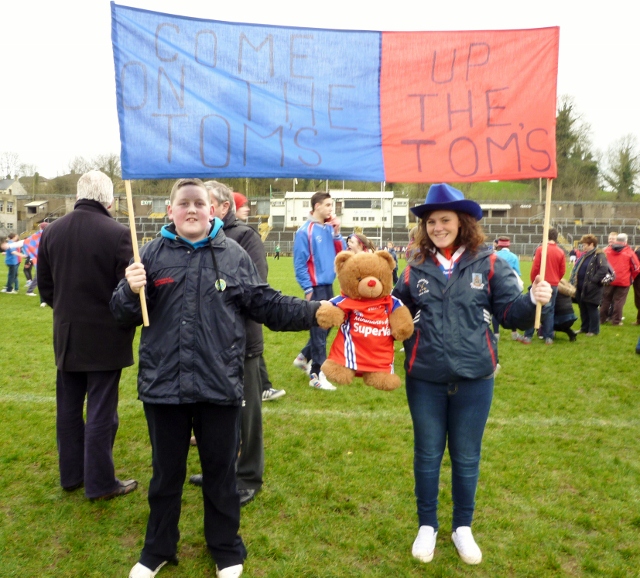
St Thomas's supporters

St Thomas’s supporters

ST THOMAS’ (Galway) 0-15 LOUGHGIEL SHAMROCKS 0-07

Conor Cooney was the top scorer for the Galwaymen, with a series of frees in the second half that helped to see off the challenge of the men from the Glens of Antrim. Loughgiel for whom Liam Watson put six frees between the posts were trailing by a single point at the break, 0-6 to 0-5. Two Watson frees in the second half were all the Shamrocks could manage. Eddie McCloskey scored their only point from play just before the break, to keep his side in the contest after the first thirty minutes.  But it could have been a very different result if a beautifully struck shot from Benny McCarry had found the net instead of glancing off the post in the first five minutes.

Bernard Burke is congratulated

Bernard Burke is congratulated

St Thomas’ must be fairly unique as it has three sets of brothers on the team, six of them from the Burke family. The club concentrates only on hurling and won their first Galway senior championship last year. Precedent was on their side as no Galway club had ever lost in a club semi-final replay. Likewise, no Antrim side had ever won a replay at this stage. So congratulations to the tribesmen, who go on to meet Kilcormac-Killoughey from County Offaly in the final at Croke Park on St Patrick’s Day as part of a double bill in which Ballymun Kickhams are up against Roscommon and Connacht champions St Brigid’s in the club football final. So no Ulster involvement in the finals this year.

St Thomas's players wind down

St Thomas’s players wind down

MONAGHAN HURLING

Dr Croke Cup

Dr Croke Cup

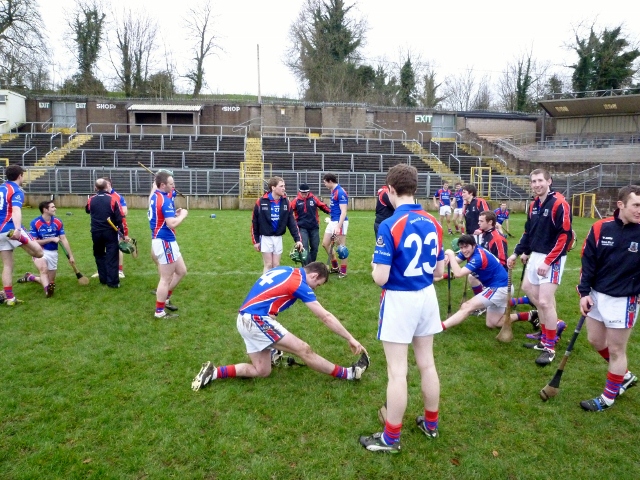
The words “Monaghan” and “hurling” don’t sit naturally together. Monaghan is a footballing county, although the Farney men have never succeeded in winning the Sam Maguire Cup. But after this evening’s result in the Allianz National League, when Monaghan were defeated by neighbours Cavan at Breffni Park, perhaps the time has come for a change! If you look closely enough at the reflection in the silver of the cup, you can see how I managed to include the Tipperary colours of my tie in the picture!

This afternoon during a visit to my mother-in-law in Castleblayney, which is also my mother’s home town, I was pleased to get an opportunity to see the spoils of Kilkenny’s hurling victories. There was the Liam McCarthy Cup, presented to the All-Ireland senior champions. Alongside it was the Dr Croke Cup, the trophy for the National Hurling League champions of 2012, having defeated Cork in the final (www.gaa.ie report).

National League Champions Kilkenny

National Hurling League Champions 2012 Kilkenny (gaa.ie photo)

The trophies came to Castleblayney in the custody of Kilkenny kit manager Denis “Rackard” Cody, an important member of the county’s backroom team. I did not get a chance to ask him if his nickname came from the famous Wexford hurlers! The cups were brought to Ulster with a purpose: to encourage the development of hurling at secondary school level. The under-12s and under-14s from Our Lady’s secondary school and their counterparts from East Cavan Gaels took part in a match and coaching session run by Cody.

Kilkenny GAA

Kilkenny GAA

He joined the Kilkenny set-up in 1977 and has served as kit manager for the past ten  years. He refereed 15 county finals in all grades, and officiated also at National League level. He was elected the first Mayor of Graignamanagh in 1982 (Kilkenny People). He brings his knowledge and passion for hurling around the country. In November he visited one of the cradles of hurling, the Glens of Antrim, as a guest of the Robert Emmet club in Cushendun and helped run an underage competition.

Hurling can continue to be successful in Ulster and can only benefit from the expertise of the Noresiders. Title holders Loughgiel Shamrocks from the Glens were playing this afternoon in an All-Ireland club semi-final, which ended in a draw after extra time and will have to go to a replay. I also recall walking through the grounds of UCD in Belfield, near the sports centre, when I spotted a young lad with a Monaghan GAA top…..carrying a hurley. Such a rare sight that I felt it necessary to go up to him and congratulate him on his perseverance!

COMMEMORATION OF CARLETON

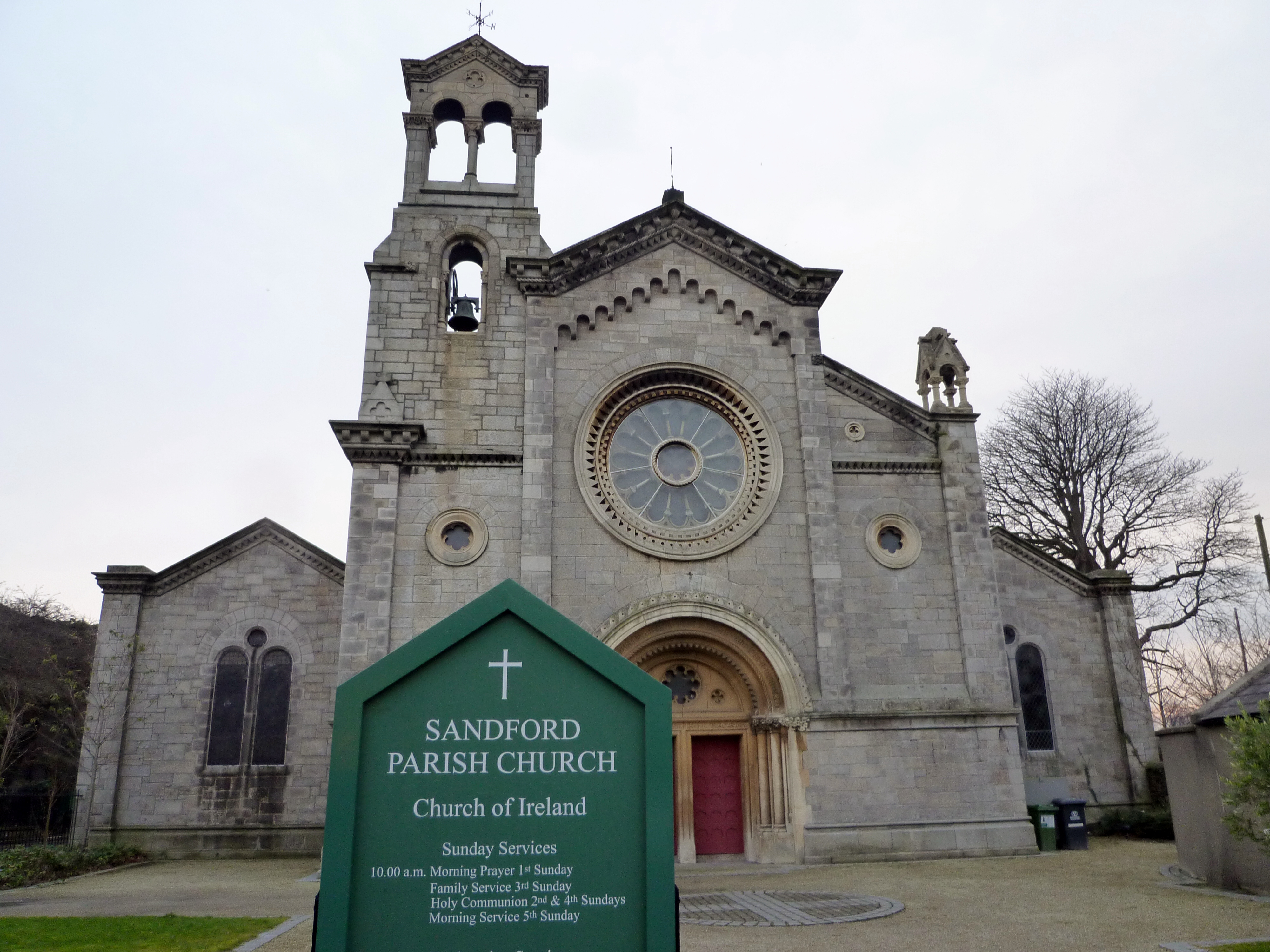
William Carleton Society at Sandford Parish Church

William Carleton Society at Sandford Parish Church

IN THE FOOTSTEPS OF CARLETON:

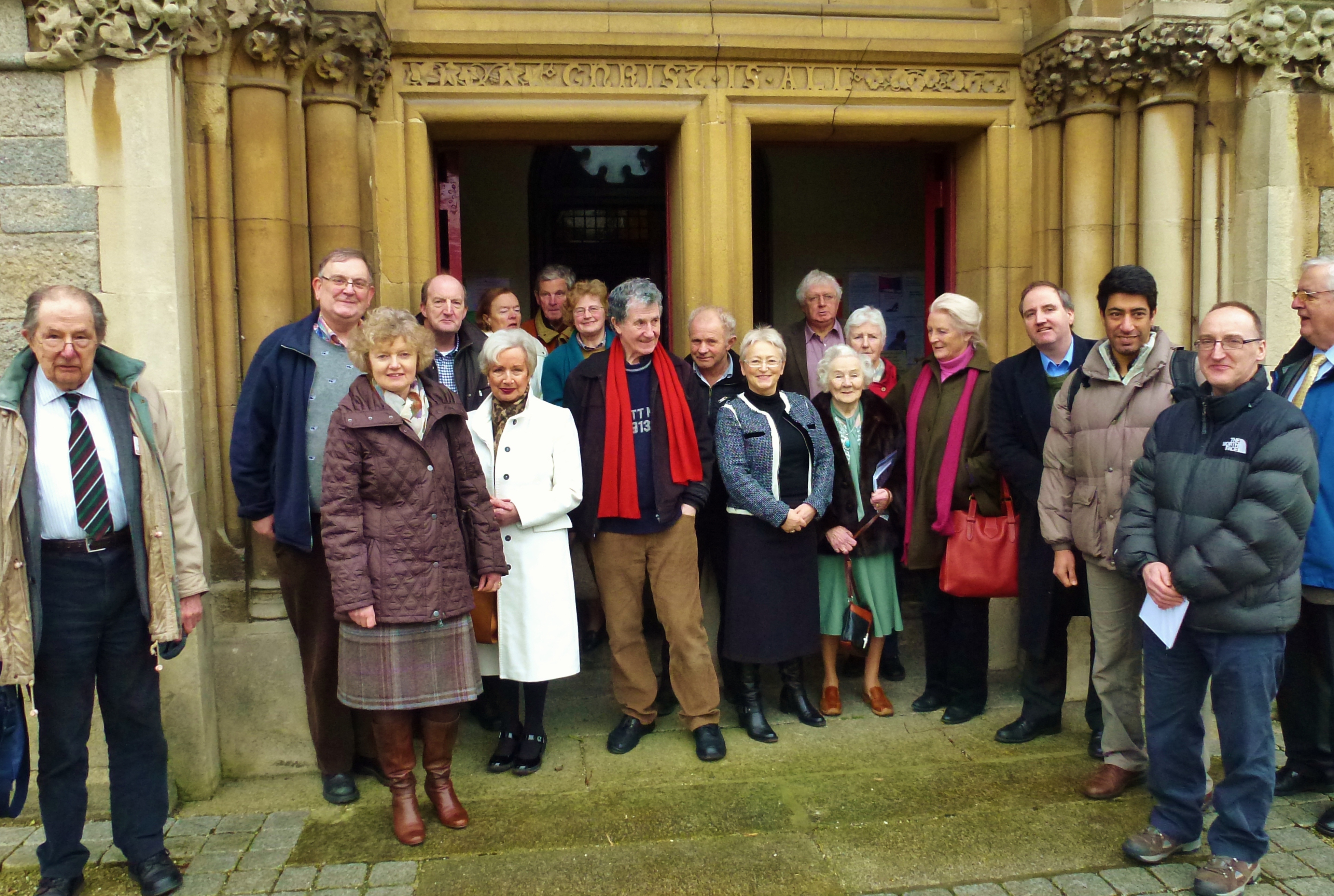
The William Carleton Society based in the Clogher Valley and Monaghan came to Dublin to mark the 144th anniversary of the death of the famous 19thC Irish author from County Tyrone. Carleton grew up as a Catholic, but would later convert to Protestantism in the Anglican church. He was the youngest of fourteen children born to a small farmer in  Clogher. Dr Frank Brennan a member of the Executive Committee met us at Castleknock and gave our coach party a guided trip through the city centre, starting with the Phoenix Park with its numerous historical monuments and associations going back hundreds of years. We passed Aras an Uachtaráin, the Polo Grounds, Phoenix Cricket Club, the oldest cricket club in Ireland and Dublin Zoo, also taking in the Wellington monument.  We then travelled along Dublin’s quays, with views of Collins Barracks which I have fond memories of, now part of the National Museum of Ireland. On the other side of the Liffey we saw Heuston station and the HSE Headquarters at what was Dr Steevens’ Hospital, with St Patrick’s Hospital and beside it Guinness’ brewery. We saw the Four Courts and crossed Grattan bridge travelling towards City Hall and what was once the headquarters of the British administration In Ireland, Dublin Castle, now in use for the state’s Presidency of the European Union.

P1050799 (2) (960x1280)

Reverend Precentor Noel Regan

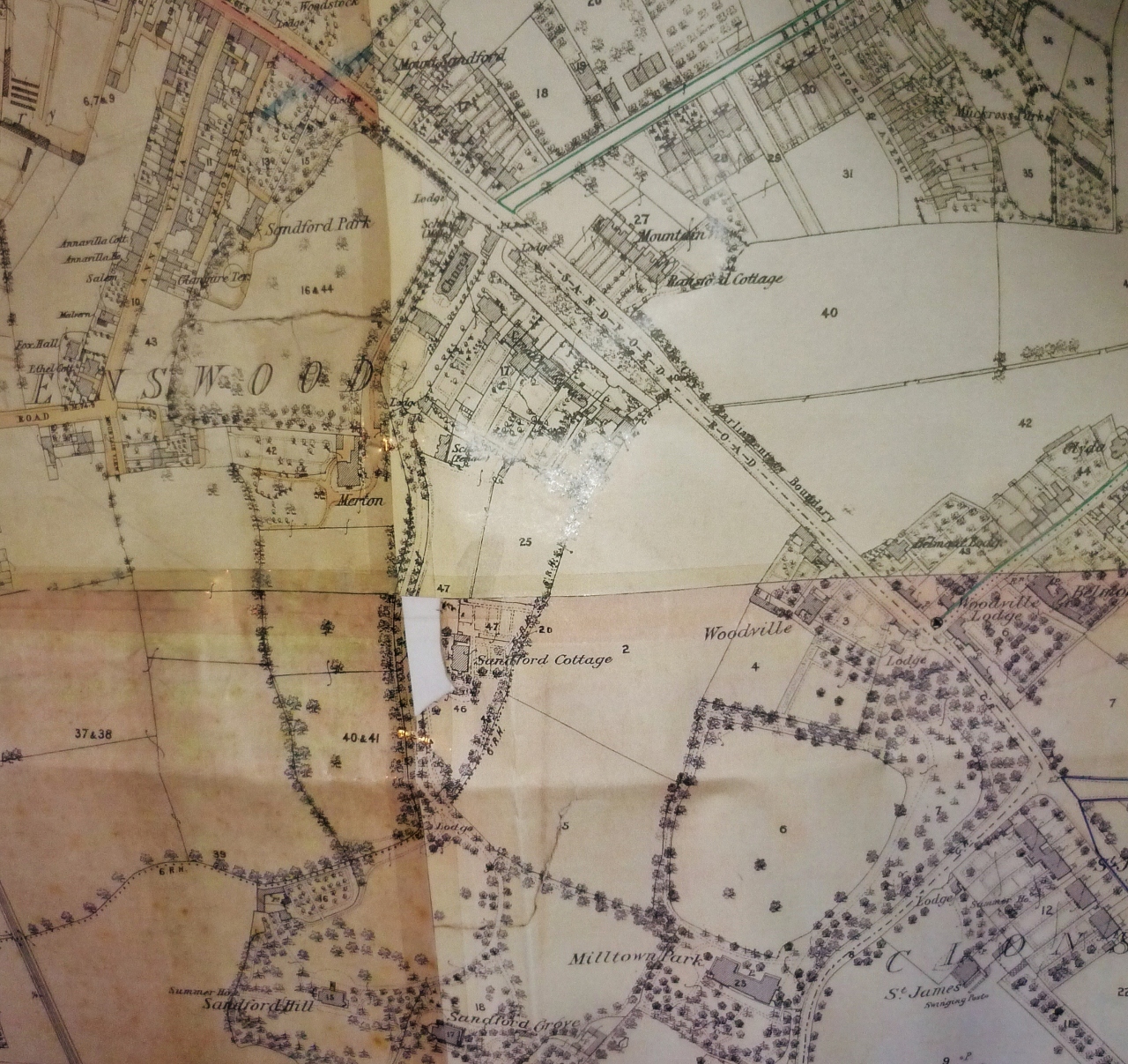
On then to the two cathedrals, Christ Church where there was a festival on in the grounds and St Patrick’s Cathedral where the Reverend Precentor Noel Regan from St Macartan’s Cathedral in Clogher provided some useful background about the two buildings. We moved on through the former Jewish area and into Ranelagh which developed as a genteel middle class suburb after the Act of Union. At Sandford Church we were addressed by a local teacher, who is a member of the congregation, on the history of Sandford church and its connection with Carleton. Susan Roundtree, an architectural historian, also spoke about the development of 19thC Ranelagh and brught along an old map of the area from 1870, which showed Woodville, a row of houses along the Sandford Road close to the entrance to Milltown Park, where Carleton had spent his final years.

1870 map shows Woodville

1870 map shows Woodville

 The residence at Woodville, (beside the entrance to Milltown Park) is now demolished. In his latter years Carleton was friendly with a Jesuit priest Fr Robert Carbery, who was based at Milltown Park. Brian Earls reminded us that in the last weeks before his death in January 1869, the priest offered through Carleton’s wife Jane to give him the last rites of the Catholic church. In response, in one of his last communications, the author told the Jesuit:

“For half a century & more I have not belonged to the Roman Catholic religion. I am now a Protestant and shall will die such”     (LA15/319 DJ O’Donoghue papers, UCD Archives)

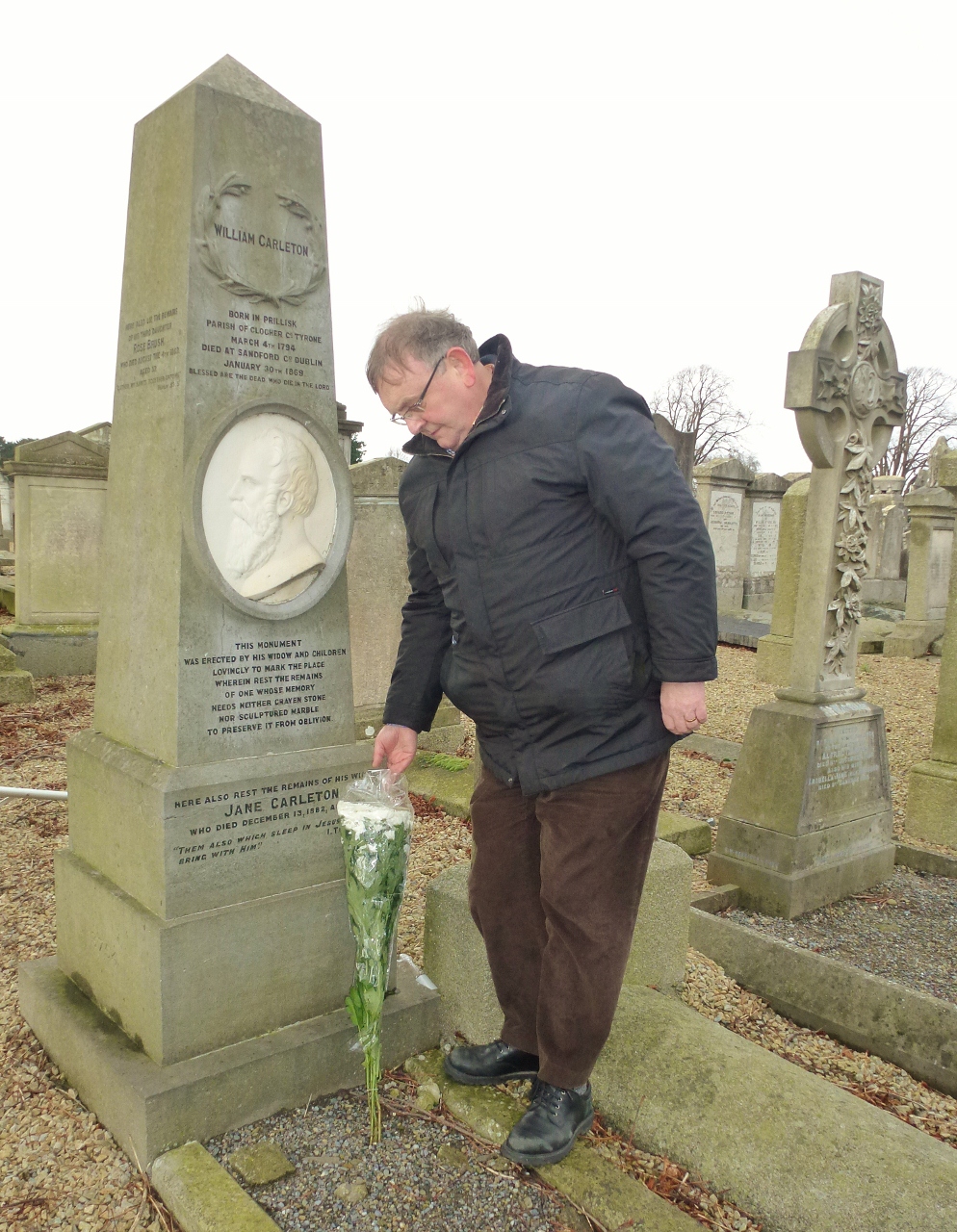
We then went to Mount Jerome cemetery for a short ceremony to commemorate the 144th anniversary of William Carleton’s death, followed by a short tour of the graveyard. We travelled to lunch at O’Briens at Sussex Place, Upper Leeson Street, one of Patrick Kavanagh’s haunts, which as a 1900’s grocery and bar reminded him of Carrickmacross. The journey to lunch took us through two Georgian squares (Fitzwilliam and Merrion) and past Leinster House and Government Buildings. Finally after lunch Frank Brennan brought us into Donnybrook and Ballsbridge, passing the British Embassy, AIB and the Aviva Stadium otherwise known as Lansdowne Road. We passed the Grand Canal Theatre, National Convention Centre, and saw some relics of the Celtic Tiger on our route home. Thanks to all who came and I hope you enjoyed the day.

At grave of William Carleton

At grave of William Carleton

The William Carleton Society is a partner in the Shared History, Shared Future project run by Dungannon and South Tyrone Borough Council through the EU funded South West Peace III Partnership Programme and this activity is being delivered through it.

DSTBC LogoSWPeaceIII_logo_options_2berdfimages

CARLETON IN RANELAGH

CARLETONportrait (2)IN THE FOOTSTEPS OF CARLETON:

I am in Dublin today with a group from the William Carleton Society based in the Clogher Valley and Monaghan to mark the 144th anniversary of the death of the famous 19thC Irish author from County Tyrone. Carleton grew up as a Catholic, but would later convert to Protestantism in the Anglican church. He was the youngest of fourteen children born to a small farmer in  Clogher.  He came to Dublin in 1819 with 2s 9d in his pocket and after trying various occupations, became a clerk in the Church of Ireland Sunday School Office.

Our coach party departs from Enniskillen at 7:30am and is picking up passengers at Maguiresbridge, Clogher, Aughnacloy and Monaghan (at the entrance to St Macartan’s College. 8:15am) for the trip to Dublin. Dr Frank Brennan a member of the Executive Committee will be our guide on reaching Castleknock.

“Frank Brennan will conduct a tour through Phoenix Park with its numerous historical monuments and associations going back hundreds of years, travel along Dublin’s quays, Four Courts, Guinness’ brewery, Dublin Castle, the two cathedrals, Jewish area and into Ranelagh which developed as a genteel middle class suburb after the Act of Union. At Sandford Church we will be addressed by a local teacher, who is a member of the congregation, on the history of Sandford church and its connection with Carleton. The Ranelagh Arts Society will then provide a talk by Susan Roundtree, an architectural historian, on the development of 19thC Ranelagh and the connection with the Plunkett family, who played a major role in Irish history.

We then go to Mount Jerome cemetery for a short ceremony (2pm) to commemorate the 144th anniversary of William Carleton’s death. A member of the Ranelagh Arts Society will then conduct a short tour of the graveyard. We travel to lunch (4pm) at O’Briens at Sussex Place, Upper Leeson Street, one of Patrick Kavanagh’s haunts, which as a 1900’s grocery and bar reminded him of Carrickmacross. The journey to lunch will take us through Dublin’s two Georgian squares  and past Government Buildings. Finally after lunch (which participants will pay for themselves) Frank Brennan will bring us past the Grand Canal Theatre, National Convention Centre, and some other of the better relics of the Celtic Tiger before our return home.”

SANDFORD CHURCH RANELAGH DUBLIN 12:30pm for 1pm   

Sandford Church, Ranelagh

Sandford Church, Ranelagh

Those joining the event in Ranelagh should assemble at the church at Sandford Road Ranelagh (junction with Marlborough Road) around 12:30pm. The group from the bus is hoping to walk from the site of Carleton’s now demolished former residence at Woodville, Sandford Road (beside the entrance to Milltown Park) to the church, weather permitting. In his latter years Carleton was friendly with a Jesuit priest Fr Robert Carbery, who was based at Milltown Park.  In the last weeks before his death in January 1869, the priest offered through Carleton’s wife Jane to give him the last rites of the Catholic church. In response, in one of his last communications, the author told the Jesuit:

“For half a century & more I have not belonged to the Roman Catholic religion. I am now a Protestant and shall will die such”     (LA15/319 DJ O’Donoghue papers, UCD Archives)

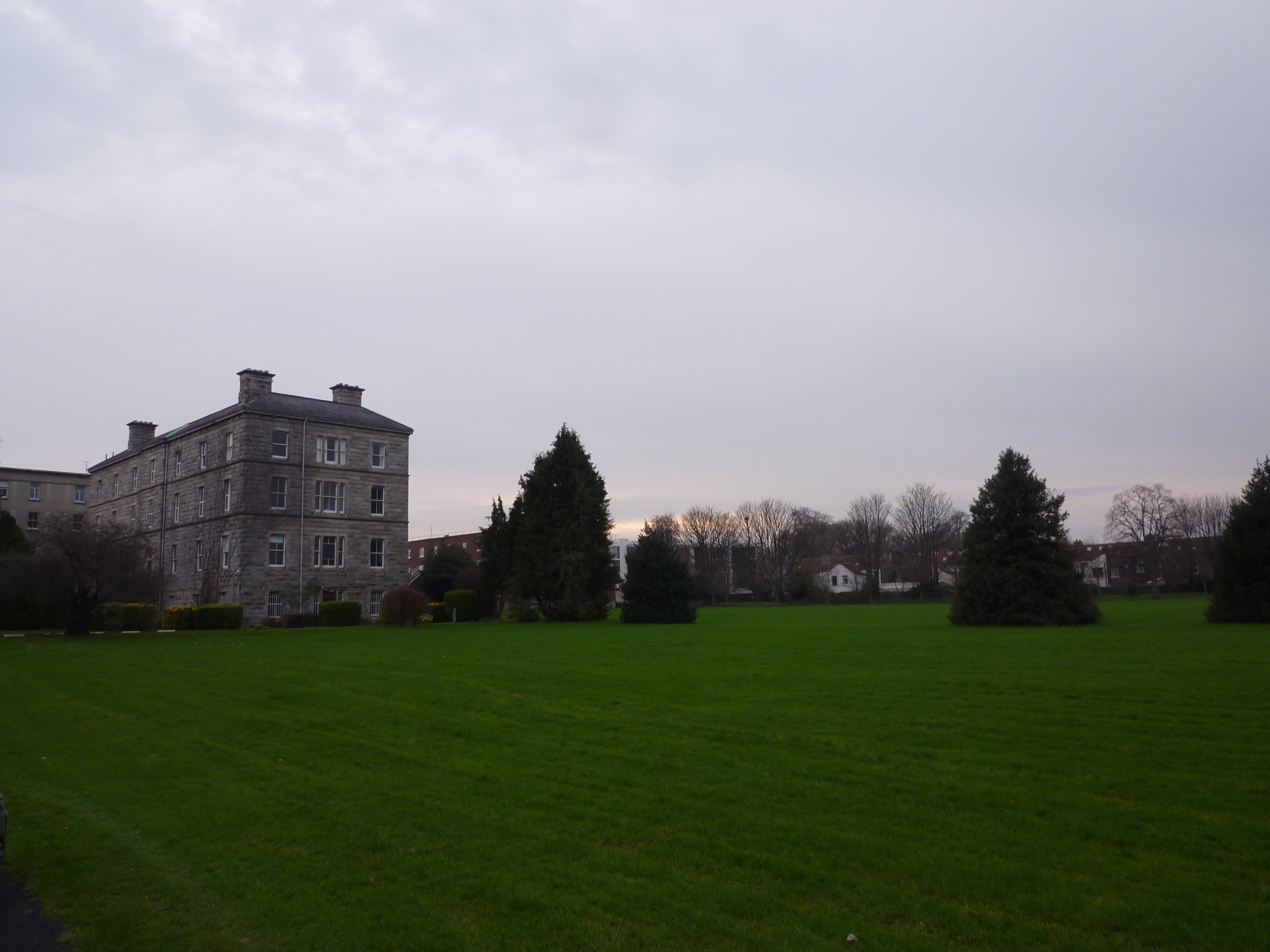
Milltown Park looking towards area where Carleton used to live

Milltown Park looking towards area where Carleton lived

Our thanks to the Reverend Sonia Gyles, Rector of Sandford and St Philip’s Milltown, for making the church available. Admission to the talks is FREE but membership of the William Carleton Society (€5) will be available for those interested. There is no charge for the tour at Mount Jerome cemetery. Participants will pay for their own lunches.

Woodville Ranelagh

House at Sandford, in which Carleton died

It promises to a be stimulating and interesting day.  The coach will return to Enniskillen by 9pm.  The William Carleton Society is a partner in the Shared History, Shared Future project run by Dungannon and South Tyrone Borough Council through the EU funded South West Peace III Partnership Programme and this activity is being delivered through it.

DSTBC LogoSWPeaceIII_logo_options_2berdfimages


WILLIAM CARLETON IN DUBLIN

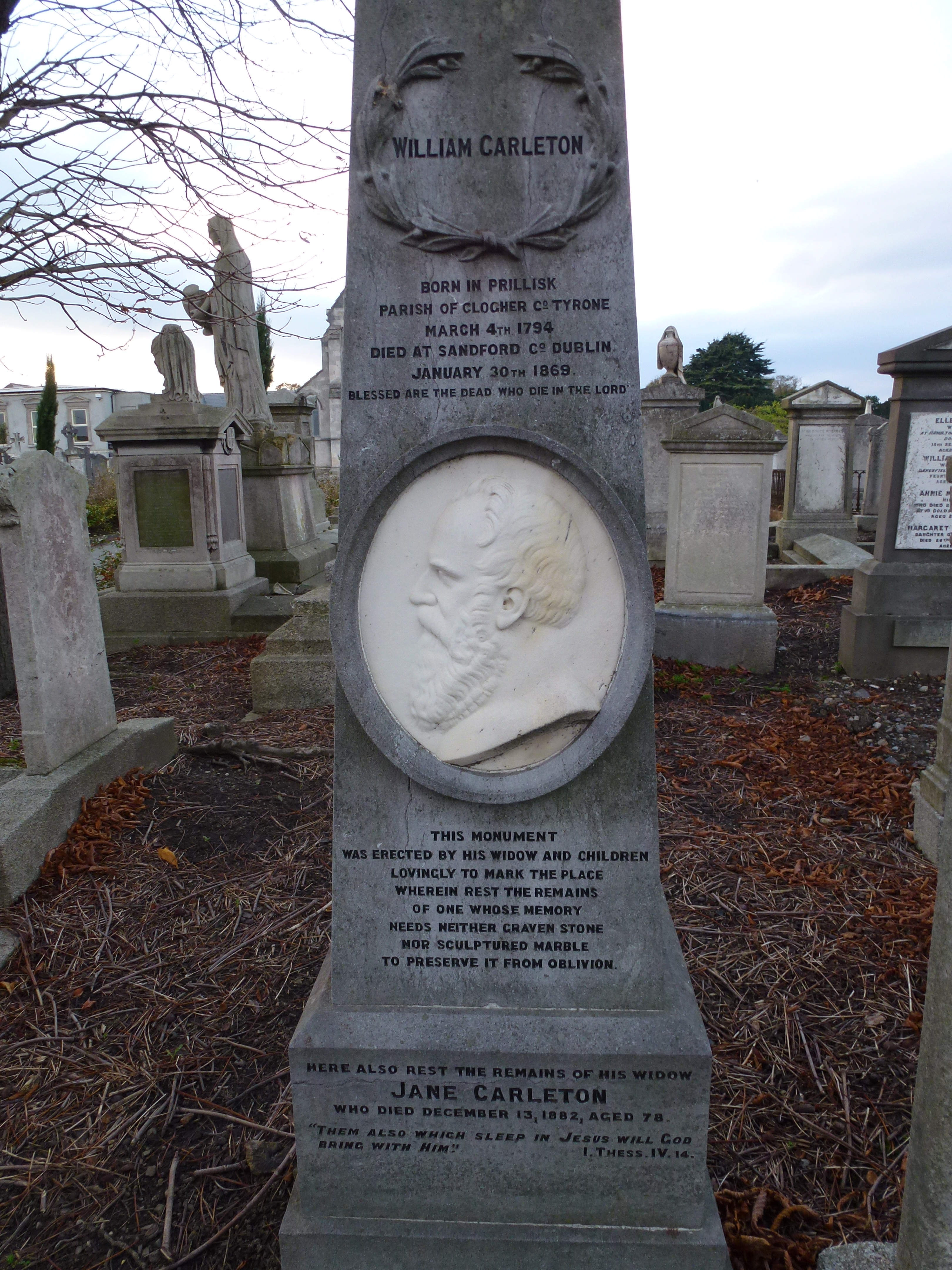
William Carleton's Grave

William Carleton’s Grave

IN THE FOOTSTEPS OF CARLETON:

Next Saturday (26th January) a group from the William Carleton Society travels to Dublin to mark the 144th anniversary of the death of the famous 19thC Irish author from County Tyrone. Carleton grew up as a Catholic, the youngest of fourteen children born to a small farmer in the Clogher area. He was educated at a hedge school near Glaslough in County Monaghan. He came to Dublin in 1819 with 2s 9d in his pocket and after trying various occupations, he became a clerk in the Church of Ireland Sunday School Office. Subsequently he would convert to Protestantism. In his autobiography (second part, finished by DJ O’Donoghue) we are told that:-

he soon became acquainted with the Rev. Caesar Otway, who was personally a most estimable man, a very pleasant writer, an enthusiastic antiquarian, but a determined proselytizer. He was one of a very remarkable group of men in Dublin at that period — when Catholic emancipation was in the air — whose lives were devoted to the task which they described as the rescue of Ireland from Popery“.

William Carleton aged 72 living in Dublin

William Carleton aged 72 living in Dublin

Otway gave Carleton an opportunity to use his journalistic talents for such proselytising purposes as satirising Catholic pilgrimages to ‘St Patrick’s Purgatory’ at Lough Derg. Further writings in the Christian Examiner & Church of Ireland Magazine led, in 1829 and 1833, to the publication of what is probably Carleton’s best known work: Traits and Stories of the Irish Peasantry – a tableau of the life of the country people of the north of Ireland before the famines of the 1840s altered their pattern of existence forever. There then followed such novels as Fardorougha the Miser (1839), Valentine McClutchy (1845), The Black Prophet (1847), The Emigrants of Ahadarra (1848), The Tithe Proctor (1849), The Squanders of Castle Squander (1852) in which he addresses many of the issues affecting the Ireland of his day such as the influence of the Established Church and landlordism, poverty, famine and emigration.

William Carleton Junior © Glenn Carleton

William Carleton Junior © Glenn Carleton

Carleton married Jane Anderson in 1820 and they had several children. Seven were born in Dublin, the first being Mary Anne in 1821. One of them, William Carleton junior, born in 1826, emigrated to Australia and was a known there as a poet. We are still not sure when and where his second daughter Jane Carleton was born. We know that she lived for time at Balham High Street in South West London, close to Tooting Bec. Deputy director of the summer school Frank McHugh reported on his research on the family tree at the 2012 event in Clogher. Thanks also to Glenn Carleton and Paul Brush in Australia, the William Carleton Society has been able to build up further details of Carleton’s genealogy.

COACH TRIP

On Saturday 26th a coach will be departing from Enniskillen at 7:30am and picking up passengers at Clogher, Aughnacloy and Monaghan (at the entrance to St Macartan’s College. 8:15am) for the trip to Dublin, which will cost £10 and will include membership of the William Carleton Society for those who have not yet joined. There will be a stop at Lusk services on the M1 before travelling into Dublin using a route which will give us an opportunity to see some of the sights, with Dr Frank Brennan as our guide.

“Frank Brennan will conduct a tour through Phoenix Park with its numerous historical monuments and associations going back hundreds of years, travel along Dublin’s quays, Four Courts, Guinness’ brewery, Dublin Castle, the two cathedrals, Jewish area and into Ranelagh which developed as a genteel middle class suburb after the Act of Union. At Sandford Church we will be addressed by a local teacher, who is a member of the congregation, on the history of Sandford church and its connection with Carleton. The Ranelagh Arts Society will then provide a talk by Susan Roundtree, an architectural historian, on the development of 19thC Ranelagh and the connection with the Plunkett family, who played a major role in Irish history.

We then go to Mount Jerome cemetery for a short ceremony (2pm) to commemorate the 144th anniversary of William Carleton’s death. A member of the Ranelagh Arts Society will then conduct a short tour of the graveyard. We travel to lunch (4pm) at O’Briens at Sussex Place, Upper Leeson Street, one of Patrick Kavanagh’s haunts, which as a 1900’s grocery and bar reminded him of Carrickmacross. The journey to lunch will take us through Dublin’s two Georgian squares  and past Government Buildings. Finally after lunch (which participants will pay for themselves) Frank Brennan will bring us past the Grand Canal Theatre, National Convention Centre, and some other of the better relics of the Celtic Tiger before our return home.”

SANDFORD CHURCH RANELAGH DUBLIN 12:30pm

Those joining the event in Ranelagh should assemble at the church at Sandford Road Ranelagh (junction with Marlborough Road) around 12:30pm. The group from the bus is hoping to walk from the site of Carleton’s now demolished former residence at Woodville, Sandford Road (beside the entrance to Milltown Park) to the church, weather permitting. Our thanks to the Reverend Sonia Gyles, Rector of Sandford and St Philip’s Milltown, for making the church available. Admission to the talks is FREE but membership of the William Carleton Society (€5) will be available for those interested.

Woodville Ranelagh

Woodville Ranelagh

It promises to a be stimulating and interesting day.  The coach will return to Enniskillen by 9pm. Please contact us by email, if you are interested or telephone me at (048 code from the Republic) 9066 2945 as there are a limited number of places available on the bus. The William Carleton Society is a partner in the Shared History, Shared Future project run by Dungannon and South Tyrone Borough Council through the EU funded South West Peace III Partnership Programme and this activity is being delivered through it.

DSTBC LogoSWPeaceIII_logo_options_2berdfimages